Guest Post: Using the MHS to Learn about Women in WWI

By Elizabeth Pacelle, John Winthrop Student Fellow

Working with the MHS primary source documents for the John Winthrop Fellowship was an amazing and rewarding experience for me.  Besides analyzing various pieces of the Constitution and other common writings, I had never worked so closely with first hand historical documents.  For my fellowship, I wrote a paper investigating women’s involvement in World War I overseas, and how their achievements directly linked to women’s suffrage.  The MHS documents provided such rich evidence for the themes that I was exploring in my paper.  

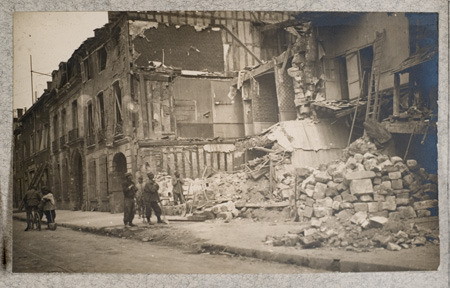
I was able to analyze the original letters of a young woman named Nora Saltonstall as written to her family.  Nora was a Boston socialite who yearned to contribute to the American war efforts in WWI more actively and directly than women had done previously.  She volunteered to go overseas to Europe to work on the warfront.  It was fascinating to read Nora’s intimate letters and get a glimpse into a personal experience that related to such a greater movement.  At points in the letters, Nora’s sense of humor and wittiness were evident which reminded me that she was indeed human and brought to life the events that transpired, in a way that textbooks are unable to. The collection contains digitized images of the very stationery she wrote on and her actual handwriting.  She dated and gave her location to each of her letters and conveyed the events in her own words, giving the reader such a vivid perspective into Nora’s world at that time. The MHS also had photographs of Nora and her companions, her lodgings and workplaces, and even her passport.  These primary source documents, gave me an eyewitness view to her experience, and made for a more interesting paper.

It is amazing how many letters and other primary sources from the MHS collection have been digitized, making them so easy to access.  The MHS also provides transcriptions of all the digitized documents, which make it easier to search the documents for specific evidence you might be looking for.  The online collection is well-organized and easy to navigate.  It allows you to search by subject, era (from Colonial Era to the present) or medium (photographs, maps, even streaming medium), so you can directly access information on the topic you are pursuing and view different types of sources, which provide different layers of evidence.  In my project I analyzed letters in the form of manuscripts, and backed up my claims with descriptions of photographs and other gallery images that further emphasized my points.  I would suggest looking for correlations between the photographs and writings provided as different means of evidence.

I based my project on the documents in the Massachusetts Historical Society’s online catalog, Abigail, but the MHS library is also an incredibly valuable resource. If you are looking to get a firsthand glimpse into a historical figure’s life, you should check out the MHS collection.  I suppose what I liked most was the ability to interpret the original documents on my own and draw my own conclusions around the actual evidence, rather than directly being told a conclusion by a third party.  The MHS collection is well-worth looking into when you are researching American history topics.


**In 2013, the MHS awarded its first two John Winthrop Fellows. This fellowship encourages high school students to make use of the nationally significant documents of the Society in a research project of their choosing. Please join us in congratulating our fellows: Shane Canekeratne and his teacher Susanna Waters,  Brooks School, and Elizabeth Pacelle and her teacher, Christopher Gauthier, Concord-Carlisle High School.


Guest Post: Using the MHS to Learn about Nuclear Weapons in WWII

By Shane Canekeratne, John Winthrop Student Fellow

History has always been an interest of mine, particularly the historical events of World War I and World War II. After I was presented with the opportunity to apply to the John Winthrop Fellowship, I immediately started to look for different articles related to the 1940s on the Massachusetts Historical Society website. This led me to the Bikini Atoll Papers. The Bikini Atoll Papers, part ofOperation Crossroads,” was a research project on the effects of nuclear bombs. Further exploration online guided me in developing my research angle: “In pursuing the Bikini Atoll Papers, I hope to discover how hard it would have been to build and use an atomic bomb. I also would like to learn what decision had to have been made by the government at the time to approve such a deadly weapon for such a horrible use.”

Through my research, I learned a lot about the procedures put in place to ensure safety during such a dangerous project. Vital Information for Operation Crossroads included: “Mail and Telegram 6 cents for air mail; Personal checks cannot be cashed aboard; No liquor available aboard; cameras are allowed except at Bikini.” My research also led me to the booklet entitled Summary Report (Pacific War). The booklet explained the plans for the United States, before and after Pearl Harbor, in considering entering war. The United States’ plan before Pearl Harbor was that the U.S. would join in the event that Germany was first eliminated. However, when the Japanese went on the offensive, and attacked Pearl Harbor, the U.S. wanted to defend the American people. As I researched further, I learned how the members of “Operation Crossroads” gave information to journalists and the public.

My visit to the Massachusetts Historical Society went very well. Mrs. Waters, Ms. Morrissey, my mother, my grandmother and I started with a tour of the facility. During the visit, we were allowed to see the construction of a new exhibit that will highlight correspondence between John Adams and his family. In addition, we saw an exhibit featuring e.e. cummings’ childhood artwork and some of his first poems. As we made our way through the building we ended up in the archives, where we were shown an old document pertaining to agriculture and Thomas Jefferson’s opinion on the best cider apple in the 13 colonies. I realized during my time spent in the reading library that I was the youngest person in the room. The room was very quiet, and I really enjoyed researching. After I was done researching, I went to another room, where I found a book about my neighborhood. Although the book contained just basic marriage, deaths, and births during the late 1700s, it was interesting to learn that Southborough, Massachusetts only had about 700 residents during the early year of its founding. I really enjoyed the visit, and would like to thank Mrs. Waters, Ms. Morrissey, and Andrea Cronin of the Massachusetts Historical Society for hosting me.


**In 2013, the MHS awarded its first two John Winthrop Fellows. This fellowship encourages high school students to make use of the nationally significant documents of the Society in a research project of their choosing. Please join us in congratulating our fellows: Shane Canekeratne and his teacher Susanna Waters,  Brooks School, and Elizabeth Pacelle and her teacher, Christopher Gauthier, Concord-Carlisle High School.

This Week @ MHS

By Dan Hinchen

After a week void of public events here at the MHS, this week the Society offers a slew of public events to satisfy your historical curiosities.

First, beginning on Monday, 15 July, the MHS hosts a two-day workshop titled “Old Towns/New Country: The First Years of a New Nation.” The workshop will concentrate on the period just after the Revolution and the concerns and conflicts, hopes and fears, experiences and expectations of the people living in the Boston area at a time of uncertainy, fragility, and possibility, using local resources to examine historical issues with a national focus. The program investigates such questions as: What was it like to live in a town that had been around for a long time in a country that was new? What were people in our town worried about as the nation was forming after the Revolution? How were these concerns influenced by geography, economy, culture, and social makeup of the region? What resources and pieces of evidence exist in our town that can help us find these things out? How is this evidence best presented to allow people of all ages to discover the answers to such questions and how does local focus add to our understanding of national history? The workshop is open to teachers, librarians, archivists, members of lcoal historical societies, and all intersted local history enthusiasts. The workshop faculty will include MHS staff members as well as historian Benjamin Park and MHS Teacher Fellow Betsy Lambert. The program takes place on Monday, 15 July, and Tuesday, 16 July, 8:30am-3:30pm  To Register: Please complete this registration form and send it with your payment to: Kathleen Barker, Massachusetts Historical Society, 1154 Boylston Street, Boston, MA 02215. For Additional Information: Contact the Education Department: 617-646-0557 or education@masshist.org.

Also on Monday, research fellow Anna Bonewitz, University of York, will present a Brown Bag discussion of her research titled “Fashion Across Borders and Seas: Print Culture, Women’s Networks, and the Creation of Feminine Identities in the British Atlantic World, 1750-1900.” Ms. Bonewitz’s reserach examines the diverse media through which women learned about fashion and how ideas of fashion were circulated around and between Britain and the United States, from the time of the engimatic fashion doll to the birth of modern advertising. Her project also considers how the circulation of visual and material sources for fashion information such as fashion dolls, portraits, and advertisements, was as much a process of learning as it was of sharing. The circulation of these objects enabled women to form valuable networks whereby ideas of femininity, politics, national identity and imperialism were created, solidified and challenged. Brown bag lunch talks are free and open to the public and begin at 12:00pm.

On Wednesday, 17 July, the MHS will host another Brown Bag lunch talk. This time, Denise Gigante of Stanford University will present “The Book Madness: Charles Deane and the Boston Antiquarians.” Ms. Gigante’s research looks at a hub of bibliomaniacs associated with the early years of the MHS. Among the circle of learned historians were George Livermore, Charles Deane, Alexander Young, and Edward Crowninshiled. Together, these amateur men of letters provide a unique look outlook on the culture of book collecting and the formation of private and public libraries in mid-19th-century America.

Then, on Thursday, 18 July, at 12:00pm, the MHS presents “Lest We Forget: The Massachusetts 54th,” a commemoration of the 150th anniversary of the Massachusetts 54th Regiment’s attack against Fort Wagner, South Carolina, and featuring guest speaker Noah Griffin. Visit his website to learn more about his work. Learn more about the Massachusetts 54th, as well as the Society’s manuscripts and photograph collections related to the regiment at our 54th Regiment! site. This event is free and open to the public

And on Saturday, 20 July, the Society will host The History and Collections of the MHS, a 90-minute docent-led tour that explores all of the public rooms in the building while touching on the art, architecture, history, and collections of the Society. The tour is free and open to the public. No reservation is required for individuals or small groups. Parties of 8 or more should contact the MHS prior to attending a tour. For more information please contact Curator of Art Anne Bentley at 617-646-0508 or abentley@masshist.org.

Stephen Greenleaf Bulfinch Diary, Post 23

By Elaine Grublin

The following excerpt is from the diary of Stephen Greenleaf Bulfinch.

Friday, July 12th, 1863

4th. The great anniversary, rendered still more famous now, was very quietly spent here. At ½ past 1, I went into Boson, & at the depot bought a paper, containing the announcement by the President of the successful issue so far of the three days’ fight at Gettysburg, – which I read with thankfulness & hope.

Friday, July 19th, 1863

The great theme of conversation has been the riots in New York & Boston, occasioned by the Conscription. Blood shed in both. Law triumphant here, and I trust also there.

Meantime, thanks to God for victory at Port Hudson, – near Vicksburg, – in Arkansas, – and some success near Charleston.

“Yet my conscience presses me on”: JQA and the Cost of Conscience

By Amanda A. Mathews, Adams Papers

John Quincy Adams, whose 246th birthday is tomorrow, often used birthdays as a moment to take stock of what he had and had not accomplished and what his priorities were. His conscience, and his sense of duty to make himself useful to his country and worthy of his family’s heritage, focused his reflections on the part he had fulfill in his limited time and his capacity for doing so, even when duty to his own conscience cost him (and often his family) a high price.

One of the most compelling occasions of this takes place in 1841, as Adams, who having successfully navigated the Amistad case, considers his larger role in the growing anti-slavery debate. In this striking diary passage, Adams fully lays out the stakes and comes down on the side of conscience and duty outweighing any personal sacrifice:

“The world, the flesh, and all the devils in hell are arrayed against man, who now, in this North-American Union, shall dare to join the standard of Almighty God, to put down the African Slave-trade—and what can I, upon the verge of my seventy-fourth birth-day, with a shaking hand, a darkening eye, a drowsy brain, and with all my faculties dropping from me, one by one, as the teeth are dropping from my head, what can I do for the cause of God and Man? for the progress of human emancipation? for the suppression of the African Slave-trade?— Yet my conscience presses me on—let me but die upon the breach.—”

This led to a renewed war by Adams in the House of Representatives against the increasingly oppressive “Gag Rule,” for which Adams was reviled, threatened, and harassed both inside and outside of Congress, much to the distress of his family.

Want to hear more about Adams and the cost of conscience? Tomorrow, I will be one of the speakers at the annual wreath-laying ceremony, held at noon at United First Parish Church in Quincy Center, better known as the “Church of the Presidents,” the long-time church for the Adams family, and the final resting place for both John and Abigail Adams as well as John Quincy and Louisa Catherine Adams. The event is free and open to the public.


This Week @ MHS

By Dan Hinchen

This week is a very quiet one here at the Historical Society. There are no special events on the calendar but that does not mean that there is no reason to pay the Society a visit. The MHS has three current exhibitions that are free and open to the public. The “headlining” exhibition is “The Object of History: 18th Century Treasures from the Massachusetts Historical Society,” which features portraits, needlework, firearms, clothing, furniture, silver, scientific instruments, documents, and books from the Society’s collections.

Complementing the main exhibition is a smaller display called “The Education of Our Children is Never Out of My Mind.” On view here are letters written by John and Abigail Adams to each other, to their children, and to friends and family regarding their views on education.These two exhibits will be viewable until 7 September 2013.

The third exhibition, unrelated to the other two, is “Estlin Cummings Wild West Show,” featuring a selection of E.E. Cummings’s childhood writings and drawings, showcasing the young poet’s earliest experiments with words and illustrations. This display will be available until 30 August 2013.

All of these exhibitions are free and open to the public six days a week, Monday-Saturday, 10:00am – 4:00pm.

Finally, on Saturday, 13 July, the Society will host The History and Collections of the MHS, a 90-minute docent-led tour that explores all of the public rooms in the building while touching on the art, architecture, history, and collections of the Society. The tour is free and open to the public. No reservation is required for individuals or small groups. Parties of 8 or more should contact the MHS prior to attending a tour. For more information please contact Curator of Art Anne Bentley at 617-646-0508 or abentley@masshist.org.

Fashionable Watering Places and How to Reach Them … in 1879

By Andrea Cronin, Reader Services

“Within a few hours’ ride from the metropolis are sections of country and seaboard, which in variety of character, loveliness of climate, and grandeur of scenery, are unsurpassed by any of the celebrated and more distant watering places on the continent,” wrote the unknown author of an Old Colony Railroad Company publication entitled, “Southeastern Massachusetts: Its Shores and Islands, Woodlands and Lakes, and How to Reach Them.” Having spent a few weeks utilizing the Old Colony Railroad system to travel throughout southeastern Massachusetts, the author wrote a guide for other adventurous vacationers in what is essentially a wonderfully descriptive, 49-page advertisement. The pamphlet lists more than 70 destinations, including traditional summer locales such as Provincetown, Martha’s Vineyard, and Nantucket and the less exotic locations such as Taunton, Foxboro, and Attleboro.

The author lays heavy praise on Newport, Rhode Island. “In Newport, however, the walks are probably more sought after than the drives. Foremost among these is the Cliff Walk among the sea bluffs, on which the pedestrian may continue his rambles to Easton’s Beach and round the southern point of Fort Adams.” Of course! The famous Cliff Walk of Newport is listed within the guide and is still as popular today as it was in 1879. Our Cliff Walk is dotted with gilded mansions. What might that scenic “ramble” have looked like in 1879 before these remarkable homes — Rosecliff, the Breakers, Marble House, Ochre Court, and Rough Point, to name a few –peaked over the cliffs?

The author directs the reader from a distant third-person narration, a change from the way many guidebooks are written today. Yet the suggestions of what to do at Monument Beach inspire today’s reader just the same. “From Monument Beach, a boat sail to Burgess Point, a distant about a mile and a half, or across to Marion, some six miles, or along the eastern shore, can scarcely be equaled. The bay is studded with gems of beauty.” Monument Beach is located within Bourne, MA near Phinney’s Harbor for all those interested vacationers reading this blog.

Though one might find the author’s descriptions fascinating, the pamphlet existed to  advertise the Old Colony Railroad. It concludes most helpfully with a list of hotels near the Old Colony Railroad’s stations to aid the traveling vacationer.

While the Old Colony Railroad no longer traverses southeastern Massachusetts as it did in 1879, parts of the system are still used today by modern commuters. Planning a summer get away? Why not get inspired to plan a trip to southeastern Massachusetts this summer? Visit the library at Massachusetts Historical Society — no sunblock required, but reading glasses are suggested — to check out this publication and others on early tourism in Massachusetts.

This Week @ MHS

By Dan Hinchen

It is a holiday week and there are plenty of goings-on here at the Massachusetts Historical Society to celebrate our nation’s independence. Please note that the library of the Historical Society will be closed on Thursday, July 4, in observance of Independence Day.

Kicking off the week on Monday, 1 July, come by at noon for a Brown Bag Lunch talk. This installment features Jen Staver of University of California, Irvine, presenting “Navigating the Other North American Coast: New England Merchants and Sailors Approach the North American Pacific, 1780s-1820s.” Ms. Staver’s project investigates social and environmental change along the far Pacific coast of North America from 1760 through 1820 by focusing on knowledge of and labor in the region’s oceanic and littoral landscapes. Brown bag lunch talks are free and open to the public, so pack up a midday snack and come on by.

On Wednesday, 3 July, another brown bag lunch talk will take place. This time, short-term fellow Lo Faber, Loyola University of New Orleans, presents “The Spirit of Enterprise Excited by the Acquisition of Louisiana: New Englanders and the Orleans Territory, 1803-1812.” In 1803 and 1804 New Englanders warily eyed their country’s vast new acquisition. Some worried that Louisiana was a “savage,” uncivilized land that would corrupt the new nation; others that it would reduce the already-declining political importance of New England; others that it would become a new addition to the “empire of slavery.” Still others, however, especially Jeffersonian republicans, dismissed these and other concerns and celebrated the Purchase and the economic opportunities it would bring. A few went so far as to move south in search of fortunes in the Orleans Territory. This event is free and begins at 12:00pm.

And on Thursday, 4 July, the MHS will host a special Independence Day Exhibition. Though the library is closed, the gallery spaces will be open from 12:00pm to 4:00pm, currently displaying three exhibitions. Also included on Thursday is a special exhibition of materials related to the Declaration of Independence. Exhibits are free and open to the public six days per week, Monday-Saturday.

Finally, on Saturday, 6 July, the Society will host The History and Collections of the MHS, a 90-minute docent-led tour that explores all of the public rooms in the building while touching on the art, architecture, history, and collections of the Society. The tour is free and open to the public. No reservation is required for individuals or small groups. Parties of 8 or more should contact the MHS prior to attending a tour. For more information please contact Curator of Art Anne Bentley at 617-646-0508 or abentley@masshist.org.

The “Exhilarating Effect of Wiry Transit”: America’s Nineteenth-Century Cycling Boom

By Anna J. Cook, Reader Services

As the Boston bike share program, Hubway, settles in for its third successful season of supporting urban cyclists, other cities around the country are rolling out their own infrastructure – encouraging more city dwellers to pick the efficient, environmentally-friendly mode of transportation. While bicycling is not an option for everyone, bike share stations make it possible to combine a bike ride with walking and public transit in flexible, efficient ways. As a first-time Hubway participant, I am re-leaning my adopted city (and the rules of the road!) this summer from the seat of what was once called “the safety bicycle.”

The safety bicycle, developed in the 1880s and popularized in the 1890s, was designed with two wheels of the same size. It was easier to ride and less dangerous than previous models. It was also a model of bicycle marketed to women as well as men. The late nineteenth and early twentieth century saw a boom in cycling for utilitarian transport and for pleasure. The Massachusetts Historical Society’s collection documents some of the ways in which the popularity of cycling made its mark on Boston. For example, in 1886 Geo. H. Walker & Co. published a Bicycling and Driving Road Map of Boston and Vicinity, the title of which prioritizes cyclists over those new-fangled motorcars.

We also hold a copy of the 1880 volume Lyra Bicyclica: Forty Poets on the Wheel, published in Boston and edited by one J.G. Dalton. Dalton prefaces the poems included therein with the autobiographical note, “The author-compiler is one of the very first Bostonians to ride and write into notice the bicycle in this country.” He goes on to describe how “under the early exhilarating effect of the wiry transit … he called upon our native poets … to favor us with a song or two for the new move, declaring that its peculiar charms and potencies and awaited an adequate celebration” (1-2).

One such song, albeit written in 1879, comes down to us as a specimen of sheet music in four-part harmony written by Thomas Keith. The three-verse ode begins:

Come ye whose sore and weary feet
With corns and blisters walk the street;
Come mount with us this easy seat
And ride in a way that can’t be beat.

We match for speed the fleeting wind,
The lagging coach leave far behind.
With wheel and axle underpin’d,
We ask no favors of that kind.

Then mount with us this easy seat,
And ride in a way that’s fun complete.
A cordial welcome all shall greet,
Who undertake to learn this feat.

Our family papers document members’ participation in the League of American Wheelmen, Harvard’s competitive collegiate cycling team of 1888-1901, and include photographs of women and men, girls and boys, posing proudly with their bicycles. I am sure our nineteenth-century predecessors would be asking us what took us so long to re-discover the “exhilarating effect of the wiry transit.”

The Chesapeake-Leopard Incident and the War of 1812

By Emilie Haertsch, Publications

This past Saturday marked the 206th anniversary of the ChesapeakeLeopard affair, a controversial incident in American history and a contributing factor to the start of the War of 1812.

In 1807 Britain was fighting in the Napoleonic Wars. The British navy sent a number of ships to blockade the French from obtaining supplies in the United States, but some crew members of these ships deserted and sought protection with American authorities. The US navy recruited these men, and they joined the crew of the USS Chesapeake.

On June 22, 1807, the British HMS Leopard pursued the USS Chesapeake off the coast of Virginia. The captain of the Leopard sent a message demanding to search the Chesapeake for British naval deserters but the Chesapeake’s Commodore James Barron refused. The Leopard opened fire and the Chesapeake, poorly armed, was forced to surrender, but not before several crew members were wounded or killed. The British removed four deserters from the Chesapeake’s crew. Only one of them was British – the rest were American seamen who had been impressed into British naval service. The Leopard then sailed to Halifax so that the men could be tried.

The American public was outraged by the actions of the British navy, but quickly divided over how to respond, with some calling for war and others caution. The Society has a number of manuscripts in its collections related to the public response to the Chesapeake incident. In “Peace Without Dishonor, War Without Hope,” a “Yankee Farmer” appealed to the reason of his readers and argued against a rush into war. “If we succeed in the war, we gain the right to cover a few British deserters, whom we do not want, and which…will bring little profit; but we hazard our lives, our liberties, our government,” he wrote. Others, however, were not so interested in peace. “Illustrations on the Fulfillment of the Prediction of Merlin” contains a poem titled “The Chesapeake Massacre,” which was written by a “Revolutionist of ’75.” The final stanza reads:

If Jefferson and Congress join,

We can defeat the base design

                        Of villainous ingrates;

Then let us arm at ev’ry point,

And with our blood, our cause anoint,

                        And trust to God our fates.

Pres. Jefferson chose to respond with an embargo rather than go to war with Britain, but his decision was controversial. The embargo hurt American industries and was difficult to enforce. Despite Jefferson’s attempt to avoid war, the British navy’s act of aggression sowed a seed that ultimately contributed to war between the United States and Great Britain five years later.

 To learn more about the War of 1812 read this earlier blog post about an 1813 political cartoon, or view this online exhibition