Lodge, Kennedy, and the 1952 Massachusetts Senate Election

By Emilie Haertsch, Publications

Massachusetts will hold a special election on June 25 to fill the United States senate seat left vacant by John Kerry, whom President Obama appointed to Secretary of State in February. The recent primary determined that the contest will be between Republican former Navy SEAL Gabriel Gomez and Democratic Congressman Ed Markey. Having just survived an extremely contentious senate race in the fall, in which Senator Elizabeth Warren emerged the victor, many Massachusetts residents now suffer from election fatigue. But this is not the first time that the state has faced hard-fought battles for these senate seats. Over 50 years ago, John F. Kennedy, then a Democratic congressman, contested incumbent Republican Henry Cabot Lodge, Jr. for his senate seat. What many believed would be an easy win for the popular Lodge turned into a tight race, and eventually an upset.

Lodge was a moderate and he was concerned about the conservative movement he saw developing in his party. The Republican frontrunner for the 1952 presidential election was Sen. Robert Taft, a conservative and isolationist who opposed NATO. Concerned about the possibility of Taft winning election, Lodge and a number of other Republicans convinced Dwight D. Eisenhower, a popular war hero, to run against him in the Republican primary. At a heated Republican National Convention, complete with accusations of “stolen delegates” on both sides, Eisenhower won the nomination and went on to a national campaign against Democratic governor Adlai Stevenson. Lodge became the manager for the “Eisenhower-for-President” campaign, a major impediment to his own reelection campaign at home in Massachusetts.

With Lodge often away and focused on Eisenhower’s election, Kennedy took advantage of the opportunity for an intensive ground campaign in Massachusetts. He used his candidacy announcement on April 7, 1952 to attack Lodge, saying, “Other states have vigorous leaders in the United States Senate to defend the interests of their citizens – men who have definite goals based on constructive principles and who move towards these goals unswerving. Massachusetts has need of such leadership.” Kennedy also accused Lodge of being too often absent from Massachusetts while working for Eisenhower.

In response, Lodge criticized Kennedy’s roll call record in Congress, with the slogan: “Would you hire a man who came to work one third of the time? Reelect Lodge! Lodge is on the job!” Lodge also called Kennedy a “rubber stamp…for the White House” in an October 17, 1952 speech on WBZ-TV. Lodge emphasized his moderate beliefs, saying he has “struggled hard and publicly against reactionary elements in both parties.” He even employed jingles as a way of drumming up support, including one to the tune of “Doin’ What Comes Naturally” from Annie Get Your Gun:

He fills the bill on Capitol Hill
In Washington down yonder
He serves with skill and dignity
Doin’ what comes naturally!

Despite Lodge’s efforts, Kennedy ran a stronger campaign at home by making many appearances across Massachusetts. He also mobilized the large Irish immigrant population in the state, and his strong ties in Boston also caused Lodge to lose ground there. On Election Day in November 1952, Lodge lost by a narrow margin.

In his concession speech, Lodge thanked the people of Massachusetts for electing him three times to the senate seat, and congratulated Kennedy and wished him well. Privately, however, the loss was a great blow. In an angry letter on Dec. 7, 1952, Quincy resident Willie James summed up his feelings about Lodge and what might have led to his loss: “There are thousands like myself in Massachusetts, always voted for you and your family but now good and sick of your actions…You have work to do in your own backyard.”

With Lodge’s great loss, however, came a great victory. Eisenhower was elected president. Lodge received many consolation letters on his senate defeat, and one theme was strong throughout. Philip Schlossberg wrote on November 5, 1952, “We feel that in [getting Eisenhower elected] you neglected your own chances for reelection with the U.S. Senate.” Many also believed that Lodge would earn an appointment from Eisenhower for his part in the presidential campaign. John Mason Brown wrote in a Western Union telegram, “You have fought your share in the general’s victory and the services you have rendered the country. Here’s to more of those services when you will be the best secretary of state or defense American has had.” This notion was correct, and when Eisenhower entered office he named Lodge U.S. ambassador to the United Nations.

Kennedy’s senate election led to a great family political dynasty in the state of Massachusetts, one which still continues today, while it contributed to the decline of the Lodge family’s influence in Massachusetts politics. How the current upcoming special election for the Massachusetts senate seat will change the course of state history is yet to be determined. To learn more about the 1952 Massachusetts senate race, view the guide for the Henry Cabot Lodge Papers in the Society’s collections.
This Week @ MHS

By Dan Hinchen

As we approach the long Memorial Day weekend, there is a lull in the activity here at the MHS. There are no public programs scheduled this week. However, this is your last chance to view our three current exhibitions concerning slavery, abolition, and Emancipation in Massachusetts. The exhibits will be available every day this week, Monday-Friday, 10:00am-4:00pm, and are free to the public. The final day of the exhibits is Friday, 24 May. After that, we will make way for our next installment: “The Object of History: 18th-century treasures from the Massachusetts Historical Society.” Stay tuned for more information or visit our online calendar of events.

And please take note that the Society will be closed this Saturday, 25 May, and Monday, 27 May, in observance of the Memorial Day holiday. Normal hours will resume on Tuesday, 28 May. Enjoy the long weekend!

Last Chance to Visit Proclaim Liberty Throughout All the Land

By Jim Connolly, Publications

Boston enjoys a reputation for its role in the founding of the United States. That reputation is well deserved, but the American Revolution was hardly the last time Boston figured significantly in a radical and righteous cause.

In the decades leading up to the Civil War, Boston became a center of the national antislavery movement. In 1831, William Lloyd Garrison, a key figure in the movement, began the publication of The Liberator, the country’s leading abolitionist newspaper. On the first page of the first issue (1 January 1831), Garrison fired a bold volley against not only proslavery attitudes, but apathy and arguments for a cautious and gradual approach to abolition. “Urge me not to use moderation in a cause like the present. I am in earnest—I will not equivocate—I will not excuse—I will not retreat a single inch.—AND I WILL BE HEARD.”

William Lloyd Garrison and several other prominent Boston abolitionists are the subjects of the Society’s current exhibition, Proclaim Liberty Throughout All the Land”: Boston Abolitionists, 1831–1865. Manuscripts, portraits, broadsides, and artifacts from the MHS collections illustrate the role of Massachusetts in the national struggle over slavery. Among the most fantastic objects on display are John Brown’s Colt revolver, first editions of Uncle Tom’s Cabin and The Narrative of Frederick Douglass, An American Slave, and the imposing table on which Garrison set the type for The Liberator, which has not been displayed at the Society in many years.

The exhibition closes Friday, 24 May 2013, so come down to 1154 Boylston Street as soon as you can. It’s free and open to the public from 10 AM to 4 PM, Monday through Saturday.

And for those who can’t make it to Boston, you can explore the exhibition’s companion web feature, Boston Abolitionists, 1831–1865.

Massachusetts History Day: Young Historians at Work

By Anna J. Cook, Reader Services

On Saturday, April 6 — one of the first truly spring-like days of the year — I left my apartment before dawn to make my coffee-clutching way, along with several Massachusetts Historical Society colleagues, to Stoneham High School. What were we doing at a high school so early on a Saturday morning? We were there to serve as volunteer judges for the state round of the annual Massachusetts History Day competition. We were there to celebrate young historians at work crafting history.

This was my second year volunteering as a judge for Massachusetts History Day (MHD). Beginning in 2012, the MHS has co-sponsored MHD alongside the Massachusetts Council for the Social Studies. MHD is the state affiliate of National History Day, an annual competition that encourages middle and high school students to undertake extensive primary-source based research on a topic related to the annual theme and build a historical argument in one of five categories: research paper, exhibition, performance, documentary, and website. Beginning in the fall (or even over summer vacation), young people embark upon their research, either individually or in groups, narrow their topic, craft a thesis, and eventually design a final project. Some face an initial in-school round before moving on to the district level competition, in early March, where the top two entries in each category move on to state. State winners will travel to the national competition in June.

On the day of the district and state competitions, students come before a panel of volunteer judges to present and discuss their hard work, after which each group of judges is faced with the difficult task of selecting the two best projects to advance to the next round — as well as awarding honorable mentions and special prizes.

As a judge, my favorite part of each round is the chance, on the competition day, to meet with each student or student group to talk with them about their research. It is often in these conversations that the young person’s excitement about their topic and their depth of knowledge come to the fore. There is nothing that warms my historian’s heart quite so much as the opportunity to see a teenager’s eyes light up as she talks about the direction she’d like to take her work in the future, or when he describes the discovery of a key primary source.

This year we had projects ranging across time and space, all touching upon the annual theme of “turning points”: students tackled topics ranging from the Federal-Aid Highway Act of 1956 to the role of the Internet in the Arab Spring, from the fall of apartheid in South Africa to the publication of Rachel Carson’s Silent Spring.

One of my favorite things about working as a reference librarian at the MHS is the opportunity to work with scholars at all stages of their research, from initial question to final footnote. Every year, young people visit our library to work on MHD topics; as a reference librarian I get to help them refine their research questions and locate primary source materials. As a History Day judge, I get to see the fruits of their hard work on competition day.

The 1st and 2nd place project winners from the Massachusetts History Day state competition will be traveling to the University of Maryland in College Park, Maryland, June 9-13 to participate in the national contest along with winners from across the country. We are proud to have our young scholars and their fine work represent Massachusetts and wish them the best of luck (and lots of fun!) while they are there.

This Week @ MHS

By Dan Hinchen

Last week saw the close to the seminar season here at the Society and as summer approaches the calendar opens up a bit. Still, there are some great programs coming up this week to experience. Here is what is on tap at the MHS this week.

First, on Wednesday, 15 May 2013, come on in for a Brown Bag Lunch discussion as Reiner Smolinski of Georgia State University presents “Cotton Mather encounters the gods of Egypt: The Transatlantic Enlightenment and the Origin of Pagan Religions.” The presentation is based on Prof. Smolinski’s ongoing work for his forthcoming intellectual biography of Cotton Mather. Brown Bag lunches are free and open to the public and begin at noon.

The following day, Thursday, 16 May, the MHS hosts “The Tender Heart & Brave: The Politics and Friendship of Charles Sumner & Henry Wadsworth Longfellow.” This talk, co-sponsored by the Longfellow House-Washington National Historic Site and the Boston African American National Historic Site, examines how the fiery abolitionist Sumner and the genteel poet Longfellow became the closest of friends. Dramatic readings of actual historic documents such as letters, journals, poetry, and speeches will show the deep personal relationship shared between the two men. The reading, done by author Stephen Puleo and the Longefellow House’s Rob Velella, takes listeners from the earliest friendship to antislavery advocacy of these two men, from personal triumphs and tragedies to their final years, weaving through the events of the nation during their lifetimes, including the Emancipation. Mr. Puleo, author of “The Caning: the assault that drove America to Civil War” will provide commentary and sign copies of his book. Reservations are requested for this event at no cost. Please RSVP. Contact the education department for more information at 617-646-0560/education@masshist.org. Program begins with a reception at 5:30pm, talk begins at 6:00pm. 

And on Saturday, 18 May, come to 1154 Boylston at 10:00am for a free building tour, The History and Collections of the MHS. This 90-minute, docent-led tour takes guests through all of the Society’s public rooms while providing information about the history and collections of the institution. The tour is free and open to the public. No reservation is required for individuals or small groups. Parties of 8 or more should contact the MHS prior to attending a tour. For more information please contact Curator of Art Anne Bentley at 617-646-0508 or abentley@masshist.org.

Finally, there are only two weeks left to view three current exhibitions, all focusing on varying aspects of the path to Emancipation in the mid-19th century. Exhibits are open to the public six days a week, Mon-Sat, 10:00am – 4:00pm. The present displays are on view until Friday, 24 May, so do not miss them!


Stephen Greenleaf Bulfinch Diary, Post 21

By Elaine Grublin

The following excerpt is from the diary of Stephen Greenleaf Bulfinch.

Monday, May 11th 1863

I must leave to history the public events of this agitating time; but I have sadly to record that my dear pupil and friend, Frank A. Eliot, was killed in the recent battle at Chancellorsville, near Fredericksburg, Va. He was captain of the Phila [Braves?], – about 35 years of age, – brother of Dawes and William G. Eliot. We hope that an honorable end of this awful strife is near.

A Fair Trial for the Boston Massacre Soldiers

By Emilie Haertsch, Publications

In the aftermath of the tragic Boston Marathon bombings, the question remains of how to handle the trial of suspect Dzhokhar Tsarnaev. There has been a public outcry for punishment, and it seems unlikely that the defense will be able to obtain an unbiased jury in a case as high profile as this. But this is not the first time that the desire for punishment has clashed with procedure in Boston’s legal history. On National Public Radio, Cokie Roberts rightly made the connection between this current case and the Boston Massacre trial of almost 250 years ago, when John Adams, in providing legal defense for the British soldiers involved in the Massacre, dealt with similar issues.

In 1768 the British Parliament stationed troops in Boston to protect customs commissioners, since they collected the unpopular taxes on imports and feared for their safety. Bostonians resented the presence of troops in their city and animosity grew between the locals and soldiers over the next year and a half. On March 5, 1770, tensions came to a head. A crowd gathered to harass the sentry posted outside the Custom House, and Capt. Thomas Preston and a small group of soldiers came to his aid. When the crowd refused to leave, the British soldiers fired on them. Three members of the crowd were killed instantly, and two later died from their wounds. The captain and his soldiers were placed in jail.

Following the Boston Massacre deaths, some Patriot leaders used propaganda to enflame feelings of rancor in Boston towards the British. Paul Revere created a famous engraving of the scene with uniformed British soldiers firing at close range into a crowd and a sign that read “Butcher’s Hall” hanging over the Custom House. Many Patriots hoped that the pressure of public opinion would lead to a murder conviction for the soldiers and aid the cause for independence.

The level of outrage in Boston made it very unlikely that the soldiers would get a fair trial. Government and judicial officials delayed the beginning of the trial in hopes that time would calm public opinion. Amidst this tumult, John Adams, Robert Auchmuty, Jr., and Josiah Quincy, Jr., were hired to defend the soldiers. The trial began on November 27, 1770.

The defense could not make the argument that the soldiers fired in self-defense without also hurting Boston’s reputation, so they tread carefully. In addition, since Capt. Preston was found to be not guilty, the soldiers could not claim they were following his orders when they fired. Adams opened his defense dramatically with a quotation from the Marquis Beccaria: “If I can but be the instrument of preserving one life, his blessing and tears of transport, shall be a sufficient consolation to me, for the contempt of all mankind.” He argued that because it was impossible to tell which soldiers fired the fatal shots, finding all of the soldiers guilty would inevitably lead to the wrongful conviction of some innocents.

On December 5, 1770, the jury delivered its verdict: six of the soldiers were found not guilty, and two were found guilty of manslaughter. None were convicted of murder. The soldiers who were convicted of manslaughter were branded on their right thumbs with the letter “M.”

The verdict quieted the mood in Boston and reflected well on the colonies internationally. Years later, Adams wrote in his diary that he believed a “Judgment of Death against those Soldiers would have been as foul a Stain upon this Country as the Executions of the Quakers or Witches, anciently.”

The Society has in its collections several manuscripts related to the Boston Massacre; there is a good introduction to them here. Robert Treat Paine prosecuted the soldiers, and you can learn more about his papers here. You can also read more about Adams’s views on the Boston Massacre and trial in this previous post.

Whist & Poetry in 19th Century Brookline

By Andrea Cronin, Reader Services

Of the many social club records held by the Massachusetts Historical Society, the Brookline Whist Club’s records are unique. Established in early 1874, the Whist Club’s members gathered to socialize with crackers, cheese, and sherry and to play whist. The club’s record book curiously holds far more whimsy than winning records; it does not contain proceedings of the organization or lists of appointed officers, but rather a volume of poetry produced during the Saturday evening meetings.

The Brookline Whist Club record book contains many poems created by members of the club, including Thacher Loring, Robert S. Peabody, Moorfield Storey, and Charles Storrow. The poetry was most likely later recorded into the volume by a single unknown individual, but in most cases the individual poets are identified. Boston lawyer and financier Moses Williams recited this small poem as recorded into the volume.  

Moses.

A flight of fancy takes me,
the divine afflatus shakes me,
And I quiver with the thoughts of that thro me thrill,
As before my sight them passes,
Such a group of lads and lasses
That my song with sweetest memoirs of I would fill

For those readers wondering, “what is in the world is whist,” whist is a 17th-century English card game closely related to bridge, which was hugely popular in the 19th century. Four people play in two partnered teams, using a 52-card deck. Each player is dealt 13 cards. The object of the game is to win tricks, which is accomplished by playing the highest value card of a particular suit in each round. According to a longtime member of the club, Edward Stanwood in Annals of the Brookline Whist Club, 1873-1907, his club played by the following rules:

Short whist is the game. Five points constitute a game. If more than eight members are present, the waiting member is taken in at the table at which a rubber is first finished, when the players “cut out,” “the highest out.” At the conclusion of the next rubber the newcomer stays and the other three cut out; then one of the two who have been longest playing retires; and finally the fourth man retires sua sponte. If ten members are present they retire from and enter the game by twos. Each member keeps an account of the number of games he has won and lost.

If you would like to read more poetry produced by the Brookline Whist Club, please visit the library to view the Brookline Whist Club record book. You can learn more about the club’s background in Edward Stanwood’s Annals of the Brookline Whist Club, 1873-1907.


This Week @ MHS

By Dan Hinchen

It is time again for the weekly forecast of events here at the MHS! There are three public programs on offer in the week to come and with spring finally settling into its normal routine, plenty of reasons to take a walk and visit 1154 Boylston.

First up, on Tuesday, 7 May, is the last in the Early American History Seminar series for the season. Sarah Bilder of Boston College Law School and Pauline Maier of MIT present “Madison’s Hand: Revising the Constitutional Convention.” This seminar focuses on the most prominent remnants of the Convention in Philadelphia during the summer of 1787, Madison’s Notes with his revisions, and ask what it means to take seriously that Madison’s notes on the Convention are notes. Two hundred and twnty-five years after the writing, the use of changing technology allows a revisiting of the original manuscript to suggest that Madison revised his notes far more extensively than was previously understood, demonstrating that Madison’s own understanding of the Convention, the Constitution, and his own role change dramatically betwee 1787 and the end of the 18th century. This seminar begins at 5:15pm and is free and open to the public. RSVP required. Subscribe to receive advance copies of the seminar paper. This is the last seminar at the MHS until the fall so come get your fix before the summer!

The following day, Wednesday, 8 May, come to attend the annual Jefferson lecture at the MHS. This year, Susan R. Stein of Monticello discusses “New Perspectives on Jefferson’s Monticello: House, Landscape, and Family.” This talk uses a wide lens to focus on recent restoration and interpretive efforts including Monticellos’ work spaces beneath the house, public rooms, and upper floors, as well as the principal street of the plantation, Mulberry Row. Also included will be description of Monticello’s free and enslaved communities. Ms. Stein is the Richard Gilder Senior Curator and Vice President for Museum Programs. Registration is required for this public program at no cost. Please RSVP. Pre-Talk Reception at 5:30pm, program starts at 6:00pm. Contact the education department at 617-646-0560/education@masshist.org for more informaiton or to reserve a spot.

And on Saturday, 11 May, after a few weeks off, our public tour resumes. “The History and Collections of the MHS” is a tour of the Society’s public rooms that touches on the history and collections of the MHS, including some of the art and architecture on view in the public spaces. Tours are led by an MHS staff member or docent and last about 90 minutes. Tour begins in the lobby at 10:00am and is free and open to the public. No reservation is required for individuals or small groups. Parties of 8 or more should contact the MHS prior to attending a tour. For more information please contact Curator of Art Anne Bentley at 617-646-0508 or abentley@masshist.org.

Finally, the three current exhibitions on view are available six days a week, Monday-Saturday, 10:00am – 4:00pm. These exhibits are only around for three more weeks so be sure to get a glimpse before they go!

Advertising in America

By Dan Hinchen, Reader Services

If you are someone who regularly reads Boston newspapers, then you probably have noticed a few advertisements within the pages. In fact, on a given day you might find several pages worth of advertisements in a single issue. And then there is the Sunday edition which comes with an entire section composed solely of ads. Occasionally, these can be useful to inform about upcoming events, special deals at a department store, or penny-saving coupons at the grocery story. More often, though, they can seem a bit of a nuisance and waste of material, taking up space and distracting from the articles.


But did you know that the first time a paid advertisement appeared in an American newspaper it happened here in Boston?


By the start of the 18th century, the New England colonies were thriving and the population was steadily increasing along with its wealth, enterprise, and intelligence. Even foreign countries began to look at Massachusetts with interest, and colonists desired acquaintance with affairs in England, Europe, and the other colonies in British America. “Such increase of population and trade must naturally call for a publication, of the common character of newspapers.”[i]

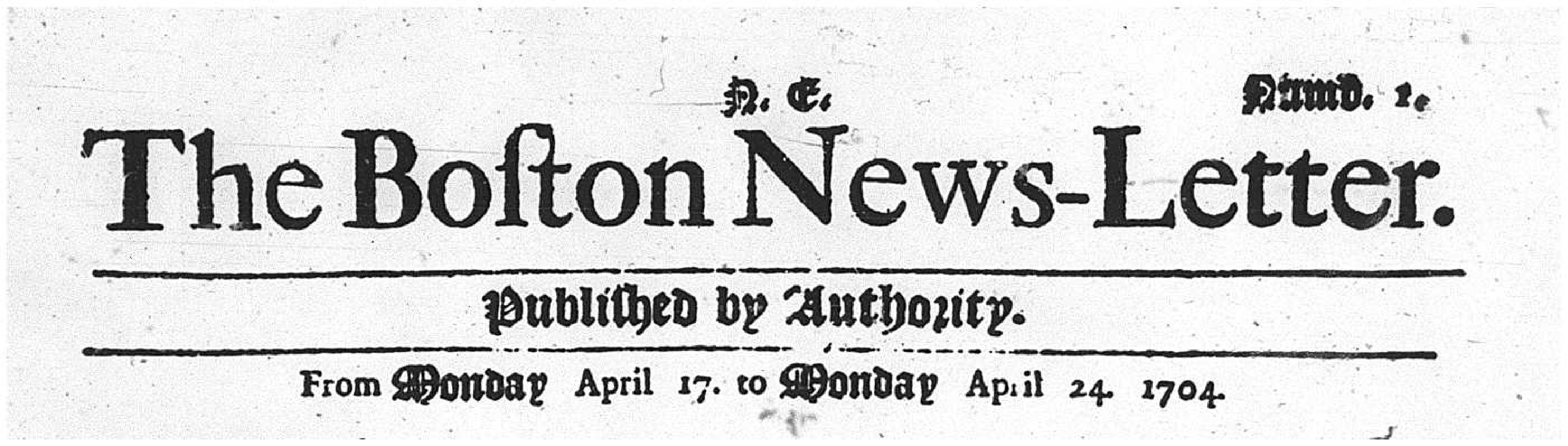
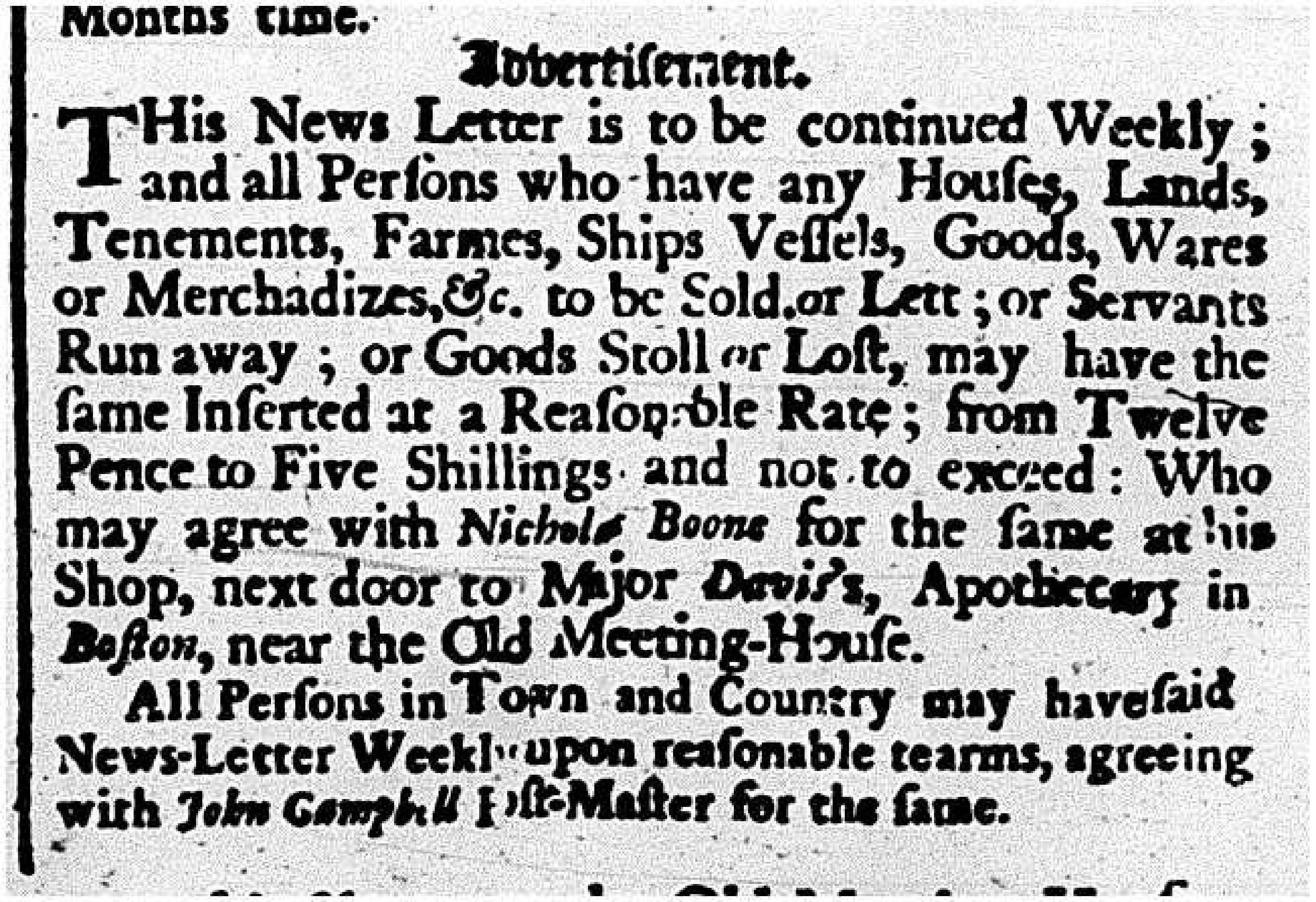
The Boston News-Letter, the first regularly published newspaper in the British Colonies of North America, began publication on 17 April 1704. This newspaper was “published by authority” and featured all of the latest news from London, though with the time it took to cross the Atlantic, there was usually a delay of three months or so. At the very end of the inaugural issue, publisher John Campbell included a short paragraph announcing that any person could insert a small notice at a “reasonable rate.”


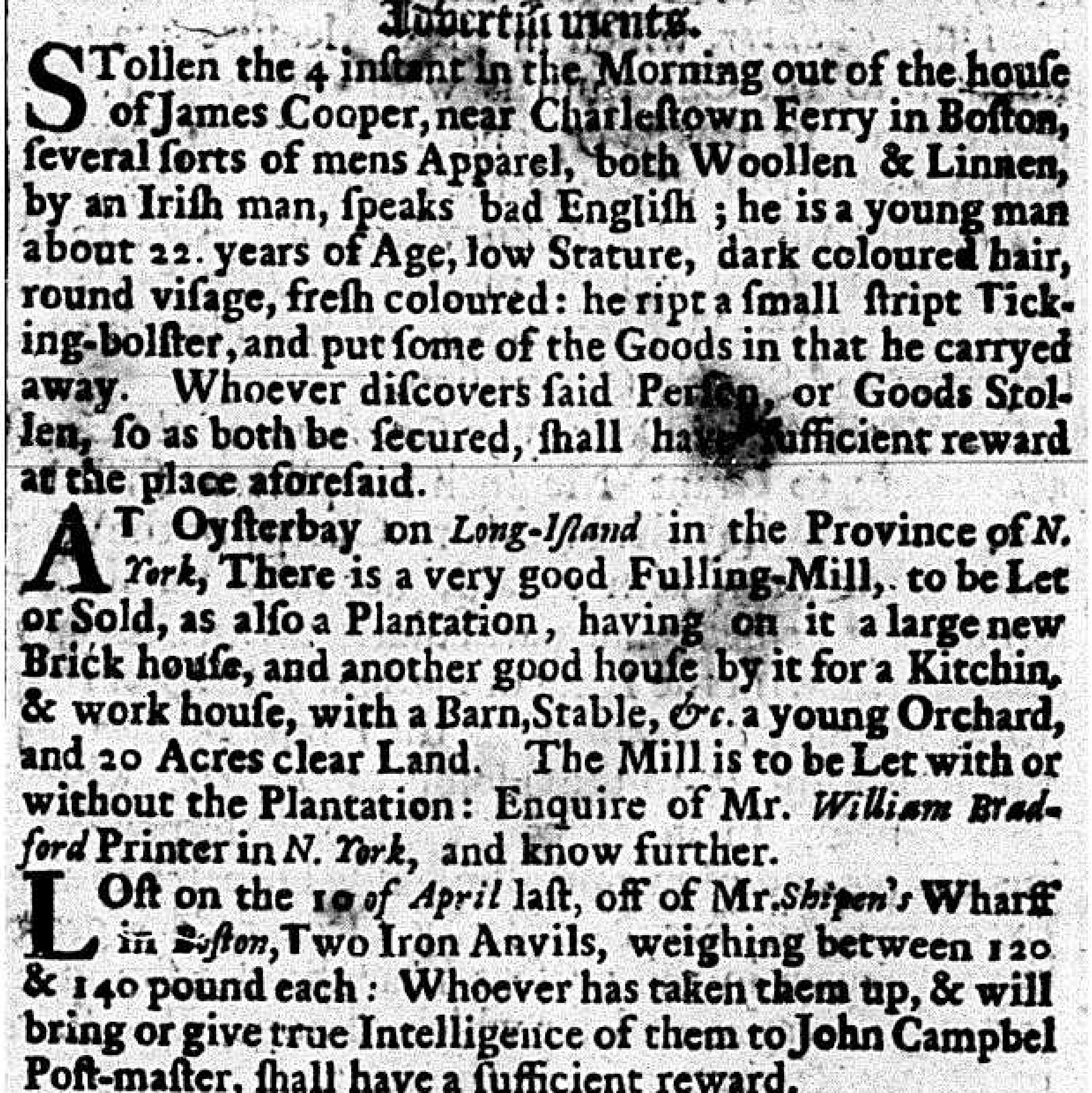
It was only two weeks later in issue number three, dated 1 May – 8 May 1704, 309 years ago this week that the first three paid advertisements appeared. The ads called for the recovery of stolen goods, information about lost anvils, and even information about real estate available on Long Island, New York.

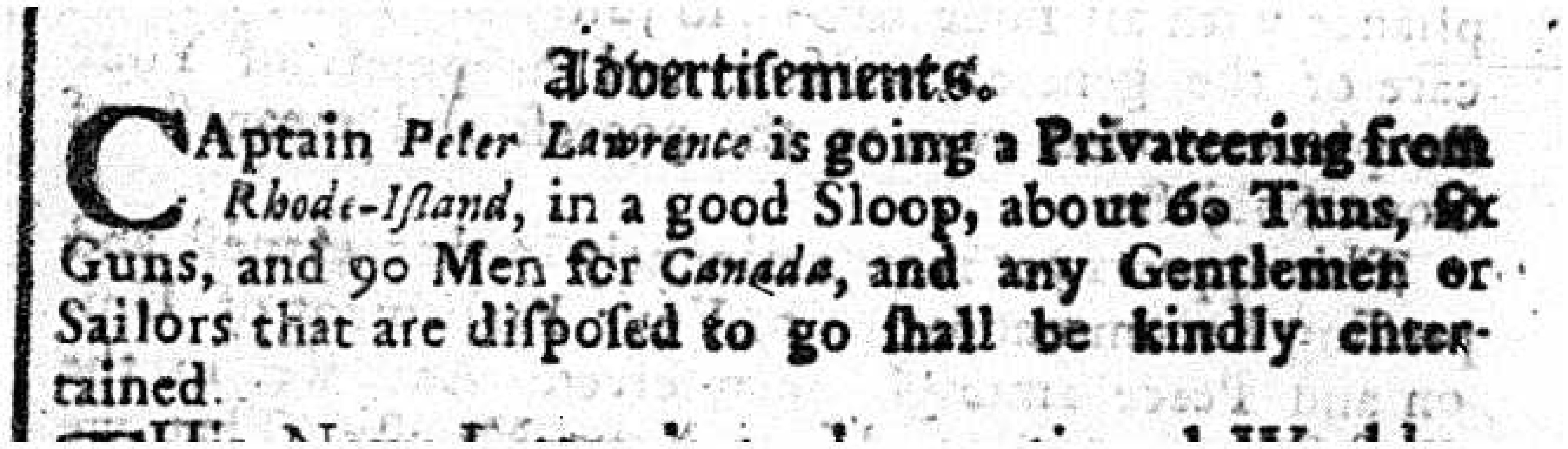
While these ads appear to be regarding fairly mundane matters, readers only had to wait a couple of weeks for this new “social media” to get more interesting. In issue number five, 15 May-22 May 1704, readers looking for adventure got their opportunity.

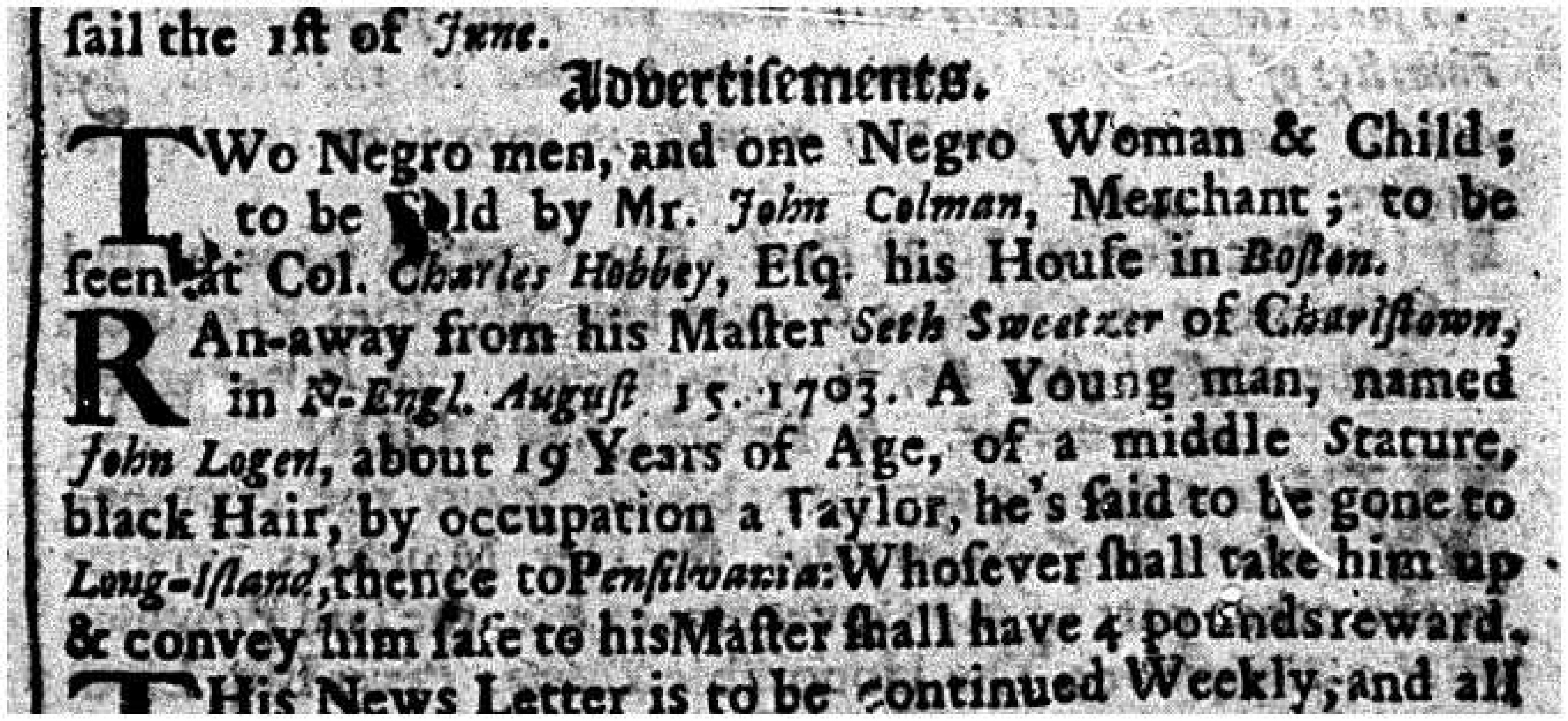
Sadly, only two weeks later, one would also see two ads that, by today’s standards, are a bit more insidious. In issue number eight, we are reminded that Massachusetts was not always a cradle of liberty and that people were property.

What do you think today’s advertisements will look like to researchers in 300 years? Maybe they will wonder how we ever got by driving automobiles relying on fossil fuels or how we kept time with something as simple as a Cartier watch. Will they look at personal ads as a definition of human interaction in our time?

To see more examples of the early days of advertising in American newspapers, consult our online catalog, ABIGAIL, or visit the library at the MHS to see what other early Massachusetts newspaper titles we have in our collections!


[i] Bradford, Alden, History of Massachusetts, for two hundred years: from the year 1620 to 1820, Boston: Hilliard, Gray, 1835.