Society Launches Modern New Website

By Emilie Haertsch, Publications

On 18 September the MHS launched its brand new website, complete with features including an interactive Adams timeline, a gallery displaying prominent objects and manuscripts from the collections, and mobile access capability. The site contains eight search tools and over 11,000 transcribed pages and 102,000 digital images.

The goal of the website redesign is to better connect with our audiences – which means you! Our audiences include researchers, educators, the intellectually curious, and anyone who is interested in learning about the MHS. We invite you to discover who we are as a Society, and how you can become involved, either remotely or in person. Check out our events calendar, about section, visit the library pages, and online resources to find out more.

If you’re interested in finding an entry point to our collections, head over to our Adams family or American Revolution resources, or check out our object of the month. Want to visit the Society in person? We have two exhibitions on display right now – In Death Lamented: The Tradition of Anglo-American Mourning Jewelry and In The Arena: The Presidential Election of 1912 in Massachusetts. For more opportunities to connect with the MHS, visit our social media section.

Want to tell us what you think about the new website? We would love your feedback. Please contact us here with your comments or questions.

This Week @ MHS

By Elaine Grublin

It has been busy, busy, busy at 1154 Boylston Street this fall.  And this week is no different.  Plan to attend one of this week’s events.  And remember to visit the online calendar for additional information.

Monday, 22 October at 6:00 PM, author Missy Wolfe launches her new publication, Insubordinate Spirit: A True Story of Life and Loss in Earliest America 1610-1665 with Elizabeth Winthrop: Insubordinate Spirit.  Reservations are requested. To RSVP call 617-646-0560 or register online

Tuesday, 23 October at 5:15 PM the Boston Immigration and Urban History Seminar continues with John Ochsendorf, The Guastavino Project, MIT, presenting Palaces for the People: Guastavino and America’s Great Public Spaces.  This event will take place at the Boston Public Library.  In lieu of reading a paper, participants will engage in discussion with the presenter after touring the exhibition “Palaces for the People.”

Please note there will be no building tour on Saturday, 27 October. The exhibition galleries, featuring In Death Lamented: The Tradition of Anglo-American Mourning Jewelry and In the Arena: The Presidential Election of 1912 in Massachusetts will be open Monday through Saturday, 10:00 AM to 4:00 PM. 


Mourning Jewelry: A Spooky Tradition?

By Jim Connolly, Publications

Halloween approaches and the MHS has decked the halls with skulls, skeletons, and scythes. Or if you don’t find those creepy, then how about rings full of human hair? How about a brooch featuring a snake eating its own tail (the ouroboros, a symbol of eternity—in itself a scary thing!)?

The spooky objects on display are part of the exhibition In Death Lamented: The Tradition of Anglo-American Mourning Jewelry, as described in a previous post. The season is right for a closer look at one of the most haunting and emblematic pieces in the exhibition.

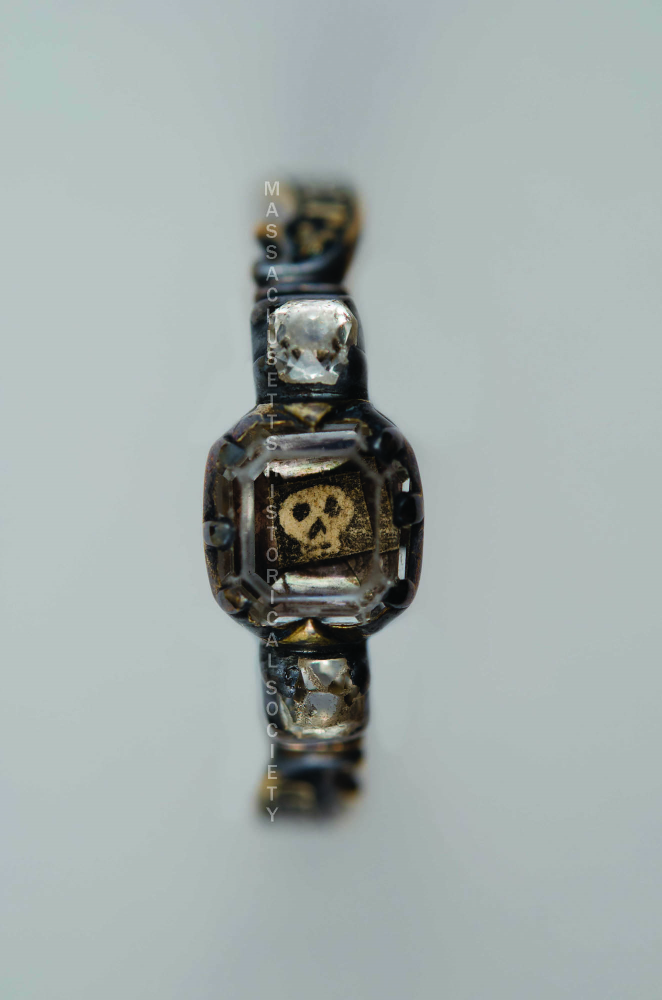
This ring, part of the MHS collections, commemorates John Gray, the infant son of John and Mary Otis Gray and nephew of political writer Mercy Otis Warren. John died at only six days old. The ring has a design of three joined enameled scrolls and a gold foil skull under a square crystal. The inscription that runs around the outside of the band reads, “J:GRAY OB·17·SEP 1763·Æ 6D,” meaning “John Gray died 17 September 1763 aged 6 days.” Less than two months after the infant’s death, his mother died as well, and a ring was made in her memory.

While skull imagery might seem outré today, it was commonplace in both memento mori jewelry and mourning jewelry before the neoclassical style. Jewels bearing skulls, skeletons, gravediggers’ tools, and other seemingly grim images served to remind the wearer that they will die and should therefore live with the next world in mind. Or, as another ring’s inscription eloquently puts it, “A good life a happie death.”

To learn more about mourning jewelry, and to see some truly beautiful and affecting pieces, visit In Death Lamented: The Tradition of Anglo-American Mourning Jewelry at the MHS. The exhibition is free and open to the public. The full-color companion volume, written by the exhibition’s co-curator Sarah Nehama, can be purchased in person at the MHS or online at Amazon.com and Barnes & Noble.


The Intersection of Comics and History: An Interview with Jason Rodriguez

By Emilie Haertsch, Publications

Writer and editor Jason Rodriguez’s work includes District Comics: An Unconventional History of Washington, DC, Postcards: True Stories That Never Happened, and The Little Particle That Could. His books have been nominated for eight Harvey Awards honoring excellence in the comics industry and a Will Eisner Comic Industry Award. Rodriguez’s current project editing graphic novels about colonial New England brought him to the Massachusetts Historical Society last week. He took the time to answer a few Beehive questions about comics, history, and what to expect from the coming historical graphic novels.

                                                                                *Image of Jason Rodriguez drawn by Scott White


1. Tell us about your current project with Fulcrum Publishing editing graphic novels on colonial New England.

Colonial Comics is a series of graphic novel anthologies about colonial life up to and a little bit beyond the American Revolution. The first book, scheduled to be released in the spring/summer of 2014, will focus on the early settlement of New England. The book will feature stories of pilgrims and Puritans, Pequots and pirates, midwives and printing presses, whales and livestock, slavery and frontiers, and many other aspects of colonial life. The second book, scheduled to be released in the fall/winter of 2014, will focus on the pre-Revolutionary period. It will depict the unconventional stories of Revolutionary men and women, the early ideas and seemingly insignificant moves that brought about revolution, and a shot that was heard around the world. We’re still in the planning phases for additional books, but editing two large anthologies at a time is a lot of work as it is, so I’m not in a huge rush to get started on a third or fourth.

The books feature an eclectic mix of comic book writers and artists, fiction and nonfiction authors, university professors, and renowned historians. I also have two assistant editors: A. David Lewis, a comic writer with a Ph.D. in religious studies, and John L. Bell, who writes the Boston 1775 blog.

2. How will the Massachusetts Historical Society support this work?

While we’re still working out the details, the MHS aims to help us in our mission to produce a historically accurate piece. With comics you need to get all the visuals right. Architecture, clothing, weapons – you need to make sure that the images you’re putting on the page are backed by the historical record. There’s also the fact that we’re crafting narratives and extrapolating between recorded points in history by making up dialog and inserting representative characters. MHS is going to help us by making sure we have access to the primary sources and artifacts so that we can include them in the stories and make a book that’s accessible and fun for readers but also educational and accurate.

3. What is your background and how did you come to write comics?

I’ve read comics my entire life, tried to write comics for a little bit, and then took a job editing a small anthology that turned into a bit of a cult hit called Western Tales of Terror. After that I took on a job editing a book called Elk’s Run, which was a critical success but not much of a commercial success. Nevertheless it got nominated for seven Harvey Awards and was picked up by Random House/Villard, who also picked up the anthology I was working on at the time, Postcards: True Stories That Never Happened. From there I worked on a lot of small- and mid-sized books, writing for anthologies and editing some projects here and there. Colonial Comics is definitely my most ambitious project to date – between the first two books we’re looking at around 50 stories, which translates to over 100 writers, artists, and designers.

4. Why do you think comics are a good medium for exploring history?

Comics tend to immerse the reader in the time period. Every panel is a moment in time, and each moment allows the reader to pause and take note of the buildings and the dress and the people. Since the words are printed on the page in little balloons, the reader can note the dialog and the pacing. There’s also a layer of subtext you get with comics that you don’t necessarily get with books and film. When someone is in panel for an entire story and hardly says a line of dialog it says a lot about that character and how he or she fits into the context of the story. And of course there’s the narrative aspect. These historic figures become interesting characters within the stories. Readers are inspired to learn more about them, either on their own or in their courses.

Because of all this, the individual stories could stand alone as fun and informative narratives or act as segues into larger discussions on the period. For example, one story in the first book is about Elizabeth Glover, the owner of the first New England print shop. The story could be used as a lead-in to a discussion on the difficulties of female business owners in society at that time. The small pieces capture your interest and encourage you to seek out the larger context.

5. What are some of your favorite comics? Can you recommend a good entry point for someone who is interested in history but fairly new to comics?

My taste in comics is pretty mixed. I love a lot of Japanese comics, especially anything by Naoki Urasawa. But more to the tastes of the people on this blog, I recently finished Osamu Tezuka’s massive eight-volume graphic novel about the life of Buddha. It’s a bit of a pop-culture twist on the source material but it is beautiful and heartbreaking.

Forgive me if I give a little plug for Fulcrum’s District Comics: An Unconventional History of Washington DC. I even wrote a story for that one about the 1867 Washington Nationals. As far as other histories, I like the ones that have a personal narrative attached to them, like Marjane Satrapi’s Persepolis (which is about her childhood in Iran) and Joe Sacco’s Palestine (which is about his experiences in the Gaza Strip during the early ’90s). A bit more of a hidden gem is Ryan Dunlavey and Fred Van Lente’s wonderful Action Philosophers! That book is the greatest way to learn about philosophy and philosophers. It should be required reading in every college philosophy class. And if you just want straight history, Hill & Wang has published a bunch of graphic histories including books about Reagan, Ché Guevara, Trotsky, the Vietnam War, the 9/11 Commission Report, and even an adaptation of the U.S. Constitution.

Stephen Greenleaf Bulfinch, Post 17

By Elaine Grublin

The following excerpt is from the diary of Stephen Greenleaf Bulfinch.

Saturday, Oct. 26th, 1862

Of public affairs, the chief have been the defeat of the rebels near Sharpsburg & elsewhere, & their evacuation of Maryland and Kentucky, – and the President’s emancipation proclamation. This measure I approve, though with some hesitation. A year since, I was much opposed to such a thing, lest it should disgrace our case by the horrors of a servile war; but the south are now in arms & can defend their homes if they please; it will therefore only weaken the force which they bring against us; and the danger of a servile war is eclipsed by the nearer and worse danger of national destruction. The President does not call on the slaves to rise; and he gives the rebels three months’ warning before his promise of freedom to the slaves goes into operation. Our hope is, it will be a means of weakening their force and dividing their counsels, and that our forces may advance, & put down the rebellion & slavery together…I chronicle, with decided disapproval, the formation of a party here, – old acquaintances under a new name, – called ‘the People’s party.’ The object is to displace Gov. Andrew and Senator Sumner, – and such men; the pretence is, to support the president. He does not seek to be supported against his best friends.

Brown-Bag Lunch Talk: “Some Are Weatherwise, Some Are Otherwise”

By Anna J. Cook, Reader Services

On Wednesday, 3 October, research fellow Lauri Coleman from The College of William and Mary, gave her brown-bag lunch talk, “ ‘Some are Weatherwise, Some are Otherwise’: Popular Almanacs and Weather Cosmology in Mid-eighteenth Century America.” Coleman’s dissertation research explores how mid eighteenth-century New Englanders, from the 1740s to the 1780s,  experienced and made sense of the weather generally and natural disasters such as draughts and earthquakes in particular. New Englanders during this period experienced the weather in two distinct yet interconnected ways: “providentially” (as a sign of God intervening in human affairs) and through the discourse of natural philosophy, scientific observation through which divine laws might be discerned. Coleman argues that these two frameworks for understanding weather – one through which God is understood to act disruptively and violently, the other through which God is seen to act benevolently and in an orderly fashion – exist together in collective consciousness throughout the period.  In the face of natural disasters, these two interpretations were often pitted against one another in public discussion (in newspapers and sermons, for example) as citizens attempted to make sense of the event.

The Cushing Academy Fellowship in Environmental History — one of the 20 short-term research fellowships offered by the MHS — is supporting Coleman’s work at the MHS this fall, where she is reading through our extensive collection of interleaved (annotated) almanacs and diaries. Almanacs, Coleman explained, are particularly useful as a window into understanding how eighteenth-century New Englanders understood “usual” weather, what type of records they kept about everyday weather, and what use they made of that documentation (if any) over the course of their lives or across generations. They are also unusual for surviving eighteenth-century records in that, while still relatively elite, the authors of annotated almanacs represent a broader cross-section of society than the typical manuscript or print materials that have been preserved from the period.  Coleman has found two collections of particular interest during her residency thus far: the Experience Wight Richardson diaries (1728-1782) and the Samuel P. Savage interleaved almanacs (1770-1795). Richardson’s diaries, which record her spiritual struggles and relate her faith experiences to weather events, are unusual in being kept by a woman. Few eighteenth-century New England women’s diaries have survived, and fewer still deal so directly with the cosmology of weather. A farmer, Samuel P. Savage used the almanacs, particularly the information they provided on the phases of the moon, to plan his management of crops and animals.

During the discussion that followed Coleman’s presentation, attendees raised questions about the motives of those documenting the weather – were they hoping to forecast the future? Did they change their behaviors in relation to the weather based on their records of the past? They also explored what is historically particular about weather cosmology in the eighteenth century, and whether Coleman’s project might benefit from comparison to earlier and later periods (possibly beyond the scope of a single dissertation!).

We wish Lauri Coleman the best as she continues her research at the MHS and then returns to The College of William and Mary to complete her dissertation.

“Representing Me”: The Scrapbook of Eleanor Shumway

By Susan Martin, Collection Services

Earlier this year, the MHS acquired the scrapbook of Eleanor Shumway, a teenager living in Newton, Massachusetts in the early 20th century. We see a lot of scrapbooks here, but this one is unique because Eleanor annotated each page, making the volume a kind of personal diary, as well.

Eleanor Shumway was born in 1895, the second daughter of salesman Harold H. Shumway and Amy Louise (Moors) Shumway. She had two sisters, Marjorie and Helen. One hundred years ago, when she kept this scrapbook, Eleanor was a student at Newton High School. She attended parties, dances, and concerts; participated in school sports; and gushed about her favorite actors and actresses. Pasted carefully to each page are ticket stubs, programs, invitations, party favors, dance cards, postcards, photographs, newspaper clippings, etc., mostly dating from 1908-1915. The volume also contains some original pencil sketches, including “Works of Art. Representing me.” And next to each item is a handwritten note by Eleanor describing her activities in detail.

Eleanor wrote about popular party games, like Winkums, Drop the Handkerchief, Hearts, and something called Buzz. She and her friends also played cards, bean bag games, and guessing games; ducked for apples; strung pumpkin seeds; told ghost stories; made fudge and molasses candy; ate Jack Horner pie; went skating; and participated in “theatricals.” At one party, the guests performed in blackface, and Eleanor got a prize “for acting the craziest.”

The slang is priceless, and reading through the scrapbook, you can almost hear Eleanor’s voice. She often had “piles of fun,” “great sport,” or “a peach of a time.” Plays she attended were “horrid,” “darling,” or “perfectly slick.” Her “chums” were a “corking bunch.”

But Eleanor’s life was not without its drama. One letter, written by her friend Ruth W. after the two had fallen out, reads:

What was it about Alfred Pratt that Eugenie didn’t know. Please tell me what I said or did to make you & Eugenie not even look at me. I’m awfully sorry and I didn’t mean what ever you heard….Please tell me why you wont look or speak to me.

There was also the occasional mortification:

This note fell out of my History Book over at Charlestown and a gentleman very politely handed it to Marjorie. We nearly died!

This scrapbook is not just a personal account of one precocious American teenager’s daily life, but a window into social history and a record of dramatic technological changes. Eleanor also described riding in a Parkhurst car, as well as eating a meal “made by electricity” at the House of Edison Light in Newton Centre.

To see the Eleanor Shumway scrapbook, or any of our other scrapbooks, please visit the MHS library.

This Week @ MHS

By Elaine Grublin

The fall season is in full-swing.  We are offering three evening programs, a brown-bag lunch, and a building tour this week. There is a little something for everyone, so plan on stopping in.  Additional details about all events are available through our online calendar.

Monday, 1 October at 6:00 PM, Christian Samito, Boston University School of Law, discusses “The War of 1812 & the Making of Modern America.” This program is presented in partnership with the USS Constitution Museum as part of the War of 1812 Bicentennial Series. There is a pre-event reception at 5:30. Reservations are requested. RSVP by calling 617-646-0560.

Tuesday, 2 October at 5:15 PM, the Boston Early American History Seminar series returns with Daniel K. Richter, University of Pennsylvania, presenting “Colonial Proprieties: Atlantic Possession in England’s Restoration Era.” Steven Pincus, Yale University, will provide the comment. Advance copies of seminar papers are available to series subscribers. RSVPs are required, and can be made by contacting Kate Viens via email or at 617-646-0568.

Wednesday, 3 October at 12:00 PM, bring your lunch and enjoy the conversation as Lauri Coleman, College of William and Mary, presents “’Some are weatherwise, some are otherwise’: Popular Almanacs and Weather Cosmology in Mid-eighteenth Century America” at a brown-bag lunch program.

Thursday, 4 October at 5:30 PM, the New England Biography Seminar series kicks off with Judith Tick, Northeastern University; Jan Swafford, The Boston Conservatory; and Tim Riley, Emerson College, sharing their insights on “Symphony and Song: Writing Lives in Music” Megan Marshall, Emerson College, will moderate the discussion. RSVPs are required, and can be made by contacting Kate Viens via email or at 617-646-0568.

Saturday, 6 October at 10:00 AM, all are welcome to explore the “History and Collections of the MHS” during our 90-minute guided tour. 

*******

If you are planning ahead, NEXT WEEK @ MHS, on Monday, 8 October, we are participating in the Fenway Alliance’s annual Opening our Doors event. The MHS galleries will be open from 10:00 AM to 2:00 PM.  The research library will be closed. Stay tuned for the next installment of This Week @ MHS (or consult the online calendar) for details about additional events next week. 

Historian Ray Raphael on that Flummoxing Electoral College

By Emilie Haertsch, Publications

Twelve years ago at this time Vice President Al Gore ran against governor of Texas George W. Bush, leading to chaotic election results. The votes were so close that one candidate won the popular vote while another won the electoral vote. That was right about the time that people across America began asking, what is the Electoral College, and how can a candidate win the popular vote and still lose the election? Who would create such a system? Many are still asking these questions as we approach another close presidential election in November, and historian Ray Raphael has the answers.

 Raphael is currently a Senior Research Fellow with Humboldt State University in Northern California. He authored the acclaimed People’s History of the American Revolution as well as many other books on the founding of the United States, and his latest book is Mr. President: How and Why the Founders Created a Chief Executive. Raphael visited the Society on Monday, September 24, to present “The Curious Creation of the Electoral College: What the Founders Didn’t Want and Didn’t See Coming.” 

 “Welcome, fans of the Electoral College,” Raphael began, to the laughter of the audience. He went on to explain the roots of the electoral system in the Federal Convention of 1787 and the ways in which even the founders viewed it as an imperfect solution. The Virginia Plan, an outline of government proposed by the Virginia delegates, called for an undetermined number of members of an executive branch chosen by the legislature. James Wilson of Virginia, however, proposed a single executive elected by the people. Although the members of the convention agreed upon the idea of a single executive, with very limited powers, they disliked the idea of a popular vote to decide the election. Wilson outlined an electoral system as an alternative, but it was rejected. The feeling of the convention was that Congress should be involved in selecting the president. Why the opposition to a popular vote?

 “They wanted government by the people,” Raphael said, “but not the people ruling on a daily basis.”

Finally, the question of how to elect the executive was referred to a committee, which became known as the “Grand Committee.” They created the electoral system we know today, which does not involve Congress directly in presidential elections. The committee also gave the president powers of treaty and appointment. The electoral system and the greater powers allocated to the president were contrary to the sentiments of the convention as a whole, but nonetheless the electoral system was ratified as part of a final effort to complete the Constitution. As a result, electors representing each state, which are equal in number to its Congressional representation, elect the president. Although Maine and Nebraska count their electoral votes proportionally, the rest have a winner-take-all system. In winner-take-all states all the electoral votes go to the candidate who had the most votes in that state, which in four cases has resulted in a candidate winning the popular vote and losing the electoral vote, as we saw in 2000—and which came very close to happening again in 2004.

The committee designed the Electoral College to avoid corruption. They believed that if the electors, who were chosen by the state legislatures, voted at a distance they would be less likely to succumb to the dangers of intrigue and faction. The founders expected the electors to behave nobly and do what was best for the nation. But it only took eight years for national political parties to take hold, resulting in electors having no discretion in voting. Their votes were pre-committed to their parties.

“It’s Oedipal,” said Raphael. “In trying to escape your fate, you create it.”

The Electoral College has evolved considerably from the original intent of the founders, which was to protect the election of the executive from corruption. But even after the collapse of the election process in 2000, Raphael believes it is unlikely to be changed by a constitutional amendment. Voters in rural states, with small populations, and voters in swing states are courted because their votes have added electoral weight, so they prefer this electoral system.

“Isn’t it amazing?” asks Raphael. “Humans are stuck with their own contrivances for centuries.”

Turning Points in History

By Kathleen Barker, Education Dept.

Summer has officially turned to fall, which means it’s time once again for leaf peeping, pumpkin carving, and National History Day! Since the Society became the official co-sponsor of Massachusetts History Day earlier this year, I’ve learned a lot about making websites, judging performances for historical accuracy, and spotting student-created content in exhibitions mounted on replicas of everything from the Taj Mahal to the R.M.S. Titanic.  I have also discovered that National History Day is a fabulous way to engage students in the process of doing history. For example, creating an NHD project requires that students work individually or in a group to select a topic related to the annual theme; conduct primary and secondary research at libraries, archives, and museums; think critically about sources and draw conclusions about the importance of their topic; and present their research through an exhibit, website, performance, documentary, or research paper.  Best of all, students who produce history day projects develop all sorts of reading, writing, thinking, and presentation skills that they can apply to other courses in other disciplines.  History Day is about so much more than history!

I was fortunate enough to attend a four-day NHD training session earlier this month. In addition to meeting competition coordinators from all over the world, I also attended a great session that explored the finer points of this year’s theme: Turning Points in American History. So, you might ask, how should we define a broad idea like “turning point?”  More than an important event from the past, a turning point is an idea, event, or action that led to some sort of cultural, political, social, or economic change. It could be anything from the changes in Secret Service protocol after President Kennedy’s assassination to the creation of state arts patronage that resulted from the Russian Revolution.  Of course, there are plenty of potential turning points in our own backyard. If you’d like to tackle a project that involves Massachusetts or New England history, explore the Society’s collections or contact the library staff (library@masshist.org; 617-646-0532) and start to plan a visit to the Library. For more information about participating in Massachusetts History Day, visit the MHD website. Good luck!