
By Emilie Haertsch, Publications

Writer and editor Jason Rodriguez’s work includes District Comics: An Unconventional History of Washington, DC, Postcards: True Stories That Never Happened,  and The Little Particle That Could. His books have been nominated for eight Harvey Awards honoring excellence in the comics industry and a Will Eisner Comic Industry Award. Rodriguez’s current project editing graphic novels about colonial New England brought him to the Massachusetts Historical Society last week. He took the time to answer a few Beehive questions about comics, history, and what to expect from the coming historical graphic novels.
*Image of Jason Rodriguez drawn by Scott White
1. Tell us about your current project with Fulcrum Publishing editing graphic novels on colonial New England.
Colonial Comics is a series of graphic novel anthologies about colonial life up to and a little bit beyond the American Revolution. The first book, scheduled to be released in the spring/summer of 2014, will focus on the early settlement of New England. The book will feature stories of pilgrims and Puritans, Pequots and pirates, midwives and printing presses, whales and livestock, slavery and frontiers, and many other aspects of colonial life. The second book, scheduled to be released in the fall/winter of 2014, will focus on the pre-Revolutionary period. It will depict the unconventional stories of Revolutionary men and women, the early ideas and seemingly insignificant moves that brought about revolution, and a shot that was heard around the world. We’re still in the planning phases for additional books, but editing two large anthologies at a time is a lot of work as it is, so I’m not in a huge rush to get started on a third or fourth.
The books feature an eclectic mix of comic book writers and artists, fiction and nonfiction authors, university professors, and renowned historians. I also have two assistant editors: A. David Lewis, a comic writer with a Ph.D. in religious studies, and John L. Bell, who writes the Boston 1775 blog.
2. How will the Massachusetts Historical Society support this work?
While we’re still working out the details, the MHS aims to help us in our mission to produce a historically accurate piece. With comics you need to get all the visuals right. Architecture, clothing, weapons – you need to make sure that the images you’re putting on the page are backed by the historical record. There’s also the fact that we’re crafting narratives and extrapolating between recorded points in history by making up dialog and inserting representative characters. MHS is going to help us by making sure we have access to the primary sources and artifacts so that we can include them in the stories and make a book that’s accessible and fun for readers but also educational and accurate.
3. What is your background and how did you come to write comics?
I’ve read comics my entire life, tried to write comics for a little bit, and then took a job editing a small anthology that turned into a bit of a cult hit called Western Tales of Terror. After that I took on a job editing a book called Elk’s Run, which was a critical success but not much of a commercial success. Nevertheless it got nominated for seven Harvey Awards and was picked up by Random House/Villard, who also picked up the anthology I was working on at the time, Postcards: True Stories That Never Happened. From there I worked on a lot of small- and mid-sized books, writing for anthologies and editing some projects here and there. Colonial Comics is definitely my most ambitious project to date – between the first two books we’re looking at around 50 stories, which translates to over 100 writers, artists, and designers.
4. Why do you think comics are a good medium for exploring history?
Comics tend to immerse the reader in the time period. Every panel is a moment in time, and each moment allows the reader to pause and take note of the buildings and the dress and the people. Since the words are printed on the page in little balloons, the reader can note the dialog and the pacing. There’s also a layer of subtext you get with comics that you don’t necessarily get with books and film. When someone is in panel for an entire story and hardly says a line of dialog it says a lot about that character and how he or she fits into the context of the story. And of course there’s the narrative aspect. These historic figures become interesting characters within the stories. Readers are inspired to learn more about them, either on their own or in their courses.
Because of all this, the individual stories could stand alone as fun and informative narratives or act as segues into larger discussions on the period. For example, one story in the first book is about Elizabeth Glover, the owner of the first New England print shop. The story could be used as a lead-in to a discussion on the difficulties of female business owners in society at that time. The small pieces capture your interest and encourage you to seek out the larger context.
5. What are some of your favorite comics? Can you recommend a good entry point for someone who is interested in history but fairly new to comics?
My taste in comics is pretty mixed. I love a lot of Japanese comics, especially anything by Naoki Urasawa. But more to the tastes of the people on this blog, I recently finished Osamu Tezuka’s massive eight-volume graphic novel about the life of Buddha. It’s a bit of a pop-culture twist on the source material but it is beautiful and heartbreaking.
Forgive me if I give a little plug for Fulcrum’s District Comics: An Unconventional History of Washington DC. I even wrote a story for that one about the 1867 Washington Nationals. As far as other histories, I like the ones that have a personal narrative attached to them, like Marjane Satrapi’s Persepolis (which is about her childhood in Iran) and Joe Sacco’s Palestine (which is about his experiences in the Gaza Strip during the early ’90s). A bit more of a hidden gem is Ryan Dunlavey and Fred Van Lente’s wonderful Action Philosophers! That book is the greatest way to learn about philosophy and philosophers. It should be required reading in every college philosophy class. And if you just want straight history, Hill & Wang has published a bunch of graphic histories including books about Reagan, Ché Guevara, Trotsky, the Vietnam War, the 9/11 Commission Report, and even an adaptation of the U.S. Constitution.
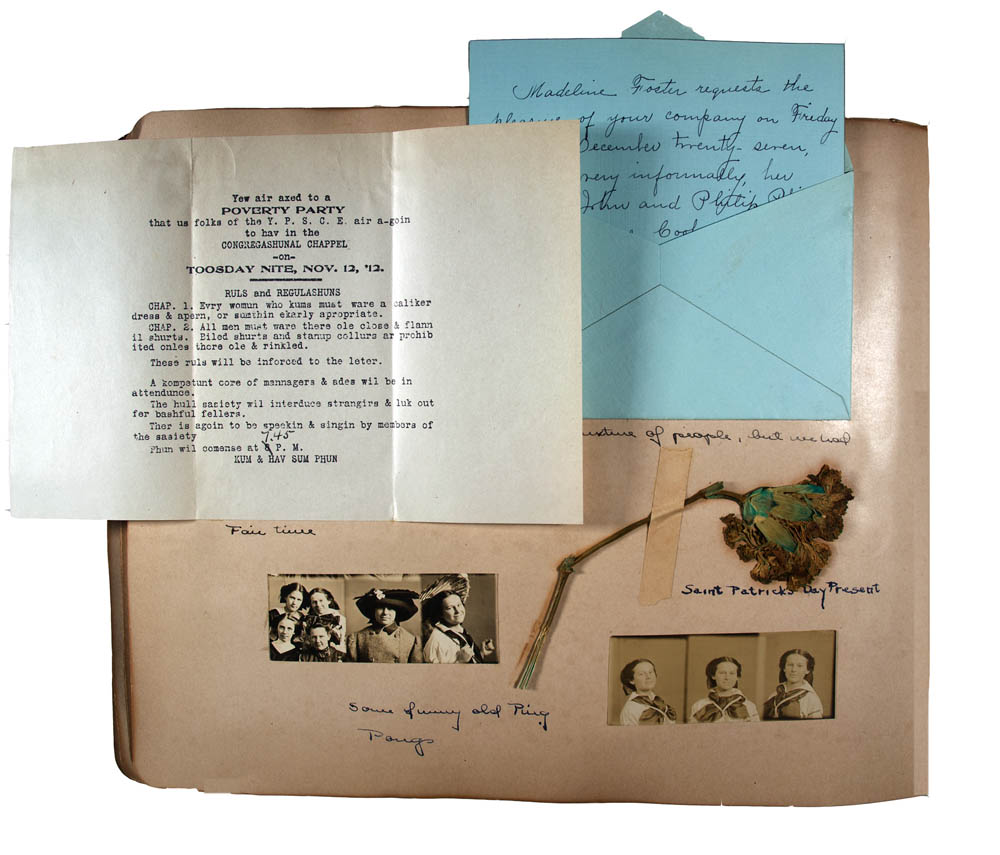
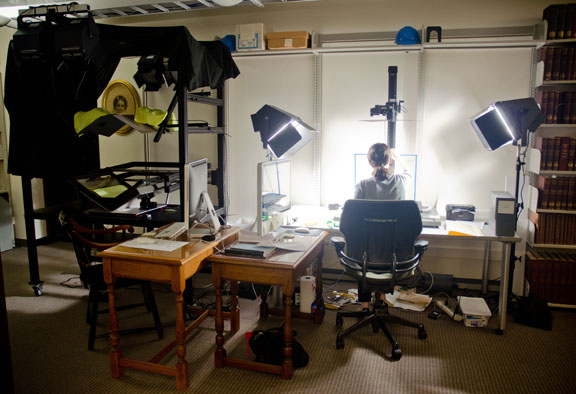 to supply somewhere in the neighborhood of 55,000 manuscript pages to a forthcoming multi-archive digital publication, China, America and the Pacific: Trade and Cultural Exchange. Adam Matthew has contracted, in turn, with Luna Imaging in Los Angeles to do the scanning. In late August, Luna shipped all of the equipment shown here and sent a representative to install and test it and train a scanning technician. The technician, shown here, is now hard at work scanning correspondence, account books, ships’ logs, and letterbooks from multiple collections, including the extensive Forbes Family Papers. Other highlights of the final product, scheduled for release in late 2013, will include the manuscript of Richard Henry Dana’s seminal work, Two Years Before the Mast, and Robert Haswell’s log of the Columbia-Rediviva, the first vessel to circumnavigate the globe
 to tell portions of the story. MHS materials feature prominently in two segments of the film. In the segment “Dying” a letter written by Wilder Dwight to his mother Elizabeth Dwight (