
By Jim Connolly, Publications
Halloween approaches and the MHS has decked the halls with skulls, skeletons, and scythes. Or if you don’t find those creepy, then how about rings full of human hair? How about a brooch featuring a snake eating its own tail (the ouroboros, a symbol of eternity—in itself a scary thing!)?
The spooky objects on display are part of the exhibition In Death Lamented: The Tradition of Anglo-American Mourning Jewelry, as described in a previous post. The season is right for a closer look at one of the most haunting and emblematic pieces in the exhibition.
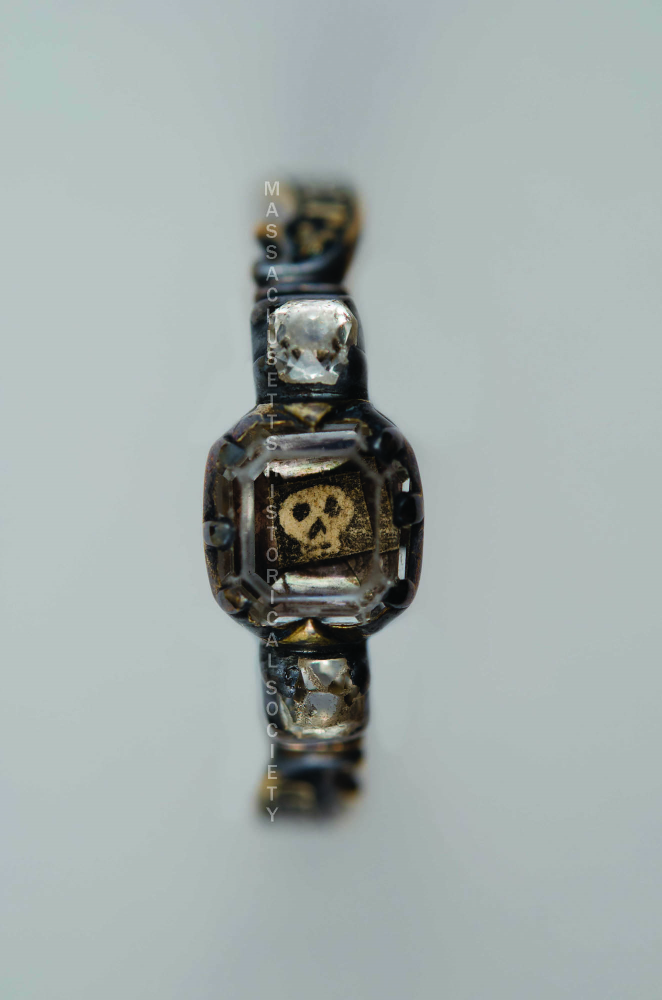
This ring, part of the MHS collections, commemorates John Gray, the infant son of John and Mary Otis Gray and nephew of political writer Mercy Otis Warren. John died at only six days old. The ring has a design of three joined enameled scrolls and a gold foil skull under a square crystal. The inscription that runs around the outside of the band reads, “J:GRAY OB·17·SEP 1763·Æ 6D,” meaning “John Gray died 17 September 1763 aged 6 days.” Less than two months after the infant’s death, his mother died as well, and a ring was made in her memory.
While skull imagery might seem outré today, it was commonplace in both memento mori jewelry and mourning jewelry before the neoclassical style. Jewels bearing skulls, skeletons, gravediggers’ tools, and other seemingly grim images served to remind the wearer that they will die and should therefore live with the next world in mind. Or, as another ring’s inscription eloquently puts it, “A good life a happie death.”
To learn more about mourning jewelry, and to see some truly beautiful and affecting pieces, visit In Death Lamented: The Tradition of Anglo-American Mourning Jewelry at the MHS. The exhibition is free and open to the public. The full-color companion volume, written by the exhibition’s co-curator Sarah Nehama, can be purchased in person at the MHS or online at Amazon.com and Barnes & Noble.

 and The Little Particle That Could. His books have been nominated for eight Harvey Awards honoring excellence in the comics industry and a Will Eisner Comic Industry Award. Rodriguez’s current project editing graphic novels about colonial New England brought him to the Massachusetts Historical Society last week. He took the time to answer a few Beehive questions about comics, history, and what to expect from the coming historical graphic novels.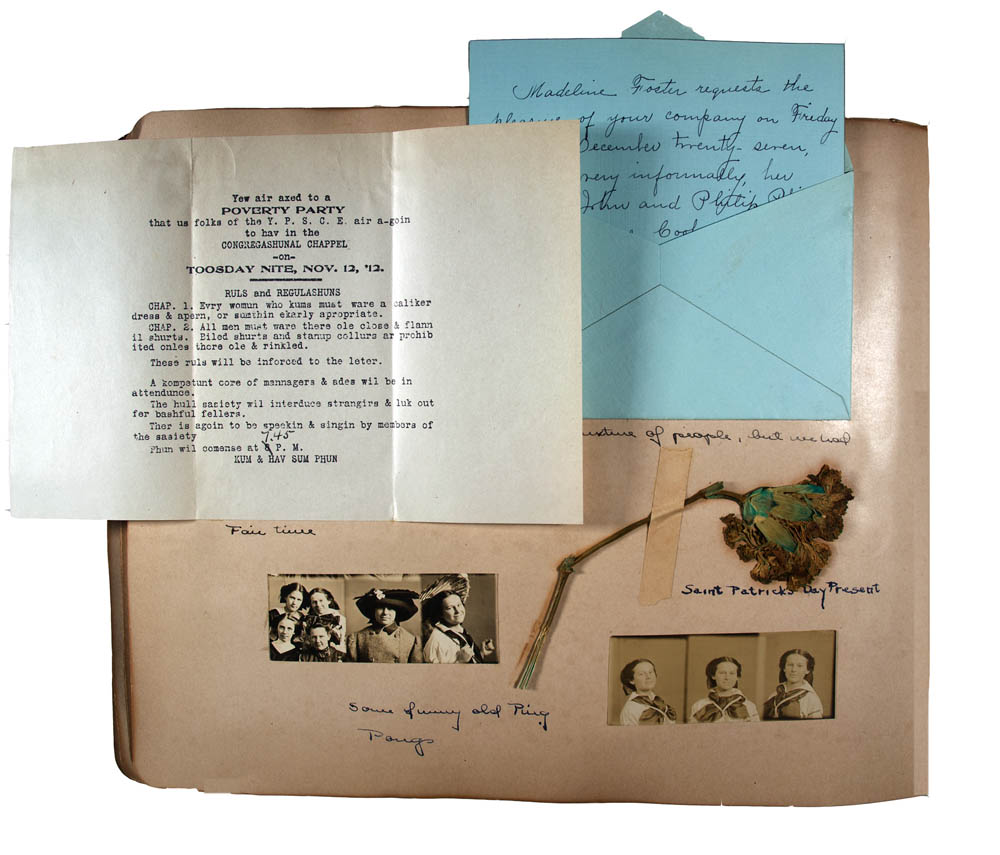
 to supply somewhere in the neighborhood of 55,000 manuscript pages to a forthcoming multi-archive digital publication, China, America and the Pacific: Trade and Cultural Exchange. Adam Matthew has contracted, in turn, with Luna Imaging in Los Angeles to do the scanning. In late August, Luna shipped all of the equipment shown here and sent a representative to install and test it and train a scanning technician. The technician, shown here, is now hard at work scanning correspondence, account books, ships’ logs, and letterbooks from multiple collections, including the extensive Forbes Family Papers. Other highlights of the final product, scheduled for release in late 2013, will include the manuscript of Richard Henry Dana’s seminal work, Two Years Before the Mast, and Robert Haswell’s log of the Columbia-Rediviva, the first vessel to circumnavigate the globe
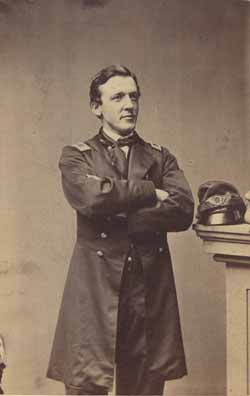 to tell portions of the story. MHS materials feature prominently in two segments of the film. In the segment “Dying” a letter written by Wilder Dwight to his mother Elizabeth Dwight (