Teachers at the Crossroads

By Kathleen Barker, Education Department

In the spring of 1775, the towns of Lexington and Concord became targets, scenes, and symbols of actions that would ignite a war culminating in the birth of a new country. What happened to inhabitants of towns like these that were literally and figuratively “on the road to revolution” where local concerns and larger outside forces intersected? This July and August the Society offered two week-long workshops designed to help K-12 educators answer this question. Funded by the National Endowment for the Humanities, our workshop, “At the Crossroads of Revolution: Lexington and Concord in 1775,” brought 80 teachers from 33 states (and the United Kingdom) to Massachusetts for an in-depth exploration of documents, artifacts, and landscapes associated with the beginning of the American Revolution.  

Group of 40 teachers in front of memorial at Lexington Green

Each week’s program began on Sunday evening at the historic Hartwell Tavern, where participants experienced Battle Road Heroes, a living history program that introduced the dramatic stories of people who lived along the crossroads of the Battle Road in April of 1775. The following day, Robert Gross, Draper Professor of Early American History at the University of Connecticut, led participants in an examination of life on the eve of the Revolution. He discussed what people were talking about; what they worried about; who the leaders were in the communities of Concord and Lexington and how they shaped public opinion; the sources of news and the places where people gathered to share it. Participants then had the opportunity to explore the Concord Museum, which holds an outstanding collection of artifacts related to life in Concord at the beginning of the American Revolution.

On Tuesdays we took to the streets of Boston with Bill Fowler, Distinguished Professor of History at Northeastern University and former director of the MHS. Building on the local concerns identified the previous day, participants considered how events in Boston were intertwined with those in Lexington and Concord. Our tour of the landscapes of revolutionary Boston included the Old State House, Boston Common, Old South Meeting House, Faneuil Hall, and Old North Church, where lanterns signaled British troop movements on the night of April 18, 1775. Our day concluded with a visit to the MHS where participants had the opportunity to meet and mingle with staff members while viewing original documents from the Society’s amazing collections.  
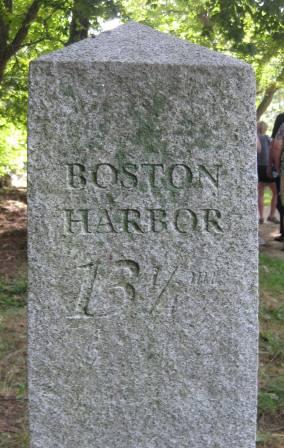
Mile Marker indicated 13.5 miles to Boston from ConcordBy Wednesday participants were ready to take a closer look at the first day of the revolution. We toured many different sites, including Lexington Green, Paul Revere’s capture site, and the North Bridge in Concord, as we focused on the actual events of April 19, 1775. Participants walked parts of the original Battle Road, now part of Minute Man National Historical Park, exploring eyewitness accounts recorded by minutemen British soldiers, and local inhabitants at various locales in order to uncover how the first few hours of the revolution unfolded. We also considered multiple perspectives through a visit to Munroe Tavern, part of the Lexington Historical Society. On the afternoon of April 19, 1775, the tavern served as the headquarters for Brigadier General Earl Percy and his one thousand reinforcements, as well as a field hospital for wounded British regulars, and interpreters within the tavern tell the story of the British retreat to Boston.

Activities on Thursday highlighted in the roles that ordinary people played in shaping extraordinary events, and the power that people had to effect change through the choices that they made. Historians Mary Fuhrer and Joanne Myers introduced the participants to documentary sources – local records – than can be used to research the lives of people living in Lexington in 1775. Through a series of hands-on research activities and a short writing workshop, participants chose a historical character from Lexington and examined their “choices at the crossroads.” Meanwhile, environmental historian Brian Donahue, author of The Great Meadow: Farmers and the Land in Colonial Concord, immersed the teachers in the colonial landscape guiding them through a section of the farming fields and providing them with tools for “reading” and understanding the “land of the embattled farmers”. Our examination of the mixed husbandry land use of Concord’s small farms provided a way of understanding interrelated strands of environmental, economic and social history, and offered a unique perspective on the daily concerns and choices, and the long-term plans and patterns that were a crucial part of family and community life in Lexington and Concord.

Our setting for the final day of the workshop was the grounds of the Old Manse, a National Historic Landmark overlooking the Concord River. Here, MHS Director of Education Jayne Gordon led the teachers in a discussion the ways in which nineteenth- century Concord authors used Concord’s revolutionary legacy in their own efforts to end intellectual and cultural dependence on the Old World. After an intense week, the program officially ended with a leisurely stroll through Sleepy Hollow Cemetery, where Emerson, Thoreau, Hawthorne and the Alcotts are buried. We completed our workshop with a quiet, casual contemplation of the different kinds of independence that each author pursued at his/her own “crossroads.”

Here at the MHS, we are grateful to our wonderful partners for making this a fantastic experience for all who participated. We are also delighted to know that participants enjoyed their time in Massachusetts. As one teacher explained in her final evaluation, this was an “absolutely fabulous workshop of great value to me and my students. In the words of my students it was: ‘freakin’ awesome!’”.

 

This Week @ MHS

By Elaine Grublin

Join us at noon on Wednesday, 15 August, for a brown-bag lunch “Cotton Mather’s use of Jacques Basnage’s History of the Jews in the Biblia Americana,” presented by Rick Kennedy of Point Loma Nazarene University. Kennedy will present his thoughts on Basnage’s influence on Mather as a historian and then will field questions from the audience.  

Visitors can also stop in anytime between 10:00 AM and 4:00 PM, Monday through Saturday to explore our latest exhibition, Mr. Madison’s War: The Controversial War of 1812. This exhibition showcases a number of letters, broadsides, artifacts, and images from the Society’s rich collections including a midshipman’s log of the USS Constitution describing the ship’s first great victory, letters written by John Quincy Adams to his mother while serving as the American minister to Russia, and a brass cannon captured from the British at the Battle of New Orleans in 1815.

And on Saturday, 18 August, do not miss our building tour “The History and Collections of the MHS.” The 90-minute tour departs our front lobby promptly at 10:00 AM.


“What a merry Company there is of Us, in the Universe”

By Amanda A. Mathews, Adams Papers

Earlier this week, the world received the exciting news of the NASA rover “Curiosity” successfully landing on Mars. The great questions of whether or not we are alone in the Universe, whether other life exists and what forms it might take call out to us for answers. But these are not merely the questions of this present “Space Age.” Both John and John Quincy Adams took great interest in questions of astronomy.

Sir William Herschel’s work with telescopes and writings on the Milky Way inspired John Adams to write, “Herschell indeed with his new Glass, has discovered the most magnificent Spectacle that ever was seen or imagined, and I suppose it is chiefly as a Spectacle that his Discovery is admired. If all those Single double, tripple quadruple Worlds are peopled as fully as every leaf and drop is in this, what a merry Company there is of Us, in the Universe? . . . Why are We keept so unacquainted with each other? . . . The Bishop of Landaff, has made the Trees, not walk, but feel and think, and why should We not at once settle it that every Attom, thinks and feels? An universe tremblingly alive all over.”

While John Adams was content to ruminate on such thoughts philosophically, John Quincy Adams put these questions to the federal government. “The voyages of discovery . . . at the expence of those [European] Nations,” Adams remarked in his first annual message to Congress on December 6, 1825, “have not only redounded to their glory, but to the improvement of human knowledge.” Now it was time for the United States to join in such pursuits by erecting an “Astronomical Observatory. . .to be in constant attendance of Observation upon the phenomina of the Heavens.” The United States had a “sacred debt” of “returning light for light,” but that was not possible as long as “the Earth revolves in perpetual darkness to our unsearching eyes.”

One can certainly imagine with what joy and fascination both these Adamses would greet our now ever searching eyes and await the discoveries and knowledge that “Curiosity” may bring to all mankind.

MHS Begins Its 4th Year Tweeting JQA’s Line-a-day Diaries!

By Nancy Heywood, Collection Services

Three years ago, on 5 August 2009, MHS staff began posting JQA’s line-a-day diary entries on Twitter, exactly 200 years after the day described. (Read about the projects launch in a post from July 2009.) JQA’s followers on Twitter received daily updates about his long voyage to Russia (he arrived in St. Petersburg on 23 September 1809) and since then have been reading JQA’s brief descriptions of his official duties, aspects of his family life and recreational activities such as frequent walks.  JQA’s diplomatic duties included many meetings with Russia’s Foreign Minister, Count Rumyantsev (JQA usually spelled his name, “Romanzoff”), diplomats from many European countries, and interactions with Levett Harris, the U. S. consul in St. Petersburg.  For example JQA’s line-a-day entry from 6 August 1810:

Interview and Conversation with Romanzoff. Call on Harris. Dined at Blome’s. Mrs Colombi here; and Jones.

Two hundred years ago (early August 1812), from his location in St. Petersburg, JQA monitored a war between France and Russia (Napoleon’s Grand Army invaded Russia in June 1812) and JQA anticipated hearing about a war between the U. S. and Great Britain.  It took a long time for news to travel across the globe, but JQA received a note on 5 August 1812 officially confirming the war between the U. S. and Britain, even though the U. S. declared war on 18 June 1812.  JQA’s line-a-day entry from 5 August 1812:

At the sale of de Bray’s furniture. Claude Gabriel here. Note from Proud. War declared 18 June by U.S. against G.B.

MHS enjoys sharing JQA’s succinct diary via tweets, and we were thrilled to get some favorable replies to a recent post mentioning his recent anniversary on Twitter:

I signed up for a Twitter account just so I could follow JQA. Thought it was a wonderful idea – still follow, still do!  (from @JoanCiolino)

@JQAdams_MHS a must follow for history geeks! (from @kristinmachina)

@JQAdams_MHS keep it up, it’s great! (@steveb7)

Those who have Twitter accounts can choose to follow (subscribe) to JQA’s twitter posts although the tweets are also available to anyone who visits the following web page: http://twitter.com/JQAdams_MHS.

The MHS provides access to digital images of every single page of John Quincy Adams’s diaries.  One benefit of the ongoing JQA Twitter Project is that MHS adds  transcriptions of the line-a-day diaries entries to the JQA diaries website after they are shared via JQA’s twitter account;  for example, please see the display of June 1812: http://www.masshist.org/jqadiaries/doc.cfm?id=jqad23_252.

This Week @ MHS

By Elaine Grublin

Looking for something to do on your lunch break today? Why not visit 1154 Boylston at noon and enjoy a stimulating brown-bag lunch program.  Lindsay Moore, Boston University, will present her research “Women, Power, and Litigation in the English Atlantic World, 1630-1700,” which explores how female litigants in England and early colonial America used the law courts to protect their rights to property.

Cannot make it all the way to the Back Bay on your lunch hour?  Plan on attending our building tour this coming Saturday. The guided tour, “The History and Collections of the MHS,” departs the front lobby promptly at 10:00 AM. 

Decoding a Photograph

By Elaine Grublin

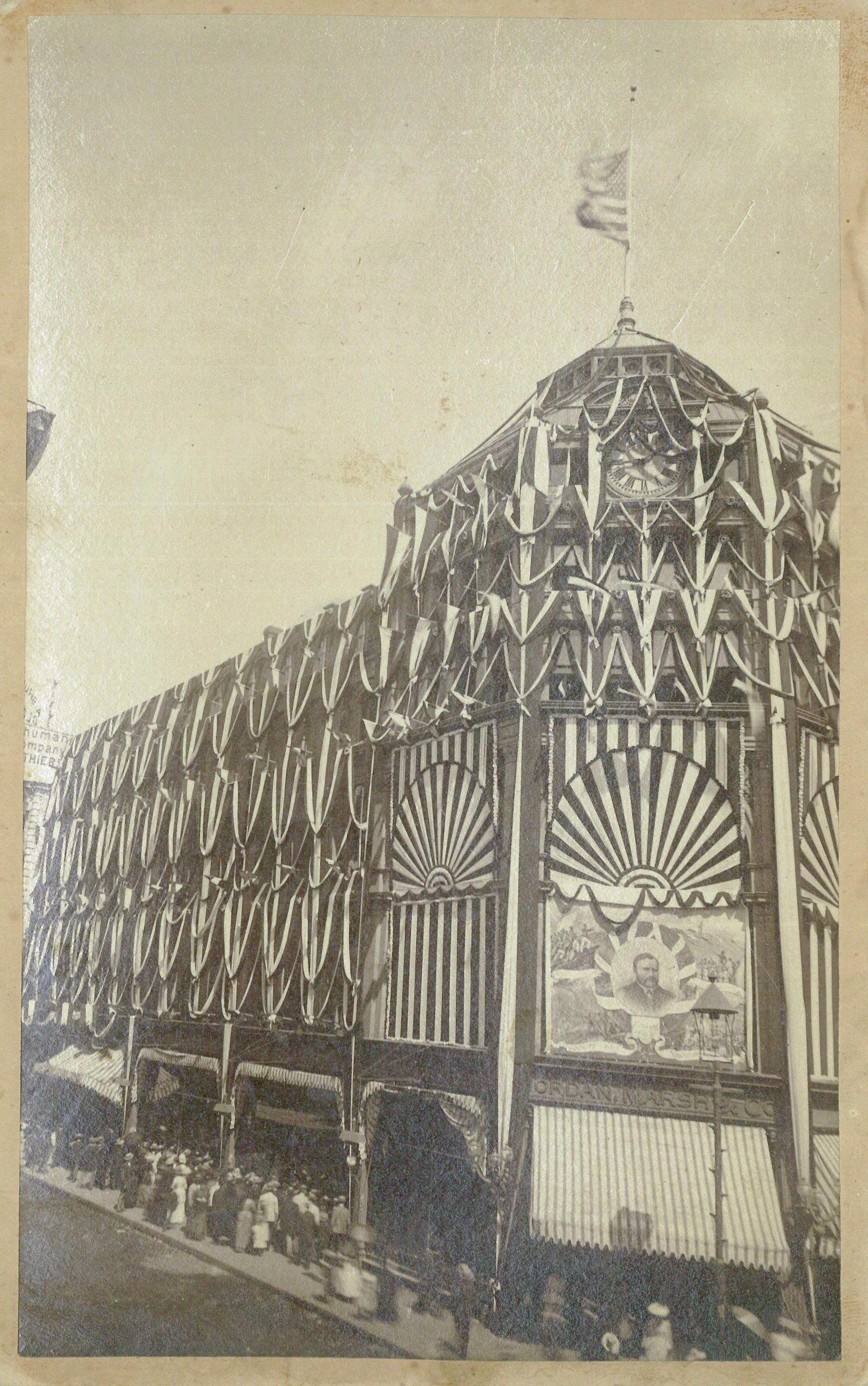
The first time I viewed this cabinet card, which is part of our Photographic Views collection, I immediately recognized the old Jordan Marsh building in Downtown Crossing and thought, “Wow! They really decorated Jordan Marsh up right for the 4th of July.” Perhaps drawn first to the flag atop the building, my mind’s eye assumed that the bunting in this black and white image was in fact red, white, and blue.

Jordan Marsh Building in Funeral Bunting after death of U.S. Grant, 1885

Looking more closely, I noticed the large image of a man in the panel directly over the awning and thought perhaps my initial instincts were wrong. Intrigued I turned the card over and read the brief handwritten description:

Jordan Marsh building, Washington St., Boston. Photograph by N.R. Worden, probably in 1885, after the death of Ulysses S. Grant.

In fact what I was imagining to be red, white, and blue was indeed a black and white display of mourning. A look through a jeweler’s loop showed that the four corners surrounding the portrait of Grant contained images of battle scenes, helping me confirm the portrait was indeed of Grant. It is likely that this photograph was taken at some point between Grant’s death on 23 July 1885 and his funeral, held in New York City, on 8 August 1885.

Interview with Author and NEH Fellow Martha Hodes

By Emilie Haertsch, Publications

Martha Hodes, author of The Sea Captain’s Wife: A True Story of Love, Race, and War in the Nineteenth Century, is the recent recipient of an NEH fellowship to conduct research at the Massachusetts Historical Society. The Sea Captain’s Wife was a finalist for the Lincoln Prize and was named a Best Book of 2006 by Library Journal. Hodes, who teaches at New York University, took the time to talk with us about the book, her past research, and her current project.

1. How did you come to know the Society and become involved in research here?

I first conducted research at MHS while I was writing my second book, The Sea Captain’s Wife: A True Story of Love, Race, and War in the Nineteenth Century. The book’s protagonist, Eunice Connolly, is a white, working-class woman from New England whose husband fought and died for the Confederacy – after which she married a black sea captain from the Caribbean. Manuscript collections at the MHS illuminated important context, including anti-slavery sentiments in the New Hampshire town where Eunice lived during the Civil War, and anti-Irish sentiments in the cotton mills (where Eunice worked). Eunice lived in Lowell when the war was ending, so I also invoked a Lowell woman’s personal response to Lincoln’s assassination from the Martha Fisher Anderson Diaries at MHS. I had no idea then what my next book would be about.

 2. What is the focus of your research during your NEH fellowship?

I’m writing a book, Mourning Lincoln, about personal responses to Lincoln’s assassination, encompassing northerners and southerners, African Americans and whites, soldiers and civilians, men and women, rich and poor, the well-known and the unknown, those at home and abroad. I’m specifically searching beyond the public and ceremonial record in order to move beyond the static portrait of a grieving nation that we find in headlines and sermons. The idea is to understand a transformative event on a human scale — access to the hearts and minds of individual Americans across the spring and summer of 1865 tells us so much more than we thought we knew.

 3. How did you become interested in history and decide to enter this field?

I went to college sure I’d be an English major. At Bowdoin, I ended up creating a double major in Religion and Political Theory. Then I continued my studies in comparative religion by getting an MA at Harvard Divinity School. During those years, my work-study job was at Radcliffe’s Schlesinger Library on the History of Women in America, and that was where I came to see that I was happier immersed less in abstract ideas and more in the workings of people’s daily lives. That’s when I applied to PhD programs in History.

 4. What inspired you to write The Sea Captain’s Wife? Did you discover anything unexpected while writing it?

While writing my dissertation at Princeton, I came across an amazing collection at Duke University – the letters of Eunice Connolly’s family. They didn’t belong in my dissertation and first book (White Women, Black Men: Illicit Sex in the Nineteenth-Century South), because Eunice’s story wasn’t a southern one, and I hoped no one else would discover the collection before I got to it. Lucky for me, no one did. And the letters did indeed yield unexpected discoveries — about race and racial classification. I found that when Eunice worked as a laundress during the Civil War (that was the lowest of lowly domestic work, reserved for Irish immigrants and black women), her New England neighbors barely thought of her as a white woman, and her subsequent marriage to a man of color further justified her exclusion from white womanhood. Then, when Eunice married the sea captain and went to live in the Cayman Islands, her neighbors there came to think of her as a woman of color, but in a very different way. In the Caribbean racial system, where the category of “colored” lay closer to whiteness than to blackness, Eunice’s status — as the wife of a well-to-do sea captain of African descent — rose beyond anything she had known as a poor white woman in New England. All in all, Eunice’s life story illuminates not only how malleable are racial categories and their meanings, but also how much power those classifications can hold. I didn’t know any of that when I began to write her story from the letters.

5. A number of professors have used The Sea Captain’s Wife in undergraduate and graduate-level courses. How do you feel about your work being taught and what do you look for in selecting materials for your own students?

I wrote The Sea Captain’s Wife for readers both within and beyond the academy, and I’m equally thrilled when professors assign it in their classes as I am when it’s chosen by, say, a women’s reading group. In my own classroom, whether I’m teaching conventional courses (like the Civil War or Nineteenth-Century U.S. History) or less conventional courses (like Biography as History or History and Storytelling), I strive to assign books that both impart good history and illuminate people’s lives, by asking — or prompting the students to ask — big questions about both the past and the present. I’m happy if The Sea Captain’s Wife can accomplish some of that. It’s what I hope to accomplish, too, in Mourning Lincoln.


This Week @ MHS

By Elaine Grublin

If you are in the neighborhood at lunch time on Wednesday, 1 August, plan to attend our brown-bag lunch.Research fellow Justin Clark, University of Southern California, will present “Training the Eyes: Romantic Vision and Class Formation in Boston, 1830-1870.” Clark will describe his work examining why, in the spectacular world of the nineteenth-century city, Boston’s Transcendentalists, clairvoyants, blind autobiographers, naturalists, artists, photographers, and numerous others became invested in seeing more than meets the eye, leaving time for discussion with audience members.

Before or after lunch — or anytime between 10:00 AM and 4:00 PM, Monday through Saturday — take some time to explore our latest exhibition, Mr. Madison’s War: The Controversial War of 1812, showcasing a number of letters, broadsides, artifacts, and images from the Society’s rich collections including a midshipman’s log of the USS Constitution describing the ship’s first great victory, letters written by John Quincy Adams to his mother while serving as the American minister to Russia, and a brass cannon captured from the British at the Battle of New Orleans in 1815.

And on Saturday, 4 August, do not miss “The History and Collections of the MHS,” our regular building tour. The 90-minute tour departs our front lobby promptly at 10:00 AM.


The Westland Gate

By Daniel Hinchen, Reader Services

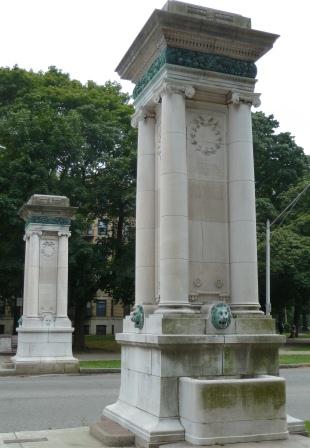
Walking just a few minutes south down the Fenway from the MHS, one arrives at the main entrance to the Back Bay Fens. At the intersection of the Fenway and Westland Avenue stands the Johnson Gates, more commonly known as the Westland Gate.

Erected in 1905, the Westland Gate is composed of a pair of large marble piers with columns on each corner and bronze lion head fountain spouts on each face. Beneath two of the spouts are marble basins. Flanking the piers are balustrades and two marble benches. The piers are constructed of white marble, while the balustrades and benches are Tennessee pink marble. While the fountains used to function and served as a water trough for animals, this use discontinued in 1919 due to an epidemic among horses.
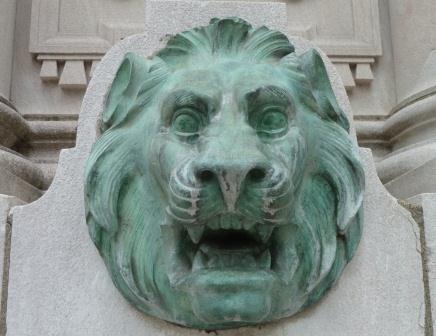
The gates were originally dubbed the Johnson Memorial Fountain after a wealthy Boston businessman, Jesse Johnson, whose widow, Ellen Cheney Johnson, donated the money to fund their construction in his memory.

Architect Guy Lowell was commissioned to design the fountain. Lowell is better known as the architect who designed the Museum of Fine Arts just a bit further down the road. In addition, Lowell designed several buildings on the campus of Harvard University, the New Hampshire Historical Society in Concord (which also features a sculpture by Daniel Chester French, who designed the John Boyle O’Reilly memorial on the Fenway), and the New York State Supreme Courthouse in New York City.

The fountains underwent their first restoration in 1980, at which time inconsistencies in the stone were addressed and the whole gate received a protective treatment to resist graffiti. A rededication ceremony was held in August of that year. There was a subsequent restoration in 1990. Since then, the fountains have remained untouched, though as of 2008 the Westland Gate and other fountains around the city are on a list of projects to be repaired by the Parks Department.

While the MHS does not have any material relating specifically to the Westland Gate/Johnson Memorial Fountain, there are plenty of items authored by Guy Lowell. Check ABIGAIL to see what there is!


This Week @ MHS

By Elaine Grublin

We are offering a couple of lunch time programs this week. Bring your lunch and join us in the Dowse Library for on of the following.

Monday, 23 July at noon listen as Andrew W. Mellon research fellow Benjamin Wright, Rice University, shares his insights into “Conversion and Antislavery, 1750-1830.” Wright’s project examines how ideologies of conversion directed the tactics of early antislavery reformers and how changes in these ideologies transformed antislavery into abolitionism.

Wednesday, 25 July at noon Malcolm and Mildred Freiberg research fellow Katherine Grandjean, Wellesley College, discusses her research into the relationship between the wars plaguing New England’s northern frontier and the rise of the press at the turn of the eighteenth century with “Terror ubique tremor: Communicating Terror in Early New England, 1677-1713.”

And on Saturday, 28 July do not miss “The History and Collections of the MHS,” our regular building tour. The 90-minute tour departs our front lobby promptly at 10:00.