
Celebrating Water with a Gala Day!

By Daniel Hinchen

“Never since the clink of the first hammer of civilization that rung its notes upon the tri-mountains of the present town or city of Boston, has there been or is there likely to be, such a gala day as that of the 25th of October, 1848! The entrance and reception of Washington, of Lafayette, and the still greater acclamation, parade and pageant that welcomed ‘Old Hickory,’ the Bunker Hill Celebration, all, all fall far behind the brilliancy, fervor and grandeur of the demonstration mode by the citizens of Boston and country adjacent upon this great occasion—introduction of the waters of Lake Cochituate into our city!”

Such was the joy in Boston and surrounding areas when the new aqueduct was opened in 1848, giving the citizens what they wanted and needed for so long: water that was not only fresh, but free.
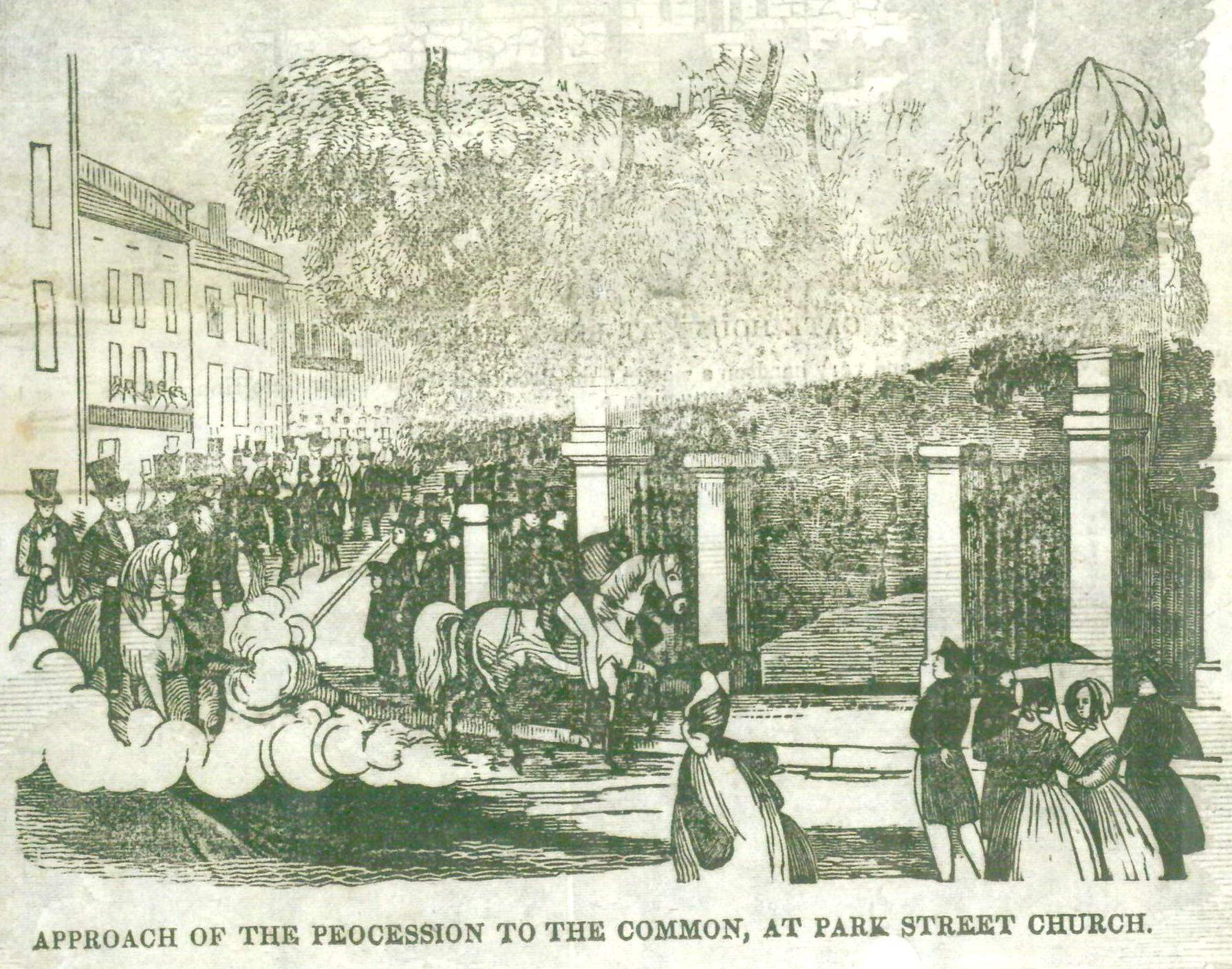
Newpaper image of Procession on Park Street, BostonWhile a modern day parade that hails our sports teams as champions draws thousands of loyal fans to the streets, none will celebrate an event that had such an impact on the city or attract such a diverse crowd. While some put their hopes and emotion into supporting the Bruins or the Red Sox and cheer their victories, this was a cause to celebrate lives saved and enriched.

People from all walks and all professions were in attendance. The great procession included, among others: firemen, military, various committee members, Governor Briggs, state officers, municipal authorities, clergy, physicians, mechanics, reporters. There were printers pulling a printing press that spat out flyers and programs as the group proceeded. All of these groups were represented in the first two divisions of the parade, which consisted of at least six divisions! And this does not include the people watching the procession. “We certainly never saw Boston so packed with people before; for miles nothing but compact masses of human beings were to be seen in our streets.”

Map of boston showing parad routeThe procession ended at Boston Common, at which point the performances began. There was singing by the Handel & Haydn Society, a prayer by a reverend minister, an ode sung by schoolchildren and penned by James Russell Lowell. A report on behalf of the Water Commission followed, along with an address by the Mayor. Finally, the water was turned on and the chorus from the Oratorio of Elijah was proclaimed.

Thinking of this event serves as a reminder of the major steps that a city like Boston takes in its development, and that the running water that is now taken for granted was once cause for unparalleled festivities, celebration, and joy.

To learn more about the celebration, or the struggle to bring additional clean water into Boston in the 19th century, visit the MHS library to discover additional source materials.
Web Presentation Launched Today: Massachusetts in the Civil War, 1861-1862

By Peter K. Steinberg

In connection with the exhibition The Purchase by Blood: Massachusetts in the Civil War, 1861-1862, the Massachusetts Historical Society has digitized a number of letters, photographs, and broadsides from its collections to present online. Available are small and large high resolution images as well as transcriptions of letters to facilitate reading where the handwriting may be difficult to discern.

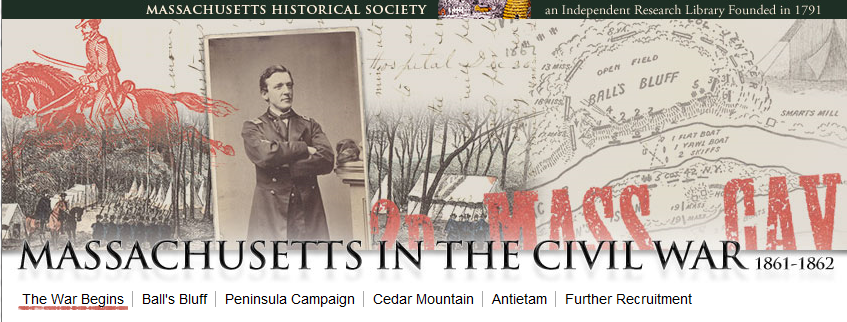
Image of web page banner

The pages in the web presentation represent a subset of the documents in the exhibition, narrating micro-stories of some battles which took place in Virginia (Ball’s Bluff, Peninsula Campaign, Cedar Mountain) and Maryland (Antietam). Regimental units were formed based on networks of friendships and alliances, and the featured materials convey the close connections between many of the soldiers. Each page highlights at least one of Massachusetts’s fallen sons, providing both a photographic image of a soldier and, in most instances, a letter which provides contextual information about a particular battle and/or a soldiers’ actions in the war and in death. Among those individuals featured are William Lowell Putnam, James Jackson Lowell, Richard Goodwin, Richard Cary, and Wilder Dwight. 

The launch is particularly timely as today is the 150th anniversary of the Battle of Ball’s Bluff, a battle explored in both the exhibition and the accompanying web presentation. 

In addition to this web presentation, please visit the The Massachusetts Historical Society Commemorates the Civil War subject portal to find additional online content, including our monthly presentation of a Civil War document from 150 years that month, a timeline, selected publications, classroom tools, and a list of past and future events held at the MHS.

Seminar Recap: Paying For “Freedom” with Her Health

By Anna J. Cook

On Thursday evening, October 13th, the Boston Seminar on the History of Women and Gender welcomed Helen Zoe Veit of Michigan State University who presented her paper “Paying For ‘Freedom’ with Her Health: Rising Life Expectancy, Women’s Aging, and American Youth Culture,” with comment by Brooke L. Blower of Boston University. Veit is an historian of food and nutrition whose first book, Victory Over Ourselves: American Food in the Era of the Great War (forthcoming in 2012) examines the modernization of food through home economics, food science, and self-discipline. While conducting research for Victory Over Ourselves, Veit discovered the work of Eugene Fiske and the Life Extension Institute, during the 1920s, in promoting the concept of self-discipline over “the one thing you couldn’t possibly apply [self-control of the body] to – that is, death.” “Paying For ‘Freedom’” examines the changing attitudes towards aging in the interwar period, with particular attention to the ways in which notions about the consequences of aging – and advice on anti-aging strategies – were framed differently for female and male audiences.

In comment, Blower commended Veit on her “classic cultural history objective” of seeking to understand how the discourse of self-discipline over the body as a means for extending life (and even defeating death?) has cast a “long shadow” over the 20th century. She pointed out how Veit brings our attention to the fact that, in the 1920s, Americans had to be sold on the idea that growing old could be a positive thing. One of the ways the fear of old age became managed was through separating the idea and performance of youth from one’s numerical age – the notion that acting young could actually make you physically youthful, no matter how many years you had been alive. Blower raised the question of whether the growing emphasize on youth in American culture may not, in fact, mask the reality that political and economic power remained in the hands of the late-middle-aged: “’youth’ rules; the young do not,” she suggested. Finally, she challenged Veit to provide more context – particularly exploring the way in which life extension efforts might relate to Teddy Roosevelt’s advocacy of “the strenuous life,” to fears of neurasthenia, and to the work of eugenics advocates. She was interested in popular reception of ideas concerning life extension, and whether Fiske’s advice had any noticeable effect on public practice. Given the gendered nature of the debate, she also wondered whether any women might be found pushing back against the new rhetoric of yourhfulness, and where and how they did so.

The discussion period was lively, as audience members discussed how persuasive Veit had been in her argument concerning the differing expectations of male and female youth and vitality. The consensus seemed to be that while the idea had promise, more evidence was needed. A number of suggestions were made for further exploration of context: Christian Science theology from the period, discussions of fertility and motherhood, the connections between nationalism and public health, the development of the life insurance industry and modern statistics collection, and scientific research on hormones.

The seminar series at the Massachusetts Historical Society are open to the public free of charge, with a small subscription fee for those wishing to receive the pre-circulated paper. We welcome you to explore our offerings, and hope to see you at upcoming sessions!

This Week at MHS

By Elaine Grublin

Our latest exhibition, The Purchase by Blood: Massachusetts in the Civil War, 1861-1862, is free and open to the public Monday through Saturday 10:00 AM to 4:00 PM. In addition to seeing the exhibition visitors will have the opportunity to attend two gallery talks this week. On Wednesday, 19 October, from 11:00 AM to 12:00 PM, and again on Friday, 21 October from 2:00 PM to 3:00 PM members of the exhibition’s curation team we speak about elements of the exhibition.

On Wednesday, 19 October at 6:00 PM current and potential associate members are invited to a special event just for them. Gloriously Gruesome at the MHS will feature a number of gruesome objects from the MHS collections. Registration is required for this event. 

And do not forget our weekly building tour The History and Collections of the MHS. The 90-minute tour departs our lobby at 10:00 AM.  


New on our Shelves: Hannah Mather Crocker’s “Reminiscences” Published

By Tracy Potter

One of the newest additions to the Society’s bookshelves is a volume more than 180 years in the making. Written by Hannah Mather Crocker in the 1820s and edited by Eileen Hunt Botting and Sarah L. Houser in the 2000s, Reminiscences & Traditions of Boston (Boston: New England Historic Genealogical Society, 2011) has finally made its way to publication. 

Hannah Mather Crocker was an author and early feminist. She was the granddaughter of renowned Puritan minister Cotton Mather, author of the Biblia Americana (another long awaited publication), and niece of Thomas Hutchinson, Jr., the royal governor of Massachusetts. Born in 1752, she lived through and participated in some of the most tumultuous and significant times in United States history. In her final years she wrote two versions of Reminiscences, combining personal anecdotes with a narrative history of Boston from the colonial era to the early 19th century. The manuscript touches on various elements of Boston history including religion, economics, gender, and foreign relations. Crocker also includes an extensive appendix of historical documents containing a large number of her own poems. 

Crocker began writing Reminiscences believing she would publish it in the near future. Unfortunately, she passed away in 1829 before she could make that happen. In the years after her death, her Reminiscences disappeared until John Wingate Thorton, a founder of the New England Historic Genealogical Society (NEHGS), acquired it for his own personal collection. Upon his death in 1878, Thorton bequeathed the manuscript to the NEHGS, where it remains today.

Botting and Houser create a fully annotated documentary edition of Hannah Mather Crocker’s Reminiscences & Traditions of Boston. This edition includes an informative introduction that provides background for Crocker, the manuscript, and the publication including a guide to how to read the two versions. It is fully indexed and includes a biographical directory, a poetry index, and a bibliography. In their attempt to remain true to Crocker’s original writing, the editors include Crocker’s original pagination, original spellings, and original notes. This volume will allow a wider audience to analyze, interpret, and understand the lives of residents and events that took place in Massachusetts from 1620 to the early 19th century.  

Sarah L. Houser is the Jack Miller Center-Veritas Fund Post-Doctoral Fellow at the Tocqueville Forum on the Roots of American Democracy at Georgetown University. Eileen Botting is an Associate Professor in the Department of Political Science at University of Notre Dame. Botting received the 2009-2010 Colonial Society of Massachusetts Fellowship which she used her to research on Hannah Mather Crocker’s and her Reminiscences at the MHS and a number of other New England research institutions. In January 2010 Botting presented some of her findings at a brown-bag lunch program at the MHS.   


A Lovely Day in the City

By Elaine Grublin

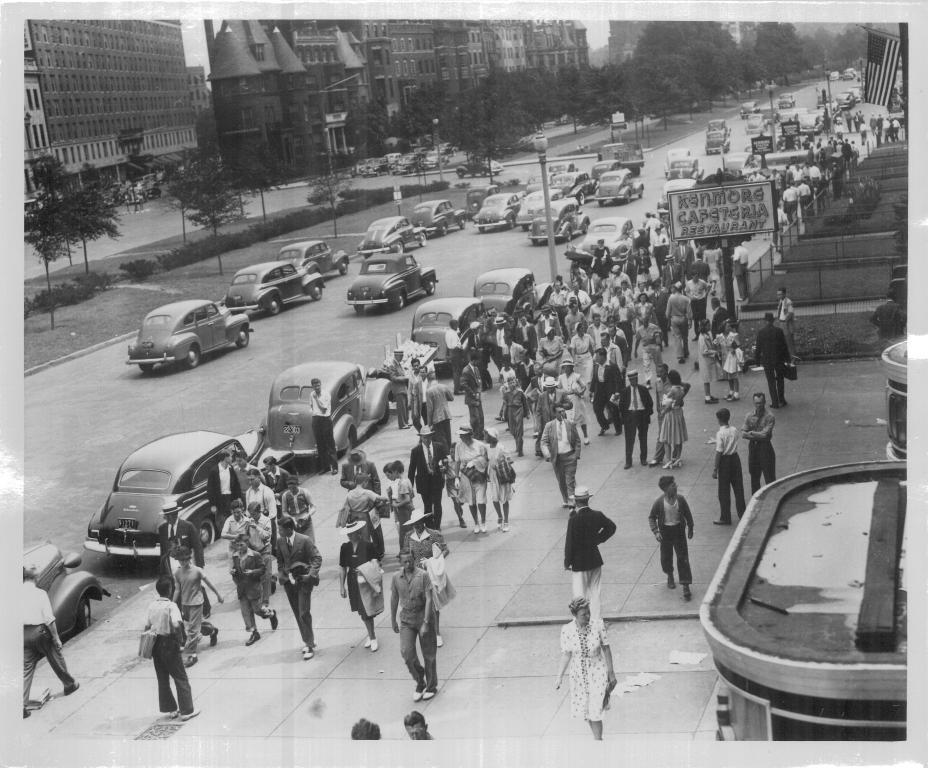
Yesterday walking around neighborhood in the sunny but crisp fall weather — Kenmore Square filled with bustling pedestrians, many carrying lightweight jackets thrown over their arms, others basking in the last warm days of season and braving the elements sans jackets — brought this image from the 1940s to  mind. Arriving at the MHS this morning I immediately went to the stacks to find the image. A close inspection revealed the image was likely captured in the spring rather than the fall, but the essence of Boston in the changing seasons is still there.

A crowd of pedestrians walking on Comm Ave in Kenmore Square, spring circa 1944

To relive this photographic moment today, head over to the Kenmore Square area and stand in front of Eastern Standard (528 Commonwealth Ave) looking down Commonwealth toward the Back Bay. In the image the two black signs on posts just behind the sign for the Kenmore Cafeteria mark the entrance to Kenmore Station.


Original photograph from Massachusetts Views, Boston Streets, Massachusetts Historical Society.

This Week @ MHS

By Elaine Grublin

Join us today between 11:00 AM and 2:00 PM for an Open House.  The MHS will be open for tours as part of the Fenway Alliance’s Opening Our Doors program.  Please note that the MHS library is closed today in observance of the Columbus Day holiday.  

Later in the week there are many other programs worth marking your calendar for.

Tuesday, 11 October, at 5:15 PM the Boston Environmental History Seminar offers John T. Cumbler, University of Louisville, presenting Cape Cod: The Environment, the Economy, and the People of a Fragile Eco-system. James O’Connell, National Park Service, will give the comment.  Advanced copies of the seminar papers are available for small subscription fee.  Find out more here.

Wednessay, 12 October, at 6:00 PM author Adam Goodheart, Washington College, offers a lecture centering on his recent book 1861: The Civil War Awakening.  Refreshments will be served beginning at 5:30.  

Thursday, 13 October, there is an offsite program, held at the Schlesinger Library at Radcliffe, beginning at 5:30 PM. The Boston Seminar on the History of Women and Gender presents
Helen Veit, Michigan State University, presenting on her research “Paying for ‘Freedom’ with Her Health”: Rising Life Expectancy, Women’s Aging, and American Youth Culture. Brooke Blower, Boston University, will give the comment. Again, advanced copies of the seminar papers are available for small subscription fee.  To subscribe to this series please email Susan Landry.

Stephen Greenleaf Bulfinch, Post 8

By Elaine Grublin

The following excerpt is from the diary of Stephen Greenleaf Bulfinch. Over the past two months the posts to the Beehive from the diary have been almost weekly as part of the Civil War series. From this point forward, the posts will be monthly — except in the few months where Bulfinch provides no comment about the war in his diary. 

This particular post is rather timely, as today marks the opening of the Society’s newest exhibition The Purchase By Blood: Massachusetts in the Civil War, 1861-1862. The terrible loss of life suffered by Massachusetts’ regiments at the Battle of Ball’s Bluff, referenced by Bulfinch as “a recent skirmish near Harper’s Ferry,” is a focal point of the exhibtion.

In this entry Bulfinch makes a slight mistake in identifying Col. Edward Baker. While Baker had lived in California for a number of years, he was a resident of Oregon at the time of his enlistment. He was elected to represent Oregon in the the US Senate in 1860. Baker was the only sitting US senator killed in the Civil War. 

Friday, Oct. 25th, 1861

The war advances slowly. The late engagements seem as much against as for us. We have to mourn the death of the gallant Col. Baker of Cala, & the death or capture of other valuable officers, – among them some of distinguished Boston families, in a recent skirmish near Harper’s Ferry. “O Lord, how long?”

Bulfinch’s pen remains silent in November 1861. Be sure to check back in December for his 15 December 1861 entry in which he comments on Union successes through the fall of 1861, the developing Trent Affair, and makes a prediction about the outcome of the war.

This Week @ MHS

By Elaine Grublin

It is another busy week at the MHS. Check your calendars and plan to attend one of the following events.

On Tuesday, 4 October, at 5:15 PM, the Boston Early American History Seminar series kicks off its season with Paul A. Gilje, University of Oklahoma, presenting his paper Contested Commerce: Free Trade and the Origins of the War of 1812. Drew McCoy, Clark University, will give the comment.  Papers are available in advance for all who subscribe to the seminar series. 

At noon on Wednesday, 5 October, Andrew W. Mellon fellow Bonnie Lucero, University of North Carolina, will present her research on Edwin F. Atkins and Race Relations in Cienfuegos, Cuba at a brown-bag lunch program.

Thursday, 6 October, brings a special event just for current MHS members and fellows. All members and fellows are invited to attend a preview and reception for our upcoming exhibition The Purchase by Blood: Massachusetts in the Civil War, 1861-1862. The program will open with remarks by guest curator Carol Bundy, author of The Nature of Sacrifice: A Biography of Charles Russell Lowell, Jr.  Registration is required for this event.

The Education Department is participating in a two-day teacher workhop, Teaching the Civil War, on Saturday and Sunday, 8 – 9 October. This workshop is sponsored by the Civil War Trust. Activities will take place at the Hyatt Regency Boston, as well as other historic sites in and around the city. There is still space for interested educators to sign-up. Pre-registration is required. For additional information, including schedules and registration procedures, visit the Civil War Trust website.

And on Saturday, 8 October, all are welcome to enjoy our 90-minute building tour, The History and Collections of the MHS, lead by an MHS docent. The tour departs the MHS lobby at 10:00 AM. 

Stephen Greenleaf Bulfinch, Post 7

By Elaine Grublin

The following excerpt is from the diary of Stephen Greenleaf Bulfinch.

Monday, Aug. 12th, 1861

 Among public events, since I last wrote, the battle at Bull’s Run is the most important, – an advantage, though a dear-bought one, to the secessionists. It has led to a change of commander in that section, and to more strictness of discipline and circumspection, while the spirit of the country rises to meet the emergency. There is some misgiving among the more timid, and the importance which the question of emancipation is beginning to assume, may divide our people somewhat. The hope of the secessionists is that England will interfere to break up the blockade which would keep from her the cotton on which she so greatly depends. Congress, after a short and efficient extra session, has adjourned.

My nephew, Charles F. B. has marched for the seat of war, as private in the 13th regiment – M.V.M. He left Monday, July 29th, and is stationed at Sharpsburg, near Harper’s Ferry.

His brother Thomas J. B. is still on board the Narragansett, by last advices at Acapulco, on the Pacific; and has received the approval of his officers, while his letters speak well for his intelligence and character.

Sunday, September 14th 1861

The condition of the country is yet painful; but hope increases, from successes, though not decisive ones in the West, – the capture of the forts at Hatteras Inlet, and the firmness of the government in crushing opposition in Baltimore.

Sunday, Sept 28th

Public affairs still critical. A pretty large force at Lexington in Missouri, of our men, compelled to surrender. Some dissension between the government and Gen. Fremont. But the good sense of the President, I trust under God, will prevent trouble there; an enormous army is said to be concentrated at Washington; Kentucky is decidedly on the Union side; and North Carolina gives favorable indications. The question, What shall be done about the slaves? is pressing itself on public attention, especially from Fremonts’ proclamation of freedom to slaves of secessionists in Missouri, & the president’s qualification of it. For myself, while with reverence I recognize the approaching settlement of the slavery question by Divine Providence, I am very anxious lest any false step should involve us in the guilt of calling the slaves to insurrection, & the horrors that must succeed. I think, the hour may come for declaring freedom to the slaves; but am disposed to fix the time for it at the end of the war, rather than in its course.

Our young connection Edw. Huntington, has entered the regular army. My brother F. continues to receive good accounts from his sons. Two of my young parishioners, W. F. & P. B. have returned from the army, out of health.

Be sure to visit the blog in October to read Bulfinch’s comments on the Battle of Ball’s Bluff.