This Week @ MHS

By Elaine Grublin

This week we have a two events at our 1154 Boylston Street home, and two co-sponsored events at alternate locations. Please note where events are happening as you plan to attend.

Thursday, 10 March, we have two public events. At 12:15 PM join us for a co-sponsored event at Old South Meeting House. Come listen as Jim Hollister, Minute Man National Historical Park, and Emily Murphy, Salem Maritime National Historic Site, present
“Let Us Wait No Longer!” Salem and the Lexington Alarm. And at 5:30 PM Annette Gordon-Reed, author of Pulitzer Prize winning The Hemingses of Monticello, will present her paper “The Hemings Family in the Nineteenth Century” as part of the Boston Seminar on the History of Women and Gender. Nell Irvin Painter, Princeton University, will give the comment. This event will take place at the Schlesinger Library at Harvard University.

Friday, 11 March, we kick off our spring exhibition History Drawn with Light: Early Photographs from the Collections of the Massachusetts Historical Society. The exhibition will be open to the public Monday through Saturday, 1:00 PM to 4:00 PM, from March 11th to June 3rd.

And last but not least, our 90 minute Saturday building tour will begin at 10:00 AM in the front lobby on 12 March.

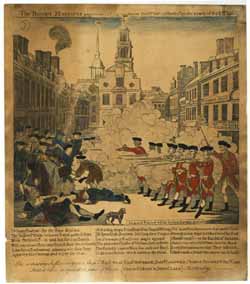
The Bloody Massacre perpetrated in King Street….

By Elaine Grublin

Today marks the 241 anniversary of the events that came to be known as the Boston Massacre.

On our website and in our reading room, you can read contemporary accounts of the events of that day or study visual representations such as Paul Revere’s engraving (based on an original drawing by Peter Pelham) which captures a less than historically accurate view of the event, but speaks volumes about how the event was interpreted for years to come.

 Revere's Massacre

For the hands-on learner, the Bostonian Society is offering a day full of interpretive events at the Old State House, culminating in a re-enactment of the Massacre at 7:00 PM.

Welcome Dan Hinchen, Library Assistant

By Anna J. Cook

It has been a season of change in the Massachusetts Historical Society’s library. On February 23rd, the Library Reader Services staff welcomed yet another new member to our ranks: Library Assistant Dan Hinchen.

Dan is not a complete stranger to the MHS, having served as a reference intern with us in 2009. During his tenure he became skilled at responding to long-distance reference queries, and also began to develop subject guides for our collections – a skill we hope to put to good use in the near future as the library revisits some of its online reference resources.

In 2007, Dan was hired to develop an archives program for the Boston Arts Academy and Fenway High School, where he has served as the “lone arranger” for the past four years. There he established the archives’ policies and procedures and supervises the work of student interns and volunteers. In addition to this position, Dan has worked at the Simmons College Beatley Library and completed a cataloging internship at the ProjectSave Armenian Photographic Archives. In 2010 he earned his Master’s in Library Science at Simmons College Graduate School of Library and Information Science.

We are pleased to welcome Dan as part of our staff, and look forward to working with him as part of our team.

Spring Time Means Baseball!

By Tracy Potter

As the late-winter thaw creeps over New England, melting away the snow banks that dwarf the average person and New Englanders pray for no more snow until next December, we cannot help but look toward the one glimmer of hope of the coming spring: Red Sox spring training at Fort Myers, Florida. This week spring training is in full swing as the Red Sox face off against various teams, warming up for the 2011 baseball season. In honor of this treasured time of year I give a nod to the beginnings of one of America’s most loved pastimes: Baseball.

When this idea was first proposed, I was asked to scour our collections for anything related to baseball that we could use to connect to spring training. Just as I thought “What on earth do we have related to baseball here?” I received a phone call from a young woman who wished to view a carton from our Globe Newspaper Co. Records. As I checked the carton to make sure the materials were in order, what did I stumble upon but an 1872 baseball scrapbook assembled by none other than George Wright, one of the first men to play for the professional baseball club the Boston Red Stockings.

In 1869, George’s brother Harry Wright managed the first professional baseball team, the Cincinnati Red Stockings. Two years later Harry moved east to manage the Boston Red Stockings. George, a talented shortstop and occasional second baseman, followed his brother from Cincinnati to Boston. He was team captain of four time association winners the Boston Red Stockings from 1871 to 1875. While in Boston, he kept a scrapbook of newspaper statistics and articles written about the professional baseball games played during the 1872 season. In 1920 he gave the scrapbook to the sports editor of the Globe Newspaper Co., Walter S. Barnes. According to a note found inside the scrapbook, the volume was rescued from a trash can in 1948 and placed in the company’s records.

Inside Wright’s scrapbook I found a two page layout of clippings from the New York Clipper analyzing each of the “Boston Nine” (a name given to the nine starters) including George Wright. These clippings demonstrate that in baseball some things will never change. Teams will always be on the lookout for a good captain to lead the team, for catchers who can actually catch their pitchers crazy pitches, for players who do not talk back to the umpires and cause a ruckus on the field, for pitchers who know how to outthink the batters, and for players who keep up their training through the offseason and enter the new season in tiptop shape (see image below), not arriving bloated and slow from too much alcohol, food, and other mischievous amusements.

detail of newspaper clipping from 1872 baseball season scrapbook

As the Red Sox players arrived in Fort Myers over the past few weeks, I found myself hoping that each arrived uninjured, ready to throw some balls, hit some home runs, and run like he has never run before. We New Englanders are counting on them to pull us out of these winter doldrums and into a season of sun, warmth, and wins.

To view the full image of Wright’s ‘Boston Nine’ described in clippings from the New York Clipper, click here.

A Winter Poem

By Elaine Grublin

As we welcome March, with the winter of 2010-2011 already on record as one of the ten snowiest winters in Boston since records have been kept, we share a poem written on 1 March 1780, noting the severity of the winter of 1779-1780. I think we all can agree that there is a sense of kindred spirit here.

On the Severity of the Past Winter

Long Winter rul’d with unrelenting sway,
And shook his icy sceptre o’er the day –
His snowy magazine’s enormous door
Ope’d wide, nor shut, till drain’d of all its store
Repeated torrents overwhelm the ground;
The earth was in a fleecy deluge drown’d.
The winds let loose impetuously sweep,
The tortured surface of the candid deep
This way & that, with all their fury blow
And raise huge billows of the yielding snow;
Stiffen’d at length, when no more storms arose
Or of descending or ascending snows,
But wearied all in calm & silence lies
Then all the power of cold fierce [illegible] tries
Thy fire began to dread it’s empire lost
Victory hung dubious,’ twixt the fire & frost
While the front suffer’d, smashing with the fire
The cold assailed us, pressing on our rear
But when oblig’d to leave the friendly hearth
Down to the lungs the cold congeal’d our breath
With quick’ned step, we hasted thro’ the streets
The threshold soon salutes the impatient feet.
Pale Phoebus shot oblique his feeble ray
Soon leaving us to mourn his transient stay.
Thanks to that Power who had the seasons roll
Commanding Sol to visit either pole
He now approaches to our hemisphere
And Aries waits him to renew the year
His beams now more direct dissolve the snow
The waters steal away & hide below. –
He who hath plac’d his shining bow on high
Which stands his faithful witness in the sky
That while the earth remains in order due
Day shall to night & heat to cold ensue
Is now beginning to unseal our hands
And gradually loose Orion’s bands –
Let us like him of vows e’er mindful prove
And let us like the Sun obedient move,
To the wise orders of the Lord above:
Nor from the paths of his commandments stray
Whose will the earth & air & heavens obey.

Finis.

The manuscript copy of this poem is contained in the Mellen Family Papers. Our preservation librarian, Kathy Griffin, came upon it in the early fall while processing that collection. At the time we hoped that the poem would not be fitting to post in the coming March. But I must say we have had a winter to rival the one this poet describes.

Transcription by Betsy Boyle.

This Week @ MHS

By Elaine Grublin

With at least one event happening each day from 1 March to 5 March, everyone should be able to make it in to the MHS for an event this week:

Tuesday, 1 March at 12:00 PM the next installment of the lunchtime mini-course series offers “What does Massachusetts have to do with … the French Revolution?”presented by
Sara Martin and Sara Sikes of the Adams Papers Editorial Project.

Wednesday, 2 March there are two programs. At noon Andrew W. Mellon fellow Rachel Herrmann, University of Texas at Austin, will present her research on “Food and War: Indians, Slaves, and the American Revolution” at a brown bag lunch program. And at 6:00, there will be a screening of Hit and Run History a film by Andrew Buckley tracing the voyage of the ship Columbia. Refreshments will be served at 5:30 PM.

Thursday, 3 March there is one event in the building, and another MHS co-sponsered event at Old South Meeting House. At noon Lou Sideris, Chief of Planning and Communications, Minute Man National Historical Park will present a lecture at Old South Meeting House (directions) on “Landscape of Memory — A Sense of Place.” And back at 1154 Boylston at 5:15, the Boston Early American History Seminar continues with MHS/NEH longterm fellow Rachel T. Van presenting the paper “The Woman Pigeon: Sociability, Sexuality, and the Anglo-American Community in Canton and Macao”. Robert P. Forbes, University of Connecticut – Torrington will give the comment.

Friday, 4 March at 12:00 PM, Malcolm and Mildred Freiberg Fellowship recipient Mary Kelley, University of Michigan, will present a brown-bag lunch program on her research “‘What Are You Reading, What Are You Saying’: American Reading and Writing Practices, 1760-1860.”

Finally on Saturday, 5 March we again have two programs. Our 90 minute Saturday building tour starts in the front lobby at 10:00 AM. And at 2:00 PM the next installment in the “Dangers and Denials” Conversation Series brings Bruce Ackerman, Yale Law School, to the MHS for a conversation about “The Decline and Fall of the American Republic.”

We hope to see lots of new and familiar faces at the many events this week.

Discovering the New England Watch and Ward Society

By Anna J. Cook

One aspect of working at a research library that I enjoy immensely is seeing the fruits of our researchers’ labor in the form of published works. I recently had the pleasure of reading historian Neil Miller’s recently published history Banned in Boston: The Watch and Ward Society’s Crusade against Books, Burlesque, and the Social Evil (Boston: Beacon Press, 2010). This slim volume chronicles the activities of the New England Watch and Ward Society, a private organization with considerable political influence in the Boston area and throughout the region, between 1878 and 1967.

Part of Miller’s research took place here at the MHS, where we hold the Godfrey Lowell Cabot Papers. Cabot was a prominent member of the Watch and Ward, to which he began donating funds in the early 1890s. He joined the Watch and Ward in 1900, served as treasurer from 1915 to 1940, and remained active into the 1950s [1]. Of the 73 boxes of material in the Godfrey Lowell Cabot papers, only two boxes are directly related to the Watch and Ward Society between 1913 and 1921. Yet those two boxes offer researchers a wide range of documentary evidence concerning the Watch and Ward’s activities during this period. My own perusal of the collection this week turned up a few documents that hint at some fascinating stories.

For example, there is an invoice from The Morgan-Boylston Detective Agency for expenses related to “Case 1172” during the fall of 1917. These expenses included taxi hire, car and boat fares, a railroad trip from Boston to New York City, room at a hotel, and unspecified “entertainment.” $10.00 in cash was also paid out to a Mr. H.

A more descriptive report from the same case is found in another folder, and it becomes clear that the investigators are seeking out information concerning the activities taking place at a certain hotel where “it is claimed many high jinks times used to occur.” The author of the report (“Operative #38”) observes, “I attended a banquet on business one night in almost the same room pointed out by Mrs. Moore, if not the same one, when girls in pink skin tights danced the ‘Hoochy Koochy’ on the dining table.”

The Watch and Ward was not only interested in illegal activities, but also in monitoring the efforts of “good people” and institutions involved in public health. On 16 April 1918, J. Frank Chase, the secretary of the Watch and Ward, wrote a letter describing his visit to the Old Army Medical Museum in Washington D.C. for a screening of “Fit to Fight,” a propaganda film that was part of the military’s attempt to combat “the Social Diseases.” While he approved of the general effort, Chase was critical of certain aspects of the film:

Realizing the difficulties of the subject and how mistakes are inevitable and the diversity of opinion even among good people as to the details and the methods of doing this necessary work, I am loathe to criticize the work accomplished. Yet, I must urge one criticism of the method. It concerns the unwisdom [sic] of putting on exhibition at the very beginning or at all the picture of a nude woman of full front view, as is done in this film.

While he acknowledges the “nude” is, in fact, a statue of Venus, he argues that its manner of display is troubling. It “does not declare itself as a statue until after such a time as gives the mind a chance to conclude ‘Here is the picture of a naked woman,’ and to gasp at the boldness.”

It is unclear from the existing correspondence whether anyone in the War Department was similarly offended by the film, or whether Chase’s objection to it had any effect on future screenings.

These are just a few examples of the primary source materials to be found in the Cabot papers related to Watch and Ward efforts. You can read more about the Watch and Ward in Miller’s new book, Banned in Boston. The Geoffrey Lowell Cabot papers are open and available for research in the Library’s reading room.

[1] Neil Miller, Banned in Boston, 47.

Spotlight on Collections: The Lodge Papers, Part 3

By Tracy Potter

Last time in Spotlight on Collections, I wrote about the history of the Cabot and Lodge families and touched briefly on Henry Cabot Lodge (1850-1924). Today I will further discuss Henry Cabot Lodge and his political and historical importance to both United States and world history.

Henry Cabot Lodge (HCL) was born in Boston in 1850. In 1871, he married Anna “Nannie” Davis. They had three children, including George Cabot Lodge who became a well known poet and the father of Henry Cabot Lodge, Jr. (HCL II) During his early years at Harvard College, HCL began a friendship with one of his history professors, Henry Adams. Later, while in law school, HCL went on to work for Adams (unpaid) as assistant editor at the North American Review. HCL obtained a law degree from Harvard Law School in 1874 and continued on at Harvard University to obtain one of the first PhDs for history awarded in the United States in 1876. After obtaining his PhD, HCL returned to Harvard as a lecturer of American history and began writing a biography about his great-grandfather entitled Life and Letters of George Cabot. He later wrote biographies about Alexander Hamilton, Daniel Webster, and George Washington.

HCL began his political career serving in the Massachusetts House of Representatives from 1880-1881. In 1884 he became a delegate-at-large at the Republican National Convention where he developed a close friendship with fellow delegate-at-large Theodore Roosevelt of New York. During the convention both men faced a difficult decision: support the unpopular traditional party politics or the more popular party reformers. A reform movement had taken hold in the Republican Party by 1884, advocating for less corruption within party. When it became clear that the reformers would abandon party loyalty and support the Democratic nominee for president, both Roosevelt and Lodge made an unpopular choice. They remained loyal to their party supporting the Republican nominee, James Blaine, with the hope of initiating more change from within the party. This decision resulted in resentment from their reformer friends and constituents.

HCL’s and Roosevelt’s trial by fire cemented their respect for each other and their friendship, which would last through times of political partnerships and disagreements until Roosevelt’s death in 1919. The Republican National Convention of 1884 also set the tone for HCL’s political career. He was never afraid to give his opinion, to choose the unpopular choice (risking the backing of his constituents and even his own party), or to change his mind after further investigation. It was this type of politics that often alienated his constituents and fellow politicians.

In 1887 HCL was elected to the US House of Representatives, where he served until 1893. At that time he was elected to the US Senate and served there until his death in 1924. As a senator, HCL’s interests rested in foreign affairs. He often loudly advocated for issues he felt strongly towards such as a stronger US Navy, civil service reform, the federal supervision of national elections in the South, and the building of the Panama Canal. HCL just as forcefully campaigned against issues he did not agree with such as the direct election of senators by the people and the creation of the League of Nations. HCL was very vocal about his views, never pulling his punches in speeches regarding presidential policies or when confronted by disapproving pacifists. In the end, although not loved by all, HCL did a great deal for Massachusetts and for the United States as a whole (much more than I can touch on here), carrying on the legacy of the Cabot and Lodge families.

As the brevity of this blog post provides terribly inadequate space to fully describe HCL’s influence on the United States, you may wish to delve deeper into his world by reading more about his life in the following publications:

Lodge, Henry Cabot. Early Memories. New York: Charles Scribner’s Sons, 1913.

Thomas, Evan. The War Lovers: Roosevelt, Lodge, Hearst, and the Rush to Empire, 1898. New York: Little, Brown and Co., 2010.

Washburn, Charles G. “Memoir of Henry Cabot Lodge.” Proceedings of the Massachusetts Historical Society 58 (1925): 324-376.

Join me on March 9th when I write about the connection between Henry Cabot Lodge and the MHS, and give an overview of his collections held by the MHS.


Happy Presidents’ Day

By Elaine Grublin

Most people who are familiar with the MHS know that two of our most well-known collections are the Adams Family Papers and the Coolidge Collection of Thomas Jefferson Manuscripts.  Between these two collections, the MHS holds a large corpus of papers belonging to three American presidents: John Adams, Thomas Jefferson, and John Quincy Adams.  These collections contain items written by the individual men and members of their families throughout their lifetimes, including the years they served as President of the United States.   

But did you also know that the MHS holds some volume of manuscript material written by each man that has held the office of president through to George Herbert Walker Bush?

We most definitely do.  Although we do not hold documents written by all of these men during their presidential terms, we do have materials authored by them during their lifetimes sprinkled throughout our collections.  Most of these items are letters held in the individual collections of the men and women that received them.  Other items are materials collected by third parties contained in autograph collections.   

On this Presidents’ Day as you think about the lives of the men that have held this highest office, take a few minutes to peruse the Presidential Letters at the Massachusetts Historical Society.  This collection guide, completed in 2010, is a roadmap to finding manuscript materials authored by American presidents in our collections.  If you have any questions about any materials in this guide — if you would like to plan a visit to view any of the items, or would like to request copies to be sent to you — please contact our library staff at library@masshist.org.  


This Week @ MHS

By Elaine Grublin

Another busy week for programs at the MHS:  


Wednesday, 23 February at 12:00 PM, Paine Publication Fund fellow Edward W. Hanson presents his brown-bag lunch, “Crime in the Early Republic: Robert Treat Paine as Massachusetts Attorney General.”  Bring a lunch and join in the conversation.

Thursday, 24 February at 5:15 PM, The Boston Immigration and Urban History Seminar continues with Christopher Capozzola, Massachusetts Institute of Technology, presenting his paper “How Filipino Veterans Joined the Greatest Generation: Transnational Politics and Postcolonial Citizenship, 1945 – 2009.”  Margot Canady of Princeton University will give the comment.   

Friday, 25 February at 12:00 PM, Alan Hoffman, president of the Massachusetts Lafayette Society, will present a lunchtime program Lafayette and the Farewell Tour: Odyssey of an American Idol.  

And finally, our Saturday building tour starts at 10:00 AM.