Reflections from a John Winthrop High School Student Fellow

By Sahai Virk, Milford High School, 2023 MHS John Winthrop Student Fellow

Today, I want to share my experience as a student fellow at the Massachusetts Historical Society (MHS) and how it helped me explore the effects of social welfare on low-income minorities in 19th-century Massachusetts. Buckle up for a journey through the past, filled with insights, surprises, and a few head-scratching moments!

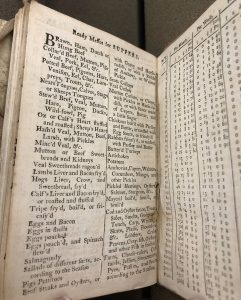
One of the most enjoyable aspects of this fellowship was diving deep into the historical records of almshouses because while I’ve read passages from primary resources in school, I had never tackled the entire primary resource in detail. These public institutions aimed to help the poor, elderly, and disadvantaged. Unearthing menus from almshouses like Ward’s Island and Randall’s Island gave me an understanding of the food disparities among inmates. It made me wonder if low-income minorities received equitable nourishment compared to others. An exciting find was John Stanton Gould’s report comparing food in almshouses and prisons, showing some prisons offered a more varied and nutritious diet.

However, the journey wasn’t all smooth sailing. The most challenging part was dealing with the limitations of historical records, which often lacked specific details about minority experiences in these institutions. This made it difficult to gauge the healthcare needs to be met for minorities living in almshouses. I could extensively research and answer my original question if I had more time. My research question was broad and hard to tackle, so if I had a couple more months, I could find more details and evidence by examining more sources.

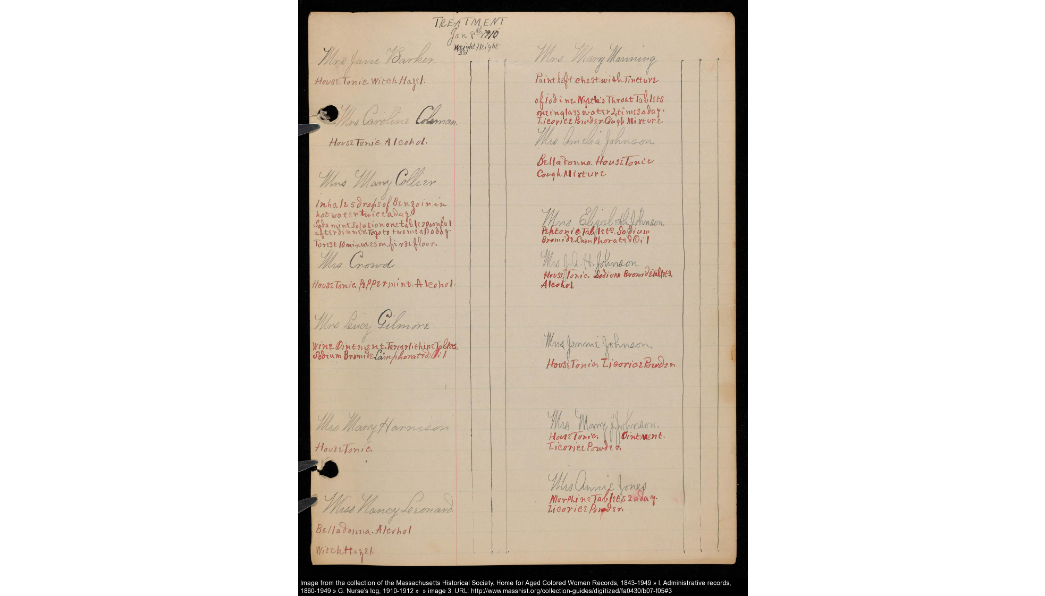
I also explored other avenues to approach my research question, like homes for the elderly, which were established specifically for aging individuals lacking familial support. Comparing the Home for Aged Colored Women to others that excluded people of color revealed disparities in healthcare provisions. For example, some homes had multiple physicians working free of charge, while others only had one nurse. It made me ponder the impact of socioeconomic factors on healthcare access for low-income minority communities during that time.

My initial research question evolved and became more nuanced during my research journey. I wanted to explore the legacy of social welfare institutions on healthcare and understand how these establishments shaped the modern healthcare system. However, the limited historical records challenged me to find other avenues to understand the reactions of minority communities to healthcare laws and procedures. 

As I conclude my fellowship, I am grateful for the eye-opening experience that brought me closer to the struggles and triumphs of low-income minorities in 19th-century Massachusetts. It’s a constant reminder that we still have work to do in addressing healthcare disparities for all communities, and the legacy of social welfare institutions continues to impact our healthcare system today.

Teaching the Family Tradition: George Washington Adams and John Adams II Learn to Write and Preserve Letters

By Miriam Liebman, Adams Papers

In the summer of 1809 as John Quincy Adams prepared to set sail for St. Petersburg, Russia where he would serve as U.S. minister until 1814 with his wife Louisa Catherine and their son Charles Francis, he made plans for his two older sons, George Washington Adams and John Adams II, to stay with family in Quincy, much to his wife’s protest. While John Quincy had spent brief periods away from his children when he served as a U.S. Senator for Massachusetts in Washington, D.C., this would be the longest and furthest away he would be from his two older sons.

While he was in Russia, John Quincy wrote letters to his sons, who were now eight and six years old, for the first time. Previously, he would include brief notes or pieces of advice to them in letters addressed to either his wife or parents. As with his other letters from Russia, these were long letters filled with information and advice. In the letters to his sons, he focused on their education, writing, and penmanship, all highly valued skills by the Adams family. He also reminded his sons of their place in the world. He wrote, “you should each of you, consider yourself, as placed here to act a part— That is to have some single great end or object to accomplish; towards which all the views and all the labours of your existence should steadily be directed.”

Within these letters, he explained to his sons the family mandate: writing and recording one’s correspondence. This family practice went back to when his father, John Adams, first wrote of this idea to his mother Abigail Adams, on 2 June 1776 explaining how he had not kept a record of his correspondence and now purchased a folio book to keep track of his letters. John Adams did not wait long to pass this now family tradition on to John Quincy Adams. On 27 September 1778, John Quincy, while abroad in Europe, wrote to Abigail Adams about how his father taught him this same mandate. He wrote, “My Pappa enjoins it upon me to keep a journal, or a diary, of the Events that happen to me, and of the objects I See, and of Characters that I converse with from day, to day.” As he was only eleven years old at the time, he continued, “altho I am Convinced of the utility, importance, & necessity, of this Exercise, yet I have not patience, & perseverance, enough to do it so Constantly as I ought.”

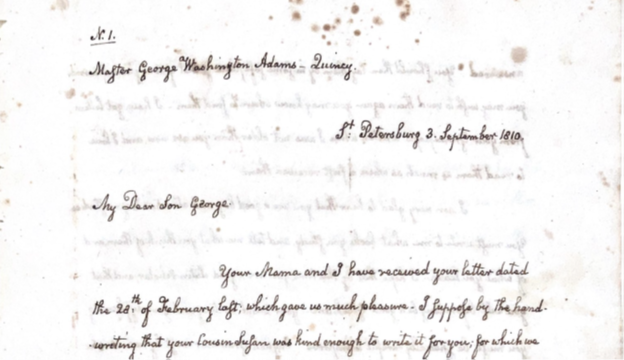
detail of a handwritten letter
John Quincy Adams’s letter to his son George Washington Adams, 3 September 1810.

John Quincy did not wait until his sons were eleven years old to teach them the family practice and used his letters to his sons from Russia to introduce them to the family mandate. John Quincy provided practical advice for how George Washington Adams should keep track of his letters, a key part to preserving and recording one’s letters. The first step, according to John Quincy, was to keep all the letters he received from his parents. As part of this step, he advised his son to follow his lead and number the letters he sends. John Quincy wrote, “I have therefore numbered this letter at the top, and will continue to number those that I shall write you hereafter— Thus you will know whether you receive all the letters that I shall write you, and when you answer them you must always tell me the number or the date of the last letter you have received from me—.” In case George Washington Adams was not sure what his father meant, John Quincy told him to ask his uncle Thomas Boylston Adams how to number them, but also how to endorse and file them. He then suggested storing them in “some safe place” so that he could read them again if he wanted.

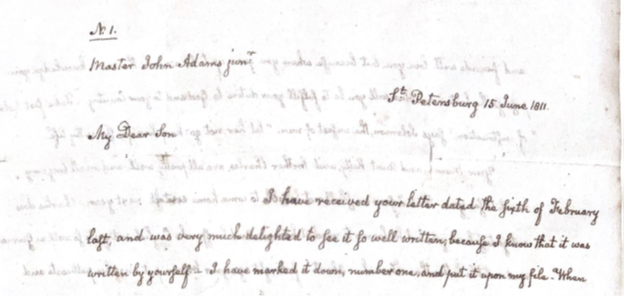
John Quincy provided similar instructions to John Adams II. Upon receiving his first letter from his second son, John Quincy “marked it down, number one, and put it upon my file.” While not providing the same detailed instructions, which George Washington Adams likely explained to his younger brother, John Quincy did have similar expectations that his second son would write him letters demonstrating his improved penmanship. He noted that since this began their individual correspondence, he noted it as number one, and that he was “very well pleased that you have resolved to keep your own file; and hope that it will be followed by an entertaining and instructive correspondence between us.”

John Quincy Adams’s letter to his son John Adams II, 15 June 1811.

With these letters sent to his sons thousands of miles away, John Quincy began to teach the next generation of Adamses the important family tradition of writing, recording, and preserving correspondence.

The Adams Papers editorial project at the Massachusetts Historical Society gratefully acknowledges the generous support of our sponsors. Major funding of the edition is currently provided by the National Endowment for the Humanities, the National Historical Publications and Records Commission, and the Packard Humanities Institute.

Of Sun and Sand: Beaches in the MHS Collections

By Meg Szydlik, Visitor Services Coordinator

As this very rainy summer winds down and fall peeks its head out from around the corner, I find myself thinking wistfully about going to the beach. Growing up in NJ meant that summer was full of trips to the shore and the boardwalk. I formed a strong affinity for the beach. This wet and dreary summer has made taking a trip out to one of the many beaches around Boston difficult. Instead, I decided to take a virtual visit to some of the beach scenes that the MHS has in its archives. There are quite a few! It’s not quite as good as getting the sand between my toes, but it is delightful to see people from all different times enjoying themselves at the beach just like I do.

Black and white scene of a beach. There is a little boy in the foreground. In the background there is a pair close to the water and a group of people playing with a ball further from the water.
North End Bathing Beach, Boston, possibly by Arthur A. Shurcliff, circa 1920s

Heather Rockwood wrote a blog last year about some of Boston’s beaches but these are far from the only beaches in the MHS collections. One such example is the image of a bathing beach in the North End. The little boy in the foreground drew me in immediately with the mischievous glint in his eyes as he looks at the camera and the mostly empty beach in the background. He is not alone, though. On the other side of the beach, some more people are in view, including a group that looks like they are playing some kind of game and an older pair looking out at the water. However, instead of the bathing suits I grew up wearing, everyone is fully dressed in normal clothing. Despite that, this is very recognizable as a scene at a beach today, just as the crowded beach labeled as “probably in Boston area” from the same collection elicits a sense of salt air and giggling as children run through the crowds of people and umbrellas. Despite being from the 1910s, the image is familiar and nostalgic to me more than 100 years later.

Scene of a beach. There are lots of people sitting under umbrellas and playing in the water. The image is black and white
View of crowded beach, probably in Boston area, unidentified photographer, circa 1910s.

Now that’s what I call beach!

Beach paintings are also a theme I recognize. I love the paintings of blue skies and oceans and charming beaches that show up in MHS collections, including a collection by Henry Adams. A watercolor of a beach in the Caribbean is especially interesting to me. It’s not terribly sophisticated but it captures the sense of peace that I always feel at the beach. Adams also created sketches of people and palm trees on the beach. It almost makes me want to dive in myself! The romance of sunny beaches in faraway lands is enticing and looking through these examples is delightful.

Watercolor of a beach. The bulk of the beach was created by the page intentionally left blank. There is darker coastline to the left. The water is very blue and the sky is a slightly lighter blue. The scene does not have any people.
[A beach on the Caribbean. Nassau? 1894-5], by Henry Adams.

If you haven’t been to the beach in a while, looking through some of the MHS collections can be a great way to “go to the beach” virtually. I know I enjoyed flipping through all the beautiful pictures! If beaches are not your scene, though, the Beehive has explored plenty of other places, including the White Mountains, New Zealand, Europe, and cross-country trips. Explore our archives and blogs to plan your virtual vacation!

Edward Atkinson, Eleazer Carver, and the Ginning of Port Royal Cotton during the Civil War

By Ian Delahanty, Springfield College, MHS Suzanne and Caleb Loring Fellow

Much was riding on the cotton crop that flowered on Port Royal Island in the autumn of 1862.  Occupied by Union forces since November 1861, Port Royal soon became the focal point of a radical experiment in the employment of free Black labor.  One of the people at the center of this experiment was Edward Atkinson, a Massachusetts industrialist and reformer whose status as a wunderkind of cotton textile manufacturing was preceded only by his reputation as a proponent of free labor.  By 1857, the 30-year-old Atkinson managed six textile miles in New England.  He had also devised a scheme to establish a colony of free Black laborers in western Texas and, in 1859, he would attempt to prove that imported African-grown cotton could supplant slave-grown southern cotton in the American market.[1]  Secession and the outbreak of civil war in 1860-61 disrupted those plans.   

But in 1862, Atkinson and dozens of other like-minded abolitionists and missionaries in Boston and New York concluded that African Americans’ productive and moral capacities in freedom could be demonstrated by the 8,000 or so newly freed people around Port Royal.  In June, they formed The Educational Commission for Freedmen, an organization dedicated to the industrial, social, intellectual, moral and religious uplift of newly freed slaves.  As one contemporary put it, “the success of a productive colony there [at Port Royal] would serve as a womb for the emancipation at large.”[2]  In October, as boles of Sea Island cotton blossomed around Port Royal, Atkinson looked to have the cotton ginned in a manner that would render it as clean and as valuable as possible.  He had one man in mind for the job: Eleazer Carver. 

“Educational Commission List of Officers, 1862.jpg”: Included in Atkinson’s papers at the MHS is this list of officers and committees of the Educational Commission for Freedmen, which lists Atkinson as the organization’s secretary.  Ms-298: Edward Atkinson Papers, General Correspondence, Carton 1: 1819-1871. Massachusetts Historical Society, Boston.

Carver is one of the central figures in my study of New England’s cotton gin manufacturers, which I’ve pursued at the MHS as the 2023-24 Suzanne and Caleb Loring Fellow.  By 1862, he had nearly half a century of experience manufacturing cotton gins and was the proprietor of E. Carver Cotton Gin Company in East Bridgewater, Massachusetts.  Having established himself as a reputable gin repairman and manufacturer after arriving in the Mississippi Valley in 1806, Carver returned to his native Bridgewater in 1817 and, with capital invested by the town’s thriving iron manufacturers, incorporated Carver, Washburn, & Co. as New England’s first gin factory.[3]    

“Eagle Cotton Gin Directions.jpg”: Illustration of and directions for assembling a cotton gin produced by the Eagle Cotton Gin Co., one of several gin manufacturers in Bridgewater, Massachusetts during the nineteenth century.  Bdsese n.d. Massachusetts Historical Society, Boston.

Carver-made gins set the industry standard in antebellum America.  In 1853, the New York Exhibition of the Industry of All Nations, a sequel to London’s Crystal Palace Exhibition of 1851, awarded its second-highest highest honor to Carver’s gin.  Alluding to a model of the gin patented by Eli Whitney in 1793 that stood at one end of the exhibition’s arcade, the prize jury noted that Carvery’s gin failed to win its highest recognition “only because Whitney did not leave room for improvements worth that reward.”  This would have come as news to Carver, who over the previous quarter century had in fact patented numerous improvements on the cotton gin.[4] 

Thus, with Sea Island cotton waiting to be ginned in October 1862, Edward Atkinson instructed one of the Port Royal colony’s superintendents to “have Carver … engaged to attend to the gins.”  Upon learning that another official contracted to have the cotton ginned in New York, Atkinson was perplexed by this “adverse decision” and urged one of the colony’s superintendents to arrange for Carver to ship gins to Port Royal.  Unfortunately, Atkinson’s papers yield no further information on whose gins cleaned the Sea Island cotton crop of 1862.

Why was Atkinson so intent on having cotton gins made in East Bridgewater, Massachusetts shipped to Port Royal, South Carolina?  Part of the reason was that ginning the 90,000 pounds of cotton in New York at a premium of two to three cents per pound amounted to a loss of roughly $2,250.00 in profits.  Then too, once the cotton was shipped to New York, the seeds separated from the fiber by the gins—seeds prized by Sea Island planters who knew the fickleness of long-staple cotton—could not be planted for next year’s crop.[5]

But Atkinson’s hopes of procuring gins specifically from Carver’s factory in East Bridgewater are also telling.  As Atkinson noted in a May 1862 letter to one of the colony’s superintendents, the longer fibers of Sea Island cotton were prized by lace and muslin weavers in Britain.[6]  But those fibers were severely damaged by the saw gins typically used to deseed the short-staple upland cotton that grew across most of the American South.  Perhaps Atkinson planned to have Carver produce roller gins that, while less efficient than saw-toothed gins, left intact the longer fibers that were so valued by the agents of British muslin and lace factories. 

Admittedly, this is speculation.  But we do know that by the end of the Civil War, the E. Carver Cotton Gin Co. was producing roller gins.  In fact, in April 1866, as 81-year-old Eleazer Carver gazed out of his bedroom window at the mill he had built, he asked an employee when a certain new roller gin model would be completed.  Informed that it would be finished within a week, Carver replied, “I can live but a little longer, but do wish very much to see its operation.”  He died the next day on April 6.[7] 

“Eleazer Carver Gravesite, Mount Prospect Cemetery”: Eleazer Carver’s gravestone in Mount Prospect Cemetery, Bridgewater.  Author’s personal photograph.  

[1] Frederick Law Olmsted to Edward Atkinson, May 5, 1858; Edward Atkinson to Thomas Clegg, April 20, 1859. Ms. N-298: Edward Atkinson Papers, Volume 1: Letterbook, 12 April 1853-28 December, 1860. Massachusetts Historical Society, Boston. 

[2] Circular, “The Education Commission for Freedmen” (June 1862). General Correspondence, 1819-1920. Carton 1: 1819-1871. Ms. N-298: Edward Atkinson Papers, Massachusetts Historical Society, Boston; quote in Willie Lee Rose, Rehearsal for Reconstruction: The Port Royal Experiment (New York: The Bobbs-Merrill Company, Inc., 1964), 31.

[3] M.C. McMillan, “The Manufacture of Cotton Gins, 1793-1860,” Cotton Gin and Oil Seed Press 94, 10 (May 15, 1993), 6-8.

[4] New York Exhibition of the Industry of all Nations, Official Report of Jury D: Machinery and Civil Engineering Contrivances (New York: DeWitt and Davenport, 1854), 12-13. Box 1854. Massachusetts Historical Society, Boston; Angela Lakwete, Inventing the Cotton Gin: Machine and Myth in Antebellum America (Baltimore: Johns Hopkins University Press, 2003), 80-92.

[5] Edward Atkinson to Edward Philbrick, October 14, 1862.  Ms. N-298: Edward Atkinson Papers.  General Correspondence, 1819-1920, Carton 1: 1819-1871.  Massachusetts Historical Society, Boston; Rose, Rehearsal for Reconstruction, 204.

[6] Edward Atkinson to Edward Philbrick, May 19, 1862.  Ms. N-298: Edward Atkinson Papers.  General Correspondence, 1819-1920, Carton 1: 1819-1871.  Massachusetts Historical Society, Boston.

[7] D. Hamilton Hurd, History of Plymouth County, Massachusetts, with Biographical Sketches of Many of Its Pioneers and Prominent Men (Boston: J.W. Lewis & Co., 1884), 866.

“Mostly Without a Ripple”: The Journal of Howard J. Ford, Part VI

By Susan Martin, Senior Processing Archivist

This is the sixth installment in a series. Click here to read Part I, Part II, Part III, Part IV, and Part V.

We return to the story of Pvt. Howard J. Ford of the 43rd Massachusetts Infantry, as told in his Civil War journal at the MHS.

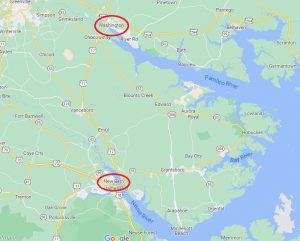
On 21 December 1862, after ten days of hard fighting and marching in the Goldsboro Expedition, the 43rd Regiment returned to New Bern, North Carolina, just in time for Christmas. What followed was a period of relative quiet for Howard. Instead of writing about bullets whizzing over his head, he was free to write about—what else?—food! For example, on Christmas day, Howard had a dinner of hard tack, salt beef, sweet potatoes, and cracker pudding. For supper, he ate boiled rice.

He also had time to reflect on his recent experiences in battle, writing,

Some may wonder how I felt while the balls and shells run across my back, and I knew not but that the next minute would be my last. I admit that I had rather been at home. But still I felt cool and knew everything that passed. […] I could only think of portions of the 91st Psalm. “A thousand shall fall at thy side, and ten thousand at thy right hand but it shall not come nigh thee.[”]

You can tell how relieved he was to be out of immediate danger. He took walks to local gardens and wrote with great appreciation of the natural world, the smell of English violets, the roses “bursting out.” He noticed the many beautiful birds wintering around New Bern, including robins, blackbirds, and woodpeckers, and was amused one morning to be awakened by a rooster. The woods teemed with game, and the river flowed “mostly without a ripple.”

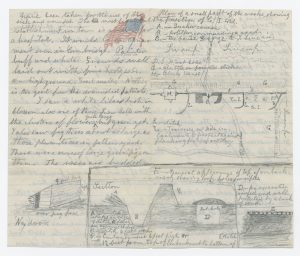
On 11 January 1863, Howard’s company was assigned picket duty about seven miles south of New Bern at a place called Evans’ Mill, formerly the plantation of Col. Peter G. Evans. Its job was to protect the operation of the mills. Howard drew a detailed map of the location.

Map of Evans’ Mill from the journal of Howard J. Ford

Personally, I think the “Impassible Swamps” (at the top right) sound like something out of Tolkien. Notice, also, the row of buildings along the bottom labeled “Negro quarters formerly.”

Detail of a building at Evans’ Mill “probably used by the overseer of the plantation slaves”

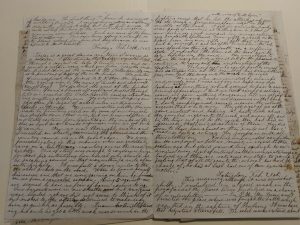
Howard was bunking with three other soldiers: his brother George and two fellow Cantabrigians, Pvt. Russell L. Snow and Cpl. James K. Odell. When the four men were assigned the “meanest” of the barracks, they decided to rebuild from the ground up. Fortunately, Pvt. Snow was a carpenter, and they finished in just over a week. They were proud of their “little hen house” and enjoyed the luxury of sleeping in a bunk and sitting at an actual table to write letters. Russell L. Snow, incidentally, would go on to build many buildings in and around Cambridge after the war.

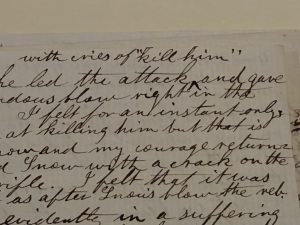
But even in the relative comfort of camp, the life of a soldier was hard. Picket duty was particularly nerve-wracking, standing at alert for hours, fearing every night-time noise presaged an attack, “a twig crack here, a limb break there, a yell – a screech – a howl – a cry like a baby.” By now, Howard was accustomed to hardship and usually tried to make the best of things, but he had lost all patience for empty talk of patriotism.

I cant help thinking of Mr. Mason, Richard H. Dana or any other of our big guns who think it a fine thing to be one of those “who fought, bled and died” for the country, how patriotic they would look lugging down Magazine Street all day wood and water for the cook house, or perhaps taking their turn at washing the dirty pans and pails […] A person ought to have practical experience in those things of which he talks. Nothing like cold toes or a hungry stomach to make ones patriotism dwindle down.

In my next post, I’ll tell you what happened on 20 February 1863, what Howard described as “a great day in my term of service as a soldier.”

Amusing Hairstyles of the Past

By Heather Rockwood, Communications Manager

When I am taking a long drive, I find ways to amuse myself, such as counting how many log cabins I see or catching snatches of the mooing and neighing farm animals or singing songs at the top of my lungs. I’ve started to notice a similar tendency as I look through the MHS’s archival collection. My latest focus has been hairstyles of the past and how many different or repeated ones I can find.  A number of these styles made me chuckle, and I hope they also bring you a smile.

The only hairdo in this selection of styles that uses the subject’s actual hair and not a wig is A. Alfaro, who had his photograph taken in Washington, DC, on 28 June 1911. I love how the swoops of his hair above his forehead match the swoops of his elegant mustache.

Photograph of a man in a jacket and tie. The man wears a handlebar mustache.
A. Alfaro, by unidentified photographer, from the Dall-Healey Family Photographs

This engraving of John Wesley, the founder of Methodism, shows an older man wearing a very long wig. Because I am a lifelong Star Wars fan, I can’t stop seeing Darth Vader’s helmet in this wig!

Image of a man wearing a long, white wig.
John Wesley, engraving by J. Posselwhite, from a print engraved by J. Fittler, after a miniature painting by J. Barry, from Portraits of American Abolitionists.

Caption: This wig, belonging to Henry Bromfield, came to the MHS with all its accoutrements. Wigs were a lot of work to care for and maintain, and they were made of human hair and horsehair. It took a lot of effort and expendable income to be in style!

Wig, unknown maker, England, 18th century, human hair, horsehair, silk thread, silk ribbon.

One of my favorite hairstyles of the MHS collection—featured in the recent Our Favorites exhibition―is Lucy Flucker Knox’s wig, which could rival Marie Antoinette’s wigs. The part that amuses me with each new viewing of the image is how the hat defies gravity in its precarious perch atop a towering hairdo!

Lucy Flucker Knox, Robert Morris, Silhouette, circa 1790.

Censorship in Boston  

By Rakashi Chand, Reading Room Supervisor

On August 1, 1878, thousands gathered at Faneuil Hall in Boston to fight for Free Love.   

A century before the sexual revolution of the 1960’s, Ezra and Angela Heywood were leading a movement to fight for the rights of women, against the oppression and constraints of marriage, and for sexual self-governance. But, how did 19th century Boston react to these ideas? For some, it was an eye-opening revelation, and they turned out in droves at the ‘Indignation Meeting’ to protest the arrest of Ezra Heywood on obscenity charges. For others, such ideas needed to be stopped by any means possible. Hence the New England Society for the Suppression of Vice was born. A precursor to the Watch and Ward Society, the Society for the Suppression of Vice was determined to enforce moral policing of society.  

Ezra Heywood was on the road to a career as a minister when he became disaffected with organized religion and its control of people’s private lives. In 1865, he married Angela Tilden of Worcester, MA, a radical feminist. Following the Civil War, the Ezra and Angela began a life-long fight for women’s rights. While they believed in long-term monogamous unions, they argued that the institution of marriage was nothing more than a contract meant to subdue and control women. They advocated for a woman’s right to choose in areas like sexual relations, birth control, and abortion. In 1872, they launched The Word, a “Free Love” publication sent out to like-minded people across the country. People who read the journal were grouped with Ezra and Angela as anarchists. 

By circulating the journal by mail, Ezra Heywood was in knowing violation of the Comstock Laws, a set of anti-obscenity laws lobbied for by U. S. Postal Inspector Anthony Comstock and passed by Congress in 1873. As a result, Heywood was arrested, imprisoned, and in June 1878 sentenced to two years hard labor in the Dedham Jail. In protest to his imprisonment, the National Liberal League organized the “Indignation Meeting” at Faneuil Hall. While most of the people who turned out were there to defend free speech, some were also there to support “Free Love” as defined by the Heywoods, and vilified by Comstock.  The rally at Faneuil Hall was enough to convince President Rutherford B. Hayes to pardon Ezra Heywood and secure his release from prison.  

From The Proceedings of the Indignation Meeting 
(images from Harvard Libraries on Google Books) 
From The Proceedings of the Indignation Meeting 
(images from Harvard Libraries on Google Books) 

On May 28, 1878, a group of Bostonians gathered in the vestry of the Park Street Church and resolved to establish a New England Society for the Suppression of Vice, taking inspiration from none other than Anthony Comstock who served as the secretary of the New York Society for the Suppression of Vice. The MHS holds New England Society for the Suppression of Vice record book, 1878-1888, which documents some of their activities. 

The records of the society were kept by the secretary, Frederick Baylies Allen, and describe the society’s work to ban books, curtail sex work and gambling, juxtapose themselves in schools, libraries, and courts, and to stop work of people like Ezra and Angela Heywood, whose agitation for women’s rights and autonomy was seen not only as radical, but as anarchical.  

New England Society for the Suppression of Vice record book, 1878-1888

The record book begins with a set of resolutions that praise Comstock for his efforts to curtail the spread of “impure literature” and to protect “our youth from those who would defile their innocence…” 

“Resolutions (May 28th 1878.)  

First.  Resolved: that the hearty thanks of this community are due to Mr. Anthony Comstock, (Secretary of the N. Y, So. For the Suppression of Vice) for his efficient and untiring labors in the extermination of impure literature, in the protection of our youth from those who would defile their innocence, in the condign punishment of the unprincipled offenders, and the brave and unflinching defence of public morals.  

Second.  Resolved: that the circulation of sensational and demoralizing literature among the young has assumed such alarming proportions that it may be characterized as a national evil, calling for the wisest and most earnest cooperation of all good citizens for its suppression or reformation.” 

Following the August rally at Faneuil Hall and Pres. Hayes’s subsequent pledge to free Ezra Heywood, the NESSV made it their goal to block his release. On December 10, 1878, secretary of the society Allen records that 

“Messrs. French and Allen were appointed committee to prepare a petition against the release of Ezra Heywood from prison.” 

And at the society’s regular monthly meeting on December 31, the minutes record that  

Upon report of the Committee [French and Allen] to consider a petition with regard to Ezra D. Heywood’s imprisonment, it was moved and carried that a Com. be appointed to furnish facts to the Aldermen in view of the proposed request for the use of Faneuil Hall for a testimonial to Mr. Heywood. Messrs. Whiting and French were appointed as this committee. 

The minutes of the following month include mention of the work of Whiting and French, as well as some of the expanding activities of the society 

“…the committee appointed to prepare the draft of a State Law for the more efficient suppression of Vice, made a favorable report of progress. Their report was accepted and they were requested to complete their work. The Report of the committee, appointed to resist the granting of Faneuil Hall to the friends of Ezra D. Heywood for a public Reception was made and the committee discharged…” 

Later records of the NESSV demonstrate their attempts to force the Boston Public Library to censor books, and to push for the conviction of booksellers in the city for carrying works that the society deemed inappropriate. At a meeting of the society on December 4, 1882, it was  

*Moved and carried that the Agent proceed at once to obtain legal Evidence of the Sale of [Walt] Whitman’s Book- “Leaves of Grass”, sufficient to secure the conviction of the Booksellers dealing in it. 

*It was then voted that the consent of All the Booksellers shall be sought to agree not to keep or sell said book: – This to be done in the name of the Society over the Signature of the Prest. And the Sec’y… 

The NESSV grew stronger in subsequent years, gaining more supporters and hiring additional agents to carry out their decrees, the society taking it upon itself to decide what was good and what needed to be banned in Boston. In 1891, the NESSV was renamed the Watch and Ward Society, an organization that lasted through much of the 20th century, finally dissolving in 1975. 

After serving six months during his first term in prison and receiving his pardon from Pres. Hayes, Ezra Heywood was arrested and jailed four more times as he continued to fight for the rights of women and laborers, always pushing for equality. During his last stint in prison, Ezra contracted tuberculosis and, less than a year after his release, died in 1892. 

Visit the library to look more closely at the New England Society for the Suppression of Vice records.  

***** 

Further reading on Ezra Heywood 

A Tale of Two Hannahs: Women and Waterfront Real Estate in Early National Boston

By Kathryn Lasdow, Assistant Professor of History, Suffolk University, Boston

It might surprise readers of this post to learn that women played a significant role in Boston’s late-colonial and early-national real estate market. Who were these women, and what kinds of properties did they own or rent? What impact did they have on the evolving cityscape of the bustling port? The traditional narrative of Boston’s urban development has mainly focused on the contributions of men—businessmen, merchants, and craftsmen—who envisioned, funded, and built the city. However, what has intrigued me most about Boston’s evolution is the involvement of women as property owners, renters, and occupants. As a NEH Long-Term Fellow, I uncovered this hidden history while undertaking revisions for my forthcoming book Wharfed Out: Improvement and Inequity on the Early American Urban Waterfront. Here are two stories drawn from MHS collections that shed light on the presence and influence of women in Boston’s early real estate market.

Hannah Rowe’s Wharf: Inheritance and Financial Know-How

In 1787, Hannah Rowe inherited waterfront real estate valued at $20,000 from her late husband, John Rowe.[1] As a widow, Hannah no longer faced the legal constraints of coverture, which stipulated that a woman’s property became her husband’s upon marriage. The wharf once synonymous with his successful merchant business now belonged to her, making her one of the most economically powerful waterfront real estate owners in early national Boston.

When looking for Hannah Rowe in the archive, I delved into sources left behind by her husband to uncover evidence of her proximity to merchant business. John’s diary, a meticulous but concise record that he kept in the 1760s and 1770s, corresponded to Hannah’s life in middle age. John frequently mentioned counters with “Dear Mrs. Rowe” and his business associates as they navigated the economic challenges posed by the American Revolution and its impact on the wharf.[2] Hannah was present for many of these conversations and likely listened to and participated in them. John mentioned how she “assisted [him] very much.”[3] [See Fig. 1]

However, it was Hannah’s real estate transactions during her widowhood, spanning approximately eighteen years from her husband’s death in 1787 to her own death in 1805, that truly showcased her financial skill. I examined both the Samuel Chester Clough Atlases and the “Inhabitants and Estates of the Town of Boston, 1630-1822” (Thwing database) to uncover Hannah’s strategic purchase of various properties. [See Fig. 2] Hannah engaged in at least twenty-four property transactions, managing a diverse portfolio that included parcels of undeveloped land, homes, warehouses on Merchant’s Row, the Lamb Tavern, and water rights along the harbor.[4] She used mortgages as an investment opportunity and a means to safeguard her funds through real estate holdings.

Fig. 1: Diary entry from March 8, 1776. John Rowe describes conversations with “my Dear Mrs. Rowe” and his business associates.
Fig. 2: Plate from the Samuel Chester Clough Atlas of Boston Property Owners showing Hannah Rowe’s name. “H. Rowe.”

Hannah Singleton’s Plight: Boarding House Keeping and Renting

Fig. 3: Letter from Hannah Singleton to Francis Cabot Lowell, September 14, 1805, Ms. N-1603, MHS.

For women of modest means, the journey to property ownership was more complex. Financial precarity often pushed women to rent rather than shoulder a mortgage burden. This was certainly the case for Hannah Singleton, a widow who leased a house from merchant Francis Cabot Lowell and struggled to run a boarding house. In the Francis Cabot Lowell Papers, I unearthed a letter she wrote to Lowell in September of 1805. [See Fig. 3] “I’m very sorry,” Hannah wrote, “it is not in my power to pay the rent immediately.” She assured him that she would have the money in a few days and pleaded with him to allow her “to remain in the house until [she could] get another.” Aware of Lowell’s position as her landlord, Hannah implored him not to “distress” her.[5]

In this brief exchange, we see Hannah Singleton attempt to navigate the fluctuating real estate market while beholden to a male landlord. The sources do not reveal her fate, but she may have remarried. The 1806 tax assessment lists a woman named Hannah Doane on Nassau Street, the same street where Hannah Singleton’s boarding house was located.[6]

The stories of these two Hannahs in early Boston demonstrate that women found ways to work within and transcend societal expectations regarding female financial behavior, making their own significant impact on the waterfront and the urban landscape.


[1] See multiple entries for Hannah Rowe in “A Report of the Record of Commissioners of the City of Boston, containing the . . . Direct Tax of 1798” (Boston: Rockwell and Churchill, 1820).

[2] Diary entry, March 8, 1776, John Rowe Diaries, 1764-1779, Ms. N-814, Massachusetts Historical Society, https://www.masshist.org/collection-guides/view/fa0535

[3] Diary entry, March 11, 1776, John Rowe Diaries, 1764-1779, Ms. N-814, Massachusetts Historical Society, https://www.masshist.org/collection-guides/view/fa0535

[4] Deed between Hannah Rowe and Perez Morton, May 12, 1787, SD 160:115; Deed between Hannah Rowe and Isaiah Doane, May 12, 1787, SD 160:118; Deed between Hannah Rowe and Thomas Bulfinch, August 2, 1788, SD 163:115; Deed between Hannah Rowe and Samuel Cookson, July 11, 1788, SD 163:133; Deed between Hannah Rowe and Ezra Whitney, August 24, 194, SD 181:91, Thwing Database.

[5] Hannah Singleton to Francis Cabot Lowell, September 14, 1805, Francis Cabot Lowell Papers, Ms. N-1603, MHS.

[6] Boston City Directory 1806, Boston Athenaeum Digital Collections, https://archive.org/details/bd-1806, 45.

Bombshells: Girlhood and Warfare in the MHS Collections

By Meg Szydlik, Visitor Services Coordinator

If you’ve paid any attention to the internet recently you may be aware that the movies Barbie and Oppenheimer just came out. While completely tonally different, many people are watching them as a double feature and the “correct” order for doing so is hotly debated. Personally, I plan to see Oppenheimer first and then Barbie. This is the order recommended by most of my friends who have seen the films. With all the excitement about the movies, I decided to dig around and see what the MHS collection has to offer related to either movie. It turns out, we have quite a few relevant items that I want to highlight here.

Photograph of a doll sitting in a rocking chair. The doll is wearing a dress and shoes. Her face is cracked and her hair is painted on.
Rebeccah perched on a rocking chair, looking uncomfortably into my soul

The first is “Rebeccah,” a doll from the 19th century with a fascinating and somewhat romantic history. While she has no Ken counterpart, she had plenty of experience with Transcendentalist culture at Brooks Farm and presumably lived a very happy existence among the children. Founded in 1841, Brooks Farm was meant to be a communal utopia but ultimately failed in 1846. By the doll’s own account (a letter pinned to her petticoat when she arrived) she had a happy life inside the commune as well as out and was enjoyed by generations of children. Though she is made of cloth and porcelain rather than the plastic of Barbies, Rebeccah fulfills the same basic function. She is a toy, but one filled with meaning and the expectations of what women and girls are meant to be. While she no longer fulfills that function and instead spends her time in our stacks, she still provides insight into girlhood in the 19th century.

The Barbie movie is, of course, not the only movie in this “double-header” summer flick extravaganza.

Oppenheimer is a biopic looking at the creation and aftermath of the atomic bomb through the complicated life of the scientific director of the project. Nuclear weapons remain a contentious topic and conversations about nuclear proliferation are picking up, which makes this film especially timely. Within the MHS collections are the Sen. Leverett Saltonstall Bikini Atoll Papers, which chronicle Senator Saltonstall’s experience of seeing the 1946 Able and Baker tests detonate in the Pacific. Reading these documents and examining the photographs, it is clear how destructive the bombs were, to the point that Bikini Atoll is still not habitable, nearly 70 years after the last test. Carl A. Hatch, chair of the Evaluation Commission for Operation Crossroads, noted in his message to President Truman after the Baker test bomb that:

As was demonstrated by the terrible havoc wrought at Hiroshima and Nagasaki, the Bikini tests strongly indicate that future wars employing atomic energy may well destroy nations and change present standards of civilization.

To us who have witnessed the devastating effects of these tests, it is evident that if there is to be any security or safety in the world, war must be eliminated as a means of settling differences among nations.

Image of three black and white photographs. The photo on the left shows detonation with a very small cloud where the bottom of the cloud is white and the top is dark over a large body of water; the middle photograph shows a white mushroom cloud over a large body of water; the photograph on the right shows a wide white mushroom cloud that spreads beyond the limits of the photograph over a large body of water
Photographs of the Baker detonation from the Leverett Saltonstall collection showing the first 8 seconds after detonation

And Hatch was not alone. As early as 1946, the “father of the atomic bomb” was lobbying hard against the further use of the bombs he shepherded through creation, despite his advocacy prior. Oppenheimer maintained a strong anti-nuclear weapons stance for the rest of his life.

While on the surface neither movie has much in common with the other and neither do the collection materials I pulled for this blog, I appreciate the juxtaposition of two radically different stories coming out on the same day. The thrilling intensity of the Oppenheimer story paints a picture of a horribly destructive weapon of war and the minds who created it. The spirit of Barbie is bright pink and sparkly and fun but presents interesting conversations about power and who has it. Both films tell us something about what humans care about and are interested in exploring. They ask what we think is worth saving, which is reflected in the collections of the MHS.

**Note that WGA(https://www.wgacontract2023.org/) and SAG-AFTRA(https://www.sagaftra.org/) are on strike, which includes those who worked on these films. I fully support the strike, however neither union has called for a consumer boycott.**

“Continual calms, and contrary winds”: JQA’s Tedious Transatlantic Trek

By Gwen Fries, Adams Papers

In the summer of 1785, John Quincy Adams was trapped on a ship slowly making its way across the too-still waters of the Atlantic. The eighteen-year-old was leaving behind Europe, his parents, and his friends, to return to Massachusetts and to his father’s alma mater, Harvard College.

Four days into his journey, on 25 May, Adams bemoaned relentless seasickness, static landscapes, and indifferent companions. “The Events that happen on board a Vessel are very seldom interesting, and the life we lead is very lazy and tiresome. Our Company on board . . . is not in general such as I should have wished.”

One of the crew, Mr. Well de Singler, was the same age as John Quincy, but friends they were not. “His manners are by no means agreeable. . . He is full of his knowledge, and does not doubt but he is the most learned man on board though the youngest. He commonly engroces the conversation wherever he is, and maintains his opinion in the most positive manner, upon any subject whatever. His principles are to fight with every body, and upon the most trivial occasions; he even gives to understand, that if opportunities fail, he takes care to create them. He pretends to be of noble birth and affects to despise every body who is not noble. In short I think it an unlucky circumstance that I am obliged to remain with him during 50 days.”

If the lack of agreeable company and interesting sights weren’t enough to make the journey feel endless, nature itself was against him. On most days the wind stood completely still and they made very little progress. When the wind did blow, it blew “directly contrary” to what the sails needed. “Our Wind has been very low for several days. 15 or 20 leagues a day is the utmost extent of our route,” Adams lamented to his diary.

Twenty-three days into the voyage, cabin fever had set in in a big way. “This forenoon,” Adams wrote, “we saw something at Sea, but we could not distinguish what. Some said it was a very large piece of wood. Others, were of opinion, that it was a boat overset. It pass’d at a small distance, and amused us for half an hour. At Sea, such is the continual sameness of the surrounding objects that the smallest trifle becomes interesting.”

Halfway through the odious odyssey, Adams and his fellow passengers had had enough of the baking sun. “We would willingly agree to have less Sun, and more wind,” he complained. “This evening, as we were near the tropic one of the officers, according to the custom universally established, of wetting all the persons on board who have not cross’d the tropic, sprinkled us with a little water.”

To break up the monotony, “one of the passengers, who is fond of such amusements; as the french in general are; returned the officer’s Compliment, with an whole bucket of water.”

detail of a handwritten letter
John Quincy Adams’s diary entry for 20 June 1785

“This was as a signal to us all,” John Quincy recorded. He and all the other passengers—scholars, physicians, merchants, and officers, Dutch, Swedish, French, and American—“immediately form’d two parties, and we were all, officers and passengers, wet from head to foot before we ended. I believe more than 200 buckets of water were spilt upon the deck in the course of the evening. One of the passengers alone receiv’d thirty buckets.”

If you think connecting with his inner child and having a water fight was out of character for John Quincy Adams…you’d be right. “Such a diversion is not very instructive nor very agreeable, but may be pass’d over for once: I hope it will not be repeated.”

The Adams Papers editorial project at the Massachusetts Historical Society gratefully acknowledges the generous support of our sponsors. Major funding for the John Quincy Adams Digital Diary was provided by the Amelia Peabody Charitable Fund, with additional contributions by Harvard University Press and a number of private donors. The Mellon Foundation in partnership with the National Historical Publications and Records Commission also supports the project through funding for the Society’s digital publishing collaborative, the Primary Source Cooperative.