The Thomas Shepards and Their Books [Part 1]

By Jeremy Dibbell

Biblio-sleuthing is one of my very favorite things to do, so it was fun to be able to spend some time last Thursday working on a really interesting project in collaboration with Stephen Ferguson, Curator of Rare Books at Princeton University; Diann Benti, Assistant Reference Librarian at the American Antiquarian Society; and staff at the New England Historic Genealogical Society (NEHGS).

The project got underway when, as Stephen Ferguson noted in a blog post, they found at Princeton more than twenty books from the library of the Thomas Shepards. That’s three generations of early (and famed) New England ministers, each named Thomas Shepard. Or as we’ve taken to calling them, TS1 (1605-1649); TS2 (1635-1677); and TS3 (1658-1685). Most of the Shepard books, Ferguson found, were each “branded” or stamped on the top edge with a “TS” monogram (quite an uncommon practice in early New England, as far as we’ve been able to discover so far). In a follow-up post, Ferguson notes some of the most interesting finds.

Steve called me to see if I could find out a little about the wills and probate inventories of the Shepards, to see if there might be a list of the libraries included there, so off I went to NEHGS and looked through their microfilm copies of the seventeenth-century Middlesex County probate records. Frustratingly, the Shepard probate documents are vague (as so many are) about the contents of the library. TS1’s will leaves to his son Thomas “all my Bookes, manuscripts & paper which last named, viz: bookes, manuscripts & papers, although be propriety of my sonne Thomas yet they shall bee for the use of my wife and my other children.” The inventory lists, as the final item “about two hundred and sixty printed bookes” valued at £100, reiterating that they are to go to TS2.

TS2’s 1677 will leaves to “my son Thomas my whole library, both printed books &  writings, which though the property of my son, shall be also, occasionally, for the use of my wife, & daughters, as they may need, and desire the perusal thereof.” The inventory lists “his Library”, again valued at £100.

TS3, who died in his mid-twenties, left no known will or inventory. His widow Mary (nee Anderson) later married Rev. Samuel Hayman. Hayman died in 1712; his will doesn’t mention a library, and there is no inventory. Mary died in 1717; her will also doesn’t mention a library. Thomas and Mary had one surviving child, a daughter Hannah (or Anne) who married Rev. Henry Smith of New York. Steve has some ideas about how the books now at Princeton made their way there, which I’m sure he’ll share in good time, and he’s also found some good evidence to prove a statement Cotton Mather made about TS3 in his Magnalia Christi Americana (Volume II, p. 124 of the 1820 edition): “… his piety was accompanied with proportionable industry, wherein he devoured books even to a degree of learned gluttony; insomuch, that if he might have changed his name, it must have been Bibliander. … he had hardly left a book of consequence … in his library (shall I now call it, or his laboratory) which he had not so perused as to leave with it an inserted paper, a brief idea of the whole book, with memorandums of more notable passages occurring in it, written in his own diligent and so enriching hand.”

When I got back to MHS from NEHGS, I decided to take a peek through our “manuscript catalog,” which sometimes lists annotations or signatures found in books. Jackpot! I quickly discovered a few Shepard titles in our collections here at MHS … and I look forward to sharing those with you tomorrow. Did those here also have the “TS” mark on the top edge? Where’d they come from? Stay tuned! And what other institutions have Shepard books today?

This Week @ MHS

By Jeremy Dibbell

Join us on Wednesday, 20 January at 12 noon for a brown-bag lunch talk with research fellow Eileen Botting. Eileen will discuss her current project, “Hannah Mather Crocker’s Reminscences and Traditions of Boston.” There’s a bit more about the project here, via J.L. Bell’s Boston 1775 blog. And if you happen to know of an image of Hannah Mather Crocker, please let Eileen know!

Holiday Closure Notice

By Jeremy Dibbell

The MHS, including the library, will be closed on Monday, 18 January in observance of Martin Luther King, Jr. Day.

This Week @ MHS

By Jeremy Dibbell

Join us on Wednesday, 13 January at 12 noon for a brown-bag lunch with research fellow Rachel Shelden. Rachel will speak on her current project, “Washington Brotherhood: Friendship and Politics in the Civil War Era.”

New Collection Guide: Edward Atkinson Papers

By Peter Steinberg

A new guide to the Edward Atkinson papers, 1819-1920, is now available on the Massachusetts Historical Society website  (http://www.masshist.org/findingaids/doc.cfm?fa=fa0016). Previously only minimally described, the newly processed collection and finding aid contribute to a fuller understanding of the breadth of Edward Atkinson’s business affairs.

Edward Atkinson was born on 10 February 1827 in Brookline, Massachusetts. He began working as a teenager and became a very well-known and respected authority in a number of business fields and social causes including cotton manufacturing, anti-slavery, fire prevention and insurance, and the science of nutrition, to name but a few.

The loose correspondence has been reorganized, and where applicable, separate series of correspondence have been created. We hope this will save researchers some time as they look for letters from many of Atkinson’s most frequent correspondents, including Wilbur Olin Atwater, Thomas F. Bayard, Jonathan Chace, John Murray Forbes, Franklin L. Ford, Charles Nordhoff, Charles Eliot Norton, John Ott, Ellen H. Richards, or David Ames Wells. 

Additionally, the 79 letterbooks have been re-indexed as part of the project; the new cumulative index can be found at the bottom of the collection guide. Outside of the above named separate series, there is no name index to the loose correspondence, but the index to the letterbooks can be used as a guide to narrow down a potential date or date range of Atkinson’s incoming mail. In the finding aid, each letterbook is also described separately with a list of selected subjects discussed and frequent recipients.

Indexing the letterbooks proved challenging as over the years, in at least two purges, letters were removed either by Atkinson or his descendants prior to the collection’s arrival at the Historical Society, and in creating the new index we found instances where letters were removed after the handwritten indexes were made. While the cumulative indexes do not include entries for the letters removed from the letterbook volumes, the original handwritten indexes remain available at the beginning of each letterbook. We took care to catch each instance, and often mourned the loss of letters which promised to be interesting or quirky, such as Atkinson’s letter to the Department of Lost Umbrellas.

Contributions to the creation of the finding aid were made by Kimberly Kennedy, Kyle Hudgins, Rebecca Hecht, Susan Martin, and Peter K. Steinberg. Support for this project was provided by the FM Global Foundation.

Please note that the Edward Atkinson papers are stored offsite and must be requested at least one business day in advance. Contact the Library at library@masshist.org or (617) 536-1608 to request materials. Please discuss your request with the reading room staff before requesting cartons by barcode.

Coming Full Circle: Our 100th Object of the Month

By Jeremy Dibbell

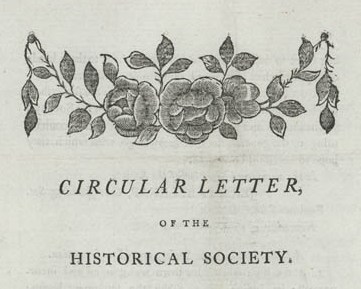
To mark the 100th Object of the Month, we’ve decided to go back to our very deepest roots, highlighting one of the first published documents produced by the MHS (and probably my personal favorite of all the things under the roof). It’s the “Circular Letter, of the Historical Society“, in which Jeremy Belknap and the other founders lay out their goals for the organization: “to collect, preserve, and communicate, materials for a complete history of this country.”

Read more about the Circular Letter, Belknap, and the founding of the MHS in Library Assistant Rakashi Chand’s Object of the Month essay. You can also find high-quality scans and a transcription of the Letter there.

You can browse all 100 Objects by clicking here.

This Week @ MHS

By Jeremy Dibbell

Join us on Wednesday, 6 January at 12 noon for a brown-bag lunch with MHS Digital Projects Coordinator Nancy Heywood and Web Developer Bill Beck, “From Sealing Wax to a Website: The MHS Presents Jefferson’s Manuscript of Notes on the State of Virginia.” More info here.

Summing Up 2009

By Elaine Grublin

It looks like 2009 was a busy year in the MHS library. We previously reported that this past July was the busiest month on recent record in our reading room. The trend continued through most of the calendar year. All told we had over 1,450 researchers visit the library over the course of the year, for a total of 2,851 daily uses. We had over 740 first time visitors this year, a good indication that both our website and our public and educational programs are reaching out to new users. It is also a good indicator that people are still interested in using libraries.

In addition to the people that visited the library in person, our reference staff engaged in over 1,500 email correspondences with researchers seeking assistance, answered 62 posted letters, and fielded over 1,100 reference-related phone calls.

In servicing our researchers the staff made over 13,000 photocopies of MHS documents, and paged over 5,600 call slips. Because researchers can request multiple volumes and/or boxes from manuscript collections on a single call slip, it is difficult to gauge just how many individual items were retrieved and returned to the stacks, but I would wager it is a safe bet to say that it was well over 10,000 items.

You may be wondering where all those researchers come from. Given the size and scope of our collection is it not surprising that researchers come from near and far to visit the MHS reading room.

Local visitors, (individuals with Massachusetts addresses), make up about 44% of our researcher population. A person in Pittsfield, MA may argue that he is less of a local than a resident of Providence, RI or Portsmouth, NH, so that number may be a bit of an unfair representation of the ‘local’ population. It would be interesting to see what percentage of our Massachusetts visitors are from the greater Boston area. Perhaps we will track that data in 2010.

The largest percentage of our researcher population, about 50%, is comprised of United States residents living outside of Massachusetts. In 2009 the MHS reading room was visited by individuals traveling from 44 of the 50 states, plus researchers from both Washington, D.C. and Puerto Rico. The only states not represented by researchers visiting the library this year were Hawaii, Louisiana, Mississippi, Nevada, North Dakota, and West Virginia. Incidentally, West Virginia is the only state in the nation not represented in our current researcher database. This means that we have not had a visitor to our library from West Virginia in the 21st century (the new database was started in 1999). If you know of any West Virginian historians, please send them our way!

Our researchers do reach well beyond the borders of the United States, though. In 2009 we had visitors from more than 12 foreign nations, including Portugal, Japan, Croatia, Poland, Israel, Australia, Ireland, and Russia. The majority of our international visitors are from the nations of the United Kingdom and Canada, a trend that continues from year to year. It is also interesting to note, although not at all surprising, that our international visitors tend to visit the reading room on multiple consecutive days, more so than researchers from the United States.

Hopefully 2010 will prove to be an even bigger year for the library staff and our researchers, and with any luck at all we’ll add a West Virginian to our reader database!

Holiday Closure Notice

By Jeremy Dibbell

The MHS, including the library, will be closed from 24 December through 3 January; we’ll reopen on Monday, 4 January at 9 a.m.

If you need a Historical Society fix over the holidays, C-SPAN2’s “Book TV” will be airing the launch of Woody Holton’s Abigail Adams, taped here at MHS on 9 November. The first showtime is set for Saturday, 26 December at 7 p.m., with a rebroadcast on Monday, 28 December at 5 a.m. You can find scheduling and other information here (and following the broadcast you will probably be able to watch the show online there, too).

From all of us at MHS, happy holidays, and we hope to see you in 2010!

“The Case of the Slave Child, Med”: Lunch Talk Recap

By Anna Cook

Last Wednesday (16 December), MHS research fellow Karen Woods Weierman gave “concluding remarks” about the research that has brought her to a second fellowship here at the MHS: an examination of the 1836 legal case Commonwealth vs. Aves, or “the case of the slave-child Med” as it was commonly referred to. Med was a seven-year-old enslaved girl brought by her Southern owners to Boston when they came North to visit family. Anti-slavery activists discovered Med’s status and brought suit against the family claiming that since Med was on free soil it was unlawful to keep her enslaved, even though the family was only “in transit.” Judge Lemuel Shaw, who heard the case, ultimately decided in favor of freeing Med, and the case remained an influential legal decision until the Dred Scott decision of 1857.   

Karen Weierman’s work at the Historical Society this fall was comprised of four parts. She built on her work at the Boston Public Library, which holds the records of the Boston Female Anti-slavery Society (BFASS); she attempted to piece together the involvement of the Boston African-American community in Med’s case – a process that has involved a lot of archival detective work!; she delved deeper into the legal history of the case, with its cast of “usual suspects” who appear time and time again in slave transit cases of this period; and finally, she hopes to consider the literary dimension of the case – including the role played by such literary and abolitionist figures as Maria Chapman and Lydia Maria Child.

Her time at the MHS, Karen reported, has been helpful in clarifying what will be framed in the lens of her book project. Currently, she is hoping to maintain a tight focus on Med’s case and the surrounding decade, starting with an 1832 case that was the first slave-child case and ending with the 1842 Latimer case, which shifted the nation’s focus from slave transit cases to fugitive slave laws in the lead-up to the Civil War. While the case of Med has not gone entirely un-examined in the historiography, the attention it has received this far has been minor and no one has yet done an interdisciplinary study that seeks to combine local, Boston history, legal scholarship, and literary scholarship: this is a gap that Karen is hoping to fill with her work.

During the Q&A period, several audience members questioned what Med’s owners were thinking bringing a slave North to a city like Boston, which was known for its abolitionist activities. There was also a great deal of discussion about the way that the discourse of motherhood was shared by both the pro- and anti-slavery sides: those who argued for Med to remain with her owners suggested that anti-slavery activists would be ripping Med’s family apart by keeping her in the North while her mother remained enslaved in Louisana; abolitionists countered by pointing out that Med’s family was already torn apart by slavery and that it was the duty of the owners to free Med’s mother who could travel North to be reunited with her daughter. Both sides, in other words, were positioning themselves as “protectors of children” and the family.

Sadly, Med died before her eighth birthday in an orphan home, set free but with her custody remaining murky. The reason for her death remains unclear, but her story vanishes from the antislavery discourse given its less-than-triumphal end.  I look forward to seeing how Karen brings her back from obscurity and re-directs our focus toward this legal and social turning-point in the history of anti-slavery law.