Voices from the Past: 1-2 November

By Jeremy Dibbell

A new month, something new and different here at The Beehive. Since there are a tremendous number of diaries in the MHS collections, I thought it would be neat to pick out some “voices from the past” and highlight a few of these. I’m going to try this in various different ways, the first of which is to look at some anniversary posts (“this day in history”, if you will). You can search our online catalog (ABIGAIL) for diaries by year (just use “Diaries Year”, i.e. “Diaries 1709” in the subject box), so I’ve taken a look at diaries from 1709 onward, every hundred years and picked out some interesting entries from 1-2 November. Following the year I’ve listed the number of manuscript diaries from our collections that cover the period. A link at the end of each person’s entry will take you to the ABIGAIL record for their collection.

1709 (8 Diaries)

– Thomas Prince (1687-1758), newly-minted minister. Later pastor of the Old South Church, Boston (and a great book collector). He kept a fascinating (and quite beautiful) journal while travelling on the ship Thomas and Elizabeth as part of a fleet on several journeys: Boston to Barbados, 29 March – 4 September 1709; Barbados to London, 5 September 1709 – 16 March 1710; London to Madeira, 17 March – 29 April 1710; Madeira to Barbados, 30 April – 2 August 1710; Barbados to Great Britain, 3 August – 17 October 1710. The entries contain geographic coordinates, wind direction and speed, and weather, as well as descriptions of daily occurrences including incidents between the fleet and other ships, poetry, and ballads.  On 1-2 November 1709 (days 58 and 59 of his trip) he carefully records in small hourly tables the wind direction and speed, weather conditions (breezy at 6 a.m., smooth sea at 6 p.m., cloudy at 10 p.m. on 1 November; the following day they had fair weather at 2 a.m., rain at 8 a.m., faint wind at 2 p.m., and clear skies at 6 p.m.), the speed of the ship, miles travelled, &c. On 2 November he records their latitude as 49 degrees, 43 minutes.

Prince’s journal also contains some fascinating ballads and poetry. On his page for 1 November are written the 12th and 13th stanzas of a ballad he began recording back on 28 August, “On y’e Battle of Oudenard, June 30 1708. Jack Frenchman’s Lamentation. An excell’t New Song: to y’e Tune of I’ll tell Thee Dick, &c.” Below this, he’s copied another few lines of verse (not part of the ballad):

“Unhappy news! again without success!
Alass who can my sorrows now express?
Oh Thou unhappy continent of Spain!
Oceans of Blood for Thee are spillt in vain!
Routed again! again my army broke!
This is a fatal, mortifying stroke!
Alas what shall I do? I fear they’l force
Me at y’e last to take Benhadad’s course!
Since Israel’s Kings so mercifull have been;
Mercy I hope to find from Britain’s Queen:
I’ll stay a while & see how matters go,
My spirit cant yet bare to stoop so low:
But if it must be so, it must be so.”

In the upper right corner of the page Prince records his “remarks” for the day. On 1 November he writes (slightly expanded based on his handy list of abbreviations at the front of the journal): “At 10 y’e morn: we sounded 61 Fath: Grainy [?] cs: sand [coarse sand], white & yellow; w’th [bits of] scallop shells, some of [which were] small & [word unclear]. By [which] we Judg ours: on y’e coast of France; [which] is generally such sort of Ground & about y’e same Depth of Water: [which] grows deeper towards y’e Brittish shoars; [where] y’e Ground is much finer & whiter. At y’e same time, y’e [wind] [weaving?] to y’e NE, we kept on our Larb: [tack] till 12, [when] we stood to y’e Nor-ward.”

For 2 November, Prince remarks “About midnight, we fell in [with] a strange Fleet, [which] put us in a great confusion, but wasnt [thoroughly] discerned till about 2, a Gun was fired [that] alarmed us. At y’e same time we saw 2 Top-Lights, & several ships [that were] larger [than] any of our Fleet. At [daybreak], we Discover’d our Comma[nders] Ensign flying, & we Reckon about 50 [sails]. But as it grew Lighter we can count 54, and y’e 14 or 15 [sail that were] strangers, appear’d [very] Large, on our Larb: Bow, to [the Leeward], & y’r Ensign seem’d to [be White which made] us afraid [they were] French Men of War. But we [were] presently undeceiv’d, [when] at [sunrise] we saw [the] Red-cross; upon we concluding [them] to [be the] Brittish Squadron of y’e White, we bore down to [them]; & by 10, [the] Men [of] War saluted each other. Below the remarks, Prince outlines the “Plimouth-Squadron of Cruisers” in a table, listing eight third-rate and eight fourth-rate ships with the number of guns on each (the Russel, Royal-Oak, and Newark with 80 guns; the Kent and Restoration with 70; the Plimouth, Medway, and Montague with 64; the Monk, August, and St. Albans with 60; and the Depforth, Romney, Falmouth, Salisbury, and Winchester with 54 guns apiece).

His remarks continue next to the table: “My [Lord] Dursley, [Vice] Admiral of y’e White, in y’e Kent, lets fly a White Flag w’th St. Georges Cross, at y’e [foretop masthead]. Y’e Medway & Falmouth [are] sent on a seperate Cruize. My [Lord a Day] or 2 ago Gave [DuGuay with] 5 or 6 [Men of War] a chase, till [they] rais’d [their] Hulls, but y’e Night Parted [them]. Y’e Lost-Light of Scilly Lights last night, at 10. & [they] Judge, we are 15 or 20 Leag[ues] to [the] NbE. Having steer’d SbW, till they fell in [with] us.” (Thomas Prince journal)

1809 (26 Diaries)

– John Quincy Adams (1767-1848), American minister to Russia. St. Petersburg, Russia. Line-a-day diary for 1 November: “Wednesday. Looking out for lodgings, first alone. Then with Harris, who called on us again in the Evening.” Long diary for 1 November: “I was engaged all this morning after breakfast, in visiting houses and apartments to be let. First going out alone; and afterwards in Company with Mr. Harris who called upon me for that purpose. I have an length seen two places, either of which will supply us with better accommodations than any that we have hiterto seen. Mr. Harris called upon us again in the Evening. I read and wrote very little this day.”

Line-a-day diary for 2 November:”Still in search of lodgings with my wife. Visits from Harris and Mr. Meyer. Harris sent a Russian Dict’ry & Grammar.” Long diary for 2 November: “Went out this morning with Mrs. Adams and looked over two or three houses, and lots of apartments which we have not yet engaged. Met Mr. Harris and Mr. Meyer, who called and paid us a visit. I delivered him a letter of credit from Mr. Grey. Mr. Harris called again and passed a couple of hours with us in the Evening. He sent me also a Russian and French Dictionary and Grammar, from which I began the attempt to learn the character of the Russian Alphabet. Among the peculiarities of this Country with which is will be proper to become more conversant, are the stoves, the kitchens, the double windows, the construction of the houses generally and the drojky’s – These and other things will be the subjects of more particular future observation. I tried this day two of their most ordinary liquors. The quas, at two kopoeks the bottle and the chitslisky at five. They have a taste of small beer; with an acid not unpalatable to me, though much so to all the rest of the family.” (John Quincy Adams diaries)

– Alexander Hill Everett (1790-1847), secretary to John Quincy Adams. St. Petersburg, Russia. Writing on 1 November: “Our first care has been to equip ourselves under the direction of a tailor, till which time we were unable to stir out and indeed have as yet seen nothing of the curiosities of the place. The weather has as yet been uncommonly mild, today Nov. 1 is the coldest and the temperature is at 6 [degrees] Keau, the air very clear & bracing. …

One of the first things that at once delights and surprises an American traveller here is the great respect entertained by the Emperor and Court for the national character. Mr. Harris, our agent has received most marked [favor] from his Imperial Majesty and the Court and all distinguished persons here and the reception Mr. Adams has received is thus far equally flattering. We found a few of our countrymen that expect to pass the winter among them was Mr. Fisher, with whom I had contracted an acquaintance at Christiansand and in whose company I expect much satisfaction. Besides him are Mr. Osgood, the brother of my classmate Osgood, Capt. Shreve of Salem, Mr. Waters of Boston and several others.

The effect of Petersburg when it first strikes the eye is very great. It is the most beautiful city in Europe, though inferiour in size to Constantinople, London, Paris, Vienna, Naples, Berlin & Moscow. The publick buildings are in a style of wonderful magnificence. I have not yet had an opportunity to examine any of them, but as I do, I shall note my observations. The granite embankments of the Neva and of the canals, surrounded with railings of iron are most stupendous and admirable, whether we consider the immense labor, bestowed upon them or their incalculable utility. The famous status of Peter the Great is one of the most striking monuments in the place and one that first meets the eye on landing. It stands in the middle of a square in the first Admiralty Quarter which you pass through as you enter the town from the quay. He is on horseback in the attitude of gaining the summit of a rough rock, an allegorical representation of his victory over the savage state of his country. …” (Alexander Hill Everett diaries)

1909 (23 diaries)

– Robert James Streeter (1889-1951), student at Clark College, Worcester. Later a history teacher. On 1 November 1909 he records the temperature (50) and the weather (Clear, calm) before recording the events of the day. “That story about Cross was not so. I played tennis with Woodbury & gave him a hard rub on teh second set. After Glee Club Fletcher & I went down to Porter’s house after some dress suits. LeSure [?] was up here raising cain when we got back. He threw a pillow at me, bending my glasses, & I broke them trying to fix them.”

The following day, 2 November, Streeter notes that the temperature was 60 and the weather “Cloudy, some showers.” “We had a quiz in logic & one in Biol. I cut Biol. Lab this afternoon & went downtown to see an occulist, but did not get there till after office hours. This eve Parris, Oberg & another fellow was up here this eve. Today the state election takes place. The first of the Ellis Concerto is given this eve.

Streeter also kept an expense book, in which he records that he spent 10 cents on ice cream on 1 November, and 5 cents for carfare and 5 cents on ice cream on 2 November [a fellow after my own heart, eating ice cream well into November!] (Robert James Streeter diaries)

William Lawrence (1850-1941), Epsicopal Bishop of Massachusetts (1893-1927). On 1 November 1909, he records “Home before breakfast. Wrote. Met Rose of Nashville at Mr. [Oliver’s?] office & work on statement of history of Geo. Peabody College for two hours. Rose & I lunch at Union Club.” He goes on to describe several church services that afternoon and evening. On 2 November, he writes “Office hours: 1 1/2 hours with Rose & Oliver[?] finishing statement. Lunch. [Word unclear] with Julie to Salem … funeral of __ Endicott Peabody. Rain. Brght Edith Wolcott back. Wrote in Ev’g. (William Lawrence diaries)

William Cameron Forbes (1870-1959), Secretary of Commerce and Police for the Philippines (he would be named Governor-General later in November). On 2 November he writes: “I must have got a sunstroke in a little way on Sunday as I went out to inaugurate the new [polo] field and see how much a pony cut it up, and that night had a fierce headache. So in all day yesterday, only getting up enough energy to lunch with my bureau chiefs. If I am to become Governor at the end of this week it may be that a new Secretary of Commerce and Police will be appointed, and that I shall step out of the office I’ve held now for nearly six years.

So old Strong came round, tenderly looking after me. He looks worn and dragged, poor fellow. His wife has blood poisoning and has been very ill, but is recovering slowly.

No polo on Monday, and today being election day I have taken it generally easy, only going to a Carnival directors’ meeting, as I am still President of the Association, and having to walk part way home as Cootes, headless and heedless as a boy of four, had run off with my machine and forgotten to order it back for me.

A few days ago I made my return call on Admiral Sebree when he had all his captains and coadjutors, by whatever rank distinguished, collected on the flagship; – and all this to save me the trouble of going to each of his eight ships, and Uncle Sam the cost of eight times seventeen guns, which would have been indeed a bombardment and taken all the morning. We drank champagne in the Admiral’s cabin. I sat at a table with three admirals, as Nazro had turned up, and we were indeed ranky.” (W. Cameron Forbes journals)

I hope these are of interest, and look forward to more of these “voices from the past” in future posts.


“McClellan in Boston”: Lunch-Talk Recap

By Elaine Grublin

On Wednesday, 28 October, the MHS hosted a brown-bag lunch talk, “McClellan’s Visit to Boston, January 28-February 8, 1863″  in which Carol Bundy, a current Andrew W. Mellon Fellow and long-time MHS researcher, led a discussion of her current project. An audience of about twenty, comprised of MHS members, staff, and research fellows, as well as local scholars and history enthusiasts, listened as Carol presented a brief synopsis of her research before engaging her in a lively question and answer session.

At the outset of the program Carol described her project as an “unformed mass of dough, just beginning to rise” meaning that the project is in its early stages and she is still working on identifying the main characters and primary direction of her narrative. She introduced the audience to her project by giving a bit of background about both McClellan’s visit and the social and political environment in Boston in the winter of 1863. 

While McClellan’s visit to Boston in that winter is the focus of the project, McClellan himself is not the center of Carol’s research. The project is “not so much about McClellan, as about Boston’s reaction to McClellan.” As a result Carol has been working to identify the men responsible for bringing McClellan to Boston that winter, as well as fleshing out his itinerary. Through contemporary diary accounts she has already identified a committee of twelve men responsible for bringing McClellan to Boston. The hope is that the project will grow from there as she explores these men and their connections to both each other and the places that McClellan visited during his time in the city.

The greater questions to be explored include the reasons for McClellan’s visit to Boston, and why was he seemingly so popular with Bostonians at the time. Bundy presented the argument that the men who brought McClellan to Boston supported him for various – mostly personal – reasons which were more pragmatic than ideological, and raised her own questions about the reaction of the city at large. 

During the discussion part of the program attendees raised questions about the role of religion in the development of the political and personal motivations surrounding individual positions on the emancipation issue, the appeal of McClellan (which was presented as being a superficial appeal), and the form that the written project may take once the direction of the project becomes more clear.

A hearty thank you to Carol for an engaging presentation and for sharing her research with us. Keep your eye out for the resulting publication down the road.

MHR Volume 11 Available

By Jeremy Dibbell

The 2009 volume of the Massachusetts Historical Review is now available. You can order a copy here.

The volume’s contents:

Essays
– Jason M. Colby, Race, Empire, and New England Capital in the Caribbean, 1890-1930
– J. Patrick Mullins, “A Kind of War, Tho’ Hitherto an Un-Bloody One”: Jonathan Mayhew, Francis Bernard, and the Indian Affair
– Neil Longley York, Rival Truths, Political Accommodation, and the Boston “Massacre”
– Stephen Kantrowitz, A Place for “Colored Patriots”: Crispus Attucks among the Abolitionists, 1842-1863
– Robert J. Robertson, Louisa Catherine Adams Kuhn: Florentine Adventures, 1859-1860

Notes & Documents
– M. X. Lesser, A Transcendentalist Conversion Narrative

Review Essay
– Elizabeth R. Varon, The Afterlife of Abolition

This Week @ MHS

By Jeremy Dibbell

A busy week at 1154 Boylston Street!

Join us Tuesday, 27 October for a lecture by Bruce Ronda, “The Kaleidoscope of History: John Brown after Fifteen Decades.” This event is part of John Brown and New England, a series of public programs commemorating the 150th anniversary of John Brown’s raid on the federal arsenal at Harper’s Ferry. Refreshments will be served at 5:30 p.m., and the talk will begin at 6 p.m. More info here.

On Wednesday, 28 October, we’ll have a brown-bag lunch talk at 12 noon with MHS short-term research fellow Carol Bundy; she’ll speak on “McClellan’s Visit to Boston, January 28-February 8, 1863.”

On Friday, 30 October, another brown-bag lunch talk (also at 12 noon): Electa Kane Tritsch will discuss her book Medfield’s Dwight-Derby House: A Story of Love and Persistence. Copies of the book will be available for purchase. More info here.

And for MHS Members and Fellows, don’t forget the special exhibition opening event at 6 p.m. on Thursday, 29 October: Librarian Peter Drummey will speak on the new exhibit “Atlantic Harvest: Ellery Sedgwick & The Atlantic Monthly, 1909-1938.” Registration is required for this event; more info here.

On Arriving in St. Petersburg

By Jeremy Dibbell

Exactly eighty days after departing Charlestown, MA (5 August 1809), John Quincy Adams and his party arrived in St. Petersburg, Russia on the afternoon of Monday, 23 October 1809 (see the track of their journey here). He wrote in his short diary (manuscript image, Twitter update) “St. Petersburg. Came in a Government Boat. Visit to Mr. Harris our consul. Lodge at the Hotel de Londres.”

Here’s how JQA recounted the day in his long diary (manuscript images, partial transcription)

It blew a heavy gale of wind all the night, which continued this day so that it was equally impossible for the ship to warp into the mole* and for any boat to go off to the ship. But it was fair as possible for coming up to Petersburg. Admiral Kolokoltzoff, who, with the Governor of Cronstadt, this morning paid me a visit, offered me the use of a Government boat, with a deck and a cabin, but at the same time advised us to stay here, until the weather should be more moderate. The admiral the next in command under him, Lomenne, also paid us a visit, and recommended to us to wait for fine weather. But we could procure no lodgings at any public house. We had been already too burdensome to Mr. Sparrow, and could not think of continuing longer at his house. An American gentleman, Mr. Martin, was coming up to Petersburg, and offered to bear us company; and by delay we might have lost the finest opportunity for completing in three or four hours of time the remainder of our voyage. We therefore determined to proceed, and after writing a letter for Mr. Smith, which Mr. Sparrow engaged to deliver as soon as it should be possible to get on board the ship we embarked in the Government boat about elevent o’clock. It took us nearly two hours to warp out of the mole, and then three hours up to Petersburg, where we landed just below the bridge over the Neva, upon the quay, at four o’clock in the afternoon. It blew a strong gale all the way up. We passed rapidly the palaces of Oranienbaum and Peterhof, and the bar seven wersts** below the city, where there is only eight feet of water, and where the channel is winding and narrow, obliging our boat several times to change her tacks.

When we came to the land, Mr. Martin immediately went and procured a carriage, in which the ladies rode with the child, while we walked to his lodgings. A Mr. Richardson, whom we met upon the quay, and who undertook to look out lodgings for us, came in early in the evening, and with him I when to the Hôtel de Londres, in the street called the Newsky Perspective, and engaged an apartment of five indifferent chambers, but said to be the best in the city.”

Remember, however, that there were others accompanying Adams. Alexander Hill Everett, one of JQA’s young secretaries, left a diary of the voyage and his time in Russia: what does he have to say about the arrival in St. Petersburg? Writing retrospectively on 1 November, Everett recalls the trip into the city: “Preferring a voyage by water from Cronstadt to Petersburgh on account of the difficulty of procuring land-conveyances we came up in the packet on the morning of Monday the 24th [sic] and reached Petersburgh in three hours after leaving the Mole. The operation of warping out of the Mole employed as much as one hour. It is done by fastening ropes to piers erected at considerable distances from each other in the Mole and hauling up to them by windlass. The distance is 30 wersts. Captain Martin, an American of Portsmouth N.H. came up with us and invited us to his lodgings to dine and having obtained lodgings for us at the H tel de Londrs which though indifferent were the best that could be obtained we adjourned there at about 10 in the evening. The lodgings were rather indifferent, though extravagantly high in their price, and we are served with our meals from a traiteur*** which forms another enormous article of expence. In fact I soon found on arriving here that the expence would be extravagantly high.

On our arrival we were immediately introduced to Mr. Leavitt Harris of Philadelphia, a gentleman holding the station of Consul General of the United States here but who from a particular favour of the Emperor to the Americans is ranked with the corps diplomatique and received as a Minister Resident. He is a gentleman of very amiable manners and apparently of good talents. He assisted in procuring us lodgings at the Hotel and has since bestowed every attention that politeness could dictate. We found in the Hotel Mr. Richardson, of Norfolk, Virginia, who left Petersburgh the day but one after we arrived for England and from thence to the Mediterranean by whom I had an opportunity of writing to my dear friend Cogswell. I have not much satisfaction that the letter will reach him there for probably before the time it arrives he will be safe at home but I could not miss even the possibility. There were several vessels also about sailing for America by which I have had an opportunity of writing to several dear friends, to my brothers Oliver and Edward, to my sister Lucy, to my Uncle House, to Mr. William Gray on business, to my Lucretia and I hope to have an opportunity of sending some more letters in the course of the fall.”

John Quincy Adams’ wife Louisa also commented on the voyage into the city, writing in her 1840 sketch “Adventures of a Nobody”: “At Breakfast Mr. Sparrow informed us that a heavy had sprung up; the Vessel been blown many miles down (leagues) I mean and the she probably would not get back for ten days. Here was a position agreeably defined: Myself a white Cambric Wrapper; my Sister the same; A Child of little more than two years old with only the suit on his back, and the Minister with the Shirt he had on; solus!! We did appear quite in the Garb of the Aberiginals of our Land but as near as possible to do it honor.

We embarked again in the Admirals all the Females the Child Mr Adams Mr. Everett and Mr Gray en suite and Nelson–;at twelve at noon we started: and were two hours before to warp out of the Mole–;and we were four hours more before we arrived at the Wharf at Petersburgh and had to wait until a Carriage could be procured to take us to and the water had already affected the Child very much so that it required to be more than a philosophic Squaw to bear up against our varied trials Mr Martin an American Gentleman whom we met at Cronstadt accompanied us and kindly had a dinner served up and every as comfortable as possible in the horrid Hotel that could possibly be got.

Immediately after dinner Mr. Harris the Consul came and all the Shop keepers were set in motion to procure the requisites for ready use. And we had an outside garment and the Minister was dressed from top to toe much to his discomfiture in a superb style Wig and all to be presented to the Chancellor of the empire when he should be ready to receive him.”

So now our weary travelers are safe in St. Petersburg, and Mr. Adams’ ministerial duties await him. Stay tuned! We hope you’ll continue to follow along on Twitter and watch for additional updates here.

* More on the “Cronstadt mole” (harbor) here. For “warp out of the mole,” see Alexander Hill Everett’s entry for the procedure.
** A “werst” or “verst” is a Russian measure of linear distance equivalent to about two thirds of a mile.
*** More on traiteurs here.

On our arrival we were immediately introduced to Mr. Leavitt Harris of Philadelphia, a gentleman holding the station of Consul General of the United States here but who from a particular favour of the Emperor to the Americans is ranked with the corps diplomatique and received as a Minister Resident. He is a gentleman of very amiable manners and apparently of good talents. He assisted in procuring us lodgings at the Hotel and has since bestowed every attention that politeness could dictate. We found in the Hotel Mr. Richardson, of Norfolk, Virginia, who left Petersburgh the day but one after we arrived for England and from thence to the Mediterranean by whom I had an opportunity of writing to my dear friend Cogswell. I have not much satisfaction that the letter will reach him there for probably before the time it arrives he will be safe at home but I could not miss even the possibility. There were several vessels also about sailing for America by which I have had an opportunity of writing to several dear friends, to my brothers Oliver and Edward, to my sister Lucy, to my Uncle House, to Mr. William Gray on business, to my Lucretia and I hope to have an opportunity of sending some more letters in the course of the fall.”

John Quincy Adams’ wife Louisa also commented on the voyage into the city, writing in her 1840 sketch “Adventures of a Nobody”: “At Breakfast Mr. Sparrow informed us that a heavy had sprung up; the Vessel been blown many miles down (leagues) I mean and the she probably would not get back for ten days. Here was a position agreeably defined: Myself a white Cambric Wrapper; my Sister the same; A Child of little more than two years old with only the suit on his back, and the Minister with the Shirt he had on; solus!! We did appear quite in the Garb of the Aberiginals of our Land but as near as possible to do it honor.

We embarked again in the Admirals all the Females the Child Mr Adams Mr. Everett and Mr Gray en suite and Nelson—at twelve at noon we started: and were two hours before to warp out of the Mole—and we were four hours more before we arrived at the Wharf at Petersburgh and had to wait until a Carriage could be procured to take us to and the water had already affected the Child very much so that it required to be more than a philosophic Squaw to bear up against our varied trials Mr Martin an American Gentleman whom we met at Cronstadt accompanied us and kindly had a dinner served up and every as comfortable as possible in the horrid Hotel that could possibly be got.

Immediately after dinner Mr. Harris the Consul came and all the Shop keepers were set in motion to procure the requisites for ready use. And we had an outside garment and the Minister was dressed from top to toe much to his discomfiture in a superb style Wig and all to be presented to the Chancellor of the empire when he should be ready to receive him.”

So now our weary travelers are safe in St. Petersburg, and Mr. Adams’ ministerial duties await him. Stay tuned! We hope you’ll continue to follow along on Twitter and watch for additional updates here.

* More on the “Cronstadt mole” (harbor) here. For “warp out of the mole,” see Alexander Hill Everett’s entry for the procedure.
** A “werst” or “verst” is a Russian measure of linear distance equivalent to about two thirds of a mile.
*** More on traiteurs here.

American Indian Photographs at MHS

By Jeremy Dibbell

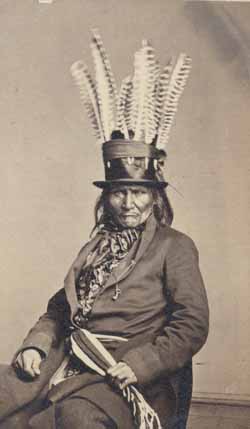
One of the MHS digital collections currently being highlighted on our homepage is Photographs of Native Americans, a compilation of portraits and other photos collected by four Bostonians during the late 19th and early 20th centuries. “Charles W. Jenks and Francis Parkman collected carte de visite and tintype portraits of American Indians during the 1860s as historical records of tribal groups and their role in contemporary American politics. After a visit to southern California, Boston collector Kingsmill Marrs brought home platinotypes of southwestern Indians taken by Adam Clark Vroman in the late 1890s. An anonymous donor was inspired to collect Joseph Kossuth Dixon’s photogravures from the Wanamaker Indian expeditions of the early 1900s after hearing Dixon lecture in 1912.”

The fellow at left is a Chippewa man, photographed in Washington, D.C. in 1862 by Charles D. Fredericks & Co. The carte de visite is from the Charles W. Jenks collection.

You can find background text and links to many more photographs here.

This Week @ MHS

By Jeremy Dibbell

Join us tonight, Monday 19 October, at 6 p.m., for a talk and booksigning by Gordon S. Wood, the Alva O. Way Professor of History Emeritus at Brown University. His books include the Pulitzer Prize-winning The Radicalism of the American Revolution, the Bancroft Prize-winning The Creation of the American Republic, 1776-1787, The Americanization of Benjamin Franklin, and The Purpose of the Past: Reflections on the Uses of History.

Wood’s talk tonight will be on his new book, Empire of Liberty: A History of the Early Republic, 1789-1815, just published by Oxford University Press. Professor Wood will sign copies of his book following the talk. Refreshments will be served at 5:30 p.m.

And join us on Wednesday, 21 October, at noon, for a brown-bag lunch with Caroline Frank, current MHS short-term research fellow. She’ll discuss her current project, “Native American Enslavement in Southern New England, 1630-1730.”

“Sexual Warfare”: Lunch Talk Recap

By Anna Cook

Last Wednesday (9 October) current NEH-MHS long-term fellow Crystal Feimster gave a brown bag lunch talk titled “Sexual Warfare: Rape and the American Civil War.” Crystal described for us the research project that brought her to the MHS, which builds upon the material in her first book (newly-released through Harvard University Press), Southern Horrors: Women and the Politics of Rape and Lynching.  In Southern Horrors, Crystal explored the fears about sexual violence in the postwar South; her current research moves back in time from Reconstruction to the war itself. 

As a way of sharing the early findings of her research with us, Crystal described some of the materials she has been using to piece together the story of sexual violence in wartime and posed some of the questions that these documents leave her pondering. For example, elite white women’s diaries kept prior to and during the war express coded fears about sexual violence at the hands of Union troops, but rarely talk directly about being raped – at the same time, they use the language of invasion, and talk about Union troops entering their bedrooms. They also describe sexual violence witnessed against other women (often female slaves).  Another source of information has been the approximately two hundred court marshals against Unions for sexual assault, a small percentage when compared to other conflicts that has left some historians to conclude the Civil War was a “low rape” war.  However, Crystal raises questions about how accurately the court marshals reveal the situation on the ground: What rapes are being reported? When reported, which are likely to be entered into the record and brought to trial?  Correspondence from officers in MHS collections suggests that there was an expectation within the military hierarchy that certain behaviors among the troops not enter into the official record. 

During the discussion period, questions were raised about change over time during the course of the war.  Crystal described General Butler’s occupation of New Orleans during which local women openly resisted Union troops.  In response to the women’s disrespectful behavior toward Northern soldiers, Butler enacted General Order No. 28, or “the women’s order,” that sanctioned the use of sexual violence – or at least the threat of sexual violence, as a way of controlling women’s behavior.  She sees Butler’s occupation as one of a series of moments during the war during which the discourse – and possibly the practice – of sexual violence shifts.  Through tracking certain individuals for the duration of the war – Southern women, men in the military – Crystal hopes to chart out when and how these shifts took place. 

We are excited to have Crystal here as one of our research fellows, awed by her diligence in making sense of nineteenth-century military culture (not to mention nineteenth-century handwriting!) and look forward to future updates on the project, and eventually the book that will no doubt result.

Ulrich Receives Society’s Kennedy Medal

By Jeremy Dibbell

Harvard professor Laurel Thatcher Ulrich was awarded the Massachusetts Historical Society’s John F. Kennedy Medal on Wednesday night at the Society’s 60th annual dinner. Ulrich, the tenth Kennedy Medal honoree, is the first woman to receive the medal, the Society’s highest possible honor.

“Throughout her career Professor Ulrich has mixed very distinguished scholarship with an ability to cross conventional academic boundaries, which has greatly enriched our understanding of history,” stated Bill Clendaniel, chair of the Society’s Board of Trustees. “In addition, she has helped make American history relevant and thought-provoking to a wide audience through her PBS documentary and the popular use of her phrase ‘well-behaved women seldom make history.’ That she is the first woman to receive the Kennedy Medal also gives the Society particular pleasure.”

Shortly after President Kennedy’s death, the Society received several gifts designated for use in any appropriate way to perpetuate President Kennedy’s memory as an active member of the Society and a great friend of historical scholarship. The MHS determined to create a medal in President Kennedy’s name and commissioned eminent artist and MHS Fellow Rudolph Ruzicka to design the medal. Since then, the Society has presented 10 honorees with the Kennedy Medal, awarded from time to time to persons who have rendered distinguished service to the cause of history. It is not limited to any field of history or in fact to any particular kind of service to history. The previous recipients of the medal are Samuel Eliot Morrison (1967), Dumas Malone (1972), Thomas Boylston Adams (1976), Oscar Handlin (1991), Edmund S. Morgan (2002), Alfred DuPont Chandler, Jr. (2003), Bernard Bailyn (2004), John Hope Franklin (2005), and Arthur M. Schlesinger, Jr. (2006).

Professor Ulrich, the 300th Anniversary University Professor at Harvard University, delivered a talk at the dinner, “A Mormon Apostle in Boston: Sightseeing, Riot, and Martyrdom.”

The Harvard Gazette features a story about the award.

Invade Canada?

By Rakashi Chand

This is a lovely time of year to visit the beautiful province of Quebec, Canada. Quebec City is a special hidden gem, the feel of Europe without boarding a plane! But many Americans crossing the border are not aware of American invasions of Canada (most significantly, the Quebec expedition, during the American Revolution).

The first Continental Congress invited the French-Canadians to join their cause, hoping to appeal to their desire to be rid of British rule. Although this union never came to fruition, there was perhaps the possibility of a fourteenth colony. France had recently lost the Province of Quebec to the British in the French and Indian War so the Americans forces hoped the French Canadians would join them in over-turning British rule in North America when they invaded Quebec. This was the first major military excursion for the young Continental Army. General Richard Montgomery led a successful campaign in Montreal, but his snow-storm assault on the last day of the year in 1775 ended in disaster below the heavily fortified walls of Quebec City.

The six-week trek from Boston to Quebec City through the Maine wilderness led to the creation of an interesting array of documents in testimony of the hardships endured and the battle which ensued. Here at the MHS, researchers can view the William Dorr Journal, 1775-1776, which describes the journey to Maine up the Kennebec River and down the Chaudiere to Quebec and the hardships incurred; Jonathan Hill Journal, 1776, which recounts the march from New York to Montreal (and is written on the back pages of an arithmetic copy book); the handsome penmanship of Benedict Arnold in a letter regarding the siege of Quebec in the Hector McNeill papers, 1765-1812. Alternatively, researchers can get the British perspective, through the Journal of an officer of the 47th Regiment of Foot, 1776-1777, kept during campaigns in Canada describing the regiment’s activities under Gen. Guy Carleton while reinforcing the Quebec area against American forces in 1776.

There are also numerous printed documents recounting the “Canadian Invasion.” The Quebec expedition turned out to be much more than what the Continental Army could manage the winter of 1775-76, but don’t take our word for it. You can read about the expedition through journals, letters, books and even a drama (The death of General Montgomery, in storming the city of Quebec: A tragedy By H. H. Brackenridge (Norwich [Conn.]: Printed by J. Trumbull, for and sold by J. Douglass M’Dougall, on the west side of the Great-Bridge, Providence, 1777). If this topic piques your interest, please use our on-line catalog, ABIGAIL, to do a subject search for “Canadian Invasion, 1775-1776”; to see a list of available sources. And the next time you cross the border or if you ever have a chance to walk through the fortifications of Old Quebec City, you can imagine the hardships encountered by General Montgomery, Benedict Arnold, and the continental army as they attempted to “take Canada”.