Letters to William and Caroline Eustis, Part IV

by Susan Martin, Processing Archivist & EAD Coordinator

This is the fourth  part of a series about the letters to William and Caroline Eustis at the Massachusetts Historical Society. Click here to read Part I, Part II, and Part III.

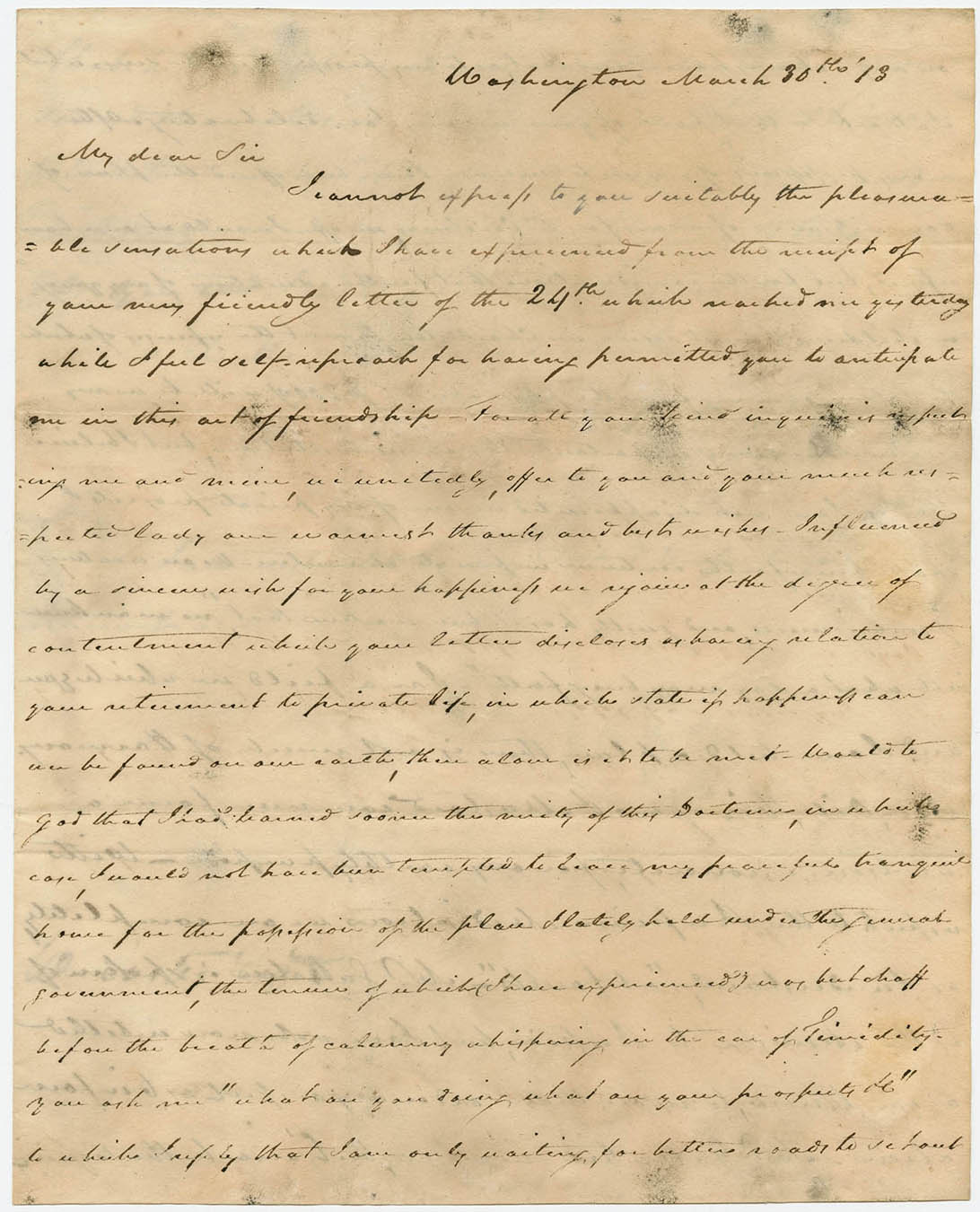
On 30 March 1813, Paul Hamilton wrote to his friend and former colleague William Eustis in Boston. Both men had been serving in the Cabinet of President James Madison at the start of the War of 1812 just nine months before, Hamilton as Secretary of the Navy and Eustis as Secretary of War. But by the time this letter was written, both had resigned.

Letter from Paul Hamilton
Letter from Paul Hamilton to William Eustis, 30 Mar. 1813

I found an extensive biography of Paul Hamilton, particularly his early years, in the History of Higher Education in South Carolina (pp. 127-133). He was a South Carolinian, born in 1762 and the only one of his parents’ three children to live past the age of five. He fought with the state militia in the American Revolution while still a teenager. Beginning in 1785, he served in several public offices, sitting for a few terms in the South Carolina legislature before his election to the governorship in 1804. He was a rice planter and enslaver.

His elevation to the federal government came in 1809, when he was appointed Secretary of the Navy by President Madison. Less than four years later, Hamilton regretted accepting the job. He wrote this letter to Eustis while the resignations of both men were still fresh.

We rejoice at the degree of contentment which your letter discloses as having relation to your retirement to private life, in which state if happiness can ever be found on our earth, there alone is it to be met. Would to God that I had learned sooner the verity of this Doctrine, in which case, I would not have been tempted to leave my peaceful tranquil home for the possession of the place I lately held under the general government, the tenure of which (I have experienced) was but chaff before the breath of calumny whispering in the ear of Timidity.

A tortured metaphor, to be sure, but his bitterness is clear. So what had gone wrong?

According to the National Archives’ Founders Online, Secretary of the Navy Hamilton “was increasingly beset by rumors of alcoholism, lax record keeping, appointment of unqualified persons, and extravagant contracts.” Biographer Raymond Walters, Jr. does not mince his words, either, in his 1957 book about fellow Cabinet member Albert Gallatin. He calls both William Eustis and Paul Hamilton “amiable incompetents” (p. 251). Jeff Broadwater, in his 2012 biography of James Madison, says that “Eustis and Hamilton provided sectional balance in the Cabinet and not much else” (p. 147). President Madison apparently met with Hamilton twice to relay concerns about his management of the department and essentially pressured him to resign.

By all accounts, Madison’s Cabinet was a mess. Even Hamilton seemed to agree. In my favorite passage of the letter, he used another metaphor to describe the dynamics of the group, this one much more robust and eloquent.

In a field in which you and I once held a place, there is not much of Harmony. Ice, Oil, Vinegar & Mustard can never form a wholsome [sic] concrete, for any earthly purpose.

Paul Hamilton letter to William Eustis
Excerpt of Paul Hamilton’s letter

Now Hamilton found himself on the outside, and he resented it. With so much going on in the world, he was no longer entitled to privileged information and could only repeat gossip. Who would be appointed minister to Russia to negotiate the end of the war? His guess was as good as anybody else’s.

Hamilton wrote this letter from Washington, D.C., while he waited for the roads to become passable enough for his trip home. His next steps were uncertain. Madison had nominated him as Commissioner of Loans for South Carolina, but he was reluctant to accept. He’d soured on government, but admitted that the $2,000 salary would help pay for the education of his younger children. (He and his wife had eight children, the youngest of whom was only eight.) As he considered the future, he said: “We are creatures of contingencies, and justly has it been written that, ‘no man knoweth what a day may bring forth.’”

Ultimately, the decision was made for him. The U.S. Senate rejected his appointment, and Hamilton retired to private life after all. He died on his plantation in 1816 at the age of 53.

Hamilton’s tenure as Secretary of the Navy was not a complete failure. He is particularly recognized for the passage of the Act Establishing Navy Hospitals in 1811, which appropriated funds for the construction of the first permanent medical facilities for sailors.

For more on Paul Hamilton, I recommend this small collection of his personal papers digitized by the University of South Carolina Libraries. And of course, you can read the rest of this letter and other letters to William Eustis and his wife Caroline at the MHS website.

The Missing Whydah Treasure

By Laura Williams, Visitor Services Coordinator

It was a sad day for treasure hunters across the U.S.  when on 6 June 2020, millionaire art dealer Forrest Fenn’s legendary treasure was reported as found. Hidden in the Rocky Mountains for 10 years, the only clues to find the chest filled with gold coins and nuggets were a map and a poem. Like most mysteries, this treasure hunt did not come without a fair share of darkness as it is believed that 4 people died on the quest. [1]  As I learned more about this present day treasure hunt, I could not help but think back on other tales of hidden riches that have puzzled treasure seekers and historians alike. From the pirate Blackbeard to the Aztec Emperor Montezuma II, legends of hidden treasures are as old as time. In fact, one such treasure that is still missing is the rumored bounty of the pirate ship the Whydah which sank just off the coast of Cape Cod, Mass..

The Whydah had a dark past before it was captured by pirates, as it was originally a merchant slaver used within the Triangular Trade and the Middle Passage. It was boarded by pirates as it left Jamaica en route to London in late February/early March 1717. The pirate crew was led by Samuel Bellamy, or Black Bellamy, and the ship was soon loaded up with plunder as they made their way across the seas. In addition to weaponry and other valuables, the most intriguing facet aboard was the rumored 20,000 pounds of gold and silver.  Captain Bellamy’s command of the ship was short lived, however, as it sank on 26 April 1717 after storm winds pushed it onto the shoals of Cape Cod. Only a handful of survivors were left and they were taken ashore to face trial in Boston.

Immediately following the wreck, it is known that Cape Cod locals plundered the ship’s valuables. Cyprian Southack, a cartographer, was also hired to note the location of the shipwreck and gather treasures for the crown. More about his voyages and time serving the Mass Bay Colony can be found in the MHS’s Cyprian Southack letters collection. In fact, much of what we now know about the pirates comes from the priest Cotton Mather’s papers and his account of visits with the men in jail to provide them salvation. However, it was never confirmed whether or not the large bounty of treasure that the pirates gloated about truly existed.

Once six out of the seven surviving pirates were sentenced to death and executed in Boston, the Whydah remained buried under 30 feet of water for over 250 years. That is until 1984 when underwater explorer and Massachusetts native, Barry Clifford, found the ship’s remains and the Whydah became the first authenticated pirate ship wreck in North America. The thousands of artifacts discovered in the wreck can be seen at the Whydah Pirate Museum in Cape Cod, and Clifford has continued his search for the legendary treasure. In 2016, Clifford and his team stated that they discovered a large metallic mass off the coast of Wellfleet, MA that may contain most or all of the alleged 400,000 coins hidden below sea. [2]  Further deconstruction of the mass will be needed to verify this claim.

As modern day treasure hunters continue their quests for riches, the journey will always begin with history and the clues that have been left behind. To learn more about the Whydah pirates, notorious Captain Kidd or Boston’s history as the “Port Where Pirates Hang,” take a look at our previous Beehive posts: The End of Piracy: Pirates hanged in Boston 300 years ago | Beehive & Piracy and Repentance | Beehive.

[1] Chappell, Bill. “Hidden Treasure Chest Filled With Gold And Gems Is Found In Rocky Mountains.” NPR.org, accessed on June 10, 2020. https://www.npr.org/2020/06/08/872186575/hidden-million-dollar-treasure-has-been-found-in-rocky-mountains-art-dealer-says

[2] Marcelo, Philip. “Explorer Barry Clifford claims he’s located famous pirate ship Whydah’s treasure.” patriotledger.com, accessed on June 19, 2020. https://www.patriotledger.com/news/20161007/explorer-barry-clifford-claims-hes-located-famous-pirate-ship-whydahs-treasure

Race and Infectious Disease in the 18th Century

By Dr. Talya Housman, Threadable Books

In 1722, Reverend William Douglass attacked the smallpox inoculation efforts of Cotton Mather and Zabdiel Boylston, dismissing inoculation as based on “a silly Story or familiar Interview and Conversation between two black (Negroe) Gentlemen,” and promoted by “an Army of half a Dozen or half a Score Africans, by others call‟d Negroe Slaves, who tell us now (tho‟ never before) that it is practiced in their own Countery.”[1]

Inoculation had been used in Africa prior to its use in Boston and Mather had heard of the process from Onesimus, who was his slave. Mather defended his and Boylston’s experiments noting that inoculation had worked “upon both Male and Female, both old and young, both Strong and Weak, both White and Black.”[2]

The 1721 controversy over inoculation was not exclusively about race. There were myriad issues mixed up in the debate including medical certification and religion. However, as was the case in much of the eighteenth century American history of infectious disease, race played an important and often times unsavory role.

Human bondage is a critical piece of these stories. Though in this case Mather used his voice to amplify an idea he heard from Onesimus, as Mather’s “property,” Onesimus had little choice in the course of events and we have no record of his voice in the story. Unfortunately, Onesimus is hardly the most exploited enslaved person in the eighteenth century history of infectious disease. Numerous physicians in the Americas performed experiments on slaves. For these experiments, physicians would solicit consent from the owners of slaves, rather than the enslaved persons themselves. Physician John Quier, for example, experimented with innoculation on almost eight hundred slaves.[3]

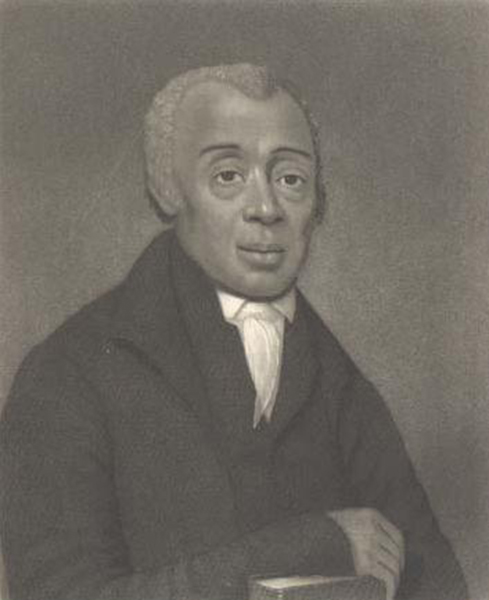
The freed black community was far from unaffected by the interplay between race and infectious disease. In 1793, yellow fever broke out in Philadelphia. Benjamin Rush, signer of the Declaration of Indpendence and one of the most prominent physicians in North America, actively worked to combat the disease. After reading Dr. John Lining’s account of the 1754 yellow fever outbreak in Charleston, Rush wrote to his friend Richard Allen, a preacher and founder of the African Methodist Episcopal Church, who was one of the most influential black leaders of the time.

Richard Allen by Daniel A. Payne
Portrait of Richard Allen by Daniel A. Payne from the frontispiece of History of the African Methodist Episcopal Church (1891)

Yellow fever, Rush informed Allen, “infects white people of all ranks, but passes by persons of your color.” While Rush wrote that this “important exemption which God” granted to the black community from “a dangerous & fatal disorder” did not create “an obligation to offer your services to attend the sick,” Rush emphasized that tending to the sick white community would earn the black community gratefulness. (Interestingly, Rush initially wrote that nursing the sick would “render you acceptable to,” but he struck out those words and replaced them.) Allen and the black community of Philadelphia obliged, tending to the sick white community. However, as Rush himself would later discover, they were no more immune to yellow fever than the white community. [4]

In fact, Lining’s research was part of an ongoing myth that black bodies are more immune to all sorts of things than white bodies: disease, heat, pain – the list goes on.

The intersection between infectious disease and race in the eighteenth century is a reminder that infectious disease intersects with and exposes other existing problems in our society – be they racial, socio-economic, religious, or otherwise.

Dr. Housman’s first book project uses digital tools to explore sexual crime in seventeenth century England. She has written on numerous historical topics including slavery, suffrage, religious freedom, industrialization, charitable giving, and pandemics for various public history organizations. 

[1] William Douglass, Inoculation of the Small Pox as Practiced in Boston, Consider‟d in a Letter to A—S– -M.D. & F.R.S (Boston, 1722), 6-7.

[2] Minardi, Margot, “The Boston Inoculation Controversy of 1721-1722: An Incident in the History of Race,” The William and Mary Quarterly, Third Series, 61, no. 1 (2004), 58 citing Cotton Mather, The Angel of Bethesda, ed. Gordon W. Jones (Barre, Mass., 1972), 113.

[3] Londa L Schiebinger, Plants and Empire, (Harvard University Press, 2009). p. 175.

Rana A. Hogarth, Medicalizing Blackness: Making Racial Difference in the Atlantic World, 1780-1840. (University of North Carolina Press, 2017), 220, fn. 12.

[4]Ibid, 24-8.

Early American Purses

By Angela Tillapaugh, Library Assistant

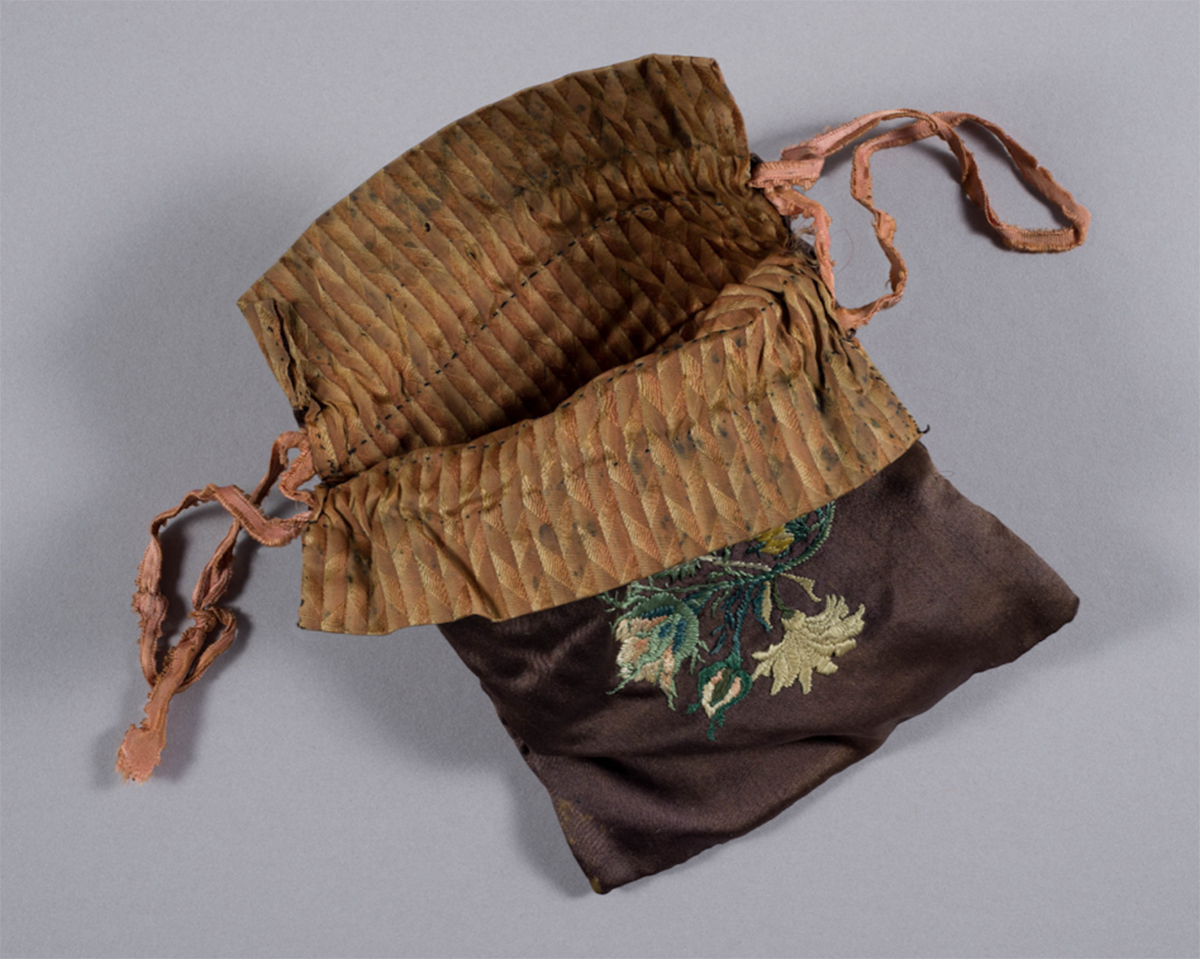
Silk purse that belonged to Sarah Leverett
Purse made for Sarah Leverett. Silk. 1840. 20 cm x 15 cm. From the collection of the Massachusetts Historical Society.

The image above shows a brown silk purse with floral embroidery owned by Sarah Leverett. Small drawstring purses, sometimes called reticules, became popular in the early 19th century. They were usually made fine materials like silk and velvet, and some decorated with elaborate embroidery or beading to make them stand out. Most were secured by a drawstring on the top and held around the wearer’s wrist. Previously, carrying small fashionable purses was not standard for early Americans.

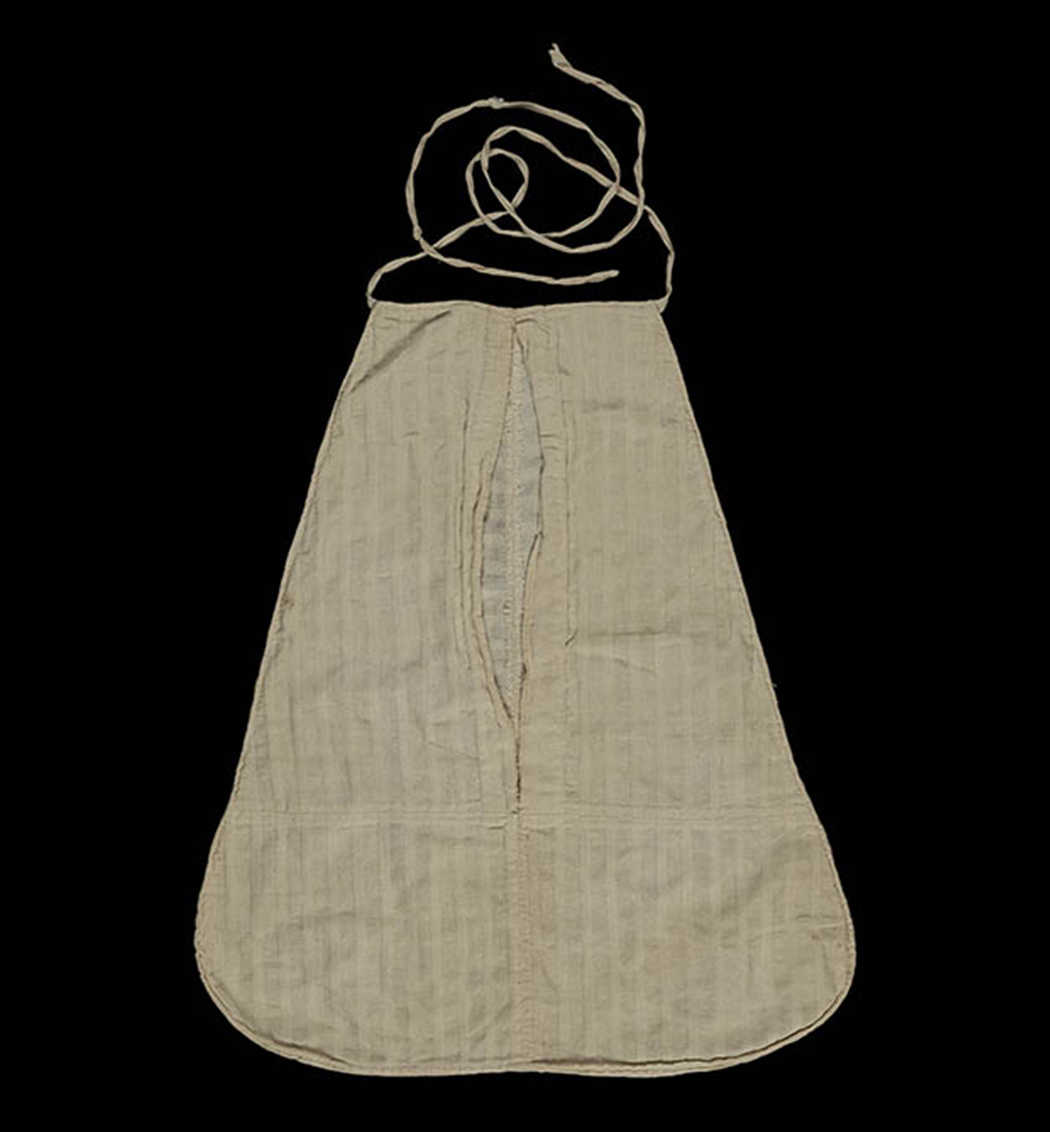
Dimity pocket
Pocket belonging to Abigail Adams. Dimity with cotton tapes by unknown maker. Late 18th-early 19th century. 36.1cm x 13.7cm. From the collection of the Massachusetts Historical Society.

Women used to carry their belongings in pockets, like the one above owned by Abigail Adams. Unlike menswear, pockets were separate garments that would be tied around the waist underneath an outer skirt with slits cut into it so the wearer could easily access the pouch. Unlike the delicate embroidered purses, pockets were large practical garments usually made of sturdy cotton that could fit many of the wearer’s belongings. Reticules replaced pockets around the early 19th century when full dresses with layered petticoats fell out of fashion. Dresses with high waistlines and slim fitting skirts became popular among fashionable women. Slim fitting skirts were not conducive to hiding large pockets, which were considered undergarments and inappropriate to see through a dress.[i] To account for the loss of pockets, many started carrying small purses like the one owned by Sarah Leverett. Some American women fought against the loss of the pocket, arguing that carrying a bag could never provide the same freedom having your belongings tucked away in a pocket. Other women argued that the opposite was true, the reticules gave women more freedom because they were not weighed down by heavy pockets.[ii]

Regardless, the pocket never made a significant comeback in American women’s fashion, but the purse continued to evolve. Luggage manufacturers like Louis Vuitton introduced the early modern purse by making smaller versions of their suitcases and calling them “hand-bags”.[iii] These purses were much more secure than the silk drawstring bags and allowed the owner to carry more belongings with them then the pockets of centuries prior. The purse has certainly stood the test of time, continuing to modernize and change with the times to meet the needs of the wearer.

Further reading on Abigail Adam’s pocket: www.masshist.org/object-of-the-month/objects/abigail-adams-pocket-2009-12-01

[i] Danford, Sara. “The History of the Handbag,” May 31, 2017. https://womensmuseum.wordpress.com/2017/05/31/the-history-of-the-handbag/.

[ii] Trufelman, Avery, host. “Pockets: Articles of Interest #3.” 99 Percent Invisible (podcast). October 2, 2018. Accessed June 04, 2020.

[iii] Danford, Sara. “The History of the Handbag,” May 31, 2017. https://womensmuseum.wordpress.com/2017/05/31/the-history-of-the-handbag/.

Letters to William and Caroline Eustis, Part III

By Susan Martin, Processing Archivist & EAD Coordinator

This is the third part of a series about the letters to William and Caroline Eustis at the Massachusetts Historical Society. Click here to read Part I and Part II.

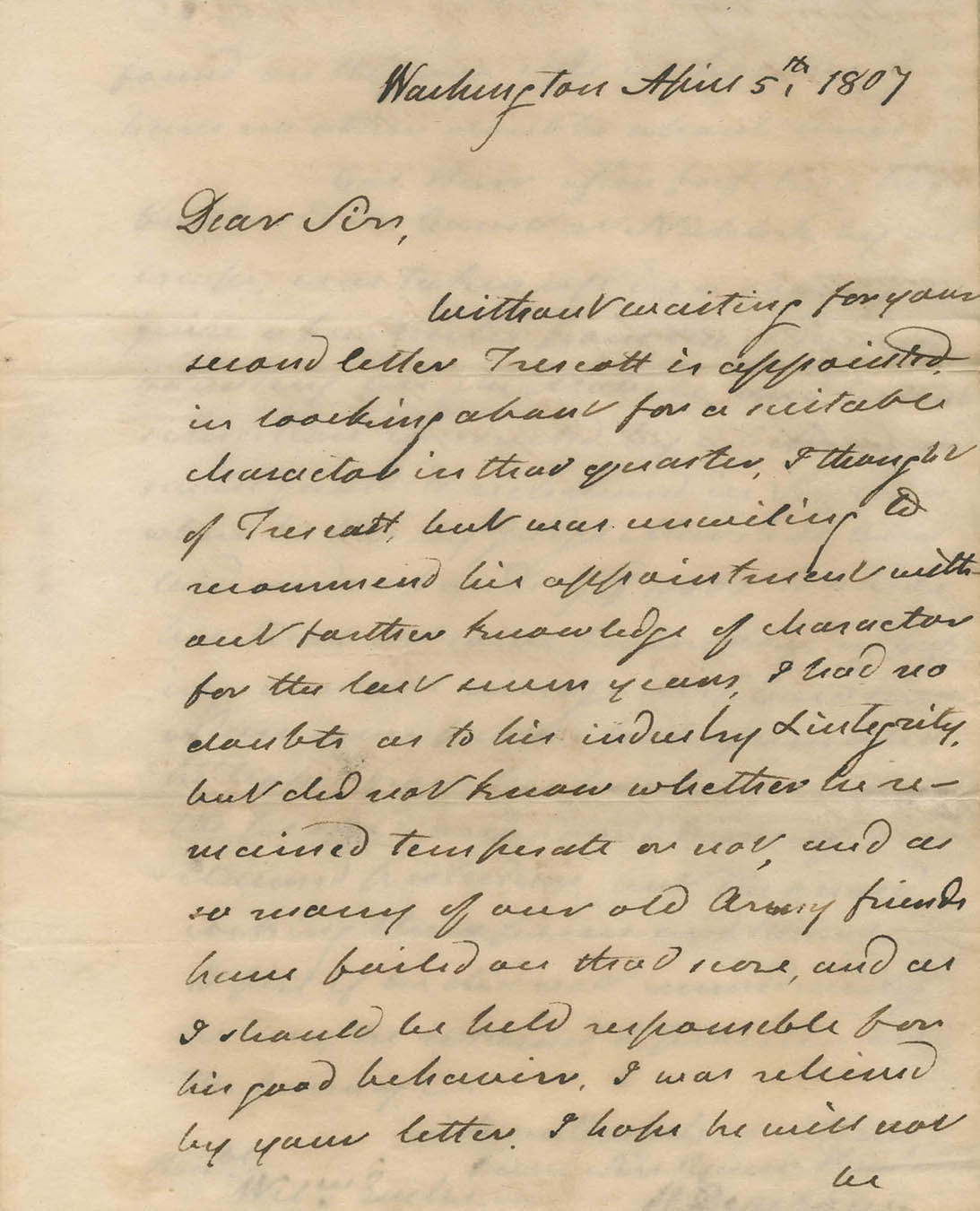
Letter to William Eustis
Letter from Henry Dearborn to William Eustis, 5 April 1807

Among the many interesting letters to William and Caroline Eustis at the MHS is one written by Secretary of War Henry Dearborn in Washington, D.C. on 5 April 1807. I’d like to take another one of my deep dives and look at this letter in more detail. It’s a great example of what we archivists often see in historical correspondence: a relatively mundane topic juxtaposed with a very dramatic one.

Dearborn began his letter to William Eustis by informing him of the routine appointment of a man named Lemuel Trescott to be collector of customs at the port of Machias, Maine. Dearborn had asked Eustis for advice about Trescott’s character, and what he heard reassured him. He’d been particularly concerned with the question of temperance, “as so many of our old Army friends have failed on that score.”

So far, so good. But what began as a letter on straightforward official business became, on the second page, an account of the escape and recapture of Vice President Aaron Burr before his trial on charges of treason. Here’s how Dearborn described it (I’ll preserve his misspellings):

Col Burr, after forfiting his bonds to the Court at Natchez, by an escape, was taken up in a shabby disguise a few miles from the Spanish boundary on the Mobile, and in that situation conducted by a Citizan and small guard to richmond in Virginia where he has by Judge Marshal, been laid under bonds of $10,000 to abide his trial at some future day.

(An online currency converter tells me that $10,000 in 1807 is the equivalent of approximately $220,000 today.)

Aaron Burr had been Thomas Jefferson’s first vice president, serving until 1805. He had, of course, famously killed Alexander Hamilton in a duel in 1804. But this time, he was accused of something quite different: plotting to create a secessionist state in the West and raising troops to invade and annex Spanish-held land in Texas and Mexico. Or something like that. The details and purpose of his enterprise are still contested by historians.

Thomas Jefferson ordered the arrest of Burr, who surrendered to the authorities at Natchez in the Mississippi Territory. As Dearborn explained in the passage above, Burr then escaped and managed to get to within a few miles of the border of West Florida before his recapture in February 1807. West Florida was a Spanish territory consisting of a narrow strip of land along the northern coast of the Gulf of Mexico from the Florida panhandle to the Mississippi River.

Dearborn also related the story of a second escape attempt by Burr on the way to Richmond.

In passing a small village in S. Carolina where some people had assembled, he leaped from his horse, ran towards the people, announced himself, and claimed protection, but the guard cocking their pins and threatening to fire if he did not immediately return, he returned & proceeded on the journey.

I found references to this story online and confirmed that this incident took place in Chester, South Carolina. It was probably reasonable for Burr to hope for sympathy in that state, since his son-in-law was a prominent landowner there. But he’d clearly taken the people of Chester by surprise, and what might have become a dramatic rescue unceremoniously fizzled out. Interestingly, the rock on which Burr stood as he made his plea to the town is now a designated historical marker carved with the following inscription:

In 1806 [sic] Aaron Burr while passing through Chester a prisoner dismounted on this rock and appealed in vain to the citizens for help.

Burr’s trial at Richmond was a sensation and lasted for months. He was eventually acquitted due to lack of evidence of any overt act of treason. Chief Justice of the Supreme Court John Marshall presided.

Incidentally, Henry Dearborn and William Eustis had a lot in common. They were both Revolutionary War veterans. They both served as Secretaries of War, Dearborn under President Jefferson, and Eustis right after him under President Madison. And both men knew Burr personally. Eustis in particular was a good friend and frequent correspondent of the vice president, which may have been why Dearborn was keeping him in the loop.

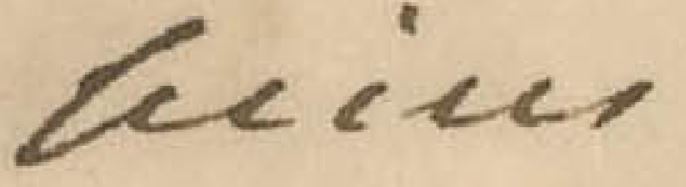
This letter is also fairly typical for another reason: tricky handwriting. With practice, archivists get better at reading old manuscripts, but each correspondent has his or her own quirks. Dearborn’s writing is large, and the letters don’t really connect up well with each other. For example, this word is apparently “pins.”

Detail from letter written by Dearborn
Dearborn’s handwriting: “pins”

Here is “some.”

Letter from Dearborn to Eustis
Dearborn’s handwriting: “some”

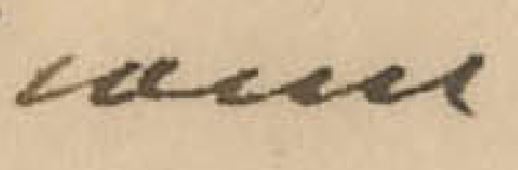
And this one, as near as I can tell from context, is “wrong.” Or, that is, “rong” spelled wrong.

Letter from Dearborn to Eustis
Dearborn’s handwriting: “rong”

Stay tuned to the Beehive for more on the Eustis collection.

“How are your nice Feelings affected by the Times?”

By Gwen Fries, Adams Papers

The news is scary. In the midst of global pandemic, an economic crisis, and nightly images of police brutality, we keep hearing the same question over and over: What do I tell my children?

This is not a new question. Every time John Adams sat at his writing desk in Philadelphia, quill in hand, he contemplated what to say to his “little flock.” He knew they had the violence of war on their doorstep, and the smallpox virus was creeping ever closer. “My Anxiety about you and the Children, as well as our Country, has been extreme,” he confided to Abigail on 24 July 1775.

John recognized that his children were exceptionally lucky to have a mother like Abigail to explain, care, and console, but he was still their father. In his letter to Abigail of 2 June 1775, John wrote, “My Dear Nabby, and Johnny and Charley & Tommy are never out of my Thoughts.”

letter from John Adams to Abigail Adams
John Adams to Abigail Adams, 2 June 1775.

Adams encouraged his children to communicate with him, telling them he longed “to share with your Mamma the Pleasures of your Conversation.” Sometimes he invited the children to lead the conversation and tell him what they were experiencing. On 17 March 1777, he asked his son Charles, “What Subject do your Thoughts run upon these Times. You are a thoughtfull Child you know, always meditating upon some deep Thing or other. Your Sensibility is exquisite too. Pray how are your nice Feelings affected by the Times?”

John also reminded his children that God was watching over them, and that they could trust Abigail to keep them safe. “I hope you and your Sister and Brothers will take proper Notice of these great Events, and remember under whose wise and kind Providence they are all conducted. Not a Sparrow falls, nor a Hair is lost, but by the Direction of infinite Wisdom. Much less are Cities conquered and evacuated,” he wrote to John Quincy on 18 April 1776. For the baby, Tommy, John simply wrote, “Be always dutifull and obedient to your Mamma.”

John Adams encouraged conviction and virtue in his elder children, writing John Quincy what books to pull out of the family library to prepare for a life of public service and responsible citizenship. “Public Virtues,” he wrote to Abigail on 29 Oct. 1775, “and political Qualities therefore should be incessantly cherished in our Children.” For Tommy, who was too young to understand what was happening, John focused on love and play. “Tell Tom, I would give a Guinea to have him climb upon my shoulder, and another to chase him into his Jail.”

Letter from John Adams
John Adams to Abigail Adams, 29 Oct. 1775

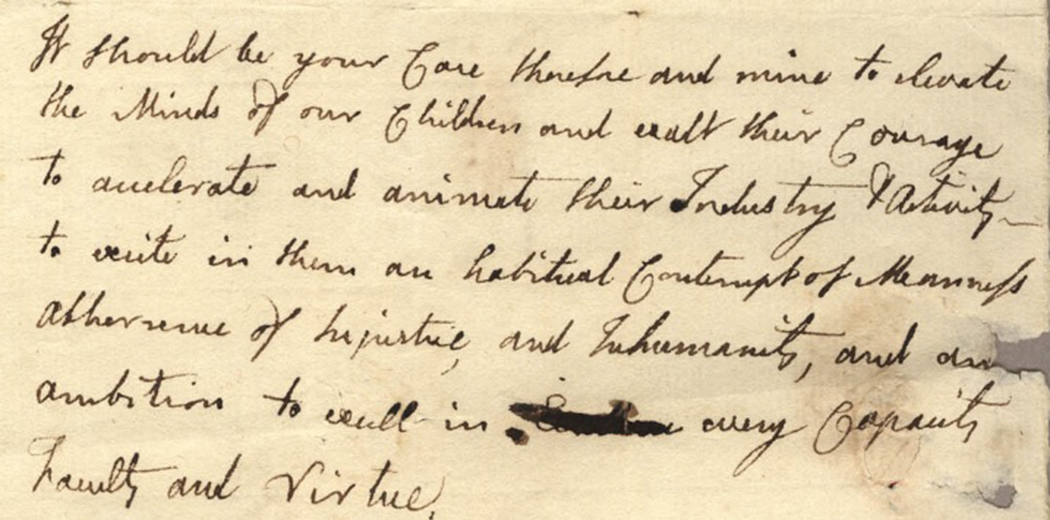
John Adams, like every parent, had many anxieties and aspirations for his children. He urged Abigail to “elevate the Minds of our Children and exalt their Courage; to accelerate and animate their Industry & activity— to excite in them an habitual Contempt of Meanness, abhorrence of Injustice and Inhumanity, and an ambition to excell in every Capacity, Faculty, and Virtue.”

To his daughter, Nabby, Adams provided his most succinct advice for navigating tumultuous times: “To be good, and to do good, is all We have to do.”

The Adams Papers editorial project at the Massachusetts Historical Society gratefully acknowledges the generous support of our sponsors. Major funding is provided by the National Endowment for the Humanities, the National Historical Publications and Records Commission, and the Packard Humanities Institute. The Florence Gould Foundation and a number of private donors also contribute critical support. All Adams Papers volumes are published by Harvard University Press.

How to Live a Long Life: Advice from the 17th & 19th Centuries

by Florentina Gutierrez, Library Assistant

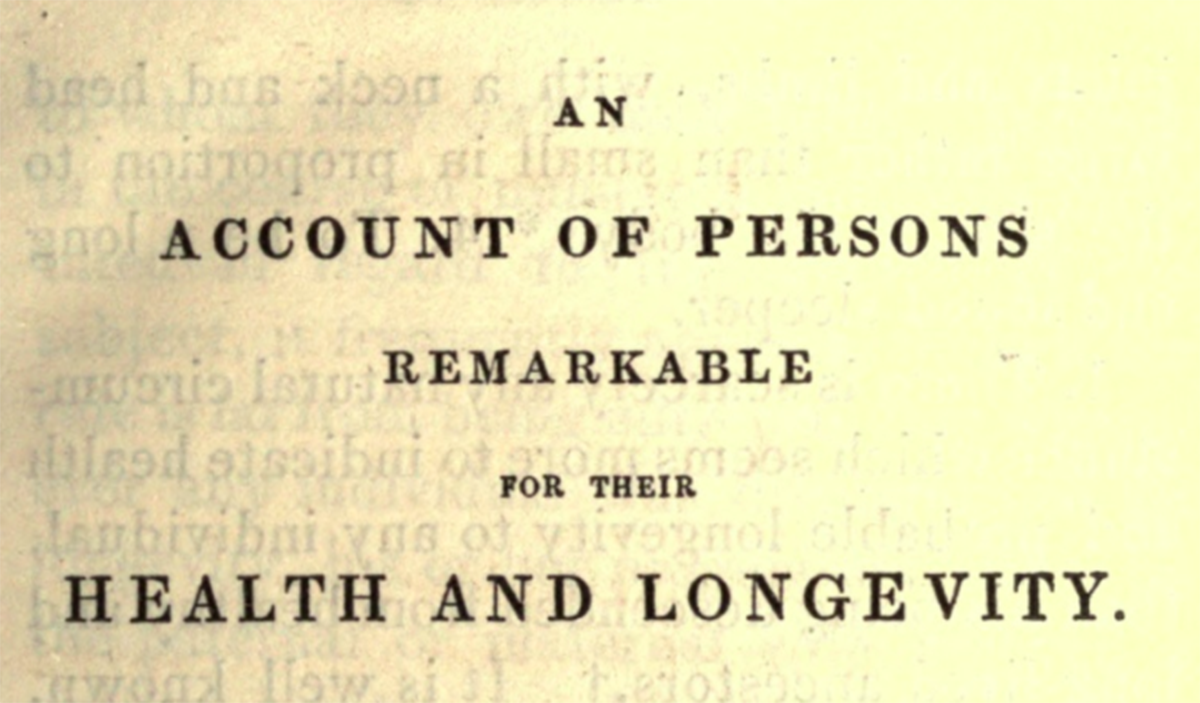
As I work remotely during this time, one of my projects has been to find digitized versions of the Society’s Dowse Library books. One that caught my eye is called An Account of Persons Remarkable for Their Healthy and Longevity, written by a physician, Thomas John Graham (1795?-1876), and published in London in 1829. This book was meant as a supplement to another book by the same author, entitled Sure Methods of Improving Health and Prolonging Life. An Account of Persons Remarkable for Their Healthy and Longevity was meant to provide examples of people that have lived healthy lives and which support the advice given in the former book.

Title page o An Account of Persons Remarkable for Their Health and Longevity
An Account of Persons Remarkable for Their Health and Longevity

What piqued my interest in An Account of Persons Remarkable for Their Health and Longevity was not a need for advice in improving/extending my own life, but rather my curiosity as to what was thought to lead to healthy life nearly 200 years ago. Would the advice be completely different from what we hear today? Would the book suggest that people do things that we now consider unhelpful, unhealthy, or even dangerous? I have to say, I was surprised by how sound the advice actually was for the most part and most of it sounded like things experts say today. However, this surprise is coming from the perspective of someone who has little knowledge about the state of medicine/knowledge of the human body during the early 19th century.

John Thomas Graham starts of the book by saying that the “principal natural indications of long life are:

  1. To be descended from long-lived parents
  2. To be of a calm, contented, and cheerful disposition
  3. To have a just symmetry
  4. To be a long and sound sleeper” (Graham 1-2)


Graham then goes on to explain why he believes these all to be true. At least two of these seem to be somewhat controllable aspects of our lives that many of us strive for today, trying to be content and happy as well as sleeping enough each night. While overall, these “indications of a long life” seem almost obvious, Graham relies on mostly anecdotal evidence and some of the claims he makes in support of the above are not ones I’ve heard before. For example, Graham says that “in hot climates, the human frame is too hastily brought to maturity to last long” (Graham 28).

In his book he also refers to other more functional tips on how to have a prolonged life, which are based on a book written in 1648! (Almost 200 years before Graham wrote his own book). The list is long and mostly revolves around eating habits- again most seem to offer sound advice. Here’s the paraphrased list (Graham 33-38):

  1. Don’t over eat or you won’t be able to exercise
  2. Only have moderate amounts of exercise, food, drink, sleep, etc.
  3. Do not eat if you have not yet digested your last meal
  4. Don’t eat the same amount of food for each meal
  5. If you eat too much during a meal, eat less later
  6. Chew all your food before you swallow
  7. Proportion your drinks to the amount of solid food you’re eating
  8. Don’t eat too many different things at the same time
  9. Try abstaining from eating a meal once a week (maybe dinner), especially if you are not very hungry
  10. Try to exercise (probably just means move around) once a day and preferably before a meal
  11. Eat liquids and soft foods before dry and solid foods
  12. Try not to eat or drink in between meals
  13. Try to have a bowel movement every day
  14. Do not eat food that is too cold or too hot
  15. Sleep between 6 and 8 hours
  16. Do not try to read, write or reflect deeply after having a full meal
  17. Don’t exercise heavily right after eating
  18. Stretch
  19. Don’t drink (alcohol) on an empty stomach
  20. Don’t drink too much wine
  21. Eat only soft bread
  22. Try not to eat dairy
  23. Don’t eat fish often, when you do it should be “tender and well-dressed”


Out of all of these suggestions, I have to say I only found number 16 questionable and most others I have heard before. Perhaps the author thought that in the same way that you shouldn’t exert your body after eating a meal, you should also not exert your mind. And it’s true that many of us probably need a nap after a full meal! Although I have definitely been known to snack while I read.

After offering these tips, Graham goes on to describe people who lived particularly long lives- one of which he claimed lived to the age of 169! This man was named Henry Jenkins, said to have been born in 1501 and died in 1670. Graham refers to other unnamed authors who attest to this man’s age at death and Jenkins himself is said to have testified as to his old age under oath. Wikipedia also notes that his death, at least, can be trusted to be accurate as it is noted on a parish register. Besides his age, Jenkins is known to have been a fisherman in old age and then have gone on to begging- prior to this, nothing much is known. As to his “healthy” habits, Jenkins is said to have swum through rivers and had a “diet [that] was course and sour” (Graham 63-65)!

Unfortunately, I could not find additional information on the life of the author himself, John Thomas Graham, online, besides the fact that he wrote other medicine-related books. However, if you would like to read more of this book and his other book on Sure Methods of Improving Health and Prolonging Life, you can find them here and here. Of course, I would suggest referring to modern books and physicians if you are looking for medical advice for improving your health.

Citation:

Graham, Thomas J. An Account of Persons Remarkable for Their Health and Longevity. London, Simpkin and Marshall, 1829.


John Winthrop’s “History of New England”

by Laura Williams, Visitor Services Coordinator

If the first half of 2020 has shown us anything thus far, it is that there are countless sources of media, voices, opinions, and channels to connect with one another and tell the story of the times. How will historians look back on these days in our history? What will make up our archives and serve as a source for insight?

With the state of the world constantly changing, we are given the opportunity to think back and reflect on those significant days in history that have also shaped our civilization. As members of our community acknowledge present day experiences and their importance on the MHS’s Witness to History: What Are Your COVID-19 Experiences?  website, there still remains boundless opportunities to connect with the past. Throughout the summer, I will highlight historical events and feature relevant pieces from the MHS collections. By looking back on these moments of adversity, progress, and pertinence, (and their remnants), we can discover that our present perspective may still be influenced.

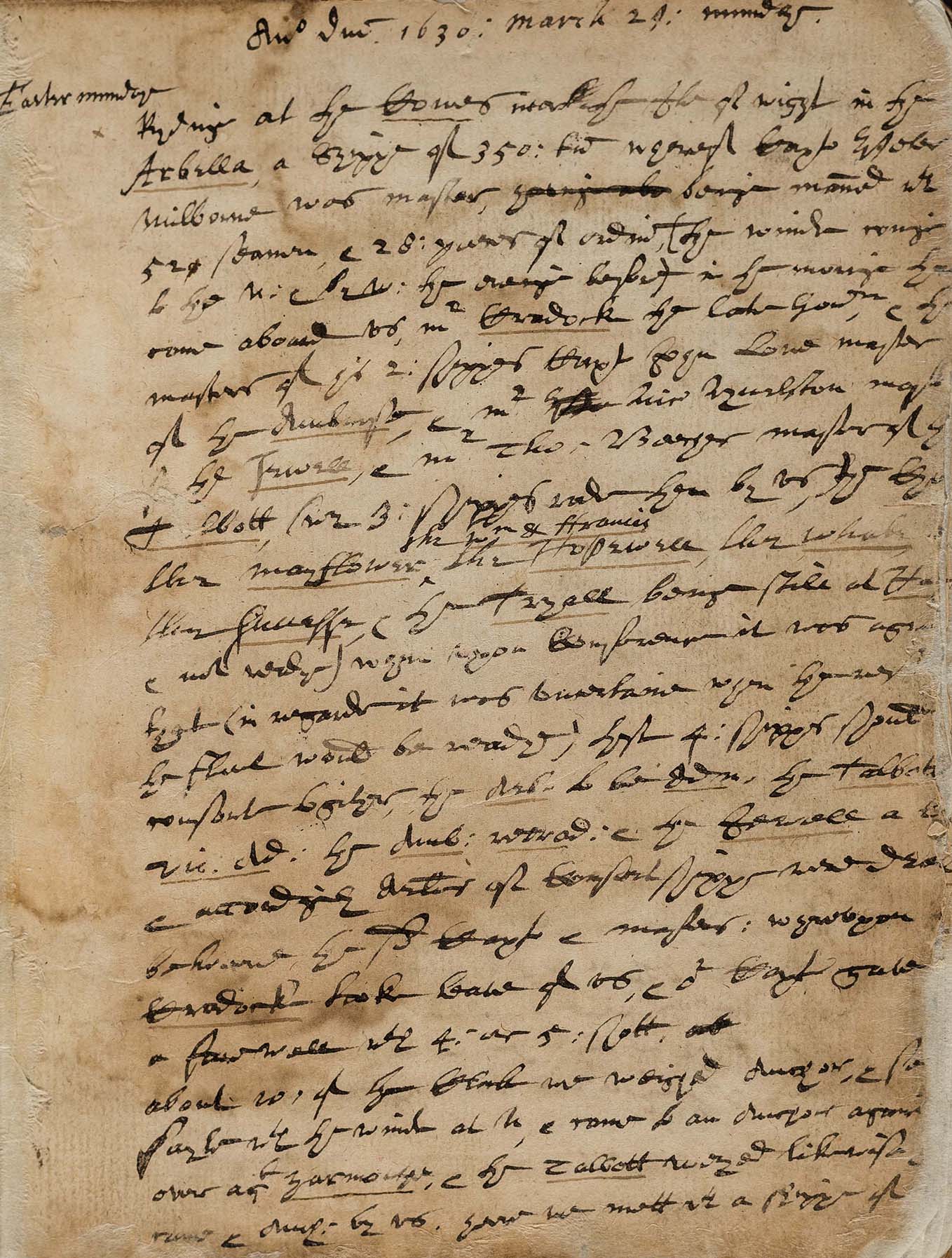
We begin this series with John Winthrop’s History of New England. The surviving volumes of this journal are housed at the MHS among the Winthrop family papers and contain Winthrop’s personal writings surrounding the “history of the Massachusetts Bay Colony from the sailing of the Arbella in March 1630 until shortly before his death.” [1] A Puritan lawyer who was selected to lead English immigrants and form a colony in Massachusetts, Winthrop served as governor for the Massachusetts Bay Colony and is known as “the chief figure among the Puritan founders of New England.” [2] The journal begins with his recording of the journey from England to America, but as time went on it also served as a way of documenting civic and social details for the colony. His observations included daily occurrences of early New England life, as well as a look into his political standings and religious ideologies.

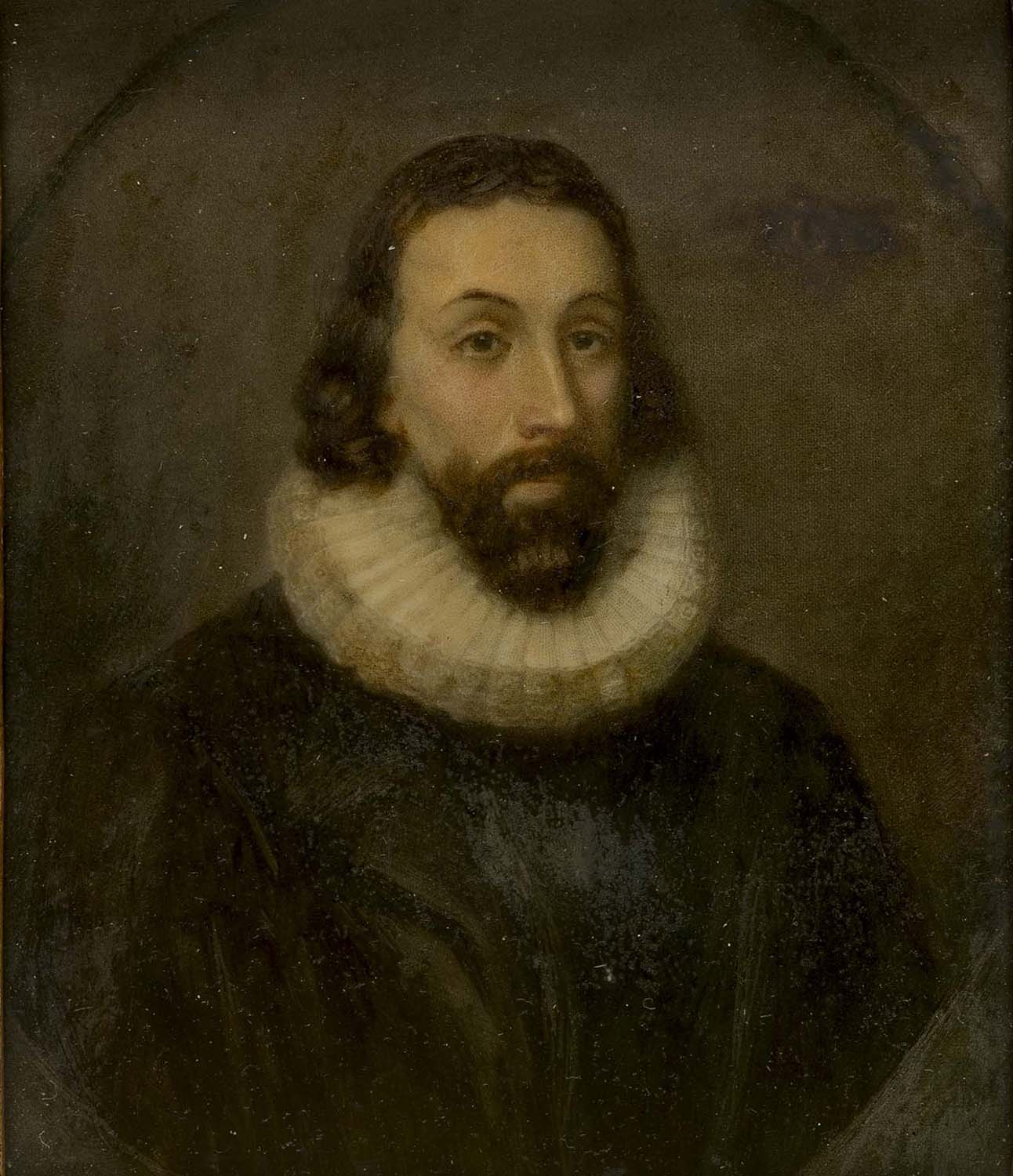
John Winthrop portrait
This portrait depicts John Winthrop (1588-1649) and is attributed to Paul Moschowitz, [19–]
Since the late colonial period, historians have used Winthrop’s journal, first as a manuscript, and since 1790 in a variety of editions, for the study of the founding of Massachusetts. [3] Having been reelected as governor over a dozen times, Winthrop’s historical account of his views and experiences in early colonial life are extremely valuable as a source for the study and understanding of American history. His narration of Puritan life offers a much more in depth account of the political affairs within a desired utopia for the New World. The journal also includes references to many other prominent figures of early New England history, including William Bradford of Plymouth, John Cotton, Anne Hutchinson, and Roger Williams. Though a completely biased account of the goals and principles for the colony, the public nature of the document gives us clear insight into Puritan ideals in a time of growth.

John Winthrop journal
John Winthrop journal, History of New England (manuscript), volume 1

This manuscript is only a small part of the total Winthrop family papers collection, which includes personal journals, manuscripts, diaries, deeds, etc. from generations of family members. Even today, documenting our own personal experiences, opinions, and reactions to historical events will play an important role in the preservation of history. As we understand such writings to be a personal or one-sided account of events, the unique perspective that a manuscript such as this brings to evaluating history is irreplaceable. As “witnesses” to history, it is imperative that subjective documentation of events continues to contribute to the world’s archives. Whether it be a blog, Tweet, traditional diary entry or a handwritten letter to a loved one, historical accounts may now take many forms.

I encourage you all to visit our Witness to History website and contribute your story. View Winthrop’s History of New England  journal, volume 1 on our website and read a detailed account of how the volumes made their way into the MHS collections.

[1] MHS Collections Online, John Winthrop journal, History of New England (manuscript), volume 1, accessed May 13, 2020, http://masshist.org/database/3897

[2] “John Winthrop, American Colonial Governor,” Richard S. Dunn, accessed May 7, 2020, https://www.britannica.com/biography/John-Winthrop-American-colonial-governor.

[3] MHS Collections Online, Witness to America’s Past, accessed May 19, 2020, http://masshist.org/database/viewer.php?item_id=2311&pid=15

Letters to William and Caroline Eustis, Part II

by Susan Martin, Processing Archivist & EAD Coordinator

This is the second part of a series about the letters to William and Caroline Eustis at the Massachusetts Historical Society. Click here to read Part I.

May 17, 1816 letter from Dolley Madison
Letter from Dolley Madison to Caroline Eustis, 17 May 1816

On 17 May 1816, First Lady Dolley Madison wrote to her friend Caroline (Langdon) Eustis. She started by apologizing for not writing earlier, complaining, “my occupations have increased seven fold since you left me, & caused me to forget (allmost) the use of my pen.” This item is one of sixteen that form the letters to William and Caroline Eustis at the MHS.

The letter is apparently Dolley’s answer to one written by her “devoted friend” Caroline, which is also part of the Eustis collection.

September 9, 1815 letter from Caroline Eustis
Letter from Caroline Eustis to Dolley Madison, 9 Sep. 1815

Caroline lived at the Hague, where her husband was serving as U.S. ambassador to the Netherlands. He’d been appointed by Dolley’s husband. Caroline boasted about her invitation to the coronation at Brussels of William I, king of the Netherlands, and sent Dolley engravings of William I and Queen Wilhelmine. According to an 1897 article in New England Magazine, Caroline became “a great favorite with the king and queen.”

Dolley’s reply came more than eight months later. In spite of the delay, she assured Caroline of her affection and esteem, as well as that of mutual friends. The names she dropped were a veritable who’s who of Washington wives: Lucy (Payne) Todd, Dolley’s sister and wife of a Supreme Court justice; Anna (Payne) Cutts, another sister and wife of a former U.S. Congressman; Catherine (Murray) Rush, wife of the U.S. Attorney General; and Hannah (Nicholson) Gallatin, wife of the former Secretary of the Treasury and brand-new minister to France. This network of women was key to Dolley’s popularity.

Many books have been written about Dolley Madison and her significant role as First Lady and hostess at the White House, so I won’t attempt to duplicate that work here. A search of our catalog returns 12 published biographies dating from 1886 to 2012, and online sources abound. To me, the most fascinating resource is Paul Jennings’s reminiscences of his years as an enslaved person in the Madison White House, first published in 1865. He called Dolley “a remarkably fine woman. She was beloved by every body in Washington, white and colored.” (It should be noted that the memoir is a transcription of Jennings’s recollections written “in almost his own language” by John B. Russell.)

1816 was a remarkable year in the history of the nation’s capital. Just two years before, in the midst of the War of 1812, British troops had marched into the city and set fire to many of its buildings, including the White House and the Capitol. With the White House gutted, the Madisons moved to the “Seven Buildings,” a row of townhouses a few blocks away on Pennsylvania Avenue. When she wrote this letter to Caroline, the Madisons and some extended family members filled two of the seven residences. Dolley’s 24-year-old son John Payne Todd, her “darling Payne,” was also with her at this time. (Payne was her son from her first marriage and her only surviving child. Her first husband and another son had both died of yellow fever on the same day in 1793.)

But now the war was over, and, as Dolley explained, the bustling city was “in a state of great improvement” and “crowded with strangers from every Nation.” However, overwhelmed with familial and social responsibilities, she was already looking forward to the end of her husband’s presidential term and the family’s return to their home at Montpelier, Virginia.

One of the things I like about doing these deep dives into a single manuscript is that it gives me the opportunity to learn more about a specific historical moment and the individuals involved. There’s almost always something interesting or surprising to uncover. Writing about this particular collection also allows me to highlight the work of our digital team, which has fully digitized all sixteen letters. We hope you’ll explore more of the letters to William and Caroline Eustis and the stories behind them.

An ABIGAIL Scavenger Hunt

by Hannah Elder, Reproductions Coordinator

Even as much of the country begins to make slow steps towards reopening, many of us still find ourselves spending much more time than usual at home. One of the things that I’ve been doing to occupy some of that time is browsing the MHS catalog, ABIGAIL. I thought it might be fun to invite the readers of the Beehive to join me, so to guide your exploration, I’ve made a scavenger hunt!

I find the easiest way to search in ABIGAIL is to search by Author/Creator name (in the format Last Name, First Name, e.g. Franklin, Benjamin) or by Library of Congress Subject heading. If you need some search tips, check out this page of our website, as well as the bottom of the ABIGAIL home page. Now let’s get hunting!

MHS ABIGAIL Scavenger Hunt

In ABIGAIL, try to find:

  • something created pre-1500
  • an artifact owned by a First Lady of the United States
  • a suffrage and an anti-suffrage document
  • something with a connection to your home town/state/country
  • an item related to abolition
  • a sports-related item
  • a book related to your favorite class that wasn’t “history”
  • an item related to your favorite historical event
  • an item created the year your grandmother was born
  • a nature-related item
  • an item related to indigenous peoples of Massachusetts
  • a 19th century diary
  • an item created by a person who shares your first or last name (or both!)
  • church records
  • an 18th century newspaper


Below are examples of items I have handled in my time at the MHS that serve as answers to the scavenger hunt.

If you want to save your findings for future reference or future viewing in the MHS reading room, you can do that! Start by logging in or registering for an account in Portal1791, the library’s automated request system. Once you find the catalog record for an item you want to save, click on the red “Request Item” button next to the call number. This will auto-direct you to a request form. Make notes about the item in the “My Notes” field, then scroll to the bottom of the page. Instead of selecting a date to view the item, select the “Keep for My Review” option, then hit “Submit Request.” This will save your request in the system; you can find all of your saved requests under the Requests field in the left-hand menu. They’ll have the status “Awaiting User Review,”  but once the library reopens to the public, you can edit the request to make it an active one.

Selection of possible answers to the scavenger hunt:

Something created pre-1500

Privilegia Carthusiensium
Privilegia Carthusiensium. Written ca. 1300, this volume outlines the special privileges and rules granted to the Cathusian order of Catholic monks. Note the spot where the parchment tore and was repaired!

An artifact owned by a First Lady of the United States

States plate
Martha Washington “States” china plate. This plate is from a tea set made for Martha Washington in China, and given to her by Andreas E. van Braam Houckgeest in 1796. The design on the lip of the plate includes the names of 15 states, including Massachusetts.

Something with a connection to your home town, state, or country

Captain John Binney letter
An extract of a letter written by Captain John Binney while he was stationed at Fort Edgecomb (from the Binney Family Papers). For more information on John Binney and his time at Fort Edgecomb, check out my blog post from September.

A nature-related item

mulberry tree segment
Triangular piece cut from Shakespeare’s mulberry tree. Legend has it, the tree this piece was cut from was planted by Shakespeare himself.

An item related to the indigenous peoples of Massachusetts

Natick language rules of grammer
The title page of Natick Indian grammar. This volume is Peter Stephen Du Ponceau’s manuscript copy of John Eliot’s rules of grammar for the Natick (Massachuset) Indian language.

Church records

Record book for the Second Chuch
A page from Volume 8 of the Second Church (Boston, Mass.) records, a record book covering 1650-1808.

An 18th century newspaper

The Boston Gazette
Volume no. 718 of The Boston gazette, or, Country journal, published  2 January 1769. This newspaper was printed by Benjamin Edes and John Gill between 1755 and 1793.

I hope you enjoy your scavenger hunting! To learn more about the library and our services during the COVID-19 closure, visit the Reference Services During COVID-19 Closure page of our website.