This Week @MHS

Here is a look at what is going on at the MHS this week:

On Monday, 10 February, at 6:00 PM: Civil War Monuments & the Militarization of America with Thomas J. Brown, University of South Carolina. This new assessment of Civil War monuments unveiled in the United States between the 1860s and 1930s argues that they were pivotal to a national embrace of military values. Americans’ wariness of standing armies limited construction of war memorials in the early republic and continued to influence commemoration after the Civil War. Professor Brown provides the most comprehensive overview of the American war memorial as a cultural form and reframes the national debate over Civil War monuments that remain potent presences on the civic landscape. A pre-talk reception begins at 5:30 PM; the speaking program begins at 6:00 PM. There is a $10 per person fee (no charge for MHS Fellows and Members, EBT or ConnectorCare cardholders). 

On Tuesday, 11 February, at 5:15 PM: Northern Exposure: American Military Engineering in the Arctic Circle with Gretchen Heefner, Northeastern University, and comment by Christopher Capozzola, MIT. From the late 1940s through the 1960s, U.S. military engineers constructed and maintained a vast, though largely unknown, infrastructure of military facilities throughout the Far North. This paper examines how these engineers explored the Arctic regions, what sorts of information they accumulated about it, and ultimately what happened to that information once it was released from military constraints. This is part of the Boston Seminar on Environmental History series. Seminars are free and open to the public.

On Wednesday, 12 February, at 12:00 PM: Committees in Unexpected Places: Community Building in the American Revolution with Catherine Treesh, Yale University. In 1772 Samuel Adams and the Boston Town Meeting famously created a correspondence network to resist imperial policies. If we move away from that familiar scene, though, we find that the committee of correspondence was actually a common tool for community-building during the American Revolution. By highlighting committees in unexpected places — New Hampshire and Nova Scotia — this talk shows that committees can give us a better sense of how colonists understood their place in the Empire and on the Continent.  This is part of the Brown-bag lunch programBrown-bags are free and open to the public.

On Saturday, 15 February, at 10:00 AM: The History & Collections of the MHS. This is a 90-minute docent-led walk through of our public rooms. The tour is free and open to the public. If you would like to bring a larger party (8 or more), please contact Curator of Art Anne Bentley at 617-646-0508 or abentley@masshist.org.

Fire! Voices from the Boston Massacre
On the evening of March 5, 1770, soldiers occupying the town of Boston shot into a crowd, killing or fatally wounding five civilians. In the aftermath of what soon became known as the Boston  Massacre, questions about the command to “Fire!” became crucial. Who yelled it? When and why? Because the answers would determine the guilt or innocence of the soldiers, defense counsel John Adams insisted that “Facts are stubborn things.” But what are the facts? The evidence, often contradictory, drew upon testimony from dozens of witnesses. Through a selection of artifacts, eyewitness accounts, and trial testimony—the voices of ordinary men and women—Fire! Voice from the Boston Massacre explores how this flashpoint changed American history. The exhibition is on display at the MHS through 30 June 2020, Monday and Wednesday through Saturday from 10:00 AM to 4:00 PM, and Tuesday from 10:00 AM to 7:00 PM.
Considering Catalogs: Resources on Cataloging & Bibliographies in the MHS Collections

by Theresa Mitchell , Library Assistant

As someone who is starting her career in the library field, and hoping to start library school in the coming year, I am very interested in how libraries organize information. Paradigms like the Library of Congress Classification not only make the information in our collection easy to navigate, these classification systems are information in-and-of themselves. They trace a lineage of scholars trying to determine the best ways to arrange collections in repositories such as libraries and archives, in accordance with the dominant ideologies of their time.

In the descriptively titled “Four letters to the mayor of Boston regarding waste and inefficiency in the cataloging department of the Boston Public Library” (s.n., 1880), Fredrick B. Perkins penned a series of letters to the mayor of Boston about what he considered to be the malpractice of the cataloging department at the Boston Public Library. His letters, direct and full of wit, call for the mayor to cut the library’s budget as an effort to force them to either decrease staff or decrease the salaries of staff in their cataloging department. He points out some specific examples of their negligence: a card in the card catalogue was labeled “Bomarsund (in India)”, though Bomarsund is in the Balkans (and also a village in the U.K.). Whether or these cataloguers deserved pay cuts and whether or not all Perkins’ claims are true, these series of letters bring up an interesting point: that the navigability of library catalogs is a public concern—even more so now, as public institutions have done more to live up to their mission of serving the public at its broadest.

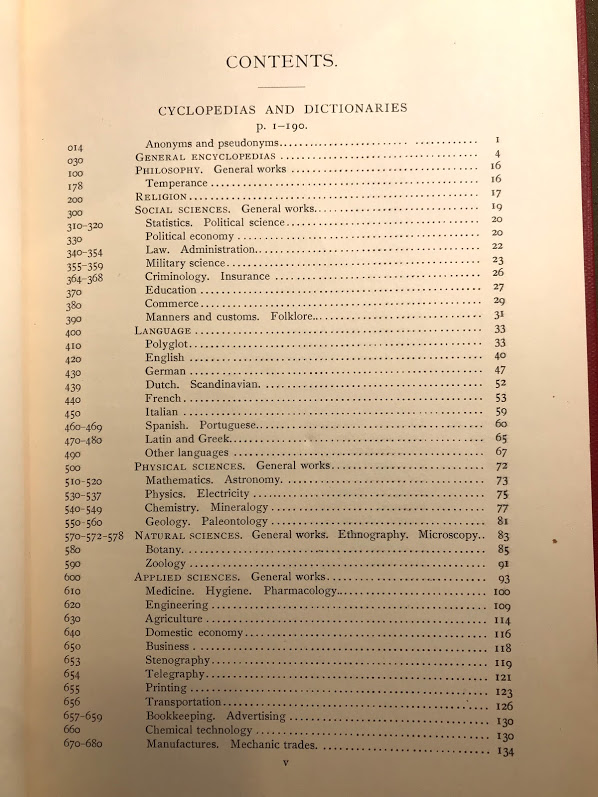
catalog of encyclopedias and dictionaries published by the John Crerar library in 1904
Example of a library’s catalogue in the early 20th century. This image is of A list of cyclopedias and dictionaries (John Crerar Library Board of Directors, 1904, a catalog of encyclopedias and dictionaries that the John Crerar library published.

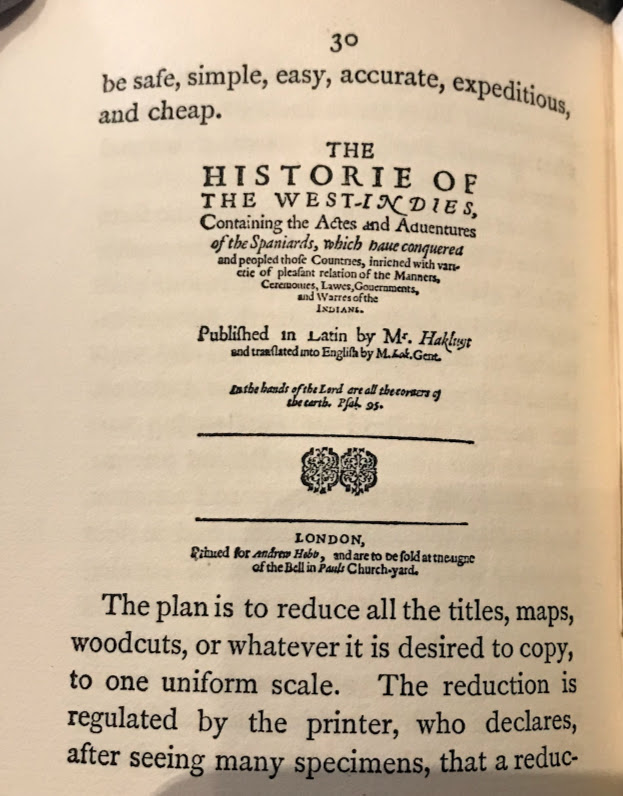
In the pamphlet “On the construction of catalogues of libraries” (Smithsonian Institution, 1852) written in 1852, prominent librarian Charles C. Jewett—who in his lifetime was the Librarian of the Smithsonian  Institution and the Superintendent of the Boston Public Library—proposed a method called stereotyping to effectively create library catalogs.[1] In his program all public libraries interested in adhering to this set of rules would send a formatted list of the titles all the books in their collection. This list would then be made into clay plates for printing. His ultimate hope for this was to create an aggregate catalog of all participating libraries, which would eventually include libraries in Europe, moving toward what he termed a “universal” catalog. Of course, this plan is ideologically limited, the scope of his universalism only extending to the North American and European continents. His vision did not come to fruition, though he remains a figure in the library field for his writing about cataloging methods.[2]

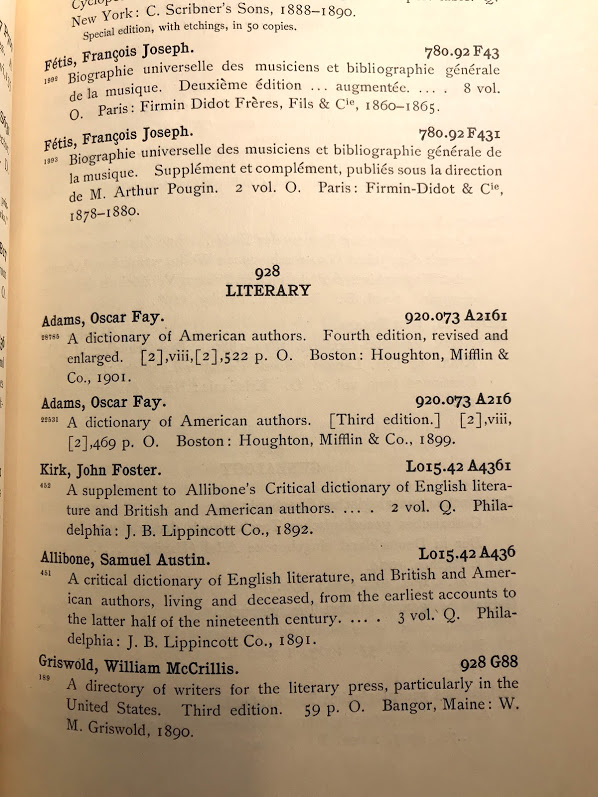
example of John Crerar encyclopedia and dictionary catalog
Another image of the John Crerar encyclopedia and dictionary catalog. This is of the literary subsection of the broader history section. Here you can see how the titles are formatted and what information they provide.

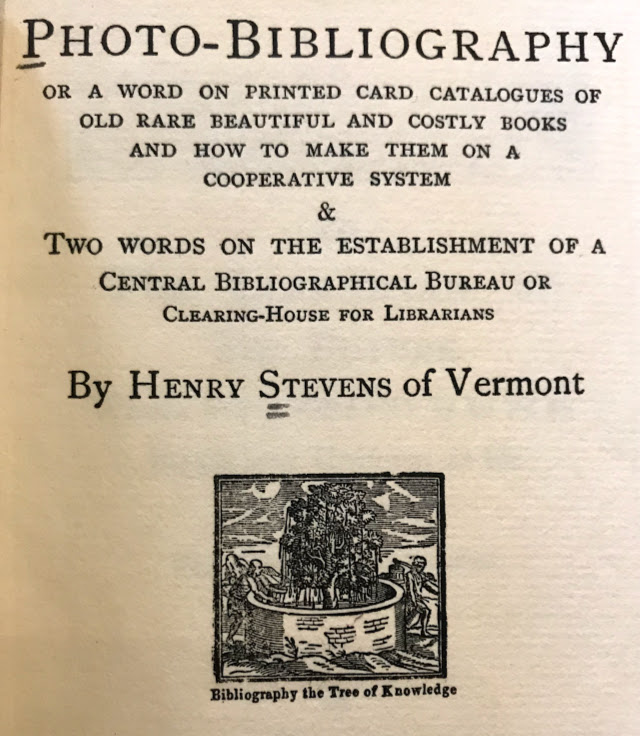
Photo-Bibliography (H. Stevens, 1878), written by bibliographer Henry Stevens in 1878, goes even deeper into the desire for an object that could, in-itself, act as a repository of knowledge. Stevens, an American expatriate living in the United Kingdom, calls for a full bibliography of all English books, and along with this bibliography, a “universal system” for cataloging.[3] To achieve this, he hopes for a “Central Bibliographical Bureau or Clearing House”. He even lays out the ideal dimensions for titles in such a bibliography. Ultimately, though, he does not imagine his vision coming to fruition, because of the ever expanding nature of libraries: “As there is little hope of any library ever even approaching completeness, there is no apparent progress whatever made towards that universal and harmonious catalogue raisonné which we have so long and so devoutly been praying for”. This hope will continue to permeate at least parts of librarianship and academia. Even a resource we have from 1952, “Indexes and Machines,” by the academic librarian Earl Gregg Swem, is intrigued by some way capturing “total-books”, or all the books  published in English and European languages.

Formatting proposed by Stevens
Stevens proposed formatting for titles in his imagined photo-bibliography.

Looking to create something all-encompassing, these sources point to the limiting viewpoints of their creators, and perhaps more generally, the time in which they were created. None of these sources point to any other epistemologies or consider any sort of relativism, such as forms of knowledge-making outside of the book. Rather, they hint at exceptionalism. Universality came to be a stand-in for all that is a part and product of European and American culture, specifically of the educated classes. The decisions made by those who envisioned a specific classificatory system come to be viewed as neutral and arbitrary. Librarians such as A. Brian Deer have realized the importance of creating classification systems that align with the beliefs of their communities and counter hegemonic classificatory schemes. Deer, a member of the Mohawk of Kahnawá:ke community, created the Brian Deer Classification System in the mid-seventies, which worked to prioritize an Indigenous perspective and an Indigenous audience. This system has been adapted and reinterpreted by various libraries in North America.[4]

Photo-bibliography page
Detail of the title page of Photo-bibliography, referencing the “Tree of Knowledge”.

Classification systems will never be perfect. Knowing that a total system would at best be a reflection of ideologies of those that created it, the fact no library is “ever even approaching completeness” allows room for growth. As the discourses around knowledge shift to be less conclusive and more inclusive, the ever expanding nature of a collection can come to be less of a burden and more of an opportunity.

If you want to learn more about how we organize our resources, peruse our online catalog, Abigail. And if you are interested in viewing the MHS sources listed in this post, or many of our other resources, please visit our research library, which is free and open to the public!


[1] Baker, B.B. (1993) Cooperative Cataloging: Past, Present, and Future (5). Psychology Press.

[2] Jewett, C. C., & Harris, M. H. (1975). The age of Jewett: Charles Coffin Jewett and American librarianship, 1841-1868. Littleton, Colo: Libraries Unlimited.

[3] Schopieray, C. J. & Hixon, M. Henry Stevens papers (1812-1935). Retrieved from https://quod.lib.umich.edu/c/clementsead/umich-wcl-M-228ste?rgn=Collection+Title;view=text#Additional%20Descriptive%20Data

[4] Doyle, A. M., Lawson, K., & Dupont, S. (2015). Indigenization of knowledge organization at the Xwi7xwa library. Journal of Library and Information Studies, 13(2), 107-134.

This Week @MHS

Here is a look at the programs we have at the MHS this week:

On Monday, February, at 6:00 PM: Peter J. Gomes Memorial Book Prize Ceremony and conversation between Christine DeLucia, Williams College, and Rae Gould, Brown University. Please join us for a special evening in which historian Christine DeLucia will receive the 2019 Gomes Prize for Memory Lands: King Philip’s War and the Place of Violence in the Northeast. DeLucia will join Dr. Rae Gould in a conversation about the war’s effects on the everyday lives and collective mentalities of the region’s diverse Native and Euro-American communities over the course of several centuries, focusing on persistent struggles over land and water, sovereignty, resistance, cultural memory, and intercultural interactions.

On Tuesday, 4 February, at 5:15 PM: Historical Datasets as Arguments: 21st Century Curations of 17th Century Records with Talya Housman, Digital Historian. Using Dr. Housman’s experience of curating a relational database on cases of sexual crime and gendered violence in England between 1642 and 1660 as a point of entry, this talk looks at some implicit editorial arguments we make in our historical research. This talk will outline the process of data collection, designing, and building the database (including software selection and database design choices) and discuss some of the issues posed by historical data itself, including standardization of spelling and how to document uncertainty. This is part of the Boston-Area Seminar on Digital History Projects series. Seminars are free and open to the public. Content warning: this talk discusses sexual violence.

Stolen: Five Free Boys Kidnapped into Slavery & Their Astonishing Odyssey Home with Richard Bell, University of Maryland. Philadelphia, 1825: five young, free black boys fall into the clutches of the most fearsome gang of kidnappers and slavers in the United States. Determined to resist, the boys form a tight brotherhood as they struggle to free themselves and find their way home. Their ordeal shines a glaring spotlight on the Reverse Underground Railroad, a black market network of human traffickers and slave traders who stole away thousands of free African Americans from their families in order to fuel slavery’s rapid expansion in the decades before the Civil War. A pre-talk reception begins at 5:30 PM; the speaking program begins at 6:00 PM. There is a $10 per person fee (no charge for MHS Fellows and Members, EBT or ConnectorCare cardholders). 

On Saturday, 8 February, at 10:00 AM: The History & Collections of the MHS. This is a 90-minute docent-led walk through of our public rooms. The tour is free and open to the public. If you would like to bring a larger party (8 or more), please contact Curator of Art Anne Bentley at 617-646-0508 or abentley@masshist.org.

Fire! Voices from the Boston Massacre
On the evening of March 5, 1770, soldiers occupying the town of Boston shot into a crowd, killing or fatally wounding five civilians. In the aftermath of what soon became known as the Boston  Massacre, questions about the command to “Fire!” became crucial. Who yelled it? When and why? Because the answers would determine the guilt or innocence of the soldiers, defense counsel John Adams insisted that “Facts are stubborn things.” But what are the facts? The evidence, often contradictory, drew upon testimony from dozens of witnesses. Through a selection of artifacts, eyewitness accounts, and trial testimony—the voices of ordinary men and women—Fire! Voice from the Boston Massacre explores how this flashpoint changed American history. The exhibition is on display at the MHS through 30 June 2020, Monday and Wednesday through Saturday from 10:00 AM to 4:00 PM, and Tuesday from 10:00 AM to 7:00 PM.
Investigating Abigail Adams: My Time as a John Winthrop Student Fellow

By Kate Melchior, MHS, and Ella Amouyal

Every year, the MHS selects one or more high school students for our John Winthrop Student Fellowship. This award encourages high school students to make use of the nationally significant documents of the MHS in a research project of their choosing. Students perform historical research and create a project (usually an assignment for class) using materials at the MHS, both in our archives or digitized online. This project can be something assigned in a class, a National History Day project, or something of the student’s invention!  Both student and teacher each receive $350 to support their research. Applications for the 2020 student fellowship are due on 11 February 2020.  Learn more and apply!

In 2019, Ella Amouyal and her teacher Jenna Wolf from the Cambridge School of Weston were awarded one of our student fellowships to research Abigail Adams’ diplomatic mission to France and England in 1784-88. Ella spent several months working in the MHS library with the support of our research librarians and produced an online exhibit. Read Ella’s account of her experience at the MHS, where she describes exploring the collections, speaking with historians, and using a microfilm reader for the first time.

Investigating Abigail Adams: My Time as a John Winthrop Student Fellow
By Ella Amouyal, Cambridge School of Weston

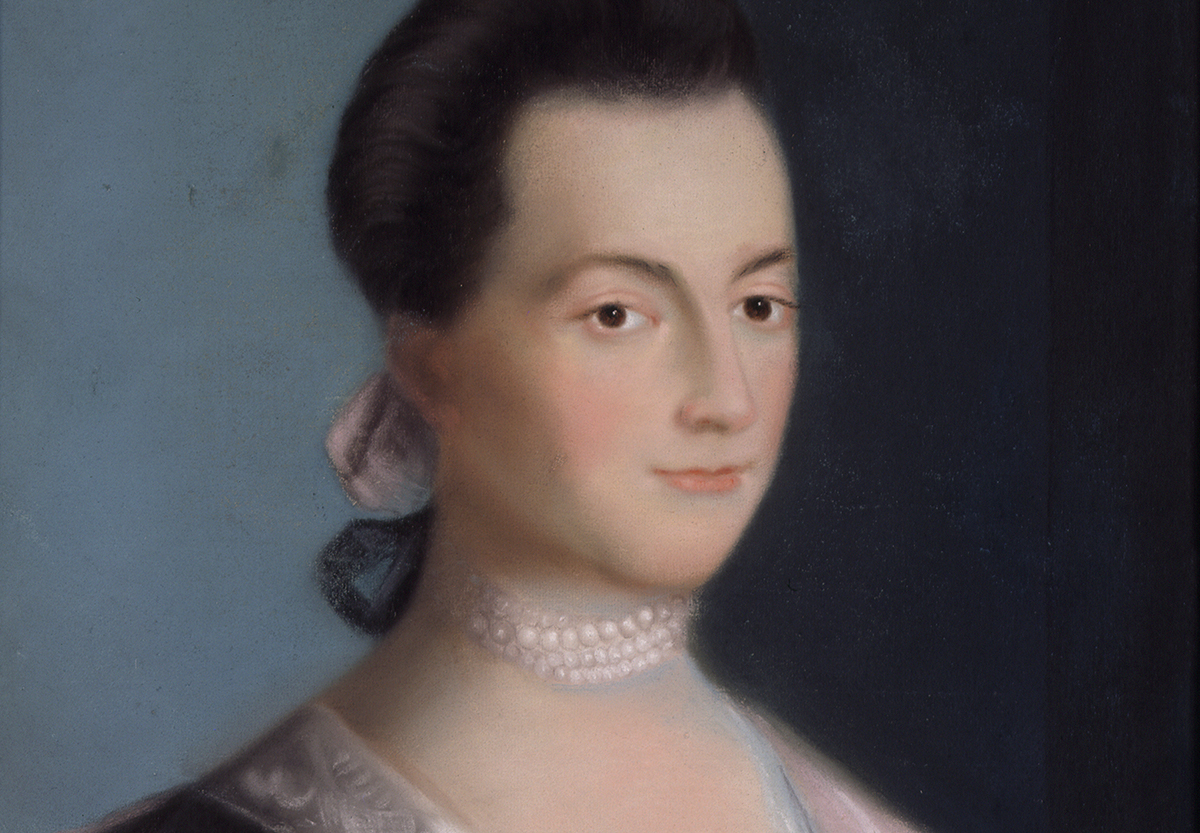
Portrait of Abigail Adams
Abigail Adams (Mrs. John Adams) by Benjamin Blythe, c. 1766

My experience as a John Winthrop Student Fellow in the Spring of 2019 was an incredible learning opportunity. My research focused on Abigail Adams’ time in Europe, and my final project was the creation of an online exhibit, I aimed to produce an engaging, interactive experience that would impact and educate a wider audience.

My exhibit explores Abigail Adams’ time in Europe  through three lenses: patriotism, economics and education. These lenses allowed me to clearly specify the ways Europe influenced Abigail Adams. When I began my research, I was overwhelmed by the sheer number of secondary and primary sources; I had so many questions–too many, perhaps. I found that honing in on more concise channels helped me tremendously with scope and organization.

I began the project by reading secondary sources to help frame my research in a broader context. This was first step was key, as it allowed me to understand more about the time and place my topic was grounded in, and exposed me to the questions, ideas and observations of professional researchers. My advice to a future student fellow would be to start by exploring secondary sources already published by the Massachusetts Historical Society. These sources will help you uncover new primary sources during you discovery phase, and they will help you to understand the subject more broadly. The MHS is an institution available to all learners; being a fellow affords you more access to the Society’s incredible collection of materials and helpful experts.

My next step was to attend one of the many lectures the Society offers regularly. You should, too. I had the pleasure of attending a pop-up talk hosted by the head of the Adams’ papers. If you are a fellow, attending a lecture or other event at the MHS is an excellent way to gain access to experts, ask questions, and enhance your knowledge. Talking about your research–and hearing about experts’ research–is one of the most important aspects of conducting research. Historians are tasked with educating, so there is nothing to be scared about. What’s more, they will probably be so excited to see a young scholar interested in the subject. Capitalize on the opportunity and seize it. The process of being a fellow is not just to learn about the past; it is also to learn how to communicate, ask questions, stay organized and do independent research.

As you conduct your own research, remember your work does not have to be limited to primary sources offered by MHS. Your research will become stronger when you explore many routes for learning and balance your evidence–primary sources, secondary sources, their context and analysis. However, finding and analyzing primary sources is the most important part of doing the work. And it’s work.

When you conduct your research using the online catalog Abigail, remember one thing: it has a learning curve. It can be quirky. Some quick tips: I found that looking up specific words and phrases can be confusing and yield thousands of results, which are impossible to navigate. One way to mitigate this potential problem is to search by specific dates; for instance, my research focused on Abigail Adams’ diplomatic missions to Europe from 1784 – 1788, which allowed me to limit the primary sources by the correspondences she wrote during this four-year period.

And while students today have grown up believing the Internet holds the keys to every door, remember that not all of the Society’s holdings are available digitally. This is where the excitement of visiting the MHS came in; I had the opportunity to spend hours pouring over documents in the Reading Room and Library. The Society is a warm, inviting and open environment. I was initially scared to visit because I was unfamiliar with historical archives or larger research libraries. Don’t be nervous. Remember the mission of the Society is to educate, so I immediately felt accepted and invited. In addition, the building itself is a work of art–there is so much to see. Alas, most of my visit was spent with a machine new to me–the microfilm.

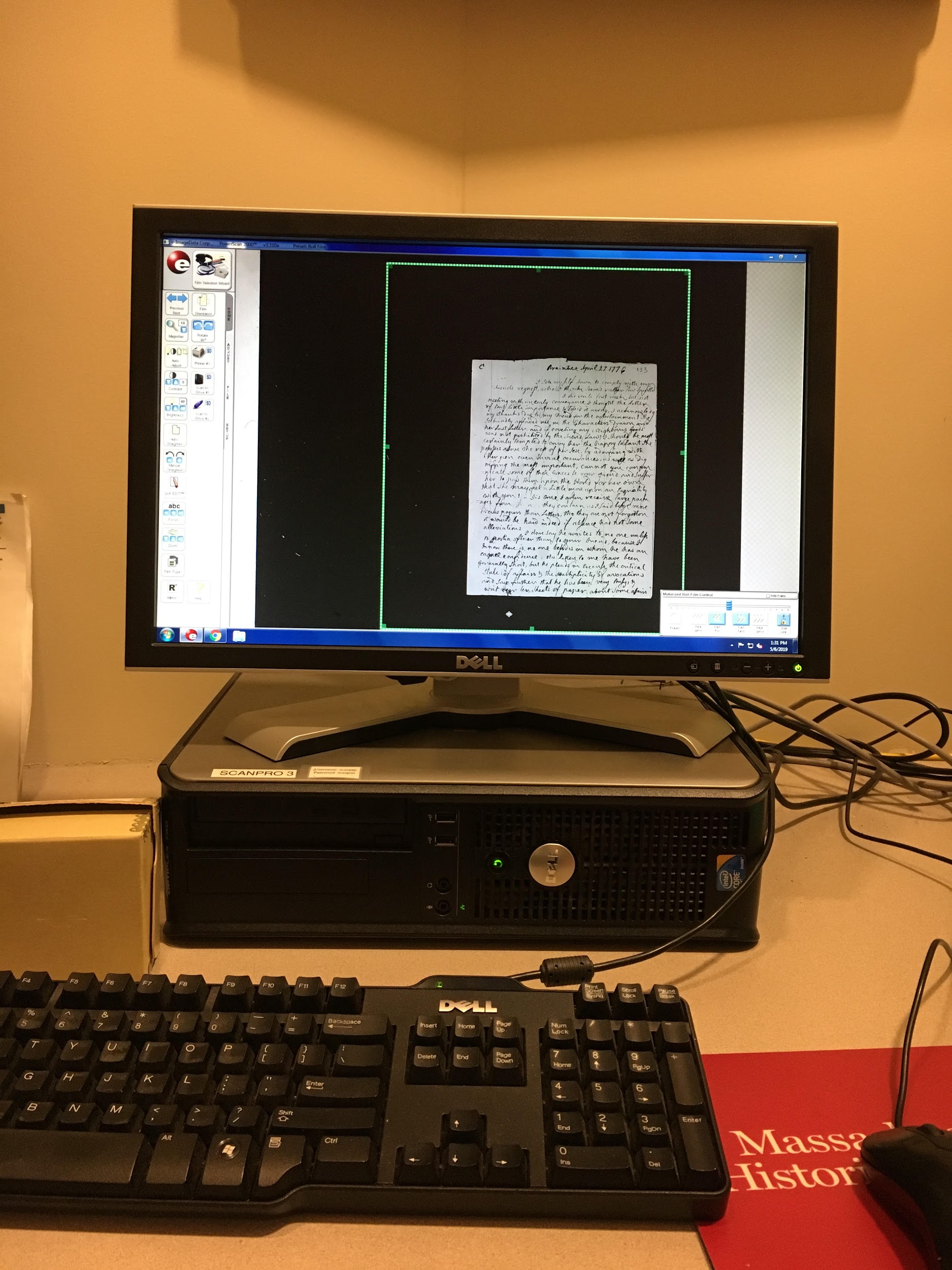
This contraption is, quite simply, a film roll that includes photographed versions of historical material. The librarians are extremely nice and helped guide me through the steps of using a microfilm. I previously had no knowledge of microfilm but I think it is an amazing device because it helps preserve the original letters and makes it easier to access the material safely. What’s more, reading the historical handwriting can also be extremely difficult. I asked the librarian if the letters I was looking at had been transcribed, which helped me see them in a more legible, modern font.

Microfilm reader in use at the MHS
A photo of a letter on microfilm taken during my first visit to the MHS library, photo by Ella Amouyal

Conducting research with the MHS was an amazing opportunity and I learned a lot. I learned about the fascinating intellect and ideology of Abigail Adams and about new historical figures like Mercy Otis Warren–Adams’ friend and confidant–someone previously unknown to me. I also learned that research is not always about sitting in the library, spending hours analyzing an original letter. It’s also about organization, retooling a question or avenue to explore, and most importantly, time management. Research is not always about reading books either; sometimes it entails pouring over transcribed documents online in your pajamas while drinking tea, or even awkwardly learning to scroll through microfilm. But it’s in these moments that you learn and grow the most. This is why conducting research is a rewarding opportunity for every student, even those who do not want to be historians or archivists. Research teaches you skills that are important for every subject and job – skills such as empathy and critical thinking. This is why I am going to propose a mini-unit this Spring to the history department at my high school on analyzing primary sources utilizing the free resource of the MHS Abigail catalogue.

I often wondered what Abigail Adams would have thought about a teenage girl 300 years later looking at the intimate letters she wrote to her friends, family and acquaintances and the letters she received. I wondered if she would have been shocked or perhaps happy. Abigail was always a forceful proponent of female education, one of the many reasons why I find her fascinating and inspirational. Her knowing that women would be able to research her words equally to any man would probably have brought her immense pride and joy.

If you have any interest in history and research, I would highly recommend applying to be a fellow. The John Winthrop Student Fellowship gives you access to thousands of letters and material and is truly a unique, enlightening experience for all students interested in delving into American history.

If you are interested in learning more about the John Winthrop Student Fellowship or any of our other programs, please visit the Center for the Teaching of History website or e-mail us at education@masshist.org.  We look forward to hearing from you!

Valentine’s Day the Adams Way

By Gwen Fries, Adams Papers

This is your official warning—Valentine’s Day is just over two weeks away. Maybe you’re in charge of planning festivities; maybe you’re looking for a subtle way to remind the person who is in charge. Either way, read on.

If there’s one thing my time with the Adams Papers editorial project has taught me, it’s that the answers to all of life’s questions can be found within the collection. Since the project contains three central power couples—John and Abigail, John Quincy and Louisa Catherine, and Charles Francis and Abigail Brooks—I knew the outline of a perfect Valentine’s Day date was scattered across those quarter of a million manuscript pages.

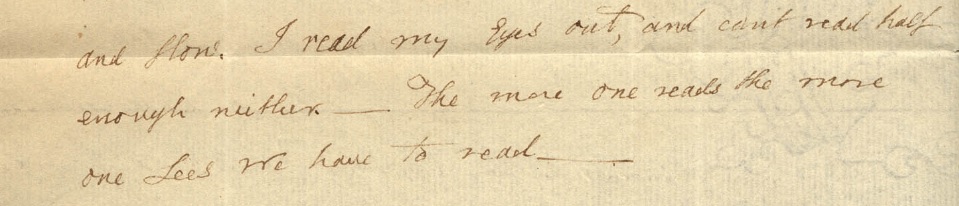
John and Abigail liked nothing more than to sit together by a crackling fire, languorously paging through the newest additions to their ever-growing private library. “I read my Eyes out, and cant read half enough neither,” John wrote to his like-minded wife on 28 Dec. 1794. “The more one reads the more one sees We have to read.” John and Abigail’s letters are full of quotes and beloved bon mots, and they would swap book recommendations, yearning to hear the other’s opinion. If you and your partner are all about that hygge lifestyle, swap books, get a fire roaring, put your feet up, and sink into a soft chair. Let others fight for those hard-to-get dinner reservations. (Bonus points if you indulge in another of John and Abigail’s favorite things: hot chocolate!)

Letter from John Adams to Abigail Adams
John Adams to Abigail Adams, 28 Dec. 1794

John Quincy and Louisa Catherine shared an affection for music. Louisa was a harpist and singer, and John Quincy played the flute. John Quincy’s first impressions of Louisa were of her musical ability, as she always sang and played for him when he visited her family in London. “Memory often repeats to my Fancy, every strain which was once performed by you; it gives an Echo still returning to my ear, to every sound uttered by your voice, or called forth by your fingers,” John Quincy wrote to her on 6 March 1797. Valentine’s Day is the perfect excuse to get dolled up and take the music lover in your life to a symphony, choral concert, or opera.

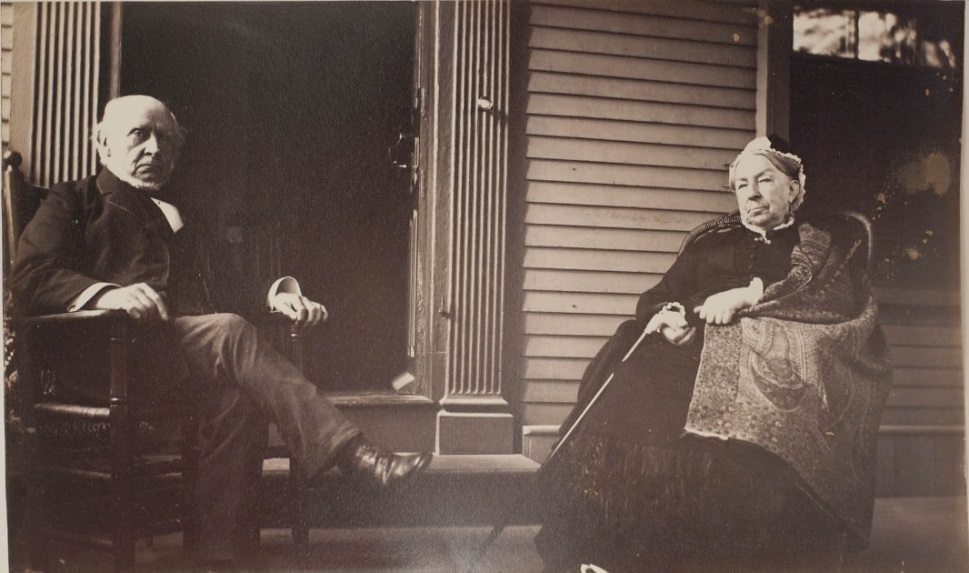
Photograph of Charles Francis and Abigail Brooks Adams
Charles Francis and Abigail Brooks Adams, 1883. Photograph by Marian Hooper Adams

Charles Francis and Abigail Brooks were collectors by nature. Their free time was filled with antiques shopping, and Charles was a regular at auctions. Charles collected rare coins, and Abby was delighted by knick-knacks of all kinds. They enjoyed traveling together, taking in landscapes, wandering through art galleries, and tasting local cuisine. “My Wife went in to make her purchases at the shop, the usual tax for curiosity in travelling,” Charles Francis recorded in his diary on 19 July 1836. If you and your date are always up for a daytrip, why not spend your Valentine’s Day as tourists, exploring boutiques and gift shops somewhere new?

It doesn’t matter how you celebrate this February 14th so long as you spend the day with your Dearest Friend.

John and Abigail Adams’s customary salutation
John and Abigail Adams’s customary salutation.

The Adams Papers editorial project at the Massachusetts Historical Society gratefully acknowledges the generous support of our sponsors. Major funding is provided by the National Endowment for the Humanities, the National Historical Publications and Records Commission, and the Packard Humanities Institute. The Florence Gould Foundation and a number of private donors also contribute critical support. All Adams Papers volumes are published by Harvard University Press.

This Week @MHS

Here is a look at what is happening at the MHS this week:

On Monday, 27 January, at 6:00 PM: Animal City: The Domestication of America with Andrew A. Robichaud, Boston University. American cities were once full of animal life: cattle driven through city streets; pigs feeding on trash in public alleys and basements; cows crammed into urban feedlots; horses worked to death in the harness; dogs pulling carts and powering small machines; and wild animals peering out at human spectators from behind bars. In his new book, Andrew Robichaud reconstructs this evolving world of nineteenth-century urban animal life—from San Francisco to Boston to New York—and reveals its importance, both then and now. A pre-talk reception begins at 5:30 PM; the speaking program begins at 6:00 PM. There is a $10 per person fee (no charge for MHS Fellows and Members, EBT or ConnectorCare cardholders). 

On Tuesday, 28 January, at 5:15 PM: Genetown: The Urbanization of the Boston Area Biotechnology Industry with Robin Wolfe Scheffler, MIT, and comment by Lizbeth Cohen, Harvard University. Today, the Boston area hosts the densest cluster of biotechnology firms anywhere in the world. Yet in the 1980s, the rapid concentration of the industry within Boston’s urban neighborhoods was a striking contrast to the suburbanization of high technology research and development a generation before. This remarkable urbanization represented the confluence of the labor and financial challenges faced by biotechnology start-ups with decisions regarding municipal governance and redevelopment in the aftermath of deindustrialization.  This is part of the Boston Seminar on Modern American Society and Culture series. Seminars are free and open to the public.

On Thursday, 30 January, at 6:00 PM: Historical Perspectives on Today’s World: Our Nation’s Founders & Today’s Political Challenges with Stephen Fried; Liz Covart; Sara Georgini; Nathaniel Sheidley, and moderator Fred Thys. Our Founding Fathers were progressive for their time in establishing a new nation. Many of them grappled with the same issues that we face today, including political polarization, voicing new ideas, and approaches to health care. Stephen Fried, author of Rush: Revolution, Madness & the Visionary Doctor Who Became a Founding Father, will explore the life and legacy of Benjamin Rush–one of the least known Founding Fathers. He will be joined by additional historians in a conversation of how many of our nation’s founders persevered during this time–and the lessons that we can learn by reflecting on our past. This program will be held at the Edward M. Kennedy Institute (210 Morrissey Blvd, Boston). Click HERE to register for this program.

On Saturday, 1 February, at 10:00 AM: The History & Collections of the MHS. This is a 90-minute docent-led walk through of our public rooms. The tour is free and open to the public. If you would like to bring a larger party (8 or more), please contact Curator of Art Anne Bentley at 617-646-0508 or abentley@masshist.org.

Fire! Voices from the Boston Massacre
On the evening of March 5, 1770, soldiers occupying the town of Boston shot into a crowd, killing or fatally wounding five civilians. In the aftermath of what soon became known as the Boston  Massacre, questions about the command to “Fire!” became crucial. Who yelled it? When and why? Because the answers would determine the guilt or innocence of the soldiers, defense counsel John Adams insisted that “Facts are stubborn things.” But what are the facts? The evidence, often contradictory, drew upon testimony from dozens of witnesses. Through a selection of artifacts, eyewitness accounts, and trial testimony—the voices of ordinary men and women—Fire! Voice from the Boston Massacre explores how this flashpoint changed American history. The exhibition is on display through 30 June 2020, Monday and Wednesday through Saturday from 10:00 AM to 4:00 PM, and Tuesday from 10:00 AM to 7:00 PM.
Rough Seas: 120 Days on the Barque Hannah Sprague

By Rakashi Chand, Senior Library Assistant

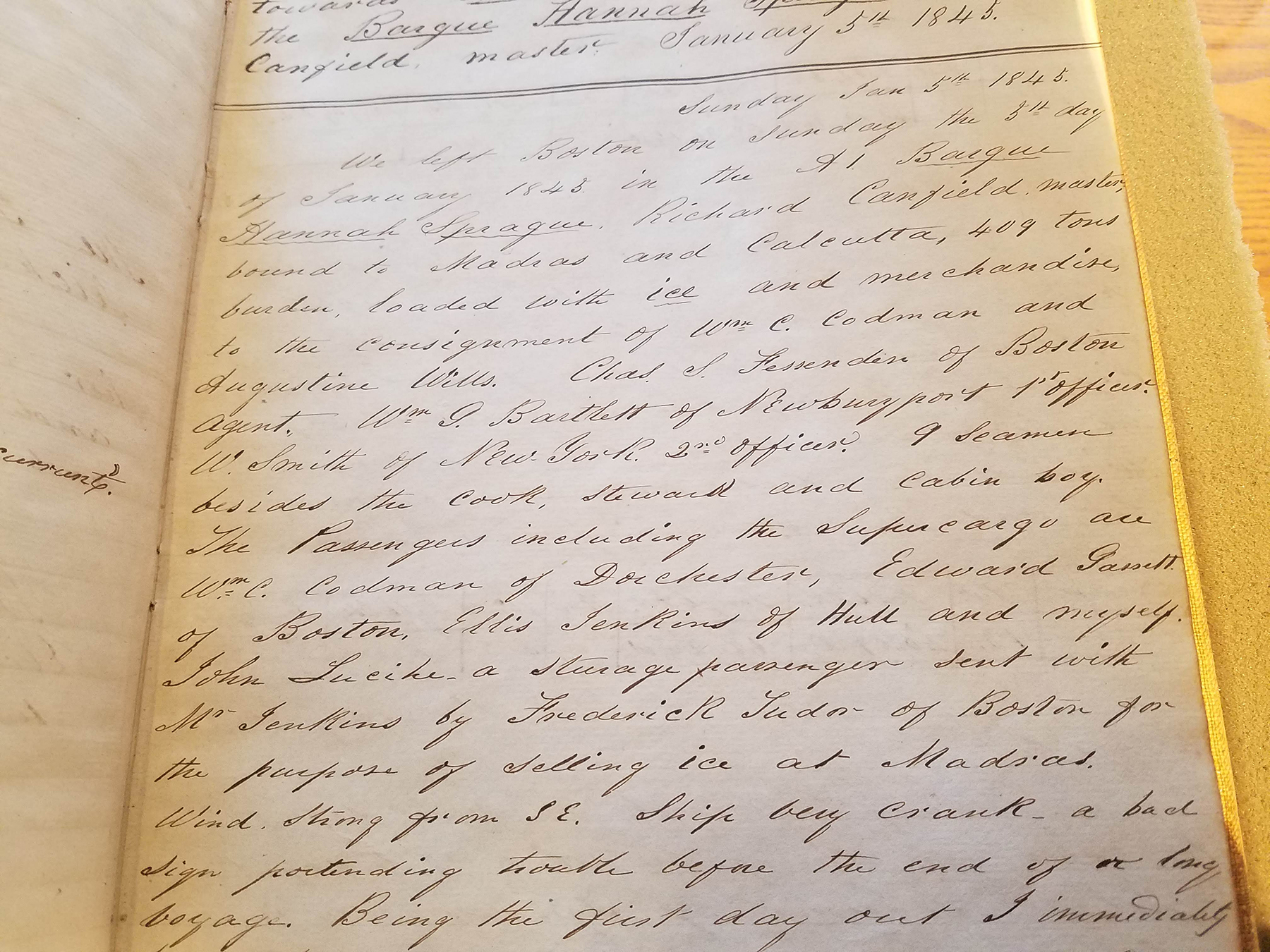
“We left Boston on Sunday the 5th day of January 1845 in the Barque Hannah Sprague, Richard Canfield master, bound to Madras and Calcutta, 409 tons burden, loaded with ice and merchandise, to the consignment of Wm. C. Codman and Augustine Wills. Chas S. Fessenden of Boston Agent. Wm G. Bartlett of Newburyport 1st Officer, W. Smith of New York 2nd Officer. 9 Seamen besides the cook, steward and cabin boy. The Passengers including the Supercargo are Wm. C. Codman of Dorchester. Edward Gassett of Boston, Elis Jenkins of Hull and myself. John Lucike a (strange) passenger sent with Mr. Jenkins by Frederick Tudor of Boston for the purpose of Selling ice at Madras. Wind Strong from SE. Ship very crank- a bad sign (portending trouble) before the end of our long voyage. Being the first day out I immediately began to oversee the preparation of my State-room &c. Find it pretty difficult to walk on the deck, not being accustomed to the motion of a ship. Did not sleep very well, but was not the least bit sick.”

Hannah Sprague logbook, day 1
Day 1, logbook of the barque Hannah Sprague kept by Horatio Stockton Rotch, 1845.

Thus begins Day 1 of Horatio Rotch’s 120 day journey towards Madras and Calcutta, India from Boston on a chilly January day. The log of the barque Hannah Sprague was kept by Horatio Stockton Rotch from 5 January 1845 through 25 December 1845, while on a trading voyage. Entries record longitude and latitude, course, winds, and distance traveled. One of many in the Society’s collection, I find this logbook to be simply remarkable. Indeed I am appreciative for his lovely legible handwriting (which I imagine is not easy aboard ship) but I am even more grateful for his detailed and honest descriptions throughout the journey. This must have been his first, as his narratives are rich in detail. The volume includes the logbooks of two subsequent journeys by Rotch: one aboard the barque Sylphide in 1846 and another on the brig Emily Bourne in 1849.

Rotch describes day to day happenings aboard the ship. It seems their journey was not in the least bit peaceful.

“ 2 Days Out

The gale kept continuing al day and increasing in violence towards night. Rained very hard and blew tremendously al night, so that the ship was in great danger of Capsizing. The ship bore up gallantly against the heavy sea, which at every plunge washed her decks, and almost overwhelmed her, and the next morning saw her safe.”

“3 Days Out

We got through the night safe, only to experience during the whole of today a constant succession of squalls, once in a while getting a peek at the sun. One of the sailors taken sick and put under my care by the Captain.”

“4 Days Out

Fair weather. Sun makes its first appearance to our great delight. First Observation taken. A Barque visible at the Southwest what name and where from we cannot find out, probably from some southern port. We are now in the South side of the gulf, and the change in climate is very manifest.”

And after two calmer days…

“7 Days Out

9 O’clock –The Storm still continues to rage, incessant squalls, very heavy sea. Blew a perfect hurricane all day and night. Thunder and lightning with most perfect squalls every five minutes. Scudding before the wind under a close-[suffered] foresail  Great anxiety for the safety of the Ship and consequently of ourselves. Almost gave her up at one time during the night. The Captain said he had never experienced such a tremendous hurricane, although he has been eight voyages to the East Indies. The ship bore up gallantly (Just like a seagull) in spite of the roaring of the sea, which at every rise looked like a huge Mountain about to dash us to pieces. The scene in the Cabin was quite comical, some praying, some groaning, and most all frightened to Death, especially an Austrian name Lucike. Nobody can conceive the danger of our situation, save an eye-witness. Words cannot describe the scene.”

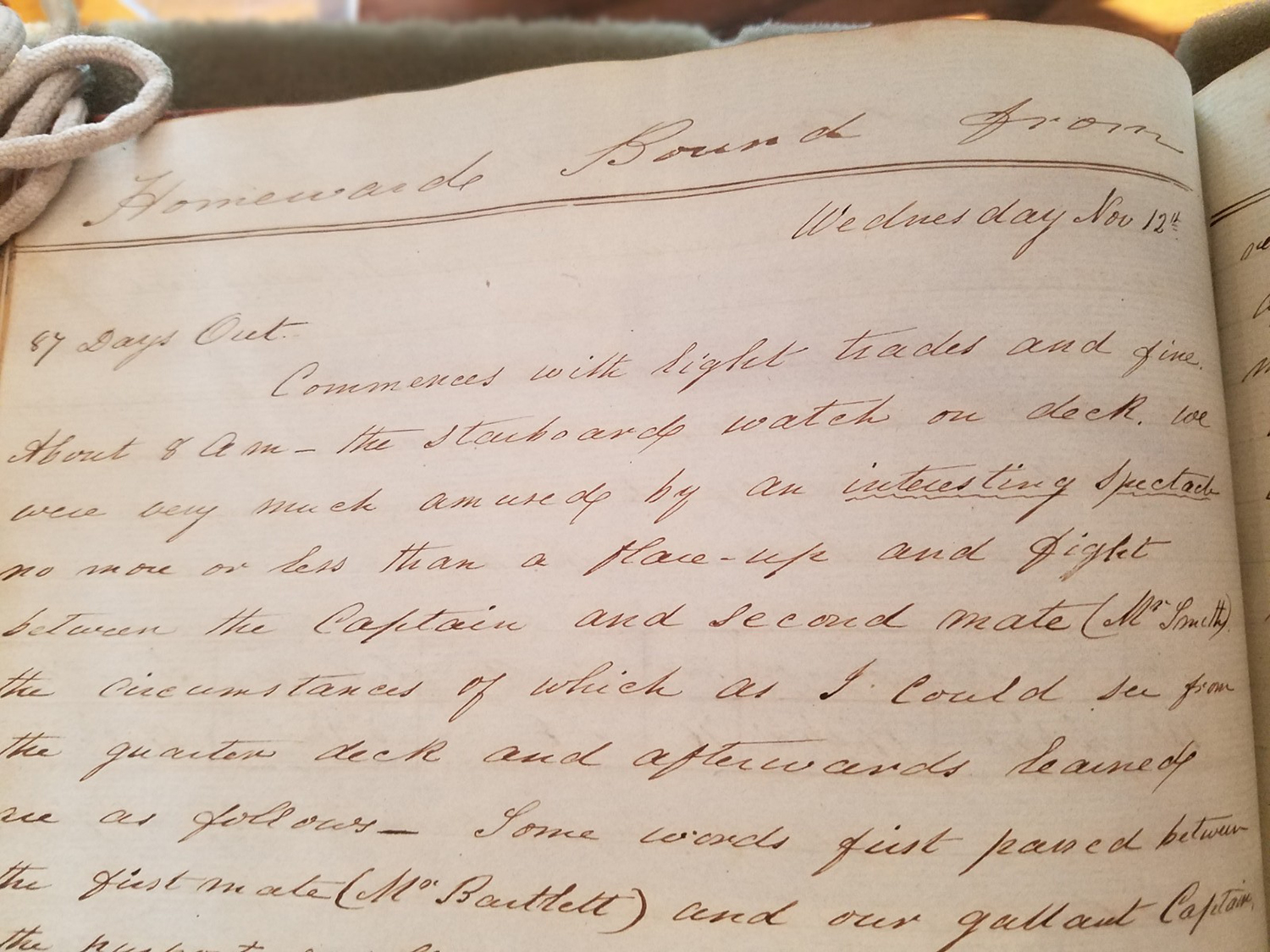
That was only 7 days out with another 111 to go before they would near their first destination. Personally, I would have never left land again, but as we already know, Horatio Rotch set out on the very next ship. For those who wonder what it was like to be out at sea on such a journey, this logbook is a magnificent resource. While there is simply not enough space in this post to include all the interesting details of the logbook, I will add that there is a fight scene 87 days out on the homeward bound journey. What would a sea voyage be without an “Interesting Spectacle” between the Captain and the 2nd Mate? Rotch describes the altercation in detail as “This Gentlemanly Affair took place on the starboard side of the forecastle in presence of the crew and every-body else aboard.”

Hannah Sprague logbook, day 87
Day 87, logbook of the barque Hannah Sprague kept by Horatio Stockton Rotch, 1845

Arriving in India three months later, Rotch gives a description of the Calcutta and an interesting  recommendation:

“Calcutta

This is one of the largest cities in the east-indies and one to which it is well worth while to pay a visit, if only for once. It covers an immense space of ground and is three or four times the size of our largest American city (New York)…”

Turly, he must have succumbed to the lure and excitement of traveling the world, as is evident by the haste in which his next voyage begins. Horatio Stockton Rotch died in 1850 at the age of 28 and is buried in New Bedford, Mass. His thoughts and words live on through his wonderful logbook.

Interested in reading more? Visit the MHS library to view the log of the bark Hannah Sprague. Or, search our online catalog, Abigail, for logbooks. Everyone is welcome to do research in our Reading Room, so stop in the next time you are on Boylston Street, and take a journey back in time and across the Globe!

Archivist as Detective: Finding “Nannie”

By Susan Martin, Processing Archivist & EAD Coordinator

The MHS recently acquired a fascinating letter, dated 10 August 1849 from Mecklenburg County, Virginia. It was written by “Nannie,” a young white woman from New England, to her brother back home. Over four large, densely packed, cross-written pages, she discussed a variety of subjects, including chattel slavery on a plantation in the antebellum South.

letter from Nannie to brother
Letter from “Nanny” to “My Dear Brother,” 10 Aug. 1849

It’s a disturbing letter to read. According to Nannie, enslaved people were not mistreated, they suffered more at each other’s hands than at those of enslavers, and Northern opposition to slavery was the real problem, because it made Southerners cling more tightly to their ways. She warned that the South “will see, and vote for, a dissolution of the union before they will give one inch to the north upon the subject.” She also revealed the whites’ widespread fear of revolt and defended the separation of families as necessary to preserve order.

The importance of manuscripts like this to our historical understanding can’t be overstated. Many white Northerners were not, of course, abolitionists, but were either complicit in or openly justified the South’s “peculiar institution.” This letter gives us a first-hand look at their self-serving rationalizations and willful ignorance.

Cataloging this new acquisition was also challenging for another reason: I had no idea who wrote it. Nannie was probably a nickname, but the letter came to the MHS as a single item, not as part of a family collection, so I had no context to help me. I didn’t even know the name of the brother she was writing to. So I began with a close reading of the text, gathering whatever piecemeal clues I could.

  1. Nannie mentioned several other correspondents, including Elizabeth, Parker, and Caleb.
  2. She asked about happenings at Amherst, Mass., possibly her hometown.
  3. She worked as a teacher for a Mr. Pettus, who treated her well and wanted her to stay on.
  4. She apparently lived and taught in the family home; she described writing the letter “by the windows of my school room which looks out upon the piazza” and going upstairs one night to visit the “boarders.”
  5. Her brother, the recipient, worked for an abolitionist paper, of which Nannie disapproved.
  6. She wrote poetry and had previously published her work in newspapers under the pseudonym “Viola.”

And that was it. Not much to go on. I thought my best clue was the name Pettus and started there. Searching online, I found Pettuses galore in Mecklenburg County, including three listed in an 1860 census of enslavers, but I could not pinpoint who employed Nannie. I needed to come at it from a different angle.

I searched using various combinations of keywords (Nannie, Pettus, Mecklenburg, plantation, Parker, Caleb, Amherst, Viola, 1849, etc.), hoping but not expecting to stumble on something helpful. To my surprise, I got a break in the case, so to speak. I found a transcription of an 1851 letter from Arlena Pettus to someone called Nancy “Nannie” Henderson Hubbard!

Arlena had apparently been one of Nancy Hubbard’s students, and the details in her letter matched what I knew—she even asked after her teacher’s birds, and our Nannie had written about keeping mockingbirds. Using this website as a jumping-off point, I set out to confirm the identification. I found Historic Homes of Amherst, a 1905 publication by Alice Morehouse Walker, which filled in most of the gaps: Nancy Henderson Hubbard, born in 1823, attended school in North Amherst, “went South as a teacher,” and published poetry under the pen name “Viola.” This was definitely Nannie.

Nannie’s signature
Nannie’s signature

Researching Nancy Hubbard’s family tree, I found a brother Parker (who incidentally later served in the Union army), a sister Elizabeth, and a brother Caleb. The only living brother she didn’t mention in her 1849 letter—and therefore its recipient—was Stephen Ashley Hubbard (1827-1890), a journalist in Connecticut and later managing editor of the Hartford Courant.

Arlena’s letter not only linked the names Pettus and Hubbard, but also provided the specific Pettus for whom Nannie worked, the picturesquely named Musgrove Lamb Pettus (1808-1881). I verified this with the help of the Library of Virginia, which holds a few of Nancy’s letters discussing Musgrove’s family. My final and unexpected discovery was the 1850 Mecklenburg County census, where Nancy’s name is listed alongside Musgrove, Arlena, and other members of the Pettus household.

Nancy Henderson Hubbard returned to Massachusetts in 1851 and married Ansel Wales Kellogg, a banker in Oshkosh, Wisconsin. She died in Wisconsin in 1863, just thirteen days shy of her fortieth birthday. The Oshkosh Public Museum holds a carte-de-visite photograph of Nancy, a.k.a. Nannie, taken in 1855.

This Week @ MHS

While the  MHS will be closed on Monday, 20 January in observance of Martin Luther King Jr. Day, we still have a busy week of programming including  two seminars, an author talk, and a Saturday tour. Here is a look at what is planned:

On Tuesday, 21 January, at 5:15 PM: “For I’d Rather Be Dead Than Not to Dream of a Better World”: Mae Gadpaille’s Vision of the Montessori Family Centre Community with Mary McNeil, Harvard University, and comment by Ashley Farmer, University of Texas – Austin. In 1967, Mae Gadpaille, the director of a black Montessori preschool in Roxbury, faced displacement; the church that housed her school was slated to be cleared for an urban renewal project. In response, Gadpaille launched a campaign to build the Montessori Family Centre Community, a living community for approximately 150 families with a PreK-12 Montessori school in the center. This talk traces Gadpaille’s efforts to realize her vision, paying special attention to how she thought Montessori methods could help advance a black nationalist project of self-determination, while also considering the limitations of such a vision – namely, who could “belong” to this community and who might be left at the margins. This is part of the Boston Seminar on the History of Women, Gender, & Sexuality series. Seminars are free and open to the public. 

On Wednesday, 22 January, at 6:00 PM: The Puritans: A Transatlantic History with David Hall, Harvard University. David Hall presents a sweeping transatlantic history of Puritanism from its emergence out of the religious tumult of Elizabethan England to its founding role in the story of America. Shedding new light on the diverse forms of Puritan belief and practice in England, Scotland, and New England, Hall provides a multifaceted account of a cultural movement that judged the Protestant reforms of Elizabeth’s reign to be unfinished. Hall describes the movement’s deeply ambiguous triumph under Oliver Cromwell, its political demise with the Restoration of the English monarchy in 1660, and its perilous migration across the Atlantic to establish a “perfect reformation” in the New World. A pre-talk reception begins at 5:30 PM; the speaking program begins at 6:00 PM. There is a $10 per person fee (no charge for MHS Fellows and Members or EBT cardholders).

On Thursday, 23 January, at 5:15 PM: The Art of Family History: Visual Imagery, Family Narrative, & Native American Modernism with Phil Deloria in conversation with Julie Dobrow. Decades ago, historian Philip Deloria (Harvard University) found some drawings in the basement. These distinctive prints turned out to be the iconic work of his great aunt. Deloria will speak about his new book, Becoming Mary Sully: Toward an American Indian Aesthetic with Julie Dobrow (Tufts University), author of After Emily: Two Remarkable Women and the Legacy of America’s Greatest Poet. The event will focus on how an intensely personal story interweaves Sully’s life and works with the “richness of their historical situation” in Native studies and art history.  This is part of the New England Biography Seminar series. Seminars are free and open to the public.

On Saturday, 25 January, at 10:00 AM: The History & Collections of the MHS. This is a 90-minute docent-led walk through of our public rooms. The tour is free and open to the public. If you would like to bring a larger party (8 or more), please contact Curator of Art Anne Bentley at 617-646-0508 or abentley@masshist.org.

Fire! Voices from the Boston Massacre
On the evening of March 5, 1770, soldiers occupying the town of Boston shot into a crowd, killing or fatally wounding five civilians. In the aftermath of what soon became known as the Boston  Massacre, questions about the command to “Fire!” became crucial. Who yelled it? When and why? Because the answers would determine the guilt or innocence of the soldiers, defense counsel John Adams insisted that “Facts are stubborn things.” But what are the facts? The evidence, often contradictory, drew upon testimony from dozens of witnesses. Through a selection of artifacts, eyewitness accounts, and trial testimony—the voices of ordinary men and women—Fire! Voice from the Boston Massacre explores how this flashpoint changed American history. The exhibition is on display at the MHS through 30 June 2020, Monday and Wednesday through Saturday from 10:00 AM to 4:00 PM, and Tuesday from 10:00 AM to 7:00 PM.
Women & Hooped Petticoats in the United States

by Angela Tillapaugh, Library Assistant

Woman in dress with full skirt and view of hoop skirt
Woman’s costume circa 1865, [photograph] [1927]. Image from the collection of the Massachusetts Historical Society.
Hooped petticoats arrived in the United States from England and France in the 18th century. Many women started to wear them as the hoops lifted heavy petticoats off the legs. The image above is a drawing of a woman in a dress from around 1865 with a full skirt and a view of her hoop skirt.

Hoop-Petticoats Arraigned and Condemned
Satire of ministers who called hooped petticoats “contrary to the light of nature”. Printed and sold by James Franklin in Queen Street., 1722, microfilm edition. Image from the collection of the Massachusetts Historical Society.

However religious leaders of the church condemned the garments because the lightness of the hoop skirts often caused them to raise and expose undergarments or bare skin. Newspapers also published satirical cartoons and articles exaggerating how impractical wide skirts were, suggesting women got stuck in doorways or crushed men with their hoops. Despite the controversy, women continued to wear hooped undergarments until the silhouette fell out of fashion around the 1780s.

Full skirts became fashionable again only a few decades later in the United States.  At first women used other means to achieve the desired full skirt by wearing crinolines, which were petticoats stiffened with baleen and horsehair. The heaviness of these crinoline made hoop skirts appealing once again. The trend of hooped petticoats really took hold after the invention of spring steel petticoats (also called crinolines) around 1850. These new undergarments eliminated the need for layers of stiffened garments, allowed the legs to move easily, and sit comfortably.[i] This type of undergarment is likely what is depicted on the young women in the image above.

Pages from diary of Sarah Gooll Putnam
Sarah Gooll Putnam Diaries, 8 August 1864 – 11 December 1865. Image from the collection of the Massachusetts Historical Society.
Pages from Sarah Gooll Putnam diary
Sarah Gooll Putnam Diaries, 10 January 1861. Image from the collection of the Massachusetts Historical Society.

While the image of dresses with large hooped skirts are often associated with the antebellum period of the South the new spring steel hoop skirt became enormously popular, often dubbed “crinolinemania”.  There were over 100 factories in New England making hooped petticoats and were even worn by women in rural areas of western Massachusetts.[ii]  Sara Gooll Putnam of Boston often included photos and drawings of her friends and family wearing full skirted dresses in her diary entries.

The hoop skirt remained popular for many decades but eventually the style fell out of favor by the end of the 1860s. The condemnation of hooped skirts became stronger after the end of the Civil War, particularly by ministers.[iii] Additionally, the garments were impractical.  While spring steel crinolines were an improvement wide skirts were still cumbersome, and in some cases even dangerous. In 1858 the New York Times reported that a woman in Boston died after standing too close to a fire in a crinoline, and that 19 women in England died due to crinoline related deaths.[iv] While the hoop skirt gave women a taste of freedom and mobility, eventually they wanted to have even more freedom of movement that a wide skirt cannot provide regardless of the undergarments holding it up.

[i] Erin Blakemore, “Why Hoop Petticoats Were Scandalous,” JSTOR Daily (JSTOR, January 28, 2018),   https://daily.jstor.org/why-hoop-petticoats-were-scandalous/)

[ii] Lazaro, David E. “Supporting Role: The Hoop Skirt in 1860s Western Massachusetts Fashion.” In Dressing New England : Clothing, Fashion and Identity, 31. Deerfield, MA: Dublin Seminar for New England Folklife, 2010.

[iii]Abbott, Karen. “Death by Crinoline.” Wonders & Marvels. Accessed January 10, 2020. http://www.wondersandmarvels.com/2012/08/death-by-crinoline.html.

[iv] “The Perils of Crinoline.” The New York Times, March 16, 1858.