Every year, the MHS selects one or more high school students for our John Winthrop Student Fellowship. This award encourages high school students to make use of the nationally significant documents of the MHS in a research project of their choosing. Students perform historical research and create a project (usually an assignment for class) using materials at the MHS, both in our archives or digitized online. This project can be something assigned in a class, a National History Day project, or something of the student’s invention! Both student and teacher each receive $350 to support their research. Applications for the 2020 student fellowship are due on 11February 2020. Learn more and apply!
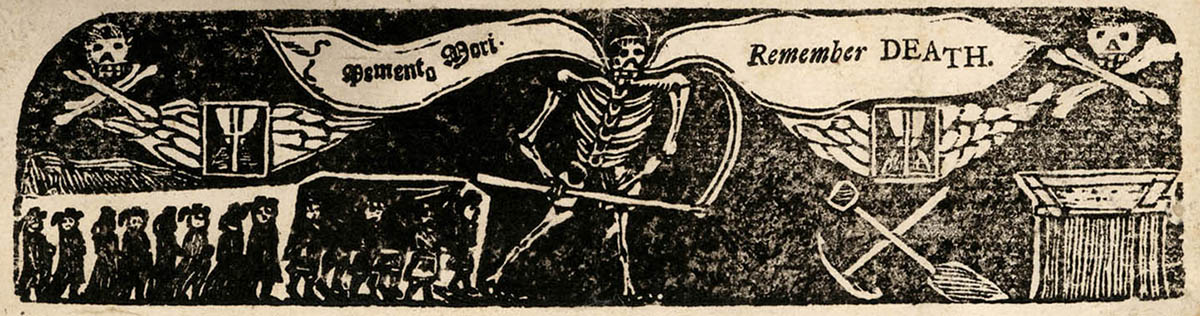
Upon the Death of the Virtuous and Religious Mrs. Lydia Minot, detail of broadside, [Cambridge, Mass. : Printed by Samuel Green, 1668]In 2019, Riana Bucceri and her teacher William Miskinis from Littleton High School were awarded one of our student fellowships to research how trends in gravestone iconography reflected shifts in early New England theology. Riana spent several months working in the MHS library with the support of our research librarians and produced an essay titled “The Frailty of Man”: An Analysis of Changing Gravestone Iconography and Theological Sentiment in Early New England.Read Riana’s account of her experience at the MHS:
Every student in our AP U.S history class is required to do a local research project. I had already known I was doing an analysis on gravestone iconography, but working solely with the sources I was getting from my town’s historical society was not cutting it. Luckily, I discovered the Massachusetts Historical Society and the search engine ABIGAIL, and was then able to breathe a sigh of relief. I found sermons from every time period I needed to connect iconographic trends on New England gravestones to the theology of the time. It was through this browsing of the MHS’s website that I discovered I had the opportunity to apply for the John Winthrop fellowship, which I immediately decided that I wanted to do.
When I went in to visit the MHS, I was instantly impressed with the welcoming, intellectual, and professional environment I encountered. Every employee was willing to help. I was honestly shocked that I was able to touch actual letters and sermons that were up to 300 years old. Sitting in the stately reading room, holding handwritten letters, I felt like I had history in my hands. After struggling with the delicate handwriting for a while, I deciphered letters from rural pastors addressed to city priests describing the great religious revivals they had witnessed. Their handwritten words demonstrated a clear turning point in religious sentiment that became the backbone of my paper. These letters show turning points in theological sentiment, which coincided with changes in iconography. I used these to compare the general evolution of New England gravestone iconography with greater theological ideas, such as predestination, and the First and Second Great Awakenings.
Possibly one of the most helpful and interesting sources I found was Ezra Sampson’s sermon on seventeen year old Olive Soule. His metaphors comparing death to nature were really beautiful, and the way he emphasized ‘the frailty of man’ was engrossing. He said, “Grass we know is but of short duration. It grows and flourisheth but a little while, before it fadeth and withereth away…and this holds true of man…” His themes showed an important turning point in religious sentiment that supported my thesis. In fact, I decided to entitle my paper “‘The Frailty of Man” because of the way the phrase resonates throughout my research. Looking back, I am so grateful for the opportunity I had to use the resources available at the Massachusetts Historical Society. If I had not had access to these sources, I would not have been able to create such a complex and nuanced paper.
By Lance Boos, MHS Malcolm and Mildred Frieberg Short-Term Fellow and Ph.D. Candidate in History, Stony Brook University
I have been incredibly lucky to spend several weeks during the summer and autumn of 2019 doing research at the Massachusetts Historical Society for my dissertation on the musical marketplace of Revolutionary and Early National America. In course of my work, I came across an unusual request in a 1769 letter from three Boston wardens (Thomas Walley, John Joy, and Henry Hill) to Colonel Alexander Mackey, commanding officer of the British troops stationed in the city. Following what they described as a “Gross affront & insult” toward a citizen of Boston, they urged Mackey to forbid his troops from performing music during the Sunday morning changing of the guard.1
The incident that sparked the request had occurred on the previous Sunday, when, as the the letter described it:
a Young Gentleman an Inhabitant of the Town, appeared at ye relieving of ye Main Guard who being desired by one of ye Wardens to retire showed a willingness to Comply, but Capt. Molesworth of ye 29th Regiment, who was Capt. of ye Guard that was to be relieved, & an other officer Came to him & Insisted upon his tarrying to hear the Musick, Saying he would protect him, & Immediately ordered the fifes to play (in derision, as we Suppose,) what by them is Commonly Called ye Yankee Tune.2
In this account, the soldiers doubly antagonized the young gentleman first by instructing him to leave, and then by summoning him back for an insulting musical performance of what was very likely “Yankee Doodle.” The etymology of “Yankee Doodle” and the origins of its melody have been extensively studied, but the lack of pre-Revolution documentation make definitive answers elusive. However, scholars generally agree that British soldiers used the tune to mock American colonists until Americans defiantly appropriated it during the Revolutionary War.3
The letter gives greater weight to the conclusion that it was deployed mockingly by the British, confirms that this dynamic had developed at least six years prior to Lexington and Concord, and adds an important dimension about the actual use of the song and how the colonists initially responded to that derision. The writers couched their complaint in supplication, both opening and closing the letter by appealing to Mackey’s politeness and magnanimity. They went on to note that it was the music “which draws great Numbers of persons together,” thus alarming or annoying the soldiers. This point frames their request not solely as a concession to the Bostonians, but as a practical method of easing tensions and preventing further disruption. Yet they return to imploring Mackey to “protect us from any Insults from ye officers or soldiers,” reminding him of his soldiers’ antagonistic conduct.
If the letter genuinely sought to quell growing hostilities between Bostonians and soldiers, it simultaneously advanced an argument against military occupation and deflected attention away from the possibility that the soldiers’ behavior had been provoked by unruly Bostonians. Less than a year before the Boston Massacre, this possibility can not be discounted. The letter is, of course, a one-side account of the incident, and while the writers detailed the soldiers’ offenses right down to the song, they provided no information about what precipitated the initial order for the “young gentleman” to depart.
By calling for the cessation of all music during the Sunday morning guard change rather than just banning “Yankee Doodle,” the writers reveal that this was about more than a single song. They very likely understood the importance of the fife and drum to military formalities, and may have seen this as a means of undermining the military’s stature in the city by curtailing its ability to use music as a performance of its authority, tool of insult and intimidation, or vehicle for militaristic sentiment. I have not yet found any sources indicating how, or even if, Mackey responded, although it is unlikely that he acquiesced. He returned to England two months later, and maintained that the troops had been treated quite poorly by the Americans.4
This incident shows that tension between the soldiers and the people of Boston was clearly palpable, and “Yankee Doodle” was an obvious point of discord. Music, more than just the song itself, was a venue of contestation through which Bostonians and royal officials debated the role and behavior of soldiers in the city, and more broadly the relationship between colonial citizens and the empire.
1 Letter to Col. Alexander Mackey [manuscript copy], 17 June 1769. Misc. Bd. 1769 June 17
2 ibid.
3 The turning point for the song was likely the British retreat from Lexington and Concord in 1775. However, J.A. Leo Lemay makes a convincing argument that despite its subsequent derisive use by British soldiers, the song was American rather than British in origin and likely dates from the 1740s. See Oscar Sonneck, Report on “The Star-Spangled Banner,” “Hail Columbia,” “America,” “Yankee Doodle” (Washington, DC : Government Printing Office, 1909), 79-156; S. Foster Damon, Yankee Doodle (Providence: Brown University Library, 1959); J.A. Leo Lemay, “The American Origins of ‘Yankee Doodle.’” The William and Mary Quarterly 33 no. 3 (1976): 435-464; Kenneth Silverman, A Cultural History of the American Revolution: Painting, Music, Literature, and the Theater in the Colonies and the United States from the Treaty of Paris to the Inauguration of George Washington, 1763-1789 (New York: Columbia University Press, 1987), 140-144, 275-290; and Henry Abelove, “Yankee Doodle Dandy.” Massachusetts Review 49, no. 1/2 (2008): 13-21.
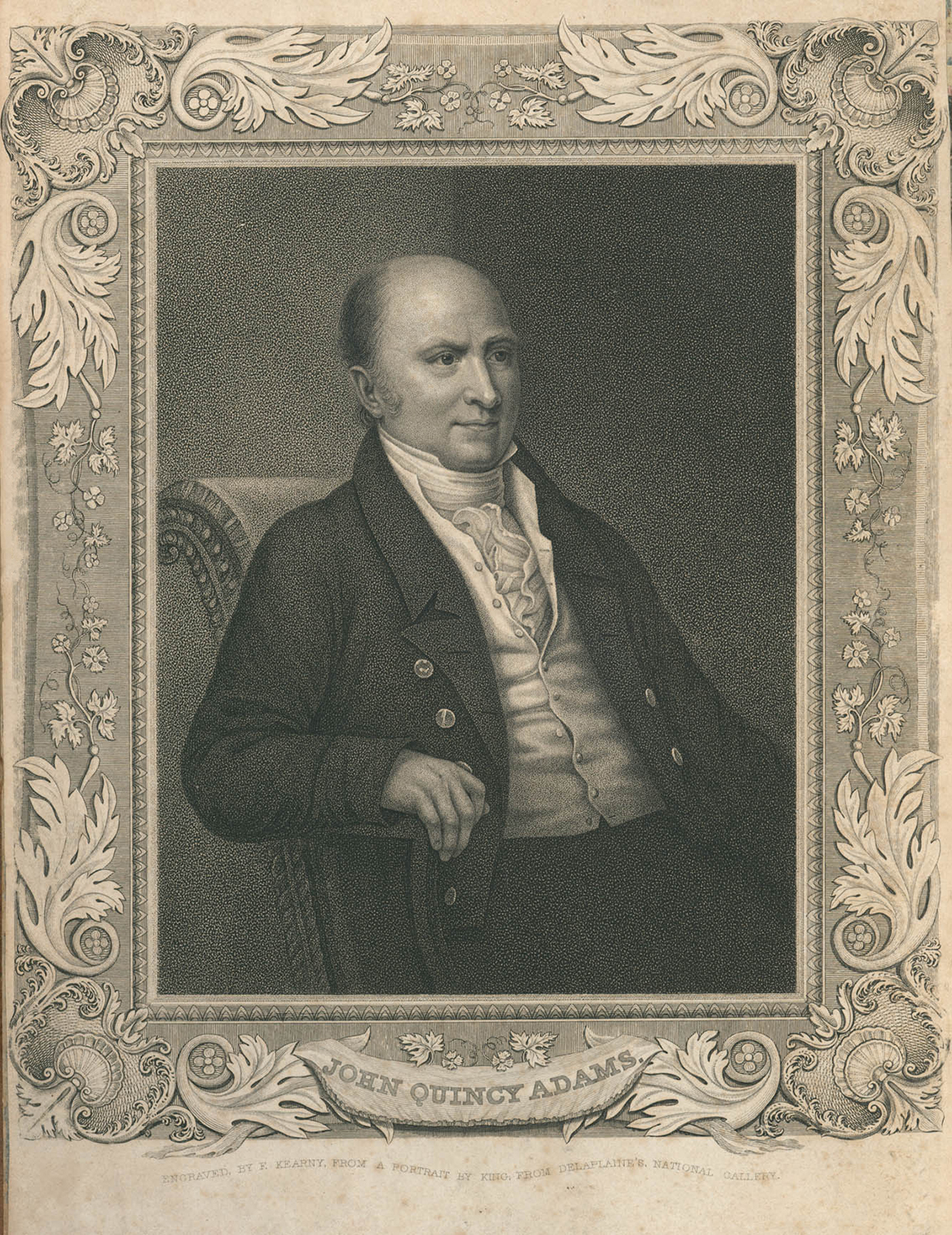
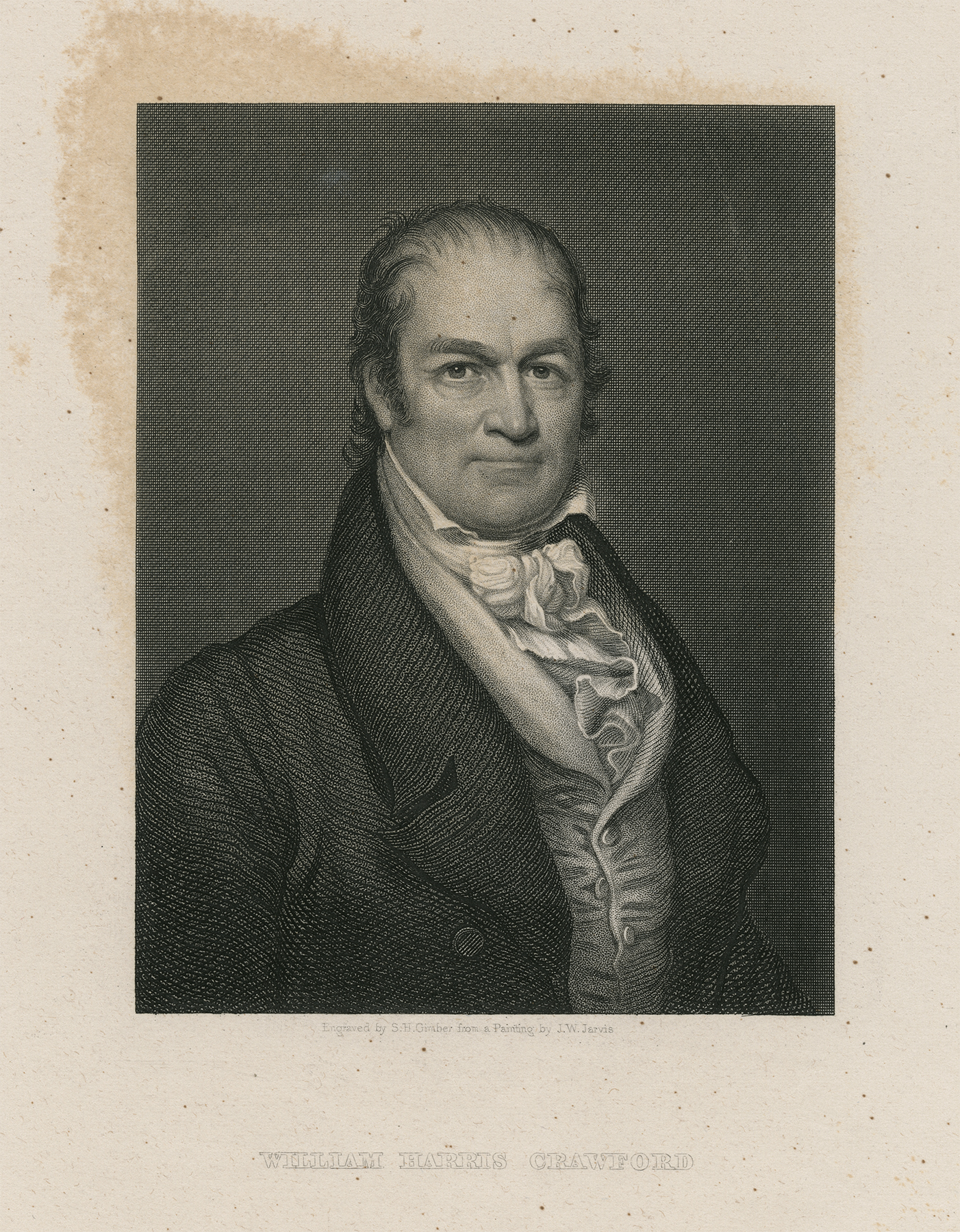
During President James Monroe’s administrations, Secretary of State John Quincy Adams (1767–1848) served alongside Secretary of the Treasury William Harris Crawford (1772–1834), one of the men against whom he would vie for the presidency in the election of 1824. Adams’s Diary offers his private musings on and feelings toward his fellow cabinet member and political opponent; it also gives tantalizing glimpses of Adams’s deteriorating opinion of Crawford.
John Quincy Adams engraving by Francis Kearney, circa 1824
On February 3, 1819, Adams recorded in his Diary his current view of the treasury secretary: “Crawford is not a worse man, than the usual herd of ambitious intriguers. Perhaps not so bad as many of them— I do not think him entirely unprincipled; but his ambition swallows up his principle.” However, two years later in his entry for March 3, 1821, Adams’s tone was far more cynical: “Crawford has been a worm preying upon the vitals of the Administration within its own body.” Adams also noted “the emptiness of the Treasury, and Crawford’s utter inability to devise any other source of Revenue but loan upon loan.”
William Harris Crawford engraving by S. H. Gimber, no date
Like Adams, Crawford sought to attain the presidency in the 1824 election, but a stroke in the fall of 1823 kept him out of politics for several months. Adams was elected president in February 1825 and subsequently offered the treasury secretary the opportunity to remain in his cabinet position, but Crawford declined. On December 14, President Adams learned a shocking piece of information about Crawford, which he recorded in his Diary. According to a clerk in the Treasury Department, “all personal communication between Mr Monroe and Mr Crawford had ceased” toward the end of Monroe’s presidency. Curious as to the cause of this breach, Adams asked his secretary of the Navy, Samuel Southard, “if this fact had been known to him.” Southard, who had visited the White House shortly after the argument occurred, stated that he “found Mr Monroe walking to and fro across the room in great agitation.” Crawford had recommended certain customs officials for office to whom Monroe objected. Crawford then “said petulantly; well—if you will not appoint the persons well qualified for the places, tell me whom you will appoint; that I may get rid of their importunities.” Monroe then “replied with great warmth; saying that he considered Crawford’s language as extremely improper, and unsuitable to the relations between them.” At this point, Crawford “raised his Cane, as in the attitude to strike, and said ‘you damned infernal old Scoundrel’— Mr Monroe seized the tongs at the fire-place for self-defence; applied a retaliatory epithet to Crawford and told him he would . . . turn him out of the house.” Adams then told Southard: “if I had known it at the time, I should not have invited Mr Crawford to remain in the Treasury Department.”
This week marks the end of our fall programming at the MHS with an author talk, a seminar, and a tour. Take a look at what is planned.
On Monday, 16 December, at 6:00 PM:Revolutionary Networks: The Business & Politics of Printing the News, 1763–1789 with Joseph Adelman, Framingham State University. During the American Revolution, printed material played a crucial role as a forum for public debate. Joseph Adelman argues that printers—artisans who mingled with the elite but labored in a manual trade—used their commercial and political connections to directly shape Revolutionary political ideology and mass mobilization. Moving through the era of the American Revolution to the war’s aftermath, this history details the development of the networks of printers and explains how they contributed to the process of creating first a revolution and then the new nation. A pre-talk reception begins at 5:30 PM; the speaking program begins at 6:00 PM. There is a $10 per person fee (no charge for MHS Fellows and Members or EBT cardholders).
On Tuesday, 17 December, at 5:15 PM:Dr. Ana Livia Cordero, Social Medicine, & the Puerto Rican Liberation Struggle with Sandy Placido, Queens College, CUNY, and comment by Susan Reverby, Wellesley College. Born in San Juan in 1931, Ana Livia Cordero was a trailblazing physician and activist-intellectual whose life illuminates the crucial role Puerto Ricans played in Cold War-era freedom struggles. Cordero worked as a physician, public health advocate, and radical organizer in New York, Puerto Rico, Cuba, Ghana, Egypt, and Nicaragua for over four decades. Using a new framework of feminist social medicine, this essay examines Cordero’s contributions to the field of social medicine, particularly maternal and children’s health. This is part of the Boston Seminar on the History of Women, Gender, & Sexuality series. Seminars are free and open to the public.
On Saturday, 21 December, at 10:00 AM: The History & Collections of the MHS. This is a 90-minute docent-led walk through of our public rooms. The tour is free and open to the public. If you would like to bring a larger party (8 or more), please contact Curator of Art Anne Bentley at 617-646-0508 or abentley@masshist.org.
Abigail Adams: Life & Legacy Pop-Up Display Abigail Adams urged her husband to “Remember the Ladies” and made herself impossible to forget. But Abigail is memorable for more than her famous 1776 admonition. This final Remember Abigail display uses documents and artifacts through the ages to consider the way Abigail viewed her own legacy and to explore how and why we continue to Remember Abigail.
Fire! Voices from the Boston Massacre On the evening of March 5, 1770, soldiers occupying the town of Boston shot into a crowd, killing or fatally wounding five civilians. In the aftermath of what soon became known as the Boston Massacre, questions about the command to “Fire!” became crucial. Who yelled it? When and why? Because the answers would determine the guilt or innocence of the soldiers, defense counsel John Adams insisted that “Facts are stubborn things.” But what are the facts? The evidence, often contradictory, drew upon testimony from dozens of witnesses. Through a selection of artifacts, eyewitness accounts, and trial testimony—the voices of ordinary men and women—Fire! Voice from the Boston Massacre explores how this flashpoint changed American history. The exhibition is on display at the MHS through 30 June 2020, Monday and Wednesday through Saturday from 10:00 AM to 4:00 PM, and Tuesday from 10:00 AM to 7:00 PM.
Please note that the library and gallery spaces will be closed Monday, 23 December 2019 through Wednesday, 1 January 2020.
My name is Florentina and I am a Library Assistant at the Massachusetts Historical Society. This is my first blog post and I want to start off by sharing a little bit about myself.
During my undergraduate career, the focus of my studies was Classical Civilizations, particularly ancient Rome. My junior year of college, I was very lucky to have the opportunity to travel abroad not only to volunteer at an excavation of a Roman bath but to take classes in Rome and visit archaeological sites. Maybe it was because it was my first trip outside of North America, by myself, and with limited knowledge of Italian, but I had some of my most memorable experiences there and I have hoped to be able to visit again ever since. As such, I have attempted to satisfy my wanderlust by studying Italian on my own and reading Italian travel blogs and diaries.
Now, you may ask why I am talking about Italy on the Society’s blog. Well, one day as I was browsing through Abigail, the Society’s online catalog, I wondered if there was any chance that we held materials related to Italy. Surprise- we do! Among what we have available are travel diaries, architectural sketches, photographs, handbooks for travelers dating from the mid to late 19th century, and historical works. If you do a quick search of “Italy” as a subject, you can find a list of related Italian subjects and the associated resources.
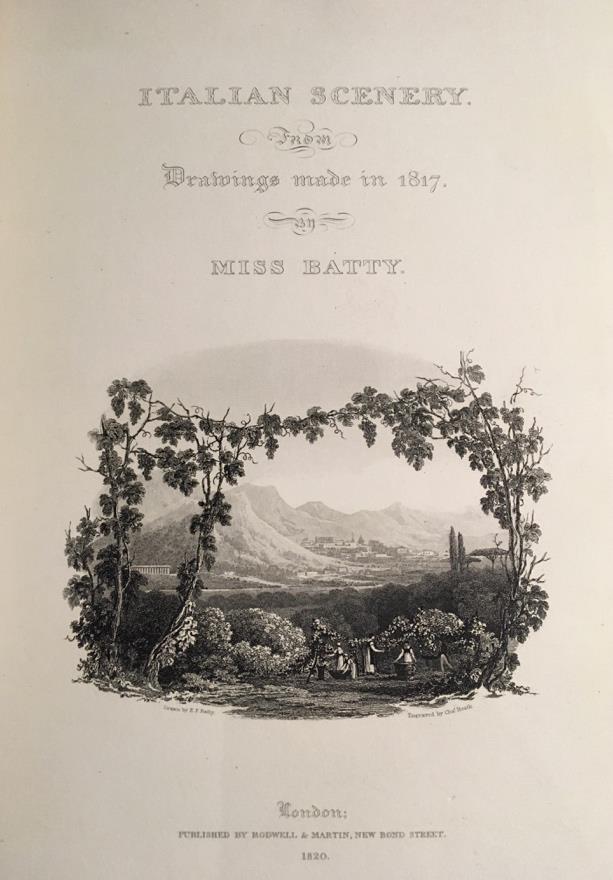
Of the resources I have looked at, one that caught my eye is the book titled Italian scenery: from drawings made in 1817 by Elizabeth Frances Batty (1791-1875), published by Rodwell & Martin in 1820. I really admire art that is composed of intricate details and this book is filled with etchings of beautiful Italian scenes based on a journey that Batty took with her father in 1817.
Image of title page. Batty, E. F. (1820). Italian scenery: from drawings made in 1817. London, England: Rodwell.
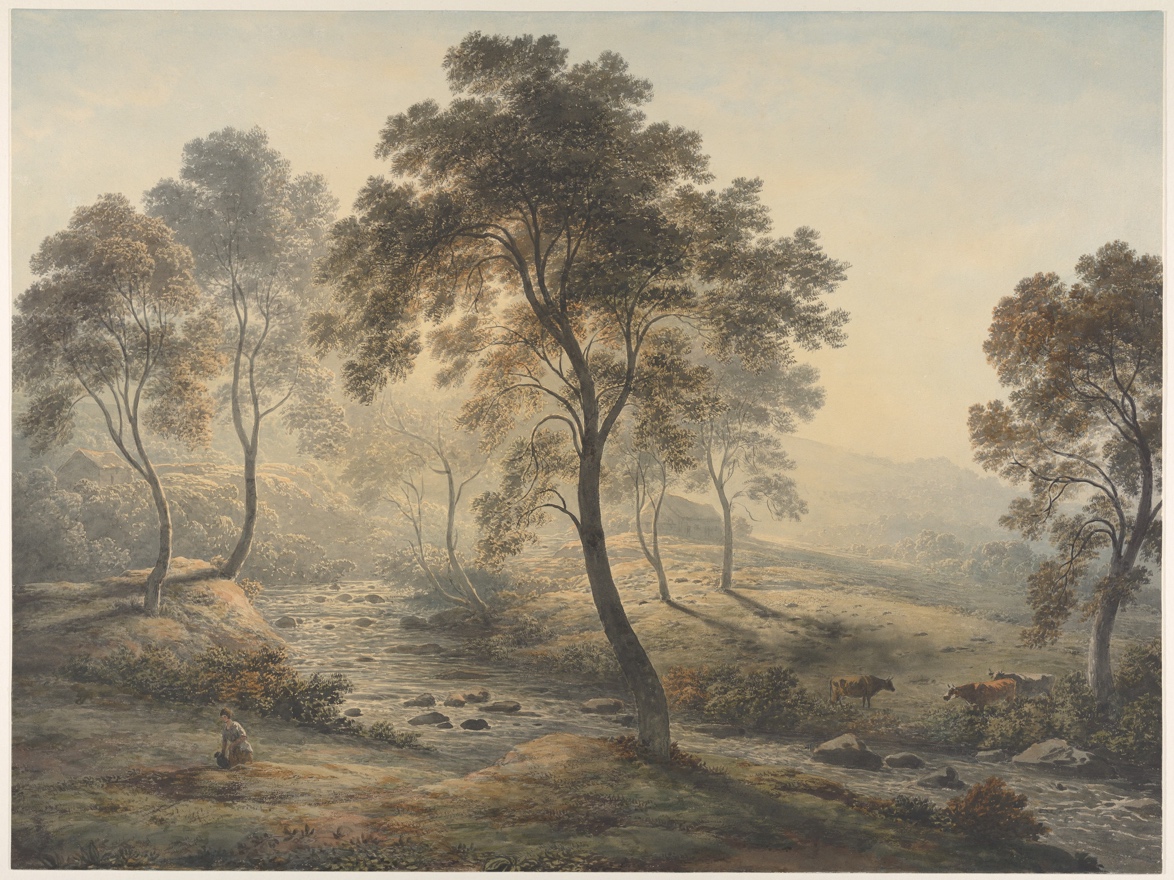
Even though these etchings are the only known works by Elizabeth Frances Batty, she clearly had well-developed artistic skills when she created them. According to Frances Allitt, from the Antiques Trade Gazette, her drawings suggest that she studied under the artists John Glover due to her use of the “split brush technique”, whereby she made two strokes at once to add more detail to her work (see below for an example of Glover’s work from the Metropolitan Museum of Art). Batty may have also used a camera obscura for some of her more accurate and detailed drawings.
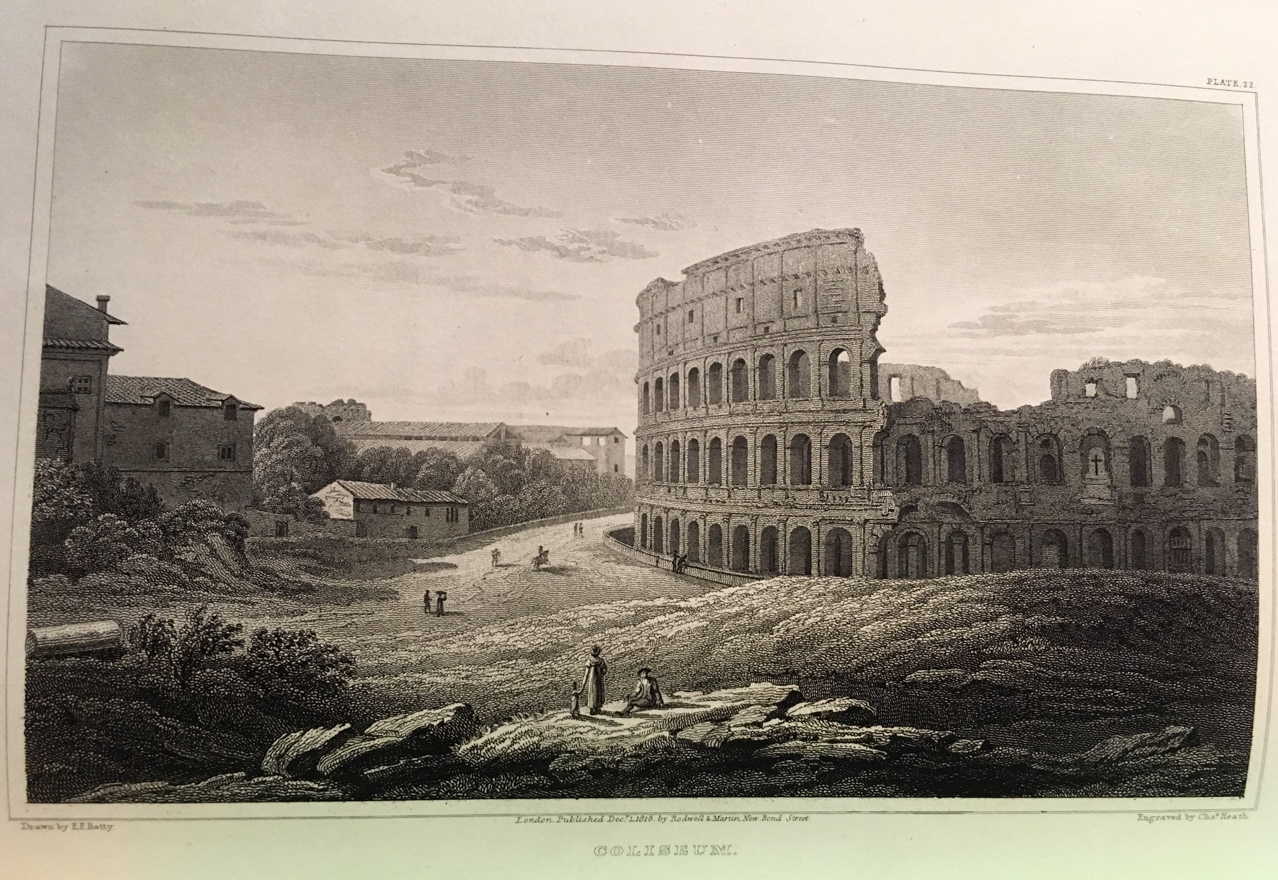
Below is an example of Batty’s work included in the book.
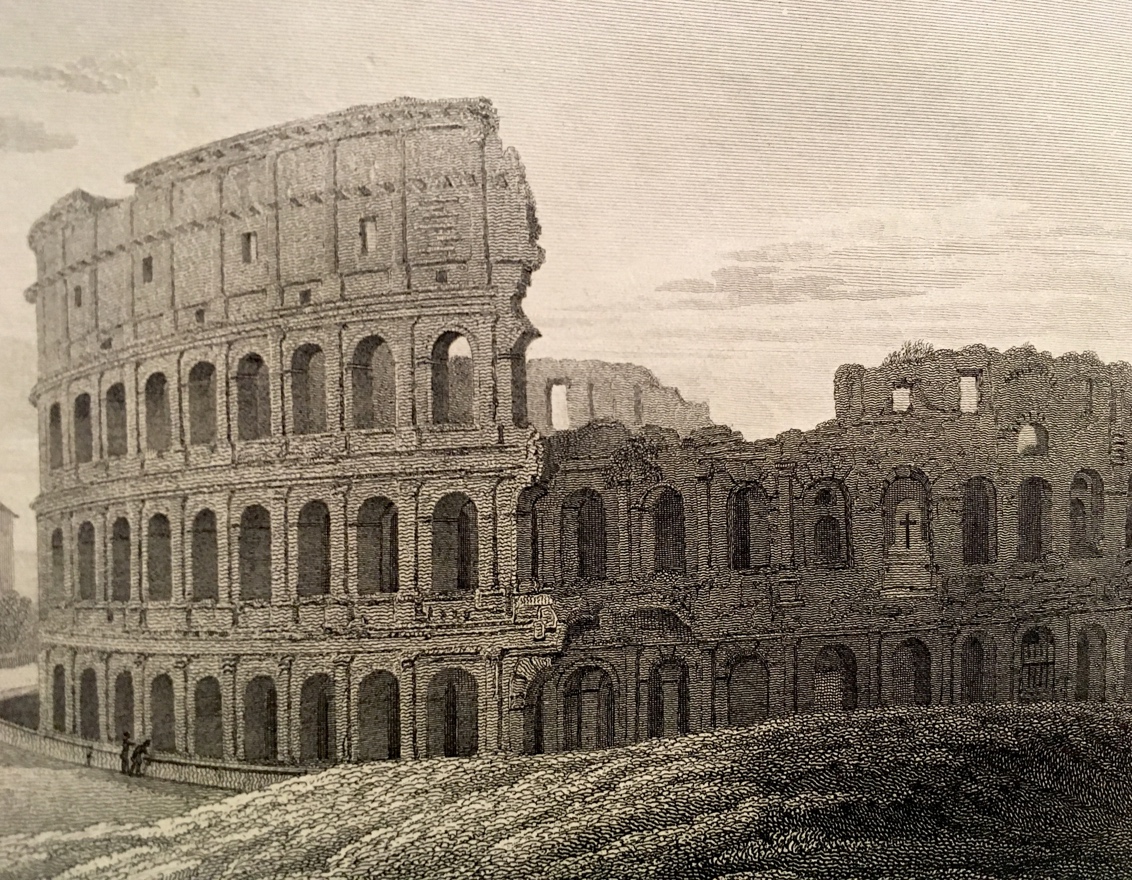
[Coliseum, p.74]. Batty, E. F. (1820). Italian scenery: from drawings made in 1817. London, England: Rodwell.[Detail of Coliseum, p.74]. Batty, E. F. (1820). Italian scenery: from drawings made in 1817. London, England: Rodwell.Accompanying the drawing of the Colosseum, is a three-page description (as there is with every other image in the book). We learn from a note at the beginning of the book that the writing was done by a friend of the publisher, although we are not told who that was.
The Colosseum’s section starts off with:
“Passing by the arch of Titus, seen in the preceding view, a little to the left, we come to the Flavian amphiteatre, now called the Coliseum, erected by Vespasian out of materials and upon part of the site of the golden house of Nero, which was then deemed to sumptuous even for a Roman emperor” (p.75-76).
This book provides a nice historical overview of Italy but also serves as a visual travel guide (you could almost consider it an early version of a Rick Steve’s travel guide without the restaurant and hotel recommendations). Abbott and Holder Ltd. (an art gallery in London) says that “following the defeat of Napoleon in 1815 Europe had once again become accessible to British travelers, and as their numbers rose, so did interest in illustrated travel books. Accurate and evocative wash drawings made by those who actually made the journey…were the cornerstone of these publications, and on which their success depended.” It is unclear whether Elizabeth meant for the etchings to be personal keepsakes from her travels or if she sought for them to be published. The inside of the book, however, does have a dedication to her father that states:
“TO DOCTOR BATTY, M. D. F. L. S. OF THE ROYAL COLLEGE OF PHYSICIANS, THESE VIEWS OF ITALIAN SCENERY ARE DEDICATED, AS A GRATEFUL TESTIMONIAL OF HIS UNVARIED KINDNESS, AND AS A TRIBUTARY TOKEN OF THE PLEASURE DERIVED FROM A TOUR MADE THROUGH THAT DELIGHTFUL COUNTRY IN 1917, BY HIS AFFECTIONATE DAUGHTER, ELIZABETH FRANCES BATTY. LONDON, APRIL, 1818.”
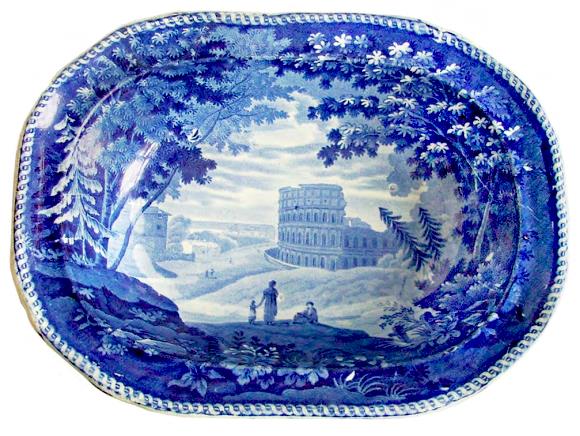
As an interesting side note, Abbott and Holder mentions that it was recently discovered that her etchings were used for a series of blueprinted earthenware by Enoch Woods & Sons, Staffordshire potters in the UK from 1818 to 1845, whose wares were for the greater part exported to America (see example below).
[Staffordshire pottery inspired by Elizabeth Frances Batty’s work]. Kling, L. (2012). Wood’s Italian scenery [PDF]. Retrieved from https://www.transcollectorsclub.org/specinterest/Wood’sItalianScenery-Reduced.pdfIf you take anything from this post, besides my obsession with Italy, it should be that our collections cover a variety of subjects. It can be fun to delve into our catalog to see what’s available and you might even be surprised by what you find. There is also nothing else like being able to see and hold with your own hands a piece of history (of course, while following our handling guidelines!).
Citations:
Allitt, F. (2019). London gallery showcases rediscovered drawings that record an Italian journey in 1817. Retrieved from https://www.antiquestradegazette.com/print-edition/2019/may/2393/dealers-diary/london-gallery-showcases-rediscovered-drawings-that-record-an-italian-journey-in-1817/
Batty, E. F. (1820). Italian scenery: from drawings made in 1817. London, England: Rodwell.
Elizabeth Frances Batty (1791-1875): A rediscovery. (n.d.). Retrieved from http://www.abbottandholder-thelist.co.uk/batty-italy/
Kling, L. (2012). Wood’s Italian scenery [PDF]. Retrieved from https://www.transcollectorsclub.org/specinterest/Wood’sItalianScenery-Reduced.pdf
By Susan Martin, Processing Archivist & EAD Coordinator
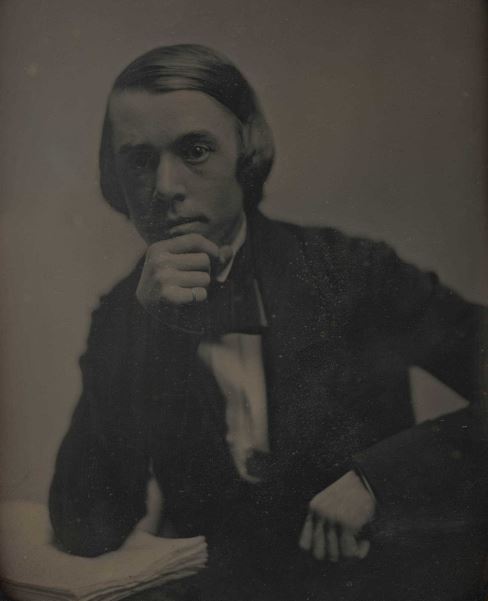
Frederick Beck, whose papers form part of the Beck-Alleyne family papers here at the MHS, counted among his friends and acquaintances many eminent artists and intellectuals of 19th-century Massachusetts. His correspondence includes letters from artist Hammatt Billings, writers Ednah Dow Cheney and Kate Field, physician Nancy Elizabeth Clark, and Ralph Waldo Emerson, whom Beck greatly admired. The collection also contains a few letters from the charismatic young minister and lecturer, Thomas Starr King.
Photograph of Thomas Starr King, ca. 1850s (Photo. #1.365L)
Standing about five feet tall, weighing only 120 pounds, and by all accounts looking even younger than his years, with little formal education, King may have seemed an unlikely celebrity, but that’s what he became. After preaching in Charlestown, Mass. for a short time in the 1840s, he took over the pulpit at Hollis Street Church in Boston. There he made a name for himself and gained recognition as a compelling orator, one of the best of his day. He joined the popular lyceum circuit, lecturing to audiences in New England and the Midwest on religious, literary, and social topics.
The Becks were friends of Thomas Starr King. According to a family history published in 1907, Frederick Beck said:
Thomas Starr King and my mother were great friends, for they were both very humorous and he used to come to our house a great deal. He was a brilliant talker; we went to his church, which is now the Hollis Street Theater. I saw a great deal of Starr King, and he used to tell us most amusing anecdotes. (p. 107)
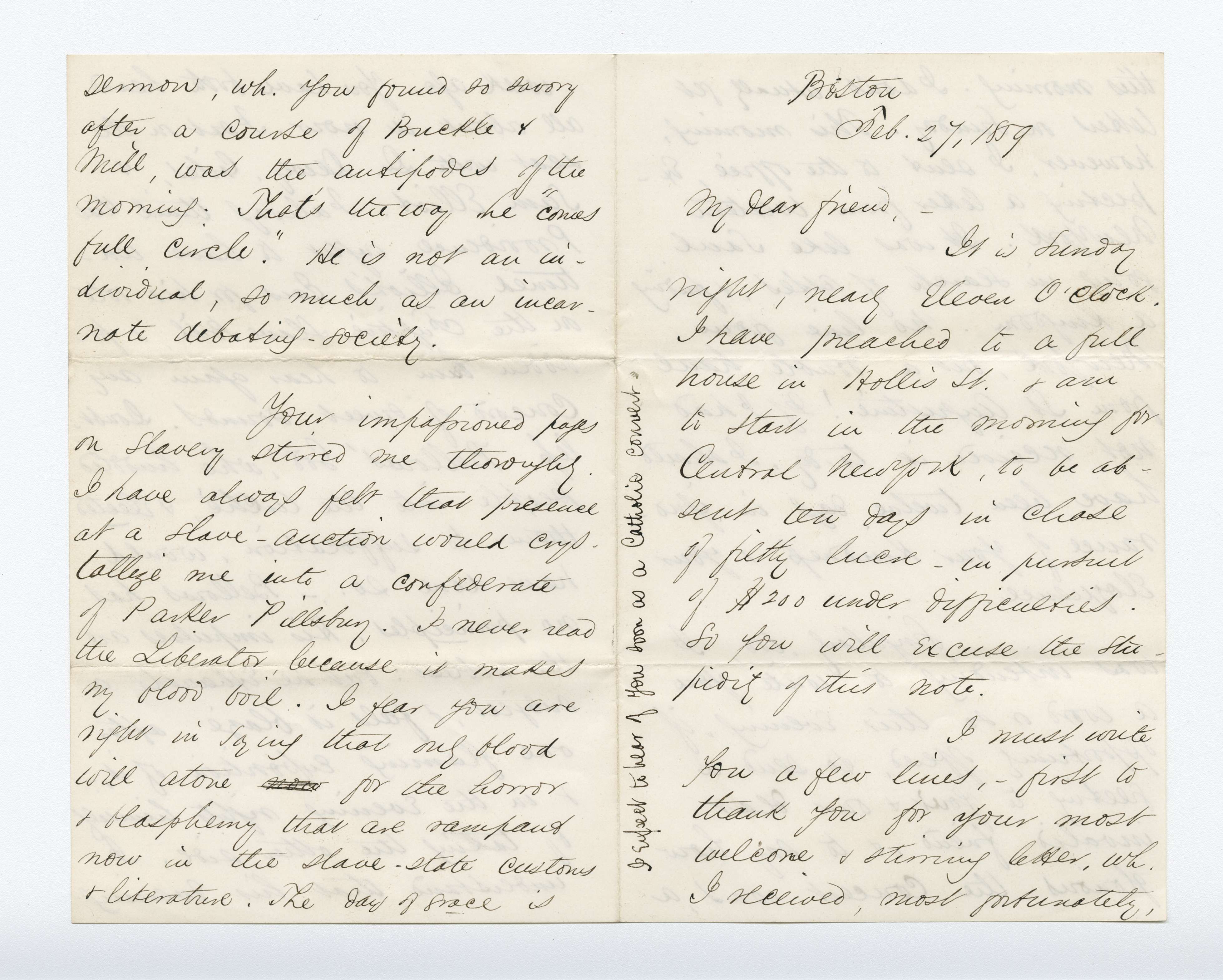
King was an abolitionist, like many of his Boston contemporaries, and in his correspondence with Beck, he shared his feelings on the subject of slavery. In early 1859, Beck was traveling in St. Augustine, Florida, and sent King an advertisement for a local auction of enslaved people, or “barracoon bill of lading.” A disgusted King replied:
Your impassioned pages on Slavery stirred me thoroughly. I have always felt that presence at a slave-auction would crystallize me into a confederate of Parker Pillsbury. I never read the Liberator, because it makes my blood boil. I fear you are right in saying that only blood will atone for the horror & blasphemy that are rampant now in the slave-state customs & literature. The day of grace is doubtless sinned away.
Letter from Thomas Starr King to Frederick Beck, 27 Feb. 1859
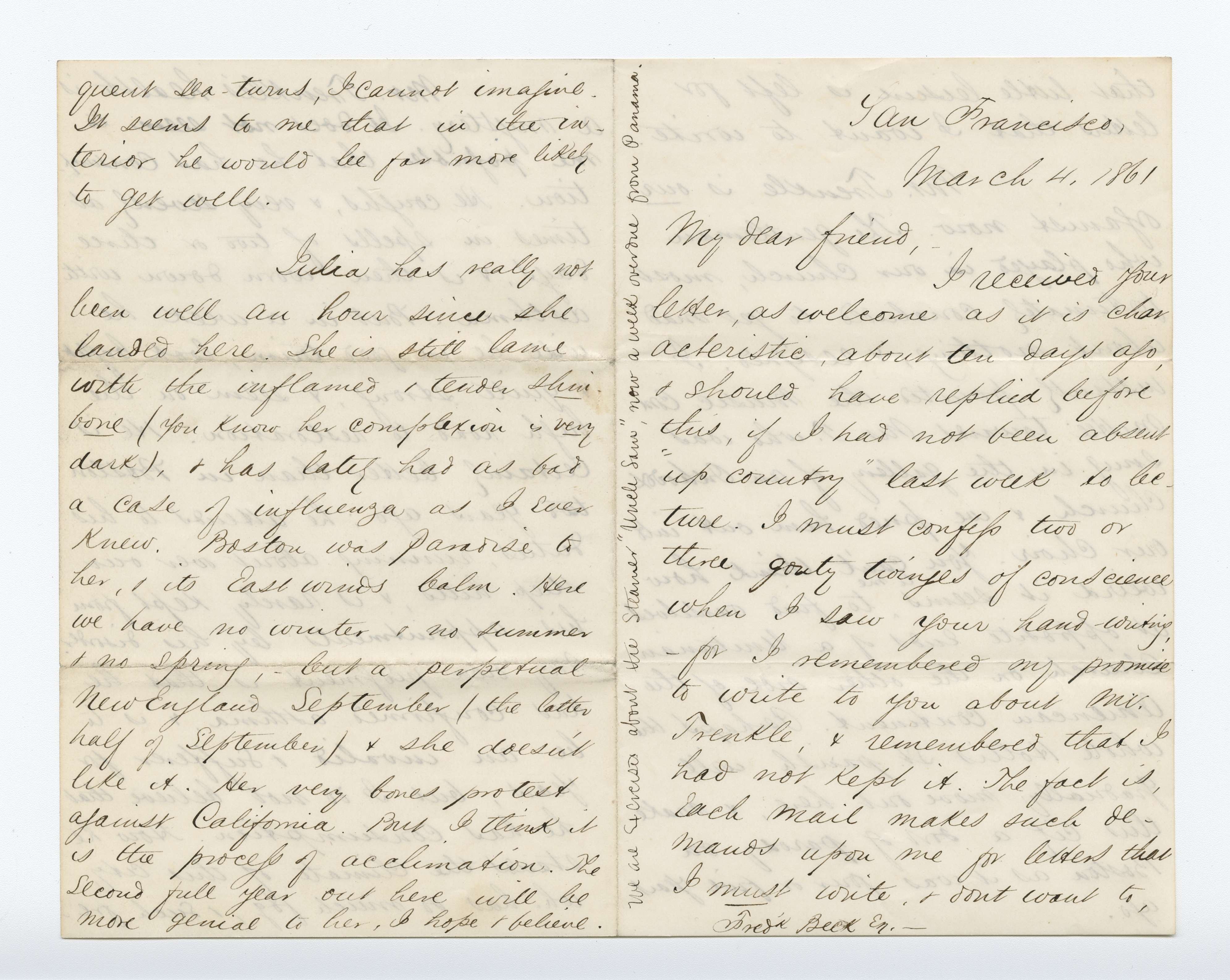
In 1860, King moved to San Francisco and was soon drawn into the political arena. California had only been a state for ten years. With transplanted Southerners threatening secession, King delivered long, fiery speeches around the state aimed at keeping California in the Union. On George Washington’s birthday in 1861, King spoke to a packed house for 2 1/4 hours. He wrote to Beck ten days later:
This is the Fourth of March, inauguration day of the new President over the Crippled Union. I am afraid the wretches around the Gulf will get back again by some imbecile compromise. They ought to be pitched into the Gulf that Lazarus in Abraham’s bosom looked down into. I hope that our Abraham will make them feel where they are, & how comfortable a drop of water would be.
Our public is greatly exercised on Disunion & Pacific Republics. The Chivalry here began to pull the wires to divorce sympathies between California & the North, & we have pitched into them. […] Such a thing was never known in California before, & it makes the “Chivs” open their eyes, & wonder what century they live in. We have utterly crushed Disunion, Secessionism, & Pacific-Republic folly in the State.
Letter from Thomas Starr King to Frederick Beck, 4 Mar. 1861
This speech was just one of many. None other than Abraham Lincoln is said to have credited King with preventing the secession of California.
King was not all fire and brimstone, though. Beck described his friend as “humorous” and “amusing,” and King’s letters are often very funny. He complained that the San Francisco fleas were too “attentive.” And here’s what he had to say about a fellow clergyman:
Bellows has no principles. His impulses are the noblest, but he exhausts a subject, & feels it blaze, after one flaming exposition of it, & in the evening rights himself by taking the other side. I understand that his evening sermon […] was the antipodes of the morning. That’s the way he “comes full circle.” He is not an individual, so much as an incarnate debating-society.
Thomas Starr King died in 1864, at the age of 39, due to diphtheria and pneumonia reportedly brought on by exhaustion. He left a wife and two children. He is buried in San Francisco.
There is a lot going on at the MHS this week. Take a look at the programs we have planned:
On Monday, 9 December, at6:00 PM: Destination: Boston–Immigration & Migration, 1820-1920 with Andrew Robichaud, Boston University. From 1820 to 1920, Boston grew by leaps and bounds through an intensive (and often contentious) process of immigration and migration that ultimately created the modern metropolis. In this presentation and virtual exhibit, Prof. Andrew Robichaud and students from Boston University will present more than 20 rare artifacts and documents from the archives of the MHS. Through letters, diaries, drawings, photographs, reform tracts, and memoirs, presenters will unearth the complex and nuanced dimensions of immigration and migration to Boston. Light refreshments will be served following the presentation.
On Tuesday, 10 December, at 5:15 PM:Who Was “One-Eyed” Sarah? Searching for an Indigenous Nurse in Local Government with Gabriel J. Loiacono, University of Wisconsin, Oshkosh, and comment by Cornelia Dayton, University of Connecticut. This essay considers the life of an indigenous woman, known as “One-Eyed” Sarah, who provided full-time nursing care to poor communities in early nineteenth-century Providence, RI. The only historical sources that describe Sarah’s work never provide her last name or details beyond the description “Indian.” So who was she, and how do we tell her story? Using sometimes patchy sources of non-elite people, the author hopes to gain new insights into social welfare history and explore how ordinary women made the poor law function. This is part of the Pauline Maier Early American History Seminar series. Seminars are free and open to the public.
On Wednesday, 11 December at6:00 PM:At Home: A Look at Historic Houses Through the Archives with Beth Luey. Archival collections held in local institutions can help historians uncover the untold stories of historic houses in Massachusetts. The library of the New Bedford Whaling Museum documents the homes of the great whaling families, while Harvard documents the Ward House and the American Antiquarian Society welcomes us into the Salisbury Mansion in Worcester. The Mary Baker Eddy library documents the many houses where she lived, and, of course, the Massachusetts Historical Society brings the Adams family and their houses to life. A pre-talk reception begins at 5:30 PM; the speaking program begins at 6:00 PM. There is a $10 per person fee (no charge for MHS Fellows and Members or EBT cardholders).
On Saturday, 14 December, at 10:00 AM: The History & Collections of the MHS. This is a 90-minute docent-led walk through of our public rooms. The tour is free and open to the public. If you would like to bring a larger party (8 or more), please contact Curator of Art Anne Bentley at 617-646-0508 or abentley@masshist.org.
On Saturday, 14 December, at 4:00 PM:Legacies of 1619: Citizenship & Belonging with Manisha Sinha, University of Connecticut; Elizabeth Herbin-Triant, University of Massachusetts—Lowell; Hasan Kwame Jeffries, Ohio State University; and moderator Marita Rivero, Museum of African American History, Boston. For 400 years, Africans and African Americans carved out a distinctive culture for themselves even as they sought equal rights in American society. This program will consider how African Americans struggled to gain equal access to political and social rights, all the while making the American experience their own. This is the final program in a four-part series co-sponsored by the Museum of African American History and the Roxbury Community College. There will be a pre-talk reception at 3:30 PM; the speaking program begins at 4:00 PM.
Abigail Adams: Life & Legacy Pop-Up Display Abigail Adams urged her husband to “Remember the Ladies” and made herself impossible to forget. But Abigail is memorable for more than her famous 1776 admonition. This final Remember Abigail display uses documents and artifacts through the ages to consider the way Abigail viewed her own legacy and to explore how and why we continue to Remember Abigail.
Fire! Voices from the Boston Massacre On the evening of March 5, 1770, soldiers occupying the town of Boston shot into a crowd, killing or fatally wounding five civilians. In the aftermath of what soon became known as the Boston Massacre, questions about the command to “Fire!” became crucial. Who yelled it? When and why? Because the answers would determine the guilt or innocence of the soldiers, defense counsel John Adams insisted that “Facts are stubborn things.” But what are the facts? The evidence, often contradictory, drew upon testimony from dozens of witnesses. Through a selection of artifacts, eyewitness accounts, and trial testimony—the voices of ordinary men and women—Fire! Voice from the Boston Massacre explores how this flashpoint changed American history. The exhibition is on display at the MHS through 30 June 2020, Monday and Wednesday through Saturday from 10:00 AM to 4:00 PM, and Tuesday from 10:00 AM to 7:00 PM.
Please note that the library and gallery spaces will close at 3:30 PM on Thursday, 12 December and the library will close at 3:00 PM on Saturday, 14 December.
Laura Ingallinella, Mellon Postdoctoral Fellow in Italian Studies & English, Wellesley College and Agnieszka Rec, Associate Editor, Publications, MHS
In her essay collection Ex Libris, Anne Fadiman suggests that every library contains an “Odd Shelf.” “On this shelf,” she writes, “rests a small, mysterious corpus of volumes whose subject matter is completely unrelated to the rest of the library, yet which, upon closer inspection reveals a good deal about its owner.”[i] While Fadiman’s own odd shelf holds books on polar exploration, the Massachusetts Historical Society’s arguably contains works of a noticeably older vintage.
Among the MHS’s hundreds and thousands of linear feet of family papers, rare books, and scholarly volumes are some two dozen medieval manuscript books and fragments, covering a range of topics from Spanish history to urine to the quest for the Holy Grail. [ii]
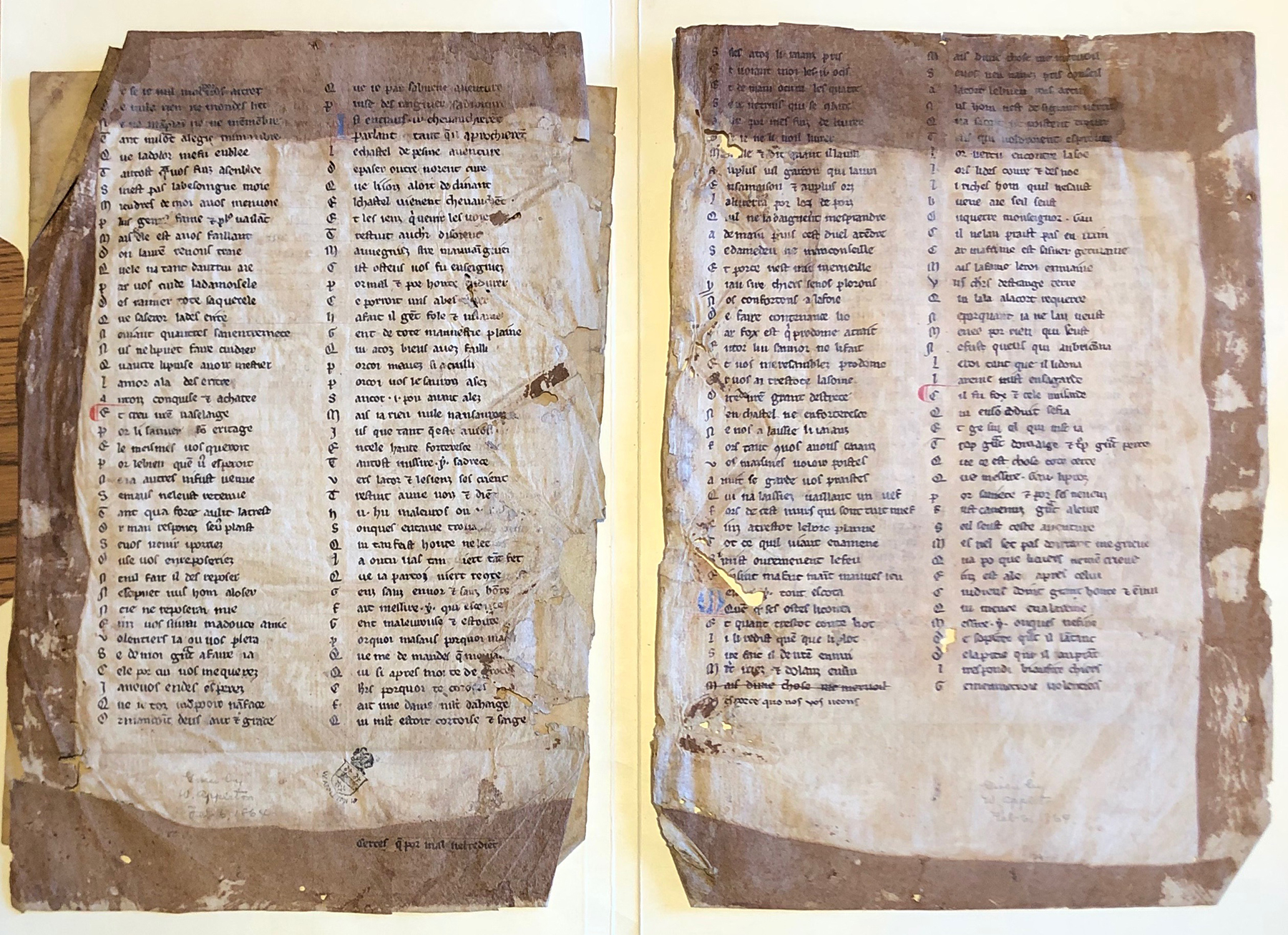
Chrétien de Troyes’ Yvain, Appleton Family Papers, MHS. A wonderful example of binding waste.
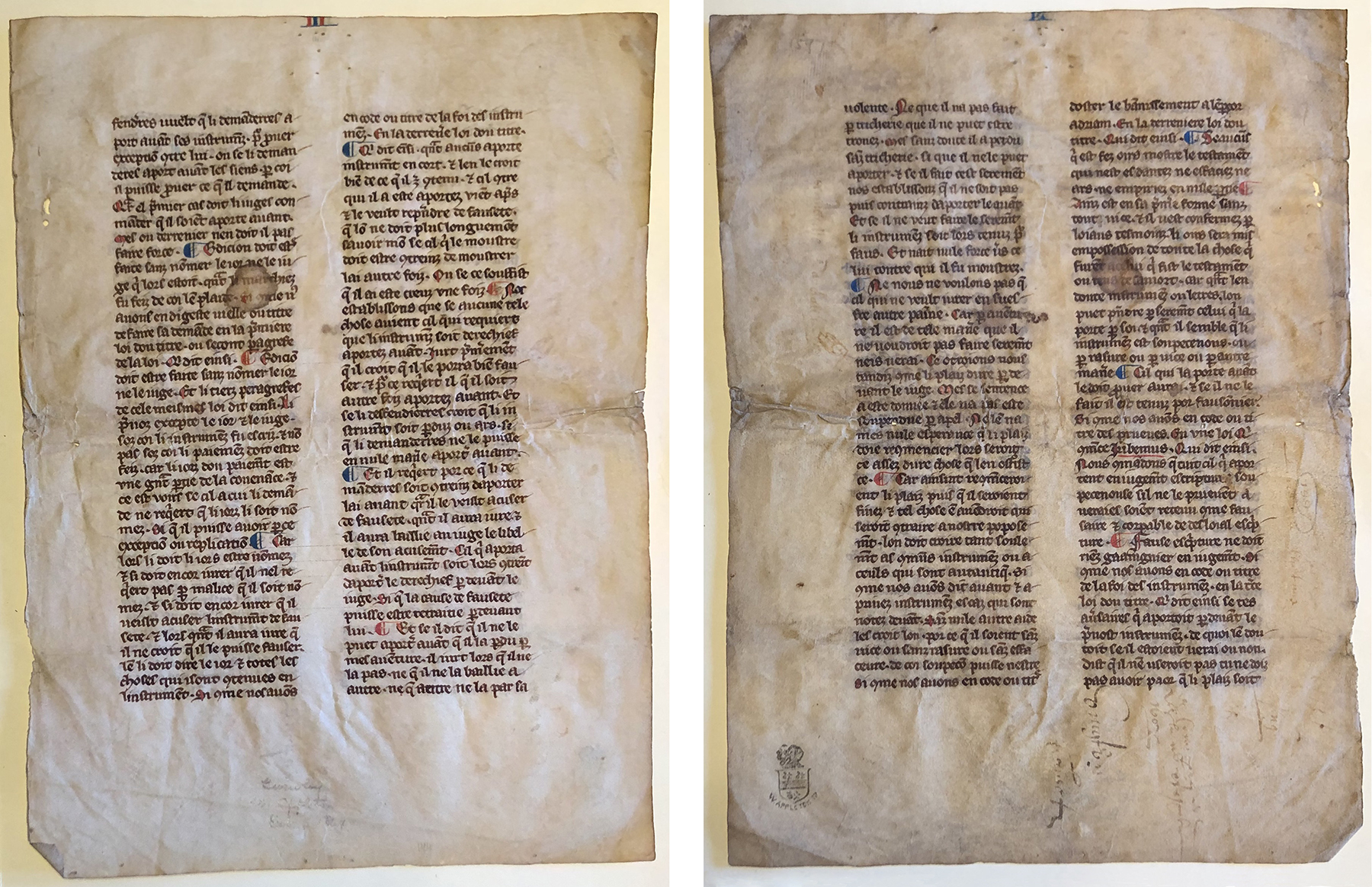
One particularly intriguing example is an unidentified medieval manuscript leaf in the Appleton Family Papers. Today, we’re happy to say: mystery solved! The fragment is in fact a late thirteenth-century excerpt of a text on procedural law, specifically the French translation of the Ordo judicarius by Tancred of Bologna (c. 1185–c. 1236).
MHS Ordinaire recto and verso
Born in Bologna and educated at the university there, Tancred was one of the leading authorities on ecclesiastical law in his day.[iii] After studying with renowned jurists Azo, John of Wales, and Lawrence of Spain, he taught canon law at his alma mater and often advised popes on legal and diplomatic matters. During his busy career as a teacher, writer, diplomat, consultant, and man of God, Tancred wrote many procedural texts, which he compiled into a complete manual, the Ordo judicarius, between 1214 and 1216.[iv]
The Ordo quickly became a standard reference manual for canon law and circulated widely over the centuries—it exists today in over a hundred manuscripts—and was also translated into French, German, and Portuguese.[v] The French translation, titled Li Ordinaires mestre Tancrés or more simply Ordinaire, was dedicated to a “noble Philip, king of France,” either Philip III (1270–85) or Philip IV (1285–1314). It seems to be a remarkably good translation: Frédéric Duval has noted that the translator tried his level best to turn Tancred’s dull and often repetitive legalese into a more lively vernacular text that could appeal to a “larger public” of law practitioners.[vi]
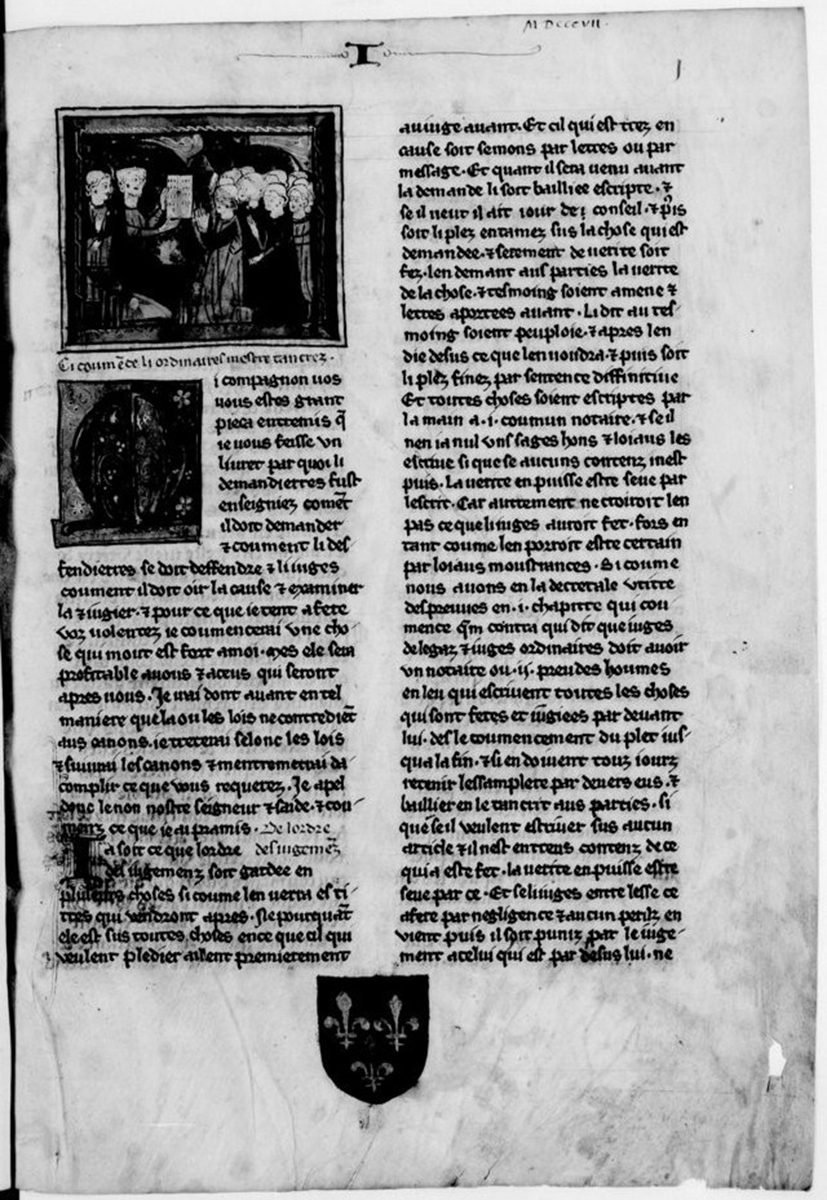
With the identification of the MHS fragment, the Ordinaire survives in ten manuscripts, five of which date before 1300.[vii] The script is a refined late thirteenth-century Gothic script (the so-called littera textualis) of better quality than other manuscripts of the Ordinaire produced in the same period (see, for example, Metz, Bibliothèque municipale, MS 1196). The page layout (or mise-en-page) of the manuscript, with two columns and paragraph marks in red and blue, resembles those of the earliest copies of the Ordinaire.
Like its Latin source, the Ordinaire is divided into four books, which deal, respectively, with judges; defendants and other parties; legal procedure; and sentencing. The MHS fragment is from book 3, chapter 13. That chapter discusses the so-called instrumenta, that is, the written evidence produced by the various parties involved in a trial. In an premodern age of handwritten documents, how could a judge trust that a piece of evidence was authentic? What were the telltale signs that an important document, such as a contract or a will, had been tampered with or even forged? Reading this fragment, we glimpse a legal system concerned with perjury, falsification, and ill intent, as well as a dogged pursuit of the “truth”—issues very relevant today.
So far our previously unidentified manuscript has a title, author, and approximate date, but what can we say about where it comes from? To answer that question, we turn to the language of the fragment. In this case, as with many manuscripts produced in France over the thirteenth and early fourteenth centuries, we can more conclusively say where it does not come from. We can exclude areas such as northern, northeastern, and southwestern France (namely, Picardy and Artois, Lorraine, and Gascony). The “neutral” spellings, word forms, and syntax found in this fragment normally suggest a provenance from the Île-de-France, that is, the environs of Paris, a major center of book production.[viii] Other important manuscripts of the Ordinaire (for example, Paris, Bibliothèque nationale de France, MS fr. 1073) were also produced there.[ix] It is also worth remembering that the Ordinaire had been written for the king of France, and Île-de-France would have been the first hub where a Parisian-born translation would circulate.
Paris, BnF, MS fr. 1073, a manuscript of the Ordinaire produced in Paris between 1275 and 1300 like the MHS fragment.
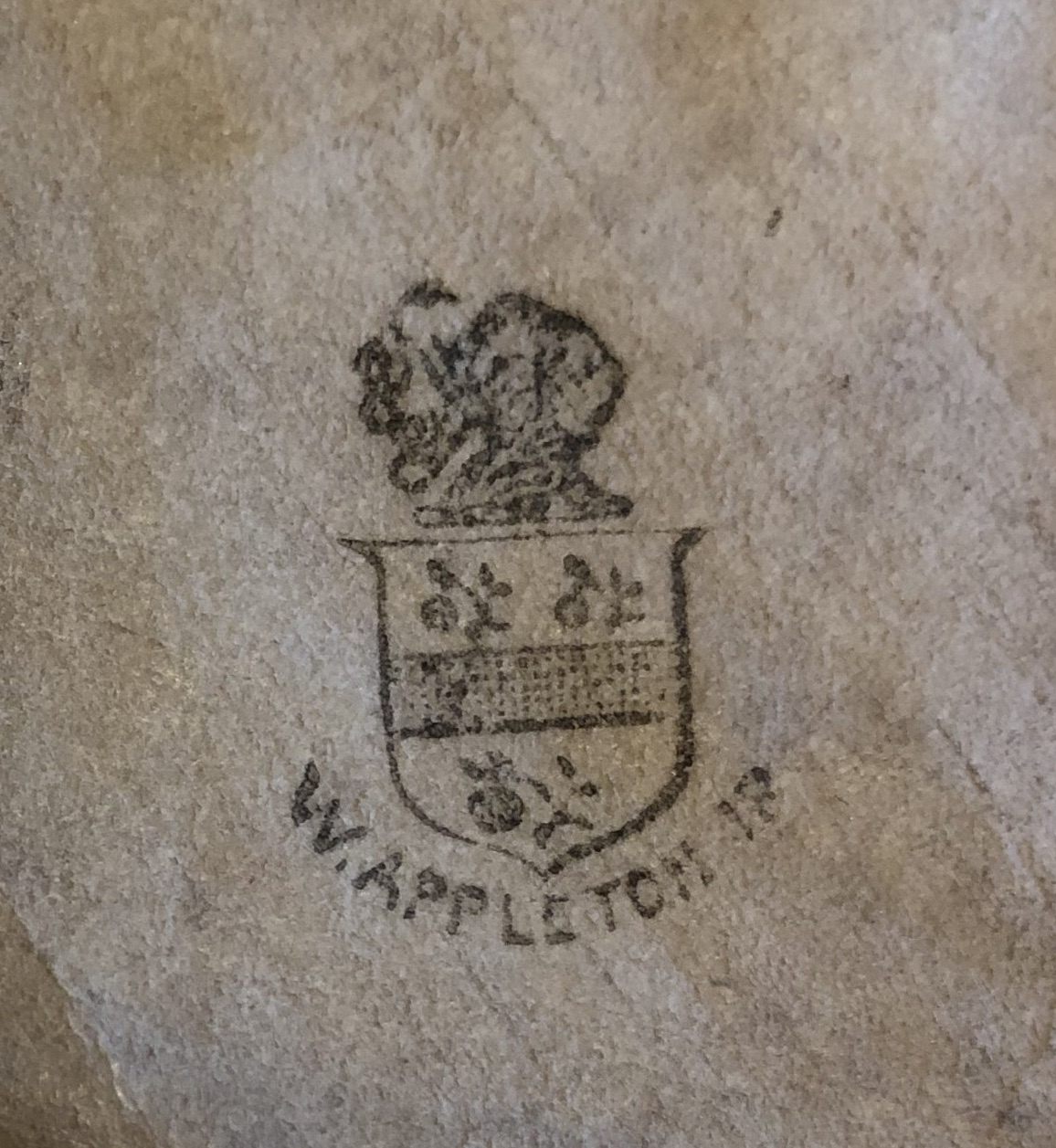
One final question remains: What is this medieval European manuscript doing among the MHS’s very American collections? This particular witness of Tancred’s Ordinaire entered the collections in 1864 as a gift from a W. Appleton Jr., likely William Joseph Warren Appleton (1825–1877), son of Rep. William Appleton (1786–1862). A library stamp is found in the lower left corner on one side of the leaf bears the name “W. Appleton Jr.” Seemingly something of a manuscript collector, William J. W. Appleton also donated several other manuscripts to the New England Historic Genealogical Society the same year as his donation to MHS.[x]
William Appleton Jr.’s library stamp, with the Appleton family coat of arms.
In our next post, we’ll delve further into the MHS’s premodern Odd Shelf and see what closer inspection might reveal about the historical society.
[i] Anne Fadiman, “My Odd Shelf,” Ex Libris, New York: Farrar, Straus, and Giroux, 1998, 21.
[ii] The De Ricci-Bond census lists twenty-seven, but there may well be more among the MHS’s many family papers. Seymour de Ricci et al., Census of medieval and renaissance manuscripts in the United States and Canada, vol. 1. (HW Wilson, 1935), 937–41.
The manuscript referred to here are the Coronica del rey do Enrique el quarto de Castilla y de Leon by Diego Enriquez del Castillo; Liber Uricrisiarum by Daniel Henry; and fragments of Perceval in the Appleton Family Papers. Dan Hinchen discussed other medieval manuscripts in the MHS collections in earlier posts to this blog here (part 1 & part 2) and here.
[iii] Peter Landau, “The Development of Law,” The New Cambridge Medieval History, ed. David Luscombe and Jonathan Riley Smith, vol. 4/1. (Cambridge, UK, 1995), 113–47, at 136.
[iv] Friedrich Bergmann, ed., Pillii, Tancredi, Gratiae libri de iudiciorum ordine (Göttingen, 1842), 89–314.
[v] José Domingues and Pedro Pinto, “Um fragmento em português do Ordo iudiciarius de Tancredo,” Glossae: European Journal of Legal History 13 (2016): 207–42.
[vii] Two other manuscripts were destroyed during World War II.
[viii] For the philologists among you, we can delve even futher into the language of fragment by considering how it fits into the stemma codicum recently constructed by Frédéric Duval. Essentially a manuscript’s family tree, a stemma codicum assesses the quality and relations of all the Ordinaire manuscripts. Duval’s stemma has two main branches θ and ε. Without any doubt, the MHS fragment does not belong to ε: where that branch presents an error of some sort, our fragment retains the correct reading in quite a few instances. For example, in the second column of the verso, our fragment cites a law by quoting its very first word in Latin, Iubemus (“we order”). The ε manuscripts, however, all mistake it for another similar one, Iubilemus (“we rejoice”). In other words, in this branch, a word typical of the Latin Christian liturgy made its way into a treatise on how to conduct a trial. Examples such as this one suggests that the MHS fragment might instead bear some affinity to or derivation from the θ branch of the Ordinaire.
[ix] See the descriptions in Duval, “Ordo judicarius.”
[x] These included the Book of Esther in Hebrew and a Koran in Arabic. The New England Historical and Genealogical Register, vol. 18 (Albany, 1864), 215.
Today, we return for the last time to the diary of George Hyland. If this is your first time encountering our 2019 diary series, catch up by reading the January, February, March, April, May, June, July, August, September, October, and November 1919 installments first! Then join me in following George day-by-day through the final month of 1919.
The Hills of Hingham by Dallas Lore Sharp (1916), p. 216.
* * *
PAGE 353 (cont’d)
Dec 1. In forenoon sawed and split wood 2 hours for Mrs. M.G. Seaverns — 60. In aft. worked 3 hours for Mr. James — mowing with lawn mower and raking grass and leaves and other work –Clear. cold. W.N.W. Played on the guitar 1 1/2 hours in eve.
2d. Worked 5 hours for Mrs. Bertie Barnes — diging [sic] parsnips, cleaning out part of barn, and harvesting turnips — 1.50. Had dinner there. Bought a pint of milk there — 7 cts. Milk is 17 cts. per qt. At N. Scituate. tem. To-day 28-50; W.S.W. fair. Eve. par. Clou., W.N.W. Played on the guitar 1 1/2 hours in eve. The parsnips I dug to-day were the largest I ever saw — some of them were 16 inches long.
3d. Clear. cold. tem. 14-34. W.N.W. did some work at home in forenoon. In aft. Went up to my home. Staid 1 1/2 hours — got some more of my cloths. Called at Uncle Samuel’s. Ellen gave me a quart of milk and some apples. Walked up and back. Called at Mrs. Bailey’s this forenoon to see about some work Edith C. Sargent wants me to do. Eve. cold. 11:15 P.M. tem. 18.
PAGE 354
Dec 4. Sawed, split and housed the last of my wood — heavy timber boards and etc. Clear. Cold. W.N.W. tem. 13-34. Played on the guitar 1 1/4 hours in eve. Eve. cold. tem. 18.
5th. In forenoon wkred 1 1/2 hours for Mrs. James — about 7 hours in all — 1.00. Also got some wood and and put it in my wood house late in aft. Went into woods S. of Conihasset […] to pick some pr. [sic] pine. Did not find much. Very light snow storm. Tem. to-day about 18-40; W.S. and N.W. aft. Clear. W.N.W. Cold. Played on the guitar 1 1/4 hours in eve.
6th. Clear. W.N. in forenoon, S.E. in aft. tem. About 27-45. In aft. Worked 3 3/4 hours for Miss Edith C. Sargent taking off window screens and putting on storm windows and carrying coal ashes out of cellar and wheeling it out to the swamp — 1.05. She gave me 18 good apples (R.I. Greening). Eve. clou. W.S.E. Played on the guitar 1 1/2 hours in eve. Snow storm late in eve. Turned to rain later.
7th. (Sun.) Light rain and fog. Eve. clear.
8th. Cloudy. Damp. W.N., S.E. Went to Scituate Cen. and Greenbush to pick some evergreen — got a bag full. Rode to Beaverdam Road with Willie Stockbridge and Lottie in automobile (they called here in morning) then walked to S. Cen. and Greenbush. Had lunch in the woods. Ret. came back on 4:12 tr. from Greenbush. Began to rain at 5 P.M. Light rain all eve. Played on the guitar 1 1/2 hours in eve.
9th. Light rain all day — W.N.E. wind light, did some work at home late in aft. Worked 1 hour for J.H. Vinal getting good from a freight car and putting them in the store — 30. Very light rain in eve. Foggy. Played on the guitar 1 1/4 hours in eve. Galen Watson called here in aft.
10th. Cloudy and warm in morning. Windy and dark — w. Changed to N.W. and began to clear about 9 A.M. Went up to Uncle Samuel’s — had dinner there. In aft. Went to Mr. Hope hill and picked a bag full of evergreens, pr. pine, and etc. […] got some wood, cloths, bedding, and other things in my house and Ellery B. Hyland brought them here in his auto. Cold and very windy after 9:30 A.M. Tem. to-day — 60-30. Clear soon after 10 A.M. Eve. windy and cold — tem. 25. Played on the guitar 1h. 25m. in eve.
11th. Clear. Cold. W.W.; tem. 16-30. Worked 3/4 hour for J.H. Vinal in forenoon — in the store — 25.In aft. picked some pr. pine. Went nearly to Mungoe’s Corner — came out on a road in the woods near a farm where a family of Finns live. Their place is a mile from any public street. I met a young lady (a Finn) about dark 1/2 mile from the main road (about 13 or 14) She asked me if I had been to her house — I said I just came into the road that leads to their farm. I showed her some of the pine I had in a bag. Eve. clear. Played on the guitar 1 1/2 hours in eve. 11:30 P.M., tem. 28; hazy.
12th. Worked 2 1/4 hours for J. H. Vinal unloading a load of flour and packing it in piles in store — also cleaned and washed a large meat grinder — 61. Got 1/4 lb. of meat in it — fried it for my dinner. Light rain all day. Warm. tem. 30-60. Eve. cloudy. W.N.W. cooler. Played on the guitar 1 1/4 hours in eve.
13th. Cloudy. Warm. Damp. tem. 58-60. Did some work at home — got the last of the wood from the spot where the laundry was torn down — wood very dirty and wet, prob. I have picked out 1/2 cord there in all. Bought 65 pounds of very nice straw (rye) at the Story Grain store house — 91 cts. The manager sent 70 pounds (sent 5 lbs. gratis) […] Cook brought it here. In aft. Worked 1/3 hour (in the Store) for J.H. Vinal — 10. Eve. clou. W.N.W. Played on the guitar 1h. 25m. In eve.
14th. (Sun.) Cold rain storm until noon; then snow storm until 2 P.M. Then clou. Eve. clear. Cold. tem. 26 W.N.W. Took the old hay out my bed and filled with new rye straw; also took the wool out of my mattress and filled it with straw — 70 pounds of straw in both — too much in both of them 30 pounds is enough to fill a bed. Prob. I put over 40 pounds in my largest one.
15th. Clear. Cold. Windy. N.W. In aft. Went up to my place to get a piece of stove pipe and a few
PAGE 355
other things. Called at Uncle Samuel’s. Ellen gave ma a piece of winter squash to boil and several apples. Walked up and back. Stopped at Mrs. Merritt’s and bought a quart of milk. Ethel got 2 pairs of scissors for me to sharpen. She met with an accident about 3 weeks ago — ran into a telephone pole while riding in her automobile and her back is still lame. Eve. clear. cold. tem. 20. Played on the guitar 1 1/4 hours in eve. 11:45 P.M. tem. 18.
16th. Cold weather — tem. 11-22; W.N.W.; Clear, made some wreaths in aft. Also got some […] vines to wind them on. Eve. cold. clear. Tem. 18. Played on the guitar 1 ½ hours in eve.
Sold some junk to Samuel Benson this A.M.
30 pounds of cotton — 30.
3 pds. rags — 3.
10 1/7 pds. of zinc — 25.
2 pds. of brass — 10.
2 pds. of rubber — 10.
30 pds. of iron — 10.
60 pds. of papers — 15. (total 1.03)
17th. Cold weather. Snows storm until about 10 A.M. aft. Clear. Windy. N.W. Snow blowing about. A water pipe in the bath room froze last [sic] in night and it burst about noon. I had to keep the the [sic] water from the floor because it began to leak down into the store. Kept a pail under the place where it leaked and emptied it often — this was all I could do to-day. I got all the water out of the toilet and box last night — worked on it until 1:30 (after mid). Scott Gannett here this eve. And turned off the water. Also took the water out of the copper boiler — connected with the stove. Played on the guitar 1 1/2 hours in eve. Cold night. 11:45 P.M. tem. 2 below zero. […]
18th. Made wreaths (in my front room — opp. the R.R. station) Very cold weather — tem 7 below zero to 12 above. W.N.W. Played on the guitar 1 1/2 hours in eve. Eve. cold. — tem 2.
19th. Worked on wreaths — also piled up wood in the woodhouse and carried wood into the house — 2 hours for Mrs. M.G. Seaverns — 60.Cold. par. Clou.; W.N.W. temp. 5-26. Played on the guitar 1 1/4 hours in eve. Eve. cloudy. 12 (mid) clear. Tem 24.
20th. Clear. Cold. W.N.W. tem. 10-26. Went up to Uncle Samuel’s had dinner there. Picked 3 bags of hemlock twigs […] went to my home and got my sled and brought it here only a little […] ground. Stopped at Wm. Clapp’s. Martha A. Clapp there. She engaged 3 wreaths (pr. pine) walked up and back. Sold 1 wreath to Mrs. Ethel Torrey — 25. Called at Mrs. Merritt’s to get some milk — had none. Eve. clear. Cold. tem 19. Made 5 wreaths in eve. Then played on the guitar 1 1/2 hours.
21st (Sun.) Cloudy A.M. Clear after 11 A.M. W.N.W. tem. 16-32. Worked on my wreaths early in aft. Went up to Uncle Samuel’s. Irene there — she brought a loaf of bread there — Ellen gave me 1/2 of it also a large apple. Carried 3 pr. Pine wreaths to W.O. Clapp’s — for Martha — 75. Bought some milk at Mrs. Merritt’s. Rode 1 mile with a man in auto truck — some one who lives in Beechwoods — could not see who he was — too dark. Walked back in eve. Martha C. showed me a large grove filled with dif. kinds of green (wild) plants and red berries. Mrs. Clapp gave me 4 apples. Eve. clear. cold. tem. 15.
22d. Made wreaths (15) par. Clou. tem. About 15-42. W.N.W. eve. Clear. Tem. 28. Played on the guitar 1 1/4 hours in eve.
23d. Made wreaths until late in aft., then walked to Cohasset and carried 23 large hemlock wreaths. Sold none there, went to Hingham on 4:30 P.M. tr. from Cohasset. In eve. sold 12 wreaths there. Sold 4 to Mrs. Soule — 1.00. Sold 2 to a man opp. H.T.P. — 50. 2 to another man same place — 50. 2 to another man same place — 50. 2 to others — 50. Cloudy, wet, foggy to-day, W.N.W. Tem. about 30-42. Came back on 6:17 P.M. tr. Eve. very foggy, cold. Played on the guitar 1 1/4 hours in eve. I brought back 11 wreaths — the Conductor came and sat in a seat next to mine and took one and examined it, he said they were very handsome wreaths. I told him I got the hemlock in W. part of Scituate — where my place is — he belongs in Plymouth or Kingston.
24th. Made wreaths in forenoon. In aft. went to Hingham to sell wreaths — sold 4 to Prop. of Italian fruit store — 1.00. 2 to Thom. R. Studley — 50. 3 to man near R.R. Sta.– 75. 2 to a man near same place — 50. 1 to a man near same place — 25. Cloudy; W.N.W. tem. About 36-46. Wet and damp. Chilly. Began to rain over
PAGE 356
2:30 P.M. Light rain all. Cold. Met Henrietta, Ethel, and Frank on St. H. and E. are going to New London, Conn. to visit Lettie for 2 weeks — Frank was taking them to the R.R. Sta. in his auto: he bought 2 of my wreaths. Eve. dark. cold. Light rain. Played on the guitar 1 3/4 hours in eve.
Snow storm and mod. Gale late in night. Cold storm. Max. W. 35m. W.N.E.
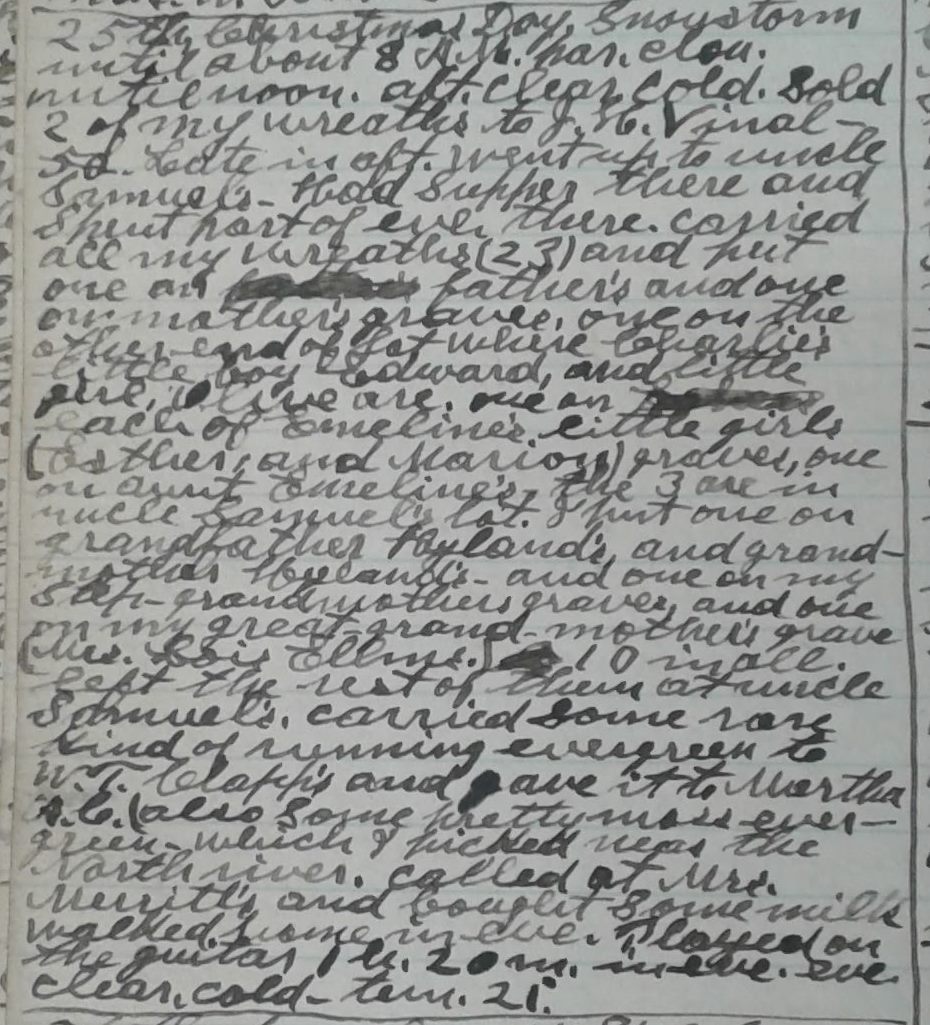
diary snippet 2 – December 25th (Christmas Day)
25th. Christmas Day. Snowstorm until about 8 A.M. Par. clou. Until noon. Aft. clear. cold. Sold 2 of my wreaths to J. H. Vinal — 50. Late in aft. went up to Uncle Samuel’s — Had supper there and spent part of the eve. There. Carried all my wreaths (23) and put one on father’s and one on mother’s graves. One on the other end of the lot where Charlie’s little boy Edward, and little girl, Olive, are. One on each of Emeline’s little girls (Esther and Marion) graves, one on Aunt Emeline’s, the three are in Uncle Samuel’s lot. I put one on grandfather Hyland’s and grandmother Hyland’s — and on one my step-grandmother’s graves, and one on my great-grand-mother’s grave (Mrs. Lois Ellins). 10 in all. Left the rest at Uncle Samuel’s. Carried some rare kind of running evergreen to W.O. Clapp’s and gave it to Martha A.C. (also some pretty moss evergreen which I picked up near the North River. Called at Mrs. Merritt’s and bought some milk. Walked home in eve. Played (on the guitar) 1 h. 20 m. in eve. Eve. clear. cold. — tem. 21.
26th. Par. clou. W.S.W. tem. About 20-36. Late in aft. Went up to Uncle Samuel’s to get one of my wreaths — to put on Charlie’s new lot in Graveland Cem. — to put with a flag that was put there in honor of Fred. Fred did not come back with the 101st Machine Gun Battalion after the Great War ended. Eve. cloudy. W.N.W. Cold. Played on the guitar 1 1/2 hours in eve.
27th. Par. clou. W.W. tem. About 34-39. Mr. W.D. Gannett came here in forenoon and took the water pipes from the back of the stove (disconnected them from the copper boiler) and put a new grate in the stove — and cleaned out the stove. After he left here I took the stove out and cleaned it. Late in aft. went up to Uncle Samuel’s. Had supper there. Bought some milk at Mrs. Merritt’s. Ethel got it for me. She is nearly well again — got injured in automobile accident about a month ago. Rode 3/4 mile with Everett Marsh, and 1 mile with Robert Litchfield — in their autos. Walked back in eve. I went up to get some milk, but as I had a chance to ride to Uncle Samuel’s I did so. Received a Christ card in an envelope with a dollar bill from Henrietta — from New London, Conn. — she also sent me 2 […] chicks from Hingham — before she left there. Also rec. A Christmas card from Lottie several days ago. Eve. clou. Began to clear soon after I left Mrs. Merritt’s. Clear when I arr. back. Played on the guitar 1 h. 10 m. in eve. 11:30 P.M. tem. 32.
28th (Sun.) Clear. Tem about 25-38; W.N.W. eve. clear.
29th. Clear. Cold. tem. 15-35. Went up to Uncle Samuel’s late in forenoon. Had dinner there. In aft. cut wood in swamp for Uncle Samuel 3 3/4 hours. Had supper there. Walked back in eve. (also walked up there) Irene is there on a visit. Eve. clear. cold. Tem. at 11 P.M. 14. Fine weather in aft. W.E.S.S., W.N.W. in forenoon. Called at my home to get my saw horse and 4 ft measuring stick. Played on the guitar 1 h. 10 min. In eve.
30th. Light snowstorm all day. W.W.S.W. in forenoon, S.E. to E.N.E. in aft. tem. tem. [sic] 18-30. Cut wood 2 hours for Uncle Samuel — had dinner there, walked up and back. Called at Mrs. Merritt’s and bought some milk. Ethel got it — staid [sic] there 5 min. Eve. clear. cold. windy. W.N.W. Played on the guitar 1 h. 20 min. 11 P.M., tem. 23.
31st. Cut wood in swamp 4 1/2 hours for Uncle Samuel — had dinner there. Walked up and back — worked 20 min for Mrs. M.G. Seaverns — early in eve. Shoveling snow from path to street and clearing it from steps and […] — 15. Fine weather for the season. Clear. tem. 15-32. W.N.W. called at Eugene Brown
PAGE 357
To see if he has any potatoes to sell — Uncle Samuel wants to buy some. Eve. cloudy. tem. 32. Played on the guitar 1 h. 25 min in eve.
1919
[…] 3 cords and 1 ft. of hardwood in […] for Uncle Samuel — 7.50.
7 1/2 cords of hardwood for L.F. Hyland — 16.87. Hauled out 1/2 cord […] — 25.
Working for Uncle Samuel — mowing bushes — 75.
Working for L. F. Hyland — picking beans — 4.95.
Working for E. Jane Litchfield 9.60.
Hyman Coyne — 1.25.
Aaron Bates — 40.
Arthur E. Litchfield 4.30.
Wm. F. Carter — 7.72.
Mrs. Caroline Litchfield — 2.25.
Mason Litchfield — 5.00.
Peter W. Sharpe — 13.38.
Mrs. Emma F. Sargent — 5.85.
Charles Bailey — 1.50.
Mrs. Edna T. Bailey — 6.00
Miss Edith C. Sargent — 1.55
Fred T. Bailey — 5.60
Mrs. Salome Litchfield — 5.77
O. Clapp — 7.00
Mrs. Bertie Barnes — 7.50
Mrs. Vera Wilder — 13.60.
Herbert Bates and Mrs. Mary Wilder — 45.
Mrs. Mary Wilder — 35.
Mrs. Hazel Dimond — 1.65 […]
Joseph W. Morris — 2.10
George Crosby — 17.97
Mrs. Christine Ellis and Mr. Bullard — 8.78
Bruce Fletcher — 2.25
Mrs. Cora Bailey — 20.
Repaired and sharpened 1 pr. of scissors for Mrs. Henrietta Merritt — 15. Sharpened 2 prs. […] for Mrs. M — 12.
Working for S.T. Speare — 16.00
Margaret Speare — 5.70
Mrs. Ethel Torrey — 10.90
Frank Clapp — 26.50
Mrs. M.G. Seaverns — 26.55
H. Vinal — 6.41
Charles James — 2.00
Sold plants (from my garden at home) to Mrs. M. G. Seaverns — 1.00
Sold vegetables from my garden on the James place — 61. 35 boxes of currants 4.32 and 1/2 box of raspberries — 10 cts.
Sold the grass on my place — 1.00
Sold 1 1/2 feet of cedar wood — 1.50 (sawed into firewood)
Sold junk to Samuel Berson — 3.11
Made 54 wreaths (in Dec.) Sold 31 of them — 7.75
Assisting the Auctioneer at the auction at Henrietta’s — 5.00
Housing furniture and taking it out again for Mr. Smith after the auction — 1.00
Working for Henrietta (taking down buildings (in Nov.) — 2.00
And stay tuned for our serialized diary from 1920; the first post will appear on January 3rd!
*Please note that the diary transcription is a rough-and-ready version, not an authoritative transcript. Researchers wishing to use the diary in the course of their own work should verify the version found here with the manuscript original. The catalog record for the George Hyland’s diary may be found here. Hyland’s diary came to us as part of a collection of records related to Hingham, Massachusetts, the catalog record for this larger collection may be found here.
Join us for a program this week. Here is a look at what is planned:
On Monday, 2 December, at 6:00 PM:Revolutionary Networks: The Business & Politics of Printing the News, 1763–1789 with Joseph Adelman, Framingham State University. During the American Revolution, printed material played a crucial role as a forum for public debate. Joseph Adelman argues that printers—artisans who mingled with the elite but labored in a manual trade—used their commercial and political connections to directly shape Revolutionary political ideology and mass mobilization. Moving through the era of the American Revolution to the war’s aftermath, this history details the development of the networks of printers and explains how they contributed to the process of creating first a revolution and then the new nation. A pre-talk reception begins at 5:30 PM; the speaking program begins at 6:00 PM. There is a $10 per person fee (no charge for MHS Fellows and Members or EBT cardholders).
On Tuesday, 3 December, at 5:15 PM: Climate in Words & Numbers: How Early Americans Recorded Weather in Almanacs with Joyce Chaplin, Harvard University. With support from the Guggenheim Foundation, Joyce Chaplin is compiling a database of manuscript notes about weather in early American almanacs, 1647-1820. Her talk focuses on how people recorded weather in numbers (including degrees Fahrenheit) and in words, ranging from “dull” to “elegant!” These notations are significant as records of a period of climate change, the Little Ice Age, also as records of how people made sense of and coped with that climatic disruption. This is part of the Boston Seminar on Environmental History series. Seminars are free and open to the public.
On Wednesday, 4 December, at 6:00 PM:Members & Fellows Holiday Party. MHS Fellows and Members are invited to the Society’s annual holiday party. Celebrate the season with an evening of holiday cheer and jovial camaraderie. This event is open to Members and Fellows of the MHS. Registration is required and space is limited.
On Saturday, 7 December, at 10:00 AM:The History & Collections of the MHS. This is a 90-minute docent-led walk through of our public rooms. The tour is free and open to the public. If you would like to bring a larger party (8 or more), please contact Curator of Art Anne Bentley at 617-646-0508 or abentley@masshist.org.
Abigail Adams: Life & Legacy Pop-Up Display Abigail Adams urged her husband to “Remember the Ladies” and made herself impossible to forget. But Abigail is memorable for more than her famous 1776 admonition. This final Remember Abigail display uses documents and artifacts through the ages to consider the way Abigail viewed her own legacy and to explore how and why we continue to Remember Abigail.
Fire! Voices from the Boston Massacre On the evening of March 5, 1770, soldiers occupying the town of Boston shot into a crowd, killing or fatally wounding five civilians. In the aftermath of what soon became known as the Boston Massacre, questions about the command to “Fire!” became crucial. Who yelled it? When and why? Because the answers would determine the guilt or innocence of the soldiers, defense counsel John Adams insisted that “Facts are stubborn things.” But what are the facts? The evidence, often contradictory, drew upon testimony from dozens of witnesses. Through a selection of artifacts, eyewitness accounts, and trial testimony—the voices of ordinary men and women—Fire! Voice from the Boston Massacre explores how this flashpoint changed American history. The exhibition is on display through 30 June 2020, Monday and Wednesday through Saturday from 10:00 AM to 4:00 PM, and Tuesday from 10:00 AM to 7:00 PM.
Please note that on Wednesday, 4 December, the library will close at 3:45 PM.