People were publicly spreading their political ideologies long before the days of social media. For Sarah Winnemucca, a public presence was a key element of her political agenda. Winnemucca, a Northern Paiute woman and daughter of Chief Winnemucca, holds a complex spot in the history of the United States. In part, she took to the written word, publishing a book titled Life Among Piutes: Their Wrongs and Claims, which is in the Society’s collection. The autobiographical work is a deft account of the history of her family and culture, including the agonies of white settlement. Winnemucca was well connected to contemporaries who were engaged in their own campaigns for change. Most notably, she was connected to Horace Mann, his second wife, Mary Peabody Mann, and her sister and fellow education reformer, Elizabeth Peabody. It is through these connections that she was able to share her struggle with a larger audience.
Elizabeth Peabody’s letter to Dr. Lyman Abbot, Sarah Winnemucca’s practical solution of the Indian problem: a letter to Dr. Lyman Abbot of the ’Christian Union, is more of a booklet for a public audience than a letter—it even includes a postscript that refers to itself as a public document—to get support and funding for a school Winnemucca had started for Paiute children in Nevada. In advocating for Winnemucca’s school, Peabody cites Winnemucca’s Christian faith, private (as opposed to communal) land ownership and the fact that the children were to be taught in English as well as Paiute. Winnemucca’s own writing plays into the American rhetoric of creating our own destiny. In an address quoted by Peabody, Winnemucca tells her peers “It will be your fault if [your children] grow up as you have”, saying that “a few years ago you owned this great country; today the white man owns it all and you own nothing.” She was clear that education was the best path forwards for the Paiute and Peabody’s writing gives us some insight into the type of education she offered at the school. There is a subtle impulse towards educational assimilation in the text: Peabody stated that not funding such a school as Winnemucca’s “prevents civilization” among the Paiute “by insulting that creative self-respect and cautious freedom to act.” Indeed, Winnemucca was an activist who felt that she needed to work within the framework of Euro-American systems. In an “Appeal for justice,” a circular in the MHS broadside collection, she states “My work must be done through Congress.”
At the same time, she willing to communicate the profound, harmful effect the processes of colonization had on her community. In the early 1880s, the Paiutes were struggling to have reservation lands, acknowledged in the 1860s and subsequently sold off, restored to the community. Winnemucca in particular held this battle for the Malheur Reservation close to her heart. In 1883, the year before Life Among Piutes was published she traveled to Boston where she met the Peabody sisters and Horace Mann. The Peabody sisters were the ones who pushed forward the publishing of her book. During her time in the Eastern United States, she gave public lectures discussing the injustices faced by her people. Her circular “Appeal for justice” mentioned above, was another way a garnering support, and to do so she made her public appeal an emotional one.
In the circular she states, “No door has been open to [the Paiute]; on the contrary, every arm has been raised against them” and that their reservation was “taken from us in the usual way.” In two paragraphs, she establishes her emotional appeal, urging people to seek justice with her. She explains that she is acting not on behalf of herself, but for her people and especially her father. Winnemucca makes her eastern audience aware of their power: “will you give my people a home? Not a place for this year, but a home forever? You can do it. Will you?” It is not until the second and much shorter paragraph that she gives information about the cession Malheur Reservation to the Paiute. Here, she informs her public that the reservation lands were sold against the wishes of her community, implying no community members were in a position to push back against the sale of the land. Still, while being more informative here she does not abandon the impassioned language from earlier in the circular. She states, “I want to test the right of the United States government to make and break treaties at pleasure.” She finishes by saying “Talk for me and help me talk, and all will be well.” On January 4, 1884, she went before Congress with a petition for the restoration of the Malhuer Reservation to the Paiute.
Unfortunately, the lands designated as the Malheur reservation would never be reacknowledged by the government as the Malheur reservation. Winnemucca’s declining health and funds prohibited her from keeping her school running, and she passed away in 1891. Though her work in these areas was not fully realized, Winnemucca was able to fashion a public voice that reached an elite and influential circle of Boston, made herself heard by the United States Congress, and translated her experience to be understood by a broad American public. Her legacy today is controversial and her complicated public advocacy resonates with contemporary debates. The questions of identity and representation are some of the most pressing of our time; the rhetoric of who belongs where is a common topic in popular and political media. Reading through Winnemucca’s “Appeal for justice” and Peabody’s letter offers a historical perspective.
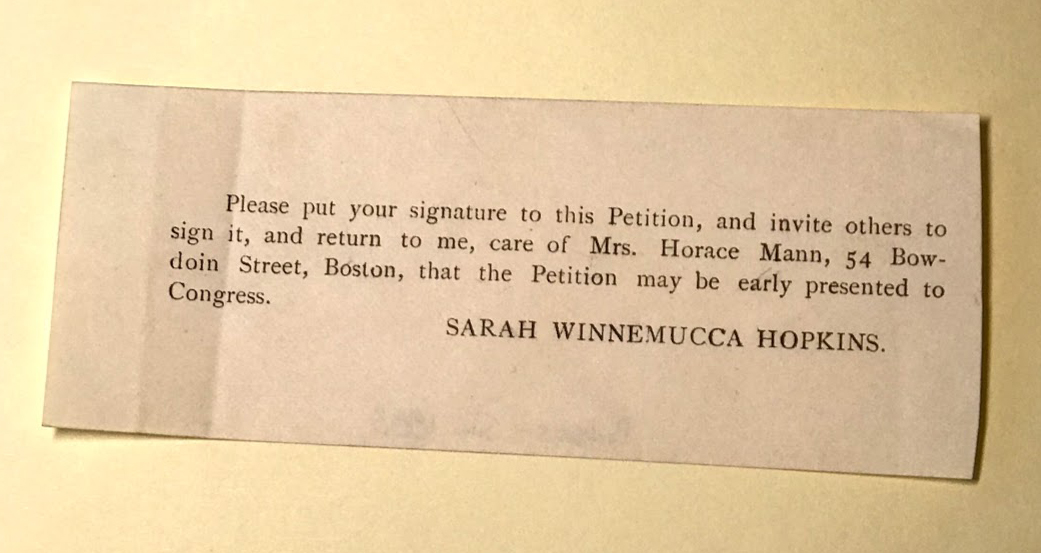
Card in the folder with circular letter directing readers to sign and return to Mary Peabody Mann so that Winnemucca could present the signitures to Congress.
All of the excerpts and images in this post were taken from collections held at the MHS. You can visit our library to take a look at the originals.
by Susan Martin, Processing Archivist & EAD Coordinator
Have you ever wondered about the origins of the everyday technological devices that we take for granted today? How far back do these devices go? What did some of their earliest incarnations look like?
The newly processed papers of Charles Francis Adams give us an idea. You may recognize his name, but no, I’m not talking about the ambassador to the U.K. during the Civil War (CFA 1807-1886), the railroad executive and historian (CFA 1835-1915), or the Secretary of the Navy and yachtsman (CFA 1866-1954). He was, however, a member of the same illustrious family and a direct descendant of Presidents John and John Quincy Adams.
Our Charles Francis Adams (1910-1999) was, among other things, a Navy veteran, vice president of the Massachusetts Historical Society, and executive at Raytheon for many years. It’s this last role I’d like to highlight in this post. Raytheon, founded in 1922, has been headquartered in Cambridge, Newton, Lexington, and Waltham, Mass. Between 1947 and 1975, Adams served alternately as vice president, president, and chairman of the company.
Adams’ papers include 15 scrapbooks of newspaper clippings, photographs, and ephemera going back to 1920 that document much of the history of Raytheon. Adams’ tenure coincided with a period of explosive technological innovation, and while the company has become one of the country’s foremost military contractors, it was also involved in the development of a variety of commercial technological gadgets and home appliances in the post-World War II years. I want to focus on three devices: the microwave oven, the television, and the walkie-talkie.
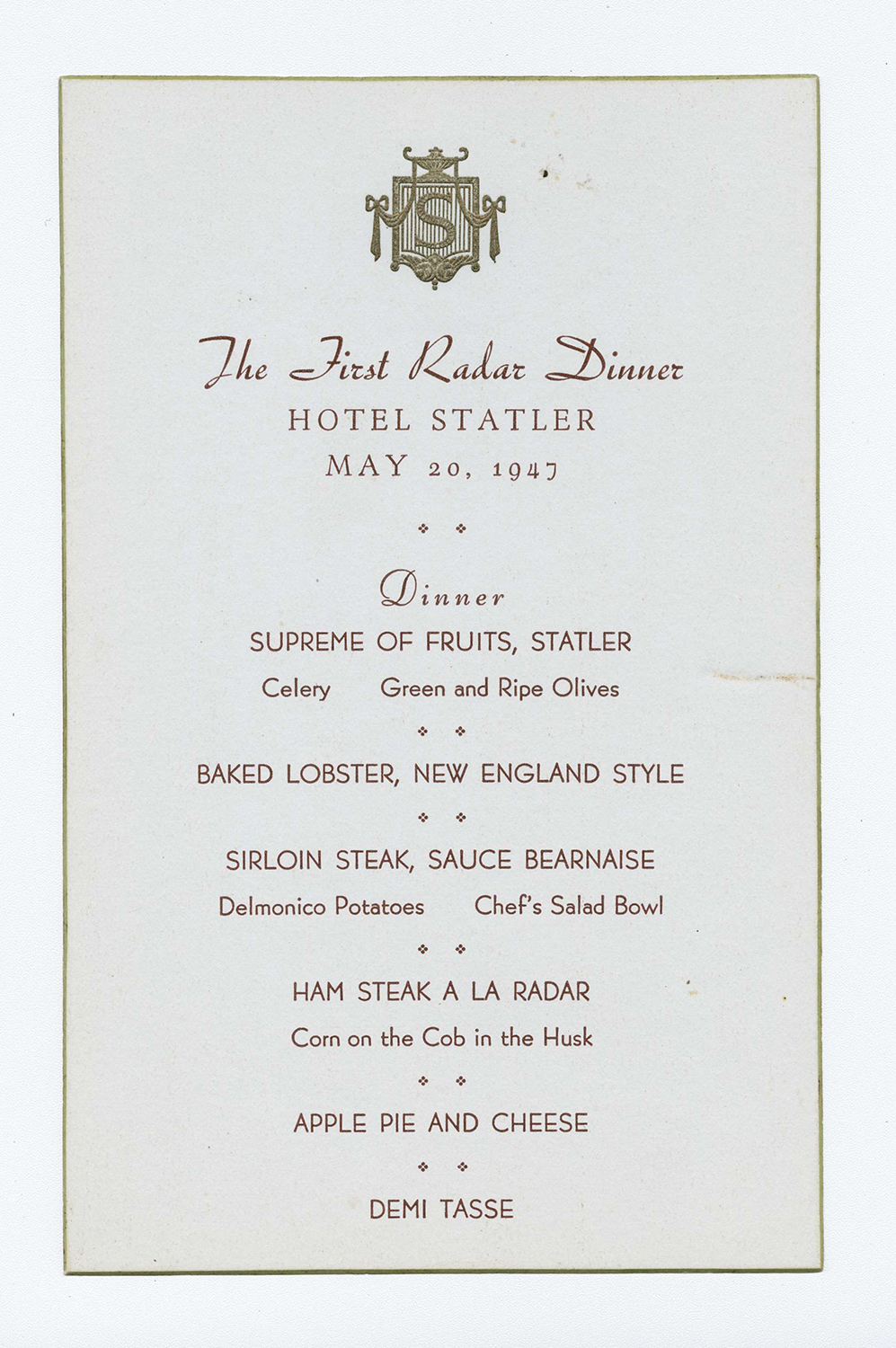
On 20 May 1947, the Hotel Statler in Boston (now the Park Plaza Hotel) debuted a new appliance manufactured by Raytheon—the “Radarange.” It was about five feet high, stainless steel, and used a magnetron tube for cooking meals in a matter of seconds. That evening, an entire meal was prepared with this “radar cooking,” including “radar coffee.” According to a Boston Post article published the following day, “The Hotel Statler made epicurean history last night. […] It was the first time this has been done anywhere.”
Menu for “the first radar dinner,” Hotel Statler, 20 May 1947
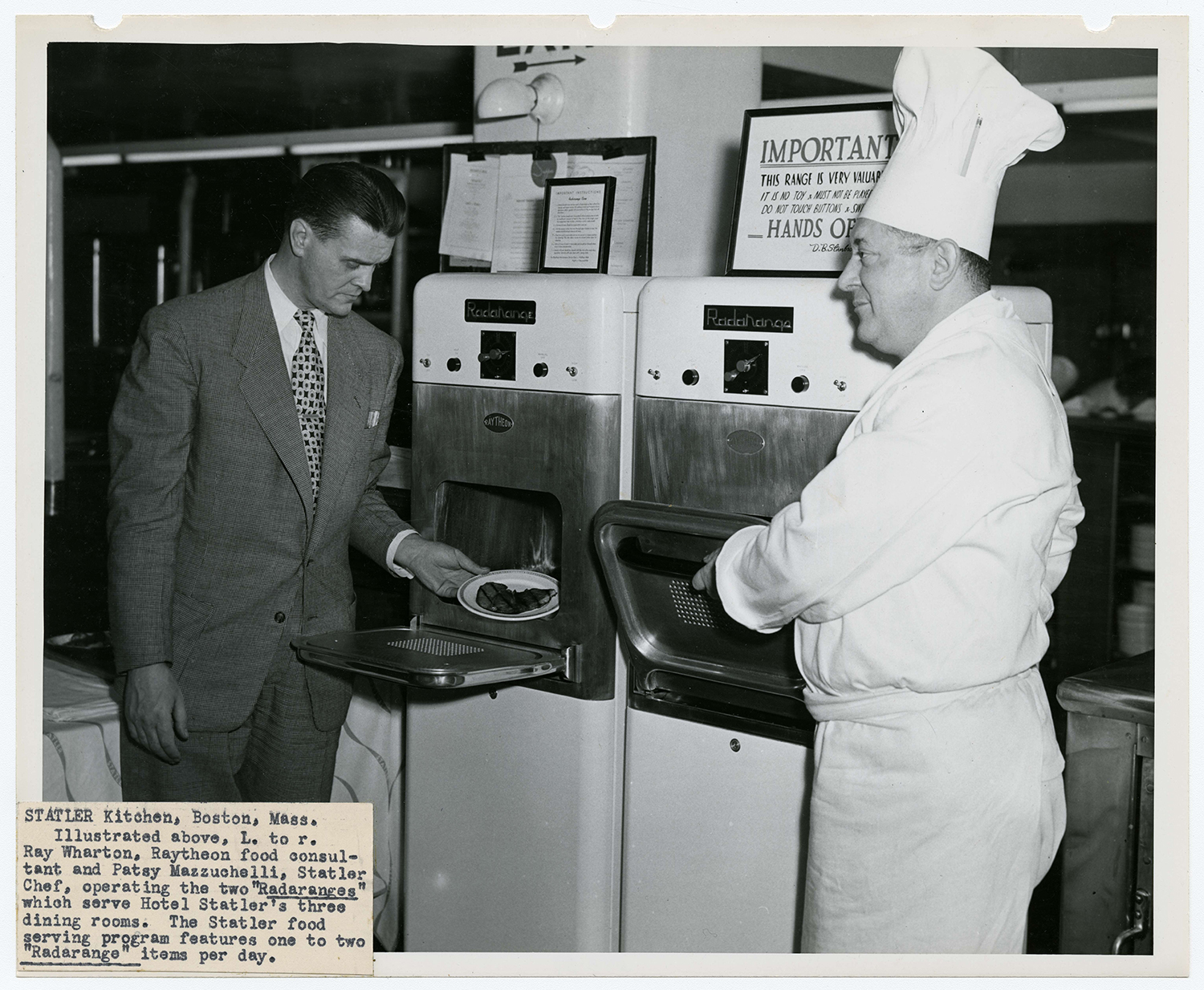
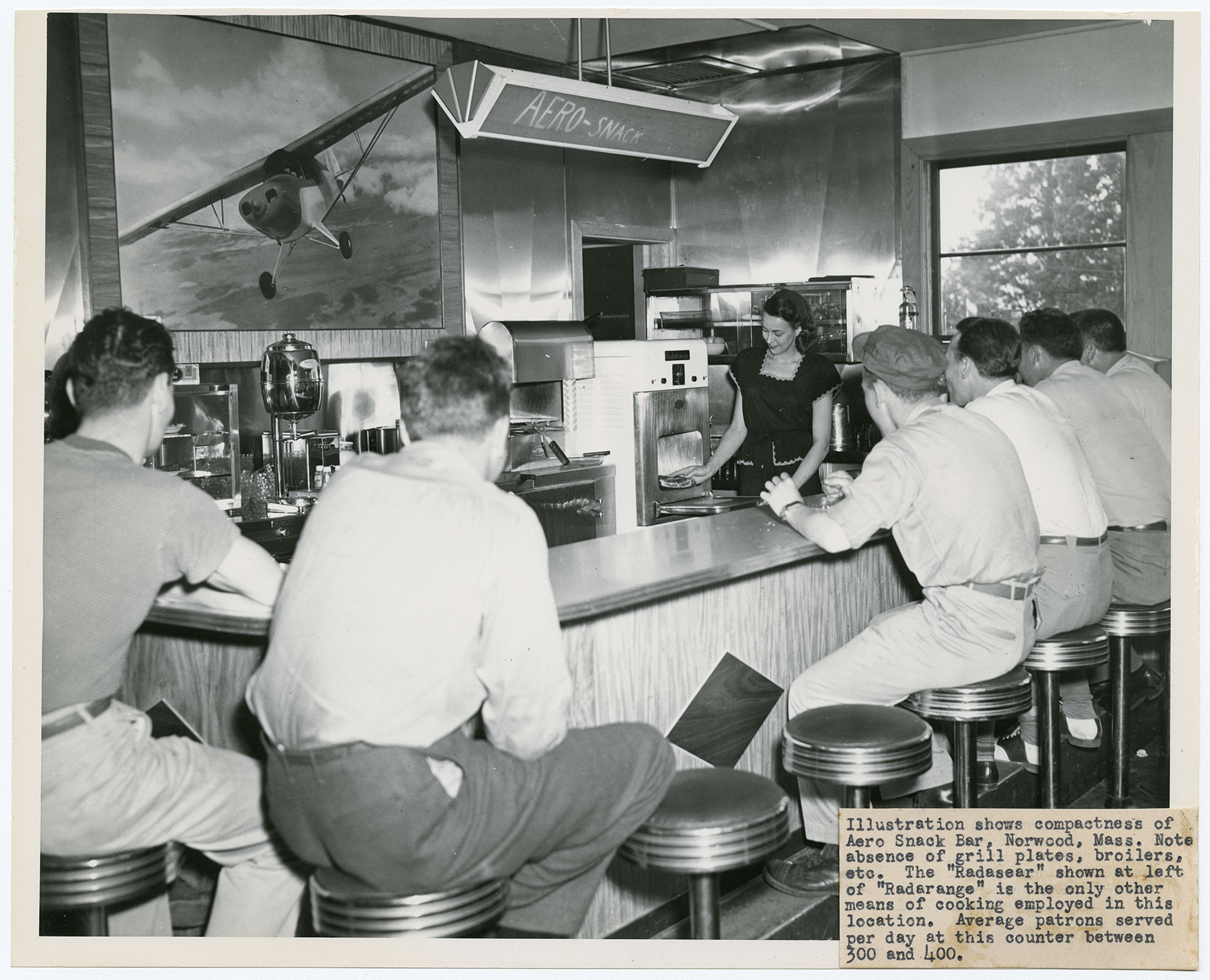
The scrapbooks include some fun promotional photographs featuring the Radarange at the Statler and other Massachusetts locations, like the Aero Snack Bar, a lunch counter at the Norwood airport; White Tower Restaurant in Brookline Village; and United Farmers Dairy Store in Dorchester.
Statler kitchen with two Radaranges, taken by Avalon Studios, 1947 (Photo. #343.07)Aero Snack Bar with a Radarange, taken by Avalon Studios, 1947 (Photo. #343.08)
One article estimates that there were about 75 Radarange units in operation by early 1948, mostly in hotels and restaurants. The appliances were not sold, but leased to customers for $150 a month. They were also intended for trains, ships, and even planes. Radaranges were not ready for everyday home use yet—for one thing, they were too expensive to make and to service—but Adams saw the potential in the domestic market, and by the mid-1950s, the company was developing a smaller model for direct sale.
The chairman of the board of Hotels Statler Co., quoted in a press release, said that the Radarange “has a definite place in the preparation of quality food in quantity production. The cooking is not only fast, it is clean—there is no grease, smoke or odor. Our chefs, furthermore, are delighted because ‘Radarange’ produces no external heat, making the kitchen a more comfortable place in which to work.”
What was the public’s reaction to this new-fangled contraption? Tide magazine, a publication covering advertising, marketing, and public relations news, said the Radarange was the “most intriguing” of Raytheon’s new products (30 Jan. 1948). A reviewer, early the following year, called it a “spooky invention,” but was otherwise positive about it. Christian Science Monitor summed it up this way: “At first there was some opposition to radar ranges because of the revolutionary changes in cooking methods implicit in them. Some cooks were impatient of the new techniques and others expected too much” (1 Apr. 1954).
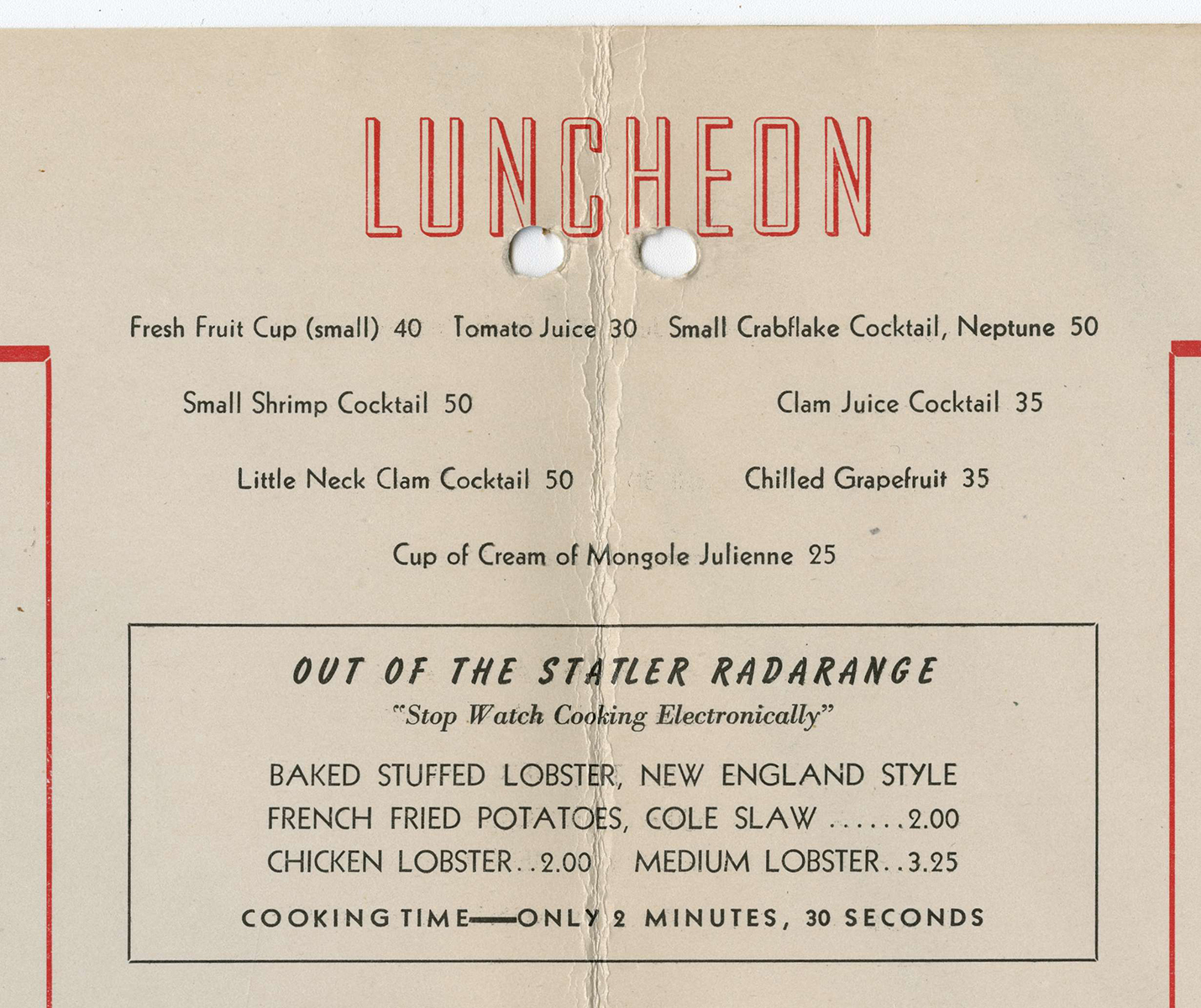
I, for one, love the idea of diners at a high-end restaurant ordering a microwave meal. In fact, the Statler reserved a special section on its daily menu for food prepared via Radarange.
Lobster in 2 ½ minutes, Hotel Statler, 15 May 1947
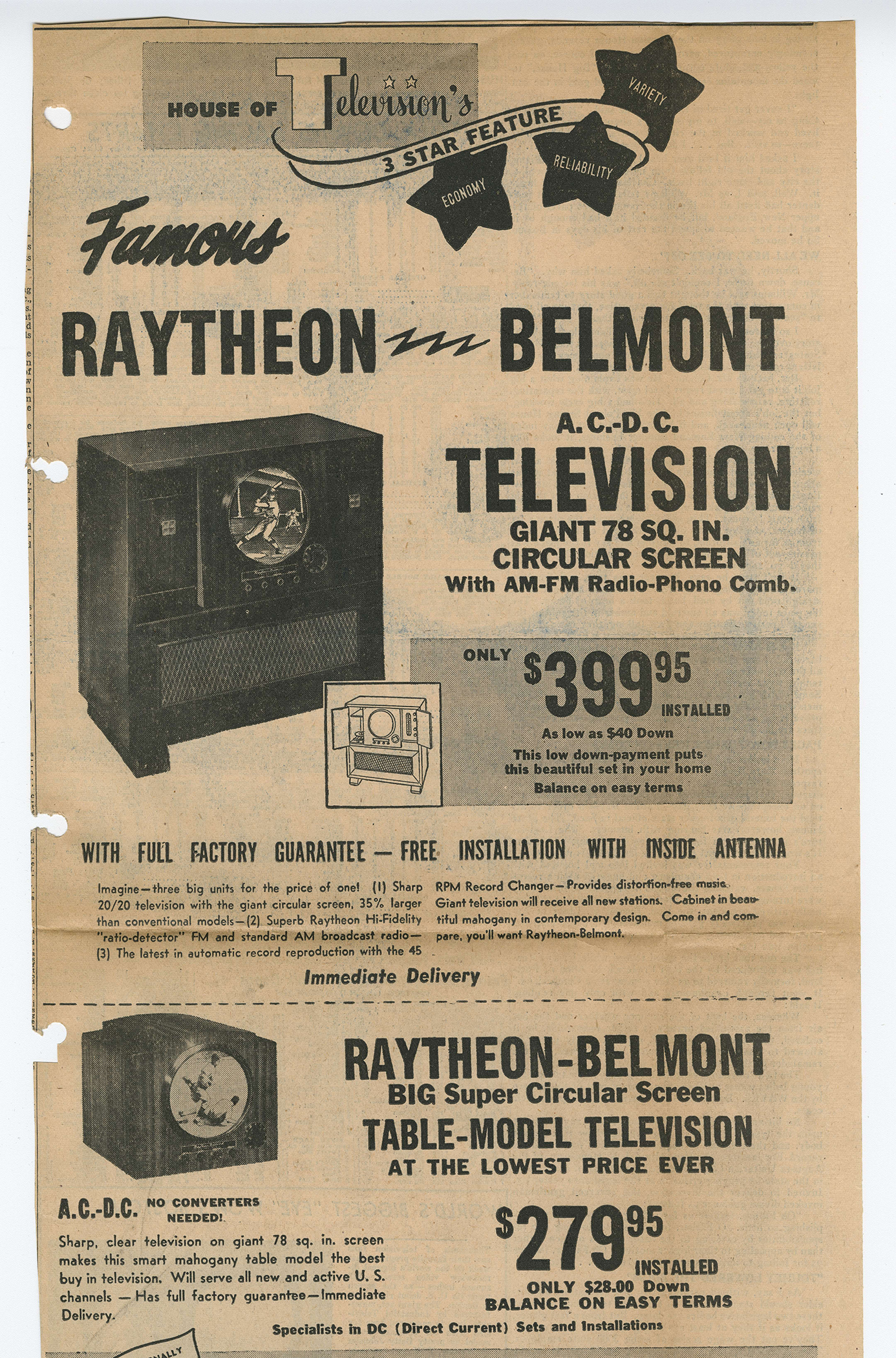
Television, on the other hand, had been around for a little while before Raytheon got in on the game. The company’s foray into the TV market wouldn’t last, but in the late 1940s, Raytheon and its subsidiary Belmont Radio Corporation were hyping their new model with features like a clearer picture, static-free sound, and a “snap-action station selector” (the channel dial, I assume). Prices of televisions advertised in Adams’ scrapbooks ranged from $200-$750. A store in Boston called the House of Television was selling a set that came in a mahogany cabinet with a AM/FM radio and a record player. It also boasted a “giant” circular screen…about 8.8 inches in diameter.
Advertisement for the Raytheon Belmont TV, 1949
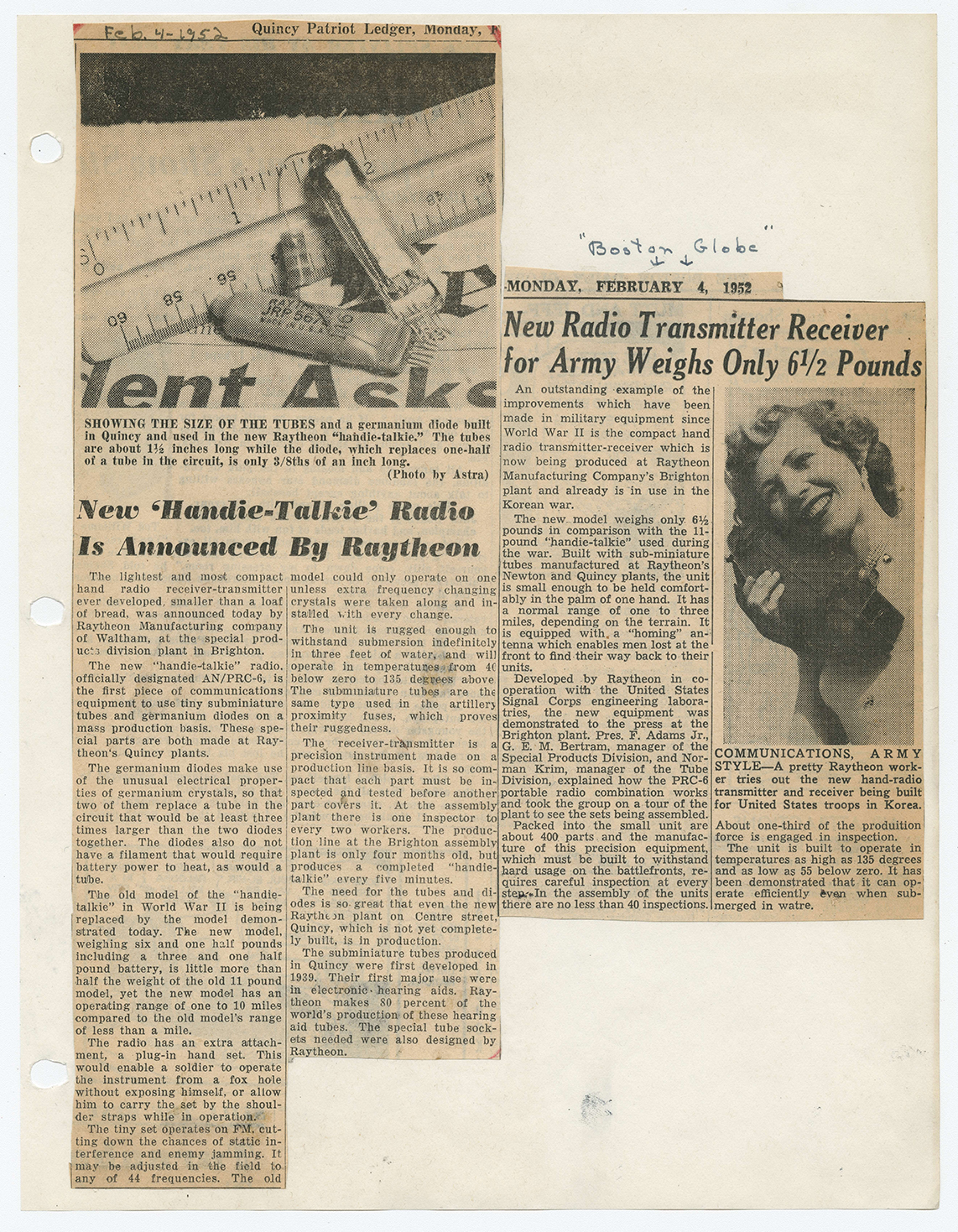
Last but definitely not least, I stumbled across these terrific clippings from the Quincy Patriot Ledger and the Boston Globe dated 4 Feb. 1952.They showcase Raytheon’s new “handie-talkie” radio, “the lightest and most compact hand radio receiver-transmitter ever developed,” weighing in at a mere 6 ½ pounds and larger than a woman’s head.
Clippings promoting the new “handie-talkie,” 4 Feb. 1952
This radio, officially named the AN/PRC-6, was already proving useful to American troops in Korea. It could be submerged in water and withstand extreme temperatures, had a greater range and far more available frequencies than the previous version, and the 3 ½-pound battery lasted about 100 hours. As for its size, well, it was definitely an improvement over the 11-pound World War II “handie-talkie.” One writer astutely observed that this model was part of “the continuing miniaturization of communications equipment.” Imagine what they’d say about today’s hand-held devices.
All of the excerpts and images in this post were taken from the Charles Francis Adams scrapbooks here at the MHS. Click on any of the images above to see them larger. Or better yet, visit our library and take a look at the originals.
Join us for a program at the MHS this week. Here is a look at what is planned:
On Tuesday, 8 October, at 5:15 PM:Brighton Fair: The Animal Suburb & the Making of Modern Boston with Andrew Robichaud, Boston University, and comment by Zachary Nowak, Harvard University. In the 19th century, Brighton, Mass. became an iconic center of livestock and animal industries in North America. Andrew Robichaud explores the political and environmental dimensions of the rise and fall of this “animal suburb,” and explains its significance, both then and now. This is part of the Boston Seminar on Environmental History series. Seminars are free and open to the public.
On Wednesday, 9 October, at 6:00 PM:The Black Presence at the Battle of Bennington with Phil Holland. The Battle of Bennington, fought on August 16, 1777, was a critical patriot victory that led directly to the British surrender at Saratoga two months later. Led by Gen. John Stark, militia from New Hampshire, Massachusetts, and Vermont, and Continental troops under Col. Seth Warner soundly defeated British troops attempting to seize stores held at Bennington. This illustrated talk is the first treatment of the black presence at the battle, which extended from black soldiers from the Berkshires to the sources of the wealth that funded the New Hampshire troops. A pre-talk reception begins at 5:30. There is a $10 per person fee (no charge for MHS Fellows and Members or EBT cardholders).
On Thursday, 10 October, at 5:15 PM:Talking About the N-Word: A Personal Social History* with Elizabeth Pryor, Smith College, and comment by Randall Kennedy, Harvard Law. In the 1980s and 1990s, Black intellectuals increasingly refused to repeat the violent language wielded against them. Thus, they invented the “n” word phrase, placing the racist slur n***er at the center of debates over political correctness and Black cultural expression. By exploring the long history of African American protest against the n-word, this reflection examines how the surrogate phrase straddles Black radicalism on one hand and respectability politics on the other. This is part of the Boston Seminar on African American History series. Seminars are free and open to the public.
*Previously titled “‘A New Game’: The Invention of the N-Word Phrase”
Abigail Adams: Life & Legacy Pop-Up Display Abigail Adams urged her husband to “Remember the Ladies” and made herself impossible to forget. But Abigail is memorable for more than her famous 1776 admonition. This final Remember Abigail display uses documents and artifacts through the ages to consider the way Abigail viewed her own legacy and to explore how and why we continue to Remember Abigail. Join us for gallery talks on 25 October and 22 November at 2:00 PM.
Fenway Connections, an exhibition by the MHS and the Fenway Studios
The Fenway Studios is the only purpose-built structure in the United States designed to provide work and living space for artists that is still used for its original intent. It was modeled after 19th-century Parisian atelier studios but took the additional step of encouraging studio-design suggestions from the founding artists. This temporary exhibition will celebrate the history and evolution of Fenway Studios by shining a light on contemporary work produced by current members alongside rarely shown paintings from the MHS collection created by past Fenway Studios artists.
Today, we return to the diary of George Hyland. If this is your first time encountering our 2019 diary series, catch up by reading the January, February, March, April, May, June, July, August, and September 1919 installments first!
October begins “cloudy and cold” with temperatures in the 40s and occasional overnight frost. George is still busy helping bring in the autumn harvest — during October he picks tomatoes, cauliflowers, apples, pears, lettuce, potatoes, corn, and tobacco plants. He also travels to Boston to put more money down on his liberty bonds and to Hingham to assist with a large estate auction. Some of the small details are the most charming: He feeds the sparrows at Rowe’s Wharf in Boston; dances the Mazurka (a Polish folk dance) with friends; he walks to Egypt Beach and has to wait out a sudden rainstorm on the veranda of a house near the shore. He once notes that the stars are small and hazy, a “sign of storm.” There tiny glimpses, too, of the way George’s life is connected to a wider world beyond the South Shore. One of his tobacco plants is shipped to Seattle, Washington; on his trip to Boston he sees one of “the new U.S. destroyers … large ship – 4 funnels.” At the train station he runs into a veteran “recently returned from the war” in Europe.
Join me in following George day-by-day through October 1919.
* * *
PAGE 346 (cont’d)
Oct. 1. Worked 8 hours for E.F. Clapp – rode up with the horse and farm wagon. Had lunch at B. Brigg’s. Found me […]. Cloudy and cold in forenoon, W.N.W. aft. Clear, W.S.E. Eve. clear. tem. 40. Played on the guitar 1 hour in eve. Saw […] to-day.
2d. Worked 2 hours for E. Frank Clapp — on his farm in Norwell — Cloudy A.M., W.S. damp. Began to rain about 11:20 A.M. — light rain all
PAGE 347
day. Frost this A.M. Eve. clou. to misty. Played on the guitar 1h. 20m. in eve. I have a cold. With cough. 12 (mid.) thunder tempest W. of here.
3d. Fine weather, W.S.E. tem. 76. In aft. mowed, trimmed and raked lawn 1 1/4 hours for Russell Wilder — 50. Late in aft. picked up some boxes and other things for fuel — cut it up and housed it. Eve. cloudy — W.S.E. Played on the guitar 1h. 20m. in eve. I have a bad cold.
4th. Cloudy to par. clou. tem. 74. Played on the guitar 1 hour in eve. (Rain in eve.)
5th. (Sun.) Foggy and misty rain at times day and eve. Mr. James called here in forenoon — had job for me. Mr. S.T. Speare also called to see if I will mow his grass.
6th. Cloudy. Foggy A.M. warm N.S.W. rain all day — tem. 72. Went to the R.R. Station (opp. This house) early in eve. 5:40 P.M. Paul Briggs there — also [space left blank for name] of Norwell — recently returned from the war — is a French […] — was in 39th U.S. Inf. 4th Div. 2d […] in U.S. Army. They were waiting for the 6:19 P.M. tr. Eve. clear. Fine. Played on the guitar 1 h. 10 min. In eve.
7th. Worked 8 hours for E. Frank Clapp — on his farm in Norwell — [space left blank for amount owed]. Picked 10 bus. of ripe tomatoes, and helped E. F. C. harvest and pack 40 bus. of cauliflowers — Mrs. [space left blank for name] there — she cut and packed them. I brought them home with the horse, and they brought the tomatoes home in the auto. I got some bread at Fred Litchfield’s, and some milk at Mrs. Merritt’s. Fine weather. Clear nearly all day — W.W. in afternoon — N.W. late in aft. Windy. Air dry. Fine eve. Played on the guitar 1 h 10 min. in eve.
8th. Worked 8 hours for E.F. Clapp. [space left blank for amount owed]. Picking ripe and green tomatoes and helped E.F.C. and [space left blank for name] get a load of cauliflowers — 40 bus. They carried home the cauliflowers in the auto and I carried home the tomatoes with the horse and wagon. Ate my dinner at B. Briggs. Olive made some tea for me. A large automobile with members of the Bap. Church passed me in morning — when I was walking up to E.F. Clapp’s, and Fred T. Bailey drove the leading one — a large car (limousine) stopped and invited me to ride with them.
Cold A.M. W.N.N.W. wind S.E. after 5 P.M. S. later in eve bought some bread at F. Litchfield’s and some milk at Mrs. Merritt’s. Played on the guitar 1 h. 25 m. in eve.
9th. Worked 8 hours for E. Frank Clapp — picking tomatoes (ripe) — are worth $5.00 per bu. To-day went to the farm in Norwell with the horse and wagon. Frost this A.M. Very chilly wind — S.W. par. Clou. in aft. Began to rain when I arr. at E.F. Clapp’s (7 P.M.) and rained all eve. Warmer. Played the guitar 1 h. 10 min in eve. Carried my dinner — ate at B. Brigg’s. Bought bread at F. Litchfield’s and milk at Mrs. Merritt’s. Light rain all night.
10th. Light rain early A.M. Forenoon clou. to par. Clou. Very warm in aft. — tem. To-day 66-80; W.W.S.W. Picked tomatoes for E.F. Clapp — in aft. — went to the farm late in forenoon with the horse and wagon — brought home 18 bus. Of tomatoes. Eve. par. Clou. W.N.W. bought some milk at Mrs. Merritt’s. Played on the guitar 1 h. 15 m. in eve. Worked 6 hours to-day for E.F. Clapp.
11th. Worked 6 hours for E.F. Clapp — picking tomatoes on the farm in Norwell. Brought them home with the horse and wagon. Hot weather — tem. 72-83; W.W.; clear to par. clou. Carried a light dinner. At it at B. Brigg’s — also had some of their dinner. Began to sprinkle — light rain about 3:30 P.M. W.N.W. E.F. Clapp and Mrs. [space left blank for name] came here in eve. And paid me for all work to date — 10 days, 5 hours — 25.50. Played on the guitar 1 1/4 hours in eve. Rain late in eve. W.N.W.
12th. (Sun.) Clou. light rain at times in aft. W.M.E. Very cool. 11:30 A.M. clear. W.N.W.
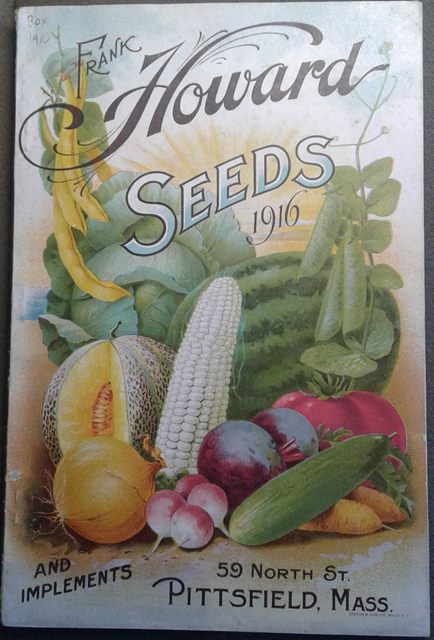
Image from Frank Howard’s annual spring catalog of reliable “seeds that grow”, tools and machinery (1916).
PAGE 348
13th. Worked 4 hours for Mr. James — clearing out buildings and doing carpentry work. Fine weather, tem. About 35-65; W.N.W. and S.E. Cut down some of my tobacco plants — brought it home and drying it out in the woodhouse. Also picked some of the seeds. I have 50 large plants — raised them on the James place. Played on the guitar 1 1/4 hours in eve.
14th. Went to Boston — on 9:15 A.M. tr. Paid the last instalment on the 5th Liberty Bond. (Victory Liberty Loan) Forenoon cloudy; W.W. rain all aft. W.S.E. bought some groceries at Cobb Bates store. Returned on Steamer “Betty Alden” to Pemberton, tr. to Nantasket Junction, then tr. to N. Scituate. Arr. 4 4 P.M. Light rain in eve. Saw the new U.S. Destroyers — “129” passed by her. Is large ship – 4 funnels. I gave the sparrows at Rowe’s Wharf some [bread] I give them some every time I go there. Played on the guitar 1 1/4 hours in eve.
15th. In forenoon did some work at home — washing and etc. In aft. Worked 3 hours for Mason Litchfield — mowing lawn and trimming grass around the house — 65. Cloudy. Very damp. Warm. W.S.W. tem. 72. Played on the guitar 1 1/2 hours in eve.
16th. In forenoon worked 2 ½ hours for Mr. James — carpentering. In aft. worked 3 hours for J.H. Vinal — in the store and loading and unloading goods — 90. Late in aft. cut down all my tobacco plants (50 large plants) and brought them home and put them in the woodhouse — tied them up in bundles. Got some lettuice [sic] in my garden — gave some to Mrs. Mary [blank space left for name] J.H. Vinal and Mrs. Bertha Bates (nee Holson). Very warm weather, W.S.W. tem. 76 cloudy, light rain at times in aft. Eve. cloudy, warm. Played on the guitar 1 1/2 hours in eve. Heavy thunder tempest at 10 P.M. W. of here. Rain here, 10:45 tempest passed close by here — thunder at same time. 11 P.M. raining. Tempest about done. Gave Mrs. [space left for name] E. James Jr. one of my tobacco plants to send to Seattle, Wash. 11:15 P.M. tempest has passed to the S. of here — steady rain here.
17th. In aft. picked apples 3 hours for Mrs. Eudora Bailey — picked […] on a very large R.I. […] tree (3 barrels) Light rain in morning. W.N.W. aft. and eve. clear. Played the guitar 1 1/2 hours in eve.
18th. Worked 7 hours for Mrs. Eudora Bailey — mowing and trimming the grass on W.S. and N. sides of the house — also the bank, and picking pears. Put 3 barrels of apples and 2 bus. of pears into the cellar, and housed 1 cord of wood. 10 hours in all — 1.50. Mrs. B. gave me some of the pears (Burr, Bosc) and apples, also a piece of brown bread. Mr. James paid me 1.00 for work I have done for him (I did not charge much for what I did.) Very fine weather, W.N.W. in forenoon — S.E. in aft. Fine eve. Played on the guitar 1 1/2 hours in eve.
19th. (Sun.) Fine weather. In aft. (2:45 P.M.) went to Egypt Beach and N. Scituate Beach via Hatherly Road — ret. via Surfside road — got some sea moss. Walked all the way. arr. Home at 6 P.M. eve. Very cool. W.N. hazy.
20th. Dug potatoes 6 hours for Mrs. Bertie Barnes (nee Clapp) — 1.50. Had dinner there. Very cool; par. clou. to clear — W.N.E. Eve. cold. Played on the guitar 1 1/4 hours in eve.
21st. Dug potatoes 6 1/2 hours for Mrs. Bertie Barnes — 1.50. Had dinner there. Par. clou. to clou. W.S.W. and S.E. arr. home at 2 P.M. began to rain about 7:15 P.M. Bought some milk at Mrs. Barnes’ — she gave me 2 qts. of buttermilk to take home. Played on the guitar 1 hour. 10 min. In eve. Rain all eve — light rain. Frost this A.M.
22d. Dug potatoes 6 hours for Mrs. Bertie Barnes — 1.50. Had dinner there. Fine weather — W.W. clear after 10:30 A.M. Eve. clear. Played on the guitar 1 1/4 hours in eve.
23d. Worked 6 hours for Mrs. Bertie Barnes (fin. diging [sic] the potatoes in forenoon and harvested the corn and stalks and house them in aft. — 1.50. I had dinner there. Her daughter Mrs. Dorothy Wilder there to-day.
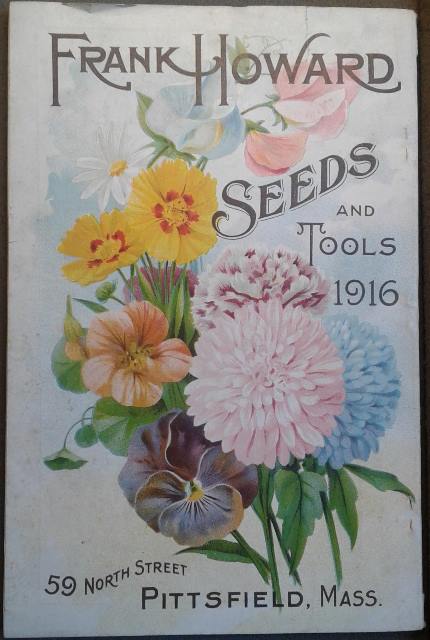
Image from Frank Howard’s annual spring catalog of reliable “seeds that grow”, tools and machinery (1916).
PAGE 349
Her two little granddaughters — Priscilla and [blank space left for name] with me most all the time — helping me. Mr. Israel is a cripple, and Mrs B. runs the farm. She sent me a pint of buttermilk in eve. Clou. to par clou. To-day; W.S. to S.E. damp eve. Cloudy. Raked and cocked up some hay for Mrs. M.G. Seaverns after dark — (15 min.) Played on the guitar 1 hour, 25 m. in eve. Met Mrs. Eva [blank space left for name] in Mrs. Seaverns’ store early in eve. She introduced me to her step-daughter, and invited me to call at their place at No. Scituate Beach.
24th. Cloudy; W.N.E.; tem. 50-55. In aft. went to Hingham — to Henrietta’s. Had dinner there — spent aft. There. Ret. on 5 P.M. tr. Saw Lottie (Mrs. Whiton) just as I was about to get aboard a car — she came from Boston on same tr. I came home on — she lives in Groton, opp. N London, Conn. and came on a visit to her mother’s (Henrietta.) Eve. cloudy, W.N.E. 10 P.M. Stars look very small — hazy — sign of storm. Played on the guitar 1 1/2 hours in eve.
25th. Went to Hingham Cen. Great auction at Henrietta’s — furniture, pictures, and many kinds of goods sold. I worked there at geting [sic] the things out of building and assisting in the auction. Ethel and I assorted [sic] the things, and I helped Arthur Whiting to move them. Had dinner and supper there. Lottie got the dinner and supper. Road about 1/2 way to Cohasset Sta. with James H. Merritt in auto-truck — had a load of vegetables, fruit, and etc. Then I walked nearly to N. Cohasset Sta. (3 miles) — then rode to Henrietta’s with Mrs. [blank space left for name] Hall in her auto. Mrs. Binney, her mother, and Mrs. [blank space left for name] Merritt with her. She invited me to ride back home with them but I went back on tr. from Hingham Sta. 7 P.M. tr. arr. N.S. 7:15 P.M. Par. clou. W.N.E. and S.E. good weather. Eve. clou. Played on the guitar 1 hour in eve.
26th. (Sun.) Warm weather, W.S.W. tem. 76. Late in aft. went to Egypt Beach — via Mann Hill. aft. clou. just as I arr. there it began to rain. Staid [sic] on the veranda of a house near the beach. At 3:45 P.M. started for home — arr. 4:30 P.M. walked 3 m. in 45 min. Eve. cloudy. Warm. Light rain at times.
27th. Went to Hungham (9:12 A.M. tr.) Walked to Hingham Cen. and helped at the Auction — assistant to the auctioneer (Chauncy O. Davis, Hanover Cen., Mass. Tel — Hanover — 79-5). Ethel and I selected the things and I carried them to the auctioneer’s stand (near there) and Arthur Whiting placed them where people could see them. Auction began at 12:33 P.M. and finished at 6 P.M. Everything in all the buildings were sold. Arthur Whiting lives in West Hanover, Mass. Ethel H. Studley administrator of the estate. Had dinner and supper at Henrietta’s and staid all night. Arthur W. and I carried some furniture back into the large barn — for Mr. O. Smith, and he gave us each 50cts. Clou. A.M. fine weather after 11 A.M. Ethel played on her new piano in eve. Clou. W.E. in eve. Rain late in night.
28th. Staid at Henrietta’s. Helped Mr. Smith get his furniture out of the building (about 1 hour). He paid me 50cts. Did some chores on the place. Lottie went home this forenoon. Frank went to Scituate in eve. in his auto: to bring his mother home. Ellen came to Hingham with them — for a visit. I staid all night. Ethel played on the piano over an hour in eve. Very warm weather — W.S.W. […] temp. 82. About 5:30 P.M. par. Clou. — wind changed to N.W. very windy. Very cool in a few […] cold and windy all night. Henrietta and I danced the Mazurka — Ethel played it on piano.
PAGE 350
29th. Staid at Henrietta’s until 1 P.M. Did some chores. Had dinner there. Mrs. Keenan worked there to-day. Ethel gave me $5.00 for assisting at the auction — and Mr. Smith gave me 1.00 for work I did for him. Made $6.00 in all. Henrietta gave me some pieces of cooked meat to bring home. Came back on the 1:50 P.M. tr. Saw Ellery F. Hyland near Hingham Sta. One of the tires on his auto-truck was punctured — I loaned him $8.50 to get it repaired. Late in aft. Chopped old board and planks 1 1/2 hours for Mrs. M.G. Seaverns — 30. Very cool day and eve. Played on the guitar 1 1/4 hours in eve.
30th. In forenoon swept and cleaned the Bates & Wilder Store for J.H. Vinal — has been using it to store goods in — is done with it now — lease expired. He gave me all the wood and boxes, a table, 2 flour bags (cloth) and a broom for cleaning the store — and brought them here in his grocery wagon. In aft. Worked 1 2/3 hours for Herbert Bates 45.– transplanting grape vines (4) also transplanted a rambler rose bush for Mrs. Mary Wilder (his sister) they live in a house close to the river — I got the water (to water the vines) from the river — then I transplanted 3 grape vines for Russell Wilder — 1 hour — 30. Then I picked up a small load of kindling wood — where the laundry building (close to my house) was torn down and J.H. Vinal and I carried it to his place and put it in his cellar. 1 hour — 25. Was dark then — then I got some of the wood for my use and put it in the house. Played on the guitar 1 1/2 hours in eve. Cloudy; W.E. to S.E. damp. Eve. clou.
31st. Picked wood out of the pile of rubbish where the old Chinese laundry was torn down. Also got some junk. Rain nearly all forenoon. W.S.W. clou. aft. and eve. W.E. Played on the guitar 1 1/2 hours in eve. Have worked 7 hours in all where the laundry building stood.
*Please note that the diary transcription is a rough-and-ready version, not an authoritative transcript. Researchers wishing to use the diary in the course of their own work should verify the version found here with the manuscript original. The catalog record for the George Hyland’s diary may be found here. Hyland’s diary came to us as part of a collection of records related to Hingham, Massachusetts, the catalog record for this larger collection may be found here.
by Peter Olsen-Harbich, Ph.D. Candidate, Lyon G. Tyler Department of History, William & Mary and NERFC Fellow
Among the austere manuscripts of the Massachusetts Historical Society’s collection resides an unassuming assemblage. Weighing in at precisely ten boxes, it bears a substantive though middling rank in the vast archival stock of America. An additional marker of ordinary quality concludes the title of the collection: “Transcripts.” These are thus ten boxes of derivative, copied papers—primary documents by proxy only. Yet a full examination of the collection title suggests a content that is anything but mundane, for these are the “Winthrop Family Papers [Transcripts],” also known as Ms. N-2211, a trove of transcribed, unpublished correspondence from the family whose various progeny presided at the very center of seventeenth-century New England’s political orbit.
As I began my research fellowship at the Society, I fully intended to spend my time entirely with original documents, as I felt any proper historian in an archive should. But in surveying the Society’s catalog in search of 17th-century materials on New England’s diplomacy with indigenous nations, it was obvious that dedicating myself to this collection of copies was in fact the most necessary task. The original manuscripts, fully transcribed but never completely published by the Society over its centuries of documentary editing, are almost certainly the largest collection of unprinted personal papers before 1700 in the American archive. The contents of the collection are too numerous to mention, though they generally survey the frontier period of the Connecticut Colony and this epoch’s concomitant conditions of extensive relations with indigenous peoples, agricultural and industrial establishment, and the disordered medical condition of settler populations. Ms.N-2211, then, though modest and unremarkable at first glance, is nothing less than the invaluable treasure of the most significant archival project in early American history.
Much of the Winthrop papers has already been published. Six volumes of records from this collection, inclusive of those documents dated from 1498-1654, were printed by the Society in the twentieth-century in two distinct editorial phrases. The first occurred between 1929 and 1947 and published all the Winthrop family papers dated between 1498 and 1649 in five volumes. It appears that an effort to complete publication of the papers was resumed in the 1960s and ran into the late 1980s, during which time the entire collection was transcribed and partially annotated. These transcriptions were the tireless and diligent work of Dr. Majorie Frye Gutheim, whom former MHS Director of Research Conrad Wright recalls clacking on a typewriter in the Society’s stacks deep into the evenings of his early professional years. One additional volume was produced by this effort in 1992, extending the publication’s chronology through 1654. But Dr. Gutheim’s efforts were far vaster than this single volume: she had transcribed the entire collection, with documents spanning 1655-1741 (bulk pre-1700) across the decades of work. As the publication project faded from active endeavor into a Society legacy, the transcripts remained: ten boxes worth of near-perfect paleographic detours around cribbed 17th-century hand.
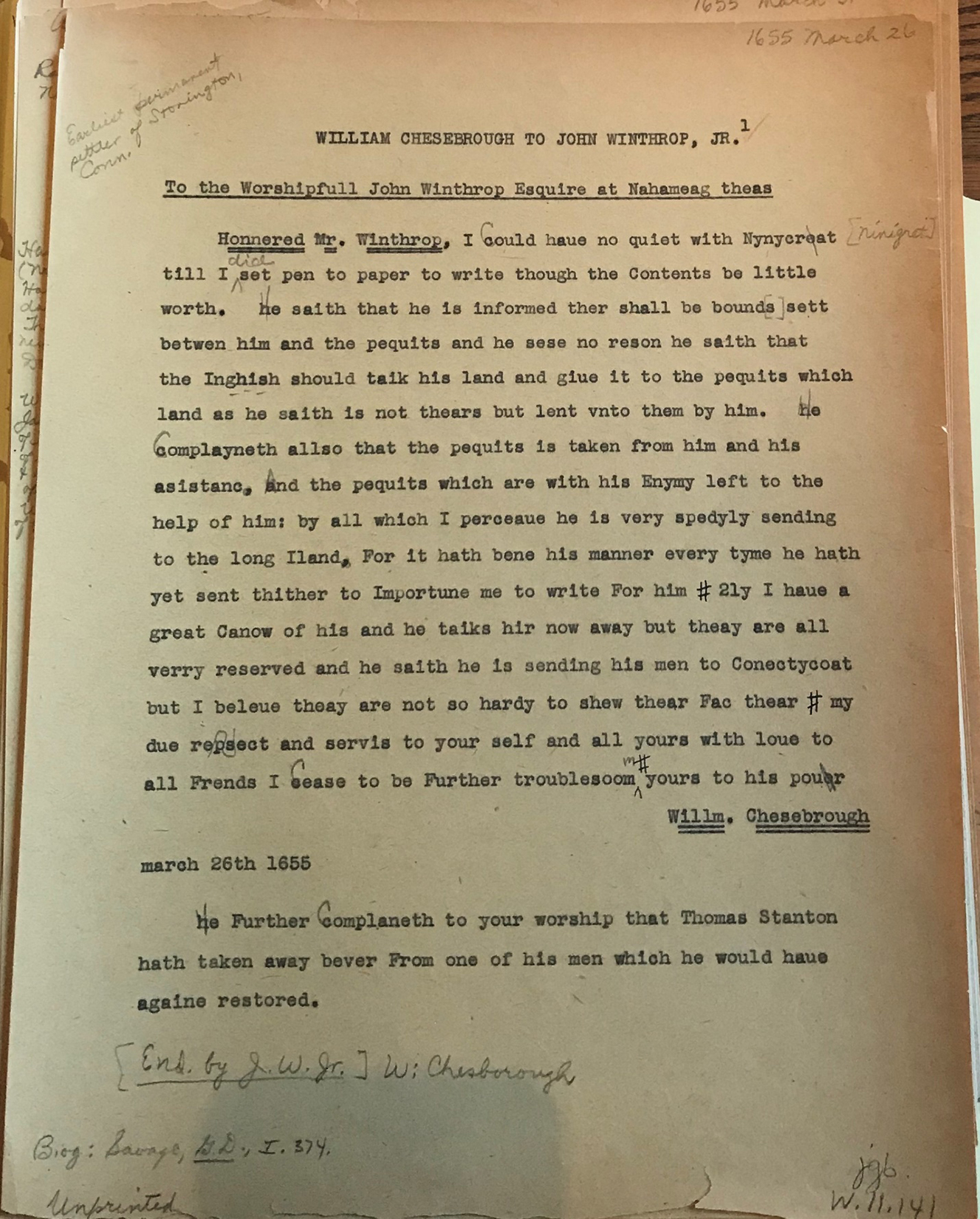
Majorie Frye Gutheim Transcription of William Chesebrough [sic] to John Winthrop, Jr., 26 March 1656. Massachusetts Historical Society, Winthrop Family Paper Transcripts, Ms. N-2211. Original Ms. in Winthrop Family Papers Microfilm, P-350, Reel 5.Dr. Gutheim’s transcriptions make the 17th century accessible to the professional researcher and the curious Bostonian alike. For the likes of the former, the transcripts are an indispensable tool for expediting general scans of the collection’s contents, and for identifying documents of particular significance to one’s project. When scholars wish to verify the content of the transcriptions against the original manuscripts (though, I can assure, they will find this effort generates little), they remain at the Society, and microfilm of them is easily accessible at the Library of Congress and a variety of American universities. In about four weeks’ time, I was able to read the majority of the transcripts and verify the quotations I deemed relevant against the originals, undoubtedly saving months of laborious peering at the originals. For the likes of casual readers, the transcripts offer an unparalleled opportunity for casual access to the cutting edge of unpublished historical knowledge. It is fair, in other words, to say that Ms. N-2211 punches far above its weight. The Winthrop Papers remain exciting and accessible grounds for the excavation of new revelations on early American history.
Here is a look at what is going on at the MHS this week:
On Wednesday, 2 October, at 12:00 PM:Autonomous & Independent: Native Activists & the Rejection of U.S. Citizenship, 1906-1924 with Lila Teeters, University of New Hampshire. In the early 20th century, U.S. Congressmen attempted to make every Native within the territorial boundaries of the United States a citizen. Native activists, many committed to cultural integrity and the maintenance of tribal sovereignty, thwarted Congressional efforts for almost two decades. This talk follows the Native individuals and nations who led the protest against U.S. citizenship and analyzes how their fights shaped citizenship policies at large. This is part of our brown-bag lunch program.Brown-bags are free and open to the public.
On Wednesday, 2 October, at 6:00 PM:Housing as History: Columbia Point & Commonwealth with Lawrence Vale, Ford Professor of Urban Design and Planning, MIT; Jane Roessner, author; Charlie Titus, UMass Boston. In 1979, after touring public housing sites with deplorable conditions, Massachusetts Superior Court Judge Paul Garrity ordered the Boston Housing Authority into receivership. Lewis H. (Harry) Spence was appointed as receiver. As Spence oversaw a massive redevelopment of the fourth largest housing authority in America, two very different housing models emerged: Columbia Point in Dorchester and Commonwealth in Brighton. Columbia Point was the largest public housing complex in New England and had once been a source of pride. However, a quarter century after it opened, it stood neglected, isolated, and mostly vacant. When it was redeveloped into the new community of Harbor Point, less than one-third of the resultant apartments were targeted to public housing residents. By contrast, Commonwealth remained 100% public housing. Nearly two-thirds of its original residents, many of whom had been deeply involved in the site’s redevelopment, were able to return to the site. This conversation will explore these outcomes, situating these redevelopments in the overall history of the Boston Housing Authority. This program is made possible by the generosity of Mass Humanities and the Joint Center for Housing Studies at Harvard University. A pre-talk reception begins at 5:30 PM; the speaking program begins at 6:00 PM. Please note: those registered for the program after 28 September may be asked to sit in our overflow room with a live video feed.
On Thursday, 3 October, from 5:30 PM to 7:30 PM:Fenway Connections Opening Reception. This temporary exhibition will celebrate the history and evolution of Fenway Studios by shining a light on contemporary work produced by current members alongside rarely shown paintings from the MHS collection created by past Fenway Studios artists. The opening reception is free and open to the public.
On Saturday, 5 October, from 9:30 AM to 12:00 PM:Student Research Open House at the MHS. Working on a National History Day or other historical research project? Want to learn what it’s like to get your hands on primary sources? Discover the incredible primary sources at your fingertips in the MHS collections, and learn how to get the most out of researching in the archive! Open to students in grades 6-12 and teachers.
Abigail Adams: Life & Legacy Pop-Up Display Abigail Adams urged her husband to “Remember the Ladies” and made herself impossible to forget. But Abigail is memorable for more than her famous 1776 admonition. This final Remember Abigail display uses documents and artifacts through the ages to consider the way Abigail viewed her own legacy and to explore how and why we continue to Remember Abigail. Join us for gallery talks on 25 October and 22 November at 2:00 PM.
Fenway Connections, an exhibition by the MHS and the Fenway Studios, opens on 3 October
The Fenway Studios is the only purpose-built structure in the United States designed to provide work and living space for artists that is still used for its original intent. It was modeled after 19th-century Parisian atelier studios but took the additional step of encouraging studio-design suggestions from the founding artists. This temporary exhibition will celebrate the history and evolution of Fenway Studios by shining a light on contemporary work produced by current members alongside rarely shown paintings from the MHS collection created by past Fenway Studios artists.
Today I want to share some letters that were written in a place close to my heart: my hometown! They were written by Capt. John Binney while he served as the commander at Fort Edgecomb (in Edgecomb, Maine) in the lead up-to the War of 1812. The fort was built in 1808-1809 to protect the port of Wiscasset, then a busy shipbuilding center. Binney, originally from Boston, lived in the neighboring town of Wiscasset while the fort was under his command and he frequently wrote to his brother, Amos Binney, while he was stationed there. John’s letters to Amos can be found in both the Binney Family Papers and the Henry P. Binney Family Papers at the MHS.
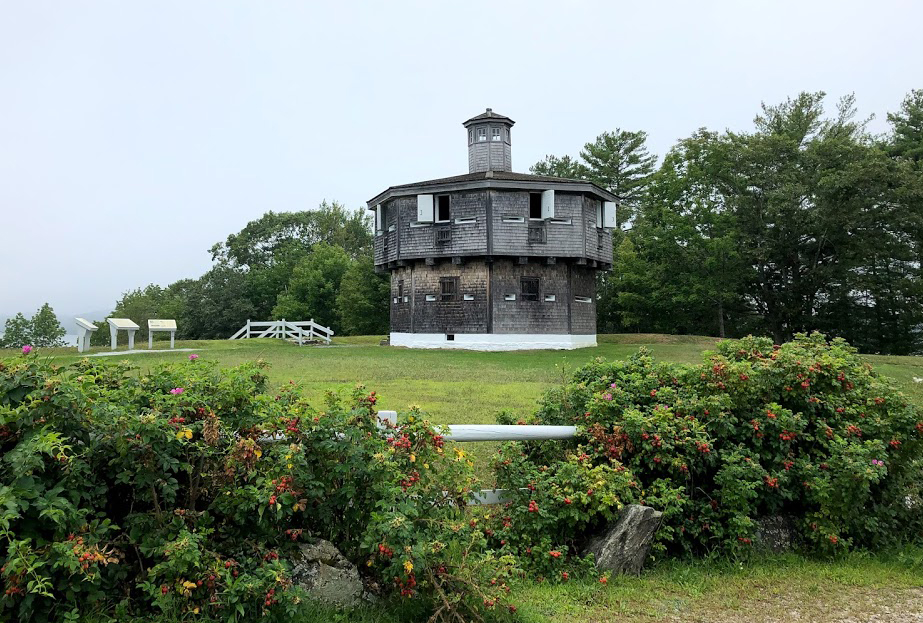
Fort Edgecomb in September 2019, photo by Hannah Elder
John Binney served as the captain of the 4th Regiment, U.S. Infantry at Fort Edgecomb from 1809 to 1813. When he arrived, he was not impressed with the men in his regiment or with the people of Wiscasset. Upon his first inspection of his men, he wrote to Amos:
27 fine hearty young men immediately appeared on parade but as dirty, pybald, ragged and as gawky as you please. Ten thousand harlequins – Twenty thousand Rainbows, or thirty thousand ribbons shop would not have displayed half the variety of colors as their dress did
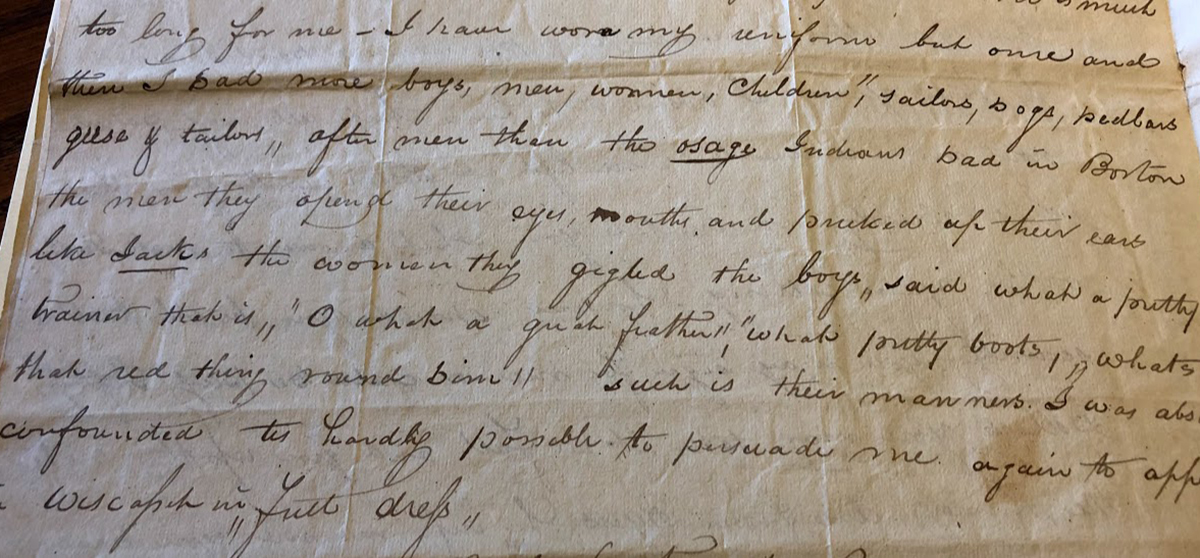
The differences between this Boston army captain and the people in the rural shipping port became very apparent to John the first time he wore his full dress uniform in town. He was “absolutely astounded” by the reactions of the townspeople, who gawked at his “pretty boots,” feather, and sword.
John’s description of the reactions to his dress uniform
He spent much of his first years in Wiscasset equipping his men and the fort. Many of John’s letters to Amos included instructions on what to send to Wiscasset, how to manage his Boston household on his behalf, and discussions of his business.
When war was declared in June of 1812, John was informed by letter. On June 27, he wrote to Amos:
I received an express on the 23rd at 5PM with notice of the Declaration of War. I immediately sent express to Georgetown, Damariscotta and Ft. George and in half an hour was ready to commence action, El W Ripley commands from Saco to Passamaquoddy Bays. Your department I expect will open the Ball and all must regret that more frigates was not built we shall feel the want of them – I have but 56 effectives at 5 forts from Castine to Kennebeck [sic] that more troops are necessary is ready seen. The militia will be called to our aid or should be – I have made the best display possible with my small force – amwellarmed and have powder and ball, but not enough should a ship of war attempt either of the Posts under my command the result is not doubtful. is should have to contend against fearful odds, six heavy guns is the most at either of my posts. A frigate would bring more than twenty to bear on my works – and then from a destruction I should least annoy, however I shall do all that can be expected with the force at the posts.
In the first few months of the war, John was concerned about the number of men at his command, sure that they would not be able to properly defend the towns under his protection. In August of 1812, he wrote:
It is a fact and I shudder when I think a Privateer with 100 men could destroy every port from Eastport to Portsmouth and Castine. I have 8 men at St George 8 men at Damariscotta 8 at Kennebeck [sic] 12 at this Post. 24 effectives – what could we do with this small force – little or nothing not one of the Ports being defensible on the land side – a small force in our rear would defeat or slaughter the whole with a few discharges of grape. And there is nothing prevent an Enemy from landing on the back of us – thus you see my means with more than 100 miles of coast under my command requiring 500 men at least to make a respectable defence but I shall endeavor to do my duty.
In September, though, he received orders to call new men to service. He told Amos:
I have this day been directed by Colo Boyd to call into immediate service at the Port and vicinity a volunteer company of Infantry under Capt. Daw Rose 84 strong – this will be quite an addition to my Garrison and if they prove good I shall feel much more at ease than I have for months past with 5 ports and sixty men
Luckily for John and his few men, Fort Edgecomb was never attacked during the war.
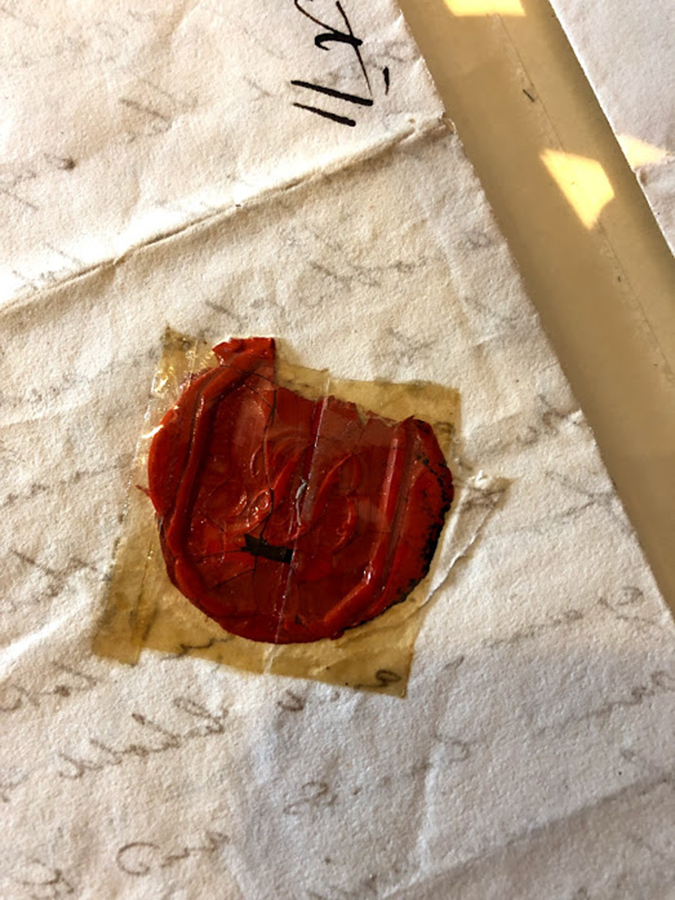
Capt. John Binney’s wax seal
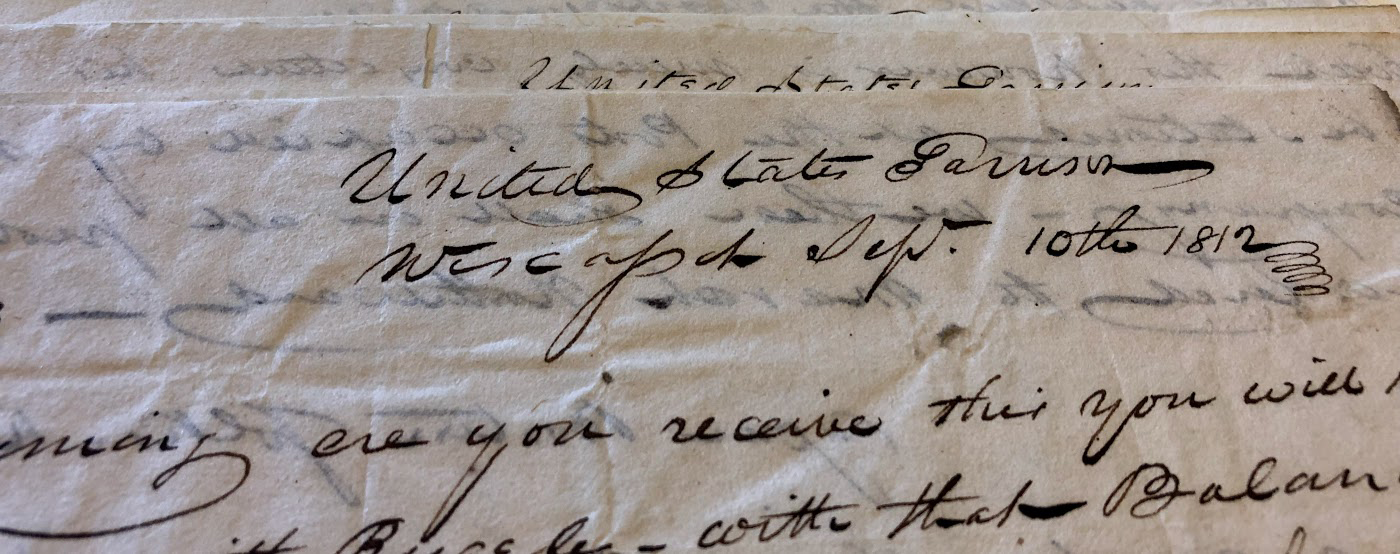
I really enjoyed getting to see what life was like in my hometown more than two hundred years ago, but more than that, I enjoyed getting to know John Binney. John was a diligent correspondent, always confirming that he had received Amos’s letters and passing along affection to his brother and the rest of his family. He had a quick wit and provided vivid descriptions of the people he met (one fellow who did not impress John was once described as “the most awkward styled two-legged unfeathered animal you ever saw”). I especially enjoyed the variation in the flourishes in John’s handwriting – it seems that when he was in a good mood, the flourishes were much more plentiful, like the one seen here:
Sample of John Binney’s handwriting
If you would like to get to know the Binney family for yourself, or any one of the many fascinating people from our collections please consider visiting the library!
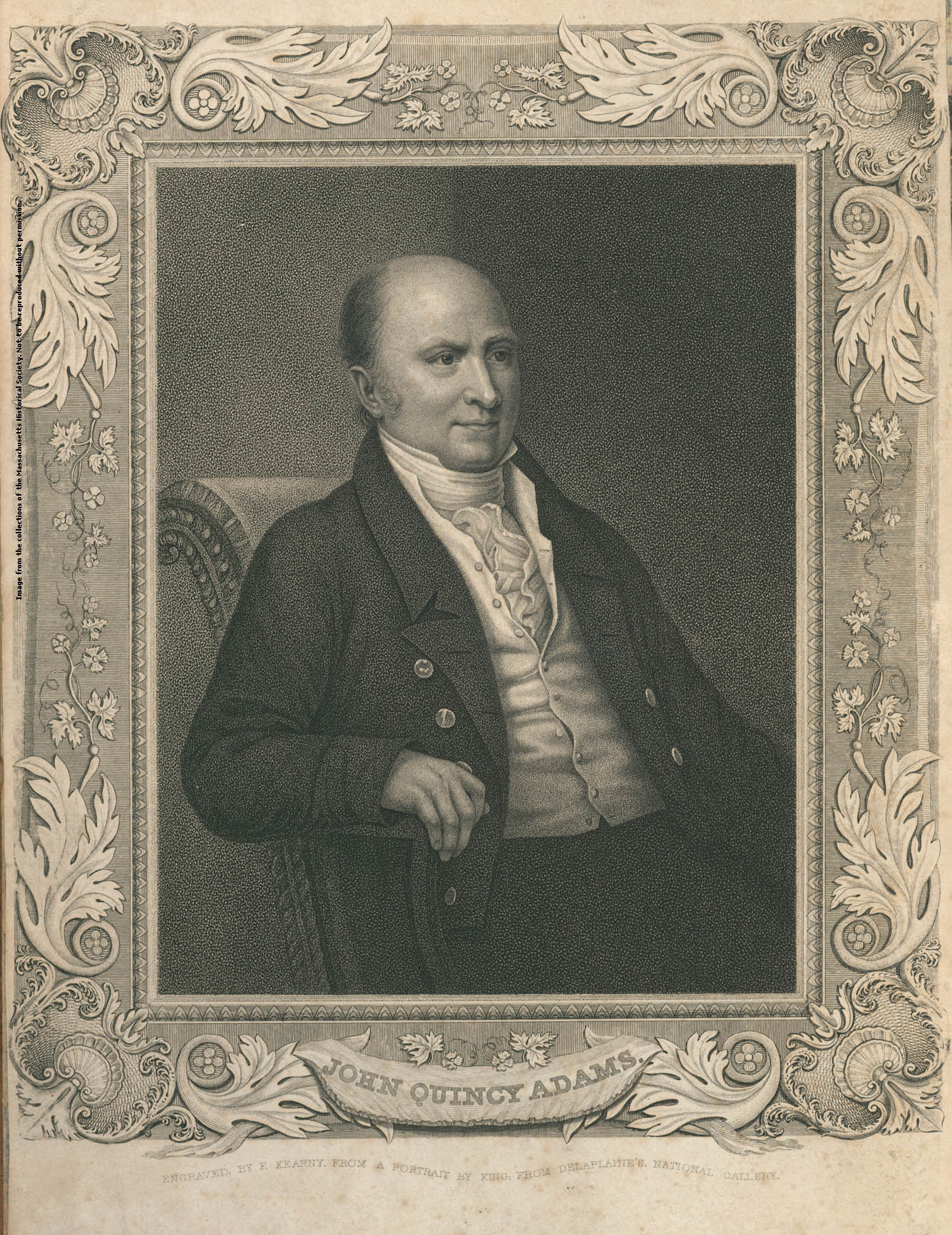
On 4 March 1825, 57-year-old John Quincy Adams believed he had reached the apex of his political career when he was inaugurated the sixth president of the United States. “I entered upon this day with a supplication to Heaven, first for my Country; secondly for myself, and for those connected with my good name and fortunes, that the last results of its events may be auspicious and blessed.” However, Adams found the four years of his administration among the most challenging of his life. This month the Adams Papers editorial project added verified transcriptions of Adams’s diary entries for the period March 1825 to December 1829 as part of its John Quincy Adams Digital Diary. The entries chronicle his time in the White House, the 1828 presidential election, and Adams’s uneasy retirement from office, during which the former president worried he was “losing day after day without atchieving any thing.”
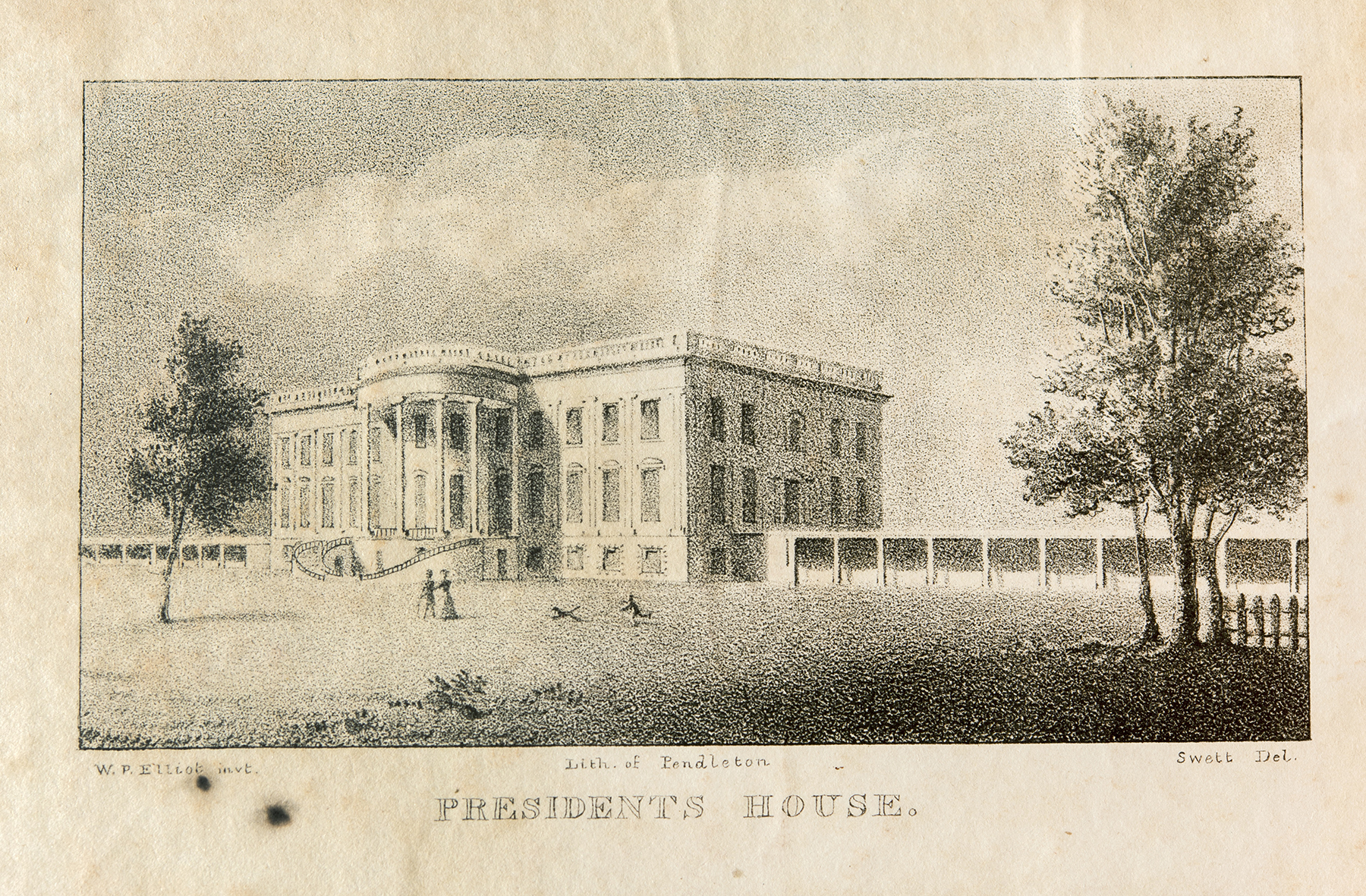
Lithograph of White House affixed inside front cover of John Quincy Adams’s Diary 37
As president, Adams’s agenda encompassed an ambitious strategy of reforms for American society, including internal improvements, a national university, and a department of the interior, many of which he outlined in his first State of the Union address in December 1825. From the start of his presidency, John Quincy dealt with the repercussions of the 1824 election, which Andrew Jackson and his supporters believed Adams had unfairly won by making a “corrupt bargain” with Henry Clay to secure the executive. By the 1826 mid-term elections, the Jacksonians assumed the majority in the House of Representatives and used their power in Congress to thwart Adams’s plans. The 1828 presidential campaign also began almost as soon as Adams took office in 1824, and with Adams and Jackson as the main opponents, it became one of the most fiercely contested political campaigns in American history.
Engraving of John Quincy Adams by Francis Kearney, circa 1824
John Quincy Adams’s private life was also difficult during these years. His wife, Louisa Catherine Adams, continued to have bouts of ill health throughout his presidency, and he grieved the loss of two close family members: his father, John Adams, died in 1826, and his eldest son, George Washington Adams, died in 1829. Upon learning of John Adams’s death, John Quincy recorded in his diary: “My father had nearly closed the ninety-first year of his life: A life illustrious in the Annals of his Country, and of the World— He had served to great and useful purpose his Nation, his Age, and his God— He is gone, and may the blessing of Almighty Grace have attended him to his Account.” As in previous years, John Quincy’s diary recounts his outlets from the pressures of his myriad public duties by continuing his exercise regimen of swimming and walking and spending time in the White House gardens.
For an overview of John Quincy Adams’s life during these years, read the headnote for the presidential period or navigate to the entries to begin reading the diary.
The John Quincy Adams Digital Diary is a born-digital edition that will pair a verified and searchable transcription of Adams’s diary with the manuscript images of the diary pages. The diplomat and statesman kept a journal for more than 68 years, starting in 1779 at the age of 12, and continuing until just before his death at age 80 in 1848. In all, his diary spans 51 volumes and comprises 15,000 manuscript pages. More than 3,200 pages are now available online through the generous support of the Amelia Peabody Charitable Fund, Harvard University Press, and private donors. To find out how you can get involved, visit the Digital Diary website.
There is a lot going on at the MHS this week. Here is a look:
On Tuesday, 24 September, at 5:15 PM:Fifty Shades of Green: Sexing Economics with Bethany Moreton, Dartmouth College, and comment by Nancy Cott, Harvard University. From the Full Gospel Businessmen’s Fellowship to the Chicago School, thinkers on the Right have vigorously theorized the foundational connections between sexual and economic ideologies, even while self-identified partisans of labor democracy scold radicals for “trying to persuade people on the left that gay issues, black issues, feminist issues and so on are all really about capitalism.” What happens when we consider economic “science” as a chapter in the history of sexuality? This is part of the Boston Seminar on Modern American Society and Culture series. Seminars are free and open to the public.
On Wednesday, 25 September, at 12:00 PM:Suffragists of Scituate with Lyle Nyberg, Scituate Historical Society. A hundred years ago, several nationally prominent suffragists spent summers in Scituate, which had become a popular seaside destination. They included Inez Haynes Irwin, who wrote the history of the National Woman’s Party, and Judith Winsor Smith, who wrote for the Woman’s Journal and gave public speeches into her 90s promoting a woman’s right to vote. This talk examines their little-known stories and unique relationship to Scituate. This is part of the Brown-bag lunch program. Brown-bags are free and open to the public.
On Wednesday, 25 September, at 6:00 PM:The Arts & Crafts Houses of Massachusetts: A Style Rediscovered with Heli Meltsner, Cambridge Historical Society. At the opening of the twentieth century, Massachusetts architects struggled to create an authentic new look that would reflect their clients’ increasingly informal way of life. Inspired by the Arts and Crafts Movement in England, the result was a charming style that proved especially appropriate for the rapidly expanding suburbs and vacation houses in the states. Through meticulous research, Heli Meltsner brings this distinctly New England architectural style the attention it deserves. A pre-talk reception begins at 5:30 PM; the speaking program begins at 6:00 PM. There is a $10 per person fee (no charge for MHS Fellows and Members or EBT cardholders).
On Thursday, 26 September, at 5:15 PM:Toward the Sistercentennial: New Light on Women’s Participation in the American Revolution with Woody Holton, University of South Carolina, and comment by Mary Bilder, Boston College Law. This essay offers new insight on some of the iconic stories of women’s involvement in the American Revolution. For example, it documents disputes among the Patriot boycotters of 1769 and 1770 (male vs. female, enslaved vs. free, and northern vs. southern) and describes the male-on-male conflicts that led to and resulted from Esther Reed’s famous Ladies Association of 1780. This is part of the Pauline Maier Early American History Seminar series. Seminars are free and open to the public.
On Saturday, 28 September, at 2:00 PM:Primary Sources for Fashion & Costume History Research with Kimberly Alexander, University of New Hampshire, and Sara Georgini, MHS. Antique textiles, images of historical figures, and material culture hold a wealth of information that can enrich personal stories, explain relationships, and contextualize the world that people occupied. However, these sources can seem daunting to explore. Two experts on fashion and material culture will guide you through unraveling the stories woven into history’s fabric. This workshop is part of our Remember Abigail programming.
Abigail Adams: Life & Legacy Pop-Up Display begins on 27 September Abigail Adams urged her husband to “Remember the Ladies” and made herself impossible to forget. But Abigail is memorable for more than her famous 1776 admonition. This final Remember Abigail display uses documents and artifacts through the ages to consider the way Abigail viewed her own legacy and to explore how and why we continue to Remember Abigail. Join us for gallery talks on 25 October and 22 November at 2:00 PM.
Fenway Connections, an exhibition by the MHS and the Fenway Studios, opens on 3 October
The Fenway Studios is the only purpose-built structure in the United States designed to provide work and living space for artists that is still used for its original intent. It was modeled after 19th-century Parisian atelier studios but took the additional step of encouraging studio-design suggestions from the founding artists. This temporary exhibition will celebrate the history and evolution of Fenway Studios by shining a light on contemporary work produced by current members alongside rarely shown paintings from the MHS collection created by past Fenway Studios artists. An opening reception will take place on 3 October at 5:30 PM. It is free and open to the public.
Thanks to the support of the Richard Saltonstall Charitable Foundation, this summer the Center for the Teaching of History offered four workshops for teachers that used four essential themes to explore the intersection between history, memory and legacy: equality in education, immigration, post-Civil War Reconstruction, and LGBTQ+ rights. Each of these topics allowed Center staff and participants to ground contemporary debates in their historical foundations and provided teachers with suggestions for fostering civic dialogue among their students. As well, the workshops offered tools to teacher participants for supporting the new 2018 Massachusetts History and Social Science Curriculum Framework (adopted and required by the Board of Elementary and Secondary Education in 2018), particularly with an increased focus on civic education across all grade levels.
We were very pleased to have the opportunity to work with several of our partner institutions across Boston, including the Museum of African American History, the Boston Public Schools History and Social Sciences Department, History UnErased, Northeastern University’s Special Collections, GLAD, Facing History and Ourselves, and the International Institute of New England, as well as numerous scholars and experts.
After each of our programs, educators provided constructive feedback on the structure and content of our programs, while also expressing a need for more professional development resources tailored for history and social science educators. In fact, according to a 2018 survey, 75% of Massachusetts teachers report that they do not have professional development resources available to them. Teachers appreciate being treated like knowledgeable professionals, and many noted on their evaluation forms that they felt valued at the MHS, not just as educators but as history professionals. Teachers expressed an appreciation for teaching resources that help them approach challenging class topics that relate to current events and present issues. They also specifically referenced the helpfulness of class materials and workshops that focused on minority voices, diverse histories, and that connected to civics and democracy—all priorities in the new 2018 MA History and Social Science Curriculum Framework. A number of teachers from these workshops reported that they are using workshop resources to develop new fall curriculum that better incorporates these elements into their teaching.