This Week @ MHS

By

– Wednesday, 25 July, 12:00PM : “The End of War: The Wabanaki Struggle with New England, 1722-1727” is a Brown Bag talk with Ian Saxine of Alfred University. This talk examines the Anglo-Wabanaki War of 1722-1727 in the American Northeast. It situates the conflict as the final resolution of a half-century of imperial crisis in the region. The talk argues the limits of indigenous, colonial, and imperial power influenced the war’s outbreak, the fighting, and its resolution.

This talk is free and open to the public.

– Wednesday, 25 July, 6:00PM : On November 23, 1849, in the heart of Boston, one of the city’s richest men, Dr. George Parkman, vanished. What resulted was a baffling case of red herrings, grave robbery, and dismemberment on the grounds of Harvard Medical School. The Commonwealth of Massachusetts v. John White Webster pioneered the use of medical forensics and the meaning of reasonable doubt. In “Bloody & Ivy: The 1849 Murder That Scandalized Harvard,” Paul Collins of Portland State University brings 19th-century Boston back to life in vivid detail, weaving together accounts of one of America’s greatest murder mysteries.

This talk is open to the public, registration required with a fee of $10 (no charge for MHS Fellows and Members or EBT cardholders). Pre-talk reception begins at 5:30PM, followed by the speaking program at 6:00PM.

– Thursday, 26 July : The teacher workshop “Immigration Policy in American History” has been POSTPONED. Please check back for further information about rescheduling.

– Friday, 27 July, 12:00PM : The second Brown Bag talk this week is with Katherine McIntyre of Columbia University. “Maroon Ecologies: Albery Allson Whitman and the Place of Poetry” follows the intertwining of race and ecology in Albery Allson Whitman’s 1884 The Rape of Florida through an analysis of colonial cartographic practices. Using maps to examine the cartographic representation of swamps and other wetlands that permeate the boundary between land and water, this talk opens questions about the porous ecologies of maroon communities and the poetics that follow from such ecologies.

This talk is free and open to the public.

– Saturday, 28 July, 10:00AM : The History and Collections of the MHS tour is a 90-minute docent-led walk through our public rooms. The tour is free, open to the public, with no need for reservations. If you would like to bring a larger party (8 or more), please contact Curator of Art Anne Bentley at 617-646-0508 or abentley@masshist.org.

While you’re here you will also have the opportunity to view our current exhibition: Entrepreneurship & Classical Design in Boston’s South End: The Furniture of Isaac Vose & Thomas Seymour, 1815 to 1825.
The Battle of the Barges

By Peter Drummey, Librarian

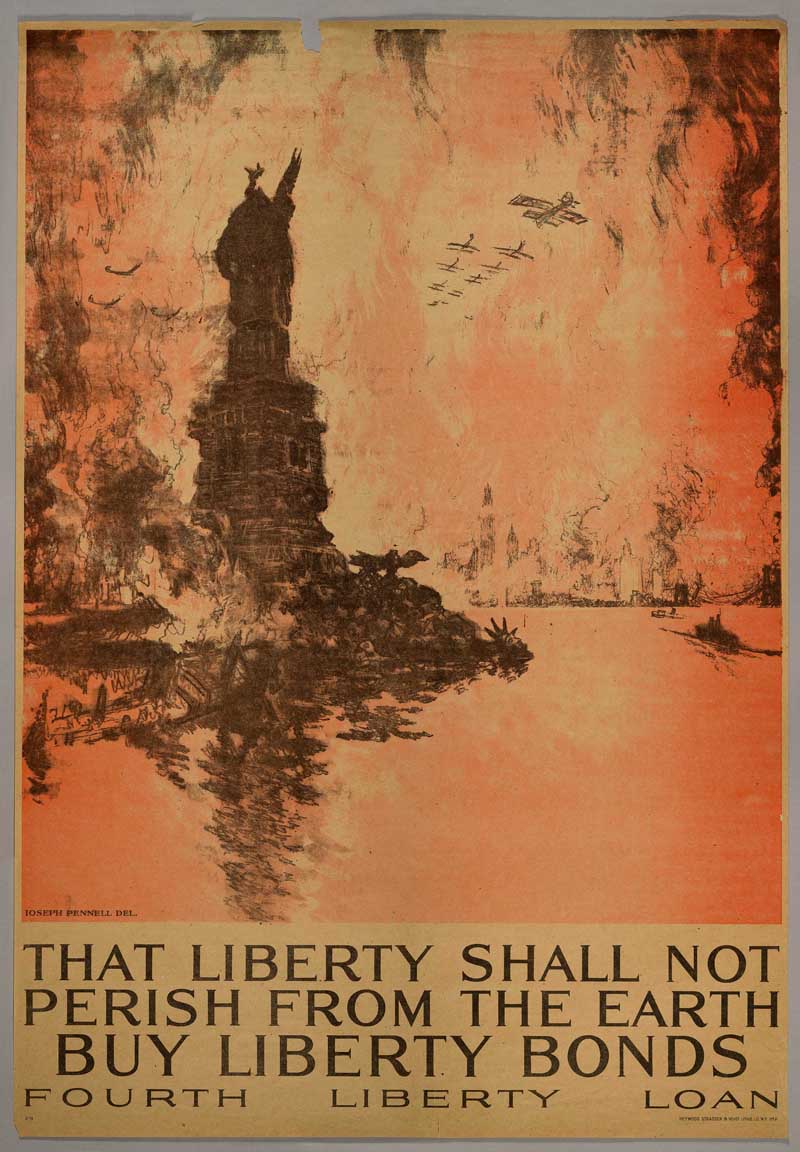
Joseph Pennell originally titled his dramatic depiction of war-ravaged New York City, a poster he created during World War I for a patriotic loan drive, “Buy Liberty Bonds or You Will See This.” In 1918, the idea of New York under aerial bombardment and in flames would have seemed to be a fantasy, but Pennell’s lithograph contained one element that reflected actual events a century ago. In the poster, just to the right of the decapitated head of the Statue of Liberty, the sinister shape of a German submarine glides through New York Harbor. In the summer of 1918, “U-Kreuzers,” German long-range submarines, patrolled off the coast of Long Island where, at night, crewmembers could see light cast by the “Great White Way” of Manhattan on the horizon. The threat of enemy attack had come to North American waters and would soon arrive off the shores of Cape Cod.

July 21, 2018, marks the 100th anniversary of the only attack on American soil—although probably inadvertent—during the First World War. On that summer Sunday morning, 21 July 1918, while shooting at the tugboat Perth Amboy and its towline of four large barges off Nauset Beach in Orleans, on Cape Cod, Massachusetts, the German submarine U-156 fired shells that passed over their intended targets and landed on the beach. Town residents and vacationers, attracted by the rumble of artillery fire, gathered to watch the “Battle of the Barges,” also known as the “Battle of Nauset Beach.”

Dr. Joshua Danforth Taylor of East Boston, a loyal subscriber to the Boston Globe, telephoned the Globe newsroom from his vacation cottage overlooking the scene to give the editors and reporters, in real time, a blow-by-blow (shell-by-shell?) account of the one-sided “battle.” Almost miraculously, although some of the barge captains were accompanied on their ships by wives and children, there were only two serious injuries, both to members of the Perth Amboy’s crew. The casualties, John Bogovich and John Zitz, turned out to be immigrants from the Austro-Hungarian Empire, then at war with the United States, so Bogovich and Zitz—although badly wounded—fell under suspicion of playing some sort of nefarious role in the attack.


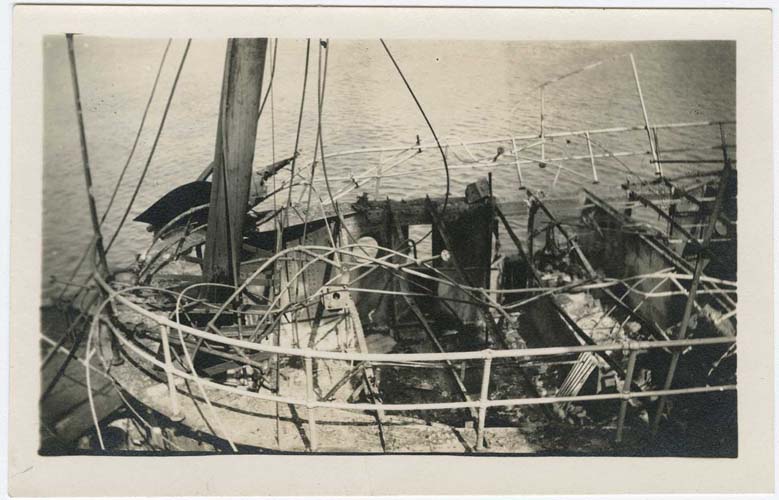
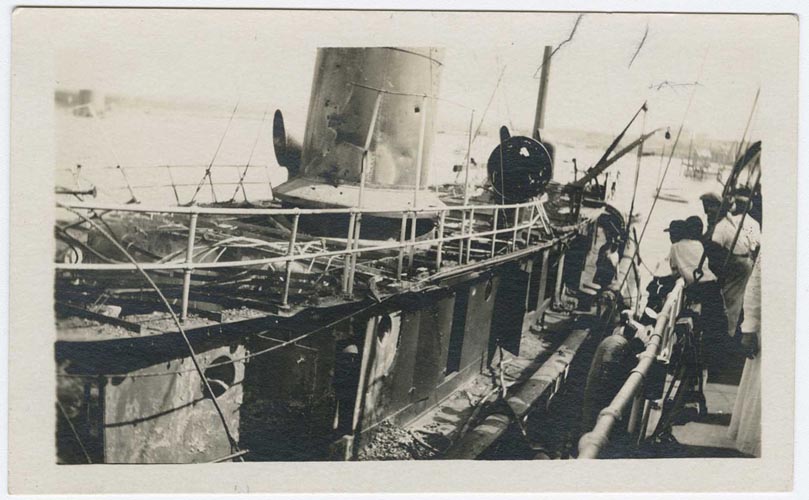
As shown in the accompanying photographs (deck of tug / side of tug) , the Perth Amboy was badly damaged by shell fire and abandoned by its crew, but it survived the attack. The four barges were all sunk. Prompt action by the Coast Guard and local fishermen saved the barges’ crews, families, and even a ship’s dog named Rex. Jack Ainsleigh, a young son of the master of the sail barge Lansford, became an instant celebrity when he waved the American flag as his family abandoned ship and threatened to return the 150 mm cannon fire from the U-156 with his .22 caliber rifle.

The U-156 disappeared with all hands in September 1918 during its voyage home to Germany, probably sunk by a British or American mine in the North Sea, so some of its operations are conjectural or based on intercepted radio messages, but its presence off Nauset Beach probably had more to do with an attempt to cut the transatlantic telegraph cable to France that came ashore in Orleans than to sink empty coal barges and scare/thrill the local population. If cable cutting was the U-156’s mission that day, it failed, but the U-Kreuzer already had delivered a heavy blow: the mines it laid off the coast of Long Island sank the armored cruiser San Diego on 19 July, the largest U.S. warship lost during the war.

With no loss of life to darken the story and many human interest elements to enliven the very heavy press coverage of the event, the “Battle of the Barges” seems a long-ago and somewhat bizarre summer adventure at the beach for the people who witnessed it. The U-156 was a technological marvel, but it devoted most of its voyage to destroying sail-powered American and Canadian fishing vessels. Nevertheless, the German long-range submarine campaign in 1918 was, in some respects, a rehearsal for the much more dangerous and successful German U-boat operations in North American waters during the Second World War.

The photographs of the Perth Amboy after it was salvaged and towed into Vineyard Haven on Martha’s Vineyard are from the diary of Charles Henry Wheelwright Foster, an avid yachtsman, who inserted them between his entries for August 1918, but otherwise made no note of the attack on Orleans or the presence of German submarines along the coast. Joseph Pennell’s Liberty Loan poster is from the Massachusetts Historical Society’s large collection of World War I posters, many the gift of Senator Henry Cabot Lodge, the president of the Historical Society during the war.


This Week @ MHS

By

– Wednesday, 18 July : People did not become loyalists; it was the patriots who first began to craft an identity different from that of a loyal British subject.  In the struggle over identity and ideology, families were torn apart, friendships were broken, and lifelong residents of Massachusetts were forced to surrender their homes and possessions. Through letters, diaries, newspapers, propaganda, and historical sites, “Loyalism in the Era of the American Revolution,” a multi-day teacher wokshop, will introduce teachers to some of the people and places implicated in debates over loyalism between 1770 and 1785.

This program is open to all K-12 educators, registration required with a fee of $50 per person. If you have any questions, please contact Kate Melchior at kmelchior@masshist.org or 617-646-0588.

– Thursday, 19 July, 6:00PM : Boston’s Back Bay neighborhood is not just a quintessential Victorian neighborhood of the 19th century but one that was infilled and planned as the premier residential and institutional development. In Back Bay Through Time, a photographic history of the Back Bay of Boston, Anthony M. Sammarco, with the contemporary photographs of Peter B. Kingman, has created a fascinating book that chronicles the neighborhood from the late 19th century through to today. Join us as Mr. Sammarco discusses his work.

This talk is open to the public, registration requried with a fee of $10 (no charge for MHS Fellows and Members or EBT cardholders). Pre-talk reception begins at 5:30PM, followed by the speaking program at 6:00PM.

– Saturday, 21 July, 10:00AM : The History and Collections of the MHS tour is a 90-minute docent-led walk through our public rooms. The tour is free, open to the public, with no need for reservations. If you would like to bring a larger party (8 or more), please contact Curator of Art Anne Bentley at 617-646-0508 or abentley@masshist.org.

While you’re here you will also have the opportunity to view our current exhibition: Entrepreneurship & Classical Design in Boston’s South End: The Furniture of Isaac Vose & Thomas Seymour, 1815 to 1825.
– Saturday, 21 July, 2:00PM : To gain some insight into our current exhibition, join us for a special Gallery Talk. Guest curator and American furniture specialist Clark Pearce will lead visitors through the exhibition’s highlights while giving deeper context to the life and work of two extraordinary Massachusetts craftsmen, Isaac Vose and Thomas Seymour.

This event is open to the public free of charge.


The Nathaniel T. Allen Papers and Photographs

By Susan Martin, Collections Services

I’d like to take this opportunity to tell you about two terrific collections available for research at the MHS, the papers and photographs of Nathaniel T. Allen of West Newton, Mass. The Allens were a truly remarkable family. Nathaniel, his wife Carrie, and their three daughters (as well as many other relatives) were educators and reformers of the 19th and 20th century, and these fascinating collections are a very welcome addition to our library. I processed the photographs, and my colleague Laura Lowell processed the papers.

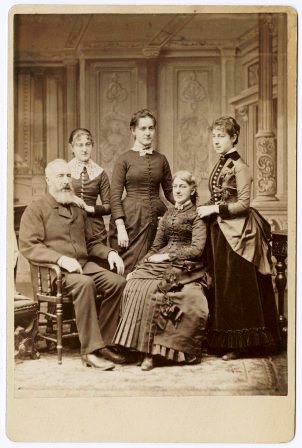
This cabinet card photograph (Photo. #247.311), taken in 1882, is my favorite of the Allen family. Seated are Nathaniel Topliff Allen (1823-1903) and his wife Caroline Swift (Bassett) Allen (1830-1915). Standing behind them, from left to right in reverse age order, are their three children: Lucy Ellis Allen (1867-1943), Sarah Caroline Allen (1861-1897), and Fanny Bassett Allen (1857-1913). A son, Nathaniel, Jr., had died as a child.

Nathaniel Allen was the founder and principal of the West Newton English and Classical School (familiarly known as “the Allen School”) from 1854 to 1900. The school was progressive, co-educational, and integrated, and its student body included African American, Latino/a, and Asian boys and girls, as well as international students. It was also one of the first schools to incorporate physical education into the curriculum. Nathaniel’s wife Carrie worked with him to run the school and look after the students, many of whom boarded in various Allen family homes. Several aunts, uncles, and cousins also served as teachers and administrators.

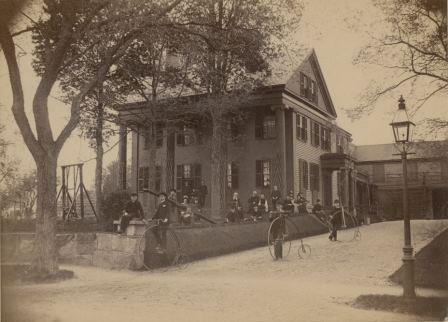
This photograph (Photo. #247.874) of the Allen School at 35 Webster Street, West Newton, dates from 1886. Carrie is seated in the middle wearing a light-colored shawl, with Nathaniel immediately to her right. You can also see some exercise equipment in the yard.

After Nathaniel died in 1903, his oldest and youngest daughters, Fanny and Lucy, opened the Misses Allen School for Girls at the same location. Their middle sister Sarah, unfortunately, had died in childbirth in 1897 at the age of 36.

Laura and I processed the papers and photographs concurrently, and I think our work really benefited from the collaboration. We arranged the collections to mirror each other, for the most part, with separate series of family and school material. This division was trickier than it sounds, because many family members were also teachers and students. I frequently had to move photographs from one section to the other as I figured out who everyone was. (For more information about how we process photographs at the MHS, see my earlier Beehive post.)

The photograph collection contains 1,030 photographs, primarily individual and group portraits of Allen family members and students spanning almost 100 years. While Laura got to know the Allens from their letters, diaries, and other writings, I got to know them from their faces. The collection was completely disorganized when it came to us, but by the end I’d gotten pretty good at identifying people and could even distinguish baby pictures of the three sisters!

It was a lot of fun to share information and compare impressions with Laura as we worked. When she came across a particularly interesting person, she was curious to see what he or she looked like. I also went to her to learn more about the people who intrigued me. For example, I loved the way Lucy, the youngest Allen, usually smiled directly into the camera while other subjects looked stiff or coy with a slightly averted gaze.

The story of the Allens has so many fascinating threads to follow that we hope these collections will be of interest to a wide variety of researchers. For example, Edwin and Gustaf Nielsen were two brothers who, through the intervention of the poet Celia Thaxter, were taken as wards into the Allen home and became de facto members of the family. There’s also Fanny Allen’s decades-long friendship with Pauline Odescalchi, Princess of Hungary. Not to mention the fact that the Allens played an active part in the anti-slavery, suffrage, temperance, peace, and educational reform movements, rubbing elbows with the likes of William Lloyd Garrison, Frederick Douglass, Horace Mann, and Lucy Stone.

Nathaniel and Carrie Allen had no surviving grandchildren. Fanny and Lucy never married, and Sarah’s only daughter died two days after she did in 1897. But this family of teachers clearly had a profound and far-reaching influence on the thousands of boys and girls who attended the Allen School and Misses Allen School. Among them were future writers, doctors, lawyers, teachers, activists, soldiers, at least one actor, and a Supreme Court justice. In my next post, I’ll tell you more about them.

Barbara Hillard Smith’s Diary, July 1918

By Lindsay Bina, Intern and Anna Clutterbuck-Cook, Reader Services

Today we return to the 1918 diary of Newton teenager Barbara Hillard Smith. You may read our introduction to the diary, and Barbara’s previous entries, here:

January | February | March | April

May | June | July | August

September | October | November | December


As regular readers of the Beehive know, we are following Barbara throughout 1918 with monthly blog posts that present Barbara’s daily life — going to school, seeing friends, playing basketball, and caring for family members — in the words she wrote a century ago. Here is Barbara’s June, day by day.


* * *

MON. 1                       JULY

Came to Camp.

TUES. 2

Got word that Peg was operated on. Unpacked. Swimming

WED. 3

Hung around. Swimming. Went to Hillcrest

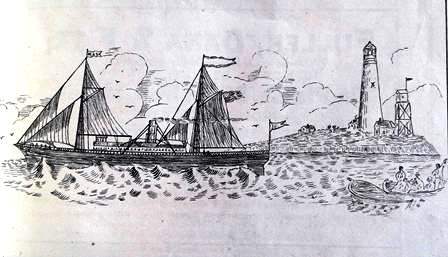
Image from Tileston’s off-hand sketches in Boston Harbor: Pen and Ink Drawings, Centennial 1876.


THUR. 4                      INDEPENDENCE DAY

Governor’s Island picnic. Drunk! Raspberries! Swimming

FRI. 5

Went to [Wiers]. Swimming. Run Sheep Run.

SAT. 6

Played Basketball. Swimming

SUN. 7

Hung around. Swimming.

MON. 8

Went to Merideth. Swimming

TUES. 9

Basketball. Swimming

WED. 10

Pete + Babe [start] for Reg’s wedding. Swimming

THUR. 11

Went to Haunted House. Libby + Rosamond came. Swimming.

FRI. 12

Bear Island

SAT. 13

Basket Ball. Canoeing. Thunder Storm

SUN. 14

Rehearsed for play. Swimming. Powder fight.

MON. 15

Went Blueberrying. Swimming

TUES. 16

Peg got after the skunk. Uncle Sam. Swimming. Cake. Play.

WED. 17

Hot as the dickens. Mother went home.

THUR. 18

Col. Cummings Sick?

FRI. 19

Walked down Boulevard. Swimming

SAT. 20

Hung around

SUN. 21

Went to church. Song service.

MON. 22

P The Hiems took us to the movies. Swimming

TUES. 23

The Streeter’s came. Went Raspberrying on Governor’s Island

WED. 24

Basketball. Swimming

THUR. 25

Sprained my finger. Went by ice houses. Supper on the [stove].

FRI. 26

Basketball. Couldn’t play. [Streiter’s] went home. Pinnicle over night

SAT. 27

Hung around and […]

SUN. 28

Hung around. Swimming

MON. 29

Canoeing. Swimming. Uncle Freddie, Miss A- + Mr R-S [show]

TUES. 30

Basketball. Swimming

WED. 31

[no entry]

* * *

If you are interested in viewing the diary in person in our library or have other questions about the collection, please visit the library or contact a member of the library staff for further assistance.


 *Please note that the diary transcription is a rough-and-ready version, not an authoritative transcript. Researchers wishing to use the diary in the course of their own work should verify the version found here with the manuscript original. The catalog record for the Barbara Hillard Smith collection may be found here.


Piracy and Repentance

By Ashley Williams, Reader Services

As many of us are gearing up to indulge in summer fun, potentially beach or ocean related, it seems a more than appropriate time to delve into MHS collections related to real life swashbucklers. In an earlier post we discussed collections related to the Whydah pirates who were executed in Boston in 1717. Boston also boasts as the place of capture for the notorious Capt. William Kidd.

Kidd started out as a British privateer and was praised for defeating several French ships for England. In 1695, he received a commission from the King to take out pirates that were attacking East India Trading Company Ships. It was after setting sail to fulfill this commission that Kidd turned to piracy.

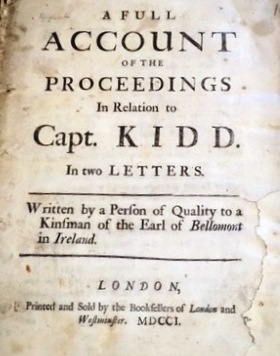
The most extensive document we have related to Kidd’s story is titled A Full Account of the Proceedings in Relation to Capt. Kidd… written in 1701 by “A person of quality.”


Leading up to Kidd’s trial in 1701 there were many rumors and great debate that he was framed by his benefactors, primarily the Earl of Bellemont. The Earl had been responsible for proposing the pirate-hunting commission from the king and was also responsible for helping fit Kidd with a ship and crew. This pamphlet was published by allies of the Earl and primarily serves to argue for the Earl’s ignorance in relation to Kidd’s intentions of piracy, discuss the details of Kidd’s commission, and call for a salvaging of the Earl’s reputation while also recounting a sort of origin story for Kidd that follows up until his trial in England.

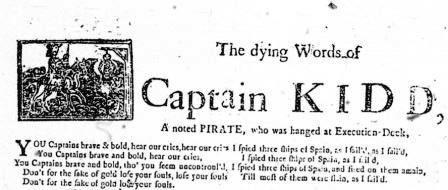
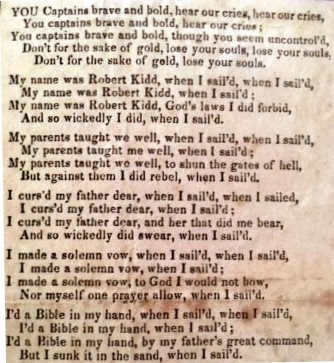
In addition, there are The Dying Words of Capt. Kidd and Capt. Kidd: a noted pirate, who was hanged at Execution Dock, in England. Both documents appear to have the same information, but are housed in different formats, accompanied by different art, and are marked with different publishing dates.


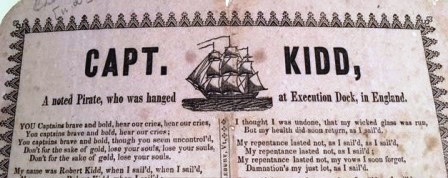
Capt. Kidd : a noted pirate, who was hanged at Execution Dock, in England, pictured above, is a small broadside adorned with a drawing of a ship set in the center of the title. It is believed to have been published sometime between 1837 and 1841, but the publisher is unknown. Running vertically up the center of the document, there is writing that indicates this piece was once sold, “by L. Deming at the sign of the Barber’s Pole, Hanover Street, Boston, and at Middlebury, Vt.”


The Dying Words of Capt. Kidd, however, is held as microform and is marked in the upper left-hand corner with an illustration of a figure on a horse looking onward towards another figure hanging from gallows. The publisher for this piece is also unknown and the publishing date an uncertain “1800?” Either way, they seem to simply be two separate printings of the same song.

Yes, you read correctly, song. Both titles turning out to be incredibly misleading, the text in these works appear not to be Kidd’s words at all, but a sort of foreboding nursery rhyme. The painfully repetitive lyrics recount a remorseful and repentant Kidd warning other sailors not to follow his example and, “for the sake of gold, lose your souls.”


Regretfully, no melody for the tune can be provided from the text, but if you’re looking for suggestions, I would recommend “She’ll Be Coming Round the Mountain.” Just give it a try.

It is difficult to imagine that Kidd actually felt or ever even said many of the lines recounted in this song himself, especially given that either of these were published a decent century after his execution. What isn’t difficult to imagine or observe is that religious leaders of the 17th and 18th century would often use pirate executions as an opportunity to draw the minds of their congregations to their own sins and need for repentance. This practice can be seen in action throughout several MHS collections, more notably by people like Cotton Mather who was also referenced in the earlier piratical blog post.

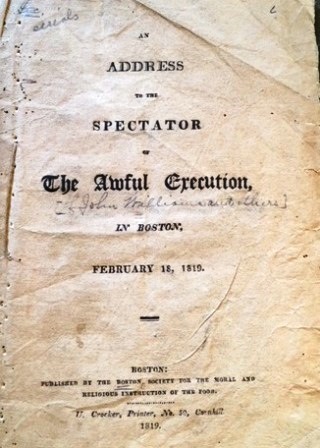
One example that can be given comes in a pamphlet from the Boston Society for the Moral and Religious Instruction of the Poor entitled An Address to the Spectator of the Awful Execution in Boston, referring to the execution of several pirates.


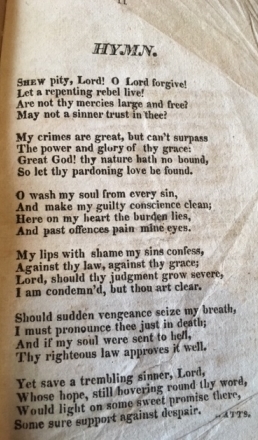
This brief pamphlet charges onlookers to pray for the pirates, reflect on their own sins, and to take initiative in dissuading their children and friends from sin. It ends with a hymn of repentance.


For more on pirates and guilt trips… I mean repentance:

Davis, William C., The Pirates Laffite: The Treacherous World Of The Corsairs Of The Gulf. 1st ed. Orlando, Fla.: Harcourt, 2005.

Kidd, William, Nicholas Churchill, and Don C Seitz., The Tryal Of Capt. William Kidd For Murder & Piracy Upon Six Several Indictments. New York: Printed for R.R. Wilson Inc., 1936.

Mather, Cotton, The Converted Sinner :… A Sermon Preached In Boston, May 31, 1724. In The Hearing And At The Desire Of Certain Pirates, A Little Before Their Execution, Boston: Massachusetts Historical Society, 1724.

Tully, Samuel, The Last Words Of S. Tully : Who Was Executed For Piracy, At South Boston, December 10, 1812, Boston: Massachusetts Historical Society, 1812.

The Adams Papers Digital Edition Turns Ten!

By Amanda M. Norton, Adams Papers

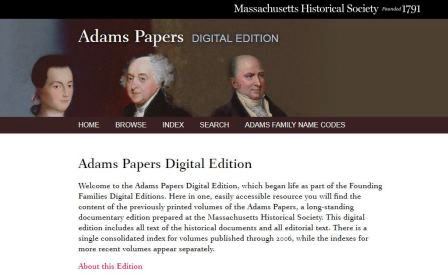
On July 1, 2008, the Massachusetts Historical Society launched the Founding Families Digital Editions, the home of the Adams Papers Digital Edition. This resource converted 45 years’ worth of published material, comprising 32 volumes and three generations of Adamses, and made them more accessible than ever with keyword searching, a cumulative index, and hyperlinked cross references on a freely available website. This massive multi-department undertaking took three years, financial support from the National Endowment for the Humanities and Harvard University Press, as well as technical support from Rotunda, the electronic imprint of the University of Virginia Press. Using a defined subset of the Text Encoding Initiative, an XML-based tagging language designed for the digital markup of various kinds of texts in the humanities, the website retains the editorial standards of the original letterpress volumes, while making the presentation more flexible for the digital environment. As originally conceived, this Founding Families project was to house both the Adams Papers and the seven volumes of the Winthrop Family Papers; however, over time, the projects were separated and the Founding Families page was renamed to simply the Adams Papers Digital Edition.

Over the last ten years, the website has only increased in its value to scholars and the public as thirteen more volumes have been made available, additional search and browse features were added, and displays were updated.

This summer we are pleased to announce that to celebrate its tenth anniversary, the Adams Papers Digital Edition has undergone a complete redesign. The all new web platform enhances not only its readability but also its usability, with more tailored search options, the ability to save your most recent search, and a better mobile experience. Last, but certainly not least, the relaunched website benefits from the addition of a new volume, Papers of John Adams, Volume 17. This volume includes a momentous occasion for both the Adamses and the nation—John Adams greeting King George III as the first minister from the newly independent United States. John’s detailed account of this dramatic meeting, written in code to the secretary of foreign affairs, John Jay, is just one highlight from a volume that also includes the first substantial correspondence between Adams and Thomas Jefferson and the beginnings of treaty negotiations with the Barbary States of North Africa.

While some of the Adams Papers volumes are also available on both the National Archives’ Founders Online and Rotunda’s Founding Era sites, only the Adams Papers Digital Edition website includes all of the historical documents and editorial content from all of the digitized volumes in one place; and the Adams Papers Editorial Project with the Massachusetts Historical Society is committed to continuing to expand its digital offerings. Visit our new site at www.masshist.org/publications/adams-papers.

Massachusetts Students at National History Day

By Kate Melchior, Education

On June 10th, 64 middle and high school students from 25 different Massachusetts schools set out to the University of Maryland, College Park for the 2018 NHD National Contest. There they joined a group of over 3,000 students representing all fifty United States, Washington, D.C., Guam, American Samoa, Puerto Rico, and international schools in China, Korea, and South Asia.  Once at College Park, they spent the week presenting the history projects they’ve worked on all year, traded state pins and stories with students from around the world, and shared in the incredible experience that is National History Day.

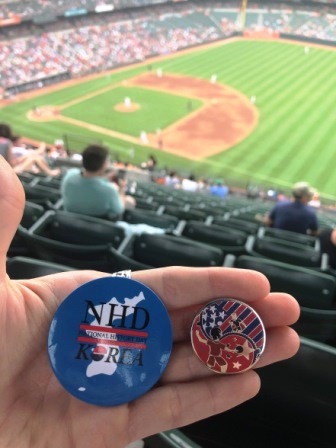
Students bring pins from their state to National History Day, which they trade during the week. The goal is to collect every state and territory!


The annual National History Day contest serves as the final stage for a series of smaller NHD contests at the local and state/affiliate levels. There, students who have spent the year working on primary source-based research papers, exhibits, performances, documentaries, and websites and have made it through local, regional, and state contests compete against hundreds of other national and international projects. Massachusetts prize-winning projects explored this year’s theme of “Conflict and Compromise” through topics and historical figures including Deborah Sampson, the Treaty of Portsmouth, The Philippine-American War, Desmond Doss, and the Civilian Public Service.

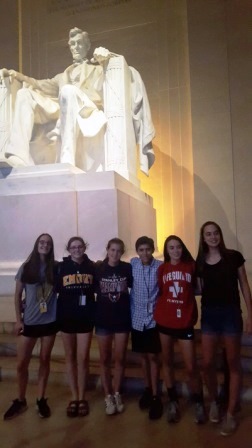
Students visited the Lincoln Memorial during their D. C. Monuments Tour.


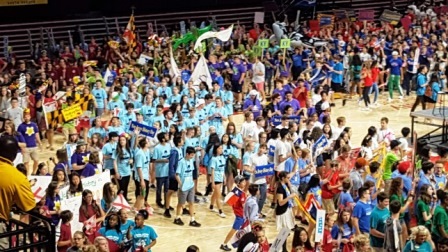
During their four day stay in College Park, students experienced life on a college campus, staying in dorms and eating in the school dining halls with students from around the world.  They viewed the exhibits and performances of other students and explained their own topics of research to new friends.  They also participated in a variety of activities with their Massachusetts cohort, including a monument tour of D.C., a trip to the National Zoo, and a Red Sox-Orioles baseball game at Camden Yards.  Finally, on the last day they participated in a massive parade and award ceremony in the UMD Stadium.

The MA students are wearing blue t-shirts with our tricorn hat logo on them.


The Massachusetts Historical Society is incredibly proud to recognize the following winners from the 2018 National Competition:


First Place – Senior Group Website

Tucker Apgar, Lily Ting, Sean Li

“‘By Winter We Will Know Everything’: The Prague Spring and Conflict over Control”

 Hamilton-Wenham Regional High School, Wenham MA


Outstanding Junior Entry from Massachusetts – Junior Paper

Heather Anderson

“The Penny War: How Children Fought to Compromise with Millionaires”

Hanscom Middle School, Lincoln MA


Outstanding Senior Entry from Massachusetts – Senior Group Website

Zijian Niu, Robert Sucholeiki

“The Geneva Accords: The Compromise That Sparked the Vietnam War”

Winchester High School, Winchester MA


We’d also like to extend a special shout out to William Sutton of Hingham High School for his selection as the Legacy Award nominee for Massachusetts, and to Massachusetts students who made it into the top ten finalists at NHD 2018: Angela McKenzie (Stoneham HS), Ben Franco and Massimo Mitchell (Applewild School), Nora Sullivan Horner (Hamilton Wenham HS), Arda Cataltepe (Weston HS), Robert Sucholeiki and Zijian Niu (Winchester HS), and Heather Anderson (Hanscom MS). Congratulations to all of our student historians!

If you are interested in learning more about NHD or joining us as a teacher, student, or judge for Massachusetts History Day 2018, please visit our website at www.masshistoryday.com.   


This Week @ MHS

By

 – Monday, 25 June, 12:00PM : Jean Franzino of Beloit College presents this week’s first Brown Bag talk, titled “Dis-Union: Disability in the U. S. Civil War.” Franzino’s project examines the emerging legal category of “disabled” American at the end of the nineteenth century in relation to the construction of disability in Civil War literature, broadly conceived. In texts ranging from hospital newsppaer poetry to mendicant narratives sold for veterans’ financial support, representations of Civil War injury engaged shifting understandings of disability: from individual condition to evolving social class.

This talk is free and open to the public. Pack a lunch and come on in!

– Tuesday, 26 June, 6:00PM : Stephen Bush of Brown University is on-hand to discuss his new book, William James on Democratic individuality. William James advocated a philosophy of democracy and pluralism that emphasizes individual and collective responsibility for our social arrangements, our morality, and our religion. In James’s view, democracy resides first and foremost not in governmental institutions but rather in the characteristics of individuals and in qualities of mind and conduct. It is a philosophy for social change, counseling action and hope despite the manifold challenges facing democratic politics, and these issues still resonate strongly today. Stephen Bush explores how these themes connect to James’s philosophy of religion, his moral thought, his epistemology, his psychology, and his metaphysics.

This talk is open to the public, registration required with fee of $10 (no charge for MHS Fellows and Members or EBT cardholders).

– Wednesday, 27 June, 12:00PM : Judith Harford of University College Dublin leads the second Brown Bag talk of the week, and it is called “The Gendering of Diaspora: Irish American Women Teachers and the Rise of the Irish American Elites, 1880-1920.” This talk examines the education, professional training and wider public activism of first-generation Irish American women teachers during the peak of Irish emigration to the United States. 

This talk is free and open to the public.

– Friday, 29 June, 2:00PM : Guest curator and American furniture specialist Clark Pearce leads visitors through the current exhibition with this Gallery Talk: Entrepreneurship & Classical Design in Boston’s South End, identifying highlights while giving deeper context to the life and work of two extraordinary Massachusetts craftsmen, Isaac Vose and Thomas Seymour.

This event is free and open to the public.

– Saturday, 30 June, 10:00AM : The History and Collections of the MHS is a 90-minute docent-led walk through our public rooms. The tour is free, open to the public, with no need for reservations. If you would like to bring a larger party (8 or more), please contact Curator of Art Anne Bentley at 617-646-0508 or abentley@masshist.org.

While you’re here you will also have the opportunity to view our current exhibition: Entrepreneurship & Classical Design in Boston’s South End: The Furniture of Isaac Vose & Thomas Seymour, 1815 to 1825.
– Saturday, 30 June, 3:00PM : As a doctoral student at Boston University’s School of Theology, Martin Luther King, Jr., spent some of his formative years walking the streets of Boston and living in the South End. His life in Boston was King’s first immersive experience outside of the segregated South and while he experienced the de facto racism of the North he also enjoyed the acceptance of the BU and Boston area communities. The Martin Luther King Jr. in Boston Walking Tour will guide visitors through areas of Boston where King lived and socialized, where he met and courted Coretta Scott, and where he returned later at the height of the Civil Rights Movement to deliver powerful speeches on the struggle for racial and economic equality.

This event is open to the public, registration required with a fee of $10  (no charge for MHS Members and Fellows or EBT cardholders).

“I still hear her whenever I open my window”

By Susan Martin, Collections Services

The MHS recently acquired two fascinating letters related to a woman named Nancy Barron, and when cataloging the collection, I found a surprising connection. 

The first letter, addressed to Dr. “Hayward” of Concord, Mass., was written on 20 July 1827 by R. Barron, Nancy’s mother. The Barrons lived in Boston. The letter begins:

Sir I sent a letter to you since Mr Stow was here but have receaved no answer. I take the liberty to state my curcumstances to you and hope that you will concider my case. My daughter is sick more or less all of the time. As for myself I cannot do any work of any consequence. Nancy can do some work all though not capable of takeing care of herself.


R. Barron asked the doctor for help with their rent, which was two months overdue, and explained that she and her daughter couldn’t come to Concord “as it would make Nancy as bad as she was before.” The family received some charity, but it wasn’t enough.

The only other letter in the collection was written almost a year later, this time to Dr. “Haywood.” The writer, D. Patten of Boston, pleaded on behalf of the Barrons, for whom circumstances had deteriorated. Mrs. Barron was “verry much afflicted with ill health,” and the family suffered “poverty and want in a great degree.” Adding to these troubles was Nancy’s “derangement of Mind […] which of late has become much worse.”


Just identifying the correspondents in this small collection was challenging. The two letters were clearly written to the same person, but spelled his name differently. I started with him, assuming he’d be the easiest to find. It took some digging, and through trial and error, I finally stumbled on Dr. Abiel Heywood (1759-1839). Neither Barron nor Patten had spelled the name right.

According to a biography of Heywood published in Memoirs of Members of the Social Circle in Concord (pp. 228-33), he began practicing in Concord in 1790, though he soon left medicine to serve in a series of public positions, including town clerk, selectman, tax assessor, justice of the peace, and Middlesex County judge. He was a very eminent member of the community in 1827, when Mrs. Barron appealed to him.

I never did identify the writer of the second letter, D. Patten. I also don’t know the first name of Nancy’s mother. But when I started looking for Nancy, I found more than I expected. A Google search turned up her name in, of all places, the journals of Ralph Waldo Emerson.

The relevant journal entry is dated 24 June 1840. By this time, Nancy was living at the Concord Asylum, an almshouse just 200 yards behind Emerson’s home, across the Mill Brook. The reference to her is unexpected and startling. Emerson wrote:

Now for near five years I have been indulged by the gracious Heaven in my long holiday in this goodly house of mine, entertaining and entertained by so many worthy and gifted friends, and all this time poor Nancy Barron, the mad-woman, has been screaming herself hoarse at the Poor-house across the brook and I still hear her whenever I open my window.


Ralph L. Rusk, who edited the published volumes of Emerson’s letters beginning in 1939, included citations for a few letters related to Nancy, but he misread her last name as “Bacon.” The error was corrected in an annotation in volume 7 (p. 336) by subsequent editor Eleanor M. Tilton. Apparently, between 1839 and 1843, Emerson corresponded with a Mary Mason about Nancy’s case; these letters are currently on deposit at Harvard’s Houghton Library. It seems Emerson and others provided financial support for Nancy’s care, which would account for how he knew her name.

Like his neighbor Abiel Heywood (the land adjacent to Emerson’s home is still called Heywood Meadow), Emerson belonged to the Social Circle in Concord, a private club for illustrious men of the town. Also among its members was Cyrus Stow—undoubtedly the man R. Barron mentioned in her letter. According to the Memoirs (pp. 295-301), Stow contracted with the town “to take charge of its poor for the use of the Cargill Farm.” Concord Asylum was located on Cargill Farm, probably near where the police and fire department building stands now. Stow was the last piece of the puzzle.

The only other result of my search for Nancy was a single line in the register of births,  marriages, and deaths in Concord: “Nancy Barron aged 46 years died March 29, 1843” (p. 355). Emerson acknowledged her death in his correspondence with Mary Mason.

The striking juxtaposition of Nancy Barron and Ralph Waldo Emerson, with just 200 yards and a narrow brook between them, may have been the kind of thing Henry David Thoreau had in mind when he wrote the following passage in Walden (p. 172):

But how do the poor minority fare? Perhaps it will be found, that just in proportion as some have been placed in outward circumstances above the savage, others have been degraded below him. The luxury of one class is counterbalanced by the indigence of another. On the one side is the palace, on the other are the almshouse and “silent poor.”