Barbara Hillard Smith’s Diary, June 1918

By Lindsay Bina, Intern and Anna Clutterbuck-Cook, Reader Services

Today we return to the 1918 diary of Newton teenager Barbara Hillard Smith. You may read our introduction to the diary, and Barbara’s previous entries, here:


January | February | March | April

May | June | July | August

September | October | November | December


As regular readers of the Beehive know, we are following Barbara throughout 1918 with monthly blog posts that present Barbara’s daily life — going to school, seeing friends, playing basketball, and caring for family members — in the words she wrote a century ago. Here is Barbara’s June, day by day.


* * *

SAT. 1                         JUNE

Swimming. May [Fête]. Hot as the deuce

SUN. 2

Went to Winthrop

MON. 3

School. Babies

TUES. 4

School. Babies

WED. 5

School. Babies

THUR. 6

School. Swimming Exhibition

FRI. 7

School. Went up River and to Park.

SAT. 8

Babies. In town with Peg.

SUN. 9

Hung around. Commencement Vespers

MON. 10

School. Babies. Class Night at Lasell

TUES. 11

School. Sick? Mother with Cousin Bert

WED. 12

School. Babies

THUR. 13

School. Babies

FRI. 14

School. Babies

SAT. 15

In Town. Wellesley with Peg. Dance at Spuds

SUN. 16

Church. S. School. Mrs. Moody to dinner

MON. 17

School. Babies

TUES. 18

School. Babies. Got a boil.

WED. 19

School. Riding with Cousin Bert. Peg over Night.

THUR. 20

French Exam. Mother’s Birthday. Headache. Pegs. Almost Sick

FRI. 21

Latin Exam. Tennis at Pegs

SAT. 22

Cooked. Pegs. Party at Posies. Dancing at Garden

SUN. 23

Sunday School. Peg’s over night.

MON. 24

Geometry Exam. Cleaned Closet. Peg’s for eighth grade party.

TUES. 25

In town with Mrs. Dow. Cousin Alice’s for supper. Met Babe

WED. 26

In town to the Dr. Dill. K’s for supper. Study club affair

THUR. 27

DIn town. Worked with Platt.

FRI. 28

Cleaned. Dentist. Dinner with Platt. Saw him off.

SAT. 29

Shampoo. Aunt Mable’s. Said goodbye to Stewarts

SUN. 30

Church. Sunday School. Riding with [Gathaman’s]. Packed.

* * *

If you are interested in viewing the diary in person in our library or have other questions about the collection, please visit the library or contact a member of the library staff for further assistance.


 *Please note that the diary transcription is a rough-and-ready version, not an authoritative transcript. Researchers wishing to use the diary in the course of their own work should verify the version found here with the manuscript original. The catalog record for the Barbara Hillard Smith collection may be found here.


A Little Free Library @ MHS!

By Anna Clutterbuck-Cook, Reader Services

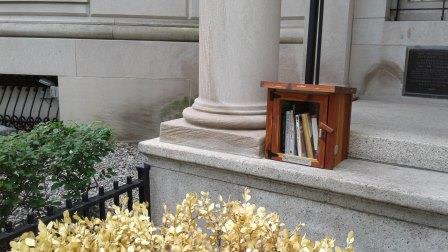
The next time you are in the neighborhood, we invite you to stop to check out the Little Free Library we have installed to the left of our front steps. One of many such book exchanges in Boston, the Little Free Library maintained by Massachusetts Historical Society staff will be filled with books that are free for the taking! If you take a book, also consider leaving a book in its stead so that another reader may have a chance to enjoy it. 

While you’re pausing to browse the current selection of free books, be sure to check out our upcoming events on the calendar to your left — many of our events are free and open to the public.

Of course, the Massachusetts Historical Society is, itself, a big free library — we welcome researchers into our reading room Monday through Saturday to work with our non-circulating collections of manuscripts, rare print materials, art, artifacts, and photograph collections. More information about planning a visit to work with our collections may be found on our website.


This Week @ MHS

By

It is a bit of an odd week ahead with a couple of early library closures. Still, there are plenty of programs to take in here at the Society. This is what’s on tap:

– Monday, 11 June, 12:00PM : Starting the week is a Brown Bag lunch talk with Andrew Rutledge of University of Michigan. “‘We have no need for Virginia Trade’: New England Tobacco in the Atlantic World” examines tobacco’s role in the agriculture, commerce, and political economy of New England. By the 18th century, tobacco figured prominently in the region, and was exported in large quantities to Dutch Suriname and to West African slave traders. Tobacco was a true “Atlantic Commodity,” and, just as in the southern colonies, it drew New England farmers in the to the world of Atlantic slavery. 

This talk is free and open to the public. 

The library closes at 1:30PM on Wednesday, 13 June, to make way for the MHS Fellows Annual Meeting.

– Thursday, 14 June, 6:00PM : Authors Keith Stavely and Kathleen Fitzgerald will be on-hand to discuss their recent work United Tastes: The Making of the First American Cookbook. Amelia Simmons’ American Cookery (1796) is known as the “first American cookbook”and has attracted an enthusiastic modern audience of historians, food journalists, and general readers. Yet until now American Cookery has not received the sustained scholarly attention it deserves. Stavely and Fitzgerald’s United Tastes fills this gap by providing a detailed examination of the social circumstances and culinary tradition that produced this American classic.

This talk is open to the public, registration required with a fee of $10 (no charge for MHS Fellows and Members or EBT cardholders). Pre-talk reception begins at 5:30PM, followed by the speaking program at 6:00PM.

– Friday, 15 June, 12:00PM : The second Brown Bag talk to round out the week is with Adam Mestyan of Duke University, and is titled “U. S. Monarchism in the Middle East?: Orientalism, American Travelers, and Arab Rulers.” The origins of the United States are often framed as anti-monarchist, yet Americans entertain a fascination with monarchs and royalty. Is it possible to create a taxonomy of popular Orientalist images of modern Muslim and Arab rulership in the United States? Next to foreign policy considerations and economic interests, this talk searches for the private views of American travelers about modern Muslim and Arab rulers in the Middle East in the nineteenth and twentieth centuries.

This talk is free and open to the public. 

The library closes at 3:00PM on Friday, 15 June, for a staff event.

– Saturday, 16 June, 10:00AM : The History and Collections of the MHS is a 90-minute docent-led walk through our public rooms. The tour is free, open to the public, with no need for reservations. If you would like to bring a larger party (8 or more), please contact Curator of Art Anne Bentley at 617-646-0508 or abentley@masshist.org.

– Saturday, 16 June, 2:00PM : Come in for a special Gallery Talk related to our current exhibition, Entrpreneurship & Classical Design in Boston’s South End. Guest curator and furniture conservator Robert Mussey will lead visitors through the exhibition’s highlights while giving deeper context to the life and work of two extraordinary Massachusetts craftsmen, Isaac Vose and Thomas Seymour.

Massachusetts Historical Review : Its Origins and Legacy

By Katheryn Viens, Research

To most MHS members, the Massachusetts Historical Review is the annual publication that appears in their mailboxes every autumn, with a glossy, colorful cover and intriguing historical content. Few members know its rich history or visualize its exciting prospects for the future. As we typeset the forthcoming issue and develop essays for future volumes, this seems a good time to reflect on the MHR’s heritage and legacy.

In 1859, the members of the MHS decided to launch a new publication. Since 1792, the year after the Society’s founding, members had been “multiplying the copies” of items in the archives by issuing Collections volumes. Now, as the country approached a civil war, Boston was growing dramatically, from a town of fewer than 20,000 in 1790 to a city of almost 180,000. The Society’s collection, too, had ballooned with the 1857 acquisition of the more than 4,600 volumes in the library of Thomas Dowse. The men who made up the Society now represented a wider range of interests, and they decided to apply the best practices of corporate business to the conduct of the MHS.

A new publication would document the Society’s “proceedings” and include an annual report. It would contain transcripts of the lectures that members offered when they gathered for meetings. A commitment to publish these talks could have resulted in a series of dry volumes—but what a roster of historians would appear in the pages of the Proceedings! Over nearly 140 years, until 1998, the deep leather chairs, madeira, and slanting sunlight of the Society’s afternoon meetings yielded the wisdom of Henry Adams, Oscar and Lillian Handlin, Edmund Morgan, and Bernard Bailyn, to name just a handful of the illustrious historians represented in the Proceedings’ pages.

Enter the 1990s. Computers and the internet transformed the way in which the MHS related to the outside world. Alongside our expanding research programs, including fellowships, conferences, and seminars, the Proceedings came to feel constrained. The MHS made the decision to end its publication and invite the wider possibilities of an annual journal that would accept outside submissions and, in its design, serve as an ambassador of the Society’s vibrant mission. The Massachusetts Historical Review was born.

Two decades later, the MHR features scholarship on all historical periods, from across the country and overseas. This takes the form of essays, photo-essays, historical documents, and review articles authored by both eminent scholars and those new to the field. There have been themed issues and a recent special issue on the occasion of the Society’s 225th anniversary, “Massachusetts and the Origins of American Historical Thought.” The forthcoming issue will include essays on the Harlem Renaissance artist Cloyd Lee Boykin, who taught in Boston, colonial Massachusetts Governor Thomas Pownall, and the 1975 Edelin manslaughter trial. Essays demonstrate the influence of Massachusetts across the nation and around the world.

As with the Proceedings, the Research Department acquires and develops the content for the MHR, while the Publications Department handles the copyediting, design, and indexing. Throughout this process, the MHS staff maintains a commitment to scholarly excellence. They send each essay to at least two peer reviewers in a “double-blind” process, and the editors and authors work together to revise and edit the contributions.

Now available online (as are the Proceedings), the MHR has a wider reach than ever before. It takes its place comfortably among a range of professional journals in major research libraries. And it offers a pleasant read in a comfy chair on a quiet afternoon, perhaps alongside a little glass of good madeira.


The Joy of Bookplates

By Mary Yacovone, Senior Cataloger

One of the Society’s “hidden gems” is finally getting its day in the sun with the processing of three collections of bookplates. Known since 15th-century Germany, bookplates, sometimes called Ex Libris, have a long and interesting history. Initially a tool to identify the owner of a book and to prevent theft (or ensure safe return), bookplates evolved from mere identification into tiny works of art and reflections of the owner’s personality and aspirations.

Perhaps the most common bookplates to be found in our collection are armorial bookplates, featuring family coats of arms and mottoes, which became prevalent in bookplate design from an early date. These armorial designs display both “pride of ancestry and love of the display of aristocratic claims.” Also quite common are simple labels with the owner’s name, sometimes enclosed in a border of engraving or type ornaments. But around the turn of the last century, bookplate designs became much more creative and personal with designers creating plates that reflected the interests of their clients—homes, pets, hobbies, portraits. In this period, many of the bookplates never made it into books, but instead were collected and traded among fellow enthusiasts. The collecting and trading of bookplates reached its peak between the 1880s and 1950s, and most of the plates in the Society’s collection date from this era.

The earliest bookplate found in the Massachusetts Historical Society is from 1685, a plate bearing the inscription “Gulielmus Payne Me suis addidit MDC,LXXXV, ” but I wanted to feature some of the quirkier examples of the art that caught my eye when I was cataloging these collections.

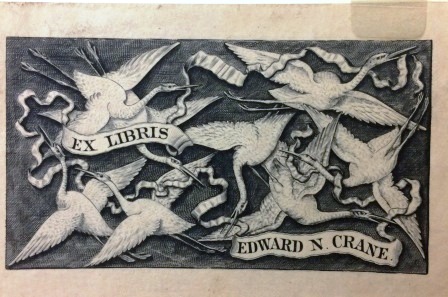
Edward N. Crane chose for his bookplate a play on his last name.


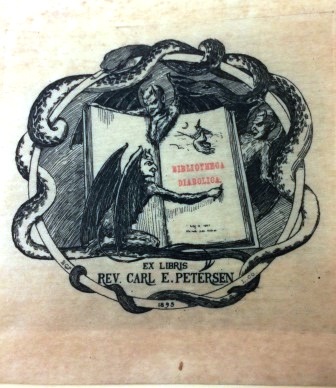
 Reverend Carl E. Peterson chose this 1893 design by Bessie Pease Guttman, better known for her illustrations of children and babies than for cheeky devils reading witchcraft books.


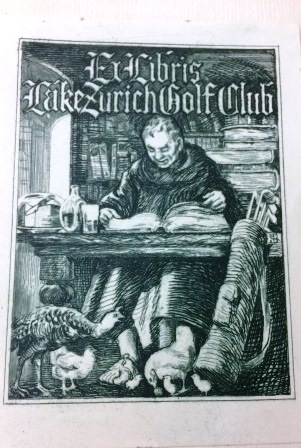
The Lake Zurich Golf Club in Lake Zurich, Illinois, identified its (presumably) golf-related tomes with the image of a studious monk with his libations and clubs at the ready.


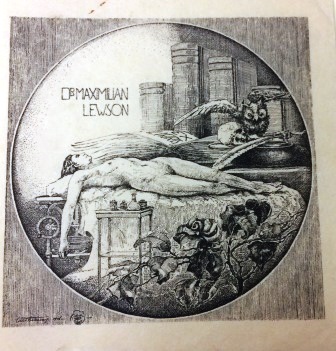
 Dr. Maximilian Lewson of New York selected a somewhat dramatic scene by bookplate designer Curt Szekessy to represent his profession.


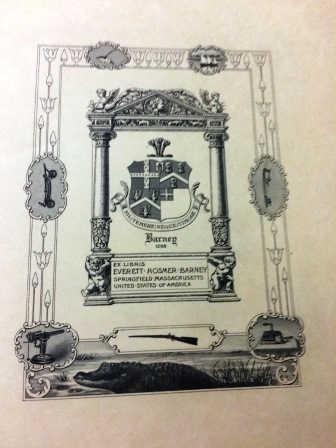
Last, but by no means least, Everett Hosmer Barney of Springfield, who made his fortune as a Civil War arms producer and inventor of clamp-on roller and ice skates, somehow managed to incorporate his genealogy, inventions, hobbies, and a grinning alligator onto one small bookplate.


The bookplates shown here are all from the Ruby V. Elliot bookplate collection (http://balthazaar.masshist.org/cgi-bin/Pwebrecon.cgi?DB=local&BBID=114606), but there are plenty to treasures to be found in the Society’s own collection (http://balthazaar.masshist.org/cgi-bin/Pwebrecon.cgi?DB=local&BBID=208382), as well as the collection of armorial bookplates amassed by Charles R. Crane (http://balthazaar.masshist.org/cgi-bin/Pwebrecon.cgi?DB=local&BBID=208307).

This Week @ MHS

By

It’s a Brown Bag Lunch kind of month at the Society in the weeks ahead, with eight noon-time talks on the calendar, two of which take place this week. Here are the details for the goings-on at the MHS in the week ahead:

– Monday, 4 June, 12:00PM : The first Brown Bag talk this week is with research fellow Ittai Orr of Yale University, whose talk is titled “Genres of Mind: 19th-Century American Literature and the Idea of Intelligence.” While the measurement of human intelligence is now fully in the purview of science, antebellum novelists and poets engaged in public debate over its meaning. Key to recovering this contentious field are the student essays of Richard Henry Dana, Jr. and Henry David Thoreau for Harvard professor Edward Channing in 1836.

This talk is free and open to the public.

– Wednesday, 6 June, 12:00PM : Also presenting a Brown Bag talk this week is Alexandra Montgomery of the University of Pennsylvania with “Projecting Power in the Dawnland: Empires, Native Americans, & Settlement Schemes in the Gulf of Maine, 1710-1800.” In the eighteenth century, the far northeastern coast of North America had more in common with the trans-Appalachian west than the white settler colonial east. This talk examines the British and French efforts to import white settlers in an attempt to change these demographic and political realities. These state projects offer a different view of the role of settlement in 18th-century North American empires.

This talk is free and open to the public.

– Wednesday, 6 June, 6:00PM : “Massachusetts Leadership in the Woman Suffrage Movement” is an author talk with Barbara Berenson. Few are familiar with Massachusetts’s role at the center of the national struggle for woman suffrage. Lucy Stone and other Massachusetts abolitionists were some of the first figures who vocally opposed women’s exclusion from political life. Demanding the vote and other reforms, they launched the organized women’s movement at the first National Woman’s Rights Convention, held in Worcester in 1850. Berenson gives Massachusetts suffragists the attention they deserve in this engaging story and discusses the battle over historical memory that long obscured the state’s leading role.

This talk is open to the public, registration required with a fee of $10 (no charge for MHS Members and Fellows or EBT cardholders). Pre-talk reception begins at 5:30PM, followed by the speaking program at 6:00PM.

– Saturday, 9 June, 10:00AM : The History and Collections of the MHS Tour is a 90-minute docent-led walk through our public rooms. The tour is free, open to the public, with no need for reservations. If you would like to bring a larger party (8 or more), please contact Curator of Art Anne Bentley at 617-646-0508 or abentley@masshist.org.

While you’re here you will also have the opportunity to view our current exhibition: Entrepreneurship & Classical Design in Boston’s South End: The Furniture of Isaac Vose & Thomas Seymour, 1815 to 1825.

Charles Cornish Pearson and the Great War, Part VII

By Susan Martin, Collections Services

This is the seventh and final post in a series about the wartime experience of Charles Cornish Pearson. Go back and read Part I, Part IIPart IIIPart IV, Part V, and Part VI for the full story.

We’ve come to the conclusion of the story of Sgt. Charles Cornish Pearson and his service with the 101st Machine Gun Battalion during World War I. We pick up after the Battle of Saint-Mihiel in September 1918, a success for the Allies, who forced the German line back and captured thousands of prisoners and hundreds of guns. Loved ones back in the States were thrilled by the news. Charles wrote to his Aunt Florence:

Suppose the news in the paper the past few weeks has cheered up the people at home a good deal. Certainly is quite a set back to the Hun but guess they need a lot of licking yet before they see the error of their ways in the proper light. One doesn’t appreciate the havoc & needless vandalism they have carried on until one has travelled over this part of the country & then one hasn’t taken into consideration the slavery the civilian population has had to undergo the past four years. They sure have a lot to pay for if they ever can.


Despite rumors that the war was winding down, Charles knew his “next trick” would come soon, and he was right. Less than a month after Saint-Mihiel, on 8 October 1918, his battalion moved to the outskirts of Verdun to prepare for its part in the brutal Meuse-Argonne Offensive. Philip S. Wainwright points out, in his History of the 101st Machine Gun Battalion, that from this position the men could see the infamous Mort-Homme, the site of terrible losses in the Battle of Verdun two years before. Another soldier described the feeling of being surrounded by “numberless French graves” (p. 124).

From 23-31 October, the guns of the 101st were used to support an attack by the 26th Yankee Division at the Bois de Brabant-sur-Meuse. According to Wainwright, it was the hardest fight the battalion had ever faced, with “continuous shell-fire” and “gas attacks every night” (p. 52). Charles agreed. On 1 November, after a gap of 17 days, he wrote to his parents from a reserve position at Marre, and his usual breezy style was muted.

One doesn’t feel much in the mood for letter writing. […] Things have been happening pretty swiftly lately and I feel pretty lucky to be able to scribble you a line & say O.K. […] Suppose I could write you a great deal about what we have been doing the past days but am only too glad to be out of it for the time beginning [sic] & just say that war is h–l & let it go at that.


He told his brother Bill, in a bemused tone, “I often wonder how they all missed me and the others. Fate I guess with good dodging is the answer.” In a letter to his sister Jean, he included some very vivid details of the battle—huddling in a trench as shells flew overhead, the spray of dirt as “whiz bangs” hit the hill opposite, the hardness of the ground. He also switched seamlessly to the present tense and second-person pronouns, making his story even more visceral: “You try to sleep saying to yourself well you are pretty safe unless they make a direct hit…” But as for the worst of his experiences, he explained, “I am getting so now I try to forget all about them as soon as they are over and sometimes that is no easy thing to do.”

Rumors of peace were coming in fast and furious now. As one soldier put it, “this war is all over but the shooting” (Wainwright, p. 131). Sure enough, at 11 a.m. on 11 November 1918, the armistice went into effect. This description of that moment doesn’t come from Charles, but from another soldier quoted by Wainwright:

Suddenly there is a queer silence—we don’t know what to think or do. It is true—but no one wants to shout or laugh. We just cannot realize the significance of it. Here we were, only a few moments ago, ready to jump into our cars and go out and shoot up the Boche, or get shot up. What will happen, and where are we going now? (p. 132)


Charles, like others, was both stunned and relieved that the war was over. He wrote to his parents the following day,It seems too good to be true & one wanders around in a daze. It sure has been h–l at times but guess it has been worth it all.” And he signed off another letter with the words: “Finis la Guerre.”

Charles looked forward to getting back into civilian clothes, rejoining the commercial paper business, and doing “as I damn please for awhile.” He even asked his sister if she knew any single girls who would be interested in a “perfectly harmless veteran.” But he would have a long and frustrating wait of several months before the 101st Machine Gun Battalion finally sailed for home in the Agamemnon on 31 March 1919. Charles was discharged on 29 April 1919.

Charles married Edith Irene Carrier in 1925. He died on 19 May 1973 at the age of 83, survived by his wife, three children, six grandchildren, and one great-granddaughter.

In spite of his humble protestations, Charles was a very compelling correspondent, and I hope you’ve enjoyed this deep dive into his papers as much as I have. I’ll finish with an excerpt from a letter to his sister, written from France after the war:

Glad you have appreciated or rather enjoyed my letters written over here. Am afraid you over exaggerate as I never was much of a hand at letter writing and my power of description etc is sadly lacking, still if they gave you some idea of what we have been doing over here why I am satisfied.

Spring Flowers

By Anna J. Clutterbuck-Cook, Reader Services

The month of May brought a sudden profusion of new growth to Boston’s green spaces this year: front yards, city parks, community gardens, and wild untamed lots all burst forth into a riot of green foliage and bright flowers.

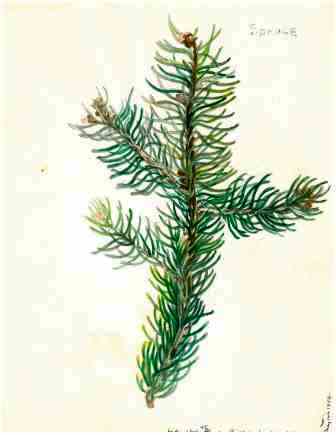
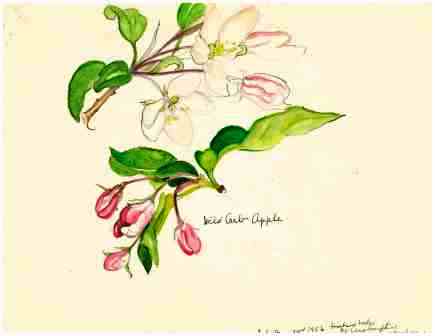
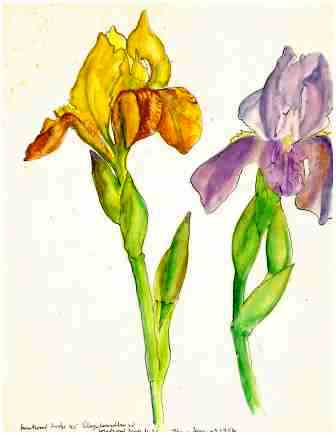
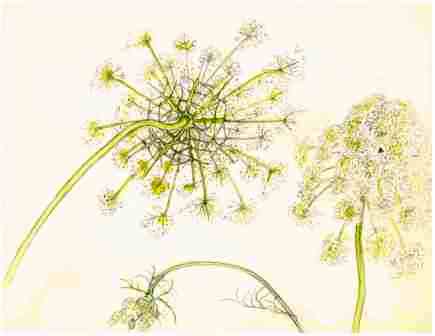
To celebrate the season on this final day of May, I bring you the botanical watercolors of Louise Wheelwright Damon (1889-1973), who painted these vibrant pictures in 1956. I love the examples of amateur art in our collections; that the trained eye and hand of artists such as Susan Anne Livingston Ridley Sedgwick or John Singleton Copley exist in our collections alongside these lesser known — sometimes even unknown, unremarked upon — works that brought their creator pleasure, were saved by a family member, and ultimately donated to our institution where researchers of the future could discover and enjoy them.

“Spruce”

Westwood Lodge, 45 Clapboardtree Street, Westwood, Mass., 14 May 1956.

Graphics. Damon 004.


“Wild Crab Apple”

Westwood Lodge, 45 Clapboardtree Street, Westwood, Mass., 23 May 1956.

Graphics. Damon 009.


Untitled irises

Westwood Lodge, 45 Clapboardtree Street, Westwood, Mass., 8 June 1956.

Graphics. Damon 017.


Untitled queen anne’s lace

Westwood Lodge, 45 Clapboardtree Street, Westwood, Mass., 23 May 1956.

Graphics. Damon 030.


The Louse Wheelwright Damon botanical drawings are available to access in the MHS reading room or at a distance through the purchase of PDF or TIFF reproductions. Please check out Visiting the Library and Reproduction Services page for more detail.

This Week @ MHS

By

The Society is CLOSED on Monday, 28 May, for Memorial Day.

As we return to the building after a long holiday weekend, we are looking at a fairly quiet week before the activity increases in June. Here are the events on the schedule this week:

– Wednesday, 30 May,12:00PM : This week’s Brown Bag talk is with short-term research fellow Abigail Cooper of Brandeis University. “Conjuring Emancipation: Making Freedom in the U. S. Civil War’s Refugee Camps”  examines the political work of revival in wartime refugee camps and envisions emancipation as a religious event. It reckons with religion as a mediating force between the enslaved and the state, asking “Who belongs and how?” for those negotiating statelessness and peoplehood in the midst of self-emancipation.

This talk is free and open to the public.

– Wednesday, 30 May, 6:00PM : “Apostles of Revolution: Jefferson, Paine, Monroe, & the Struggle against the Old Order in America & Europe” is an author talk with John Ferling of University of West Georgia who discusses his newest book of the same name. As Founding Fathers, Thomas Jefferson, Thomas Paine, and James Monroe risked their lives and their liberty for  American independence, and as reformers, each rejoiced at the opportunity to be part of the French Revolution, praying that it in turn would inspire others to sweep away Europe’s monarchies and titled nobilities. But as the 18th century unfolded, these three embarked on different routes to revolution. As writers, soldiers,and statesmen, these three men reshaped their country and the Western world.

This talk is open to the public, registration required with a fee of $10 (no charge for MHS Members and Fellows, or EBT cardholders). Pre-talk reception begins at 5:30PM followed by the speaking program at 6:00PM.

– Saturday, 2 June, 10:00AM : The History and Collections of the MHS is a 90-minute docent-led walk through our public rooms. The tour is free, open to the public, with no need for reservations. If you would like to bring a larger party (8 or more), please contact Curator of Art Anne Bentley at 617-646-0508 or abentley@masshist.org.

While you’re here you will also have the opportunity to view our current exhibition: Entrepreneurship & Classical Design in Boston’s South End: The Furniture of Isaac Vose & Thomas Seymour, 1815 to 1825.

Anna Peabody Bellow’s Travel Diary

By Alex Kouroriez, Intern

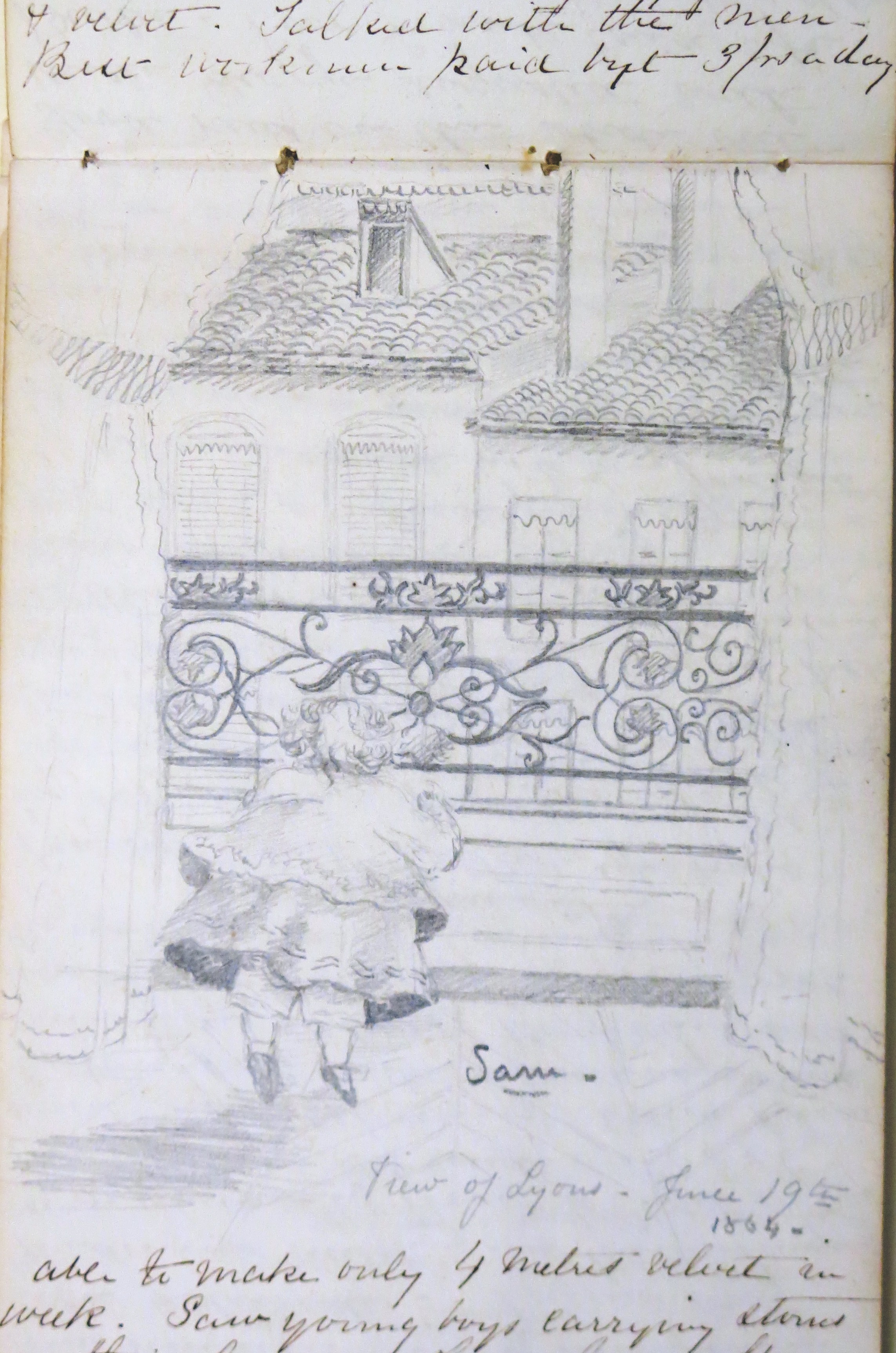
Anna Peabody Bellow’s 1864 travel diary documents her voyage to England and France as a young and wealthy New England young woman during the Civil War. Included among her paragraph-a-day entries are watercolor and pencil sketches, perspective as a tourist in Europe, and a reminder that some things never change.

The Paris Bellows describes is under the Haussmann renovation and many famous landmarks make cameos in her diary.  She records sights such as the Champs Elysees, the Madeline, Notre Dame, and the Pantheon, which she described her visit as “a little uncomfortable visiting the tombs underneath.” I had a similar experience visiting the Pantheon crypt a few years ago, but seeing the resting place of legendary French writers was worth the chill. 

Though a tourist in the 1800s, Bellows’ account of Parisian museum going could be a post on TripAdvisor.  In an entry, Anna Peabody Bellows and her brother-in-law Charles are turned away from a museum without a ticket, “However by some hocus pocus Charles soon got in of course.”  I’m amused that charming one’s way into museums is not recent practice, and Bellow’s dry humor regarding museums does not stop there. At the Louvre’s sculpture gallery her blasé tone is incredible: “These much disappointed. Venus of Milo really the only thing we appreciate.”

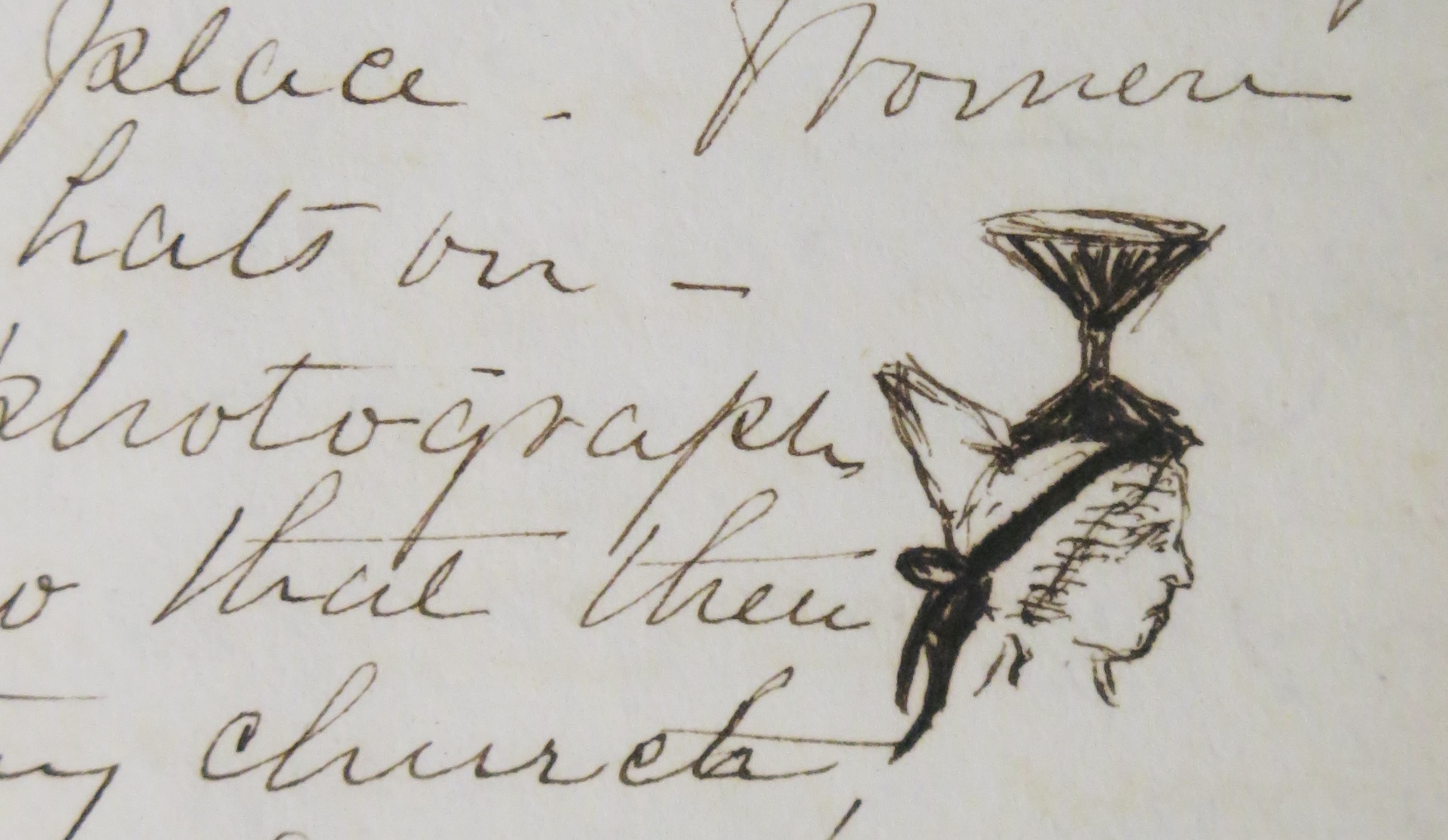
Bellows and her entourage vacationed in Europe during the Civil War with little reference to current events in her diary full of social calls, travel itineraries, and statements of health.  I wonder her reason for traveling to Europe in the midst of a war and if she felt more anxiety for her country beyond the page. While the daily entries are short, they capture the essence of the day in the lists of monuments visited and names of the people with whom she dined.  In the lists of sight-seeing, she includes sketches to prompt her memory.


 For example, she meets “women with very funny hats on” as they wear traditional Lyonnais dress for a summer festival.

As a high school student preparing to take a gap year to study in Tours, France, I feel encouraged to keep my own travel journal for the sake of being fashionable in the 1860s.  Inspired by Bellows’ diaries, I would like to capture my surroundings not only through words but also in my amateur watercolor illustrations. I would like to research into the reason for the Bellow’s family trip during the Civil War, but in the meantime, I make the connection: Bellows left the Boston she knew well to see France, as I will this fall. While I’m not leaving the country during a war, Bellows and I have looked to Europe for a brief escape, in my case, one year of studying language for pleasure before jumping into four years of academics.


All in all, this journal is a delight for its pointed observations, illustrations, and addition to the account of Americans in Paris. If you are traveling this summer visit the library to check out this diary or other travel dairies at the MHS for inspiration on journal keeping.