The month of May brought a sudden profusion of new growth to Boston’s green spaces this year: front yards, city parks, community gardens, and wild untamed lots all burst forth into a riot of green foliage and bright flowers.
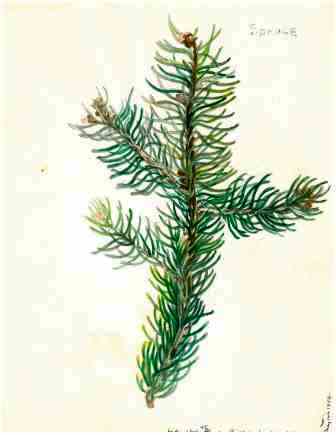
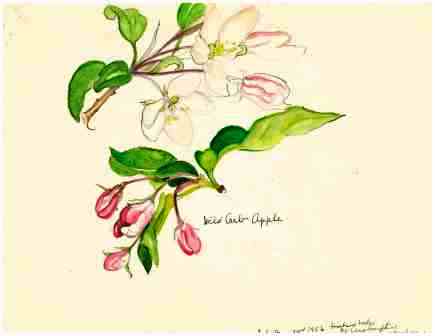
To celebrate the season on this final day of May, I bring you the botanical watercolors of Louise Wheelwright Damon (1889-1973), who painted these vibrant pictures in 1956. I love the examples of amateur art in our collections; that the trained eye and hand of artists such as Susan Anne Livingston Ridley Sedgwick or John Singleton Copley exist in our collections alongside these lesser known — sometimes even unknown, unremarked upon — works that brought their creator pleasure, were saved by a family member, and ultimately donated to our institution where researchers of the future could discover and enjoy them.
“Spruce”
Westwood Lodge, 45 Clapboardtree Street, Westwood, Mass., 14 May 1956.
Graphics. Damon 004.
“Wild Crab Apple”
Westwood Lodge, 45 Clapboardtree Street, Westwood, Mass., 23 May 1956.
Graphics. Damon 009.
Untitled irises
Westwood Lodge, 45 Clapboardtree Street, Westwood, Mass., 8 June 1956.
Graphics. Damon 017.
Untitled queen anne’s lace
Westwood Lodge, 45 Clapboardtree Street, Westwood, Mass., 23 May 1956.
The Society is CLOSED on Monday, 28 May, for Memorial Day.
As we return to the building after a long holiday weekend, we are looking at a fairly quiet week before the activity increases in June. Here are the events on the schedule this week:
– Wednesday, 30 May,12:00PM : This week’s Brown Bag talk is with short-term research fellow Abigail Cooper of Brandeis University. “Conjuring Emancipation: Making Freedom in the U. S. Civil War’s Refugee Camps” examines the political work of revival in wartime refugee camps and envisions emancipation as a religious event. It reckons with religion as a mediating force between the enslaved and the state, asking “Who belongs and how?” for those negotiating statelessness and peoplehood in the midst of self-emancipation.
This talk is free and open to the public.
– Wednesday, 30 May, 6:00PM : “Apostles of Revolution: Jefferson, Paine, Monroe, & the Struggle against the Old Order in America & Europe” is an author talk with John Ferling of University of West Georgia who discusses his newest book of the same name. As Founding Fathers, Thomas Jefferson, Thomas Paine, and James Monroe risked their lives and their liberty for American independence, and as reformers, each rejoiced at the opportunity to be part of the French Revolution, praying that it in turn would inspire others to sweep away Europe’s monarchies and titled nobilities. But as the 18th century unfolded, these three embarked on different routes to revolution. As writers, soldiers,and statesmen, these three men reshaped their country and the Western world.
This talk is open to the public, registration required with a fee of $10 (no charge for MHS Members and Fellows, or EBT cardholders). Pre-talk reception begins at 5:30PM followed by the speaking program at 6:00PM.
– Saturday, 2 June, 10:00AM : The History and Collections of the MHS is a 90-minute docent-led walk through our public rooms. The tour is free, open to the public, with no need for reservations. If you would like to bring a larger party (8 or more), please contact Curator of Art Anne Bentley at 617-646-0508 or abentley@masshist.org.
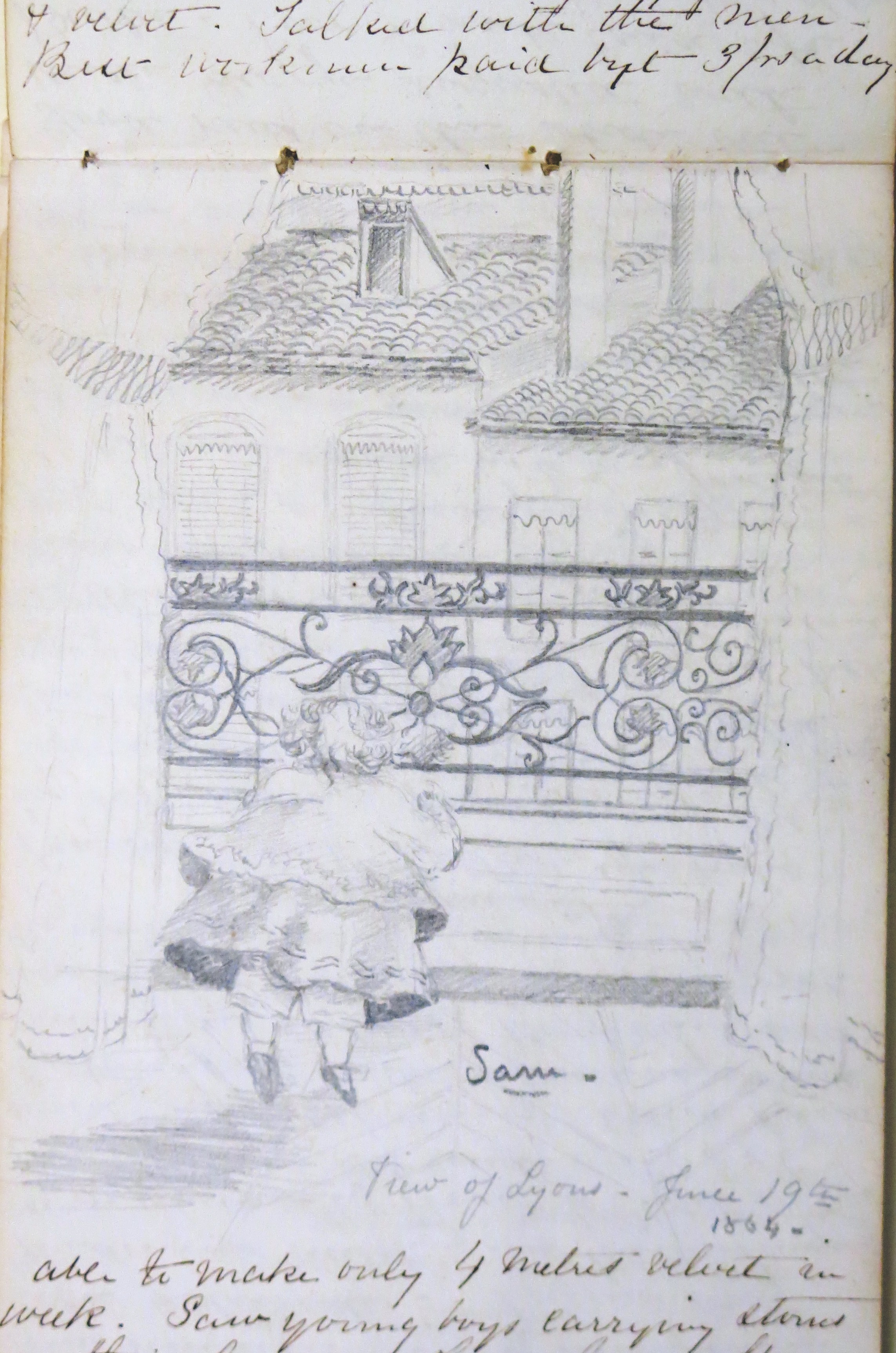
Anna Peabody Bellow’s 1864 travel diary documents her voyage to England and France as a young and wealthy New England young woman during the Civil War. Included among her paragraph-a-day entries are watercolor and pencil sketches, perspective as a tourist in Europe, and a reminder that some things never change.
The Paris Bellows describes is under the Haussmann renovation and many famous landmarks make cameos in her diary. She records sights such as the Champs Elysees, the Madeline, Notre Dame, and the Pantheon, which she described her visit as “a little uncomfortable visiting the tombs underneath.” I had a similar experience visiting the Pantheon crypt a few years ago, but seeing the resting place of legendary French writers was worth the chill.
Though a tourist in the 1800s, Bellows’ account of Parisian museum going could be a post on TripAdvisor. In an entry, Anna Peabody Bellows and her brother-in-law Charles are turned away from a museum without a ticket, “However by some hocus pocus Charles soon got in of course.” I’m amused that charming one’s way into museums is not recent practice, and Bellow’s dry humor regarding museums does not stop there. At the Louvre’s sculpture gallery her blasé tone is incredible: “These much disappointed. Venus of Milo really the only thing we appreciate.”
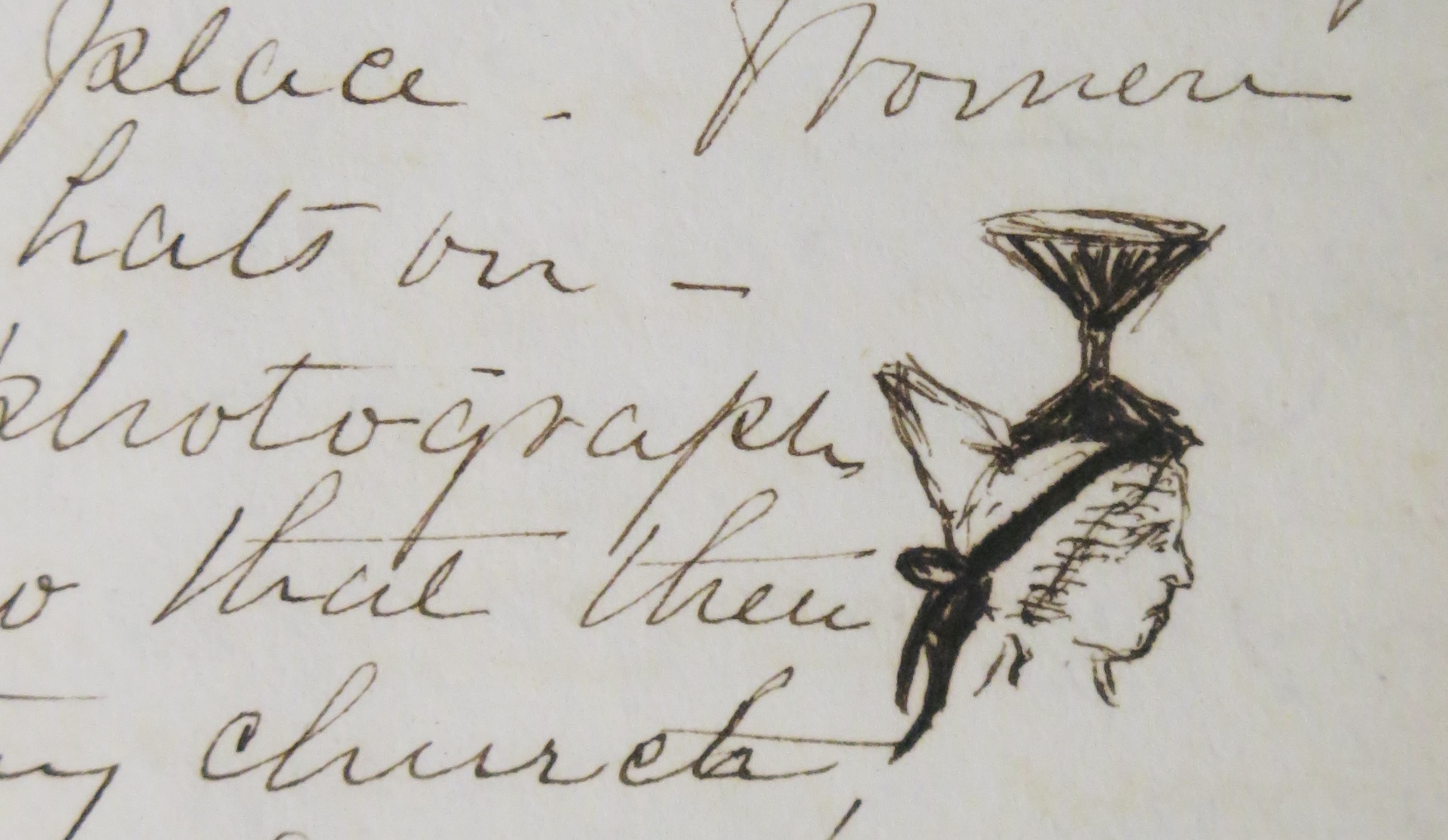
Bellows and her entourage vacationed in Europe during the Civil War with little reference to current events in her diary full of social calls, travel itineraries, and statements of health. I wonder her reason for traveling to Europe in the midst of a war and if she felt more anxiety for her country beyond the page. While the daily entries are short, they capture the essence of the day in the lists of monuments visited and names of the people with whom she dined. In the lists of sight-seeing, she includes sketches to prompt her memory.
For example, she meets “women with very funny hats on” as they wear traditional Lyonnais dress for a summer festival.
As a high school student preparing to take a gap year to study in Tours, France, I feel encouraged to keep my own travel journal for the sake of being fashionable in the 1860s. Inspired by Bellows’ diaries, I would like to capture my surroundings not only through words but also in my amateur watercolor illustrations. I would like to research into the reason for the Bellow’s family trip during the Civil War, but in the meantime, I make the connection: Bellows left the Boston she knew well to see France, as I will this fall. While I’m not leaving the country during a war, Bellows and I have looked to Europe for a brief escape, in my case, one year of studying language for pleasure before jumping into four years of academics.
All in all, this journal is a delight for its pointed observations, illustrations, and addition to the account of Americans in Paris. If you are traveling this summer visit the library to check out this diary or other travel dairies at the MHS for inspiration on journal keeping.
The Rockwood Hoar Papers at the MHS document the life and career of Rockwood Hoar, a Worcester, Massachusetts lawyer and politician who lived from 1855 to 1906. Hoar was the son of United States Senator George Frisbie Hoar, and he served in Congress himself toward the end of his life. Among Hoar’s papers are his legal files which are arranged alphabetically by client name, including immigrants from various countries. I looked into these files and focused specifically on the file relating to Ideem Fatool,* a Worcester resident who was, according to a September 1905 Hoar letter (a copy of which is in the collection), Syrian. Through my reading of these materials I got a sense of the research possibilities these papers offer for anyone studying the experiences of immigrants in late 19th- and early 20th-century Massachusetts.
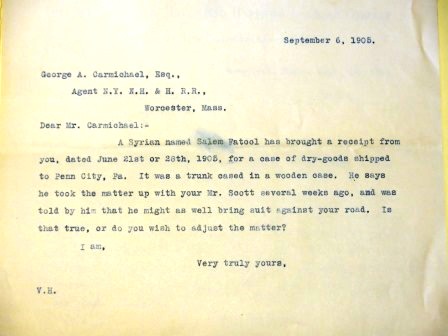
Copy of a 6 September 1905 letter from Rockwood Hoar to George A. Carmichael of the New York, New Haven and Hartford Railroad
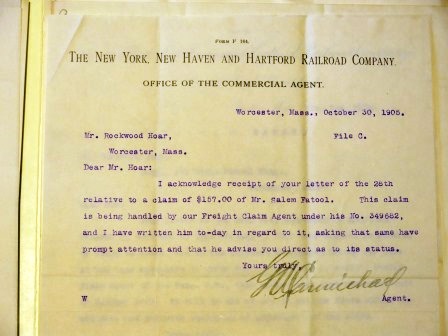
Ideem Fatool lived at 31 Norfolk Street in Worcester and worked in “rugs” in 1905, according to the 1905 Worcester Directory (p. 238; Fatool’s first name is listed as “Saleem” in this directory). His file relates to a claim he made with the New York, New Haven and Hartford Railroad after a trunk of goods he shipped was lost along the way to its destination in Pennsylvania. In an undated typescript copy of a letter addressed to the railroad company, Fatool lists items in the lost shipment along with their values. He lists the total value of the goods as $157. His letter is followed by correspondence between September 1905 and March 1906, primarily involving Fatool’s lawyers and railroad representatives. Hoar writes to railroad agent George A. Carmichael about the issue in September. Carmichael responds the following week indicating that the railroad would require more information, and writes again in October to state that he is passing the dispute along to Boston freight claim agent T. C. Downing.
In November and February letters, Downing follows up with additional details relating to the status of the claim, and writes in his February letter that, without additional evidence, they would not accept Fatool’s statement relating to the value of the goods as accurate. Hoar sends information about the case to another lawyer, Charles F. Aldrich, in a February letter, and a Downing letter sent the following month is addressed to Aldrich. Downing writes that the company believed Fatool claimed the goods to be worth five times more than they actually were, and in a xenophobic comment, attributes this to the fact that Fatool was an immigrant and implies that he was likely looking for money from the company.
Rockwood Hoar to George A. Carmichael, 30 October 1905.
The last two items in the folder are February and March 1906 letters written from Aldrich to Hoar. These letters contain updates relating to the case. In both letters, Aldrich writes that Fatool had left the country, but the lawyer doesn’t seem certain of Fatool’s destination. In his 27 February 1906 letter, he writes that “Fatool has gone back to Europe,” and in his 6 March 1906 letter, he writes that “Fatool has gone back to the interior of his native country, which is Syria or Armenia, I am not sure which.” In his final letter, Aldrich notes that he is still attempting to find out more from the company about the issue, but it seems that he had hit a roadblock.
The materials in this file provide some glimpses into the Worcester of the period and the ways that immigrants helped to shape it. The list of goods in Fatool’s shipment includes wool, perfume soap, a silk spread cover, a quilt, drawnwork, and other items. Additionally, the folder includes a card for Orfalea Bros. & Co. in Worcester. The card lists laces, drawn work, Turkish rugs, and kimonas as some of the items they sold. The card also lists various cities and countries in the Middle East, Asia, and Europe from which they imported items. These items provide brief but insightful evidence of international trade networks of the period and invite further research into the roles Syrian immigrants to the United States played within these networks and within the Worcester community.
On a side note, I took to the Internet to see if I could find out anything else about Fatool, and interestingly, according to a blog post by Chet Williamson of Jazz Riffing on a Lost Worcester, a Saleem Fatool was the father of Nick Fatool, a noted drummer born in Millbury, Massachusetts who played with Benny Goodman and other acts in the mid-20th century. Williamson references Millbury birth records that give Syria as the country of origin for Nick Fatool’s parents. A little more digging would be required to confirm whether or not this Saleem Fatool was the same individual as the person I write about in this post, so I can only speculate at this point, but this was an exciting find, and the fact that I also play the drums made it particularly exciting for me.
If you are interested in looking at the Rockwood Hoar Papers, feel free to view them here in the MHS library. Most of the collection is stored offsite, so library staff recommends requesting the materials through Portal1791 at least two business days before your intended visit, but they are otherwise open and available for research!
*****
*Fatool’s first and last names are spelled multiple ways by the correspondents in the file. The name “Ideem Fatool” is used here, as it is the one that is written on the folder and used in the collection guide. However, as noted in the text of this post, the spelling “Saleem,” which does not appear among the papers in Hoar’s file, is used in the 1905 Worcester Directoryand in the sources cited by Chet Williamson in the Jazz Riffing on a Lost Worcester blog post, which makes me wonder if “Saleem Fatool” is the correct spelling of Fatool’s name.
As many of my colleagues have pointed out in the past here on the Beehive, one of the joys of working with the manuscript collections at the MHS is finding something unexcpected when going through a box of material.
Recently, I tried to answer a reference question from a remote researcher that deal with a ship captain from the early 19th century. As it turned out, I made a bit of a mistake and provided information on the wrong person. However, it turned out to be a happy accident because of what I ended up finding, and which may have otherwise escaped my notice.
The Smith family papers are a single-box collection of manuscripts that contains several volumes of Capt. William Smith of Boston. Each of these volumes is tucked inside its own folder with a brief title that indicates what the volume contains: “Account book,” “Letterbook,” “Log of Mary.” However, within these volumes there are some surprises. For example, in a letterbook dated 1812, not only are there manuscript copies of several pieces of correspondence, but also several pages of accounts and ship inventories, and even a couple of poems.
Still, it is not so unusual to find something like poetry in a letterbook maintained by a man who would have been at sea for weeks or months at a time.
A standard account book page detailing a ship’s inventory.
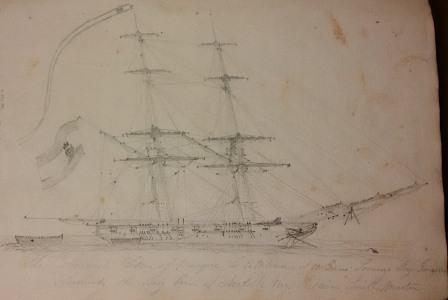
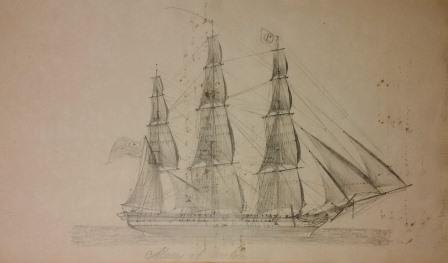
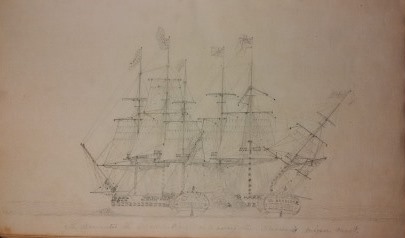
To me, the real treasure is inside a thin volume simply labeled “Accounts, 1812-17.” While there are many pages of ship inventories, accounts, and invoices, as the title so faithfully indicates, much less expected are the myriad hand-drawn images of various ships done with wonderful detail.
“The Spanish Letter of Marque la Catalina, of 10 guns, Lorenze Joze Gonzales. Formerly the Brig Erin of Norfolk Virg. William Smith Master.”
Elsewhere in the account book is another picture of the above ship where it is simply identified as the Brig Erin of Norfolk, mastered by William Smith.
Another drawing shows the Brig Mary, the log of which is also housed in the Smith family papers.
“Mary of Boston.”
“Independence, 74 Guns [Commodore] William Bainbridge.”
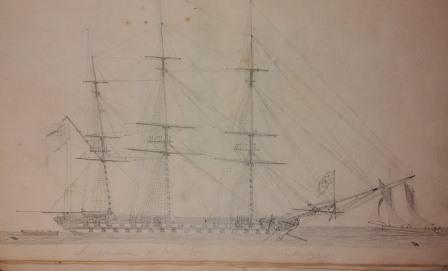
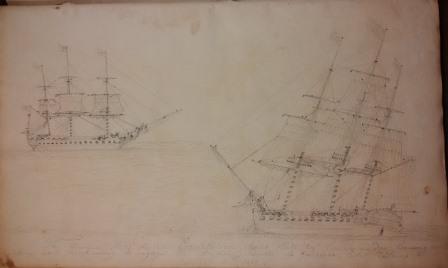
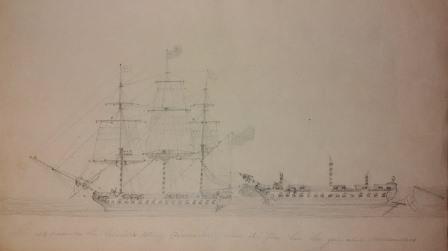
In addition to these standalone images there is a series of three drawings that detail the encounter between the United States Frigate Constitution and H. M. S. Guerriere on 19 August 1812.
“The United States Frigate Constitution, Isaac Hull, Esq, Commander, bearing down upon and preparing to engage the British Frigate Le Gurriere, Capt. Dacres, August 19, 1812.”
The story of this naval battle early in the War of 1812 is well-known and well-documented with many tributes in text and in image available, so I will not attempt to rehash that here, except to say that this battle is where the U. S. ship received its nickname, “Old Ironsides.” [See below for some websites that recount the battle.]
But the drawings themselves are worth a look.
“In 15 minutes the Constitution cuts away the Gurriere’s mizen mast.”
“In 43 minutes the Gurriere totally dismasted, when she fires her Lee gun and surrenders.”
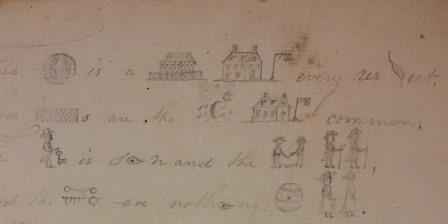
Finally, the account-keeper even included a couple of rebuses in this volume. Longtime visitors to the Beehive may remember a post here a few years ago about rebuses, written by MHS alum Kittle Evenson. [“Cryptic Communique…“] After you re-read Kittle’s entry, you can come back here and see if you can figure out one of the word puzzles. As of publication, I have yet to crack it!
As always, if you see something here of interest and want to view it in person, consider Visiting the Library!
It is a fairly quiet week at the Society as we head toward a long holiday weekend. Here is what is happening in the coming days:
– Monday, 21 May, 6:00PM : We start things off with an author talk featuring Alan Hoffman who will discuss Lafayette In America. In 1824 and 1825 General Lafayette made a farewell tour of the United States. The 67-year-old hero was welcomed in an adoring frenzy. The visit to Boston of the sole surviving major general of the Continental Army was one of the largest celebrations the city had ever seen. A “Committee of Arrangements” was organized to rent and furnish an appropriate home and all of the furniture was purchased from Isaac Vose & Son. Hoffman will recount the general’s visit and discuss his translation of Lafayette’s private secretary’s journal.
This talk is open to the public, free of charge, though registration is required. A pre-talk reception begins at 5:30PM followed by the speaking program at 6:00PM.
– Wednesday, 23 May, 12:00PM : “Are We Descended from Puritans or Pagans?: New England’s Critique of Manifest Destiny” is the title of a Brown Bag talk with current short-term research fellow Daniel Burge of the University of Alabama. This talk examines the religious critique of manifest destiny put forth by New Englanders from 1848-1871. Although manifest destiny is often portrayed as an ideology rooted in Puritan theology, this talk explores how opponents of expansion in New England used religion to castigate and separate themselves from this ideology.
Brown Bag talks are free and open to the public, so pack a lunch and stop on by!
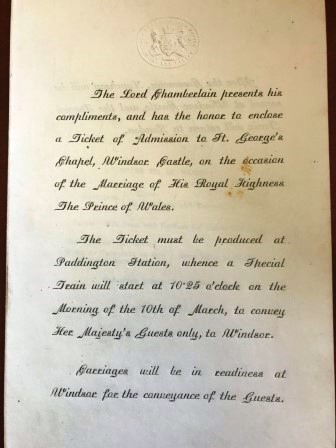
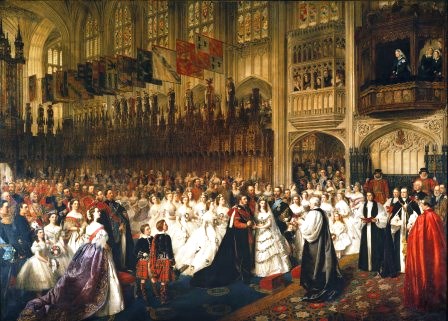
On May 19th, HRH Prince Harry and Ms. Meghan Markle will wed at St. George’s Chapel in Windsor Castle. The couple has decided to update several royal wedding rituals, but their choice of venue is steeped in tradition. On March 10, 1863, Prince Harry’s great-great-great-grandfather, Prince Edward VII, married Princess Alexandra of Denmark in the same chapel. As with so many historical events, an Adams was there to witness and record it.
Charles Francis Adams was serving as U.S. minister to the Court of St. James’s when his invitation to the heir apparent’s wedding arrived. With his son Charles Francis 2d fighting in the American Civil War, the elder Adams had more pressing concerns on his mind. But, as evidenced by the dwindling number of documents crossing his desk, the British were absorbed by the union of their future king and queen, and it was Adams’s diplomatic obligation to attend. (To read more about CFA’s diplomatic career, see his 1861–1865 diaries that have been digitized by the MHS and are available here.)
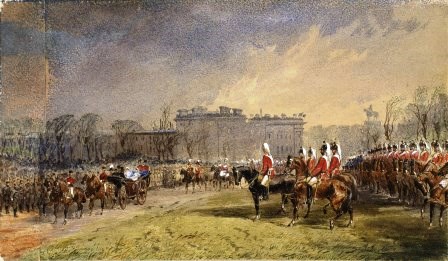
With five days left before the wedding, Charles Francis took his wife, Abigail, to Garrard’s to see the diamond jewelry prepared for Princess Alexandra. Adams recorded in his diary that employees told him the crowds of oglers “had been constant since nine in the morning.” Three days before the nuptials, Charles Francis took his youngest son, Brooks, to observe the public’s reception of Alexandra herself. The streets of London were mobbed with Brits hoping to catch a glimpse of the young bride. Though he and his son (uncomfortably wedged in the mass of humanity) waited more than an hour to witness the event, “the banners of the Livery companies and the quaint dresses of some of the servants and postilions constituted all the display.” Princess Alexandra and Prince Edward processed in a carriage surrounded by horsemen and escorting coaches. “The thing itself was not worth the trouble of seeing,” Adams reflected, “but the city of London in a convulsion of enthusiasm about a girl of eighteen of whom nobody yet knows anything good or bad, fully repaid my fatigue.” On the night before the wedding, Charles Francis and Brooks again ventured out into the cold to observe the men arranging the “illuminations,” or fireworks, prepared for the occasion.
Adams and his wife woke early on the day of the ceremony, braved heavy fog and the crowds at Paddington Station and boarded the train to Windsor Castle. Once inside, the Adamses took their designated place at the north side of the altar and waited for the ceremony to begin.
“The scene was very impressive,” Adams wrote of the chapel space. “Here amidst the emblems of a remote age were assembled all there is of rank and official reputation in the kingdom. Here the greatest dignitaries of the Church performed the solemn service which waited a young couple destined under Providence to continue the line of monarchy for another age.”
Adams noted how young the bride and groom were—Edward was 21 and Alexandra was 18—and mentioned that the couple “are supposed to be attached,” which he recognized as a rarity for royal unions. Charles Francis was impressed by their calm demeanor, especially young Alexandra’s as he looked down upon her and her eight bridesmaids kneeling at the altar. The Archbishop of Canterbury performed the half-hour service, and the newlyweds left the chapel to Beethoven’s “Hallelujah” chorus. Guests were then ushered into St. George’s Hall for refreshments.
“With the surroundings of the royal family, the household and the Court resplendent with gay attire for the first time the conception dawned upon me of the political importance of all the paraphernalia that surround a throne,” he wrote. “Satin and lace and diamonds and gold embroidery all contribute to make a pageant which knits the wealth of the land into the texture of the crown itself. It is a ponderous machine enough, but may-be necessary.”
Baseball season is in full swing and this year marks the 100th anniversary of the 1918 World Series, a series that became a part of city lore ever since the “Curse of the Bambino” was cast on Boston. Baseball has a long history in Boston which precedes the Red Sox, the Curse of the Bambino, and even Fenway Park.
Bostonians have enjoyed playing baseball since the 1850s and in 1871 Boston acquired a team in the newly formed National Association of Professional Base Ball Players. Boston manager William Henry (Harry) Wright helped organize the National Association and went on to lead the Boston Red Stockings to four consecutive pennants. In 1874, Wright even took his unstoppable Red Stockings to England in hopes of popularizing baseball worldwide. By 1876 the National Association was replaced by the National League, a change which provided players more stability as they were bound to specific clubs.
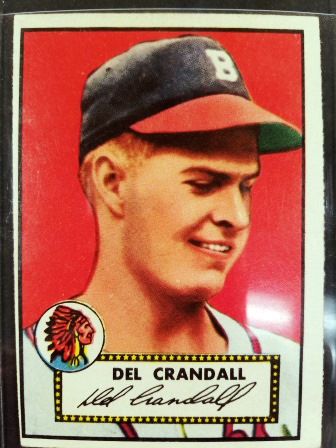
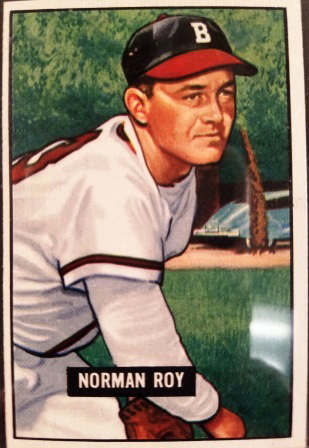
Boston Braves Baseball Cards, circa 1949Boston Braves Baseball Cards, circa 1949
By the turn of the 20th century Boston had not one but two teams: the National League had the Boston Braves (formerly the Red Stockings, Red Caps, and Beaneaters), and the upstart American League had the Boston Americans. Each team had their own playing field in the city. The Braves played on the South End Grounds, moving in 1915 to Braves Field on Commonwealth Avenue (current site of Boston University’s Nickerson Field). After 82 years in Boston, 1871-1952, the Braves moved to Milwaukee in 1953, and then to Atlanta in 1966. The Boston Americans played at the Huntington Avenue Baseball Grounds – located just over the railroad tracks from the South End Grounds – from 1901 to 1911, and was the site of the first modern World Series in 1903 when the Boston Americans played the Pittsburgh Pirates. In 1908, the moniker for Boston’s American League team was officially changed to the Red Sox, and in 1912 the team relocated to the newly-built Fenway Park.
Cy Young and other baseball players at the Huntington Avenue Grounds
The above image of the Huntington Avenue Grounds was also featured on the MHS website as the July 2017 Object of the Month. Click on the link to see more information about the grounds, as well as suggestions for further reading about Boston’s baseball past.
*****
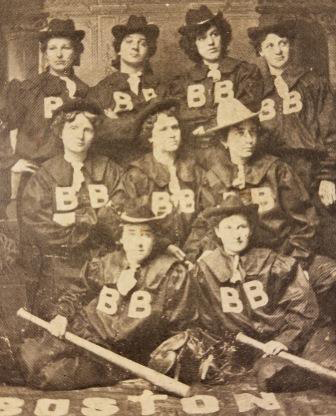
More interesting than the Boston Americans or the Boston Braves, though, is another local team that most have never heard of…The Boston Bloomers!
Women’s baseball teams, called Bloomer Teams due to the preferred “bloomer” style of dress which allowed for easier play, were popular all across the country between 1890 and 1930. These women traveled the country, wore pants, and received pay as professional players, providing a level of independence that was uncommon in a time when such “priveleges” were often not extended to women.
The Boston Bloomers, [photograph] [ca.1890s-1910s].Bloomer teams began in colleges in New England and New York, then spread across the country as hundred of women started playing baseball. The teams often consisted of seven women and two men who barnstormed the country playing local amateur, semi-pro, and minor league men’s teams. Sadly, the Bloomer Teams lost popularity with the onset of World War I and the pioneering women of baseball were soon forgotten. Women such as Boston Bloomer Maud Nelson – a famous pitcher who went on to form and manage her own team in 1911, the Western Bloomer Girls – are only now gaining recognition for their contributions to the game.
If you are interested in learning more about the role of women in America’s Pastime, consider joining us next month for The All-American Girls: Women in Professional Baseball, a panel discussion led by Gordon Edes, offical historian of the Boston Red Sox. Click the link to find out more the event and how to register.
When men across the country entered the draft for World War II, Philip Wrigley foudned the All-American Girls Professional Basebeall League in hopes of keeping baseball alive. The league started in 1943 and lasted until 1954. In 1992, the league was made famous by the feature film “A League of Their Own,” and lead many to believe that this was the first time women took the field professionally. In truth, they were following int he footsteps of their talented foremothers, the Bloomer Girls.
To find out what else the MHS holds relating the nation’s game, you can search our online catalog ABIGAIL, and when you find something interesting, consider Visiting the Library to see it in the reading room!
The week ahead is a little bit lite on the number of public programs available. However, the MHS is pleased to announce that the newest exhibition is now open for viewing! The Furniture of Isaac Vose & Thomas Seymour, 1815 to 1825 is open to the public free of charge Monday-Saturday, 10:00AM – 4:00PM.
Here are the other events taking place this week:
– Tuesday, 15 May, 6:00PM : In 1805 and 1806, former vice president Aaron Burr traveled through the trans-Appalachian West gathering support for a mysterious enterprise, for which he was arrested and tried for treason in 1807. The Burr Conspiracy was a cause célèbre of the early republic-with Burr cast as the chief villain of the Founding Fathers—even as the evidence against him was vague and conflicting. James E. Lewis, Jr. of Kalamzaoo College will explore how Americans made sense of the reports of Burr’s intentions and examine what the crisis revealed about the new nation’s uncertain future.
This talk is open to the public and registration is required with a fee of $10 (no charge for MHS Members and Fellows or EBT cardholders). Pre-talk reception begins at 5:30PM, followed by the speaking program at 6:00PM.
– Thursday, 17 May, 6:30PM : We invite you to join us for a festive evening in support of the Center for the Teaching of History at the MHS featuring Harvard President Drew Faust in conversation with MHS President Catherine Allgor. The evening will begin with a cocktail reception. A seated dinner will follow. Feast, sip, and celebrate history at the eighth Cocktails with Clio!
– Saturday, 19 May, 10:00AM : The History and Collections of the MHS is a 90-minute docent-led walk through our public rooms. The tour is free, open to the public, with no need for reservations. If you would like to bring a larger party (8 or more), please contact Curator of Art Anne Bentley at 617-646-0508 or abentley@masshist.org.
This is the sixth post in a series about the wartime experience of Charles Cornish Pearson. Go back and read Part I,Part II,Part III, Part IV, and Part V for the full story.
After the Battle of Château-Thierry on 18 July 1918, Sgt. Charles Cornish Pearson of the 101st Machine Gun Battalion, American Expeditionary Forces, was granted a 48-hour leave, so he went to Paris to see the sights. (These two days, 6-8 August, would be his only leave during the war.) Of course, he enjoyed the respite very much, calling Notre-Dame Cathedral “the most wonderful building I ever saw, but I haven’t spent all my time admiring buildings.” He sent postcards to his family back home, including one to his little niece from “Uncle Buster.”
Just a few days after rejoining his battalion, Charles was on the road again. According to Philip S. Wainwright’s history, the 101st moved several times between mid-August and mid-September, first southeast to the town of Étrochey, then northeast again to the Rupt Sector. There the battalion took part in the Battle of Saint-Mihiel, which Charles described in an eight-page letter to his sister Jean, dated 15 September 1918. He began with his arrival at the front and what he saw as he came over a hill.
What a scene. Those guns had knocked those trenches some I can tell you, and the trenches were pretty well destroyed. Pill boxes, concrete dugouts & everything had been knocked to pieces in fine shape.
Charles spared Jean the grisly details—every letter had to pass the watchful eyes of censors, and the Censorship Bureau had forbidden any mention of casualties. But he did tell her about the grueling hikes to various positions, the sight of villages burning in the distance, and the capture of hundreds of German soldiers “who offered no resistance & seemed only too glad to be thru with the war.” The war was taking its toll on Charles, too, who wrote his Aunt Florence that same day, “It is great to be in all these drives but I tell you they are heart breakers and at times you wonder how you are going to keep going but still you manage it someway.” He longed for civilian life, but was proud of his service and the bravery and comradeship of his fellow soldiers.
A lot of Charles’ correspondence deals with items shipped back and forth between France and the U.S. His family sent care packages, and he sometimes requested specific items. For example, there’s this great insight into the life of a soldier:
Mighty glad to learn from Dads letter that you are sending a couple of books over. Any late popular & light fiction appeals to one over here. Of course one reads a great deal about the boys desiring the serious heavy stuff but far from it. They get too much of that in their days work. Any thing that will bring a smile is worth a thousand dollars I can tell you.
Meanwhile, Charles sent gifts home when he could, including a German helmet and gas mask for his nephew Bobby. “Suppose they are rather gruesome articles,” he admitted. He’d retrieved them himself from enemy lines after the German troops were driven off, weaving his way through the French trenches, across No Man’s Land, over barbed wire, and around shell holes—“havoc,” he called it, left by four years of fighting. He was impressed by the German trenches, though, some of which were 40 or 50 feet deep.
The spoils most prized by Allied soldiers were German pistols, belts, and belt buckles carved with the famous motto “Gott mit uns.” I don’t know if Charles ever found those, but he did send a second helmet to his brother Bill.
Picked yours up near a dead Hun. Didn’t quite feel like taking the one he had on although someone ahead of me had evidently cut his belt off for a souvenir. I am not quite so keen after souvenirs as that. Dont mind the sight of the dead but not very keen for handling them.
As always, Charles was humble about his letters. He wrote to Bill on 6 October 1918:
Am afraid my letters prove rather uninteresting reading as a rule. I don’t write an awful lot about this war stuff practically impossible to describe it in the proper way. It is a good deal made up of sensations and some of them aren’t especially pleasant.
Stay tuned for the seventh and final chapter of Charles Cornish Pearson’s story.