Welcome to Our 2018-2019 MHS-NEH Fellows!

By Lex Buckley, Research Dept.

The Massachusetts Historical Society’s Research Department is pleased to announce our two 2018-2019 MHS-NEH Long-Term Fellows, Mara Caden and Brent Sirota. Mara Caden will be researching the mint and early economic conditions in New England, and revising her book manuscript, which comes out of her Yale University dissertation, “Mint Conditions: The Politics and Geography of Money in Britain and Its Empire, 1650-1750.” Brent Sirota is an associate professor at North Carolina State University, and will be researching and writing his second monograph, Things Set Apart: An Alternate History of the Separation of Church and State, examining how people in the 18th– and 19th-century British Atlantic maintained their religion separate from the state after 1689.

Caden and Sirota join a renowned group of current and former MHS-NEH fellows. The long-term fellowship began in 2002, and the National Endowment for the Humanities has helped to support long-term fellows every year since. NEH support has allowed the MHS to have fellows spend four to twelve months as not only researchers, but as part of the scholarly and collegial fabric of the Massachusetts Historical Society. Our 2017-2018 fellows have presented at MHS seminars and brown bag lunches, and prior fellows have presented at MHS conferences and elsewhere in the city of Boston during their tenure here, and often return to the MHS to serve on committees for seminars, conferences, and future fellowship selections. As well as taking the opportunity to share their research and historical expertise in these formal settings, our MHS-NEH fellows—many of whom are established scholars in their fields—also foster an intellectual atmosphere at the Society by taking local graduate students and short-term fellows under their wing. They attend other researchers’ presentations, invite them for coffee, and offer advice on archives to visit, collections to search, and ways to read documents, artifacts, and silences. Our long-term fellows come from History, English, Political Science, Drama, and other fields, and their innovative methods and deep understandings of their field have broadened research horizons for younger fellows and students for over a decade.

Of course, such erudite scholars also use their long-term fellowships to research and write, and have published impressive works on a wide variety of subjects. From the fellowship’s first year in 2002-2003, we had Walter Woodward, who was working on Prospero’s America: John Winthrop, Jr., Alchemy, and the Creation of New England Culture, 1606-1676. There is 2003-2004 fellow Woody Holton’s research project, “Minds Afire,” now the book, Unruly Americans and the Origins of the Constitution; Lisa Wilson’s A History of Stepfamilies in Early America; Lisa Tetrault’s The Myth of Seneca Falls: Memory and the Women’s Suffrage Movement, 1848-1898; Vincent Carretta’s biography of Phyllis Wheatley; Martha Hodes’s Mourning Lincoln; Linford Fisher’s The Indian Great Awakening; and many, many more stellar works produced and forthcoming. (Keep an eye on our fellows’ publications page to read what comes out next!)

In sum, we couldn’t be more excited to have Caden and Sirota join an already prestigious array of long-term fellows in enriching the field with the scholarship they’ll produce here, and enriching the MHS with the expertise that they’ll share with young fellows and researchers during their stay. And we couldn’t offer any of this without the generous support and encouragement from the National Endowment for the Humanities!

(For more on the National Endowment for the Humanities, see their webpage. For more on our long-term MHS-NEH fellowships and past recipients, please visit http://www.masshist.org/2012/research/fellowships/long-term.)
 

From Absolute Monarchy to Absolute Demon: “Identity of Napoleon and Antichrist”

By Ashley Williams, Reader Services

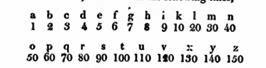
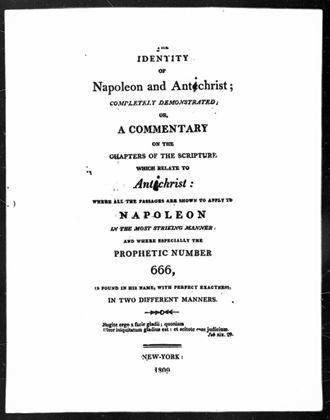
As a newer library assistant in the MHS library, I occasionally peruse different subjects in ABIGAIL in the hopes of further familiarizing myself with topics our collections cover. Often, the search topics pertain to my own historical interests. A few months ago I was looking into our Napoleon-related materials when I came across this leviathan of a title: The Identity of Napoleon and Antichrist completely demonstrated, or, A commentary on the chapters of the Scripture which relate to Antichrist [microform] : where all the passages are shown to apply to Napoleon in the most striking manner : and where especially the prophetic number 666 is found in his name, with perfect exactness, in two different manners. 


This “observation,” as defined by the text, has no attributed author but was published by Ezra Sergeant in 1809, the same year the War of the Fifth Coalition was fought. It is no great secret that Napoleon had enemies, but to realize that he was despised enough to be compared as Antichrist was too thought-provoking a concept to let lie. As soon as time afforded, I pulled out the microfilm to take a peek.

Before diving into the topic of their reflection the author takes a few pages to chastise philosophers like Locke, Rousseau, and Voltaire for furthering the spread of deism and religious tolerance, seeing it as promotion for war against Christianity:

We never ought to use against any body the arms of satire and ridicule, which both reason and Religion disown. But to permit in this way the weakest boldly and openly to make war against the strongest, to tolerate it, and not to take care sometimes to set every one at his proper place, is what I consider as entirely abusive.


Throughout the work, the author notes what they consider to be several blatant parallels between passages from the Bible’s book of Revelations and Napoleon’s reign. They conclude that Napoleon and “the beast” share the same origins as the beast is prophesied to emerge from the sea and Napoleon, being Corsican, comes from an island.

The parallel of second beast is given to Charles Maurice de Talleyrand-Périgord, a French diplomat known for promoting the nationalization of church property in France during the beginnings of the French Revolution. The description of the second beast reads, “And he exerciseth all the power of the first beast before him, and causeth the earth and them which dwell therein to worship the first beast, whose deadly wound was healed.” (Revelation 13:12)

Tallyrand played a large role in foreign ministry under Napoleon and was eventually appointed grand chamberlain. He worked to keep peace with the British and encouraged the signing of the Concordat of 1801 which mended the alliance between France and the Papacy.² Unfortunately, he was also an accessory to the kidnapping and execution of a Bourbon prince and attempted to steal from the French National Archive to hide his involvement.¹ While this was a crime to the outside world, it helped to safeguard Napoleon’s rule. The author attributes a great deal of Napoleon’s success to the tireless work of Talleyrand which earns him the parallel.

After assigning the roles of Revelation to different people and countries, the author interprets the symbolism they perceive in the mark of the beast:

And he causeth all, both small and great, rich and poor, free and bond, to receive a mark in their right hand, or in their foreheads: And that no man might buy or sell, save he that had the mark, or the name of the beast, or the number of his name. (Revelation 13:16-17)

Given that Napoleon’s rule was arguably one of militant conquest the author argues that this mark in the hand or forehead is materialized by the French cockade, typically worn in hats, and the swords of the French military. To make applicable the hindrance of buying and selling in verse 17, the author alludes to Napoleon’s interference with European trade. In 1806, Napoleon issued the Berlin Decrees forbidding trade between his allies and England in the hopes of wounding England’s economy.³ This was not altogether unsuccessful, however, since England ruled the seas and moving goods over land was rather expensive, many of continental Europe’s economies suffered as well.

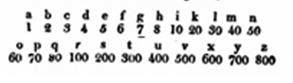
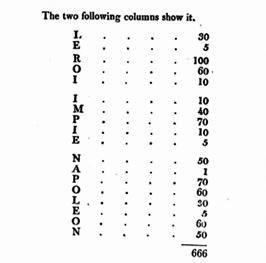
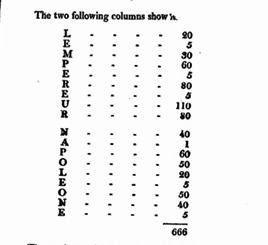
One of the final and farthest reaching pieces of evidence our author declares is mentioned in the title, “…where especially the prophetic number 666 is found in his name…” The author uses two different series of numbers aligned with letters of the English alphabet to spell out different versions of Napoleon’s name. In each case the numerical values assigned to the letters in his name equal 666. 


One can’t help but wonder just how many combinations of numbers and names the author calculated before getting the desired results.

These are just a few highlights of the connections drawn in this work. If you are interested in reading more parallels or perhaps viewing other Napoleon-related materials, check our online catalog, ABIGAIL, and consider stopping by the library for a Visit!

*****


1. “Charles-Maurice de Talleyrand, prince de Bénévent | French statesman and diplomat”. Encyclopedia Britannica, Accessed 2018-03-09 at https://www.britannica.com/biography/Charles-Maurice-de-Talleyrand-prince-de-Benevent.

2. “Concordat Of 1801 | French Religious History”. Encyclopedia Britannica, Accessed 2018-03-09 at https://www.britannica.com/event/Concordat-of-1801.

3. “Continental System | European History”. Encyclopedia Britannica, Accessed 2018-03-09 at https://www.britannica.com/event/Continental-System#ref71521.


This Week @ MHS

By

It is a fairly quiet week ahead, so this round-up will be brief:

– Wendesday, 14 March, 6:00PM : Between 1638 and today, the Browns of Rhode Island have provided community leaders, endowed academic institutions, and transformed communities through art and architecture. However, they also have wrestled with society’s toughest issues slavery, immigration, child labor, inequality and with their own internal tensions. Sylvia Brown, of the family’s 11th generation and author of Grappling with Legacy, explores this story in conversation with Edward Widmer.

This event is open to the public, though registration is required with a fee of $10 (no charge for MHS Members or Fellows, and EBT cardholders). 

– Saturday, 17 March, 9:00AM : “Monuments & Historical Memory” is a teacher workshop that explores how monuments can help students understand history, historical memory, and how national symbols play a critical role in articulating culture and identity. Highlights include looking at WWII and Holocaust commemoration across the globe; learning about the history of Confederate monuments in America; and a tour of Reconstruction-era Boston monuments. 

This program is open to all K-12 educators, and registration is required with a fee of $25 per person. 

– Remember to come in and view our current exhibition, Yankees in the West, before it ends on 6 April. 


There is no Saturday tour this week.

“Too many things to do in the cause”

By Susan Martin, Collection Services

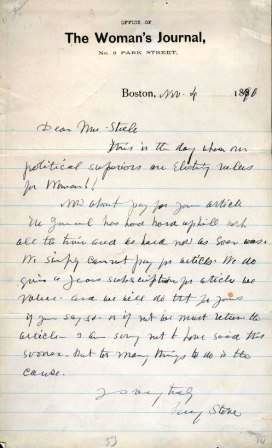
As I looked through the MHS collections for a Massachusetts woman to profile for Women’s History Month, I found myself faced with an embarrassment of riches. Our library holds the papers of female writers, doctors, teachers, artists, war volunteers, and mill workers, not to mention slaves and First Ladies. I decided to go back to a letter acquired by the MHS a few years ago. The letter was written by Lucy Stone on election day 1890, and I remembered her terrifically snarky opening sentence: “This is the day when our political superiors are electing rulers for Women!!”


Lucy Stone (1818-1893) was a suffragist and abolitionist from West Brookfield, Mass., famous for her oratory at a time when public speaking by women was considered scandalous and unfeminine. According to one account, before an appearance by Stone, a certain minister warned his congregation that “a hen will undertake to crow like a cock.” Opponents of her speeches shouted her down, threw hymn books at her, and even once dowsed her with water from a hose. As Sally G. McMillen wrote in her biography Lucy Stone: An Unapologetic Life (2015):

To say that most mid-nineteenth-century Americans deemed this occupation wholly inappropriate for women was a truism. Women were not supposed to have a public persona; they were supposed to marry and spend their lives in the quiet of home. And the two causes that Lucy espoused on which she intended to speak were radical ones. [p. 63]


Stone is also known for her refusal to take her husband’s name when she married—later advocates of this practice were often called “Lucy Stoners.”

This letter was written on the stationery of the Woman’s Journal, a paper founded in 1870 by Stone, her husband, and other like-minded reformers. The recipient, Mrs. Steele, had submitted an article, and Stone wrote back to explain that she couldn’t pay for contributions; the paper “had hard uphill work all the time and as hard now as ever was.” She offered Steele a one-year subscription instead and finished with: “I am sorry not to have said this sooner. But too many things to do in the cause.”

I had hoped to identify Mrs. Steele, but unfortunately came up empty. I did find three possible candidates: Lucy Page Steele of Washington, D.C., who wrote for the Young Woman’s Journal; Anna (Truax) Steele, wife of Colorado’s Chief Justice Robert W. Steele; or Carrie Steele, the “Mother of Orphans,” a former slave and founder of an African-American orphanage in Atlanta, Ga.

Lucy Stone did not live to see the battle for suffrage won for all American women, which wouldn’t happen for 27 more years with the passage of the Nineteenth Amendment. But less than three weeks after her death, on 7 November 1893, Colorado became the first state to enact women’s suffrage through popular vote.

Lucy Stone, Abigail Adams, and Phillis Wheatley are honored in the Boston Women’s Memorial on the Commonwealth Avenue Mall.

Barbara Hillard Smith’s Diary, March 1918

By Lindsay Bina, Intern and Anna Clutterbuck-Cook, Reader Services

Today we return to the 1918 diary of Newton teenager Barbara Hillard Smith. You may read our introduction to the diary, and Barbara’s January and February entries, here:


January | February | March | April

May | June | July | August

September | October | November | December


We will be following Barbara throughout 1918 with monthly blog posts that present Barbara’s daily life — going to school, seeing friends, playing basketball, and caring for family members — in the words she wrote a century ago. Here is Barbara’s March, day by day.


* * *

FRI. 1                          MARCH

School. Dentist Cousin Bert came. Papa glad to see him, Sick

SAT. 2

Showed C. Booklet to K. Heard Galli Curci. She is wonderful. Seminary with Mother


SUN. 3

Helped Mother. Studied

MON. 4

School. Mrs. Reed’s. Papa died. Grandma very brave, Mother is wonderful. C. Burt came.

TUES. 5

Aunt Mabel gave Mother her car. She is very busy. People are very kind. Cousin Bert is the [back…]

WED. 6

Everything peaceful. Deluged with flowers. Funeral services very sweet + pretty. C. Bert went back.

THUR. 7

I must stand up for Mother. Worked. Flowers from […]. Waltham with Mrs. Pyrene. Hard to keep tears back

FRI. 8

Worked. Doctors with Mother. Things [go] a little easier. I feel like crying all the time.

SAT. 9

Helped Mother. Got Camp Fire Cocoa. Mrs Richmond came. Wood called up. At McDonalds

SUN. 10

Church. Sunday S. Cousin Mildred to dinner. Dr. Huntington.

MON. 11

School. Mrs. Reed

TUES. 12

School. Basket Ball

WED. 13

School. Gym dancing. Swimming

THURS. 14

School. Basketball. Got on class team

FRI. 15

School. Took care of the baby. Captain of the team

SAT. 16

Sewed at Mrs. Bucknams. Over to Lanes. Went swimming

SUN. 17

Shot Cat. Church and Sunday School. Moody’s for supper. Mr. Bailey out.

MON. 18

School. Took care of baby. Got [byce] out. Living Pictures.

TUES. 19

School. Played the Freshmen. 16-5 s. Juniors beat 30-0. Saw Dr. Ashland.

WED. 20

School. Rehearsed dancing. Swimming.

THUR. 21

School. Played the Juniors. They beat us. 25-10. Saw Dr. Ashland.

FRI. 22

School. Mrs. Reed’s. Newton-Erasmus game. We licked em up. War is awful

SAT. 23

Mrs. Reed’s all day.

SUN. 24

Church. Sunday School. Saw Dr. Ashland ([nude]). He seems much better. Dr. McClure.

MON. 25

School. In Town. Got suit. It seems funny without paper.

TUES. 26

School. Went to Mrs Reeds. Sick.

WED. 27

School. Dancing. In Town. Peg went with me.

THUR. 28

School. Mrs. Reed’s. Wrote Dr. Gordon

FRI. 29                                    GOOD FRIDAY

No School. Mrs. Reed’s all day. Surgical dressings

SAT. 30

Mrs. Reeds. In town. Got new hat

SUN. 31                      EASTER

Church[,] Sunday School and Concert. [Fraulein] and Miss [Colin] to dinner.

* * *

If you are interested in viewing the diary in person in our library or have other questions about the collection, please visit the library or contact a member of the library staff for further assistance.


 *Please note that the diary transcription is a rough-and-ready version, not an authoritative transcript. Researchers wishing to use the diary in the course of their own work should verify the version found here with the manuscript original. The catalog record for the Barbara Hillard Smith collection may be found here.


This Week @ MHS

By

As of this writing, it is a very dreary and soggy day outside. After you dry your bones this weekend, consider visiting the MHS in the week ahead for one or more of these upcoming events:

– Tuesday, 6 March, 5:15PM : We start our programs this week with a seminar combo, bringing together Environmental History and Early American History into one neat package. “Common Spaces: Environmental History and the Study of Early America” is a panel discussion with Christopher Pastore, State University of new York at Albany; Nancy Shoemaker, University of Connecticut at Storrs; and Conevery Bolton Valencius, Boston College; with Matthew McKenzie of University of Connecticut at Avery Point moderating. Environmental historians are concerned with concepts such as ecological imperialism and non-anthropocentric empires, built and natural environments, controlling and organizing space, and the relationship between borders and frontiers. How does or might this influence scholarship on early America? How can work on early American history enrich environmental historians’ understanding of empire, metropoles and borderlands, movement and colonization?

Seminars are free and open to the public; RSVP requiredSubscribe to receive advance copies of the seminar papers.To RSVP: email seminars@masshist.org or call (617) 646-0579.

– Wednesday, 7 March, 12:00PM : The Brown Bag discussion this week features G. Patrick O’Brien of University of South Carolina, who presents “A Massachusetts Family’s Exile & Return, 1775-1790.” After being forced to flee Marblehead in May 1775, the Robie family joined fellow refugees in Halifax, Nova Scotia. In exile, each family member developed a unique perspective on his or her new home and outlook for the future. Repatriation further complicated these understandings and divided the family between two nations. This project explores how a family in exile struggled to maintain kinship networks while its members adapted to a new social environment. This talk is free and open to the public. 

– Wednesday, 7 March, 6:00PM : Join us for an author talk with Liesl Olson of the Newberry Library as she discusses her recent work, Chicago Renaissance: Literature and Art in the Midwest Metropolis. From the 1893 World’s Fair through mid-century, Chicago writers revolutionized literary forms during the first half of the 20th century, a period of sweeping aesthetic transformations all over the world. Olson’s enthralling study bridges the gap between two distinct and equally vital Chicago-based artistic “renaissance” moments: the primarily white renaissance of the early teens and the creative ferment of the “Black Metropolis” of Bronzeville. This talk is open to the public, registration required with a fee of $10 (no charge for MHS Fellows and Members or EBT cardholders). 

– Saturday, 10 March, 10:00AM : The History and Collections of the Massachusetts Historical Society Tour is a 90-minute docent-led walk through our public rooms. The tour is free, open to the public, with no need for reservations. If you would like to bring a larger party (8 or more), please contact Curator of Art Anne Bentley at 617-646-0508 or abentley@masshist.org.

While you’re here you will also have the opportunity to view our current exhibition: Yankees in the West.

Book Review: “The Palatine Wreck: The Legend of the New England Ghost Ship”

By Erin Weinman, Reader Services


For nearly three centuries, stories of a burning ghost ship haunted the residents of Block Island, Rhode Island. Although it is unknown what it was witnesses have seen, the origin of “The Palatine Light” tells a different tale then the one passed down through popular culture. The Palatine Wreck: The Legend of the New England Ghost Ship by Jill Farinelli examines how the legend developed from the wreck of the Princess Augusta and explores how legends can emerge from public memory. By examining surviving letters of passengers, notarial records, and newspaper accounts of merchant ships, Farinelli was able to piece together a narrative of the Princess Augusta’s final journey in 1738 (xv-xvii). Further information on witnessed accounts of the ghost ship and surviving artifacts of the shipwreck was provided by Block Island’s historians. Jill Farinelli has worked as a freelance writer and editor for twenty-five years in Boston, Massachusetts. The Palatine Wreck is her first work of historical non-fiction.

In January 1867, the poet John Greenleaf Whittier published a poem titled “The Palatine” in the Atlantic Monthly. Based on a tale he heard from a friend, the poem was the first to launch the legend of “The Palatine Light” into mainstream society (158).

“The Palatine Light, from an illustration in the Providence Evening Bulletin, September 12, 1933. Image courtesy of the Boston Public Library.”


For still, on many a moonless night,

From Kingston Head and from Montauk light

The spectre kindles and burns in sight.


Now low and dim, now clear and higher,

Leaps up the terrible Ghost of Fire,

Then, slowly sinking, the flames expire.


And the wise Sound skippers, though skies be fine,

Reef their sails when they see the sign

Of the blazing wreck of the Palatine!


They burned the wreck of the Palatine.”


The origin of the Palatine Light legend began in 1738. Palatines, a name given to the people who resided in regions along the Rhine of modern-day Germany, began emigrating in vast numbers in the early 18th-century. As Farinelli examines, over 6,500 emigrants made their way to the British colonies in 1738 alone in hopes of a better economic opportunity in the Pennsylvania colony (169). Unfortunately, the 1738 sailing season would be one of the deadliest in history, with a death rate of 35 percent. Massive storms in the Atlantic and ill-preparation for numerous overcrowded ships were to blame. The Princess Augusta departed from Rotterdam in June 1738 with an estimated 340 passengers. While only 68 would survive the journey across the Atlantic, it was the ship’s destruction within the sandbanks of Block Island that brought wide-spread attention to the voyage.

Farinelli explores how such a common story captivated the public’s mind in final section of the book. Why was the Princess Augusta the event to be immortalized? One idea Farinelli explores is the rise of the Spiritualist Movement in the 19th century. People became interested in the paranormal and were simply captivated by stories believed to be started by the ship’s survivors, allowing them to remain popular amongst New Englanders (144-145). While Farinelli and other researchers are unsure what exactly caused the illusion of a burning ship, the legend has been embraced by many New Englanders.

“Map of Block Island.

Map: Patti Isaacs, 45th Parallel Maps and Infographics.”


Farinelli’s research on the works of 19th-century New England writers, interviews with local Block Island historians, and years of researching Palatine emigration allows The Palatine Wreck to work as a case study for how history can transform itself into legend. A mixture of human tragedy fueled by the national rise in Spiritualism sparked interest amongst artists, who used the legend within their own fictional works. Whittier may have been the most famous example, but a number of writers had interpreted the event in their own ways. The emergence of Spiritualism sparked interest in these types of tales, combined with increased tourism in Block Island. At the end, Farinelli points out that this isn’t necessarily a bad thing.

In the end it doesn’t matter whether the Palatine Light is a phantom, a figment, or a floating mass of dinoflagellates. Because the light has become an integral part of the legend, its reappearances has served a continual reminder of the tale. Without it, the Princess Augusta and its many passengers lost to the sea, would be lost to history as well. (152).

This book may be of particular interest to those who study transatlantic migration, German migration, and the development of public memory. Local New England residents who are familiar with the tale of “The Palatine Light” may also be interested, as the book provides a thorough background to the incident. The Massachusetts Historical Society holds a number of collections that complement the themes of this book including Palatine migration, transatlantic history, spiritualism, and maritime culture: 


Manuscripts

Depositions of officers of the Palatine ship Princess Augusta, 1939

The Palatine, or, German immigration to New York and Pennsylvania, 1897

John Erving logbooks, 1727-1730

Log of the Brigantine Dolphin, 1732-1734


Printed Material

Early eighteenth century Palatine emigration: a British Government Redempitioner Project to Manufacture Naval Stores by Walter Allen Knittle [Philadelphia: S.N., 1936]

Boston in the Golden Age of Spiritualism: Séances, Mediums, and Immortality by Dee Morris [Charleston, SC: History Press, 2014]


To work with these materials, or any other collections at the MHS, consider Visiting the Library!

*****

[Updated, 5 March 2018, to include images.]

This Week @ MHS

By

Here is a look at events taking place at the Society in the week ahead as the calendar turns another page:

– Monday, 26 February, 6:00PM : Starting things off this week is an author talk with Pual Finkelman of Gratz College. Supreme Inustice: Slavery in the Nation’s Highest Court examines the careers of three important antebellum Supreme Court Justices: John Marshall, Roger B. Taney, and Joseph Story, who all upheld the institution of slavery in multiple rulings. Finkelman establishes an authoritative account of each justice’s proslavery position, the reasoning behind his opposition to black freedom, and the incentives created by his private life. This talk is open to the public, registration required with a fee of $10 (no charge for MHS Fellows and Members, or EBT cardholders). Pre-talk reception begins at 5:30PM, followed by the speaking program at 6:00PM. 

– Tuesday, 27 February, 5:15PM : This week’s seminar is part of the Modern American Society and Culture series and is a panel discussion. In “Capitalism and Culture,” Jonathan Cohen of University of Virginia and Davor Mondom of Syracuse University examine the reaction against welfare state capitalism in the mid-20th century U. S., looking at two companies that promoted themselves as bastions of free enterprise or as a solution to high state taxes. Sven Becker of Harvard University provides comment. 

Seminars are free and open to the public; RSVP requiredSubscribe to receive advance copies of the seminar papers. To RSVP: email seminars@masshist.org or call (617) 646-0579.

– Thursday, 1 March, 6:00PM : MHS Fund Giving Circle members are invited to Dinner with Dolley, a festive evening with good food, fine wine, and lively conversation inspired by Dolley Madison. During dinner, MHS President Catherine Allgor, who is known for her published work on Dolley Madison, will provide history and fun facts about dining with Mrs. Madison. 

This event is open only to MHS Fund Giving Circle Members. Join a Giving Circle today at www.masshist.org/support/mhsfund

– Saturday, 3 March, 10:00AM : The History and Collections of the Massachusetts Historical Society Tour is a 90-minute docent-led walk through our public rooms. The tour is free, open to the public, with no need for reservations. If you would like to bring a larger party (8 or more), please contact Curator of Art Anne Bentley at 617-646-0508 or abentley@masshist.org.

While you’re here you will also have the opportunity to view our current exhibition: Yankees in the West.

“He has been the great landmark of my life”: CFA on JQA’s death and legacy.

By Gwen Fries, Adams Papers

On a drizzly February morning in 1848, Charles Francis Adams, son of John Quincy Adams, walked into his Boston office. As he reached his desk, Adams noticed a telegraph that communicated that his father “whilst in his seat at the House of Representatives at half past one o’clock was taken in another fit of paralysis and that it was not thought he could survive the day,” CFA wrote in his diary. Adams was on the next train south.

Charles Francis Adams, Photogravure, from “Portraits of American Abolitionists,” MHS.


Delays prevented Adams from making his connection to Philadelphia. As he waited for the next train, Adams began reading the book his wife had sent with him, Jane Eyre. That night, February 23rd, he anxiously read a newspaper that had reports from 11 p.m. on the 22nd that John Quincy “lingered.”

The next morning, while on the train to Baltimore, Charles Francis opened that day’s paper.

The first thing I saw was the announcement that at a quarter past seven last night my father had ceased to breathe. . . . Here then it is in all its reality— I have no longer a Father.

After another short layover in Baltimore, Charles Francis reached his parents’ home in Washington, D.C. He went straight upstairs to comfort his mother, Louisa Catherine. Charles Francis sat with her until it was time to go to bed.

She then told me she had no place to put me in but his room— And I went to it, just as he had left it on Monday morning: Yes there was his table and chair, his papers and writing materials, his bed and all his materials for his late sick life. And the animating spirit was not there and I was.

Charles Francis got little sleep.

The next day, his mother was “in a low, fainting state all day, and utterly unable to say any thing.” After a morning of greeting acquaintances and thanking them for their condolences, Charles Francis traveled to the House. He was ushered through crowds to the coffin, where he was left alone. “And here I was to take my last look upon one to whom for forty years I had been looking for support and aid and encouragement!” Charles Francis studied his father’s face through a glass pane and considered his future responsibilities. Poignantly, Adams reflected that he was “alone in the generation,” as his two older brothers and younger sister had all already passed away. He shed a few tears before returning to the committee room to discuss arrangements “until every nerve in me quivered.”

His mother being too unwell to attend, Charles Francis represented his family at the funeral. As he stood on the steps of the Capitol waiting for his carriage, he felt acutely the curious eyes of gawkers and resolutely stared ahead, reflecting on his father’s influence. “He has been the great landmark of my life,” Charles Francis wrote. “My stay and companion.” As he descended the stairs and climbed into the carriage, Adams prepared himself to become the Adams patriarch. “For the future I must walk alone and others must lean on me.”


This Week @ MHS

By

The Society is CLOSED on Monday, 19 February, for Presidents Day. 

It is a holiday-shortened week but there is still plenty of action happening here at the Society. Below are details for what we have on tap.

– Tuesday, 20 February, 6:00PM : Kendra Field’s epic family history, Growing Up with the Country, chronicles the westward migration of freedom’s first generation in the 50 years after emancipation. Fields traces the journey of her ancestors out of the South to Indian Territory, where they participated in the development of black towns and settlements. When statehood, oil speculation, and segregation imperiled their lives, some launched a back-to-Africa movement while others moved to Canada and Mexico. Interweaving black, white, and Indian histories, Field’s narrative explores how ideas about race and color powerfully shape the pursuit of freedom. 

This talk is open to the public. Registration is required with a fee of $10 (no charge for MHS Members and Fellows or EBT cardholders). Pre-talk reception begins at 5:30PM, followed by the program at 6:00PM. 

– Wednesday, 21 February : All K-12 educators are invited to register for Yankees in the West, an all-day teacher workshop. Using the Society’s current exhibition as a guide, participants will investigate how writers, artists, and photographers sensationalized the frontier experience for eastern audiences and conceptualized the West for Americans who increasingly embraced the nation’s manifest destiny. 

Registration is required for this program with a fee of $25 per person. 

– Wednesday, 21 February, 12:00PM : “Billets & Barracks: The Quartering Act & the Coming of the American Revolution” is a Brown Bag talk with John McCurdy of Eastern Michigan University. The arrival of British soldiers in the 1750s forced Americans to ask “where do soldiers belong?” This project investigates how they answered this question, arguing that it prompted them to rethink the meaning of places like the home and the city, as well as to reevaluate British military power.

This talk is free and open to the public. 

– Thursday, 22 February, 6:00PM : After the Civil War, artists and writers from Boston faced a question that haunted America: what’s next? For cultural leaders like Charles Eliot Norton and Isabella Stewart Gardner, Reconstruction left them feeling directionless and betrayed. Shunning the Whig narrative of history, these “Boston Cosmopolitans” researched Europe’s long past to discover and share examples of civil society shaped by high ideals. “For the Union Dead: Bostonians Travel East in Search of Answers in the Post-Civil War Era” is a public talk with Mark Rennella.

This program is open to all, free of charge, though registration is required. Click on the link and look for the Register button. 

– Saturday, 24 February, 9:00AM : The second teacher workshop this week examines how the personal and political philosophies of Justices John Marshall, Roger B. Taney, and Joseph Story influenced their proslavery positions. In “Slavery & the U.S. Supreme Court,” Paul Finkelman, President of Gratz College, will discuss why these three influential justices upheld the institution of slavery and continued to deny black Americans their freedom. Participants will connect these federal rulings to local court cases, as well as antislavery and abolitionist efforts to undermine these unpopular decrees. 

This program is open to all K-12 educators. Registration is required with a fee of $25 per person. 


There is no public tour this week.