“Vast awful & never ending Eternity”: Personal Accounts of Mourning

By Erin Weinman, Reader Services

I recently came across the Elizabeth Craft White diary, written in 1770 when the death of her husband left her distraught. “Life seems a burden to me since Death, Cruel, & unrelenting Death- has snacht from me the Partner of my heart: O fated Death how could you come, tho he called for thee why did you not pass by him, turn from him & flee away.” Elizabeth White’s diary lasted from December 26, 1770 until its sudden end on January 23, 1771. Throughout its passages, she questions the fate of her husband’s soul and laments over the ultimate fate of her own soul. The entries read more of a reflection of her own spiritual awareness as she makes it clear that she has accepted death’s presence and hopes that her daughter would be properly guided into heaven.
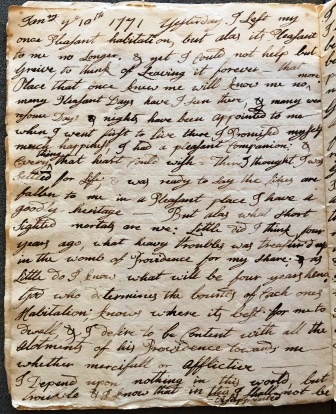
“Jan ye 10th 1771” 


The diary is heartbreaking, but Elizabeth White’s thoughts were not uncommon during a period in which mourning became intertwined with religious culture. In early Massachusetts, it wasn’t uncommon for people to use the death of a loved one as a time to reflect upon their own souls and ask God to forgive their sins, faced with the reality that their own end could be near. Ministers often encouraged their parishioners to keep diaries to embellish their faith in Heaven, viewing this as another way to become closer to God and to understand what death meant. Sermons often revolved around the topic of dying, such as Timothy Edwards’ All the living must surely die, and go to judgement.

Man is born to trouble as the Sparks fly upward tears sorrow & Death is the Portion of every person that is Born into the world. I have been born, most certainly & it is as certain that I must die & I know not how soon. Die I must! & die I shall! (Elizabeth White, January 18, 1771).

While Elizabeth White would live another 60 years, her words reflected those of many others who faced the prospect of death. While writing a diary was certainly a way to privately grieve and bring routine back into one’s life, the sentimentality can be found in countless other accounts. Public displays of mourning were common through sermons and poetry, much of which told personal stories to illustrate the importance of accepting our demise. In an undated poem titled A few lines to a Friend: Mourning the loss of a Beloved Wife, the author clearly states the purpose of a loved one’s death is to remember our own mortality.  
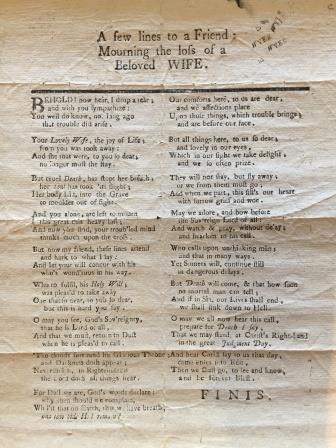
A few lines to a Friend: Mourning the loss of a Beloved WIFE,” n.d.


“O may we all now heart his call,

Prepare for Death I say,

That we may stand, at Christ’s Right-hand

In the great Judgement Day.


And hear Christ say to us that day,

Come enter into Reît,

Then we shall go, to see and know,

And be forever Blest.”


Such expressions were also common in letters of correspondence. In a Letter from William and Mary Pepperrell to their children, the Pepperrell’s express a similar sentiment at the death of their son.

Your kind & symathiseing Letter of this day we received for wich are oblig’d to you and as you justly observe that if this Great affliction may be wich we have meet with in ye Death of our Dear Son may be sancthifyed so as to warn our hearts from our Earthly Enjoyments & to set them more & more upon our Great Creator […]


As the living hoped to reflect upon death, there was also importance placed upon a person’s final words. Tracts were commonly produced to teach people of the importance of dying properly and to share examples of good Christians, such as The Triumphant Christian: or The dying words and extraordinary behavior of a gentleman. Rev. Mr. Clarke later wrote in 1756 The real Christians hope in death, or, An account of the edifying behavior of several persons of piety in their last moments. The resting words of young children and women were of particular interest and were commonly published for the public to learn from. This model became embedded in New England culture. Dying words reflected one’s entire life. To speak such proper final words meant that one had led a pious life and was ready to accept their fate. It meant they would make amends with any sin they had caused and reassured those close by that they were off to heaven.
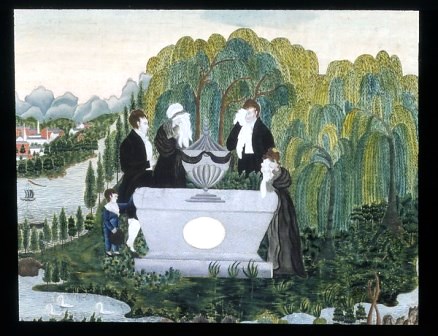
Mourning Picture, ca. 1810. Metropolitan Museum of Art, New York, NY


To die quietly or without any resting words often caused distress to the living. Oftentimes, many would suspect that silence meant the person led a sinful life and that their fate was eternity in Hell. Elizabeth White’s husband died quietly after succumbing to fever, leaving her to question his fate.

When I think of home it seems to hurt me, once I had a home but now I have none. O that it was with me as in time past- But alas I shall never see a good day, more in the Land of the Living, once I was a girl then was I happy; once I was a married woman & was very happy till it Pleased the Lord to visit the pasture of my joys & cares, with a violent likeness that; deprived him of his senses so that he was never himself not long together to his dying day- now alas he is gone from whence he will never return, even to the Land of darkness, & ye shadow of death: a Land of darkness, as darkness itself & of ye shadow of death without any order- if he had died upon a sick bed, I should have some Peace concerning him: but now I have none- he is gone, I know not how it is with him […]


Such a prescribed mentality towards death is found across hundreds of letters and diaries, but they certainly don’t discredit the sentimentality of the writer’s feelings. It is simply part of human nature to cope with tragedy. In a society where religion played a vital role in everyday life, it is not at all surprising that death became a lesson to remind oneself of their ultimate ending.


To see what other related materials are held are at the Society, try searching our online catalog, ABIGAIL, then consider Visiting the Library.


Sources:

Seeman, Eric R. “’She died like good old Jacob’: deathbed scenes and inversions of power in New England, 1675-1775.” Proceedings of the American Antiquarian Society, v. 104 (1994), p. 285-314.

Vinovskis, Maris. Angels’ heads and weeping willows: death in early America.” Proceedings of the American Antiquarian Society, v. 86, pt. 2 (1977), p. 273-302.


The Baker and the Bear

By Daniel Tobias Hinchen, Reader Services

In a previous post here on the Beehive, I introduced readers to William Emerson Baker and his estate called Ridge Hill Farms, highlighting his affinity for all things porcine. As mentioned before, the MHS recently acquired a handful of items that relate to Ridge Hill Farms, including documents, artifacts, and photographs. Today, we return to the estate once more, but for a different sort of affair.


You’ve lost your bear, so bear your loss,

Of all your hopes the ruin;

And while you drain the bitter draught,

          Reflect–’twas your own “bruin.”

                                                “A.M.H”


William E. Baker purchased Billy Bruin – a two and a half year old black Labrador bear – from a Boston showman. On 15 July 1874, Billy was delivered to Baker’s estate at Ridge Hill Farm, and promptly escaped three hours later. Over the next ten days, Billy roamed the area, frightening parishioners in Dedham, Selectmen in Needham, and Irish quarrymen in Quincy, among others. With a sizable reward offered for his capture, Billy was pursued as far as Weymouth. Sadly, a starving Billy was shot and fatally wounded while crossing a river in that town, then carried on the current into Boston Harbor, finally washing ashore in the town of Hull about 25 July.

Upon Baker’s request, the body of Billy Bruin was returned to Ridge Hill Farms. The hide was mounted by a taxidermist and the remains were buried in a $2,000 solid copper casket on 8 August 1874. And while this was a somber affair, Baker, in his usual style, took the opportunity to make it a grand and remarkable event. As with an event to lay the conerstone of his new piggery, Baker sent formal invitations to the funeral of his departed bear. It is said that over 1,000 invited guests and several hundred others showed up for the affair. And as with the other party, those who could not attend sent their regrets along with bits of inspired poetry, published and shared with guests that day. No less a personage than Oliver Wendell Holmes extended his regrets to Baker:

Dear Sir,

Many thanks for your polite invitation to attend the obsequies of the lamented plantigrade. I am sorry that it will not be in my power to attend upon the melancholy occasion. I have a great respect for bears since those two femal one taught the little children of Bethel and Belial that they must not be rude to elderly persons. I think a loose bear or two might be of service in our community, and I regret much the loss of an animal who might have done so much as a moral teacher for the young of this city and its suburbs.

I am, dear Sir, yours very truly,

O. W. Holmes

269 Beacon Street, August 1, 1874.


Among the recently-acquired items now at the MHS is a watercolor painting which shows the funeral procession for the ill-fated Billy Bruin.

The Funeral of Billy Bruin / [landscape] by an unidentified artist


From a distance, the image fairly clearly shows a procession, of sorts, but it is on closer inspection that the wonderful idiosyncrasies of a Baker-hosted event start to show.

Detail. The Funeral of Billy Bruin


Here we can see a segment of the procession, with the stuffed hide of Billy at the center. With him are members of a marching band, various costumed individuals including the pallbearers, and sundry other onlookers. In seeking more information online, I found a piece over at the Wellesley History blog (titled “Billy Bruin and his festive funeral”) which thankfully sheds some more light on this colorful cast of characters. To wit:

What follows is a partial list of the participants: the Grand Marshall (Baker) a la cheval, the stuffed corpse of Billy Bruin on a bier carried by four men wearing animal skins to represent the Bulls and Bears of the Financial District, 5-month-old bear cub Topsy, the 20-piece Natick Cornet Band, men dressed as frogs to symbolize the greenbacks of American finance, someone dressed as a monkey as a nod to the wise heads who thought they knew how to catch Billy, Native American hunters, a “black man turned white with bare fright,” and following up at the rear, a handful of babies that supposedly had been swallowed by the bear.


And to that, I know not what to add…


To find what other items here at the MHS are related to Ridge Hill Farms and William Emerson Baker ,or to read the full story of Billy Bruin consider Visiting the Library!


Sources

Crumbaker, Leslie G., The Baker Estate, or Ridge Hill Farms of Needham, Needham, Mass.: Needham Historical Society, 1975.

– “Billy Bruin and his festive funeral,” Wellesley History, accessed 10 April 2018 at https://wellesleyhistory.wordpress.com/townsman-articles/billy-bruin-and-his-festive-funeral/

This Week @ MHS

By

It is a quiet week ahead at the Society as we lead into a long weekend. Here are the programs on the schedule for coming week:

– Tuesday, 10 April, 5:15PM : This week’s seminar is part of the Environmental History series and features Andrew Robichaud of Boston University, with David Spanagel of Worcester Polytechnic Institute providing comment. “The Ice Trade: Frederic Tudor’s ‘Slippery Speculation’” reexamines the emergence and development of the ice trade in Boston and North America, described in 1806 by the Boston Gazette as a “slippery speculation.” What can the ice trade tell us about environmental, economic, political, and spatial change in nineteenth-century Boston and North America?

Seminars are free and open to the public; RSVP required. Subscribe to receive advance copies of the seminar papers. To RSVP: email seminars@masshist.org or call (617) 646-0579.

– Wednesday, 11 April, 12:00PM : Stop by at noon on Wednesday for a Brown Bag lunch talk with Kimberly Blockett of Pennsylvania State University at Brandywine, whose talk is titled “#sayhername: Recovering the Itinerant Ministry of Zilpha Elaw, 1820-1873.” During the Second Great Awakening, almost all denominations discouraged female preachers. Of course, some women did it anyway. Elaw ignored her husband and clergy, faced significant danger, and preached from Maine to Virginia. Then famous, now Elaw and her published Memoirs are mostly unknown. Blockett will discuss the silences of race and gender in the archive. This talk is free and open to the public.

The exhibition Yankees in the West is now CLOSED. The exhibition galleries remain closed through the month of April as we prepare for our next exhibit, Entrepreneurship & Classical Design in Boston’s South End: The Furniture of Isaac Vose & Thomas Seymour, 1815-1825, which opens to the public on Friday, 11 May.

Please note that the Society is CLOSED on Monday, 16 April, in observance of Patriots’ Day.

“Feasting and fasting”: Easter in St. Petersburg

By Gwen Fries, Adams Papers

“The Russian People pass their lives in a continual and alternate succession of feasting and fasting,” John Quincy Adams stated to his mother without so much as a salutation. From his vantage point as minister plenipotentiary to St. Petersburg in 1811, Adams wrote to his parents about Russian politics, court life, and traditions. Based on the eight pages he dedicated to it, one of the customs that intrigued John Quincy most was how Russians celebrated Easter.

Panaromic view of St. Petersburg by J. A. Atkinson, c.1807.(Library of Congress)


In mid-February seven weeks of “rigorous lent” began during which believers should eat “absolutely nothing but bread and salt.” John Quincy acknowledged that the severity of the restrictions were somewhat abated in practice, and that “among the highest class of the nobility there are persons not extremely scrupulous about observing the fast at-all.” This laxity came at a price, however, as the public was severely critical of those who did not follow the orders of the Church. For this reason, “there are few even of the highest ranks, but choose to be thought regular in their practice.” He added that the Imperial family was “punctilious in setting the example.”

Besides being without the foods to which they were accustomed, theaters were closed for all seven weeks of Lent. “No entertainments are given, and the families which profess to be scrupulous in their duties neither pay nor receive visits.” In place of the usual merriments, there were religious services three or four times a week. In the last week of lent, called “Passion-week,” there were ceremonies every day.

On Good Friday, funeral processions led into churches where elaborate representations of Christ’s sepulcher were erected and lit until the midnight services on Easter morning. At the stroke of midnight, cannons were fired to signal the start of three- or four-hour services in all the churches of St. Petersburg.

As a foreign minister, John Quincy was permitted to attend services in the chapel in the Imperial palace. He arrived at the palace “in full dress as to Court” and was ushered into the chapel just before midnight. He soon heard the thunder of cannons and observed Emperor Alexander I and the Imperial family process into the candlelit chapel. Attendants distributed lit wax tapers as the all-male choir performed. At the conclusion of the Mass, seven priests formed a line before the Emperor, each holding a holy relic. The Emperor kissed each relic and “embraced the Priests themselves.” John Quincy wrote that the other members of the Imperial family followed in succession, “excepting that the Priests instead of being embraced by the Ladies, kiss’d their hands.” He informed Abigail that this was a new trend with which many believers from all ranks of society were displeased because it removed the “primitive equality of all Christian believers” and “the purity of Christian innocence” from the tradition. He writes that many preferred “the good old smack upon the cheek and lips, which they boast of as having always been given at Easter.” Interestingly, John Quincy noted, “Every individual in the chapel. . .was understood to have the privilege of going up and embracing the Emperor.” The people attending the ceremony excitedly exercised this privilege, keeping the Emperor kissing and embracing for a full hour.

On the afternoon of Easter Sunday, St. Isaac’s Square became home to “Rope-dancers, Chinese-Shadows, puppet-shows, mechanical and optical representations, strange animals, and the like delights of the Populace.” The square, John Quincy related, was also filled with twenty or thirty carnival rides, “filled by a succession of men, women and children who keep them in perpetual motion.” He observed that the fair was enjoyed only by “the lowest classes,” and that anyone who owned or could hire a carriage spent the afternoon circling the Square, “beholding all these amusements. . .and at the same time exhibiting themselves, and their Carriages, and Liveries and Horses, in Spectacle to one Another.”

One tradition that pervaded all classes was the custom of giving eggs, which was “as universal as that of kissing,” John Quincy told his mother. Those in the lower classes exchanged hard-boiled eggs that were dyed red. People with greater wealth gifted artificial eggs made of everything from marble and porcelain to candied sugar. John Quincy assured Abigail that his four-year-old son was partaking in the festivities. “Boxes of Sugar-plums assume this form in presents for children, much to the entertainment of master Charles.” Charles also had the opportunity to gaze in shop windows lavishly decorated with “multitudes of these artificial eggs, of various sizes, suspended by silk ribbons of all the gaudy Colours” and to hear street vendors hawk the candy eggs, gingerbread, and other candy. “In short,” John Quincy concluded, “these objects are so multiplied at these times before the eyes of a Stranger to the Custom, that he would almost be induced to believe that in Russia, breeding eggs, and kissing was the business of human life.”

This Week @ MHS

By

It’s a new month and here at the Society we keep on rolling with our public programs. This is what we have on tap in the week ahead:

– Tuesday, 3 April, 5:15PM : Brendan McConville of Boston University starts the week with an Early American History seminar, “Terror Twice Told: Popular Conventions, Political Violence, and the Coming of the Constitutional Crisis, 1780-1787.” This paper argues that the wave of political violence after the American victory at Yorktown in 1781 ultimately reflected conflicts within the American political community over who could be an American, what institutions constituted “the people” in a republic, and the character and limits of the “the people’s” power to form self-governing institutions. These disputes played an important role in creating the 1787 constitutional crisis.

Seminars are free and open to the public; RSVP required. Subscribe to receive advance copies of the seminar papers.To RSVP: email seminars@masshist.org or call (617) 646-0579.

– Wednesday, 4 April, 12:00PM : This week’s Brown Bag lunch talk is given by research fellow Natalie Joy of Northern Illinois University. “Native Americans in the Antislavery Movement” explores Native American participation in the American antislavery movement from the 1830s to the 1860s. In addition to attending meetings, Indians signed petitions, donated money, organized fundraising fairs, held positions in antislavery societies, and assisted fugitive slaves. Most significantly, they influenced abolitionist thought on a number of issues. This talk is free and open to the public.

– Wednesday, 4 April, 6:00PM : “Private Land” is the first event in a new series called This Land is Your Land. Some of the early efforts to preserve open space for the physical and spiritual benefits offered by access to nature came from private organizations. Mount Auburn Cemetery was the first large-scale designed landscape open to the public in North America and as such began the rural cemetery movement that later led to public parks. In 1853 the Laurel Hill Association was founded in Stockbridge, inspiring a national Village Improvement Society movement. Later generations have benefited from the first private, statewide conservation and preservation organization, The Trustees of Reservations. Historic New England has saved traditional farms and Mass Audubon and other private organizations preserve and manage open space across the state. How common is this preservation by private organizations? How sustainable is this concept for future generations? This talk is open to the public though registration is required with a fee of $10 (no charge for MHS Members or Fellows, EBT Cardholders, and Members of Co-Sponsoring Institutions). A pre-talk reception kicks-off at 5:30PM followed by the speaking program at 6:00PM.

– Thursday, 5 April, 6:00PM : “Distilling Boston: From the Colonial Period to the Present” is a special event for MHS Fund Giving Circle Members, Fellows, and Members, who are invited to a lively evening that explores the culture and history of alcohol consumption in Boston. Using illustrations, photos, and multimedia clips, Stephanie Schorow will speak about Boston’s drinking history beginning in the colonial period, continuing through Prohibition and into the current craft cocktail scene. Following the talk, enjoy a reception, sample cocktails, and continue the conversation. Registration required at no cost. This progam begins at 6:00PM.

This is the final week to view our current exhibition, Yankees in the West! The exhibit closes on Friday, 6 April. The next exhibition, Entrepreneurship & Classical Design in Boston’s South End: The Furniture of Isaac Vose & Thomas Seymour, 1815-1825, opens to the public on 11 May.

There is no building tour this week.

Charles Cornish Pearson and the Great War, Part IV

By Susan Martin, Collection Services


This is the fourth post in a series about the wartime experience of Charles Cornish Pearson. Go back and read Part I, Part II, and Part III for the full story.

After a short hiatus, I’m happy to return to the story of Sgt. Charles Cornish Pearson of the 101st Machine Gun Battalion in World War I. We last heard from him in April 1918, so I’ll pick up now in May. I’ve been looking forward to this installment because it was during this month that Charles wrote some of my favorite letters in the collection.

Things were relatively quiet for Charles’ battalion after the terrible Battle of Seicheprey in northeastern France. Philip S. Wainwright says very little about the month of May 1918 in his History of the 101st Machine Gun Battalion, except that it “passed uneventfully.” But I imagine these calmer periods gave soldiers time to pause and reflect on their experiences, for better or worse. Certainly Charles wrote longer and more introspective letters this month, and in them he took a broader look at the war he’d been fighting for almost a year. He was housed in barracks somewhere near Seicheprey when he wrote to his parents on the 5th.

Please get the idea of the awfulness of this war out of your head […] We are not such a terribly afraid lot and as long as they keep us supplied with the necessary articles of food clothing & ammunition why we don’t kick a great deal. Money supplies & less politics are what we need over here and I hope the people in the U.S. will gradually awaken to these facts & the sooner they do so why the sooner the war will be over.


As for his recent “exciting experiences,” Charles showed remarkable composure (or at least put on a brave face for his family). His letters give us a fascinating look into the psychology of soldiers in the trenches.

Now that we have done our bit at the Front & had a taste of gas, shells air raids etc. why there isn’t much new to experience & one settles down to take it all as it comes. Do our bit & then try to forget about it as quickly as possible. […] We aren’t down hearted, but don’t think that we forget the serious side of this business and realize that the next day may be the time that we get our stomachful a plenty. Its all a matter of chance anyway & […] it makes little difference what you do, if its your turn, why you get it. 


Fifteen days later, still enjoying the well-deserved rest and relaxation, he wrote at length to his younger sister Jean. The collection came with one photograph of her, taken ca. 1910-1915.


Jean—short for Jeannette—was about 26 years old in 1918 and lived in Masters, Colorado, with her husband Thomas B. McPherson and, I think, a young son and daughter. Unfortunately, the MHS doesn’t hold her letters to Charles, but she’d been a steadfast correspondent, often sending cigarettes and care packages. His letter, dated 20 May, reveals not only his affection for her, but also his sense of humor, compassion, and humility. After reassuring Jean that things were fairly quiet (“You don’t care for excitement these days after you have had a little of it”), he launched into a description of another soldier named Charlie. I particularly like his euphemism “over the weather,” which was a new one for me.

[He] was a little Sicilian in my old squad who when ever he got tight found the English language a little beyond him. […] He sure was a comical chap and furnished us with many a laugh. Used to always call me “Boss” and when he came in evenings a little bit over the weather would have to sit on the edge of my bunk and tell me all his troubles. Poor Charlie, he was not a success at the front. He developed a case of shell shock and was sent back to the Base and suppose we will never see him again.

Later he corrected a misunderstanding in his endearingly modest way.

Where do you get that “Hero” stuff in your last letter? Indifference to fear etc. Don’t you believe it for a minute. Yours truly is just as frightened as the next fellow and can duck and run for dug-out just as quick as the next fellow. Still this fear stuff doesn’t figure a great deal at that; you may be scared to death still if you have to do something why you have to, that is all.

And he explained in no uncertain terms who the real heroes were, downplaying his own hardships and betraying not even a trace of self-pity.

Besides as far as danger goes we don’t get it the way the doughboys do, he is the fellow that stands the brunt of this war and deserves the credit even more than any other line of service, aviators not excepted. Why? because he stands real hardship which many of us are lucky to get out of. He goes up to the trenches for six or seven days at a stretch, lives in mud and water, gets very little sleep and eats when he gets a chance […] To see those boys hiking back from the trenches makes one (who doesn’t get that part of the game) think that doughboy is the fellow to be pitied.

Stay tuned for Part V of Charles’ story.

“Across wide fields of melting snow / The winds of summer softly blow”: The Easter poems of Lucy Larcom

By Anna J. Clutterbuck-Cook, Reader Services

On March 20th we marked the spring equinox here in New England with the arrival of our fourth nor’easter of the month. After a warmer-than-average February we found ourselves bundling up for a colder-than-average March and spring has seemed further around the corner than it ought to be. In this week that marks both the Jewish Passover and Christian Easter holidays, I decided to share a poem for spring from New England poet Lucy Larcom.

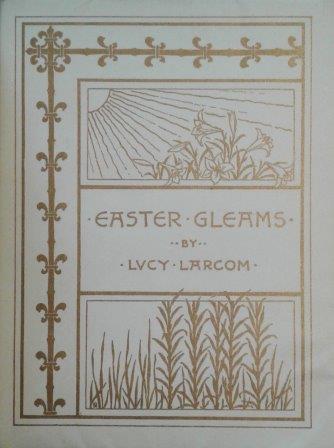
A book of Easter poems
Easter Gleams, by Lucy Larcom, 1891

Many of you have likely encountered nineteenth-century writer Lucy Larcom through her autobiographical work A New England Girlhood (1889) which tells the story of her childhood in Beverly, Massachusetts and her experience working in the mills of Lowell before she traveled west to Illinois to become a teacher and later returned to Massachusetts to make her living as a writer and editor. In 1891, Larcom published a small collection of Easter poems, Easter Gleams with Riverside Press an imprint of Houghton, Mifflin & Company based in Cambridge, Massachusetts. Riverside had also published Larcom’s Girlhood three years before. Below are the poems “Ring! Happy Bells!” (5) poem “Sunrise” (13) from Easter Gleams.

Ring! Happy Bells!

Ring, happy bells of Easter time!

The world is glad to hear your chime;

Across wide field of melting snow

The winds of summer softly blow,

And birds and streams repeat the chime

Of Easter time.

Ring, happy bells of Easter time!

The world takes up your chant sublime,

The Lord has risen!” The night of fear

Has passed away, and heaven draws near:

We breathe the air of that blest clime,

At Easter time.

Ring, happy bells of Easter time!

Our happy hearts give back your chime!

The Lord has risen! We die no more:

He opens wide the heavenly door;

He meets us, while to Him we climb,

At Easter time.


Sunrise.

The Sunrise over the houses!

The beautiful rose of dawn

Reddening the eastern windows, —

The curtains of Night withdrawn!

More lovely than boughs in blossom

The spires and the roof-trees glow.

It is day; and, in God awaking,

Shall the spirit unfold and grow.

On the city, in chrismal splendor,

The blessing of morning falls: —

The Bride coming down out of heaven! —

The pearl-gates, the jasper walls!

The white light enters the casement

Like the wings of the Holy Dove;

And every house is a flower,

A blossom of peace and love.

The sunrise is fair on the gardens,

The groves and the forests afar;

But fairer the trees of manhood,

Of heavenly planting are.

And wide are the green savannahs

That under the dawn unroll;

But broader the landscape opens

In the sunrise of a soul!

The footsteps of morning hasten

Across yonder populous space,

And the dwellings of men are illumined

With the glory of God’s own face.

Who can guess the power of His coming?

He will banish doubt and despair;

The life of His Spirit will kindle

And stir the sleepers there.

Behold the Day Star ascending!

See the hour of His triumph begin!

The sunrise over the houses!

The Christ-light shining in!

In addition to holding a print copy of Easter Gleams and other published works by Larcom, the Massachusetts Historical Society holds Larcom’s diaries, correspondence, and other manuscript materials, principally in the Daniel Dulany Addison collection. We also hold issues of Our Young Folks (1865-1873) and the Lowell Offering (1840-1845), both of which Larcom was deeply involved in as a writer and editor. Researchers interested in accessing Larcom’s writings may visit the library or contact the reader services staff to learn about options for reproduction.

This Week @ MHS

By

After three straight weeks with canceled programs or weather-induced closures, here is hoping that the last week of March lets us exit the month like a lamb. This is the slate of programs coming in the week ahead:

– Tuesday, 27 March, 5:15PM : First up this week is a seminar from the Modern American Society and Culture series with John Bezis-Selfa of Wheaton College, titled “La Villania Arizoniana: Disenfranchisement, Citizenship, and Defining the Body Politic in the Early 20th-Century US-Mexico Borderlands.” In 1909 and 1912, the Arizona legislature enacted requirements that all voters be literate in English, sparking a storm of multilingual protests in the papers and the courts. How and why Anglo-Arizonans took the right to vote from thousands of Mexican-American men and how Spanish-speakers fought back shows how conflicting views of race and ethnicity have influenced citizenship in the U.S.’s southwestern borderlands. Alex Keyssar of the Harvard Kennedy School provides comment. 

Seminars are free and open to the public; RSVP requiredSubscribe to receive advance copies of the seminar papers. To RSVP: email seminars@masshist.org or call (617) 646-0579.

– Wednesday, 28 March, 12:00PM : Jaclyn Schultz of University of California at Santa Cruz leads this week’s Brown Bag lunch talk, “Learning the Values of a Dollar: Childhood & Cultures of Economy, 1825-1900.” Nineteenth-century children rarely had access to money, even when they worked. Yet, several forms of authority instructed children in specific expectations of spending, saving, and giving. This talk explores how and why children were taught to interact with and value financial resources as well as how these lessons were racialized. This talk is free and open to the public. 

– Thursday, 29 March, 6:00PM : Protest & Citizenship is a panel discussion with Stephen Kantrowitz, University of Wisconsin-Madison; Crystal Feimster, Yale University; John Stauffer, Harvard University; and Chad Williams, Brandeis University. Throughout American history many groups have struggled to establish their rights as citizens. While the United States was a grand experiment in republican government, in the beginning only a small percentage was allowed to participate. Over time, citizenship has grown, but this has often not been a simple or a smooth process. This talk explores this history of citizenship and protest. How have groups throughout American history used agitation to help change the dialog about their position as citizens? How can this history help inform our views and reactions to the changing political climate we see today?

This talk is open to the public, though registration is required. PLEASE NOTE – PEOPLE REGISTERING FOR THIS PROGRAM AFTER 3/15/18 MAY BE ASKED TO SIT IN OVERFLOW SEATING (The overflow seating is on the same floor, one room over with a live video feed).

This program is made possible by a grant from Mass Humanities

– Saturday, 31 March, 10:00AM : The History and Collections of the Massachusetts Historical Society Tour is a 90-minute docent-led walk through our public rooms. The tour is free, open to the public, with no need for reservations. If you would like to bring a larger party (8 or more), please contact Curator of Art Anne Bentley at 617-646-0508 or abentley@masshist.org.

While you’re here you will also have the opportunity to view our current exhibition: Yankees in the West

World Poetry Day, Porcine Edition

By Daniel T. Hinchen, Reader Services

Today, 21 March, is World Poetry Day as proclaimed by UNESCO in 1999. To recognize this designation we will look at a bit of newly-acquired poetry found here in the collections at the MHS. 

A few years ago here on the Beehive I published a post, “Porcineographs and Piggeries” about a man named William Emerson Baker and his vast estate, Ridge Hill Farms. In the original post I included references to a Guide to Ridge Hill Farms held here at the Society, as well as an invitation “to assist in laying the corner stone of a new piggery” on the estate, and my personal favorite, the Porcineograph.* 


The Society recently acquired several more items related to Ridge Hill Farms and Baker, generally, and some that specifically detail the lavish party held to lay the corner stone of his new piggery. In a printing titled Fete Champetre at the laying of the coner-stone for the new piggery…“, a contributor mourns the dearth of verse dedicated to pigs: 


The Pig and the Poets.

Almost every domestic animal has found his Homer among the poets. The horse, the dog, the cat, all have been celebrated in immortal verse. The pig, on the contrary, has been neglected by the brotherhood of bards; and the most persons would find it difficult to cite a single friendly reference to this despised creature in the writings of British poets. The pig seems to have been born under an evil star. He is never esteemed until he is dead. During his life, man gives him the cold shoulder: when he is dead, man takes it back.


What follows this brief lamentation is a series of responses to Baker’s invitations to join the festivities, including a handful of poems dedicated to his porcine pals. In honor of World Poetry Day, I present one such poem here. 


To the Ridge Hill Piggery.


Tall oaks from little acorns grow;

Great deeds from little causes flow.

The corner-stone of this new piggery

Is monument of past-time Whiggery,

When porkers, rooting for their dinner,

Cured old Great Britain, that great sinner,

And, making war upon strange gardens,

Set the old lady asking pardons;

And so she yielded up her knavery

That bound our seamen in her slavery.

All honor to the pigs immortal

Who brought the key to freedom’s portal!

They shall be praised with feast and song

As years roll on, and ages long, 

And voices chant the glorious bravery

Of those who broke our seamen’s slavery;

While grunting piggeries shall proclaim

From shore to shore each glorious name

Of porcine pilgrim, who began

The contest brave, that swiftly ran

Through House and Senate, and put down

The claim to search from Britain’s crown.

Let their bold choruses of grunts

Still meet all national affronts,

And stir the hearts of man and beast,

From North to South, from West to East.

All praise to all brave pigs forever!

Let piggeries multiply; and never

The glorious race, or noble donors,

Live but in health and wealth and honors!*

Mrs. G. L. Ford


Stay tuned to the Beehive for more recently-acquired items relating to the eccentric William Emerson Baker and Ridge Hill Farms. And if you just cannot wait until then, consider Visiting the Library. Who knows, there could be many a piggy punny you just might find funny.


*The Porcineograph provides a small tidbit of information that sheds some light on the topic of Mrs. Ford’s poem: “Litigation about the killing of two hogs found trespassing in a garden in Rhode Island in 1811, is said to have resulted in the election of the opposition candidate, Howell, to the United States Senate, and the Declaration of War in 1812.” 

This Week @ MHS

By

It is the middle of the month and it appears that the lion of March is not making way for the lamb. Below is the round-up of events in the week to come, just be sure to keep an eye on our website to ensure that the event you want to attend is not affected by weather-related closures. 

– Tuesday, 20 March, CANCELED : This week’s seminar, “On Fantasy,” is canceled due to illness.

– Tuesday, 20 March, 6:00PM : People before Highways: Boston Activists, Urban Planners, & A New Movement for City Making is the new book by Karilyn Crockett, who will be on-hand for this author talk. In 1948, inspired by changes to federal law, Massachusetts officials started to plan highways circling and cutting through the heart of Boston. But when officials began to hold hearings in 1960 the people pushed back. The story of how an unlikely multiracial coalition of urban and suburban residents, planners, and activists emerged to stop a highway is one full of suspenseful twists and surprises. And yet the victory and its aftermath are undeniable: federally funded mass transit expansion, a linear central city park, and a highway-less urban corridor that serves as a daily reminder of the power of citizen-led city-making and has had lasting national implications.

This talk is open to the public, registration required with a fee of $10 (no charge for MHS Fellows and Members or EBT cardholders). 

– Thursday, 22 March, 5:30PM : Often a biographer confronts silences in the record of her subject, when part of the life story is not documented with words. Mute sources—objects in the subject’s archive—can pose a challenge for interpretation, but also offer rich opportunities. How can biographers read objects as eloquent sources? “‘No Ideas But in Things’: Writing Lives from Objects” is a panel discussion with Deborah Lutz of University of Louisville, Karen Sanchez-Eppler of Amherst College, independent scholar Susan Ware, and moderator Natalie Dykstra of Hope College. 

Seminars are free and open to the public; RSVP requiredSubscribe to receive advance copies of the seminar papers. To RSVP: email seminars@masshist.org or call (617) 646-0579.

– Saturday, 24 March, 10:00AM : The History and Collections of the MHS is a 90-minute docent-led walk through our public rooms. The tour is free, open to the public, with no need for reservations. If you would like to bring a larger party (8 or more), please contact Curator of Art Anne Bentley at 617-646-0508 or abentley@masshist.org.

While you’re here you will also have the opportunity to view our current exhibition: Yankees in the West.

– Saturday, 24 March, 10:00AM : In celebration of Women’s History Month, the MHS is calling for items–pink hats, signs, pins, t-shirts, photographs, written accounts–from the 2017 and 2018 Women’s March events. We invite the public to stop by 1154 Boylston Street in Boston to donate 2017 and 2018 Women’s March memorabilia—pink hats, signs, pins, t-shirts, photographs (prints or digital images)—as well as written accounts to its collection. If you do not want to part with your Women’s March items, consider wearing them to the MHS and having your picture taken (a photographer will be on site) to be added to our collection. We also encourage written experiences and accounts of the marches to be shared. These can be e-mailed to collections@masshist.org or mailed to: Massachusetts Historical Society, 1154 Boylston Street, Boston, MA, 02215, attention Brenda Lawson.

If you are unable to come to the MHS on 24 March but have items you would like to donate, please contact Anne Bentley (abentley@masshist.org or 617-646-0508) or Brenda Lawson (blawson@masshist.org or 617-646-0552) to discuss.

Selected items collected on 24 March will be displayed as part of our 2019 exhibition on women’s suffrage.