This Week @ MHS

By

Here is the weekly round-up of events at the MHS in the week to come. 

– Wednesday, 20 September, 12:00PM : Pack a lunch and stop by at noon for a Brown Bag talk with independent researcher Nina Sankovitch. “Exploring Conflict, Collaboration, and Conciliation in Colonial Families before the American Revolution” considers how the Quincy, Adams, and Hancock families – all living in Braintree, MA but of varying social classes – interacted, especially in their attitudes towards England in the late colonial era, and the roles the families played in fomenting agitation against English rule. This talk is open to the public free of charge. 

– Wednesday, 20 September, 6:00PM : Join us for a public conversation with Garrison Nelson of the University of Vermont, Michael Dukakis of Northeastern University, and Peter Drummey of the MHS. “John McCormack and David K. Niles: How Two Reinvented Bostonians Altered American Politics and Foreign Policy” explores the lives of two Boston politicians who came from large poor families within religious minority communities and rose to the levels of Speaker of House and White House advisor, and how both became central to the shaping of modern American political parties and politics. This talk is open to the public and registration is required with a fee of $20 (no charge for MHS Members or Fellows). The talk begins at 6:00PM and is preceded by a reception at 5:30PM. 

– Thursday, 21 September, 6:00PM : “An Extraordinary Life: An Evening with John Quincy Adams” is a fun and festive evening celebrating the life of one of America’s most fascinating statesmen. Enjoy a reception, learn about moments from Adams’s life—as told through his diary and correspondence—from incoming MHS President Catherine Allgor and the staff of the Adams Papers editorial project, and explore a pop-up exhibit of the artifacts and documents that tell his story and that of our nation’s history. This program is SOLD OUT.

– Friday, 22 September, 10:00AM-4:00PM : This is your last chance to view our current exhibition, The Irish Atlantic, which ends on Friday. 

– Saturday, 23 September, 9:00AM : “John Quincy Adams and American Diplomacy” is a teacher workshop open to all K-12 educators. Participants will learn more about JQA’s achievements as Secretary of State; analyze documents from the Adams family papers, including JQA’s diary; discuss his role in westward expansion; and meet Adams papers editors and learn how they make the family’s work accessible to audiences of all ages. Registration is required for this event with a fee of $25. 

“An Amusing Journey”: John Quincy Adams Explores Silesia

By Hobson Woodward, Adams Papers

On 17 July 1800 John Quincy Adams and his wife Louisa Catherine embarked on an extended tour of Silesia, now southwest Poland. John Quincy chronicled their tour in a series of letters to his brother Thomas in the United States. The letters provide a rich description of a European excursion at the dawn of the nineteenth century. They also provide a rare look at a relaxed John Quincy Adams, unfettered by the demands of his diplomatic duties in Berlin.

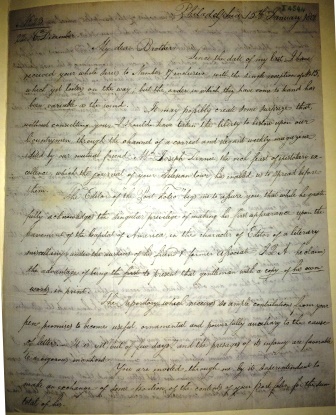
John Quincy Adams to Thomas Boylston Adams, 20 July 1800, letterbook copy (Adams family papers, Massachusetts Historical Society)

John Quincy prefaced his first letter to Thomas by advising him to send his correspondence to their mother Abigail if his extended descriptions of the Silesian countryside and people proved a bore:

I cannot promise you an amusing journey, though I hope it will prove so to us; & if at the sight of this my first letter on this occasion, you think it looks too long, & appears likely to prove tiresome, seal it up, unread, & send it to Quincy, where a mother’s heart will fill it with all the interest of which it may be destitute in itself

Thomas Boylston Adams to John Quincy Adams, 15 January 1801 (Adams family papers, Massachusetts Historical Society)

Thomas found the letters anything but boring, however, and he was so entranced that he gave them to a newspaper editor friend for publication. John Quincy graciously accepted their printing for the public, even though he had not been told in advance. He was less happy when the articles were later published in an unauthorized 1801 London edition.

John Quincy’s travel accounts are indeed vivid. In a 3 August letter he described an ascent of a mountain near Schreiberhau (now Szklarska Poreba, Poland). The hike began easily enough, he reported, traversing a grade “about equal to the steepest part of Beacon hill in Boston.” The difficulty increased, however, and the party finally emerged to a dramatic sight:

Instantly a precipice nearly fifteen hundred feet deep opened its gastly jaws before us— A sort of isthmus, or tongue of land however allowed us to proceed about an hundred rods further, untill we could fix ourselves against the side of a rock, & look over into the tremendous depth— We had then the precipice on both sides of us, & it passes by the respective names of the great & the small snow-pit— They are so called because generally the snow at the bottom remains unmelted the whole round, although this has not been the case for the last two summers, & at present they contain no snow at all

Later John Quincy and Louisa visited the Zackenfall waterfall. One is almost brushed by the leafy mist when reading John Quincy’s description:

At this place you stand upon one side of the cleft & see the water dash down from the other; upon a level with yourself; between you & the stream is an abrupt precipice, which seems the more profound, for being so narrow; about an hundred yards— With the help of a ladder I descended to the bottom, & walked partly over the rocks, & partly over the billets of wood lying in the bed of the stream to the spot from which the water falls— We likewise went round by a winding foot path on the top, to the spot from which the streams launches itself

John Quincy also described a visit to a coal mine near Waldenburg (now Walbrzych, Poland). The mine was accessed by a small boat navigated over a subterranean stream.

You go down in a boat, flat bottom’d, about a yard wide, & ten feet long. The canal is not more than four wide, & equally deep, & over it is an arch about as high, hew’d in many places through the solid rock. It is nearly an english mile long, & strikes deeper & deeper under ground, untill the surface of the earth over head is more than 150 feet above you. The boat is pushed along through the canal, by two men, one standing at each end, who with a short stick in the hand press it against the sides of the arch that goes over the canal.

John Quincy further commented on churches, factories, and estates, and the peasants, craftsmen, and soldiers who occupied them. Thomas called his brother’s travel accounts a “rich feast of epistolary excellence.” The letters survive today in the Adams Papers collection of the Massachusetts Historical Society. In 2019 a selection of them will be annotated and published in volume 14 of Adams Family Correspondence, providing unprecedented access to a luminous portrait of an excursion through central Europe in an age gone by.

This Week @ MHS

By

A chill is in the air as autumn arrives. And with the turning of the leaves comes a return to more public programs for your consumption here at the Society. This is what’s coming up in the week ahead:

– Wednesday, 13 September, 6:00PM : John Kenneth Galbraith devoted his professional life to three main political goals: ending war, fighting poverty, and improving quality of life by achieving a balance between private and public goods in an affluent capitalist society. In The Selected Letters of John Kenneth Galbraith, Richard P. F. Holt selected the most important of the thousands of letters that Galbraith wrote in his long, cosmopolitan life. This talk with Mr. Holt is open to the public and registration is required with a fee of $10 (no charge for MHS Members or Fellows). A pre-talk reception begins at 5:30PM, followed by the speaking program at 6:00PM. 

– Thursday, 14 September, 6:00PM : The second author talk this week features Hidetaka Hirota of the City College of New York. Expelling the Poor: Atlantic Seaboard States & the Nineteenth-Century Origins of American Immigration Policy, is a groundbreaking work which reinterprets the origins of immigration restriction in the U.S. This work fundamentally revises the history of American immigration policy by locating the roots of immigration control in cultural and economic nativism against the Irish on the 19th-century Atlantic seaboard. This talk is open tot he public free of charge. The program begins at 6:00PM, and is preceded by a reception beginning at 5:30PM. 

– Saturday, 16 September, 10:00AM : The History and Collections of the Massachusetts Historical Society Tour is a 90-minute docent-led walk through our public rooms. The tour is free, open to the public, with no need for reservations. If you would like to bring a larger party (8 or more), please contact Curator of Art Anne Bentley at 617-646-0508 or abentley@masshist.org.

While you’re here you will also have the opportunity to view our current exhibition: The Irish Atlantic: A Story of Famine Migration and Opportunity. This exhibit ends on Friday, 22 September, so don’t miss it!

Holding Those in the Path of Hurricane Irma in Our Thoughts

By Anna J. Clutterbuck-Cook, Reader Services

As I write this post on Friday, September 8th, Hurricane Irma is working its destructive way through the Caribbean toward the southeast United States. While this blog post was scheduled to be the September 1917 diary entries of Gertrude Codman Carter it felt strange not to recognize the lives that are being turned upside down in the very islands that Lady Carter called home for much of her adult life. Carter’s diaries, chronicling her journey from Boston to Barbados in the early twentieth century, are far from the only or the earliest connections between Massachusetts and the Caribbean to be found in the MHS collections.


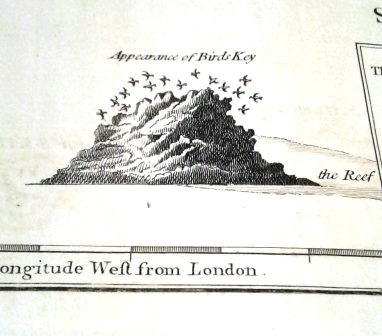
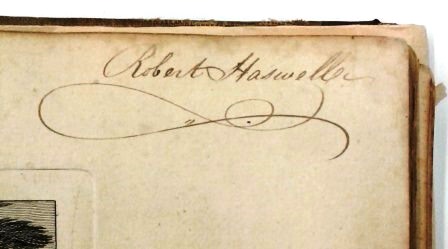
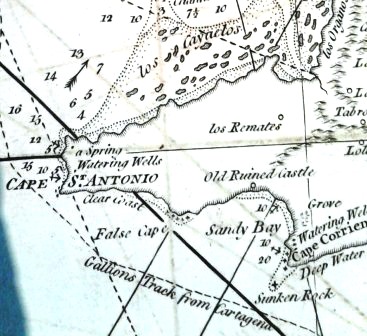
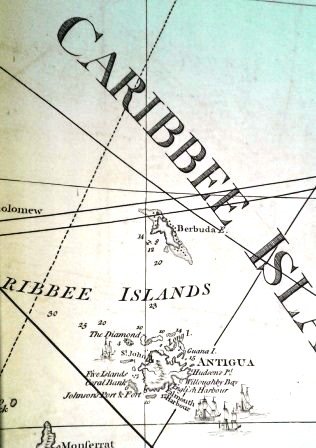
Today, I want to share some images from our copy of Thomas Jeffrey’s The West-India Atlas: or, A compendious description of the West-Indies: illustrated with forty correct charts and maps, taken from actual surveys. Together with an historical account of the several countries and islands which compose that part of the world (London: R. Sayer and J. Bennett, 1775). The MHS copy of this 18th century atlas was owned by Robert Haswell, whose Voyage round the world onboard the ship Columbia-Rediviva and sloop Washington, 1787-1789 also resides in our collections. A pastel portrait of Haswell by the English painter James Sharples may be viewed here.


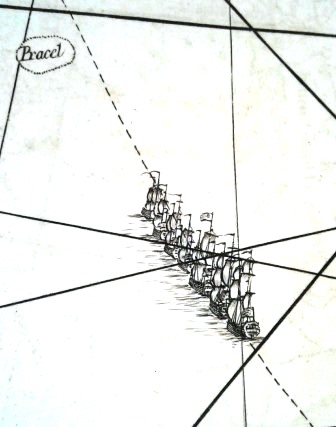
The details in this atlas are both informational and whimsical. In addition to the flocks of birds pictured above, almost every chart includes tiny parades of detailed ships making their way safely past such landmarks as the Colorados Reef, sunken rocks, and false headlands.


The atlas also provides voyagers with information about fresh water, as in this detail of the tip of Cuba, an “old ruined castle.”


Earlier this week, Hurricane Irma devastated the islands of Barbuda and Antigua, pictured here. I encourage you, if you have the ability, to donate to a charity of your choosing that will support those who need to rebuild their lives.

Look for a return to Lady Gertrude’s diary at the end of September.

This Week @ MHS

By

The Society is CLOSED on Monday, 4 September, in observance of Labor Day. Normal hours resume on Tuesday, 5 September. 

With September comes a return to much more activity here at the Society as far as programs are concerned. But after a long weekend, the increase begins quietly. Here is what is happening at the MHS this week:

– Wednesday, 6 September, 12:00PM : “The Liberator’s Legacy: Memory, Ablitionism, and the Struggle for Civil Rights, 1865-1965” is the first Brown Bag talk in a month. In it, Donald Yacovone of Harvard University explores popular memory of William Lloyg Garrison, Frederick Douglass, and their fellow abolitionists in the decades following the Civil War and reveals how that legacy influenced the rise of the modern Civil Rights Movements. This talks is open to the public with no charge. 

– Saturday, 9 September, 10:00AM : The History and Collections of the Massachusetts Historical Society Tour is a 90-minute docent-led walk through our public rooms. The tour is free, open to the public, with no need for reservations. If you would like to bring a larger party (8 or more), please contact Curator of Art Anne Bentley at 617-646-0508 or abentley@masshist.org.

While you’re here you will also have the opportunity to view our current exhibition: The Irish Atlantic: A Story of Famine Migration and Opportunity.


And don’t forget to check our online calendar to see what else is coming in the weeks ahead!

George Washington: John Quincy Adams’s “great Patron”

By Gwen Fries, Adams Papers

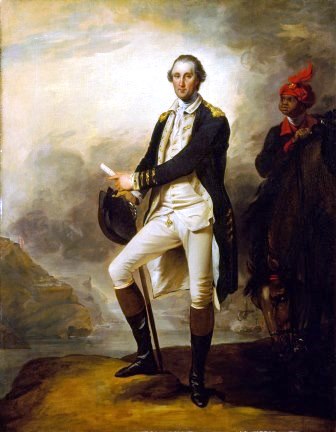
For as long as teenagers have had bedrooms, they’ve been pinning their role models up on the wall—a favorite singer, a beloved actor, the best ball player. When John Quincy Adams was fifteen, his bedroom at The Hague held a gilded framed picture of General George Washington. Like many of his contemporaries, John Quincy had the deepest respect for the “truly great and illustrious” Washington, a respect that endured throughout his life.

John Quincy’s portrait was likely a copy of John Trumbull’s 1780 portrait of Washington. 

[Accessed on 29 August 2017 at: http://www.metmuseum.org/toah/works-of-art/24.109.88/]

Twelve years after the portrait of Washington was removed from the wall, John Quincy Adams discovered he would be returning to The Hague thanks to the general’s orders. On May 27, 1794, John Adams wrote to his wife that, “the President has it in contemplation to Send your son to Holland.” When he wrote to his son, he discussed the appointment at The Hague in vague terms, calling the nomination “the Result of the Presidents own Observations and Reflections.” The next day, John Adams penned, “The Senate have this Day unanimously advised and consent to the Appointment of John Quincy Adams to the Hague.”

Just at the beginning of his law career in Boston, John Quincy felt too young and inexperienced to deserve the honor. Nevertheless, he did not believe his father would have suggested it to the president. When he next met his father in Quincy, John Adams confirmed his hunch. “I found that my nomination had been as unexpected to him as to myself,” JQA recorded in his diary. “His satisfaction at the appointment is much greater than mine,” he confessed, writing, “I wish I could have been consulted before it was irrevocably made. I rather wish it had not been made at all.”

Despite his hesitation at being separated from his family and sent halfway across the world for a then-undisclosed purpose, the day before his 28th birthday, JQA was in Philadelphia being introduced to President Washington. “He said little or nothing to me upon the subject of the business on which I am to be sent,” JQA noted. That night JQA was invited to dine with the president, and he paid his respects to Martha Washington, delivering her a letter from his mother. Abigail wanted to acknowledge “the honor done him by the unsolicited appointment conferd upon him by the President.” She continued, “I hope from his Prudence honour integrity & fidelity that he will never discredit the Character so honorably conferd upon him. painfull as the circumstance of a Seperation from him will be to me Madam I derive a satisfaction from the hope of his becomeing eminently usefull to his Country whether destined to publick, or to Private Life.”

A week after receiving Abigail’s letter from John Quincy’s hand, Martha responded. “The prudence, good sence and high estamation in which he stands, leaves you nothing to apprehend on his account from the want of these traits in his character;—whilst abilities, exerted in the road in which he is now placed, affords him the fairest prospect rendering eminent services to his country; and of being, in time, among the fore most in her councils.— This I know is the opinion of my Husband, from whom I have imbided the idea.”

Washington may have felt confident in John Quincy’s diplomatic abilities, but the young man was less sure. As he waited for Alexander Hamilton to return to Philadelphia to deliver instructions relevant to his mission, JQA wrote to his father, expressing doubt about his unfolding career: “I have abandoned the profession upon which I have hitherto depended, for a future subsistence . . . At this critical moment, when all the materials for a valuable reputation at the bar were collected, and had just began to operate favourably for me, I have stopped short in my career; forsaken the path which would have led me to independence and security in private life; and stepped into a totally different direction.” John Quincy ended his letter by telling his father that he determined to return home and to private life in no more than three years, if Washington had not already recalled him by then. John Adams replied urging patience and flexibility. “As every Thing is uncertain and Scænes are constantly changing I would not advise you to fix any unalterable Resolutions except in favour of Virtue and integrity and an unchangeable Love to your Country.”

In 1796 John Quincy learned that his father had been elected to succeed Washington. He wrote to his mother, assuring her that he would never solicit an office from his father. He discussed the devotion he felt to his country and his plans for a private life back in Massachusetts. John Adams was so touched by the letter that he shared it with Washington. Washington communicated his reflections on the private letter to John Adams: “if my wishes would be of any avail, they shd go to you in a strong hope, that you will not withhold merited promotion from Mr Jno. Adams because he is your son.” Washington declared it his “decided opinion” that John Quincy was “the most valuable public character we have abroad,” a man who would “prove himself to be the ablest, of all our diplomatic Corps.”

When George Washington died on December 14, 1799, John Quincy received many letters offering condolences from his family, closest friends, and foreign dignitaries. Poignantly, his father, though overworked in the office of president, sent him a short note on February 28, 1800, acknowledging that John Quincy was mourning the loss of his “great Patron.” Just over a year later, John Quincy welcomed his first son, George Washington Adams.

“A Subject Which Weighs Much Upon My Mind”: John Quincy Adams’s Work on Weights and Measures

By Neal Millikan, Adams Papers Editorial Project

On February 22, 1821, John Quincy Adams noted in his diary that “two of the most memorable transactions of my life” occurred that day: the ratification of the Transcontinental Treaty between the United States and Spain, and the submission of his report on weights and measures. While the treaty is remembered for orchestrating the U.S. acquisition of Florida, Adams’s work on weights and measures, which he referred to as “a fearful and oppressive task,” is largely forgotten today.

John Quincy’s obsession with the subject began in 1810 when he was minister plenipotentiary to Russia and spent his free time researching the variations among countries’ standard weights and measures. His wife, Louisa Catherine, recorded in her diary on July 21 that he “too often passed” the days “alone studying…no article however minute escaped his observation and to this object he devoted all his time.”

A page of John Quincy’s notes

 [John Quincy Adams memorandum and garden book, 1810-1845, Adams Family Papers, microfilm edition, 608 reels (Boston: Massachusetts Historical Society) reel 203.]

As secretary of state (1817–1825) John Quincy had many duties, but none intrigued him more than this topic. In 1817, the Senate passed a resolution asking that office to submit “a statement relative to the standard weights and measures” within the states and foreign countries, along with “propositions…as may be proper to be adopted” in America. John Quincy assumed the position on September 22, and by October 7 he drolly noted in his diary that the subject “weighs much upon my mind.” During the summer of 1820 he would wake up early to perform tests and record his results before going to work. Adams’s final report recommended that “no innovation upon the existing weights and measures should be attempted.” He instead called for America to “declare” its official measures “as they now exist” and to give standard metal measurements to “every State and Territory.”

For all his efforts, Adams’s work was not widely read. Indeed, his own father, John Adams, referred to it on May 10, 1821, as “a Mass of historical, philosophical chemical mathematical and political knowledge” but noted, “I cannot Say and perhaps Shall never be able to Say I have read it.” Upon the completion of the work Louisa Catherine recorded in her diary: “Thank God we hear no more of Weights and Measures” [January 6], and John Quincy commented on the final report in his diary:

It is, after all the time and pains that I have bestowed upon it a hurried and imperfect work; but I have no reason to expect that I shall ever be able to accomplish any literary labour more important to the best ends of human exertion, public utility, or upon which the remembrance of my children, may dwell with more satisfaction.

This Week @ MHS

By Dan Hinchen

The only item on the calendar this week is a free tour on Saturday, 2 September, at 10:00AM

The library is closed on Saturday, 2 September, though the exhibition galleries remain open, 10:00AM-4:00PM.

The building is closed on Monday, 4 September, in observance of Labor Day. Normal hours resume on Tuesday, 5 September.

Be sure to check our online calendar to see what is coming up in the fall!

“Look out for boms”: The Trial and Execution of Sacco and Vanzetti

By Susan Martin, Collections Services

Today marks the 90th anniversary of the execution of Nicola Sacco and Bartolomeo Vanzetti at Charlestown State Prison. Sacco and Vanzetti were Italian immigrants and anarchists convicted for killing two men in South Braintree, Mass. on 15 April 1920. Their notorious trial, described and debated by many qualified historians in the intervening decades, is still hotly contested to this day. I’d like to concentrate on the immediate aftermath of the case, as told to us by an eyewitness.


Robert E. Grant was captain of the Hyde Park (Boston) Police Department at the time of the trial and execution of Sacco and Vanzetti. The MHS holds in its collections the diaries Grant kept off and on between 1901 and 1930, which my colleague Brendan Kieran wrote about in an earlier Beehive post. Grant played a role in the Sacco-Vanzetti story primarily because the prosecutor of the case, District Attorney Frederick G. Katzmann, lived in his district.


The trial and verdict sparked protests and bombings around the world, and individuals associated with the prosecution were threatened, including Katzmann. As early as June 1926, shortly after the Massachusetts Supreme Judicial Court upheld the conviction of Sacco and Vanzetti, Captain Grant dispatched a police detail to Katzmann’s home in Hyde Park.

Sent two men first and last half to watch the Katzmann house #11 Prospect Street for bombs. Sacco and Vanzetti Sympithy. [1 June 1926]


On 9 April 1927, Sacco and Vanzetti were sentenced to death by Judge Webster Thayer of the Superior Court in Dedham, Mass. Supporters were outraged, as you can see in this broadside distributed by the International Anarchist Group.


Facing intense pressure and petitions for clemency, Massachusetts Governor Alvan T. Fuller appointed a three-man advisory committee to review the case and determine if it had been prosecuted fairly. On 3 August 1927, the committee sustained the decision of the court, and protests intensified. Throughout the spring and summer of 1927, Captain Grant and the Hyde Park police kept a watchful eye on Katzmann’s home and other hot spots. It appears they even tapped the district attorney’s phone line.

Had 3 men sent here [from other districts] for Katzman Detail this am. […] Sent to Capt Lutz [of the Riot Squad] for three Riot Guns to send to Katzman house. [I] went out to telephone Co. about quick service to Katzmans house. They told me they would do so. [4 August 1927]

Order came out noon mail that all Days Off are suspended and Night and Day men to sleep in and report back for duty on long days on Account of boms in other Cities. [6 August 1927]

Very quiet here. Capt. Lutz was out and went to the house of Katzmans to instruct the men about shot guns. They have to be told every day. [17 August 1927]


One of the jurors in the case, Lewis McHardy of East Milton, Mass., was also targeted.

Learned of the Boming of the house of McHardy one of the Sacco Jurors. Five asleep about 4 this am. None injured. House badly damaged. […] Went to Katzmans Office to talk this matter of bomming over with him. […] No arrests here or Milton on the Bomming case. [16 August 1927]


Sacco and Vanzetti lost their appeals and were executed on 23 August 1927, along with Celestino Madeiros (for another murder).

Supreme Court handed down a disision against Sacco Vanzetti for new trial and stay of sentence. Orders again came out holding all men over time at station beginning tomorrow morning. Look out for boms. [19 August 1927]

Every thing is ready for Sacco Vanzetti in the Electric Chair to night after 12 midnight. […] Saw the details at Tel building, Public Library and later at Katzman house. […] They are all ready for the Execution of Sacco and Vanzetti and Maderos at State prison. [22 August 1927]

At Station untill 12-40 am. Day men Excused. Sacco Venzetti Maderos Elicetruded at 12.27 am. […] Things very quiet here after the Execution of Sacco-Venzetti. [23 August 1927]


The MHS holds the six-volume transcripts of the case, published in 1928-1929 and given to us by Felix Frankfurter. I found, folded up in the front of volume one, the September 1927 bulletin of the Sacco-Vanzetti Defense Committee. It describes injustices perpetrated against the accused men by Katzmann, Thayer, Fuller, and others, and includes an article entitled “The Hatred in High Places That Murdered Sacco and Vanzetti.”


In 1977, Massachusetts Governor Michael Dukakis issued a proclamation declaring that Sacco and Vanzetti had not received a fair trial. The proclamation argued that “the atmosphere of their trial and appeals was permeated by prejudice against foreigners and hostility toward unorthodox political views,” and Dukakis encouraged the people of Massachusetts 

to reflect upon these tragic events, and draw from their historic lessons the resolve to prevent the forces of intolerance, fear, and hatred from ever again uniting to overcome the rationality, wisdom, and fairness to which our legal system aspires.


Descriptions of Eclipses: “Every body was looking and little was done”

By

On Monday, 21 August 2017, a solar eclipse will occur!  Many people in Boston are looking forward to 2:46 pm when they will (weather permitting!) experience what  it is like when the sun is about 60% eclipsed.

Staff of the MHS have located a few items that convey descriptions of other solar eclipses.  Please enjoy this sampler (arranged in reverse chronological order):


1878

A description and illustration of the eclipse that was visible 29 July 1878 from Snake River Pass, Colorado appeared in Harper’s Weekly.

At 3 hours 12 minutes 0 seconds the great orb looked only like the newest of new moons, and the wonderful light over all the grand landscape was not of sunlight, or moonlight, or starlight, or twilight, and an adequate description, beyond stating the tint as a peculiar lilac, is impossible.

During  totality the sharp breeze sweeping over the elevated ridges became so intensely cold that we actually suffered, and the re-appearance of the sun was hailed with pleasure.1

“The Great Solar Eclipse.”  Engraving from Harper’s Weekly, 24 August 1878. Vol. XXII, Number 1130, page 673.

1831

Charles Francis Adams wrote about the eclipse he witnessed in Boston on 12 February 1831.

But as there must always be something or other to distract my attention, so today it was taken off by the eclipse of the Sun which took place about noon.  I spent some time in observing this phenomenon. The Sun was not entirely darkened as the eclipse was not total, consequently the light was but partially affected. The cold however was considerable, and the temperature did not recover it throughout the day. The sight is a splendid one…. Every body was looking and little was done. The appearance of the Streets was certainly curious. Men, Women and Boys all gazing at a spectacle the nature of which there were not many to comprehend.2


1780

John Davis (1761-1847) describes the total solar eclipse that happened on 27 October 1780.  Davis was part of an expedition led by Samuel Williams that was so motivated to observe the eclipse they traveled to a part of Maine that was under the control of the British army.  Only a fragment of his Davis’s diary survives.

Five of the company were furnished with telescopes for observation.  A few minutes before 11, we sit down to the instruments.  The seconds are counted & the minutes pronounced as they advanced….All [was]…expectation and suspense–the initial moment at length arrives, & soon after 11, the shadow is observed to touch the western limb of the sun.  The several phases of the eclipse as they appeared to the different observers were carefully noted…

The eclipse was nearly total. Objects cast no perceptible shadow. Venus appeared bright in the west.3


1766

The eclipse of 5 August 1766 is described in a newspaper.  A Boston newspaper published on 11 August 1766 includes a short piece about the eclipse. As was common at the time, newspapers would republish news from other locations, and the heading on the piece about the eclipse is: “Portsmouth. August, 8.”

Last Tuesday being fair Weather and very Hot we had a distinct View of the remarkable ECLIPSE of the SUN–At the Time of greatest Observation, it appeared larger than is represented in the Almanack–the Air was considerably darkned, so that some who did not know of the Eclipse, were surprised.4

*****

1. “The Great Solar Eclipse,” by St. George Stanley.  Harper’s Weekly, 24 August 1878. Vol. XXII, Number 1130, page 675. 

2. From Charles Francis Adams diary, 12 February 1831.  The transcribed entry is available online as part of the Adams Papers Digital Editions: http://www.masshist.org/publications/apde2/view?id=ADMS-13-03-02-0003-0002-0012

3. From John Davis diary, 1780. From the collection of the Massachusetts Historical Society.

4. From: The Boston Gazette, and Country Journal, 11 August 1766 supplement.  Online version is available within The Annotated Newspapers of Harbottle Dorr, Jr.:  http://www.masshist.org/dorr/volume/1/sequence/480  (see column 1)