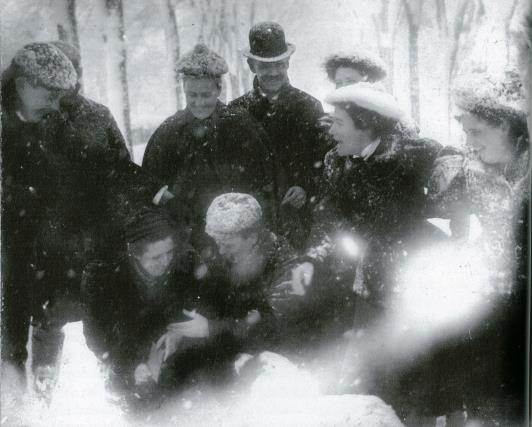
Margaret Russell’s Diary, September 1916

By by Anna J. Clutterbuck Cook, Reader Services

Today, we return to the line-a-day diary of Margaret Russell. You can read previous installments here:

January | February | March | April | May | June | July | August

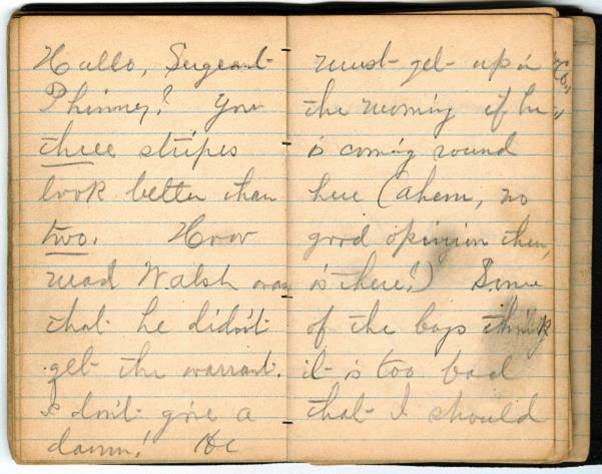
In August, Margaret Russell wrote about her ambivalence planning a trip to the American west due to the uncertainties created by the looming railroad strike. The strike was resolved, however, and as her diary reveals Margaret went ahead with her travel plans. On September 6th, the Wednesday after Labor Day (established as a federal holiday in 1894), she went to Boston to purchase tickets. Between September 7th and September 21st she traveled to Colorado and back by train. It is unclear whether Margaret Russell traveled alone or with other members of the family; her diary seldom reveals her daily companions. Her diary once again reveals her to be a lover of walks and drives, as she details the natural beauty of the landscape in the West. 

On the return journey she notes a tragedy: “Two men killed by our train but we did not know.” Were the men laborers? Were the deaths intentional suicide? An accident? She likely did not know and certainly does not say. It is a passing horror in an otherwise “splendid trip.” The final week of September sees Margaret return to her usual routine of errands, walking, and visiting on the North Shore and in Boston.

 * * *

September 1916*

1 Sept. Friday – Stayed at home in the morning. Drove to Newburyport for tea at Blue Elephant. Home by turnpike.

2 Sept. Saturday – First to Hosp. on to Natick Inn for lunch, on to see Mrs. Hodder home at 6. Dined at Marblehead to see Miss Reulker.

3 Sept. Walked to church & back. Family to dine.

4 Sept. Labor Day – Stayed at home in the A.M. Made calls at Nahant in the P.M.

5 Sept. Tuesday – Mrs. Ward’s last lecture, took tea with Jennie.

6 Sept. To town to make last plans & get tickets. Packing in the P.M.

7 Sept. Left home 8.30. Boston at 10 A.M.

8 Sept. Arrived at Chicago at 12.30. Bath & lunch at Blackstone. Drove through the Riverside Park. Left at 6pm for Denver.

9 Sept. Omaha when awakened at 7. Arrived Denver at 9.45. Brown Palace Hotel. Very noisy room.

10 Sept. Sunday. Fine service at cathedral & sermon from Dean on 10 Commandments. Took sight-seeing bus in P.M. Changed rooms.

11 Sept. Rainy – museum in the A.M. Movies in the P.M.

12 Sept. Left Denver at 8 A.M. Train to Loveland motor to Estes. Wonderful drive thru Thompson canyon. Stanley Hotel most comfortable.

13 Sept. Walked about in the A.M. I found flowers. Drove to Long Peak’s rim in the P.M. & on way home saw beaver dams.

14 Sept. Walked on the Prospect Trail & took Fall River drive up to 10,000 feet. Wonderful view.

15 Sept. Friday – Walked nearly to Glen Lake. Drive the High Drive & Moraine Park. Wonderful weather.

16 Sept. Saturday – Walked along river. Drive to Sprague’s in P.M. The most beautiful drive yet. Views superb.

17 Sept. Sunday Left Estes P- by motor at 2 in thunderstorm which was short. Reached Denver at 6. Road fine thru canyon very dusty on plains. Room Palace Hotel.

18 Sept. Went to museum. Very interesting, did errands. Left Denver at 2.45 for Chicago N. P. & C.M.St.P. Comfortable weather. Saw wind storm.

19 Sept. Travelling all day through corn fields & stock farms. Two men killed by our train but we did not know. Chicago at 9.

20 Sept. Left Chicago at 10.30. Went to Creighton’s first under Hotel Blackstone. Comfortable train & cool.

21 Sept. Arrived in Boston at 3. Had my hair washed & got home by 5.30. Mama very well. A splendid trip.

22 Sept. Writing & paying bills. Drove to Salem for errands & to N. Andover for tea in the P.M.

23 Sept. Saturday – Went to N. Andover with H.G.C.’s. Lovely day.

24 Sept. Walked to church. The two C’s & Ellen to dine only.

25 Sept. Monday – Town for errands. Lunched at Marian’s, went out to see Aunt E.

26 Sept. Tuesday – Walked from little Nahant. Drove to Lynnfield swamp & cut fringed gentian.

27 Sept. Wednesday – To town after lunch for Mayflower Soc. meeting.

28 Sept. Thursday – Walked from Marblehead across [illegible]. Quite warm. To Salem to see Ropes’ house in P.M. Dined at Beverly.

29 Sept. Friday – Church at ten. Looking [illegible] flowers to take to Gray. P.M. went to Herbarium & to Radcliffe tea.

30 Sept. Went to see Mrs. H. Then to Southboro to lunch with H.G.C. Much cooler. High wind.

* * *

If you are interested in viewing the diary in person in our library or have other questions about the collection, please visit the library or contact a member of the library staff for further assistance.


*Please note that the diary transcription is a rough-and-ready version, not an authoritative transcript. Researchers wishing to use the diary in the course of their own work should verify the version found here with the manuscript original.


This Week @ MHS

By Dan Hinchen

It is time, once again, for the weekly round-up of events to come here at the MHS. A reminder: be sure to look ahead using our online calendar of events to see the myriad programs we have slated for the fall. But before we get too far ahead of ourselves, here is what this week holds:

– Wednesday, 14 September, 6:00PM : In Confounding Father: Thomas Jefferson’s Image in his Own Time, historian Robert M.S. McDonald explores how Jefferson emerged as a divisive figure in his day. This author talk is open to the public at a fee of $10 (no charge for MHS Members or Fellows) and registration is required. A pre-talk reception begins at 5:30PM followed by the program at 6:00PM. 

– Thursday, 15 September, 6:00PM : MHS Fellows and Members are invited to a special program, reception, and chance to view Turning Points in American History, the current exhibition on display at the Society. With “More Turning Points: Documents & Artifacts That Didn’t Make the Cut,” Stephen T. Riley Librarian Peter Drummey will highlight some of the turning points that did not make it into the exhibition. Guests can then head upstairs to view the exhibition, socialize, and enjoy a reception. Registration is required at no cost, though seating is limited. 


There is no public tour this week. 

Reference Collection Book Review: Bay Cities, Water Politics

By Anna Clutterbuck-Cook, Reader Services

During a year when much of Massachusetts is experiencing drought conditions and water use restrictions have become a reality in the lives of many in the Commonwealth, it is timely to consider what our regional history of water use and management has been. In the recently-acquired Bay Cities and Water Politics: The Battle for Resources in Boston & Oakland (University Press of Kansas, 1998), historian Sarah S. Elkind documents the political development of water use policies in two geographically and culturally divergent areas of the United States: eastern Massachusetts and the San Francisco bay area. Briefly surveying early water use policies in both the Boston area and the East Bay, Elkind focuses her historical narrative on the late-nineteenth and early twentieth centuries when first-generation water systems began to strain under increasing demand and each region had to determine a way forward.


In Massachusetts, where clean water delivery and sewage disposal had long been framed as a public health concern, the political elite were able to build the case for a regional system that put water and sewage into the hands of state agencies. The voters supported the creation of “new institutions, controlled by engineers and bureaucrats…because they face pollution and water supply problems that their municipalities had repeatedly failed to solve” (114). On the East Bay, meanwhile, water resources became a struggle over private versus publicly-held water supplies as powerful commercial interests resisted attempts to establish publicly-controlled regional deep into the twentieth century.

In both regions, Elkind argues, “rural activities and economies were sacrificed for urban prosperity in spite of the continued nostalgia for America’s rural past” (155). While each region developed temporary solutions to both water supply and waste disposal, these systems remained vulnerable to increased demand for clean water and the growing environmental burden of pollution. Regionalism, Elkind argues, was a Progressive-era solution to challenge of water resource management. By creating infrastructure somewhat immune to the local politics of individual city or corporate interests, regional solutions created water systems that provided clean water to citizens and removed waste. However, regional technologies “ultimately impaired the ability of…natural systems to absorb the byproducts of modern industrial life” (171). By the late twentieth century, regional entities came under harsh criticism from citizen activists in both Massachusetts and California as water battles took center stage in regional politics once again.

For a book on water politics, Bay Cities and Water Politics is a fairly dry read. Elkind relies on government records, the personal papers of key figures, newspapers, pamphlets, and other print materials to construct her history. Readers unfamiliar with the individuals, municipal agencies, and corporations involved may get lost in the play-by-play accounting of regional politics at work. Nonetheless, the title will be an essential resource for anyone needing background on Progressive era water and sewage politics in Boston. It complements the work done by Carl Smith in City Water, City Life (University of Chicago Press, 2013) documenting water supply politics in Philadelphia, Boston, and Chicago before the Civil War.


Related Collections:

Boston & Roxbury Mill Corporation records, 1794-1912. 

Elizabeth S. Houghton papers, 1916-1999; bulk: 1955-1999.

Allen H. Morgan papers, 1923-1990.

Lemuel Shattuck papers,1676-1909; bulk: 1805-1867.

Quincy family papers (1665-1852) in the Quincy, Wendell, Holmes, and Upham Family Papers, microfilm edition.


This Week @ MHS

By Dan Hinchen

The Society is CLOSED on Monday, September 5, in observance of Labor Day.

We return from a long holiday weekend to a steadily increasing flow of events through the month and into October as seminar season resumes. Here’s what’s happening this week:

– Wednesday, 7 September, 12:00PM : Join us for a Brown Bag lunch talk with Chris Staysniak of Boston College. “To Serve and Grow: Catholic and Protestant Youth Volunteering in America, 1934-1973” explores the development of youth volunteering in the United States in the twentieth century and shows how the development of the volunteer was always as important as the actual servcie work he or she provided. This talk is free and open to the public. 

– Thursday, 8 September, 5:00PM : In “The Past Has a Future,” Jonathan Fanton, President of the American Academy of Arts and Sciences, takes up the recurring challenges in the relationship between historians and the public. In so doing, he looks toward a better future for the disipline from the perspective of a leading learned society tha tbridges the humanities, the sciences, and the public good. This talk is open to the public, free of charge, though registration is required. A pre-talk reception begins at 4:30PM and the event begins at 5:00PM. 

Please note, the library closes at 4:15PM on Thursday, 8 September, in preparation for the evening’s event. The library remains closed on Friday, 9 September. Normal hours resume on Saturday, 10 September.

– Saturday, 10 September, 10:00AM : The History and Collections of the MHS is a 90-minute, docent-led walk through the public spaces at the Society. This tour is free and open to the public with no reservations needed for individuals or small groups. Larger parties (8 or more) should contact Curator of Art Anne Bentley in advance at 617-646-0508 or abentley@masshist.org. 

While you’re here you will also have the opportunity to view our current exhibition: Turning Points in American History.

“The Poor Wretched People Are Much Difficulted”

By Susan Martin, Collections Services

I’d like to take this opportunity to write about the topic that’s been dominating U.S. headlines and occupies countless hours of on-air and on-line punditry: the annual migration of the monarch butterfly.

Just kidding. Yes, I mean the U.S. presidential election. Bear with me.

Historical perspective is our bread and butter here at the MHS, of course. Studying the past is almost always both illuminating and sobering. So I thought I’d revisit the U.S. presidential election of 1788-1789, when 56-year-old George Washington became the first chief executive of the brand-new nation.

Looking for inspiration, I browsed through our collection of Miscellaneous Manuscripts, what we call an “artificial” collection. These documents were donated to the MHS at different times, and each is cataloged individually in our online catalog. They’re arranged chronologically, so I could zero in on a specific date range.

I came across a document I’d never seen before but loved immediately. It’s a letter from Baptist minister David Thomas (1732-1815) in Virginia to his nephew Griffith Evans (1760-1845) in Philadelphia. The letter is dated 3 March 1789. After complaining that he’d been “immers’d in the fatigues and troubles of a foolish perverse hairbraind world,” Thomas launched into a bitter diatribe about the sweeping Federalist victory in the presidential election two months before. His letter is dripping with sarcasm and contempt:

“How does Fedralism go on in your State? Does the people know the meaning of the word Fedralism, it is a very pretty word, it has a beautiful sound, it Charms all the learned the wise, the polite, the reputable, the Honorable, and virtuous, and all that are not Caught with the alurements of its melody, are poor ignorant asses, nasty dirty sons of bitches; reserved for future treatment agreeable to their demerrit. […] The whole American world is in an uproar.”


It’s hard to imagine the kind of sea change Thomas was living through. In fact, this letter was written just one day before the U.S. Constitution went into effect, superseding the Articles of Confederation. Thomas clearly resented the strong centralized government that was set to replace the looser confederation of independent states that he preferred.

George Washington belonged to no political party and was elected unanimously, a circumstance inconceivable today. But far from inconceivable is Thomas’s frustration at his state’s convoluted electoral process, which he described in detail:

“Perhaps you are a Stranger to the term hold the pole, of which I will inform you, viz: the Candidate stands upon an eminence close to the Avenue thro which the people pass to give in their votes, viva voce, or by outcry, there the candidates stand ready to beg, pray, and solicit the peoples votes in opposition to their Competitors, and the poor wretched people are much are much difficulted by the prayers and threats of those Competitors, exactly Similar to the Election of the Corrupt and infamous House of Commons in England.”

He’d narrowly escaped a seat in the Virginia Assembly himself:

“At the last Election I was drag’d from my Lodging when at dinner, and forced upon the Eminence purely against my will, but I soon disappeared and return’d to my repast, and as soon as they lost sight of me they quit voting for me. Such is the pitifull and lowliv’d manner all the Elected officers of Government come into posts of honour and profit in Virginia, by Stooping into the dirt that they may ride the poor people; and would you have your Uncle to divest himself of every principle of honour to obtain a disagreeable office[?] I hope not.”

So, if you get fed up with political shenanigans, chicanery, and tomfoolery this election season, what Thomas called “Rotated […] tricks” and “Reverberated flings,” remember that you’re not alone. And be sure to visit the MHS library to learn more about early American politics—or butterflies, if you prefer.

This Week @ MHS

By Dan Hinchen

There are no public programs or events scheduled this week. Keep an eye on our Online Calendar of Events to see what is coming in the fall and for library/building closures. 

Please note that the library is CLOSED on Saturday, September 3, but the galleries remain open. The Society is CLOSED on Monday, September 5, for Labor Day. 

Reference Collection Development: Watch This Space for New Titles!

By Anna Clutterbuck-Cook, Reader Services

During the past fiscal year, the MHS used income from hosting the GLCA Boston Summer Seminar to increase our reference collection development efforts. As a research library, it is crucial for the MHS to have up-to-date scholarly and reference works that support in-depth exploration and analysis of our manuscript, print, and art and artifact collections. In recent years we have depended primarily on the generosity of donors to add recent publications to our collection. We are excited that the Boston Summer Seminar income allowed us to be more proactive in strengthening our scholarly and reference holdings.

During the winter of 2016, our reader services team reviewed and updated the reference collection development policy, identified priority areas for acquisition, and surveyed trade publications for relevant titles. In June we were able to purchase over fifty titles in the following key areas: artifacts and material culture reference works, art and photography history and reference, Boston and local history, environmental history, immigration and emigration, New England in a global context, research fellows’ publications, World War I, research strategies and techniques, and twentieth century political and social history. Most of these titles are now cataloged and available upon request for review in the MHS library’s reference or reading rooms.

Beginning in September, reader services team members will highlight some of these newly-acquired works here on The Beehive, in the form of summary reviews paired with suggestions for which MHS collections might benefit from consultation with the work under review. We hope that these short reviews will encourage you to explore our scholarly and reference holdings for titles that support your work with our rare and unique collections material.

The MHS library also continues to welcome the donation of recent scholarly works that make use of or fit with our holdings, as well as being open to suggestions for titles that may be useful additions to our scholarly and reference collection. Offers of donation or suggestions for acquisition should be directed to the reference librarian Anna Clutterbuck-Cook at acook@masshist.org.

This Week @ MHS

By Dan Hinchen

It’s another quiet week at the MHS as far as programs go. Here is what lies ahead:

– Wednesday, 24 August, 12:00PM : Join us for a Brown Bag lunch talk with Kenyon Gradert of Washington University in St. Louis as he presents “The Puritan Imagination in Antislavery New England.” Gradert’s talk will exlpore why antebellum Americans reached for the Puritans in the fight against slavery and why this matters for scholarship of American history and culture. 

– Saturdya, 27 August, 10:00AM : The History and Collections of the Massachusetts Historical Society Tour is a 90-minute docent-led walk through our public rooms. The tour is free, open to the public, with no need for reservations. If you would like to bring a larger party (8 or more), please contact Curator of Art Anne Bentley at 617-646-0508 or abentley@masshist.org.

While you’re here you will also have the opportunity to view our current exhibition: Turning Points in American History.

Death of a Party

By Dan Hinchen, Reader Services

“At seven minutes to three o’clock on the afternoon of Monday, Oct. 20, 1902, the National Club of Massachusetts committed suicide by voting itself out of existence. The scene of the tragedy was Room 12, Young’s Hotel, Boston. Twenty-one members, four less than a quorum, agreed with unanimity and composure to commit this act. A few minutes later, twenty-one gentlemen dispersed to their usual occupations so quietly that neither the elevator boy nor the waiters, nor the lynx-eyed clerks of the hotel, suspected what had been done. The newspapers took no notice of the suicide. The police did not exercise their ingenuity in inventing a theory as to its motive, or debate whether the weapon used were sharp or blunt. To this day, the coroner has ordered no ‘quest. And yet, for the historian, the National Club may be of interest, because of the great crisis out of which it sprang. That is why I have been so precise in specifying time and place and circumstance; and why it seems right to give the Society for safe keeping this collection, unfortunately incomplete, of papers refering to the Club and to is parent, the National Party of 1900. Antiquaries today spend their lives gathering similar material about political organizations long past; and in due season our time will be antiquity to a new age.”

From “The Suicide of a Political Infant” by William R. Thayer, found in the National Party records, 1900-1903.


If you want to learn more about the demise of this political movement, consider Visiting the Library!

“Have you look’d at this Universe, through the Telescopes of Herschell?”

By Rhonda Barlow, Adams Papers

The Juno space probe began orbiting Jupiter on July 4, 2016, and already has transmitted images of the planet’s moons and famous Great Red Spot. The study of the planets is not new, however, and when he was in England, John Adams had the opportunity to meet one of the most famous astronomers of his day.

In 1781, astronomer William Herschel discovered the planet Uranus, an accomplishment that earned him the patronage of King George III. Herschel set up his telescopes near Windsor, the summer home of the king.

John Adams seems to have been impressed. In 1786 he wrote, “Herschell indeed with his new Glass, has discovered the most magnificient Spectacle that ever was seen or imagined.” He tipped his hat to Herschel when writing his Defence of the American Constitutions: “A prospect into futurity in America, is like contemplating the heavens through the telescopes of Herschell: objects, stupendous in their magnitudes and motions, strike us from all quarters, and fill us with amazement!”

Adams had the opportunity to look through Herschel’s telescopes himself. He was supposed to accompany his friend Benjamin Vaughan to Windsor on the evening of April 1, 1787. A few days later, Vaughan wrote that although Adams had been unable to attend, “Dr. Herschell will always of course be happy to see his Excellency;—but the longer the visit is deferred, the more will be there to see. The most proper time is, the first quarter of the moon, whenever the visit is intended.”

What could have kept John Adams from an opportunity to look through Herschel’s telescopes? Adams explained in a brief note:

“I am very much mortified to loose the Pleasure and Advantage of an Excursion to Windsor, to see Mr Herschell in Such Company: but the State of my Family is Such that I cannot justify leaving it.— Mrs Smith is in Travel and the Anxiety occasioned by this Event has made Mrs Adams so much worse, that I should be very bad Company at Windsor, and what is more decisive, it becomes my Duty to Stay at home.”

Mrs. Smith—his only daughter, Nabby—was “in travel,” meaning she was in labor, and Abigail was understandably anxious about the birth of her first grandchild. As usual, John Adams knew where his duty lay—the volcanoes on the moon would have to wait.

Although we do not know when Adams finally looked through Herschel’s telescopes, we do know that he maintained his interest in astronomy. In 1813, Adams wrote to John Quincy, “Have you look’d at this Universe, through the Telescopes of Herschell? What am I and all my Posterity? What is this Globe of Earth? What is the Solar System?”

For more on the Adamses and astronomy see here