
A Perilous Transformation: The Soldiers of Fort Washington & the Siege of Boston

by Aaron Peterka, MHS Early Career Scholar Committee & Mentorship Program Member

Over the course of 250 years, the grass-covered mounds of Cambridge’s Fort Washington morphed from a necessary military fortification to a lasting monument to the American Revolution’s early perils. It is also a monument to another kind of metamorphosis: that of a colonial citizen army outside Boston in 1775-76 to the professional Continental Army that emerged victorious at Yorktown in 1781. Diaries from the MHS archives, like that of Boston merchant William Cheever, clearly illustrate the hazards for the New Englanders who faced the British, who, though besieged, were still mobile and active in late 1775/early 1776.

In one entry dated November 9, 1775, mere weeks before Fort Washington’s construction began, Cheever noted that “Several Companies” of British regulars crossed over to “Phip’s Farm” and “brought off some Cattle at noon day under Cover of a Ship in the River, Cannon on Charlestown point, and their own Floats.” He recorded a similar raid that took place on February 14, 1776, wherein the night before, “a Number of the Light Infantry and Grenadiers went over to Dorchester Neck and burnt 4 or 5 Houses” and took several prisoners. Moreover, as the Americans continued to entrench in front of Cambridge, the British did likewise in Boston. Cheever noted on December 4, 1775, that the “regulars have a Battery just above the Copper-Works” in west Boston, as well as colonial artillery dueling British ships “at the head of the Charles River,” as the British attempted to keep the Americans from “carrying on their Works on a Rise at Phips’s Farm.” Soldiers like Private Obadiah Brown of Gageborough, Massachusetts, could easily supplement Cheever’s observations, as Brown recalled an ordeal on February 20, 1776, where the British “Regulars fired all Day” at him and his comrades as they dug trenches at “Leachmore point.”

Such accounts bring to life the hardships and precarity of the Revolution’s earliest days, and it is to this narrative of trial and peril, so carefully preserved in the MHS’s collections, that Fort Washington belongs. However, that narrative not only includes the challenges of containing a worthy foe, but also the complex characters of those soldiers who held the line in bastions like Fort Washington.          
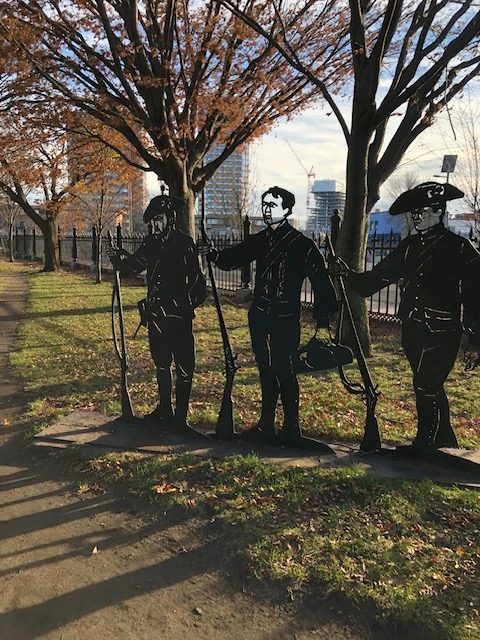
Photo of 3 cut-out statues standing in a park-like environment
Life-size renderings of colonial soldiers at Fort Washington today.
Courtesy of Aaron Peterka.

In the summer and fall of 1775, General Washington hardly held those soldiers in high esteem. He lamented their apparent self-centeredness, poor discipline, and civilian attitude, writing to Lieutenant Colonel Joseph Reed on November 28, 1775, that “such a dirty mercenary Spirit pervades the whole, that I should not be at all surprised at any disaster that may happen.” Granting generous furloughs just to keep up enlistments, the general also despaired over the Connecticut regiments’ refusal to extend their service beyond their original term, fearing that absent soldiers and expiring enlistments would weaken his army to the point of disintegration. “[O]ur lines will be so weakened that the Minute Men & Militia must be call’d in for their defence,” Washington ruefully observed, and “these being under no kind of Government themselves, will destroy the little subordination I have been laboring to establish.”

The diary of the aforementioned Private Brown allows for a glimpse into Washington’s conundrum. Oftentimes, Brown stood “gard” or performed “feteague” duty at the “Leachmore point” fort from January to March 1776. But interspersed throughout his terse entries are observations of drunkenness and ill-discipline; the kind that would drive mad a professional soldier like Washington. In one instance on February 7, 1776, “Two Sodiers Drank 33 glases of Brandy and Gin one Died.” Five days later, Brown witnessed another soldier receiving “39 lashes” for an unspecified indiscretion. And on February 16, 1776, Brown recalled that “orders came for one Shilling to be taken out of the Sodier wages for Every Cartridg Lost,” a stark reflection of the dire shortage of shot and powder that threatened the army, as well as the general unmilitary air that characterized the army in New England. And despite its successful re-occupation of Boston in March 1776, this same army would endure defeat after defeat in the coming years, and through the miseries of Valley Forge, painfully transform into the Continental Army that would ultimately prevail at Yorktown. Fort Washington is a testament to the beginning of that metamorphosis.

It is this complicated history of which Fort Washington is a part. It is a reminder of the challenges and contradictions that shaped the Revolution and this country’s birth: the fierce independent spirit that drove the colonists to rebel and made them poorly disciplined soldiers; the uncertainties of maintaining adequate supplies and manpower; and the looming threat posed by the growing might of the British army in Boston. In a time when the United States remains the world’s superpower, its military might thus far unmatched in the 21st century, it is easy to forget these truths. And yet, Fort Washington continues its silent vigil; a memorial that compels all who reflect upon it to remember “the times that try men’s souls.”      

Further Reading:

“From George Washington to Lieutenant Colonel Joseph Reed. 28 November 1775,” Founders Online, National Archives. https://founders.archives.gov/documents/Washington/03-02-02-0406.

Thomas Paine. Common Sense and Other Works. New York: Fall River Press, 2021.
Silent Sentinel, Silent Witness: Reflections upon Fort Washington & the Siege of Boston

by Aaron Peterka, MHS Early Career Scholar Committee & Mentorship Program Member

At 95 Waverly Street in Cambridgeport, a silent sentinel still keeps watch. Its four earthen mounds, cradling three eighteen-pound cannons, still face eastward towards Boston, standing at the ready for a long-departed foe from a long-ago war. This is Fort Washington. A relic from the beginning of the American Revolution, this unimposing redoubt is all that remains of the fortifications that besieged the British army in Boston from April 1775 to March 1776. As the country marks the Revolution’s semiquincentennial anniversary, it is all together appropriate to reflect upon Fort Washington and its testimonial to the perilous origins of an army and the embryonic country for which it fought.

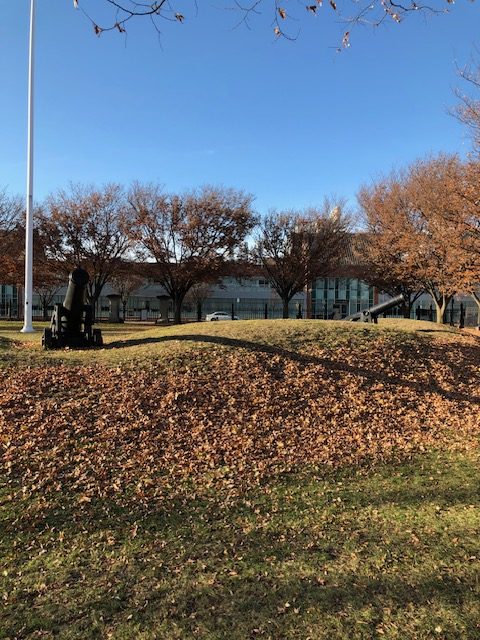
Photo of a grassy area with some cannons. Large buildings and trees are in the background.
Facing east, Fort Washington’s three 18-pounder guns positioned between earthworks dug by the Continental Army besieging Boston in 1775-1776.
Courtesy of Aaron Peterka.
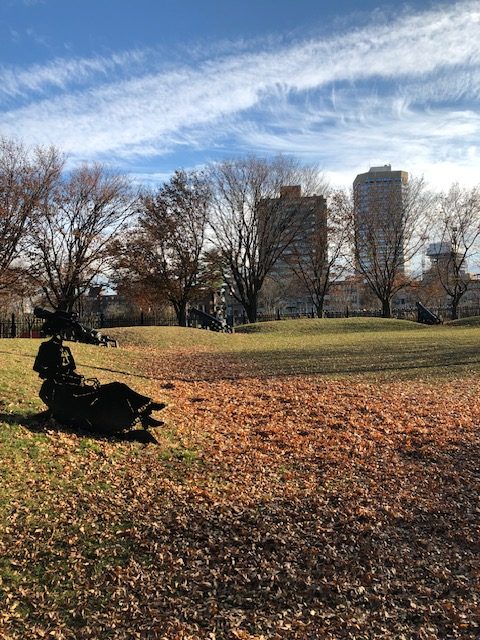
Photo of a grassy mound with two cannons on it
Looking west into Cambridge. Although not the originals, the cannons date from the Revolutionary era, while the gun carriages are from the 1850s.
Courtesy of Aaron Peterka.

Fort Washington’s service began on a simple piece of paper upon which General George Washington penned a letter to Lieutenant Colonel Joseph Reed on November 27, 1775. When he first arrived in Cambridge that July to take command of the fledgling Continental Army, he found the fortifications woefully inadequate for a siege, with “shallow redoubts on Winter Hill and Prospect Hill,” a “crude abatis on the Boston Road,” a mere trench stretching across Roxbury’s main street, and a single “breastwork on Dorchester Road.” Rightly concerned with such vulnerabilities, the general labored to improve the American defenses through the coming months, and it was under this labor in the fall of 1775 that he informed Reed that he “caused two half Moon Batteries to be thrown up, for occasional use, between Litchmores point to command that pass, & rake the little rivulet which runs by it to Patterson’s Fort.” Washington also commissioned the construction of three other fortifications “between Sewells point, & our Lines on Roxbury Neck” to further reinforce the American lines.

These fortifications are clearly visible on the Henry Pelham Map from 1775 in the Massachusetts Historical Society’s collection, with Fort Washington appearing as the “3 Gun Battery” sitting along the Charles River just before it empties into Boston Harbor. Today, modern Cambridge surrounds the fort, but in 1775, it commanded both the river’s mouth and the southernmost extremity of a meadow that is now part of the MIT campus. This strategic position contributed to Washington’s goal of preventing a British “Sortee, when the Bay gets Froze” and securing Cambridge from attack. Designed to accommodate roughly 50-60 soldiers, the earthen redoubt took the name of the American general-in-chief, its garrison scanning the marshy approaches for any sign of British encroachment. Although there is no record of the fort having ever fired its guns in anger, it nevertheless served an important purpose; a brick in the greater wall that Washington designed to restrict General William Howe’s freedom of movement. And yet, Fort Washington’s service transcends the realm of strategy.

Beyond its military utility, Cambridge’s redoubt gives testament to the harsh realities that confronted the infant American army outside of Boston. In another letter to Reed dated November 28, 1775, Washington conveyed his fears of dwindling gun powder supplies, writing that the vital commodity was “so much wanted, that nothing without it can be done.” Also weighing heavily upon Washington was the omnipresent threat of British spoiling attacks and counter-strikes. Indeed, the general expressed his expectation that the British would interfere with the digging of the “Letchmores point” earthworks, “unless Genl Howe is waiting the favorable moment he has been told of, to aim a capitol blow.”

Facing a growing force of British regulars with an army of untrained civilian-soldiers and his supplies dangerously low, General Washington confided to Reed that had he been able to foresee the dismal state of affairs outside Boston, “no consideration upon Earth should have induced me to accept this Command.” Thus, Fort Washington is both a literal product and reflection of the crisis of 1775, wherein the siege of Boston, even the survival of the Revolution, was in doubt. Erected out of military exigency, the Cambridge earthworks remain a physical reminder that no cause, no revolution, no fight for independence, is ever guaranteed.     

Further Reading:

“From George Washington to Lieutenant Colonel Joseph Reed. 27 November 1775,” Founders Online, National Archives. https://founders.archives.gov/documents/Washington/03-02-02-0401.

“From George Washington to Lieutenant Colonel Joseph Reed. 28 November 1775,” Founders Online, National Archives. https://founders.archives.gov/documents/Washington/03-02-02-0406.

“Fort Washington,” https://historycambridge.org/Cambridge-Revolution/Fort%20Washington.html.

Robert Middlekauf. The Glorious Cause: The American Revolution, 1763-1789. Oxford: Oxford University Press, 1982.

Love During the Siege of Boston

by Rakashi Chand, Reading Room Supervisor

The Siege of Boston (April 1775-March 1776) during the American Revolution was marked by chaos. Boston, one of the busiest cities in the colonies, became a loyalist stronghold as British troops took control, while those drawn to the American cause fled to the countryside. American troops, eventually forming into the Continental Army, surrounded the city, cutting off land access that led to food and causing supply shortages.

Amid this turmoil a young patriot named William Tudor was in love with a beautiful loyalist named Delia Jarvis. But duty and the cause called; John Adams had William appointed chief legal officer to General Washington and William left Boston with a heavy heart. But that didn’t stop him from trying to court Delia, who refused to leave her family in the besieged city, as their love turned to missives. They took on romantic pen names, she signing her letters Felicia, and he Crito.  Delia pretended to be unimpressed by William’s pursuits but that did not discourage him, nor did it ease the worries he had for dear Delia trapped in Boston. He urged her to come out and guaranteed her safe passage, but she refused to go, worrying about the health and wellbeing of her family. The pain William must have felt looking at Boston aching for his ‘Felicia’ as the siege intensified.


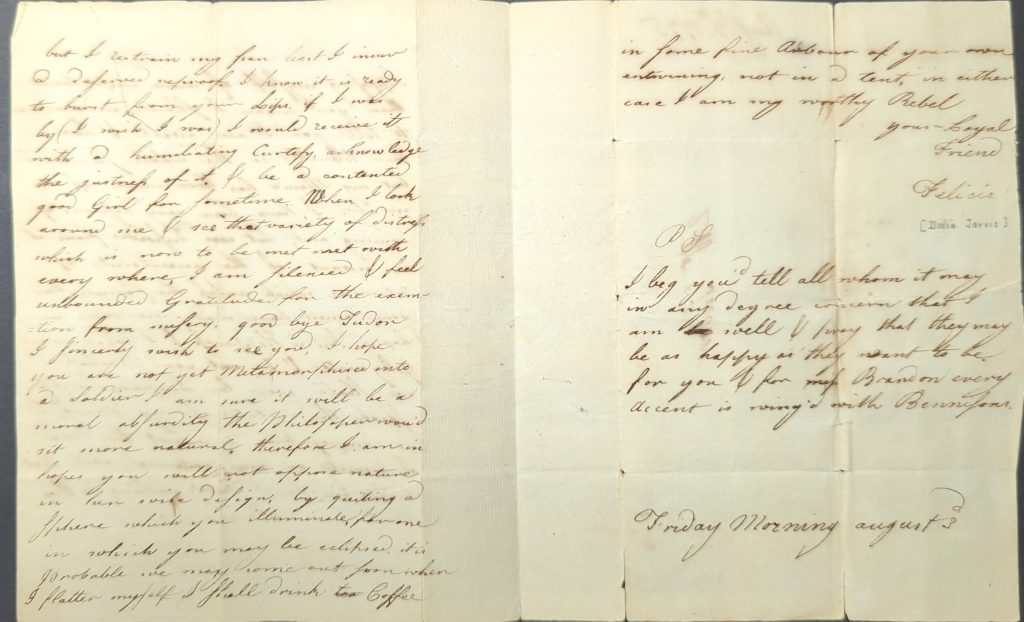
Excerpt of Delia Jarvis to William Tudor, 3 August 1775

I sincerely wish to see you, I hope you are not yet Metamorphised into a Soldier. I am sure it will be a moral absurdity the Philosopher wou’d sit more natural, therefore I am in hopes that you will not oppose nature in her wise design by quitting a sphere which you illuminate, for one in which you may be eclipsed. It is probable we may come out soon when I flatter myself I shall drink tea Coffee in some fine Arbour of your own entwining, not in a tent, in either case I am my worthy Rebel,

Your Loyal
Friend
Felicia

handwritten letter
Letter by Delia Jarvis excerpted above

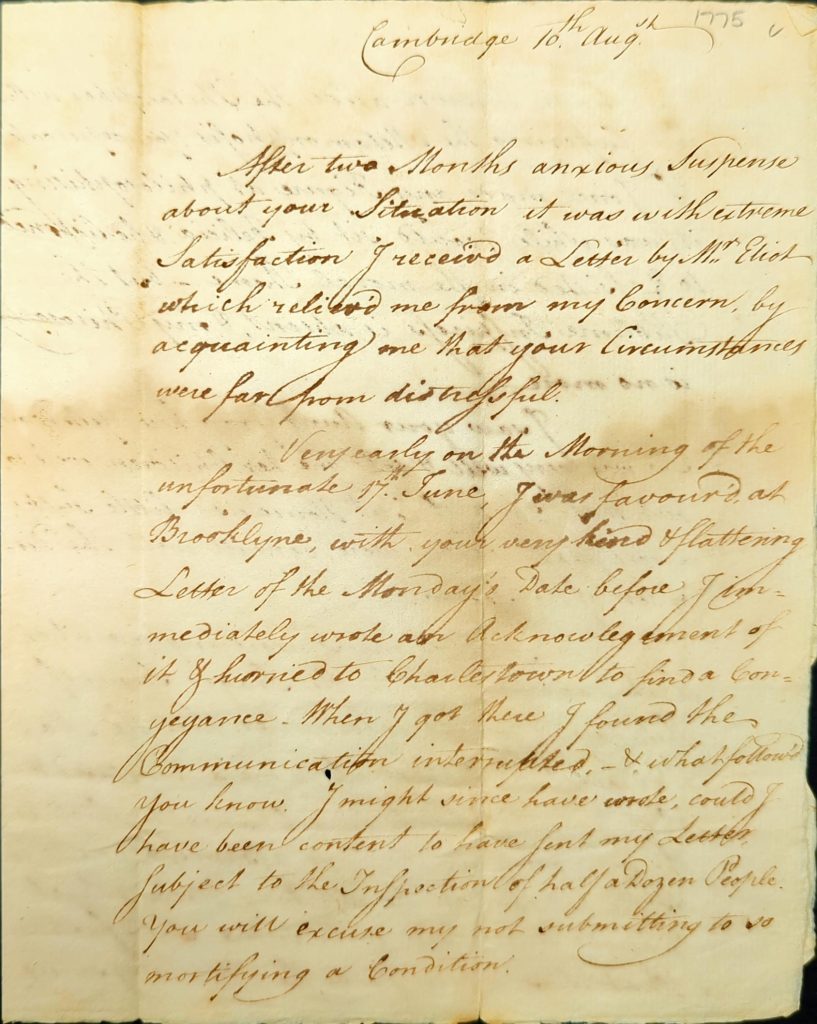
Excerpt of William Tudor to Delia Jarvis, 10 August 1775

You appear inclin’d to make an Excursion into the Country, provided you could get back again to Boston. If you will come, I will venture to insure you Permission to return, from Head Quarters here. You are best acquainted with the Difficulty on your Side. There can be none of your Friends who would not be happy to see you, & among them I presume you will think me not the least so, on such an Occasion.

Should the Family remove, I will ask the Favour of Felicia to bring with her 3 or 4 Manuscript Books, which I left in my writing Desk; providing she can do it . . . .

Adieu my amiable Loyalist & be assur’d that though deem’d a Rebel in Politicks, I am a true Subject to Friendship. To that I mean which you have permitted me to cultivate; For as my Esteem for you was founded on Qualities, which Time can no otherwise affect, than to improve. It cannot cease but with the Life of Crito

handwritten letter
First page of the letter by William Tudor excerpted above

The Siege of Boston continued until the spring of 1776, but William and Delia maintained their secret correspondence throughout. According to family lore, when word came that Delia had escaped to Noddle’s Island, Wiliam swam across the bay to see her with his clothes on his head. Perhaps it was that sight that swayed Delia’s heart, as they reunited on the shore after months of uncertainty, longing, and letters.

The Siege ended with the exodus of the British troops and loyalist followers from the city, but Delia stayed. Unfortunately for William, he now had to leave Boston with the Continental Army for New York City, as the Judge Advocate General, further interrupting their complicated courtship.

Were they ultimately united?

Yes.

After marrying in 1778, their union produced several notable descendants including author and diplomat William Tudor Jr., the “Ice King” Frederic Tudor, and their daughter Delia, who may have had an even more interesting romance when she married naval hero Charles Stewart, commander of the USS Constitution.

Most enduringly, William Tudor went on to be one of the ten founding members of the Massachusetts Historical Society. The very first meeting of the Massachusetts Historical Society was hosted by “Felicia” and “Crito” in their Court Street home and their love story became a part of the Society they helped create.

Further Reading

The Tudor Family Papers

The bulk of this collection are the love letter between William Tudor (1750-1819) and Delia Jarvis (later Tudor 1753-1843) during their courtship from 1773 until their marriage in 1778.

Tudor family papers II, 1765-1862

A small collection of mostly legal papers involving recovery of land after the evacuation of Boston,  and some family correspondence

A lovely day for a cup of Tea!

By Rakashi Chand, Reader Services

“This is the most magnificent Movement of all. There is a Dignity, a Majesty, a Sublimity, in this last Effort of the Patriots, that I greatly admire. The People should never rise, without doing something to be remembered — something notable And striking. This Destruction of the Tea is so bold, so daring, so firm, intrepid and inflexible, and it must have so important Consequences, and so lasting, that I cant but consider it as an Epocha in History.” (John Adams diary entry for 17 December 1773)

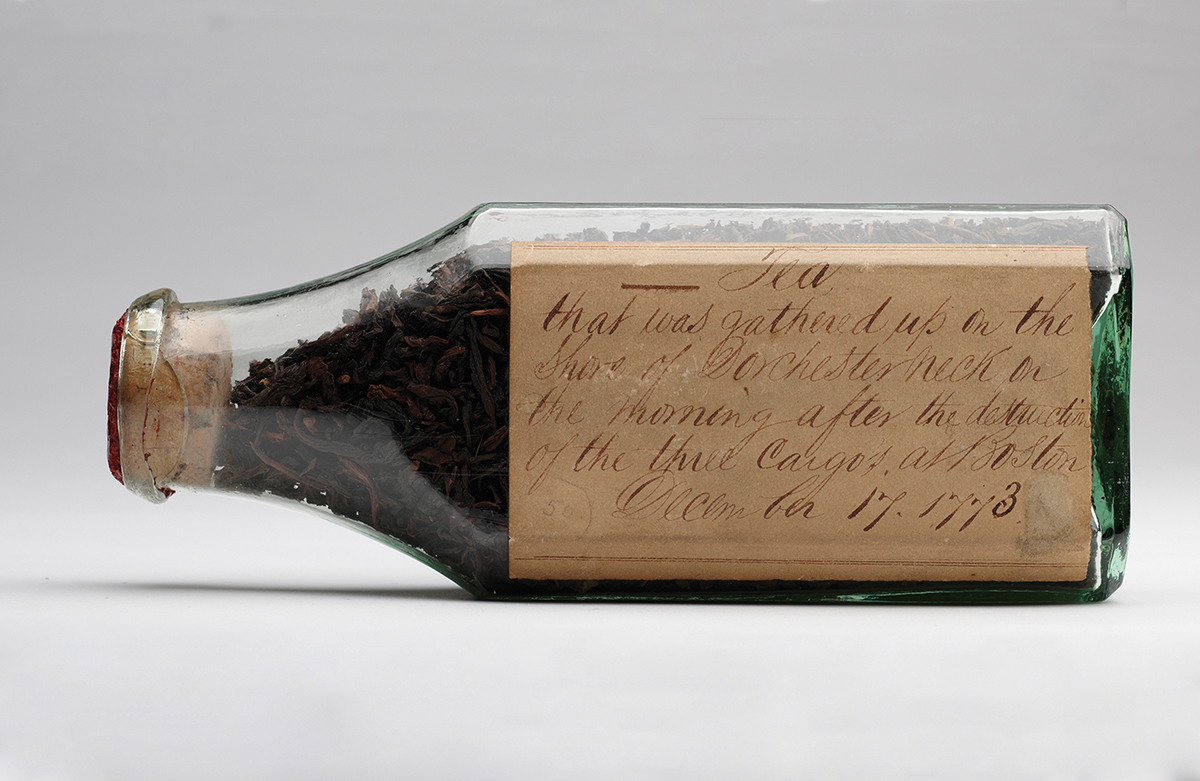
On this day, 245 years ago, tea leaves washed up on the shore of Dorchester Neck. Some of those tea leaves were collected and put into a glass bottle for safe keeping. Why? Because inhabitants of Boston were very proud of what they had brewing in the harbor the night before! Read about the events leading up to the Boston Tea Party at the Coming of the American Revolution: The Boston Tea Party.

Along with the tea leaves collected at Dorchester Neck, the MHS has 4 relics related to the Boston Tea Party inlcuding tea caddies said to have been emptied at the Tea Party and the Edes Family Tea Party punch bowl. The MHS also holds the Boston Tea Party meeting minutes from 29-30 November 1773 and 14-16 December 1773.

For more information, visit the MHS library with or e-mail us at library@masshist.org.

A Revolutionary Reunion: Lafayette and John Adams

By Amanda M. Norton, Adams Papers

On August 15, 1824, the General Marquis de Lafayette, one of the great heroes of the American Revolution, returned to the United States for the first time in forty years, kicking off a nearly thirteen-month tour of the entire country. After Lafayette’s arrival in Massachusetts, John Adams greeted him via his grandsons on August 22, “There is not a man in America who more sincerely rejoices in your happiness and in the burst of joy which your presence has diffused through this whole continent than myself.” “I would wait upon you in person,” Adams lamented, “but the total decrepitude and imbecility of eighty nine years has rendered it impossible for me to ride even so far as Governor [William] Eustis’s to enjoy that happiness.” He instead requested that Lafayette spend a day with him in Quincy. Lafayette in turn noted his regret that he had not been able to go straight to Quincy “on [his] Arrival at this Beloved place . . . and Embrace You.”

John’s grandson Charles Francis Adams was present for the meeting of the old revolutionaries in Quincy on August 29 and recorded his impressions in his Diary:

The Marquis met my Grandfather with pleasure and I thought with some surprise, because really, I do not think he expected to see him quite so feeble as he is. It struck me that he was affected somewhat in that manner. Otherwise the meeting was a pleasant one. Grandfather exerted himself more than usual and, as to conversation, appeared exactly as he ever has. I think he is rather more striking now than ever, certainly more agreable, as his asperity of temper is worn away. . . . How many people in this country would have been delighted with my situation at this moment, to see three distinguished men dining at the same table, with the reflections all brought up concerning the old days of the revolution, in which they were conspicuous actors and for their exertions in which, the country is grateful! It is a subject which can excite much thought as it embraces the high feelings of human nature. . . . My grandfather appeared considerably affected and soon rose after dinner was over.

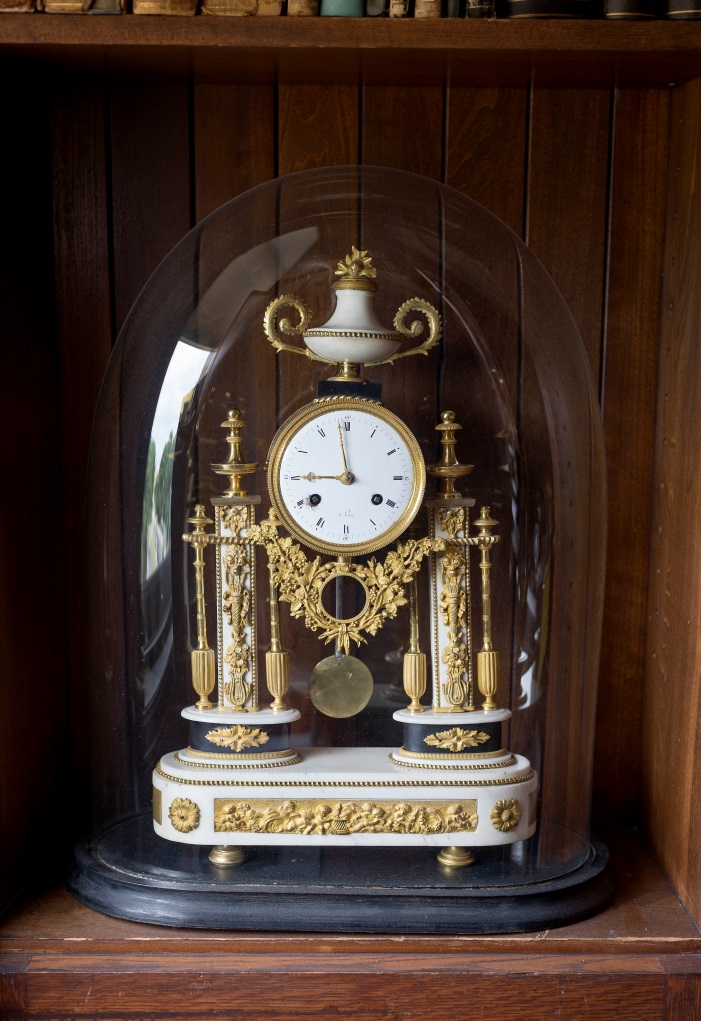
A few weeks after their reunion Lafayette thanked Adams for the visit: “I Have Been Very Happy to See You, and altho’ I Regretted The shortness of My Visit . . . I Have Cordially Enjoy’d, More indeed than I Can Express it, the pleasure to Embrace My old Respected friend and Revolutionary Companion.” A French brass and marble mantle clock that Lafayette gifted to his old friend in honor of this visit now sits in the office of the Editor in Chief of the Adams Papers Editorial Project at the Massachusetts Historical Society.


Major Samuel Selden’s Powder Horn: A Revolutionary Map of Boston

By Allison K. Lange, PhD

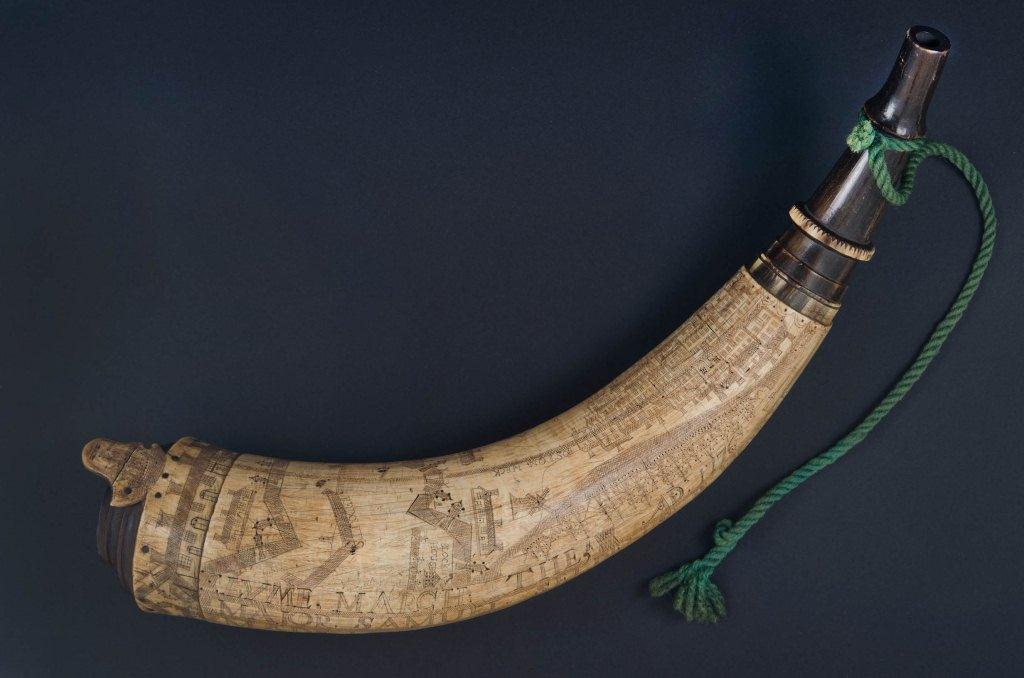
We expect to see maps on paper, not on animal horns. Maj. Samuel Selden might have thought this as he etched a map of Boston on his powder horn, which is dated 9 March 1776. During the Revolutionary War, soldiers used animal horns to hold their gunpowder. They filled them at the larger end and funneled the powder into their weapons. Not all militiamen had their own powder horns, so men like Selden carved unique designs on them in order to claim them as their own.

Selden was a member of Connecticut’s Provincial Assembly and became a major in the colony’s militia during the war. He served under George Washington’s direction during the siege of Boston. His powder horn depicts the sites of American fortifications as well as the positions of the Continental Army just before the British evacuated the city.

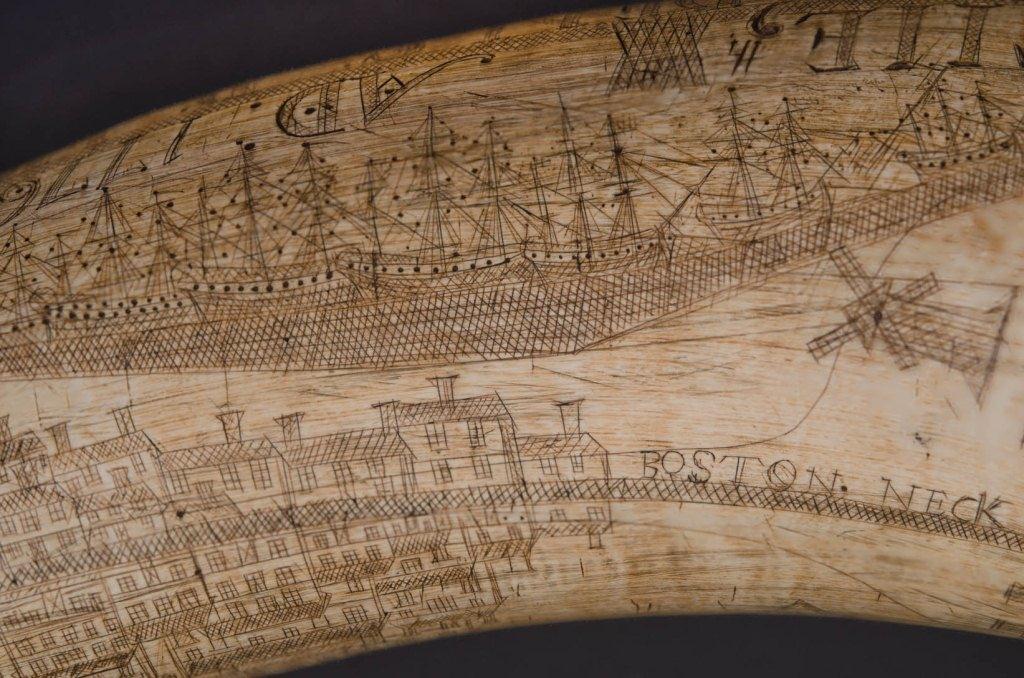
Even if we did not know Selden’s background, his carvings convey his allegiances. A ship labeled “Amaraca” displays a Continental Union flag. Another flag depicts the Liberty Tree, the tree near the Boston Common where locals met to protest British rule. Alongside his name, Selden also inscribed the words: “made for the defense of liberty.”

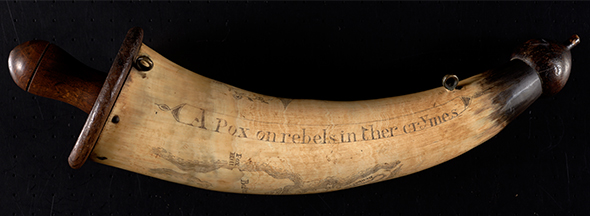
Selden’s map is a pictorial map rather than one focused on the area’s geography. His detailed carvings feature individual ships in the harbor and houses lining the Boston neck. Crosshatching adds depth to the water and makes his lettering stand out. In contrast, a 1775 powder horn housed at the Norman B. Leventhal Map Center features a more traditional map of Boston. Instead of pictures, this map traces shorelines. Unlike Selden’s, however, a British soldier carved this powder horn. He inscribed the words: “A Pox on rebels in ther crymes [their crimes].”

1775 powder horn

Photo courtesy of Norman B. Leventhal Map Center.

Just six months after Selden carved his horn, the British captured him at the Battle of Kip’s Bay during their campaign to take control of New York City. The prison’s conditions were poor. Less than a month later, Selden fell ill and died on 11 October 1776.

Selden’s powder horn, as well as that of his British counterpart, is currently on display in the Norman B. Leventhal Map Center’s exhibition at the Boston Public Library. The exhibition, We Are One: Mapping America’s Road from Revolution to Independence, uses maps to explore the events that led thirteen colonies to forge a new nation. We Are One demonstrates that maps, from Selden’s carving to early European maps of the new nation, were central to the revolutionary process. The exhibition features maps as well as prints, paintings, and objects from the Leventhal Map Center’s own collection and those of twenty partners, including the British Library and Library of Congress. Visit zoominginonhistory.com to explore geo-referenced maps from the exhibition.

The exhibition will be on display at the Boston Public Library through November 29, 2015. We Are One then travels to Colonial Williamsburg from February 2016 through January 2017 and to the New-York Historical Society from November 2017 through March 2018.

The Leventhal Map Center also hosts the NEH-funded American Revolution Portal database. Researchers can access maps from the Massachusetts Historical Society, British Library, Library of Congress, and other institutions in one search. Users can download images for research and classroom use. Access these resources and learn more about We Are One at maps.bpl.org/WeAreOne.

Find out more about the Society’s own map collection at their upcoming exhibition: Terra Firma: The Beginnings of the MHS Map Collection, which opens on 2 October. Through 4 September, visitors to the MHS can learn more about the American Revolution with exhibition: God Save the People! From the Stamp Act to Bunker Hill.

Image 1: Selden, Samuel, 1723-1776. [Powder horn scribed by Samuel Selden.] Lyme, Conn., 1776. 1 powder horn: ivory; 37 x 21 x 13.3 cm. Massachusetts Historical Society.

Image 2: Detail of above.

Image 3: E.B., [Powder Horn with Map of Boston and Charlestown]. [Boston], 1775. Scrimshaw horn, 14 x 3.5 x 3.5 inches. Norman B. Leventhal Map Center.

“Signed, sealed and delivered”: The Treaty that Ended the Revolutionary War

By Amanda A. Mathews, Adams Papers


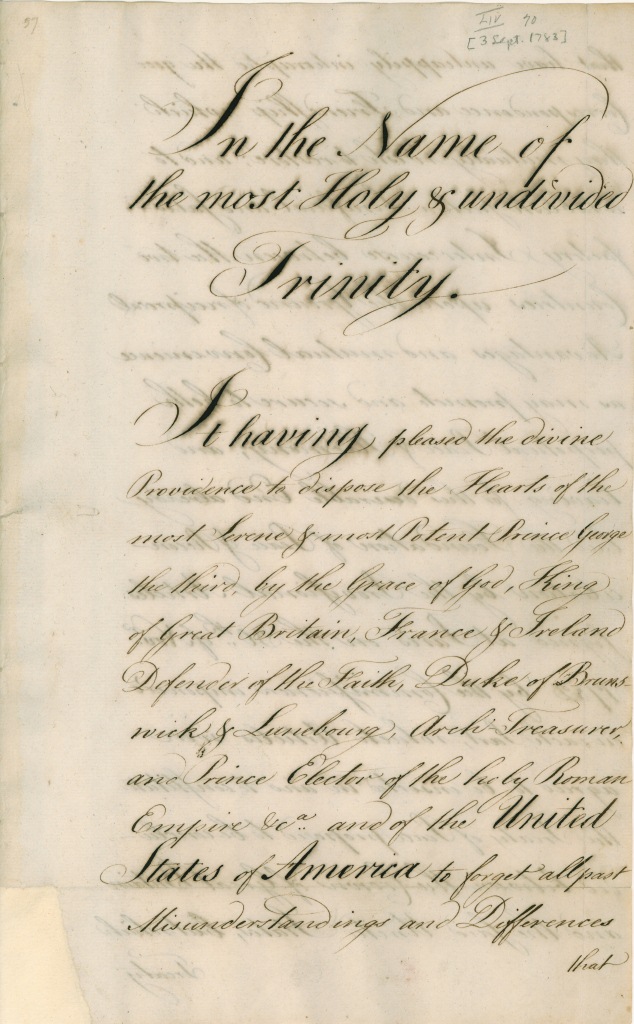
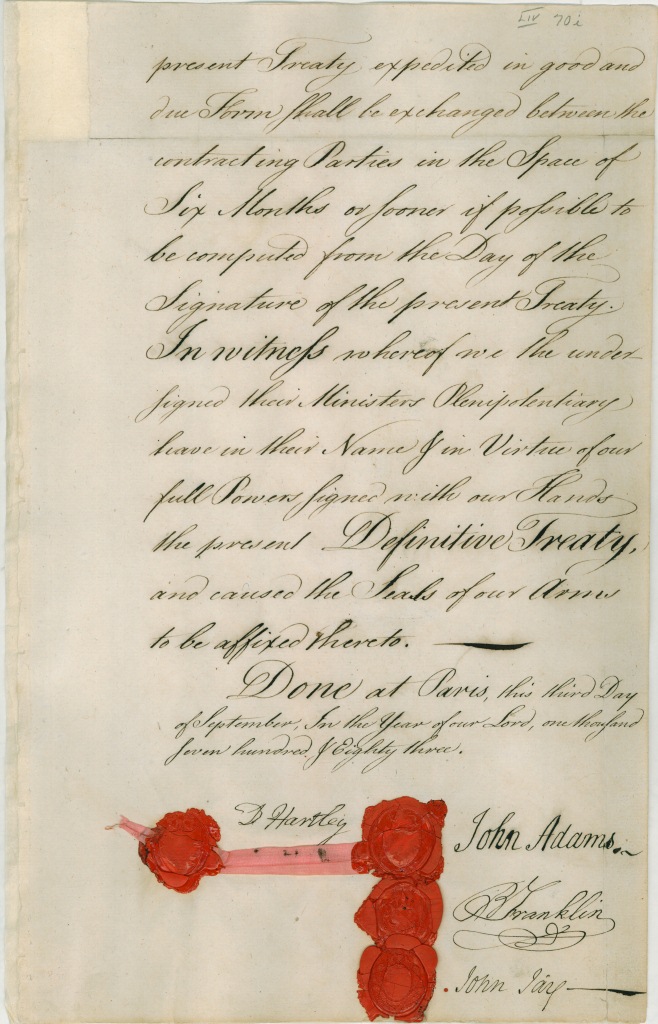
“On Wednesday the third day of this Month, the American Ministers met the British Minister at his Lodgings at the Hôtel de York, and signed, sealed and delivered the Definitive Treaty of Peace between the United States of America and the King of Great Britain.” John Adams reported this news to the President of Congress on September 5, 1783 and congratulated Congress on the “Completion of the work of Peace.”

It was eight o’clock in the morning when John Adams along with Benjamin Franklin and John Jay, met the British peace negotiator, David Hartley, at his residence in Paris and months of negotiations, first the previous year leading to the preliminary peace treaty, and then in earnest from April until the end of August culminated in this definitive treaty.

While this was no doubt a significant moment—after all, eight long years of war were officially ending with complete American independence—the signing was more of an anticlimax for Adams. His immediate feelings, as he revealed to Abigail the following day, were that as the definitive treaty was no more than “a Simple Repetition of the provisional Treaty,” they had “negotiated here, these Six Months for nothing.” Nevertheless, Adams understood that given the political realities of their position relative to Great Britain, “We could do no better Situated as We were.”

The key provisions of the Treaty of Paris guaranteed both nations access to the Mississippi River, defined the boundaries of the United States, called for the British surrender of all posts within U.S. territory, required payment of all debts contracted before the war, and an end to all retaliatory measures against loyalists and their property. Throughout John Adams’s term as minister to Great Britain in the 1780s, he and the British foreign secretary, the Marquis of Carmarthen, regularly discussed the actions each side saw as breaches of and a failure to fulfill the treaty—a debate that went unresolved until the signing of the Jay Treaty in 1794.

When editors at the Adams Papers Editorial Project are asked to name our favorite document in the immense collection that is the Adams Family Papers, John Adams’s copy of the Treaty of Paris, is certainly a top choice. This duplicate original in the Adams Papers is the only original not in a government archive. One can easily imagine that the legal- and legacy-minded John Adams was keen to retain a copy of this founding document over which he had so long toiled so far from his home for his posterity. Of particular interest are the seals—as there was no official seal for the American commissioners to use, each used whatever was convenient to him. See here for a full discussion of the Boylston family coat of arms, which Adams used as his seal on both the preliminary and definitive treaty and for more on Adams’s thoughts at the conclusion see the newly launched digital edition of Papers of John Adams, volume 15.

Image: First and last pages of the Definitive Peace Treaty between the United States and Great Britain (Treaty of Paris), September 3, 1783, Adams Family Papers.