Join Us for Launch of Holton’s “Abigail Adams”

By Jeremy Dibbell

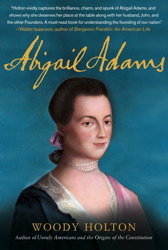
On Monday, 9 November, the MHS hosts the official launch of Woody Holton’s Abigail Adams, a new biography of the woman Holton calls the “most richly documented woman of America’s founding era.” Holton offers important new insights into the life and times of his subject: Catherine Allgor, quoted on the dust jacket, says of the book “This is not your father’s Abigail Adams. Woody Holton has given us the gift of the most fully rounded picture of those most famous of Founding Mothers to date. Entrepreneur, politician, mother, wife – Abigail Adams emerges from Holton’s burnished prose as the compelling, complicated person she was. The discoveries he has made, and the insights they have inspired, will shape how we think of revolutionary men and women and partnerships both political and personal.”

Much of Holton’s research for this book is drawn from the Adams Family papers collection here at MHS (in its various forms), so needless to say we’re delighted to see the project come to fruition and are very much looking forward to the launch event. Refreshments will be served at 5:30 p.m. on Monday, with a talk by Woody Holton to begin at 6 p.m. Copies of the book will be available for purchase after the lecture.

On a personal note, I started Abigail Adams last night, and read long into the wee hours. It’s as captivating a biography as any I’ve ever read.

MHR Volume 11 Available

By Jeremy Dibbell

The 2009 volume of the Massachusetts Historical Review is now available. You can order a copy here.

The volume’s contents:

Essays
– Jason M. Colby, Race, Empire, and New England Capital in the Caribbean, 1890-1930
– J. Patrick Mullins, “A Kind of War, Tho’ Hitherto an Un-Bloody One”: Jonathan Mayhew, Francis Bernard, and the Indian Affair
– Neil Longley York, Rival Truths, Political Accommodation, and the Boston “Massacre”
– Stephen Kantrowitz, A Place for “Colored Patriots”: Crispus Attucks among the Abolitionists, 1842-1863
– Robert J. Robertson, Louisa Catherine Adams Kuhn: Florentine Adventures, 1859-1860

Notes & Documents
– M. X. Lesser, A Transcendentalist Conversion Narrative

Review Essay
– Elizabeth R. Varon, The Afterlife of Abolition

“Sexual Warfare”: Lunch Talk Recap

By Anna Cook

Last Wednesday (9 October) current NEH-MHS long-term fellow Crystal Feimster gave a brown bag lunch talk titled “Sexual Warfare: Rape and the American Civil War.” Crystal described for us the research project that brought her to the MHS, which builds upon the material in her first book (newly-released through Harvard University Press), Southern Horrors: Women and the Politics of Rape and Lynching.  In Southern Horrors, Crystal explored the fears about sexual violence in the postwar South; her current research moves back in time from Reconstruction to the war itself. 

As a way of sharing the early findings of her research with us, Crystal described some of the materials she has been using to piece together the story of sexual violence in wartime and posed some of the questions that these documents leave her pondering. For example, elite white women’s diaries kept prior to and during the war express coded fears about sexual violence at the hands of Union troops, but rarely talk directly about being raped – at the same time, they use the language of invasion, and talk about Union troops entering their bedrooms. They also describe sexual violence witnessed against other women (often female slaves).  Another source of information has been the approximately two hundred court marshals against Unions for sexual assault, a small percentage when compared to other conflicts that has left some historians to conclude the Civil War was a “low rape” war.  However, Crystal raises questions about how accurately the court marshals reveal the situation on the ground: What rapes are being reported? When reported, which are likely to be entered into the record and brought to trial?  Correspondence from officers in MHS collections suggests that there was an expectation within the military hierarchy that certain behaviors among the troops not enter into the official record. 

During the discussion period, questions were raised about change over time during the course of the war.  Crystal described General Butler’s occupation of New Orleans during which local women openly resisted Union troops.  In response to the women’s disrespectful behavior toward Northern soldiers, Butler enacted General Order No. 28, or “the women’s order,” that sanctioned the use of sexual violence – or at least the threat of sexual violence, as a way of controlling women’s behavior.  She sees Butler’s occupation as one of a series of moments during the war during which the discourse – and possibly the practice – of sexual violence shifts.  Through tracking certain individuals for the duration of the war – Southern women, men in the military – Crystal hopes to chart out when and how these shifts took place. 

We are excited to have Crystal here as one of our research fellows, awed by her diligence in making sense of nineteenth-century military culture (not to mention nineteenth-century handwriting!) and look forward to future updates on the project, and eventually the book that will no doubt result.

Recent MHS Grant Announcements

By Jeremy Dibbell

Among the stories in the September/October MHS e-newsletter is a short piece highlighting some recent and very exciting grants we’ve received. They include:

– $15,000 from the Library of Congress for its “The End of Slavery: Documents and Dilemmas” program. MHS staff will take 20 documents from the LOC From Slavery to Freedom digitized collections and 20 documents from the MHS African Americans and the End of Slavery and Images of the Antislavery Movement in Massachusetts digitized collections to develop educational materials for teachers based on both institutions’ resources.

– a $22,100 matching grant from the Massachusetts Cultural Council, which will help the Society create and promote exceptional public programs and exhibitions to the community. As an investment in the MHS, the grant signifies that the Society provides a high level of quality in its programs, services, and administrative ability.  The staff of the MHS would especially like to recognize MHS Fellow Gov. Deval Patrick and the state legislators who supported the MCC, and in turn the MHS, particularly Sen. Steven A. Tolman and MHS Fellow Rep. Byron Rushing.

– a grant from the Ruby W. and LaVon P. Linn Foundation to replace a traditional microfilm reader with a microfilm scanner. The new equipment produces high resolution digital scans of microfilmed manuscripts, allowing researchers and staff to print, e-mail, or save the relevant pages to a CD, USB drive, or hard drive. We library folks are very excited about this one; we’re getting a demo of a possible scanner today, and please stay tuned for more information.

You can read more about each of these grants here, and sign up to receive the e-newsletter here.

MHS Unveils New Homepage

By Jeremy Dibbell

This just in from our web developer, Bill Beck:

“After months of planning, consulting, designing, and general tweaking, we are very excited to present a new look for the MHS homepage! Our main goal is to help visitors get at the content they need with fewer clicks. We believe we’ve created a much-improved entry to our vast online offerings, one that’s at once more streamlined and yet highlights our content in an eye-catching, contemporary way.”

We all hope you like it!

Meet & Greet: Adams Papers

By Jeremy Dibbell

Last but certainly not least in our survey of MHS departments is the Adams Papers editorial staff, the diligent group responsible for overseeing the publication of the papers of several generations of members of the Adams family. The project, begun in 1954, has produced some 42 volumes to date (published by Harvard University Press), with many more scheduled (the cutoff date for the project is 1889, with the death of Abigail Brooks Adams). The editors do not edit the words written by the Adams family members; “rather, they continue the search for Adams documents, select the material to be included in the edition, provide a faithful transcription of the manuscripts, and supply annotation.”

As their website notes, “The Adams Papers was funded originally by Time-Life Inc. and the Ford Foundation. At present funding is provided primarily by the National Historical Publications and Records Commission and the National Endowment for the Humanities, with additional funding from the Lyn and Norman Lear Fund, the Packard Humanities Institute, and private donors. Over the years, these supporters have included The J. Howard Pew Freedom Trust, The Andrew W. Mellon Foundation, and The Charles E. Culpeper Foundation through the Founding Fathers Papers, Inc.”

The MHS’ collection of Adams Family papers forms the core of the publication project, but more than 27,000 documents held by other institutions or individuals have also been gathered for inclusion in the published editions.

Portions of the Adams Family papers are now available digitally through the MHS website; see the Guide to Adams Resources for more information.

The Adamses are ever-present here at MHS, and the work done by the supremely able staff of the Adams Papers editorial team is vital in allowing us to answer questions and provide information and context about the lives and works of the family members. We couldn’t do it without them!

Adams Papers staff members include: Editor in Chief C. James Taylor; Senior Editor Gregg Lint; Editor Margaret Hogan; LCA Diary Series Editor Judith Graham; Associate Editors Robert Karachuk and Hobson Woodward; Assistant Editors Mary Claffey, Beth Luey, Sara Martin, and Sara Sikes; Transcribers James Connolly and Amanda Matthews. Full contact information is available here.

Meet & Greet: Administration & Development

By Jeremy Dibbell

It’s been quite a while since we’ve done a Meet & Greet post (and I’ve only got a few departments left, too!). The folks in Administration and Finance, as well as in the Development office, do much work to keep the place up and running every day, so it’s their turn:

The Society’s president is Dennis Fiori, and his Executive Assistant is Mary Kearns.

Peter Hood is the Director of Finance, while Tammy Hamond serves as Account Manager and Chris Coveney is the Chief Technology Officer. Our Operations crew consists of Chris Carberry (Operations Manager), Jennifer Smith (Operations Assistant) and James “Harry” Harrison (Custodian).

Nicole Leonard is our Director of Development, and Emily Hogan is the Annual Fund Coordinator.

Complete contact information is available here.

Latest MHS E-Newsletter Now Live

By Jeremy Dibbell

The July/August edition of @MHS, the Society’s e-newsletter, is available here. It includes a note about our upcoming John Quincy Adams Twitter project, information on some of the latest grants received by the Society, a staff spotlight on Hobson Woodward and his new book, and a full calendar of events. If you’d like to receive future editions of the e-newsletter, you can sign up here.

Martineau Society Visits MHS

By Jeremy Dibbell

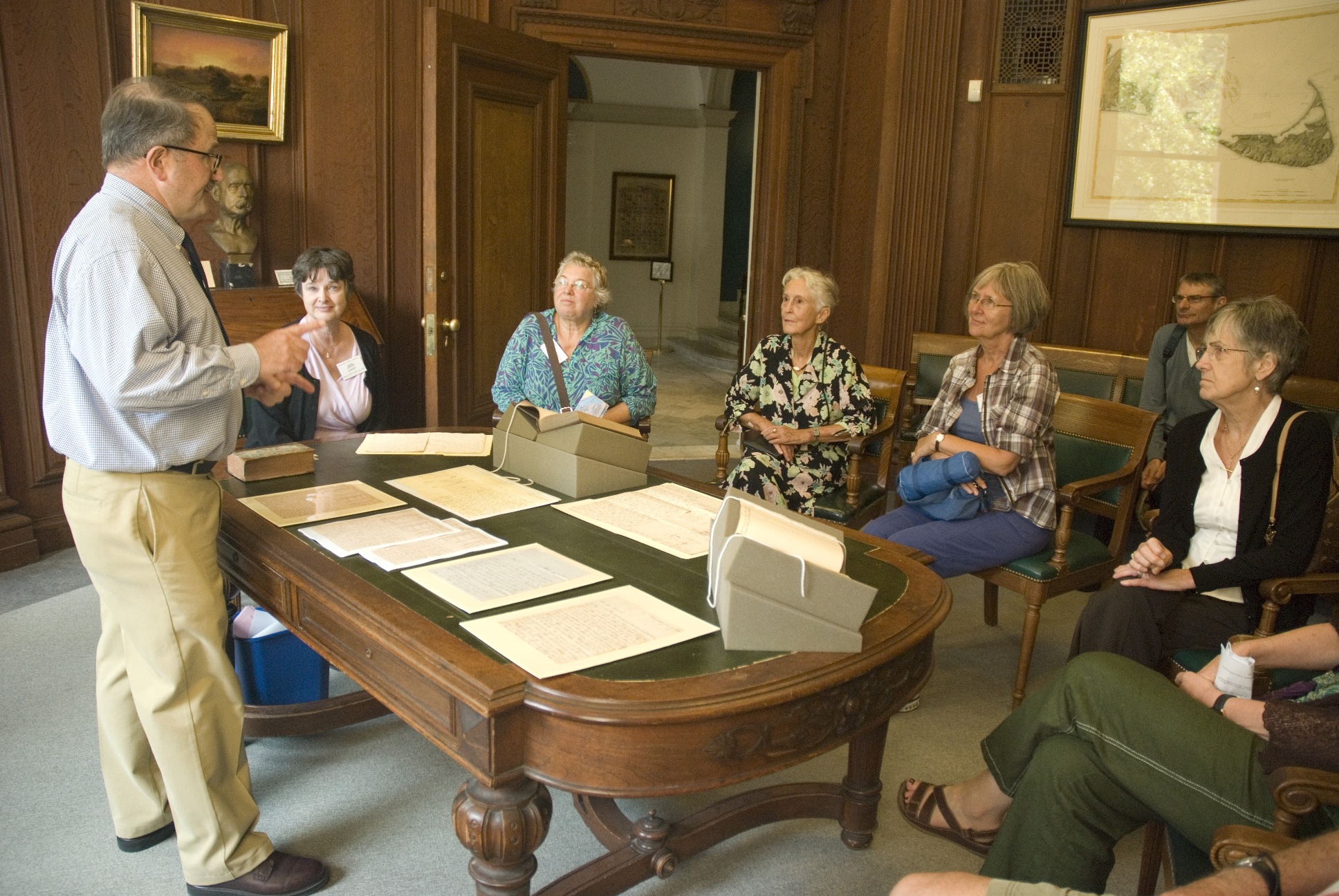
Last Thursday, the MHS hosted sixteen members of the Martineau Society, a group based at Manchester College, Oxford and devoted to the “preservation, study and publication in the public interest of material relating to the Martineau family of Norwich in the 19th century and the principles of freedom of conscience advocated by Harriet Martineau and her brother, Dr. James Martineau.” Librarian Peter Drummey displayed manuscript materials from our collections related to Martineau and her works, while curator of art Anne Bentley showed paintings, medals and other artifacts.

Among the items shown was a Harriet Martineau manuscript, a long letter to an unidentified recipient about a trans-Atlantic voyage, in the form of a journal, 3-25 August 1836. This letter, from the George E. Nitzsche Unitariana Collection, 1778-2007 (collection guide) was printed in edited form as an appendix to Martineau’s Autobiography (1877). The manuscript copy in the Nitzsche collection contains several drawings by Martineau, and also includes the names of those discussed in the letter (which are changed in the printed version).


Meet & Greet: Publications

By Jeremy Dibbell

Another round of introductions today: the Publications department. Since its inception, the MHS has taken as one of its major missions the “dissemination” of materials of historical interest, and the Publications team is responsible for carrying out that vital task. The types of volumes published by the MHS include:

Collections of the Massachusetts Historical Society. First published in 1792, and now numbering more than ninety volumes, these are documentary editions of materials from our collections. The most recent is Selected Journals of Caroline Healey Dall, Volume I (1838-1855), edited by Helen R. Deese.

– Thematic collections of essays on historical topics, Studies in American History and Culture.

The Massachusetts Historical Review, an annual journal.

– Illustrated books highlighting materials and artifacts from MHS collections.


Click here for a full list of in-print MHS publications.

The Publications department staff include Ondine Le Blanc, Director of Publications, and Assistant Editors Suzanne Carroll and Jeanine Rees.

Complete contact information is available here.