
By Jim Connolly, Publications
It’s the most wonderful time of the year: that time when a new volume of the Massachusetts Historical Review goes to press! Print subscribers will receive Volume 14 by mail in the early days of the new year, and the electronic version will be published simultaneously through JSTOR’s Current Scholarship Program. Learn more about subscription here. The journal is also a benefit of MHS membership—learn more about membership here!
The upcoming volume treats a diversity of fascinating topics:
“Boston’s Historic Smallpox Epidemic” by Amalie M. Kass
Cotton Mather’s advocacy for inoculation—a practice then unheard of in the colonies—stirred up a controversy in 18th-century Boston. Insults and accusations flew in the partisan newspapers as inoculation’s champions and opponents fought for public health—and personal glory. The source of Mather’s knowledge of inoculation may surprise you.
“The Newbury Prayer Bill Hoax: Devotion and Deception in New England’s Era of Great Awakenings” by Douglas L. Winiarski
This article explores the phenomenon of the prayer bill or prayer note in colonial religious practices, and how a satirical prayer bill was crafted to injure the reputation of Newbury Congregational minister Rev. Christopher Toppan, who vehemently opposed the popular religious revivals of the Great Awakening.
“A Prince among Pretending Free Men: Runaway Slaves in Colonial New England Revisited” by Antonio T. Bly
Bly sheds light on the lives and characteristics of runaway slaves through in-depth analysis and explication of runaway notices in newspapers. Clues within these notices tell us how fugitive slaves employed quick wits and savvy under extraordinary duress. Bly, who has compiled a database of runaway slave notices, crunches the numbers on a variety of characteristics, illuminating the most common months for escape, the race, linguistic ability, and work backgrounds of runaways, and more.
“Boston, the Boston Indian Citizenship Committee, and the Poncas” by Valerie Sherer Mathes
When the Ponca Indians of Nebraska were forced from their homeland in 1877 and sent to the inhospitable Indian Territory (modern-day Oklahoma), many Americans sympathized with their plight. Among those who took up the cause was the Boston Indian Citizenship Committee, a group of philanthropists, described in detail for the first time in this article. Mathes also chronicles the speaking tours in support of the Poncas, including the tour of Ponca chief Standing Bear.
The new volume also includes review articles by Sarah Phillips and Chernoh Sesay concerning environmental history and books about Phillis Wheatley and Venture Smith, respectively.
Every issue of the MHR offers pieces rich in narrative detail and thoughtful analysis, and Volume 14 is no different. The MHS looks forward to its publication.

 and The Little Particle That Could. His books have been nominated for eight Harvey Awards honoring excellence in the comics industry and a Will Eisner Comic Industry Award. Rodriguez’s current project editing graphic novels about colonial New England brought him to the Massachusetts Historical Society last week. He took the time to answer a few Beehive questions about comics, history, and what to expect from the coming historical graphic novels.
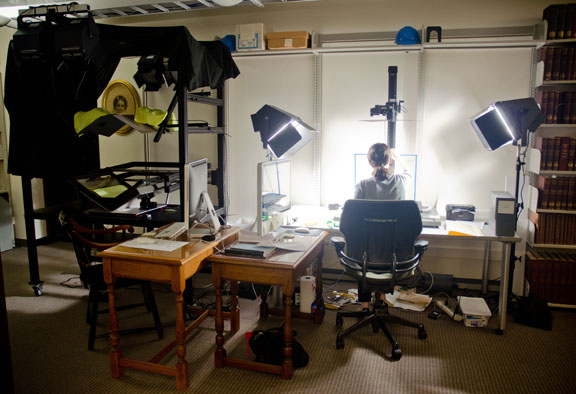 to supply somewhere in the neighborhood of 55,000 manuscript pages to a forthcoming multi-archive digital publication, China, America and the Pacific: Trade and Cultural Exchange. Adam Matthew has contracted, in turn, with Luna Imaging in Los Angeles to do the scanning. In late August, Luna shipped all of the equipment shown here and sent a representative to install and test it and train a scanning technician. The technician, shown here, is now hard at work scanning correspondence, account books, ships’ logs, and letterbooks from multiple collections, including the extensive Forbes Family Papers. Other highlights of the final product, scheduled for release in late 2013, will include the manuscript of Richard Henry Dana’s seminal work, Two Years Before the Mast, and Robert Haswell’s log of the Columbia-Rediviva, the first vessel to circumnavigate the globe
 A French citizen, Lafayette began his career as a musketeer in the king’s regiment and married into a wealthy, well-connected French family. The reports of Americans fighting for liberty moved him, and in 1777 he bought a ship and sailed for America. Upon arrival, Lafayette earned an honorary commission as major general in the Continental Army. Gen. George Washington became his mentor, and Lafayette was devoted to him. Lafayette earned fame for his courage on the battlefield, and he used his family connections to obtain crucial material aid from France for the American cause. His support for the Revolution, especially as a foreigner, captured the imagination and admiration of Americans. He was beloved in the United States for the rest of his life.
 Lafayette’s legacy is apparent in the Society’s collections, which include correspondence, artifacts, and memorabilia from the time of the American Revolution and his celebrated return trip to the States in 1824-1825. The portrait gallery also features Jospeh Boze’s well-known portrait of Lafayette. Thomas Jefferson commissioned this work for his gallery of American heroes in honor of Lafayette’s contributions to the American Revolution. The portrait depicts Lafayette at the pinnacle of his career. He wears the uniform of the French National Guard and a confident expression as he gazes off into the distance. Even at 255, he still looks good. A happy birthday to him.