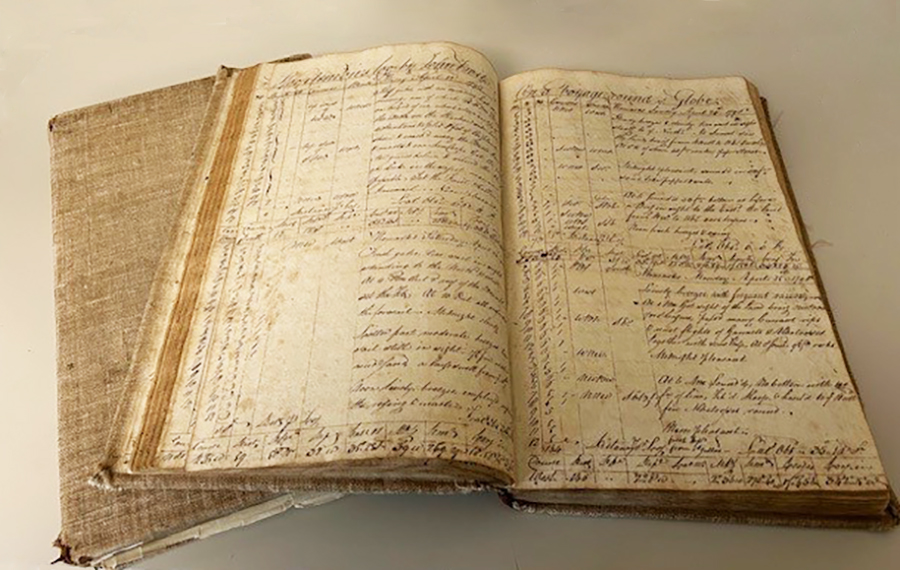
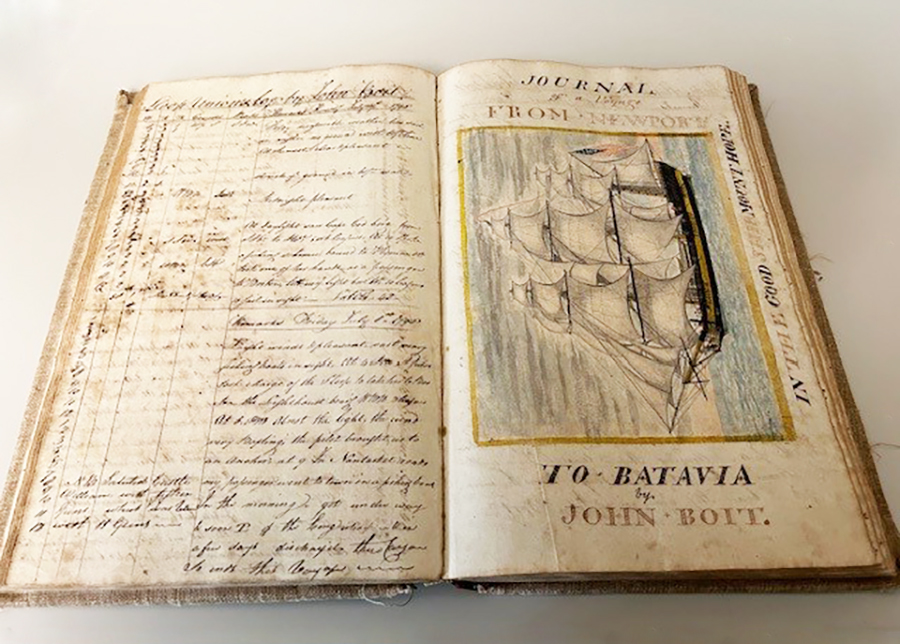
The MHS has held a collection of ships’ logs kept by John Boit, Jr. since his descendant, John Boit Apthorp, donated them in 1919. Three volumes kept by Boit on trading voyages from 1790 to 1802, including a log of the Columbia, document voyages to the Northwest Coast to trade for fur before sailing on to the Sandwich Islands (now Hawaii) and to China in the early years of the newly-opened China Trade. Boit served as a captain’s mate on the Columbia and other vessels before taking command of the Union.
Two volumes covering the Union’s voyage from Newport, R.I., to China via the Northwest Coast had reportedly disappeared when the collection was sent offsite to be microfilmed, probably in the 1960s or 1970s. Until now.
Rusty Farrin of Farrin’s Country Auctions in Randolph, Maine, recently contacted the MHS to report the recovery of two of Boit’s logbooks that were discovered in a storage locker. Farrin’s research revealed that the volumes had been part of the Society’s collection and he generously returned them, as he said, “back where they belong.”
John Boit logbooks
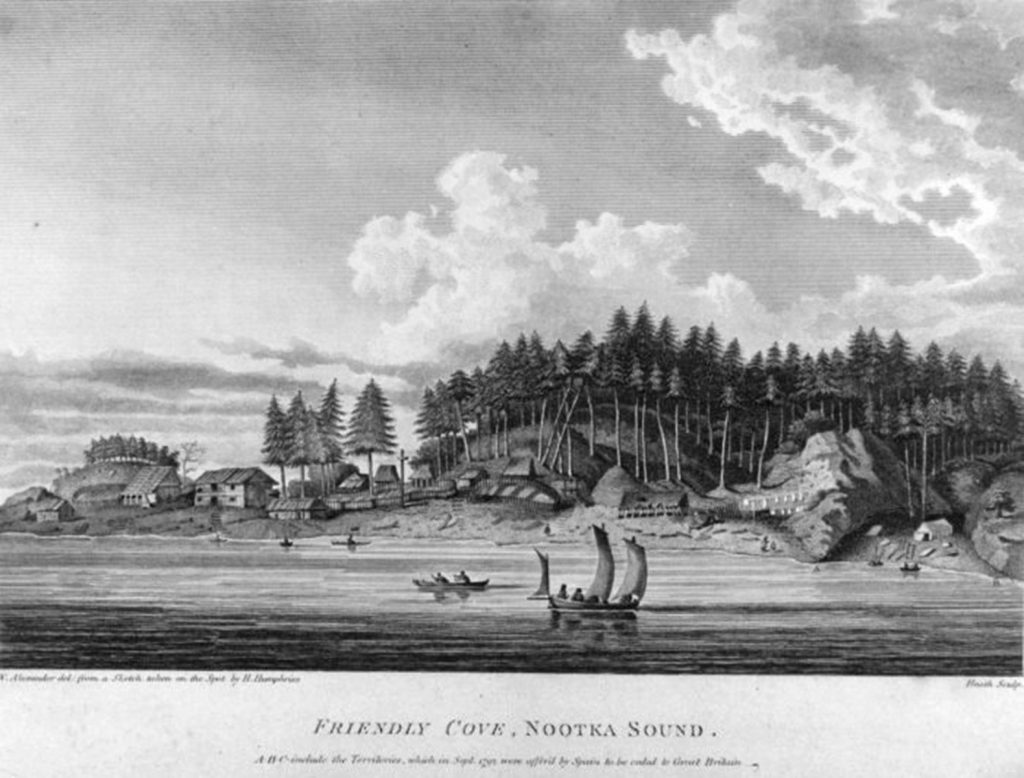
The voyage of the Union spans the two volumes and includes stops in the Falkland Islands, Nootka Sound and other locations in British Columbia, Macao, Canton, and Mauritius from August of 1794 to July of 1796. One volume also documents a voyage from Boston to Charleston, S.C., Dublin, Ireland, and back on the ship Eliza, 1793-1794, and the second includes a voyage from Newport to Batavia in the Dutch East Indies and back on the Mount Hope, 1801-1802. Both volumes include long narrative passages that describe the locations where they anchored, including encounters with indigenous people, as well as watercolor drawings of the vessels and land formations seen along the way.
We are enormously grateful to Mr. Farrin for ensuring these volumes made their way back to the MHS.
I’m happy to announce that the records of the First Baptist Church of Boston are open for research at the MHS. This fascinating collection consists of about 47 linear feet (over 15 shelves) of records dating all the way back to the founding of the church in 1665!
The First Baptist Church of Boston is one of the oldest Baptist churches in the country. Back in 17th-century Puritan Massachusetts, forming a new church “without the approbation of the Magistrates & the said churches” of the colony was illegal. So was Baptist doctrine specifically: anyone known to “openly Condemn or oppose the Baptizing of Infants” could be banished. In establishing their church, the founders of First Baptist were breaking the law, and early congregants were fined, imprisoned, threatened with exile, and otherwise persecuted.
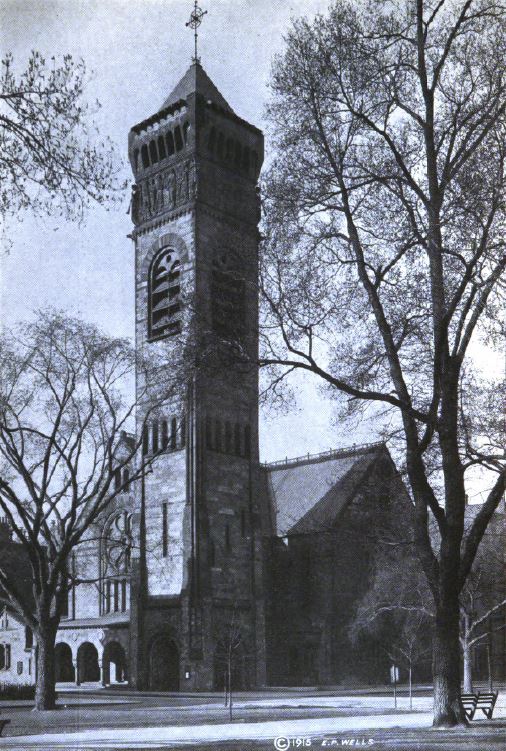
The church started in Charlestown; moved to the North End, downtown Boston, and the South End; and since 1882 has been located in the Back Bay at the corner of Commonwealth Avenue and Clarendon Street, about a 20-minute walk from the MHS.
First Baptist Church of Boston, 1915, from the frontispiece of its 250th anniversary booklet (Vol. 151)
Between 1941 and 2019, the First Baptist records were held on deposit at Andover Newton Theological School. (Records on deposit are stored and cared for by an archival repository, but the donor retains ownership.) In 2019, the church deposited the collection at the MHS, but processing was held up by the COVID-19 pandemic and subsequent backlog.
In one sense, this collection was different than most collections I process because it was already arranged and described. I made some changes and encoded the collection guide for the MHS website, but could mostly work with what I had. The records include minute books, account books, reports, receipts, committee records, pew deeds, pew accounts, correspondence, congregational records, records of the Sunday School and other church groups, marriage record books, and printed material.
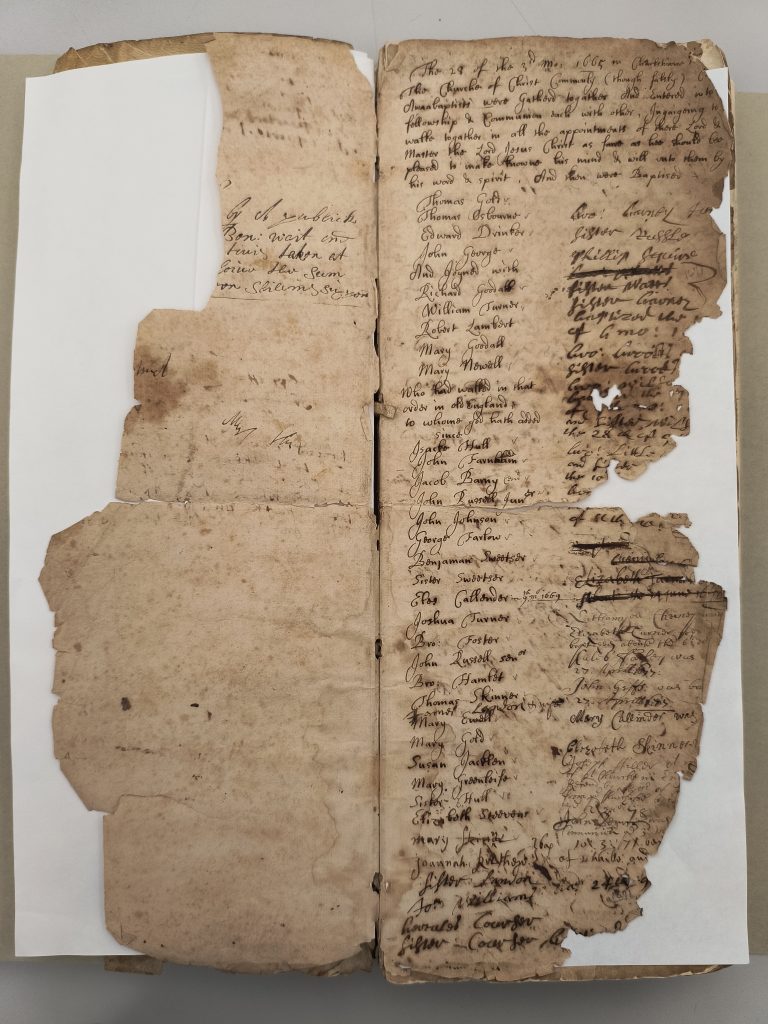
To introduce you to the collection, I’d like to showcase the oldest record book in the collection, a vellum-bound volume of meeting minutes dating back to the first meeting of the church on 28 March 1665.
First page of First Baptist Church of Boston minute book (Vol. 1), 28 March 1665
Although the volume has obviously seen better days, it’s striking to think about what exactly is documented here, the importance of this moment in the religious history of Massachusetts. The people listed on this page, “Gathered togather And Entered into fellowship & Communion each with other, Ingaigeing to walke togather in all the appointments of there Lord & Master,” were taking a real risk to practice their faith.
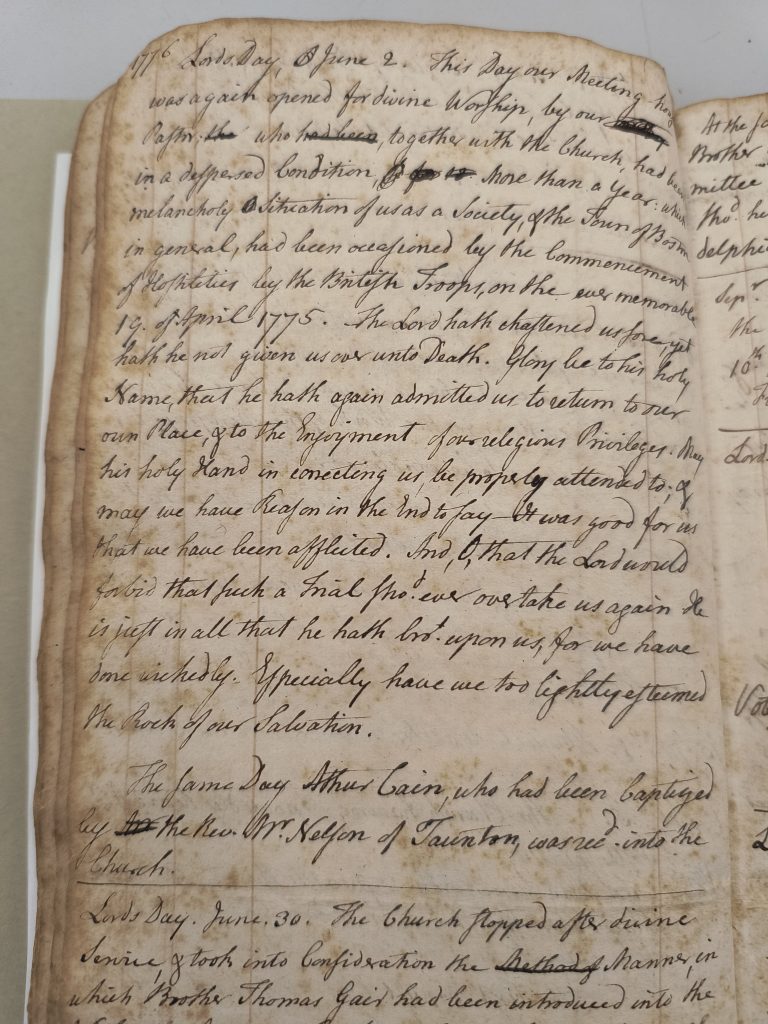
Another page in the same volume, dated 2 June 1776, refers to the “dispersed Condition” of the congregation and the “melancholy Situation […] occasioned by the Commencement of Hostilities by the British Troops, on the ever memorable 19. of April 1775.”
Detail of First Baptist Church of Boston minute book (Vol. 1), 2 June 1776
Unfortunately, many of the over 300 volumes in the First Baptist collection are fragile and/or covered in “red rot”—a sticky, rust-colored residue that comes from decaying leather bindings—so they must be handled with care. Conservation will be ongoing, but we wanted to make this collection available to the public in the meantime. Our expert librarians can assist any interested researchers in the MHS Reading Room.
By Nancy Heywood, Lead Archivist for Digital and Web Initiatives
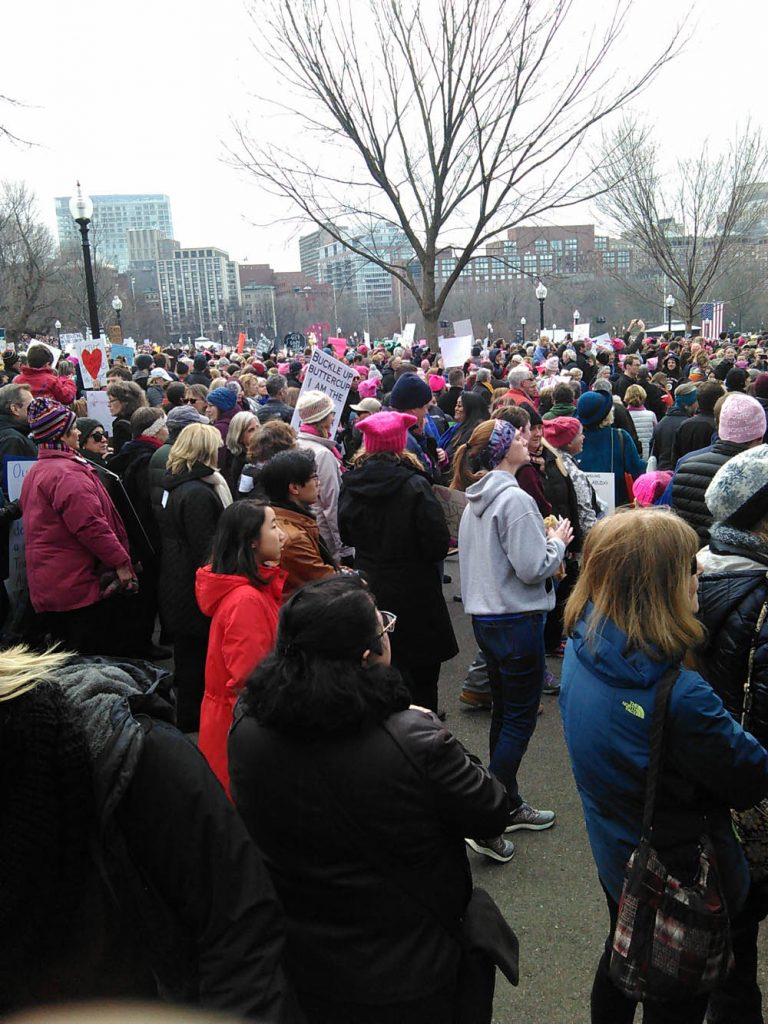
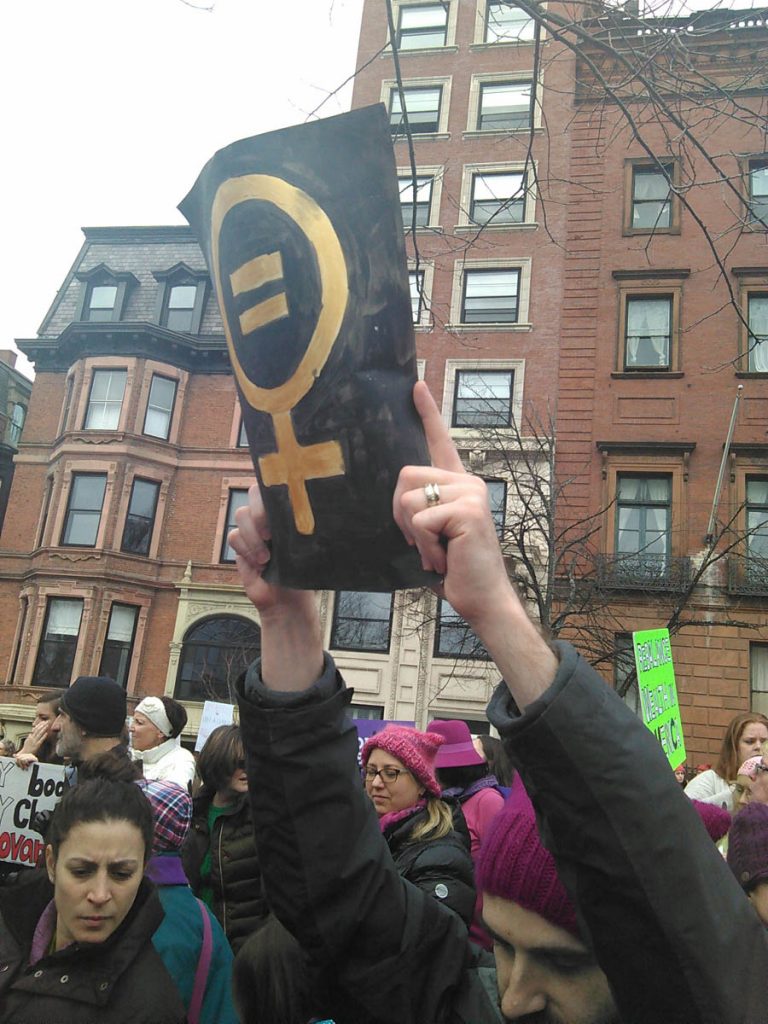
In 2017, MHS undertook a collecting initiative with an open call for donations of images and accounts relating to the Women’s March for America, a series of protest marches held around the world following the 2016 U.S. presidential election. MHS received digital files—images, narratives, and screenshots of tweets—from about a dozen donors.
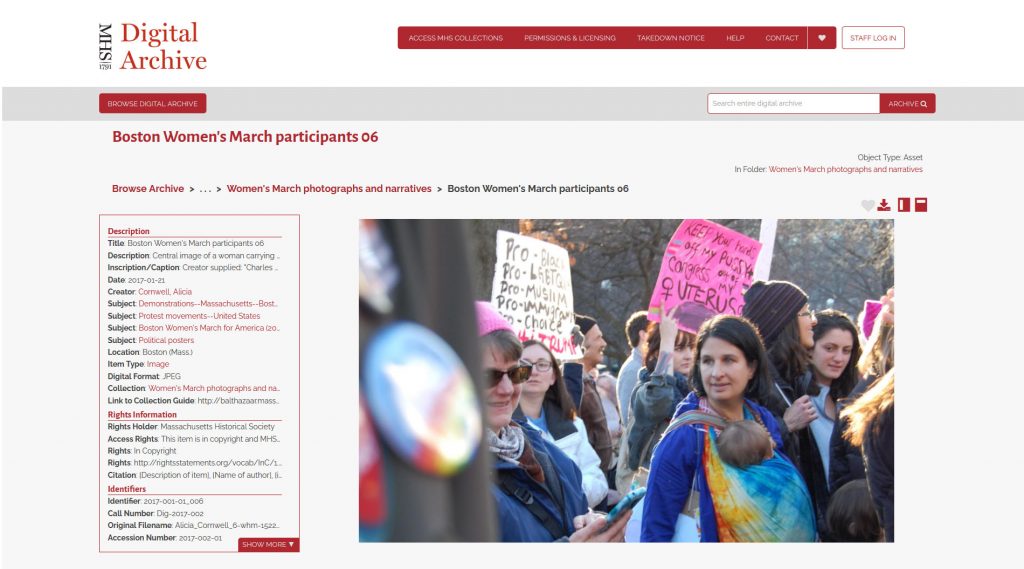
Boston Women’s March Participants, photograph donated by Anna Clutterbuck-Cook
Boston Women’s March Participants, photograph donated by Anna Clutterbuck-Cook
Staff processed, described, and made backup copies of the digital files and donation forms, but the files and metadata remained on staff-accessible parts of the MHS network. The MHS did not have an easy way to make this entire collection accessible to researchers at the time. Today, the digital files comprising the Women’s March Photographs and Narratives collection are fully accessible to the public through the new MHS Digital Archive. You can also find links to this collection from our library catalog.
Boston Women’s March Participants, photograph donated by Alicia Cornwell
The ability to view the materials of the Women’s March collection is just one piece of the MHS Digital Archive. However, there is much more happening behind the scenes!
The MHS Digital Archive is the front-end access portal to MHS’s digital preservation system (Preservica). The backend of the system allows MHS to:
organize and describe content
securely store content in the cloud with backups
monitor files for damage and replace them with an undamaged copy if damage is detected. (This means the system tracks the integrity of files and stores multiple copies of files. If the 0s and 1s of a file have changed, the damaged file can be replaced.)
ensure files are readable without needing the original application by saving them in preservation formats; for example, migrating old Word Perfect files to PDFs
MHS has been collecting, preserving and making accessible historically significant materials for over 230 years and with the rollout of the digital preservation system, we are now well-positioned to handle new accessions comprised of hybrid collections (physical and digital) or digital only. We will also be able to efficiently manage any future collecting initiative with an open call for donations of digital files and make them accessible.
By Caitlin Walker, Digital Archivist and Metadata Analyst
The MHS collects, preserves, and provides access to collections that document the history of Massachusetts and the nation up to the present day. Information is increasingly being created and communicated in a digital environment, which means many twentieth and twenty-first century collections include or consist entirely of digital files, such as PDFs and JPEGs.
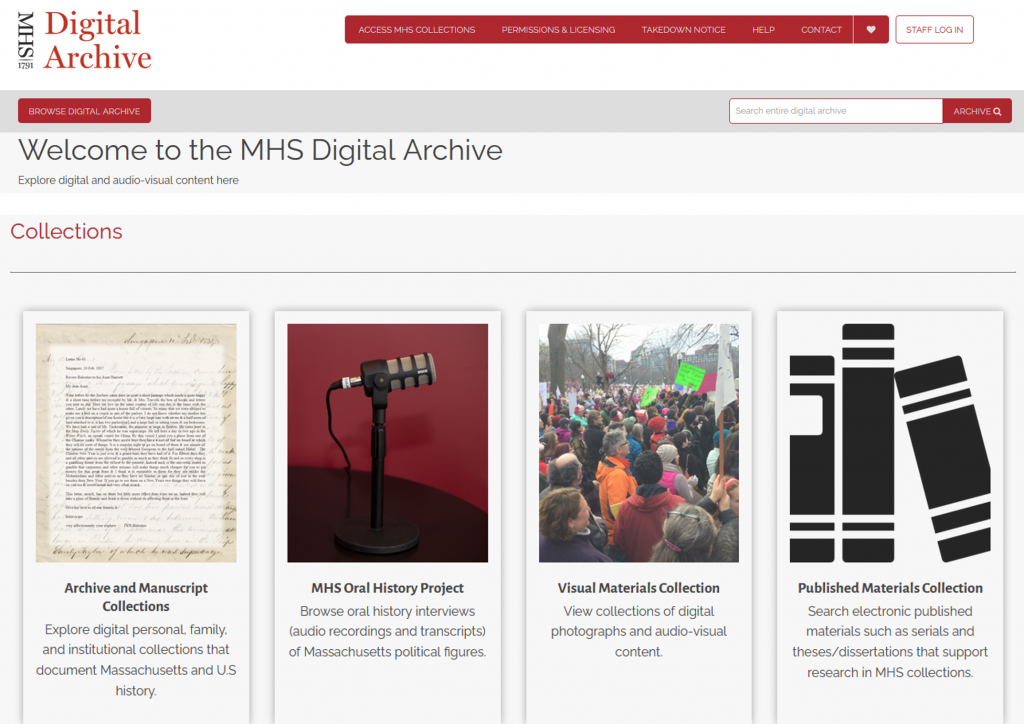
MHS has been working toward preserving and providing access to this content for many years through countless meetings with staff from the Collection Services and IT departments. We are now happy to announce the official launch of the MHS Digital Archive!
The MHS Digital Archive provides access to born-digital content and reformatted audiovisual files. We define these files as the following:
Born-digital is a term archivists use to describe content that was created in a digital environment. The emails you send and receive, the Microsoft Word documents you create and store on your computer or cloud storage like Google Drive, and the images and videos you take on your cellphone are all “born-digital.”
Reformatted-audiovisual items refer to physical audiovisual media (such as cassette tapes, VHS tapes, vinyl records, 16 mm film etc.) that have been converted to digital files, so users can access them without needing playback equipment such as a VCR or a record player.
How to access digital and audiovisual materials
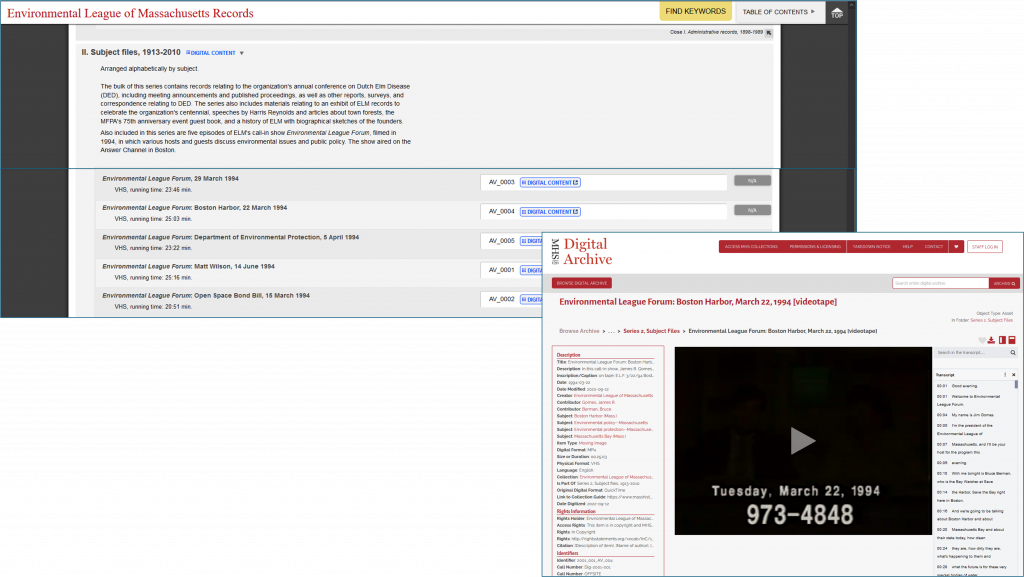
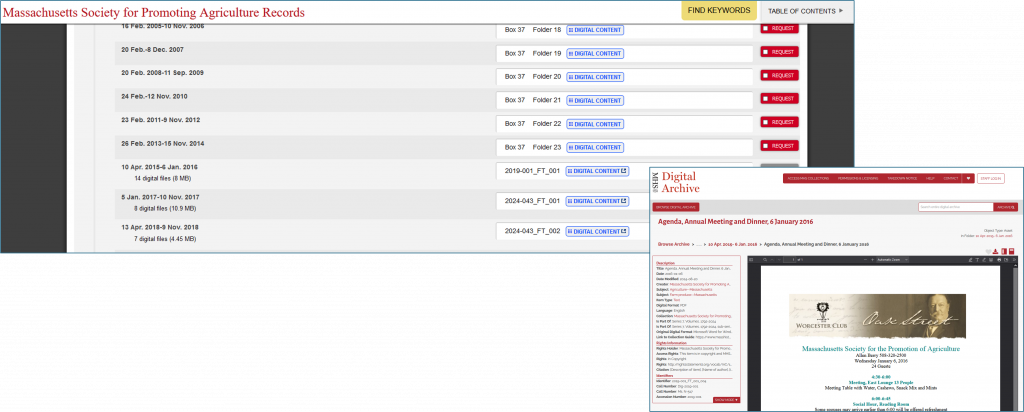
If you have researched in MHS collections in the past, you may be familiar with using ABIGAIL, the MHS library catalog, and MHS Collection Guides to access physical materials in the MHS reading room. Or perhaps you have accessed physical items that MHS has digitized and made available on our website. We have added links to born-digital and audiovisual items within ABIGAIL and the collection guides so that users will be able to find content using the same tools, regardless of format.
Users can also access individual born-digital and reformatted audiovisual items by searching or browsing the MHS Digital Archive directly, but we encourage you to start your search with the MHS Collection Guides and ABIGAIL. I like to think of catalog records and collection guides like a recipe, and individual items (whether they be physical or digital) like an ingredient list. Without the context of the recipe, you just have a bunch of ingredients.
Please Note: Born-digital and audiovisual items that have no restrictions (not under copyright, contain no private or sensitive information) will be available online through the MHS Digital Archive. Restricted collections and items can only be viewed on a provided laptop in the MHS reading room upon request via Portal1791.
Stay tuned for blog posts next week that highlight some of the collections and items in the MHS Digital Archive!
I’m very pleased to announce a new collection available for research, the Perry-Clarke additions. I’ve been processing this collection for a while now, and I can honestly tell you I’m a little sorry to be finished with it. It’s been one of the most interesting (and challenging) I’ve worked on here at the MHS.
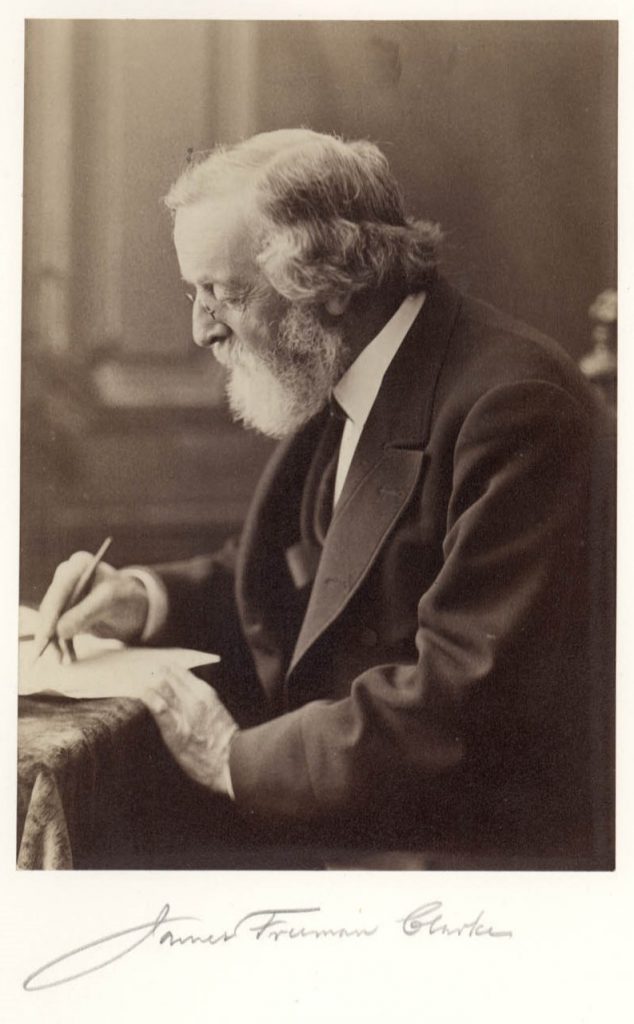
The collection contains the papers of Unitarian minister, transcendentalist, author, and social reformer James Freeman Clarke, as well as many family members from multiple generations. The “Perry” in the title comes from the collection’s donor, Clarke’s great-granddaughter Alice de Vermandois (Ware) Perry.
As you can probably tell from the name, these papers consist of additions to the Perry-Clarke collection, which Alice Perry gave to the MHS back in 1979. After that collection was processed and made available to researchers, Perry donated multiple subsequent installments of family papers. These additions posed a number of problems: many of them were completely unorganized and unidentified, and some portions were even covered in active mold.
Unfortunately, because of these problems and the lack of time and staff to address them, most of the additions have been malingering in our backlog. We did arrange, catalog, and make available four boxes of some of the most significant material—all the letters James Freeman Clarke wrote to his wife between 1832 and 1888—but the rest was largely unusable.
Thankfully that’s no longer the case! While it wasn’t possible, at this late date, to incorporate the additions into the primary collection, I’ve processed the additions separately and created links between the two. At 46 boxes, this collection is smaller than the first (64 boxes), but there’s a lot of overlap.
The collection contains ten boxes of family correspondence (the previously cataloged letters from James to Anna are filed here), followed by nine boxes of James’s papers, primarily manuscript and printed copies of his sermons and other writings.
James may be the headliner, but the collection also includes papers of several equally impressive relatives. Among them are his sister Sarah Freeman Clarke, an artist, author, teacher, and philanthropist; his wife Anna (Huidekoper) Clarke and members of the influential Huidekoper family of Meadville, Pennsylvania; his incredibly high-achieving children, Lilian (reformer and translator), Eliot (engineer and mill manager), and Cora (botanist and entomologist); and his daughter-in-law Alice and her family.
In fact, while the additions complement the original donation in many ways, they have even more to offer. Alice was, through her mother, a member of the famous Lowell family of Boston, so about a third of the additions is made up of Lowell family papers that Alice brought along with her when she married Eliot Channing Clarke in 1878.
The Lowell material includes, for example, nearly 30 volumes kept by Alice’s great-aunt Rebecca Amory Lowell during her decades of work as a Sunday School teacher, as well as 21 diaries of another great-aunt, Anna Cabot Lowell, that neatly fill the gap in one of our other collections! An entire box consists almost exclusively of letters written by Alice’s great-great-aunt, another Anna Cabot Lowell, during the Federalist Era.
Processing this collection meant opening a lot of boxes of miscellaneous unidentified loose manuscripts and crumbling volumes and identifying, to the best of my ability, what they were, who wrote them, and where they belonged. I was particularly impressed by how much material I found documenting the accomplishments of women.
I hope and expect the Perry-Clarke additions will get a lot of use by researchers. I know I intend to mine it for many future blog posts. Thanks to Interim President Brenda Lawson for prioritizing the processing of this collection.
by Neal Millikan, Series Editor for Digital Editions, The Adams Papers
The 15,000+ page diary kept by John Quincy Adams from 1779 to 1848 is now fully accessible online as the John Quincy Adams Digital Diary. A publication of the Adams Papers Editorial Project at the MHS, the Digital Diary is also one of four founding member projects of the Primary Source Cooperative, a collaborative digital editions publishing platform hosted by the Society.
The Digital Diary is presented as verified transcriptions paired with manuscript images of related entries. Biographical and historical context is supplied through essays on the major personal and professional divisions of Adams’s life, and people and historical topics are also identified for each date entry. Through the project’s participation in the Primary Source Cooperative, advanced federated search features allow users to track individuals or subjects both within and across the Cooperative editions.
John Quincy Adams often kept multiple versions of his diary, and the Digital Diary provides transcriptions of the entries in each of his 51 diary volumes. These include his “Rubbish,” almanac, and line-a-day diaries. The edition also integrates Adams’s earliest diaries, which were previously published in two letterpress volumes by the Adams Papers.
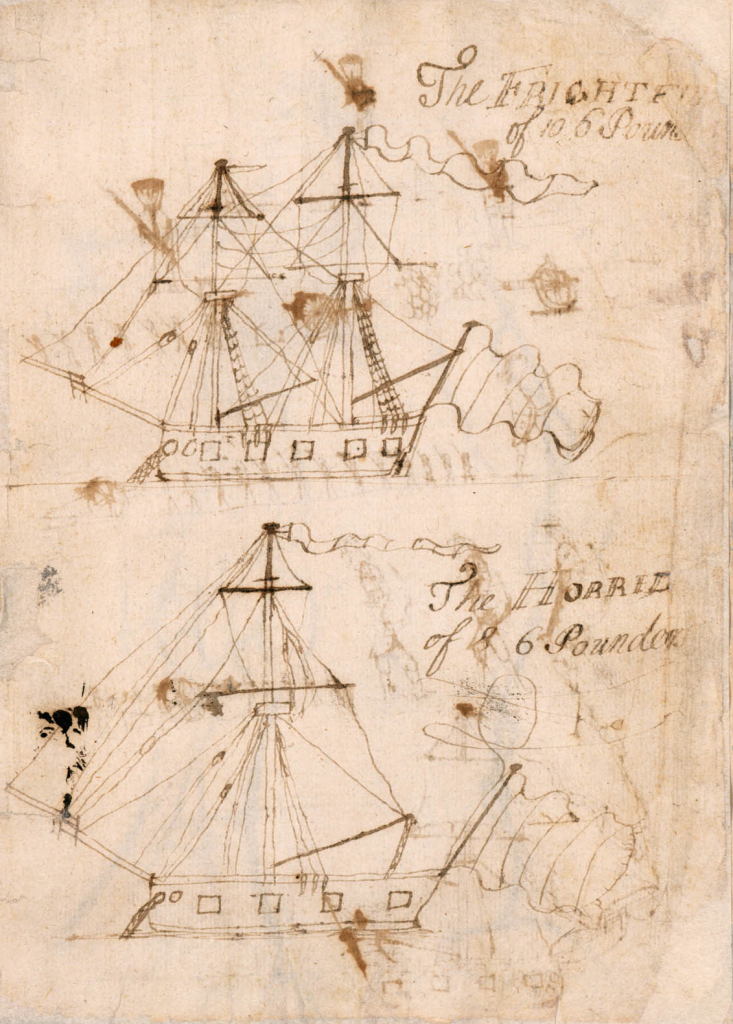
John Quincy Adams’s sketches of ships named the Frightful and the Horrid on the inside back cover of his diary, 1780
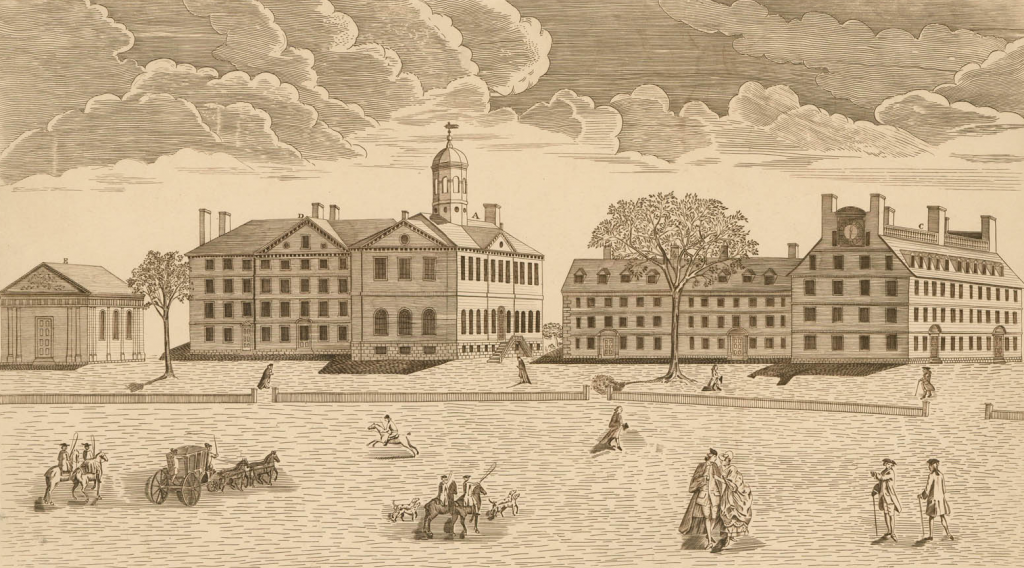
With revised transcriptions, the more than 1,500 pages in this section of the diary chronicle John Quincy Adams’s travels in Europe, as he accompanied his father, John Adams, on a diplomatic mission in 1779 and subsequently attended schools in the Netherlands and France. It also records his travels to St. Petersburg as secretary and interpreter during Francis Dana’s mission to Russia. With John Quincy’s return to the United States in 1785, the diary provides insights into Adams’s preparation for and studies at Harvard College and his legal training in Newburyport.
“A Westerly View of the Colledges in Cambridge in New England”; facsimile engraving by Sidney L. Smith of a drawing by Joseph Chadwick after Paul Revere’s 1767 engraving of Harvard College
Thanks to the efforts of many staff members, interns, and volunteers who contributed to the project since its inception in 2016, the full corpus of John Quincy Adams’s diary is now freely accessible and searchable online. Supplemental content will continue to be added via the Digital Diary and the Adams resources portion of the MHS website. This includes a timeline of Adams’s life and visualizations of the diary data via the Cooperative’s partnership with the Digital Scholarship Group at Northeastern University.
Come check it out and let us know what you think! Truly, we’d love to hear from you at adamspapers@masshist.org.
The Adams Papers editorial project at the Massachusetts Historical Society gratefully acknowledges the support of our sponsors. The Amelia Peabody Charitable Fund provided major funding for the John Quincy Adams Digital Diary, along with generous contributions by Harvard University Press and a number of private donors. The Mellon Foundation in partnership with the National Historical Publications and Records Commission also supports the project through funding for the Society’s digital publishing collaborative, the Primary Source Cooperative.
Sara Georgini, Series Editor, The Papers of John Adams
Huzzah for a new volume of The Papers of John Adams! Volume 20, which features Adams’ first term as vice president, is NOW available to read for free in the Adams Papers Digital Edition of the Massachusetts Historical Society website. In 301 documents, it offers a backstage pass to the drama of the first federal Congress, as George Washington and his cabinet shielded a fragile new nation pledging peace in a war-torn world. Maintaining “neutrality, as long as it may be practicable,” was the chief goal. For, as Adams advised Washington: “The People of these States would not willingly Support a War, and the present Government has not Strength to command, nor enough of the general Confidence of the nation to draw the men or money necessary, untill the Grounds, causes and Necessity of it Should become generally known, and universally approved.” Far from the national capital of Philadelphia, a sudden storm of events clouded the United States’ future. Volume 20’s spotlight on the understudied Nootka Sound crisis reveals how the violent interplay of imperial powers guided American prospects well after revolutionary soldiers laid down their arms.
America attracted adventures and entrepreneurs flying various flags in order to pocket big profits. John Meares, a former British naval officer, set up shop in Canada’s Nootka Sound in 1788 by using a blend of British and Portuguese colors. Meares leveraged a key hinge in global economic power. Nootka Sound functioned as a fur trade hotspot and as a gateway to the fabled Northwest Passage. Meares’ establishment of a trading post simultaneously agitated long-held notions of Spanish dominion, British opportunity, and American neutrality. Spanish Navy commodore Don Esteban José Martinez retaliated the following spring. He seized four of Meares’ ships and arrested the crews, bolstering the Spanish claim to the region. Meares sent petition after petition to the British foreign ministry seeking aid, and Anglo-Spanish relations dipped to a new low. What began as a local brawl over trading rights escalated into a clash of European powers by June 1790. Like many Americans, Adams watched tensely. British and Spanish ministries ramped up fleets and threats.
The press hurled reports and misinformation at a dizzying pace, and the vice president’s worry grew. Maybe British militias were training in Detroit, Michigan. And Spanish Army officers planned to invade St. Augustine, Florida. Or William Pitt the Younger launched secret talks with Latin American revolutionaries, plotting full British control of the region’s gold and silver mines in the wake of a Spanish defeat. Americans, who had largely evaded the global conflicts that raged in the 1780s, eyed the Nootka Sound crisis with real fear. Would the British strike through French Louisiana? What if they sought safe passage across neutral American lands to quell the Spanish? Whatever the United States decided, how would the big choice play in Europe—treaties sunk, ministers recalled, trade lost for another generation or two? Washington needed to know. Adams was first and loudest to weigh in. He urged Washington not to permit the trespass of foreign troops, citing law of nations theory and using his diplomatic experience to sketch a few scenarios of the Anglo-Spanish dispute.
Then John Adams took one more step forward. While he prickled at the secondary nature of his government role, Adams relished the chance to let his statesmanship shine. So Adams pushed for the expansion of the American diplomatic sector, reasoning that greater crises loomed ahead. The United States needed to recruit and assign more ministers to foreign courts. “It is a Misfortune that in these critical moments and Circumstances, the United States have not a Minister of large Veiws, mature Age Information and Judgment, and Strict Integrity at the Courts of France Spain London and the Hague,” Adams observed. “Early and authentick Intelligence from those Courts may be of more importance than the Expence: but as the Representatives of the People, as well as of the Legislatures, are of a different opinion they have made a very Scanty Provision for but a part of Such a system. As it is, God knows where the Men are to be found who are qualified for Such Missions and would undertake them.” To learn about the final resolution of the troubles at Nootka Sound—and how Vice President John Adams perceived opportunities for national progress despite periods of deep diplomatic crisis—you can start reading Volume 20 of The Papers of John Adamshere.
The Adams Papers editorial project at the Massachusetts Historical Society gratefully acknowledges the generous support of our sponsors. Major funding for The Papers of John Adams is provided by the National Endowment for the Humanities, the National Historical Publications and Records Commission, and the Packard Humanities Institute.
Amid his daily whirl of diplomatic duties, John Quincy Adams paused to reflect on his latest dispatch to President James Monroe. After several rewrites, Adams had drafted a course of action that would shape American foreign policy for more than a century, and he was proud of it. “I considered this as the most important paper that ever went from my hands,” John Quincy wrote of his role in formulating the Monroe Doctrine, in which the United States called for European non-intervention in the western hemisphere and specifically in the affairs of the newly independent Latin American nations. This week, you can explore the Era of Good Feelings anew, thanks to our release of the next set of transcriptions on The John Quincy Adams Diary Digital Project covering March 1821 to February 1825 when he served as secretary of state for Monroe’s second presidential term.
John Quincy also kept a close eye on the American political landscape during these years. Sectional divisions and the personal rivalries between the men seeking to succeed President Monroe made this a particularly contentious period. The campaign for the 1824 election began in 1821, and eventually four viable candidates emerged: Adams, Representative Henry Clay of Kentucky, Secretary of the Treasury William H. Crawford of Georgia, and General Andrew Jackson of Tennessee. Jackson led the popular as well as the electoral vote; however, no candidate obtained the majority of votes necessary for election. The vote then fell to the House of Representatives where each state, regardless of population, had one vote, and a majority of the states was necessary for election. John Quincy finally won the contest in February 1825.
Throughout this period, John Quincy’s family remained a significant private concern. His three sons—George Washington Adams, John Adams 2d, and Charles Francis Adams—struggled academically at Harvard, and his wife Louisa Catherine Adams suffered from bouts of poor health. He maintained his exercise regimen of swimming in the spring and summer and walking in the fall and winter. He also continued to faithfully keep his diary entries—a difficult task due to his busy work schedule and growing number of daily office visitors: “I never exclude any one. But necessary and important business suffers, by the unavoidable waste of time.” For an overview of John Quincy’s life during these years, read the headnotes for each chronological period or, navigate to the entries to begin reading the diary.
On July 1, 2008, the Massachusetts Historical Society launched the Founding Families Digital Editions, the home of the Adams Papers Digital Edition. This resource converted 45 years’ worth of published material, comprising 32 volumes and three generations of Adamses, and made them more accessible than ever with keyword searching, a cumulative index, and hyperlinked cross references on a freely available website. This massive multi-department undertaking took three years, financial support from the National Endowment for the Humanities and Harvard University Press, as well as technical support from Rotunda, the electronic imprint of the University of Virginia Press. Using a defined subset of the Text Encoding Initiative, an XML-based tagging language designed for the digital markup of various kinds of texts in the humanities, the website retains the editorial standards of the original letterpress volumes, while making the presentation more flexible for the digital environment. As originally conceived, this Founding Families project was to house both the Adams Papers and the seven volumes of the Winthrop Family Papers; however, over time, the projects were separated and the Founding Families page was renamed to simply the Adams Papers Digital Edition.
Over the last ten years, the website has only increased in its value to scholars and the public as thirteen more volumes have been made available, additional search and browse features were added, and displays were updated.
This summer we are pleased to announce that to celebrate its tenth anniversary, the Adams Papers Digital Edition has undergone a complete redesign. The all new web platform enhances not only its readability but also its usability, with more tailored search options, the ability to save your most recent search, and a better mobile experience. Last, but certainly not least, the relaunched website benefits from the addition of a new volume, Papers of John Adams, Volume 17. This volume includes a momentous occasion for both the Adamses and the nation—John Adams greeting King George III as the first minister from the newly independent United States. John’s detailed account of this dramatic meeting, written in code to the secretary of foreign affairs, John Jay, is just one highlight from a volume that also includes the first substantial correspondence between Adams and Thomas Jefferson and the beginnings of treaty negotiations with the Barbary States of North Africa.
While some of the Adams Papers volumes are also available on both the National Archives’ Founders Online and Rotunda’s Founding Era sites, only the Adams Papers Digital Edition website includes all of the historical documents and editorial content from all of the digitized volumes in one place; and the Adams Papers Editorial Project with the Massachusetts Historical Society is committed to continuing to expand its digital offerings. Visit our new site at www.masshist.org/publications/adams-papers.
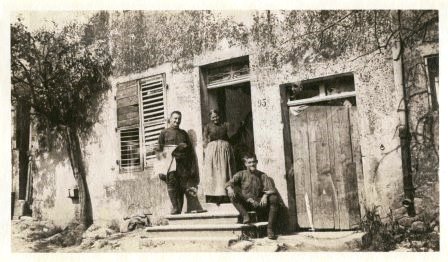
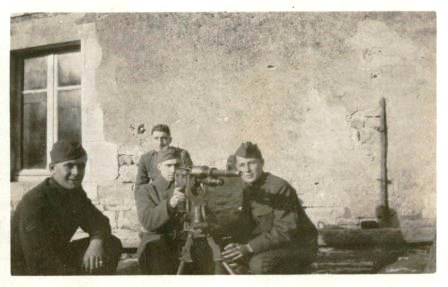
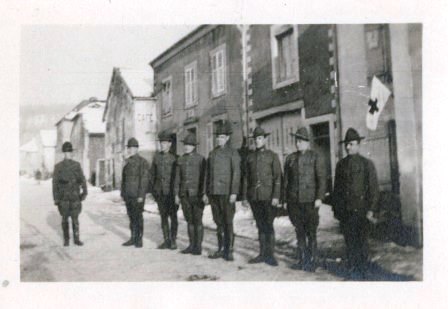
I’d like to introduce Charles Cornish Pearson, a young man who served during World War I in the 101st Machine Gun Battalion, 26th Division, American Expeditionary Forces. The MHS acquired his papers a few months ago, but as I looked at them more closely, I realized there was so much good material that I’m going to stretch his story out over several posts. I hope you’ll enjoy it as much as I have. The collection also came to us with 32 terrific photographs, undated and mostly unidentified, some of which I’ll be using as illustrations.
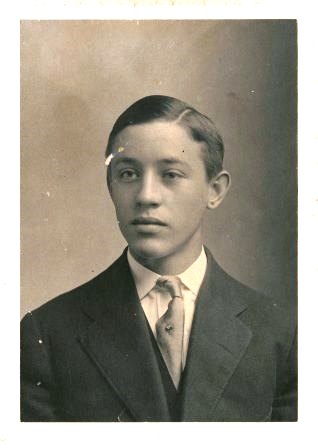
Charles C. Pearson was born on 2 April 1890, the son of Charles H. and Gertrude (Cornish) Pearson. He grew up in Arlington, Mass. with his older brother Bill and younger sister Jean. He graduated from Somerville Latin High School in 1908 and Massachusetts Agricultural College in 1912. The MAC yearbook described him like this:
This is little “Napoleon.” When he came here, he hit the studies hard and now he doesn’t have to plug, because the “Profs.” pass him on general principles. He holds the reputation of being one of the really good-looking men in the class who doesn’t fuss. “Connie” had an awful time electing his courses. He wanted to take everything, but of course they wouldn’t let him. We shouldn’t be a bit surprised to see him a member of Phi Kappa Phi.
Charles worked as a salesman after college, specifically as manager of the Hartford, Conn. office of E. Naumburg & Co. The U.S. entered World War I on 6 April 1917, Charles enlisted 12 June, was appointed corporal 1 July, and shipped out to France in early October. His letters at the MHS were written primarily to his mother Gertrude, his father Charles, his aunt Florence, and his brother and sister. He signed his correspondence variously as Charles, Cornish, C.C.P., and most often as “Buster,” but I’ll just call him Charles for simplicity’s sake.
Philip S. Wainwright’s History of the 101st Machine Gun Battalion, published in 1922, is a great resource for all things 101st. I’ll be using Wainwright’s text to add some details, but I want to focus primarily on Charles’ letters, his personal reaction to events, and his evolution over the course of the war.
Spirits were high as the men of the 101st embarked for Europe, and Charles’ first letters home were sent from “a little village in France” in November 1917. He wasn’t allowed to reveal his exact location, but I learned from Wainwright that Charles was stationed in Mont-lès-Neufchâteau in the northeastern part of the country. He was cheerful, except when it came to the weather, which was too wet and muddy for his liking. (A recurring motif.) He urged his family to write often and requested a number of items from home, including clothes, toiletries, cigarettes, and especially reading material. He also reassured them.
Believe me you & Dad and the rest of the family are constantly in my mind, and for your part don’t worry about me, have been in fine health ever since I left Niantic and believe I will keep so, and as regards getting into actual fighting why that is too far off to start worrying about.
Things had been fairly quiet for Charles so far. The training was rigorous, but he suffered few hardships, except monotony. He also liked the locals, despite the language barrier.
The French people here in the village are an interesting lot. Understand practically no English & as most of us are lacking in French, we don’t make much head way. However they all seem only too glad to do what they can for us & jabber away in French just as though we could understand every word they said.
The men of the battalion were “looking forward to when we begin to do our bit” and working hard to master their weapons and other equipment. Two days before Christmas, Charles wrote to his mother about some of this training.
Had my first experience with gas today. Tried out a couple of the masks we have issued to us. We non-coms had the pleasure of going into what they call a gas chamber (which in truth was a well built cattle shed) put on our masks & let them turn the gas on. Nothing very exciting happened if you did things as directed but if not well you would be lucky if you got away with slight sickness. […] However we have to get used to them, learning how to put them on quickly, test for gas etc, so that when we get up against the real thing why we will know what to do.
The 101st Machine Gun Battalion celebrated Christmas 1917 with the French villagers of Mont-lès-Neufchâteau. Many soldiers received care packages from home, and Charles described the meal and entertainment. The holiday was “complete except for being away from our families and believe me you could notice a far away look in the boys faces as they opened their packages and thought of the folks at home.”
Join me in a few weeks when I pick up the story of Charles Cornish Pearson in his new year and ours.