Gerry E. Studds Papers Available

By Susan Martin, Collection Services

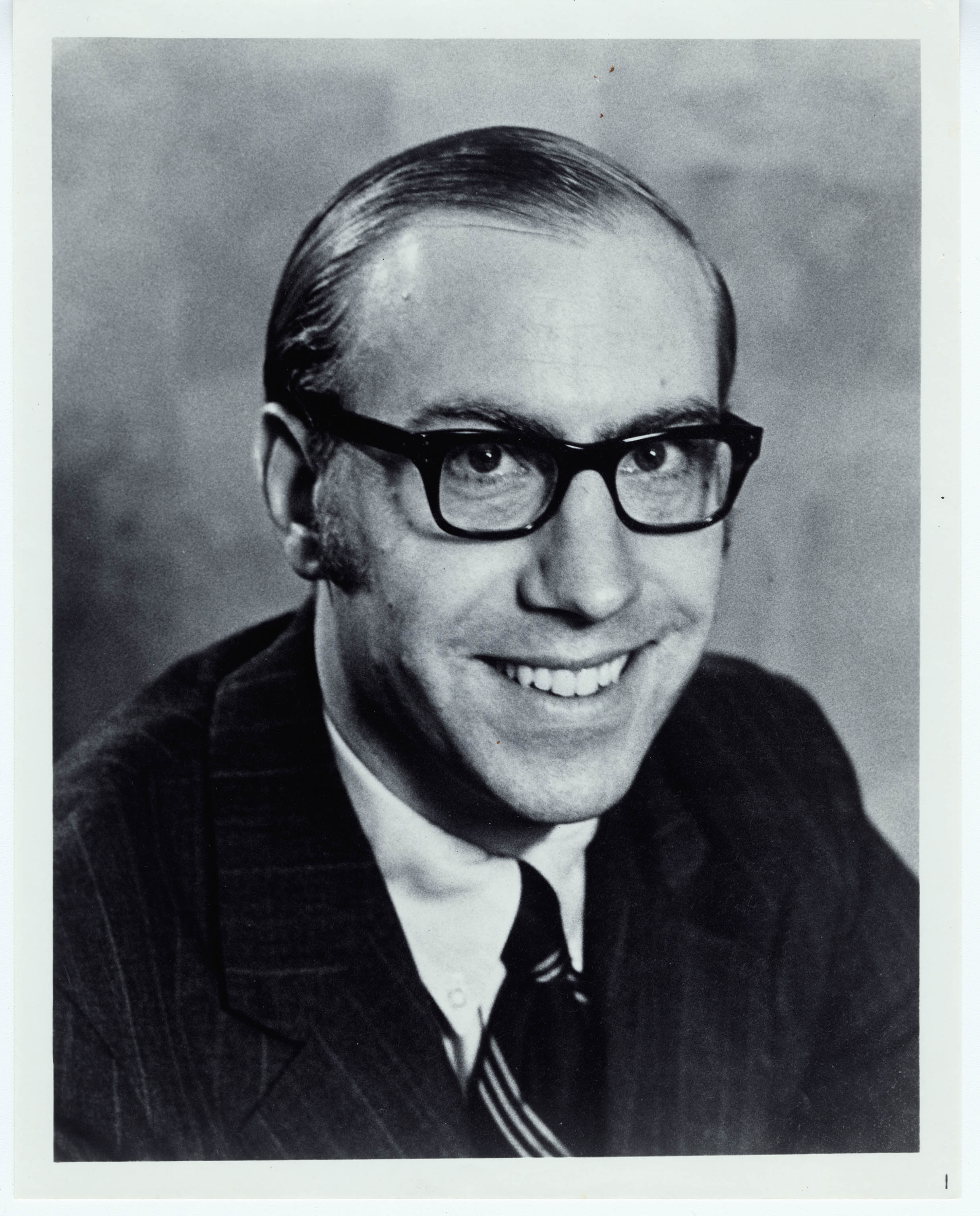
The MHS is pleased to announce that the papers of Rep. Gerry E. Studds (D-Mass.) have been processed and are available for research. This very interesting collection contains material on subjects as wide-ranging as environmental and wildlife conservation, foreign policy (particularly in Central America), and gay rights and HIV/AIDS prevention.


Gerry Eastman Studds (1937-2006) was the first openly gay Congressman in the United States. He served in the U.S. House for 24 years, from 1973 to 1997, representing first the 12th district of Massachusetts, then the 10th after redistricting in 1983. Studds’ district included Cape Cod, the islands, and parts of the South Shore, and his papers are a great resource for information on fishing, fisheries, and the Coast Guard. He also served on the Merchant Marine and Fisheries Committee and the Foreign Services Committee.

The collection consists primarily of legislative papers, campaign papers, and scrapbooks. Included are speeches, statements, press releases, newsletters, correspondence, subject files, clippings, briefing books, surveys, and commendations. Here are a few highlights:

  • – Two biographical scrapbooks compiled by Studds’ mother, Beatrice (Murphy) Studds, including material from his childhood, education, and early career;
  • – Papers related to the 1968 New Hampshire primary campaign of Senator Eugene McCarthy, which Studds coordinated; 
  • – Sixteen detailed surveys of voters in Studds’ district  reflecting the attitudes of his constituency on a variety of issues over his 24-year tenure; 
  • – Papers documenting Studds’ work to protect Massachusetts Bay’s Stellwagen Bank and to designate the Boston Harbor Islands as a national park; 
  • – And heartfelt letters from anonymous gay servicemen and women thanking Studds for his support of policies that would allow them to serve openly in the military.

We hope this collection will get a lot of use. The bulk of the papers are stored offsite, so use the online guide to submit your request at least two business days in advance.


A Treasure Rediscovered: The Civil War Sword of Robert Gould Shaw, 54th Regiment

By Daniel Tobias Hinchen, Reader Services

Today, the MHS is happy to unveil a recent acquisition to the collection. On 12 July the Society announced the acquisition of a significant collection of Shaw and Minturn family papers, photographs, art, and artifacts. The most remarkable item in the collection is the officer’s sword carried by Colonel Robert Gould Shaw, 54th Massachusetts Infantry Regiment – the first Northern regiment composed of free black volunteers. One hundred fifty-four years ago, Shaw carried the weapon during the failed assault on Fort Wagner, Morris Island, South Carolina. With sword in-hand, Shaw was shot in the chest while mounting the parapet and was killed. The sword and other personal effects were stolen from his body during the night and presumed lost.

However, the sword survives. Following acquisition of the sword from descendants of the Shaw family, the collections staff here at the MHS had the daunting task of tracing the provenance of this sword in order to ensure that it is the genuine article.

What follows is a brief chronology of Robert Gould Shaw and his sword, as laid out by Curator of Art & Artifacts Anne Bentley, and Senior Cataloger Mary Yacovone, who combed through various sources published, primary, and otherwise. [N.B. – These events are arranged chronologically but, as with much historical research, the pieces fell together in anything but clear order.]

*****

Nov. 1860 – Robert Gould Shaw (RGS) enlists in the 7th NY Militia.

28 May 1861 – RGS commissioned 2nd Lieutenant, Company H, 2nd Massachusetts Infantry.

8 July 1861 – RGS commissioned 1st Lt. in same.

10 Aug 1861 – RGS commissioned Capt. in same.

31 Mar 1863 – RGS commissioned Major, newly-formed 54th Massachusetts Regiment.

17 Apr 1863 – RGS commissioned Colonel, 54th Mass. Regt.

[mid-late April 1863?] – RGS’ uncle, George R. Russell, orders an officer’s sword for Shaw from master English swordsmith Henry Wilkinson.

11 May 1863 – Wilkinson sword no. 12506 proofed on this date, per Henry Wilkinson records.

23 May 1863 – Wilkinson sword no. 12506 etched and mounted on this date. Sold to C. F. Dennett, Esq., per Henry Wilkinson records.

28 June 1863 – RGS wrote to his mother: “Uncle George has sent me an English sword, & a flask, knife, fork, spoon &c. They have not yet come.”1

29 June [1863] – “June 29 – Monday. “Arago” in and mail from the North.”2

1 July 1863 – RGS wrote to his father that “A box of Uncle George’s containing a beautiful English sword came all right.”1

4 July 1863 – RGS wrote to his father that “All the troops, excepting the coloured Regiments, are ordered to Folly Island. … P.S. I sent you a box with some clothes & my old sword. Enclosed is receipt.”1

16 July 1863 – Mass. 54th participated in the Battle of Grimball’s Landing, James Island. RGS probably used his new Wilkinson sword in this action. First experience under fire for the 54th, which stood strong and proved its mettle covering the retreating Union forces.

18 July 1863 – Assault on Fort Wagner. RGS shot in the chest as he stood on the parapet of Ft. Wagner, sword in hand. Overnight his body was robbed of personal effects and arms and stripped to underwear. Sources differ as to the culprits.

19 July 1863 – RGS buried. According to Brig. Gen. George P. Harrison, C.S.A. writing to Luis F. Emilio much later, RGS was placed in the rifle pits below the parapet and 20 of his dead soldiers placed on top of him. Sources here differ also.

Friday 24 [July 1863] – John Ritchie diary: “Packed up Col. Shaw’s effects & expressed them North.” Ritchie later noted that he also sold the colonel’s horse.

3 June 1865 – Letter from Brigadier General Charles Jackson Paine, district commander at New Berne, N. C., to family:

Goldsboro June 3, 1865. I heard the other day of the sword of the late Robt. G. Shaw killed at Fort Wagner, in the possession of a rebel officer about sixty miles from here. I sent out and got it; the scabbard was not with it. I am going to send it on as soon as I have an opportunity.3

28 Jan 1876 – Letter from Lydia Maria Child to John Greenleaf Whittier:

I spent last winter with the parents of Colonel Shaw…The flag of the 54th Regiment was in their hall, and the sword of Colonel Shaw. There is a history about that sword. It is very handsome, being richly damascened with the United States coat-of-arms, and the letters R. G. S. beneath. It was a present from a wealthy uncle in England, and he received it a few days before the attack on Fort Wagner […] When his mother showed me the weapon she said: “This is the sword that Robert waved over his followers, as he urged them to the attack. I am so glad it was never used in battle! Not a drop of blood was ever on it. He had received it but a few days before he died.”4
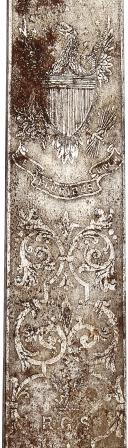
Detail of the sword, showing United States Coat-of-Arms and initials R.G.S.

(Photograph by Stuart E. Mowbray)


1900 – At a meeting of the Military Order of the Loyal Legion of the United States, Commandery of Massachusetts, Brev. Lt. Solon A. Carter, U.S.V., presented a paper titled “Fourteen Months’ Service with Colored Troops,” in which he stated:

In July [1865], upon leaving the service, the late Assistant Adjutant General* was charged by General Paine with the duty of restoring the sword to Colonel Shaw’s father, and upon arrival at this home, opened a correspondence with Mr. Francis George Shaw informing him of its recovery.

The sword in question proved to be the one carried by the gallant colonel and was identified by the initials R.G.S. delicately etched upon the blade. In a postscript to one of his letters, Mr. Shaw wrote, “The sword was a present to my son from his uncle, Mr. George R. Russell, who purchased it in England and caused the etchings to be made there.”

In a subsequent letter acknowledging its receipt he says “I thank you most heartily for all the care and trouble you have taken. So far as such words may be applied to an inanimate thing it is the weapon which has done most for our colored people in this war, and it is to me likewise as well as to you a source of great satisfaction that is was recovered and restored by officers of colored troops.”

*Captain Solon A. Carter, of Leominster, Mass., served as C.J. Paine’s Assistant Adjutant General. Appointed 15 July 1864 and resigned 3 July 1865.

Mar 2017 – The sword was found in the attic of the home of Mary (McCawley) Minturn Haskins.

6 Apr 2017 – In an e-mail to MHS Curator of Art & Artifacts Anne Bentley, one of the donors stated:

Susanna Shaw Minturn is my great-grandmother and apparently was very close to her brother, RGS. Her oldest son, Robert Shaw Minturn, had no children; there were four girls and my grandfather, Hugh Minturn (who died in 1915, before his mother). I can only guess, but presumably my great-grandmother passed the sword on to my father, Robert Bowne Minturn, not her oldest grandson, but the senior by male primogeniture. My father was 15 when his grandmother died in 1926. The sword may have hung on his childhood bedroom wall.

17 Apr 2017 – Shaw sword is given to the Massachusetts Historical Society as part of a larger gift including papers and portraits.

*****

1. Shaw, Robert Gould, Blue-eyed child of fortune: the Civil War letters of Colonel Robert Gould Shaw / edited by Russell Duncan, (Athens : University of Georgia Press, c1992.)

2. Lt. John Ritchie’s diary, Quartermaster of the Massachusetts 54th Volunteer Infantry Regiment, whose diary was used by Luis F. Emilio in A Brave Black Regiment.

3. Paine, Sarah Cushing, Paine ancestry : the family of Robert Treat Paine, signer of the Declaration of Independence, including maternal lines / compiled by Sarah Cushing Paine ; edited by Charles Henry Page, )Boston : Printed for the family [Press of D. Clapp & Son], 1912.

4. Child, Lydia Maria Francis, Letters of Lydia Maria Child / with a biogrpahical introduction by John G. Whittier and an appendix by Wendell Phillips, (Boston: Houghton, Mifflin and Company, 1883).

Working with Google to Showcase MHS Content about U. S. Presidents

By Nancy Heywood, Digital Projects Coordinator

Selections from MHS’s two most important collections, the Adams Family Papers and the Coolidge Collection of Thomas Jefferson Manuscripts, are now part of the Google Arts & Culture website. This website is administered by the Google Cultural Institute, a non-profit initiative founded in 2011 that partners with cultural organizations to “bring the world’s cultural heritage online.” [Read more about the Google Cultural Institute here: https://www.google.com/culturalinstitute/about/partners/.]

When MHS was approached by a coordinator of the Google Cultural Institute in the late summer and asked to contribute content about U.S. Presidents for the American Democracy Project, MHS staff realized there were many benefits of having our collections showcased within the Google Arts & Culture web delivery system.  Highlights of the Society’s extraordinary Adams and Jefferson manuscript collections are now available to users who browse and search the content Google is hosting from about 1,200 significant museums, archives, and cultural organizations.

MHS’s main website has thousands of presentations of documents from our Adams and Jefferson materials, and the first challenge was to figure out what specifically to contribute to Google’s recent project.  The Google content management system features items as single digitized images and online exhibitions featuring those digital items.  Given limited production time to assemble the online content, we decided to focus our efforts on creating two online exhibitions–“The Private Jefferson” and “From Diplomats to Presidents: John Adams and John Quincy Adams”.

For “The Private Jefferson” online exhibition, Laura Wulf, Production Specialist, worked from the publication, The Private Jefferson: Perspectives from the Collections of the Massachusetts Historical Society, the companion to the recent MHS exhibition.  It features selected letters written by Jefferson, pages from manuscript volumes, architectural drawings and sketches, published documents, and engravings.

Neal Millikan, Digital Projects Editor, and Amanda Norton, Digital Projects Editor (with input from their colleagues within the Adams Papers department) crafted an informative narrative for the exhibition “From Diplomats to Presidents: John Adams and John Quincy Adams.” This exhibition presents key documents and quotations about the extensive careers in public service of John Adams and his son, John Quincy Adams.

The MHS digital team (Laura Wulf, Peter Steinberg, and I) assembled all the digital components (images and associated metadata), loaded them into the Google web delivery system, and used the exhibition editor tool to assemble the online exhibitions.

Please explore the exhibitions and MHS’s online content within the Google Arts & Culture website, and the entire Google American Democracy project.


Anti-suffrage Records Available Online

By Nancy Heywood, Collections Services

A few years from now, in 2020, the United States will recognize the centennial of the ratification of the 19th Amendment to the U.S. Constitution guaranteeing women’s voting rights across the country. Although some states and territories had granted women the right to vote in the last half of the nineteenth century (including many in the western part of the country), full suffrage for U.S. women took a long time. Many organizations pushed forward referenda at the state and national level.  An amendment to the U.S. Constitution was introduced in Congress in 1878 but stalled.   The 19th Amendment stating that no U.S. citizen shall be denied the right to vote “on account of sex” was similar to the 15th Amendment that granted African American men the right to vote.  The 19th Amendment passed by the U.S. House of Representatives in 1918, and by the U.S. Senate in 1919, was ratified by enough states by 20 August 1920 to be adopted.  

During the time when so many were working hard to gain voting rights for women, there were also those working against this movement. One such organization was based in Massachusetts (and has one of the longest names of any institution whose records are held within the Massachusetts Historical Society): the Massachusetts Association Opposed to the Further Extension of Suffrage to Women.

The records of this organization are now fully digitized and available on the web, thanks to a grant provided by the Institute of Museum and Library Services under the provisions of the Library Services and Technology Act grant as administered by the Massachusetts Board of Library Commissioners.

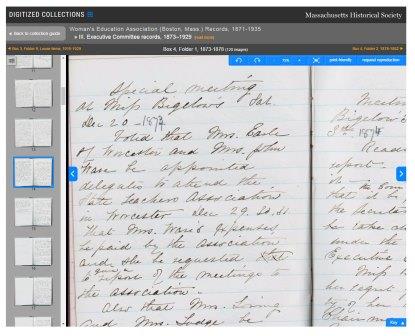
All pages of this manuscript collection have been digitized and they are presented as sequences of pages linked to the folders listed on the collection guide.  Website users may explore any or all administrative records, committee meeting minutes, typescripts of lectures and reports, and various printed items including by-laws,  and printed lists of standing committee members from all over the state.

The records date from 1894 to1920.  The Massachusetts Association Opposed to the Further Extension of Suffrage to Women was formally founded in 1895, but stemmed from a committee formed in 1882.  The Association actively recruited members, opposed legislation that would have granted voting rights to women in Massachusetts, and also held events and lectures promoting their cause. 

Women working so actively against voting rights for women seems curious and perhaps even incongruous.  Some of the reasoning and context for their motivation is found within the organization’s own records. Within the Loose papers, Legislative history section, there is a typescript document of a speech given at a hearing before committee on constitutional amendments in Feb. 1905 which states four reasons for opposing woman suffrage:  many women in Massachusetts don’t petition for it, Massachusetts wouldn’t benefit from it; it is a “most inopportune” time to change the Constitution, and suffrage hasn’t proven to be beneficial elsewhere.

Additional resources (beyond the organizational records) also provide perspectives on the context for anti-suffrage work:

The historian Francis Parkman (1823-1893) summarized the perspective of some within a pamphlet, Some of the Reasons Against Woman Suffrage [Boston?:  s.n., 1883?] by stating it would be too burdensome for women because women are delicate and not as robust as men. Parkman also advocates the position that women voting could potentially be disruptive to “civil harmony” if women were too sentimental or if women from different classes turned against each other and ended up being more “vehement” than men on opposite sides of an issue (page 13).  This pamphlet is available online from Harvard Library.

The Massachusetts Association Opposed to the Further Extension of Suffrage to Women published a newsletter, The Remonstrance.  One sample issue, from January 1908, is available as a digital presentation. An article on the first two pages covers various reasons against woman suffrage including the argument that not all women want the right to vote as evidenced by the fact that very few women who are eligible to vote in school committee elections actually do so.  Opponents also disputed the argument that voting rights would result in improving the condition of women because women already had an indirect influence on public affairs from their position of “moral influence.”  Page 4 of the newsletter offers a synopsis of “Recent Defeats of Woman Suffrage” in various states.

Three Fully Digitized Collections

By Peter K. Steinberg, Collections Services

In 2014, the MHS made available nine fully digitized collections relating to the Civil War. Since that time, we have been at work digitizing more full collections, this time under the topic of “Women in the Public Sphere.” There have been two posts on the Rose Dabney Forbes papers and her involvement in the American peace movement of the early 20th century. Forbes was an officer of the Massachusetts Peace Society, the American Peace Society, the Massachusetts branch of the Woman’s Peace Party, and the World Peace Foundation. Read the first one here and the second one here. The Forbes collection guide is online.

Continuing our review and promotion of these fascinating collections, this third blog post will discuss briefly some of the smaller digitized collections.  


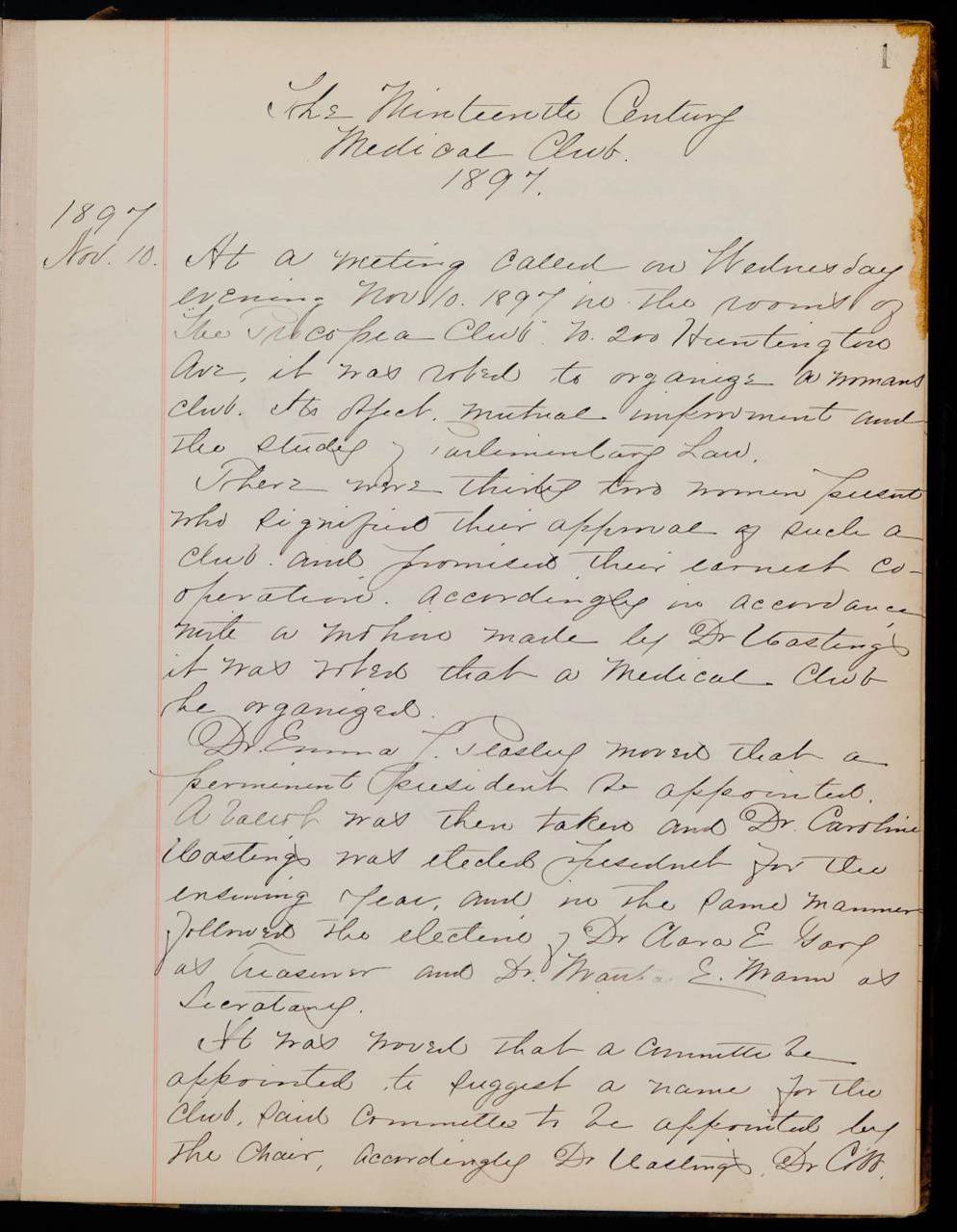
The Twentieth Century Medical Club records, 1897-1914 contain 270 images of meeting minutes of the Twentieth Century Medical Club. Interestingly, at the club’s first meeting, the intention was “to organize a womans club. Its object, mutual improvement and the study of Parlimentary [sic.] Law.” Later in this first meeting, which was attended by thirty-two women, a committee was organized to come up with a name. The minutes discuss business matters, finances, and other special occurrences such as the giving of papers on topics ranging from Placenta Praevia by Dr. Stella Perkins, The Importance of Remedies in Chronic Cases by Dr. Clara E. Gary, and Sexual Hygiene by several speakers.


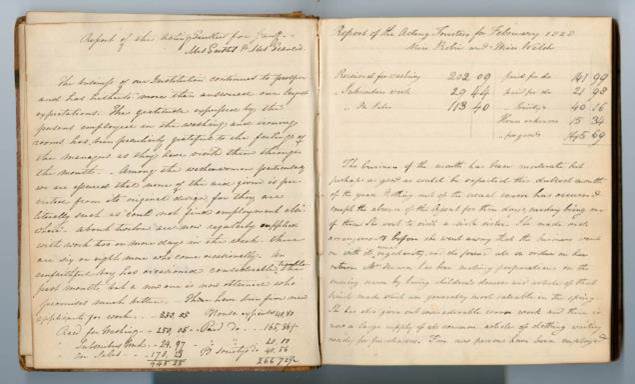
The Society for the Employment of the Female Poor  provided employment in Boston for poor women. Work duties included washing, ironing, and sewing in addition to the operation of a schoolroom. Early in the volume it is noted that “The business of our Institution continues to prosper and has hitherto more than answered our largest expectations.” Other recorded information concerns funds received and distributed and tracking new employees. Reports on individual cases are also recorded, such as the hiring of Mrs. Dow, Mrs. Ward, and Mrs. Monteith. Dow was “a widow with 4 children, she has washed & ironed here with tolerable success –.” Mrs. Ward they found “difficult to afford aid; she is very poor & sick, but so miserable a seamstress that little work can be trusted to her.” Mrs. Monteith “can do just plain sewing tolerably, her capacity & her circumstances are both moderate.” Troublesome employees are also discussed.

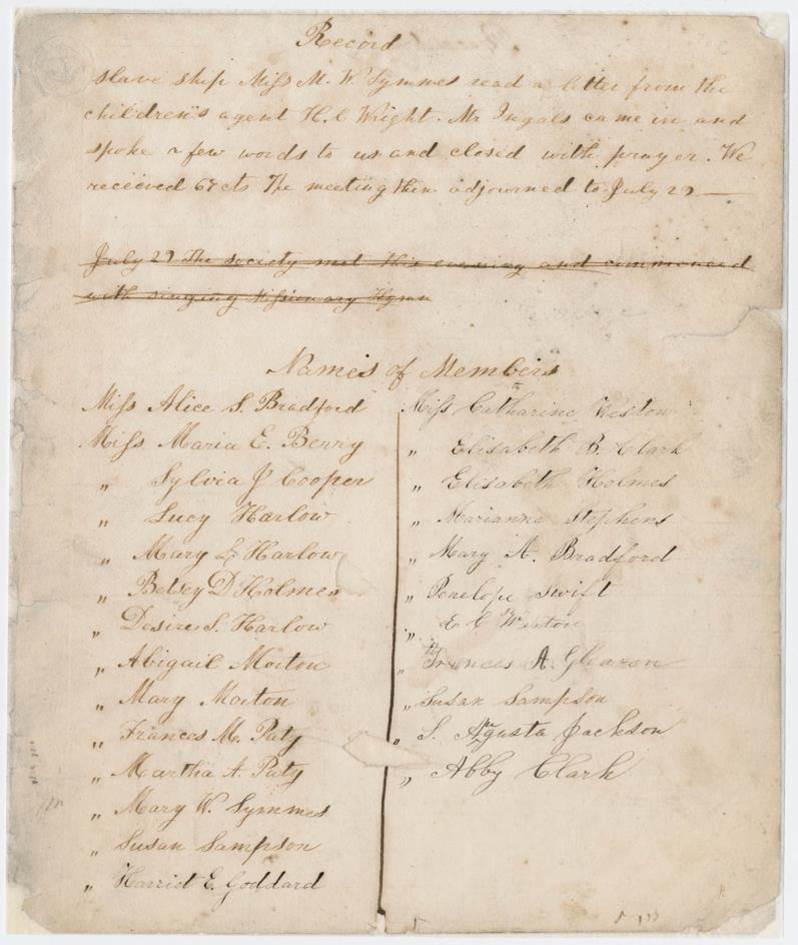
The Juvenile Anti-Slavery Society records, 1837-1838 represent the smallest organization in this digitization project at just eleven images. The monthly meeting minutes and member lists offer vital information concerning society business.


Funding for the digitization of these collections and the creation of preservation microfilms was provided by the Institute of Museum and Library Services under the provisions of the Library Services and Technology Act grant as administered by the Massachusetts Board of Library Commissioners.


Rose Dabney Forbes and women’s suffrage (part 2 of 2)

By Laura Wulf, Collections Services

In an earlier post I gave you a preview of the Rose Dabney Forbes papers. Her papers are one of seven collections that have been fully digitized and are now available on our website as part of an LSTA funded project that we are calling “Women in the Public Sphere.” These collections relate to women’s involvement in social issues of  the 19th and early 20th centuries- the suffrage and anti-suffrage movements, education, poverty, anti-slavery and pacifism.

The papers of Rose Dabney Forbes (1864-1947), the wife of businessman J. Malcolm Forbes (1847-1904), are mostly from her work in in the American peace movement of the early 20th century, but I also found some vivid descriptions of the excitement generated by the ratification of the nineteenth amendment in 1920 giving women the right to vote. In a typewritten draft of an address delivered to the League of Women Voters by Mrs. Forbes on 31 March 1921, she described,

that thrilling day in August when we knew with certainty that Tennessee had stepped forward and that political equality was at last in the grasp of the women of the United States. Our headquarters at Little Building held a continuous reception for several days…and all our members who were not too far off, came to talk over the wonderful news and to help Miss Luscomb and Mrs. Stantial put the final marks on the Suffrage map.

 She continued,

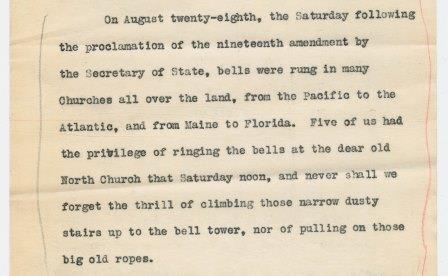
…following the proclamation of the nineteenth amendment by the Secretary of State, bells were rung in many churches all over the land, from the Pacific to the Atlantic, and from Maine to Florida. Five of us had the privilege of ringing the bells at the dear old North Church that Saturday noon, and never shall we forget the thrill of climbing those narrow dusty stairs up to the bell tower, nor of pulling on those big old ropes.


But Mrs. Forbes and her colleagues couldn’t get caught up in the excitement for long.

[A]s we all know voting is a serious business and as soon as our first rapture subsided we had to come down to earth. The work at our office grew more exacting up to the last date for registration in October. By day there were streams of would-be voters coming to the office, or ringing up by telephone, to find out about the mysteries of voting; and we kept open for five successive Monday evenings, in order to give this same opportunity to those women whose duties precluded their coming in the day time-and hundreds availed themselves of it.


It will be fascinating to compare these descriptions with materials from another collection we digitized for this project, one which has the rather unwieldy name of the  Massachusetts Association Opposed to the Extension of Further Suffrage of Women, 1895-1920. We hope that you will take advantage of these newly accessible collections and immerse yourself in the voices and the debates of their time.


Funding for the digitization of this collection and the creation of preservation microfilm was provided by the Institute of Museum and Library Services under the provisions of the Library Services and Technology Act grant as administered by the Massachusetts Board of Library Commissioners.

Rose Dabney Forbes and the American Peace Movement (part 1 of 2)

By Laura Wulf, Collections Services

The Digital Projects team here at the MHS has spent much of the past two years working on an LSTA funded project that we are calling “Women in the Public Sphere.” This grant allowed us to fully digitize and make accessible seven collections related to women’s involvement in social issues of  the 19th and early 20th centuries, including the suffrage and anti-suffrage movements, education, poverty, anti-slavery and pacifism. 

The collections range in size from 11 items in the Juvenile Anti-Slavery Society records, 1837-1838 to more than 3000 items in the Rose Dabney Forbes papers, 1902-1935. In this post, I will take a closer look at the Forbes papers, which document the participation of Rose Dabney Forbes (1864-1947), the wife of businessman J. Malcolm Forbes (1847-1904), in the American peace movement of the early 20th century, as an officer of the Massachusetts Peace Society, the American Peace Society, the Massachusetts branch of the Woman’s Peace Party, and the World Peace Foundation. The records of the organizations in which she was involved include governance documents, meeting minutes, and correspondence, as well as printed materials.

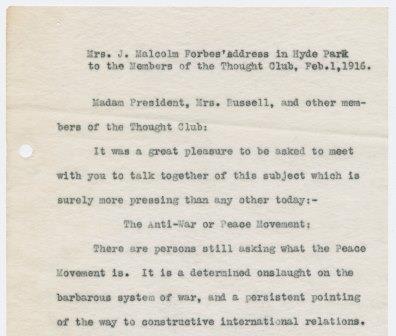
In a typescript draft of an address delivered to members of the “Thought Club” in Hyde Park, Mass., by Mrs. Forbes on 1 February 1916, she argues for  the “necessity of extending the reign of law out from the smaller circle of nationalism, to the larger circle of internationalism.” Forbes goes on to write that,

Irrespective of opinions as to the causes, and as to the consequences of this terrible  European war, thinking persons who stand for Twentieth Century ideals are passionately  exclaiming that this shall be the last war between civilized nations; that the world after   this shall not allow such a method for trying to settle international differences.

Speaking as a representative of the Woman’s Peace Party, Forbes asked why the peace movement “is still imperfectly understood even by many persons who are distinctly in sympathy with its fundamental object.” Was it because the war is happening overseas, leading to what she called “[m]ental inertia”? Was it because of a “[l]ack of literature giving authoritative and complete statement of what a great body of leading internationalists believe,” or because, as she suggested, the press ridiculed the ideas as well as the movement? 

She addressed what she calls a misconception that “when we work to banish the war system from earth, we are lowering the heroic ideals of manhood- that we are training our boys to be timid and slothful-to be ‘molly-coddled. No indeed” she exclaimed, “we train our boys to be ready to die for their country, by serving humanity, not by destroying their human brothers.” Lastly she asked whether it could be that the very name of the movement had held it back. “The word Peace,” she wrote, “stands for the result of justice and righteousness; peace is an effect, not a method of working force. Only in a restricted sense of the word is peace simply cessation of war.”

As part of her call to action, Forbes quoted Phillips Brooks, Ralph Waldo Emerson and William Ellery Channing, and she summed up her argument by insisting that

The truth is that the war against war is and has long been an aggressive campaign of  education. The Peace Movement is a determined onslaught on the old and barbarous  system of war, and a persistent pointing of the way to constructive international peace.  The Peace worker must summon all the logic and clearness of thought that he can  command and he must needs stand firm in his faith, not heeding either the ridicule or the sneers of the unconverted.

How do peace movements of today articulate their hopes and strategies? We encourage you to look through these newly digitized collections and make your own comparisons and discoveries.

For more of the story, check out part 2 of Rose Dabney Forbes and the American Peace Movement


*****

Funding for the digitization of this collection and the creation of preservation microfilm was provided by the Institute of Museum and Library Services under the provisions of the Library Services and Technology Act grant as administered by the Massachusetts Board of Library Commissioners.


Fully-Digitized Manuscript Collections Now Available

By Nancy Heywood, Collections Services

The Massachusetts Historical Society is pleased to announce that seven collections relating to women in the public sphere have been digitized thanks to funding from the Institute of Museum and Library Services under the provisions of the Library Services and Technology Act grant as administered by the Massachusetts Board of Library Commissioners.  The grant allowed us to create high resolution images that are accessible at the MHS website, as well as preservation microfilm created from the digital files.


The seven collections range from small (one thin folder of documents kept by the Juvenile Anti-Slavery Society records) to large (7,534 images of records kept by the Woman’s Education Association) and date from 1827 (Society for the Employment of the Female Poor Trustees’ reports) to the 1930s (Rose Dabney Forbes papers as well as the Woman’s Education Association records).

These collections contain records of organizations primarily run by women concerned with social issues–anti-slavery, women’s education, the peace movement, treatment of the poor, and anti-suffrage.  A total of 16,003 digital images depict all the pages of these seven collections and are available as sequences of images linked to manuscript collection guides.

Juvenile Anti-Slavery Society records, 1837-1838
http://www.masshist.org/collection-guides/view/fa0427

Massachusetts Association Opposed to the Further Extension of Suffrage to Women, 1895-1920
http://www.masshist.org/collection-guides/view/fa0121

New England Freedmen’s Aid Society records, 1862-1878
http://www.masshist.org/collection-guides/view/fa0423

Rose Dabney Forbes papers, 1902-1932
http://www.masshist.org/collection-guides/view/fa0212

Society for the Employment of the Female Poor trustees’ reports, 1827-1834
http://www.masshist.org/collection-guides/view/fa0428

Twentieth Century Medical Club records, 1897-1911
http://www.masshist.org/collection-guides/view/fa0411

Woman’s Education Association (Boston, Mass.) records, 1871-1935
http://www.masshist.org/collection-guides/view/fa0393

The work for the grant included the detailed review of all the documents in the collections, preparation for digitization and the creation of metadata for the master images.  The majority of the high-quality uncompressed master digital images were created at MHS with some images created by the Northeast Document Conservation Center.  The production steps required for the web presentation were completed by MHS staff.

Please explore these new collections!   


Newly Digitized Photograph Collection

By Peter K. Steinberg, Collection Services

Collection Services at the Massachusetts Historical Society has recently created a collection guide for, and fully digitized, the 5th Massachusetts Cavalry Regiment carte de visite album, ca. 1864-1865 (Photograph Collection 228).

The 5th Massachusetts Cavalry Regiment was a “colored volunteer” regiment active from 9 January 1864-31 October 1965. Formed at Camp Meigs, Readville, Massachusetts, was commanded by some notable sons of Massachusetts including Charles Francis Adams Jr., Henry S. Russell, Charles Pickering Bowditch, and Henry Pickering Bowditch. The regiment saw some action in the war, notably in a battles which took place at Baylor’s Farm and the Siege of Petersburg in Virginia.

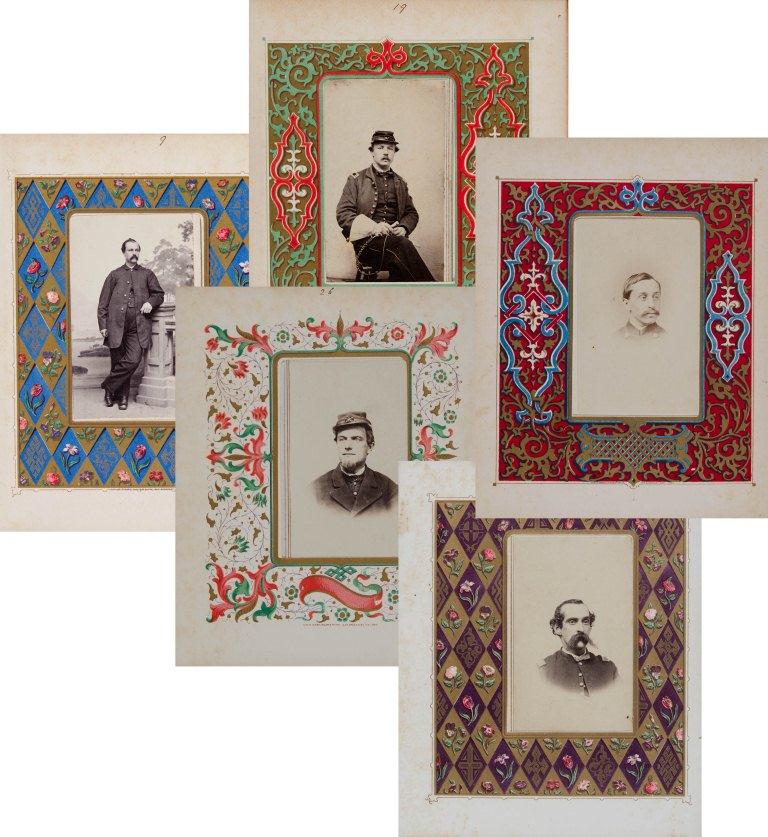
This collection consists of a photograph album containing 46 carte de visite photographs of officers from the regiment. In addition to those named above, the regiment included Edward Jarvis Bartlett, Daniel Henry Chamberlain, Patrick Tracy Jackson, and others. The album includes a two-page handwritten index which identifies all but one of the photographs. Each image appears on a page beautifully bordered, as can be seen in the examples presented here.

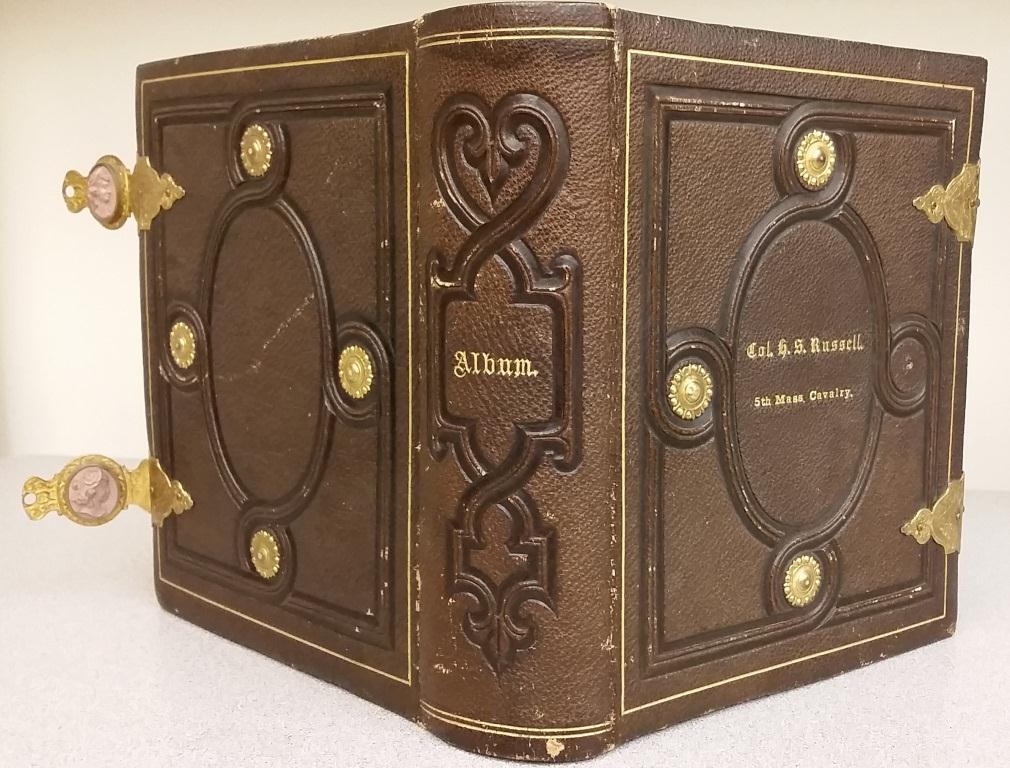
The cover of the album, also stunning, is embossed: “Col. H. S. Russell. 5th Mass Cavalry” and features the original, still-functioning brass clasps to keep the album closed. Henry S. Russell (1838-1905), an 1860 graduate of Harvard University, served several ranked positions in the Union Army reaching Lieutenant-Colonel of the 2nd Massachusetts Infantry and Brigadier-General of the 5th Massachusetts Cavalry. In 1864, Russell married Mary Hathaway Forbes, the daughter of the influential Boston businesman, railroad magnate, and abolitionist John Murray Forbes, and was a cousin of Robert Gould Shaw, Colonel of the 54th Massachusetts Volunteer Infantry Regiment.

Another family connection, but this time within the 5th Massachusetts Cavalry Regiment, were the brothers Henry Pickering Bowditch (1840-1911) and his younger brother Charles Pickering Bowditch (1842-1921). Both were Harvard educated; Henry being a physician and physiologist as well as dean of Harvard Medical School, and Charles becoming a financier, archaeologist and linguistics scholar.

This is the seventh fully digitized Civil War photograph album at the Massachusetts Historical Society. The MHS has additional fully digitized Civil War materials available, as well. Further Reading: Morse, John T., Jr. “Henry Sturgis Russell.” In Sons of the Puritans: A Group of Brief Biographies. Boston: American Unitarian Association, 1908:153-162.

Civil War Photograph Collections Online

By Peter K. Steinberg, Collection Services

On 2 October 2014, my colleague Nancy Heywood announced on the blog of the Massachusetts Historical Society (MHS): “Just Launched! Nine Fully Digitized Civil War Collections.” In addition to these manuscript collections, the MHS holds several photograph collections dating from the Civil War period as well. Six of these have been digitized and are available both on our Civil War commemoration home page, and in our larger list of guides to photograph collections.

The albums contain images of dozens of Massachusetts’ sons –some of whom feature in our digitized manuscripts collections, such as Richard Cary and Norwood Penrose Hallowell– as well as battleground areas and significant and anonymous role players in the Civil War. Seeing them adds another layer of context to the letters, newspaper articles, and other memorabilia of lives long ended. Don’t forget! Back in 2012, the MHS produced an in-house exhibit “Massachusetts in the Civil War, 1861-1862” and also made a companion website which featured many documents from the show. Since we deal with a lot of death here at the MHS – and really in most archives – I would be remiss without highlighting the second most emotional letter I have ever read, Wilder Dwight’s last letter to his mother Elizabeth from the battlefield at Antietam where he was mortally wounded.