
Clara E. Currier’s Diary, July 1925

by Hannah Elder, Associate Reference Librarian for Rights & Reproductions

Today we return to the transcription of Clara E. Currier’s 1925 diary. Currier was a working-class woman who lived in or near Haverhill, MA. Her diary records her daily activities—from fiber arts to paid employment to observations of the natural world—providing insight into daily life a century ago. You can find entries for January, February, March, April, May, and June in past blog posts.

July is another hot month, punctuated with occasional rain showers. Haverhill plays host to two national figures: President Calvin Coolidge and the rigid airship USS Shenandoah. The community also suffers a loss in the passing of Berenice (or Bernice) Marsh, a little over a month after she had given birth to a baby boy in June. Clara attends her funeral, noting it was “very sad.” Alongside this sadness, the rhythms of the summer continue, with an abundance of berries, parties to attend, and a trip to the coastal communities of southern Maine.

July 1, Wed. Fair, and hot, cooked.

July 2, Thurs. $19 Fair, Blanche came over.

July 3, Fri. Fair, went up home, saw the [dirigible] Shenandoah.
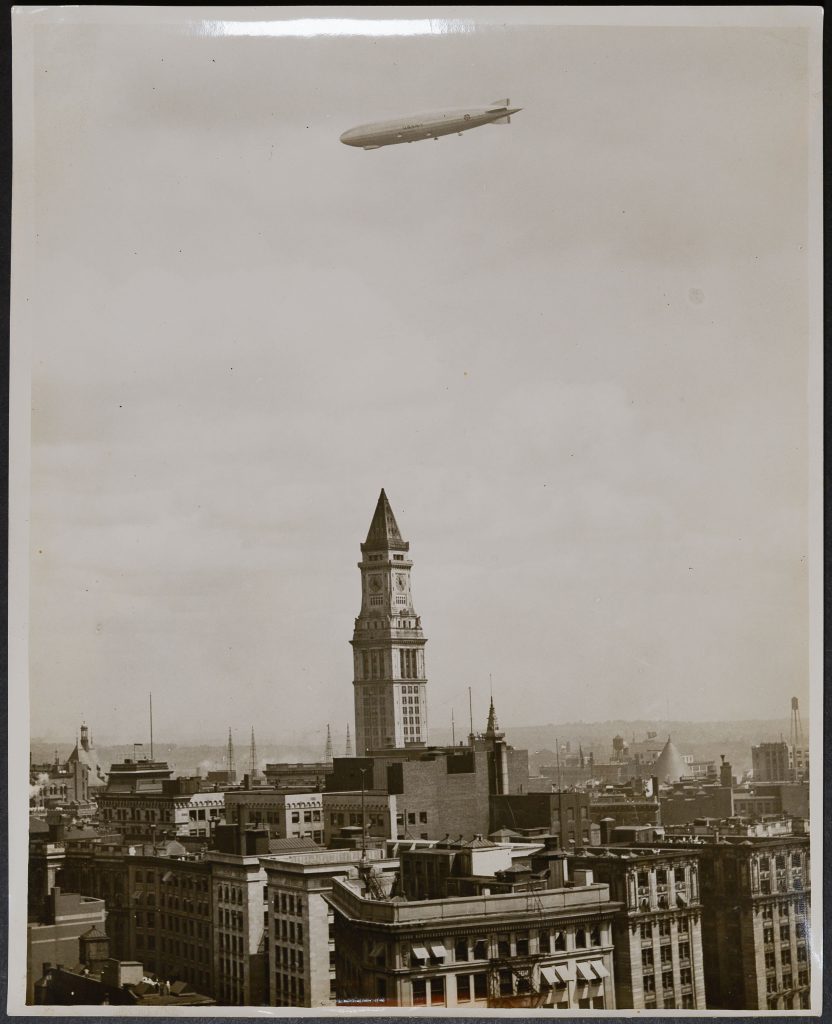
USS Shenandoah flies over the Boston Customs House tower in a black and white photograph.
MHS Photo. 10.20 USS Shenandoah above Boston Customs House, ca 1925

July 4, Sat. Dull with showers, picked peas, strawberries and washed, started an English Broadcloth dress. Bernice Greeley has a baby boy.

July 5, Sun. Fair and hot, rained early, picked strawberries, came home.

July 6, Mon. Fair with showers, sewed.

July 7, Tues. Fair and showers, went to Salisbury Beach after meeting at Grange.

July 8, Wed. Fair, sewed and cooked, Blanche sick with diptheria. [sic]

July 9, Thurs $17.10 Fair, went up town.

July 10, Fri. Fair, went up to Etta’s, picked cherries and blueberries.

July 11, Sat. Fair, Pres. Coolidge was in town guest of Mr. Bauer at Pond Hills, went to Haverhill to see Mr. + Mrs. P.

July 12, Sun. Fair, went to church + S.S, read.

July 13, Mon. Fair, went up town.

July 14, Tues. Fair, finished my dress.

July 15, Wed. Fair, cleaned my kitchen. Shower a.m early

July 16, Thurs. [$]19 shower a.m early  Fair, cleaned out funnel. Went up town.

July 17, Fri. Fair, swept and dusted.

July 18, Sat. Fair, went to Haverhill and over home went blueberrying and picked 7 or 8 qts. Canned 8 ½ pts.

July 19, Sun. Fair, picked a few raspberries and blueberries, shampooed my hair.

July 20, Mon. Fair, went up town, cooked.

July 21, Tues. Showers and partly clear, William brought me peas and blueberries. Berenice Marsh died at 11 P.M.

July 22, Wed. Fair with shower at night.

July 23, Thurs. [$]18.62 Fair, went up town.

July 24, Fri. Fair, went up to Berenice’s funeral, very sad, had Rebekah service, called on Mrs. Pickering and Mrs. Quimby, came back and went over to see Sizzie, Grace and her husband.

July 25, Sat. Fair, went to Porpoise Beach, Beachwood, Me with Corner Class guests of Mrs. Willis Cummings had a fine time, went by auto by the way of Portsmouth, York Beach, Ogunquit, ^Wells, Kennebunkport and Cape Porpoise. 31 in all in the party. Crosses the new Memorial bridge between Me. + MH.

July 26, Sun Fair, wrote letters, went down to see Cody and they took me up to Uncle Will’s and home again.

July 27, Mon. Rainy, thunder shower A.M, cooked.

July 28, Tues Dull and cleared, went up home blueberrying with Mr. Dennis, Sizzie went, shower.

July 29, Wed. Fair, came down with Mr. Dennis. out of work the rest of the week.

July 30, Thurs. [$]15.58 Fair, washed and ironed, went up town, Sizzie and I went up home with Mr. Dennis. Went to lawn party up to Alice Marden’s.

July 31, Fri. Fair, went blueberrying, picked around a half bushel. July 31, Fri. Fair, went blueberrying, picked around a half bushel.

If you are interested in viewing the diary in person in our library or have other questions about the collection, please visit the library or contact a member of the library staff.

*Please note that this diary transcription is a rough-and-ready version, not an authoritative transcript. Researchers wishing to use the diary in the course of their own work should verify the version found here with the manuscript original.

This line-a-day blog series is inspired by and in honor of MHS reference librarian Anna J. Clutterbuck-Cook (1981–2023), whose entertaining and enlightening line-a-day blog series ran from 2015 to 2019. Her generous, humane, and creative approach to both history and librarianship continues to influence the work of the MHS library.
Clara E. Currier’s Diary, June 1925

by Hannah Elder, Associate Reference Librarian for Rights & Reproductions

Welcome back to the transcription of Clara E. Currier’s 1925 diary. Currier was a working-class woman who lived in or near Haverhill, MA. Her diary records her daily activities—from fiber arts to paid employment to observations of the natural world—providing insight into daily life a century ago. You can find entries for January, February, March, April, and May in past blog posts.

June is a less eventful month than April and May, which I’m sure is a relief for Clara. She endures hot and changeable weather, recording multiple thunderstorms throughout the month. She also plays donkey (a four-player card game), goes on her usual calls, and works. She also reports on the health of those in her community and works on new hats for herself and for friends.

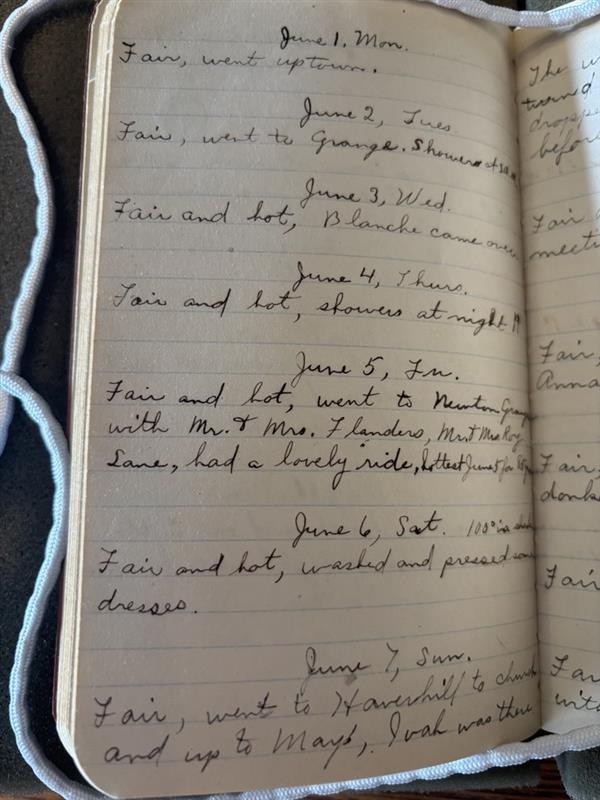
June 1, Mon. Fair, went uptown.

June 2, Tues. Fair, went to Grange. Showers at 3 a.m.

June 3, Wed. Fair and hot, Blanche came over.

June 4, Thurs. Fair and hot, showers at night. [$]19

June 5, Fri. Fair and hot, went to Newton Grange with Mr. + Mrs. Flanders, Mr. + Mrs. Roy Lane, had a lovely ride, hottest June 5 for 85 years.

Jue 6., Sat. 100° in shade Fair and hot, washed and pressed some dresses.

June 7, Sun. Fair, went to Haverhill to church and to Mary’s, Ivah was there. The wind came out east and it turned cold and the temperature dropped nearly 50° from the day before.

A page of a lined notebook with handwritten entries.
Clara’s diary entries for June 1-7, 1925

June 8, Mon Fair and cooler, went to class meeting, Blanche called.

June 9, Tues. Fair, went over to Blanche’s, finished Annah’s hat.

June 10, Wed. Fair, thunder shower, played donkey downstairs.

June 11, Thurs [$]19 Fair, sewed.

June 12, Fri. Fair, went to W. Newbury grange with the Flander’s, had a fine time.

June 13, Sat. Fair, no work, washed and cleaned my bedroom, went up home.

June 14, Sun. Fair with a little shower, Sizzie and I came back. Bernice March had a boy baby yesterday morning.

June 15, Mon. Fair with a shower at night.

June 16, Tues. Showers in A.M then cleared, went to Grange. Rode home with Earl Currier.

June 17, Wed. Fair with shower at night, sewed.

June 18, Thurs. [$]17.10 Fair, Showers in morning went down to see Cody, saw Uncle Will’s house and Gertie and they brought me home.

June 19, Fri. Fair, sewed.

June 20, Sat. Fair with thunder shower at night. No work, washed and cooked, went to Haverhill and got a new coat $19.50. Sewed.

June 21, Sun. Fair with a little shower at night, went to church and S.S, called on Mrs. F. Jewell and Gertie.

June 22, Mon. Fair, sewed.

June 23, Tues. Fair, went downstairs to play donkey.

June 24, Wed. Fair, trimmed my outing hat.

June 25, Thurs. [$]17.10 Rain, Sizzie and I went up to Etta’s to supper. Mr. Jackson see us home.

June 26, Fri. Fair, went up town.

June 27, Sat. Fair, worked all the forenoon, went up town in evening.

June 28, Sun. Fain, wrote letters and called on Aunt Abbie.

June 29, Mon. Shower early, then cleared and shower at night.

June 30, Tues. Rained early, cleared, went up town and Mary and Charles and Mabel. Sent a card to Bernice Marsh who is very sick.

If you are interested in viewing the diary in person in our library or have other questions about the collection, please visit the library or contact a member of the library staff.

*Please note that this diary transcription is a rough-and-ready version, not an authoritative transcript. Researchers wishing to use the diary in the course of their own work should verify the version found here with the manuscript original.

This line-a-day blog series is inspired by and in honor of MHS reference librarian Anna J. Clutterbuck-Cook (1981–2023), whose entertaining and enlightening line-a-day blog series ran from 2015 to 2019. Her generous, humane, and creative approach to both history and librarianship continues to influence the work of the MHS library.
Clara E. Currier’s Diary, May 1925

by Hannah Elder, Associate Reference Librarian for Rights & Reproductions

Welcome back to the transcription of Clara E. Currier’s 1925 diary. Currier was a working-class woman who lived in or near Haverhill, MA. Her diary records her daily activities – from fiber arts to paid employment to observations of the natural world – providing insight into daily life a century ago. You can find entries for January, February, March, and April in past blog posts.

When we last heard from Clara, she was recovering from a bout of measles. In May, we continue to follow her path to recovery, as she ventures further out of the house, returns to work, and has a follow-up with her doctor. She also returns to work, resumes her sewing and crocheting, and socializes with family and friends. In the second half of the month, she begins to record a time, almost always 6 p.m., on the first line of her daily entry. I haven’t found explanation of it and it does not continue into May. Perhaps that is the time she wrote the entries, or the time she took the tonic from the doctor. If I ever find out, I will be sure to let the blog know.

May 1, Fri. Fair, Blanche called, Mary and Charles came down and done some things for me, went out of doors for a few min. Mr. + Mrs. SeeGro called with fruit from the Grange.

May 2, Sat. Fair, went out to Vigeant’s store Wrote my pledge card .50[¢] for current expenses and .35[¢] for benevolences. Sizzie went home.

May 3, Sun. Fair, Thomas came down and took me home.

May 4, Mon. Showers (thunder).

May 5, Tues. Dull, went out a little ways with Charles for a ride.

May 6, Wed. Fair, went out for a walk.

May 7, Thurs. Fair, went out to walk. sewed on dress,

May 8, Fri. Fair, went out for a walk, crocheted and worked on my dress.

May 9, Sat. Fair, went for a walk and a ride with Charles, sewed and crocheted, legs still weak.

May 10, Sun. Fair, Gertie came up with our dowry, rode back with them and called on Uncle Will, has been sick but better.

May 11, Mon. Rainy, started in to work after being out 3 ½ weeks, pretty tired.

May 12, Tues. Fair.

May 13, Wed. Fair, walked over to Blache’s.

May 14, Thurs. Dull and chilly, went over to the Dr’s and he gave me a tonic, paid $14.

May 15, Fri. Rainy, read.

May 16, Sat. Fair, Sizzie and I went to Haverhill with our checks, called on Aunt Frannie, did some mending.

May 17, Sun. Fair, went to church and S.S. went over to Blanche’s.

May 18, Mon. Fair.

May 19, Tues. Fair, went to Grange. 6 P.M.

May 20, Wed. 6 P.M. Fair, did some mending.

May 21, Thurs [$]18.62 Fair, Blanche and I went to ‘The Butlers’ at the church.

May 22, Fri. 6 P.M. Fair, went up town.

May 23, Sat. Dull, went up home, made Mary’s hat. Found a $.

May 24, Sun. Fair with some rain at night, William brought me back.

May 25, Mon. 6 P.M. Rainy and cleared at night, went to Corner Class.

May 26, Tues. 6 P.M. Fair, went up to Stephen’s after work.

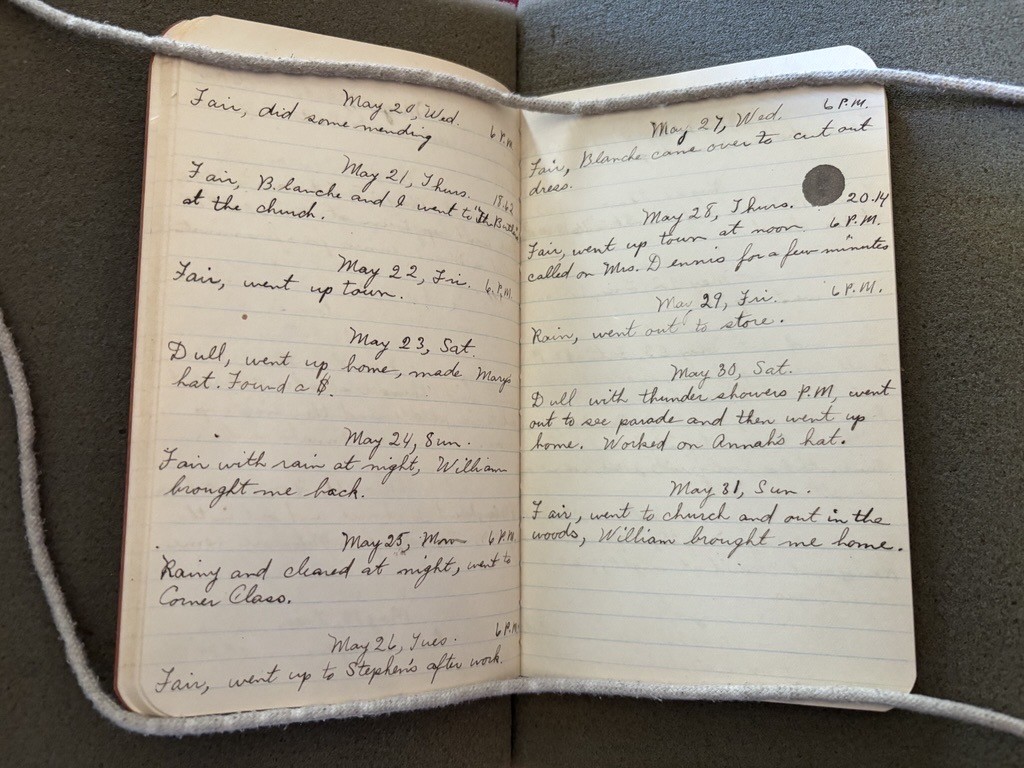
May 27, Wed. 6 P.M. Fair, Blanche came over to cut out dress.

May 28, Thurs. [$]20.14  6 P.M. Fair, went up town at noon called on Mrs. Dennis for a few minutes.

May 29, Fri. 6 P.M. Fair, went out to store.

May 30, Sat. Dull with thunder showers P.M, went out to see parade and then went up home. Worked on Annah’s hat.

May 31, Sun. Fair, went to church and out in the woods, William brought me home.

handwritten journal lies open in a book cradle
Diary entries for 20 to 31 May

If you are interested in viewing the diary in person in our library or have other questions about the collection, please visit the library or contact a member of the library staff.

*Please note that this diary transcription is a rough-and-ready version, not an authoritative transcript. Researchers wishing to use the diary in the course of their own work should verify the version found here with the manuscript original.

This line-a-day blog series is inspired by and in honor of MHS reference librarian Anna J. Clutterbuck-Cook (1981–2023), whose entertaining and enlightening line-a-day blog series ran from 2015 to 2019. Her generous, humane, and creative approach to both history and librarianship continues to influence the work of the MHS library.
Clara E. Currier’s Diary, April 1925

by Hannah Elder, Associate Reference Librarian for Rights & Reproductions

Today, we return to the transcription of Clara E. Currier’s 1925 diary. Currier was a working-class woman who lived in or near Haverhill, MA. Her diary records her daily activities – from fiber arts to paid employment to observations of the natural world – providing insight into daily life a century ago. You can find entries for January, February, and March in past blog posts.

April has a lovely start for Clara, making a hat, calling on friends and family, and celebrating Easter. In the middle of the month, though, she comes down with measles. For nearly a week, she has daily visits from her doctor, is attended to by Mary, and is bed-bound. Even after her high fever breaks and she starts to receive visits from friends, Clara is weak and has to start easing back into daily life, including sitting up, dressing, and leaving her bed. We will continue to follow her path to recovery in May.

Apr. 1, Wed. Fair, out for the day, went to Newburyport A.M, started to make a hat and went to Haverhill to Rebekah (Kenoya) and saw lovely work, Mae Jenney went with me.

Apr. 2, Thurs. [$]19. Fair, mended.

Apr. 3, Fri. Fair, went up to town.

Apr. 4, Sat. April showers, cooked and sewed, went up town and called on Mrs. Dennis.

Apr. 5, Sun Fair, went to church, Sizzie came over to dinner and we called on Mr. + Mrs. Charles Gould, looked at Uncle Will’s cellar, over to Union Cemetery and called at Delia’s.

Apr. 6, Mon. Fair, sewed.

Apr. 7, Tues. Fair, Mary came down, sewed, went to Grange, degrees.

Apr. 8, Wed. Fair, Mary sewed and went home at night, went up to Stephen’s with her.

Apr. 9, Thurs. [$]15.58 Fair, went up town, finished my hat, Blanche called.

Apr. 10, Fri. Rained in evening.

Apr. 11, Sat. Fair, went down to Grace Nealand’s for afternoon and evening.

Apr. 12, Sun. (Easter) Fair and cool, cloudy at night, went to church, S.S, and vesper service at Market St., and then went to Haverhill to a pageant. Wore my new hat.

Apr. 13, Mon. Snowed during night and in morning cleared away, and soon melted. Went to class meeting and helped serve refreshments.

Apr. 14, Tues. Fair, feeling mean, Blanche came over for the evening.

Apr. 15, Wed. Rainy, then cleared, worked in morning, had Dr. Murphy and went to bed with measles, thunder shower, Mary came down. Blanche came to the door.

Apr. 16, Thurss. [$]19. Fair, having a hot time in bed, no cold things. Dr. came

Apr. 17, Fri. Fair, Still hot and sweating. Dr. came.

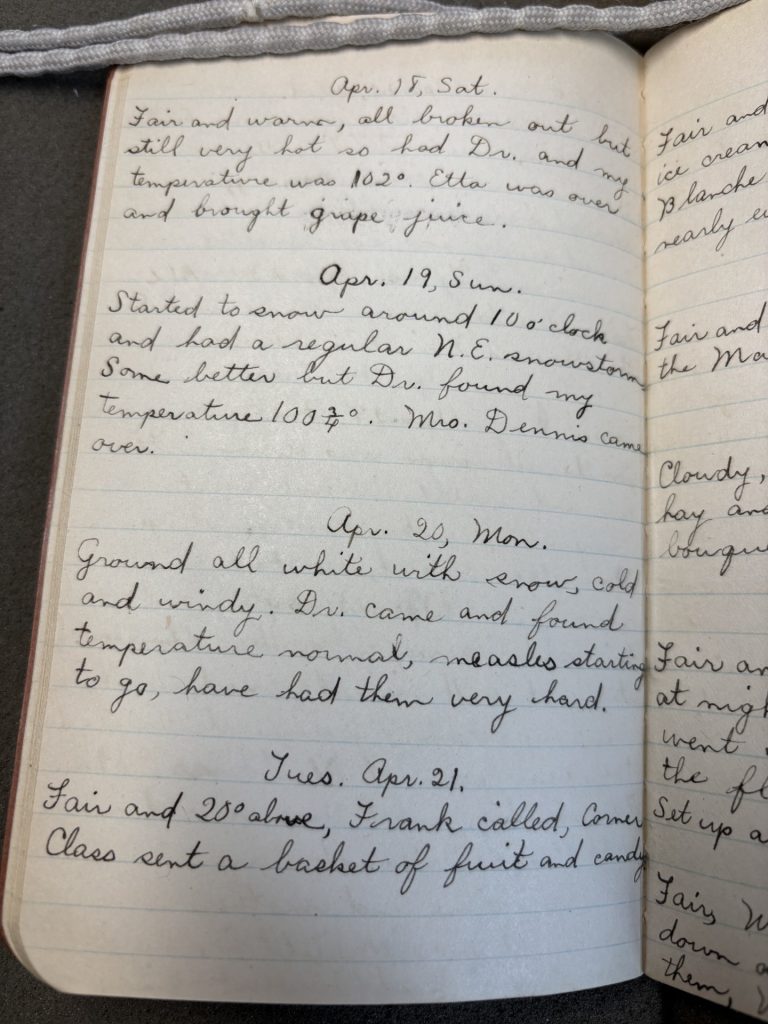
Apr. 18, Sat. Fair and warmer, all broken out but still very hot so had Dr. and my temperature was 102°. Etta was over and brought grape juice.

April 19, Sun. Started to snow around 10 o’clock and had a regular N.E. snowstorm. Some better but Dr. found my temperature 100 ¾°. Mrs. Dennis came over.

Apr. 20, Mon. Ground all white with snow, cold and windy. Dr. came and found temperature normal, measles starting to go, have had them very hard.

Tues. Apr. 21 Fair and 20° above, Frank called, corner class sent a basket of fruit and candy.

handwritten text in a journal
Diary entries for 18 to 21 April, chronicling Clara’s measles

Apr. 22, Wed. Fair and warm, Etta came over, brought ice cream, Delia (ice cream) called in the evening. Blache came to the door, Sizzie came nearly every day.

Thurs. Apr. 23 [$]9.12 Fair and windy, warm, Mary went to the Mason’s Minstrel Show.

Apr. 24, Fri Cloudy, William was down with hay and called, Rebekahs sent bouquet of cut flowers, set up.

Apr. 25, Sat. Fair and warm, Thunder shower at night and rained hard, Mary went up town, Grange dedicated the flag pole at Victoria Park. Set up awhile.

Apr. 26, Sun. Fair, William and mother came down and Mary went home with them, Was dressed for first time. Sizzie came to stay nights with me.

Apr. 27, Mon. Fair, sat up but weak. Blanche came over.

Apr. 28, Tues. Fair, got dinner and read a little.

Apr. 29, Wed. Dull and cold, Feel rather weak and shaky. Mr. Jackson called.

Apr. 30, Thurs. Rainy, Sizzie went to Grange play.

If you are interested in viewing the diary in person in our library or have other questions about the collection, please visit the library or contact a member of the library staff.

*Please note that this diary transcription is a rough-and-ready version, not an authoritative transcript. Researchers wishing to use the diary in the course of their own work should verify the version found here with the manuscript original.

This line-a-day blog series is inspired by and in honor of MHS reference librarian Anna J. Clutterbuck-Cook (1981–2023), whose entertaining and enlightening line-a-day blog series ran from 2015 to 2019. Her generous, humane, and creative approach to both history and librarianship continues to influence the work of the MHS library.

Clara E. Currier’s Diary, March 1925

by Hannah Elder, Associate Reference Librarian for Rights & Reproductions 

Today, we return to the transcription of Clara E. Currier’s 1925 diary. Currier was a working-class woman who lived in or near Haverhill, MA. Her diary records her daily activities—from fiber arts to paid employment to observations of the natural world—and provides insight into daily life a century ago. You can find entries for January and February in past blog posts. 

March sees Clara further engaged with civic life, with a town meeting, a vote, and multiple class meetings. She makes a number of social calls, both at homes and at hospitals, and goes to the movies twice. March 1925 is filled with many “fair” days. May March 2025 fare the same!

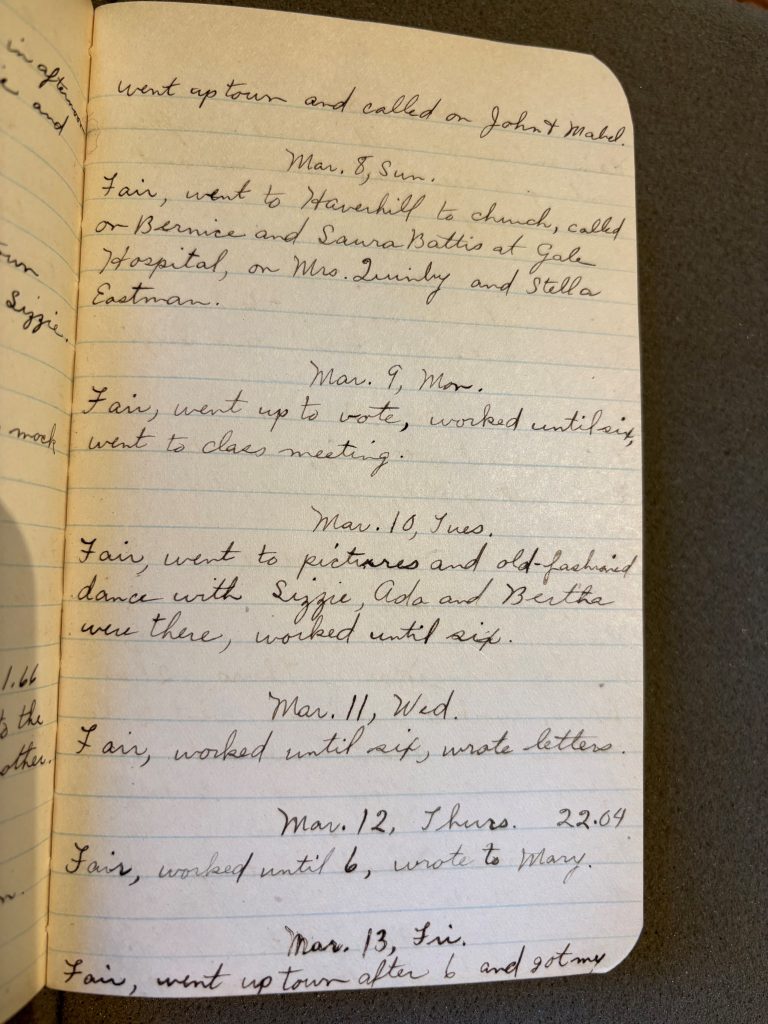
A handwritten page of journal entries from Mar. 8 to Mar. 13
Clara’s diary entries for mid-March 1925

Mar. 1, Sun. Rain and snow with wind in afternoon went up to see Aunt Frannie and Mae Tenney

Mar. 2, Mon. Fair, worked until six, went to town meeting with Mrs. Dennis and Sizzie.

Mar. 3, Tues. Fair, worked until six, went to mock town meeting at the grange.

Mar. 4, Wed. Fair, worked until six.

Mar. 5, Thurs [$] 21.66 Rain, worked until six, went to the pictures with Mrs. Dennis and mother.

Mar. 6, Fri. Fair, worked until six, went up town.

Mar. 7, Sat. Fair, worked until four, cleaned up, went to town and called on John + Mabel.

Mar. 8, Sun. Fair, went to Haverhill to church, called on Bernice and Laura Battis at Gale Hospital, on Mrs. Quimby and Stella Eastman.

Mar. 9, Mon. Fair, went up to vote, worked until six, went to class meeting.

Mar. 10, Tues. Fair, went to pictures and old-fashioned dance with Sizzie, Ada and Bertha were there, worked until six.

Mar. 11, Wed. Fair, worked until six, wrote letters.

Mar. 12, Thurs. [$]22.04 Fair, worked until six, wrote to Mary.

Mar. 13, Fri. Fair, went up town after 6 and got my electric iron (Universal).

Mar. 14, Sat. Rainy, went up town and called on Mrs. Merril. Worked until noon.

Mar. 15, Sun. Fair, went to S.S. and over to see Aunt Abbie.

Mar. 16, Mon. Fair and cooler, Got out at 5 o’clock, cooked, and mended.

Mar. 17, Tues. Rainy, went to Corner class supper and to Grange.

Mar. 18, Wed. Fair, wrote letters and made doughnuts.

Mar. 19, Thurs. [$]20.90 Rain with thunder and lightning. Went over to John’s and they were going to bed.

Mar. 20, Fri. Fair, went to concert at Methodist Church.

Mar. 21, Sat. Fair, went to Haverhill to Fraternal Rebekah Lodge to see the President and Assembly, staid all night with Ada.

Mar. 22, Sun. Fair, called on Mrs. Bagley and Maud and Bert with Ada.

Mar. 23, Mon. Fair, went to class meeting.

Mar. 24, Tues. Fair, spen the evening with Blanche.

Mar. 25, Wed. Showers, called at Dennis’s.

Mar. 26, Thurs. [$]19 Fair, went up town with Sizzie.

Mar. 27, Fri. Fair, went up town.

Mar. 28, Sat. Showery, went up home with Charles.

Mar. 29, Sun. Rain and snow, came back by train.

Mar. 30, Mon. Rain, went up town.

Mar. 31, Tues. Rain, cleared at night, went up to Stephen’s.

If you are interested in viewing the diary in person in our library or have other questions about the collection, please visit the library or contact a member of the library staff.

*Please note that this diary transcription is a rough-and-ready version, not an authoritative transcript. Researchers wishing to use the diary in the course of their own work should verify the version found here with the manuscript original.

This line-a-day blog series is inspired by and in honor of MHS reference librarian Anna J. Clutterbuck-Cook (1981–2023), whose entertaining and enlightening line-a-day blog series ran from 2015 to 2019. Her generous, humane, and creative approach to both history and librarianship continues to influence the work of the MHS library.
Clara E. Currier’s Diary, February 1925

by Hannah Elder, Associate Reference Librarian for Rights & Reproductions 

Today, we return to the transcription of Clara E. Currier’s 1925 diary. Currier was a working-class woman who lived in or near Haverhill, MA. Her diary records her daily activities—from fiber arts to paid employment to observations of the natural world—providing insight into daily life a century ago. You can find entries for January in a past blog post. 

February ushers in a series of dull days, which Clara fills with work, her fiber crafts, and entertainments with friends. She observes more cosmological and geological events and weathers a few storms. Clara starts taking home paychecks from her work and records her pay for the week on Thursdays.

pussywillows
Pussywillows. Image courtesy of Susan Drury via Wikimedia Commons.

Feb. 1, Sun. Fair and warmer, went to church and S.S, went up to Stephen’s for the afternoon, Charley and Delia came up after supper.

Feb. 2, Mon. Snow, wrote letters.

Feb. 3, Tues. Dull, went to Grange

Feb. 4, Wed. Fair, went over to see Blanche, crocheted.

Feb. 5, Thurs. [$]19 Fair, crocheted.

Feb. 6, Fri. Fair, went up town and cooked.

Feb 7, Sat. Fair and warmer, went to Haverhill about glasses and over home, had a sleighride.

Feb. 8, Sun. Fair and warm, went out skiing, saw a partial eclipse of the moon on the full, William brought me back. Wrote to Mrs. Muller.

Feb. 9, Mon. Dull with fog at night, went to class meeting, crocheted.

Feb. 10, Tues. Foggy, Blache came over.

Feb. 11, Wed. Foggy and rain, went over to Dennis’s and heard some fine music on the radio, crocheted.

Feb. 12, Thurs. [$]19. Foggy, knit and crocheted.

Feb. 13, Fri. Fair, went to the Swanee River Quartet concert (colored) at the Methodist Church with Sizzie and Blanche.

Feb. 14, Sat. Fair, washed and cooked, went uptown.

Feb. 15, Sun. Rain, went up to Delia’s for afternoon and evening with Sizzie.

Feb. 16, Mon. Fair, wrote letters and cooked.

Feb. 17, Tues. Dull, went to Grange.

Feb. 18, Wed. Fair, went to Legion play, “The Village School.[”]

Feb. 19, Thurs. [$]19 Fair, worked until six o’clock.

Feb. 20, Fri. Fair, worked until six then went up to Stephen’s.

Feb. 21, Sat. Fair, worked until 4 o’clock then went up home, Charles and Mabel came after me.

Feb. 22, Sun. Fair and springlike, went out after pussy willows, William and Mary brought me back.

Feb. 23, Mon. Dull and rainy, worked all day until six, went to class meeting.

Feb. 24, Tues. Dull, then cleared, worked until six, went up town at noon.

Feb. 25, Wed. Dull, worked until six, knit.

Feb. 26, Thurs. [$]20.90 Rain hail, snow, and cleared out at night, very cold and windy, waited on table at men’s club banquet, had Rev. Mr. Lindsay to speak.

Feb. 27, Fri. Fair and cold, worked until six, heard radio at Mrs. Dennis’s.

Feb. 28, Sat. Fair, worked until four o’clock, went up town, had an earthquake shock at 9.30 P.M shoke the house.

If you are interested in viewing the diary in person in our library or have other questions about the collection, please visit the library or contact a member of the library staff.

*Please note that this diary transcription is a rough-and-ready version, not an authoritative transcript. Researchers wishing to use the diary in the course of their own work should verify the version found here with the manuscript original.

This line-a-day blog series is inspired by and in honor of MHS reference librarian Anna J. Clutterbuck-Cook (1981–2023), whose entertaining and enlightening line-a-day blog series ran from 2015 to 2019. Her generous, humane, and creative approach to both history and librarianship continues to influence the work of the MHS library.
Clara E. Currier’s Diary, January 1925

by Hannah Elder, Associate Reference Librarian for Rights & Reproductions 

Long time readers of the blog may recall a series of posts that ran from 2015 to 2019, transcribing a line-a-day diary from exactly one century before. This series was run by Anna Clutterbuck-Cook, who at the time of her passing in 2023 was the Senior Reference Librarian here at the MHS. Anna was mid-way through that series when I started at the MHS and it quickly became one of my favorite features on the blog. In memory of Anna and to bring back a delightful, regular read, I want to pick up the series and bring to you, our lovely readers, a new diary transcription project.

For 2025 we will be journeying with Clara E. Currier, a woman who lived in or near Haverhill, Massachusetts, and her 1925 diary. Blog readers first met Currier in a 2022 blog post about the 1918 influenza pandemic, which Currier mentioned in her diary for that year. Currier was a regular diarist and while we only have her diaries for 1 July 1918 to 31 December 1919, 1 January 1925 to 31 March 1926, and 1 January 1928 to 1932, I speculate that she kept a diary for most of her adult life. While I haven’t been able to learn much about Currier’s life from sources outside of her diaries, the diaries do tell me that she had a small circle of friends and family in the area, wore glasses, could knit, crochet, embroider, and sew, and had an active volunteer life.

Without further ado, I present Clara Currier’s 1925 diary.

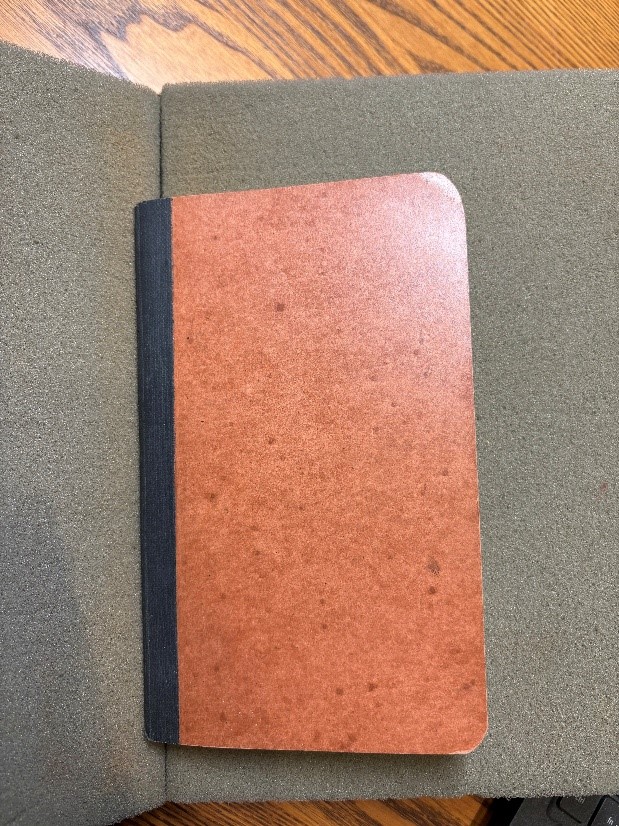
The front cover of a small, brown paperbound diary on top of a bookrest in the MHS reading room.
Clara E. Currier’s diary for 1 January 1925-31 March 1926

Jan. 1, Thurs. Fair and cold, sewed.

Jan. 2, Fri. Dull with snow flurries, cold, embroidered. Swept chambers.

Jan. 3, Sat. Dull, snowed and rained a little, went up to Edith Palmer’s, crocheted.

Jan. 4, Sun. Fair, read, went to church in evening.

Jan. 5, Mon. Fair, went over to Frank’s and played whist.

Jan. 6, Tues. Dull and raw, went to Haverhill* to have eyes tested, called on May Pickering, crocheted.

Jan. 7, Wed. Fair, help cut up lard, crocheted and sewed. Saw a flying machine and a earthquake shock.

Jan. 8, Thurs. Fair and warmer, crocheted, went over to Frank to play whist.

Jan. 9, Fri. Fair, lovely moon, worked on bungalow apron, played whist. Swept chambers.

Jan. 10, Sat. Fair, Gertie, Sizzie and Ralph came up.

Jan. 11, Sun. Dull, went to church and over to Uncle Will’s. Charlie, Delia and Ben were there.

Jan. 12, Mon. Snowed, did some embroidery.

Jan. 13, Tues. Snowed a little and cleared, embroidered, played whist.

Jan. 14, Wed. Fair and cold, Mary and I went down to Kate’s for the afternoon and to the Grange Installation by Mr. + Mrs. Otis Eastman in the evening. Listened in on the radio.

Jan. 15, Thurs. Fair, crocheted and played whist.

Jan. 16, Fri. Dull with snow in afternoon and evening, crocheted, done the sweeping.

Jan. 17, Sat. Fair, finished a doily and sewed.

Jan. 18, Sun. Fair with snow flurries, started to read, “Fair Harbor” by Lincoln. [editor’s note: Fair Harbor by Joseph C. Lincoln is available to read for free on the Internet Archive]

Jan. 19, Mon. Fair, finished some insertion, went up and called on Helen West with Mary.

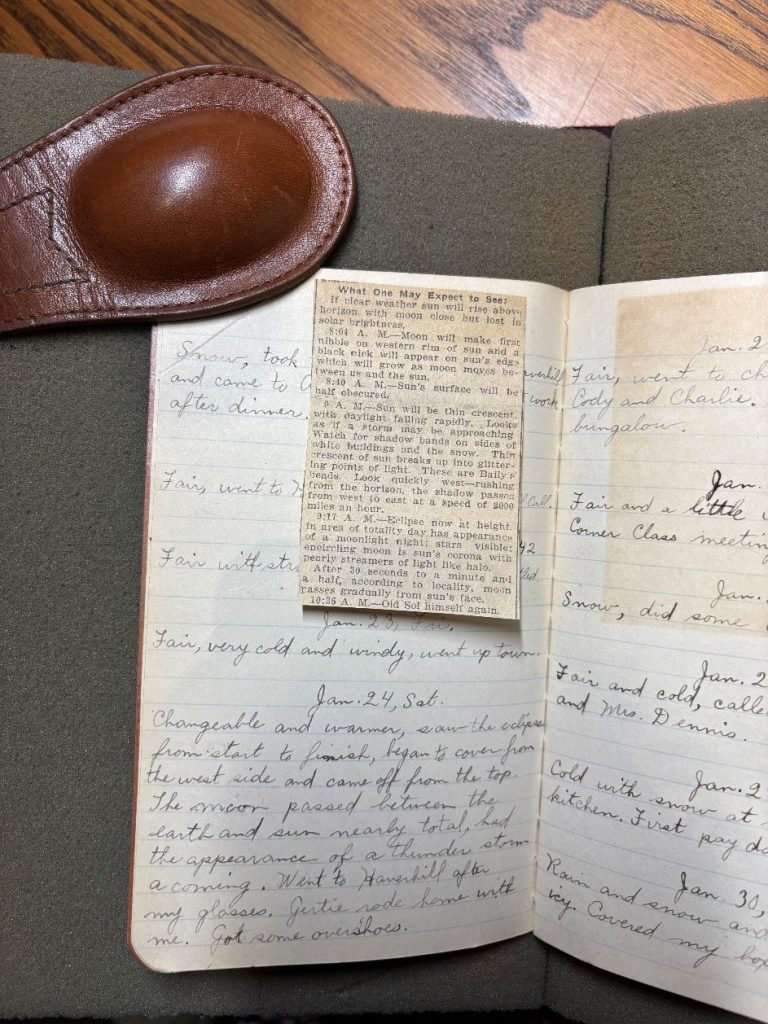
A news clipping covering manuscript diary entries. The article describes what will happen during the total solar eclipse on January 24, 1925.
Diary entries for Jan 20-24, partially covered by a news clipping on what to expect during the solar eclipse

Jan. 20, Tues. Snow, took the 9.45 train for Haverhill and came to Amesbury and went to work after dinner.

Jan. 21, Wed. Fair, went to Haverhill to Rebekah Roll Call.

Jan 22, Thurs. 3.42 Fair with strong wind at night. Settled.

Jan. 23, Fri. Fair, very cold and windy, went up town. 

Jan. 24, Sat. Changeable and warmer, saw the eclipse from start to finish, began to cover from the west side and came off from the top. The moon passed between the earth and sun nearly total, had the appearance of a thunder storm a coming. Went to Haverhill after my glasses. Gertie rode home with me. Got some overshoes.

Jan. 25, Sun. Fair, went to church and called on Cody and Charlie. They have a cute bungalow.

Jan. 26, Mon. Fair and a little warmer, went to Corner Class meeting at Mrs. Fiske.

Jan. 27, Tues. Snow, did some clearing up.

Jan. 28, Wed. Fair and cold, called on John and Mabel and Mrs. Dennis.

Jan. 29, Thurs. Cold with snow at night, cleaned up kitchen. First pay day.

Jan. 30, Fri. Rain and snow and then froze up, icy. Covered my box for grange.

Jan. 31, Sat. Fair and a little warmer, went up town on errands, read.

If you are interested in viewing the diary in person in our library or have other questions about the collection, please visit the library or contact a member of the library staff.

*Please note that this diary transcription is a rough-and-ready version, not an authoritative transcript. Researchers wishing to use the diary in the course of their own work should verify the version found here with the manuscript original.

“Tell it to the whales”

by Lauren Gray, Reference Librarian

Whale tours abound in Massachusetts. In 2024, boats take to the seas laden with tourists white-knuckling smart phones, their eager lenses hoping to catch a glimpse of tail, or a rounded, spurting hump. A native Missourian (read: ‘landlocked’) and new resident of Massachusetts, I took my first whale watch tour in June and was not disappointed. The whales delivered, and my phone was there to catch every hump, spurt, and tail (not to mention a few dolphins). The whale watch got me thinking about the history of whaling. Whaling was a massive industry in the 19th century, and the profits were enormous. But what did that mean to the whales? I’m an animal-lover at heart, and I can’t stand the thought of those giant majestic beauties floundering under a barrage of harpoons, yet that’s exactly what kept the New England economy viable during a critical point in the region’s history. That history has also given us scores of archival material. On further consideration, as it turns out, whaling is the perfect metaphor for America—its greed, violence, exploitation of nature, and human arrogance define one of the worst chapters in American environmental history. (In the west, their quadrupedal cousins, the bison, can tell you the sequel.)

Pilgrims brought whaling to Massachusetts. (Most pre-contact Indigenous people in New England did not actively hunt whales.) Spying a pod of whales during a voyage from Plymouth to Cape Cod in 1621, Edward Winslow commented, “…every day we saw whales playing hard by us, of which in that place, if we had instruments and means to take them, we might have made a very rich return, which to our great grief we wanted.” [1] He went on to report that, had he the right tools for the job, he “might have made three of four thousand pounds worth of oil” out of the whales, and “purpose the next winter to fish for whale here.”

However, it would be another two decades before there was wide-spread commercial whaling in the colonies. By the 1670s, small whaling ships, crewed by English and Indigenous people together, hunted off the coast of Cape Cod. Even before the end of the 18th century, scarcity in the whale population in the northern Atlantic forced whalers to round the horns to hunt for whales in the Pacific, where an ocean of opportunity awaited. The golden age of whaling had begun.

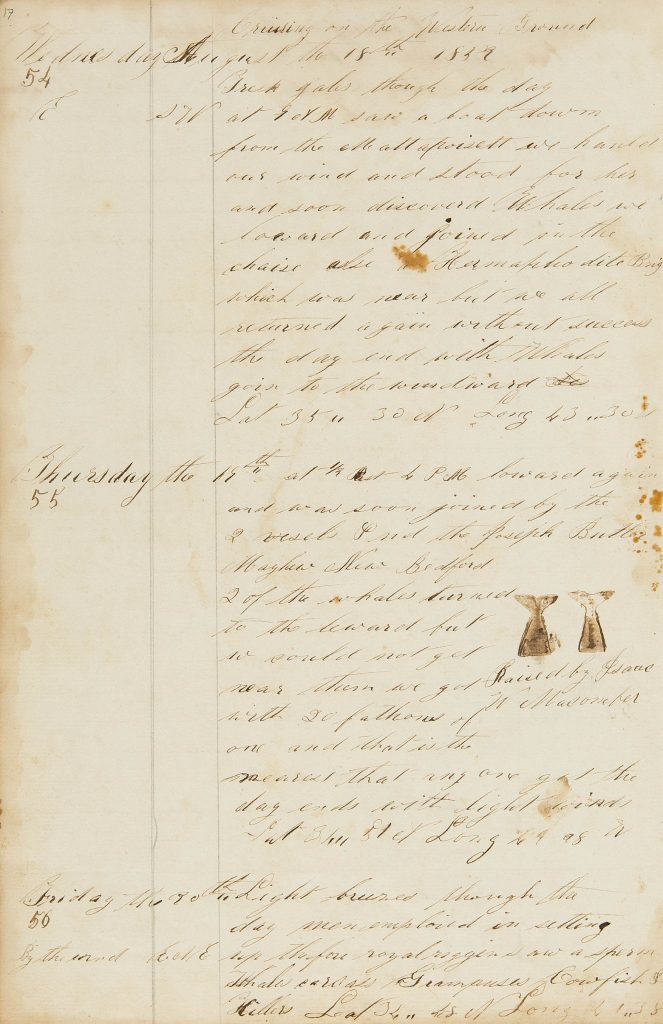
Color photograph of a page discolored with age with brown ink handwriting in a diary format. Halfway down the page are drawings of two whale's tails next to each other.
Page from the diary of Perry R. Brightman aboard the whale ship George & Mary, 1852

Golden, that is, for the sea captains, merchants, and bankers who lined their pockets from the spoils of the hunt. In the first half of the 19th century, American whalers dominated the global market, and the whaling industry contributed $10 million dollars to the U.S. GDP (which is over $300,000,000 in 2024 dollars).[2] Whale oil, made from boiled blubber, spermaceti from sperm whales’ heads, and baleen—the delicate bristles found in baleen whales’ mouths—were key resources for the Victorians. Baleen was woven into the corsets that pinched the waists of tubercular maidens and buxom madams alike; whale oil burned in lighthouses along every coast; and spermaceti wax dripped and flared in candles that illuminated nights “lit only by fire.”[3] In the Victorian world, the whale was omnipresent and indispensable.

If it was fantastically lucrative for the merchants profiting from their ill-begotten wares, it was not so fantastic for the whales. During whaling’s heyday, the whale population plummeted. Due to the steady decrease in whale populations and the advent of viable alternatives (like manufactured gas and petroleum), the American whaling industry went into a steep decline, and effectively ended in the mid-1880s.[4] While scholars disagree on exact numbers, over 150,000 whales were killed in just 50 years of whaling’s heyday, leading to the decimation of the blue, right, gray, and bowhead populations.

In the historical record, whales don’t fare much better. After my whale watch tour, I came back to the MHS to start research on this blog post, but I found that whales surface in the MHS catalog rarely and even then, the archival record captures them as creatures to be hunted and exploited. The MHS holds dozens of ships logs, descriptions of whaling voyages, personal papers of those who participated in the whaling industry or profited from it, histories of the towns where whaling dominated, and much more. But where, exactly, are the whales that make whaling possible? In the archive, the pictures that come down to us are grainy and grim: a boy perched next to a beached and conquered finback; a sun-bleached skeleton of indeterminate species, dreary in sepia; a captive beluga in the Boston Aquarial Gardens flashing through a young girl’s diary “white almost as snow.” In the archive, the whales’ memory is entwined with the legacy of violence and greed, the hunters’ hubris immortalized in ledgers and statistics.

The history of whaling is, in large part, the history of New England. Thankfully, the industry collapsed before irreparable harm could be done. Whale populations rebounded throughout the 20th century, and now the ‘gentle giants’ are objects of awe instead of greed. Just this month, amazed Bostonians were greeted by a breaching whale in Boston Harbor, and local institutions like the New England Aquarium are at the forefront of conservancy and education. However, despite whales’ popularity, and the efforts of environmental groups and advocates, whale populations continue to be disrupted by illegal whaling; shipping lanes interfere with mating patterns; and global warming makes whale feeding grounds unstable. Edward Winslow’s “great grief” in 1621 was that he could not hunt the whales; in 2024, it’s that the colonists eventually succeeded. Meanwhile, in the archive, we are left to grapple with whaling’s history. Whaling’s economic benefits alone fill volumes, and the data found in ships logs and ledgers help us to understand our changing climate. Stories from whaling voyages help us to better understand the human condition.

I wish it was as simple as balancing the karma between history and what we can learn from it. All I can think is, “tell it to the whales.”[5]


[1] Edward Winslow, Mourt’s Relation (1621)

[2] Lance E. Davis, Robert E. Gallman, and Teresa D. Hutchins, “The Decline of U.S. Whaling” (The Business History Review, Vol. 62, No. 4, Winter, 1988 pp. 569-595)

[3] William Manchester, A World Lit Only by Fire (Little, Brown and Company, 1993)

[4] Whaling globally didn’t peak until the 1960s.

[5] Max Brooks, World War Z (Three Rivers Press, 2007)

“Great sights upon the water…”: unexplained phenomena in early Boston

By Daniel Tobias Hinchen, Reader Services

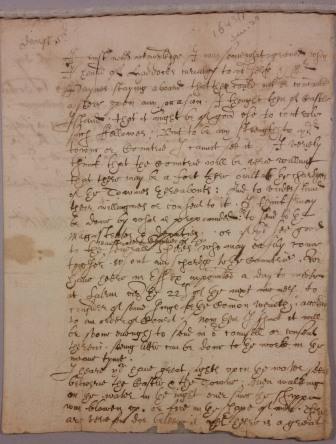
I hear you haue great sights upon the water seene betweene the Castle and the Towne: men walking on the water in the night euer since the shippe was blowen vp or fire in the shape of men. There are verie few do beleeue it yet here is a greate report of it, brought from thence the last day of the weeke.*


The above excerpt is from the letter shown, dated 29 January 1643/4, written from John Endecott in Salem to Governor John Winthrop in Boston. In the weeks preceding this letter, a series of strange occurrences took place in Boston, and Winthrop recorded the events in his journal. It seems that the entries were written after the fact since Winthrop relates a couple of happenings in the same entry. The first event, though, was said to have taken place on January 18th of that year.

About midnight, three men, coming in a boat to Boston, saw two lights arise out of the water near the north point of the town cove, in form like a man, and went at a small distance to the town, and so to the south point, and there vanished away. They saw them about a quarter of an hour, being between the town and governour’s garden. The like was seen by many, a week after, arising about Castle Island and in one fifth of an hour came to John Gallop’s point.


Winthrop continues his entry recording matters pertaining to maintenance of Castle Island and defense of the town of Boston. But after just a paragraph, he returns to the topic of strange sights in the sky.

The 18th of this month two lights were seen near Boston, (as is before mentioned,) and a week after the like was seen again. A light like the moon arose about the N.E. point in Boston, and met the former at Nottles Island, and there they closed in one, and the parted, and closed and parted divers times, and so went over the hill in the island and vanished. Sometimes they shot out flames and sometimes sparkles. This was about eight of the clock in the evening, and was seen by many. About the same time a voice was heard upon the water between Boston and Dorchester, calling out in a most dreadful manner, boy, boy, come away, come away: and it suddenly shifted from one place to another a great distance, about twenty times. It was heard by divers godly persons. About 14 days after, the same voice in the same dreadful manner was heard by others on the other side of the town towards Nottles Island.


Writing after the facts, Winthrop made very little attempt at providing explanations for these occurrences. In the immediate journal entries there was only one bit that gave anything in the way of reasoning for what people saw:

These prodigies having some reference to the place where Captain Chaddock’s pinnace was blown up a little before, gave occasion of speech of that man who was the cause of it, who professed himself to have skill in necromancy, and to hav done some strange things in his way from Virginia hither, and was suspected to have murdered his master there; but the magistrates here had no notice of him till after he was blown up. This is to be observed that his fellows were all found, and others who were blown up in the former ship were also found, and others also who have miscarried by drowning, etc., have usually been found, but this man was never found.


Interested in finding out more? Consider visiting the MHS Library to work with the sources cited, or see the suggestions below for further reading. 


*The transcriptions of the documents in this post appear as they do in the published volumes cited below, typically with original spelling and punctuation intact.


Sources

Endicott family papers, Massachusetts Historical Society.

Winthrop, John, The journal of John Winthrop, 1630-1649, Cambridge, Mass.: the Belknap Press of Harvard University Press, 1996.

Winthrop papers, vol. IV, Boston: Massachusetts Historical Society, 1944.


Further Reading

Hall, David D., “A World of Wonders: The Mentality of the Supernatural in Seventeenth-Century New England,” Publications of the Colonial Society of Massachusetts, Vol. 63 (1984), pp.239-274.

McKeown, Adam N., “Light Apparitions and the Shaping of Community in Winthrop’s ‘History of New England’,” Early American Literature, Vol. 47, No. 2, BETWEEN LITERATURE AND HISTORY (2012), pp.293-319.


The First Publication of Phillis Wheatley

By Daniel T Hinchen, Reader Services

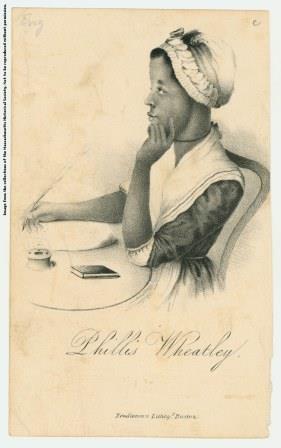
Recently, the MHS hosted a program called “No more, America,”* which featured a conversation with Henry Louis Gates Jr. and Peter Galison, both of Harvard University. In it, the two men reimagined a 1773 debate between graduating Harvard seniors Theodore Parsons and Eliphalet Pearson who deliberated on the compatibility of slavery and “natural law.” In the program, Gates and Galison added a third contemporary voice to the argument, that of the then-enslaved Phillis Wheatley, the acclaimed poet who lived just over the Charles River from the two Harvard students.

Now, just over a week later, we recognize the anniversary of the first publication of one of Wheatley’s poems. “On Messrs. Hussey and Coffin” appeared on December 21, 1767, in the Newport Mercury, a Rhode Island weekly newspaper. According to Vincent Carretta in his 2011 biography of Wheatley, this poem was not published again during Wheatley’s lifetime.

When Wheatley submitted her poem to the Newport Mercury, she addressed a note to the printer which was to precede the poem.

Please to insert the following Lines, composed by a Negro Girl (belonging to one Mr. Wheatley of Boston) on the following Occasion, viz. Messrs Hussey and Coffin, as undermentioned, belonging to Nantucket, being bound from thence to Boston, narrowly escaped being cast away on Cape-Cod, in one of the late Storms; upon their Arrival, being at Mr. Wheatley’s, and, while at Dinner, told of their narrow Escape, this Negro Girl at the same Time ‘tending Table, heard the Relation, from which she composed the following verses.

On Messrs. Hussey and Coffin

Did Fear and Danger so perplex your Mind,

As made you fearful of the Whistling Wind?

Was it not Boreas knit his angry Brow

Against ? or did Consideration bow?

To lend you Aid, did not his Winds combine?

To stop your passage with a churlish Line,

Did haughty Eolus with Contempt look down

With Aspect windy, and a study’d Frown?

Regard them not; — the Great Supreme, the Wise,

Intends for something hidden from our Eyes.

Suppose the groundless Gulph had snatch’d away

Hussey and Coffin to the raging Sea;

Where wou’d they go? Where wou’d be their Abode?

With the Supreme and independent God,

Or made their Beds down in the Shades below,

Where neither Pleasure nor Conten can flow.

To Heaven their Souls with eager Raptures soar,

Enjoy the Bliss of him they wou’d adore.

Had the soft gliding Streams of Grace been near,

Some favourite Hope their fainting hearts to cheer,

Doubtless the Fear of Danger far had fled:

No more repeated Victory crown their Heads.

To see what materials the MHS holds related to Phillis Wheatley’s life and work, you can search our online catalog, ABIGAIL, then consider Visiting the Library, but be sure to consult our online calendar for upcoming holiday closures.

*Watch a recording of the event that took place at the MHS on 12 December 2018.


References

Carretta, Vincent, Phillis Wheatley: Biography of a Genius in Bondage, University of Georgia Press, 2011.