
“Your Trew and Truly Husband”: The Letters of Civil War Sharpshooter Moses Hill, Part 1

By Susan Martin, Collection Services

The Frank Irving Howe, Jr. family papers here at the MHS include a wonderful series of Civil War letters by Howe’s grandfather Moses Hill (1823-1862). Hill served in the 1st Company of Massachusetts Sharpshooters, or “Andrew Sharpshooters,” during some of the worst fighting in Maryland and Virginia in 1861 and 1862. He wrote most frequently to his wife Eliza, but also to their two children, Lucina and George, affectionately known as “Sis” and “Bub.”
Moses, a stone mason of Medway, Mass., was 38 years old when he enlisted in August 1861 and began his service at Camp Benton, Md. His health was good, and he wrote contentedly about life at camp and proudly of the men of the 1st Company:

I am well and we live very well. A beter company never went into the army, the Smartist & largest lot of men I never saw….I think the Governer is proud of the company. It is cald Andrews Sharp Shooters. He says we can have any thing we want….I think camp life will suit me firstrate.

The company was “composed of Lawyers school masters, schollars, clearks, Laboring men, black legs, machinests, and most every thing else.” They fought well at Ball’s Bluff and Edwards Ferry, but Moses didn’t expect the war to last long and hoped to be back in Medway by spring. In November, with Thanksgiving approaching, he urged his wife Eliza to enjoy the holiday without him. He tried to do the same, but with little success:

They have a kitten in the cooks house, and last night when I put my men on guard, I sat by the fire alone and she came and play’d with me and it made me think of home….I belieave I never was so long away from home before.

By December, Moses began to realize the war would last much longer than a few months. He missed his family terribly, but was determined to do his job the best he could. On Christmas eve, he wrote a letter to his 13-year-old daughter Lucina:

I wish I was at home to see you all and hug and kiss you and bub but I think it is better for me to be here to give you better suport and to serve my countery. I pray the National Troble will close soon. Then I hope I shal be with you as long as we live….Kiss bub for me and Mother to, and tak as meny for yorself as you are a mind to.

On 3 Jan. 1862, the Andrew Sharpshooters left Camp Benton via the C&O Canal. I’ll be blogging more about Moses Hill right here at the Beehive, so stay tuned!


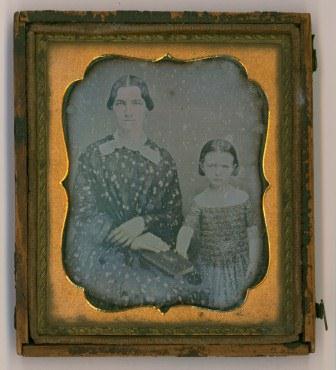
*Eliza Ann Arnold Hill and Lucina Maria Hill [photograph], [ca. 1855], Photo 1.570, Massachusetts Historical Society.

This Week @ MHS

By Dan Hinchen

Here is the weekly round-up of events going on at the MHS this week, presented in a 3-2-1 fashion.

First, there are three exhibitions currently on display, all interrelated. The main feature, “Proclaim Liberty Throughout All the Land: Boston Abolitionists, 1831-1865,” highlights the work of Boston abolitionist William Lloyd Garrison and his famed newspaper the Liberator. Through manuscripts, photographs, and artifacts, the exhibit looks at the work of Bostonians to thwart the spread of slavery as well as the fierce resistance met by their radical movement.

In complement to the main feature, the Society has two smaller exhibits which focus on Abraham Lincoln, slavery, and the Emancipation Proclamation. “Lincoln in Manuscript & Artifact” includes a bronze cast of the life mask and hands of Lincoln made by Leonard Volk in 1860 along with a letter to Joshua Speed which demonstrates his evolving views on slavery. In addition, “Forever Free: Lincoln & the Emancipation Proclamation” displays the pen that Lincoln used the sign his famous Proclamation along with paintings, broadsides, and manuscripts that tell the story of Boston’s celebration of the Emancipation. All of these exhibits are free and open to the public, available for viewing Monday-Saturday, 10:00am – 4:00pm.

Next on the calendar, the MHS has two public seminars this week. On Tuesday, 19 March 2013, drop by the MHS for the latest Immigration and Urban History Seminar, “Dynamic Tensions: Charles Atlas, Immigrant Bodybuilders, and Eugenics, 1920-1945.” Dominique Padurano, Scarsdale High School, presents a paper which highlights the paradox of bodybuilders like Charles Atlas who marketed diet and exercise regimens by emphasizing their own innate weaknesses while, at the same time, espousing eugenics techniques of the day. Ms. Padurano also argues that, in a time when the nation was not a hospitable place for foreigners, both techniques served as sorts of assimilation strategies within immigrant and ethnic bodybuilding communities. Martin Summers, Boston College will provide comment. The seminar will begin at 5:15pm and is free and open to the public. RSVP required. Subscribe to receive advance copies of the seminar paper.

Then, visit the Society again on Thursday, 21 March, for “Subjects in Context: The Role of Place in the Writing of Bigoraphy.” In this panel discussion, part of the MHS Biography Seminar series, Carla Kaplan, Diane McWhorter, and Lois Rudnick will present their views on the topic through the prisms of their respective projects. Ms. Kaplan will highlight her forthcoming book on white women in the Harlem Renaissance; Ms. McWhorter will focus on the civil rights struggle and the growth of the military-industrial comples in postwar Alabama; and Ms. Rudnick discuss Mabel Dodge Luhan and her circle of friends in New Mexico. The discussion will be moderated by Carol Bundy. This event is also free and open to the public and will begin at 5:30pm. Again, RSVP required.

And rounding out the countdown this week, there will be one public tour happening. Come in on Saturday, 23 March 2013, for a free docent-led tour of the Society. The History and Collections of the MHS is a 90-minute tour that touches on the history and collections of the MHS, as well as some of the art and architecture on display in the Society’s public rooms. No reservation required for individuals or small groups but parties of 8 or more should contact the MHS prior to attending the tour. For more information, please contact Curator of Art Anne Bentley at 617-646-0508 or abentley@masshist.org. Tour will begin at 10:00am in the lobby.


Margaret Fuller’s Italy Comes to Life

By Emilie Haertsch, Publications

Author and MHS Fellow Megan Marshall recently published a new biography of Margaret Fuller titled Margaret Fuller: A New American Life (Houghton Mifflin Harcourt 2013), and on the evening of Wednesday, 13 March, she joined with Italian folk musicians Newpoli to honor Margaret Fuller’s time in Italy.

A Massachusetts native, Fuller was, in Marshall’s words, an “intellectual prodigy and brilliant conversationalist.” In the 1840s, Fuller organized the “Conversations” discussion group in what is now the Jamaica Plains neighborhood of Boston, and came to know many prominent intellectuals in the Boston area. Fuller befriended Ralph Waldo Emerson and Henry David Thoreau and joined the growing American Transcendentalist movement. An accomplished writer, she cofounded the Transcendentalist publication the Dial, and became its first editor. Horace Greeley then hired Fuller to be a front-page columnist for the New York Tribune and eventually sent her to Europe as a correspondent.

Fuller’s travels led her to Italy in 1847 when she met a young Italian man named Giovanni Angelo Ossoli and they became lovers. They had a child together and then married. Fuller lived in Italy until 1849, and this period of her life was the focus of the MHS event. Marshall spoke of Fuller’s feelings of contentment during her respite in Italy. “Rome fulfills my hopes,” Fuller wrote. She witnessed the Roman revolution of 1848 and became enamored of Italian culture.

That Italian culture was on display at this event in the form of traditional Italian folk music. After a reading by Marshall, Newpoli took the stage and serenaded a captivated audience with songs ranging from tarantellas to ballads. The songs touched on subjects as diverse as funny tongue-twisters about fish to sad tales of corruption in church and government.

In a great tragedy, Margaret Fuller, her husband, and their young son died in a shipwreck just off the coast of Fire Island, New York, on their return voyage from Italy. But in listening to her story and hearing the music she experienced on the streets of Rome, it was easy to feel her presence still inspiring the Boston intellectual and cultural scene.

Making Music, Making History

By Kathleen Barker, Education Department

Over the last four hundred years Boston has nurtured the creation and performance of numerous musical genres. Distinguished by the breadth and intensity of its musical life, Boston has been home to talented and influential composers, conductors and performers; world-class orchestras and conservatories; and community music societies representing a broad range of musical genres. Located in Boston’s Back Bay neighborhood, the MHS is literally surrounded by several premier musical institutions. In addition to sharing walls with two of these institutions, (Berklee College of Music and the Boston Conservatory) the MHS also counts the Boston Symphony Orchestra, the New England Conservatory, the Handel and Haydn Society, and Boston University School of Music as its near neighbors. Over the next several months the MHS will offer several public programs that bring Boston’s history makers and music makers together, using music as a lens to investigate Boston’s history.

Our goal is to introduce fans of music to the history behind some of their favorite songs, venues, and performers, and to the local, national, and even global historical context of specific musical moments. We also want to expose our devoted corps of intellectually curious adults to a new way of investigating Boston’s past. We will begin with two programs in spring 2013. On 13 March, prize-winning author Megan Marshall will offer insights from her newest book Margaret Fuller: A New American Life, her biography of the 19th-century heroine who spent her last years in Rome and Florence as a war correspondent covering the early stages of Italy’s Risorgimento. Folk ensemble Newpoli will be on hand to conjure the vibrant music that Fuller came to love as emblematic of Italy. Together with the audience, Ms. Marshall and Newpoli will discuss what music can tell us about Fuller’s life in Italy and how Italian history was presented and commemorated in nineteenth-century America.

On 29 May, we will collaborate with Berklee professor Peter Cokkinias and the Boston Saxophone Quartet to explore the music of the Civil War era. This two-hour program will feature familiar tunes from the 1860s that were sung around the parlor piano, as well as songs written specifically for the newest instrument of the era: the saxophone. The Quartet will also perform several pieces composed by Patrick Gilmore, the band leader who established the concert band as an American institution and removed music from the home and concert hall to the parade ground and bandstand. In the early years of the Civil War, Gilmore’s band became attached to the Twenty-fourth Massachusetts Infantry Regiment, accompanying the troops to North Carolina in 1861–1862. Audience members will sing along to familiar camps songs and discuss the role of musicians in the Civil War.

Planning is also underway for a third program, which will take audiences out in the field to experience musical venues in the fall of 2013. Our “Tempos of Turbulence” walking tour will immerse participants in the music of the Society’s Back Bay neighborhood. We will focus our tour narrative on stories that demonstrate how the creation and enjoyments of music in early twentieth-century Boston were intertwined with larger, political, cultural, and social issues. For example, at Berklee College of Music, participants will learn about the founding of the institution in 1945, and why its creator, composer Lee Berk, chose to focus on training musicians in jazz, blues, and other forms of American popular music in the years after World War II. At Symphony Hall, we will hear examples of works by German, Austrian, and Hungarian composers, which dominated the repertoires of symphonies in cities like Boston in the years prior to WWI, and explore (visually and aurally) American responses to this music in the years during and after the war.  Just across the street from Symphony Hall, a block of jazz clubs dominated Massachusetts Avenue in the 1940s.  We will use these “lost” venues to discuss the influence of black culture on the music scene in mid-century Boston, as well as the moment when jazz music began to spread from the African American community to clubs attended by an ethnic and economic cross-section of the population.

You too can experience theses musical moments at the MHS! Visit our web calendar to learn more about upcoming events and how to reserve your spot on the guest list. 

This Week @ MHS

By Dan Hinchen

It will be an eventful week here at the MHS with plenty of quality public programming for all to enjoy.

Kicking things off on Tuesday, 12 March 2013, is the latest in the Environmental History Seminar series. This edition will see Sarah Sutton, Brandeis University, presenting “The First Local Food Movement: Elizabeth Lowell Putnam and Boston’s Cmpaign for Clean Milk.” The seminar looks at the perceived relationship among rural environments, food consumed in urban areas, and human health through the evolving understanding of bacteriology in the early 20th century, using the Massachusetts Milk Consumers’ Association and the “milk question” as a case study. SUNY-Albany’s Kendra Smith-Howard will provide comment. Seminars are free and open to the public but RSVP is required. Subscribe to receive advance copies of the seminar papers. The event will begin at 5:15pm.

Then, on Wednesday, 13 March 2013, there will be a full house as the Society hosts “An Evening with Margaret Fuller in Italy,” a talk with prize-winning author and MHS Fellow Megan Marshall. Ms. Marshall will read from Margaret Fuller: A New American Life, a biography of the 19th-century heroine who spent her final years as a war correspondent in Rome and Florence. The author reflects on how this period in Ms. Fuller’s life should be remembered given the scandal she created through her love affair with Giovanni Ossoli during the early stages of Italy’s Risorgimento. Complementing the discussion will be a performance by the Folk ensemble Newpoli, who specialize in southern Italian folk music from the Middle Ages to the 19th century. They will focus their energy on the vibrant music emblamatic of Italy at the time and that Ms. Fuller came to adore. Pre-talk reception at 5:30pm, author talk begins at 6:00pm. Advance reservations requested, however, as of Friday, 8 March, registration is closed and the MHS is no longer accepting reservations.

The Historical Society invites new MHS Members and Fellows to enjoy a Reception & Tour. This special event on Thursday, 14 March, is an opportunity to learn more about the Society and its collections. RSVP required and there is no cost to register. For more information, call 617-646-0543.

On Friday, 15 March, join the MHS Art Curator, Anne Bentley, as she shines a spotlight on our current exhibition with “Our Fanatacism: Garrison’s Antislavery Banners.” This gallery talk examines the nature and use of WIlliam Lloyd Garrison’s banners in the 1840s and 1850s for various local fairs and demonstrations that were sponsored by the Massachusetts Anti-Slavery Society. This event is free and open to the public and will begin at 2:00pm. Show up early or stay after to explore the multiple exhibits currently on show and highlighting the fight against slavery in Massachusetts and the nation. Exhibits are free and open to the public Monday-Saturday, 10:00am-4:00pm.

Finally, join us Saturday, 16 March, as our public building tour returns after a couple of weeks off. The History and Collections of the MHS is a 90-minute, docent-led tour that explores the art and architecture of the public spaces here at a1154 Boylston St. Tour begins at 10:00am in the lobby of the MHS and is open to the public at no cost. No reservation is required for small groups but parties of 8 or more are requested to contact the Society in advance of attendance. For more information, please contact Curator of Art, Anne Bentley, at abentley@masshist.org or 617-646-0508.

Plenty of great reasons to shake off the last of the snow and pay the MHS a visit!


Tutankhamon’s Tomb: Connections between Boston and Cairo

By Andrea Cronin, Reader Services

“The inner chamber of Tutankamon’s tomb privately opened today,” Alice Daland Chandler wrote in her diary on 16 February 1923. “Mr. Winlock one of those going in.” Alice Daland Chandler, the wife of Massachusetts Institute of Technology Professor of Architecture F. W. Chandler, recorded details of many events occurring in and around Boston in her diaries, which span from 1886 to 1932 with some gaps. The Chandler family resided on Marlborough Street in Boston directly across the river from MIT. Surely it was an easy commute for F. W. Chandler to his work place. But how was it that the news of Egyptologist Howard Carter’s private opening of the boy pharaoh Tutankhamun’s tomb reached Alice Chandler in Boston so soon?

The then associate curator of Egyptian art at the Metropolitan Museum of Art, Herbert Eustis Winlock was Alice Daland Chandler’s son-in-law. Winlock assisted Carter during the excavations as part of his work with the Metropolitan Museum of Art. Winlock had attended Harvard University where he earned Bachelor’s degree in archaeology and anthropology in 1906, and began working at the Met in 1909.  In 1912, he married Helen Chandler, one of Alice Chandler’s three adult children. Helen and their daughter Frances were with Winlock in Egypt, and throughout the 1920s Herbert and Helen wrote to F. W. and Alice Chandler from Cairo, informing the family of their excavation endeavors and daily lives.

In April 1923, Alice Chandler made note in her diary of the death of Lord Carnarvon, a sponsor of Howard Carter’s excavations in Egypt. Lord Carnarvon died on 5 April 1923 in Cairo, purportedly of a severely infected mosquito bite. His sudden death, and the deaths of others who had entered the tomb of Tutankhamun, gave rise to the legend of the curse of Tutankhamun. In spite of having entered the inner chamber of the tomb on 16 February 1923, Herbert Winlock, as most of the other men with him that day, would live a long life. He continued his celebrated career in Egyptology and became the director of the Metropolitan Museum of Art in 1932.

If you are interested in Egyptology, visit the MHS library to view the Chandler and Winlock correspondence in the Chandler Family Papers. Alice Chandler’s diaries are contained in the Charles Pelham Curtis Papers.


John Adams on the Case: Untangling Myths of the Massacre

By Amanda A. Mathews, Adams Papers

The basic outlines of the Boston Massacre are well known. March 5, 1770, that fateful and bloody night, led to trials that have become almost as famous. That the British soldiers were successfully defended by staunch patriot John Adams has certainly increased their fame. Myth cloaks the reasons why he took on these cases, but in examining the Adams papers, a different, but far more interesting story reveals itself.

To hear Adams tell it, as he did in his Autobiography written following his bitter defeat to Thomas Jefferson in 1800, he was merely standing up for the principles of law, upholding the great ideal that all men deserved a good defense and a fair trial, even at the expense of his own interests, reputation, and bank account, all three of which suffered for this gallant action. History has generally taken him at his word and heralded his actions as the pure disinterested idealism of a heroic patriot.

But reality was not as picturesque as this portrayal. Adams’s own recollection (he kept no diary at the time), is tainted by a long and often torturous public service that left him feeling unappreciated for his many sacrifices to his country. Moreover, while there may have been some gossip, on the whole Adams did not suffer with the patriot community of Massachusetts. In fact, within three months of taking the case (but before the actual trials) Adams was elected to the Massachusetts provincial assembly; and even immediately after the verdict, continued getting work as an attorney. He was even asked by the patriot leaders of Boston to give the annual oration on the third anniversary of the Massacre, an honor he declined.

So why did he take the case? As are human motives generally, his reasons were complex. It is important to remember that these cases were just two out of hundreds in his career and when put in that larger context, they appear less extraordinary. He mistrusted mob action as a rule and he defended patriots against the crown, and Tories against patriot wrongs. No doubt the knowledge that these cases would be well recorded encouraged him and his ego as well. Finally, the balance of power between the Crown and the colonies was still in flux. Adams was determined to appear neutral until the winds were evident. In 1768, he had been offered the position of the Crown’s advocate general in Massachusetts. He declined. On the other hand, Adams wanted it known that he was not controlled by the Boston patriot leadership. He would be an independent man at all times. It was a theme and standard he maintained throughout his life and one quite evident throughout the Massacre trials.

This Week @ MHS

By Dan Hinchen

It is time again to check out what events are on tap this week at the Historical Society.

First, on Tuesday, 5 March 2013, join us for our latest in the Early American History Seminar series. Presenting “Blood in the Water: The Pequot War, Kieft’s War, and the Contagion of Coastal Violence,” Andrew Lipman of Syracuse University examines the links between the Anglo-Indian conflict in 1636-1637 and the Dutch-Indian conflict of 1643-1645. The paper deals with the larger implications of seeing these two wars as tandem events and viewing New England and New Netherland as part of a single contested region. Comment will be provided by Katherine Grandjean, Wellesley College. Seminars are free and open to the public though RSVP is required. Subscribe to receive advance copies of the seminar papers.

On Wednesday, 6 March 2013, there will be two events to take advantage of at the Society. Pack a lunch and come by at 12:00pm for a Brown Bag discussion. Independent researcher Charles Wyzanski will share information about his research into the papers of his father when he presents “Charles E. Wyzanski, Jr.: Lawyer, Judge, Public Citizen in Massachusetts and Beyond.” In 1927, Justice Oliver Wendell Holmes encouraged the subject to “…realize that every detail has the mystery of the universe behind it and keep up [his] heart with undying faith.” Throughout his life, Mr. Wyzanski, Jr. carried out the advice and had a large influence on the legal, political, intellectual, and moral life of his times, until his death in 1986.

And on Wednesday evening the MHS will present “Walking the Great Beach with a Volume of the MHS ‘Collections’ in Hand,” the next event in the “Object of History” series.This conversation series, hosted by MHS Librarian Peter Drummey, looks at various documents and artifacts from the collections of the Society to see what they can tell us about the characters, events, and issues of the past and the role of the Society in documenting them. In Henry David Thoreau’s Cape Cod, the author describes using an early MHS publication as a sort of antiquarian travel guide — a way of looking back on the landscape he traversed as it had been described almost 50 years earlier. What did the founders of the MHS set out to print and what have later generations made of our early publications? There will be a pre-talk reception starting at 5:30pm with the event kicking-off at 6:00pm. Registration is required and there is a fee for this event. Please contact the education department at 617-646-0557 / education@masshist.org.

Finally, do not forget about the three exhibits currently on display. First is “Proclaim Liberty Throughout All the Land: Boston Abolitionists, 1831-1865.” Through various artifacts, manuscripts, and photographs related to the abolitionist movement, this exhibit demonstrates how Boston emerged as a center for the national antislavery movement in the decades leading up to the Civil War. Included in the display are examples of William Lloyd Garrison’s, the Liberator, the country’s leading abolitionist newspaper, published in Boston beginning in 1831. Also illustrated is the fierce resistance that this radical movement received, not only from Southern slaveholders, but from Northerners, as well.

Complementing this new exhibit are two minor exhibitions that spotlight Abraham Lincoln and the signing of the Emancipation Proclamation, an event that occurred on the first day of the new year exactly 150 years ago. All of these exhibits are free and open to the public with opening hours Monday-Saturday, 10:00am-4:00pm. All three will be on view until 24 May 2013.

This Week @ MHS

By Dan Hinchen

This week will be quiet here at the MHS but we still have a couple reasons for you to break your cabin fever and pay us a visit.

First, we are happy to announce the opening of our most recent exhibition, “Proclaim Liberty Throughout All the Land: Boston Abolitionists, 1831-1865.” Through various artifacts, manuscripts, and photographs related to the abolitionist movement, this exhibit demonstrates how Boston emerged as a center for the national antislavery movement in the decades leading up to the Civil War. Included in the display are examples of William Lloyd Garrison’s, the Liberator, the country’s leading abolitionist newspaper, published in Boston beginning in 1831. Also illustrated is the fierce resistance that this radical movement received, not only from Southern slaveholders, but from Northerners, as well.

Complementing this new exhibit are two minor exhibitions that spotlight Abraham Lincoln and the signing of the Emancipation Proclamation, an event that occurred on the first day of the new year exactly 150 years ago. All of these exhibits are free and open to the public with opening hours Monday-Saturday, 10:00am-4:00pm. All three will be on view until 24 May 2013.

On Tuesday, 26 February 2013, join us for another installment in the Immigration and Urban History Seminar series. Starting at 5:15pm, David Jaffee of the Bard Graduate Center will present “Seeing in the City: Broadway and the Culture of Vision in 19th Century New York.” With Keith Morgan of Boston University providing comment, Mr. Jaffee explores Broadway as the central location for various case studies of cultural entrepreneurs and as the subject and site of new ways of seeing in the city. Seminars at the Society are free and open to the public though, RSVP is required. Subscribe to receive advance copies of seminar papers.

Finally, make note that this Saturday there will not be a public building tour as the Society plays host to part one of “Writing, Reading, & Preserving Eighteenth-Century Letters,” a two-part teacher workshop. In this workshop, done in conjunction with the Revere House, teachers will learn about the importance of letters as communication tools in the 18th century and as their importance as historical sources today. For more information about the workshop, please contact the Historical Society’s Education Department at 617-646-0557 or education@masshist.org.

And as always, keep an eye on our calendar for information about upcoming events.

Ellen Coolidge Meets Charles Babbage, 1839

By Jim Connolly, Publications

In 1838, Ellen Wayles Coolidge, granddaughter of Thomas Jefferson, arrived in London for a visit that would last nearly a year and fill four notebooks with Ellen’s sharp and witty observations. Ellen and her husband, Joseph Coolidge, Jr., gained entry to some of the most coveted drawing rooms of the time, and Ellen candidly recorded her impressions of the illustrious people she met.

One such person was Charles Babbage, the mathematician, inventor, and author celebrated today as the father of computing for his design of mechanical computers that he called the Difference Engine and the Analytical Engine. Babbage held Saturday-evening parties of London’s elite, which Coolidge attended twice. She writes on 18 February 1839 of the previous Saturday’s gathering,

Here was a gathering of the elect, a ‘re-union’ of literary & scientific men, artists, authors, celebrities of both sexes. Those who like myself had no claim of learning or letters for admittance into so choice an assembly, could only rejoice in the opportunity of seeing so many Lions in one cage. We had, Mr Babbage himself the inventor of the famous calculating machine. . .

But for all the rejoicing they might have caused, these gatherings also inspired some choice words on English manners. On 21 February 1839, Coolidge writes,

The persons . . . whom I meet in society have all, more or less, the same style of manners and of dress, and their ordinary conversation is pitched nearly in the same key. They vary because Nature has put it out of their power to conform in all things to a given standard, but they vary as little as they can. This, in general society, produces a certain amount of insipidity, a want of heartiness, or earnestness, of any sort of warmth or glow. At [Babbage’s] saturday evening parties, where so many political, literary, scientific & artistic characters assemble, I should say that the distinguishing mark was want of all character for good or evil. . . . [I]t seems a pity that Babbage, Hallam, Whewell, Wilkie &c &c should move about requiring . . . to have labels pinned to their backs, in order to tell one from another.

Do you see why earlier I described her observations as “sharp”?

Ellen Coolidge’s diary of the trip—edited by Ann Lucas Birle and Lisa A. Francavilla and co-published by the MHS and the Thomas Jefferson Foundation in 2011 as Thomas Jefferson’s Granddaughter in Queen Victoria’s England: The Travel Diary of Ellen Wayles Coolidge, 1838–1839—is being reprinted in paperback as we speak and will be released in April 2013, just in time for Thomas Jefferson’s 13 April birthday.