
On the Road to Richmond: The Letters of Civil War Sharpshooter Moses Hill, Part 4

By Susan Martin, Collection Services

Welcome back to our series on the letters of Moses Hill, part of the Frank Irving Howe, Jr. family papers here at the MHS. In my last post, I described Moses’ experiences during the Siege of Yorktown as part of McClellan’s Army of the Potomac. After the siege, Rebel forces retreated to the Confederate capital of Richmond, Virginia, with the Union army hard on their heels. Moses’ regiment, the 1st Massachusetts Sharpshooters, had been attached to the 15th Regiment  Massachusetts Infantry, Sedgwick’s Division, since April 1862. They traveled up the York River to West Point, arriving in the midst of the fighting there, then continued west through New Kent toward Richmond.

Some of my favorite letters in the collection were written during this time. Moses was especially reflective and honest after nearly a year of hard service. On 26 May 1862, he wrote to his mother Persis (Phipps) Hill:

Some times it looks rather dark and as if the war might last for some time yet, and some times It looks as if it might close soon. I supose you have seen all my letters that I have sent Eliza so I will not write meny poticulers but I can say I have seen some hard times….I am sick of fighting and shooting our Brother man.

Dear Mother I do not see such times as I use to when I could go to the old cupboard and eat of your cooking and eat my fill of boild vitils and custard pie and every thing that was good. I cannot have that now….I hope I shal live to come home and eat one good meal with you. How I would enjoy it.

Love to all, From your never forgetful Son Moses Hill

While Moses approached Richmond, two of his sister’s sons, John and Albert Fales, were serving under Gen. Nathaniel P. Banks in the 2nd Regiment Massachusetts Infantry, Company E, and currently fighting Stonewall Jackson’s troops in the Shenandoah Valley. Moses worried about his nephews in his usual understated way:

They dont know what fighting is and I hope the[y] never will. I have seen enough of it and I hope I shal not see any more….It is not very agreeable.

Unfortunately, just days later, Moses would take part in the worst battle he had seen yet. The Battle of Seven Pines, otherwise known as the Battle of Fair Oaks, was fought from 31 May-1 June 1862 on the outskirts of Richmond. Moses described it to his wife Eliza in gruesome day-to-day detail:

The Surgents [surgeons] was cutting of[f] legs and armes, and dressing wounds all night. The grones was terible. I did not sleep that night. [31 May]

The dead and wonded lay one top of another when the Battle was through. The ded lay on all sides of us where they was kiled the day before. Along the fences they lay some with their faces up, and some with their fases down and in all shapes. It was a horable sight. [1 June]

The dead was about all buared today. Our armey did not bring meny shovels with them so it took some time….There was one on each side of where I slep that lay dead with in a few feet of me. They s[c]ented very bad. The magets was on them, but they burried them as fast as they could. [2 June]

If you see any body that complains of hardship tell them to come into this armey and they will begin to find out what it is.

Even in the darkest times, however, Moses never seemed to lose sight of the humanity of his enemy. He wrote about the Confederate soldiers captured by the Union army:

They Belonged to Georgia Alabamma North Carlonia. I went and talked with them. They said they wanted to get home. The ground was so wet that it was very uncomftible for them. I pitied them from the Bottom of my heart. The ground was most all coverd with water. One of them asked me for my pipe and I gave it to him to smoke.

McClellan failed to take the city of Richmond and was driven back by Robert E. Lee in the Seven Days Battles. Stay tuned to the Beehive for more!


**Image: “War Views. Panoramic View of Richmond, Va. From Libby Hill, looking west.” Published by E. & H. T. Anthony & Co. (New York, N.Y.). Original photographer unknown. From Adams-Thoron Photographs, MHS. 
This Week @ MHS

By Dan Hinchen

There is a bit of a lull in the action this week at the Society with only two public programs on the slate. Up first is the next episode of the MHS Brown Bag talks. On Wednesday, 24 July, bring a lunch to hear NERFC Fellow Michael Blaakman, Yale Univeristy, as he presents “Speculation Nation: Land Speculators and Land Mania in Post-Revolutionary America.” Mr. Blaakman will discuss research for a dissertation which traces the causes and consequences of large-scale land speculation between 1776 and 1812 in order to ask: Why and how had the new United States become a land of speculation? What effect did land speculation have on society, politics, and the evolving capitalist economy during the revolutionary settlement? On the formation of the American state? What about speculation was uniquely American, and what about the nascent republic was distinctly speculative? Brown Bag lunch talks are free and open to the public and begin at 12:00 PM.

And on Saturday, 27 July, the Society will host The History and Collections of the MHS, a 90-minute docent-led tour that explores all of the public rooms in the building while touching on the art, architecture, history, and collections of the Society. The tour is free and open to the public. No reservation is required for individuals or small groups. Parties of 8 or more should contact the MHS prior to attending a tour. For more information please contact Curator of Art Anne Bentley at 617-646-0508 or abentley@masshist.org.

John Quincy Adams: Summer Chronicles

By Jim Connolly, Publications

So, have you noticed the heat? For your refreshment, here is a little historical commiseration from the diaries of John Quincy Adams.

21 July 1820:

IV:30. Thunder Shower in the night, which made it almost a sleepless night to me. . . . The day was sultry and damp, a temperature which always affects unfavourably my Spirits.

My Spirits are affected too. This weekend, severe thunderstorms are expected break the heat wave in New England. The relief should be well worth the Sturm und Drang.

27 July 1820:

There was one of the most violent Thunder Showers that I ever witnessed. For about half an hour the clash of electric clouds was immediately over the City—the flashes of lightening, followed instantly by the thunderclap, and at intervals of scarcely a minute from each other. Fahrenheit had been in the morning at 90, but fell about 10 degrees immediately after the shower— The evening was cool, and Mrs. Adams rode out with the children.

Here JQA describes his summer evening routine.

30 July 1820:

After dinner, while day-light lasts I read the Newspapers, but from the dusk of Evening, pass an hour or two of total vacancy, sitting at the porch of the door, or the chamber window; almost gasping for breath and maintaining the war with Spiders, bugs and musquitoes.

Did you know that JQA’s diaries are reproduced in full on the Society’s website? Perfect reading for an impossibly stuffy night, don’t you think?


**All quotations from diary 31 of The Diaries of John Quincy Adams: A Digital Collection.

Guest Post: Using the MHS to Learn about Women in WWI

By Elizabeth Pacelle, John Winthrop Student Fellow

Working with the MHS primary source documents for the John Winthrop Fellowship was an amazing and rewarding experience for me.  Besides analyzing various pieces of the Constitution and other common writings, I had never worked so closely with first hand historical documents.  For my fellowship, I wrote a paper investigating women’s involvement in World War I overseas, and how their achievements directly linked to women’s suffrage.  The MHS documents provided such rich evidence for the themes that I was exploring in my paper.  

I was able to analyze the original letters of a young woman named Nora Saltonstall as written to her family.  Nora was a Boston socialite who yearned to contribute to the American war efforts in WWI more actively and directly than women had done previously.  She volunteered to go overseas to Europe to work on the warfront.  It was fascinating to read Nora’s intimate letters and get a glimpse into a personal experience that related to such a greater movement.  At points in the letters, Nora’s sense of humor and wittiness were evident which reminded me that she was indeed human and brought to life the events that transpired, in a way that textbooks are unable to. The collection contains digitized images of the very stationery she wrote on and her actual handwriting.  She dated and gave her location to each of her letters and conveyed the events in her own words, giving the reader such a vivid perspective into Nora’s world at that time. The MHS also had photographs of Nora and her companions, her lodgings and workplaces, and even her passport.  These primary source documents, gave me an eyewitness view to her experience, and made for a more interesting paper.

It is amazing how many letters and other primary sources from the MHS collection have been digitized, making them so easy to access.  The MHS also provides transcriptions of all the digitized documents, which make it easier to search the documents for specific evidence you might be looking for.  The online collection is well-organized and easy to navigate.  It allows you to search by subject, era (from Colonial Era to the present) or medium (photographs, maps, even streaming medium), so you can directly access information on the topic you are pursuing and view different types of sources, which provide different layers of evidence.  In my project I analyzed letters in the form of manuscripts, and backed up my claims with descriptions of photographs and other gallery images that further emphasized my points.  I would suggest looking for correlations between the photographs and writings provided as different means of evidence.

I based my project on the documents in the Massachusetts Historical Society’s online catalog, Abigail, but the MHS library is also an incredibly valuable resource. If you are looking to get a firsthand glimpse into a historical figure’s life, you should check out the MHS collection.  I suppose what I liked most was the ability to interpret the original documents on my own and draw my own conclusions around the actual evidence, rather than directly being told a conclusion by a third party.  The MHS collection is well-worth looking into when you are researching American history topics.


**In 2013, the MHS awarded its first two John Winthrop Fellows. This fellowship encourages high school students to make use of the nationally significant documents of the Society in a research project of their choosing. Please join us in congratulating our fellows: Shane Canekeratne and his teacher Susanna Waters,  Brooks School, and Elizabeth Pacelle and her teacher, Christopher Gauthier, Concord-Carlisle High School.


Guest Post: Using the MHS to Learn about Nuclear Weapons in WWII

By Shane Canekeratne, John Winthrop Student Fellow

History has always been an interest of mine, particularly the historical events of World War I and World War II. After I was presented with the opportunity to apply to the John Winthrop Fellowship, I immediately started to look for different articles related to the 1940s on the Massachusetts Historical Society website. This led me to the Bikini Atoll Papers. The Bikini Atoll Papers, part ofOperation Crossroads,” was a research project on the effects of nuclear bombs. Further exploration online guided me in developing my research angle: “In pursuing the Bikini Atoll Papers, I hope to discover how hard it would have been to build and use an atomic bomb. I also would like to learn what decision had to have been made by the government at the time to approve such a deadly weapon for such a horrible use.”

Through my research, I learned a lot about the procedures put in place to ensure safety during such a dangerous project. Vital Information for Operation Crossroads included: “Mail and Telegram 6 cents for air mail; Personal checks cannot be cashed aboard; No liquor available aboard; cameras are allowed except at Bikini.” My research also led me to the booklet entitled Summary Report (Pacific War). The booklet explained the plans for the United States, before and after Pearl Harbor, in considering entering war. The United States’ plan before Pearl Harbor was that the U.S. would join in the event that Germany was first eliminated. However, when the Japanese went on the offensive, and attacked Pearl Harbor, the U.S. wanted to defend the American people. As I researched further, I learned how the members of “Operation Crossroads” gave information to journalists and the public.

My visit to the Massachusetts Historical Society went very well. Mrs. Waters, Ms. Morrissey, my mother, my grandmother and I started with a tour of the facility. During the visit, we were allowed to see the construction of a new exhibit that will highlight correspondence between John Adams and his family. In addition, we saw an exhibit featuring e.e. cummings’ childhood artwork and some of his first poems. As we made our way through the building we ended up in the archives, where we were shown an old document pertaining to agriculture and Thomas Jefferson’s opinion on the best cider apple in the 13 colonies. I realized during my time spent in the reading library that I was the youngest person in the room. The room was very quiet, and I really enjoyed researching. After I was done researching, I went to another room, where I found a book about my neighborhood. Although the book contained just basic marriage, deaths, and births during the late 1700s, it was interesting to learn that Southborough, Massachusetts only had about 700 residents during the early year of its founding. I really enjoyed the visit, and would like to thank Mrs. Waters, Ms. Morrissey, and Andrea Cronin of the Massachusetts Historical Society for hosting me.


**In 2013, the MHS awarded its first two John Winthrop Fellows. This fellowship encourages high school students to make use of the nationally significant documents of the Society in a research project of their choosing. Please join us in congratulating our fellows: Shane Canekeratne and his teacher Susanna Waters,  Brooks School, and Elizabeth Pacelle and her teacher, Christopher Gauthier, Concord-Carlisle High School.

This Week @ MHS

By Dan Hinchen

After a week void of public events here at the MHS, this week the Society offers a slew of public events to satisfy your historical curiosities.

First, beginning on Monday, 15 July, the MHS hosts a two-day workshop titled “Old Towns/New Country: The First Years of a New Nation.” The workshop will concentrate on the period just after the Revolution and the concerns and conflicts, hopes and fears, experiences and expectations of the people living in the Boston area at a time of uncertainy, fragility, and possibility, using local resources to examine historical issues with a national focus. The program investigates such questions as: What was it like to live in a town that had been around for a long time in a country that was new? What were people in our town worried about as the nation was forming after the Revolution? How were these concerns influenced by geography, economy, culture, and social makeup of the region? What resources and pieces of evidence exist in our town that can help us find these things out? How is this evidence best presented to allow people of all ages to discover the answers to such questions and how does local focus add to our understanding of national history? The workshop is open to teachers, librarians, archivists, members of lcoal historical societies, and all intersted local history enthusiasts. The workshop faculty will include MHS staff members as well as historian Benjamin Park and MHS Teacher Fellow Betsy Lambert. The program takes place on Monday, 15 July, and Tuesday, 16 July, 8:30am-3:30pm  To Register: Please complete this registration form and send it with your payment to: Kathleen Barker, Massachusetts Historical Society, 1154 Boylston Street, Boston, MA 02215. For Additional Information: Contact the Education Department: 617-646-0557 or education@masshist.org.

Also on Monday, research fellow Anna Bonewitz, University of York, will present a Brown Bag discussion of her research titled “Fashion Across Borders and Seas: Print Culture, Women’s Networks, and the Creation of Feminine Identities in the British Atlantic World, 1750-1900.” Ms. Bonewitz’s reserach examines the diverse media through which women learned about fashion and how ideas of fashion were circulated around and between Britain and the United States, from the time of the engimatic fashion doll to the birth of modern advertising. Her project also considers how the circulation of visual and material sources for fashion information such as fashion dolls, portraits, and advertisements, was as much a process of learning as it was of sharing. The circulation of these objects enabled women to form valuable networks whereby ideas of femininity, politics, national identity and imperialism were created, solidified and challenged. Brown bag lunch talks are free and open to the public and begin at 12:00pm.

On Wednesday, 17 July, the MHS will host another Brown Bag lunch talk. This time, Denise Gigante of Stanford University will present “The Book Madness: Charles Deane and the Boston Antiquarians.” Ms. Gigante’s research looks at a hub of bibliomaniacs associated with the early years of the MHS. Among the circle of learned historians were George Livermore, Charles Deane, Alexander Young, and Edward Crowninshiled. Together, these amateur men of letters provide a unique look outlook on the culture of book collecting and the formation of private and public libraries in mid-19th-century America.

Then, on Thursday, 18 July, at 12:00pm, the MHS presents “Lest We Forget: The Massachusetts 54th,” a commemoration of the 150th anniversary of the Massachusetts 54th Regiment’s attack against Fort Wagner, South Carolina, and featuring guest speaker Noah Griffin. Visit his website to learn more about his work. Learn more about the Massachusetts 54th, as well as the Society’s manuscripts and photograph collections related to the regiment at our 54th Regiment! site. This event is free and open to the public

And on Saturday, 20 July, the Society will host The History and Collections of the MHS, a 90-minute docent-led tour that explores all of the public rooms in the building while touching on the art, architecture, history, and collections of the Society. The tour is free and open to the public. No reservation is required for individuals or small groups. Parties of 8 or more should contact the MHS prior to attending a tour. For more information please contact Curator of Art Anne Bentley at 617-646-0508 or abentley@masshist.org.

Stephen Greenleaf Bulfinch Diary, Post 23

By Elaine Grublin

The following excerpt is from the diary of Stephen Greenleaf Bulfinch.

Friday, July 12th, 1863

4th. The great anniversary, rendered still more famous now, was very quietly spent here. At ½ past 1, I went into Boson, & at the depot bought a paper, containing the announcement by the President of the successful issue so far of the three days’ fight at Gettysburg, – which I read with thankfulness & hope.

Friday, July 19th, 1863

The great theme of conversation has been the riots in New York & Boston, occasioned by the Conscription. Blood shed in both. Law triumphant here, and I trust also there.

Meantime, thanks to God for victory at Port Hudson, – near Vicksburg, – in Arkansas, – and some success near Charleston.

“Yet my conscience presses me on”: JQA and the Cost of Conscience

By Amanda A. Mathews, Adams Papers

John Quincy Adams, whose 246th birthday is tomorrow, often used birthdays as a moment to take stock of what he had and had not accomplished and what his priorities were. His conscience, and his sense of duty to make himself useful to his country and worthy of his family’s heritage, focused his reflections on the part he had fulfill in his limited time and his capacity for doing so, even when duty to his own conscience cost him (and often his family) a high price.

One of the most compelling occasions of this takes place in 1841, as Adams, who having successfully navigated the Amistad case, considers his larger role in the growing anti-slavery debate. In this striking diary passage, Adams fully lays out the stakes and comes down on the side of conscience and duty outweighing any personal sacrifice:

“The world, the flesh, and all the devils in hell are arrayed against man, who now, in this North-American Union, shall dare to join the standard of Almighty God, to put down the African Slave-trade—and what can I, upon the verge of my seventy-fourth birth-day, with a shaking hand, a darkening eye, a drowsy brain, and with all my faculties dropping from me, one by one, as the teeth are dropping from my head, what can I do for the cause of God and Man? for the progress of human emancipation? for the suppression of the African Slave-trade?— Yet my conscience presses me on—let me but die upon the breach.—”

This led to a renewed war by Adams in the House of Representatives against the increasingly oppressive “Gag Rule,” for which Adams was reviled, threatened, and harassed both inside and outside of Congress, much to the distress of his family.

Want to hear more about Adams and the cost of conscience? Tomorrow, I will be one of the speakers at the annual wreath-laying ceremony, held at noon at United First Parish Church in Quincy Center, better known as the “Church of the Presidents,” the long-time church for the Adams family, and the final resting place for both John and Abigail Adams as well as John Quincy and Louisa Catherine Adams. The event is free and open to the public.


This Week @ MHS

By Dan Hinchen

This week is a very quiet one here at the Historical Society. There are no special events on the calendar but that does not mean that there is no reason to pay the Society a visit. The MHS has three current exhibitions that are free and open to the public. The “headlining” exhibition is “The Object of History: 18th Century Treasures from the Massachusetts Historical Society,” which features portraits, needlework, firearms, clothing, furniture, silver, scientific instruments, documents, and books from the Society’s collections.

Complementing the main exhibition is a smaller display called “The Education of Our Children is Never Out of My Mind.” On view here are letters written by John and Abigail Adams to each other, to their children, and to friends and family regarding their views on education.These two exhibits will be viewable until 7 September 2013.

The third exhibition, unrelated to the other two, is “Estlin Cummings Wild West Show,” featuring a selection of E.E. Cummings’s childhood writings and drawings, showcasing the young poet’s earliest experiments with words and illustrations. This display will be available until 30 August 2013.

All of these exhibitions are free and open to the public six days a week, Monday-Saturday, 10:00am – 4:00pm.

Finally, on Saturday, 13 July, the Society will host The History and Collections of the MHS, a 90-minute docent-led tour that explores all of the public rooms in the building while touching on the art, architecture, history, and collections of the Society. The tour is free and open to the public. No reservation is required for individuals or small groups. Parties of 8 or more should contact the MHS prior to attending a tour. For more information please contact Curator of Art Anne Bentley at 617-646-0508 or abentley@masshist.org.

Fashionable Watering Places and How to Reach Them … in 1879

By Andrea Cronin, Reader Services

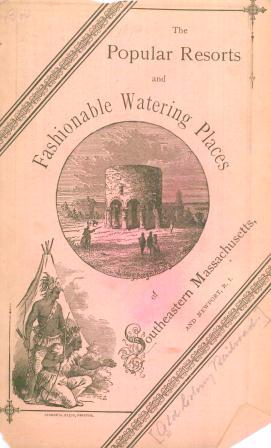
“Within a few hours’ ride from the metropolis are sections of country and seaboard, which in variety of character, loveliness of climate, and grandeur of scenery, are unsurpassed by any of the celebrated and more distant watering places on the continent,” wrote the unknown author of an Old Colony Railroad Company publication entitled, “Southeastern Massachusetts: Its Shores and Islands, Woodlands and Lakes, and How to Reach Them.” Having spent a few weeks utilizing the Old Colony Railroad system to travel throughout southeastern Massachusetts, the author wrote a guide for other adventurous vacationers in what is essentially a wonderfully descriptive, 49-page advertisement. The pamphlet lists more than 70 destinations, including traditional summer locales such as Provincetown, Martha’s Vineyard, and Nantucket and the less exotic locations such as Taunton, Foxboro, and Attleboro.

The author lays heavy praise on Newport, Rhode Island. “In Newport, however, the walks are probably more sought after than the drives. Foremost among these is the Cliff Walk among the sea bluffs, on which the pedestrian may continue his rambles to Easton’s Beach and round the southern point of Fort Adams.” Of course! The famous Cliff Walk of Newport is listed within the guide and is still as popular today as it was in 1879. Our Cliff Walk is dotted with gilded mansions. What might that scenic “ramble” have looked like in 1879 before these remarkable homes — Rosecliff, the Breakers, Marble House, Ochre Court, and Rough Point, to name a few –peaked over the cliffs?

The author directs the reader from a distant third-person narration, a change from the way many guidebooks are written today. Yet the suggestions of what to do at Monument Beach inspire today’s reader just the same. “From Monument Beach, a boat sail to Burgess Point, a distant about a mile and a half, or across to Marion, some six miles, or along the eastern shore, can scarcely be equaled. The bay is studded with gems of beauty.” Monument Beach is located within Bourne, MA near Phinney’s Harbor for all those interested vacationers reading this blog.

Though one might find the author’s descriptions fascinating, the pamphlet existed to  advertise the Old Colony Railroad. It concludes most helpfully with a list of hotels near the Old Colony Railroad’s stations to aid the traveling vacationer.

While the Old Colony Railroad no longer traverses southeastern Massachusetts as it did in 1879, parts of the system are still used today by modern commuters. Planning a summer get away? Why not get inspired to plan a trip to southeastern Massachusetts this summer? Visit the library at Massachusetts Historical Society — no sunblock required, but reading glasses are suggested — to check out this publication and others on early tourism in Massachusetts.