The Diary of William Logan Rodman, Part I

By Susan Martin, Senior Processing Archivist

This is the first installment of a series on the diary of William Logan Rodman. Stay tuned to the Beehive for more.

About a year ago, the MHS acquired a very interesting diary kept by William Logan Rodman of New Bedford, Mass. Though it covers only a year and a half of Rodman’s life, it’s full of terrific anecdotes, descriptions, and hot takes on current events leading up to and including the first year of the Civil War.

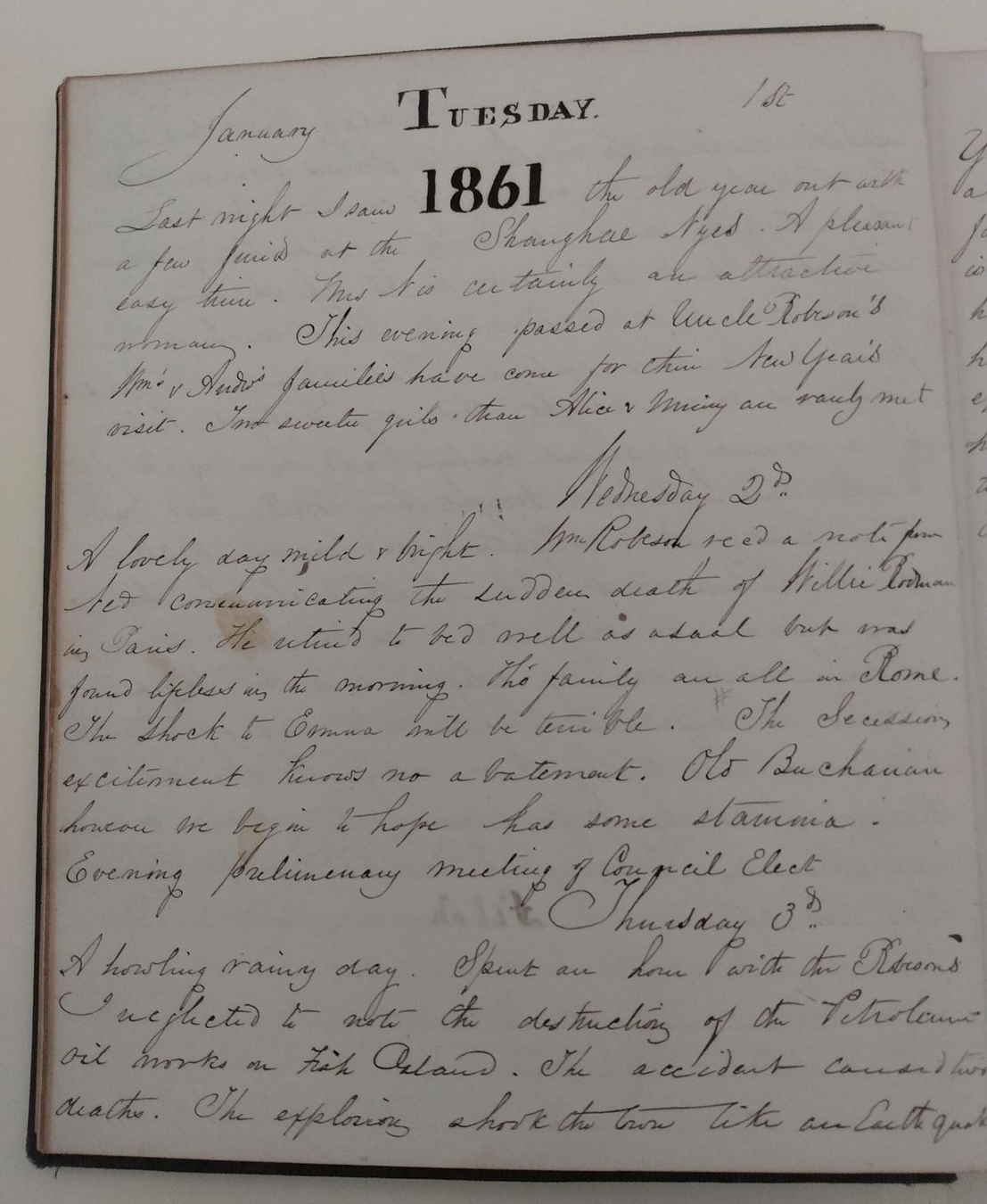
Rodman diary
Page of William Logan Rodman diary

If he sounds familiar to you, that may be because of his grandfather Samuel Rodman (1753-1835), a very prosperous merchant who made his name in the whaling centers of Nantucket and New Bedford. Samuel married Elizabeth Rotch, and several other Rodmans also married into that family, interweaving the two powerful New England whaling dynasties. William’s maternal grandfather, meanwhile, was Thomas Morgan, a prominent merchant of Philadelphia.

Members of the Rodman, Rotch, and Morgan families were also practicing Quakers and fervent opponents of slavery.

In October 1860, when he began his diary, William Rodman had a comfortable life. He was 38 years old, unmarried, living in New Bedford, and “participat[ing] moderately in business,” as his Harvard biography puts it. But his life would change dramatically in the coming months, and it all began with the momentous election of Abraham Lincoln on 6 November.

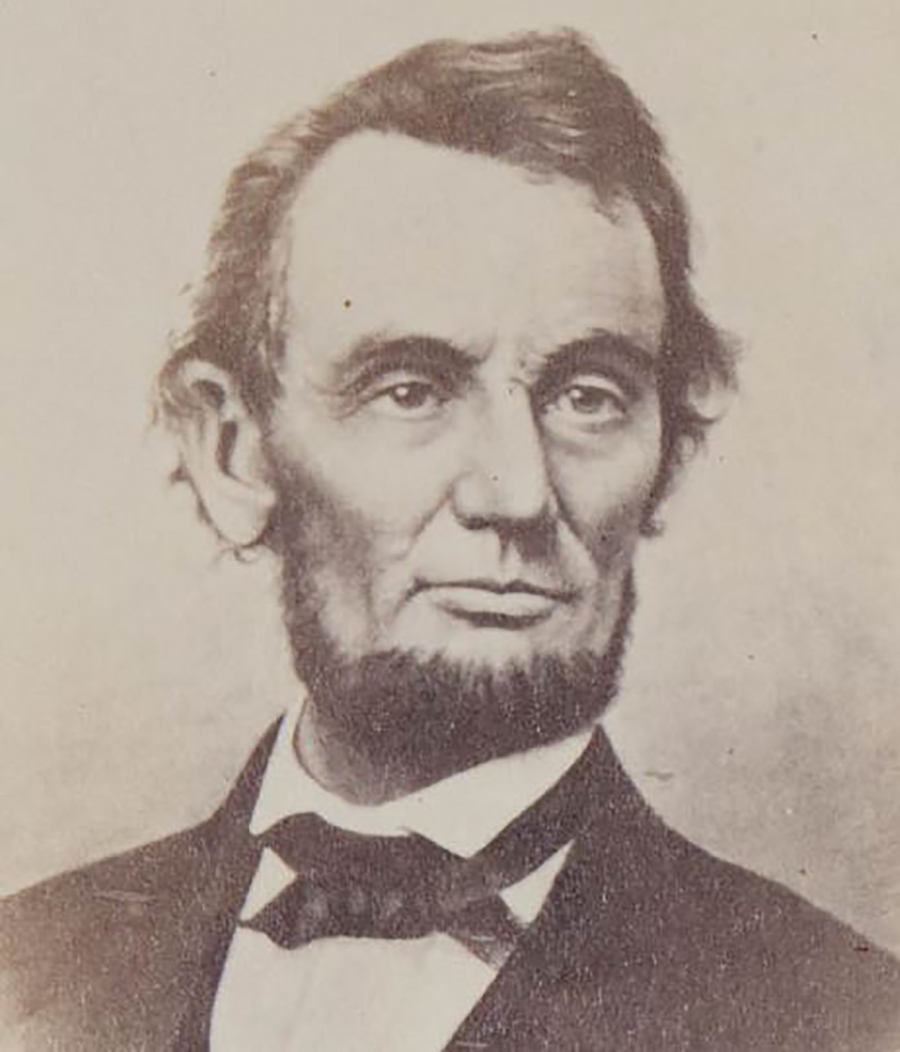
Abraham Lincoln photo
Carte-de-visite photograph of Abraham Lincoln, ca. 1861-1865

Southern backlash to the election was fierce, but Rodman was initially sanguine about it, writing the day after, “I have no fears of Secession or Revolution. The South will bluster & Resolve but […] all will be quiet.” And a few days later: “They will have to submit to the will of the majority viz the Union or go to everlasting smash out of it.” He dismissed what he called “Southern secession nonsense” in the newspapers.

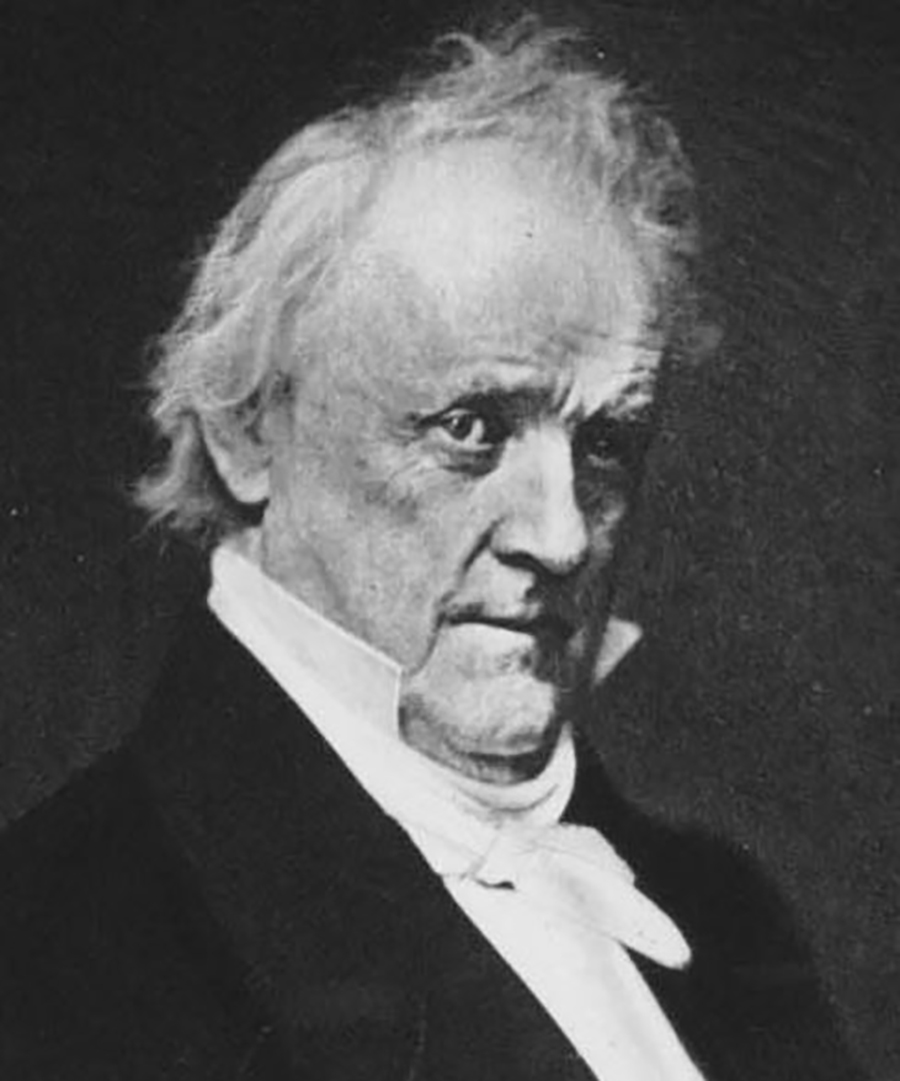
James Buchanan was now a lame-duck president. Rodman hated him, and he did not mince words. He called the administration “corrupt and degraded” and the man himself “the meanest & vilest of the American Presidents,” lacking “a vertebral column.” He rarely even referred to Buchanan by name, preferring epithets such as “the Old Public Functionary,” “an inefficient old fool,” and even “Mrs. Buchanan,” probably a not-so-veiled reference to rumors about the bachelor president’s sexuality.

James Buchanan photograph
Photomechanical of James Buchanan, undated

Buchanan’s political positions were abhorrent to opponents of slavery like Rodman. Buchanan had intervened in the deliberations of the U.S. Supreme Court in Dred Scott, pressuring justices to rule against Scott and deny citizenship to Black people. He supported the Fugitive Slave Law requiring free states to return enslaved people to their enslavers and argued for a federal law protecting slavery in the territories. And he used his 1860 State of the Union address to pre-emptively blame the Northern states for Southern secession (emphasis mine):

The long-continued and intemperate interference of the Northern people with the question of slavery in the Southern States has at length produced its natural effects. The different sections of the Union are now arrayed against each other, and the time has arrived, so much dreaded by the Father of his Country, when hostile geographical parties have been formed.

I have long foreseen and often forewarned my countrymen of the now impending danger. This does not proceed solely from the claim on the part of Congress or the Territorial legislatures to exclude slavery from the Territories, nor from the efforts of different States to defeat the execution of the fugitive-slave law. All or any of these evils might have been endured by the South without danger to the Union (as others have been) in the hope that time and reflection might apply the remedy. The immediate peril arises not so much from these causes as from the fact that the incessant and violent agitation of the slavery question throughout the North for the last quarter of a century has at length produced its malign influence on the slaves and inspired them with vague notions of freedom. Hence a sense of security no longer exists around the family altar. This feeling of peace at home has given place to apprehensions of servile insurrections. Many a matron throughout the South retires at night in dread of what may befall herself and children before the morning. Should this apprehension of domestic danger, whether real or imaginary, extend and intensify itself until it shall pervade the masses of the Southern people, then disunion will become inevitable. […]

How easy would it be for the American people to settle the slavery question forever and to restore peace and harmony to this distracted country! They, and they alone, can do it. All that is necessary to accomplish the object, and all for which the slave States have ever contended, is to be let alone and permitted to manage their domestic institutions in their own way.

Historians have consistently ranked Buchanan at or near the bottom in lists of U.S. presidents. One 2015 biography is even called The Worst President: The Story of James Buchanan.

At the beginning of December, still three months away from Lincoln’s inauguration, Rodman was beginning to sound a little less sure of himself on the question of secession. He wrote, “I cannot feel that this great confederacy is to be destroyed just yet and I dont like to contemplate the fearful ruin that must overtake the South if they pursue their mad schemes.”

Sure enough, on 20 December 1860, South Carolina became the first of eleven states to dissolve its ties with the Union. Rodman had not wanted to see it happen, but now that it was underway, he recorded his feelings in his diary:

Some of our citizens talk blood and warfare, but this is easy talking far away from the probable scenes of danger. I hope we may have peace without blood but if not why my first wish is for wiping Charleston off the face of creation.

Rendezvous at the Lines: The Murray Family During the Siege of Boston

By Lauren Duval, NEH-MHS Long-term Research Fellow, Assistant Professor of History, University of Oklahoma

This past fall I was delighted to spend time at the Massachusetts Historical Society as a research fellow. Analyzing British-occupied cities during the American Revolution, my research centers the urban household and examines how civilian families navigated the disruption of occupation and the consequence of this experience, both during and after the war. The voluminous correspondence of the loyalist Murray family proved an exceptional source for examining these dynamics, offering a fascinating glimpse into how one Boston family navigated the hardships of martial law during the early months of the war.

On April 20, 1775, in the wake of the battles at Lexington and Concord, Bostonians awoke to startling news that they were, in the words of one woman, “Genl. Gage’s prisoner[s]—all egress, & regress being cut off between the town & country.”[1] In the months that followed, both the British army and the militia (later Continental army) besieging Boston were hesitant to allow civilians to cross military lines, fearing disease, espionage, and the loss of resources. Some fortunate Bostonians managed to secure passes.[2] Many others, however, lingered in the besieged city (whether by choice or circumstance), where they endured food shortages, disease, plunder, and violence, and struggled to communicate with friends and family outside the British garrison.

The Murray family was stranded on both sides of the lines. Residing in Boston alongside his wife, Elizabeth, and youngest daughter Betsy, loyalist James Murray occupied his time by gardening and reading books, the latter of which he jokingly referred to as “the best friends now left to me.”[3] His sister, Elizabeth Murray Campbell Smith Inman and eldest daughter, Dolly Murray Forbes dwelt at the family’s Brush-hill estate, in Cambridge, surrounded by Continental troops. Later in the occupation, Betsy, to her parents’ distress, would abandon the garrison to shelter at Brush-hill.[4] Crossing the lines was nevertheless a fraught endeavor, even with permission. In the fall of 1775, for instance, Elizabeth Inman was advised to remove into the garrison for safety. She obtained a pass to visit Boston and became stranded there for the remainder of the occupation.[5]

Despite being separated by only a few miles, the Murray family was divided by both wartime circumstances and military boundaries. Obtaining passes from commanding officers, they arranged meetings at the military outposts that separated the British garrison at Boston from the Continental camp in Cambridge. Such conferences permitted them to visit, exchange news, and offer reassurances of safety. But they were far from private. As James Murray explained in July 1776, a British officer would observe the family’s gatherings “to be Eye & Ear Witness of all that passes.” This precaution, Murray explained, was for the family’s protection and he strongly advised “the Ladies . . . to use the same precaution, on their side: the Times require it.”[6] With various family members stranded on either side of the lines, dependent upon the protection of both armies, the Murrays could ill-afford to be charged with treasonous behavior by either faction. Witnesses, both British and Continental, who could attest, if necessary, to the content of the family’s conversation was an important shield against such charges. Still, the Murrays were cautious not to meet too frequently, fearful of raising suspicions among Massachusetts revolutionaries.[7]

Like inhabitants of occupied cities throughout British North America, the Murrays struggled with the lack of private communications. They lamented the necessity of leaving letters unsealed for inspection and bemoaned the uncertainty of conveyance. The Murrays, with their regular visits at the lines, were in some ways, more fortunate than those families who had to settle for letters or word-of-mouth reassurances of safety. When possible, the Murrays used private channels, entrusting their missives to neighbors who had obtained passes to cross the lines. Such conveyances were nevertheless circumspect; nothing of consequence could be committed to paper, lest the letter be intercepted.[8] Occasionally, the Murrays sent letters and goods via servants and enslaved messengers, whose roles as laborers permitted them to more easily traverse military lines.[9] Such mobility could, however, be perilous. Enslaved laborers were routinely plundered and kidnapped. Disease flourished near military encampments. Like white civilians, the enslaved could become trapped within the garrison, far from their own families and where they encountered far more difficulties in learning about their loved ones’ well-being. Proximity to the British army nevertheless offered a chance for freedom, and approximately twenty thousand self-emancipated men, women, and children made their way to the British lines during the war.[10]

Despite scrupulous planning, miscarried letters, delayed passes, and other mishaps disrupted the Murrays’ meetings.[11] Weather could deter visits, especially in the frigid winter months.[12] Wartime circumstances introduced additional fears; in the midst of civil war, surrounded by two armies, safety was no guarantee. Hinting at the strain of nine-months-long separation, in January 1776, James Murray wrote to his daughters, requesting them to “bring with you as healthy & chearful Countenances as you did at our last [meeting].” “Your very looks will be a feast to your old Father tho not a Word pass,” he assured them.[13] But even as such glimpses fortified the family for the hardship ahead, the long period of separation exacerbated other worries. Parted from his grandsons for several months, James Murray and his wife Elizabeth worried that “they will have quite forgot us.”[14] Each time the family sent off a letter, they worried, as Dolly expressed to her father in May 1775, that “it may be the last time we can hear from you.”[15]

Although only one facet of the wartime disruption that Bostonians faced in the early years of the war, the experiences of the Murray family underscore the deeply personal and intimate ways in which the war affected American families. Residing between two armies, the challenges that the family faced speak not only to the hardship that civil war inflicted on civilians residing in and around the Boston garrison, but also illustrate in vivid detail the consequences of these circumstances on daily life and familial relationships. As Dolly Forbes feared, the separation from her parents did become permanent. Like many Boston loyalists, James and Elizabeth Murray evacuated Boston with the army in March 1776. They eventually settled in Halifax, where James died in 1781, far from the family that he had valiantly struggled to keep unified during the war.[16]

[1] Sarah Winslow Deming Journal, April 20, 1775.

[2] Permit to pass through British lines, May 1775, Miscellaneous Bound Manuscripts, 1774–1775.

[3] James Murray to Dorothy Forbes & Betsey Murray, October 2, 1775, James M. Robbins Family Papers, Box 2 (garden); James Murray to Elizabeth Inman, May 23, 1775, James M. Robbins Family Papers, Box 2 (quotation).

[4] James Murray to Dorothy Forbes & Betsey Murray, October 2, 1775, James M. Robbins Family Papers, Box 2.

[5] Memorial of Dorothy Forbes of Milton to the Honble. Council & House of Representatives of the Colony of the Massachusetts Bay, December 12, 1775, Murray Robbins Family Papers, Box 1, Folder 4.

[6] James Murray to Elizabeth Inman and Dolly Forbes, July 26, 1775, Murray Robbins Family Papers, Box 1, Folder 4.

[7] James Murray to Dorothy Forbes & Betsy Murray, Feb 10, 1776 (James M. Robbins Family Papers, Box 2.

[8] James Murray to Dorothy Forbes and Betsy Murray, November 6, 1775, James M. Robbins Family Papers, Box 2.

[9] For a few examples, see James Murray to Elizabeth Inman, May 17, 1775, James M. Robbins Family Papers, Box 2; James Murray to Elizabeth Inman, Boston, Thursday, May 18, 1775, James M. Robbins Family Papers, Box 2; Elizabeth Inman to Ralph Inman, 29th & 30th May 1775, James M. Robbins Family Papers, Box 2; Elizabeth Inman to Dorothy Forbes and Betsy Murray, October 28, 1776, James M. Robbins Family Papers, Box 2.

[10] Cassandra Pybus, “Jefferson’s Faulty Math: The Question of Slave Defections in the American Revolution,” The William and Mary Quarterly 62, no. 2 (2005): 261.

[11] Letter to Betsie Murray, February 23, 1776, Murray Robbins Family Papers, Box 1, Folder 5, (miscarried); Elizabeth Inman to Ralph Inman, Sunday April 30, 1775, James M. Robbins Family Papers, Box 2 (delayed).

[12] James Murray to Dolly Forbes and Betsy Murray, February 14, 1776, James M. Robbins Family Papers, Box 2.

[13] James Murray to Dorothy Forbes & Betsy Murray, January 10, 1776, James M. Robbins Family Papers, Box 2.

[14] James Murray to Dorothy Forbes and Betsy Murray, November 6, 1775, James M. Robbins Family Papers, Box 2.

[15] Letters of James Murray, Loyalist, ed. Nina Moore Tiffany and Susan Inches Lesley (Boston, 1901), 199.

[16] James Henry Stark, The Loyalists of Massachusetts and the Other Side of the American Revolution (J.H. Stark, 1907), 258–60.


Louisa Catherine Adams: “I was a Mother ”

By Sara Martin, Editor in Chief, The Adams Papers

On 8 July 1801 Louisa Catherine Johnson Adams stepped aboard the ship America in Hamburg. She was ill, worried for the son she birthed less than three months earlier, and sailing toward an America she knew only as “the land of my Fathers.” Volumes 15 and 16 of the Adams Family Correspondence, two forthcoming volumes in the Adams Papers series, chronicle the exciting and daunting changes in Louisa’s life during the first decade of the nineteenth century. She met the Adams family in the United States, carved a place for herself and her husband, John Quincy Adams, in Washington society, and most importantly embraced motherhood.

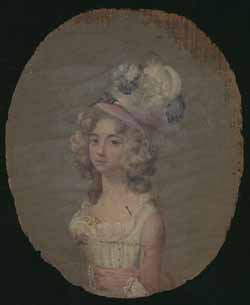
Miniature portrait of Louisa Catherine Johnson
Louisa Catherine Johnson,
miniature, circa 1792

The daughter of an American father, Joshua Johnson, and English mother, Catherine Nuth Johnson, Louisa was born in London on 12 February 1775. She received her education in France, after her family fled to Nantes during the American Revolution. Returning to London after the war, Joshua Johnson became the U.S. consul at London in 1790, and the Johnson household served as a center for Americans in the British capital. When John Quincy Adams arrived in bustling city in late 1795, he was welcomed into the Johnson home and found the three eldest Johnson “daughters pretty and agreeable.” Louisa captivated his particular focus, and the couple was engaged before John Quincy returned to his diplomatic post at The Hague in late May 1796. More than thirty letters exchanged during their courtship are included in volumes 11 and 12 of the Adams Family Correspondence and are available online through the Adams Papers Digital Edition.

Following the couple’s July 1797 marriage, they moved to Berlin, where John Quincy spent more than three years as the U.S. minister to Prussia. The young diplomat successfully negotiated a new treaty with Prussia but found many of his other duties onerous. Neither he nor Louisa relished the constant whirl of Berlin’s lavish court life, and they escaped the capital when they could, enjoying trips to Dresden and Töplitz and making an extensive tour of Silesia. Louisa’s health in this period was precarious. She experienced several miscarriages before the birth of the couple’s first child, a son named George Washington Adams, in April 1801. “I was a Mother—God had heard my prayer,” Louisa recalled in her autobiography years later.

So it was with a great deal of trepidation that Louisa boarded the America for America in July 1801. After “Sixty long and wearisome days” the family arrived in Philadelphia that September. Louisa spent several weeks visiting her family in Washington, D.C., before traveling to Quincy to meet her in-laws. “Quincy! What shall I say of my impressions of Quincy,” Louisa recalled of her introduction into the Adamses’ community. “Had I steped into Noah’s Ark I do not think I could have been more utterly astonished.” With her cosmopolitan upbringing in Europe, Quincy society seemed foreign. She often felt herself on the outside, looking in.

With John Quincy’s election to the U.S. Senate in 1803, Louisa returned to Washington, a city she found charming on her first arrival in 1801: “I am quite delighted with the situation of this place and I think should it ever be finished it will be one of the most beautiful spots in the world.” The close proximity to her family held great appeal, and she remained in the capital during the 1804 recess, while John Quincy visited his parents in Massachusetts. The situation was reversed in 1806 and 1807, when Louisa stayed in Boston while John Quincy returned to his post in the capital.

Louisa’s frequent letters during these periods of separation discuss a wide range of activities, from what she was reading and who she was visiting to what was going on in Congress and Washington society or locally in Massachusetts. Tender moments between husband and wife are joined by periods of miscommunication and disagreement. But much of Louisa’s letters are filled with commentary about their children, for they welcomed a second son, John Adams, in July 1803, and then another, Charles Francis Adams, in August 1807.

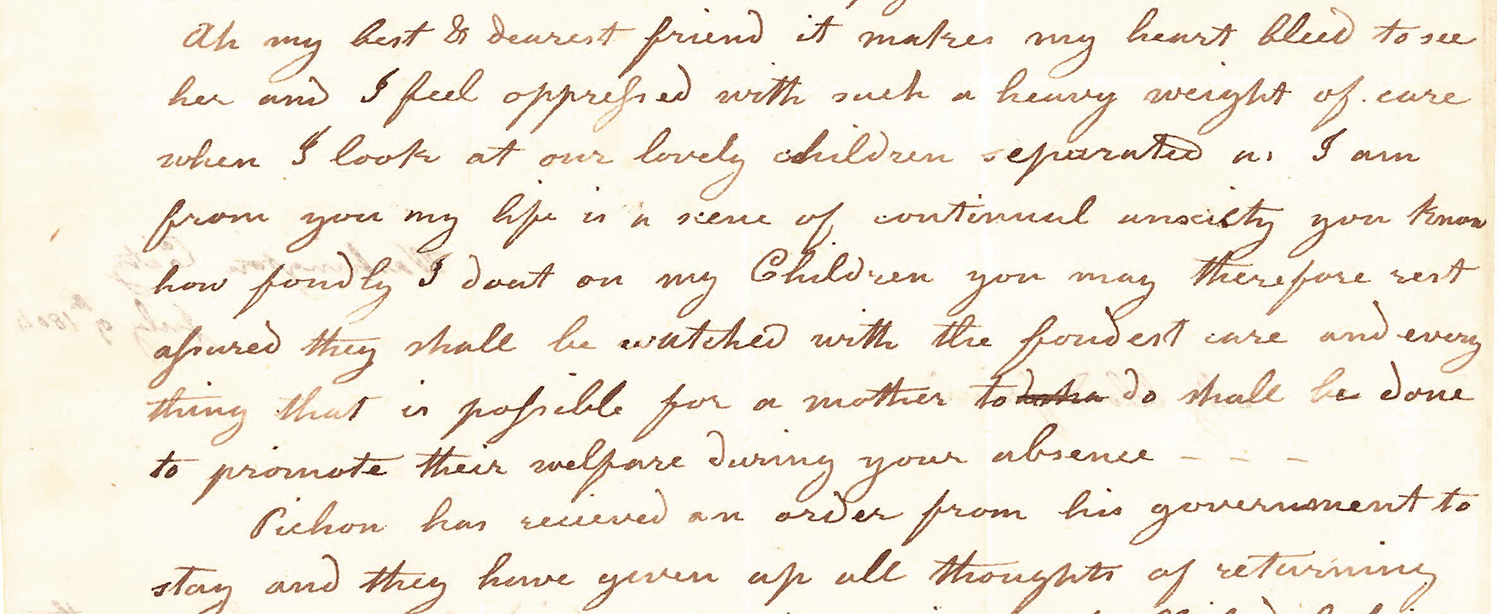
Letter from Louisa Catherine Adams to John Quincy Adams
Louisa Catherine Adams to John Quincy Adams, 9 July 1804

“I feel oppressed with such a heavy weight of care when I look at our lovely children separated as I am from you my life is a scene of continual anxiety,” Louisa wrote on 9 July 1804. “You know how fondly I doat on my Children you may therefore rest assured they shall be watched with the fondest care and every thing that is possible for a mother to do shall be done to promote their welfare during your absence.” Much of Louisa’s anxiety pertained to the children’s health. In a 4 October 1801 letter she noted a “terrible eruption” on George’s skin but was relieved when it “proved to be nothing more than bug bites.” She also commented on common illnesses from teething and seasonal complaints, along with the challenges in getting the children inoculated.

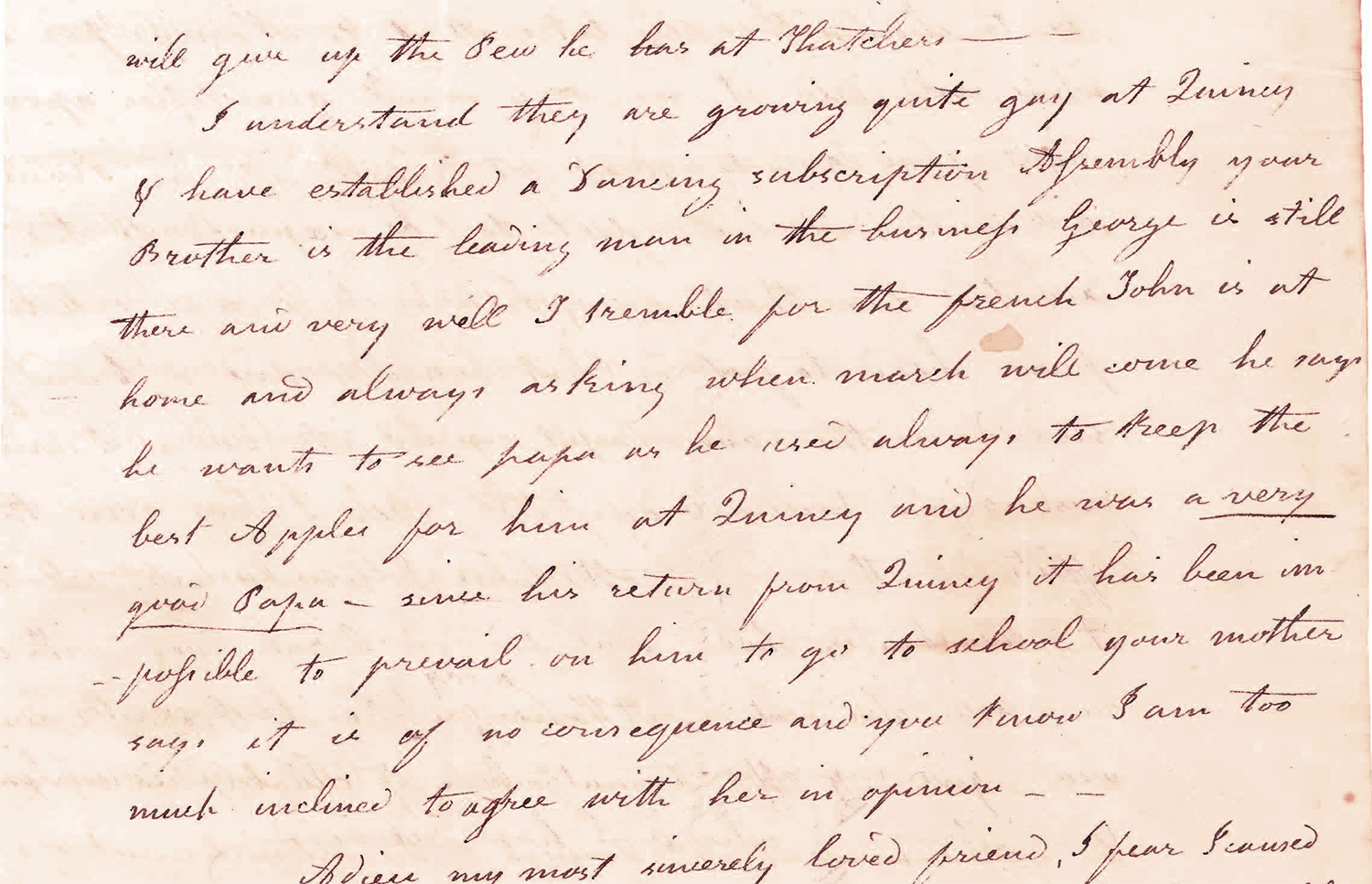
Louisa was delighted—and occasionally exasperated—by her sons’ antics. “George . . . says you are very naughty to go away and leave him he does teaze me so when I write I scarcely know what I am doing,” she wrote on 20 May 1804. And in January 1807 she reported that while John eagerly anticipated the return of his “very good Papa” it had “been impossible to prevail on him to go to school.” George, on the other hand, boasted that he “believed he was too clever” for his schoolmaster.

Letter from Louisa Catherine Adams to John Quincy Adams
Louisa Catherine Adams to John Quincy Adams, 21 January 1807

As the first decade of the nineteenth century drew to a close, Louisa returned to Europe with John Quincy. With her children always centermost in her thoughts, this time she looked longingly back toward Massachusetts, where she left her two oldest children under the care of the Adamses . But that is a story for a later Adams Papers volume.

The Adams Papers editorial project at the Massachusetts Historical Society gratefully acknowledges the generous support of our sponsors. Major funding is provided by the National Endowment for the Humanities, the National Historical Publications and Records Commission, and the Packard Humanities Institute. The Florence Gould Foundation and a number of private donors also contribute critical support. All Adams Papers volumes are published by Harvard University Press.

“I preys mighty for you all”: Letters of a Black Family in the Early 20th Century, Part V

By Susan Martin, Senior Processing Archivist

This is the final installment of a five-part series on the Jarrett family letters at the Massachusetts Historical Society. Click here to read Part I, Part II, Part III, and Part IV.

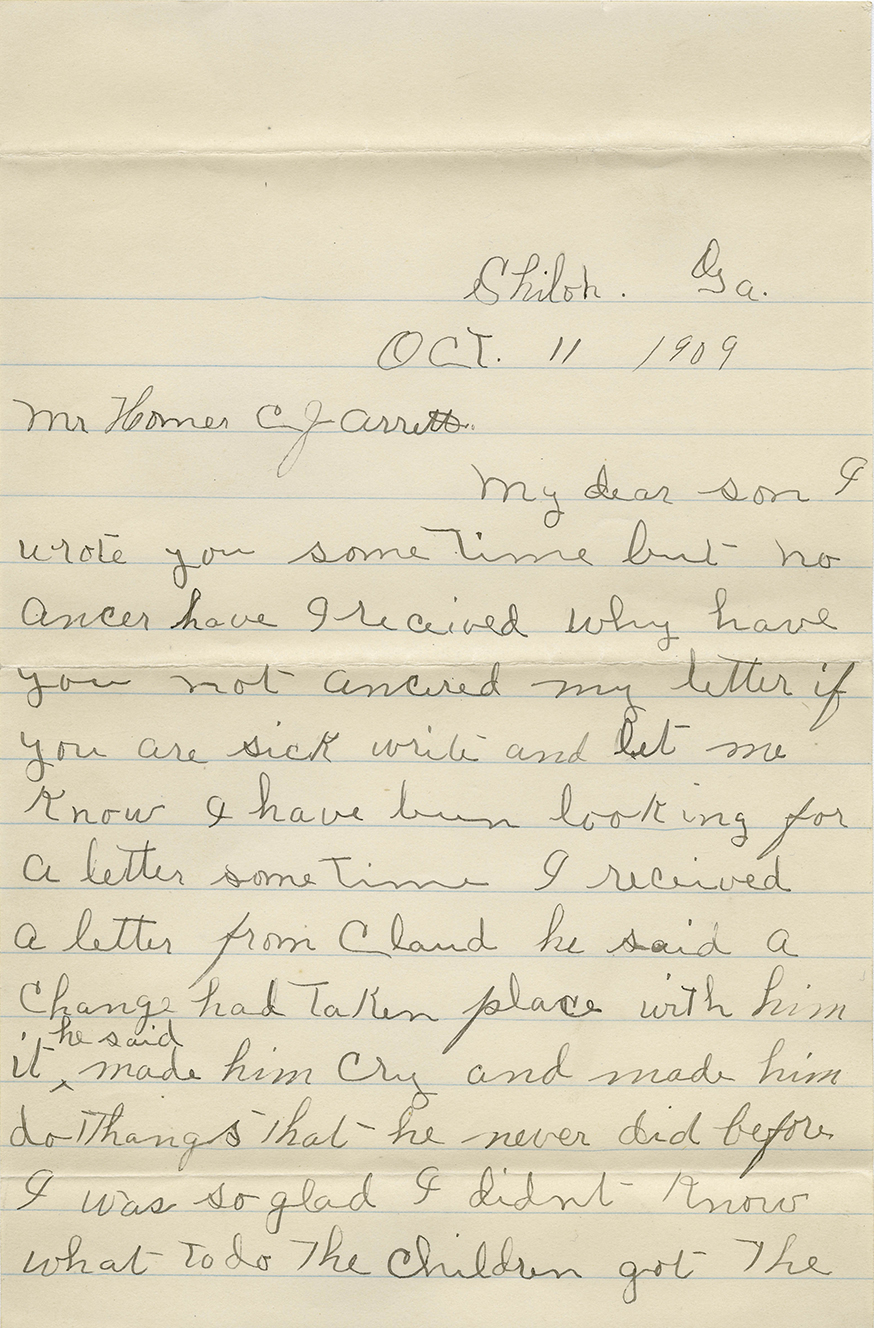
In this post, I conclude the story of Julia Jarrett and her son Homer, as documented in the Jarrett family letters here at the MHS. Julia had been born into slavery in the 1850s, and in 1909 was living with members of her sprawling family on a farm in Shiloh, Ga. Homer, after years of peripatetic wandering through the Midwest and Northeast, had settled here in Boston, where he would apparently spend the rest of his life. Below is a complete transcription of the fifth and final letter of the collection.

Jarrett letter
Letter from Julia Jarrett to Homer Jarrett, 11 Oct. 1909

Shiloh. Ga.

Oct. 11 1909

Mr Homer C Jarrett.

My dear son

I wrote you some time but no ancer have I received. Why have you not ancered my letter. If you are sick write and let me know. I have been looking for a letter some time.

I received a letter from Claud. He said a Change had taken place with him. It he said made him cry and made him do things that he never did before. I was so glad I didnt know what to do. The children got the letter out of the box and carried it to the field and I went out thair and they read it to me and I couldent help from shouting and crying and rejoicing.

All at home is well at present. I have been sick for two weeks. I went to see Sister Jane Hawkins. Yesterday Sister Sallie went with me. Sister Jane has been sick but she is better now. Grandpa is well and is try to work as usial.

Homer you must be a good boy and try to prey. I preys mighty for you all and the Lord has give me Claud. He is fix up all right and I trust you is all ready fit meat for the Lord. I trust that I will see you once more in life but if I never see you in life hope to meet you where parten [parting] is no more.

All at home sends love to you. All the children sends their best regards to you. Cora and family is well. Wilson and family is well. The drouth [drought] cut the cotton crops off. We has picked out two bales of cotton but we dont know how many bales we will get. Hasent geathered corn yet.

I remain yours Mother

Julia Jarrett.

This letter was written more than two years after the last. I don’t know whether any correspondence was exchanged in the interim (if so, it may be found in the Homer C. Jarrett letters at the University of Georgia), but Julia’s concern for her son is palpable and touching. She was anxious at not hearing from him and worried not just about his physical, but also his spiritual well-being. Overjoyed at his brother Claud’s new-found commitment to religion, she urged Homer to follow his example and “be a good boy.”

The envelope is addressed to Homer at what looks like #410 A. Col” Ave., which may have been Colonial or Columbus Avenue. He had traveled north at the cusp of the Great Migration, which historians describe as taking place in two waves between 1910 to 1970. Homer would be followed by millions of other African Americans seeking opportunity and escaping Jim Crow. According to National Park Service data, the Black population of Boston, which grew less than that of other Northern cities, still nearly doubled between 1900 and 1930.

Unfortunately I couldn’t find any more information about Julia than I’ve shared in this and previous posts. Homer Clifford Jarrett worked in real estate in Boston and died unmarried in 1959 at the age of 76 or 77. Some of his siblings lived into the 1960s and ‘70s, and amazingly little sister Lizzie lived all the way to 1988. To think that a woman who lived long enough to watch the 1988 Winter Olympics on TV had had a mother born enslaved is to see how few generations removed from slavery we are today.

The Massachusetts Gubernatorial Election of 1878 – “Honest Money, Honest Men”

By Matthew Ahern, Library Assistant

In 1878, the future of the US currency was on the minds of many American citizens. With America in the middle of an economic depression contributing to anxieties around American monetary policies that had existed since the Civil War, the Greenback party had made considerable gains. Greenbackers saw money not restricted by bullion as being inherently helpful to the lower classes during this economic depression, while traditionally minded gold standard supporters feared what Greenback policy would do to the confidence in the American dollar, both domestically and abroad. In 1878, Massachusetts would be confronted by this debate when ardent Greenbacker Benjamin Butler’s was pitted against businessman Thomas Talbot in the gubernatorial election that year. In a contest that mixed personal reputation with monetary policy, it would be Talbot’s “Honest Money, Honest Men”[1] pitch that would win the day.

During the summer of 1878, Civil War General, and disillusioned ex-Republican congressmen, Benjamin F. Butler found himself as the conductor of a populist movement on a Greenback platform that ultimately led to him receiving the Democratic nomination for Governor. Almost as if in response to Butler and his followers, the Republican party nominated the mild-mannered mill owner Thomas Talbot. A former acting Governor of Massachusetts, Talbot supported the gold standard and took a far more moderate stance to both business and labor reform. This election, with these two contrasting figures would be just as much about personality and personal history as it was about policy.

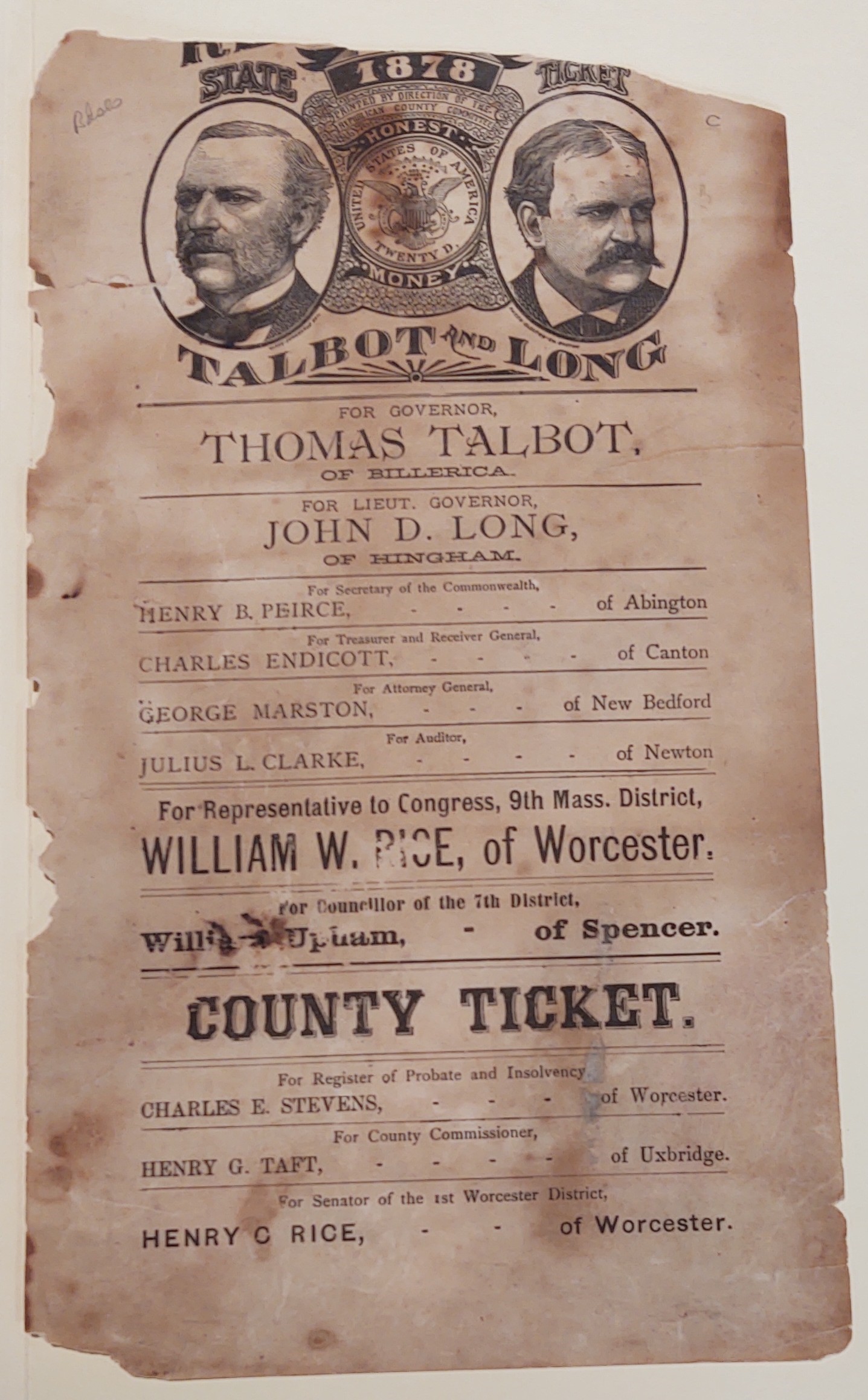
"Honest Money" ticket
Governor Talbot’s ticket using the phrase “Honest Money” at the top.  “State Ticket. 1878. Talbot and Long.” Collection of the MHS.

Talbot grew up in poverty, receiving only a partial education, and working primarily as a mill worker when he was younger. Eventually he established the modestly sized Talbot Mills in Billerica and had quickly earned himself a strong reputation paying his employees high wages with fair treatment during a time when mill workers were often treated poorly. By the 1850s, he had entered local Republican politics, and was eventually tapped to be Gov. Washburn’s running-mate in his successful 1874 ticket. Only a few months later, Talbot would find himself serving as the acting Governor after Washburn’s electoral victory for the late Charles Sumner’s seat in the US Senate. Though he was generally well liked during his time in office, Talbot destroyed his chances at winning re-election when he vetoed a liquor reform bill due to his temperance convictions (A stance that would be his political Achilles heel). Still a strong voice in the party, he would need to wait until 1878 to get another shot at the office of Governor.[2]

Butler lived a rather different life. Growing up in a family with some means, Butler benefited from an education from Philips Exeter and Colby College. Setting up a legal practice in Lowell, he engaged in speculation and would become a majority stakeholder in the Middlesex Company, a large mill in the city. Entering politics around the same time as Talbot, Butler was originally a Democrat, and first switched party affiliations to the Republican party during the Civil War. As a Major-General for the Union, he was known as an abysmal battlefield commander, but effective administrator. Post-war, he would serve in the US Congress as a Republican, though eventually growing frustrated the Republican platform’s lack of populist policies he had come to favor. Butler switched his party affiliation once more the Greenback Party, and he would carry with him the majority of Democratic party support within the state.

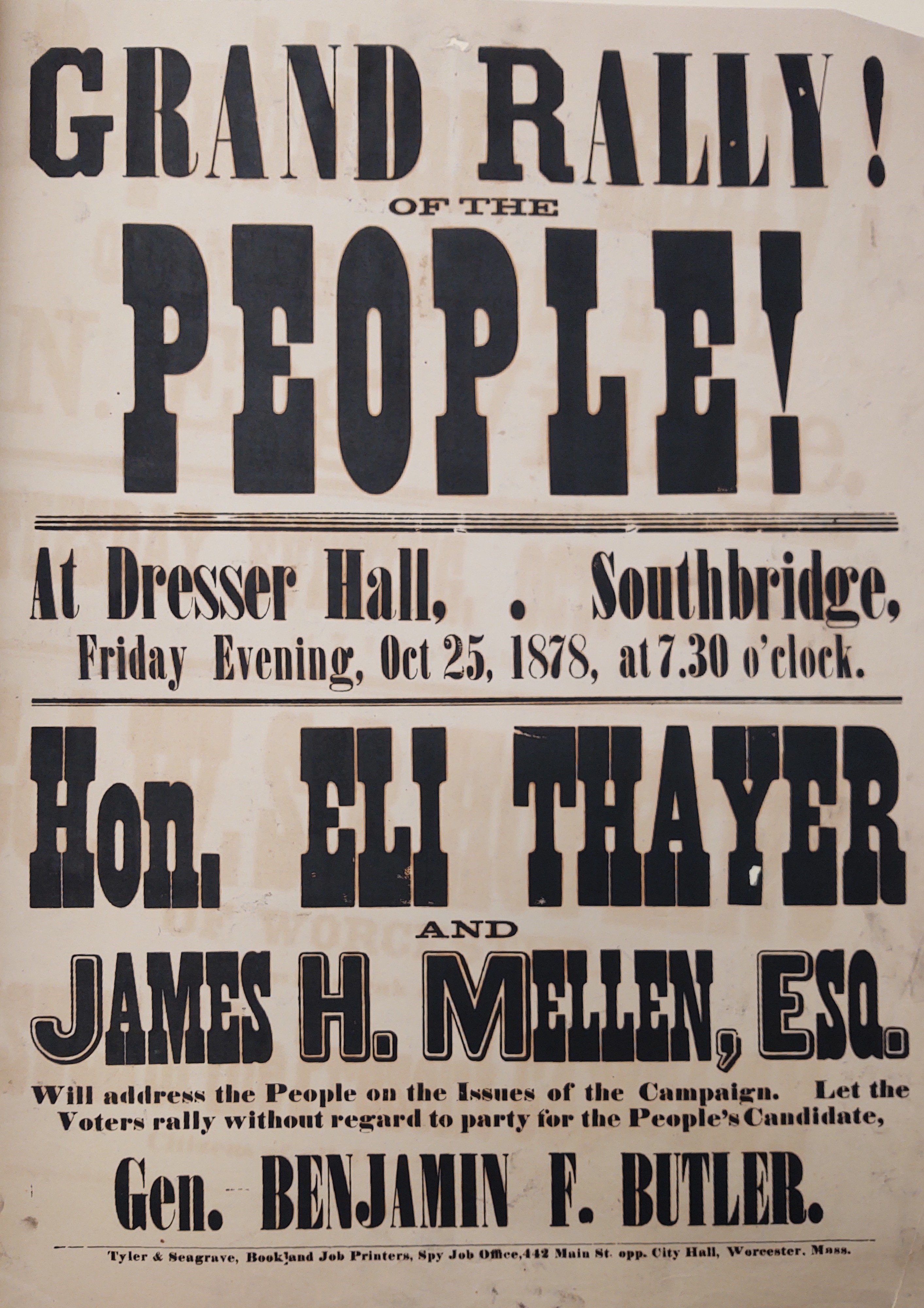
Butler Rally Poster
Butler Campaign Rally, with Butler described as the “People’s Candidate”. “Grand rally! Of the people!” Collection of the MHS.

Talbot and his supporters understood that his reputation would be the key to both challenging Butler and adding validity to his more moderate platform. The Talbot Mills had a strong reputation amongst workers, while Butler’s Middlesex Company did not. Talbot was a loyal party-man while Butler had a history of switching affiliations. Talbot also sought no higher office and disliked public ceremony, while many guessed (and rightly so) that Butler, who thrived in the spotlight, would use the Governorship as a step towards the Presidency. Furthermore, he was aided by rising Republican politician Gen. James A. Garfield, who delivered a speech at Faneuil Hall and lampooned Butler’s monetary policy.[3]

Political attacks continued to rage, with Talbot cast as part of the Republican oligarchy currently in power and Butler labeled a demagogue. Despite Butler’s attempts to soften controversial aspects of his history, he was not able to escape the perception of him as a leader of the “Repudiationists, Greenbackers, and Communists” trying to wrestle for power in the state.[4]

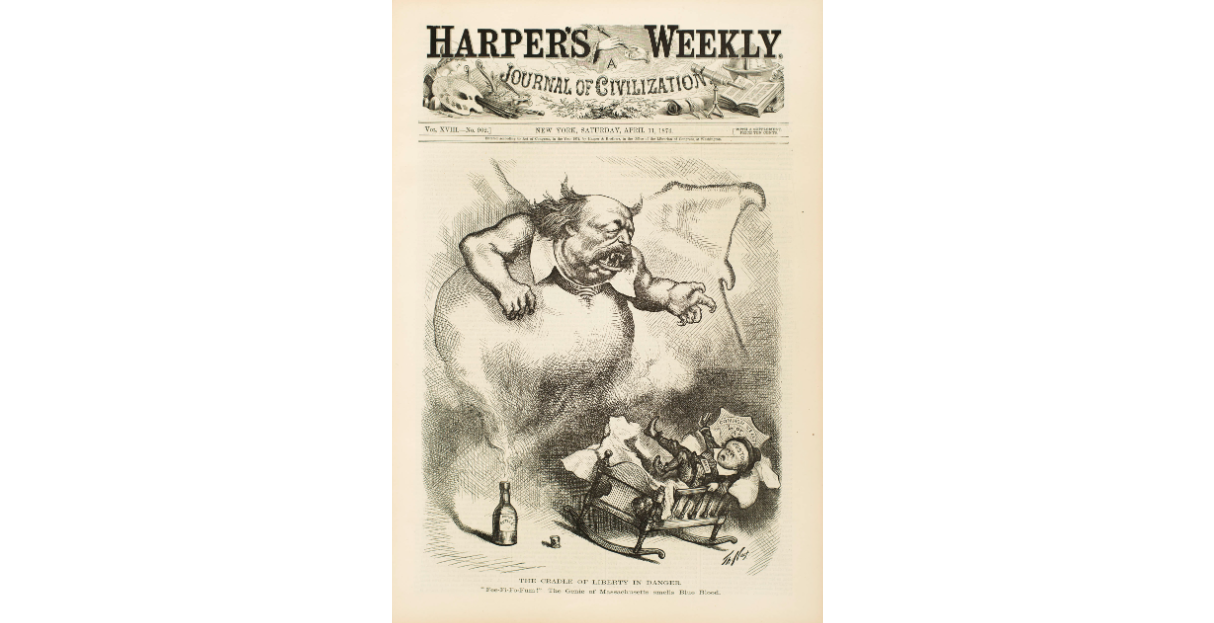
Butler caricature cartoon
1874 cartoon displaying criticisms of Butler in caricature. “Cradle of Liberty in Danger.” Collection of the MHS.

In the end, turnout would be massive, with Butler receiving more votes than any other defeated candidate previously, though he was still beaten handily by Talbot 53% to 43%.[5] Voters appeared to have seen the merit in Talbot’s campaign pitch of “Honest Money, Honest Men” over a controversial and radical Butler. Butler would go on to achieve electoral victory in 1882 and launch his bid for the Presidency in his unsuccessful campaign of 1884. As for Talbot, his term in office was characterized by incremental labor and prison reforms, as well as the implementing of the first piece of limited women’s suffrage in the state. Refusing a run for reelection, Talbot became largely a footnote in Massachusetts’s political history, but the campaign he ran in 1878 demonstrated reputation can matter just as much, if not more, than a politician’s policy platform.

[1] “Regular Republican ticket : honest money, honest men.” Rockwell and Churchill, Printer. Boston Athenaeum Collections.

[2] Thomas Talbot: A memorial. Privately printed, 1886. MHS Collections.

[3] Endicott’s letter : Garfield’s speech on honest money : delivered at Faneuil Hall, Boston, Sept. 10, 1878. MHS Collections.

[4] “Address of the Massachusetts Republican State Committee, 1878.” MHS Collections.

[5] “1878 Massachusetts Gubernatorial Election” Congressional Quarterly Guide to U S Elections, second edition.

“New England Bravery”

By Amy Watson, NEH Fellow, University of Alabama at Birmingham

At four o’clock in the morning on 3 July 1745, Boston’s residents awoke to the firing of guns, the beating of drums, and the ringing of bells. The bleary-eyed Bostonians’ alarm soon turned to delight when they learned the cause of the commotion: New England troops had captured the town of Louisbourg, a French colonial port on the island of Île Royale (in what is now Nova Scotia). For the entirety of the day, Bostonians “laid aside all thoughts of business” to celebrate the victory, participating in a city-wide block party that included fireworks, songs, and “plenty of good liquor.” As one eyewitness wrote, “never before, upon any occasion, was observed so universal and unaffected a joy.”[1]

I began my research at the Massachusetts Historical Society with questions about this victory and the celebrations it sparked. Why had New Englanders volunteered to fight the French at Louisbourg? Why were Boston’s residents so thrilled about winning a fishing port on the frigid waters of the Gulf of St. Lawrence? What did they hope to get out of it?

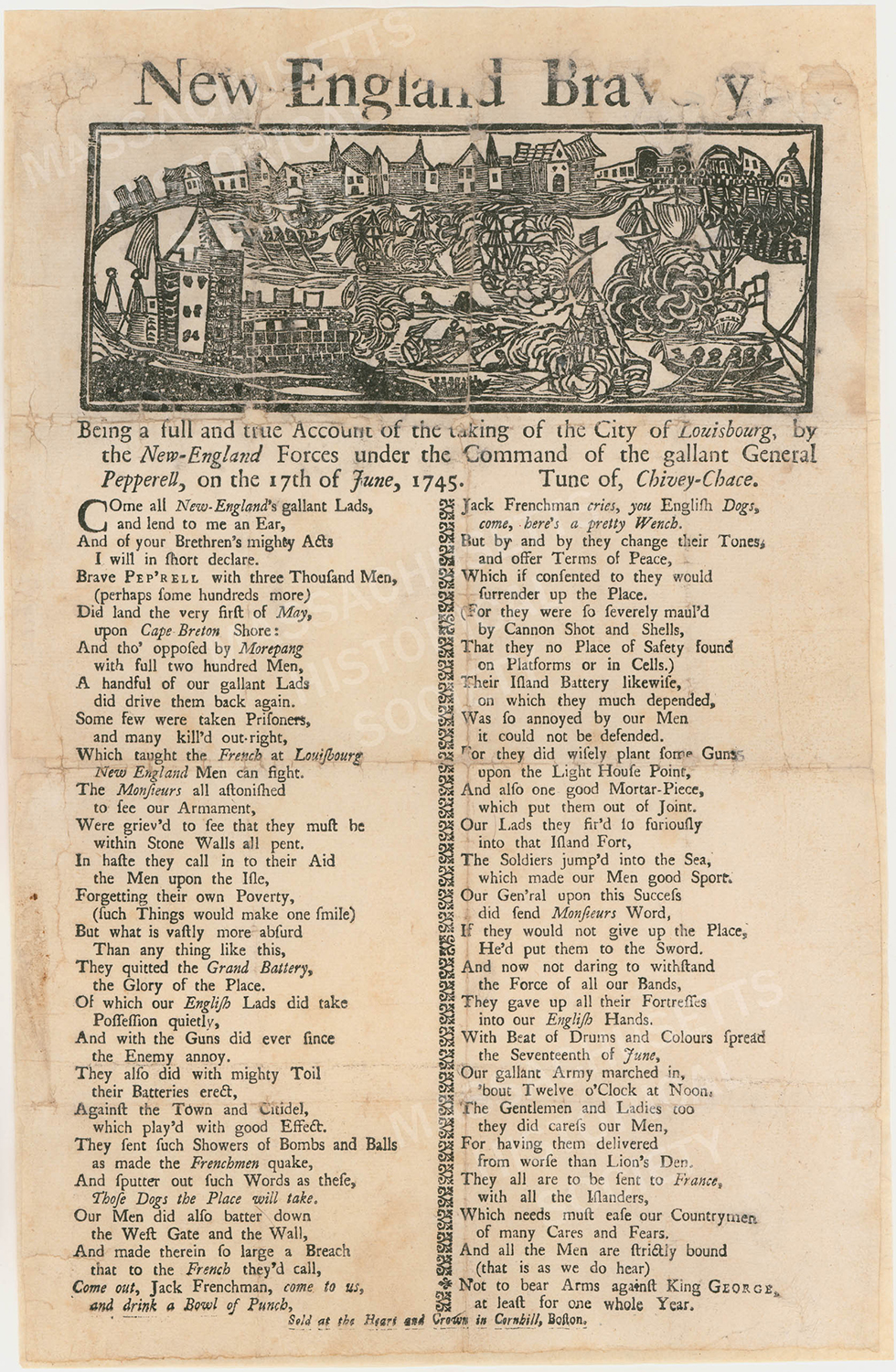
I knew that I would be able to find these answers at the MHS, which has the best collection in America on the Louisbourg expedition, including accounts of military leaders, politicians, and New England soldiers.[2] But my favorite find at the MHS was a simple printed ballad that circulated in Boston immediately following the victory. Entitled “New England Bravery,” this broadsheet describes New England’s capture of Louisbourg in verses to be sung to the tune of the old English song “Chivey Chace.” This ballad gave me not only a glimpse into the raucous celebrations that took place on Boston’s streets in July 1745, but also insight into what Louisbourg represented to the ordinary shopkeepers, merchants, and laborers who sang of its conquest. [Figure 1]

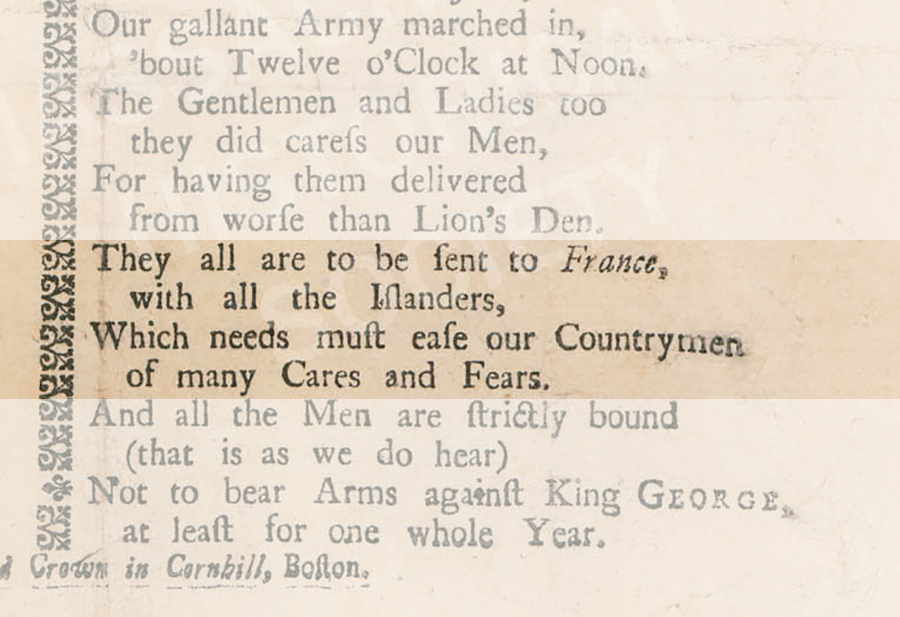
“New England Bravery,” shows the real antipathy that New Englanders held towards their French neighbors in North America. In the ballad’s description of the siege itself, there is the normal lighthearted banter between French and New England soldiers: “Jack Frenchman, cries, you English dogs/ come, here’s a pretty Wench.” But the tone turned serious once the New Englanders successfully captured the port, and decided what to do with their defeated foes: “They all are to be sent to France,/ with all the Islanders,/ Which needs must ease our Countrymen/of many Cares and Fears.” The ballad is therefore advocating for the expulsion of the French-speaking inhabitants of Île Royale, a people whose families had lived in the region for more than a century. [Figure Two]

Why did New Englanders want these French islanders gone so badly? The first motive was commercial: Louisbourg provided access to the cod fisheries of the North Atlantic, a lucrative trade which many Massachusetts colonists hoped to capture for themselves. More pressing, however, were the colonists’ geopolitical concerns. There was a growing political movement on both sides of the British Atlantic in the 1740s to take a more militant stance towards France in order to protect and expand Britain’s imperial hegemony in America.[3]  Île Royale was key to this program: British control of Louisbourg could choke off French shipping to Canada, making it too costly for France to continue its colonial operations in the region. As Massachusetts Governor William Shirley wrote, the conquest of Louisbourg was the first, essential step “to drive the French wholly off the North American continent.”[4] The anonymous writer of “New England Bravery” evidently agreed with Shirley’s aims, and many of the ordinary Bostonians who sang the ballad no doubt did as well.

More than a thousand inhabitants of Île Royale would be deported to France in the months following the conquest of Louisbourg, though some would return home briefly in peacetime, only to be expelled again during the Seven Years War. Ultimately, more than ten thousand French-speaking inhabitants of the greater Acadian region would be forced from their homes in the 1750s-60s, a violent undertaking that historian John Mack Faragher has described as an American example of “state-sponsored ethnic cleansing.”[5] Not all New Englanders supported this cruelty. However, “New England Bravery” suggests that in 1745 there were Bostonians in favor of a forced French expulsion singing out in the streets.

New England Bravery broadside
New England Bravery, Broadside, [Boston] : Sold at the Heart and Crown in Cornhill, Boston, 1745.
Detail of broadside
Detail of New England Bravery, Broadside, sold at the Heart and Crown in Cornhill, Boston, 1745.

[1] Pennsylvania Gazette, 18 July 1745

[2] See William Pepperrell Papers, William Shirley Papers, and William Clarke Journal in Dolbeare Family Papers, Massachusetts Historical Society.

[3] For more on this political movement, see Steve Pincus and Amy Watson, “Patriotism after the Hanoverian Succession,” in The Hanoverian Succession in Great Britain and its Empire, eds. Brent Sirota and Allan MacInnes (Woodbridge, UK: Boydell, 2019), 155-174.

[4] William Shirley to Lords Commissioners of Admiralty, 10 July 1745, The National Archives of the UK, ADM 1-3817

[5] John Mack Faragher, A Great and Noble Scheme (New York: Norton, 2005), 473

“I Hope You Will Be Successfull in Your New Home and Luck Well”: Letters of a Black Family in the Early 20th Century, Part IV

By Susan Martin, Senior Processing Archivist

This is the fourth installment of a five-part series on the Jarrett family letters at the Massachusetts Historical Society. Click here to read Part I, Part II, and Part III.

Today we return to the story of the Jarretts, a farming family in the small town of Shiloh, Georgia. The Jarrett collection at the Massachusetts Historical Society consists of five letters to Homer Clifford Jarrett (1882-1959) from family members, primarily his mother Julia. The fourth letter was written on 17 July 1907. Below is a complete transcription. As before, I’ll retain misspellings but add sentence and paragraph breaks for readability.

Julia Jarrett letter to Homer Jarrett
Letter from Julia Jarrett to Homer Jarrett, 17 July 1907

Shiloh Ga.
July. 17, 1907

Mr. Homer C. Jarrett.

Dear son

I received your letter some time ago. This leaves the family well. Hope when this reach it will find you the same. I just received a letter from Claud. It stated that he was well.

People are slow on crops. We just started back to hoeing the second time Monday. The cotton is looking fine. Corn crop is slow. It is not going to be much corn made this year down here.

I dont think we all went to the district meeting last Saturday and Sunday at Shiloh Ga. It was helt at the A.M.E. Church. It was nice times up thair. On Sunday Shack Barney and Shurn Copeland got in fuss. They shot at one and other. Shurn shot at Shack 3 times. Shack shot at Shurn 2 times. But not one got hurt. Shurn is under a hundred dollar [barn]. They hasent got Shack yet but say they is going to have him.

Homer you must be a good boy and try to prey. The people is got to be so bad nowadays. I hope you will be successfull in your new home and luck well. Grandpa is well and sends his best regards to you often speakes of you. Lizzie sends love to you and many sweet kisses. Charlie eyes is something better. He is plowing evey day. Generous is gone back to cooking again. He is not at home now. Sister Cora and family is well. Brother Wilson and family is well.

I hasent got any ink this time. I will try to get some the next time I write you.

So good bye

Your mother
Julia Jarrett

We’ve met most of the family before. Homer’s brother Claud and sister Lizzie have figured prominently in our series so far, and Grandpa, Charlie, and Wilson have made appearances. Cora, another sister, was married to a man named Levi Whitehead, according to online genealogical sources. I don’t know who Generous was, but it’s a great name!

The handwriting of this letter differs from that of the first three. I believe Claud had previously transcribed for his mother, but since he was away, someone else took over the job. I can only guess who the new transcriber was, but I wonder if it might have been Julia’s young daughter Lizzie. We know she was (or at least had been) in school, and in July 1907 she would have been nine years old.

I hit a number of frustrating dead ends researching the details of this letter. I couldn’t find an African Methodist Episcopal church in Shiloh, but it may have closed, moved, merged with another church, or changed denominations. Today, there are more than 500 AME churches in Georgia alone. I also didn’t locate any contemporary accounts of the confrontation between the two men, Shack Barney and Shurn Copeland, and I couldn’t confirm the meaning of “barn” (or “barm”) in this context. I assume it meant bail or a fine.

But details aside, this letter touches on several interesting themes, particularly the precariousness of the Jarretts’ income from their cotton and corn crops. We also see Julia’s concern for her son Homer, so far away from home—concern not just for his physical, but also his moral well-being.

One thing I like about this collection and other family letters I’ve seen at the MHS is that they really give us a sense of how people talked to each other in their everyday lives. This is something that doesn’t come through as strongly in formal correspondence. Phonetic spellings tell us how Julia pronounced certain words: “helt,” for example. It’s almost as if we can hear her voice. I also love the expression “luck well” instead of “have good luck.”

Homer had been moving steadily northward over the course of the previous two years. By 1907, he had reached New England, and this letter is addressed to him at Farragut House, a resort hotel in Rye Beach, N.H., where Homer was presumably working. Farragut House, according to the 1907 publication New England Vacation Resorts (p. 67), was the largest and priciest hotel at Rye Beach, accommodating 300 guests and costing $5.00 a night. The building has since been torn down, but you can find picture postcards of it online.

In my next post, I’ll be concluding the story of the Jarrett family. I hope you’ll join me!

After the Storm

By Sara Georgini, Series Editor, The Papers of John Adams

Campaign token
John Adams campaign token or button coat stud, [1800].
He came home in a whirlwind. His “little bark…oversett in a Squal of Thunder and Lightening and hail attended with a Strong Smell of Sulphur,” outgoing President John Adams fought the five hundred miles from Washington, D.C., to his native Quincy in two weeks flat. Traveling in early March 1801 meant a rough ride. Mud inked along the new, boggy roads, pooling in deep gulches that braked Adams’ path to a crawl. No longer the kind of celebrity who drew feasts, toasts, and fêtes, Adams plodded through dreary tavern stops. Minutes after he reached Peacefield to reunite with wife Abigail and his family, a violent storm splintered the New England sky. Gales of wind shuddered across his farm. Rain whipped down, flooding crops and confining the Adamses for several days. John Adams didn’t mind. It was “So old fashioned a storm that I begin to hope that nature is returning to her old good nature and good humour and is substituting fermentations in the Elements, for revolutions in the moral intellectual and political World,” he wrote on 31 March. Turning the page on his presidency, Adams sensed greater change was in the air.

Back at the capital, Thomas Jefferson pondered the challenge of how to lead that shift. “The storm is over, and we are in port,” Jefferson wrote to Samuel Adams on 29 March. “The ship was not rigged for the service she was put on. we will shew the smoothness of her motions on her republican tack.” The election of 1800 evolved American democracy in big ways. Electioneering dominated the press, as Adams’ Federalist Party supporters continuously clashed with their rivals, Jefferson’s Democratic-Republicans. Both camps diverged on domestic and foreign issues; Adams’ unpopularity surged as he enforced the Alien and Sedition Acts and loudly defended the need for peace with France. As voting stretched from September to December, party cleavage ended the Federalists’ hold on a congressional majority. The whole electoral system rebooted, too. States’ methods for choosing presidential electors changed, igniting confusion and popular concern. When Jefferson tied with Aaron Burr for the top seat, the House of Representatives slogged through nearly a week of balloting to break the deadlock in the Virginian’s favor. In all the political chaos, a silver lining glimmered: Adams and Jefferson’s joint commitment to a peaceful transfer of power between parties pointed to the young democracy’s potential.

In its aftermath, citizens like Abigail Adams, Hannah Phillips Cushing, and Margaret Bayard Smith leaned in to private letters where they weighed the election’s role in history. Cushing, wife of U.S. Supreme Court justice William Cushing, lamented Federalists’ waning “judgment and prudence.” And was this election a harbinger, she wondered, of how presidents might stir public unrest through doling out highly coveted appointments? Smith, a Washington chronicler who began as a Federalist and was, in 1800, newly wed to a Democratic-Republican newspaper editor, looked for daylight between the parties’ views. She found it in the crowds at Jefferson’s inauguration, watching opponents unite to agree (at least) that the system worked fine, with a few tweaks. Jefferson, “called by the voice of his country,” still impressed Smith eight years later, when she visited him at Monticello. But what Smith noticed on the morning of Jefferson’s inauguration—the enduring trust of the people who guided the president—helped to solidify her political thought. “The political theory of republicanism, which seated power in a virtuous people, encouraged individuals to evaluate all facets of their lives along the lines of civic-mindedness, and from her earliest writings, Margaret discussed the connections she saw between political ideals and the way that people behaved,” MHS President Catherine Allgor wrote of Smith in 2012. “Intellectual, well educated, and politically aware, she made few decisions lightly.” Often minus a vote but not a voice, early American women offer us an intriguing glimpse of the election’s fallout and the nation’s future in 1801. You can explore their ideas in our free Adams Papers digital editions, available here.

Like many Americans adapting to the ebb and tide of the U.S. election cycle, Abigail Adams struggled to take the long view. Party drama would recede as a new generation of lawmakers shouldered their duties, she thought. The contours of political difference that felt so crystalline in the election’s maelstrom would soften, uniting them in common cause. “Before many more years pass away, every candid Republican will be ready to acknowledge the justice and wisdom of many measures, which party Spirit and a distorded view led them to condemn,” Abigail wrote to Hannah Philips Cushing. “They will find more Love of country, more disinterested patriotism in the measures of the federal government than they can produce, public good and not popularity were sought.” With a new president waiting in the wings for 2021, we invite you to join us for a special discussion on contested elections, featuring scholars Joanne B. Freeman, Peter S. Onuf, Rachel A. Shelden, Erik B. Alexander, and Ted Widmer on Wednesday, 6 January 2021, 5:30pm EST via Zoom webinar. You can read all about it and register to join us here.

Ghost of New Year’s Past

By Viv Williams, Library Assistant

Diary of Sara Gooll Putnam
Doodle of a clock with wings and legs chasing a running man from Sara Gooll Putnam’s diary, entry date January 1, 1863

Happy New Year, Readers!

As 2020 crawls to a close, I’m sure many people will be keeping with the tradition of preparing some hope or goal they intend to carry with them into the coming year while reflecting on the lasting impacts of the year departing. I can imagine after the very unusual toll 2020 has taken on all of us, a few more distinctive resolutions and reflections will be made alongside the typical list of starting a new fitness journey, getting organized, or learning a new skill or hobby. 2020 has been particularly dark for many of us, but with a new calendar year comes new hope. When seeking hope amidst troubled times, I believe much can be gained from remembering that few struggles in this world are unprecedented. And so, I can think of a no more appropriate endeavor than to invoke the ghosts of New Year’s past by diving into our collections and observing the reflections and resolutions of previous years. Come in, and know our collections better, Readers! (Figuratively of course, we are still closed to the public for now.)

Our first New Year’s reflection comes from the Everett-Noble papers which include the diary of Alexander Hill Everett, brother to the famous Massachusetts orator, Edward Everett. In December of 1809, Alexander finds himself in Russia serving as secretary to John Quincy Adams. He writes:

This day brings the year to a close. On casting back a glance, I find it marked for me with events that will probably fix, fortunately or otherwise, the color of my life. As a matter of naked prudence, perhaps it was rather questionable whether I ought to harken such a step as to leave my country for so long a time and sacrifice for the present, the study of a profession. Hitherto, however, instead of repenting I have applauded myself more and more: I have placed myself in a way of distinction; it will only be unfortunate for me if my abilities are not adequate to support the situation.

Reader, have you made any “questionable” decisions this year or maybe taken a great risk? I can ascertain from the rest of this collection that Alexander’s “questionable” decision panned out nicely for him. He continued in the field of foreign diplomacy until his death. So, perhaps there is hope for you. Only time will tell. Keep going.

We move on to our next New Year’s reflection which I can only describe as a big “2020 Mood,” though it was actually written in 1816 which New England historians might recognize as “the year without a summer.” After spending the year in lockdown, I find that phrase to be all too relatable. This excerpt comes from the diary of Hannah Dawes Newcomb, a resident of Keene, N.H. She writes:

The New Year opens upon me with my feelings gloomily impressed. May God grant me strength of mind to endure his chastening with suitable firmness and humility & may it be consistent with his decrees to remove the difficulties which now await me.

Not all resolutions can be cheerful. While we can all be grateful to make it to another year, it can be hard to be hopeful when the “difficulties” of the previous year have no determined end in sight. May we all find the strength to push forward in hopes of happier times.

Many people this year have been forced apart from family and other loved ones. This is of course a burden that is relatable across time. If you find yourself in this predicament, perhaps you will find your own New Year’s hopes reflected in this 1862 letter from Richard Cary to his wife:

My dear wife,

Happy New Year to you & may this day twelve months see us once more together & settled down to a regular hum-drum Darby & Joan which sort of life I look upon now as the most desirable possible existence & may the country be quiet united & contented as we shall be if my hopes might come true.

At the time this letter was written, Richard Cary was serving as a captain in the 2nd Massachusetts Infantry Regiment, Company G. I take no pleasure in telling you that his hopes did not come true. He was killed at the Battle of Cedar Mountain at the age of 26. Sobering, I know, but more than 300,000 people were permanently separated from their family members in the United States this year, many of them just as young. In this New Year, may we hold our loved ones closer and be so much kinder to one another.

Each of us has had to endure so much this year. But we did just that–endured–and we did it together as many have before us. Thank you for continuing to stand by us, the MHS, and each other as we’ve all learned to adapt and survive. My wish for the New Year is that we would all experience fewer moments of pure survival and more opportunities to thrive. I leave you with this last brief but all-encompassing New Year’s entry from the diary of Andrew Oliver who said simply, “Thus ends the year 1953 with its ups and downs!”

Happy New Year!

Dreaming of Greener (or At Least Warmer) Pastures

by Susan Martin, Senior Processing Archivist

I don’t know about you, but just two days after the official start of winter and six days after Winter Storm Gail, I’m already dreaming of tropical climes. To whet my appetite, I turn to a fun old travel guide in the Massachusetts Historical Society’s collection, Appleton’s Illustrated Hand-book of American Winter Resorts; for Tourists and Invalids.

Appleton’s Illustrated Hand-book of American Winter Resorts; for Tourists and Invalids
Front cover

This small, attractive hardcover volume, only 138 pages long, is chock full of terrific illustrations and maps.

Appleton’s Illustrated Hand-book of American Winter Resorts; for Tourists and Invalids
Description and illustrations of Savannah, Ga.

It was published in 1879 by D. Appleton and Co., a major New York publishing company run by five sons of founder Daniel Appleton. The company put out a number of targeted guidebooks like this; there’s one about summer resorts, too. In the front and back, you’ll find advertisements for hotels, banks, railroads, steamship companies, and, of course, other Appleton publications.

Appleton’s Illustrated Hand-book of American Winter Resorts; for Tourists and Invalids
Advertisements for tours

The book is divided into twelve sections: Florida, Georgia, South Carolina, North Carolina, Minnesota, Arkansas Hot Springs, Colorado, California, the Lower Mississippi, the West Indies, the Bermudas, and the Sandwich Islands. Sections include general descriptions; descriptions of major cities, towns, rivers, etc.; lists of hotels and boarding houses; and information on climate, history, and points of interest.

As you can tell from its unfortunate title, this book is targeted not only at recreational travelers, but also “invalids,” primarily tuberculosis patients, or “consumptives” in the vernacular of the time. Included are “all the facts as to climatic and local conditions” in each location, as well as testimonials by physicians and even mortality rates!

The largest section by far is the one on Florida, a popular destination for “those afflicted with pulmonary complaints.” The anonymous author waxes almost poetic about the state’s many rivers, including the St. Johns and the Ocklawaha. My favorite illustration, depicting Green Cove Springs, also appears in this section.

Appleton’s Illustrated Hand-book of American Winter Resorts; for Tourists and Invalids
Green Cove Springs on the St. Johns River

The guidebook contains some fascinating factoids that give us a snapshot of what vacations were like in 1879. Travel by train cost 2-3 cents per mile (more in the southern and western United States); steamboats were even cheaper; the going rate for first-class hotels was $4.00-$4.50 per day; and only gold and silver, not U.S. Treasury notes or National Bank bills, were legal tender in California. A train ticket from New York to San Francisco would run you $138.

Speaking of California, I particularly enjoyed the description of a quaint little town called Los Angeles.

Its present population is about 12,000, and the adobe buildings, of which it was originally composed, are fast giving way to larger and more imposing structures. It has a large and varied trade with the interior, and contains three banks, a Roman Catholic college, several public schools, a public library, three daily and two weekly newspapers, churches of the various denominations, and good hotels.

What other tips did the Appletons have for the resourceful tourist or “consumptive” in search of relief?

Our American climate is very changeable, and the traveler had better suffer at noonday from too much clothing than expose himself at night, in storms, or to sudden changes of temperature, with too little. One should wear woolen underclothing, both summer and winter, and always have a shawl or extra wrapper of some kind at hand.

Here’s hoping you are enjoying whatever weather you happen to be in!