
“You just aught to be here now”: Letters of a Black Family in the Early 20th Century, Part III

By Susan Martin, Senior Processing Archivist

This is the third installment of a five-part series on the Jarrett family letters at the Massachusetts Historical Society. Click here to read Part I and Part II.

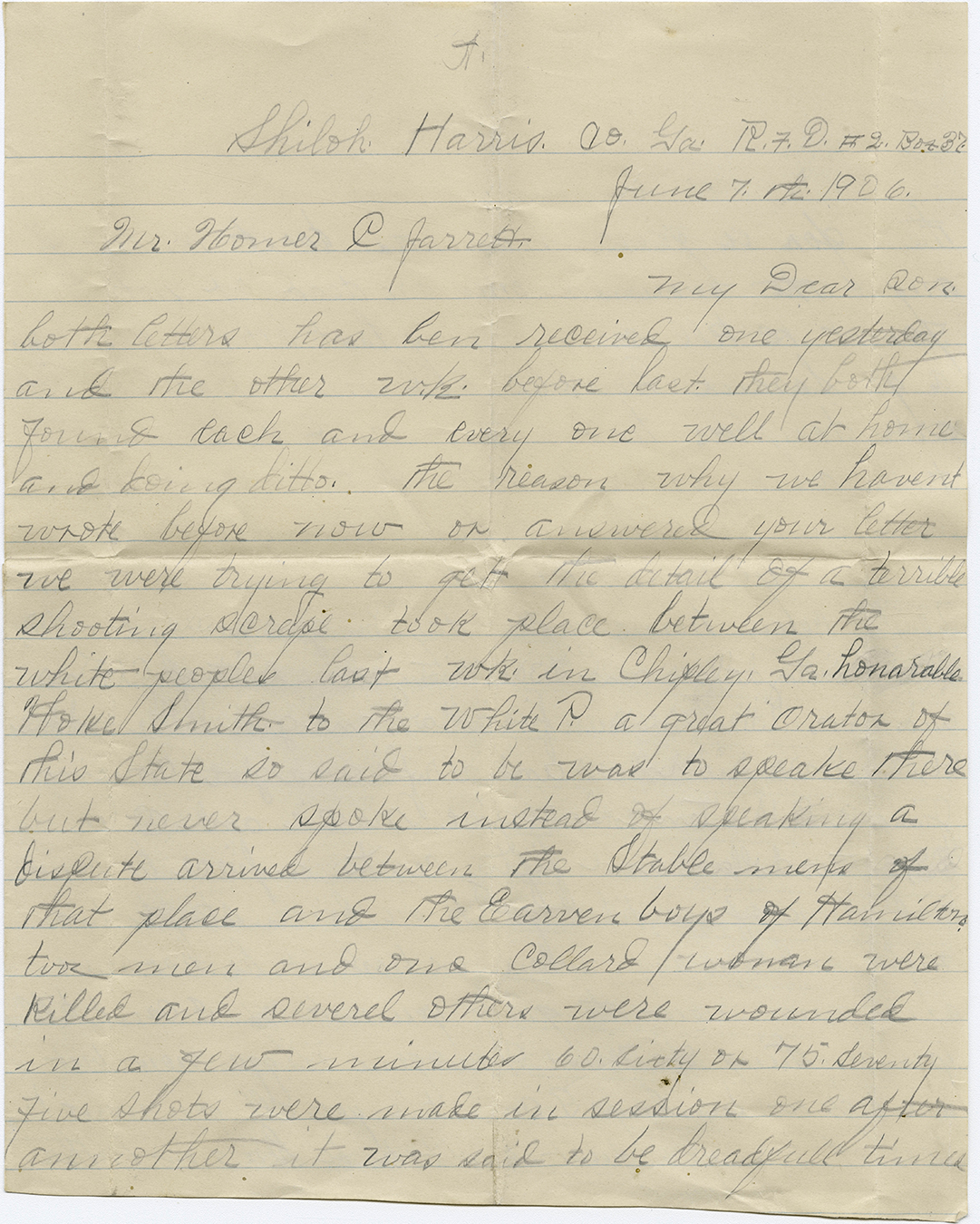
I’m really enjoying learning about the Jarrett family of Shiloh, Ga., and I hope you are, too. I’ll continue now with the third letter in the Massachusetts Historical Society’s small Jarrett family collection, another long one from Julia Jarrett to her son Homer. Below is a complete transcription. As I’ve done before, I’ll retain misspellings but add sentence and paragraph breaks for readability.

Letter from Julia Jarrett
Letter from Julia Jarrett to Homer Jarrett, 7 June 1906

Shiloh. Harris Co. Ga. R.F.D. #2 Box 37

June 7th 1906.


Mr. Homer C. Jarrett

My Dear son

Both letters has ben received, one yesterday and the other wk. before last. They both found each and every one well at home and doing ditto. The reason why we havent wrote before now or answered your letter, we were trying to get the detail of a terrible shooting scrape took place between the white peoples last wk. in Chipley, Ga. Honarable Hoke Smith to the White P. a great orator of this State so said to be was to speake there but never spoke. Instead of speaking a dispute arrived between the Stable mens of that place and the Earven boys of Hamilton. Two men and one collard woman were killed and severel others were wounded. In a few minutes 60 sixty or 75 seventy five shots were made in session one after another. It was said to be dreadfull times there for a few minutes. Dont know if any of the wounded ones are dead or not.

I forgot to tell you in my last letter a few wks. a go Sarand Dowdle old man Barlow Pollard’s daughter had a fit and fell in the fire and burnt both feet. Burnt one [off] and the other cooked. Died day before yesterday. Burried yesterday at 11 OClock.

Uncle John J. Will come home a few days ago. He give Uncle John $60, dollars sixty dollars and a $30,00 thirty dollars suit of Clothes and give little sis $5,00 five dollars, and give little buddie $6,00 dollars six dollars and a rifle and give Cousin Jimmie $10,00 ten dollars give Maxcie and Oler $2,50 two dollars and fifty cents a piece. He come and none of us didnt get to see him. Stayed two nights and one day. When we hard it he had come and gone.

Now the girls you ask of. I cant tell you anything of Miss Imogene Biggs now but in a few Sundays I can tell you all you want to hear of her. You just aught to be here now. Brother Wilson & Charlie both have new top Buggies just broght in about three 3 wks. ago and I am just rideing girls on every hand. We are going to visit Powels Church as soon as we catch up with our works and if she Miss Imogene be there Charlie say he is going to burn her up.

Our Teacher is not a sister to Anna M. Williams. This Willie Williams is the daughter of Henry Williams of Hamilton Ga.

I shall if nothing happen write you a long letter telling you of all the girls and everything at home in short.

Respectfully yours mother

Julia Jarrett.

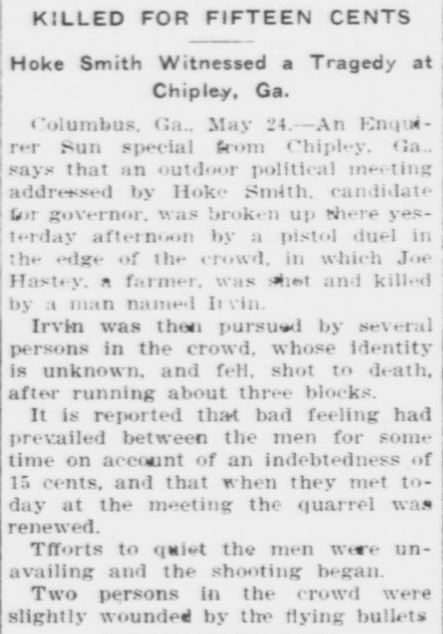
The Jarretts certainly lived in tumultuous times! I’ll start, as Julia does, with the “terrible shooting scrape.” Hoke Smith (1855-1931), a Georgia lawyer and former editor of the Atlanta Journal, was campaigning to be the Democratic nominee for governor. He was slated to give a speech in Chipley (now called Pine Mountain), a town about eleven miles west of Shiloh, but the event was rocked by a violent confrontation between two local men. I found details of the shooting in one of the historic newspapers digitized and presented online as part of the Library of Congress “Chronicling America” project. Here’s an image of the article with a transcription.

Clipping
Clipping from the Ocala Evening Star, 24 May 1906

KILLED FOR FIFTEEN CENTS

Hoke Smith Witnessed a Tragedy at Chipley, Ga.

Columbus, Ga., May 24.—An Enquirer Sun special from Chipley, Ga., says that an outdoor political meeting addressed by Hoke Smith, candidate for governor, was broken up there yesterday afternoon by a pistol duel in the edge of the crowd, in which Joe Hastey, a farmer, was shot and killed by a man named Irvin.

Irvin was then pursued by several persons in the crowd, whose identity is unknown, and fell, shot to death, after running about three blocks.

It is reported that bad feeling had prevailed between the men for some time on account of an indebtedness of 15 cents, and that when they met today at the meeting the quarrel was renewed.

Tfforts [sic] to quiet the men were unavailing and the shooting began.

Two persons in the crowd were slightly wounded by the flying bullets.

The man named Irvin who died that day (incidentally the day before his 23rd birthday) was Virgil H. Irvin. His tombstone reads: “Gone but not forgotten.” The man Irvin killed was 34-year-old Joseph Walter Hastey. I couldn’t identify any other individuals shot and/or killed in the incident, including the Black woman mentioned by Julia Jarrett.

Unfortunately, as it so often does, the cycle of violence continued. On 10 June 1906, a man named Theophilus Theodore Murrah, who served on the governor’s staff, was also shot and killed in Chipley. The Atlanta Georgian reported that the murder was committed by Abb (or Ab) Hastey as retaliation for his brother Joe’s death, but I couldn’t determine what, if anything, Murrah had to do with it. Another Georgia newspaper summed up local sentiment: “The series of tragedies has greatly stirred the Chipley community.”

Hoke Smith went on to win the gubernatorial nomination and the office, though he didn’t serve for long. The online New Georgia Encyclopedia has a good article about Smith that touches on some of his efforts to disenfranchise Black Georgians with Jim Crow tactics. As governor, he would sign an act to add a literacy test and grandfather clause to the state’s constitution. This amendment stood until the passage of the Voting Rights Act of 1965.

Julia continued her letter with another horrifying piece of local news, the death of a woman from fire, but the rest of the content is fairly mundane. Most of the handwriting matches that of the previous two letters, which I’m fairly confident means her son Claud transcribed it for her. (The passage about Imogene Biggs seems to be in his own voice.) However, a few sentences in the middle were written by someone else, possibly another of Julia’s children. The next two letters in the collection are written in this second hand, which you’ll see in upcoming posts.

As I mentioned in my last installment, Homer C. Jarrett moved around a lot. This letter was originally addressed to him at Chestnut Street in St. Louis, Missouri, then forwarded to the Algoma Club, 176 Congress Street, Detroit, Michigan. He eventually settled in Boston, Mass., but he hadn’t arrived here yet. Stay tuned for more.

Aviation History at the MHS

by Laura Williams, Visitor Services Coordinator

November is National Aviation History month, and the MHS is the perfect place to commemorate with our many collection items surrounding the history of flight! While we’ve been stuck on the ground for much of this year, take a look back and see how the history of aviation changed our country and the rest of the world.

Previously featured as one of our ‘Objects of the Month’ on the 100th anniversary of the first flight in 2003 was a series of letters regarding the successful venture into the skies. These letters are housed in the MHS’s Godfrey Lowell Cabot collection, and include correspondence with the civil engineer Octave Chanute, who served as an advisor to Orville and Wilbur Wright. These letters describe the technical properties of the plane and the details of the four short flights that the “Flyer” was able to make in December 1903. You can read more about the MHS records of the first flight and sources for further research here.

Also included in the Godfrey Lowell Cabot collection are photographs of some of the Wright brothers’ first experiments with flight. These images in particular were taken by the previously mentioned Octave Chanute, and besides the Wright brothers’ own photographs these images are the only other known photographic records of the flight experiments. Massachusetts natives Godfrey Lowell Cabot and his brother Samuel were both avid aviation pioneers and did much for the advancement of aviation. Their incredible family history and influence is described in greater detail here.

1903 photographs of the Wright brothers experiments with flight
Photographs by Octave Chanute, October 1903.

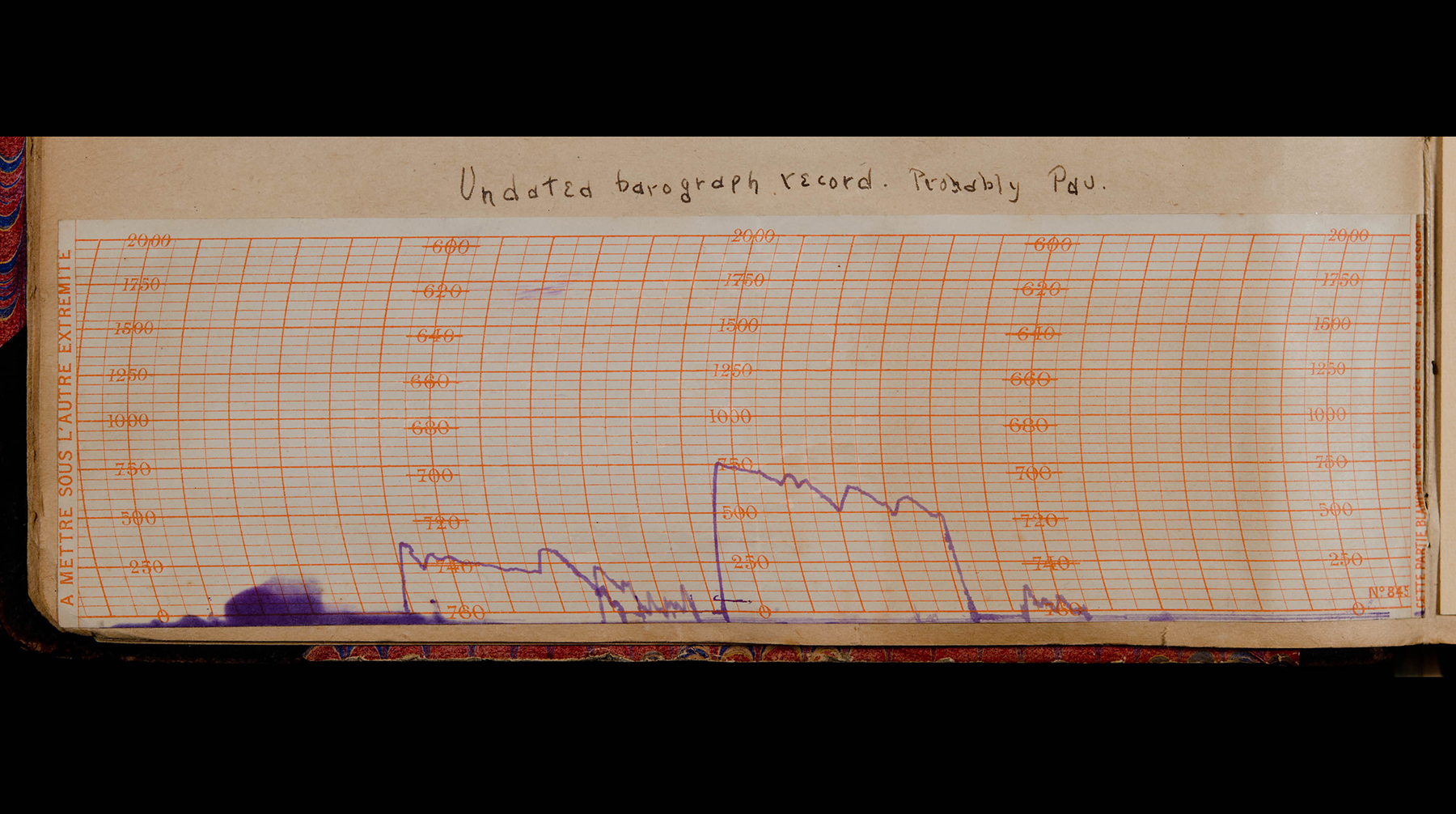
Another interesting piece of aviation history from our collections is this barograph record of a flight circa early 1915 most likely made by Frazier Curtis at a French aviation school at Pau.

Barograph
Barograph record of a flight, early 1915. Handwritten caption: “Undated barograph record. Probably Pau.”

This piece of data reports the height and endurance of a flight which was used to approve pilots at Pau for active duty. This piece was also previously featured as one of our ‘Objects of the Month’, and its full description can be found here. Notably, Frazier Curtis spent much of his life working to form a flying corps of American pilots, rather than volunteering as individuals, in British and French armies. Before his death in 1940, this barographic record was added into a scrapbook of letters, photographs, newspaper clippings and magazine articles that, “documented his unsuccessful efforts to fly for Britain or France, and his small but important role in founding the Lafayette Escadrille/Flying Corps and promoting aviation training and military preparedness at home.”

A Visit with Dr. DeGrasse: The Medical Account Book of Boston’s First Black Physician

by Mia Levenson, Tufts University, Andrew W. Mellon Research Fellow

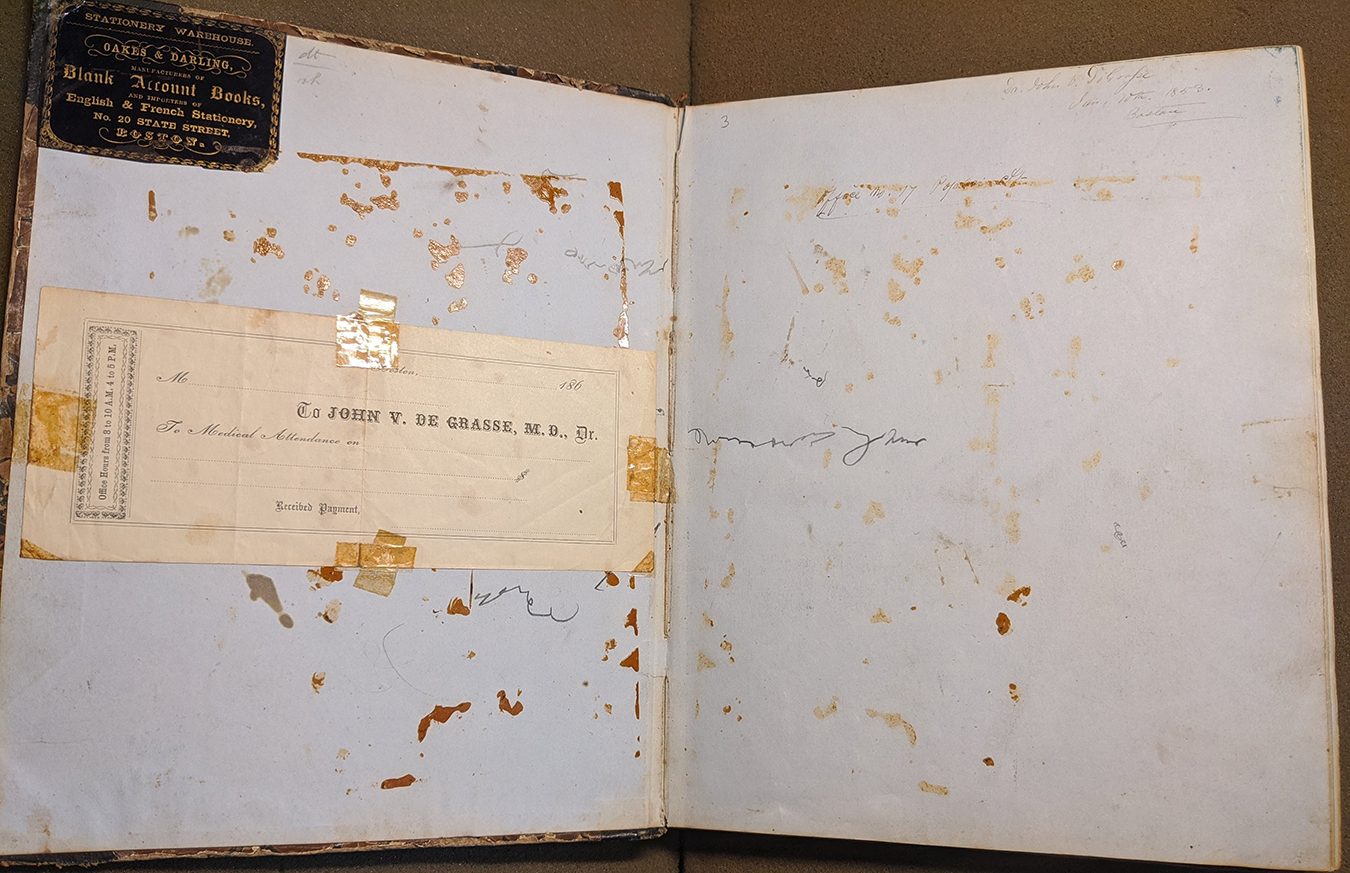
medical account book
John Van Surly DeGrasse’s medical account book

By the serendipitous combination of the pandemic’s limitations and a mislabeled folder, I found myself with scans of John Van Surly DeGrasse’s medical account book, located in the DeGrasse-Howard papers. At first glance, a medical account book seemed like an opaque collection of names, services, and charges. However, I found his records to be filled with nuggets of information about how medicine plays a role in people’s lives, both patient and physician. Through a careful excavation process using census data and city directories, I was able to find bits and pieces about the ways in which one of the first African American physicians educated in the United States served his community.

There has been little written on DeGrasse and his life, but what we do know is that alongside another student of color, he was one of the first Black graduates of the Maine Medical School at Bowdoin College in 1849. DeGrasse practiced in Europe and New York City before coming to Boston in 1852. Two years later, he became a member of the Massachusetts Medical Society and was the first Black physician to be admitted into a medical society anywhere in the nation. His medical account book, which records his services rendered from 1852 to 1857, offers fascinating insight about his practice as the first Black physician in Boston from the very beginning through the contentious years before the Civil War.

While DeGrasse’s account book notes the monotony of his day-to-day work – most of the entries are simply charges for “visit and prescription” – there are also references to the kinds of treatments he would administer. Bloodletting, for example, was a common practice in nineteenth century medicine and DeGrasse similarly used cupping and leeches on several patients. DeGrasse also inoculated many of his patients, particularly in 1854, which corresponds with a massive smallpox epidemic that year. In the mid-nineteenth century, vaccination was a contentious debate, so it is notable that DeGrasse not only believed in its efficacy but administered vaccines to the marginalized communities he served.

While only a few diagnoses are included in his records, what DeGrasse chose to include provides insight into the kinds of diseases he encountered. One John Henry Garrison passed away during a minor cholera outbreak in 1854. Two of DeGrasse’s patients, Mr. H and Lloyd McCabe, were treated for venereal disease. It is unclear why their diagnosis was remarked upon while others were not. Perhaps it noted a potentially chronic issue. Or maybe it explained why they were charged significantly more for their treatment (for instance, for McCabe, DeGrasse charged him $15 for a visit and prescription rather than the usual $1).

Genealogical research gives a closer look into the communities DeGrasse served.[1] Operating out of Poplar Street, he primarily treated patients living in the Fifth and Sixth Wards, a once historically Black neighborhood that is now known as Beacon Hill and the West End, respectively. DeGrasse began his practice treating mainly his in-laws, the well-known Howard family. Interestingly, he treated his wife’s nephew, Edwin Clarence Howard, who would later go on to be Harvard Medical School’s first Black graduate. Peter Baldwin also appears in DeGrasse’s records as one of his first non-relative patients. A noted abolitionist, his daughter, Maria Louise Baldwin, would become a leader of Black education in Cambridge. DeGrasse’s records thus reveals how he served an emerging African American middle class in Boston that was intricately linked to nineteenth-century activism.

Among DeGrasse’s patient base were also a number of African Americans who were born in slave states. One such patient, Benjamin C. Gregory, who was a regular of DeGrasse’s, was born in North Carolina. Historians can only imagine what it must have meant for a formerly enslaved person—whose experiences with physicians were exclusive to plantation doctors who viewed them as chattel rather than people—to be treated by a Black physician.

DeGrasse did not only serve Boston’s African American community. While census data does not always provide information on race, he had multiple patients who were born in Ireland, like William Mellen and Ellen Marshall. While a contemporary physician of color, James McCune Smith in New York City, has been noted as having a multi-racial patient base, it has yet to be acknowledged that DeGrasse had one as well.[2] During his time as an assistant surgeon in the Union Army, DeGrasse continued to serve both white and Black soldiers. After the War, he returned to Boston and continued with his medical practice until his death in 1868.[3]

As historians continue to pan for golden flakes of information about nineteenth-century life, DeGrasse’s medical account book gives small but marvelous glints of one of the nation’s first Black physicians. His medical practice, the illnesses he encountered, and the communities he served offer glimpses into how DeGrasse’s groundbreaking work fit into the constellation of Boston society. His records have been a wonderful reminder for me that the archive is filled with these treasures if only we pause to look.


[1] All genealogical research was done using the 1850 and 1860 U.S. Federal Census and the 1855 Massachusetts State Census, all accessed via AncestryLibrary.com

[2] John Stauffer, The Black Hearts of Men, (Cambridge: Harvard University Press, 2002), 66.

[3] Franklin A. Dorman, Twenty Families of Color in Massachusetts: 1742-1998, (Boston: New England Historic Genealogical Society, 1998), 155-7.

Scary Stories to Tell in the Stacks

Alexandra Bush, Digital Production Specialist

This October, current events dictate that we must keep our tricks and treats indoors. Fortunately, working at the MHS provides more opportunities to get scared than one might think. Read on for some short glimpses into the more macabre side of the MHS and its collections.

Close Encounters of the Winthropian Kind

Portrait of John Winthrop
Detail: John Winthrop, Governor of Massachusetts. Miniature portrait, oil on porcelain attributed to Paul Moschowitz, [19–].
John Winthrop’s journal has long served as a cornerstone of Massachusetts historical scholarship. In it he diligently recorded the events of his life, along with the trials and tribulations of the people of the Massachusetts Bay Colony during the first 19 years of its existence. These stories run the gamut between the mundane and the fantastic and even include accounts of the paranormal—for example, two of the earliest recorded UFO sightings. The first, which occurred in 1639, was relayed to Winthrop by “sober, discreet man” James Everell and two others. It describes a strange light in the sky above the Muddy River:

“When it stood still, it flamed up, and was about three yards square; when it ran, it was contracted into the figure of a swine: it ran as swift as an arrow towards Charlton, and so up and down about two or three hours.”

The three men, who were in a boat at the time, had been paddling downstream when they saw the strange light. After it vanished, they inexplicably found themselves “carried quite back against the tide to the place they came from.” The second event occurred a few years later, in 1644, when three men approaching Boston in a boat at night saw two lights rise from the water, coalesce into the form of a human figure, and walk south. A week later, the lights returned:

“Sometimes they shot out flames and sometimes sparkles… About the same time a voice was heard upon the water between Boston and Dorchester, calling out in a most dreadful manner, boy, boy, come away, come away: and it suddenly shifted from one place to another a great distance, about twenty times.”

Winthrop offers no explanation of the first account, but of the second he postulates that the disembodied voice is that of a man involved in the explosion of a ship in that same area of the bay. Before he died, the man “professed himself to have skill in necromancy.” After the ship burned, his body was the only one that was not recovered.

Another Creepy-Crawly Diary Entry

John Quincy Adams’ lifelong diary is similarly touted as an invaluable account of life in early America as part of a prodigal family. JQA covers a wide range of topics with a uniquely vivid voice. This description of a spider’s nest in his bed is positively shiver-inducing:

“IV: I passed the night without closing my eyes, under a perpetual irritation of the skin over my face and almost every part of the body, which I supposed to be the effect of what is called prickly heat— But on changing my linen this morning I discovered it was caused by a nest of Spiders just from the egg-shell, so small that most of them were perceptible only by their motion. It was like the continual titillation of a feather passing over the skin at a thousand places at once— It was a night of exquisite torture without pain— My linen and body were covered with them. I immediately stripped, changed all the clothes I had been wearing, and took a warm bath at Burnside’s. How this horrible creeping Nation got upon me, I could not exactly ascertain— They had already produced a cutaneous inflammation, and almost an eruption in various places…”

Portrait of a Serial Killer

Thomas W. Piper scrapbook
Detail: Thomas W. Piper scrapbook, 1875-1876. Compiled by Walter L. Sawyer.

On 7 May 1876, Thomas W. Piper, the well-respected sexton of Boston’s Warren Avenue Baptist Church, confessed to the murder of 5 year-old Mabel Young in the belfry of his church. Under the pressure of two days’ worth of intense questioning, Piper also confessed to several cases of arson as well as two earlier crimes; the assault of prostitute Mary Tyner with a blunt object, and the murder of domestic servant Bridget Landregan. Known for his high level of literacy and his trademark flowing black cloak, Piper was spotted fleeing the scene of Mabel Young’s murder by a man identified in the case notes as “Glover.” Later on, when Glover heard the news of the murdered girl, he connected the two events and took the information to the police. Throughout the trial and confession, Piper retained an air of detached apathy, only becoming nervous once he was convicted. He was hanged for his crimes on 26 March, 1876.

Walter L. Sawyer, one of the witnesses to the trial, compiled a scrapbook of drawings, photographs, and newspaper accounts immortalizing the man who would come to be known as the “Boston Belfry Murderer.”

Poor Rebeccah

There’s no scary story behind this item, but several MHS-ers insisted that she belongs on this list. In fact, her provenance is quite idyllic. “Rebeccah Codman Butterfield” is a doll, likely made by a member of the Codman family, part of the Transcendentalist community Brook Farm of West Roxbury, Massachusetts. A note pinned to her petticoat, penned by her donor’s mother, reads:

“My name is Rebeccah Codman Butterfield. I was born in 1841. My mother made me and I was the darling of the Brook Farmers & their children. Brook Farm was called The Transcendentalists. I grew up with the Alcotts, George Ripley, John S [Dwight], Margaret Fuller, Ralph Waldo Emerson, Henry Thoreau, William Ellery Channing, Elizabeth Peabody & Nathaniel Hawthorne–no wonder I look a bit cracked! I was the doll for all the Butterfield children & a beloved member of that brilliant colony.”

How sweet! One of our Reference staff, also a member of the group who suggested Rebeccah for this list, fondly remembers retrieving artifacts under her watchful eye while she was living in the stacks.

Doll named Rebeccah
Detail of doll belonging to members of the Codman and Butterfield families

Hallowed Halls

The MHS’ vast archival collections notwithstanding, our building at 1154 Boylston Street has weathered its fair share of history. Although this is the society’s seventh location since its founding in 1791, we have resided in the current space for over 120 years. A large addition was built onto the MHS in 1970, expanding the office and collection storage space by filling in the middle of the original, L-shaped building. As many in the archives field can attest, old buildings packed with decades of personal papers carry with them an innate weight—a sense of presence. Below, MHS employees recount unexplainable occurrences within our building.

Independently of one another, two MHS veterans mentioned the clear sound of footsteps from the stacks. One recalled conversations with past Operations staff, who swore they heard “measure footsteps back and forth” while they cleaned the building after hours. The other described how the wooden floors (now concrete) used to creak and groan near the areas where the new addition connected to the original building. The footsteps, he said, sounded like an echo of his own as he walked the aisles. He wondered if the sound could be attributed to the previous owners of our various collections, trailing behind the remnants of their legacies. Or perhaps, after nearly 230 years, MHS founder Jeremy Belknap still felt the need to act as steward to his treasured collection.

Stories like this tend to pile up when speaking to Operations staff and other employees who often find themselves in the building at night. Several people remember an event in the early 2000s, when an arm of the crystal chandelier hanging in the lobby crashed to the floor in the dead of night. The CCTV camera footage from just before the arm fell showed the chandelier swinging back and forth as if pushed by an unseen force—the only movement in a completely dark, silent room. When asked, the Art and Artifact Curator had a perfectly sound explanation; after a faulty repair job, “the weight of the crystal beyond the pin and cement join proved too heavy and failed and slowly separated from the end plugged into the chandelier base. The shifting weight was enough that the finely balanced chandelier to start swinging and when the arm fully separated and fell, that made the swinging wider.” As to what caused the arm to separate on that day specifically, there is no answer.

stacks
Book stacks

The other group that probably deals with the bulk of experiences like this is the Reference staff—in other words, the ones who most frequently delve into the stacks. Anyone who has spent time in library stacks can attest to their eeriness. Cold air and row after row of floor-to-ceiling shelving, interspersed with portraits, busts, and mannequins, greet anyone stepping into the MHS stacks. One Reference staff member remembers working one winter, during which she spent long hours completely alone in the stacks:

“For the most part it was just eerie. Being superstitious means I have always kind of viewed the collections as alive to a certain extent, and I just try to treat them with as much respect as possible. Several times while in the stacks I would hear random sounds—sometimes wall tapping or sometimes banging sounds. I recall one time I’d gotten particularly on edge, and I said out loud, “Unless you’re going to come out here and help me with this, give it a rest.” Nothing came out to help, but the noise subsided for a while. And I’m sure I don’t have to tell you about the intense feeling of unease I would get every time I was close to that rocking bassinet. One time I thought I saw it moving. That thing has always given me the creeps. Otherwise not much happened, just a mixture of eerie silence and varied clanging sounds.”

The staff member quoted above would often talk with another staff member about that cradle, but research into it has yielded overwhelmingly normal results. However, the former staff member remembers another encounter:

On a dark, rainy Saturday, she received a paging request from one of the few researchers in the building that day. The requested pamphlet described the 1850s construction of the Hoosac Tunnel, a project so fraught with accidents that the tunnel was nicknamed the “Bloody Pit.” Over the course of the 20+ year construction, a total of 196 workers died in explosions, cave-ins and floods. Haunted by the surprising content of the volume, the staff member ventured to find the pamphlet, tucked with others like it at the very end of a row of rolling high-density shelves. She wheeled the shelves apart, slipped between them, and followed the call numbers to the back wall. There, on an envelope—“The Hoosac Tunnel Disaster.” In spite of herself, she stopped to scan the shelf, choosing another volume and opening it to read a few pages. Accounts of cave-ins and suffocating workers nearly distracted her from the moving shelf behind her, closing by itself due to uneven flooring, until it had nearly crushed her. The uneven flooring argument makes sense, of course, but this was first time the shelves had done this in her several months of work.

Wishing everyone a safe and happy Halloween!

References

John Winthrop’s Journal, “History of New England,” 1630-1649. Pg. 154, 294.

John Quincy Adams Diary, volume 30. 22 August 1818. https://www.masshist.org/publications/jqadiaries/index.php/document/jqadiaries-v30-1818-08-22-p382

COMMONWEALTH vs. THOMAS W. PIPER. 120 Mass. 185. 20 March 1876. https://law.justia.com/cases/massachusetts/supreme-court/volumes/120/120mass185.html

New-York tribune. [volume] (New York [N.Y.]), 09 May 1876. Chronicling America: Historic American Newspapers. Lib. of Congress. https://chroniclingamerica.loc.gov/lccn/sn83030214/1876-05-09/ed-1/seq-4/

World War I and Early 20th Century Knitting

By Angela Tillapaugh – Library Assistant

As the cold winter months are rapidly approaching, I have found myself with the desire to knit all things warm and cozy. And luckily there is a booklet in the collections of the MHS to assist me on this endeavor. “Comforts for the Men” was published in 1917 by Columbia Yarns and provided patterns for garments suggested by the American Red Cross and the British Relief Committee. The booklet gives instructions for the garments, and of course, suggestions for which Columbia brand needles and yarn you should purchase to knit them.

Comforts for the Men
Comforts for the Men, Published by Columbia Yarns, 1917. Collection of the Massachusetts Historical Society.

This type of booklet was common during World War I. There was a large demand for socks and other knitted items for soldiers overseas, leading the American Red Cross to publish patterns for garments and encourage citizens to “knit their bit”. The Red Cross provided knitting materials as well, so long as leftover yarn was returned to prevent any wool from being wasted.[i] Yarn companies used this as a chance to advertise their own products and published their own books with patterns for similar garments. Knitting became a popular pastime in the United States, many people hosted knitting parties and clubs for their communities. The popularity of knitting likely emerged because it gave Americans a hobby that contributed to the war effort and connected them with others affected by the ongoing war.

Our Boys Need Socks
Our boys need sox – knit your bit American Red Cross. United States, [NY: American Lithographic Co., between 1914 and 1918] Photograph. https://www.loc.gov/item/00652152/.
Making a garment from this book was a bit of a challenge due to the vast differences in how knitting patterns are described today. In this pattern book, the yarn suggestions are from Columbia Yarns, which no longer exists. Also, the language for describing how thick the yarn should be in the early 20th century was not universal. And, needle sizes were not universal either. There is no suggested gauge or final sizing details, most old patterns did not provide this information. If the gauge was given, it would be easier to figure out what yarn and needles to use but that is not possible. All of this to say, I was going to have to wing it for this pattern.

Because I had to knit this without any concrete information on gauge, final sizing, or yarn, I decided it would be best to pick something simple. While I always enjoy a knitting challenge, considering the lack of information on materials and the vague directions, I was positive any attempt would yield disastrous results. I decided to try out the knitted wristlets. These wristlets are a ribbed rectangle sewn up the side with some space left for the wearer’s thumb.

Comforts for the Men, page 34
Page 34 of Comforts for the Men.

The directions for the wristlets call for a No. 4 celloid or bone knitting needle and Columbia Worsted Knitting Yarn. The material that the needle is made of is important because the diameter of bone and plastic needles used to increase as the number increased, while steel needles got smaller as the number increased. I checked a few different resources about old knitting needle sizing, and most agreed that a No. 4 knitting celloid or bone needle would equal about a US 4 today. The name of the yarn suggested that it is a worsted weight. I decided to use some leftover worsted weight wool yarn from a previous garment I made. I thought it would be fitting to use up some scrap yarns for this project, using up every bit of good wool was of the utmost importance during the wartime years.

Sample wristlet
Wristlet prior to being sewn up

As per the instructions, I cast on 50 stitches. After knitting a few rows, I realized that these were going to end up far too wide for my hands. These wristlets were probably designed for someone with larger hands, but even with that in mind they seemed pretty big. It is possible they were ending up wide because of the thickness of the yarn I was using; the suggested yarn in the original pattern may have been lighter than modern than worsted weight yarn. This would make sense because a US 4 needle for worsted weight yarn is a smaller needle size than what most modern patterns would suggest. I tried again and reduced the stitch count to 40, and they ended up fitting really well. I worked on these over about three days but it only took a few hours all together to make. While these wristlets are not perfectly accurate to the pattern considering the materials and changes I made, I learned a lot making them. Also I think amateur knitters like me would have put their own creative spins on these patterns back in 1917 as well. I think this is a great project for any knitter looking to add a bit of historical inspiration into your crafting, and I highly recommend trying out old patterns and seeing what comes of it.

completed wristlet
Finished product

[i] Lovick, E., Brodnicki, J., Loven, P., & Doyle, E. (2014). Knitting in WW1. In Centenary stitches: Telling the story of one WW1 family through vintage knitting and crochet (pp. 9-11). Orkney, Scotland: Northern Lace Press.


“We…have had a good time and a bad time”: Letters of a Black Family in the Early 20th Century, Part II

by Susan Martin, Senior Processing Archivist

This is the second installment of a five-part series on the Jarrett family letters at the Massachusetts Historical Society. Click here to read Part I.

Three weeks ago, I introduced you to the Jarretts, a Black family living in Shiloh, Ga. during the first decade of the twentieth century. The MHS holds a small collection of five letters from members of the family to Homer C. Jarrett (1882-1959). The first letter, which I discussed in my last post, was written by Homer’s brother Claud. The second came from his mother Julia.

Julia Jarrett letter
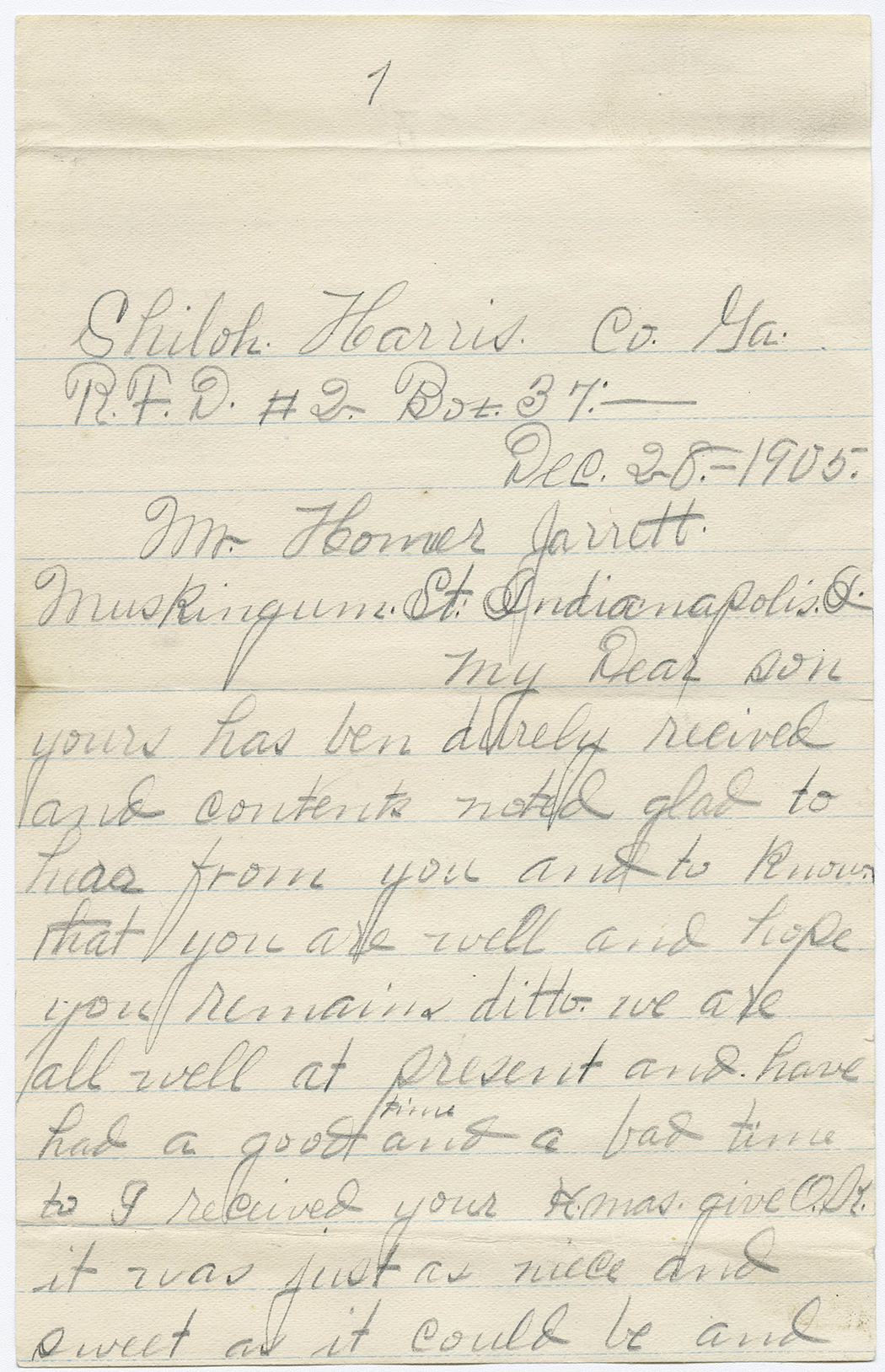
Letter from Julia Jarrett to her son Homer, 28 Dec. 1905

Running to eight pages, this letter is the longest in the collection, and I think you’ll see why. The Jarretts had had a very eventful Christmas. Below is a complete transcription. I will retain misspellings but add sentence and paragraph breaks for readability.

Shiloh. Harris Co. Ga.
R.F.D. #2 Box 37 –

Dec. 28.- 1905.

Mr. Homer Jarrett
Muskingum St. Indianapolis I.

My Dear son

Yours has ben durely received and contents noted. Glad to hear from you and to know that you are well and hope you remains ditto. We are all well at present and have had a good time and a bad time to. I received your Xmas give O.K. It was just as niece and sweet as it could be and I also received yours regeristered letter and contents therein $20 Twenty dollars and for this I send you many thanks. Thank that I cannot express to you as I wish to.

Each one and all sends their love and best rgards to you. Santa Claus come to see me this time brought me a niece parlor water set and a pretty glass pitcher. He or she would have brought more but the boys got in fuss there in Shiloh on Christmas Eve. I Charlie & Wilson had to do around and sturabout to settle it. The way it was Robbert Amos and Grandpa. Robert was drinking about half drunk and Grandpa was the same. He & Robert met bhind Fullers store. Chas & Fletcher J. was already around there and from one word to another Robert grasp Grandpa stick and bgin to shake him and snatch him and jeck him about and cursed him once a twice and the boys spoke to him and he didnt pay any attention to them and Claud come up and spoke to him. He asked Claud who was he talking to. Claud told him he was talking to him and from one word to another he snatched out his knife at Claud and cursed him. Chas and Fletcher grab him and made Claud go away from around there. He did so and after awhile Claud seen him agin and begin to talk with him about it and begin to curse him and catched him in the collar and draw his knife on him. He grasp his arm and snatched alooce from him. Robert grasped a rock in one hand and knife in the other and told him goddam you Ill kill you and started towards him. Claud jumped and grab him and aim to shoot him. He knocked the pistol down and one ball went in the ground by his foot. He grab Robert and snatched him and shot him through the wright side across his back about a inch deep and set him afire. He staggard backwards holding his side saying you have don shot and killed me. I am dying. I am dying. Dont shoot me any more. In that time since Chas & Feck Hawkins & [Square] J. among them made him go on out of Shiloh and afterwards John McDaniel threw a gun on Chas J. and arrested him for curseing and thought he had a Pistol consealed but he did not have no pistol at all.

Aunt Jane & uncle Hawkins is here now sends there best regards to you and says you must write to them. They are well and spent one day with me in the Christmas. Aunt Sallah say thats all wright you didnt send her any santa Claus but she hope [eate] that you did send.

Homer I wish I could send you a SantClaus that I thought you needed. I enjoyed the last of the Xmas very well I but the first to or three days I was barthered up so I couldnt enjoy the Xmas no way I could do. The boys spent the Christmas every where through the settlement.

Close for this time. I will ans yours other letter now in short.

Bye bye yours mother

Julia Jarrett

Eagle-eyed readers of the Beehive may notice, from the image above, that the handwriting of this letter matches that of the last. I assume this means the letter was dictated by Julia but written by Claud. Other letters indicate Julia’s children read correspondence aloud to her. Born into slavery in the 1850s, it’s likely she had never been taught to read or write.

The story told by Julia is a little hard to follow without knowing the identities of all the people involved. “Grandpa” was probably her father Benjamin Jarrett, who was still alive in 1905 but would have been about 90 years old, according to online genealogies. Benjamin and another man, Robert Amos, had both been drinking and got into an argument that turned physical, whereupon Julia’s sons—Charles, Fletcher, and Claud—stepped in to defend their grandfather. The argument escalated as weapons were drawn, culminating in Claud shooting Robert with a pistol.

We don’t get much detail from Julia about the aftermath of the incident, and the sequence of events is unclear to me. It seems Robert Amos survived and was run out of Shiloh. The law descended on the Jarretts in the person of John McDaniel, but it was Claud’s brother Charles who was arrested. Unfortunately, the money spent to “settle” the dust-up meant a meager Christmas for the family.

One of the things I enjoy about doing deep dives into individual items like this is the chance to follow leads and just see where they take me. Here are a few details I turned up:

  1. The initials “R.F.D.” at the head of the letter refer to “rural free delivery,” a postal service for residents living in remote locations. Rural free delivery was still in its infancy at this time, its first routes only a few years old.
  2. Young Homer moved around a lot (in fact, each of the five letters in the collection is written to him at a different location), but he eventually settled in Boston. Most historians put the starting date of the Great Migration, in which millions of Black southerners settled in northern cities, a little later than 1905, but I think it’s fair to call Homer an early part of this wave. This letter is addressed to Homer at Indianapolis, specifically 412 Muskingum Street. There’s a parking lot there now, but what about 115 years ago? I uncovered references to rooms for rent at this address in the Indianapolis Recorder, a long-running African American newspaper.
  3. Historical currency converters online tell me $20 in 1905 would be something in the neighborhood of $600 today!
  4. “Aunt Jane” was Janie Jarrett Hawkins (1858-1916), wife of J. G. Hawkins and Julia’s younger sister. She is buried at the Bethel C.M.E. Church Cemetery in Harris County, Georgia.

Stay tuned to the Beehive to hear more about the Jarrett family!

Nabby and John Quincy Adams: Life Strangers

by Gwen Fries, Adams Papers

Three days before her second birthday, Abigail Adams 2d, or “Nabby,” received the perfect birthday present—a little brother named John Quincy. As she remembered it, the love was instant, and history is on her side. The first mention of John Quincy Adams in the Adams Family Papers is an account given by Abigail of a two-year-old Nabby rocking a two-month-old JQA to sleep, singing, “Come pappa come home to Brother Johnny.”

During the next decade the siblings lost two little sisters, gained two brothers, and lost their father to the Continental Congress in Philadelphia. Yet, in the midst of revolution and war, they still found time to be children—trading books, going fishing and ice skating, taking long walks, and gossiping about their cousins. Then in February 1778 their father was sent to Paris, and he decided to take ten-year-old John Quincy with him.

Over the next six years, Nabby felt the loss of John Quincy’s company severely. Nabby wrote to her brother, “I cannot bear the idea of growing into life strangers to each other,” adding, “Indeed, it sometimes seems to me as if you were lost.” To her cousin Elizabeth Cranch, Nabby admitted, “I do not talk upon the subject, but there is not a day passes over my Life but this subject occupys my thoughts, and disbelieve it if you please, I can seldom reflect upon it without tears.”

Abigail Adams Smith
Miniature of Abigail Adams Smith

After years of waiting, Nabby and her mother set sail for London to reunite with John Quincy. On 30 July 1784, nineteen-year-old Nabby was in the middle of a letter to her cousin when she wrote, “This moment a servant tells me that my Brother has arrived and has stoped at the next house to dress. Why has he done this. He knowns not the impatience of his sister.” Abigail later related: “His sister he says he should have known in any part of the World,” and added, “Were I not their Mother, I would Say a likelier pair you will seldom see in a summers day.”

Less than a year later, JQA had to return to the United States to prepare for Harvard. Nabby lamented, “He is gone—alas to my sorrow—for I lost in him all the Companion that I had—and it is not possible his place should be supplyd.”

Determined to be “life strangers” no more, John Quincy and Nabby kept up their correspondence, writing uncommonly long letters to each other in which they covered all topics—particularly gossiping about the people with whom they came into contact, royalty included. Nabby and John Quincy shared a somewhat snarky sense of humor, and their letters were considered too candid even for John and Abigail’s eyes. Abigail wrote to her son, “Your Sister has written you so many pages that I suppose she has not left me any thing material to write to you but. . .I am very rarely honourd with a sight of any of them.”

Nabby told JQA of her daydream that she would settle in New York near her husband’s family “and have you one of these Days come as a Member from the Massachusetts to Congress. We should be quite at home again.”

A shifting capital dashed Nabby’s daydream, but John Quincy and Nabby never became strangers again. JQA was a devoted uncle to Nabby’s children, and Nabby nursed John Quincy’s wife through bouts of illness and difficult childbirths.

Their 46-year friendship confirmed Nabby’s prediction that she made in the same letter where she fretted they were becoming strangers: “There is no higher pleasure, no greater happiness, than a family bound by the ties of love, and cemented by the bonds of affection, where each for the other feels more than for himself, and where the chief end and aim is to render each other happy: this I wish may be our situation; it will; and the advantages arising will be mutual.”

“The peoples had fine times”: Letters of a Black Family in the Early 20th Century, Part I

by Susan Martin, Senior Processing Archivist

Tucked away in the stacks of the Massachusetts Historical Society is a small but fascinating collection of letters of the Jarrett family, a Black family living in Shiloh, Georgia. The collection dates from 1905 to 1909 and consists of five letters written to Homer C. Jarrett, who moved frequently but eventually settled in Boston. Each letter contains so many interesting details that I’d like to discuss them individually in a series here at the Beehive.

Claud Jarrett letter
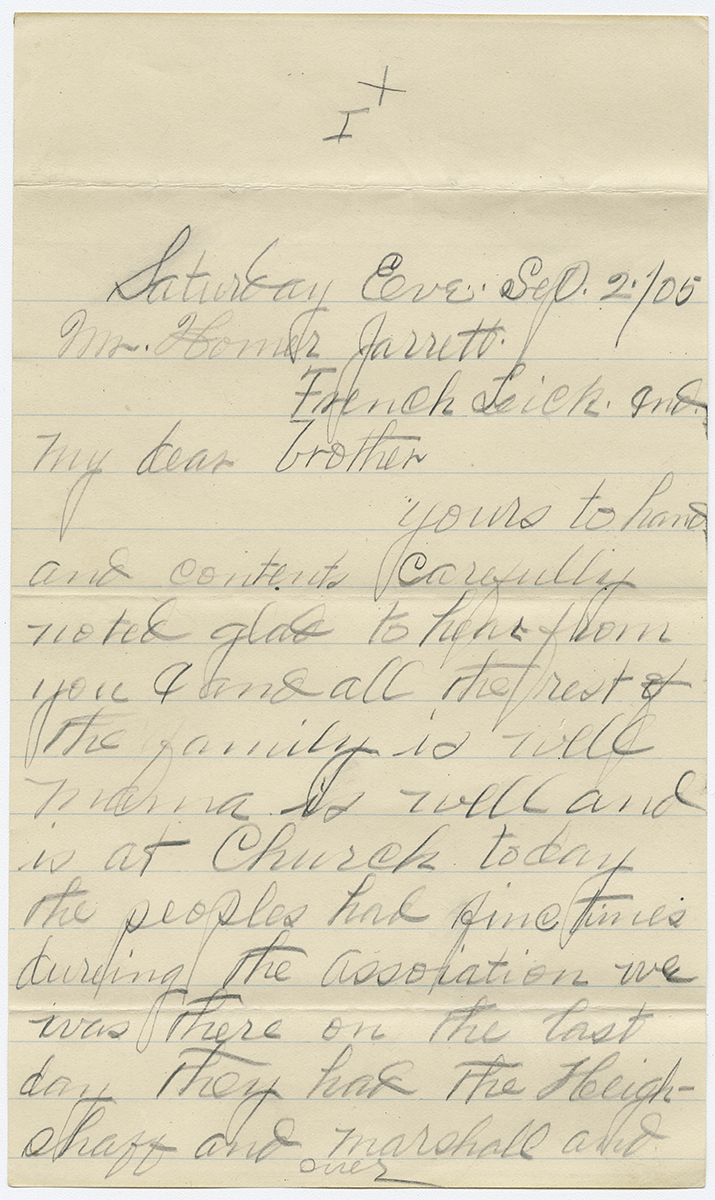
Letter from Claud Jarrett to his brother Homer, 2 Sep. 1905

The first letter in the collection was written by Homer’s brother Claud Jarrett at Shiloh. Below is a complete transcription. I will retain misspellings but add sentence and paragraph breaks for readability.

Saturday Eve Sep 2/05

Mr. Homer Jarrett
French Lick, Ind.

My dear brother

Yours to hand and contents carefully noted. Glad to hear from you. I and all the rest of the family is well. Mama is well and is at Church today.

The peoples had fine times dureing the Association. We was there on the last day. They had the Heigh-shaff and marshall and three or four depertised White men from Hamilton out there. It was a hundred gal. of whiskey drinked or more and just thousands of peoples were there and not a cross word among them no way. We had one deligate that was Mr. [Elax] Joes of Columbus Ga. the richest negro so said to be in Columbus.

The babe of Wilson that died it was onely 7. seven months old. It was unhealthy and sickely from its birth untill it died. Born Feb. the 11- 1905.

Yes I re’cd the paper you sent me from St. Lewis mo. It was O.K. That train was running sum before it rected. They need not do all that. If I should live and can restore good health I am going to fire the lard out of sume locomotive Engine some day before long.

I have just quit picking cotton. We have out a bale and a half. Sold one bale last saturday at 10 1/8 percts weight even 500 lbs. [illegible] is here now come friday before the third Sunday and is now working with Buck and aunt Sallah. Our little big [hed?] Burt is in Ala. some whare. I re’cd a letter from him the first of the year. He was in Curtisy Ala. I dont know if he is there now or not.

Grandpa and lizzie is well. She is in School now. We have an Independent School now for two 2 months. She is progressing very fast in her studies come home from School ever evening and pick a handle Basket full of cotton. I ben averign too hundred for the last three or four days. It is now field time and I must go.

By by yours brother

Claud Jarrett

The envelope is addressed to Homer at French Lick, Indiana, specifically the “French Lick Hotel D. room,” which probably means Homer worked in the hotel’s dining room. French Lick, known for its sulfur springs, was a newly booming resort town in southern Indiana. In fact, according to census data, the population of the town increased seven-fold between 1900 and 1910, from just 260 people to 1,803.

Sadly but unsurprisingly, it’s been difficult to find a lot of information about the Jarrett family. The matriarch, Julia Jarrett, was born into slavery in the 1850s, and it’s likely many of the people mentioned in this letter were her children. My research indicates she may have had as many as 16. Among them were Homer, born in 1882; Claud, born in 1885; Wilson, the one who lost his child; and Elizabeth, or “Lizzie,” about seven years old when this letter was written.

It’s also been difficult to identify many of Claud’s references. Because the collection contains only five letters, often with large gaps of time in between, I don’t have a lot of context to help. The best I can do is make educated guesses.

First, the Jarretts farmed cotton, so the “Association” was possibly the Southern Cotton Association, an organization established in 1905 to regulate the production (and therefore raise the price) of the cotton crop. The association held state conventions across the South, and it was probably one of these conventions that Claud was describing.

I hoped to identify the man Claud called “the richest negro so said to be” in Columbus, Georgia, delegate to the association, but I’ve hit nothing but dead ends. The name is difficult to discern. I also couldn’t find the newly opened “independent school” Lizzie attended. These two details have been particularly frustrating, but I’ve been in touch with archivists and historians in Georgia and will update the Beehive if I learn anything more. Feel free to leave a comment if you have any leads!

This letter is the only one from Claud in the Jarrett family letters; the other four are from Julia. When he wrote to his brother, Claud was 20 years old and apparently had dreams of becoming a railroad engineer. I like the way he put it: “I am going to fire the lard out of sume locomotive Engine some day before long.”

I hope you’ll come back to the Beehive to read more about the Jarrett family in the coming weeks. If you get a taste for more, the University of Georgia holds a collection of Homer C. Jarrett letters written between 1888 and 1948.

Wine, Wealth, & Revolution

By Megan Watts, MHS Digital Team summer intern

Many things have served as symbols of status, political leanings, and wealth throughout United States history. One of the most iconic symbols of status is alcoholic beverages. The history of early America and British North America is littered with empty bottles and full glasses. Ale flowed freely in taverns full of sailors and artisans. Rum was often cheap and plentiful in New England, the runoff product of sugar manufacturing made possible by the labor of enslaved persons. Failed vineyards could be found all over the British North American colonies in the 1600s and 1700s.[1]

However, one drink that holds a special place in colonial and American history is Madeira wine. Commonly referred to as “Madeira,” this Portuguese red wine has endured throughout the centuries. In the 1700s, it was consumed by people from different social classes and regions of North America. Madeira was popular because of its international origins (European goods were in high demand at that time), but also because it was an economical choice. Its unique creation process allowed it to survive transatlantic trips easily and remain unspoiled for long periods after purchase.

Wine shipped from Madeira was diluted with “neutral grape spirits,” then packed away in the bottom of ships. In his book Colonial Spirits: a Toast to Our Drunken History, Steven Grasse discusses how the “sweltering conditions” of transatlantic travel acted as an integral part in the Madeira creation process, which required an oxidization process in high heat.[2] This heating and oxidation process made it possible for Madeira to stay unspoiled and palatable for long periods of time. In addition, Madeira was imported tax free to the British North American colonies, a result of a long-standing political agreement between Portugal and England.[3] Thus it was the perfect practical choice—an imported wine with no taxes and a long shelf life, perfect for merchants and consumers alike.

Madeira is a significant example of the economic, social and political ties which linked the British colonies and Europe. “The invention of Madeira wine was both an economic act—carried out in response to commercial motives—and a social act—not invented by a solitary “genius” but by an Atlantic network of producers, distributors, and consumers in intense conversation with one another.”[4]

At the end of the 1700s, Madeira became more than just a symbol of transatlantic trade, but a symbol of the American Revolution. Madeira was one of the products that British authorities attempted to collect expensive import taxes on in 1768. When a ship packed with the wine was seized by customs officials, its owner, John Hancock, refused to pay. The ship was later burned by colonists in an act of defiance.[5] This incident, and several other events related to taxation contributed to the socio-political upheaval in Boston. Madeira never lost its cultural significance. By the 1800s it served as one of the ultimate signifiers of socioeconomic status, the choice of powerful politicians, wealthy elites and influential socialites. Madeira thus was the one of the only beverages which mixed science, transatlantic shipping, privilege and coincidence.

—-

Megan Watts is a second-year history M.A. student at Simmons University. Megan enjoys researching anything related to history. However, her most recent research has focused on colonial America- particularly American slavery. This past summer, she completed an internship with the Digital Team at MHS. During this internship she worked with the Harbottle Dorr newspapers and created metadata for some of the organization’s online resources.  Currently Megan is completing another internship at the Gibson House Museum in Boston and working at the Paul Revere House.

Sources

Grasse, Steven A. “Wine.” Essay. In Colonial Spirits: a Toast to Our Drunken History, Being: a Revolutionary Drinking Guide to Brewing and Batching, Mixing and Serving, Imbibing and Jibing, Fighting and Freedom in the Ruins of the Ancient Civilization Known as America, 69–86. New York: Abrams Image, 2016.

Hancock, David. “Commerce and Conversation in the Eighteenth-Century Atlantic: The Invention of Madeira Wine.” The Journal of Interdisciplinary History 29, no. 2 (1998): 197–219. https://doi.org/10.1162/002219598551670.

[1] Steven Grasse, Colonial Spirits: a Toast to Our Drunken History, New York: Abrams Image, 2016. 69-71.

[2] Ibid, 75.

[3] Ibid,75-76.

[4]David Hancock, “Commerce and Conversation in the Eighteenth-Century Atlantic: The Invention of Madeira Wine”, The Journal of Interdisciplinary History, 29, no. 2 (1998): 197–219. https://doi.org/10.1162/002219598551670. 199.

[5]Steven Grosse, Colonial Spirits: a Toast to Our Drunken History, Being: a Revolutionary Drinking Guide to Brewing and Batching, Mixing and Serving, Imbibing and Jibing, Fighting and Freedom in the Ruins of the Ancient Civilization Known as America (New York: Abrams Image, 2016),  76

2020 John Winthrop Student Fellows Caroline Johnson & Olivia Chickering: Researching the History of Boston’s Responses to Epidemics

by Olivia Chickering, Caroline Johnson, and Kate Melchior

Every year, the MHS selects one or more high school students for our John Winthrop Student Fellowship. This award encourages high school students to make use of the nationally significant documents of the MHS in a research project of their choosing. Students perform historical research and create a project (usually an assignment for class) using materials at the MHS, both in our archives or digitized online. This project can be something assigned in a class, a National History Day project, or something of the student’s invention! Both student and teacher receive $350 to support their research. Applications for the 2021 student fellowships are due on February 18, 2021. Learn more and apply!

This year, John Winthrop Student Fellows Olivia Chickering and Caroline Johnson, as well as their teacher Dan Ritchie of Marblehead High School, have been researching the evolution of Boston medical practices and the city’s response to epidemics throughout history.  Here they explain their plans for their research project and what they hope to find in the MHS archives.

John Winthrop Student Fellows Caroline Johnson and Olivia Chickering

Hello members of the historical community, we are Caroline and Olivia and we are honored to be one of the recipients of the John Winthrop Student Fellowship. The John Winthrop Fellowship offers students the opportunity to conduct research using historical documents found at the Massachusetts Historical Society. Before we begin explaining our topic of research, we’d like for you to get to know us a bit more! We are both rising seniors at Marblehead High School that share a passion for history. We are also intrigued by the development of medical practices over time. With both of these interests in mind, we decided to focus our research on the evolution of medical practices used in Boston throughout the centuries.

Today Boston is highly regarded as one of the best cities for medical care. Mass General and Boston Children’s Hospital are both top tier institutions that attract patients from all over the world. Initially, we intended to focus our research on how Boston’s history has contributed to its current position as a leading city in the medical field. However, this topic was far too broad as there are so many various types of doctors and medicine. This topic would have required extensive research in order to connect every single medical development and historical event. We decided to narrow our topic and focus our research on something more specific. The recent global outbreak of COVID-19 has led us to look more specifically at Boston’s response to pandemics and epidemics throughout history. The state of the world right now is one that many people are not acquainted with. Never before in our lives have we experienced a health crisis that has caused such drastic changes in all ways of life. Using our own experiences, recent sources, and the archives at the MHS, we will be able to research Boston’s response to the smallpox outbreak and the Spanish Flu of 1918. Then we will be comparing the city’s responses to these earlier pandemics to the current response to COVID-19.

The MHS has a wide selection of documents in their archives that we are very excited to use while conducting our research. Using ABIGAIL, the library catalog for the Massachusetts Historical Society, we have been able to select some sources that we would like to use. The first of which is an anonymous letter written by an individual living in Boston during the smallpox epidemic. This document will give us an idea of what epidemic life was like during the eighteenth century. Another source we’ll be exploring is a smallpox statistic for Boston to determine how many people were infected, and how many of those infected people died. We will also be using a medical advisory from a Health Commissioner on the prevention of the influenza virus, written during the 1918 outbreak. This source will allow us to compare the prevention methods used in 1918 to the methods used today to slow the spread of COVID-19.

While we will not be conducting this research exactly how we initially intended, we are looking forward to exploring the digitized archives and learning about pandemics while in the midst of one. Hopefully, we will be able to uncover information about how the outbreaks of the past shaped Boston’s response to the current health crisis.