by Susan Martin, Processing Archivist & EAD Coordinator
As a processing archivist here at the MHS, I enjoy the opportunity to play detective, to research a newly acquired but unattributed manuscript and try to identify its author. I’ve described some of these “investigations” in previous blog posts: Benjamin Smith, Louisa Appleton, and one of my favorites, Eliza Cheever Davis.
These discoveries are very rewarding. Of course it’s satisfying to solve a mystery, but I also appreciate the chance to uncover some of the fascinating men and women who have been lost to us over time and to ensure they’re part of the historical record.
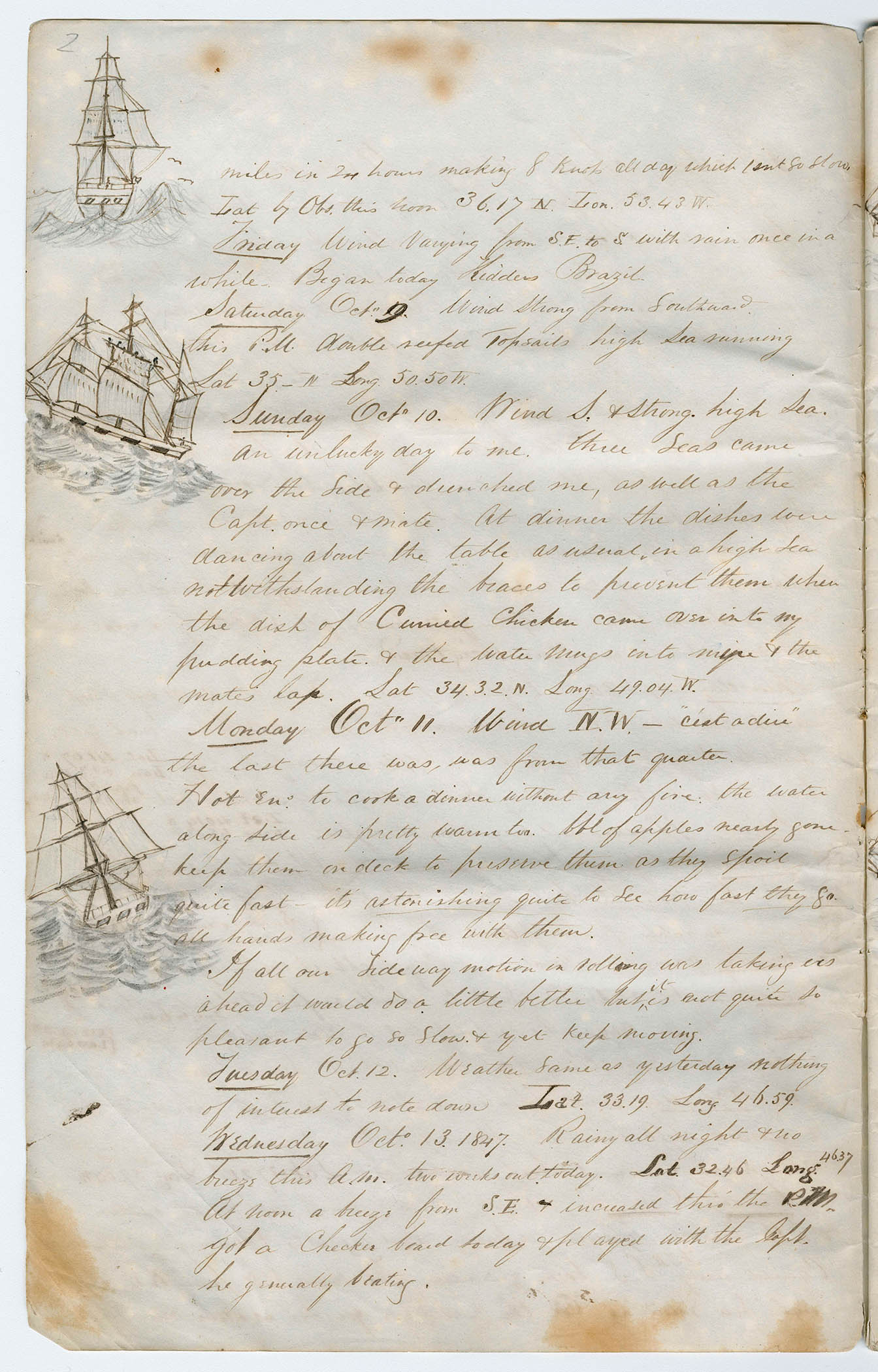
My mission this time was to identify the author of a journal acquired by the MHS earlier this year. The thin, paper-bound volume, a kind of ship’s log kept from 1847 to 1848, describes a round-trip journey between Boston and Rio de Janeiro on the bark Paulina. Only 34 pages long, the journal includes a lot of detail—not only navigation information, such as latitude, longitude, wind direction, course, etc., but also descriptive entries and some beautiful drawings in the margins.
Page 2, showing entries from 7-13 October 1847
The journal didn’t come to us as part of a family collection, so I didn’t have the help of context to narrow my search. All I could determine at first was that our author was most likely male, apparently young, and since he wrote about the ship’s captain, mate, and steward…well, he wasn’t one of them. A search for information on the Paulina came up dry, so I went back to the text for clues.
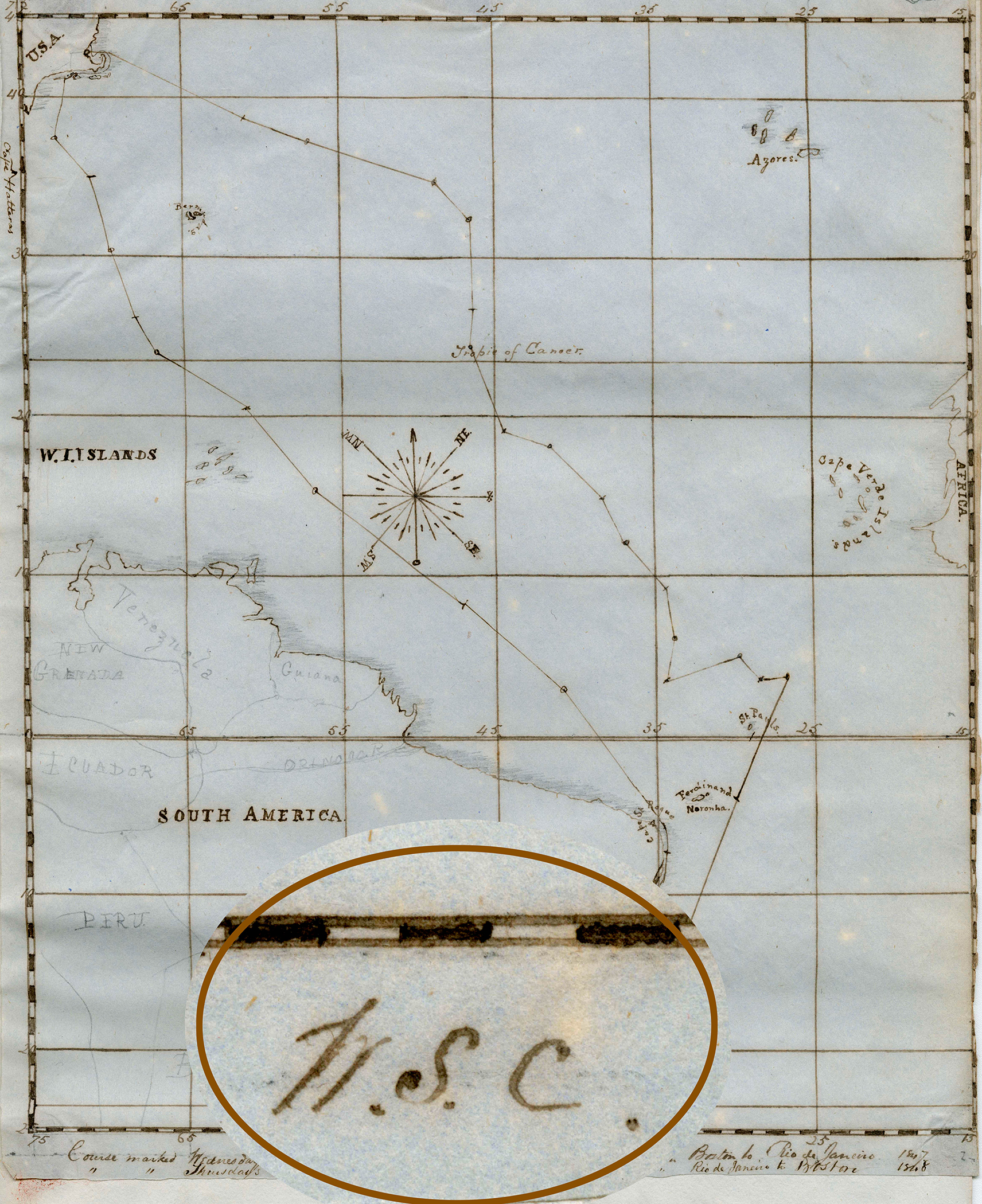
A close reading turned up a few entries containing the letters W.S.C. First this one: “This P.M. painted Fanny’s trunk W.S.C. instead of her initials.” Then two annotations about halfway through the volume, in the same hand but apparently written at later date, followed by “W.S.C.” A map of the Paulina’s route was also signed this way.
Page 33, with attribution enlarged
These letters were almost certainly the initials of our author. I was getting closer. If nothing else, I could at least include “W.S.C.” in my catalog record for the journal and hope that some intrepid researcher would someday make the identification for us. But I wasn’t giving up yet.
I stumbled on a few other tantalizing details in the text. Someone named Greely saw the ship off when it sailed—a brother or friend, maybe? Fanny, as mentioned above, had been the previous owner of the trunk our young man now used. There was also a reference to a brother Jim.
The author did leave me one very specific biographical tidbit on 15 February 1848: “Birthday – The last of my Teens.” So he was 19 years old, born on 15 February 1829. How to find someone with just their initials, birth date, and a few first names of friends or siblings?
Finally, the coup de grace. When the Paulina returned to Massachusetts, our author wrote, “Mailed letter home – first thing I saw on going ashore was an old paper of Feb 25 saying the T. B. Curtis house 45 Mt Vernon St had caught fire but was ext[inguishe]d with little difficulty.” Could this have been his home? Did the “C” stand for “Curtis”?
A quick online search for “Curtis Boston 1829” (our author’s birth year) didn’t lead me to a genealogical website, as I’d expected, but straight to the guide for one of our very own collections, the Curtis-Stevenson family papers. Listed in the biographical sketches is none other than William Stevenson Curtis, born in 1829!
The other data points lined up. William was the son of James Freeman Curtis and his wife Isabella Pelham (Stevenson) Curtis. William’s seven siblings included brothers James and Greely and a sister Frances, or Fanny. The home on Mount Vernon Street that had caught fire belonged to William’s uncle, Thomas Buckminster Curtis.
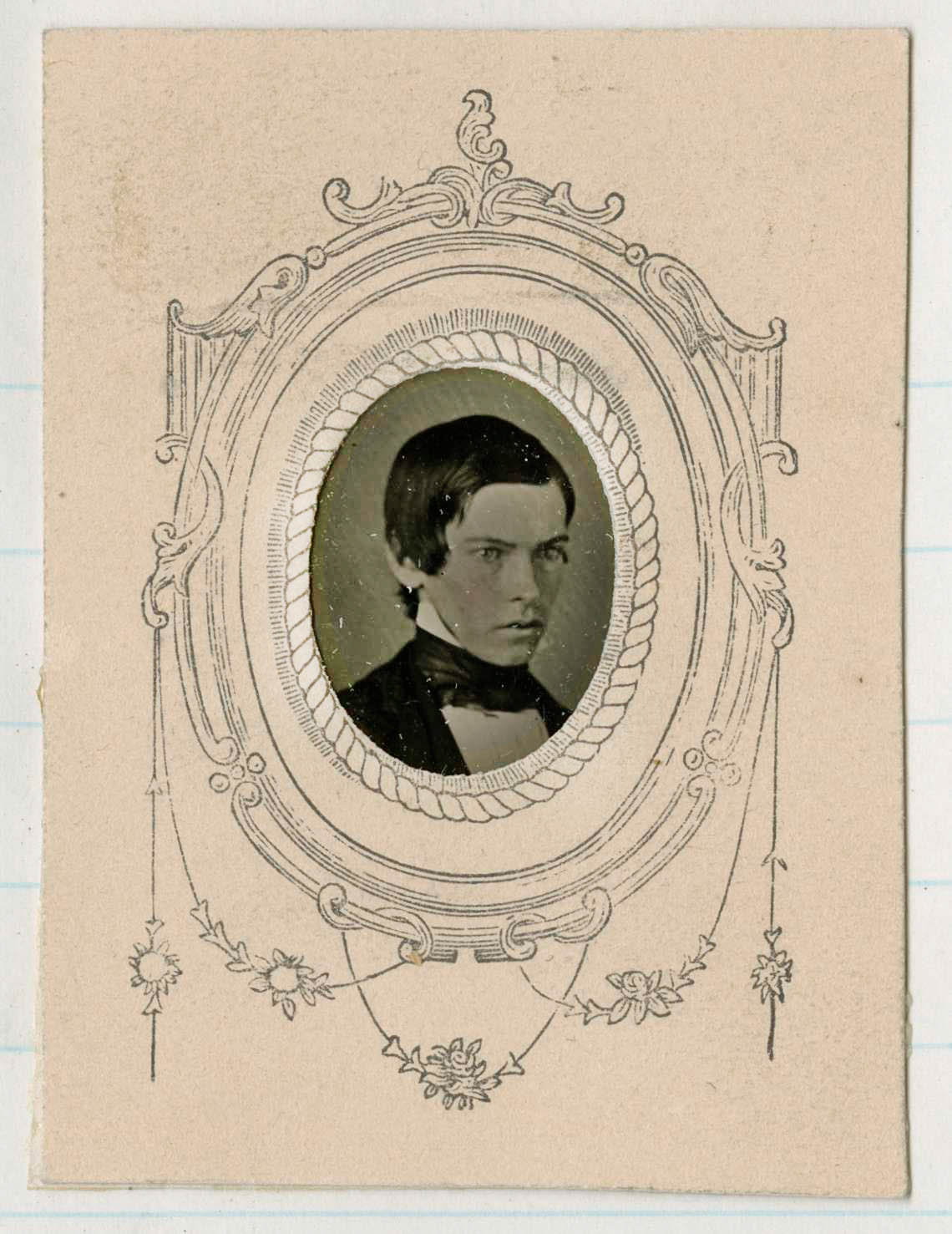
All I had to do was head one floor up and check the Curtis-Stevenson family papers to confirm my attribution once and for all and to look for any additional items related to William. I found an amazing family history, written by his sister Isabella. She not only included descriptions of relatives and family anecdotes, but illustrated her volume with photographs, letters, you name it. It was here I got my first glimpse of William Stevenson Curtis, in this small tintype.
Tintype of William Stevenson Curtis, unknown date
Isabella filled in the last few details of William’s story. Willie (as she called him) served as the Paulina’s supercargo, an agent of the ship’s owner responsible for overseeing the loading, unloading, buying, and selling of cargo. An impressive position for someone so young.
Sadly, I learned that William died in May 1849 at the age of 20. He was on another voyage when he died of what Isabella called a “wasting fever” and was buried at sea. His uncle Charles Pelham Curtis wrote to a friend that he had never seen “a more loveable person” and called William’s death a “bolt [that] had been shot” and “a sharp wound” to the family.
Isabella wrote this loving tribute to her brother almost 50 years after his death:
He was the beloved of all, so gentle & just, so helpful and self-sacrificing. He was never robust, having a severe illness in childhood, which left him delicate. This want of health, with its consequent limitations, he bore in the most patient, cheerful way. His young life was made up of acts of thoughtful care for others, and of a most tender devotion to his Mother. “Brother Ibid,” his little sister Mary called him, because he is always the same.
For the catalog record of the William Stevenson Curtis journal, click here.
Today, we return to the diary of George Hyland. If this is your first time encountering our 2019 diary series, catch up by reading the January, February, March, April, May, and June 1919 installments first!
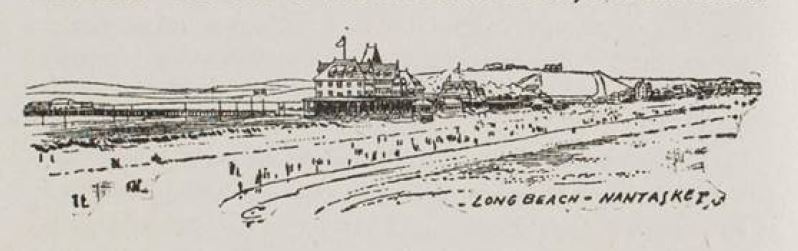
Image from Tourists Guide to Down the Harbor, Hull and Nantasket, Hingham… (1901).
July 1st, 1919 marked the beginning of Prohibition in the United States. “Last night was celebrated in Boston by drinking plenty of whiskey, rum, and other liquors,” George wrote, going on to describe an episode of domestic violence in Worcester that ended in a murder-suicide. The eighteenth amendment to the U.S. Constitution — which banned the production, transport, and sale of “intoxicating liquors” — would remain in effect until repealed in 1933. George’s labors continue through the heat of July and he spends his days mowing, weeding, pruning, picking fruit to sell, and other tasks. On the 4th he goes to hear military bands perform at Egypt Beach in Scituate; on the 12th he travels by train and steamer into Boston to pay a visit to the bank. Charmingly, he writes that “last time I was in Boston (May 6) some sparrows were near the Pier Rowe’s Wharf trying to find something to eat — I gave them a few crumbs of bread. Today I bought a loaf at the […] store and when I arr. at the pier I untied the package and cut off some bread and put it where the birds could find it.” He continues to play almost daily on the guitar.
Enjoy another month with George as we continue our journey through 1919.
* * *
PAGE 335 (cont’d)
July 1. Worked 5 hours for Mrs. Caroline Litchfield mowing and trimming grass on her place – 1.25. Walked up there — rode (ret.) 2 miles with Ellery Hyland in auto. Had dinner and supper at E. Jane Litchfield’s. Hot weather tem. About 66-87. W.N.W. The sale or making of whiskey, rum, or any liquor is forbidden in this country beginning to-day. Last night was celebrated in Boston by drinking plenty of whiskey, rum, and other liquors. 412 persons arrested in Boston for drunkenness — 30 of whom were women. Fighting, murders and other crimes. This was the same in other places in this whole country. One man in Worcester, Mass. pounded one of his children — a girl — broke her jaw, knocked out her teeth, also abused his other small children, then killed his wife, then k[illed] himself. Murders in other places.
2d. Mowed in a lane and around his house — 5 hours for Charles Bailey (brother of Mrs. Emma Sargent) — 1.50. Also mowed Mrs. Eudora Bailey’s lawn and trimmed around the house – 1 1/4 hours — […] Also picked about 15 boxes of currants at home (James place) sold one box to Mrs. M. G. Seaverns, and 1 to Mrs. Ethel Torrey. Warm weather, muggy, W.M.W. and N.E. tem. 66-86. Played on the guitar 1 hour in eve.
3d. Worked 5 hours for E. Jane Litchfield — 1.25. Had dinner there. Mowed grass, hoed garden, and cleaned out the large closet. Walked up there — ret. rode ¾ mile with Everett Marcus in auto. In eve sold 12 boxes of currants to J. H. Vinal — keeps store and market. Very hot weather tem. 85-102 in shade. Clear. W.N.W.
4th. Staid [sic] at home. Weeded my carrots, parships, and other plants. Also picked 10 boxes of currants — sold 2 boxes to some people in large auto. Very hot weather tem. 85-102 in shade. In eve went to a great celebration at Thomas W. Lawson’s place, Egypt. Had 2 large military bands — from Brockton. Milo Burke’s band divided and enlarged one band (about 35) playing (in a concert) and one band playing in a very large Hall — for dancing (about 35 players) Milo Burke dir. of the band in the hall. Had cel. all day. Welcome to the 162 soldiers and sailors ret. from the Great War. 10 lost in the war. About 10 w[ounded]. Motion pictures in eve. Saw several men whom I knew — were there the same year that I worked there. The first person I saw when I arr. there were T.W. Lawson, his daughter Jean, and Capt. Burgess A. Edwards […] late of Battery B. 302d field artillery — in the Great War (married Miss Jean C. Lawson) and Gov. Samuel W. McCall (War Gov.) They all got into an automobile and rode to Mr. Lawson’s house — 1 mile from the Egypt end of the place. In eve., the 13th Mass. State Guard band played on the lawn — […] Academy, and the 14th Rgmt. M.S.G. played in the dance Hall. B. Milo Burke, Director.
PAGE 336
July 5th. Worked 1 hour for J. H. Vinal getting good from freight car and piling them in store — 25. Picked 3 boxes of currants. Sold J. H. Merritt 8 boxes, 96, J. H. Vinal 2, Mrs. Torrey 1 — total 132. Also worked in my garden. Very hot weather — tem. 87-103 in shade. I never saw the mercury in the glass at 103 (102 highest I ever saw it until this aft. W.W. tem. 100 to 102 nearly all aft. 103 for about 20 min).
6th. Sun. Thunderstorm N. of […] between 4 and 5 A.M. W.N.E. with rain. Another one (short) about 11 A.M. and for a few min about 8 P.M. rain in eve. tem. To-day about 72. This place is close to the State Road and automobiles are passing here all the time. 7 or 8 a min. 40 passed here in 5 min this forenoon.
7th. Dusted rugs 3 hours for Mrs. […] Ellis Bullard — 90. Mowed grass 2 hours for Mrs. Ethel Torrey — 60. Picked 1 box of currants (sold to Mrs. Torrey) worked in my garden 3/4 hour in eve. Played on the guitar 1 1/4 hours. Clear. Cool W.N.E., par. clou. late in eve. tem. To-day about 62-77.
8th. In forenoon mowed the grass in field — in aft. weeded and […] strawberry plants — 6 1/2 hours in all — for Peter W. Sharpe — 1.50. Had dinner there. Fine weather — W.N.E. Very cool. eve. cold. tem. 52. Played on the guitar 2 hours in eve. hoed in my garden 1 hour. late in aft.
9th. Weeded strawberry plants 6 1/2 hours for P.W. Sharpe — 1.50. Had dinner there with Franklin. Warm weather tem. about 60-82. W.S.W. Early in eve. Mrs. Sarah Brown X called here (15 min.) to see if I had any currants to sell. I showed her all my flower gardens. Charles Bailey called here a few min. in eve. eve. par. clou. Played on the guitar 1 1/4 hours in eve. X nee Sarah Bailey.
10th. In forenoon mowed lawn 2 hours for Mason Litchfield — 60. Very damp. W.S.W. Windy. Thunderstorm N. of here — rain here about 10:15 to 11 A.M. Rain at times all aft. Cold. Very damp wind in eve. Eve. cloudy.
11th. In forenoon picked 5 boxes of currants and 1/2 box of raspberries — sold them to Mrs. Albert (Burt) Wilder — 15cts a box for the currants, 10cts for the raspberries. Mrs. (nee Minnie Bates of N. Abington) there — have not seen her before for about 38 years. In aft. Transplanted some tobacco plants — also mowed the grass — with lawn mower, and dug out the walk. Mrs. Agnew stopped here a few min. early in eve. Fine weather to-day. Received a letter this eve. From Spokane, Wash. eve. very cool. Clear.
12th. Went to Boston (9:12 tr. A.M.) tr. to Nantasket Junc., than tr. to Pemberton, the Steamer (Nantasket) to Boston, ret. steamer (“Old Colony”) to Nantasket Beach via Pemberton and […] Point. then Elec. car to Hingham, then tr. (5 P.M.) to N. Scituate. Went to State St. Trust […] Bank (33 State St.) and paid $15.00 on the Victory Bond (5th) I bought May 6. Stopped at Nantasket Beach, 1 hour. Band concert at the Hotel Nantasket, by Carter’s Band of Boston.
Cornet soloist. He had just played a fine cornet solo, and then the band an intermission — I was on the way to R.R. Sta. when I saw Mrs. (nee Mrs. Eva M. Thayer — in an automobile. He came there and she introduced me to her husband — the cornet soloist.
Shortly after leaving Boston on the Stm. we saw a seaplane very near — it rose from the water and flew away towards the East. The last time I was in Boston (May 6) some sparrows were near the Pier Rowe’s Wharf trying to find something to eat — I gave them a few crumbs of bread. Today I bought a loaf at the […] store and when I arr.
PAGE 337
at the pier I untied the package and cut off some bread and put it where the birds could find it. One sparrow was there. par. clou. Today. W.S.W. very warm in aft. eve. par. clou. 5:20 P.M. to 6:20 P.M. worked (1 hour) for Mrs. M.G. Seavern — 35. Played on the guitar 1 1/4 hours in eve.
13th. (Sun.) In aft. went up to Uncle Samuel’s — little Sarah there — have not seen her since Nov. 2, 1918. I gave her some choc. candy (3cts). Picked some cherries for Sarah and Hester Tich, Irene and Ellen. Sarah and I went to my place and stayed a few min. We got some plants in my garden. Walked to Uncle Samuel’s — ret. rode 1 1/4 miles with Albert E. Brown and Mrs. B. fine weather. Bought some milk at Mrs. Merritt’s and carried it to my home at N. Scituate.
14th. Worked 5 hours for 177. George […] — digging out the well — making it deeper. Had dinner at Uncle Samuel’s. Warm weather — tem. About 60-88. W.N.N.E. walked up there ret. rode 2 miles with Aaron Bates. Worked in my garden 2 hours late in aft. Sold some brass, iron, and rope to Mrs. Benson this […] A.M. 12. Andrew Bates bought the grass on my place — 1.00. Paid the rent for July — for James place late in aft. 8.00 Played on the guitar 1 hour in eve.
15th. Worked 6 1/2 hours for George Crosby helping to dig an old well deeper. 2.30. Walked up there — ret. — rode 2 miles with Galen Watson. He came here in his automobile — I showed him around the place and in the house — I gave him some lettuce — from my garden. Worked in my garden 1 hour late in aft. Carried my dinner to-day ate it at Uncle Samuel’s. Sarah gave me some peas. I gave her a bannana [sic] and nearly a pint of raspberries. Picked them in my garden this A.M. fair to par. cloudy to-day W.SW. muggy. Began to rain about 8 P.M. Very light rain. Played on the guitar 1 hour in eve. Rain at times dur. night.
16th. Light rain all day W.S. muggy. Worked between showers in my gardens (flower and vegetable garden) eve cloudy. warm. Played on the guitar 1 hour in eve.
17th. Mowed, raked and piled up grass 5 hours for E. Jane Litchfield — 1.25. Had dinner and supper there. Walked up and back. Carried a bannana for Sarah. Cloudy. Warm. Waldo Litchfield gave me 21 cabbage plants and turnip seeds. Transplanted them early in eve. Also got an Oxide [sic] Daisy plant from my garden and transplanted it here. Bought some milk at Mrs. Merritt’s — Ethel got it for me. Played on the guitar 1 h. 10 min in eve.
18th. Worked 7 hours for George Crosby– 2.50. George Jenkins also worked there. Carried my dinner — ate it at Uncle Samuel’s — carried a bannana for Sarah. Walked up and back. Warm and muggy. clear to par. clou. W.S.W. Met Norma M. — she asked me when I am coming to hoe their garden. Worked in my garden 1 hour early in eve. Played on the guitar 1 hour in eve. Rain about 8 P.M. rain all night. Warm. Muggy.
19th. Warm and muggy. Rain until 9 A.M. mended some of my clothes in the morning. 10:37 A.M. Started for Mr. Crosby’s. Cloudy, but clearing went to Uncle Samuel’s. Had dinner there — carried it — also had some of their dinner. Carried nearly a pint of raspberries and a bannana for Sarah. In aft. Worked (5 hours) for Mr. Crosby on flower gardens and hedge. 1.75. Warm and muggy W.S.W. tem. 70-86. Walked up there — ret. rode 1 1/4 miles with Ellen A. Briggs and Olive and family in auto. Played on the guitar 1 hour in eve. Mrs. Eudora Bailey gave me 3 magazines to-night.
PAGE 338
July 20. (Sun.) Cloudy to par. Clou. Muggy, damp. 10 P.M. clear. Automobiles are passing here nearly all the time day and night. I counted the number that passed here dur. 5 min. Several times to-day — 6:05 P.M. to 6:06 (P.M.) 1 min. — 20 autos passed here — in 5 min — 6:05 to 10:05 P.M. 52 passed here. David Whitier sent me a N.Y. Sun “Times” of July 6, and a N.Y. Sun “Herald” of July 13. dur. past week — he lives in Groton ([…] New London, Conn).
21st. Worked 6 1/2 hours for Geo. Crosby. 2.29. Rode up there with him — walked back. Geo. Jenkins also worked there. Laurence Litchfield worked there in aft. Hot weather — tem. 73-88. W.S.W. par. clou. muggy. Put a charge of dynamite in a hole in bottom of well about 5.20 P.M. carried my dinner — at it at Uncle Samuel’s gave Sarah a bannana and some cheese. Played on the guitar 1 hour late in eve.
22nd. Worked 6 1/2 hours for Mr. Crosby — 2.17. Walked up there — ret. rode 1/2 mile with Harry Bates, then 1 1/4 miles with Mrs. Fletcher X in their new automobile. Light rain at times W.S.W. tem. about 75-85. Carried my dinner — ate it at Uncle Samuel’s gave Sarah a bannana and some raspberries. George Jenkins put a heavy charge of dynamite in the bottom of the well about 5:30 P.M. Mrs. Hall there late in aft. Came in her auto. Eve. warm. clou. W.S. Played on the guitar 1 1/4 hours in eve. Rain late in night.
X Mrs. asked me if I played on the guitar now.
23d. Went up to Uncle Samuel’s had dinner there. Spent day there. Played games with Sarah rode 2 miles with George Bailey Jr. very heavy rain early A.M. rain until about 2:30 P.M. nearly clear in late aft. Rode home with Fred J. Bailey — in auto. After 7 P.M. worked 1/2 hour for Mrs. Bullard — moving furniture and dusting a sofa — 25. Mrs. B. gave me a box of […] cake. She came here just as I arr. home. Mr. Bullard helped move the furniture. Very muggy and warm to-day tem. About 72-82. Eve […] W.S. Played on the guitar 1 1/4 hours in eve.
24th. Worked 7 ½ hours for George Crosby — 2.65. Finished digging out the well and began to wall it up. I also worked about 1 1/2 hours in flower garden. Walked there and back. Carried my dinner — ate it at Uncle Samuel’s. Gave Sarah 2 bananas. Hot weather W.W. tem. 75-90. Early in eve called at Mrs. Torrey’s to see their garden. The heavy rain broke down some of their corn. I fixed it up she gave me 2 cucumbers. Fine eve. Clear W.N.W. Played on the guitar 1 hour late in eve.
25th. Worked 7 hours for Joseph W. Morris — weeding and hoeing garden and mowing large Burdock plants — 2.10. Warm weather — W.W. tem. about 65-80. Clear. Played on the guitar 1 hour in eve.
26th. In forenoon mowed lawn and bank and around the house 2 1/2 hours for Mason Litchfield — 60. In aft. Mowed lawn and bank 2 1/2 hours for Mrs. Eudora Bailey. Par. cloudy to cloudy in aft. Light rain at times in aft. Late in aft. some lightning and rain. Played on the guitar 1 1/4 hours in eve. 10:45 P.M. clear.
27th. (Sun.) Hot weather, W.W. tem. 72-90.
28th. Worked 7 1/4 hours for George Crosby — pumped water out of the well 1 hour then worked on the flower gardens and wheeled stones to wall up the well (30 ft. deep — 10 ft. of water in it this A.M.) — 2.55. George Jenkins is building the wall in the well. Prob. shall not work there any more. Walked up there — ret. rode 1 mile with G. Crosby and family and George Jenkins — to Cohasset […] then walked home. Carried
PAGE 339
my dinner — ate it at Uncle Samuel’s. Had some peas there. Gave Sarah 20cts. She gave me some apples. In eve. got some water at Mr. Speare’s well. He gave me 2 shirts. Mar. Sp. and Norma M. there. In eve played on the guitar 1 1/4 hours. Mason Litchfield and […] Litchfield here 1/2 hour. Hot weather to-day — tem. 78-98; W.W. fine eve.
29th. Worked 6 hours for Mrs. M.G. Seaverns — moving and cutting up boxes and housing the wood — 1.50. Very fine weather, clear; W.N.W. tem. about 66-82. Played on the guitar 1 hour late in eve. Fine eve.
30th. In forenoon worked 3 hours for Mrs. M.G. Seaverns — 90. In aft worked 3 hours for Fred T. Bailey digging a trench at No. Scituate Beach — Surfside Road 1.20. Roan’s close to the ocean — rode down and back in auto. Fine weather. W.S.E.; tem. About 75-88. Played on the guitar 1 hour late in eve. Charles called here a few min. late in eve.
31st. Worked 8 hours for F.T. Bailey — at Mr. Roan’s place (3.20) N. Scituate Beach. (Rode down and back in auto.) Fine weather W.S.E. tem. About 70-86. Carried my dinner. Elmer Ramsdel gave me 2 bananas and a piece of lemon pie — Mrs. […] gave me some coffee. Late in aft. 2 young ladies there gave us some tea and milk and some cake. Late in aft. Mowed part of the lawn here. Mrs. Studley (nee […] called here a few min. Mrs. Ethel Torrey gave me 2 cucumbers. Eve. cloudy. Played on the guitar 1 hour. Shaved in eve. Rain late in night.
*Please note that the diary transcription is a rough-and-ready version, not an authoritative transcript. Researchers wishing to use the diary in the course of their own work should verify the version found here with the manuscript original. The catalog record for the George Hyland’s diary may be found here. Hyland’s diary came to us as part of a collection of records related to Hingham, Massachusetts, the catalog record for this larger collection may be found here.
During American Archives Month, I told the blog that one of my favorite collections at the MHS is the Audubon Society of Massachusetts Records. Mass Audubon was founded by Harriet Hemenway and Minna Hall, two Boston women who used their social standing to save birds by persuading other upper-class women to abandon the fashion of wearing feathers. Today, I want to introduce you to another champion for birds: Henry Davis Minot.
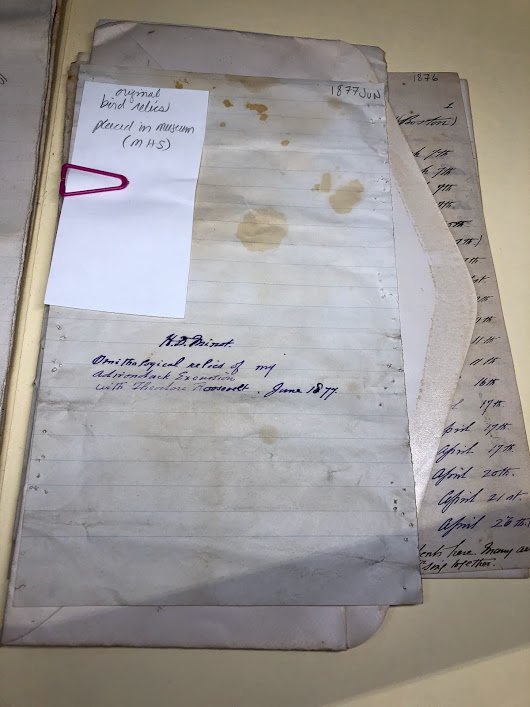
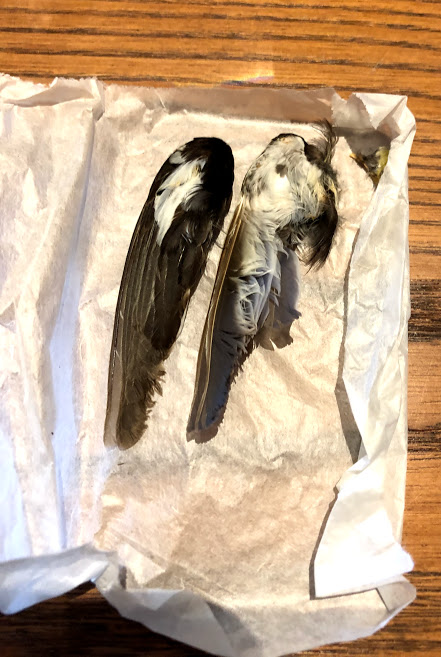
Minot was born near Forest Hills in 1859, the sixth of seven children of William and Katharine Maria Sedgwick Minot. He took an early interest in ornithology, recording careful observations of what he believed to be a new species of bird in May of 1871. In 1876, Minot entered Harvard University, where he befriended fellow ornithological enthusiast Theodore Roosevelt. Throughout their friendship, the two exchanged letters and went on birding expeditions. During one expedition in the Adirondacks in 1877, Minot caught and preserved the wings of a blackburnian warbler. The preserved relics were placed in Minot’s personal papers and were found by an archivist when the collection was processed.
Original wrappings for the warbler relicsRelics from Minot’s 1877 birding expedition with Theodore Roosevelt
Minot left Harvard in his sophomore year and entered the railroad industry, but he never left behind his interest in ornithology. Throughout his travels to Mexico, England and Scotland, and the American Midwest, he kept counts of the birds he saw and made observations of species that were new to him. He wrote multiple books and essays on birds, including Land-Birds and Game-Birds of New England (1877), Notes on Colorado Birds (1880), and New England Bird Life (1881).
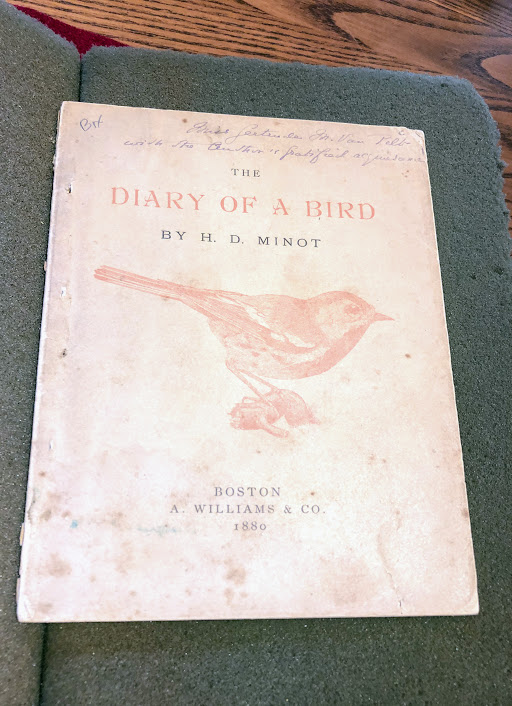
In 1880, Minot became not just an observer of birds, but an advocate for them with the publication of Diary of a Bird, Freely Translated into Human Language. In this short publication, Minot acts as “translator” for a black-throated green warbler who has kept a diary “for the purpose of amusing, instructing, and enlightening mankind,” even though the diarist claims he does not approve of the practice of diary-keeping amongst birds. The diarist does not have a name; he writes, “in a bird-community, every member is expected to know his own mate and children; beyond that, we make no distinctions . . . . I myself, for instance, have no individual name, and am very well content; for among us are no rights of property and inheritance, no law-suits, no marriage-ceremonies; but each of us lives for himself.” The warbler writes of the end of his migration from southern Mexico to the White Mountains, his mate’s efforts to build a nest and sit on their eggs, a run-in he has with a birder, and the activities of raising his family. Our feathered diarist often makes use of turns of phrase used only by birds (for instance, he once describes a lake as being “as long as the flight of a heron with thirty or more wing-beats), which Minot, as translator, helpfully explains. (Thirty heron wing-beats is about 500 feet, if you were wondering!)
The Diary of A Bird, by H.D. Minot
The major event of the diary is a meeting in early September of all of the birds of Massachusetts, organized to discuss “The Destruction and Extermination of Birds; how caused and how to be prevented.” The meeting, held in the middle of the woods to avoid notice by humans, is attended by all types of birds, leaving our warbler amazed at the sight of so many feathered friends. During the meeting, various species of birds describe their greatest threat. It is widely agreed that humans, with their traps, guns, nets, light-houses, clear-cutting, and domesticated cats, are the most dangerous threat to birds. Our diarist writes:
Men seem not only for the most part to have lost all appreciation of Nature, the best source of health and pleasure . . . but to be so utterly improvident as not to appreciate the mischief they are doing to themselves, or at least to their young, in deforesting the country. Their depravity is melancholy. Can’t they live without disturbing Nature, just as birds do? I can’t understand why they should ruin large tracts of country, as they often do, and then, instead of using them, leave them covered with pine-stumps, and bushes or stunted saplings.
As the warbler is speaking out against the use of birds in human fashions, the meeting is interrupted by the foe himself: a man with a gun, intent on shooting our diarist and his friends. I’ll leave it to you to find out what happens…
For Minot, the Diary was “a serious appeal for wiser thought and stronger action in the matter of protection of our birds” (letter to John Burroughs, 20 March 1880). He sent copies of the book to naturalists and it received praise and statements of hope for the future from some of them. In March of 1880, naturalist Samuel Lockwood wrote “This plea is very prettily put; and most heartily do I wish it God’s speed. . . . I love the birds, and cannot shoot them . . . Would that your little Warbler’s life story might still many a gun” (letter to Henry Davis Minot).
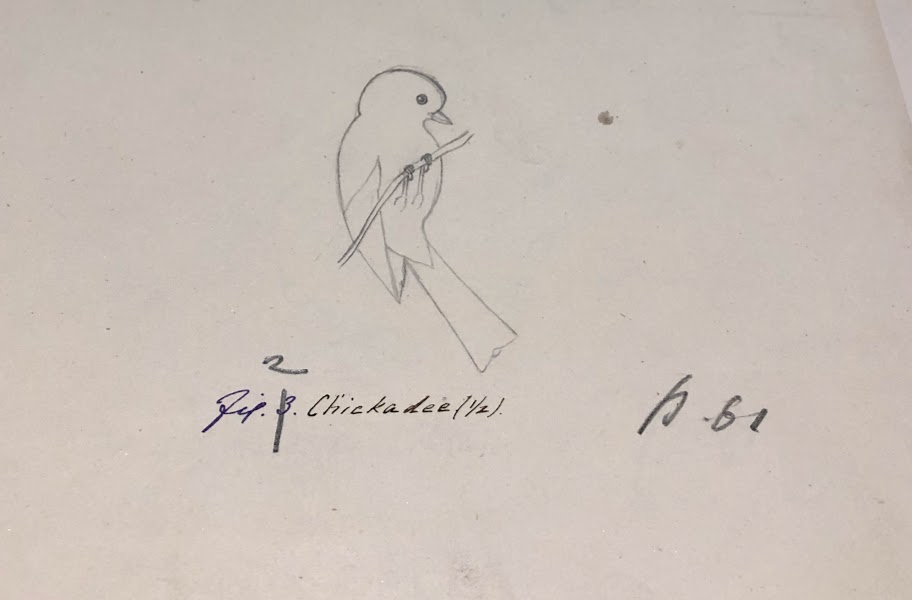
An undated sketch of a chickadee by Minot
Sadly, Minot died in a train collision in 1890, so he never saw the conservation efforts of the Massachusetts Audubon Society, which was founded in 1896. I like to think that he would have appreciated and supported their cause.
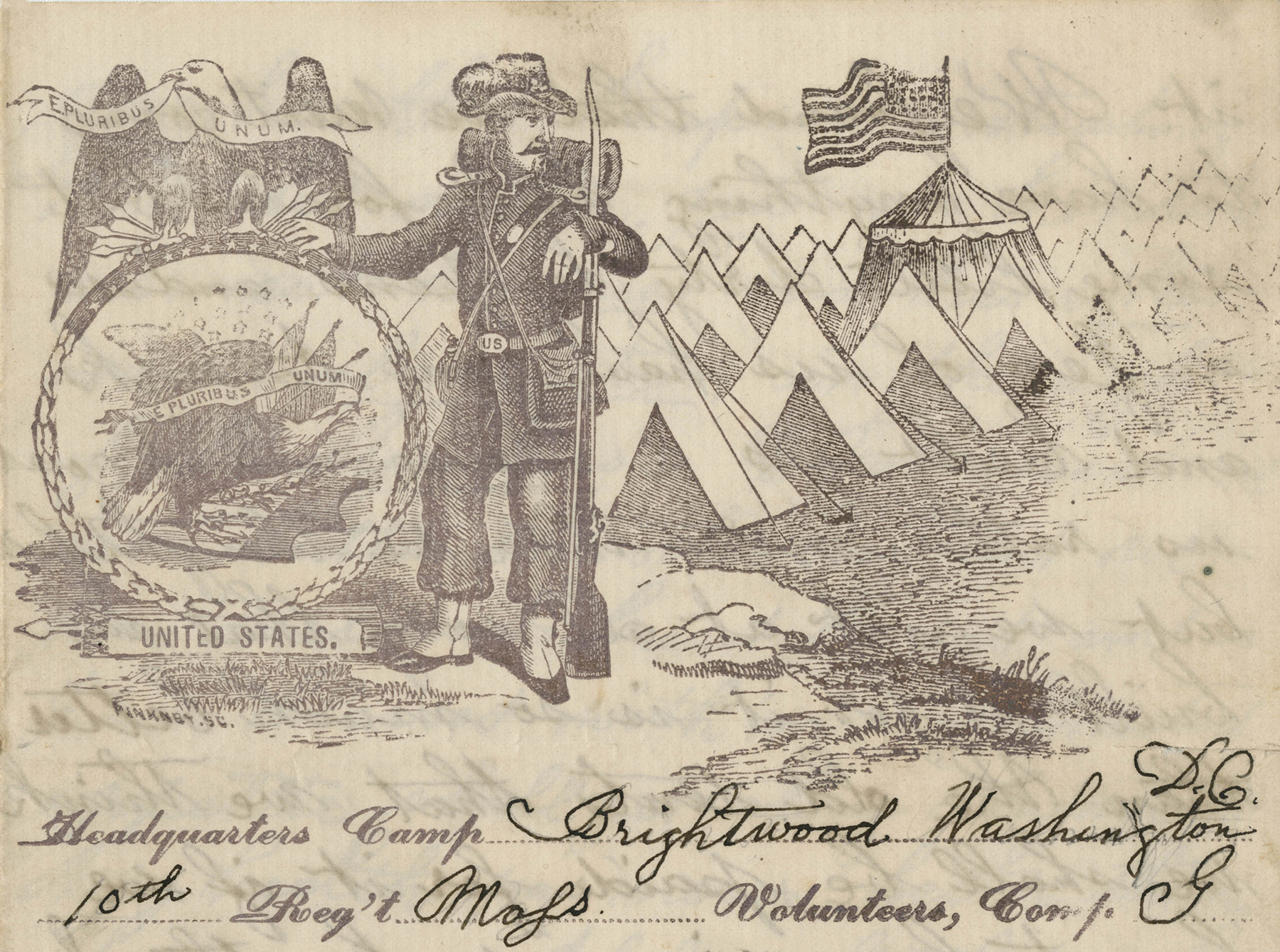
Today we return to the Civil War letters of Dwight Emerson Armstrong of the 10th Massachusetts Infantry. In March 1862, Dwight’s regiment left Camp Brightwood in Washington, D.C. and traveled south into Virginia as part of the Union advance on Yorktown. On 15 April, he wrote to his older sister Mary (Armstrong) Needham from his position near Warwick County Courthouse. The siege of Yorktown was underway.
As for the “miserable war” so far, Dwight had this to say:
I have not done much but lug a gun around. I dont want to come home until the war is over, now I have got here; but I sometimes almost think, that the Union costs rather more than it is worth. It sounds very well, for these great men, who live in good warm houses; and on the fat of the land; to preach of the value of this glorious Union but let these same men come down here and stand as picket guard some night in a pelting storm; and if they dont get some of their patriotism washed out before morning, I’ll lose my guess. Still I would not have you think that I am discouraged […] and as long as I can have the privilege of grumbling, [I] shall get along nicely.
Much of his time was occupied with repairing roads. The army’s wagons and artillery tore up the roads, rain filled the enormous holes left behind, and soldiers like Dwight were assigned to shovel mud into the holes to keep the roads passable. He understood the necessity of the work, but complained, “I dont think much of coming down here to mend their highways for them but I suppose I cant help it.”
Though he was bitter about the “great men” in their “good warm houses” and resented the drudgery of his work, he defended George McClellan against criticism that the general acted too slowly and cautiously. He called McClellan “a different sort of a man [who] cares something for a man’s life.” In fact, after a year of service, Dwight didn’t think he’d ever see much fighting.
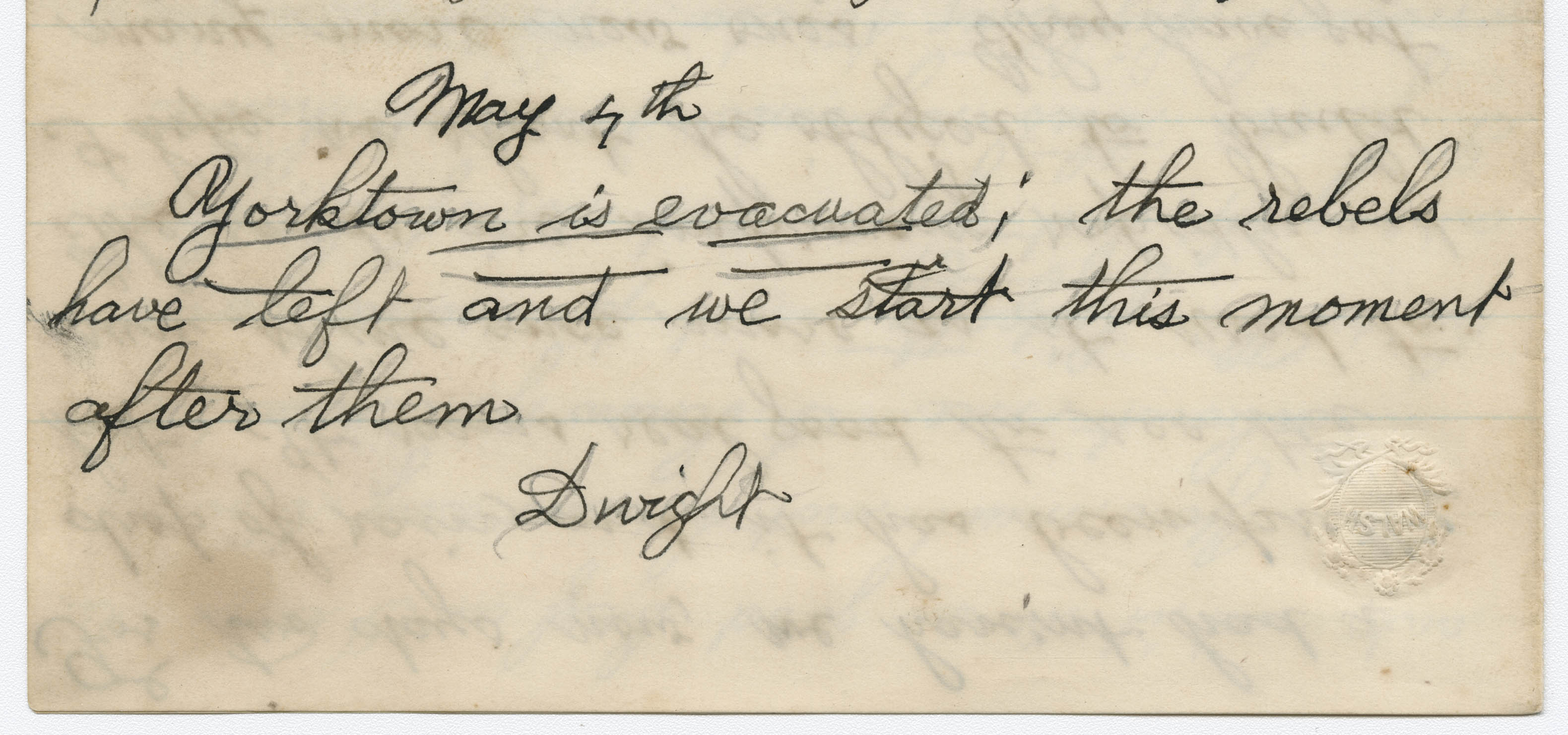
Detail of letter from Dwight Armstrong to his sister Mary, 4 May 1862
On 4 May 1862, Confederate troops evacuated Yorktown, and the Union army, including the 10th Regiment, pursued them west across Virginia. The two sides faced off in the Battle of Williamsburg the following day, but by the time Dwight reached the front lines, the fighting was already over. He was both frustrated and relieved: “I have had no chance to fire again at the rebels yet, and there is no prospect of my ever having a chance to, and I am sure I dont want to, after what I have seen.”
He didn’t elaborate, but he may have been referring to the bloody aftermath of the battle, as described by Joseph K. Newell in his 1875 history of the regiment. Newell writes about the Southern soldiers unable to retreat: “Men wounded in every shape; some dead, and some dying; many shockingly mangled, to whom death would have been a blessing.” (p. 90)
Union forces continued their march west, closing in on Richmond. Dwight didn’t even know if the Confederate army was still in the city, but he hoped they would just get it over with, make their stand “until they get enough of it, and are willing to give up. I am tired of chasing them.” His regiment was positioned about eight miles from Richmond, at Fair Oaks.
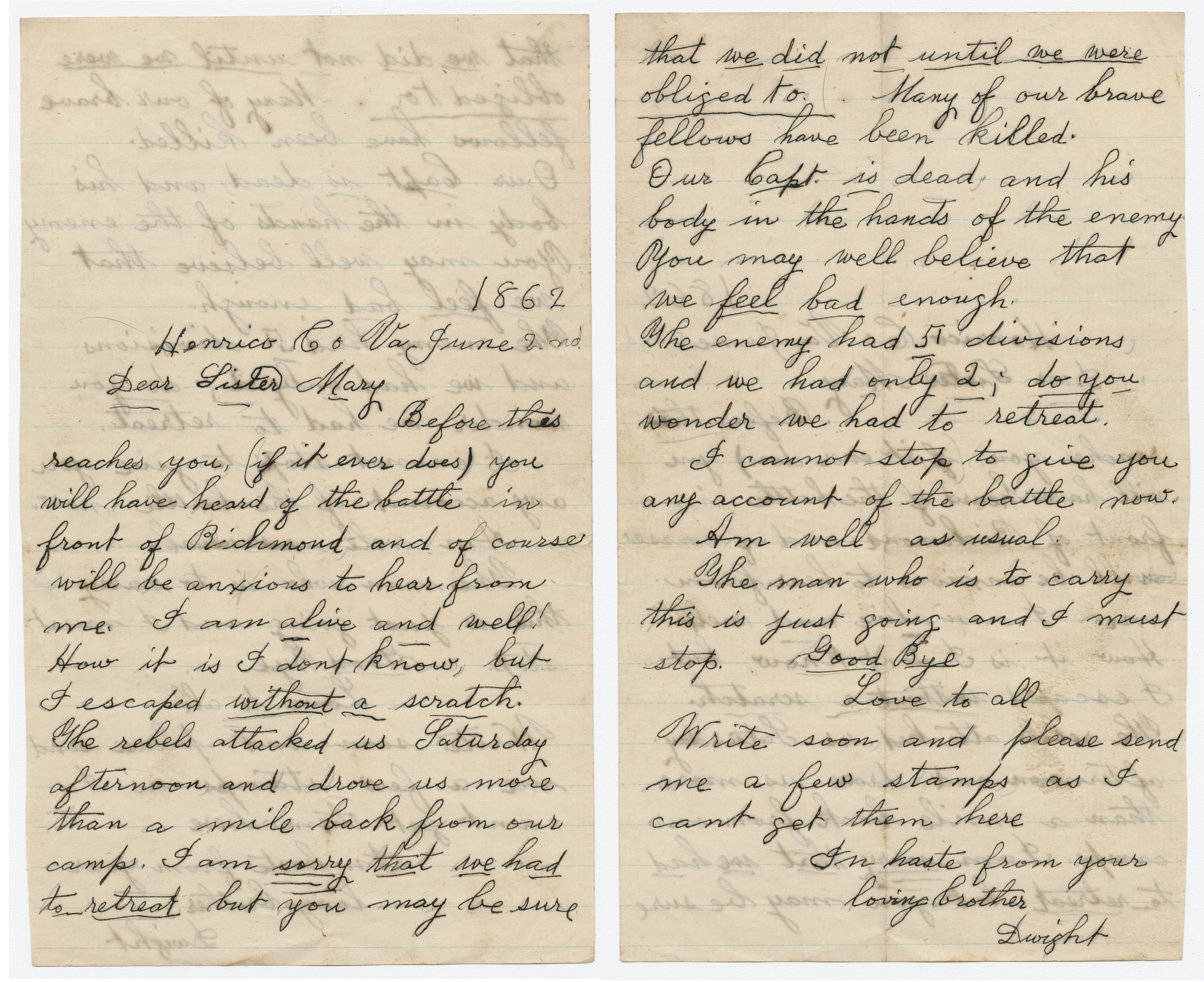
It was here that Dwight would see his worst fighting yet. The Battle of Fair Oaks (or Seven Pines) broke out on 31 May 1862. The attack was unexpected, according to Newell, “like a clap of thunder from a clear sky.” (pp. 98-9) The Union army was driven back and suffered heavy losses.
Letter from Dwight Armstrong to his sister Mary, 2 June 1862
Dwight wrote a short note to his sister after the battle to let her know he was alive and unharmed, but didn’t go into much detail until 14 June.
You want to know how I felt while in battle. Well, I suppose I felt pretty much as you would to stand out and have shot, and shell, and all sorts of missiles thrown at you. I have often read that when a man goes into battle, he loses all fear, and only thinks how he can kill the enemy the fastest. I can imagine how a man, if he was nervous enough, could get worked up to such a pitch of excitement that he would lose all fear for himself; and dont doubt it is so in some cases; but so far as my experience goes it is quite the contrary. For my part, I am not at all ashamed to own that I was some afraid at first, though the thought of turning around and running away never crossed my mind. It is perfectly astonishing what an immense amount of lead it does take to kill a man. If a single thousandth part of the missiles thrown the other day had taken effect every man on the field would have been killed the first hour. Bullets sometimes come pretty close to a man without hurting him any but if a cannonball or a shell hits a body of men it makes bad work. […] The bullets tore up the ground under our feet, and whistled terribly close to our ears, and fell all around us like hailstones; and it seems miraculous that no more were hurt.
The captain of his company, Edwin E. Day of Greenfield, Mass., was killed at Fair Oaks. Dwight witnessed his death. Under heavy fire, Day’s men were forced to leave his body behind, but when the fighting was over, they buried him “as decently as possible.” After the war, his body was retrieved from Virginia and interred at Greenfield.
Dwight finished his letter by reassuring his sister, as he had many times, to “keep up good courage and dont worry about me.”
I hope you’ll join me for the next installment of Dwight’s story here at the Beehive.
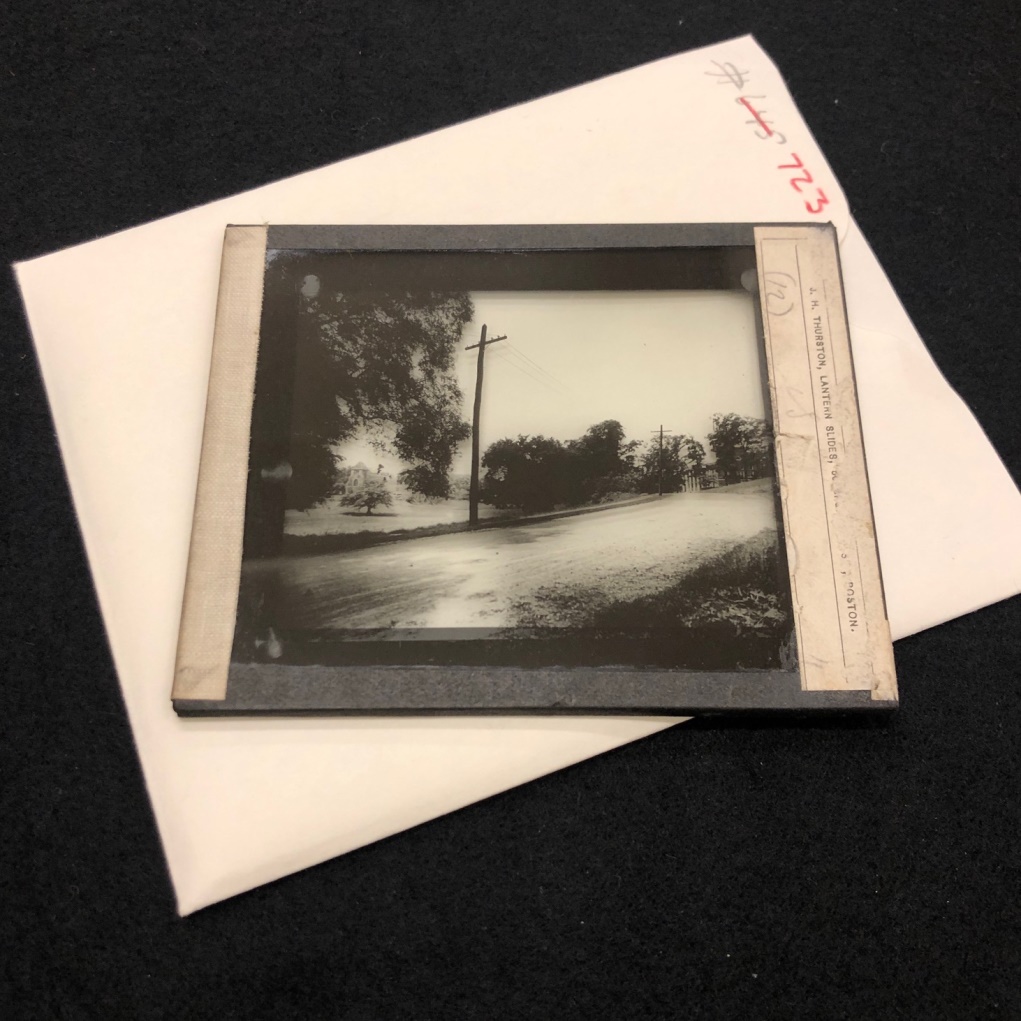
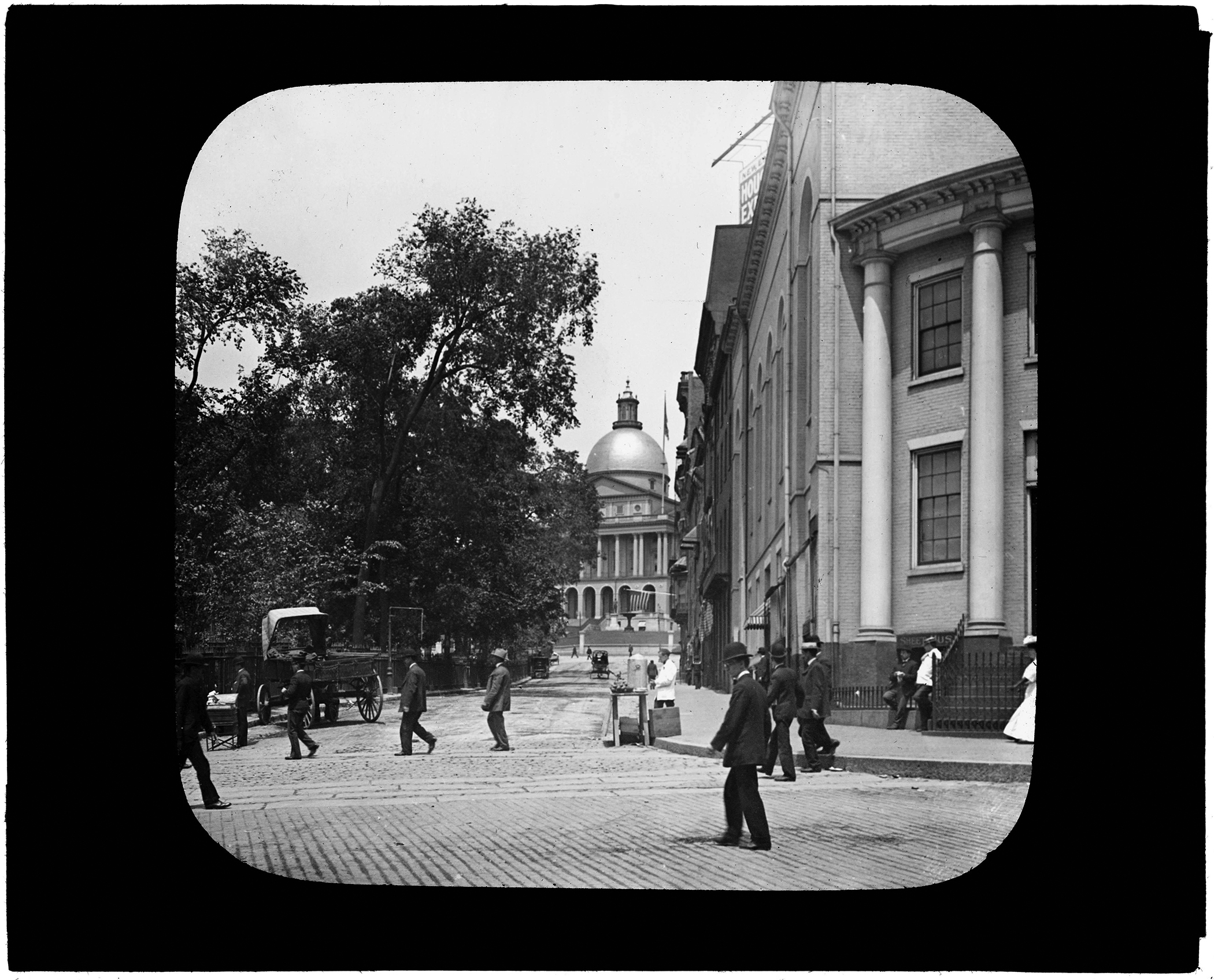
The MHS is proud to announce a newly available digital collection. Prominent Boston landscape architect Arthur Asahel Shurcliff created this collection of more than 1,200 glass lantern slides, spanning 90 physical boxes, which the MHS acquired in the 1960s. There are many rationales for the digitization of an MHS collection. In this case, the fragility of these glass slides along with the absence of the appropriate projection equipment makes in-person viewing difficult. However, a high-resolution scan reveals a diverse array of subject matter; city planning maps and diagrams, historic images of Boston’s streets and landmarks, snapshots from Shurcliff’s travels abroad, and more.
Arthur Asahel Shurcliff, born in 1870, enjoyed a long career as a landscape architect in Boston and beyond. He worked closely with Frederic Law Olmsted and his son, with whom he developed the first landscape architecture program at Harvard. Through his interest in urban beautification and landscape-based history, Shurcliff played integral roles in projects such as the restoration of Colonial Williamsburg, the 1920s additions to the Back Bay Fens including the athletic track and Kelleher Rose Garden, and the reinvention of the Charles River Esplanade, among many others. He also dreamt of a transit ring encircling Boston which, although never realized, would have revolutionized the city’s traffic flow. Shurcliff married Margaret Homer Nichols in 1905 with whom he had six children. Margaret is described by the Nichols House Museum as a “spirited woman” whose wealth did not interfere with her social conscience. She spent her spare time teaching carpentry to inner city children and lobbying for women’s suffrage. The two were known to design and build wooden furniture together.
As President of the American Society of Landscape Architects as well as a member of the Boston Arts Commission, Shurcliff worked often with prominent individuals and organizations such as Boston’s Metropolitan District Commission and Metropolitan Planning Board. It is evidence of this work combined with that of his development of the Harvard program with Frederic Law Olmsted, Jr. that allows us to surmise that his collection of lantern slides was likely used for lectures to students or professionals in the landscape architecture field. In fact, entries in Shurcliff’s diaries, also held at the MHS, record frequent trips to various locales, camera in tow, with the aim of “preparing slides” for lectures. (Please see 23-28 February, 1923 diary entries, Arthur Asahel Shurcliff Papers, carton 7.)
Often treated as in this case as a precursor to the modern-day overhead transparency, lantern slides were popularized around 1849 but were still in use as late as the 1930s. Hand-painted scenes as well as those produced using photographic negatives, which were created both commercially as well as by amateurs using take-home kits, were used in conjunction with a light projector to produce images. These projected images were used for a variety of purposes from magic shows to academic lectures. In Shurcliff’s case, although most of the slides are without labels, it is safe to assume that the collection was created using a mixture of commercial and self-produced photography, along with photographs of paper documents such as maps or diagrams.
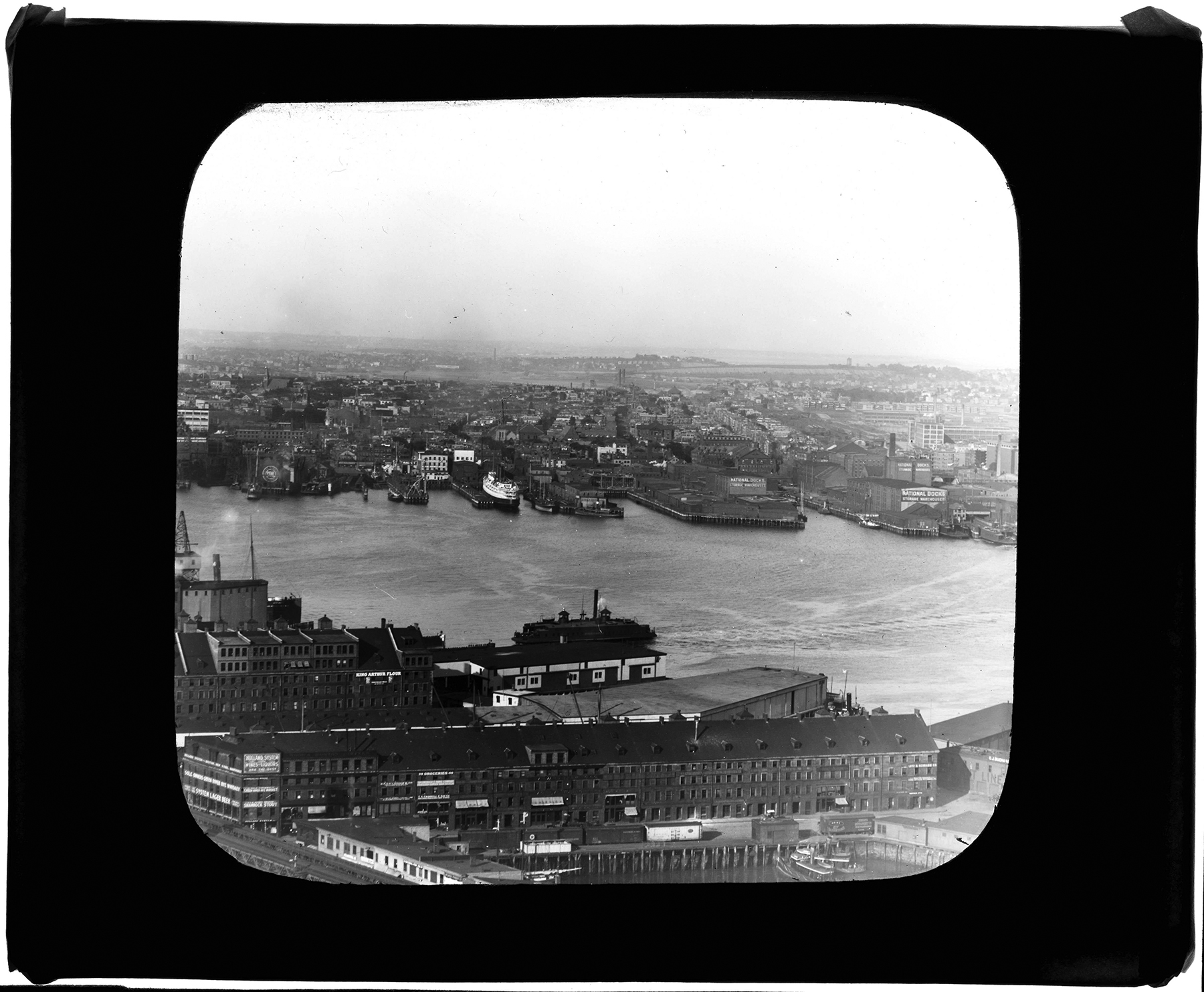
A lantern slide from the collection.
The Shurcliff Collection of Glass Lantern Slides (Photo. Coll. 6.19) boasts an interesting and varied range of subjects. Those familiar with downtown Boston will enjoy paging through images of it from over 100 years in the past. Those interested in demographics will find the charts recording changes in the populations, traffic, and city planning priorities enlightening. Those in search of evidence of Americans abroad may find Shurcliff’s architecturally-minded, photographic diary of his travels through Southeast Asia to be an especially unique example. This fascinating collection is described in the online collection guide, which also includes links to the online presentation of each image. Please explore the collection guide. The web displays of the lantern slides are also now discoverable via MHS’s general website search tool.
The MHS is grateful to the Boston Public Library for creating the master digital images of the lantern slides. The Library for the Commonwealth program of the Boston Public Library supports digitization services for a statewide collaborative project, Digital Commonwealth of Massachusetts. In the near future, metadata relating to the Shurcliff lantern slides will be added to Digital Commonwealth’s online discovery portal, where people can search across thousands of collections from various cultural institutions in Massachusetts. In the meantime check out other digitized MHS collections currently on Digital Commonwealth.
Cushing, Elizabeth Hope. Arthur A. Shurcliff: Design, Preservation, and the Creation of the Colonial Williamsburg Landscape. Amherst: University of Massachusetts Press, in association with Library of American Landscape History, 2014.
Shurcliff, Arthur A. Autobiography of Arthur A. Shurcliff: written winter of 1943- 1944, with additions summer of 1946, summer of 1947. 1981.
By Andrew Kettler, University of Toronto, Andrew W. Mellon short-term research fellow at the MHS
Time is the historian’s obsession. Wasting time is the academic’s demise. For a cultural historian, the archive can often seem like the proverbial haystack. Because the focus of cultural research is frequently upon specific and often obscure topics rather than narrative or quantitative history, the manuscript archive is often a daunting and byzantine maze where searching for single references that relate to a defined subject can be an obstructed and time consuming journey.
Occasionally, finding single references can take hours of laborious reading of problematic handwritten materials. As such, many cultural historians turn their works towards theoretical analysis and printed materials to avoid wasteful hours of archival research when the buried needle is difficult to discover. However, the general concern with these archival mazes is commonly overcome when document descriptions within library and manuscript catalogs provide enough detailed summaries to help cultural historians, and all researchers, narrow their focus prior to possibly wasting time reading unnecessary materials.
While completing research for my project on the history of smell and slavery in the Atlantic World, I recently worked at the Massachusetts Historical Society (MHS). While serving as a short-term fellow under the auspices of the Andrew Mellon Foundation, I worked often with the Beck-Alleyne family papers, 1787-1936. I had not originally sought out this collection prior to arriving in Boston, as my work at the MHS focused on searching for descriptions of slave bodies and plantation life within different paper collections from the 18th century.
Despite my initial oversight of this collection, the notes in the introduction to the Beck-Alleyne collection provided by the library staff involved great detail regarding the correspondence of family members and the specific papers within the collection. As a part of this assortment, and nearly all other collections at the MHS, researchers are frequently guided through centuries of papers through these simple keyword connections.
Specifically included as keyword links in the summaries for the Beck-Alleyne papers are topics related to slavery, trade, secession, and rebellion that cover vast areas from Boston to Barbados. Rarely would a scholar of plantation culture look to correspondence from a New England shipping family for notes on Bussa’s Rebellion in Bridgetown of 1816. However, because of the primary details provided in the document description by the library staff, keyword searches trigger important summaries of this rebellion that might have otherwise gone unnoticed.
As portrayed by the ease of maneuvering through the Beck-Alleyne papers, the MHS is the premier archive for discovering specific references through these detailed document descriptions. The research team, from those who worked at the archive decades ago to the current library staff, have consistently provided document summaries that offer much more details than nearly all other archives with similar collections. Practically every manuscript document to be accessed at the MHS includes paragraph length descriptions that provide the cultural historian keyword search terms to help focus research much more quickly and consequently avoid wasting the researcher’s time with reading irrelevant materials for their projects.
The keyword searches that are now common within historical research due to the vast accessibility of digital materials makes exploration much quicker and frequently less precise. However, the greater force of historical research remains within the manuscript archive, where materials are recovered and interpreted for the broader historical audience and the public sphere. The detailed descriptions provided within primary keyword searches at the MHS deliver researchers markedly more time to produce engaging scholarship through limiting wasted time upon documents that could be poorly, lightly, or mistakenly described in the hands of less caring and coordinated research teams.
June is finally here! The days are getting warmer and the strawberry crop is ripe.
Strawberry Festivals were popular in New England, especially in the 19th century. They often occurred in late spring/early summer when New Englanders could finally enjoy warmer weather and the strawberries were ripe. The celebrations ranged from church gatherings and dances to fundraisers, picnics, and theatre nights.
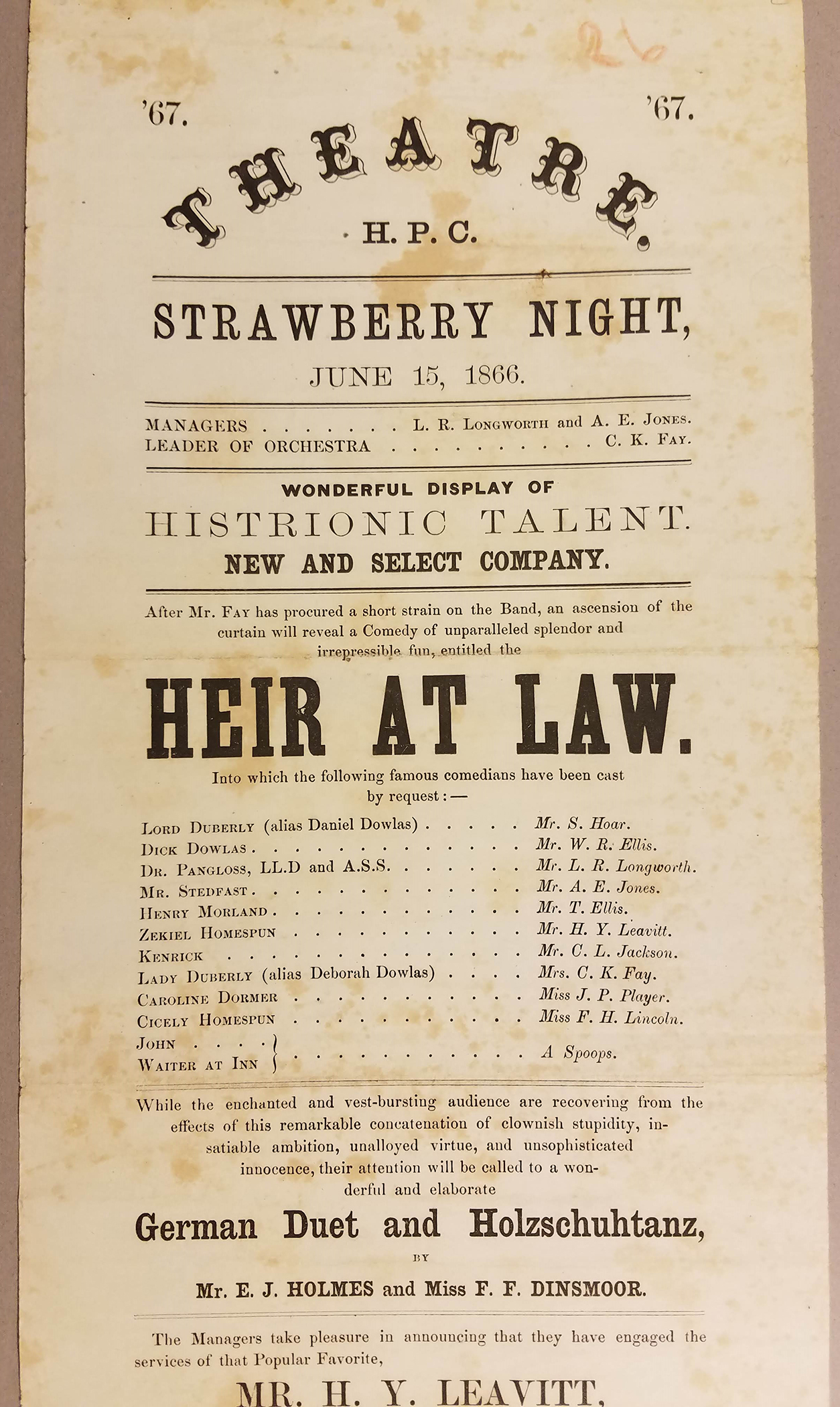
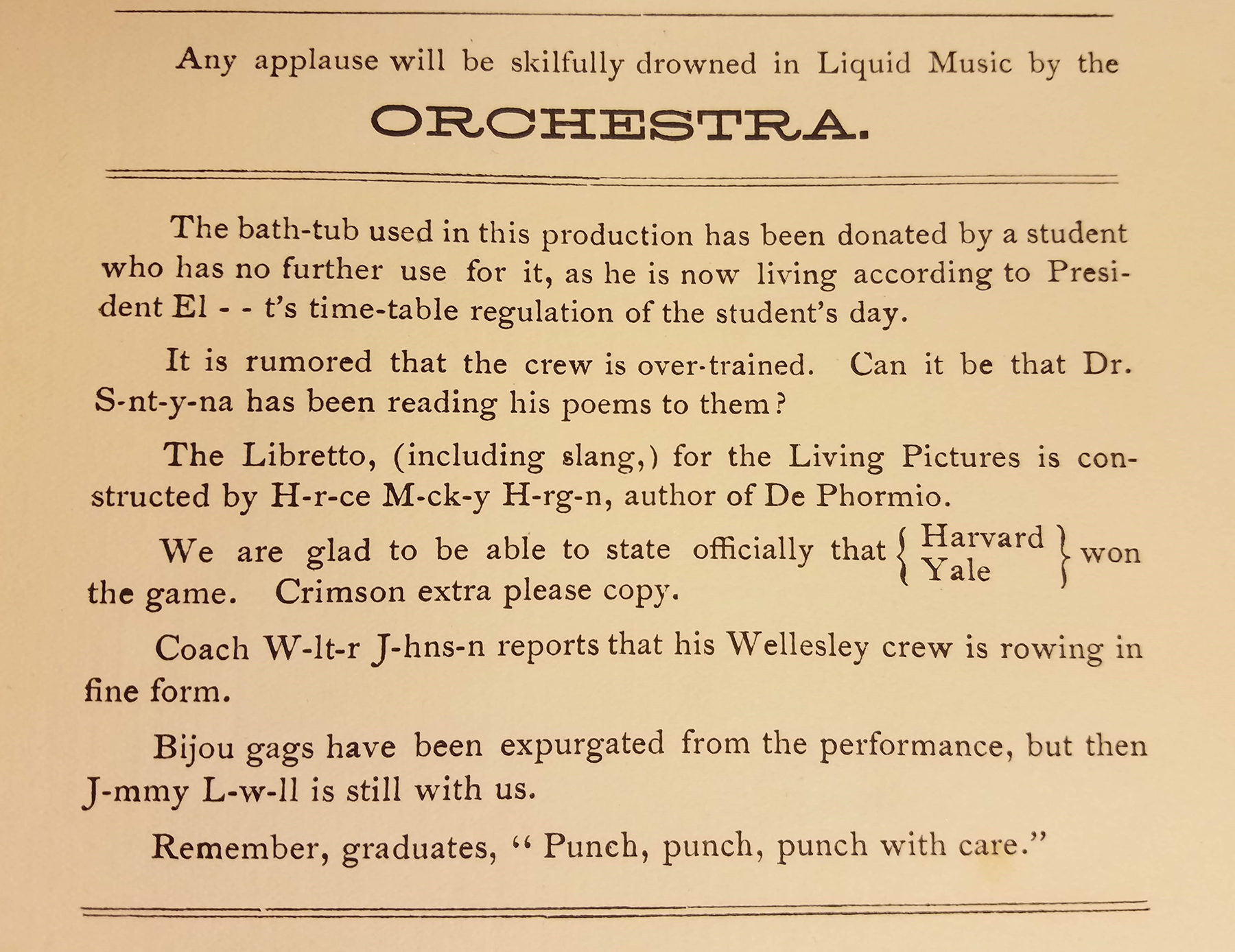
In our collection of Theatre Broadsides, we have some especially enjoyable examples from Harvard University’s Hasty Pudding Club. The Club hosted an Annual performance called “Strawberry Night.” The plays performed and the broadsides that accompanied them are irresistibly comical! In the spirit of strawberry season here are a few examples.
Found in the Strawberry Night theatre broadside from 1866:
“… While the enchanted and vest-bursting audience are recovering from the effects of this remarkable concatenation of clownish stupidity, insatiable ambition, unalloyed virtue, and unsophisticated innocence, their attention will be called on the wonderful and elaborate German Duet…”
“…That the aching sides and smoke-filled eyes of the audience may have no rest, there will immediately follow a most wonderful, original, burlesque, tragic, extravaganzetta, entitled Babes In The Wood!”
“Heir at Law,” Strawberry Night theatre broadside, 1866
And in the 1868 theatre broadside:
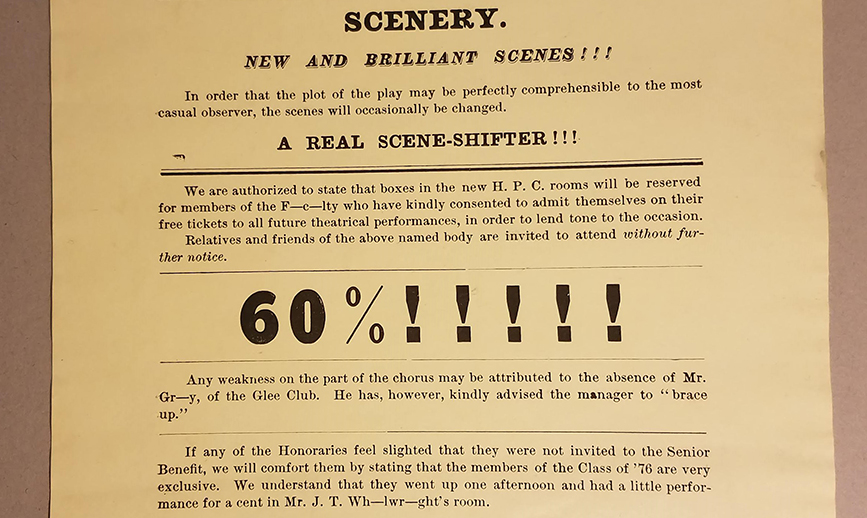
“Theatre H. P. C. Strawberry Night..: the evening’s Performance will begin with the farce, Friend Waggles! … The important and all-absorbing business transacted, and seats once more carefully resumed, the curtain rises on the farce, Wanted: One Thousand Spirited Young Milliners for the Gold Diggings.”
“In order that the plot play may be perfectly comprehensible to the most casual observer, the scenes will occasionally be changed.”
Detail of Hasty Pudding Club, Strawberry Night theatre broadside, 1868
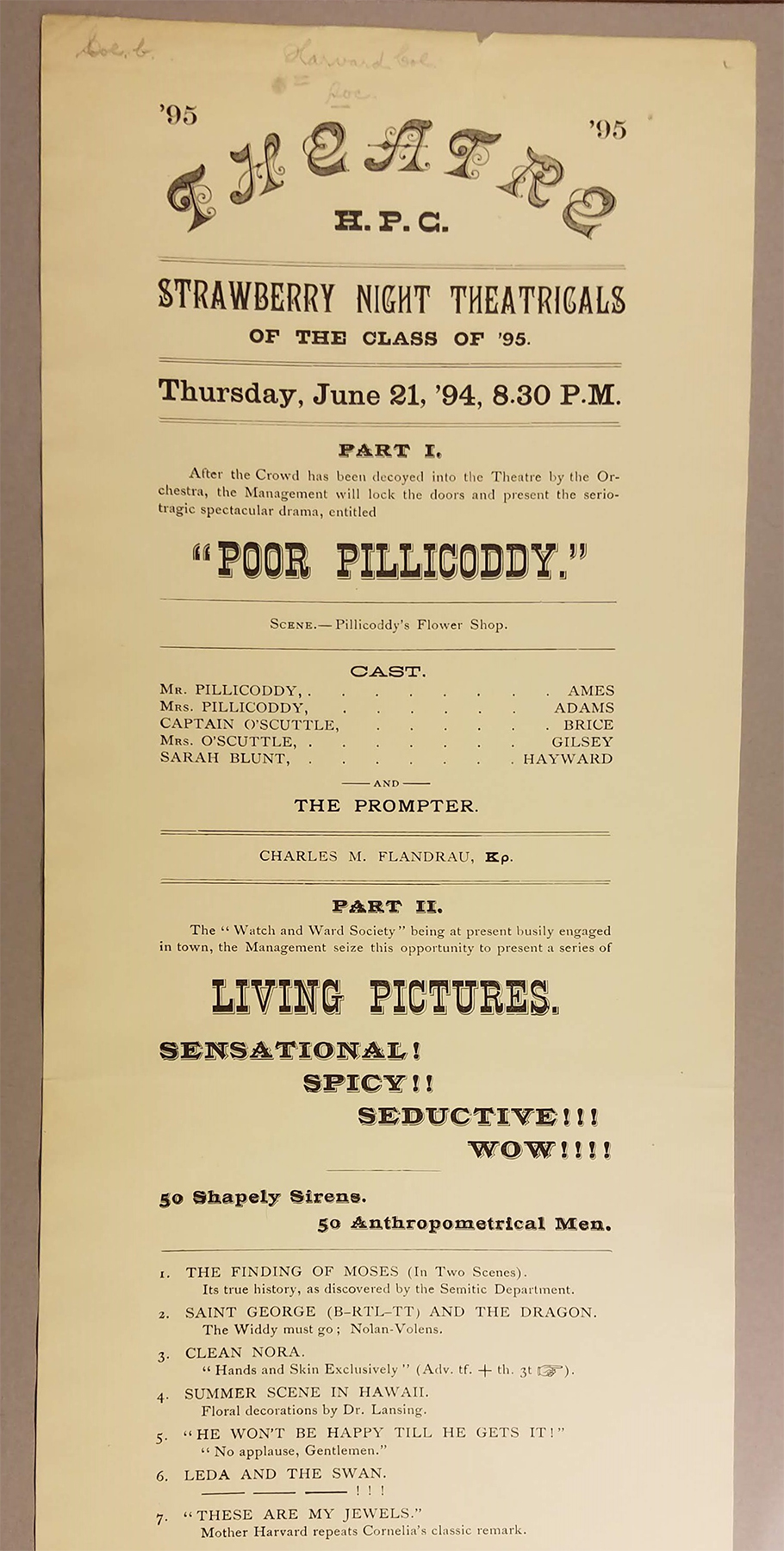
The class of ’95 produced “Poor Pillicoddy” on 21 June 1894. The broadside states:
“After the Crowd has been decoyed into the Theatre by the Orchestra, the Management will lock the doors and present the serio-tragic spectacular drama, entitled “Poor Pillicoddy”…
The MHS has an endearing and historic association with the strawberry and celebrations in its honor. An invitation to a strawberry festival in 1856 led to the donation of Mr. Thomas Dowse’s vast and coveted library:
“SPECIAL MEETING, JUNE, 1886. A Social Meeting of the Society was held at the house of Mr. Charles Deane, in Cambridge, on Friday, the 18th instant, at five o’clock, P.M.
The Hon. Robert C. Winthrop said:
“…But another of these Cambridge meetings was still more memorable, and can never be forgotten in the history of our Society. I refer, as I need hardly say, to the meeting at good George Livermore’s in 1856, just thirty years ago. From that meeting came the library and large endowment of our great benefactor, Thomas Dowse. Mr. Dowse was a neighbor and friend of Mr. Livermore, and had been specially invited by him to come over to our strawberry festival. Age and infirmities prevented his acceptance of the invitation ; but the occasion induced him to inquire into the composition and character of our Society, and he forthwith resolved to place his precious books, the costly collections of a long life, under our guardianship, and to make them our property forever. From that meeting the regeneration of our Society may thus be fairly dated.Cambridge strawberries have ever since had a peculiar flavor for us, – not Hovey’s Seedling, though that too was a Cambridge product, but what I might almost call the Livermore Seedling or the Dowse Graft, which were the immediate fruits of our social meeting at Mr. Livermore’s.”
Proceedings of the Massachusetts Historical Society, Second Series, Vol. 3, [Vol. 23 of continuous numbering] (1886 – 1887), pg. 53-54.
Inspired by the description above, and modeled on the spirited event of 1856, the MHS Library held its first Strawberry Festival in 2007. The Strawberry Festival is now an annual tradition that the MHS staff and friends look forward to attending each year. The Library Reader Services staff bring in imaginative and delicious dishes and drinks with the strawberry as the star ingredient. Here are a few photos from our 2019 Strawberry Festival:
MHS President Catherine Allgor and members of the Reader Services Staff at the 2019 Strawberry Fesitval2019 Strawberry FestivalMHS staff enjoying the 2019 Strawberry Festival
We wish you all a lovely summer and look forward to seeing you in our Reading Room, to learn more about the Hasty Pudding Club, Theatre Broadsides, and strawberry festivals!
Today, we return to the diary of George Hyland. If this is your first time encountering our 2019 diary series, catch up by reading the January, February, March, April, and May 1919 installments first!
Early in June, George moves house from his winter quarters to “the James place” he mentions paying $800 to rent in the entry for May 28th. It is unclear from the diary whether George considers this move a temporary or more permanent one, although he notes on June 27th that “Mr. James is coming back from Oregon and will live here,” followed up two days later with the note, “I do not know where I shall go.”
As with previous months, George records the hours he spends at various tasks for neighbors and the money owed (presumably striking the numbers out when he is paid). A new leisure activity appears in the diary for June: time spent nearly every evening playing the guitar. Food also makes its appearance: rhubarb sauce, peach preserves, doughnuts, baked beans, berry cake, and moss pudding. If you — like I — have never heard of “moss pudding” before (see entries for June 13-14) it seems to be a milk pudding with a type of coastal seaweed used to thicken the mixture. Edible Cape Cod provides a recipe.
On June 29th George breaks his daily record to insert a paragraph on the Treaty of Versailles (signed on June 28th, 1919) which in George’s words: “closes the greatest war the world has ever known.” The next day, he returns to mowing the lawn “with the sickle and shears.”
Without further ado, here is George Hyland’s June 1919 in his own words.
* * *
PAGE 332 (cont’d)
June 1. (Sun.) fair, W.N.E., S.E. Eve. par. Clou.; W.S.W. Went to H. Litchfield’s late in eve. To buy some bread.
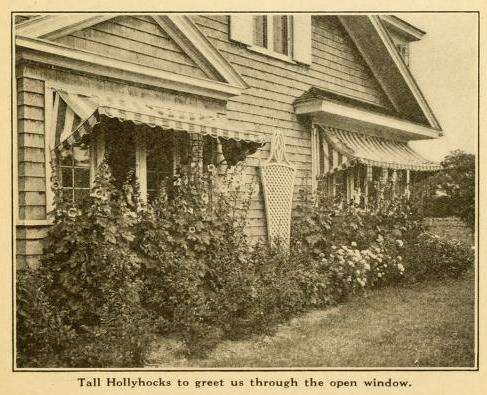
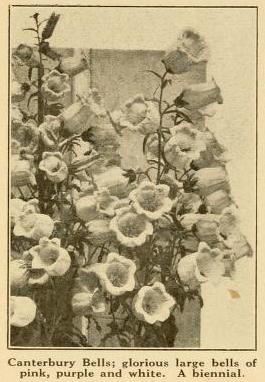
2d. Went to the James place and worked 7 hours — mowing grass and making flower gardens and transplanting foxglove, can. bell, hollyhock, heliopsis and larkspur and cornflower plants — carried them there from my garden this A.M. Ellery B. Hyland went there with me in auto, carried some plates, dishes, etc. Had my dinner in the house — bought it in store. Ret. — rode 1 1/2 miles with Albert Litchfield. Fine weather, W.S.E. Clear. Nellie B. Sharpe stopped to see my plants. I watered all of them well.
3d. Went down to the James place — mowed and trimmed all around the house. Carried my dinner. Walked down. Ret. — rode 1 mile with Ellery Hyland in auto. Carried some foxglove and canterbury bell plants and gae them to Mrs. Emma F. Sargent. […] Very hot weather W.W.S.W.; tem. 70-98 nearly all day.
4th. Moved into the James house. Ellery Hyland carried my things there in his auto truck. I rode down with him. 2 loads. Very hot weather – tem. 96. W.S.E. Clear. Worked in the place – made gardens for the plans I carried there.
5th. Worked 4 1/2 hours for Mr. S. T. Sheare clearing out the big store. Carried rubbish to the dump near Bound Brook and put the broken boxes […] his cellar. Very hot weather — tem. 78-98; W.N.W. fine eve. Mrs. Ethel Torrey and Margaret Sheare, and Mrs. Torrey’s children called here early in eve. Played on the guitar 3/4 hour in eve. X 1.35.
[entry crossed out]
6th. Worked 7 hours for Mr. Speare — repairing side-walk. 2.10. Fine weather. W.N.W. tem. 65-83. Walter Sargent [phrase crossed out] called here early in eve. I showed him a birds nest in the large rose bush on the south side of the house – 4 young birds (sparrows) in it. Played on the guitar 3/4 eve.
7th. Worked 8 1/2 hours for W. and Mrs. Emma Sargent. 2.40. Mrs. Sargent gave me rhubarb sauce — in a tumbler, and at night gave me some baked beans and cake to take home. Thunder, tempest 6 P.M. just as I finished work. Squall — W.N.W. Thunder storm and rain all eve. Played on the guitar 1 hour in eve. tem. To-day 66-84. Muggy.
9th. Worked on the place — dug up garden and did other work. Cold. Cloudy in afternoon — rain at times all aft. and eve. tem. 51-53. W.N.E. Played on the guitar 1/2 hour in eve.
10th. Fine weather. Cool; W.S.E. Clear. Planted my garden — called at Charlie’s late in forenoon — had dinner there. He cut my hair. Eve. clear. Cold. tem. 54. Played on the guitar 1 hour in eve.
11th. Worked 6 1/2 hours for Miss Margaret Speare repaving side walk. 1.80. Fine weather, W.N.W. Clear. Cool. Walter Sargent, Mrs. Emma Sargent and Mrs. Edna Bailey called here late in […]
PAGE 333
to see my flower gardens. Mrs. Bailey is Mrs. Sargent’s mother. I showed Mrs. Sargent the birds nest in the great rose bush but the birds had left it. Mr. and Mrs. Sargent will leave here for Chicago Ill. where they will spend the summer, they have let their home here. Called at Wesley Gardner’s in eve. (about 5 P.M.)
12th. Worked on sidewalk 6 hours for Mr. Sheare – 1.80. Cool. W.N.E. Clear. The piano that was in the N. room was moved from here to Mr. Sheare’s store — Girl Scouts had it loaned to them. Miss Eudora Bailey and Miss Norma Morris came here when the piano was moved. Eve. clear. Cold. tem. 45. W.N.E. Fine weather.
13th. Went home to get some of my things. Called at Mrs. Harriman’s 1 3/4 hr. I also called at Uncle Samuel’s. Gave Mrs. Harriman 4 foxglove plants from my garden. Bought 1 1/2 qts. of milk at Andrew Bates’ then went back to James place. Worked on my garden 4 hours. Also late in aft. hoed in garden 2 hours for Archie Torrey — 60. Walked home and back. Played on the guitar 1/2 hour in eve. Fine weather. Clear. W.S.E. Cool. Made moss pudding.
14th. Hoed gardens 7 hours for Archie Torrey and S. T. Speare — 2.10. (Mr. Sheare is Mrs. Torrey’s father live in the same house). Mrs. Ethel T.gave me 2 doughnuts. Fine weather tem. 55-75. Played on the guitar 1 hour in eve. W.S.E. to-day.
15th. (Sun.) Fine weather. W.S.E. tem. 65-86. Went home to get some of my things. Walked there rode nearly back with Charlie […] in auto. Bought some mill at Mrs. Merritt’s. Got 4 foxglove plants at home — gave them to Mrs. Edith Sargent and transplanted them for her. Lives with Mrs. Bailey — in house off James place — is Walter Sargent’s sister. Made a moss pudding in eve.
16th. Worked 7 1/2 hours for Peter W. Sharpe — had dinner and supper there. Nellie did go to school to-day. Fine weather. W.S.E. Charles spent eve. Here — I played on the guitar 1 1/2 hours. Fin. planting my garden early this eve. 11 P.M. clear.
17th. Worked 6 1/2 hours for P.W. Sharpe. Had dinner there. Fine weather — clear. W.S.E. worked 3 hours on the James place — after supper. Played on the guitar 1 hour late in eve.
18th. Worked 6 hours for P.W. Sharpe. 18 hours in all — 4.50. Had dinner there with Mrs. S. Fine weather. Cool. Clear. W.S.E. Worked 2 hours in my garden early in eve. Played on the guitar 1 hour late in eve.
19th. Mowed and trimmed lawn and bank 3 hours for Mrs. Eudora Bailey. Mrs. Sarah Brown (nee S.T. Bailey) there to-day. Have not seen her before for 16 or 17 years. Mrs. Bailey’s birthday to day (age 79 all her children called except Mrs. Emma F. Sargent — she is in Chicago Ill.) Henry, Albert, Fred, and Sarah. (Fred (ten), Henry (bass), Emma (sop.) and Sarah (contralto) are the Bailey Quartet. Sarah told me she lives in Wollistan, Mass. I also mowed grass 3 1/3 hours for Mrs. M.G. Seaverns. In eve. stopped and talked nearly an hour with a young man in an automobile near the fountain in N. Scituate — he brought some people from Thomas W. Larvson’s place to attend the motion pictures at the Victoria Hall near here. He was in the late war in British Army — was wounded 2 or 3 times while in service. He told me that Miss Jean Larvson was to be married to-night. Weather to-day W.S.E.; tem. 60-84; clear. Eve. clear. Chilly. Damp.
20th. Worked 5 1/2 hours for Mrs. M.G. Seaverns — mowing and other work. Rain 12:30-1:30 P.M., then cloudy. Eve. cloudy. 11 P.M., clear. Played on the guitar 1 1/4 hours in eve.
21st. Worked 6 hours for Mrs. M.G. Seaverns — haying and mowing lawn — 14 1/2 hours in all — 3.35.Also mowed the grass among Mrs. Eudora Bailey’s currant bushes — 1 hour. Fine weather. W.N.W., tem. 65-85. Lightning S. of here in eve. Played on the guitar 1 hour in eve. 11 P.M. clear.
22nd (Sun.) Fine weather — over —
PAGE 334
June 22. [cont’d] Clear. Cool. W.S.E. Cleared up a great pile of rubbish back side of the house. Eve. par. Clou. 11 P.M. clear.
23d.Worked haying 1 ½ hours — 45 — for Mrs. M. G. Seaverns. Also worked on the front steps — on this place — 7 hours. Par. cloudy, W.N.W., S.E. Played on the guitar 1 hr. 10 min. In eve. tem. to-day 50-67.
24th. In forenoon worked on the front steps and wooden walk. In aft. went to Hingham on train. Walked to Henrietta’s (H. Cen.) had dinner there. Spent aft. There. Ret. — rode back with H. Frankland his wife and three children, Ethel and Henrietta in automobile — they went to N. Scituate beach. Very hot weather — tem. 69-96. — 96 in shade all aft. Mrs. Ethel Torrey and children called here late aft. About 7:30 P.M. (fast time — 6:30 P.M. Standard Time). I went back with them to see their gardens. Played on the guitar 1 hour in eve.
25th. Worked 2 1/2 hours for Mrs. M.G. Seaverns haying — got in all the hay. 75. Also worked on the steps and walk — finished the steps and walk. Also mowed with lawn mower, sickle, and shears 7 hours. Hot weather — tem. 68-94. 94 all aft. Played on the guitar 3/4 hour late in eve.
26th. Mowed the grass with lawn mower, sickle, and shears on the whole place — also repaired a window and the roller on the well curb — so it would not slip when drawing water — handle turn-in rolled — it turned in the roller a few days ago and it hit my right arm 6 or 7 times before I could get out of the way of it. Par. clou. tem. 65-85. W.S. transplanted some summer turnips late in aft. Mason Litchfield called here early in eve. — to get me to mow their lawn. I played several selections on the guitar for him. Late in eve. played on the guitar 1 h. 35 min — played 2 hours in all this eve.
27th. Mowed and trimmed lawn 5 hours for Mason Litchfield. Clou. Very warm and muggy — light rain at times. Began to rain at 3 P.M. and rained all aft. and eve. Mrs. Eudora Bailey came here about 6:30 P.M. with 2 berry cakes — she made them. She is 79 yrs of age. Played on the guitar 1 hour in eve. I have got to move from this place Mr. James is coming back from Oregon and will live here.
28th. In forenoon — trimmed grass around the place 1 hour for Mason Litchfield — 6 hours in all — 1.75. In aft. Worked on the front walk 1 3/4 hours for Mrs. Ethel Torrey — 45. Also trimmed a large ash tree for Wm. Carter 2 hours — 50. Mrs. C. put up boards against the windows to prevent the great branches from breaking them. The branches were over the house. Early in eve. Mrs. Ethel Torrey sent two of her children here with some doughnuts and cookies for me. Also Mrs. Ella Sharpe sent her boy and a jar of pear preserves. Weather to-day cool. W.N.E. Played on the guitar 1hr 10 min in eve.
29th. (Sun.) Clear, cool. W.N.E. eve. cold. clear. 11 P.M., tem. 46. Have been getting ready to move from here — I do not know where I shall go.
The Treaty of Peace was signed yesterday at the Palace at Versailes [sic], Fr. […] Eng., Fr., Italy, Bel. and the United State of America (and other allies) and Ger., Servia [sic], Montenegro, Por. This closes the greatest war the world has ever known — over 17,000,000 lives lost dur. the war — men, women, and children K., starved, died of exposure. Only about 6,000,000 of them soldiers. I heard the guns on the warships in Boston Har. and vic. Firing salutes. U.S. has over 450,000 troops in Ger. now. 1st, 2nd, 3rd, 4th, 5th, 6th Div. of Regulars.
30th. Mowed with the sickle and shears — 6 1/2 hours for E. Jane Litchfield — 1.50. Had dinner there. Rode up to my home with […] Litchfield — Louis Litchfield’s son. Beechwood. Walked back to N. Scituate. Bought a qt. of milk at Mrs. Merritt’s. I also bought some
PAGE 335
bread at Fred Litchfield’s to cary to N. Scituate. Charles Bailey called here in eve. to get me to do some work for him. Emma and her children spent […] at place where I worked to-day. Fine weather. Clear. Cool. W. E. and S.E. Eve. very cool.
*Please note that the diary transcription is a rough-and-ready version, not an authoritative transcript. Researchers wishing to use the diary in the course of their own work should verify the version found here with the manuscript original. The catalog record for the George Hyland’s diary may be found here. Hyland’s diary came to us as part of a collection of records related to Hingham, Massachusetts, the catalog record for this larger collection may be found here.
By Susan Martin, Processing Archivist & EAD Coordinator
This is the third post in a series. Read Part Iand Part II.
Detail of letter from Dwight Emerson Armstrong to Mary (Armstrong) Needham, 21 Dec. 1861
When we left Private Dwight Emerson Armstrong in the fall of 1861, he and his regiment, the 10th Massachusetts Infantry, were stationed at Camp Brightwood (later Fort Stevens) in Washington, D.C. Dwight had seen no action yet, but was anxious to join the fight. Rumors abounded, both in camp and up North: the war would be over in a month or last another year; D.C. was in danger of imminent attack or perfectly safe; the regiment would be sent into battle at any moment or assigned to guard the nation’s capital; the troops were winning great victories or merely stumbling through inconsequential skirmishes.
Camp Brightwood was comfortable, and the soldiers had grown accustomed to the sound of nearby gunfire and cannon blasts, but the uncertainty irritated Dwight. His letters to his sister Mary (Armstrong) Needham in October 1861 were his bitterest yet, full of angry underlining for emphasis.
They have got old Armstrong this time but if Uncle Sam ever gets into another row with his rebellious children I know of one who wont help him chastise them, even if the old gent got whipped himself individually. Here they are keeping this great army here in idleness waiting for what; if anybody knows I wish they would tell. I believe that the officers are afraid to attack the rebels; it look[s] like it certainly and if they are not, why dont they do it.
In fact, the delay was making him cynical about the whole idea of reunification, and he told Mary that the Union should just fight or go home: “Now if the South cant be beaten why not give up at once and let the whole government go to eternal smash and have it done with.”
He’d started writing more broadly about the war and politics, criticizing the U.S. army for, among other things, their “foolish” attempt to starve the South “into submission.” There was also the undeniable fact that the Confederacy had chalked up a number of victories on land and sea, which called into question the reassurances of Northern generals. Dwight even began to doubt that God was on the side of the Union!
On 5 December 1861, Dwight reached the ripe old age of 22. Five days later, he wrote to Mary in a more introspective vein.
Many things have happened in the 22 years I have seen that we little thought of and how many, many things will happen during the next 22 years that we little think of now. It is true as you say we are all weaving the web of life and nations as well as individuals must play the part designed for them in the beginning and though we poor wretches often think that the machinery don’t work right yet doubtless in the end we shall all see that the jolts and wreckings were a part of the great plan and without which the web could not have been perfect.
Up to this time, he’d mentioned slavery only once or twice, but on 12 January 1862, he discussed the subject at length. He started by describing the “contrabands” at Camp Brightwood, enslaved people who’d escaped to Union lines.
We have got quite a lot of “contrabands” in our camp and they are very useful. Money would not hire one of them to set his foot out side of the camp for fear his master would get him. The slave as a class are much more intelligent than the white folks; after all that has been said about their not being able to get their own living and the like. P.M. General Blair has got some of the nicest slaves I ever saw. I wish I was half as smart as some of them.
(Montgomery Blair was Abraham Lincoln’s postmaster general from 1861 to 1864. Blair lived nearby and, according to Alfred S. Roe’s history of the 10th Regiment, had visited the camp the previous October.)
Dwight went on to compare the enslaved people and free black people he’d seen in D.C. The freemen were “as much poorer than the poorest people at the North as you can think” and usually had to beg for subsistence. Most slaves, he said, were not only more intelligent, but better fed and clothed, so they felt superior to and mocked “their free brethren” when they met in the street. Knowing this, “the free shun[ned] the slaves as they would a pestilence.”
The collection unfortunately doesn’t include Mary’s reply, but we can fill in the blanks from Dwight’s next letter. On 21 January, he clarified:
You want to know why the slaves want to be free if they were much better off then [sic] their colored brethren. It is true that all the slaves I have seen are much better off in every respect than the free negroes. But there is no such thing as a man’s being contented in slavery so long as there is a single spark of humanity in him. Most of the slaves I have seen, seem to be pretty well contented, but after all they aren’t, and never can be, so long as they have a master.
The 10th Massachusetts Infantry left Camp Brightwood on 10 March 1862 after a seven-month stay. For more “jolts and wreckings,” come back for Part IV of Dwight’s story here at the Beehive.
Have you ever wondered what Abigail Adams’s favorite song was? Or maybe you wondered if John and Abigail had a song that was their song. A series of letters written between 1778 and 1787 seems to provide the answer.
Abigail Adams had an established affinity for “Scotch” songs. She was moved by the “Native Simplicity” of the lyrics and thought they had “all the power of a well wrought Tradidy.” While John was overseas serving as a commissioner at Paris, Abigail and her two youngest sons, Charles and Thomas, were fending for themselves in one of the severest winters Braintree had ever known. Abigail’s daughter, Nabby, was staying in Plymouth with friends, and her eldest son, John Quincy, was in France with his father.
“How lonely are my days? How solitary are my Nights?” Abigail wrote to her husband on 27 December 1778. “Secluded from all Society but my two Little Boys, and my domesticks, by the Mountains of snow which surround me . . . I am solitary indeed.” Someone Abigail identified only as a young lady found her in the midst of “a Melancholy hour” and decided to sing to her to cheer her up. That was when Abigail first heard the song “There’s Nae Luck about the House”—a song she would fondly cite again and again over the years.
Letter from Abigail Adams to John Adams, 27 December 1778
The traditional song, attributed to Jean Adam, tells the story of a wife excitedly greeting her seafaring husband, or “gudeman,” after he’s been “awa’.” Abigail, deeply moved by the sentiments of the song, begged for the music. Her son Charles, then eight years old, learned the song so that he could sing it and console Abigail whenever she needed.
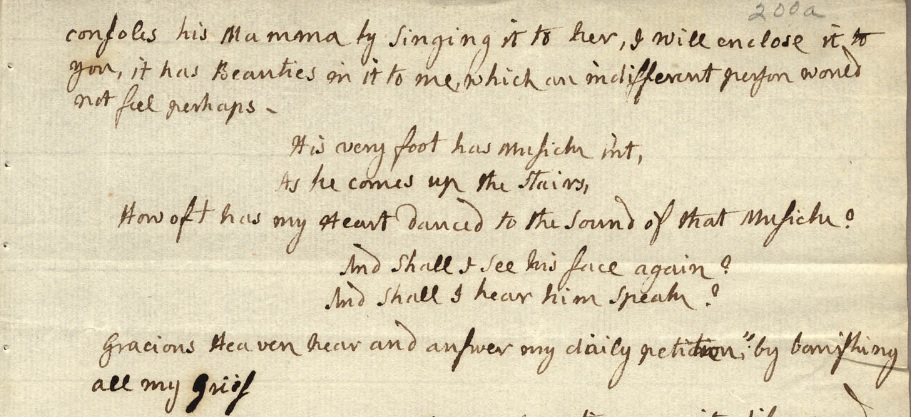
Abigail enclosed the music in one of her letters to John, telling him “It has Beauties in it to me, which an indifferent person would not feel.” She drew out several couplets that she found particularly relatable: “His very foot has Musick in’t, As he comes up the stairs” as well as “And shall I see his face again? And shall I hear him speak?”
On 13 February 1779, when John received the music in France, he was similarly affected. “Your scotch song . . . is a charming one. oh my leaping Heart.”
Letter from John Adams to Abigail Adams, 13 February 1779
Abigail’s affection for the song was shared with her dearest friends. On 15 March 1779, Mercy Otis Warren wrote to her, “You May feelingly join with me and the Bonny Scotch Lass, and Warble the Mournful Chorus from Morn to Eve. Theres Little pleasure in the Rooms When my Good Mans awaw.”
In 1785, when Abigail tried to illustrate to her teenaged niece Lucy the importance of expressing genuine sentiments simply, she referenced the song again. “It is that native simplicity too, which gives to the Scotch songs a merit superior to all others. My favorite Scotch song, ‘There’s na luck about the house,’ will naturally occur to your mind.”
A year later, while living in London, Abigail learned that her family back home in Massachusetts “were all turning musicians.” Her niece was becoming adept at the harpsicord, her nephew had taken up violin, and John Quincy and Charles were learning the flute. “Our young Folks improve fast in their musick,” her sister reported in May 1786. “Two German Flutes, a violin and a harpsicord and two voices form a considerable concert.”
Though she was now reunited with her husband and daughter, Abigail’s family was still separated by the Atlantic Ocean. “Here you would have felt a pleasure which you never experienc’d in a drawing Room at St James,” her sister wrote on 14 July 1786. “To vary our Scene musick is often call’d for . . . and then my sister how do I Wish for you. No one ever injoyd the pleasures of young People more than you use’d too.”
Abigail couldn’t join their late night concerts by the fire, but she came up with a way to make her presence felt. In the winter of 1787, she received a letter from home: “The musical society at Braintree return their thanks for those Scotch Peices of Musick whih you so kindly Sent them.”