The Wanderer

By Susan Martin, Collections Services

The Fay-Mixter family papers here at the MHS includes a folder of material related to the fascinating story of the Wanderer, a luxury yacht refitted in 1858 to engage in the illegal trans-Atlantic trade of enslaved persons. The importation of enslaved people to America was prohibited by the U.S. Congress fifty years before, but smuggling was common. Multiple sources cite the Wanderer as the last known ship to bring enslaved Africans to the United States, but we now know that the Clotilda arrived the following year.

By all accounts, the Wanderer was a very fast vessel, capable of sailing up to 20 knots. William C. Corrie of Charleston, S.C. purchased the yacht in early 1858. He and his business partner, Charles Augustus Lafayette Lamar—cotton planter, radical Fire-Eater, pro-slavery secessionist—immediately began refitting the yacht for its nefarious purpose. Their work aroused the suspicions of officials in New York, who temporarily seized the ship for inspection. Newspaper articles speculated (rightly, it turned out) about the true reason for the modifications, excessive provisions, and foreign crew. But with no definite proof, the ship was released.

The ship sailed on 3 July 1858, arriving at the African coast in September. Corrie got past the British and American anti-slavery patrols stationed there, according to one account, primarily using a charm offensive—friendly dinner parties, etc. The crew of the Wanderer claimed to be on a pleasure cruise up the Congo River. They even sailed under the pennant of the New York Yacht Club. And it worked: the vessel was apparently never inspected.

The Wanderer returned to the U.S. on 28 Nov. 1858, landing at Jekyll Island off the coast of Georgia with over 400 African captives. Dozens had died en route. The arrival of these new enslaved people, along with some questionable documentation, attracted the attention of the authorities, and the jig was up. The ship was seized and the conspirators arrested. In May 1860, Lamar, Corrie, and others were tried for piracy in federal court in Savannah…and acquitted. One of the judges in the case was Lamar’s father-in-law.

The Wanderer material forms part of the Fay-Mixter collection because James Story Fay held a bond of indemnity for the ship. The papers include twelve letters to Fay’s colleague E. D. Brigham in Boston, dated 5 Jan.-10 Apr. 1860, in the run-up to the trial. During this time, Charles Lamar regained possession of the ship and sent it to Havana, under the care of C. R. Moore, to be sold. Three of the letters were written by Moore in Havana, and these are, I think, the most interesting of the group.

Moore praised the speed and agility of the Wanderer, but not its mission: “She is one of the finest little vessels that it was ever my fortune to get on board of, and I wish she could be in some legitimate business, that I could sail her.” He had “fixed her up like a fiddle” and thought he could get $18,000-20,000.

Because of its history, the Wanderer held a certain fascination. Moore received many visitors onboard, including American tourists and British lords, all curious to see the famous ship. But selling proved difficult. The vessel was simply “to[o] expensive and to[o] notorious.” Moore felt the watchful eyes of the English and Spanish fleets and guessed that the English in particular resented the ship. He wrote: “I am asked all kinds of questions here and have to be carefull what I say.”

In his letters to Brigham, Moore discussed his future plans and weighed his options. More than once, he expressed a desire to captain the Wanderer, but he refused to resort to the trade of enslaved people, which was still legal in Cuba. He had received offers:

“There was some parties offered me $16,000 to go to the Coast [of Africa]. I refused. […] If I cannot get a livelihood without going in a Guineaman I will starve in the streets although I am no abolitionist. […] I will stay [in Havana] until I feel that its unhealthy for me to stay. You know I am fat and hot weather and musketoes operate bad on a fat man. […] I love the Wanderer but I cannot feel she will ever give me any permanent business.”

In his third and longest letter, dated 10 Apr. 1860, Moore painted a broader picture of the trade of enslaved people in Havana:

“They prefer the old vessels here for the Coast and there are 7 or 8 fitting out here for the Coast. The ship Erie cleared yesterday, and everybody knows where she is bound. The Captain an American, Gordon his name, cleared before the Consul without difficulty. The Gov Gen is poor and winks at it. He gets $50 a head. I have had offers to go in this vessel, they would bye her for me, but I have tried to live an honest life so far and as long as I have sailed out of Boston. If the Merchants will not give me legitimate employment I will starve before I will go after blackbirds, although I do not think a negro as good as a white man, and am not an abolitionist. But when I coil my ropes up for the last time, I shall feel happyer if I have lived and practised the precepts that my parents taught me.”

The more I researched the Wanderer and the people connected to it, the more interesting the story became. A biography of Charles Lamar, for example, could fill volumes. C. R. Moore described rumors of the firebrand’s colorful exploits: “What I can learn about the young man is not much to his credit […] They tell me here that he is a remarkable small man always carryes Revolvers in his belt has shot 1 or 2 men […]” The rumors were apparently well-founded; in the month of May 1860 alone, Lamar was not only tried for piracy, but also participated in a prison break and a duel!

The Wanderer was seized once more by the U.S. government in 1861 for use against the Confederacy during the Civil War. After the war, it passed into private hands and sailed commercially for a few years before sinking off the coast of Cuba.

So what happened to the hundreds of enslaved Africans smuggled across the Atlantic on the Wanderer? Unfortunately, their fate was no different than that of the millions who preceded them. They were trafficked across the South, and the brazen Charles Lamar even kept some of them himself. The federal government showed as little interest in protecting them as it had in punishing their enslavers.

Because of its notoriety, there has been significant research into this case over the years. One of the earliest studies I found is a 1908 article in American Anthropologist by Charles J. Montgomery. Published fifty years after the ship’s fateful passage, while many of the “Wanderer Negroes” were still alive, the article contains an uncomfortable anthropological focus and some unfortunate language. However, it also includes specific information about a few of the captives, as well as their histories and photographs.

In 2008, the state of Georgia erected a monument to the ship’s African survivors on Jekyll Island, and some of their descendants attended the dedication ceremony.

For more information, see The Slave Ship Wanderer by Tom Henderson Wells (Athens, Ga.: University of Georgia Press, 1967) and The Wanderer: The Last American Slave Ship and the Conspiracy That Set Its Sails by Erik Calonius (New York: St. Martin’s Press, 2006).

Margaret Russell’s Diary, January 1916

By Anna Clutterbuck-Cook, Reader Services

After receiving positive feedback on last year’s serial documenting a journey up the Nile by an anonymous diarist, I decided to repeat the format in 2016 but with a very different type of diary from the MHS collections.


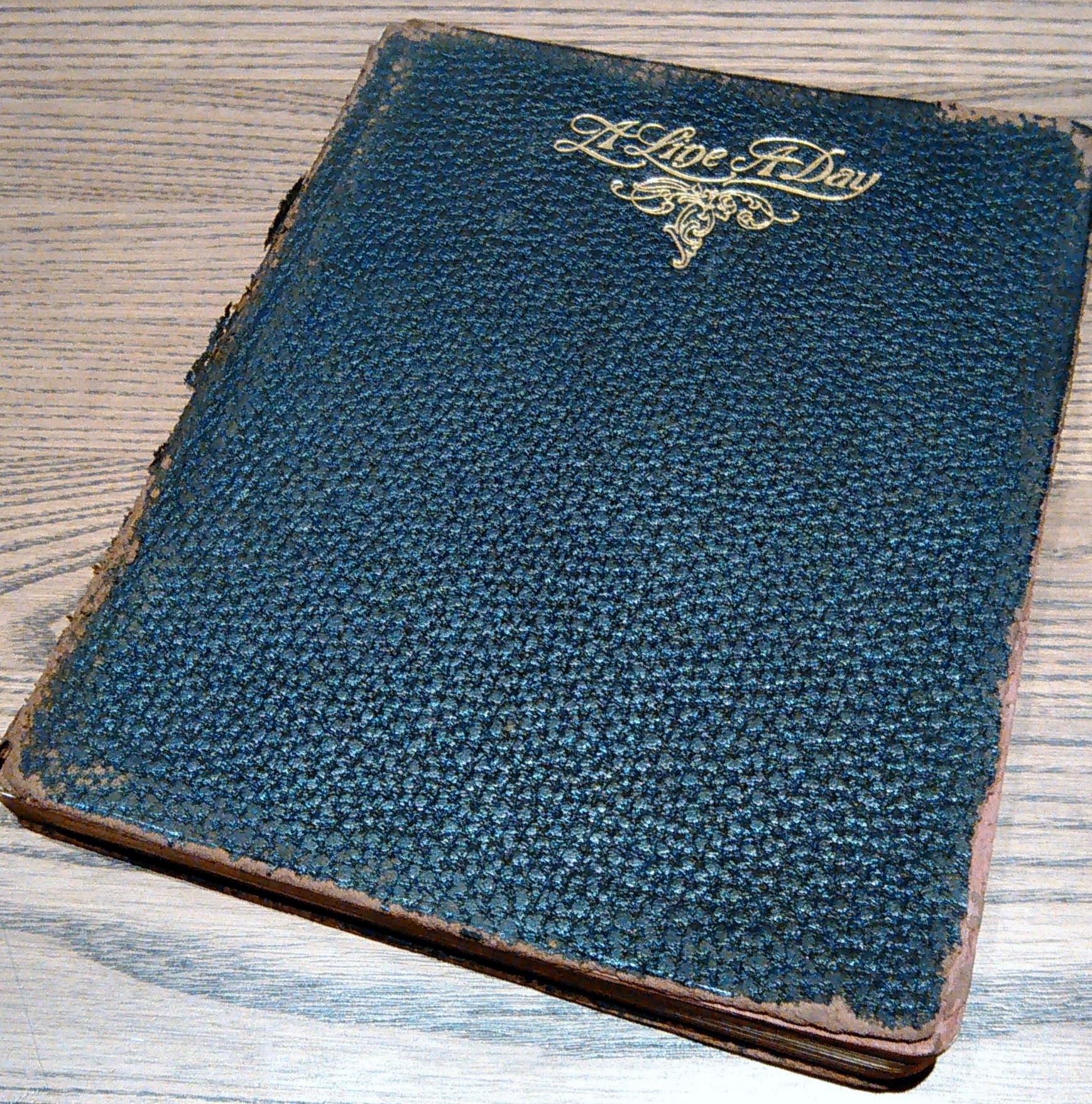
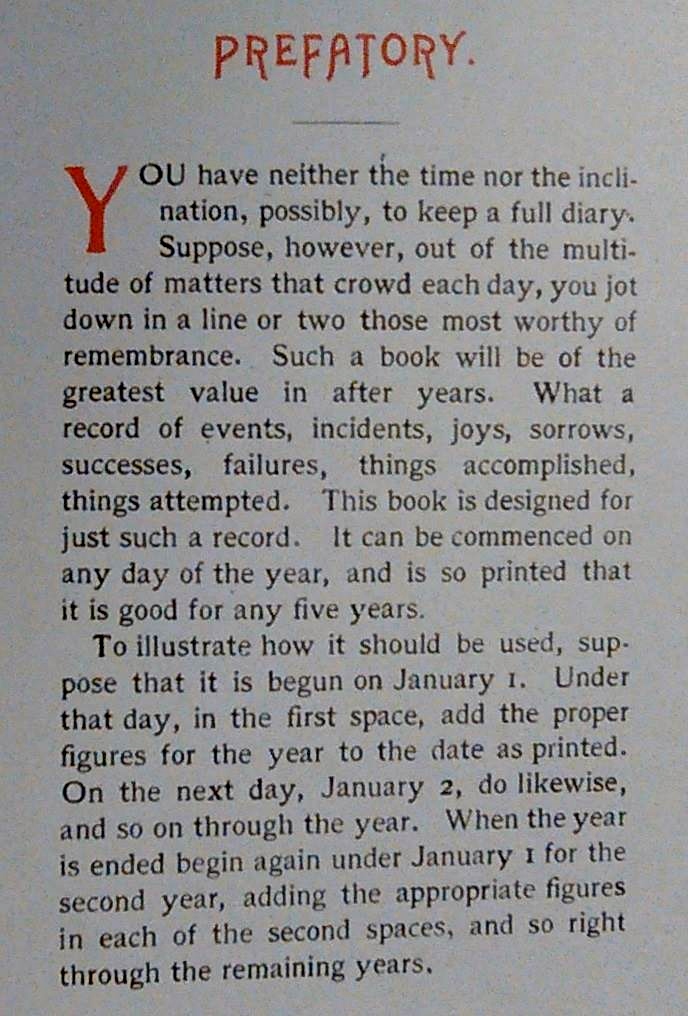
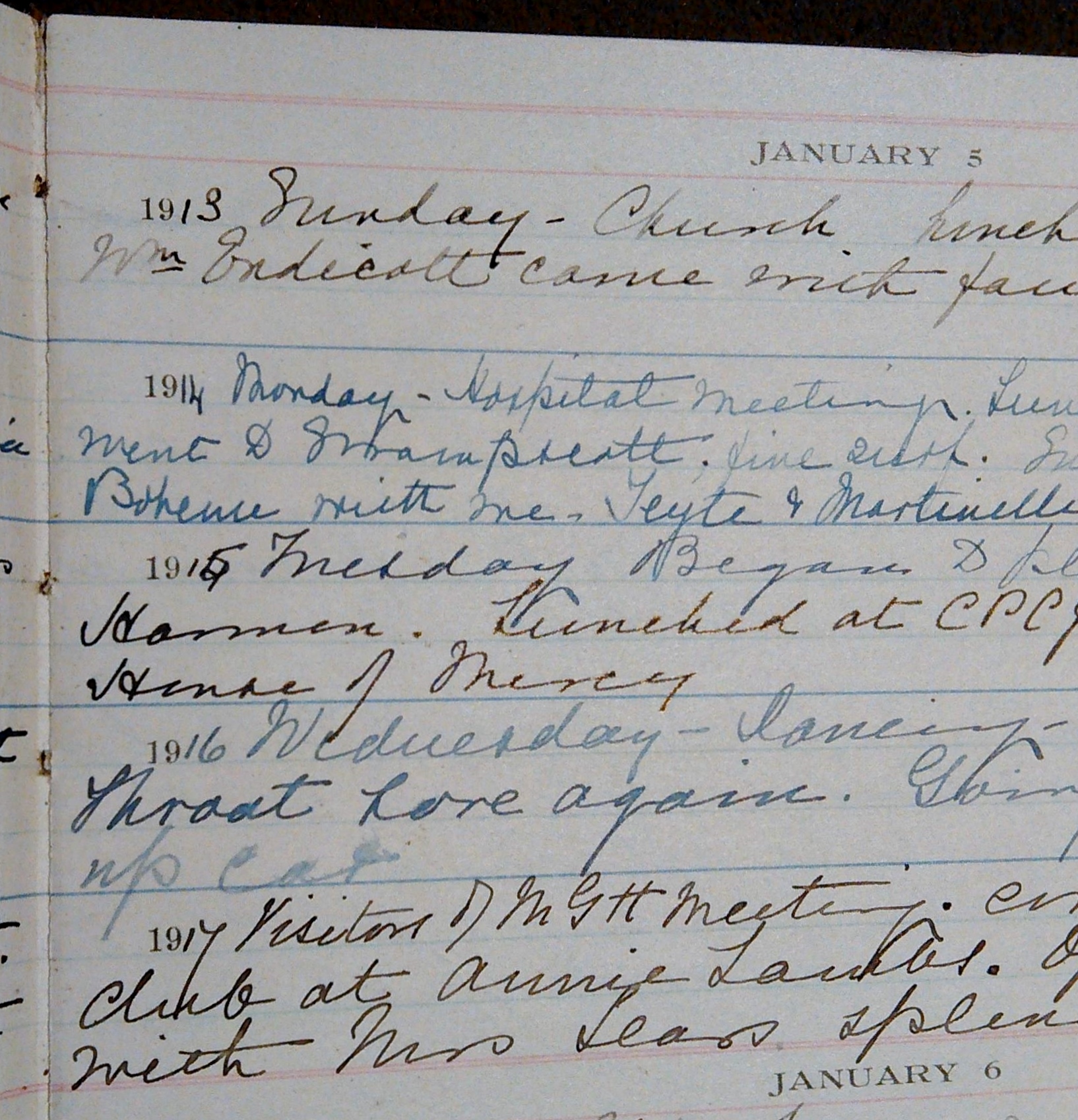
Between 1913-1922, Margaret Russell kept track of her activities in Ward’s line-a-day diaries pre-formatted to accommodate five years worth of daily records. As historian Molly McCarthy documents in her history of the daily planner, these standard blank books rose in popularity toward the end of the 19th century. The Samuel Ward Company of Boston, Massachusetts copyrighted their format in 1892, offering a “condensed, comparative record for five years” with the tagline, “nulla dies sine linea (not a day without a line).” Russell’s volume, which she began filling in 1913 at the age of fifty-five, offers prefatory instructions for the inexperienced diarist:


Russell appears to have found satisfaction in keeping her line-a-day record, because three years later in January 1916 she is still diligently writing daily in her Ward’s volume. The first month of the year is punctuated by poor weather and ill-health, as well as a full slate of social activities. While brief, in aggregate form the diary entries grant us view of daily life for a white, upper middle-class woman in middle age, living in Boston in the second decade of the twentieth century.


1 Jan. Saturday. Snowing & raining. Ear & Eye hosp. & errands. Went to Cambridge to see Katey & Aunt E–. Concert with Mrs. Schelling & Mrs. Sears.*

2 Jan. Sunday – Church – Lunched at H.G.C.’s. Family to dine & then to Slater musical. Gov. W– very prominent.

3 Jan. Monday – Hosp. meeting. [word] lunch at Marian’s. Botany lecture & drove to Swampscott. Very heavy roads.

4 Jan. Tuesday – Paying bills – walked downtown to Dr. Crockett for third time about my ear. Lafayette Fund show with Georgie.

5 Jan. Wednesday – dancing – Ward lecture. Throat sore again. Going to [word] I put up car.

6 Jan. Thursday. Felt poorly with [word] cold. Went to tableaux with Marian R. A beautiful show.

7 Jan. Friday Walked for errands & Dr. Crockett who says I better go to Woodstock to have [word]. Stayed at home all the afternoon.

8 Jan. Saturday. Mr. Surette’s first lecture very interesting. Went to Ellen’s dancing school. Meant to go to assembly but throat prevented.

9 Jan. Sunday – Felt feverish so stayed in all day. Family to dine.

10 Jan. Warm & rainy. Drove to Cambridge with Miss A– for botany lecture with slides. Much depressed by my ignorance.

11 Jan. Monday-Felt very poorly. Dr. C.sent me home & I passed the P.M. on my couch with pleasure. Gave up dinner at Burr’s. 

12 Jan. Wednesday – In the house all day this is the fourth sustained attack I have had.


13 Jan. In the house – better.

14 Jan. In the house. Sat in the window for a short time.Miss A- sent for as sister has pneumonia but she died before Miss A- got there.

15 Jan. So cold I gave up going out but sat in the window in the warm sun. Susan Bradley came to see me.

16 Jan. Sunday – did not go out. Mr Fenno came to call & family came to dine.

17 Jan. Monday – very cold & windy but drove to May R.’s birthday lunch and back .Botany lesson here. Ellen & teacher to play here.

18 Jan. Tuesday – lovely cold day.Feel better at last. Sat in the open window & went to Swampscott in P.M. Roads very good.

19 Jan. Wednesday. Went to Mrs.Ward’s lecture.Llunched at Chilton. Lecture at Art [word] & tea for Emily [word] at Mrs. T. Motley’s.

20 Jan. Thursday – Errands but began to snow and then rain so stayed at home in the P.M. Feeling better.

21 Jan. Friday. Went to concert & took Mrs.Hadder

22 Jan. Saturday Went to Mrs.Tyson’s in the P.M. did not feel so well.

23 Jan. Sunday Stayed in bed till dinner time & felt better. Family to dine.

24 Jan. Monday. Stayed in bed in the morning. Botany lesson & then rested.

25 Jan. Monday. Sat in the window & after lunch went to drive. Really warm. Gave up Lyman dinner.

  26 Jan. Wednesday.Drove morning & afternoon & feel better.

27 Jan.Thursday. Drove in the morning & went to bank. Lunch club at [word]. Went to see Dr. Balch who says I must be careful.

28 Jan. Friday – [word] not get up in the A.M. Lunched at Bell’s – took a drive & feel better.

29 Jan.Saturday-Mrs.Tyson’s in the A.M. To see Dr. Balch who called in Dr. W.D. Smith in consultation. Both say be careful.

30 Jan. So tired after yesterday’s performance that I stayed in bed until P.M. Lucy Bradley & Jessie came to call. Family to dine.

31 Jan. Monday -Feel better. Had my hair washed. Lunch at Marian’s & home for botany lesson. Rested. Mrs. McL– called home.


Join me once a month throughout the year as we continue to follow Margaret Pelham Russell’s daily activities as she recorded them one hundred years ago.

If you are interested in viewing the diary in person in our library or have other questions about the collection, please visit the library or contact a member of the library staff for further assistance.


*Please note that the diary transcription is a rough-and-ready version, not an authoritative transcript. Researchers wishing to use the diary in the course of their own work should verify the version found here with the manuscript original.


Guild Library Discoveries

By Wesley Fiorentino, Reader Services

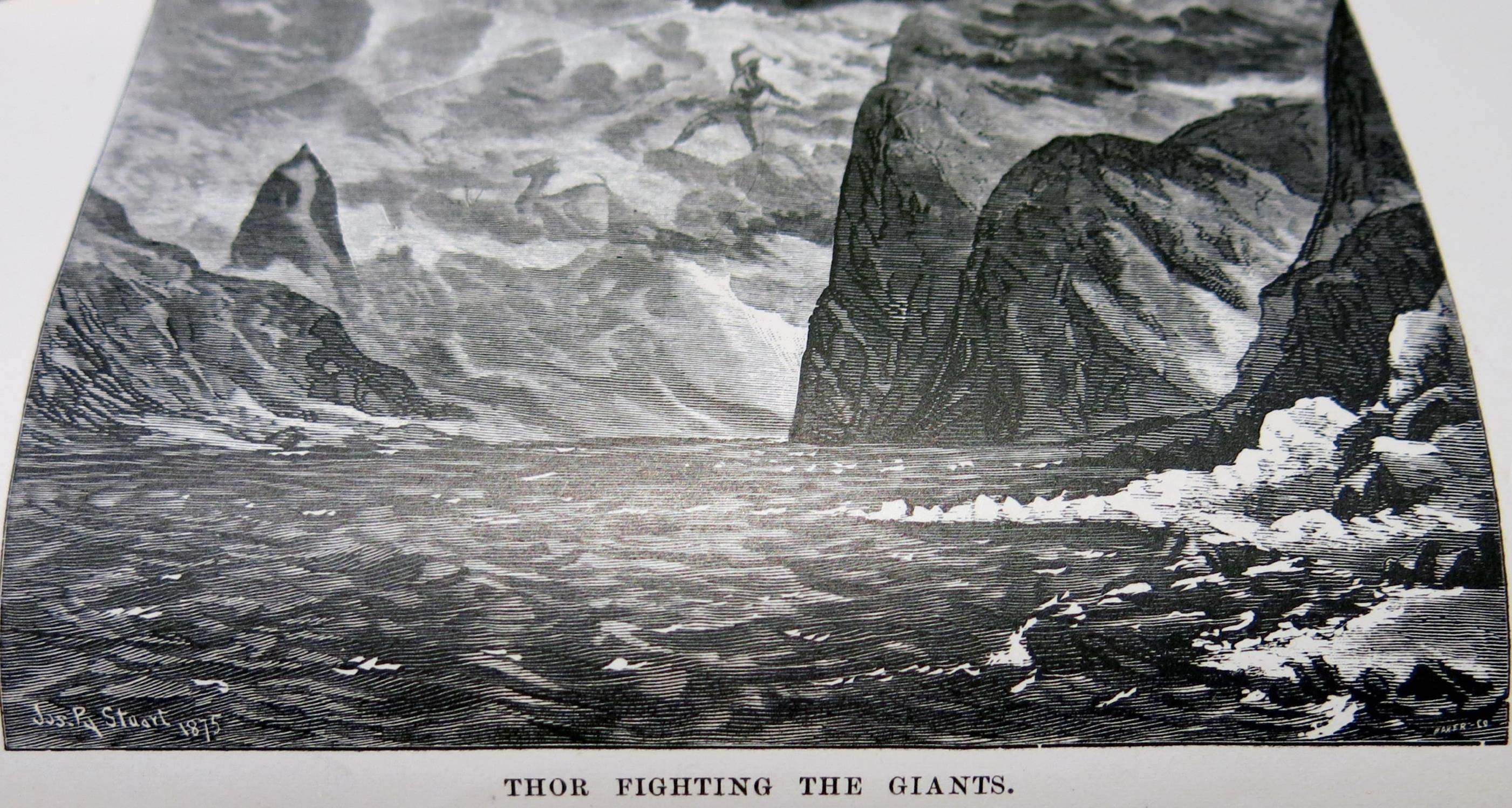
As I mentioned in a previous Beehive post, there are all kinds of interesting discoveries to be made when exploring MHS collections. This time around I will be talking about a collection of books that I came across almost by accident while navigating through ABIGAIL, our online catalog.  I found a link to a book on Norse mythology, written by Rasmus Bjorn Anderson, which intrigued me quite a bit.  Working in an institution with a clear focus on Massachusetts history, I admit I was confused when I found an item on Scandinavian antiquities.  I put in a request for the title, and when it came to me, it was in a large record carton with a number of other books. 

To my surprise, when I opened the carton there were ten volumes inside, only one of which was the book by Rasmus Bjorn Anderson.  Of the other nine, all were written by different authors, with the exception of a two volume edition of Evelina, by Fanny Burney.  In addition to Anderson’s Norse Mythology are included an English edition of Goethe’s fable Reynard the Fox and Edward B. Lytton’s historical novel The Last Days of Pompeii.  Why was Anderson’s volume on the mythology of ancient Scandinavia housed with these other intriguing yet disparate works?  The books are all part of the Guild Library, an eclectic private collection which is one of several such private collections gifted to the MHS throughout our institutional history consisting of books on a truly broad range of topics.  The library belonged to Curtis Guild, Jr., Governor of Massachusetts and MHS member, and was donated to the MHS under the terms of the will of his wife Sarah Louisa Guild in April of 1949 (MHS Proceedings, vol. 69).  Below are a few of the works I found particularly interesting, and just a taste of what the Guild Library has to offer.


Rasmus Bjorn Anderson, born in 1846 to Norwegian parents in Wisconsin, heavily promoted the Viking exploration of the New World and also originated Leif Erikson Day.  In his bookNorse Mythology, Anderson celebrates the linguistic and literary heritage of the Scandinavian countries, as well as that of Germany and England.  Anderson praises the efforts of nineteenth century scholars who promoted the study and spread of Anglo-Saxon and Old Norse literature.  He then goes on to provide a preface to some of the major poems and written works that have survived in Old English and Old Norse, mainly from England and Iceland. 


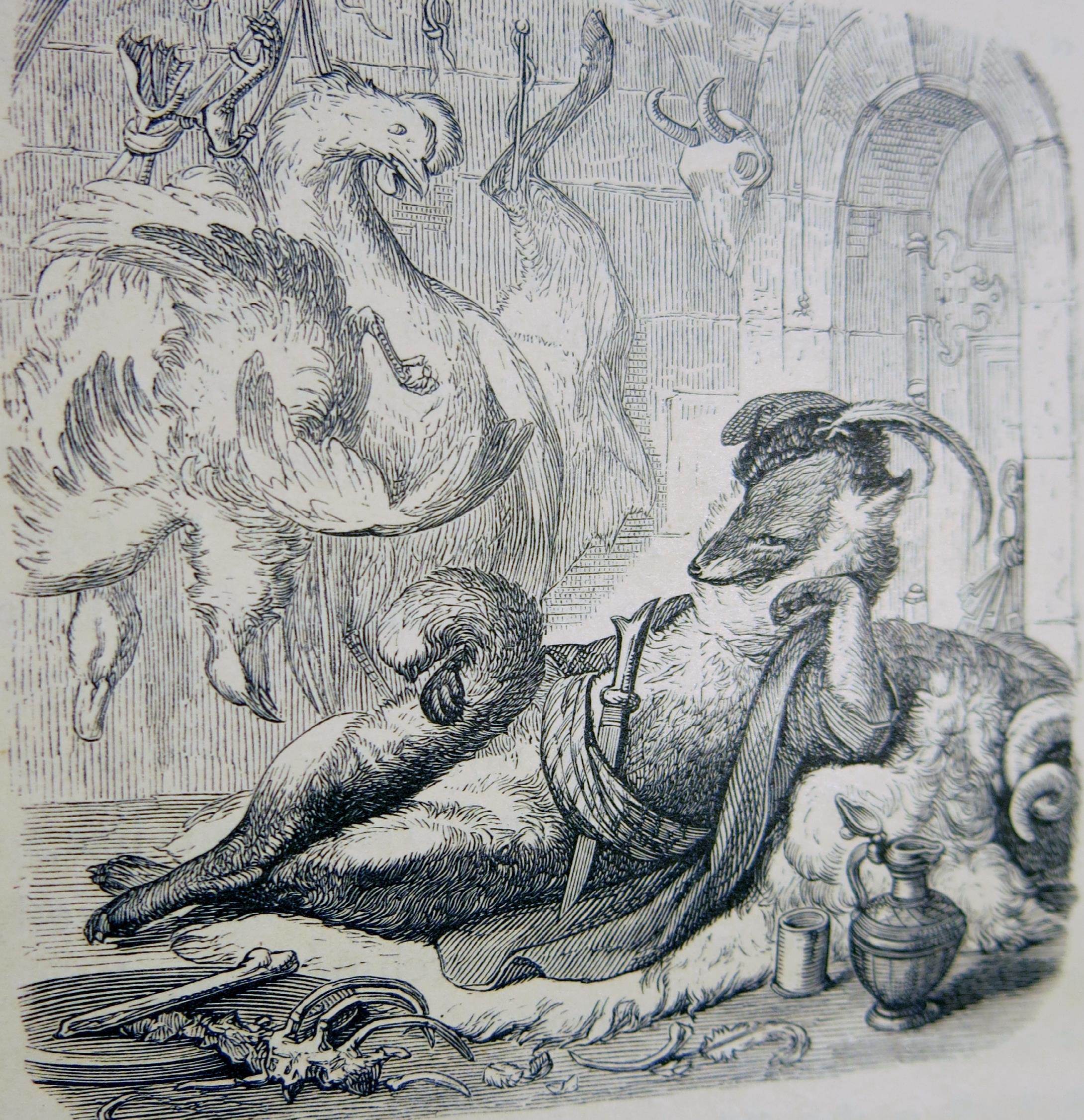
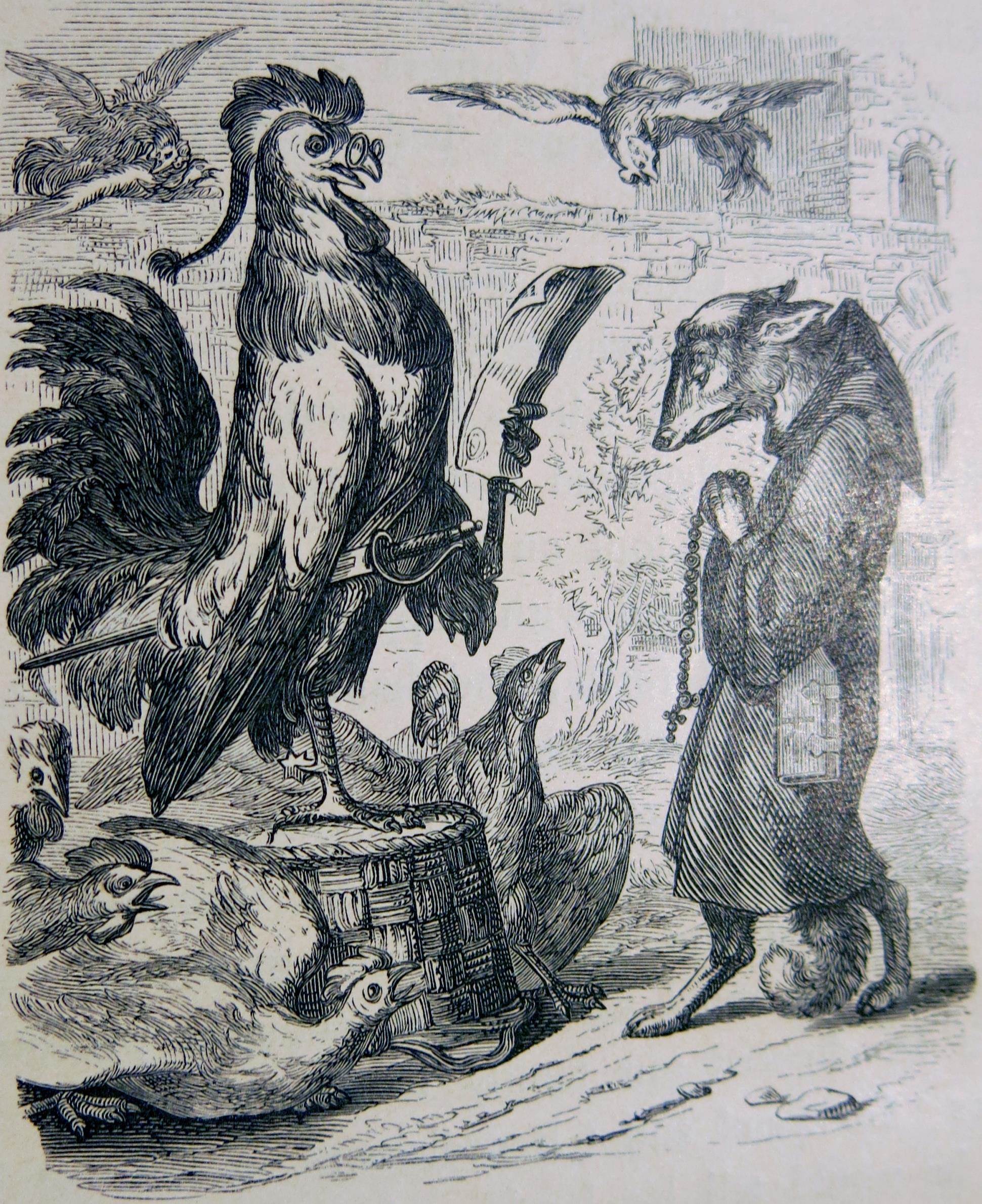
The copy of Reynard the Fox has been translated from Goethe’s German into English verse by Thomas James Arnold.  Arnold, a nineteenth-century English barrister and magistrate, was known for his translations of Goethe and other German writers.  In addition to Reynard the Fox, Arnold translated Goethe’s Faust and Friedrich von Schiller’s ‘Song of the Bell’ into English.  Reynard the Fox is an epic verse adaptation of the story of Reynard the Fox, the central character in a cycle of fables dating to the Middle Ages, mainly from England, France, Germany, and the Netherlands.  The main character, Reynard, is a trickster figure whose adventures involve a number of other animal characters including Bruin the Bear, Sir Isegrim the Wolf, and Noble, the King of Beasts.  The stories surrounding Reynard’s exploits seem to parody the political and religious institutions of the Middle Ages, as a number of characters are clearly modeled on such familiar positions as the monarch, the priest, and the soldier. 


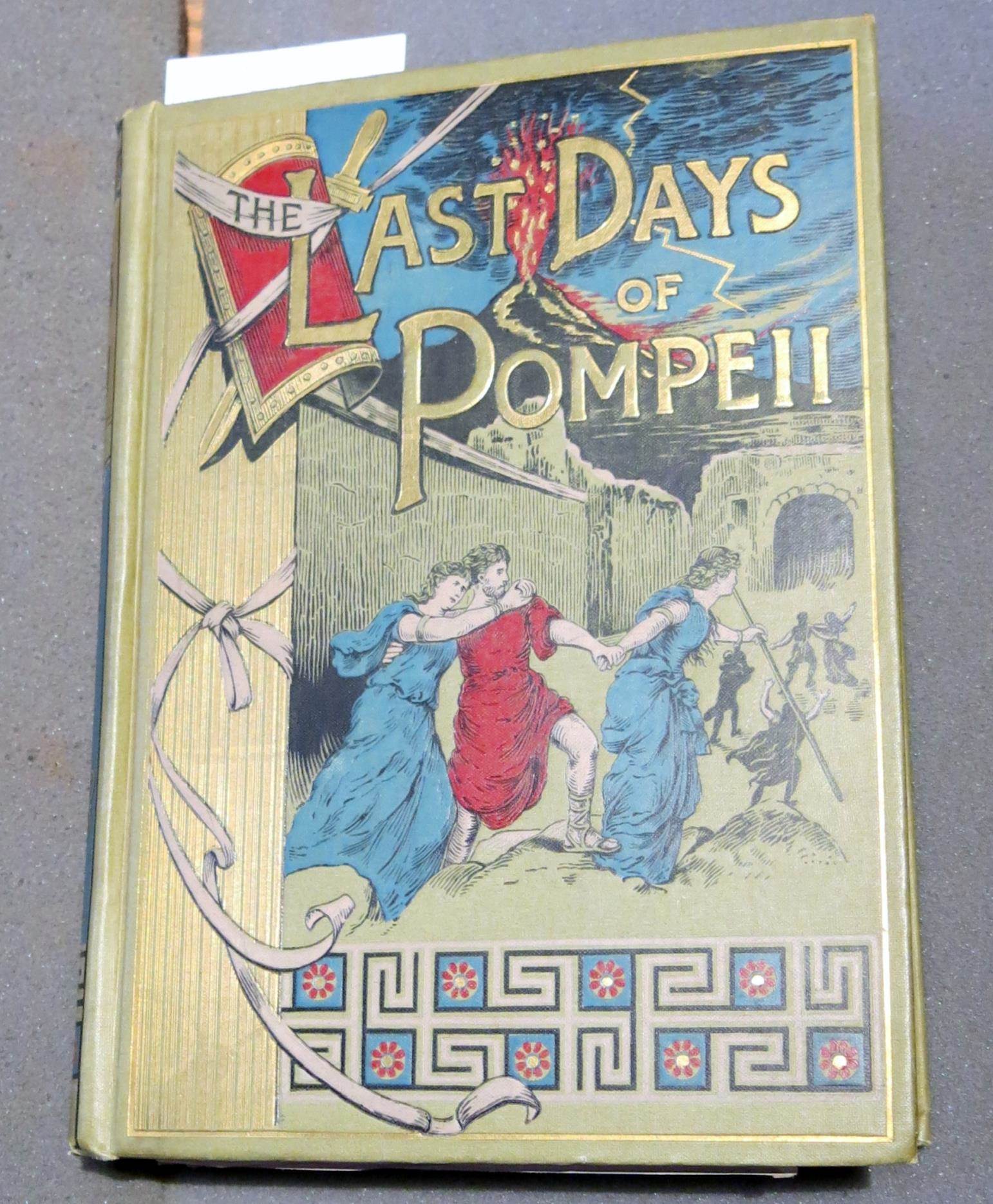
The Last Days of Pompeii, written by Lord Edward Bulwer Lytton in 1834, is a work of historical fiction focusing on events in the city of Pompeii leading up to the fateful eruption of Mount Vesuvius in 79 AD.  The novel was popular throughout the rest of the nineteenth century and well into the twentieth century, although today its popularity has severely waned.  The plot centers on a number of the city’s inhabitants.  The principal characters include a Greek aristocrat, an Egyptian sorcerer, an enslaved noblewoman, and a Christian persecuted for his faith.  The novel has been adapted to a variety of other mediums, including opera, film, and television.  Notably, the 1959 film version, directed by Sergio Leone, is considered a standard of the “sword-and-sandals” epic genre.  The cover is beautifully decorated with an image of townspeople fleeing as Vesuvius erupts, as well as with gilding and patterning along the borders. Throughout the book are intricate illustrations of scenes from the novel, though the illustrator’s name is not included.  The book is a perfect read for those hoping to learn more about nineteenth century printing, historical fiction, or romanticized memories of classical antiquity.

My curiosity about a book on Norse mythology would lead me to a number of other exciting discoveries.  I never thought that I would find a translation of a Goethe poem or a copy of a nineteenth-century historical fiction novel in the MHS collections, let alone boxed together with Anderson’s text.  The Guild Library collection covers a number of other topics as well, including African exploration and big game hunting in the nineteenth century.  There are all sorts of interesting items for the steadfast researcher or the inquisitive reader.  I can personally attest that hoping to examine just a single item, namely Anderson’s Norse Mythology, led me down a literary rabbit-hole I would not have thought existed.  Yet another example of what can happen while just browsing through MHS collections (http://www.masshist.org/library).  


“He has so damnd himself to everlasting Infamy”: Alexander Hamilton and Abigail Adams

By Amanda Norton, Adams Papers

Between the $10 bill and a smash-hit musical, everybody seems to be talking about Alexander Hamilton. January marks not only the anniversary of Hamilton’s birth, and his resignation as Secretary of the Treasury in 1795, it also marks the anniversary of the most famous, or infamous, insult hurled Hamilton’s way. It was on 25 January 1806 that John Adams memorably referred to Hamilton as the “bastard brat of a Scotch Pedler.”

John Adams’s hostility toward Hamilton late in life is well known and is usually attributed to the role Hamilton played in the Election of 1800, attacking Adams and contributing to his defeat. But the Adamses, both John and Abigail, had expressed distrust of Hamilton long before then, and Abigail was just as colorful as John was. In 1794 when opponents of his economic proposals condemned Hamilton, Abigail noted that while some of the criticism was unwarranted, it was not entirely unfounded. Alluding to William Shakespeare’s Julius Caesar, Abigail cautioned John, “I have ever thought with respect to that Man, ‘beware of that spair Cassius.’”

The next few years did nothing to improve Abigail’s opinion. Hamilton was widely believed to have unsuccessfully meddled in the 1796 Election, attempting to keep Thomas Jefferson out of the vice presidency, even, or perhaps, especially, if it meant sacrificing John Adams’ candidacy. Hearing of Hamilton’s interference in December 1796, Abigail wrote, “I have often said to you, H——n is a Man ambitious as Julius Ceasar, a subtle intriguer. his abilities would make him Dangerous if he was to espouse a wrong side. his thirst for Fame is insatiable. I have ever kept My Eye upon him.”

The revelation of Hamilton’s affair with Maria Reynolds in 1797 was a breaking point for Abigail, leading to some of her most vitriolic comments. As the Quasi-War with France was building and the United States formed a new army, Abigail could not understand those who wanted Hamilton to be commander-in-chief. “That man would in my mind become a second Buonaparty if he was possessd of equal power,” she wrote to her cousin in July 1798. By January 1799, Abigail was increasingly heated. Learning that her son Thomas Boylston Adams who had been in Europe was to return to the United States on board the ship Alexander Hamilton, Abigail sneered, “I dont like even the Name of the ship in which he is to embark” and in letters written to John on 12 and 13 January, she railed against Hamilton. Abigail firmly believed that Hamilton’s failure to uphold his private marriage vow inevitably made any public vow he made suspect. In a Biblical allusion to King David, she warned that with Hamilton in charge of the army, “Every Uriah must tremble for his Bathsheba.”

While John’s acerbity is well known, Abigail Adams was no more timid in her remarks. Throughout the 1790s, Alexander Hamilton was on the receiving end of her barbs, even though Abigail maintained that she saw no “breach of Charity” in her observations.

“. . . unidentified girl exercising with dumbbells”

By Kittle Evenson, Reader Services

That was the line in our online catalog that caught my eye last week. Sandwiched between portrait descriptions and mention of a family crest, this hint about a tintype dating to the 1870s in the Homans family photographs collection was too arresting not to follow up on.

I pulled the appropriate box from our photograph collection and sure enough, the second-to-last folder bore the title “four unidentified girls exercising, ca. 1870-1880. Photographer unknown. Tintype.” Four girls exercising? My interest was well and truly piqued.

Tintype of four girls lifting dumbbells, ca. 1870-1880. Found in the Homans family photographs.

Facing the camera, the four girls wear matching outfits, complete with white handkerchiefs tucked into their chest pockets and shiny black shoes. They appear to be in their mid-to-late teens and are standing straight-spined, each holding aloft two dumbbells.

In a collection of unremarkable individual and group portraits, this photograph raised a multitude of questions for me, chief among them being, why are these girls lifting weights? What group are these girls a part of that they are identically dressed and posing for this photograph? Was this common practice for Boston-area women in the 1870s? While common practice today, weight-lifting women were not always so familiar.

I took a two-pronged approach to answering these questions, first searching the Homans family papers, including the 1878 and 1881 diary of teenager Mattie Homans, to see if I could find reference to this type of exercise, and then looking at our collections more broadly for materials related to women’s gymnasiums in Boston and physical education for women.

The Homans family papers disappointingly failed to illuminate the context for this photograph, and so I moved on to other, related resources.

Ideas regarding health, fitness, and the role of physical activity for shaping personal and cultural character changed dramatically over the course of the 17th, 18th, and 19th centuries, and this photograph illuminates the pervasiveness of these changes. Puritan beliefs that illness was an unavoidable and even expected aspect of their daily lives, gave way to the active promotion of health and hygiene through personal actions and environmental changes. 19th century Boston played host to a multitude of facilities, practitioners, and publications devoted to shaping the public discourse on physiology and hygiene, and middle class citizens, particularly women, were at the heart of this movement.

In Able-Bodied Womanhood: Personal Health and Social Change in Nineteenth-Century Boston, Martha H. Verbrugge posits that

“[A]ntebellum health reform prescribed self-governance to alleviate the problems of urban life. The world seemed unmanageable to Boston’s middle class . . . [i]n an unpredictable and seemingly uncontrollable world, [they] looked inward for stability. Self-control appeared to be the most reliable, perhaps only, mechanism for restoring order.” (47)

While Bostonians believed that a person’s biological characteristics (like a weak heart), and their physical environment (like a drafty house) contributed to their health, or lack-thereof, they placed the greatest emphasis on the role of personal behavior in actively shaping their lives.

Attempting to break the monopoly men held over early gymnasiums, Bostonians such as Dr. Dio Lewis and Mary E. Allen, opened gymnasiums catering specifically to women and children. In 1860 Lewis opened the New Gymnasium, focused almost exclusively on promoting muscular development in children of both sexes, and his Family School for Young Ladies in Lexington, MA, which centered its curriculum around both intellectual and physical instruction.

Dr. Lewis’s Family School for Young Ladies. Sketch found in “Catalogue and circular of Dr. Dio Lewis’s Family School for Young Ladies, Lexington, Mass. 1866.”


Mary E. Allen continued this trend into the 1870s, opening the Ladies Gymnasium on Washington St. in 1877 and offering facilities for women and children to conduct slow, careful, and progressively more difficult physical exercise in the pursuit of “symmetrical bodily development”. In addition to providing a gymnasium, Allen also taught a so-called “Normal Class . . . for the instruction of those who intend to teach Gymnastics, either in public or private schools, or in Gymnasiums devoted to women and children, an urgent need of which exists in the larger towns and cities.” Not only training women to improve their own physiques, but to become teachers of such methods themselves.

“The Ladies’ Gymnasium. Eighth Year, 1885-1886”


This broadening emphasis on physical culture was deeply intertwined with changes in beauty and fashion standards, the roles of middle class women in the private and public spheres, and developments in science and medicine. Verbrugge’s work does a wonderful job of addressing the intersectionality of these varied forces, particularly within the sphere of Boston society.

Taking these sources in concert, it is no longer strange to have found the image of young women lifting dumbbells, particularly within the family photograph collection of a prominent Boston family. Unfortunately, I was not able to identify the women in the photograph, or establish their affiliation with a particular school or gymnasium. That will have to be a project for another day.

If 19th century dumbbells strike your fancy and you would like to see the Homans tintype in person, please feel free to stop in and visit our library. If you are interested in seeing what other materials we have related to physical education, you can browse our online catalog, ABIGAIL from the comfort of your own home.

The Ekphrastic Fiske

By Peter Steinberg, Collection Services

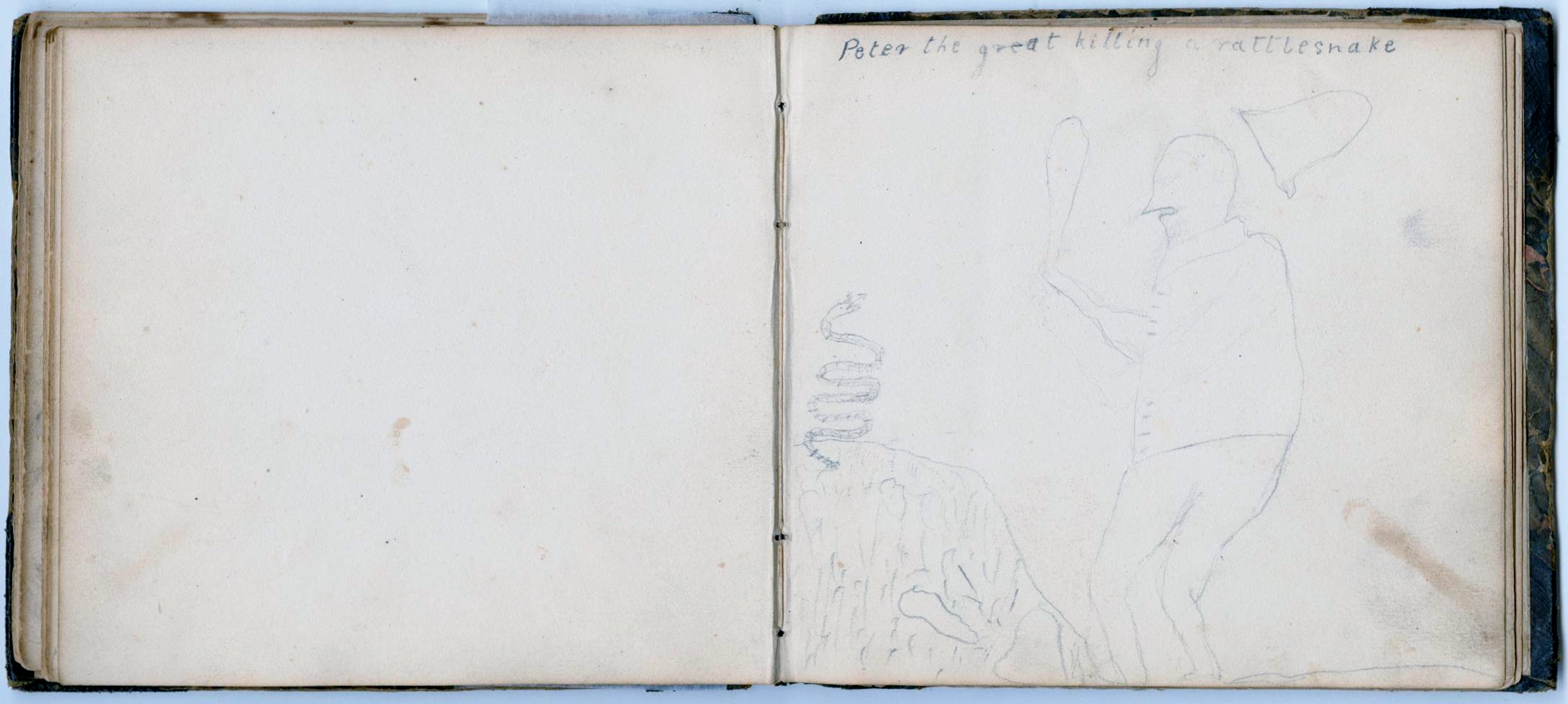
On 30 January 2015, my colleague Dan Hinchen introduced our readers to Eben W. Fiske (1823-1900), a Civil War veteran and librarian as well as a talented amateur illustrator, in his post Ishpeming Illustrators. Dan discussed Fiske’s artwork, which he broke out into two categories: Civil War drawings and other. The Fiske family papers (Ms. N-1227) also contains letters and compositions, as well as several volumes containing original pencil drawings.

Recently I was asked to review the collection to determine whether any of the drawings might be worth including in a forthcoming web project. I pulled Box 3, which houses “Volumes 3-6: E.W. Fiske writings, drawings,” from the shelves. Volumes 3 and 4 contain newspaper clippings; volume 5 is a notebook with writings on the Bible. The folder with the intricate drawings was labeled “Volume 6: Pencil drawings. Illustrations to ?”.


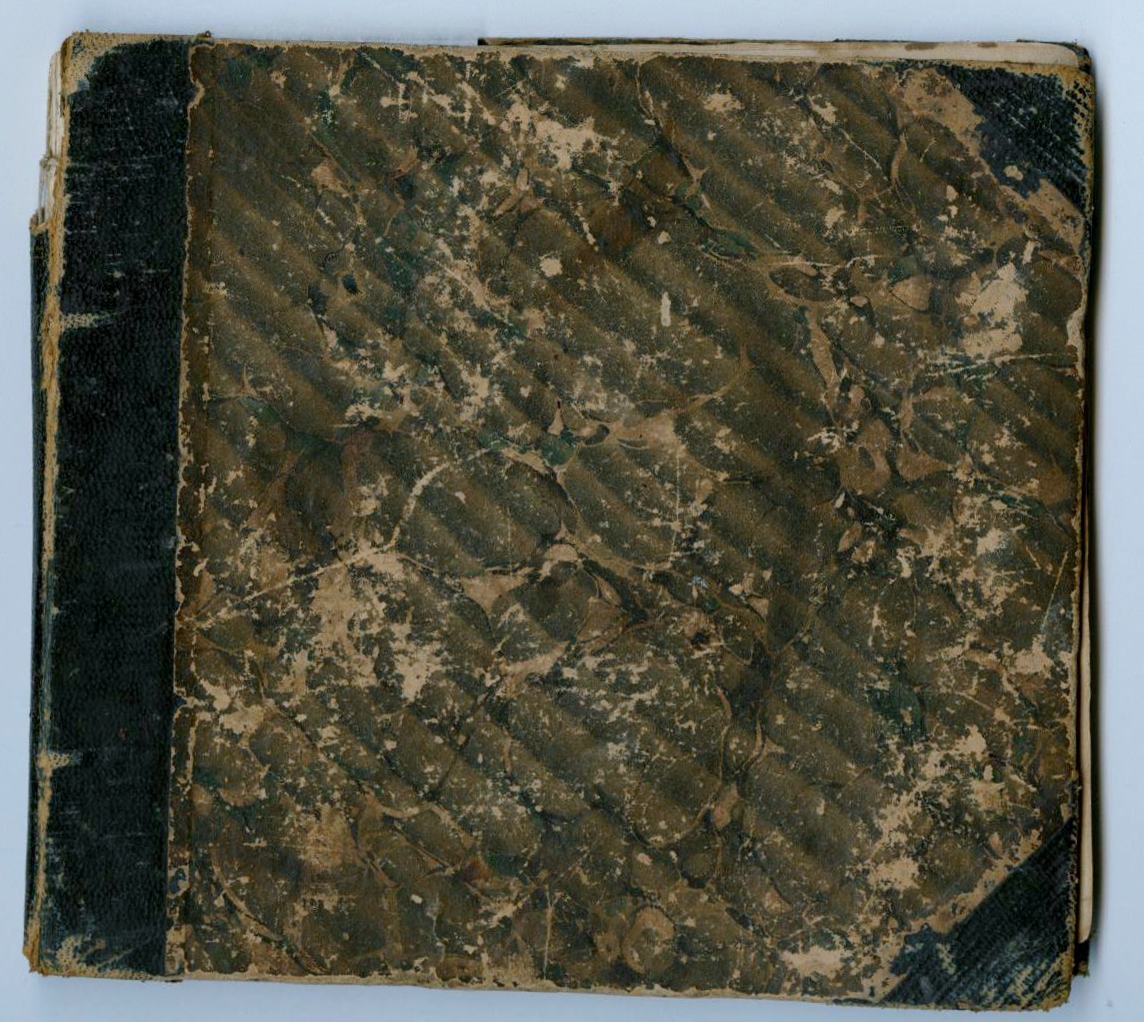
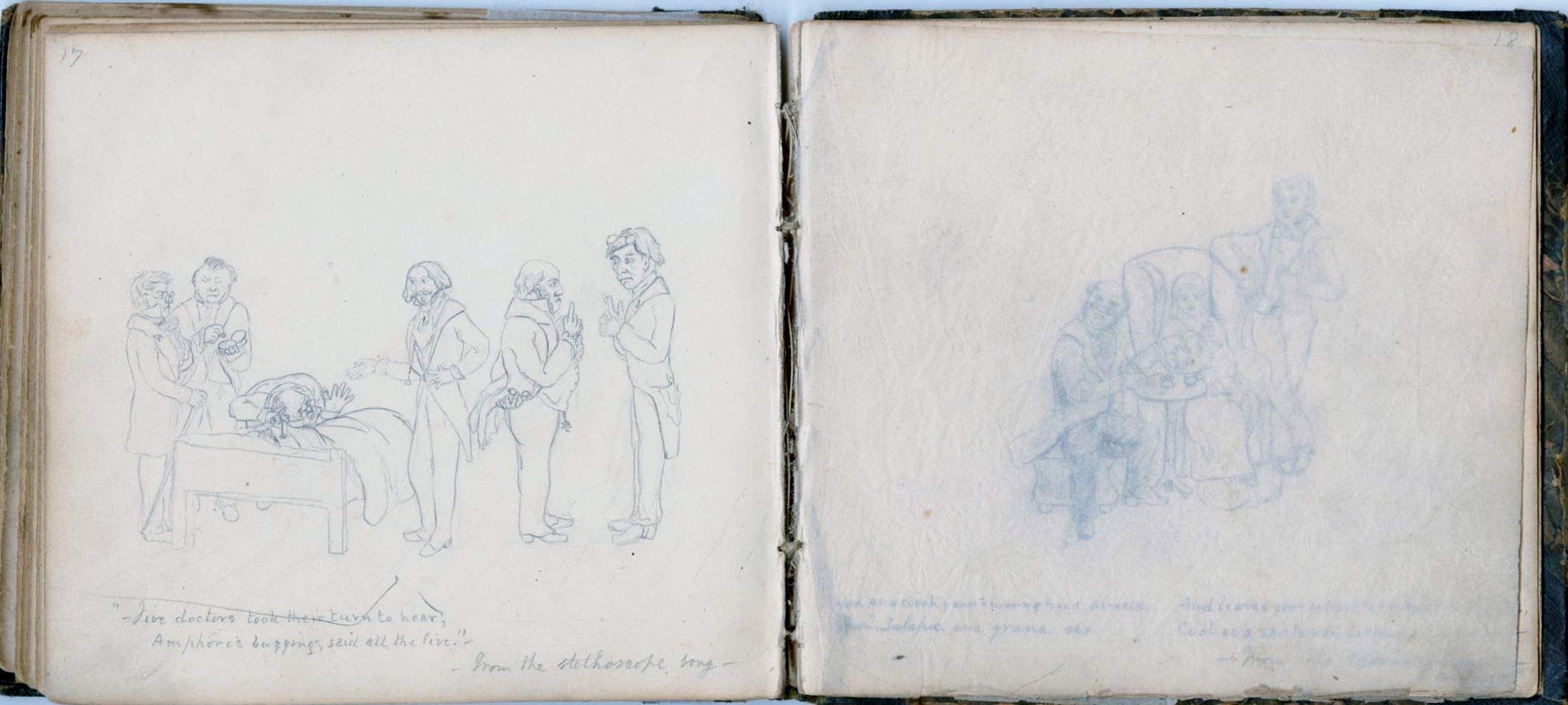
The small sketch book, measuring 16.2 cm x 17.8 cm, features highly detailed scenes that correspond to text that Fiske puts in quotes. Curious about the quotes, I learned from Dan’s prior blog post that Fiske drew in response to the poem “On Lending a Punch Bowl” by Oliver Wendell Holmes, Sr. As other poems are quoted and illustrated, I searched for word strings in Google and was happy to discover most of the works from which Fiske drew inspiration. Here is a list of the groupings of drawings:

Pages 1-4 respond to the poem “On Lending a Punch Bowl” by the physician and poet (among other things) Oliver Wendell Holmes, Sr. (1809-1894);

Pages 5-12 illustrate (pun!) Holmes’s “A Song: For the Centennial Celebration of Harvard College, 1836”;  

Pages 13-16 react to a lecture given at the Mercantile Library Association;

Page 17 draws on (pun, again!) Holmes’s “The Stethoscope Song”; and

Page 18 takes inspiration from Holmes’s “The Morning Visit”.


There are also a few unfinished sketches and two instances where drawings were tipped in between pages.


Responding to a work of art using another form of art is called ekphrasis. It is most commonly seen when a poem is inspired by a work of art. See, for example, Sylvia Plath’s poems “Conversation Among the Ruins (1956) and “The Disquieting Muses” (1958) and Giorgio de Chirico’s paintings by the same names (the former1927 and the latter1916-1918). Those are just two examples; and it appears the term is flexible enough to include Fiske’s reactions to the poems of Oliver Wendell Holmes, Sr.

While there currently is no finding aid to the Fiske family papers, please do not let that stop you from coming into the MHS to enjoy the collection.


“The Sublimity of it, charms me!”: John Adams and the Boston Tea Party

By Amanda Norton, Adams Papers

In the fall of 1773, three ships carrying a cargo of tea from the British East India Company were on their way into Boston Harbor. Subject to the Tea Act of 1773, allowing the tea to be unloaded in Boston would have meant the acceptance of the principle of Parliamentary taxation, an idea that Bostonians had been fighting for a decade. After Governor Thomas Hutchinson and the ship owners refused to prevent the ships’ landing, the Sons of Liberty decided to take action, and 242 years ago on the night of December 16, a group of patriots wearing Native American dress snuck on board the three ships and dumped their cargo into the harbor.

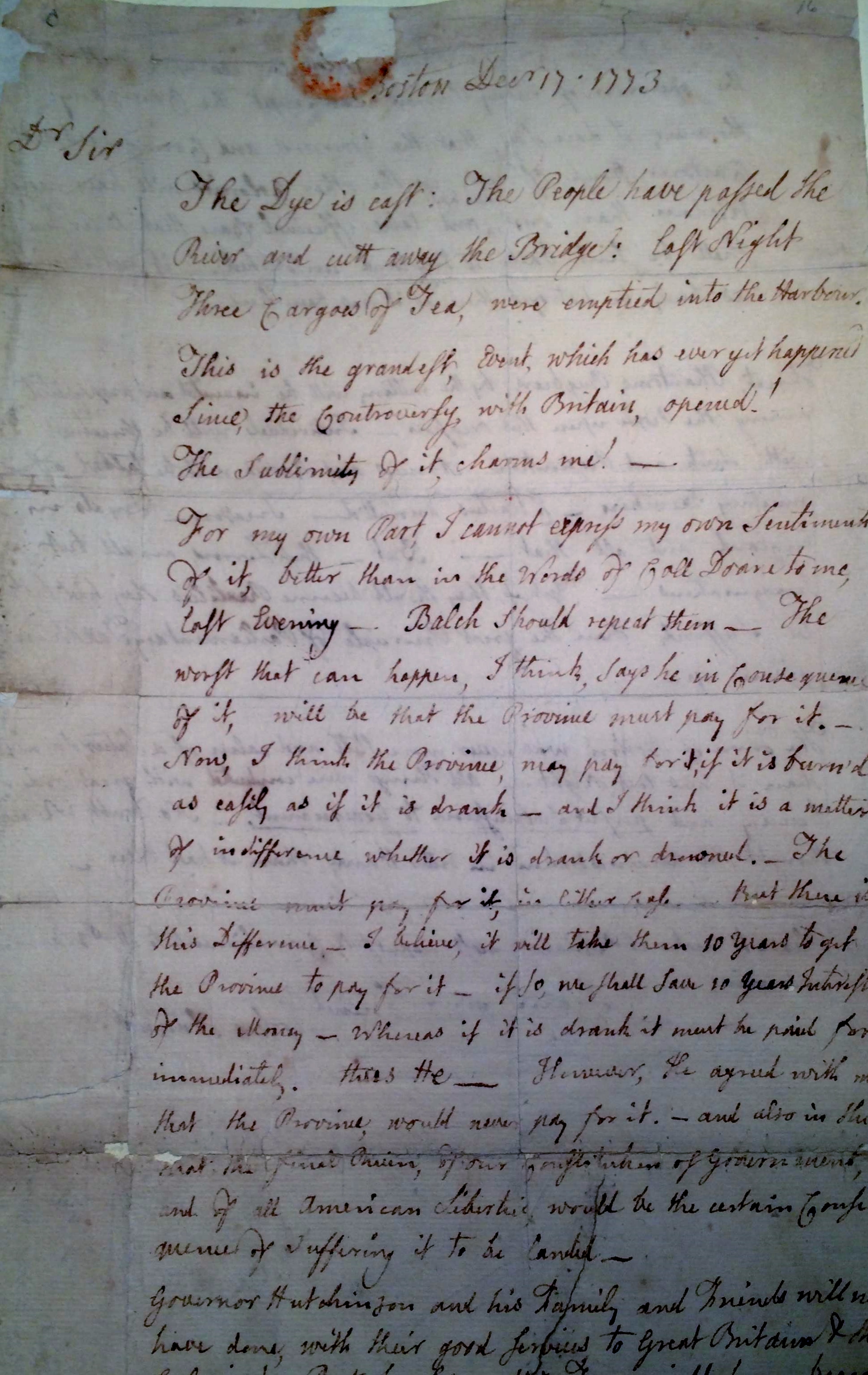
The next day, budding patriot John Adams wrote to his friend James Warren enthusiastically about the audacious stroke: “The Dye is cast: The People have passed the River and cutt away the Bridge: last Night Three Cargoes of Tea, were emptied into the Harbour. This is the grandest, Event, which has ever yet happened Since, the Controversy, with Britain, opened!” He added, “The Sublimity of it, charms me!”

“The People should never rise, without doing something to be remembered—something notable And striking.” he noted in his diary. “This Destruction of the Tea is so bold, so daring, so firm, intrepid and inflexible, and it must have so important Consequences, and so lasting, that I cant but consider it as an Epocha in History.” “The Question is whether the Destruction of this Tea was necessary?” he queried. “I apprehend it was absolutely and indispensably so.”

In his letter to Warren, Adams looked ahead as to what would follow this momentous affair. “Threats, Phantoms, Bugbears, by the million, will be invented and propagated among the People upon this occasion. Individuals will be threatened with Suits and Prosecutions. Armies and Navies will be talked of—military Execution—Charters annull’d—Treason—Tryals in England and all that—But—these Terrors, are all but Imaginations. Yet if they should become Realities they had better be Suffered, than the great Principle, of Parliamentary Taxation given up.”

There were indeed serious consequences for the people of Boston in the form of the Coercive, or Intolerable, Acts levied by Parliament in retaliation. The harsh punishment backfired however. Colonists grew more unified in sentiment, and the calling of the First Continental Congress in 1774 was a pivotal step in the movement toward revolution and eventually, independence.

John Adams to James Warren, 17 December 1773, Warren-Adams Papers


Cryptic Communique: Rebuses from Britain and the United States

By Kittle Evenson, Reader Services

[If you have trouble seeing the small details in some of these images, hold Ctrl and press + to zoom in on your browser.]


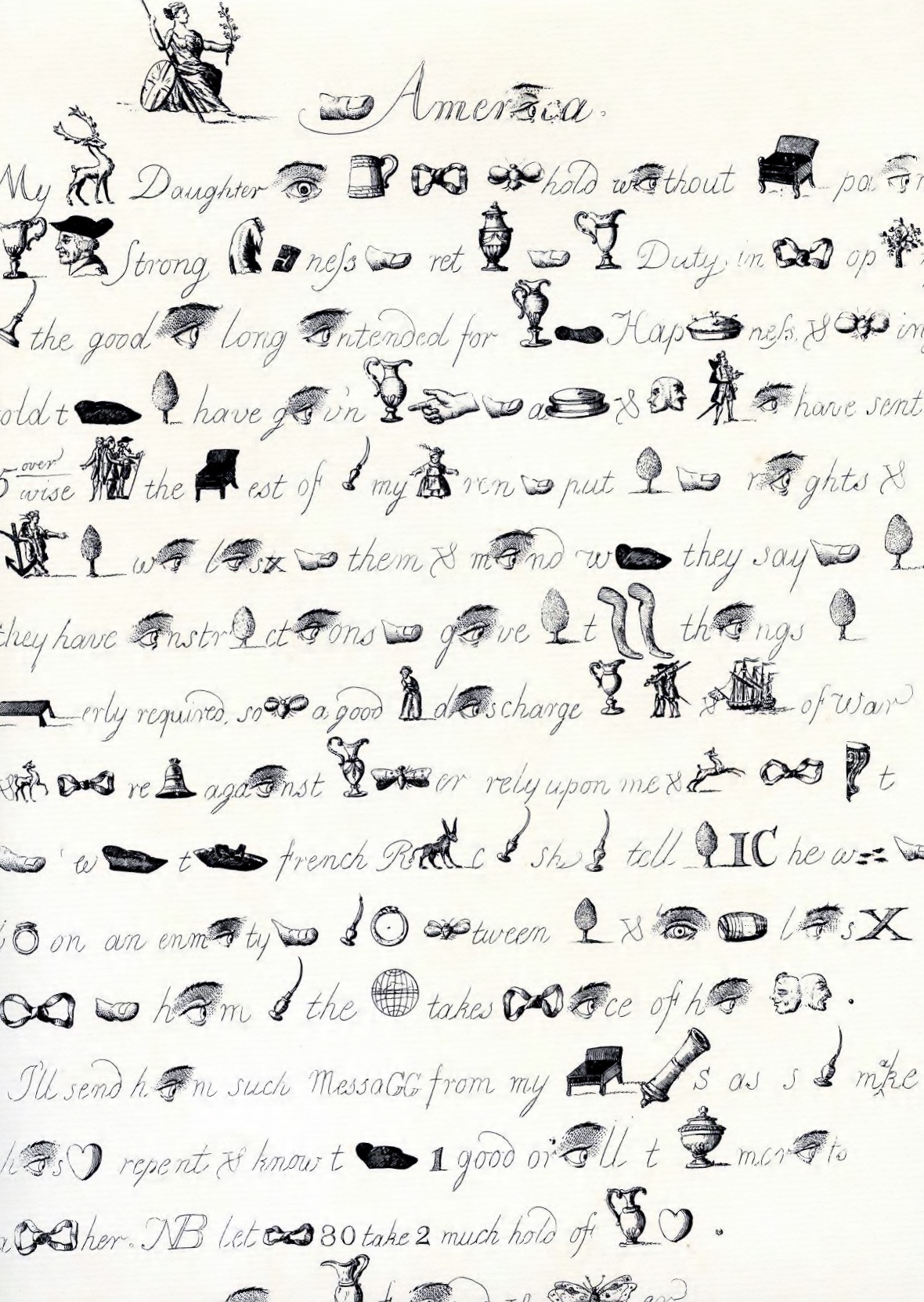
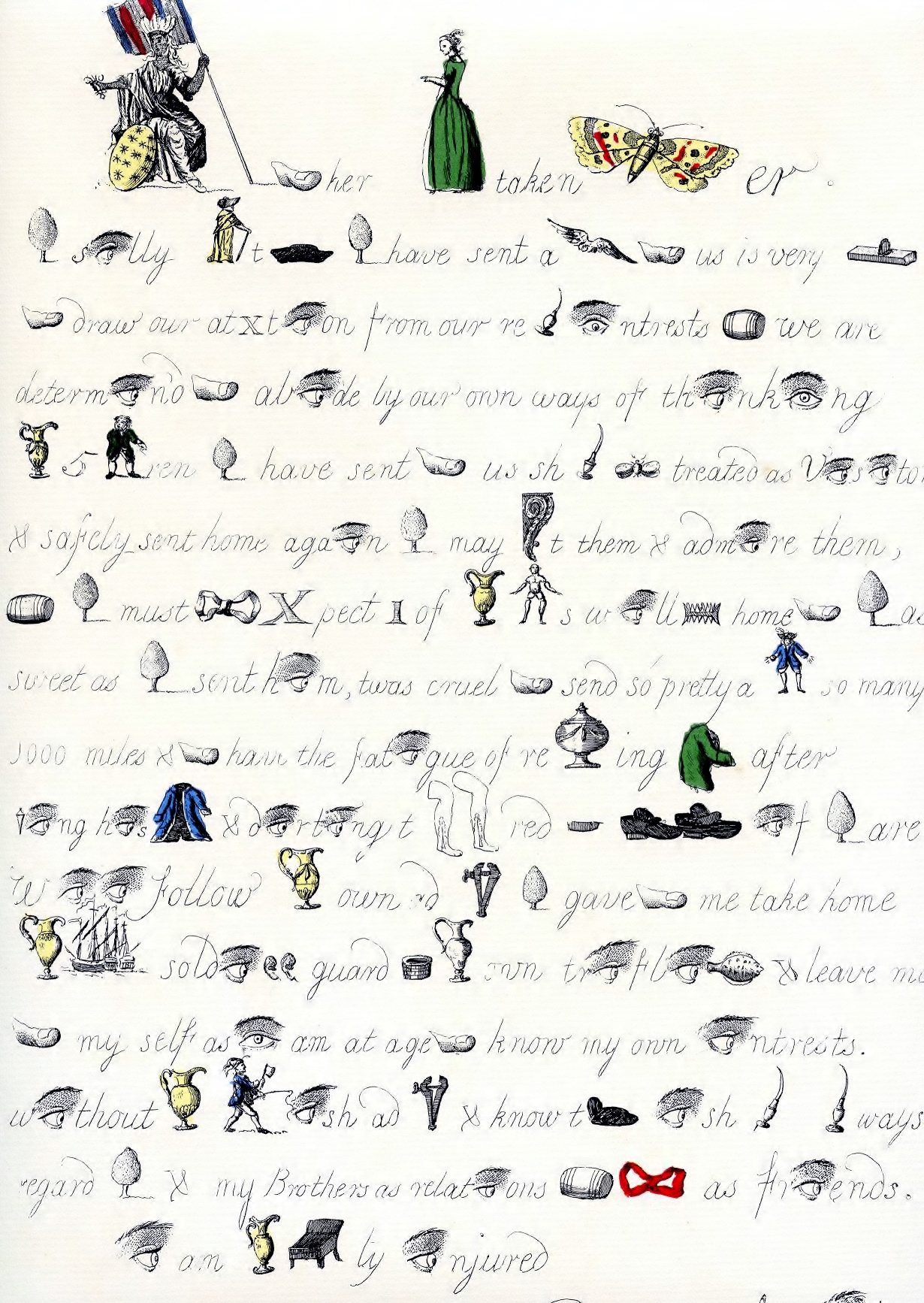
Whether as an educational tool, a creative form of political commentary, or a crafty way of targeting a chosen audience, rebuses have been used for centuries. Dating back to 1540 and the work of calligrapher and engraver Palatino, rebuses harness text, numbers, and images of recognizable objects as phonograms and hieroglyphics to convey meaning. I tracked down four examples from the MHS collections, and was surprised by the difficulty and intricacies of their presentations.

Rebuses rely on two primary usages for images: either as hieroglyphics or phonograms. Using hieroglyphics, authors can convey straightforward words by simply replacing them with an image that shows their meaning, such as   replacing the word “ship”. To express more abstract words, creators juxtapose letters and drawings that could be used as phonograms. When combined, these sounds build words, such as  representing the word “cannot”. In linguistics this is actually called the “rebus principle”.

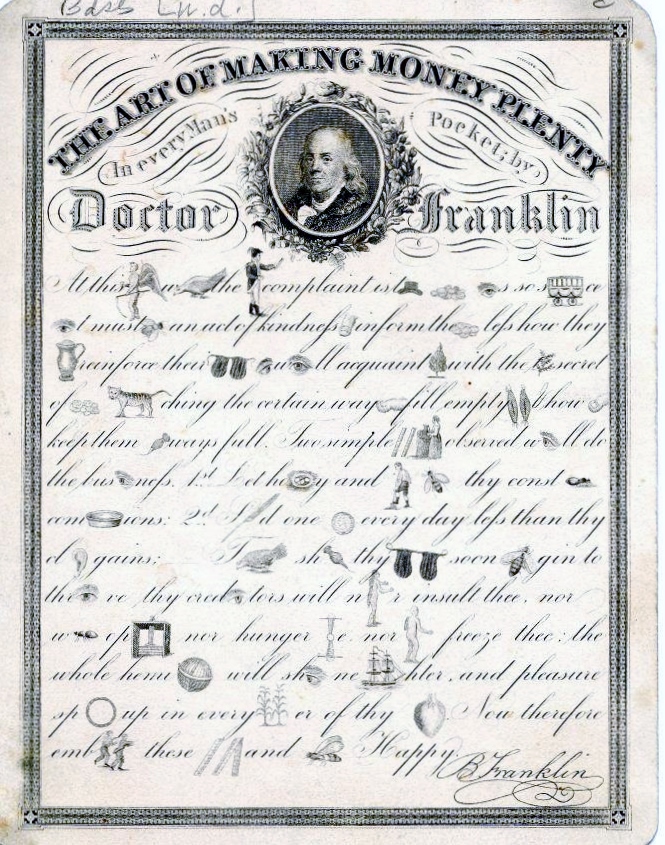
Both techniques can be seen in Benjamin Franklin’s “The Art of Making Money Plenty in every Man’s Pocket” (circa 1848), Matthew Darly’s satirical publications from the American Revolution entitled “Britannia to America” and “America to her mistaken mother” (both published in London in 1778), and an unattributed educational publication of Mother Goose in Hieroglyphics (1849).

“The Art of Making Money Plenty in every Man’s Pocket”


As I worked my way through these puzzles I began to recognize a specific vocabulary of images, a vocabulary that I was surprised to discover took some serious investigation to fully understand. Even with full-text translations to reference it took the help of several colleagues to track down the names for all of the images pictured.

“Britannia to America”


“America to her mistaken mother”


Rebuses speak specifically to the historical context in which they were created. They rely on commonly understood imagery to convey meaning, and as I compared the rebuses I was able to construct a set of common images, always used identically. Because the content of the individual excerpts is different: Franklin’s lectures on personal fiscal responsibility, Darly’s speak to the British fear of a strategic partnership between the colonists and France, and Mother Goose telling a children’s fairytale, the overlap is limited, but that which does exist exemplifies a historical context that makes its interpretation by 21st century minds difficult.

Some common sounds represented identically across these publications include

  • (eye) = “i”
  • (an individual toe) = “to”
  • (yew tree)  = “u” (“you”)
  • (awl) = “all”
  • (bee) = “be” or “b”
  • (ewer) = your


While some of these images are easily recognizable even today (the bee, or a human eye), others are no longer commonplace in most of our lives, such as an awl, or a ewer.

Changes over time in storage, weight, and measurements have also disassociated other commonly used pictures, such as a cask  , from traditionally related terms like “butt,” a British unit of measure.

Just like Franklin’s and Darly’s works, Mother Goose uses the ewer, awl, toe, and butt images to convey a story, but unlike the others Mother Goose includes an introductory note as to the importance of the use of images within the text itself. The unknown author of the Mother Goose rebus introduces the work with the words “When the doctor sends for physic for a nervous little chick, make a mistake, and go to the bookseller’s and buy Mother goose in Hieroglyphics; that’s what is wanted — a pretty book, written with pictures, as they wrote in Egypt a long while ago, when folks new something.” While Franklin uses the rebus structure to make sure readers are challenged to expend effort before obtaining answers, Mother Goose uses them as a teaching tool, bridging the gap between speech and textual understanding in children.

Mother Goose

To see an example of some unpublished rebuses, check out Susan Martin’s June 17, 2015 blog on Samuel W. Everett. Dating to the mid-19th century, Everett’s illustrations demonstrate that early Americans did not just consume these puzzles in printed form, but produced them for personal entertainment as well. If the rebuses in this   post strike your fancy, consider visiting our library to view them in person, or to explore any of our other collections in greater depth.


Diaries at the MHS (and the Archivists Who Love Them)

By Susan Martin, Collections Services

As a manuscript processor here at the MHS, I’ve had the opportunity to see a wide range of personal and family papers, but I particularly like to work with diaries. Not usually intended for a stranger’s eyes, many of them are highly revealing and deeply moving. MHS collections include diaries by men and women, young and old, rich and poor, kept throughout the centuries for a variety of reasons.

Harriet Stillman Hayward, for example, was a young 19th-century woman who clearly kept her diary as an outlet for her loneliness. She was envious of her older sister Louisa’s many social engagements and, on 21 Feb. 1850, wrote in a confessional, emotional vein: “I wonder if people will ever care more for me than they do now […] I do not think that my highest aim in life is to have every one like me, but if I could feel that one person loved me […] I should not feel entirely forgotten. […] I must continue to bear in secret, while I appear outwardly indifferent […]”

Persis Seaver Bartlett’s diary documenting the decline and death of her son from consumption falls into this category, as well. Many devout people also used diaries to work out their feelings about God and salvation.

On the other end of the spectrum are those diaries that consist of an impersonal and unembellished account of daily activities. William Wharton began every morning with a detailed description of the weather, then noted the day’s errands and appointments—the dentist, the bank, etc. On fishing trips, he recorded the size of his catches. His diaries are almost uniformly mundane and unemotional, except for the entries he wrote at the time of his wife’s death.

Printed “line-a-day” diaries, with only a small space for each day and little room for introspection, lend themselves to this kind of strictly functional record-keeping. For example, the diaries of Jane Cummings:


Travel diaries were very popular and were kept by everyone from traveling salesmen to wealthy Bostonians on the traditional Grand Tour of Europe. My colleague Anna Clutterbuck-Cook has been following one woman’s travels in Egypt. Young Charles Phillips Huse only went as far as Essex County, Mass. on a trip with his grandfather, but he made a careful record of all their adventures, illustrated with photographs pasted onto the pages. Of course, Boston artist Sarah Gooll Putnam set the standard for illustrated diaries with her elaborate sketches and watercolors.

The diary of Eliza Cheever Davis, a personal favorite of mine, is a travel diary, but also a kind of literary exercise. Davis had fun with descriptions and built suspense into otherwise ordinary anecdotes. Her entry from 9 June 1811 sounds like something out of a Gothic novel: “Behold me then in a large room or rather Hall, the Chimney boarded up, on one side a small door which I ventured to unlock which led into a dark gloomy place in which there was not light enough for me to discover what it contained, but it looked very full of wonders […]”

Obviously most diaries were not meant to be seen by anyone but the writer (though very public figures, like John Quincy Adams, certainly knew their words would be read in later days). But some people did write directly to friends or family members in diary entries. Eliza Davis used this device, but the most striking example I’ve come across is the 1864 diary of Lillian Freeman Clarke, who frequently addressed her intimate friend Emily Russell and wished her a tender “good night” at the bottom of each page:


Some diaries are unfortunately unattributed. Some are shared, with contributions by more than one person, perhaps a husband and wife. The fascinating papers of John Wells Farley consist primarily of typescript pages of diary entries dictated by Farley to his secretary, who couldn’t resist adding the occasional quip or correction.

Diaries at the MHS are cataloged by year, so researchers interested in a particular historical event can get a cross section of opinion. We also use subject headings to group diaries by the types of people writing them, for example: “Students—Diaries,” “Politicians—Diaries,” and “Farmers—Diaries.” We hope you’ll visit our Reading Room and take a look!

Penmanship and Copy Books

By Shelby Wolfe, Reader Services

In a collection rich in manuscript material like that at the MHS, it’s easy to fixate on centuries-old handwriting, whether for admiration of delicate script or frustration at illegible penmanship. I’ve overheard a fair balance of researchers lamenting the eyestrain caused by hours of squinting at spidery letterforms, and those who voice their appreciation for such intricate, time-consuming writing and the character it gives to the writer. Penmanship has an element of individuality, even when students were taught the importance of identical script or the “science” of manually forming words on a page through instruction books like Penmanship Explained, or, The Principles of Writing Reduced to an Exact Science by S.A. Potter.

Today, many of us rely on electronic means of forming words, efficiently typed out and spell-checked. Instead of putting pen to page, we often put fingertips to keyboard. I sometimes wonder if we would be able to decipher difficult handwriting more easily if we spent more time writing by hand as well. Though, if all writers had followed Potter’s exact science of penmanship, maybe we would have no trouble at all!

In an effort to learn more about the history of penmanship, I decided to see what resources I could find in the MHS collection. In the online catalog ABIGAIL I found a variety of results for penmanship instruction books and advertisements, broadsides for ink powder and writing instruments, and a few personal copy books in family manuscript collections. One manuscript item (manuscript fittingly meaning “hand” and “to write”) that I found particularly interesting was Tristram Little’s copy book. Tristram Little of Newburyport, Maine was born in December 1784, making him fifteen years of age at the time of this book’s use beginning in early 1800.

Copy books often provided written lines and blank spaces for a student to copy the text. In the case of Little’s book, there are no printed lines to copy, which indicates he must have copied from a separate volume. On one delicately lettered leaf, Little has copied from a cover or title page, “Round Text Copies, Written for the Use of Schools and Academys by D. S…Engraved by J. Ellis.” Perhaps this is from Bowles’s elegant set of round hand copies, round text copies and comprised in a set. Performed for the use of schools & Academies by D. Smith, written by I. Trinder of Northampton, or a similar copy book circulated by this publisher.


Some penmanship books are literally by-the-book, with lines written directly from a published original. Others are strewn with more personal touches. The pages of Tristram Little’s penmanship practice book mostly contain repeated lines of proverbial advice. Some are of general instruction, “Beware of idleness & sloth”, “Quarrel not at play,” and some loftier lines: “Rouze up your Genius & exalt your mind” and “Honor attends virtuous actions.” Tristram’s personal touches include original poems, one an illustrated epitaph titled “On the death of General Washington,” complete with tombstone frame. He notes on the top of the page, “He died…December 15th 1799” – which is actually one day off, the correct date being December 14.


The poem reads:

Ah! while we gather round your urn,

Joins your blest bands great Wasington [sic],

Hark to that knell, a NATION sighs,

Waft his PURE SPIRIT to the skies.


Newbury Port

The bells were then tolling.


On a previous page, Little recorded an ode to the “glorious George Wasington [sic],” asking, “What mortal praise can equal thy great claim?” Clearly, Little had a great regard for George Washington’s reputation. This common copy book offers an insight into the mind of a teenager growing up in America’s early years, looking up to his nation’s leader and lamenting his loss. Other pages include lists of personal names and cities (Newburyport and Philadelphia). Little’s embellished pages, glorifying poems, and ornate illustrations add another level of character to his already unique handwriting, as we might consider it today.

Tristram Little’s copy book is just one example of penmanship study and practice in the MHS collection. You can find other penmanship practice books and copy books for arithmetic exercises, many as part of family manuscript collections. If you would like to explore this topic further, visit the library and enjoy these personal copy books – or fascinating handwriting throughout the collection – in person.