This Week @ MHS

By Dan Hinchen

Please note that the MHS is CLOSED on Monday, 18 January, in observance of Martin Luther King, Jr. Day. Normal hours resume on Tuesday, 19 January.

This week we have two seminars on tap to sate your historical appetite. They are

– Tuesday, 19 January, 5:15PM – Join us as Sara Georgini from the Adams Papers Editorial Project presents “The Providence of John and Abigail Adams,” which asks what it meant for the Adamses of Massachusetts to be “raised” Christian in America. Chris Beneke of Bentley University provides comment. This talk is part of the Early American History Seminar series. Seminars are free and open to the public; RSVP requiredSubscribe to receive advance copies of the seminar papers.

– Thursday, 21 January, 5:30PM – “Biography, Inc.: Two Writers Talk about the Trade.” Join Christopher Benfey, Mount Holyoke College, and Megan Marshall, Emerson College, in a wide-ranging conversation moderated by Susan Ware of American National Biography about teaching, reviewing, and writing biography. This seminar is part of the New England Biography seriesPlease RSVP, this event is free.

There is no Saturday tour this week.

“. . . unidentified girl exercising with dumbbells”

By Kittle Evenson, Reader Services

That was the line in our online catalog that caught my eye last week. Sandwiched between portrait descriptions and mention of a family crest, this hint about a tintype dating to the 1870s in the Homans family photographs collection was too arresting not to follow up on.

I pulled the appropriate box from our photograph collection and sure enough, the second-to-last folder bore the title “four unidentified girls exercising, ca. 1870-1880. Photographer unknown. Tintype.” Four girls exercising? My interest was well and truly piqued.

Tintype of four girls lifting dumbbells, ca. 1870-1880. Found in the Homans family photographs.

Facing the camera, the four girls wear matching outfits, complete with white handkerchiefs tucked into their chest pockets and shiny black shoes. They appear to be in their mid-to-late teens and are standing straight-spined, each holding aloft two dumbbells.

In a collection of unremarkable individual and group portraits, this photograph raised a multitude of questions for me, chief among them being, why are these girls lifting weights? What group are these girls a part of that they are identically dressed and posing for this photograph? Was this common practice for Boston-area women in the 1870s? While common practice today, weight-lifting women were not always so familiar.

I took a two-pronged approach to answering these questions, first searching the Homans family papers, including the 1878 and 1881 diary of teenager Mattie Homans, to see if I could find reference to this type of exercise, and then looking at our collections more broadly for materials related to women’s gymnasiums in Boston and physical education for women.

The Homans family papers disappointingly failed to illuminate the context for this photograph, and so I moved on to other, related resources.

Ideas regarding health, fitness, and the role of physical activity for shaping personal and cultural character changed dramatically over the course of the 17th, 18th, and 19th centuries, and this photograph illuminates the pervasiveness of these changes. Puritan beliefs that illness was an unavoidable and even expected aspect of their daily lives, gave way to the active promotion of health and hygiene through personal actions and environmental changes. 19th century Boston played host to a multitude of facilities, practitioners, and publications devoted to shaping the public discourse on physiology and hygiene, and middle class citizens, particularly women, were at the heart of this movement.

In Able-Bodied Womanhood: Personal Health and Social Change in Nineteenth-Century Boston, Martha H. Verbrugge posits that

“[A]ntebellum health reform prescribed self-governance to alleviate the problems of urban life. The world seemed unmanageable to Boston’s middle class . . . [i]n an unpredictable and seemingly uncontrollable world, [they] looked inward for stability. Self-control appeared to be the most reliable, perhaps only, mechanism for restoring order.” (47)

While Bostonians believed that a person’s biological characteristics (like a weak heart), and their physical environment (like a drafty house) contributed to their health, or lack-thereof, they placed the greatest emphasis on the role of personal behavior in actively shaping their lives.

Attempting to break the monopoly men held over early gymnasiums, Bostonians such as Dr. Dio Lewis and Mary E. Allen, opened gymnasiums catering specifically to women and children. In 1860 Lewis opened the New Gymnasium, focused almost exclusively on promoting muscular development in children of both sexes, and his Family School for Young Ladies in Lexington, MA, which centered its curriculum around both intellectual and physical instruction.

Dr. Lewis’s Family School for Young Ladies. Sketch found in “Catalogue and circular of Dr. Dio Lewis’s Family School for Young Ladies, Lexington, Mass. 1866.”


Mary E. Allen continued this trend into the 1870s, opening the Ladies Gymnasium on Washington St. in 1877 and offering facilities for women and children to conduct slow, careful, and progressively more difficult physical exercise in the pursuit of “symmetrical bodily development”. In addition to providing a gymnasium, Allen also taught a so-called “Normal Class . . . for the instruction of those who intend to teach Gymnastics, either in public or private schools, or in Gymnasiums devoted to women and children, an urgent need of which exists in the larger towns and cities.” Not only training women to improve their own physiques, but to become teachers of such methods themselves.

“The Ladies’ Gymnasium. Eighth Year, 1885-1886”


This broadening emphasis on physical culture was deeply intertwined with changes in beauty and fashion standards, the roles of middle class women in the private and public spheres, and developments in science and medicine. Verbrugge’s work does a wonderful job of addressing the intersectionality of these varied forces, particularly within the sphere of Boston society.

Taking these sources in concert, it is no longer strange to have found the image of young women lifting dumbbells, particularly within the family photograph collection of a prominent Boston family. Unfortunately, I was not able to identify the women in the photograph, or establish their affiliation with a particular school or gymnasium. That will have to be a project for another day.

If 19th century dumbbells strike your fancy and you would like to see the Homans tintype in person, please feel free to stop in and visit our library. If you are interested in seeing what other materials we have related to physical education, you can browse our online catalog, ABIGAIL from the comfort of your own home.

Counting Down to the Quasquibicentennial

By Susan Martin, Collections Services

In eleven days, the Massachusetts Historical Society will be celebrating its quasquibicentennial, or, if you prefer, its bicenquasquigenary. In other words, on January 24, the MHS will turn 225 years old! We don’t think it looks a day over 200.

The MHS was founded on 24 January 1791, when Rev. Jeremy Belknap and a group of like-minded men met in Boston to form a society that would “collect, preserve and communicate, materials for a complete history of this country.” It was the first historical society in America, so its founders called it simply “The Historical Society.” (The New York Historical Society came along in 1804, then the American Antiquarian Society in 1812.) The MHS lived at six different locations before moving in 1899 to its current building at 1154 Boylston Street, Boston.


Staff members at the MHS have been working on a web project to commemorate our 225-year history: a gallery highlighting 225 items from our collections, including manuscripts, artwork, artifacts, and printed material representing four centuries of American history. Helping out with this project, I’ve had the chance to see a broad cross-section of material, learn the stories behind individual items, and better understand their significance.

Of course, the MHS is well-known for its iconic collection of Adams family papers, which include the letters and other papers of John, Abigail, John Quincy, and many generations of family members. We’ll be featuring some of these papers in our 225th anniversary gallery, from an early love letter by John to correspondence about Abigail’s death. John Adams’ notes on the Boston Massacre trials and his son’s reflections on the Amistad case document fascinating milestones in this illustrious family’s story.

The MHS also holds the second largest collection of Thomas Jefferson papers after the Library of Congress. Not only will our project feature Jefferson’s original manuscript draft of the Declaration of Independence, but also John Adams’ manuscript copy, the first printing, and the first printing that included signers’ names.

Many of the items in our collections are, in fact, the only known surviving copies of printed works. These include Samuel Sewall’s seminal anti-slavery pamphlet The Selling of Joseph, Benjamin Franklin’s first published work, and an early engraving of Harvard discovered by accident in the MHS collections 85 years after its acquisition!

Other ground-breaking printed works you’ll find here are the first books of poetry by Anne Bradstreet (1650) and Phillis Wheatley (1773), as well as the first Bible (1663) published in North America, a translation into the Massachuset Native American language.

The MHS holdings also include some remarkable Civil War-era material, so these papers figure prominently in our gallery. Particularly heartbreaking is a letter from Lt. Col. Wilder Dwight to his mother, written as he lay dying on the battlefield of Antietam. And this broadside recruiting African American soldiers for Massachusetts’ famous 54th Regiment becomes more poignant when you learn how the U.S. government failed to make good on its promises to the men who answered its call.

As for papers related to slavery and abolition, we highlight an eight-page letter from Abraham Lincoln to his friend Joshua Fry Speed detailing Lincoln’s feelings about slavery and the Union, and one Harriet Beecher Stowe wrote on the day she finished her novel Uncle Tom’s Cabin. I also really like our 1892 photograph of the African Meeting House, the site of many anti-slavery meetings.

Speaking of striking images, here are a few more in MHS collections that you may not know about: a watercolor painting of the Heart Mountain Japanese internment camp, John Noble’s illustrated letter to his children depicting scenes from the South Pacific, and the only known portrait of legendary frontiersman Daniel Boone painted from life.

We hope you’ll enjoy our 225th anniversary celebration and visit us either in person or on-line. Keep an eye on our website, or follow us on Facebook or Twitter, as we count down to this momentous occasion.


This Week @ MHS

By Dan Hinchen

Our map exhibition just closed and we are awaiting the arrival of The Private Jefferson which comes later this month. In the meantime, we still have a couple of free programs to tide you over this week:

– On Tuesday, 12 January, 5:15PM, there is an Environmental History seminar. “Airplanes and Postwar America: An Environmental History of the Jet Age” is presented by Thomas Robertson of Worcester Polytechnic Institute and assesses the environmental consequences of aviation. Sonja Duempelmann of Harvard University provides comment. Seminars are free and open to the public; RSVP requiredSubscribe to receive advance copies of the seminar papers.

– On Wednesday, 13 January, there is a Brown Bag lunch talk beginning at noon. This week, Jennifer Chuong, Harvard University, speaks about “‘Chargeable Ground’ and ‘Shaking Meadows’: New Models of Land Cultivation in Eighteenth-Century New England.” Part of her dissertation research, Chuong’s talk examines Connecticut minister Jared Eliot’s An Essay Upon Field-Husbandry in New England as It Is or May Be Ordered (1748), with a particular focus on Eliot’s identification of different landscapes as entailing different proportions of effort, investment, and delay in their cultivation. This talk is free and open to the public. Pack a lunch and stopy by!

Please note that the MHS is CLOSED on Monday, 18 January, in observance of Martin Luther King, Jr. Day. Normal hours resume on Tuesday, 19 January.

This Week @ MHS

By Dan Hinchen

We are back in the library for another year (our 225th!) but we are starting things off slowly. This week we have two items on the agenda for you:

– Wednesday, 6 January, 12:00PM : “Factory Fleets and Fewer Fish: Fisheries Management in the Northwest Atlantic Ocean, 1945-1996” is a Brown Bag lunch talk presented by Benjamin Kochan of Boston University. This project makes heavy use of the Leverett Saltonstall papers to explore the evolution of US fishery policy in the mid-twentieth century. The talk is free and open to the public. 

– Saturday, 9 January, 9:00AM : “Transforming Boston: From Basket Case to Innovation Hub” is a teacher workshop that connects the history of Boston to the major economic and social trends of the late 20th century, providing educators with classroom-ready materials that reveal how Boston became the innovation hub of America. This program is open to educators and history enthusiasts with a fee of $25. To register or to get more information complete this registration form, or contact the education department at education@masshist.org or 617-646-0557.

– Finally, this week is your last chance to see our current exhibitions! Come in any day this week, 10:00AM-4:00PM, to get a last glimpse of our map exhibit, the correspondence of Teddy Roosevelt and Henry Cabot Lodge, and the Unitarian Conscience. Then stay tuned to learn more about our upcoming exhibit, The Private Jefferson, opening later in January. 

* N.B. – There are no Saturday public tours scheduled in January before the next exhibit opens.


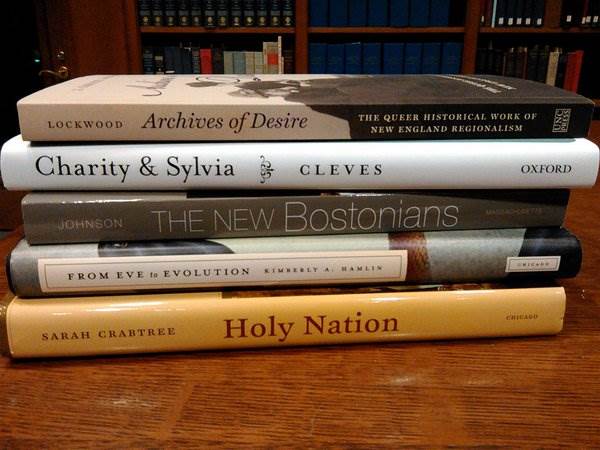
New to the Reference Collection

By Anna Clutterbuck-Cook, Reader Services

Below are titles newly received or purchased for the library’s collection of contemporary historical scholarship and reference works. All of these books will be available for use in our library once we reopen to the public on Monday, 4 January 2016. In the meantime, enjoy the end of year holidays with family and friends. May you enter the new year renewed — and excited to pick your research back up in our cozy reading room while the winter snow piles up outside!


Cleves, Rachel Hope. Charity & Sylvia: A Same-Sex Marriage in Early America. Oxford University Press, 2014.

Crabtree, Sarah. Holy Nation: The Transatlantic Quaker Ministry in an Age of Revolution. University of Chicago Press, 2015.

Downs, Jacques M. with a new introduction by Frederic D. Grant, Jr. The Golden Ghetto: The American Commercial Community at Canton and the Shaping of American China Policy, 1784-1844. Hong Kong University Press, 2014.

Free, Laura E. Suffrage Reconstructed: Gender, Race, and Voting Rights in the Civil War Era. Cornell University Press, 2015.

Graves, Donald E., ed. First Campaign of the A.D.C.: The War of 1812 Memoir of Lieutenant William Jenkins Worth, United States Army. Old Fort Niagra Association, 2012.

Hamlin, Kimberly A. From Eve to Evolution: Darwin, Science, and Women’s Rights in Gilded Age America. University of Chicago Press, 2014.

Hemphill, C. Dallett. Siblings: Brothers and Sisters in American History. Oxford University Press, 2011.

Jefferson and Palladio: Constructing a New World. Centro Internazionale di Studi di Architettura Andrea Palladio, 2015.

Johnson, Marilynn S. The New Bostonians: How Immigrants Have Transformed The Metro Region Since the 1960s. University of Massachusetts Press, 2015.

Lockwood, J. Samaine. Archives of Desire: The Queer Historical Work of New England Regionalism. University of North Carolina Press, 2015.

Nicolson, Colin, ed. The Papers of Francis Bernard: Governor of Colonial Massachusetts, 1760-69. Volume IV: 1768. Publications of the Colonial Society of Massachusetts vol. 87. The Colonial Society of Massachusetts, 2015.

Prieto, Laura R. At Home in the Studio The Professionalization of Women Artists in America. Harvard University Press, 2001.

Rex, Cathy. Anglo-American Women Writers and Representations of Indainness, 1629-1824. Ashgate Press, 2015.

Schiff, Stacy. The Witches: Salem, 1692. Little, Brown and Co., 2015.

This Week @ MHS

By Dan Hinchen

There are no events on the calendar for this shortened week here at the Society. 

Please note that the library of the Massachusetts Historical Society is closed from December 24th through January 3rd and will re-open on Monday, January 4th. The MHS exhibition galleries are open from 10 a.m. to 4 p.m. on December 26, 28-30, and January 2. Find information on our website about our current and upcoming exhibitions

See you in January!

The Ekphrastic Fiske

By Peter Steinberg, Collection Services

On 30 January 2015, my colleague Dan Hinchen introduced our readers to Eben W. Fiske (1823-1900), a Civil War veteran and librarian as well as a talented amateur illustrator, in his post Ishpeming Illustrators. Dan discussed Fiske’s artwork, which he broke out into two categories: Civil War drawings and other. The Fiske family papers (Ms. N-1227) also contains letters and compositions, as well as several volumes containing original pencil drawings.

Recently I was asked to review the collection to determine whether any of the drawings might be worth including in a forthcoming web project. I pulled Box 3, which houses “Volumes 3-6: E.W. Fiske writings, drawings,” from the shelves. Volumes 3 and 4 contain newspaper clippings; volume 5 is a notebook with writings on the Bible. The folder with the intricate drawings was labeled “Volume 6: Pencil drawings. Illustrations to ?”.


The small sketch book, measuring 16.2 cm x 17.8 cm, features highly detailed scenes that correspond to text that Fiske puts in quotes. Curious about the quotes, I learned from Dan’s prior blog post that Fiske drew in response to the poem “On Lending a Punch Bowl” by Oliver Wendell Holmes, Sr. As other poems are quoted and illustrated, I searched for word strings in Google and was happy to discover most of the works from which Fiske drew inspiration. Here is a list of the groupings of drawings:

Pages 1-4 respond to the poem “On Lending a Punch Bowl” by the physician and poet (among other things) Oliver Wendell Holmes, Sr. (1809-1894);

Pages 5-12 illustrate (pun!) Holmes’s “A Song: For the Centennial Celebration of Harvard College, 1836”;  

Pages 13-16 react to a lecture given at the Mercantile Library Association;

Page 17 draws on (pun, again!) Holmes’s “The Stethoscope Song”; and

Page 18 takes inspiration from Holmes’s “The Morning Visit”.


There are also a few unfinished sketches and two instances where drawings were tipped in between pages.


Responding to a work of art using another form of art is called ekphrasis. It is most commonly seen when a poem is inspired by a work of art. See, for example, Sylvia Plath’s poems “Conversation Among the Ruins (1956) and “The Disquieting Muses” (1958) and Giorgio de Chirico’s paintings by the same names (the former1927 and the latter1916-1918). Those are just two examples; and it appears the term is flexible enough to include Fiske’s reactions to the poems of Oliver Wendell Holmes, Sr.

While there currently is no finding aid to the Fiske family papers, please do not let that stop you from coming into the MHS to enjoy the collection.


“The Sublimity of it, charms me!”: John Adams and the Boston Tea Party

By Amanda Norton, Adams Papers

In the fall of 1773, three ships carrying a cargo of tea from the British East India Company were on their way into Boston Harbor. Subject to the Tea Act of 1773, allowing the tea to be unloaded in Boston would have meant the acceptance of the principle of Parliamentary taxation, an idea that Bostonians had been fighting for a decade. After Governor Thomas Hutchinson and the ship owners refused to prevent the ships’ landing, the Sons of Liberty decided to take action, and 242 years ago on the night of December 16, a group of patriots wearing Native American dress snuck on board the three ships and dumped their cargo into the harbor.

The next day, budding patriot John Adams wrote to his friend James Warren enthusiastically about the audacious stroke: “The Dye is cast: The People have passed the River and cutt away the Bridge: last Night Three Cargoes of Tea, were emptied into the Harbour. This is the grandest, Event, which has ever yet happened Since, the Controversy, with Britain, opened!” He added, “The Sublimity of it, charms me!”

“The People should never rise, without doing something to be remembered—something notable And striking.” he noted in his diary. “This Destruction of the Tea is so bold, so daring, so firm, intrepid and inflexible, and it must have so important Consequences, and so lasting, that I cant but consider it as an Epocha in History.” “The Question is whether the Destruction of this Tea was necessary?” he queried. “I apprehend it was absolutely and indispensably so.”

In his letter to Warren, Adams looked ahead as to what would follow this momentous affair. “Threats, Phantoms, Bugbears, by the million, will be invented and propagated among the People upon this occasion. Individuals will be threatened with Suits and Prosecutions. Armies and Navies will be talked of—military Execution—Charters annull’d—Treason—Tryals in England and all that—But—these Terrors, are all but Imaginations. Yet if they should become Realities they had better be Suffered, than the great Principle, of Parliamentary Taxation given up.”

There were indeed serious consequences for the people of Boston in the form of the Coercive, or Intolerable, Acts levied by Parliament in retaliation. The harsh punishment backfired however. Colonists grew more unified in sentiment, and the calling of the First Continental Congress in 1774 was a pivotal step in the movement toward revolution and eventually, independence.

John Adams to James Warren, 17 December 1773, Warren-Adams Papers


This Week @ MHS

By Dan Hinchen

As we approach the year’s end there are three opportunities this week to get your fill of history before the holidays:

– Monday, 14 December, 6:00PM : “She Can Bring Us Home: Dr. Dorothy Boulding Ferebee, Civil Rights Pioneer” Join us for this author talk with acting New York State Supreme Court justice Diane Kiesel. She will discuss her biography of Ferebee, an African American obstetrician and civial rights activist, introducing her to a new generation of readers. This talk is open to the public with a fee of $10 (no charge for MHS Fellows or Members). Registration required. 

– Wednesday, 16 December, 12:00PM : Stop by at noon for a Brown Bag lunch talk with research fellow Kathryn Lasdow of Columbia University. “Mrs. Rowe’s Wharf: Femal Property Owners in Early-National Boston” offers some preliminary findings on the relationship between female waterfront property ownership and the rise of corporate-sponsored building projects in early-national Boston. This talk is free and open to the public. 

– Friday, 18 December, 2:00PM : “Terra Firma: The La Perouse Atlas of a Lost Voyage” is a gallery talk centered around our current exhibition, Terra Firma: The Beginnings of the MHS Map Collection. Petery Drummey of the MHS will walk visitors through the mystery of the ill-starred Pacific voyage of the Comte de La Perouse. This event is free and open to the public. 

– Saturday, 19 December, 10:00AM : The History and Collections of the MHS is a free, docent-led tour of the Society’s home at 1154 Boylston St. Visitors will tour all of the public space in the building and will also have time to view our current exhibition. No reservations necessary for individuals or small groups. Parties of 8 or more should contact Curator of Art Anne Bentley in advance at abentley@masshist.org or 617-646-0508.