Cryptic Communique: Rebuses from Britain and the United States

By Kittle Evenson, Reader Services

[If you have trouble seeing the small details in some of these images, hold Ctrl and press + to zoom in on your browser.]


Whether as an educational tool, a creative form of political commentary, or a crafty way of targeting a chosen audience, rebuses have been used for centuries. Dating back to 1540 and the work of calligrapher and engraver Palatino, rebuses harness text, numbers, and images of recognizable objects as phonograms and hieroglyphics to convey meaning. I tracked down four examples from the MHS collections, and was surprised by the difficulty and intricacies of their presentations.

Rebuses rely on two primary usages for images: either as hieroglyphics or phonograms. Using hieroglyphics, authors can convey straightforward words by simply replacing them with an image that shows their meaning, such as   replacing the word “ship”. To express more abstract words, creators juxtapose letters and drawings that could be used as phonograms. When combined, these sounds build words, such as  representing the word “cannot”. In linguistics this is actually called the “rebus principle”.

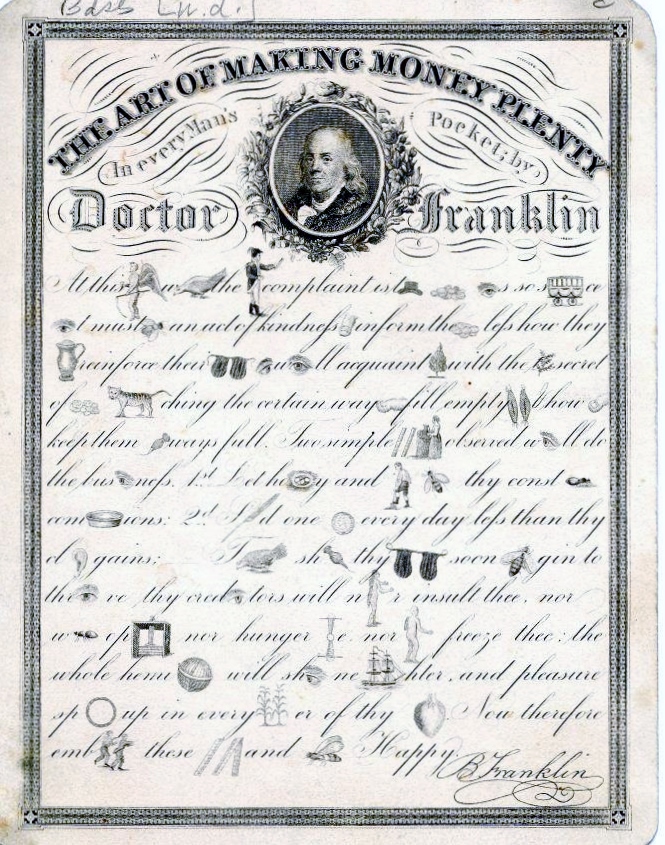
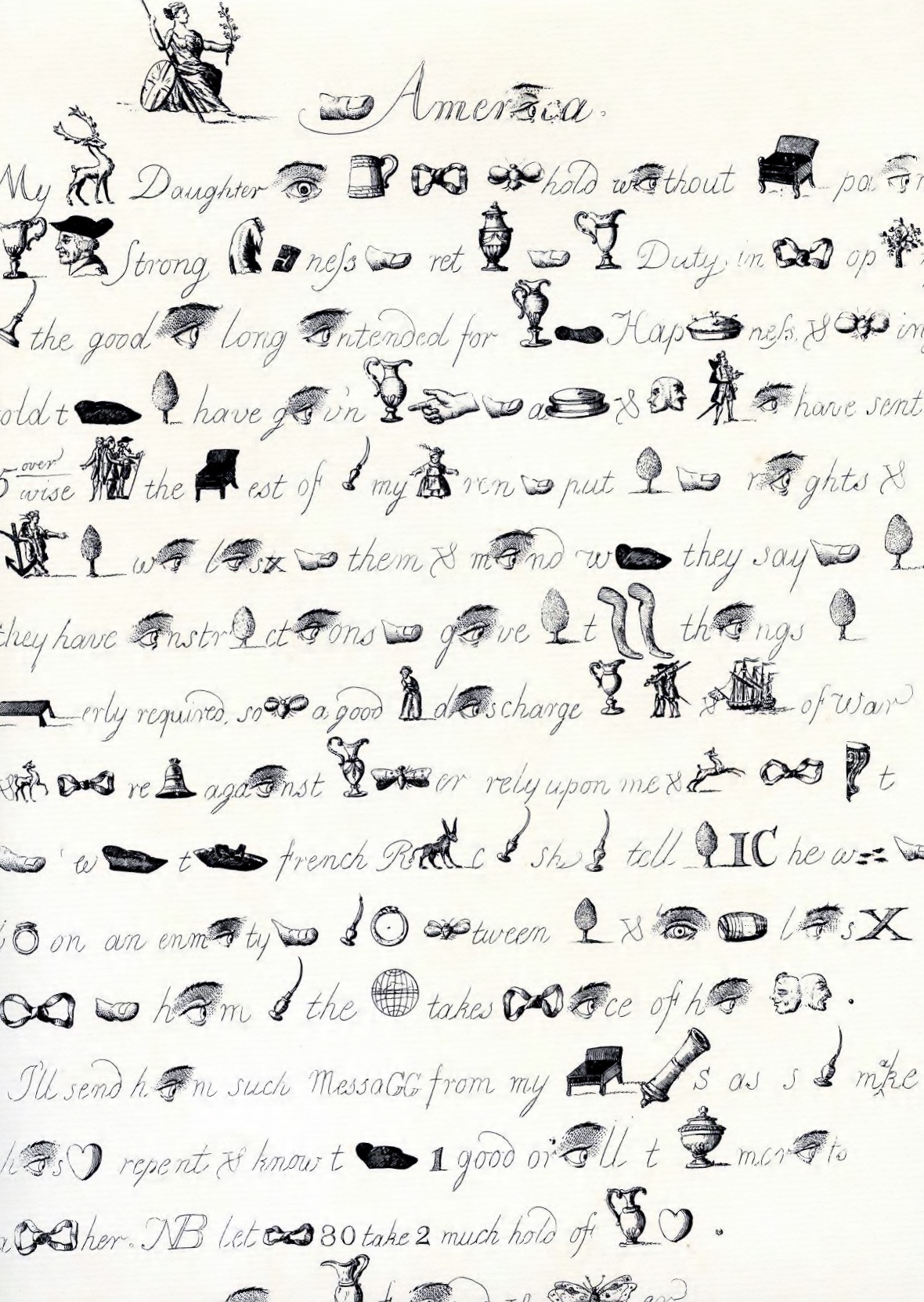
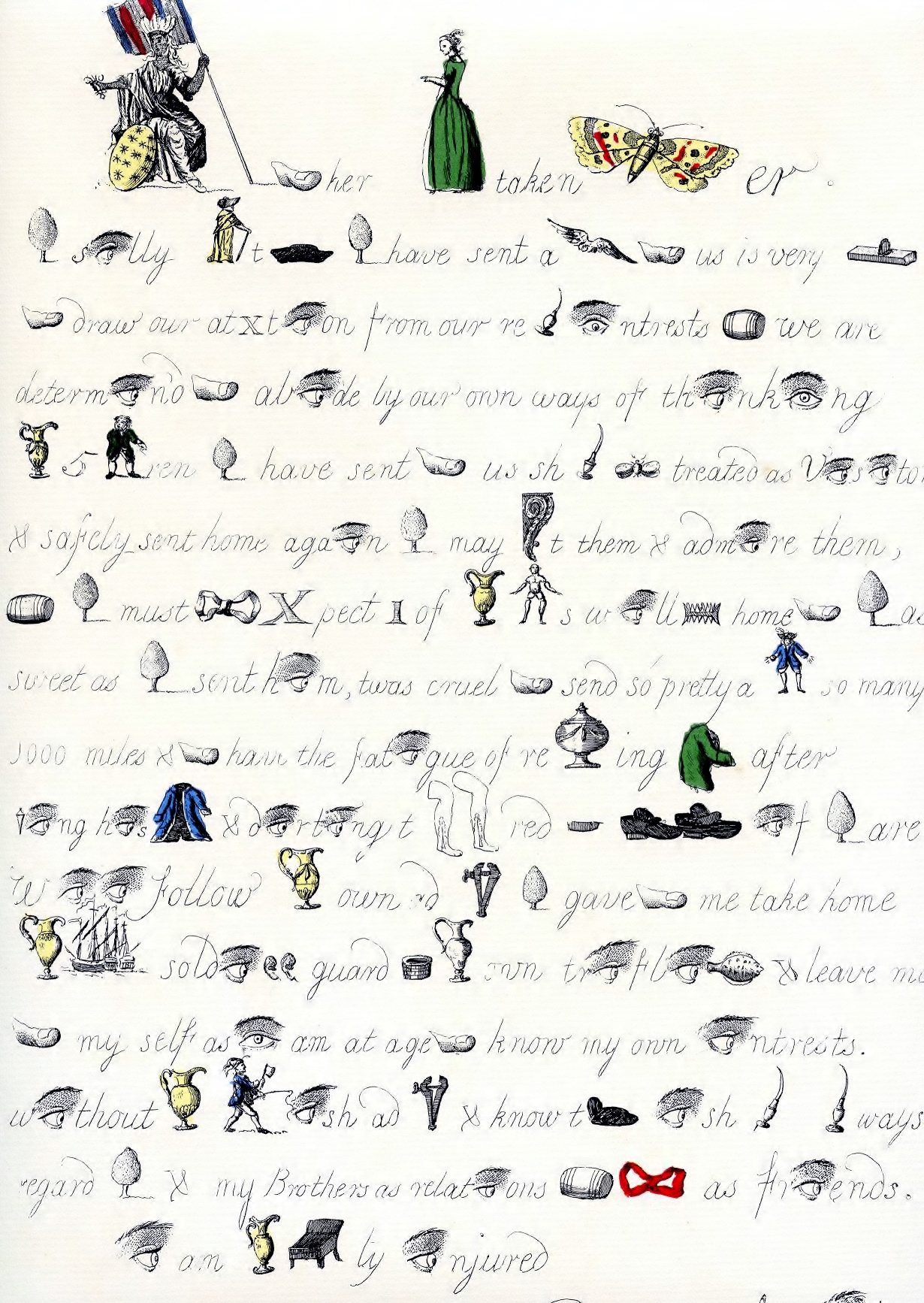
Both techniques can be seen in Benjamin Franklin’s “The Art of Making Money Plenty in every Man’s Pocket” (circa 1848), Matthew Darly’s satirical publications from the American Revolution entitled “Britannia to America” and “America to her mistaken mother” (both published in London in 1778), and an unattributed educational publication of Mother Goose in Hieroglyphics (1849).

“The Art of Making Money Plenty in every Man’s Pocket”


As I worked my way through these puzzles I began to recognize a specific vocabulary of images, a vocabulary that I was surprised to discover took some serious investigation to fully understand. Even with full-text translations to reference it took the help of several colleagues to track down the names for all of the images pictured.

“Britannia to America”


“America to her mistaken mother”


Rebuses speak specifically to the historical context in which they were created. They rely on commonly understood imagery to convey meaning, and as I compared the rebuses I was able to construct a set of common images, always used identically. Because the content of the individual excerpts is different: Franklin’s lectures on personal fiscal responsibility, Darly’s speak to the British fear of a strategic partnership between the colonists and France, and Mother Goose telling a children’s fairytale, the overlap is limited, but that which does exist exemplifies a historical context that makes its interpretation by 21st century minds difficult.

Some common sounds represented identically across these publications include

  • (eye) = “i”
  • (an individual toe) = “to”
  • (yew tree)  = “u” (“you”)
  • (awl) = “all”
  • (bee) = “be” or “b”
  • (ewer) = your


While some of these images are easily recognizable even today (the bee, or a human eye), others are no longer commonplace in most of our lives, such as an awl, or a ewer.

Changes over time in storage, weight, and measurements have also disassociated other commonly used pictures, such as a cask  , from traditionally related terms like “butt,” a British unit of measure.
Just like Franklin’s and Darly’s works, Mother Goose uses the ewer, awl, toe, and butt images to convey a story, but unlike the others Mother Goose includes an introductory note as to the importance of the use of images within the text itself. The unknown author of the Mother Goose rebus introduces the work with the words “When the doctor sends for physic for a nervous little chick, make a mistake, and go to the bookseller’s and buy Mother goose in Hieroglyphics; that’s what is wanted — a pretty book, written with pictures, as they wrote in Egypt a long while ago, when folks new something.” While Franklin uses the rebus structure to make sure readers are challenged to expend effort before obtaining answers, Mother Goose uses them as a teaching tool, bridging the gap between speech and textual understanding in children.

Mother Goose

To see an example of some unpublished rebuses, check out Susan Martin’s June 17, 2015 blog on Samuel W. Everett. Dating to the mid-19th century, Everett’s illustrations demonstrate that early Americans did not just consume these puzzles in printed form, but produced them for personal entertainment as well. If the rebuses in this   post strike your fancy, consider visiting our library to view them in person, or to explore any of our other collections in greater depth.
 

Diaries at the MHS (and the Archivists Who Love Them)

By Susan Martin, Collections Services

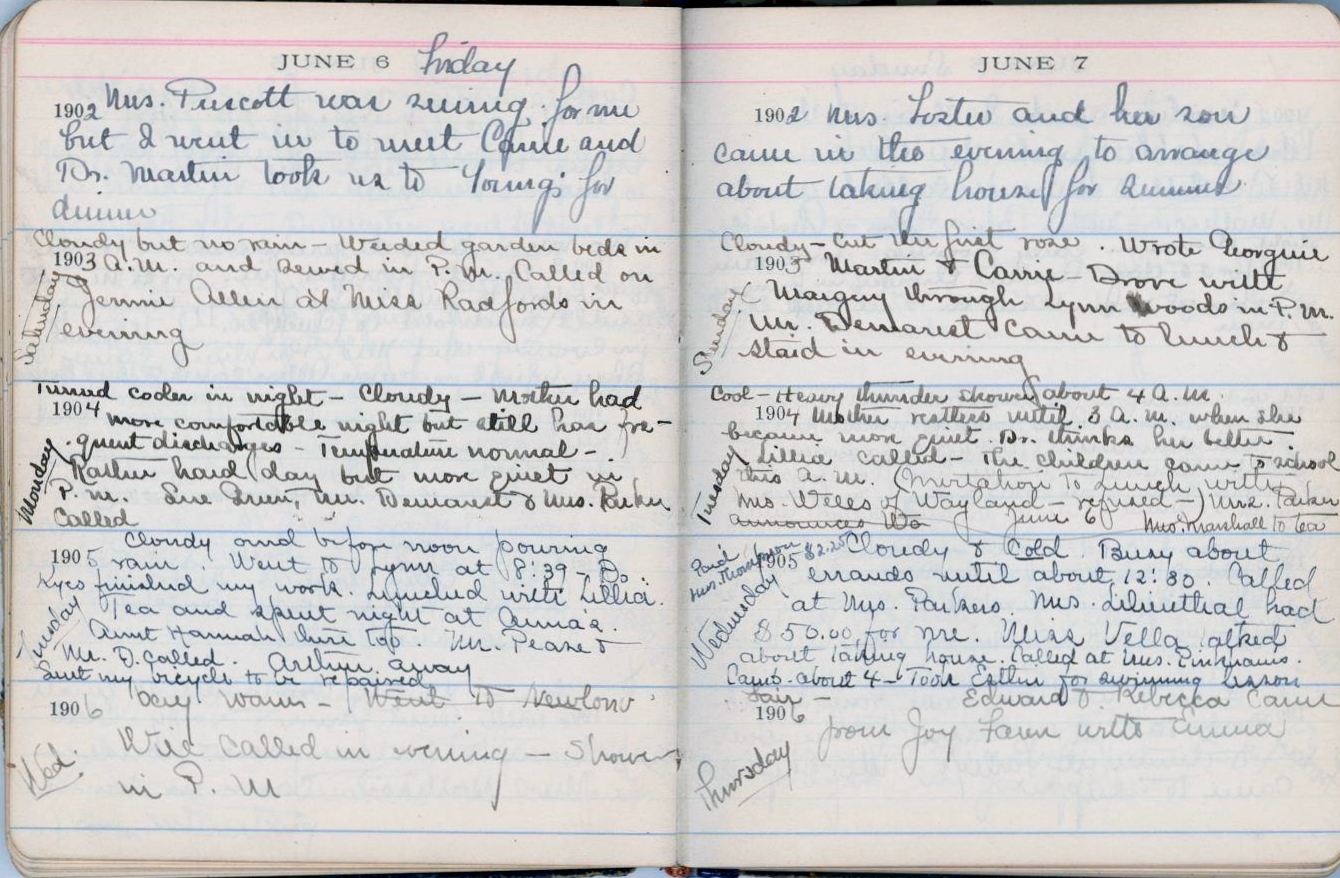
As a manuscript processor here at the MHS, I’ve had the opportunity to see a wide range of personal and family papers, but I particularly like to work with diaries. Not usually intended for a stranger’s eyes, many of them are highly revealing and deeply moving. MHS collections include diaries by men and women, young and old, rich and poor, kept throughout the centuries for a variety of reasons.

Harriet Stillman Hayward, for example, was a young 19th-century woman who clearly kept her diary as an outlet for her loneliness. She was envious of her older sister Louisa’s many social engagements and, on 21 Feb. 1850, wrote in a confessional, emotional vein: “I wonder if people will ever care more for me than they do now […] I do not think that my highest aim in life is to have every one like me, but if I could feel that one person loved me […] I should not feel entirely forgotten. […] I must continue to bear in secret, while I appear outwardly indifferent […]”

Persis Seaver Bartlett’s diary documenting the decline and death of her son from consumption falls into this category, as well. Many devout people also used diaries to work out their feelings about God and salvation.

On the other end of the spectrum are those diaries that consist of an impersonal and unembellished account of daily activities. William Wharton began every morning with a detailed description of the weather, then noted the day’s errands and appointments—the dentist, the bank, etc. On fishing trips, he recorded the size of his catches. His diaries are almost uniformly mundane and unemotional, except for the entries he wrote at the time of his wife’s death.

Printed “line-a-day” diaries, with only a small space for each day and little room for introspection, lend themselves to this kind of strictly functional record-keeping. For example, the diaries of Jane Cummings:


Travel diaries were very popular and were kept by everyone from traveling salesmen to wealthy Bostonians on the traditional Grand Tour of Europe. My colleague Anna Clutterbuck-Cook has been following one woman’s travels in Egypt. Young Charles Phillips Huse only went as far as Essex County, Mass. on a trip with his grandfather, but he made a careful record of all their adventures, illustrated with photographs pasted onto the pages. Of course, Boston artist Sarah Gooll Putnam set the standard for illustrated diaries with her elaborate sketches and watercolors.

The diary of Eliza Cheever Davis, a personal favorite of mine, is a travel diary, but also a kind of literary exercise. Davis had fun with descriptions and built suspense into otherwise ordinary anecdotes. Her entry from 9 June 1811 sounds like something out of a Gothic novel: “Behold me then in a large room or rather Hall, the Chimney boarded up, on one side a small door which I ventured to unlock which led into a dark gloomy place in which there was not light enough for me to discover what it contained, but it looked very full of wonders […]”

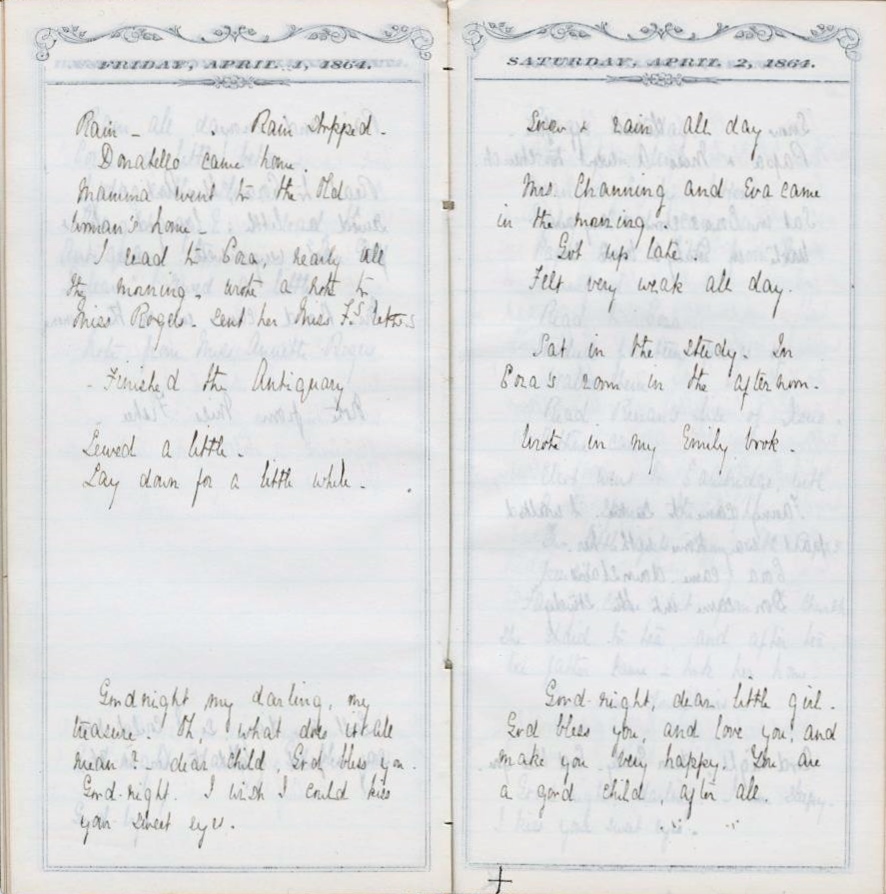
Obviously most diaries were not meant to be seen by anyone but the writer (though very public figures, like John Quincy Adams, certainly knew their words would be read in later days). But some people did write directly to friends or family members in diary entries. Eliza Davis used this device, but the most striking example I’ve come across is the 1864 diary of Lillian Freeman Clarke, who frequently addressed her intimate friend Emily Russell and wished her a tender “good night” at the bottom of each page:


Some diaries are unfortunately unattributed. Some are shared, with contributions by more than one person, perhaps a husband and wife. The fascinating papers of John Wells Farley consist primarily of typescript pages of diary entries dictated by Farley to his secretary, who couldn’t resist adding the occasional quip or correction.

Diaries at the MHS are cataloged by year, so researchers interested in a particular historical event can get a cross section of opinion. We also use subject headings to group diaries by the types of people writing them, for example: “Students—Diaries,” “Politicians—Diaries,” and “Farmers—Diaries.” We hope you’ll visit our Reading Room and take a look!

Penmanship and Copy Books

By Shelby Wolfe, Reader Services

In a collection rich in manuscript material like that at the MHS, it’s easy to fixate on centuries-old handwriting, whether for admiration of delicate script or frustration at illegible penmanship. I’ve overheard a fair balance of researchers lamenting the eyestrain caused by hours of squinting at spidery letterforms, and those who voice their appreciation for such intricate, time-consuming writing and the character it gives to the writer. Penmanship has an element of individuality, even when students were taught the importance of identical script or the “science” of manually forming words on a page through instruction books like Penmanship Explained, or, The Principles of Writing Reduced to an Exact Science by S.A. Potter.

Today, many of us rely on electronic means of forming words, efficiently typed out and spell-checked. Instead of putting pen to page, we often put fingertips to keyboard. I sometimes wonder if we would be able to decipher difficult handwriting more easily if we spent more time writing by hand as well. Though, if all writers had followed Potter’s exact science of penmanship, maybe we would have no trouble at all!

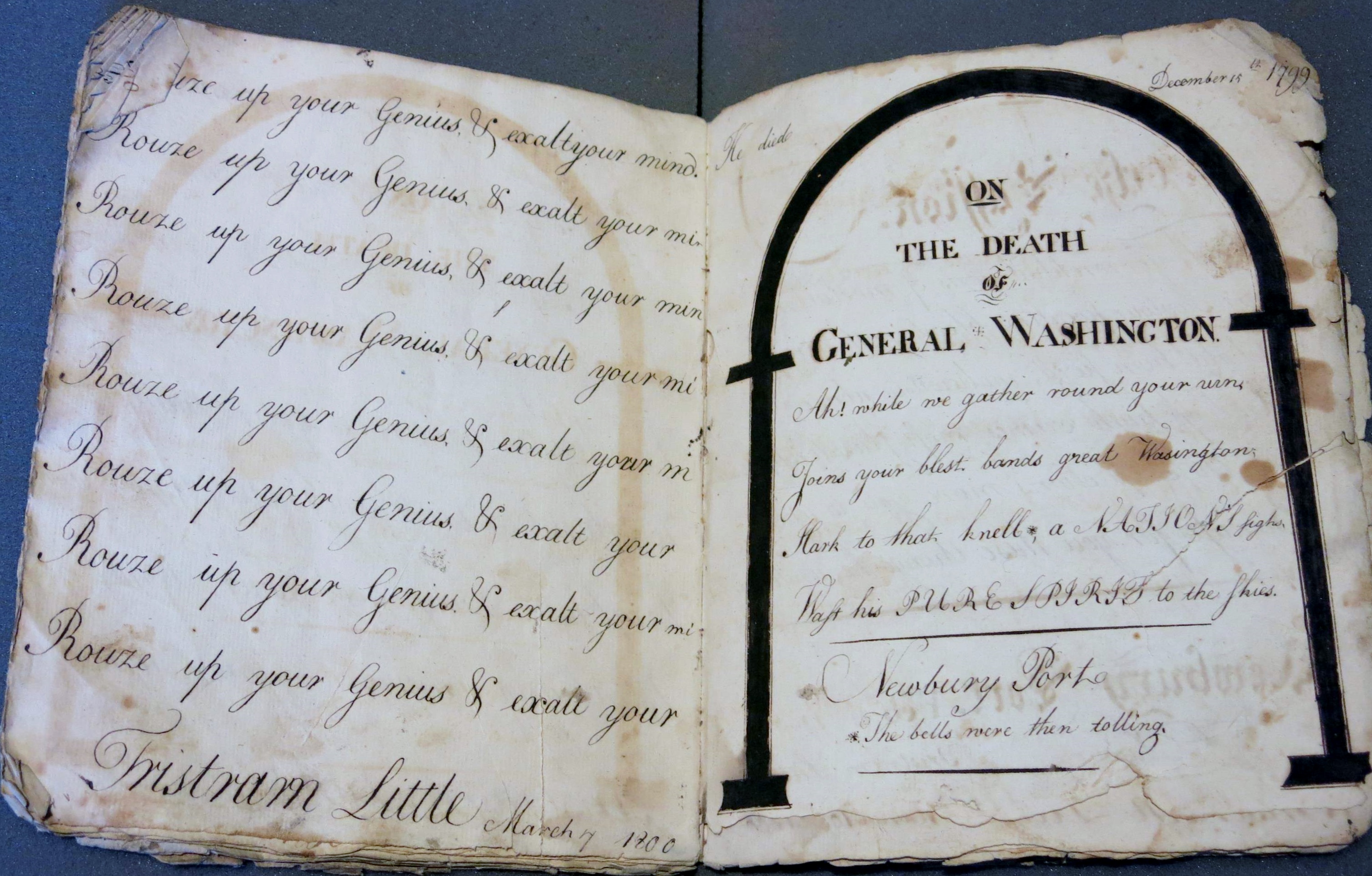
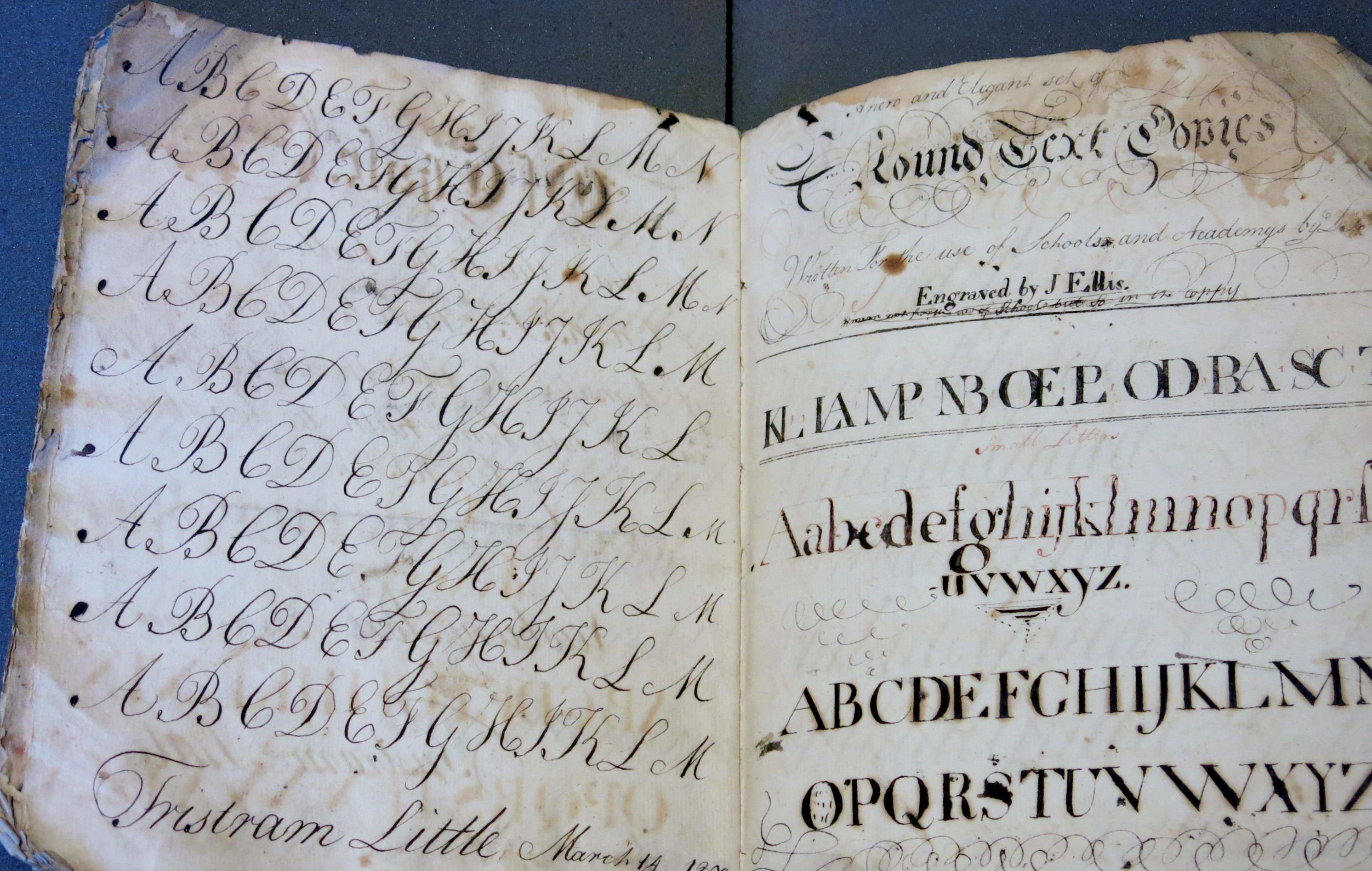
In an effort to learn more about the history of penmanship, I decided to see what resources I could find in the MHS collection. In the online catalog ABIGAIL I found a variety of results for penmanship instruction books and advertisements, broadsides for ink powder and writing instruments, and a few personal copy books in family manuscript collections. One manuscript item (manuscript fittingly meaning “hand” and “to write”) that I found particularly interesting was Tristram Little’s copy book. Tristram Little of Newburyport, Maine was born in December 1784, making him fifteen years of age at the time of this book’s use beginning in early 1800.

Copy books often provided written lines and blank spaces for a student to copy the text. In the case of Little’s book, there are no printed lines to copy, which indicates he must have copied from a separate volume. On one delicately lettered leaf, Little has copied from a cover or title page, “Round Text Copies, Written for the Use of Schools and Academys by D. S…Engraved by J. Ellis.” Perhaps this is from Bowles’s elegant set of round hand copies, round text copies and comprised in a set. Performed for the use of schools & Academies by D. Smith, written by I. Trinder of Northampton, or a similar copy book circulated by this publisher.


Some penmanship books are literally by-the-book, with lines written directly from a published original. Others are strewn with more personal touches. The pages of Tristram Little’s penmanship practice book mostly contain repeated lines of proverbial advice. Some are of general instruction, “Beware of idleness & sloth”, “Quarrel not at play,” and some loftier lines: “Rouze up your Genius & exalt your mind” and “Honor attends virtuous actions.” Tristram’s personal touches include original poems, one an illustrated epitaph titled “On the death of General Washington,” complete with tombstone frame. He notes on the top of the page, “He died…December 15th 1799” – which is actually one day off, the correct date being December 14.


The poem reads:

Ah! while we gather round your urn,

Joins your blest bands great Wasington [sic],

Hark to that knell, a NATION sighs,

Waft his PURE SPIRIT to the skies.


Newbury Port

The bells were then tolling.


On a previous page, Little recorded an ode to the “glorious George Wasington [sic],” asking, “What mortal praise can equal thy great claim?” Clearly, Little had a great regard for George Washington’s reputation. This common copy book offers an insight into the mind of a teenager growing up in America’s early years, looking up to his nation’s leader and lamenting his loss. Other pages include lists of personal names and cities (Newburyport and Philadelphia). Little’s embellished pages, glorifying poems, and ornate illustrations add another level of character to his already unique handwriting, as we might consider it today.

Tristram Little’s copy book is just one example of penmanship study and practice in the MHS collection. You can find other penmanship practice books and copy books for arithmetic exercises, many as part of family manuscript collections. If you would like to explore this topic further, visit the library and enjoy these personal copy books – or fascinating handwriting throughout the collection – in person.


This Week @ MHS

By Dan Hinchen

Got a history itch? Maybe this week’s programs can help!

– Tuesday, 8 December, 5:15PM : “Rerouting Risk: New Orleans and the Mississippi River” is an Environmental History seminar presented by Craig E. Colten of Louisiana State University. This project looks at the impacts caused by flood diversions and offers a perspective on the environmental consequences of the impending transformations. Steve Moga of Smith College provides comment. Seminars are free and open to the public; RSVP requiredSubscribe to receive advance copies of the seminar papers.

– Wednesday, 9 December, 6:00PM : MHS Fellows and Members Holiday Party. MHS Fellows and Members are invited to celebrate the season at the Society’s annual holiday party. Enjoy festive music, holiday cheer, and the annual tradition of reading the anti-Christmas laws. Registration required. Become a Member today!

– Thursday, 10 December, 5:30PM : “A ‘fine looking body of women’: Woman Suffragists Develop Their Visual Campaign.” This seminar from the History of Women and Gender series is presented by Allison Lange of the Wentworth Institute and looks at how suffrage leaders began to change the way they represented themselves and fellow prominent figures. Susan Ware, Schlesinger Library and American National Biography, provides comment. Seminars are free and open to the public; RSVP requiredSubscribe to receive advance copies of the seminar papers.

– Friday, 11 December : Library Closing at 3:30PM

Current Exhibitions : Remember that our exhibit space is open to the public free of charge Mon-Fri, 10:00AM-4:00PM. 

Dashing Through the Snow: A Tale of Boston’s Horse Railroads

By Kimberly Arleth, Reader Services

Growing up in a small Midwestern town in rural Minnesota, I had what some might say was a quintessential upbringing — complete with a horse farm! This, however, was a long time ago. Moving to the Twin Cities to attend college, and more recently Boston three months ago, I thought I left whatever rural nature I had in me behind for ‘bigger and better’ things. Yet, being in the ‘big city’ makes me nostalgic for my country childhood.

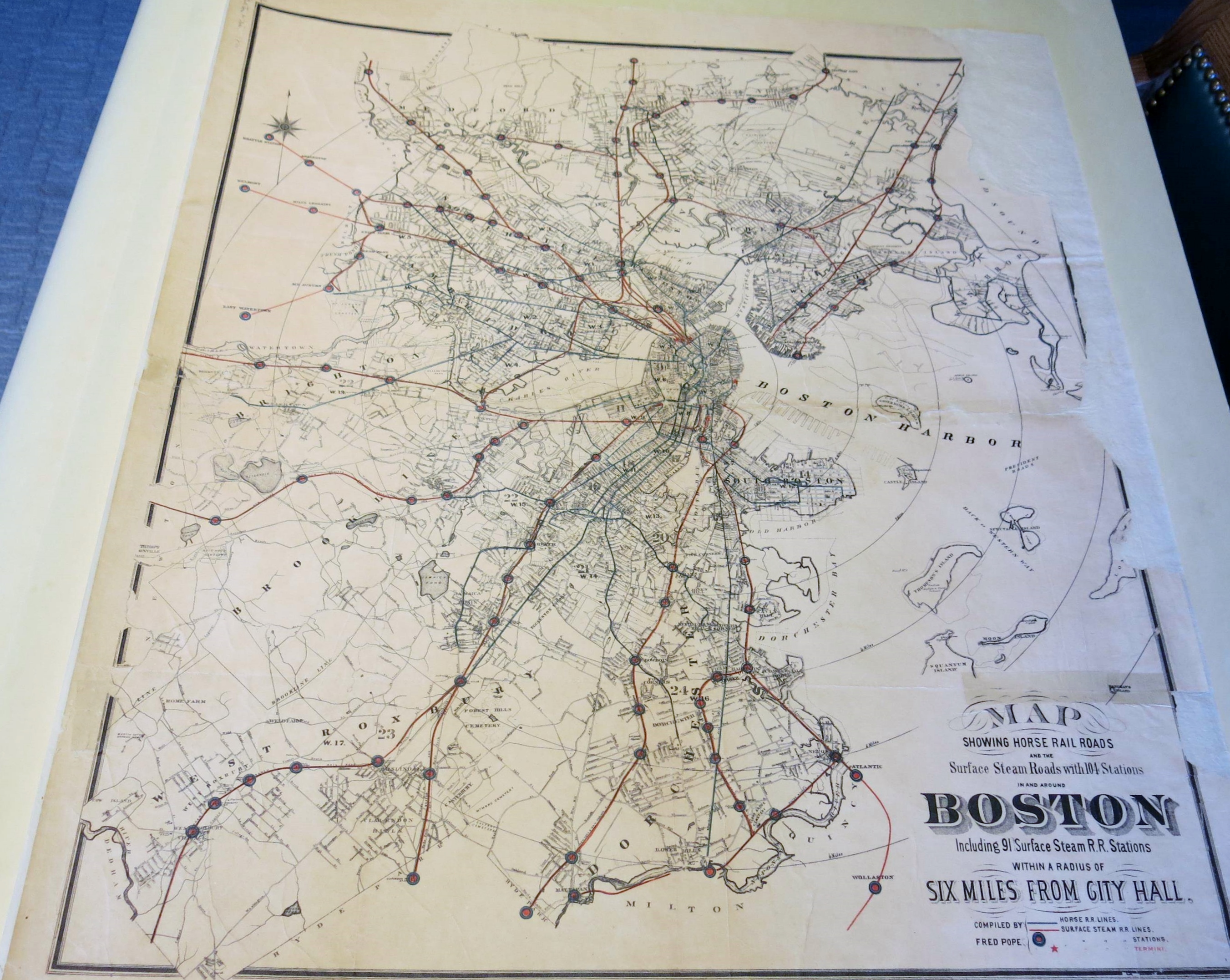
As I began to explore the extensive collections at the MHS, I found myself drawn to a number of items related to cities and working horses in the nineteenth century – particularly the ‘Horse Railroads’. This material intrigued me having worked with horses for the first thirteen years of my life and the romantic notions of a city filled with horse drawn carriages and trolley cars. Mentioning this to one of my coworkers, the joke became that after last winter’s transit halt,  it might not be a bad idea to return to these simpler roots. I wonder though, would New England snowstorms really be any easier to weather if the city ran on hooves rather than rails?


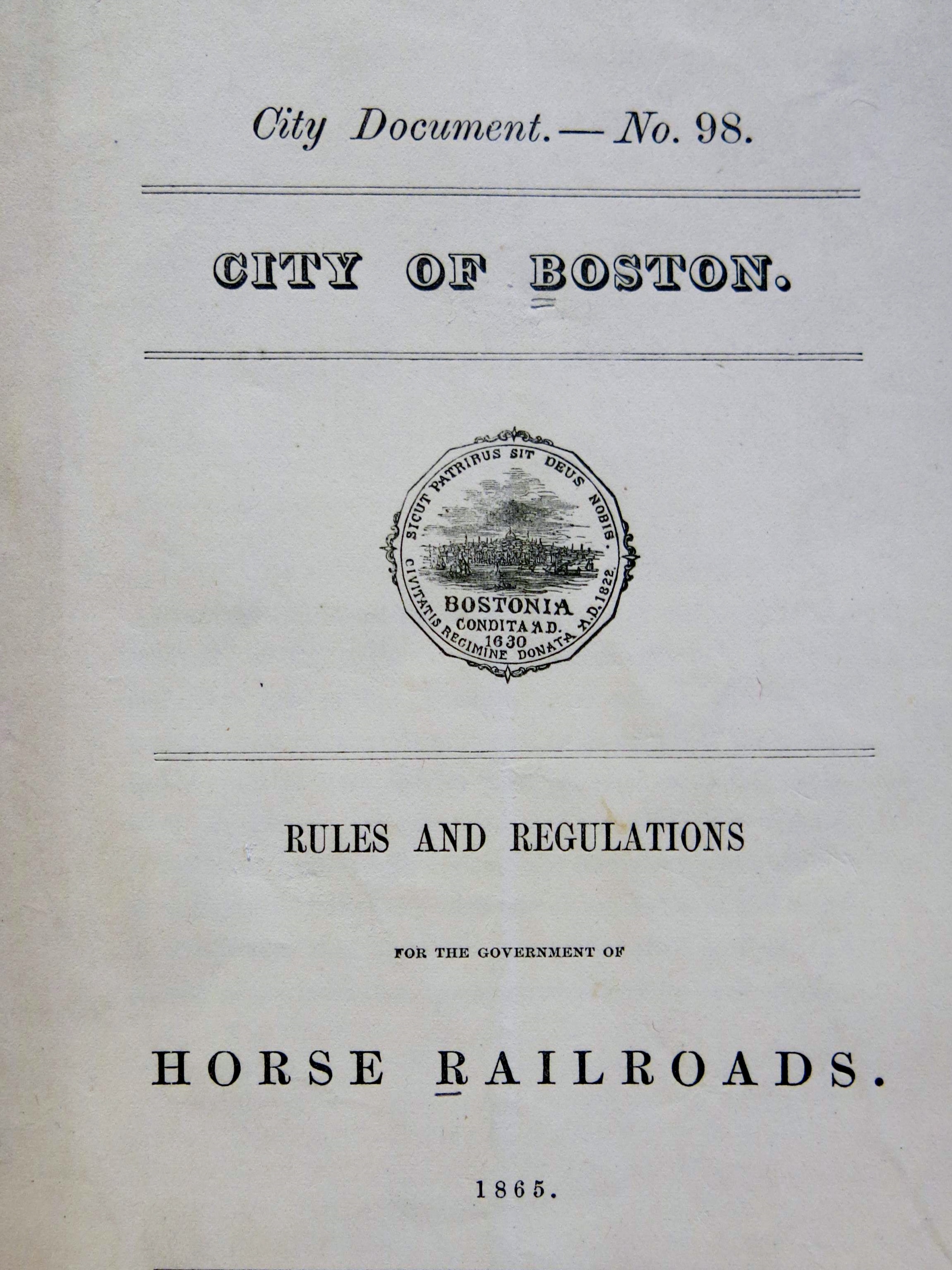
Cover of Rules and regulations for the government of horse railroads, 1865. Boston (Mass.). Board of Aldermen.


A 1865 pamphlet, “Rules and Regulations for the Government of Horse Railroads”, helped to shed some light on this question. It was declared, by an act of the legislature in 1864, that regulations on horse railroads were needed to address “the interest and convenience of the public.” Any instance of noncompliance with the rules would result in a penalty of “not more than five hundred dollars for each offence.” Today this would be a maximum fine of seven thousand dollars per offence, not a small sum at all!  

Much of the language in the rules and regulations pertain to maximum speeds allowed (five miles per hour in Boston proper, seven miles per hour outside of these city limits, and a walking gait when taking corners), and all the restrictions around when stopping of the horse railroad car is allowed and for how long. Most restrictions prohibited the stopping of the car for longer than one minute between “six o’clock in the forenoon and eight o’clock in the afternoon” (6:00 AM to 8:00 PM.) and then only at a station or designated stop. The only exceptions which allow for unscheduled stopping, repeated throughout the small four page document, are “unless detained by obstacles in the track or to avoid collision.”

Map showing horse rail roads and the surface steam roads with 104 stations in and around Boston…1878.

(A 1876 version of this map is available online at the Norman B. Leventhal Map Center at the Boston Public Library.)


Yet, it was the regulations of Section 11 and 12 that proved to be the most valuable when thinking about surviving a winter with horse railroads. Section 11 spoke to the removal of snow, [] stating that if depths were sufficient “no plough shall be allowed to pass over” unless permission was granted by the Superintendent of Streets. In this case alternative methods could be employed by the railroads, in the form of sleighs, to transport citizens until rail tracks were again accessible and normal transit methods could resume.

Similarly, Section 12 discusses the use of any salt, brine or pickle or any other material employed in the melting of snow and ice would only be allowed after receiving a permit from the city. Such permits would only be given if such use would not be detrimental to vehicles crossing the tracks and rails.


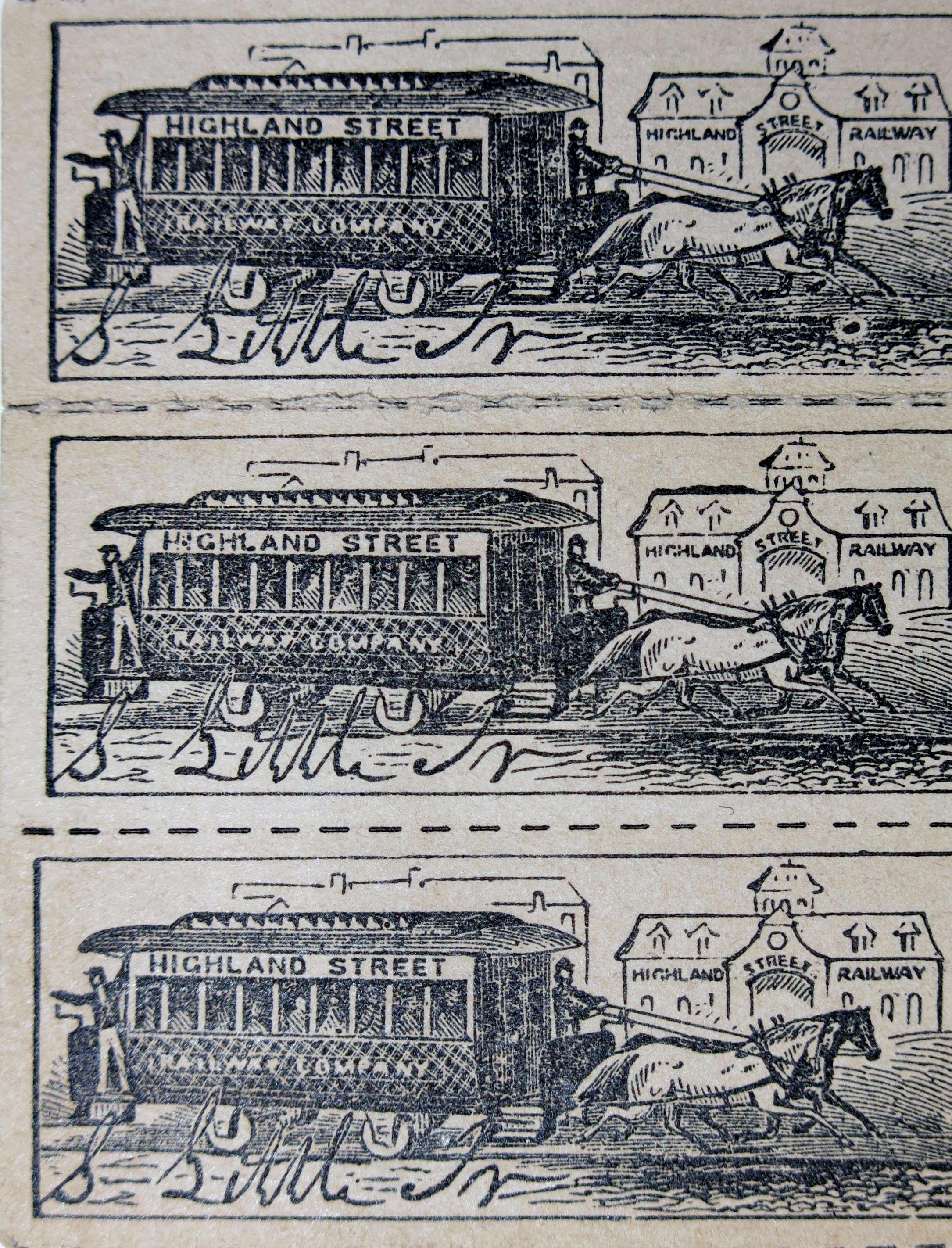
Highland Street Railroad Tickets. [No Date]


These restrictions make me imagine that if such a winter as the one last year were to have occurred during these times, the breakdown in public transit would have been far worse. While the Rules and Regulations document spoke little to the care of the working animals, the necessity of keeping the horses in working condition alone would have extended delays in transportation and confined citizens as city and transit officials worked to clear the streets.

So as we approach another winter season, and my first in Boston, a joke about returning to horse powered public transit may seem like a good idea, but I hesitate to think that the ability to combat the snowstorms of nature would be any easier won.

These are just a few samples of the material at MHS about transportation and horse railroads. If you are interested in further exploration of our collections, please visit the library or contact us for further information.

This Week @ MHS

By Dan Hinchen

Back from one holiday and looking forward to more. It is another shortened week here at the Society but there is no lack of good programming to enjoy. On the schedule this week:

– Tuesday, 1 December, 5:15PM : “Faces, Beauty, and Brains: Physiognomy and Female Education in Post-Revolutionary America.” This Early American History seminar is presented by Rachel Walker of the University of Maryland and explores how the “science” of interpreting facial features was used to distinguish between the minds of men and women in early republican America. Robert A. Gross, University of Connnecticut, provides comment. Seminars are free and open to the public; RSVP requiredSubscribe to receive advance copies of the seminar papers.

– Wedndesday, 2 December, 12:00PM : “Liberty Ports: Sex, Crime, and Policing in World War Two America” is a Brown Bag lunch talk presented by Aaron Hiltner of Boston University. His project tracks interactions between American civilians and troops, the military’s policing of stateside servicement, and the transformation of American cities during wartime. This talk is free and open to the public. 

– Wednesday, 2 December, 6:00PM : Transforming Boston: From Basket Case to Innovation Hub, Program 4 – What’s Next. This program features a panel discussion with John Barros, chief of economic development, City of Boston; Marc Draisen, MAPC; Cassandra Campbell, Fresh Food Generation; and moderator David Luberoff, Boston Area Research Initiative (BARI). The program is open to the public with a fee of $10 (no charge for MHS, BARI, or Rappaport Fellows or Members), registration required. 

– Friday, 4 December : LIBRARY CLOSED. Galleries remain open, 10:00AM-4:00PM.

– Saturday, 5 December, 9:00AM : Teacher Workshop: Roosevelt, Lodge, and the Rush to Empire. To register for this event, complete our Registration Form and mail/email it to the MHS Education Department. For more information, contact the education department at education@masshist.org or 617-646-0557.

An American Woman in Egypt, 1914-1915: Christmas in Asswan

By Anna Clutterbuck-Cook, Reader Services

Today we rejoin our anonymous diarist as she journeys down the Nile in the winter of 1914-1915. You can read previous installments of this series here (introduction), here (Cairo to Aysut), here (Aysut to Asswan), here (Asswan to Abu Simbel), and here (Wadi Halfa to Asswan), and here (At the Cataract Hotel, Asswan).


In this sixth and final installment of the “American Woman in Egypt” series, we will follow our anonymous diarist through the final ten days of the year as she celebrates the December holidays far from home. While this section of the diary doesn’t conclude the diarist’s trip to Egypt, I will be picking up with a new writer’s diary in January. Hopefully, you have enjoyed this vicarious journey!


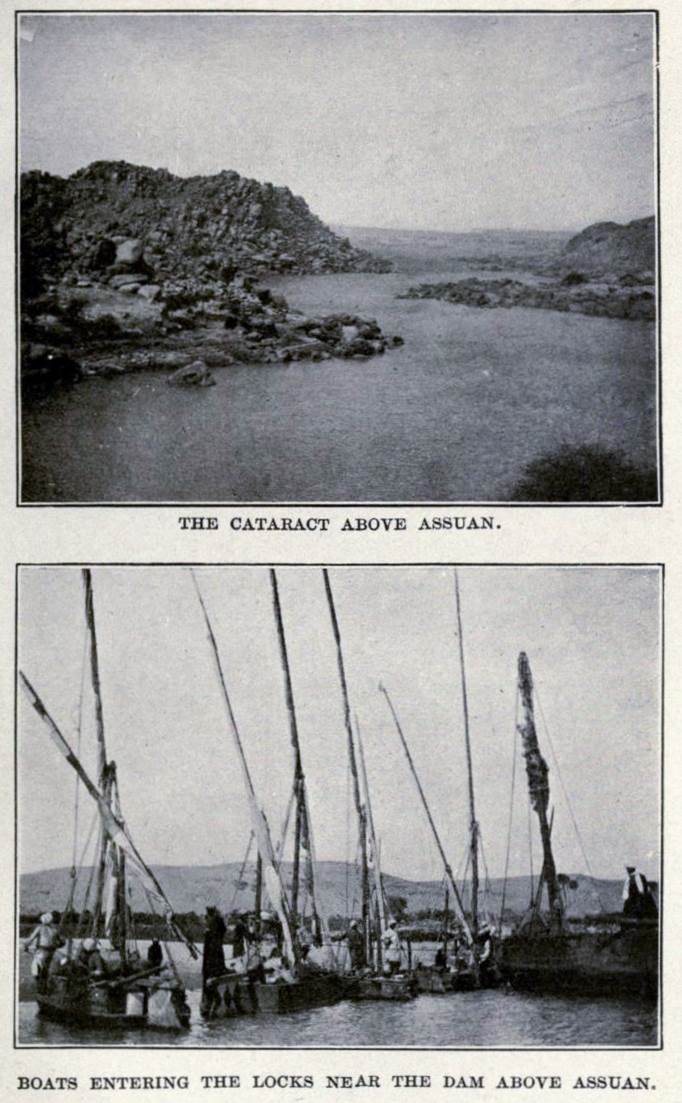
From Cairo to the Cataracts by Blanche Mabury Carson (1909)

Dec 21. Went to English church, then walked to village & back. P.M. Busy in my room till 3.45 then we went out for a sail up toward the dam among the islands. Got back & saw the sunset from my balcony.


Dec 22. Read in the garden for awhile, then at 11.40 left the hotel and took train for Shellal with party from Ramses the Great. Got back & went round first to the dam. had lunch at Cook’s resthouse, then walked nearly across the dam and back, got back in boats & went through two locks rowing back to steamer which we reached for tea. Found Mr. Wood, returned from Khartoum.


Dec 23. Sailing along all day & very cold. Began a letter after lunch. Could not sit out. Reached Luxor at 4, but decided not to land & stayed on boat overnight.


Dec 24. Landed at 9.15 & came in bus to Hotel Savoy. Miss Merrill did not feel well. I walked back to Cook’s & looked in the shops. Afternoon sat in garden & then had tea on terrace outside. Wrote in garden.


Dec 25. A.M. Xmas day. Went to church at 10.30. Dr. Hudson ill but he did officiate. P.M. Wrote till 4 in garden then went to Winter Palace for tea with Miss. M. & Miss Ensign. Saw end of some sports & met Mr. Pratman who stayed with me & escorted us home. After tea saw a Xmas tree there & Santa Claus. Listen to the music, then saw sunset on the terrace. We had our own tree for dinner with presents at each plate & a 9 course dinner.


Dec 26. Went to village & bought cards and in P.M. sat in garden & wrote then went out on terrace to see sunset.


Dec 27. Started at 9 for Karnak. Walked there & spent whole morning. Started to walk back but was taken into a carriage by a couple who picked me up in the road. After lunch sat in garden, then walked to village to P.O. – Cook’s & also went into shops. Got back just in time to see sunset from terrace.


Dec 28. Went to church, met Mr. Pratman after it, who walked home with me & sat in the garden. P.M. Wrote in the garden, then went to see Miss Gillander & had tea with her at the Hotel du Nil. Saw Miss Kerr’s pictures after lunch & in evening again.


Dec 29. Walked to village to P.O. & then went into Luxor Temple. P.M. spent in garden & on the terrace.


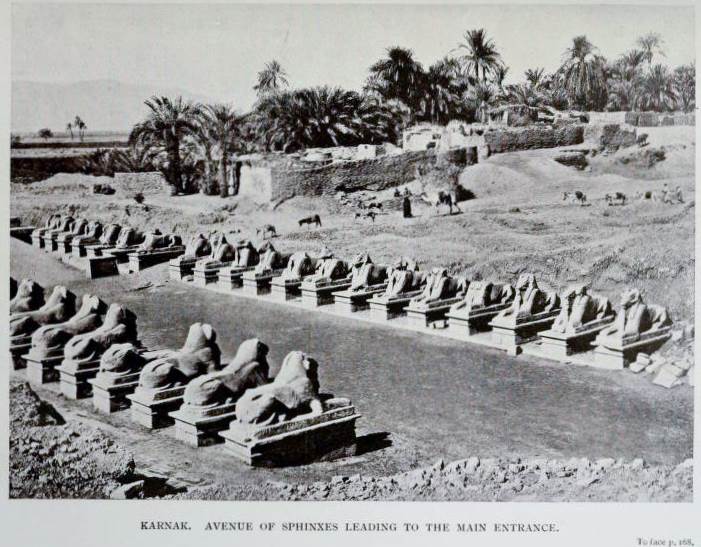
Egypt: Ancient Sites and Modern Scenes by Sir Gaston Maspero (1911)

Dec 30. Walked to Karnak first to temple of Ptah then up by eastern ave. of sphinxes to the great temple. Tried to find some friezes from Mr. Tynsdale’s book, but could not. P.M. spent in garden & on terrace.


Dec 31. Went across the river met Miss Gillander & we three went to Deir el-Medina – tombs of [illegible phrase], temple Medinet Habu where we ate our lunch & tombs of Nobles [illegible phrase]. Got back to boat at 4:30. Came back & had tea on terrace. Very hot in sun.


We will leave our diarist here, an American abroad enjoying the mid-winter sun on the terrace of the Cataract Hotel. For those of you interested in exploring more of this writer’s story, remember that you can visit the library or order reference reproductions.


This Week @ MHS

By Dan Hinchen

We have a much-shortened week at the Society as we prepare for Thanksgiving, but there are still a couple of events going on here for you take in. 

– Monday, 23 November, 6:00PM : Join us for an author talk with Sally G. McMillen of Davidson College. She is speaking on her new book, Lucy Stone: An Unapologetic Life, which addresses Stone’s omission from the pantheon of women suffragists of the 19th century. This talk is open to the public for a fee of $10 (no charge for MHS Fellows or Members). Registration is required. 

– Tuesday, 24 November, 5:15PM : Mark Herlihy of Endicott College presents “‘A barbarous practice that would not be permitted in other civilized countries’: The Evolution and Enduring Presence of the African Dodger Game at Boston-Area Amusement Venues,” a seminar talk that is part of the Immigration and Urban History series. Jeff Melnick of UMass – Boston provides comment. Seminars are free and open to the public; RSVP requiredSubscribe to receive advance copies of the seminar papers.

Please note that the MHS is closed on Thursday, 26 November, for Thanksgiving. The library remains closed through Saturday, 28 November. The exhibition galleries are open on Friday, 27 November, and Saturday, 28 November, 10:00AM-4:00PM. Normal hours resume on Monday, 30 November. 

Zymurgy in the Stacks: Brewing History at the MHS

By Dan Hinchen, Reader Services

Like many other people these days, one of my hobbies outside of work is brewing beer at home. It’s a good way to spend an afternoon and the results, if not immediate, are usually very satisfying. As I type this, there are 3 gallons of Holiday Cheer Ale in a glass carboy on my counter, bubbling-away during the primary fermentation stage. It will take a few weeks until I get my final product, so patience is a necessity. But, since I’ve gotten myself into a good rotation the last couple of months, I have plenty of other styles on standby for when I get thirsty.

Even though I started brewing about two and a half years ago, I have not yet been brave enough to do a lot of experimentation with my recipes. Instead, I rely heavily on a list of house recipes created by the folks at my local brewing supply store in Cambridge. These recipes provide step-by-step instructions (which I have down-pat, at this point), specific types and amounts of grains, malt extracts, and hops that go into a given brew, and a few types of yeast that they suggest for the best results. So far, these recipes have not failed me.

On a few different occasions I have searched our online catalog, ABIGAIL, to see what the MHS holds in relation to beer and brewing. Sadly, there is not much, most of it coming in the form of old printed treatises on beer. A few weeks ago, though, I struck gold! While preparing a display of manuscripts for a visiting college class working on food history, I brought out an item that is listed in our catalog as an “Anonymous Recipe Book, ca.1800.” Upon opening the folder, I found staring at me a small manuscript page with the simple heading “To brew Beer.”

“Take 3 pints of malt, a double handful of Hops, as much of bran or shorts, boil these in ten gallons of soft water for two hours, then strain it, and when cold, add half a pint of molasses a half pint of yest and work it well. To colour it add a handfull of roasted barley whilst it is boiling. The yest of this beer put in a bottle with water & kept in a cool place, will serve to make bread.”

Also included on the page is a recipe for Spruce Beer:

“Take half a pint of Spruce. Boil it two hours in five gallons of soft water, a quart of molasses. When cold work in a large tea cup full of god thick yest, let it work 24 hours & then bottle it off. It will be pleasant Beer without the spruce.”

As I mentioned above, with modern recipes I have grown accustomed to seeing very specific amounts (usually in ounces, to one decimal place) and varieties of grains/malts and hops to create a certain type of brew. I feel like these somewhat vague descriptions (3 pints of malt; a double handful of hops) made more sense 200 years ago because the pickings were probably slim and brewers were using what was grown nearby. In the 18th century, a brewer did not have to agonize over whether to use Northern Brewer hops or Fuggles; the myriad options simply were not there.

Still, I think that maybe in the near future I will overcome my reliance on the modern recipe and give this piece of brewing history a try at home.  


This Week @ MHS

By Dan Hinchen

It is a little bit quieter at the Society this week, but there are still some programs for your history-loving pleasure. Here’s what’s happening:

– Wednesday, 18 November, 6:00PM : “Transforming Boston: From Basket Case to Innovation Hub, Program 3 – The New Economy: Eds and Meds, 1980s to Today.” Regsitration is required for this event with a fee of $10 (no charge for MHS, BARI, or Rappaport Fellows or Members). Please note that this program takes place at the MIT Stata Center (Vassar Street near Main Street), room 33-123.

– Friday, 20 November, 2:00PM : “From Bunker Hill to Yorktown: Collecting Maps Along America’s Road to Independence.” Join us for this gallery talk in which Ronald Grim, Curator of Maps at the Norman B. Leventhal Map Center, will discuss the history of map collection in relation to Terra Firma: The Beginnings of the MHS Map Collection. This talk is free and open to the public. 

– Saturday, 21 November, 10:00AM : The History and Collections of the MHS is a free public tour of the Society’s building on Boylston St. The walk-through is docent-led and lasts about 90 minutes. No need for reservations for individuals and small groups, but parties of 8 or more should contact Art Curator Anne Bentley in advance at 617-646-0508 or abentley@masshist.org

– Saturday, 21 November, 1:00PM : “Begin at the Beginning: Boston’s Founding Documents.” Historian Margaret Newell leads a discussion of the enslavement of Native Americans from the first years of the Massachusetts Bay Colony. Registration is required at no cost. Please RSVP.