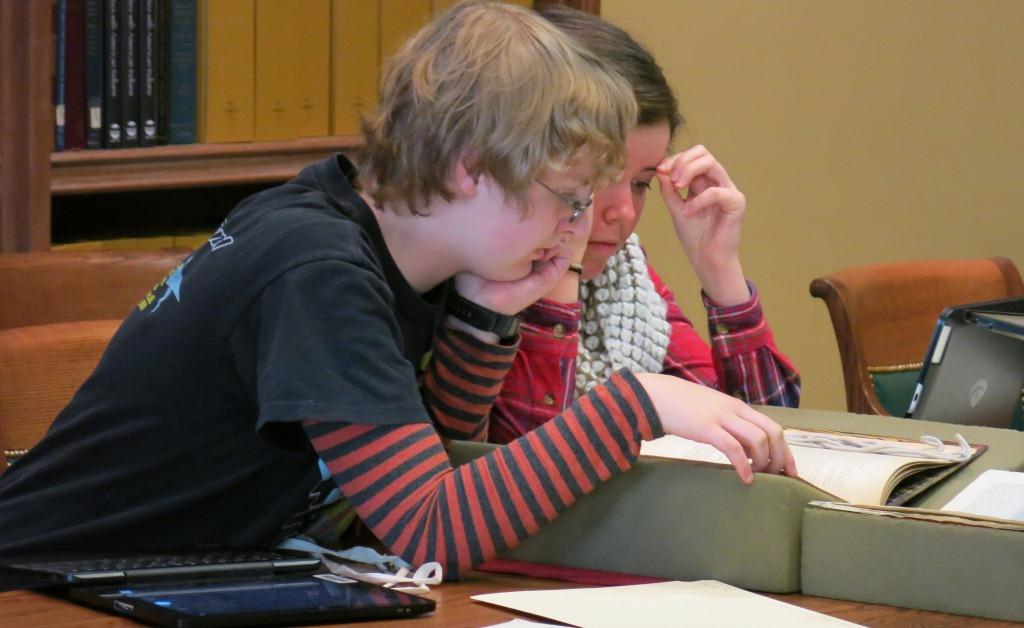
Learning the Ropes: High School Students Research at MHS

By Kathleen Barker, Education Department

As our teaching collegues head into the second half of the school year, I paused to reflect back on all the Education Department accomplished this fall. In doing so, I realized that November was a busy month for student workshops at the Society. Two programs in particular highlight the ways in which education and library staff members collaborate to make our collections accessible to audiences beyond academics. On November 10, students from Needham High School returned to the MHS for a program on the coming of the American Revolution in Boston. They analyzed propaganda from the 1760s and the 1770s, including this entertaining newspaper article encouraging colonists to boycott goods imported from Britain. Thanks to the coordinated efforts of Needham teachers and MHS staff, students were able to search for and request specific items to view during their visit. For many students, this was their first opportunity to examine original manuscripts and rare printed materials in a research library setting! 

On November 19, we welcomed students from Concord Academy. This excited group of young researchers examined documents related to slavery, abolition, and the African Americans in the Civil War in order to help select topics for an upcoming project. Students then discussed the messages promoted in abolitionist propaganda such as these cotton banners from the 1840s, and considered the role that African Americans like the men of the Massachusetts 54th Regiment  played in securing an end to slavery. Since these students were just beginning their research efforts, they also took a tour of the library and learned more about specific research tools like ABIGAIL and our collections guides.

If you would like to learn more about field trip opportunities for K-12 classes, please contact our education department!


This Week @ MHS

By Dan Hinchen

It is the return of the seminars this week at the MHS. Up first, on Tuesday, 13 January, from the Environmental History series is “The Rise and Fall of the Texas Longhorn.” This talk, given by Joshua Specht of Harvard University, explores the crossroads of economics and biology in the evolution of the cattle ranching industry. Comment provided by Beth LaDow, author of The Medicine Line: Life and Death on a North American Borderland. The talk begins at 5:15PM. Seminars are free and open to the public; RSVP requiredSubscribe to receive advance copies of the seminar papers.

On Wednesday, 14 January, stop by at noon for a Brown Bag lunch talk given by Kate Culkin of Bronx Community College, CUNY. “The Emerson Sisters’ Correspondence: A Record of Daily Life in the Emerson Home and Nineteenth-Century Concord” explores the changing world of the nineteenth century through the correspondence of two daughters of Ralph Waldo Emerson. This event is free and open to the public. 

Another seminar takes place on Thursday, 15 January, this time from the Biography series. The panel, moderated by Caroly Bundy, will discuss “Biography, the Visual Artist, and the Story Behind Public Art.” This seminar begins at 5:30PM. Please RSVPSubscribe to receive advance copies of the seminar papers.

Finally, once again there is a free tour taking place on Saturday, 17 January, at 10:00AM. The History and Collections of the MHS is a 90-minute docent-led tour through the public spaces of the Society’s home at 1154 Boylston Street. The tour is open to the public at no charge. If you would like to bring a larger party (8 or more), please contact Curator of Art Anne Bentley at 617-646-0508 or abentley@masshist.org.


Homegrown Gifts: George Washington’s Locks

By Andrea Cronin, Reader Services

Our exhibition Father of His Country Returns to Boston closes today as the holiday season wraps up. The exhibition commemorates the 225th anniversary of President George Washington’s month-long tour of New England in October 1789. One of the most interesting items on display as part of this exhibition is a lock of hair that George Washington gave to Alexander Hamilton.

Hamilton worked closely with Washington throughout the American Revolution and their political careers. Hamilton was born the second illegitimate child of James Hamilton and Rachel Faucett Lavien on 11 January 1755 or 1757 in Charlestown on the island of Nevis in the British West Indies. He worked as a clerk until he traveled to the British North American colonies for education. In New York, Hamilton became increasingly involved in the rumblings of Revolution during his studies at King’s College before responding to a call for recruits in 1776. Washington appointed Hamilton to the position of aide-de-camp at the rank of Lieutenant Colonel on 1 March 1777. Washington mentored Hamilton as he did with all his aides-de-camp until a parting of ways in February 1781 when Hamilton resigned from Washington’s staff position over insult. However, their working relationship did not end there. Washington later appointed Hamilton as first Secretary of the Treasury in  September 1789 just before the President’s tour of New England commenced in October.  The circumstances surrounding the gift of Washington’s hair to Hamilton however remain undocumented.

The practice of gifting hair seems particularly strange to the 21st century observer. Nowadays people share photographs of themselves and their families in holiday cards or digitally through social media. Portraiture remained the primary way individuals shared images of themselves prior to the invention of the daguerreotype by Louis Daguerre in the late 1830s. But the gift of hair also held considerable value. Hair was often woven and incorporated into rings, bracelets, and other jewelry throughout the 18th century. Lovers, friends, and family often exchanged locks of hair as mementos.   Vestiges of hair traditions remain even today when parents save locks of their children’s hair.

The Massachusetts Historical Society has not just one but two separate locks of hair that George Washington gave to Alexander Hamilton. Mrs. Charles Mason donated the first singular lock to the Society on 11 May 1876. The second lock of Washington’s hair is framed together with a lock of Hamilton’s own hair. The son of Alexander Hamilton, James A. Hamilton of Nevis, gave these locks to Eliza Andrew, wife of Massachusetts Governor John Albion Andrew, on 27 October 1865. The Society later received the locks from Andrew’s children, Edith and Henry Hersey Andrew in December 1920.

The text of the frame states:

“The above is the hair of my Father
Alexander Hamilton, presented
by me to Mrs. Andrew
Octo. 27 1865
James A. Hamilton”

“The above is the Hair of “The Father
of his Country” Geo. Washington pre=
sent to his friend Mrs Andrew by
James A. Hamilton
Nevis
Oct 27 1865”


Marble bust of Alexander Hamilton by Giuseppe Ceracchi, 1794

Their working relationship tempered by respect endured any snarls. Washington’s death on 11 December 1799 came as a great loss not only to the country he fathered but also to his former mentee. In a letter to Washington’s personal secretary Tobias Lear on 2 January 1800, Hamilton wrote, “Perhaps no man in this community has equal cause with myself to deplore the loss. I have been much indebted to the kindness of the General, and he was an Aegis very essential to me.”

Hacking John Adams

By Amanda A. Mathews, Adams Papers

At the end of 2014, the hack into Sony Pictures and the subsequent publication of the private communications of Sony employees drew massive public interest. While many decried the methods, and resentful of foreign meddling, many people were still deeply interested in the revelations about the executives’ opinions on various celebrities.

John Adams faced a “hack” of his own in the summer of 1775 when private letters he had written to his wife, Abigail Adams, and to his friend James Warren were intercepted by the British and subsequently published in Boston and London. Adams, participating in the Second Continental Congress in Philadelphia, was growing increasingly frustrated at the reluctance of some of the members to take strong measures of resistance against Great Britain and took to his letters to vent his frustration, in particular against John Dickinson, a member from Pennsylvania who believed that even with hostilities ongoing, reconciliation with Great Britain was still possible and should be pursued. John Adams fed up with this, vented to Warren: “In Confidence,—I am determined to write freely to you this Time. —A certain great Fortune and piddling Genius whose Fame has been trumpeted so loudly, has given a silly Cast to our whole Doings—We are between Hawk and Buzzard.” To Abigail he alluded to his fellow congressmen: “I wish I had given you a compleat History from the Beginning to the End of the Journey, of the Behaviour of my Compatriots.——No Mortal Tale could equal it.——I will tell you in Future, but you shall keep it secret.——The Fidgets, the Whims, the Caprice, the Vanity, the Superstition, the Irritability of some of us, is enough to——” and there broke it off.

Entrusting these private thoughts to Benjamin Hichborn, a young lawyer, making his way back to Boston, Adams had no idea that he had just penned words that would bring him more fame than anything he had written to that point. While at a ferry crossing in Rhode Island, a British naval vessel captured the ferry and took possession of the letters Hichborn carried. Unsurprisingly they found the contents very interesting. The British officers made several copies, some of which were sent off to London, and the letters were also quickly printed in the Massachusetts Gazette and other Boston papers, trying to create division within the patriot cause.

The breach deepened the rift between Adams and Dickinson and occasioned a great deal of gossip on both sides of the Atlantic; however it had no long term effect on John Adams’ reputation in the Congress, continuing to be an influential member, nor did it influence British policy. Still, just as many were fascinated to know what executives really thought about Angelina Jolie, there were many Americans in 1775 fascinated to hear such candid opinions about congressional members.

To read more about the incident and the subsequent reaction see the complete coverage.

This Week @ MHS

By Dan Hinchen

As the new year begins, it is a quiet first week back at the MHS. 

On Wednesday, 7 January, join us for a rare musical program at the Society. “Over There: The Boys Who Went to Fight and the Women Who Endured” tells the story of the U.S.’s involvement in WWI and its effects on the nation’s women, men, and children, starting from before the U.S. entered the war until after the war when the “boys came home”. A reception for the event begins at 5:30PM and the program begins at 6:00PM. The event is open to the public for a $10 fee (no charge for Fellows and Members). Registration is required for this event. You can register online or call 617-646-0578.

On Saturday, 10 January, is a tour of the Society’s building at 1154 Boylston Street. The History and Collections of the MHS is a 90-minute docent-led walk through our public rooms. The tour is free and open to the public, with no need for reservations. If you would like to bring a larger party (8 or more), please contact Curator of Art Anne Bentley at 617-646-0508 or abentley@masshist.org. While you’re here you will also have the opportunity to view our current exhibition, “Letters and Photographs from the Battle Country: Massachusetts Women in World War I.” This exhibit ends on Saturday, 24 January 2015. Catch it before it goes!

Also, please note that the other current exhibit, “The Father of His Country Returns to Boston, October 24, 1789,” ends on Friday, 9 January. Come in this week anytime, 10:00AM-4:00PM, to have a last look!

Equality in Incarceration: The Push for Women’s Prisons in Massachusetts

By Kittle Evenson, Reader Services

For my inaugural Beehive post I delved into the world of female incarceration, attempting to better understand the creation of women’s prisons in Massachusetts, and the codified societal controls imposed on women in the 19th century.

In 1874, Emory Washburn published “Reasons for a Separate State Prison for Women” and with impassioned rhetoric, called out the systemic inequalities leading to women’s imprisonment, and called for a shift in focus from punishment to reformation.

While I initially read his publication expecting a paternalistic discourse, what I found was a sharp commentary on women’s power for self-determination and democratic participation.

But for what we are bound to suppose wise reasons, the voice of only one sex can be heard at the ballot-box, while the other must content themselves with humbly making known their wishes to the legislature, that something may be done to relieve the Commonwealth from this inequality in the administration of justice in the case of the two sexes. It is not overlooked, that not a few of those who would be the inmates of such a prison as is here advocated, have become so from causes with which those whose votes help to settle questions of this kind have had much to do [emphasis added].

Crime is a form of social action; the criminal justice system a type of social control; and the arc of women’s history is inexorably linked to both. In puritan New England, women were predominantly brought up on charges of fornication and adultery, and even crimes such as murder, were often the result of secretive abortions, or desperate acts of infanticide. Punishment was evocative and public. As concrete expressions of social control, it served dual purposes as both a lesson to the female perpetrators and an establishment of boundaries for the women waiting in the wings.

Within our collections, there is a smattering of “last words” of colonial-era women convicted and punished for felonious crimes. Secondary sources, such as N.E.H. Hull’s Female Felons: Women and Serious Crime in Colonial Massachusetts deftly explicate the female experience in colonial courts, but women’s first-hand accounts of the 19th century justice system prove maddeningly elusive.

In his call for sex-segregated prisons, Washburn is speaking to a society in which women are jailed in the same institutions as men, yet offered no means with which to train or educate themselves.

Reformers saw the harsh conditions of men’s prisons as hardening and detrimental to women, with the lack of educational and vocational trainings failing to prepare them for a productive life beyond their incarceration. With no prospects independent of crime, recidivism among women was high, and the cycle of crime in the mid-19th century rarely broken. By advocating for separate women’s reformatories, Washburn saw a chance to break women free from this cycle. So long as the women had sufficient time to internalize the reform.

The process of working to reform in such prisons must, at best, be slow, and the attempt to do it in the period of a few months practically hopeless. Such sentences have reference to disposing of bad subjects for the time being, and not to the reforming of them (6).

To better understand the women’s prisons that arose from this movement, I found the 1888 report to the Massachusetts Commissioners of Prisons detailing the first year of the  Reformatory Prison for Women at Sherborn. The report echoes Washburn’s call for longer sentences and the necessity for access to education and vocational training. But it also complicates our understanding of female incarceration – detailing the all-female prison staff tasked with monitoring, controlling, and reforming the women under their care. This staff included a chaplain: Eliza L. Pierce, a physician: Eliza M. Mosher, and superintendent: Eudora C. Atkinson.

In its first year the prison held 794 women. 143 of the inmates were sentenced for acting “idle and disorderly”; 147 for being a “common night-walker”; and the most, 161, for being a “common drunkard” (161). While the women’s financial backgrounds are unclear, it was recorded that the majority, 54%, were foreign born.

Fom this tableau of sources, we see the beginnings of a rich context into which the experiences of women as gatekeepers, educators, protectors and prisoners can be woven. Questions abound as to the concrete changes these women pursued; the dynamics between domestic and foreign-born inmates; and the support these prisoners received after their release, specifically from institutions such as Temporary Asylum for Discharged Female Prisoners.

These are just a selection of the MHS’s offerings pertaining to women’s incarceration. Researchers interested in engaging further with these sources, or our broader manuscript and print collections, are encouraged to contact the library or stop by for a visit.

Stephen Greenleaf Bulfinch, Post 39

By Elaine Grublin

The following excerpt is from the diary of Stephen Greenleaf Bulfinch.

Monday, Dec. 19th, 1864

In public affairs, victory after victory crowns our arms, & we trust this terrible war is nearly ended. The battle near Nashville, – the successful march of Sherman from Atlanta to Savannah, & taking of Fort McAllister, – the unexpected released of the “St Albans’ Raiders” in Canada, & the stir thereupon on both sides the line, are the chief recent events. Congress has met, – received a manly message from the President, – and S.P. Chase is appointed Chief Justice, to general satisfaction.

Monday, Dec. 26th 1864

This morning I hear news of the, nearly bloodless, – occupation of Savannah; – for which God be praised!

Civil War Photograph Collections Online

By Peter K. Steinberg, Collection Services

On 2 October 2014, my colleague Nancy Heywood announced on the blog of the Massachusetts Historical Society (MHS): “Just Launched! Nine Fully Digitized Civil War Collections.” In addition to these manuscript collections, the MHS holds several photograph collections dating from the Civil War period as well. Six of these have been digitized and are available both on our Civil War commemoration home page, and in our larger list of guides to photograph collections.

The albums contain images of dozens of Massachusetts’ sons –some of whom feature in our digitized manuscripts collections, such as Richard Cary and Norwood Penrose Hallowell– as well as battleground areas and significant and anonymous role players in the Civil War. Seeing them adds another layer of context to the letters, newspaper articles, and other memorabilia of lives long ended. Don’t forget! Back in 2012, the MHS produced an in-house exhibit “Massachusetts in the Civil War, 1861-1862” and also made a companion website which featured many documents from the show. Since we deal with a lot of death here at the MHS – and really in most archives – I would be remiss without highlighting the second most emotional letter I have ever read, Wilder Dwight’s last letter to his mother Elizabeth from the battlefield at Antietam where he was mortally wounded.

This Week @ MHS

By Dan Hinchen

There is only one item on the schedule this week as we close-in on our winter break. On Saturday, 20 December, join us for a free tour of the building at 1154 Boylston St. “The History and Collections of the Massachusetts Historical Society” is a 90-minute docent-led walk through our public rooms. The tour is free and open to the public with no need for reservations. If you would like to bring a larger party (8 or more), please contact Curator of Art Anne Bentley at 617-646-0508 or abentley@masshist.org

Also, our exhibition galleries remain open so you can view both of our current exhibits: “Letters and Photographs from the Battle Country” and “The Father of His Country Returns to Boston, October 24, 1789.” The galleries are open to the public Monday through Saturday, 10:00AM to 4:00PM.

Please note that the MHS library will be closed beginning on Wednesday, 24 December and will not re-open until Monday, 5 January. During that time, the galleries will be open to the public on 26-27 December, 29-30 December, and 2-3 January. As always, keep an eye on our Calendar of Events to see what is coming up in January!