This Week @ MHS

By Dan Hinchen

After a flurry of activity to close out last week, this one starts a little bit more slowly. Please note that the Society is closed on Tuesday, 11 November, in observance of Veteran’s Day. Happy Armistice!

On Wednesday, 12 November, join us at noon for a Brown Bag lunch talk given by Johann Neem of Western Washington University and the University of Virginia. In this talk, titled “Making the Self-Made American: The Original Meanings and Purposes of America’s Public Schools,” Neem discusses the collective effort required to achieve American individualism. This talk is free and open to the public. 

Then, on Friday, 14 November, beginning at noon is a free author talk. Join award-winning food and drinks writer Corin Hirsch as she discusses her first book, “Forgotten Drinks of Colonial New England.” This event is open to the public at no cost.

And on Saturday, 15 November, we return with “The History and Collections of the MHS.” This 90-minute, docent-led tour explores all of the public space in the Society’s home at 1154 Boylston St., touching on the art, architecture, collections, and history of the institution. The tour is free and open to the public with no need for reservations. If you would like to bring a larger party (8 or more), please contact Curator of Art Anne Bentley at 617-646-0508 or abentley@masshist.org. While you’re here you will also have the opportunity to view our current exhibitions, “Letters and Photographs from the Battle Country: Massachusetts Women in World War I,” and “The Father of His Country Returns to Boston, October 24, 1789.”


MHS Librarians Hit the Road

By Dan Hinchen

Today, the library at the MHS is closed in preparation for our annual fundraising event, Cocktails with Clio. What is a group of librarians to do with a day off? Rather than sit by and toil in our respective offices as set-up goes on around us, we instead are opting to go on a field trip. Specifically, we are jumping on the Mass Pike to go see our counterparts at the American Antiquarian Society in Worcester.

The reader services staff here recently decided that we should better our knowledge of at least some of the many institutions in the area that are similar to ours. With that in mind, we compiled a list of such “sister institutions” to visit so that we can get a better sense of what they do, what collections they hold, and what a user’s experience is like.

While the MHS holds incredible and unique collections relating to the history of the state and the nation, we do not always have the right materials for every researcher. One thing that we hope to take away from these site visits is a better understanding of the holdings and specialties of some nearby institutions. This will in turn allow us to better serve our own researchers by knowing the proper direction to send them when we cannot answer their questions.

Also, these experiences give us the chance to network with colleagues and peers working in other libraries around the Boston-area. We can discuss emerging scholarship relevant to our respective institutions and talk about trends in research topics and researcher questions and behavior.

Another hope is that the places and people we visit will get the same from us in return. It is easy to think that every library professional in the area knows who we are and what we do but that is not always the case. These site visits give us the opportunity to expose ourselves more widely to the academic community in Massachusetts and to help our peers understand what material we hold and what we might do to help their researchers.

In a profession – and an institution – where it is sometimes easy to insulate ourselves from the outside, this is an opportunity for us to reach beyond our four walls to communicate our mission to other institutions. We also get the chance to increase our own ability to pursue that mission. 


The Siege of Louisbourg, 1758: The Daring Capture of the Prudent and Bienfaisant

By Thomas Lester, Reader Services

During the French and Indian War (1754-1763), the fortified French city of Louisbourg loomed over the Gulf of Saint Lawrence, denying the British access to the Saint Lawrence River – the route to capturing the key cities of Quebec and Montreal.  The fortress, considered the “Gibraltar of the North,” had famously been captured by a combination of New England militia and the British navy in 1745, only for the Treaty of Aix-La-Chapelle to return it to the French in 1748.  Now, a decade later, the invading British forces looked to capture the fortress for a second time. 

In early June 1758, ground forces under the command of Jeffery Amherst landed outside the city and began a siege operation which, in accordance with the standard of 18th century siege warfare, meant digging a network of trenches surrounding the city.    

While Amherst’s command toiled in the trenches, the British navy remained concerned about French ships defending the harbor.  Though only five French ships of the line remained by late July, they proved enough of a menace to receive considerable attention by way of British artillery fire.  As a result, on July 21st, a cannonball penetrated one of the ships, detonating its powder magazine.  The ensuing blaze was so hot that it set fire to the sails of two neighboring ships, burning all three down to the waterline. 

Three days later, on July 24th, Admiral Edward Boscawen, commander of all British vessels in North America, informed Amherst of his bold plan to capture the remaining two ships – the Prudent (74 guns) and the Bienfaisant (64 guns) .  Late in the night of July 25th-26th, two squadrons under the command of Captains John Laforey and George Balfour, totaling approximately 600 sailors and marines, rowed into the harbor.  Concealed by the dark and fog, and with Amherst ordering his artillery to “fire into the works as much as possible, to keep the enemy’s attention to the land,” the two squadrons slipped past the French battery guarding the entrance to the harbor and approached the two French vessels undetected. 

As Laforey’s command approached the Prudent and Captain Balfour the Bienfaisant, each was hailed by sentries aboard the ships.  Receiving no response, the guards opened fire, breaking the silence.  The squadrons then moved quickly to maneuver alongside their respective targets, capturing both ships with minimal resistance, but at a cost of sixteen casualties (7 killed, 9 wounded).      

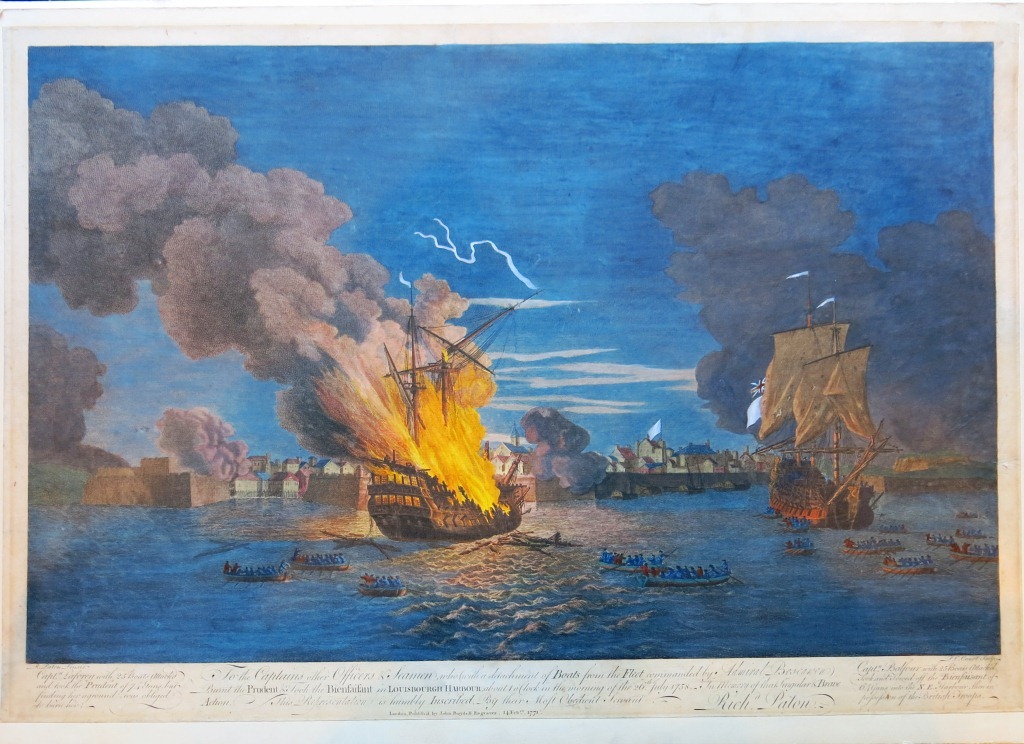
Hearing the events that transpired, the French defenders were alerted to the threat and opened fire upon the two ships.  Under fire, and finding the Prudent run aground, the British sailors set her ablaze.  The Bienfaisant, meanwhile, was towed to the Northeast corner of the harbor, safe from French artillery fire.  The image above, printed in 1771, depicts the Prudent caught in a blaze, while nearby the Bienfaisant is towed to safety. 

The following day, with Amherst’s ground forces making ready to breach the city walls and Boscawen’s fleet entering the harbor, the French governor sent a messenger to Amherst initiating the surrender of the city.

Discussing the siege, historian Julian Gwyn notes in his book, Frigates and Foremasts, that “some naval and military historians have asserted that once the British assault landing force had succeeded, the capture of the fortress with its garrison was a foregone certainty.  Yet none of the British or French accounts expressed this view.”  He goes on to comment that “the loss of these two warships had a profound effect on the French defenders…morale plummeted within the town, and the fatigue occasioned by the siege, which until then had been borne without complain, suddenly became unendurable for many.” 

In the aftermath of these events, Captain Balfour was awarded with command of the Bienfaisant, and command of the frigate Echo to Captain Laforey.  Their lieutenants were also awarded with new commands of their own.

In the short-term, the event depicted was significant for breaking French morale and contributing to the success of the siege.  In the long-term it opened the heart of New France, most notably the cities of Quebec and Montreal, to British invasion via the Saint Lawrence River.  Having previously read about the events that transpired, I was pleasantly surprised when I stumbled upon this print in our collection.  I love the color of the raging fire engulfing the Prudent set against the dark, foggy night with Louisbourg in the background.  Most of all I was caught in the suspense while reading about this risky operation.

This print was originally a painting by Richard Paton (1717-1791).  Born in London in 1717, Paton was found as a poor boy living on the streets by an admiral of the British navy and went to sea.  Receiving no professional training as an artist, Paton is known for depicting the famous sea-battles that occurred during his lifetime.  His paintings were exhibited it the Royal Academy of Art in London from 1776-1780. 

The engraving was made by Pierre Charles Canot (ca. 1710-1777).  Born in France, he moved to England in 1740 where he spent his professional career as an engraver.  Most famous for his engravings of Paton’s works, in 1770 he was elected Associate-Engraver of the Royal Academy of Arts in London.


This Week @ MHS

By Dan Hinchen

Here we are again looking at events taking place at the MHS in the week ahead. On Wednesday, 5 November, there is a Brown Bag lunch talk beginning at noon and presented by the Society’s new Director of Public Programs, Gavin Kleespies. In his talk “Choosing Challenges,” Gavin will give a rough outline of his goals, as well as his plans to meet them, in his new position. This event is free and open to the public. 

Also on Wednesday, 5 November, is an author talk featuring James Redfearn. He will talk about his most recent work, “The Rising at Roxbury Crossing,” a novel which centers on the true events of the 1919 Boston Police Strike. Visit www.TheRisingAtRoxburyCrossing.com to learn more about the author and his novel. There is a $10 fee for this event (no charge for Fellows and Members) and registration is required. Please call 617-646-0560 or click here to register. A pre-talk reception begins at 5:30PM and the talk begins at 6:00PM.

On Thursday,  6 November, is the first in this year’s series of New England Biography Seminars. Beginning at 5:30PM, Ted Widmer moderates this panel discussion, “Understanding the Presidency: Personality, Politics, and Policy.” The discussion features three authors: Evan Thomas, Kathleen Dalton, and David Michaelis, and focuses on the balance between policy and politics as it affects writing presidential biography. Seminars are free and open to the public; RSVP required.

Please note that the MHS Library is CLOSED on Friday, 7 November, as we prepare for our fifth annual Cocktails with Clio. Kicking off at 6:00PM, the evening features an elegant cocktail buffet at the Society’s historic building and then continues at the nearby Harvard Club where guests will here a conversation with historian and Pulitzer Prize-winning author, David Hackett Fischer. Purchase tickets (tickets cost $250 per person). All net proceeds from the event will support the Society’s outreach efforts. 

Finally, on Saturday, 8 November, there is a teacher workshop taking place at the Society. Painless: A Survival Guide to the Dreaded History Project is a free hands-on workshop co-sponsored by the National Archives at Boston. To register, contact the MHS Education Department at education@masshist.org or 617-646-0557. The workshop begins at 9:00AM and goes until 2:30PM. 

There is no building tour on Saturday, 8 November, but remember to stop by to check out our two current exhibitions anytime Monday-Saturday, 10:00AM-4:00PM. 

Trick AND Treat: The Digitized Norwood Penrose Hallowell Papers

By Peter K. Steinberg, Collection Services

The recently launched fully digitized manuscript collections of Civil War papers at Massachusetts Historical Society (MHS) is a significant step forward in making our collections accessible remotely. Motivated by the sesquicentennial of the Civil War, the presentation of full-color surrogates of complete collections will be a model for further digital projects at the MHS. Just as the MHS was inspired by the fully digitized collections available on other websites, we hope our approach can be useful as other organizations undertake similar projects.

Many of the collections were straightforward to digitize. Crudely and in short: remove a folder from the box>remove a piece of paper from the folder>scan>repeat. Of course, much more goes into the process than that: determining permanent and secure storage for 9,000+ images, repairing documents in need of some T.L.C. (Tender Loving Conservation), potentially informing researchers they cannot work with the materials for a while, capturing metadata, tracking all the moving pieces, and so much more. Some collections contained material separated for specific reasons. Photographs and oversize materials, for example, are stored in different locations as these items have their own preservation requirements.

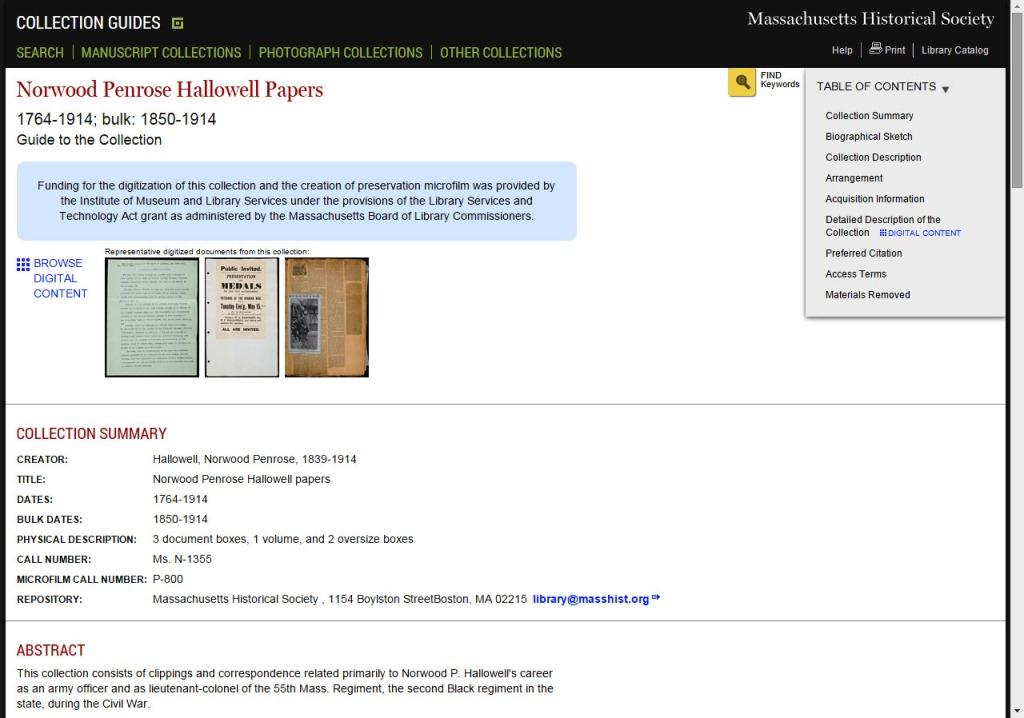
The Norwood Penrose Hallowell papers proved to be particularly challenging to digitize for a variety of reasons.  There are loose papers; three disbound scrapbooks; an oversize, intact scrapbook; an oversize scrapbook volume; and some of those aforementioned separated oversize materials. Funding for the digitization of the nine Civil War manuscript collections that enabled both the creation of preservation microfilm and the online version of the collections was provided by the Institute of Museum and Library Services under the provisions of the Library Services and Technology Act grant as administered by the Massachusetts Board of Library Commissioners.  Part of the budget of the grant enabled us to send large (oversize) materials to the Northeast Document Conservation Center in Andover for imaging.  As part of the preparation to send the collection out, we needed to record how many pages there were in total and how many digital images we expected. Then, once we got the collection back, we needed to reconcile that the collection was returned complete and that all of the anticipated digital images were made.

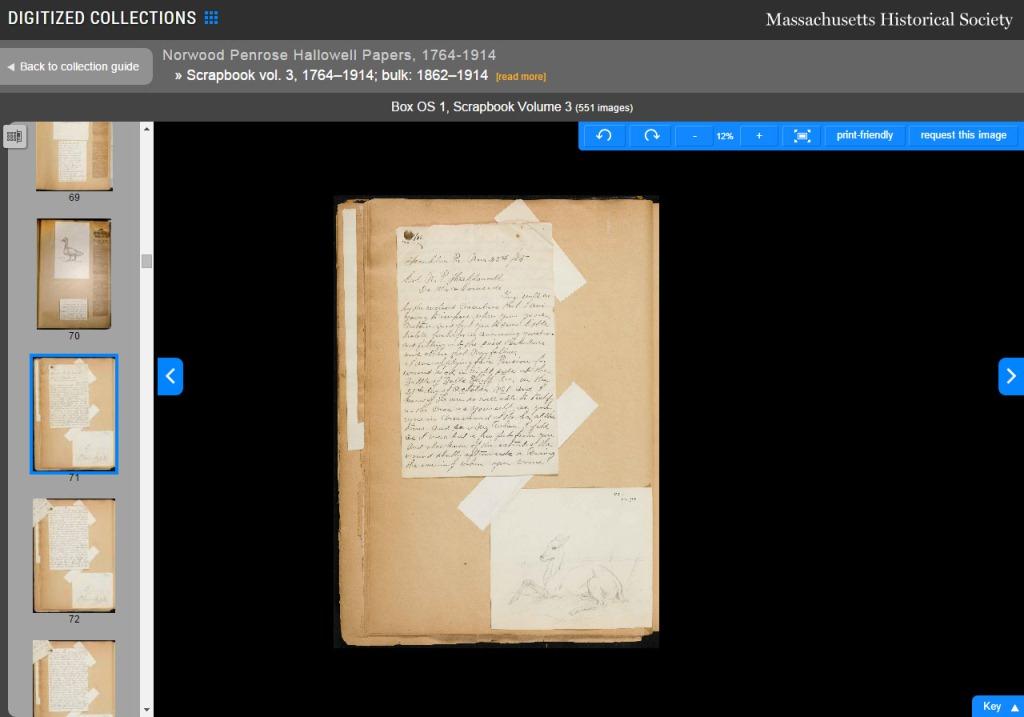
The oversize scrapbook, a.k.a. Scrapbook Vol. 3 was the most difficult part of this collection to represent online. It contains pasted-down newspaper articles, photographs, tipped-in items, photocopies, letters, pamphlets, and other relevant memorabilia. By browsing the digital images, you will see a number beneath each thumbnail image in the sidebar on the left. This is the sequence number that we used to order images so that they will accurately reflect the order of the original item. On occasion, the thumbnail images will appear to be the same. But, please do not be fooled or think us careless. What is actually happening is that a more complicated scrapbook page—one containing something with print on both side of the leaf, or a multi-page document—is being imaged page-by-page, with items flipped up, down, or over, or with loosely tipped-in pieces being photographed and removed one by one.

A good example of this is the sequence number range of 71-76. In sequence number 71, you can see the page in its static, flat form, as it would appear if the volume were in front of you: a letter (of six pages) and a drawing an animal (a doe? a deer? a horse? – I know metadata, not animal species). Sequence 72 shows the first page of the letter flipped up, so that you can read the second page, sequence 73 shows the third page of the letter, and so on. This sort of thing happens throughout the series (see also, for example, sequence numbers 140 -148; and 149 -157, which culminates fascinatingly with the story of death of “Jo-Jo” the “Dog-Faced Man”). We hope that this blog helps to explain the treats this collection has to offer. Happy Hallowell!

Ghost Advice!

By Andrea Cronin, Reader Services

Happy Halloween, dear readers! In preparation for all the spooky fun and candy this evening, I present you with two “facts” about ghosts from English humorist Jerome K. Jerome’s 1891 book, Told After Supper

1. It is always Christmas Eve in a ghost story.

Jerome K. Jerome begins his introduction with the following:

It was Christmas Eve. I begin this way because it is the proper, orthodox, respectable way to begin, and I have been brought up in a proper, orthodox, respectable way, and taught to always do the proper, orthodox, respectable thing ; and the habit clings to me.

Of course, as a mere matter of information it is quite unnecessary to mention the date at all. The experienced reader knows it was Christmas Eve, without my telling him. It always is Christmas Eve, in a ghost story.

Christmas Eve is the ghosts’ great gala night. On Christmas Eve they hold their annual fete. On Christmas Eve everybody in Ghostland who is anybody – or rather, speaking of ghosts, one should say, I suppose, every nobody who is any nobody – comes out to show himself or herself, to see and to be seen, to promenade about display their winding-sheets and grave-clothes to each other, to criticize one another’s style, and sneer at one another’s complexion.

If Jerome is to be believed, you may rest assured that you will most likely not see a “real” ghost on Halloween. If you do see a ghost, you can talk about the contrary occurrence to Jerome’s ghost on Christmas Eve. The English writer’s ashes are buried at St. Mary’s Church, Ewelme, Oxfordshire, England.

2. The act of homicide results in both murderer and murdered ghosts.

The Tales After Supper narrator relates the following story: A mysterious young woman in a nightgown visits the room of a young man staying in his family county house for the Christmas holiday. She sits on his bed before suddenly vanishing. The young man interrogates the ladies of the house the next morning in hopes that he may identify the visitor.

[The host] explains to [the guest] that what he saw was the ghost of a lady who had been murdered in that very bed, or who had murdered somebody else there – it does not really matter which: you can be a ghost by murdering somebody else or by being murdered yourself, whichever you prefer. The murdere[r] ghost is, perhaps, the more popular ; but, on the other hand, you can frighten people better if you are the murdered one, because then you can show your wounds and do groans.”

If given the choice, I would prefer to not become a ghost any time soon. Happy Halloween to everyone and to all, a sweet night!


Black Days: The Wall Street Crash of 1929

By Susan Martin, Collection Services

Today we commemorate the 85th anniversary of Black Tuesday, the worst day of the 1929 stock market crash that preceded the Great Depression. For a close-up look at these events, we turn to the papers of Henry P. Binney (1863-1940), a Boston banker and investment adviser. His voluminous outgoing correspondence, bound into 14 large letterbooks and covering the last thirty years of his life, forms part of the Henry P. Binney family papers.

The Wall Street crash began a few days before, 24 October 1929, on what came to be called Black Thursday. The bull market sustained through most of the 1920s had culminated in a record-high Dow Jones Industrial Average at the beginning of September 1929 before stock values started to tumble. Black Thursday saw the first precipitous drop. Nearly 13 million shares were traded in a single day, double the previous record and more than triple the volume of an average day. The boom was over. On that day, Binney wrote to a colleague who had proposed an investment opportunity:

On my return from a short trip to New York I find your letter of October 21st. While I do not know what reaction Mr. Ray Morris would now have regarding your proposition if presented to him I do not believe he or anybody else would consider anything new at this time. The tremendous shake-out of this morning in the stock market has taken the gimp out of pretty much everybody and it will take time for the panic of today to be forgotten. During the last week paper profits have faded away and many people rich at the beginning of said period are now poor.

To another investor on the same day, he wrote, “Everybody is pessimistic about everything just now.” Little did he know that Black Thursday would be followed by an even more frightening plunge in the market. On Black Tuesday, 29 October 1929, 16.4 million shares were traded in an all-out panic. While these numbers pale in comparison to the trading that we see on Wall Street today, they were unprecedented at the time. The stock ticker couldn’t keep up and ran hours behind as the market spiraled out of control.

One of Binney’s frequent correspondents during this period was his brother-in-law Roy E. Sturtevant. A week after the crash, he told Sturtevant:

Even the man who had his nose close to the grindstone on those fateful days did not, apparently, benefit much….Personally I don’t like the outlook. Such a tremendous crash as has occurred will take long to live down.

Binney’s prediction was prescient. He knew it would take years for the stock market to recover, but he did his best to stay optimistic and often reassured his friends and colleagues. On 30 January 1930, he joked to Sturtevant, who served as vice-president and treasurer of the Ludowici-Celadon Co. in Chicago:

I have just been reading your circular letter of January 28th to the stockholders, and have been looking over your figures for 1929. I imagine this is the first time the “Profit for the year” has been in red! However, lots of Industrials are on the same raft with you, so don’t be depressed.

Binney himself seems to have been less dramatically affected by the crash, at least initially, than many others. He was already a fairly conservative investor, preferring the safer bond market to risky stocks, and the events of October 1929 strengthened that tendency.

That’s not to say he didn’t feel the pinch. Between 1929 and 1932, the Dow Jones would lose about 90% of its value, bottoming out in July 1932. Curious to see how Binney was holding up, I looked ahead to his correspondence of that year. His letters had become more pessimistic and skeptical. I found him writing often about cutting back on utilities and luxuries, such as a proposed trip to Europe for his 18-year-old daughter Polly. He even swallowed his pride and accepted a gift from his brother- and sister-in-law, the Sturtevants:

Between ourselves, we will have to see how the depression works out. If matters remain as they are, it would be better in my judgment not to spend the money, especially as Europe is not a real necessity. I try not to be too gloomy when at home but, notwithstanding my efforts, both of my ladies have come to the conclusion that I had better hoard gold for contingencies. This being the case, I have decided to accept, with a million thanks, the check….No people I have ever known have ever been half as nice as you and Roy have been to us.

Unsurprisingly, his correspondence had also become more overtly political. He preferred Herbert Hoover to Franklin D. Roosevelt, but felt Hoover wasn’t up to the job. Binney feared a revolution if the Depression dragged on much longer. The relief measures he supported included a $5 billion bond issue to put people back to work, the repeal of Prohibition for additional revenue, and a tax on all manufactures. Here’s a sampling of his more political letters:

Needless to say I am dreadfully sorry to hear that you are so blue – it is quite the fashion here. However, things must turn or the U.S.A. will be faced by a Revolution before snow flies! I have no use for Mr. Hoover but even he may be better than whoever the Democrats nominate! Two or three days ago in New York I found rather a more cheerful tone although when one man laughed most of us fainted away at the unusual sound! [17 June 1932]

Lots of people think The Great Depression is on its last legs but, having turned pessimist, I am not at all certain of this. Apparently President Hoover will not be returned. I do not know a single Republican who will vote for him. The G.O.P. gentlemen all have their tails between their legs and either won’t vote at all or cast their votes for Roosevelt who nobody likes but, it is thought, cannot be as sloppy as H.H.! [13 July 1932]

The Depression seems to be passing, at least stock-marketwise. You had better print in your well[-]known newspaper that the one reason for this is the action of the Government in seriously attempting to put people to work. The method adapted is a little clumsy but what can one expect of Washington?! [9 Aug. 1932]

This Week @ MHS

By Dan Hinchen

On Tuesday, 28 October, there is an Immigration and Urban History seminar starting at 5:15PM. Join us as Laura Barraclough, Yale University, presents “At the Crossroads: Charros, Cowboys, and Capitalists in San Antonio, Texas,” a paper which examines the practice of charreria (Mexican rodeo) among Mexican immigrant men in San Antonio form the late 1940s through the early 1970s. Barraclough’s project looks at the reinscription of a genered and classed vision of ethnic Mexican inclusion while also seeing the place claimed by charros for Mexicans in the history of the Southwest. Comment provided by Desiree J. Garcia of Arizona State University. Seminars are free and open to the public; RSVP requiredSubscribe to receive advance copies of the seminar papers.

And on Wednesday, 29 October, bring a lunch at noon and listen in as short-term research fellow Melissa Johnson, University of Michigan, presents “The Power of Women’s Words in Puritan New England: Gossip, Rumor, and Reputation in a Culture of Surveillance.” This approach uncovers the ways that women’s networks constituted alternate sites of community definition and how different kinds of information and modes of transmission were gendered as either “gossip” or “news.” Brown Bag lunch talks are free and open to the public. 

Also on Wednesday is a special event to honor Pauline Meier (1938-2013), a longtime friend and contributor to the Society. Join us as Professor Gordon S. Wood pays tribute to a great historian, teacher, and author who was committed to making American history vivid and accessible to all. The evening will begin with a reception at 5:30PM, followed by the talk at 6:00PM. Registration is required at no cost. Please call 617-646-0560 or click here to register.

On Saturday, 1 November, why not usher in the new month with a free tour of the MHS? The History and Collections of the MHS is a 90-minute, docent-led tour that explores all of the public spaces in the building at 1154 Boylston Street, touching on the history, architecture, art, and collections of the Society. The tour is free, open to the public, with no need for reservations. If you would like to bring a larger party (8 or more), please contact Curator of Art Anne Bentley at 617-646-0508 or abentley@masshist.org.

While you’re here you will also have the opportunity to view our current exhibition, “Letters and Photographs from the Battle Country: Massachusetts Women in World War I.” In addition, you can see our new side exhibition “The Father of His Country Returns to Boston, October 24, 1789,” on view until 31 December 2014. 

A Church for a Zombie: Architecture in Salem, MA

By Dan Hinchen, Reader Services

One thing that I like about working as a reference librarian is the extreme variation in the nature of questions I receive from outside researchers. In a library like the MHS, it is commonplace to work on inquiries relating to 17th century matters, such as King Philip’s War or early Puritan evangelization of the Indians. In the same day, a researcher might ask about the Revolutionary or Civil Wars and the role of Massachusetts men in them. Then a researcher in Europe e-mails me looking for a single letter held at the Society written by composer Felix Mendelssohn in 1845. Some of these are stranger than others but all fit the description of historical research and pertain to materials we hold.

Something that I do not expect is to field a question that crosses over with my own enjoyment of heavy metal music. Specifically, we recently received via e-mail a very brief question from a researcher who was looking for information about a church that appeared in the horror film the Lords of Salem (2012). The movie was directed by Haverhill, MA native Rob Zombie (a.k.a. Robert Bartleh Cummings). Before getting into movie-making, he founded the band White Zombie in the late-1980s and the group went on to produce two multi-platinum albums in the ‘90s. After that band dissolved he continued on to a solo career. Unfamiliar with the movie, the connection gave me a chuckle and I decided to field the question myself.

I started by looking up the movie online to find screenshots that feature a church. It took a few tries, but soon enough I found an image of a woman sitting with a dog in front of a small stone church. Part of the movie was filmed on location in Salem, MA, so I thought it likely that the church was located there. I continued searching the web for more shots of and/or information about the church but to no avail. So, I took to the Society’s online catalog, ABIGAIL, to see what resources might be of use.

Beginning the search with the subject term “Salem (Mass.)” I soon found a sub-heading “Salem (Mass.) — Buildings, Structures, etc., — Guide Books.” This seemed to be an appropriate place to check and, lo and behold, the only title under this heading is Architecture in Salem: An Illustrated Guide. I called for the volume and, using the index, flipped through for images of churches in Salem. There were far more than I expected to see, a few of which looked like potential candidates. Then, near the back of the book, I found an image of the Dickson Memorial Chapel and Conservatory located in the Greenlawn Cemetery in Salem.


While the still shot that I saw from the movie showed only the back of the church, I used this photo and a couple others online to compare some prominent features to conclude that they are the same.

With Halloween quickly approaching, why not visit Salem and take a stroll around Greenlawn Cemetery to get a closer look at this little church? And, if you are so inclined and want to disrupt your sleep patterns, follow it up with some of Mr. Zombie’s horror films.