A Church for a Zombie: Architecture in Salem, MA

By Dan Hinchen, Reader Services

One thing that I like about working as a reference librarian is the extreme variation in the nature of questions I receive from outside researchers. In a library like the MHS, it is commonplace to work on inquiries relating to 17th century matters, such as King Philip’s War or early Puritan evangelization of the Indians. In the same day, a researcher might ask about the Revolutionary or Civil Wars and the role of Massachusetts men in them. Then a researcher in Europe e-mails me looking for a single letter held at the Society written by composer Felix Mendelssohn in 1845. Some of these are stranger than others but all fit the description of historical research and pertain to materials we hold.

Something that I do not expect is to field a question that crosses over with my own enjoyment of heavy metal music. Specifically, we recently received via e-mail a very brief question from a researcher who was looking for information about a church that appeared in the horror film the Lords of Salem (2012). The movie was directed by Haverhill, MA native Rob Zombie (a.k.a. Robert Bartleh Cummings). Before getting into movie-making, he founded the band White Zombie in the late-1980s and the group went on to produce two multi-platinum albums in the ‘90s. After that band dissolved he continued on to a solo career. Unfamiliar with the movie, the connection gave me a chuckle and I decided to field the question myself.

I started by looking up the movie online to find screenshots that feature a church. It took a few tries, but soon enough I found an image of a woman sitting with a dog in front of a small stone church. Part of the movie was filmed on location in Salem, MA, so I thought it likely that the church was located there. I continued searching the web for more shots of and/or information about the church but to no avail. So, I took to the Society’s online catalog, ABIGAIL, to see what resources might be of use.

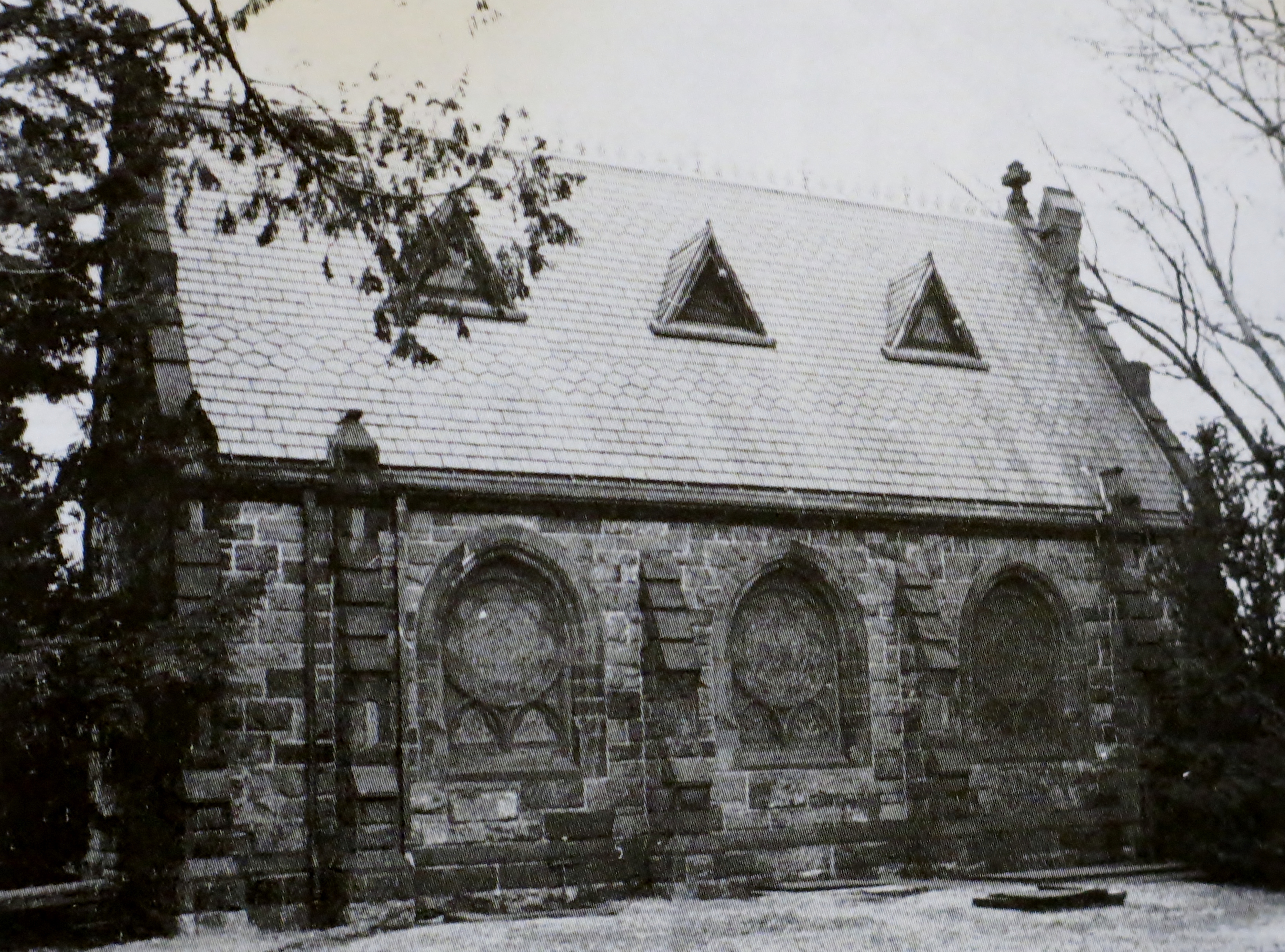
Beginning the search with the subject term “Salem (Mass.)” I soon found a sub-heading “Salem (Mass.) — Buildings, Structures, etc., — Guide Books.” This seemed to be an appropriate place to check and, lo and behold, the only title under this heading is Architecture in Salem: An Illustrated Guide. I called for the volume and, using the index, flipped through for images of churches in Salem. There were far more than I expected to see, a few of which looked like potential candidates. Then, near the back of the book, I found an image of the Dickson Memorial Chapel and Conservatory located in the Greenlawn Cemetery in Salem.


While the still shot that I saw from the movie showed only the back of the church, I used this photo and a couple others online to compare some prominent features to conclude that they are the same.

With Halloween quickly approaching, why not visit Salem and take a stroll around Greenlawn Cemetery to get a closer look at this little church? And, if you are so inclined and want to disrupt your sleep patterns, follow it up with some of Mr. Zombie’s horror films.


“To the Women of Boston…”

By Olivia Mandica-Hart, Library Assistant

Like many New Englanders, I followed the recent Market Basket labor strike with near-obsessive interest. Of course, a small, selfish part of me was irked that my “More for Your Dollar” shopping had been temporarily suspended. But beyond that, I was inspired by the employees’ bravery and revolutionary spirit. After weeks of negotiations and uncertainty, I was pleasantly surprised that the workers had triumphed over the CEOs. I’d noticed two important things while following the story; first, that many of the employees who were protesting “on the front lines,” as well as the consumer advocates who boycotted the store, were women. And secondly, that in the news media, many labor activists discussed the “record breaking” strike as distinctly unique to Massachusetts. These two facts are not particularly startling, given the state’s strong history of labor organizing and activism, much of which began with Massachusetts women.

In the 1830s, more than fifty years before labor movements became popular throughout the United States, the Lowell Mill women began organizing and striking, forming the first union of female workers in the United States. Over the next few decades, the same radical spirit picked up momentum and moved to the city of Boston. 

In 1874, forty-six years before the 19th Amendment granted women the right to vote, a group of female business owners in Boston formed the Business Woman’s Mutual Benefit Association, which published circulars in Boston newspapers to advertise its services.

This circular, dated 27 February 1874, explains that “the object of [the] association [was] threefold:”

1st. To provide a fund from which a certain sum shall be paid to any member in case of sickness.

2nd. To provide a fund from which members in case of extreme need can obtain small loans, without interest, said loans to be returned by installments, in such sums and at such rates as shall be agreed upon.

3d. To provide respectable burial to deceased members.

To include as many people as possible, the Association established two tiers of membership: beneficiary members paid yearly dues and were subsequently entitled to all of the aforementioned benefits. Honorary members paid a one-time fee and received a certificate, but did not gain any benefits from the association. Men were “cordially invited to become Honorary members,” but the Board of Directors was comprised entirely of women.

Although women’s rights were not supported by the majority of Bostonians, the Association did have some allies. For instance, in its 2 April 1874 issue, The Index: A Weekly Newspaper Devoted to Free Religion, introduced the Association’s statement by writing:

We have been requested…to give a ‘word of notice’ to the following circular; but we find it so excellent that it seems proper to publish it in full in THE INDEX, with our heartiest approval of the organization and its object. Similar ones ought to be everywhere established; and the attention of all friends of the cause of women is called to one of the best plans yet devised to further it.

Nineteenth-century society provided independent women with very few legal and social rights, so these Bostonian businesswomen decided to organize and unite to protect themselves (and each other). Their circular states:

The constant complaint among women is that nothing is done to help them, pecuniarily, as a body, in case of need. The constant response of men is, that women will not unite as do men to help each other…by becoming members of, and thus supporting this association, women will not only effectually disprove the charge, but they will by this simple method do more to defeat the evil effects of unjust wages to women…

This last point seems particularly poignant and timely given that in mid-September, the United States Senate yet again blocked the passage of the Paycheck Fairness Act, a bill that would have strengthened equal pay protections for women. Despite the valiant efforts of these pioneering ladies, women are still fighting to be paid equal wages, one hundred and forty years later. Perhaps we should look to these revolutionary nineteenth-century women for some twenty-first-century inspiration in our continued fight for gender equality.


A Farewell to Summer in the Henry Daland Chandler Papers

By Andrea Cronin, Reader Services

The transition to autumn marks the end-of-summer close for many New England communities. Bustling summer destinations pack in, close up, and settle down for the upcoming winter. The long days of summer heat and noise grow cool, quiet, and short. New England foliage bursts with rich colors like a fireworks finale before surrendering to fate of the homeowner’s rake. Seasonal homes are winterized and summer residents return to their urban homes. In September 1921 Henry Daland Chandler supervised the winterizing of his family’s summer cottage, the Palace, in North Haven, Maine.

Among the earlier Bostonians to choose North Haven as a summer destination, the Chandlers’ presence on the island took the form of three summer cottages. In 1884-85, architect Francis W. Chandler designed the clubhouse called Paralyso for summer residents from Boston. This building later became a cottage. Frank also designed and built a family summer home named the Palace a few years later in 1887. A decade after the construction of the Palace, he completed a third cottage called the Anchorage in 1897.

This 15 September 1921 letter from architect Henry Daland Chandler, called Daland, to his parents, Frank and Alice Chandler, describes occurring and proposed improvements to the house and includes a beautiful illustration.

Here is what I had in mind for the alteration to the Palace: the large window to be plate-glass despite all the canons of architectural design. The dormer that you see peeping out on the north side of the house is an enlargement of that stuff room, and, though it doesn’t perhaps improve the appearance of the north side of the house it certainly would make that particular room more habitable in every way than it now is.

The house moves on apace here, and I really look forward to having the painters, and everybody out of here about the twentieth, so that it will be possible to have the cleaners in, and I may say they will have something to clean as this painting process isn’t the neatest thing in the world.

The correspondence within the Henry Daland Chandler papers documents the family’s return to their various homes in Massachusetts within the month. With summer drawing to a close, Daland returned to 40 Central Street while his parents arrived at 195 Marlborough Street in Boston. All good things must come to an end.

This Week @ MHS

By Dan Hinchen

It’s all about Tuesday this week at the Society. First up that day, 21 October, is an author talk taking place at noon. Join local historian and author Barbara Berenson for “Civil War Boston” as she narrates a thrilling and memorable journey through the Hub in the Civil War. Black and white abolitionists dedicated to ending slavery, the Fugitive Slave Act and its repurcussions, soldiers marching to war, and women fighting to end slavery and realize their own desire to be full citizens of the Union are all included in the story. Berenson is the author of Walking Tours of Civil War Boston: Hub of Abolitionism (2011, 2nd ed. 2014) and co-editor of Breaking Barriers: The Unfinished Story of Women Lawyers and Judges in Massachusetts (2012). A graduate of Harvard College and Harvard Law School, Barbara works as a senior attorney at the Massachusetts Supreme Judicial Court. This event is free and open to the public. 

Later that evening, beginning at 5:15PM, is “Popular U.S. Enthusiasm for Latin American Independence, 1810-1825,” the latest installment in our Early American History seminar series. Presented by Caitlin A. Fitz of Northwestern University, this paper explores the reactions of those in the United States to the independence movements of Latin American nations in the 1800s. In general, U.S. observers were overjoyed by these movements; however, Massachusetts citizens were less thrilled. This presentation will analyze the national trend and the commonwealth’s deviation from it. Comment provided by John Bezis-Selfa of Wheaton College. Seminars are free and open to the public; RSVP required.

Finally, on Saturday, 25 October, come by the Society at 10:00AM for “The History and Collections of the MHS,” a 90-minute docent-led tour of the MHS building which touches on the art, architecture, history, and collections of the MHS. While here you will also have the opportunity to view our current exhibition, “Letters and Photographs from the Battle Country: Massachusetts Women in World War I.” Both the tour and the exhibition are free and open to the public. Parties of 8 or more, please contact Curator of Art Anne Bentley in advance at 617-646-0508 or abentley@masshist.org.


“I can do nothing without you”: The 250th Anniversary of John and Abigail Adams

By Amanda A. Mathews, Adams Papers

This month we celebrate the 250th wedding anniversary of John and Abigail Adams. Their marriage endured through separations, long in distance and time, war, partisan politics, and family hardships. Their distance and struggle became our treasure, because it is through their incredible correspondence that we obtain such an intimate look inside their lives—lives that in so many ways, are not so alien to our own.


About a month before their 25 October 1764, wedding, John Adams wrote to Abigail Smith movingly describing how important she was to him:

Oh my dear Girl, I thank Heaven that another Fortnight will restore you to me—after so long a separation. My soul and Body have both been thrown into Disorder, by your Absence, and a Month of two more would make me the most insufferable Cynick, in the World. I see nothing but Faults, Follies, Frailties and Defects in any Body, lately. People have lost all their good Properties or I my Justice, or Discernment.

But you who have always softened and warmed my Heart, shall restore my Benevolence as well as my Health and Tranquility of mind. You shall polish and refine my sentiments of Life and Manners, banish all the unsocial and ill natured Particles in my Composition, and form me to that happy Temper, that can reconcile a quick Discernment with a perfect Candour.

Abigail was that and more for John. His counselor and confidant, the one that even at the age of 61 and President of the United States, he could “do nothing without,” Abigail, while managing his beloved farm and caring for family, provided him with local news and gossip, advice, and a sympathetic ear. Likewise, for Abigail, when faced with trials of her own, she looked forward to a reunion with her dearest friend, where “I come to place my head upon your Bosom and to receive and give that consolation which sympathetick hearts alone know how to communicate.”

When Abigail died on October 28, 1818, just days after their fifty-fourth wedding anniversary, a heartbroken John wrote to his son John Quincy Adams, “My consolations are more than I can number. The Separation cannot be So long as twenty Separations heretofore. The Pangs and the Anguish have not been So great as when you and I embarked for France in 1778. . . . Love to your Wife. May you never experience her Loss.”

If you would like to learn more about this great American love story, the Abigail Adams Historical Society in Weymouth, MA, is holding a multi-day celebration and conference including remarks from Sara Martin, the Series Editor of the Adams Family Correspondence series, on October 24–26, 2014. Click here for more information.


Images:  Abigail Adams. Pastel on paper by Benjamin Blyth, circa 1766. Artwork 01.026; John Adams. Pastel on paper by Benjamin Blyth, circa 1766. Artwork 01.027

This Week @ MHS

By Dan Hinchen

We have another busy week ahead here at the Society, starting with a holiday event. Please note that the library of the MHS is closed on Monday, 13 October, in observance of Columbus Day. However, the building will remain open as part of Opening Our Doors, Boston’s largest single day of free arts and cultural events. The galleries are open 10:00AM-3:00PM. Stop by to view Letters and Photographs from the Battle Country: Massachusetts Women in the First World War. This event is free and open to the public.

On Tuesday, 14 October, drop by the MHS at 5:15PM for an Environmental History seminar. In “Finding Meaning and Debating Value in a Historical Landscape,” David Benac of Western Michigan University looks at the competing interpretations of landscape as a resource or as a haven. Adding nuance to the debate, Benac employs a third category: historical significance. Victoria Cain, Northeastern University, provides comment. Seminars are free and open to the public; RSVP requiredSubscribe to receive advance copies of the seminar papers. 

There are two events on Wednesday, 15 October, that are open to the public. First, beginning at noon, stop by with  a lunch to hear Rachael Abbiss of the University of Chester present “The Role of the Military within Imerpial Security Policy, 1685-1689.” This Brown Bag talk highlights a project which examines the army and military policy in the Dominion of New England between 1686 and 1689. This event is free and open to the public. Then, beginning at 6:00PM, join us for a talk given by J. Kevin Graffagnino of the William L. Clements Library, University of Michigan. “Rebels in Vermont!: The St. Albans Raid” details the events of the 1864 attack on St. Alban’s, VT by a band of 22 Confederate soldiers. There is  apre-talk reception that begins at 5:30PM. This event is open to the public with a fee of $10 (no charge for Fellows and Members). RSVP required. Please call 617-646-0560 or click here to register.

Beginning on Friday, 17 October, is a two-day teacher workshop titled “Massachusetts Women and the First World War.” The workshop explores the activities of Massachusetts women involved in the Great War, beginning before the official involvement of the U.S. in 1917. The events feature material from collections of the Massachusetts Historical Society and the Fort Devens Museum. There is a registration fee of $75 and includes lunch both days, materials, and admission to the Fort Devens Museum. Day one (17 October) takes place in Devens and day two (18 October) at the MHS. This workshop is open to all K-12 educators as well as history enthusiasts. To register complete this Registration Form and send it with your payment to: Kathleen Barker, Massachusetts Historical Society, 1154 Boylston Street, Boston, MA 02215. Contact education@masshist.org for more information.

Finally, on Saturday, 18 October, there is a public tour at the Society. Beginning at 10:00AM, The History and Collections of the Massachusetts Historical Society” is a 90-minute docent-led walk through our public rooms. The tour is free, open to the public, with no need for reservations. If you would like to bring a larger party (8 or more), please contact Curator of Art Anne Bentley at 617-646-0508 or abentley@masshist.orgWhile you’re here you will also have the opportunity to view our current exhibition, “Letters and Photographs from the Battle Country: Massachusetts Women in World War I.”

“The Moonlight Is Wasted”: Not So Quiet on the Western Front

By Susan Martin, Collection Services

The stacks of the MHS are filled with innumerable letters written by soldiers serving in U.S. wars to their families back home. This year marks both the sesquicentennial of the penultimate year of the Civil War and the centennial of the first year of World War I. It’s a disheartening fact that we rarely lack for war-related anniversaries to commemorate, but these letters are an invaluable resource for a true understanding of U.S. wars.

Some of them were written to anxious parents by very young soldiers, barely out of high school and full of bravado. Others come from older, battle-hardened men who write wistfully to their children while shells fall around them. Sometimes a soldier breezily anticipates the upcoming battle in which we know he will be killed, or has an eerie premonition of his own death. While it’s impossible for most of us to comprehend the realities of war as experienced by those in the thick of it, little details speak volumes. I always find it interesting how the ordinary things we take for granted are perceived in radically different ways by a soldier on the front lines.

Take moonlight, for example. Lovers serenade in it, poets write about it, dreamers gaze up at it. Moonlight is one of the universally acknowledged beauties of life, right? Well, not if you’re digging trenches in northern France in 1918. William F. Wolohan, serving with the American Expeditionary Forces, 103rd Engineers, Co. E, explained in a letter to his mother on 30 Nov. 1918 that he and his fellow soldiers had a different perspective:

Night work was the hardest as this country over here is positively the blackest place I have ever been in at night. Our night work consisted mostly of barbed wire work. A funny thing, still we over here can not realize the jokers regarding Beautiful-moon light nights. One mother wrote to her son who is sleeping in here with us, said that outside a beautiful moon was shining down, how much she enjoyed these moon light nights and she could always think that this same old moon was shining down on him. Yes Henry said the same moon shines but I wish the moon would die or never come out. You see on moonlight nights these big bombing planes come over and drop everything from pins to rail road engines, including boocoo bombs….So on moon l[ight n]ights we are always careful and we figure th[at] the moonlight is wasted. I wish I could remember some of the funny expressions I have heard when we did not know but the next minute we would be blown to atoms.

Henry had good reason to dislike the moon, it turns out. He had nearly been killed in a German bombing raid while working on a trench near the French town of Fismes on the Vesle River. Wolohan illustrated Henry’s story with this diagram of trenchworks. The sketch is in pencil, so it’s hard to make out some of the details in this reproduction here, but Henry and the “Bomb Hole” are marked by asterisks at the top. Below that, you can see the “Barb wire,” “no mans land,” and the “German wire.”


Wolohan wrote this letter to his mother shortly after the end of the war but before he was shipped home. In it, he proposed this theory for the Allies’ success:

As one of our fellows said the other night It was the American Smile that won this war, and I agree with him. Even in the darkest minutes you can always get a smile out of these A.E.F. wargoing Americans. I have seen men come back all shot up an[d] smiling to beat the band. One night when on a long march we were held up by our divisional train for four hours. So we gave a show right in the middle of the road.

The William F. Wolohan papers is one of our smaller collections at the MHS. It contains only three letters and three postcards, but the terrific content more than makes up for its small size. I particularly like this poignant throwaway line on the back of a postcard dated 6 Oct. 1918:

This is a French soldiers postal card. It was taken by the Germans off a captured French Soldier. We took it off a dead German soldier. Such is the fortune of war in both the big and little things.

This Week @ MHS

By Dan Hinchen

First up this week on the list of events here at the MHS is “Katherine, Grace, and Mary: Archaeological Revelations of 17th and 18th Century Women from Boston’s Big Dig.” Beginning at 6:00PM on Monday, 6 October, join us as Joe Bagley, Boston City Archaeologist, discusses the uncovering of mountains of historical data during the archaeological surveys conducted prior to the start of the Big Dig. The talk focuses primarily on three sites where evidence of the lives of three women – the late 17th century site of Katherine Nanny Naylor, the early 18th century site of Mary Long, and the mid-18th century site of Grace Parker – came to light. There is a $10 fee (no charge for Fellows and Members). Please call 617- 646-0560 or click here to register. A pre-talk reception begins at 5:30PM. 

On Tuesday, 7 October, come by at 5:15PM for an Early American History seminar given by David Konig of Washington University in St. Louis. “Thomas Jefferson, Lawyer: Property and Personhood in the Law of Slavery” examines the complex relationship between Thomas Jefferson’s legal career and his ownership of slaves. Comment provided by Malick Ghachem of MIT. Seminars are free and open to the public; RSVP requiredSubscribe to receive advance copies of the seminar papers.

Then, on Wednesday, 8 October, there is a special member event at the Society starting at 6:00PM. Members and Fellows are invited to hear John W. Tyler, editor of The Correspondence of Thomas Hutchinson: 1740-1766 (2014), as he presents “History Revealed: Thomas Hutchinson and the Stamp Act Riots.” The evening will feature a reception at 6:00PM and remarks by Mr. Tyler at 6:30PM followed by a presentation of items from the Society’s collections. Registration is required at no cost. THIS EVENT IS SOLD OUT. If you would like to be placed on the waiting list, please call 617-646-0518.

And on Thursday, 9 October, please join us for an author talk featuring Adam Hochschild of the University of California, Berkeley. “1914-1918: The War Within the War,” Hochschild describes the battle between people who regarded the war as a noble and necessary crusade, and a brave minority who felt it was tragic madness and who refused to fight. In an illustrated talk, he focuses on the country where that tension was sharpest, Great Britain. Pre-talk reception begins at 5:30PM and the talk begins at 6:00PM. The talk is open to the public but registration is required. Please RSVP


Mysteries of the Elisha W. Smith, Jr. Logbook: Part III

By Andrea Cronin, Reader Services

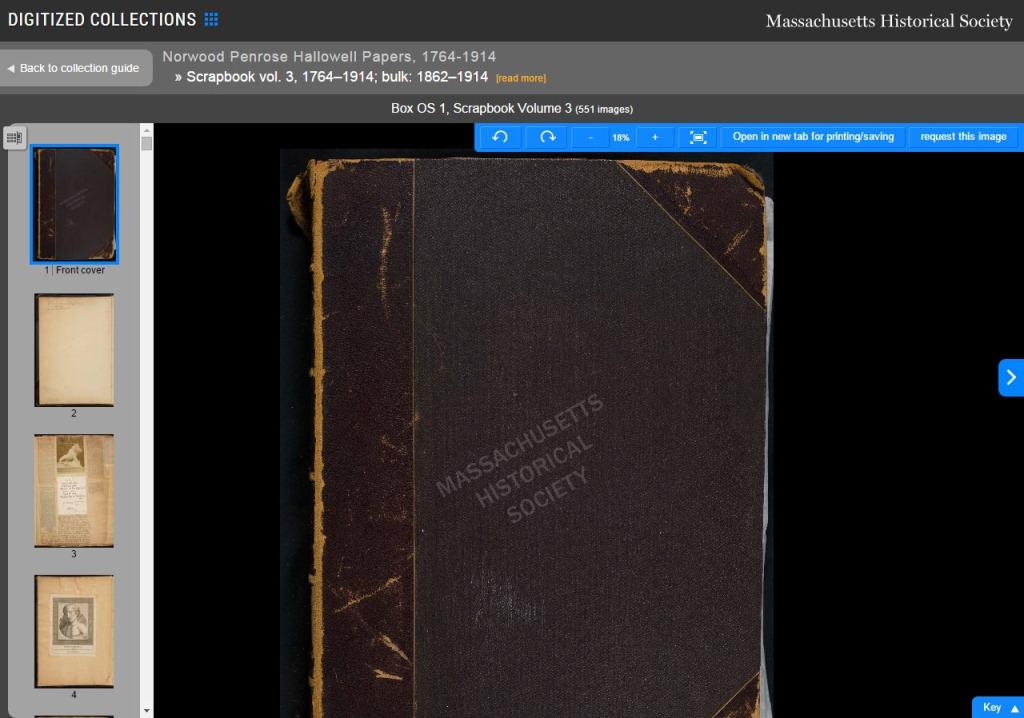
Research is a nonlinear process rife with search strategies and dead ends. While researching the inside front cover note and the scrapbook engravings of the Elisha W. Smith Jr. logbook, I remained curious about the scrapbooker’s identity. Several clues exist within the logbook to identify the individual. The efforts of penmanship practice garnishes the pages with the initials “E D F” and the names “Elbridge” and “Freeman.” While this clue offered a name as a place to start, I still found myself running into dead ends.


A plethora of physical and digital resources exist to help researchers locate genealogical information. I started with a physical resource research strategy that proved unsuccessful. I searched through family histories Freeman Genealogy and Genealogy of the Freeman Family for “Elbridge Freeman” and “William Freeman.” I assumed that the ship’s name, the schooner William Freeman, referred to a relative of Elbridge Freeman. I also surmised that Elbridge Freeman was born in the late 1850s to early 1860s because the scrapbooker pasted Gleason’s Literary Companion engravings in the volume. Gleason’s Literary Companion ran in publication from 1860 to 1870 so the individual who read the juvenile literary magazine was young. These names and time frame narrowed my search, but these criteria also narrowed my results to zero.

Moments of revelation for researchers occasionally come from other researchers’ insight or suggestion. I found a lack of answers in the physical resources, but Librarian Elaine Heavey utilized online databases to find Elbridge D. Freeman’s birth certificate from FamilySearch, a free, online tool for genealogists. Elaine provided the document that put all the pieces together!

William D. Freeman sailed with supercargo Elisha W. Smith Jr. on the schooner William Freeman to Jacmel, Haiti in 1857. Both men and the schooner originated in Wellfleet. William Freeman later served as acting master of the Portsmouth, New Hampshire Navy yard. On 31 July 1861 William D. Freeman and Harriet A. Freeman welcomed their first born son Elbridge D. Freeman into the world. Somehow the logbook ended up in William Freeman’s hands after the voyage of the schooner William Freeman. Young Elbridge turned one of his father’s possessions, Elisha W. Smith’s logbook, into an eccentric scrapbook in the late 1860s.