“Imposed Planning STOPS HERE”: Fenway in the 1970s

By Anna J. Clutterbuck-Cook

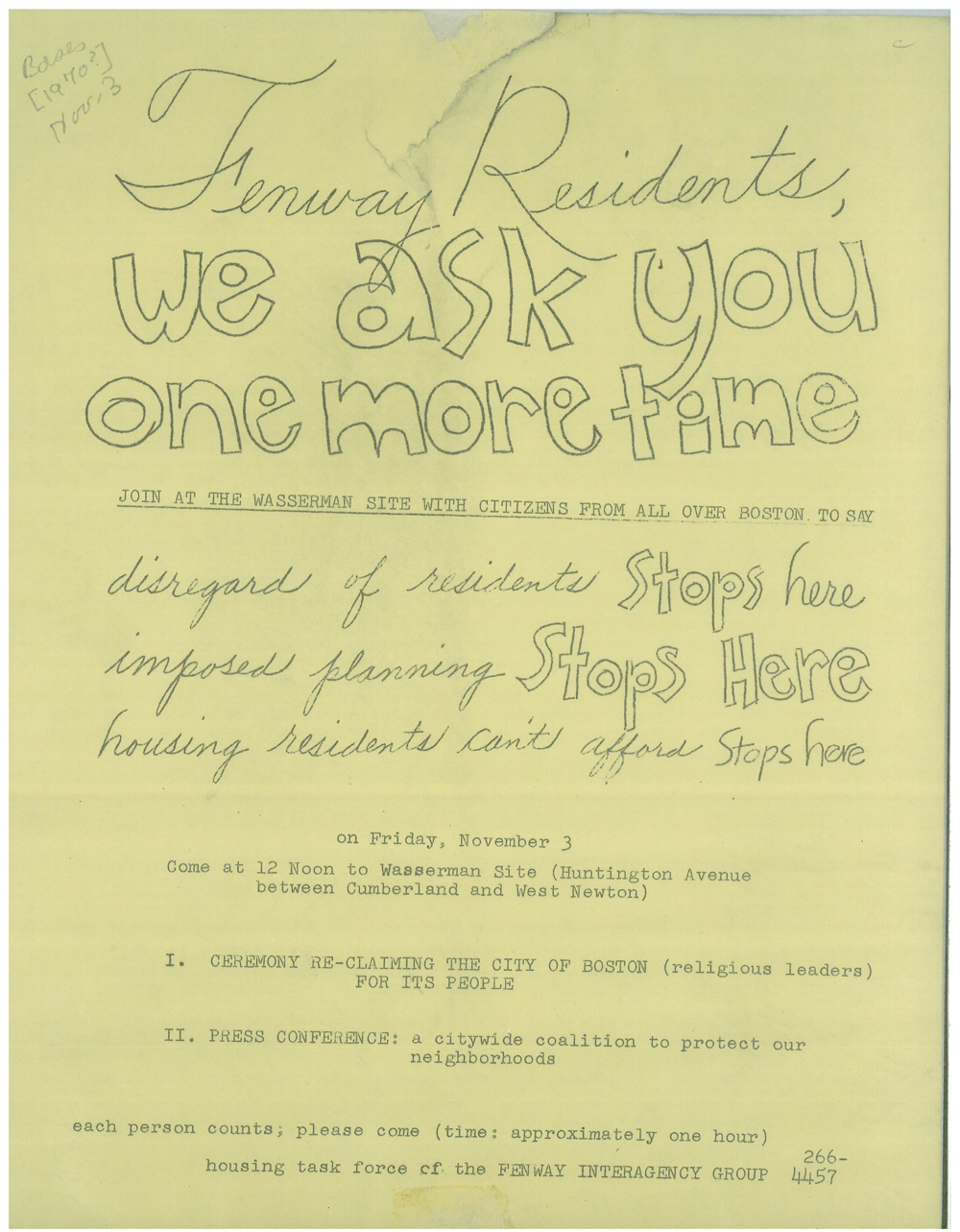
My last post for the Beehive explored the creation, destruction, and potential renewal of Charlesgate Park in the Back Bay neighborhood of Boston. In my continued exploration of the Society’s 20th-century urban history collections, I stumbled across this handmade flyer from the early 1970s calling on residents of the Fenway to protest what they experienced as “imposed planning” in the then-struggling neighborhood.

Fenway Residents broadside

“Fenway Residents, We Ask You One More Time” (Broadsides Collection, [1970] Nov. 3, MHS)

The gathering was organized by the housing task force of the Fenway Interagency Group (FIG), a loose coalition of grassroots social services organizations based in the Fenway neighborhood. What, exactly, were they protesting?

Though tentatively dated 1970, it is likely the flyer was distributed during the spring or summer of 1971, as the Christian Science Plaza was taking shape and the neighborhood around the plaza was filling with new development. A newspaper clipping dated April 1971 and preserved in a Boston Redevelopment Authority (BRA) scrapbook describes the construction in positive, neighborhood-friendly terms:

The first housing development is now under construction along the Church Center perimeter. This project, known as Church Park will be the largest apartment house in Boston. It is planned as a mixed use building with 526 units of housing plus parking and retailing. …In this low and middle income development, 25 percent of the units will go to low income families and the balance will go to middle income families at rents ranging from $110 to $360 per month.

The article goes on to describe the “Wasserman Site,” where the FIG flyer invites citizens to protest, as “320 units of middle income housing plus parking and retailing.” This official story stands in contrast to the flyer’s claims that the development represents “imposed planning,” a “disregard of residents,” and “housing residents can’t afford.”

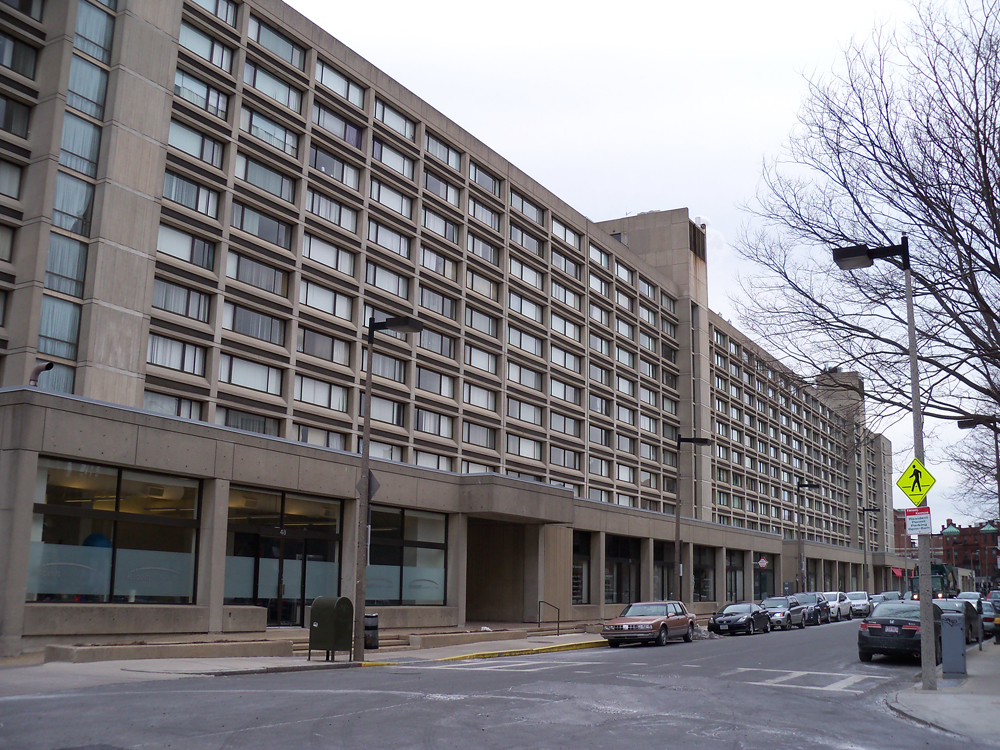
Which story won the day? The Church Park building and what became Greenhouse Apartments were both constructed and remain standing today. Leasing at prices between $2500-$5000 per month, the units are now two or three times higher than the BRA considers the maximum affordable rent for median-income Boston residents.

Church Park

Church Park from the intersection of Edgerly and Norway Streets (March 2014)

Over forty years after the FIG protest was held, economic inequality remains a central theme in Boston city politics, and the BRA role in neighborhood planning continues to prove controversial as Bostonians debate how to bring economic investment into the city without pushing lower-income residents and workers out of the urban core.

This Week @ MHS

By Dan Hinchen

It is time again for the roundup of events taking place at the Society in the week ahead. In addition to seminars, brown bags, and tours, be sure to come in anytime Monday – Saturday, 10:00AM-4:00PM, to see our current exhibition, “Tell It With Pride: The 54th Massachusetts Regiment and Augustus Saint-Gaudens’ Shaw Memorial.” The exhibit is free and open to the public and is organized by the National Gallery of Art, Washington.

On Tuesday, 4 March, Seth Rockman of Brown University brings us the next Early American History seminar. “Negro Cloth: Mastering the Market for Slave Clothing in Antebellum America” ties together the effort of a Northern firm to break into the business of making textiles for slaves; the politics of the slave plantation; and the national debate over tariffs. Rockman’s project brings together the studies of material culture, the history of capitalism, and comparative slavery, emphasizing the design history of plantation textiles and the circuits of social knowledge that linked plantation to factory. David Quigley of Boston College will provide comment. The seminar begins at 5:15PM and is free and open to the public; RSVP required. Subscribe to receive advance copies of the seminar papers.

Wednesday, 5 March, marks the anniversary of the Boston Massacre but the Brown Bag lunch talk of the day focuses on events that occurred 95 years later. Come by at noon as long-term research fellow Michael Vorenberg, Brown University, presents “The Appomattox Effect: Searching for the End of War in the American Civil War and Beyond.” Americans tend to mark the surrender at Appomattox as the end of the Civil War, but the last battle came more than a month later, the last surrender a month after that, and the official “cessation of hostilities” more than a year later. A similar Appomattox effect shapes the way Americans think of other wars, making people assume, even when well-known facts indicate otherwise, that wars have discrete, identifiable endpoints. This lunch discussion raises some of the issues associated with identifying the end of any U.S. war in light of the search for an end of the Civil War. This talk is free and open to the public.

On Thursday, 6 March, the Society hosts a special event titled “A Traveled First Lady: An Evening with Louisa Catherine Adams.” In this program, editors Margaret Hogan and C. James Taylor selected excerpts from diaries and memoirs of Adams’s most revealing comments on life at European courts, the difficulty of being an outsider, Abigail Adams’s Quincy, and the importance of society and etiquette in early Washington D.C. She is best remembered as one the capital’s most accomplished hostesses as hundreds of guests regularly attended her Tuesday evenings of conversation, music, dancing, and refreshments. Join the editors for a social evening with Louisa. There will be conversation and refreshments—but no dancing! Margaret A. Hogan is an independent editorial consultant and the former Managing Editor of the Adams Papers at the Massachusetts Historical Society. C. James Taylor is Editor in Chief of the Adams Papers. A pre-talk reception begins at 5:30PM and the discussion begins at 6:00PM. To Reserve: There is a $10 fee (no charge for Fellows and Members). Click here to register online or call the MHS reservations line at 617-646-0560.

And last but not least, come by on Saturday, 8 March, for The History and Collections of the MHS, a 90-minute tour of the Society’s public rooms led by a docent or MHS staff member and touching on the history of the Society, and the art and architecture of building at 1154 Boylston Street. The tour is free and open to the public. No reservation is required for individuals or small groups. Parties of 8 or more should contact the MHS prior to attending a tour. For more information, please contact Curator of Art Anne Bentley at 617-646-0508 or abentley@masshist.org.


Postcards from Japan, 1916

By Andrea Cronin

During a peace mission in Japan in 1916, American physician Morton Prince sent many postcards to his wife who remained at their home on Beacon Street in Boston. While exploring the cities of Yokohama and Tokyo, the doctor wrote short explanatory notes about the scenes on the postcards. Here are two of the many cards in the Morton Prince papers which illustrate the natural beauty of Japan’s landscape in stark contrast to the urban development of the Kanto metropolitan area in the early 20th century.

On 21 May 1916, an unidentified member of the peace mission entourage wrote to Mrs. Morton Prince with an update about her husband.

All goes
well. The
Dr. is very
well indeed.

The front image is a beautiful view of Mount Fuji, or as the Japanese call the mountain, Fuji-san, 富士山. Mount Fuji is located approximately 60 miles south-west of Tokyo and 75 miles west of Yokohama. Interestingly, this postcard bears the postal stamp of Yokohama rather than any of the surrounding towns near Mount Fuji.

Mt. Fuji

The delegation continued north-east toward Tokyo. This postcard bears the postal stamp of “Tokio” despite the scenery of Yokohama on the front. Recognized as Tokyo today, “Tokio” was the romanization of the Japanese city at the time.

Yokohama

On 24 May 1916, Morton Prince wrote to his wife about the view of Yokohama, 横浜市:

This is the way
the homes are
crowded in.
The outside of the
natives’ homes are
rather squalid or
down at the heel
but inside clean
& neat
 MP.

The peace mission was successful in engendering diplomacy and friendship. In 1918, Dr. Morton Prince received the Order of the Rising Sun medal for his efforts in Japanese-United States relations. The Order of the Rising Sun was a Japanese Imperial decoration bestowed upon individuals who had rendered distinguished service to the nation and people of Japan. While the MHS does not have Morton Prince’s medal in its collections, it does have the medal awarded to William Sturgis Bigelow in 1928.

This Week @ MHS

By Dan Hinchen

This week begins with a rare Sunday event. On 23 February, visit the Lawrence Library in Pepperell, Mass., for an author talk with Gary Shattuck, retired federal prosecutor. This talk is called Crossed Swords: Job Shattuck’s Blood at the Courthouse Door and is presented in collaboration with Freedom’s Way National Heritage Area. The talk begins at 2:00PM and registration is required at no cost. To register, call the MHS reservations line at 617-646-0560 or click here to register online.

On Tuesday, 25 February, join us at the Society for a new Immigration and Urban History Seminar. In this edition, Catherine Gudis of University of California – Riverside presents Curating the City: The Framing of Los Angeles. This talk looks at the ways in which Los Angeles has been framed, first in the discourse around architecture, planning, and preservation in the post-World War II period, and then through artistic practices from the late 1960s to the present that engage diverse publics in re-contextualizing urban space and acknowledging the power dynamics that have structured its development. Comment provided by Carlo Rotella, Boston College. Seminar begins at 5:15PM. Seminars are free and open to the public; RSVP required. Subscribe to received advance copies of the seminar papers.

And on Wednesday, 26 February, the Society hosts a special musical performance, Handel & Haydn Society: Bringing Music to Life for 200 Years. Since 1815, the Handel and Haydn Society has shared the inspirational and transformational power of Baroque and Classical music with people throughout Boston and the country. Join H&H for an instrumental and vocal chamber performance that will share the history of the institution, considered America’s oldest continuously performing arts organization. The performance begins at  6:00PM with a pre-performance reception at 5:30PM. To reserve: There is a $30 fee ($20 fee for Fellows and Members). Click here to register online or call the MHS reservations line at 617-646-0560.

Thursday, 27 February, visit the Boston Public Library for an author talk co-sponsored by the MHS and the BPL, George Washington: Gentleman Warrior. Award-winning independent historian and journalist Dr. Stephen Brumwell’s new book focuses on George Washington, examining his long and checquered military career, tracing his evolution as a soldier, and his changing attitude to the waging of war. This event is free and open to the public.

Finally, on Saturday, 29 February, stop by the Society for a free tour. The History and Collections of the MHS is a 90-minute tour of the Society’s public rooms, led by a docent or MHS staff member and touching on the history of the Society, and the art and architecture of building at 1154 Boylston Street. The tour is free and open to the public. No reservation is required for individuals or small groups. Parties of 8 or more should contact the MHS prior to attending a tour. For more information, please contact Curator of Art Anne Bentley at 617-646-0508 or abentley@masshist.org.


Censorship During Wartime

By Susan Martin

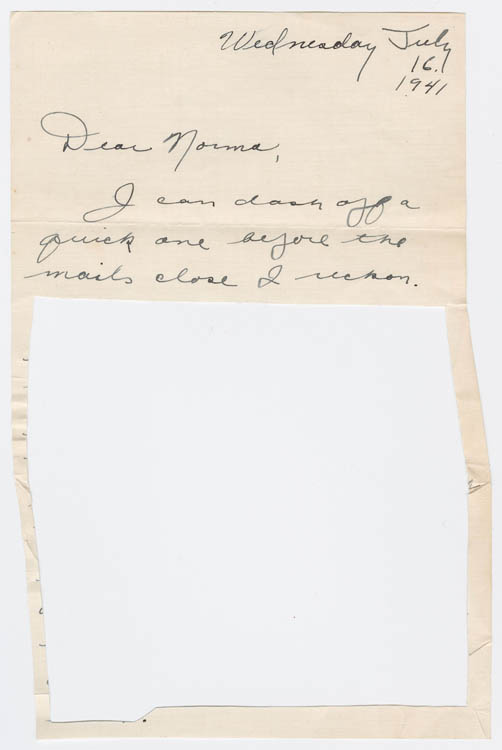
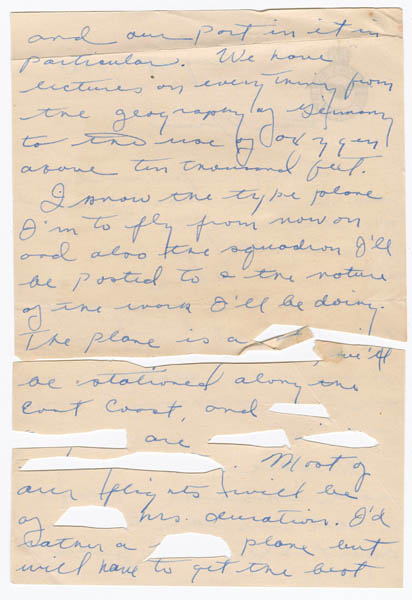
The MHS recently acquired a small collection of Norma A. Krtil papers that includes nine World War II letters from Krtil’s boyfriend, 23-year-old Donald K. Kibbe of Westfield, Mass. Sgt. Kibbe was an American volunteer with the Royal Canadian Air Force serving in England. Unfortunately, some of his letters arrived in Westfield looking like this:

Kibbe letter 1 Kibbe letter 2

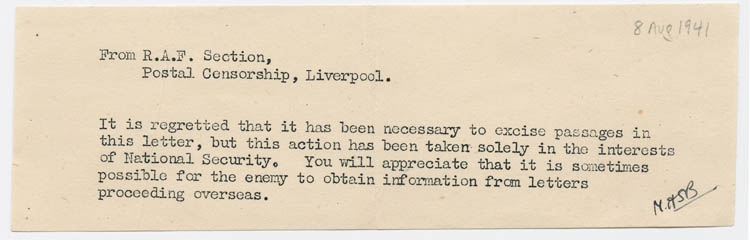
Now, I’ve seen a number of wartime letters with censorship marks or redacted passages, but this is definitely the most zealous censorship I’ve come across. Obviously these particular passages were (literally!) excised because they revealed Kibbe’s location and information about specific equipment and missions. In fact, the R.A.F. censor enclosed this helpful note in one of the envelopes:

Kibbe letter - envelope note

The content of Kibbe’s correspondence—what’s left of it—is also interesting. For example, in his first letter after shipping out, he wrote to his girlfriend with disappointment:

Norma, I lost your pin. I ransacked the house for it the morning before leaving but it was such a small thing & the house is so big. They’re going to send it to me if they find it. I feel terribly bad about it. I wanted something you wore and held in your hands and gave to me with your hands and I had it & then I lost it. But if I’ve lost the pin I’ll never lose the memory of you nor the memory of the words you said the night you gave it to me. Norma, just love me half as much as I love you.

Happily this wonderful passage remains intact. (By the way, Kibbe later found the pin and wore it “inside [his] pocket beneath the wings.”) But Kibbe’s story, like so many others, ended tragically. He was killed on 30 Sep. 1941 in a plane crash on the Yorkshire moors. He had been serving as second pilot on a bombing raid to Stettin, and the plane went down on its return flight. It was his first mission.

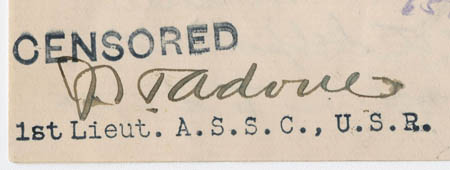
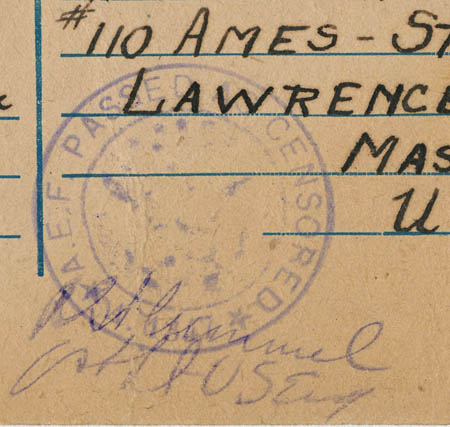
Of course, censorship of wartime letters was nothing new. Letters written by soldiers during World War I also had to be approved by censors, and it’s not uncommon to see marks or stamps on them, like these on the letters of Alton A. Lawrence and William F. Wolohan, both from 1918:

Lawrence letter  Wolohan letter

But young men, far away from home, placed in frightening situations, and desperate to reach out to their families and friends, often balked at the restrictions. When he arrived in Europe with the American Expeditionary Forces, Wolohan complained:

All the fellows are asking each other what to write as this is about the first time their mail has been censored, and they are having a great time trying to send a decent letter. They have so much to say or would like to say and yet dont know just what they are allowed to write.

Pfc. Brooks Wright, a World War II cryptographer from Cambridge, Mass. serving in India in August 1943, told his family the story of a fellow serviceman’s frustration with the censorship.

You will be amused to hear of a letter which Calahan sent home. In it he complained of censorship in no complimentary terms. Between the lines was written “He’s not far from wrong –Censor.”

Wright himself didn’t suffer much at the hands of the censors, though he did have the occasional phrase or passage cut from his letters à la Kibbe, usually when he was describing something specific about his location. Even a printed program for a concert he attended, enclosed with a letter, was redacted: “The […] Symphony Orchestra.”

But Wright was fond of drawing and illustrated many of his letters with scenes from his environment, local architecture, etc. And while he was a careful letter-writer, his sketches revealed more. His botanical sketches were so detailed, in fact, that when his mother took them to Harvard’s Gray Herbarium, the experts there were able to identify the species and pinpoint precisely where her son had been posted.

This Week @ MHS

By Dan Hinchen

The MHS is closed on Monday, 17 February, in observance of President’s Day. Normal hours resume on Tuesday, 18 February

On Wednesday, 19 February, come by at noon for a Brown Bag lunch talk.This week, independent scholar Mary Fuhrer discusses her research project “Consumed by Poverty: The Experience of Tuberculosis in the Boston Almshouse, 1800-1850.” Tuberculosis caused up to a third of all deaths in antebellum New England. Attempting to make sense of this devastation, sufferers—and society—created “illness narratives” to interpret their experience and provide meaning, consolation, or blame. This study examines poor consumptives in the Boston Almshouse, seeking to “open out” their lives and better understand how they—and others—made sense of their affliction. This talk is free and open to the public.

Please be aware that on Thursday, 20 February, the library of the MHS will close at 3:00PM as we prepare for that evenings special event. Tell It With Pride Preview Reception is a special event specifically for MHS Fellows and Members. The preview is a sneak-peek at our upcoming exhibit Tell It With Pride: The 54th Massachusetts Regiment and Augustus Saint-Gaudens’ Shaw Memorial. This exhibit, organized by the National Gallery of Art in Washington D.C., brings together photographs of members of the regiment and of the men and women who recruited, nursed, taught, and guided them. Reception begins at 6:00PM. Registration is required at no cost for MHS Fellows and Members, click here to RSVP.  Please note that the 5:30PM pre-reception talk is sold out.

The Tell It With Pride exhibition opens to the public on Friday, 21 February. Throughout the run of the exhibition special programs are planned in cooperation with the Museum of African American History, the Boston African American National Historic Site, the 54th Massachusetts Volunteer Regiment Company A, and the Friends of the Public Garden. Please check our events calendar for full listings. This exhibition is available Monday-Saturday, 10:00AM – 4:00PM and will remain open until 23 May 2014.

And on Saturday, 22 February, we resume our weekly tours of the MHS. The History and Collections of the MHS is a 90-minute tour of the Society’s public rooms, led by a docent or MHS staff member and touching on the history of the Society, and the art and architecture of building at 1154 Boylston Street. The tour is free and open to the public. No reservation is required for individuals or small groups. Parties of 8 or more should contact the MHS prior to attending a tour. For more information, please contact Curator of Art Anne Bentley at 617-646-0508 or abentley@masshist.org.

Finally, please also be aware that the MHS will sponsor an author talk taking place on Sunday, 23 February, at the Lawrence Library in Pepperell, Mass., and presented in collaboration with Freedom’s Way National Heritage Area. This talk is given by Gary Shattuck, a retired federal prosecutor who enjoys researching and writing about new-found discoveries lying deep within little-used legal documents. Crossed Swords: Job Shattuck’s Blood at the Courthouse Door examines the many changes forced on Massachusetts society by the Revolution, including the relationships and expectations of those living in the countryside. Shocking new evidence found in court records allows us to reassess the role and reputation of Capt. Job Shattuck. Capt. Shattuck was an early leader of protestors who began taking over courthouses in the summer of 1786 when officials failed to address the petitions for relief from taxes and judgements rendered against farmers by debt-enforcing courts, and he paid dearly for his effort. This event is free and open to the public, though registration is required at no cost. To register, please call the MHS reservations line at 617-646-0560 or click here to register online. The talk begins at 2:00PM


Our Monuments Man

By Peter Drummey

The release of the new George Clooney film, The Monuments Men, recalls a fascinating talk given at the Historical Society in December 1980, and published as “Remembrance of Things Past: The Protection and Preservation of Monuments, Works of Art, Libraries, and Archives during and after World War II” (Proceedings of the Massachusetts Historical Society, vol. 92, p.84-99). Our speaker was Mason Hammond, the Pope Professor of the Latin Language and Literature Emeritus at Harvard University. Professor Hammond, by then well into his seventies, was an enthusiastic member of the MHS (the man that the Adams Papers editors and other staff members turned to when a difficult Greek or Latin passage appeared in a manuscript), but until that day his fellow members probably saw him as a stereotypically tweedy academic historian. While his lecture was an overview of the quietly heroic effort of American and British curators, conservators, and art historians to save cultural treasures in wartime Europe, just enough of former Captain (later Lieutenant Colonel) Hammond’s own experiences enlivened his narrative to give his audience an inkling of the great adventure that he had participated in almost forty years before, and the remarkable role that he played as the first—and for a time the only—”Monuments Man.” 

In his MHS talk, Mason Hammond described his path to a key role in the Allied preservation effort first in Sicily and Italy, and later in Northern Europe as almost accidental. In 1943, the director of the Metropolitan Museum in New York was appointed the first Fine Arts and Monuments Officer of the Allied Military Government of Occupied Territories, but he was too fat to pass his physical, so Hammond, an intelligence officer at the Pentagon though not an art historian, was sent to North Africa in his place. Here Hammond was too diffident about his qualifications. He already had a lustrous career as a student and teacher at Harvard; had continued his studies of ancient art and archaeology at Oxford as a Rhodes scholar; and spent three years teaching at the American Academy in Rome.  In Sicily and then on the Italian mainland, he developed the pattern for the rescue work that followed. Inadvertently, he also may have given the “Monuments Men” their name. His Boston accent proved so challenging for his British colleagues (who heard him say “fine arts and monuments” as “finance and monuments”) that for the sake of clarity, they reversed the order of words in the title of his section to “Monuments, Fine Arts, and Archives”—and hence the “Monuments” rather than the “Fine Arts” (or “Finance”) Men.

Mason Hammond’s role in the Second World War is not unknown. He appears in recent popular histories by Robert M. Edsel with Bret Witter, The Monuments Men: Allied Heroes, Nazi Thieves, and the Greatest Treasure Hunt in History (2009), and Saving Italy; The Race to Rescue a Nation’s Treasures from the Nazis (2013). If his own narrative is more measured than the breathless treasure hunt described in both books and the new film, it places the work of the Monuments Men in a larger context.

What would Mason Hammond have made of the new Monuments Men movie? We cannot really say, but in his talk he described the work of the monuments officers mostly in terms of architectural preservation and the restoration of museum and archival collections within their countries of origin, rather than the focus of the film—the hunt for art treasures looted from private collections in countries occupied by the Nazis. In fact, Hammond was extraordinarily fair minded in assigning responsibility for the accidental or deliberate destruction of architectural monuments and buildings, as well as the contents of museums and libraries. He thought that what he believed to be the worst cultural loss of the war, the destruction of the bulk of the collections of the Kaiser Friedrich Museum in Berlin, probably had been an accident rather than the result of Nazi malevolence or Russian revenge. 

As a student of ancient history, Hammond probably was about the only person who could find a silver lining in the controversial Allied bombing of the Monastery of Monte Casino in Italy early in 1944 (this event is shown as leading to the creation of the Monuments Men in the new film, although Hammond had been in the field for almost nine months when the attack took place). As he noted, the Germans had removed the library of the Monastery to the Vatican before it was attacked. He thought the bombardment that followed had stripped away modern accretions to St. Benedict’s original structure, allowing its restoration in “a more suitable Romanesque style.”

Ironically, at the war’s end, Hammond found himself caught up in what appeared to be American-sponsored looting. He was serving in Berlin, the custodian of a bank vault filled with boxes labeled “Rembrandt” and “Rubens” that had been rescued from a phosphate mine in Thuringia. All the Monuments Men in Germany, regardless of rank (and by then Hammond was a senior officer in the detachment), signed a “most unmilitary” protest of a plan to remove works of art from Germany to the United Sates—a plan that the Monuments Men found too closely resembled the looting of cultural treasures by the Germans. While art works came to the United States and were stored at the National Gallery, in due course they were returned to Germany.

There is some presumption in claiming one of Harvard’s most faithful alumni and faculty members as the Society’s own “Monuments Man,” but Mason Hammond was an active member of the MHS for forty-four years, regularly attending MHS events until not long before his death in 2002, at the age of ninety-nine.

This Week @ MHS

By Dan Hinchen

On Tuesday, 11 February, join us at 5:15PM for an Environmental History seminar as Brian McCammack of Williams College presents “‘A tacit proclamation of achievement by the Race’: Landscapes Built With African American Civilian Conservation Corps Labor in the Rural Midwest.” This paper seeks to show not only how the young men of the Civilian Conservation Corps changed rural landscapes, but how those landscapes often changed them as well. McCammack explores the understudied implications of tens of thousands of young African American men in unexpected places during the Depression years: the forests and fields of the rural North. Neil Maher, NJIT –Rutgers University Newark Federated History Department, provides the comment. Seminars are free and open to the public; RSVP required.

The next day, Wednesday, 12 February, come by at 5:30PM for Created Equal: The Loving Story, a special film screening and discussion. Mildred and Richard Loving knew it was technically illegal for them to live as a married couple in Virginia because she was of African American and Native American descent and he was white. The Loving Story, nominated for an Emmy in 2013, brings to life the Lovings’ marriage and the legal battle that followed. Discussion will be facilitated by Joanne Pope Melish, University of Kentucky. Registration is required at no cost for this event. To Reserve: Click here to register online or call  the MHS reservations line at 617-646-0560.

And on Thursday, 13 February, is the next installment of the History of Women and Gender seminar series. Gloria Whiting of Harvard University and commenter Barbara Krauthamer of UMass-Amherst present “‘How can the wife submit?’ African Families Negotiate Gender and Slavery in New England.” This paper discusses various ways in which the everyday realities of slavery shaped gender relations in Afro-New England families. While the structure of slave families in the region was unusually matriarchal, these families nonetheless exhibited a number of patriarchal tendencies. Enslaved African families in New England therefore complicate the assumption of much scholarship that the structure of slave families defined their normative values. This seminar is free and open to the public; RSVP required. Talk begins at 5:30PM. Please note that this seminar is held at the Schlesinger Library, Harvard University.

Please note that the Society is closed on Monday, 17 February, in observance of President’s Day. Normal hours resume on Tuesday, 18 February.

The McKay Stitcher: The Machine That Revolutionized Footwear Production

By Andrea Cronin

On 7 February 1870, Henry H. Warden, of the Russell & Company trade firm in Shanghai, wrote to colleague John Cunningham. Cunningham served as an agent in Boston for the Walsh, Hall & Company of Nagasaki in the tea trade. In this particular letter, Warden replied to an inquiry  Cunningham had made concerning a potential shoe business in China.

“Thanks for yours of Nov 30 –
As to the McKay Machine. If it
is capable of turning out 4 @ 5000
shoes a day (those are your figures)
I should say it might be run
here to advantage for a week,
the Leather coming with it, and
supply China and the regions
round about for a year, I
fancy it is only adapted to making
foreign shoes. E. C. will be able
to give you a better opinion
than I can – He will be able
also to say whether you are
likely to find anything here
worth your while. I did not
forget to speak to him about
it-“

What is the McKay machine that Henry Warden references in this letter from John Cunningham papers?

The McKay stitcher was a sewing machine created by inventor Lyman Reed Blake and improved by businessman and self-educated engineer Gordon McKay. Prior to the introduction of this stitcher, shoes were hand stitched in a time-consuming and piecemeal manner. The machine revolutionized the speed of footwear production by machine sewing the uppers to the soles. 

In 1858, Lyman Reed Blake initially invented an interesting, but not entirely functional, sewing machine. Foreseeing a future in shoe machinery, Gordon McKay bought the patent from Lyman Reed Blake in 1858 for an immediate $8,000. An agreement was reached that Lyman Reed Blake would receive a $72,000 share of future profits. The entrepreneurial engineer for whom the machine is named then improved upon the design until submitting an enhanced patent in 1862. The McKay machine produced finished shoes far faster than hand stitching; it is often credited with giving the North a material edge during the Civil War while the Confederates went without proper footwear.

After the war, having found his market in shoe machinery, Gordon McKay made all moves to retain his profits. In 1866, he designed a leasing system for the McKay machinery which demanded royalties for each pair of shoes made. The low cost of leasing the machines allowed manufacturers to engage in the production of shoes. This production in turn furthered Gordon McKay’s business as he secured a profit for each pair made by his machines.

In his letter, Warden refers Cunningham to the expertise of his brother, Edward Cunningham (“E. C.”), a senior partner of the Russell & Company trade firm in Hong Kong. The John Cunningham papers at the Society do not contain information about further footwear business plans in China or correspondence between the brothers about the McKay stitcher. However, it is still a true mark of global prowess that Henry H. Warden and John Cunningham discussed the introduction of the McKay machine to Asian markets less than a decade after its invention.