
This Week @ MHS

By Dan Hinchen

We have a busy week here at the Society with several public events on tap. First up, on Tuesday, 14 January, is an Environmental History Seminar featuring Edward D. Melillo of Amherst College. “Out of the Blue: Nantucket and the Pacific World” builds upon insights from environmental history, migration studies, and cultural geography to argue that certain historical groups of displayed a rooted cosmopolitanism, which develops through sustained encounters with the peoples and environments of far-away places. Through whaling, Nantucket mariners came to know a distant ocean and its inhabitants in was that were often more refined and subtle than many contemporaneous understandings of the Pacific World. Nancy Shoemaker, University of Connecticut, provides comment. Seminars are free and open to the public; RSVP required. Subscribe to receive advance copies of the seminar papers. The seminar begins at 5:15PM.

On Wednesday, 15 January, stop by at noon for a Brown Bag lunch talk with Dylan Yeats, New York University, presenting “Americanizing America: Yankee Civilization and the U.S. State.” With research at the Massachusetts Historical Society and the Boston Athenaeum, Yeats is charting the evolution of what he terms the Yankee Network, comprising academic, educational, missionary, and social reform organizations, and the ways in which this network sought to harness those organs of the state that it could over the nineteenth and early twentieth centuries. Brown Bag discussions are free and open to the public.

Also on Wednesday, MHS Associate Members (age 40 and under) are invited to an evening social with the Young Friends of Historic New England. Guests will gather at the MHS for a reception followed by a scavenger hunt based on “The Cabinetmaker & the Carver” exhibition. For more information, please call 617-646-0543 or e-mail awolfe@masshist.org. And speaking of the current furniture exhibition, if you have not seen it yet then you are running out of time! The exhibition ends on Friday, January 17. Make sure you come in sometime this week between 10:00AM and 4:00PM to catch a rare glimpse of these Massachusetts-made pieces from private collections which span four centuries.

Finally, on Thursday, 16 January, there is another seminar, this time from the Biography series. “When Subjects Talk Back: Oral History, Contemporary Biography, and the Runaway Interview” will feature a conversation with Joyce Antler, Professor of American Studies at Brandeis, who is currently writing a book on Jewish women active in the feminist movement; Claire Potter, Professor of History at the New School, who is writing on anti-pornography efforts in the 1980s; and Ted Widmer of Brown University, senior advisor to former Secretary of State Hillary Rodham Clinton. The moderator for the discussion is Carol Bundy, author of “The Nature of Sacrifice: A Biography of Charles Russell Lowell, Jr., 1835-64.” The talk begins at 5:30PM and is open to the public. Be sure to RSVP for this program by emailing seminars@masshist.org or phoning 617-646-0568.

Please note that the Society is closed on Monday, 20 January, in observance of Martin Luther King, Jr. Day. Normal hours will resume on Tuesday, 21 January.
King Kalakaua’s Tour of the United States

By Andrea Cronin

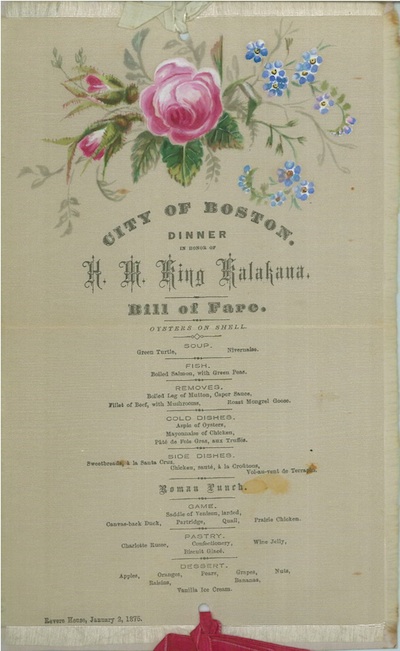
On 1 January 1875 the last reigning King of Hawai’i arrived in Boston via railroad as the last stop in a good will visit to the United States. King Kalakaua III inherited a national economic depression in 1874 from his predecessor William Charles Lunalilo. In an effort to foster tariff-free trade between the Kingdom of Hawai’i and the United States, King Kalakaua embarked on a tour of the United States in November 1874, visiting cities such as Washington, D.C., New York, and Boston.

Why did the King of Hawai’i visit Boston of all places?

The Boston visit was strategic. New England sugar interests opposed tariff-free trade which would allow Hawaiian sugar to flood the market and overtake their business. The King’s visit fostered a cultural friendship including the lavish dinner held by the City of Boston on 2 January 1875 at the Revere House. The dinner started with oysters in true New England tradition. In fact, the City spent $3,000 in entertainment and accommodations for the royal party at the Revere House. Here is the bill of fare from the banquet in honor of King Kalakaua.

King Kalakaua left Boston on 9 January 1875 with great success. Within the month, his efforts secured the Reciprocity Treaty of 1875 which enabled Hawaiian goods to enter the United States without levies.


Party Politics: The Adamses’ Jackson Ball

By Amanda A. Mathews

The women of the Adams family may not have held public office themselves, but they were vital to their husbands’ political careers. Abigail aided John both through her counsel and astute management of their property during his long absences. Louisa Catherine Adams, on the other hand, choosing to remain near her husband at his various posts, used her charm and entertaining skills to showcase John Quincy to the political world in her parlor.

Perhaps her greatest triumph in this vein came on 8 January 1824, the ninth anniversary of the Battle of New Orleans, an important victory for the United States at the end of the War of 1812. Louisa hosted a grand ball to honor the hero of the battle, Andrew Jackson.

The Jackson Ball that Louisa planned was a magnificent affair that took over two weeks for the family to prepare. Five hundred invitations were issued to congressmen, cabinet members, and the social elite of Washington, and newspapers estimated that potentially 1,000 people attended the ball that required the Adamses to install pillars to support the upper floors of their F Street, Washington, D.C., home. Wreaths, garland, and roses covered the walls, while delicate chalked eagles and flowers graced the floors and guests were treated to a sumptuous buffet. “Mr Adams and I took our stations near the door that we might be seen by our guests and be at the same time ready to receive the General to whom the fete was given,” Louisa recalled in her diary. “He arrived at nine o’clock and I took him round the Rooms and introduced him to the Ladies and Gentlemen whom we passed. . . . my Company dispersed at about half past one all in good humour and more contented than common with their entertainment.”

But this was no mere party. This was politics. The Adamses hoped to win over the support of a yet undeclared candidate and potential political rival in Jackson, and showcase their leadership as John Quincy became a leading presidential candidate. During the evening, a small mishap underscored this understood overlap between the social and political worlds. Louisa recorded, “While sitting in the dancing Room one of the lamps fell upon my head and ran all down my back and shoulders— This gave rise to a good joke and it was said that I was already anointed with the sacred oil and that it was certainly ominous— I observed that the only certain thing I knew was that my gown was spoilt—” While this lavish ball failed to win Jackson’s political support, as he became Adams’s chief rival in the Election of 1824, it was a smashing social success, spoken of for years to come, and clearly revealed Louisa’s mastery of social politics.

If you would like to learn more about Louisa in her own words, the forthcoming A Traveled First Lady: Writings of Louisa Catherine Adams is available for pre-order now.

This Week @ MHS

By Dan Hinchen

After a sputtering return to business last week due to a two-day snowstorm, the Society is back up and running this week, though it is a quiet one. On Wednesday, 8 January, join us at noon for a Brown Bag lunch discussion with Katherine Johnston of Columbia University. Well-timed to coincide with the latest round of winter storms and chills and the ensuing discussions about global climate versus local climate, during this lunchtime talk Johnston presents “A Climate Debate: Abolition and Climate in Eighteenth-Century Britain.” As British Parlimanetary debates over abolition in the West Indies grew increasingly serious toward the end of the eighteenth century, the Board of Trade interrogated people familiar with plantation life. What sorts of health risks did plantation work pose for enslaved laborers? Could Europeans labor in the West Indies climate? This project examines some of the testimony that absentee planters provided to Parliament and contrasts these arguments with evidence taken from these same planters’ private letters. Public testimony did not always match up with personal opinions, and this project explores some of the differences between the two. This event is free and open to the public.

And as this recent storm has shown, the Society is susceptible to the New England winters. When planning a trip the MHS, be sure to keep an eye on the website and events calendar to see updates on building closures and schedule changes.

Are these self-portraits at all like “selfies”?

By Nancy Heywood

In November, the Oxford Dictionary announced that “selfie” was the word of the year for 2013. The definition of selfie (from oxforddictionary.com) is:

a photograph that one has taken of oneself, typically one taken with a smartphone or webcam and uploaded to a social media website

Selfies are very common these days. Many images show the subject looking up, into the lens, and often the subject’s arm extends out of the picture (holding the very device that captures the image). These photographs are sometimes seen as lighthearted and whimsical and sometimes seen as a sign that the world is becoming filled with self-absorbed people!

Do a couple of photographic self-portraits from the past (held within the Massachusetts Historical Society’s collections) have much in common with selfies of today? The photographic equipment and processes used in the 19th century (requiring cumbersome cameras and multiple steps: exposure, development, and printing) significantly differ from the equipment and approach of creating digital images today (captured on portable and ubiquitous devices and then often seamlessly shared with family and friends).

What about the characteristics of the self-portraits from two different eras? Selfies are deliberate but quick, documenting that one was at a place or with a person and distributed publicly, ideally seen by lots of people. 19th-century self-portraits were also deliberate but had to be painstakingly composed. Within these self-portraits, most photographers took efforts to hide the fact that they took their own pictures.  Photographic self-portraits were potentially sharable; many copies of a particular image could be made from the same negative and then distributed to friends and family members.

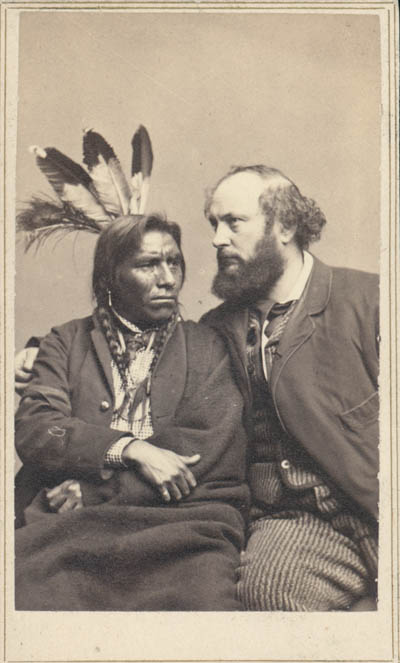
Two examples of 19th century photographic self-portraits from the collections of the MHS are a photograph taken by Francis Blake in 1885 (image below, on left) and a photograph of two men taken in 1862 by Charles D. Fredricks , who is most likely the man on the right (image below, on right). One reason why it is likely that the image on the right does include the photographer (Fredricks) is because the man on the right’s left hand extends beyond the frame of the image and could have held  a remote control for the camera’s shutter. Here is one slight similarity with selfies—the arm beyond the edge of the image!  However that similarity is offset by the fact that 19th century photographers tended to minimize any evidence of how they took their self-portrait whereas within selfies it is often quite obvious that someone in the picture, took the picture. Viewers have to closely examine the large digital image of Francis Blake’s self-portrait (click on the photo) to see that he holds a remote shutter release in his right hand.

Blake self portrait  Photograph probably by Fredricks

The seriousness of both the 19th-century images seems to differentiate them from most selfies, but one way they are similar to selfies is the fact that Blake and Fredricks consciously put themselves in front of their cameras and took the pictures. I find Fredricks’ image of himself and the Chippewa man to be intriguing, and although it is very different from a selfie, I wish he had treated it more like a selfie by leaving a comment or answering that familiar prompt from Facebook: “Say something about this photograph…”!  Fredricks’ photograph is awkward (the two men look in different directions, and Fredricks’ right arm is stiffly draped over the shoulder of the Native American) but the image seems to document a significant moment for the photographer. 

Whether or not there are many similarities between 19th-century self-portraits and selfies of today, it is interesting to take a few moments to see some examples of how people from a different century left glimpses of themselves that are still visible today! 

Extra note for word lovers: The Oxford Dictionaries blog stated that “selfie” was added to the OxfordDictionaries.com (online version) in August 2013, but as of November 2013 was under consideration for (but not yet in) the Oxford English Dictionary (OED).

A New England Christmas (And A Mystery)

By Susan Martin

On friday evening came the chunky, fat, merry, rosy cheeked dutchman Santa Claus, who makes an annual visit to good children, who have loving parents, on Christmas eve, bringing with him his pack of all sorts of nick-nacks to put into the Christmas stocking. How he makes out to get down our narrow throated chimneys, and these obstructed by grates or stoves, I dont know, unless he and his pack can be contracted and expanded by volition, like Miltons fallen angels, who reduced their gigantic forms to the size of bees, that they might be accommodated in Pandamonium…

This Christmas letter from Jacob Newman Knapp (1773-1868) to his son Frederick, written on 27 Dec. 1852, is just one of many interesting letters in the Knapp family correspondence, a new collection at the MHS.

Jacob Newman Knapp letter

Jacob’s long life stretched from the American Revolution to the Civil War. He had been a teacher for many years and now lived on a farm in Walpole, N.H. with his wife Louisa (Bellows) Knapp and Frederick’s younger brother Francis. Frederick was minister of the First Parish Church in Brookline, Mass. The family was obviously very close, and letters were frequent and affectionate. Jacob’s in particular, though not short on paternal advice, also reveal a playful and endearing sense of humor.

Christmas at the Knapp home that year was a big event. The guest of honor was a young girl named Rebecca. Rebecca’s name had suddenly appeared in the correspondence just a few days earlier, and any letter indicating who she was or why she was staying with the family has since been lost. Neither Frederick nor Francis was married or had children yet, so I assumed Rebecca was the daughter of a friend or distant relative, or perhaps the child of a servant. The Knapps were known for their hospitality, and Jacob and Louisa seem to have taken this girl under their wing. Whoever she was, she was fêted in grand style, with her very own Christmas tree, a Queen Mab doll, sleigh rides, and afternoon tea with seven other children of Walpole.

One of my favorite passages in the letter is Jacob’s description of a sleigh ride with Rebecca and the other children. He was obviously a natural storyteller, painting a vivid picture for us:

They were as full of happiness, as they could hold. The people in the street stared at the passing show, for the children, comely by nature, were bright, and cleanly dress’d. There were so many little heads peeping above the sleigh, that you might have imagined it a man and horse running off with a birds nest.

Then this fascinating detail:

Ah! a certain friend of ours would say, “you are spoiling that little coloured girl, if you have not already done it.” That we cannot readily assent to. Goodness, in every condition of life, should be encouraged, merit rewarded, and practical reform be prefer’d to theoretical and visionary. When our dignity requires to be enclosed in a glass case to guard it from plebean contact, we shall distrust in generousness, and we prefer being obeyed by love, rather than by fear.

I was more intrigued than ever. Who was Rebecca? A few other letters in the collection contain passing references to her, but nothing more. I consulted published biographies of the Knapps, but turned up nothing.

On 27 June 1853, Rebecca left the Knapp household under the care of a Mr. Makepeace, probably Walpole resident George R. Makepeace. The last letter in the collection is dated a few days later. In it, Jacob tells Frederick: “Rebecca’s safety was well cared for, as much so, as if her complexion had been a combination of white and red. She is a good girl, and will, I hope, continue so.”

Corticelli Sewing Silk Thread, 1876

By Andrea Cronin

In a prior post about American Sericulture, Dr. James Mease of Philadelphia wrote to Colonel Timothy Pickering about his sericultural pursuits in 1826. Small American sericulture experiments such as Dr. Mease’s endeavor gave way to industrial enterprise by the 1840s. In Northampton and its surrounding towns, businessmen Samuel Whitmarsh and Samuel Lapham Hill spun the necessary structure for the Nonotuck Silk Company and its Corticelli production line of sewing silk.

Though Samuel Whitmarsh gave Nonotuck Silk Company its name, the company did not survive the mulberry speculation bubble and subsequent implosion in the late 1830s. The Northampton Association of Education and Industry purchased the remains of Whitmarsh’s operations but struggled to produce raw silk until the ultimate dissolution of the association in 1846. 

Samuel L. Hill converted the silk production operations of Northampton Association of Education and Industry into manufacturing mills. The company began importing the silk from China and Japan thereafter. Hill began to manufacture a new silk sewing thread known as “machine twist” that was durable enough to be used in mechanical sewing machines. Hill sent sewing machine inventor Isaac M. Singer some of his entrepreneurial “machine twist” silk spools in 1852. Singer was so impressed that he requested all of the company’s silk spools stock. The silk thread market blossomed under the influence of these two businessmen.

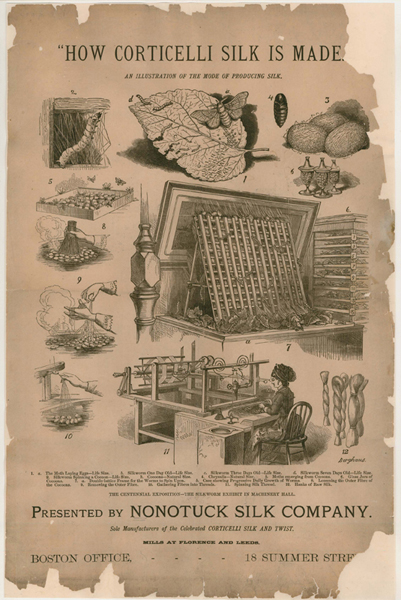
Samuel Hill remained president of the Nonotuck Silk Company until his retirement in 1876. At the 1876 Centennial International Exposition in Philadelphia, the Nonotuck Silk Company presented this gorgeous 1876 broadside that depicts twelve steps in silk production process from silkworms to raw silk.

Broadside - 12 step silk production

What step in this broadside interests you the most?

This Week @ MHS

By Dan Hinchen

There are no events scheduled here at the Society this week.

Please note that the Library of the MHS is closed beginning Tuesday, 24 December, and will reopen on Thursday, 2 January. The galleries are open to the public Thursday, 26 December – Saturday, 28 December, and again on Monday, 30 December, 10:00AM-4:00PM. Be sure to come in and take a look at our current exhibition, “The Cabinetmaker & the Carver: Boston Furniture from Private Collections” before it closes on 17 January. And keep an eye on our events calendar to see what is coming up in January.

Wouldn’t it be fun…

By Nancy Heywood

Wouldn’t it be fun if the Boston Red Sox World Series Trophies from 2004, 2007, and 2013 got to meet the 1912 Boston Red Sox medal from the collections of the Massachusetts Historical Society?   Staff members love picturing this scenario!   And, we’ve tweeted a pitch (pun intended!) about this possibility to the Red Sox Holiday Trophy Caravan!

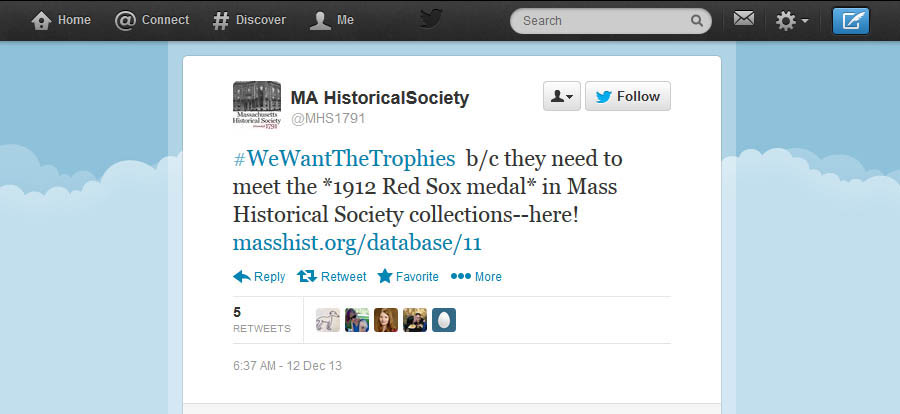
The Red Sox announced that today (Thursday, December 12) they would bring the trophies to several hospitals and after visiting with patients, they would go to three Boston-area businesses in the afternoon.  Organizations have been asked to tweet using the hashtag #WeWantTheTrophies and explain why their office deserves to be selected.  

MHS sent this tweet:

MHS Tweet December 12, 2013

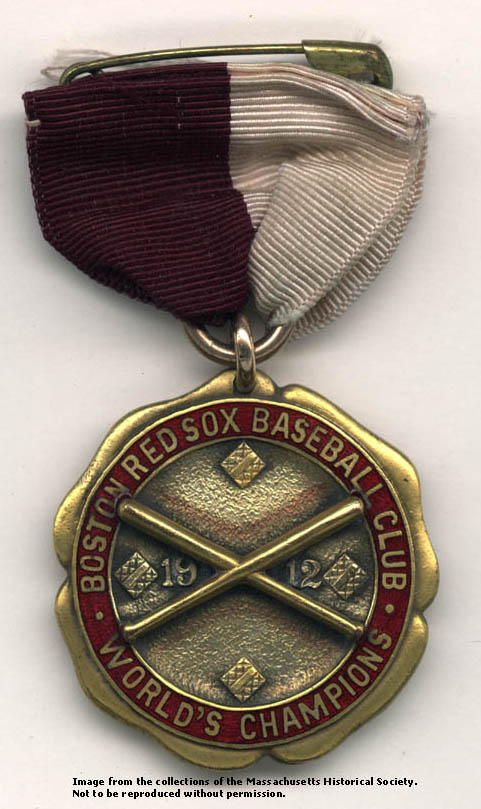
The MHS has a small number of sports-related medals in our collections including the 1912 Red Sox medal.

1912 Red Sox medal

The bronze medal was made by a Boston jeweler, Frank A. Gendreau.  MHS’s medal is made of bronze and some people speculate that our medal might have been a model because it isn’t as fancy as the two other known examples that were given to players on the team. (Those medals were made of gold with precious stones.) Read more about our medal.


“Long Sleeps Last Night for Both Sophias”: A New Mother’s Diary from 1910

By Anna J. Clutterbuck-Cook, Reader Services

As one of our staff prepared to depart on maternity leave this fall, I took the opportunity to delve into the print and manuscript materials in our collection related to pregnancy and childbirth, parenting and childhood. The MHS has a wide variety of print, manuscript, art and artifact materials related to the history of parents and children, from Cotton Mather’s Help for Distressed Parents, Or, Counsels & Comforts for Godly Parents Afflicted with Ungodly Children (1695) to the children’s health diaries of Helen C. Morgan (in the Allen H. Morgan Papers), who kept tidy notes on her children’s growth, eating habits, childhood illnesses, and medical treatments from their infancy through their college years (1923-1951).

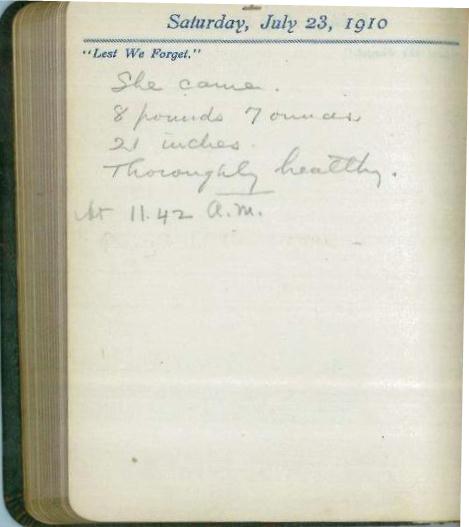
One of my favorite discoveries was the diary kept by Sophie French Valentine during the first months of her daughter’s life. Perhaps in anticipation of her daughter’s birth, Sophie purchased a page-a-day Standard Diary for 1910. In the days before Internet-based social media was our platform of choice for documenting the everyday, Standard Diaries offered a way for many Americans to keep account of their own comings and goings with “status updates” that continue to resonate with intimate immediacy for future generations.

Sophie Valentine’s 1910 diary remained blank until the page for Saturday, July 23, on which she wrote simply, “She came. 8 pounds 7 ounces, 21 inches. Thoroughly healthy. abt 11.42 a.m.”

While her infant daughter was healthy, Sophie was not. On August 2nd she had to undergo an operation (unspecified), that necessitated separation from her daughter and several days’ sedation with “narcotics.” Sophie wrote on the page for August 2nd, “I nursed the baby every three hours up to this time – but just before the operation it was decided best to take her from me!”

As the summer waned, Sophie recovered from her surgery and chronicled the comings and goings of her household, as well as the growth of her daughter (also christened Sophia). Several weeks after the birth, the family doctor paid a visit and pronounced “the little one…sound and vigorous.” Three days later, infant Sophie “went out in the bassinette in front of the house” for the first of what would be many afternoons in the fresh air with her mother. Sophie’s husband, a diplomat, appears to have been away during much of his wife’s convalescence, but a steady stream of female friends and relatives populate the pages of Sophie’s diary. On August 14th, for example, the day “the little one” was baptized Sophia French Valentine, she “had pictures taken with Harriet, Charles, Aunt Martha, Auntie May; and Elizabeth and Lucy,” as well as with her mother and Aunt Caroline (“who held her and talked to her lots”). Later she was visited by “Theodore, Mrs. Graves, and Auntie Beth.”

By Thursday of that week the social whirl may have worn thin for both mother and daughter: the entry for August 18th reads simply, “Long sleeps last night for both Sophias.” A heartfelt status update that will no doubt resonate with many new parents generations hence.

The Sophie French Valentine Papers are part of the Robert G. Valentine Family Papers and available for use by researchers in the reading room of the MHS library.