Mysteries Solved! Using Harbottle Dorr’s Index to Find Missing Pamphlets

By Peter Steinberg, Collection Services

The newly-launched website presenting MHS’s collection of Harbottle Dorr, Jr.’s annotated newspapers includes transcriptions of the indexes he created for each of the four volumes he assembled. The task of transcribing these indexes proved inspirational and provoked inquiry. The Massachusetts Historical Society has held the first three volumes, covering the years 1765-1771, for many years. The first volume contained no extra material other than a brief two-page Appendix. However, in both Volumes Two and Three Dorr included contemporarily published pamphlets on topics related to the articles he annotated.
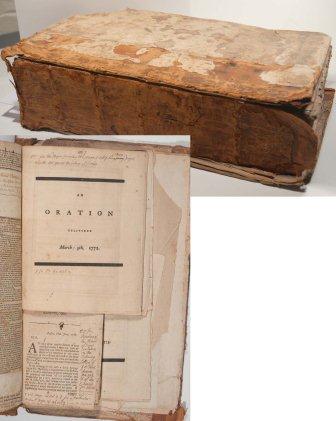
We do not know when this happened, but the volumes were disbound at some point for, among other reasons, preservation. As part of this process, the pamphlets originally collected by Dorr for Volumes Two and Three were removed and added to the Society’s general collection of printed materials. These two volumes came to the MHS in 1798 and have been in use for more than 210 years. This means there is a long period of time in which some of the documents Dorr collected may have been separated and moved around. In 2011, the MHS acquired the fourth volume of Dorr’s Annotated Newspapers via auction. Working at the MHS when this fourth volume arrived, and seeing how it looked in its original organization and binding, I became intrigued about the existence of those pamphlets that had been separated from the earlier volumes, and where they might be located within the building.

You may be wondering: What does the removal of the pamphlets have to do with the index? In transcribing the index, we grew to be familiar with the pagination of the volumes. The newspapers collected and page-numbered by hand by Dorr went only so high. For example, Volume Two’s last newspaper page number is 788 (The Boston-Gazette, and Country Journal, 25 December 1769). However, in the index for this volume there were entries for page numbers higher than page 788. This was an indication that there were supplemental items (i.e. pamphlets) that had been removed and the same was true for Volume Three.

I began to track those index terms where the page number is higher than page 788 (for Volume Two) and page 642 (for Volume Three) in order to try and gauge the subjects of the pamphlets. Then, using these extracted terms in conjunction the library’s ABIGAIL catalog, Google, and WorldCat, a global catalog of library collections, I was able to eventually track down six pamphlets and a broadside formerly included in these volumes. The tell-tale sign that these pamphlets belonged to the collection was the presence of Dorr’s distinctive numbering at the top-center of each page. Once found, these items were photographed in-house and are digitally reassembled with their original volumes via the Harbottle Dorr, Jr. Annotated Newspapers website. Each pamphlet found felt like a significant accomplishment. In finding the pamphlets and having access to them, it has led to a better understanding of how Dorr’s collection originally looked. Finding some encouraged me to look for the others, which were harder to locate.

As I worked on this this blog post, I continued searching for missing pamphlet’s and in the process, uncovered addition items. In browsing Dorr’s Index to Volume Two for indexed terms for which we had no pages, I found the entry “Statute De Tallagio non concedendo.” This term appears on Index page 13 and refers to page 814, which fell within a page range, 789-830, that was still absent from the collection. I searched ABIGAIL for “Tallagio,” as it is a word that would likely yield few if any hits, and was presented with three records: two printed editions of Henry Care’s English liberties, or The free-born subject’s inheritance. Containing Magna Charta, Charta de Foresta, the statute De Tallagio non Concedendo, the Habeas Corpus Act, and several other statutes (1721 and 1774) and one small manuscript: “Appendix of an unidentified manuscript, ca. 1790-1810.” I was familiar enough with Dorr’s Index to know that many of documents contained in Care’s book appear as terms (though largely Anglicized). Could it be that Dorr copied some of the text from Care’s book? The printed books had none of those tell-tale signs of being annotated by Harbottle Dorr. However, the small manuscript was indeed an original Dorr manuscript: the previously unknown “Appendix” to Volume Two! You might say I developed Appendix-itis as a result!
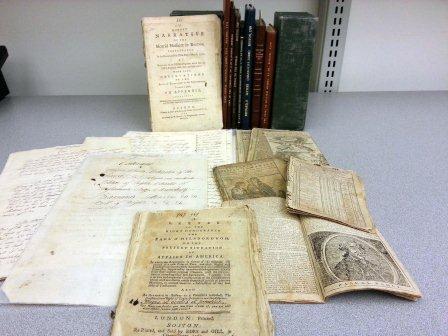
There are currently two page ranges within Volume Two for which we still do not have images: 939 to 946 and 1041-1098.  However, from an index entry and research, I have concluded that the first range (939-946) is the breathtakingly titled pamphlet: A Third extraordinary budget of epistles and memorials between Sir Francis Bernard of Nettleham, Baronet, some natives of Boston, New-England, and the present Ministry; against N. America, the true interest of the British Empire, and the rights of mankind by Sir Francis Bernard (1769). Likewise, index terms for the second range listed above (1041-1098) lead us to conclude that this span consisted of parts of three separate almanacs published in 1768 and 1769. See the Collection Outline for Volume Two for details. While we currently do not know where Dorr’s copies are, we at least know what they are… Also unaccounted for are seven pages (996-1003) from Volume Three, which deals with the Boston Massacre trial of and verdict for Edward Manwaring, John Monru, Hammond Green, and Thomas Greenwood. Research uncovered this to be an Appendix (pages 211-217) to The Trial of William Wemms, James Hartegan, William M’Cauley, Hugh White, Matthew Killroy, William Warren, John Carrol, and Hugh Montgomery… (1770). The first printing of this book included the Appendix, however, reprints did not (See end of note 1 here). We surmise that Dorr obtained a copy of the Appendix somehow, which explains why it is not a part of the copy he included in Volume Three. The MHS holds copies of these pamphlets and all the almanacs, as we created a page of Explanatory Notes  to help define what’s what.

As stated above, the first volume is the exception to the other three: there were no pamphlets. However, mysteries still abound about the first volume. Dorr’s original page numbering had the index appearing after a two-page Appendix which followed the last newspaper. But, between the Appendix (pages 790-791) and the Index (pages 794-801) there are two pages (792-793) that are missing. There are references in Dorr’s Index to the missing page 792 (see pages 796 and 799). In the latter, “Stamp Act Rise of it, vide a Letter from E Dyar 203 vide Huskes Letter in the Appendix 792,” Huske’s letter was printed originally on the front page of the 29 October 1764 issue of The Boston-Gazette and Country Journal. This is curious in and of itself as the letter was printed in a 1764 newspaper, which is the year prior to the start of Dorr’s first volume.

The recently-found pamphlets for volumes Two and Three, as well as the appendix to volume Two and a short title list of known missing items, are easily accessible via the Collection Outline page within the Dorr website: www.masshist.org/dorr/outline.

This Week @ MHS

By Dan Hinchen

On Wednesday, 12 June, the Society will host its annual business meeting, a special event for elected MHS Fellows. The meeting will begin at 5:00pm and registration is required at no cost.

Following the annual meeting, MHS Fellows along with Members will be invited to a special preview reception for MHS Fellows and Members to get a glimpse of the upcoming exhibition, “The Object of History: 18th-Century Treasures from the Massachusetts Historical Society.” Starting at 6:00pm, the evening will begin with remarks by Peter Drummey, Stephen T Riley Librarian of the Society, followed by a reception and exhibition preview. Registration is required at no cost.

The next day, Thursday 13 June, is the official opening of three concurrent exhibitions. First is “Estlin Cummings Wild West Show.” This small exhibit features childhood writings and drawings of e.e. cummings. Drawings and paintings of zoos, circuses, wild west shows, and house plans, along with a story about life on Joy Farm and the 1914 poem “From a Newspaper” showcase the earliest experiments with words and illustrations by the young poet. This exhibit will be on display from 13 June 2013 until 30 August 2013, 10:00am-4:00pm, Monday-Saturday.

Second, “The Education of Our Children Is Never out of My Mind” will display letters written by John and Abigail Adams to each other, to their children, and to friends and family regarding their views on education. The title of the exhibit comes from a letter that John wrote to Abigail, dated 28 August 1774, in which he exhorts her to train their children to “Fix their Ambition upon great and solid Objects, and their Contempt upon little, frivolous, and useless ones.” This exhibit will be on view until 7 September 2013, 10:00am-4:00pm, Monday-Saturday.

Finally, the Society’s main exhibition will open to the public on 13 June. “The Object of History: 18th-Century Treasures from the Massachusetts Historical Society” explores questions about the meaning of historical objects, why they are preserved, and where their value lay, through the display of 18th-century portraits and objects from the Society’s collections, along with rarely seen engravings, needlwork, maps, weapons, furniture, clothing, scientific instruments, and silver. This exhibit will also run until 7 September and will be on view Monday-Saturday, 10:00am-4:00pm. All of the Society’s exhibitions are free and open to the public during viewing hours.

On Friday, 14 June, stop by for a free public program in conjunction with the new exhibition as J.L. Bell presents the Curator’s Choice.Bell will discuss the provenance, history, and people connected with Ephraim Moors’s powder horn, one of the items featured in The Object of History. Bell will also delve into his investigation into the object’s details and what they tell us about the Siege of Boston. Carvings on the horn include a crude drawing of the Continental Army encampment at Winter Hill, five grenadiers, a mansion house, and the head of a beast. J.L. Bell is a Massachusetts writer specializing in the start of the American Revolution in and around Boston. His blog, Boston1775.net, features “history, analysis, and unabashed gossip about the start of the American Revolution in Massachusetts.” This program will begin at 2:00pm and is free and open to the public.

And on Saturday, 15 June, there will be another free tour of the Society’s home at 1154 Boylston St. The History and Collections of the MHS is a 90-minute docent-led tour that explores all of the public rooms in the building will touching on the art, architecture, history, and collections of the Society. The tour is free and open to the public. No reservation is required for individuals or small groups. Parties of 8 or more should contact the MHS prior to attending a tour. For more information please contact Curator of Art Anne Bentley at 617-646-0508 or abentley@masshist.org.


Discussing Digitization with a Visitor from Serbia

By Nancy Heywood, Collection Services

On May 7, I had the privilege of sharing information about how MHS digitizes its collections with Dr. Andrej Fajgelj, Director of the Cultural Center of Novi Sad.  (Novi Sad is the second largest city in Serbia.) The Cultural Center is embarking on a new project to use information technology in art and culture and Dr. Fajgelj will be overseeing a large digitization effort to present rare books, musical scores, notes and manuscripts. 

The purpose of Dr. Fajgelj’s trip to the United States was to meet with professionals involved with the digitization of library and cultural heritage materials.  Over the course of about one week, he visited many institutions on both coasts including the San Francisco Public Library, Stanford University, the Internet Archive, Harvard University, and the Massachusetts Historical Society.

To help Dr. Fajgelj understand the context in which our digital projects take place, Brenda Lawson, Director of Collections Services, provided a brief overview about the MHS.  Even though MHS is an independent research library (and differs greatly in size from the other institutions he visited), I conveyed how important it is for us to create digital collections according to standards and best practices.  At MHS we always have to work to balance the content and goals for digital projects with the available resources.   We talked about workflows, standards, equipment, encoding, web delivery systems, and budgets.  

Towards the end of our meeting Dr. Andrej Fajgeli made some thought-provoking points about the importance of the Cultural Center’s upcoming digitization activities.  He acknowledged that at the present time, there aren’t significant amounts of digitized Serbian-language material s.  As a former instructor of languages and assistant professor in a university philology department, he is well-aware of the fact that students turn to the Web for research, news, and fun.  Although many Serbs know multiple languages, he wants them to find more Serbian cultural sources online.  He hopes more digitized Serbian materials will inspire Serbs to be creative and write songs, prose, and poetry in their native language. 

Dr. Fajgelj was accompanied by Glenn Carey, a U. S. State Department English Language Officer (who kindly provided the image of the meeting).  Dr. Fajgelj’s trip and itinerary were administered by the U.S. Department of State’s International Visitor Leadership Program and the Massachusetts portion of his visit was arranged by WorldBoston. 

Virtual Field Trip: MHS Staff Interacts with 5th Graders 1,400 Miles Away

By Kathleen Barker, Education Department

Earlier this spring my colleagues and I had the opportunity to spend two fabulous afternoons with a fifth-grade class in Minnesota. Thanks to the magic of Skype, we never had to leave the Society! Our online field trip was facilitated by Laura Tessmer, a teacher at the Clover Ridge Elementary School in Chaska, just outside of Minneapolis. We first met Laura three years ago when she participated in our NEH Landmarks of American History and Culture workshop, “At the Crossroads of Revolution.” Since that summer we have looked for ways to reconnect with Laura and her students, in spite of the 1,400 miles that separate our two institutions. Laura has been experimenting with other distance-learning technologies this year, and in April and May, she added the MHS to her list of virtual classroom visitors.

The Society’s wealth of online resources  allowed Laura’s class to preview many documents and artifacts prior to our discussions. On 4 April, students came prepared to analyze items from our recent exhibition on the War of 1812. Questions and comments flowed nonstop as we discussed documents such as “Huzza for the American Navy!”, a political cartoon published in 1813. Students expertly dissected the saucy puns and plays on words intended to celebrate America’s early naval victories over the British, while commenting on visual details such as the patriotic wings of the wasp and the hornet. Throughout the discussion these young scholars demonstrated their great knowledge of the war, as well as their enthusiasm for the documents and artifacts they explored as part of our visit.

We met with Laura’s class again on 29 May, this time to review events related to the Civil War. We began by discussing the recruitment of soldiers during the first year of the war, and students quickly identified all of the clever tactics used by military propagandists in broadsides such as “Major Gen. Banks’s Grand Expedition!: 2d Mass. Cavalry!” from 1862. We pondered the military pay scale, and discussed the importance of musicians, who often played a vital role in preserving troop morale during and between battles (in spite of their lower pay). Class members also discussed several manuscript documents, including the illustrated diary of Sarah Gooll Putnam. On 3 February 1864, Putnam visited the military camp at Readville (in Boston) where she saw General Burnside on parade with Massachusetts troops. Once again, this great group of budding historians impressed us with their knowledge of the Civil War, making connections between MHS documents and the wartime experiences of men and women from Minnesota.

Since our first experiments with Skype programs were both entertaining and enlightening, we hope to expand our virtual offerings to additional teachers and students in the next school year. The flexibility of this online format allows us to expand our outreach efforts in multiple ways. We are always looking for new opportunities to meet local teachers who might not have the time or the budget to bring students to our headquarters on Boylston Street. Of course, we also enjoy meeting and working with teachers from across the United States through our onsite programs, and virtual field trips will allow us to maintain our many connections in all corner of the nation. If you are a teacher who would like to sample an education program at the Society—either in person or through the web – please contact the education department. Meanwhile, many thanks to Laura Tessmer and our new friends in Minnesota for making our virtual visits such a success!

This Week @ MHS

By Dan Hinchen

Last Friday saw the curtain drop on our three exhibitions relating to slavery, abolitionism, and Emancipation. As the set-change takes place this week in preparation for our next exhibit there are plenty of other public programs happening this week to bring you to the Society.

First, on Monday, 3 June, the MHS will co-sponsor a conference in Worcester at the College of the Holy Cross. Through a series of sessions and roundtables, “Listen my children and you shall hear: balancing history and myth in Massachusetts public history” will examine and present organizations, programs, and projects that have successfully harnessed myths, expanded their narratives, and redefined their mission without losing their identity. There will also be practical sessions/workshops to explore “teaching the problem,” and how to use this model for programming purposes in exciting ways that successfully challenge audiences. The conference for Massachusetts history organizations is presented by the MHS, Mass Humanities, University of Massachusetts Amherst Public History Program, and the University of Massachusetts Boston Public History and Archives Track. Ray Raphael, author of Consitutional Myths: what we get wrong and how to get it right (March 2013) will address “Why myths persists” in his keynote speech. The conference will take place from 9:00am until 4:00pm at the Hogan Campus Center, College of the Holy Cross. For more information, or to register for the conference, visit the Mass Humanities website: http://masshumanities.org/history_conference.

The following day, Tuesday 4 June, pack a lunch and swing by the Society for “What ‘the Federalist Papers’ Are Not,” a Brown Bag Lunch Author Talk. Beginning at 12:00pm, Ray Raphael will consider the questions: When and why did The Federalist become The Federalist Papers? What role did the essays play in the ratification debates? Can Publius be considered an authoritative source for interpreting specific sections of the Constitution – or for discovering its inner meaning? Ray Raphael’s latest book is Constitutional Myths: What We Get Wrong and How To Get It Right. His previous works include Mr. President: How and Why the Founders Created a Chief Executive, Founding Myths, A People’s History of the American Revolution, and The First American Revolution: Before Lexington and Concord. This event is free and open to the public.

On Wednesday, 5 June, come on back for another talk in our Brown Bag series as Michael Hevel, University of Arkansas, presents “Betwixt Brewings: A History of College Students and Alcohol.” Mr. Hevel’s project traces the historical roots of contemporary concerns about college students’ alcohol use, specifically focusing on students and alcohol between 1820 and 1860. Drinking behaviors, meanings that students made from alcohol, and their reactions to and involvement in the temperance movement are all gleaned from antebellum diaires kept by them. The discussion begins at 12:00pm and is free and open to the public.

Finally, on Saturday, 8 June, stop by for a building tour. The History and Collections of the MHS is a 90-minute docent-led tour that explores the public spaces of the Society’s home at 1154 Boylston St. Visitors will learn about the history of the Society, the collections it holds, and see some of the art and architecture of the historic building, listed on the National Register of Historic Places. The tour is free and open to the public. No reservation is required for individuals or small groups. Parties of 8 or more should contact the MHS prior to attending a tour. For more information please contact Curator of Art Anne Bentley at 617-646-0508 or abentley@masshist.org.

The White Mountains in Summer: Maria G. Webber’s Travel Diary, 1837

By Andrea Cronin, Reader Services

“Left Boston at ½ past two in the afternoon in a carry all with Mr. Webber and little Maria, went through Cambridge, Lexington, Concord to Acton, where we arrived about 8 oclock, it rained quite fast most of the way but we wrapt up well and were very comfortable,” wrote Maria G. Webber in her travel journal on 27 June 1837. Accompanied by husband Aaron Webber and their infant daughter, Maria Webber embarked on a journey from Boston, Massachusetts to the White Mountain range in New Hampshire in 1837 via a horse-drawn carriage known as a “carryall”. The White Mountain range begins approximately 140 miles northwest of Boston, by way of modern highways. In 1837, however, the journey was not so direct! Maria Webber recounts many of her stops with her family in the villages and towns along the way from Boston to Crawford Notch near Bartlett, New Hampshire. Over the 16-day trip, the Webbers stopped in 41 different towns and villages and made note of seeing several mountains.

The Webbers crossed the state line — from their last noted location in Pepperell, Massachusetts into New Ipswich, New Hampshire — with little fanfare on 28 June 1837. Along the way, Mr. Webber gathered some wild strawberries. In Jaffrey, NH the couple and child stopped due to the bad road conditions and requested accommodation at the house of Mr. Prescott. They were refused! But Mr. Prescott’s father and brother in the next house down the road took the travelers in for the night. By the next evening, the family entered Bellows Falls, where they shared their strawberries with their host and hotelier, Mr. Hyde.

As the family crosses the state line, Webber notes that “the horses did not prove as good as recommended.” On 1 July 1837 outside Orford, New Hampshire, the horses give out, much to Webber’s dismay. Twice the family had to ask the assistance of locals to let their horses rest. Finally, Aaron Webber left the carryall and horses with local family and borrowed a wagon. The Webbers only traveled four miles in four hours that day. The group did not reach Mr. Morse’s Tavern, their hotel for the evening, until 9 PM. Maria Webber commented that Mr. Morse’s Tavern was about four miles from “home,” as her mother and sister lived in the area. Maria Webber certainly had a superb grasp on the geography of her native state and diligently recorded the locations within her diary.

One of the most remarkable mentions of a landmark in the diary is Webber’s description of the Old Man in the Mountain.On 5 July 1837 she wrote:

Arose quite refreshed, took breakfast, and went down to see the profile of the Old man in the mountain, it was very foggy, and we were obliged to wait a quarter of an hour before we could see it, we were pleased with it and Mr. Webber drew a sketch of it…

Her comments about the Old Man of the Mountain are full of both pleasure and impatience. To the modern reader it is remarkable to think that although Maria Webber’s diary has been preserved for the past 176 years, the Old Man of the Mountain has not. On 3 May 2003, the precariously perched profile of the Old Man collapsed. While it is still a recognizable symbol of the Granite State, one can no longer stand where Webber stood all those years ago to view.

Much like the profile of the Old Man of the Mountain, Maria Webber’s opinion of the horses continued to deteriorate throughout the journey. Not only were the horses exhausted by the road conditions but the carriage fell apart on 11 July 1837. Perhaps best summarizing her thoughts on the journey, the last line in the diary reads, “Had a pleasant journey but should have enjoyed it better if our horses were not such miserable ones, they were so unacquainted with the roads.”

Care to find out the other towns the Webbers visited? You can visit the library and find out more about their visit to the White Mountains in Maria Webber’s travel diary in the Webber Family Papers at the Massachusetts Historical Society.

Adams Family Advice upon Commencement

By Amanda A. Mathews, Adams Papers

When 20-year-old John Quincy Adams graduated from Harvard in 1787, both John and Abigail Adams, like all parents, had plenty of advice for the young man about to embark on legal studies and adulthood. Writing from London, where he was serving as the first American Minister to Great Britain, John Adams advised his son on practical and specific habits to improve in his chosen profession. “When you Attend the Superiour Court,” the father and lawyer counseled, “carry always your Pen and Ink & Paper and take Notes of every Dictum, every Point and every Authority. But remember to show the same respect to the Judges and Lawyers who are established in Practice before you, as you resolved to show the President Tutors Professors, and Masters and Batchelors at Colledge.”

Abigail Adams, on the other hand, offered more general words of motherly wisdom to guide him on his life’s journey and finding that essential balance:

I congratulate you upon your Success at Commencment, and as you have acquired a reputation upon entering the stage of the World, you will be no less solicitious to preserve and increase it, through the whole drama. . . . it is natural to the humane Heart to swell with presumption when conscious of superiour power, yet all humane excellence is comparative, and he who thinks he knows much to day, will find much more still unatained, provided he is still eager in persuit of knowledge. Your Friends are not anxious that you will be in any danger through want of significant application, but that a too ardent persuit of your studies will impair your Health, & injure those bodily powers and faculties upon which the vigor of the mind depends. Moderation in all things is condusive to human happiness, tho this is a maxim little heeded by Youth, whether their persuits are of a sensual, or a more refined and elevated kind.

In this commencement season, parents everywhere are giving important advice to their freshly launched adult children, but the advice serves a dual purpose, for, in helping their children achieve all they can, as Abigail noted upon hearing of the success of her son at Harvard, “there is no musick sweeter in the Ears of parents, than the well earned praises of their children.”


This Week @ MHS

By Dan Hinchen

Attention Researchers: The library of the MHS will be closing at 4:00pm on Wednesday, 29 May, and at 3:00pm on Thursday, 30 May. Please excuse any inconvenience.

As summer unofficially begins this week, exhibitions officially close here at the Society. Thank you to all who visited 1154 Boylston to learn about abolitionism, slavery, and Emancipation over the past couple of months. Stay tuned for more information about upcoming exhibitions.

Now, with the beautiful week on tap outside, why not consider taking a walk to the MHS for a public program this week? On Wednesday, 28 May 2013, pack yourself a lunch and come by for a brown bag lunch talk. Beginning at noon, Heather Cooper of the University of Iowa presents “Confiscated Voices: representing the slave experience during the American Civil War.” In this talk, Ms. Cooper will explore the ways in which contraband men and women – runaway slaves who fled to the Union during the Civil War – enacted their own representation of their changing status and slave experience and through everyday performance in the contraband camps, challenging competing representations of race, gender, and slavery in the process. This view is contrasted with the pervasive references to “contraband” in the press, on stage, and in political cartoons which suggested that “contraband” became the primary representation of slavery and slaves during the Civil War. Brown Bag lunch talks are free and open to the public.

Then, on Wednesday evening beginning at 6:00pm, the MHS will host a special musical performance by the Boston Saxophone Quartet. “Sounds of the Civil War” will feature familiar tunes from the 1860s that were sung around the parlor piano, as well as songs written specifically for the newest instrument in the era: the saxophone. Included will be musical performances and historical commentary on the selected pieces. Members of the Boston Saxophone Quartet have performed with the Boston Pops, Boston Symphony Orchestra, and leading Broadway theaters throughout New England. Conductor and instrumentalist Peter Cokkinias, Professor at neighboring Berklee College of Music, has served for over 30 seasons as Music Director/Conductor of the Metrowest Symphony Orchestra; has conducted the Boston Ballet and Boston Pops; and has performed with the Boston Lyric Opera, Boston Ballet, and Cincinnati, Hartford, Pittsburgh, and Boston Symphony Orchestras. Registration is required with a fee for this event. Free for MHS Fund Giving Circle members. Please contact the education department for more information at 617-646-0557/education@masshist.org.

Finally, on Saturday, 1 June, stop by the MHS for a free tour. The History and Collections of the MHS is a 90-minute docent-led tour that explores the public rooms of the Society’s home on Boylston St. and touches on the history and collections of the MHS. The tour is free and open to the public and begins at 10:00am. No reservation is required for individuals or small groups but parties of 8 or more should contact the MHS prior to attending the tour. For more information please contact Curator of Art Anne Bentley, at 617-646-0508 or abentley@masshist.org.


Lodge, Kennedy, and the 1952 Massachusetts Senate Election

By Emilie Haertsch, Publications

Massachusetts will hold a special election on June 25 to fill the United States senate seat left vacant by John Kerry, whom President Obama appointed to Secretary of State in February. The recent primary determined that the contest will be between Republican former Navy SEAL Gabriel Gomez and Democratic Congressman Ed Markey. Having just survived an extremely contentious senate race in the fall, in which Senator Elizabeth Warren emerged the victor, many Massachusetts residents now suffer from election fatigue. But this is not the first time that the state has faced hard-fought battles for these senate seats. Over 50 years ago, John F. Kennedy, then a Democratic congressman, contested incumbent Republican Henry Cabot Lodge, Jr. for his senate seat. What many believed would be an easy win for the popular Lodge turned into a tight race, and eventually an upset.

Lodge was a moderate and he was concerned about the conservative movement he saw developing in his party. The Republican frontrunner for the 1952 presidential election was Sen. Robert Taft, a conservative and isolationist who opposed NATO. Concerned about the possibility of Taft winning election, Lodge and a number of other Republicans convinced Dwight D. Eisenhower, a popular war hero, to run against him in the Republican primary. At a heated Republican National Convention, complete with accusations of “stolen delegates” on both sides, Eisenhower won the nomination and went on to a national campaign against Democratic governor Adlai Stevenson. Lodge became the manager for the “Eisenhower-for-President” campaign, a major impediment to his own reelection campaign at home in Massachusetts.

With Lodge often away and focused on Eisenhower’s election, Kennedy took advantage of the opportunity for an intensive ground campaign in Massachusetts. He used his candidacy announcement on April 7, 1952 to attack Lodge, saying, “Other states have vigorous leaders in the United States Senate to defend the interests of their citizens – men who have definite goals based on constructive principles and who move towards these goals unswerving. Massachusetts has need of such leadership.” Kennedy also accused Lodge of being too often absent from Massachusetts while working for Eisenhower.

In response, Lodge criticized Kennedy’s roll call record in Congress, with the slogan: “Would you hire a man who came to work one third of the time? Reelect Lodge! Lodge is on the job!” Lodge also called Kennedy a “rubber stamp…for the White House” in an October 17, 1952 speech on WBZ-TV. Lodge emphasized his moderate beliefs, saying he has “struggled hard and publicly against reactionary elements in both parties.” He even employed jingles as a way of drumming up support, including one to the tune of “Doin’ What Comes Naturally” from Annie Get Your Gun:

He fills the bill on Capitol Hill
In Washington down yonder
He serves with skill and dignity
Doin’ what comes naturally!

Despite Lodge’s efforts, Kennedy ran a stronger campaign at home by making many appearances across Massachusetts. He also mobilized the large Irish immigrant population in the state, and his strong ties in Boston also caused Lodge to lose ground there. On Election Day in November 1952, Lodge lost by a narrow margin.

In his concession speech, Lodge thanked the people of Massachusetts for electing him three times to the senate seat, and congratulated Kennedy and wished him well. Privately, however, the loss was a great blow. In an angry letter on Dec. 7, 1952, Quincy resident Willie James summed up his feelings about Lodge and what might have led to his loss: “There are thousands like myself in Massachusetts, always voted for you and your family but now good and sick of your actions…You have work to do in your own backyard.”

With Lodge’s great loss, however, came a great victory. Eisenhower was elected president. Lodge received many consolation letters on his senate defeat, and one theme was strong throughout. Philip Schlossberg wrote on November 5, 1952, “We feel that in [getting Eisenhower elected] you neglected your own chances for reelection with the U.S. Senate.” Many also believed that Lodge would earn an appointment from Eisenhower for his part in the presidential campaign. John Mason Brown wrote in a Western Union telegram, “You have fought your share in the general’s victory and the services you have rendered the country. Here’s to more of those services when you will be the best secretary of state or defense American has had.” This notion was correct, and when Eisenhower entered office he named Lodge U.S. ambassador to the United Nations.

Kennedy’s senate election led to a great family political dynasty in the state of Massachusetts, one which still continues today, while it contributed to the decline of the Lodge family’s influence in Massachusetts politics. How the current upcoming special election for the Massachusetts senate seat will change the course of state history is yet to be determined. To learn more about the 1952 Massachusetts senate race, view the guide for the Henry Cabot Lodge Papers in the Society’s collections.

This Week @ MHS

By Dan Hinchen

As we approach the long Memorial Day weekend, there is a lull in the activity here at the MHS. There are no public programs scheduled this week. However, this is your last chance to view our three current exhibitions concerning slavery, abolition, and Emancipation in Massachusetts. The exhibits will be available every day this week, Monday-Friday, 10:00am-4:00pm, and are free to the public. The final day of the exhibits is Friday, 24 May. After that, we will make way for our next installment: “The Object of History: 18th-century treasures from the Massachusetts Historical Society.” Stay tuned for more information or visit our online calendar of events.

And please take note that the Society will be closed this Saturday, 25 May, and Monday, 27 May, in observance of the Memorial Day holiday. Normal hours will resume on Tuesday, 28 May. Enjoy the long weekend!