
John Adams on the Case: Untangling Myths of the Massacre

By Amanda A. Mathews, Adams Papers

The basic outlines of the Boston Massacre are well known. March 5, 1770, that fateful and bloody night, led to trials that have become almost as famous. That the British soldiers were successfully defended by staunch patriot John Adams has certainly increased their fame. Myth cloaks the reasons why he took on these cases, but in examining the Adams papers, a different, but far more interesting story reveals itself.

To hear Adams tell it, as he did in his Autobiography written following his bitter defeat to Thomas Jefferson in 1800, he was merely standing up for the principles of law, upholding the great ideal that all men deserved a good defense and a fair trial, even at the expense of his own interests, reputation, and bank account, all three of which suffered for this gallant action. History has generally taken him at his word and heralded his actions as the pure disinterested idealism of a heroic patriot.

But reality was not as picturesque as this portrayal. Adams’s own recollection (he kept no diary at the time), is tainted by a long and often torturous public service that left him feeling unappreciated for his many sacrifices to his country. Moreover, while there may have been some gossip, on the whole Adams did not suffer with the patriot community of Massachusetts. In fact, within three months of taking the case (but before the actual trials) Adams was elected to the Massachusetts provincial assembly; and even immediately after the verdict, continued getting work as an attorney. He was even asked by the patriot leaders of Boston to give the annual oration on the third anniversary of the Massacre, an honor he declined.

So why did he take the case? As are human motives generally, his reasons were complex. It is important to remember that these cases were just two out of hundreds in his career and when put in that larger context, they appear less extraordinary. He mistrusted mob action as a rule and he defended patriots against the crown, and Tories against patriot wrongs. No doubt the knowledge that these cases would be well recorded encouraged him and his ego as well. Finally, the balance of power between the Crown and the colonies was still in flux. Adams was determined to appear neutral until the winds were evident. In 1768, he had been offered the position of the Crown’s advocate general in Massachusetts. He declined. On the other hand, Adams wanted it known that he was not controlled by the Boston patriot leadership. He would be an independent man at all times. It was a theme and standard he maintained throughout his life and one quite evident throughout the Massacre trials.
This Week @ MHS

By Dan Hinchen

It is time again to check out what events are on tap this week at the Historical Society.

First, on Tuesday, 5 March 2013, join us for our latest in the Early American History Seminar series. Presenting “Blood in the Water: The Pequot War, Kieft’s War, and the Contagion of Coastal Violence,” Andrew Lipman of Syracuse University examines the links between the Anglo-Indian conflict in 1636-1637 and the Dutch-Indian conflict of 1643-1645. The paper deals with the larger implications of seeing these two wars as tandem events and viewing New England and New Netherland as part of a single contested region. Comment will be provided by Katherine Grandjean, Wellesley College. Seminars are free and open to the public though RSVP is required. Subscribe to receive advance copies of the seminar papers.

On Wednesday, 6 March 2013, there will be two events to take advantage of at the Society. Pack a lunch and come by at 12:00pm for a Brown Bag discussion. Independent researcher Charles Wyzanski will share information about his research into the papers of his father when he presents “Charles E. Wyzanski, Jr.: Lawyer, Judge, Public Citizen in Massachusetts and Beyond.” In 1927, Justice Oliver Wendell Holmes encouraged the subject to “…realize that every detail has the mystery of the universe behind it and keep up [his] heart with undying faith.” Throughout his life, Mr. Wyzanski, Jr. carried out the advice and had a large influence on the legal, political, intellectual, and moral life of his times, until his death in 1986.

And on Wednesday evening the MHS will present “Walking the Great Beach with a Volume of the MHS ‘Collections’ in Hand,” the next event in the “Object of History” series.This conversation series, hosted by MHS Librarian Peter Drummey, looks at various documents and artifacts from the collections of the Society to see what they can tell us about the characters, events, and issues of the past and the role of the Society in documenting them. In Henry David Thoreau’s Cape Cod, the author describes using an early MHS publication as a sort of antiquarian travel guide — a way of looking back on the landscape he traversed as it had been described almost 50 years earlier. What did the founders of the MHS set out to print and what have later generations made of our early publications? There will be a pre-talk reception starting at 5:30pm with the event kicking-off at 6:00pm. Registration is required and there is a fee for this event. Please contact the education department at 617-646-0557 / education@masshist.org.

Finally, do not forget about the three exhibits currently on display. First is “Proclaim Liberty Throughout All the Land: Boston Abolitionists, 1831-1865.” Through various artifacts, manuscripts, and photographs related to the abolitionist movement, this exhibit demonstrates how Boston emerged as a center for the national antislavery movement in the decades leading up to the Civil War. Included in the display are examples of William Lloyd Garrison’s, the Liberator, the country’s leading abolitionist newspaper, published in Boston beginning in 1831. Also illustrated is the fierce resistance that this radical movement received, not only from Southern slaveholders, but from Northerners, as well.

Complementing this new exhibit are two minor exhibitions that spotlight Abraham Lincoln and the signing of the Emancipation Proclamation, an event that occurred on the first day of the new year exactly 150 years ago. All of these exhibits are free and open to the public with opening hours Monday-Saturday, 10:00am-4:00pm. All three will be on view until 24 May 2013.

This Week @ MHS

By Dan Hinchen

This week will be quiet here at the MHS but we still have a couple reasons for you to break your cabin fever and pay us a visit.

First, we are happy to announce the opening of our most recent exhibition, “Proclaim Liberty Throughout All the Land: Boston Abolitionists, 1831-1865.” Through various artifacts, manuscripts, and photographs related to the abolitionist movement, this exhibit demonstrates how Boston emerged as a center for the national antislavery movement in the decades leading up to the Civil War. Included in the display are examples of William Lloyd Garrison’s, the Liberator, the country’s leading abolitionist newspaper, published in Boston beginning in 1831. Also illustrated is the fierce resistance that this radical movement received, not only from Southern slaveholders, but from Northerners, as well.

Complementing this new exhibit are two minor exhibitions that spotlight Abraham Lincoln and the signing of the Emancipation Proclamation, an event that occurred on the first day of the new year exactly 150 years ago. All of these exhibits are free and open to the public with opening hours Monday-Saturday, 10:00am-4:00pm. All three will be on view until 24 May 2013.

On Tuesday, 26 February 2013, join us for another installment in the Immigration and Urban History Seminar series. Starting at 5:15pm, David Jaffee of the Bard Graduate Center will present “Seeing in the City: Broadway and the Culture of Vision in 19th Century New York.” With Keith Morgan of Boston University providing comment, Mr. Jaffee explores Broadway as the central location for various case studies of cultural entrepreneurs and as the subject and site of new ways of seeing in the city. Seminars at the Society are free and open to the public though, RSVP is required. Subscribe to receive advance copies of seminar papers.

Finally, make note that this Saturday there will not be a public building tour as the Society plays host to part one of “Writing, Reading, & Preserving Eighteenth-Century Letters,” a two-part teacher workshop. In this workshop, done in conjunction with the Revere House, teachers will learn about the importance of letters as communication tools in the 18th century and as their importance as historical sources today. For more information about the workshop, please contact the Historical Society’s Education Department at 617-646-0557 or education@masshist.org.

And as always, keep an eye on our calendar for information about upcoming events.

Ellen Coolidge Meets Charles Babbage, 1839

By Jim Connolly, Publications

In 1838, Ellen Wayles Coolidge, granddaughter of Thomas Jefferson, arrived in London for a visit that would last nearly a year and fill four notebooks with Ellen’s sharp and witty observations. Ellen and her husband, Joseph Coolidge, Jr., gained entry to some of the most coveted drawing rooms of the time, and Ellen candidly recorded her impressions of the illustrious people she met.

One such person was Charles Babbage, the mathematician, inventor, and author celebrated today as the father of computing for his design of mechanical computers that he called the Difference Engine and the Analytical Engine. Babbage held Saturday-evening parties of London’s elite, which Coolidge attended twice. She writes on 18 February 1839 of the previous Saturday’s gathering,

Here was a gathering of the elect, a ‘re-union’ of literary & scientific men, artists, authors, celebrities of both sexes. Those who like myself had no claim of learning or letters for admittance into so choice an assembly, could only rejoice in the opportunity of seeing so many Lions in one cage. We had, Mr Babbage himself the inventor of the famous calculating machine. . .

But for all the rejoicing they might have caused, these gatherings also inspired some choice words on English manners. On 21 February 1839, Coolidge writes,

The persons . . . whom I meet in society have all, more or less, the same style of manners and of dress, and their ordinary conversation is pitched nearly in the same key. They vary because Nature has put it out of their power to conform in all things to a given standard, but they vary as little as they can. This, in general society, produces a certain amount of insipidity, a want of heartiness, or earnestness, of any sort of warmth or glow. At [Babbage’s] saturday evening parties, where so many political, literary, scientific & artistic characters assemble, I should say that the distinguishing mark was want of all character for good or evil. . . . [I]t seems a pity that Babbage, Hallam, Whewell, Wilkie &c &c should move about requiring . . . to have labels pinned to their backs, in order to tell one from another.

Do you see why earlier I described her observations as “sharp”?

Ellen Coolidge’s diary of the trip—edited by Ann Lucas Birle and Lisa A. Francavilla and co-published by the MHS and the Thomas Jefferson Foundation in 2011 as Thomas Jefferson’s Granddaughter in Queen Victoria’s England: The Travel Diary of Ellen Wayles Coolidge, 1838–1839—is being reprinted in paperback as we speak and will be released in April 2013, just in time for Thomas Jefferson’s 13 April birthday.

Mary Rowlandson’s “Dolefullest Day”

By Andrea Cronin, Reader Services

February 1676 likely marked the most devastating month of Mary Rowlandson’s long life. During the winter of 1675/76 many New England frontier towns experienced American Indian raids in a series of conflicts later known as King Philip’s War. On 10 February of that year, Rowlandson was taken captive by Nipmuck Indians in an attack on her hometown of Lancaster, Massachusetts. She subsequently witnessed the death of her youngest child, and observed the gathering and return of Nipmucks who attacked the town of Medfield, Massachusetts on 21 February. 

Nearly six years after her captivity ended Rowlandson published “The Soveraignty & Goodness of God, … a Narrative of the Captivity and Restauration of Mrs. Mary Rowlandson.” In the narrative Rowlandson describes the day of the Lancaster attack as “the dolefullest day that ever mine eyes saw.” She recounts her efforts to gather her three children, and one of her sister’s children, to escape the musket balls riddling her Lancaster house. “[T]he bulletts flying thick,” she reported, “one went through my side, and the same (as would seem) through the bowels and hand of my dear Child in my arms.” In captivity, she was separated from her son Joseph and her daughter Mary. The injured child, Sarah, remained with her, dying from her wounds on 18 February. Rowlandson writes of the powerful memory, “my sweet Babe, like a lambe departed this life, …. being about six yeares, and five months old.”

On 21 February 1676 Rowlandson witnessed preparations for a raid on Medfield, Massachusetts. She did not observe the raid itself yet she calls both the events in Lancaster and Medfield desolations in her narrative. Lancaster suffered 13 dead, 24 captives, and lost almost all buildings to fire. Medfield lost 14 residents, had one person taken captive, and saw over 30 structures destroyed by fire. In the aftermath of the Medfield attack, Rowlandson procured two items for herself, a Bible and a hat. Rowlandson writes that a Nipmuck brought her a Bible from the Medfield plunder. She also records meeting a Mary Thurston, from whom she borrowed a hat. Mary, the 10-year-old daughter of Thomas Thurston, was captured during the raid on Medfield, in which her mother was wounded and two of her six siblings died.

Mary Rowlandson’s captivity ended in May 1676 when John Hoar of Concord purchased her freedom with “two Coats and twenty shillings in Mony, and half a bushel of feed Corn, and some Tobacco.” Rowlandson reunited with her husband and surviving children.  Her son Joseph Rowlandson returned with Major Richard Waldron of New Hampshire, and daughter Mary Rowlandson was discovered at Providence. A true survivor, Mary outlived two husbands, dying in 1711. 

If this story piques your interest, visit the MHS library to read the full-text of Mary Rowlandson’s narrative. For the less adventurous, or for those too distant, Internet Archive has made an edition available online


This Week @ MHS

By Dan Hinchen

This week is shortened due to the President’s Day holiday but there is still plenty of excitement at the MHS. There is a seminar that is overdue, an exhibit that is right on time, and tour of the MHS building.

First, the next installment of our Early American Seminar series takes place on Tuesday, 19 February. If you remember back to late October, you might recall that there was a little storm that caused some big problems for everyone on the east coast. Hurricane Sandy compelled the MHS to close its doors and shutter its windows for a couple of days and forced the postponement of a seminar. Now it is time to carry on with our scheduled program. Join us at 5:15pm as Daniel Mandell, Truman State University, presents “Revolutionary Ideologies and Wartime Economic Regulation.” This seminar, rescheduled from October 30, is part of a larger study of the notions of equality in America. It will focus on the ideological elements in the conflict over wage and price regulation. as wartime debates created a conceptual gap between calls for economic equality and liberty. Comment provided by Brendan McConville, Boston University. Seminars at the MHS are free and open to the public but RSVP is required. Subscribe here to receive advance copies of the seminar papers.

Then comes the unveiling of the next public exhibit at the Society. In the decades leading up to the Civil War, Boston took center stage in the national movement to promote antislavery. In 1831, William Lloyd Garrison commenced publicaiton of his famous newspaper, the Liberator, as a vehicle for promoting the cause. The movement met resistance, though, both from Southern slaveholders and Northern intellectuals, alike. “Proclaim Library Throughout All the Land” will feature manuscripts, photographs, and artifacts related to the abolitionist movement in Boston. MHS members and fellows will be able to get a sneak-peek at the exhibit on Thursday, 21 February, beginning at 6:00pm with remarks from the MHS’ Stephen T. Riley Librarian, Peter Drummey. Registration is required for members and fellows planning to attend. 

On Friday, 22 February, the exhibition will open to the general public, free of charge. To coincide with the public opening, at 2:00pm join Librarian, Peter Drummey, as he presents “‘I Will Be Heard:’ William Lloyd Garrison & the Abolitionis Movement in Boston, 1831-1865.” This exhibition spotlight will examine materials in the new exhibition that illustrate the life and career of Garrison, a central figure in the antislavery movement and editor of the Liberator.

The new exhibition will be on view Monday-Saturday, 10:00am-4:00pm, until 24 May 2013. Remember, also, that there are currently two other smaller exhibitions highlighting Abraham Lincoln and the Emancipation Proclamation, signed into law 150 years ago this year. Both of these complementary exhibits will also be on view through 24 May.

And last but not least, join us on Saturday at 10:00am for the History and Collections of the MHS. This free, 90-minute guided tour will expose visitors to the history of the MHS, the collections contained within, and some of the art and architecture of 1154 Boylston St. No RSVP required for individuals or small groups. However, parties of 8 or more should contact the MHS prior to attending the tour. For more information please contact Curator of Art Anne Bentley at 617-646-0508 or abentley@masshist.org.

We look forward to seeing you here for any or all of our great public programming!

MHS Painting Featured in Missouri Classroom

By Anna J. Cook, Reader Services

Last semester, students in Professor Norton Wheeler’s Age of Jefferson and Jackson course at Missouri Southern State University (Joplin, Missouri) read a critical edition of Nathaniel Hawthorne’s novel The Blithedale Romance (1852) alongside nonfiction works such as Sean Wilentz’s The Rise of American Democracy (2006). Hawthorne’s novel draws heavily on his own experience at Brook Farm, a short lived utopian community established in West Roxbury, Massachusetts, where he lived in 1841. Wheeler observed to me by email:

My students enjoyed the novel, along with documents detailing connections of Hawthorne, George Ripley, Ralph Waldo Emerson, Margaret Fuller, and others to the historical Brook Farm. They found the social and cultural history embedded in these texts to be a helpful complement to the political history they had been reading.

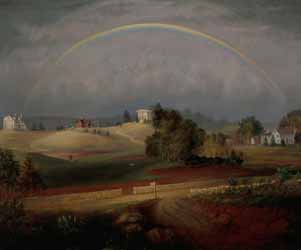
To help his students visualize the setting of the novel, Professor Wheeler contacted us to obtain a digital image of one of our two paintings of Brook Farm by Josiah Wollcott, Brook Farm with Rainbow, painted by the artist in 1845 and pictured above (his second rendering can be viewed here).


Wheeler sent us a photograph of his students in class, with the painting hung on the wall (right corner of bulletin board), for us to share with you here at The Beehive.

In addition to Wollcott’s two paintings, the Massachusetts Historical Society holds a collection of Brook Farm records and the papers of founder George Ripley, as well as memoirs, pamphlets, and other materials related to the West Roxbury utopian experiment. We also hold several early editions of The Blithedale Romance, the full text of which can be read online through Project Gutenberg, or downloaded in a variety of formats from the Internet Archive.


Stephen Greenleaf Bulfinch Diary, Post 20

By Elaine Grublin

The following excerpt is from the diary of Stephen Greenleaf Bulfinch.

Sunday, Feb. 15th, 1863

I should have recorded in my last entry that two of my young friends, – the Weymouths, – were taken prisoners at Galveston, with others from this neighborhood. The war continues, & there is some reason to fear that insubordination at the Northwest may complicate the evil. God have our country in His holy keeping!

Sunday, Feb. 22d, 1863

 In our own town another victim of the war is buried to-day, – as one was last Sunday. The days are dark, – but ‘Deep in unfathomable mines’ etc.

Lincoln’s Early Views on Slavery

By Emilie Haertsch, Publications

Today is President Abraham Lincoln’s 204th birthday. In honor of the occasion, we examine his early, often guarded, views on slavery. In a letter to his close friend Joshua Fry Speed, Lincoln reveals his personal beliefs prior to his presidency and the Civil War.

Speed and Lincoln met in 1837 when they became roommates, living above the store that Speed co-owned in Springfield, Illinois. Both men were from Kentucky, and they worked together to grow the Whig Party in the Springfield area.

Lincoln wrote this letter to Speed on 24 August 1855. At the time, the North and South were reaching a crisis over the issue of slavery in the United States. Senator Stephen A. Douglas of Illinois had introduced the Kansas-Nebraska Bill, which proposed allowing the new territories to determine the legality of slavery within their borders by popular sovereignty. This undermined the Missouri Compromise of 1820 and created the potential for an unbalanced relationship between the number of free and slave states.

In reference to his feelings about slavery, Lincoln mentions a river trip he and Speed took in 1841. They encountered a group of slaves on the boat, and it made a lasting impression on Lincoln. He writes:

You may remember, as I well do, that from Louisville to the mouth of the Ohio, there were, on board, ten or a dozen slaves, shackled with irons. That sight was a continual torment to me; and I see something like it every time I touch the Ohio, or any other slave-border.

Speed and Lincoln did not agree about the Kansas-Nebraska Bill or slavery in general, but Lincoln felt no qualms about addressing their differing viewpoints. He continues:

It is hardly fair for you to assume, that I have no interest in a thing which has, and continually exercises, the power of making me miserable. You ought rather to appreciate how much the great body of the Northern people do crucify their feelings, in order to maintain their loyalty to the Constitution of the Union. I do oppose the extension of slavery, because my judgment and feelings so prompt me; and I am under no obligation to the contrary. If for this you and I must differ, differ we must.

Despite their divergent views, Lincoln signed the letter, “Your friend forever A. Lincoln.” And they did remain friends – even through the divisive Civil War.

Want to learn more about birthday boy Lincoln? Two exhibitions currently on display at the MHS explore his life and work: “Lincoln in Manuscript and Artifact” and “Forever Free: Lincoln and the Emancipation Proclamation.” In addition, this online gallery features Lincoln-related artifacts from the Society’s collections.


This Week @ MHS

By Dan Hinchen

After the big storm this weekend, stop by the MHS this week to shake off the snow and enjoy some great public programs!

Kicking the week off, on Monday, 11 February 2013, the Society will host “Lincoln & Liberty, too.” In this program Mr. William Martin, author and MHS Fellow, will discuss the causes that led to the Emancipation Proclamation and, eventually, the passage of the 13th Amendment. Using Lincoln’s two inaugural addresses as bookends, Mr. Martin examines the transformation of Lincoln from a sober Constitutional lawyer to a near-messianic figure. This even is free and open to the public at no cost. Registration is required. Please click here to RSVP or contact the Education Department at (617)646-0560 or education@masshist.org.

On Tuesday, 12 February 2013, join us at 5:15pm for one of our Environmental History Seminars. Ben Cronin, University of Michigan, presents “To Clear the Herring Brook: Fluvial Control, Common Rights, and Commercial Development in Plymouth County, Massachusetts, 1660-1860.” Here, Mr. Cronin scrutinizes the towns of Plymouth County, especially Pembroke and Middleboro, to show how political, economic, and even military power flowed from effective control of waterways. Comment provided by William F. Hanna III, author of A History of Taunton, Massachusetts. Subscribe to receive advance copies of the seminar papers. This seminar is free and open to the public. RSVP required.

The week then quiets down a bit until Saturday, 16 February 2013, when we host yet another of our free building tours. Join us at 10:00am for The History and Collections of the MHS. This roughly 90-minute tour exposes visitors to all of the Society’s public rooms and touches on the art, collections, and history of the MHS. Tours are free and open to the public. No reservation required for individuals and small groups. Parties of 8 or more should contact the MHS prior to attending a tour. For more information, please contact Curator of Art, Anne Bentley, at (617)646-0508 or abentley@masshist.org.

Finally, if you plan to visit the MHS next week, be aware the Society will be closed on Monday, 18 February 2013, in observance of the President’s Day holiday and will resume normal operating hours on Tuesday, 19 February.