
By Anna J. Cook, Reader Services
On Wednesday, 3 October, research fellow Lauri Coleman from The College of William and Mary, gave her brown-bag lunch talk, “ ‘Some are Weatherwise, Some are Otherwise’: Popular Almanacs and Weather Cosmology in Mid-eighteenth Century America.” Coleman’s dissertation research explores how mid eighteenth-century New Englanders, from the 1740s to the 1780s, experienced and made sense of the weather generally and natural disasters such as draughts and earthquakes in particular. New Englanders during this period experienced the weather in two distinct yet interconnected ways: “providentially” (as a sign of God intervening in human affairs) and through the discourse of natural philosophy, scientific observation through which divine laws might be discerned. Coleman argues that these two frameworks for understanding weather – one through which God is understood to act disruptively and violently, the other through which God is seen to act benevolently and in an orderly fashion – exist together in collective consciousness throughout the period. In the face of natural disasters, these two interpretations were often pitted against one another in public discussion (in newspapers and sermons, for example) as citizens attempted to make sense of the event.
The Cushing Academy Fellowship in Environmental History — one of the 20 short-term research fellowships offered by the MHS — is supporting Coleman’s work at the MHS this fall, where she is reading through our extensive collection of interleaved (annotated) almanacs and diaries. Almanacs, Coleman explained, are particularly useful as a window into understanding how eighteenth-century New Englanders understood “usual” weather, what type of records they kept about everyday weather, and what use they made of that documentation (if any) over the course of their lives or across generations. They are also unusual for surviving eighteenth-century records in that, while still relatively elite, the authors of annotated almanacs represent a broader cross-section of society than the typical manuscript or print materials that have been preserved from the period. Coleman has found two collections of particular interest during her residency thus far: the Experience Wight Richardson diaries (1728-1782) and the Samuel P. Savage interleaved almanacs (1770-1795). Richardson’s diaries, which record her spiritual struggles and relate her faith experiences to weather events, are unusual in being kept by a woman. Few eighteenth-century New England women’s diaries have survived, and fewer still deal so directly with the cosmology of weather. A farmer, Samuel P. Savage used the almanacs, particularly the information they provided on the phases of the moon, to plan his management of crops and animals.
During the discussion that followed Coleman’s presentation, attendees raised questions about the motives of those documenting the weather – were they hoping to forecast the future? Did they change their behaviors in relation to the weather based on their records of the past? They also explored what is historically particular about weather cosmology in the eighteenth century, and whether Coleman’s project might benefit from comparison to earlier and later periods (possibly beyond the scope of a single dissertation!).
We wish Lauri Coleman the best as she continues her research at the MHS and then returns to The College of William and Mary to complete her dissertation.
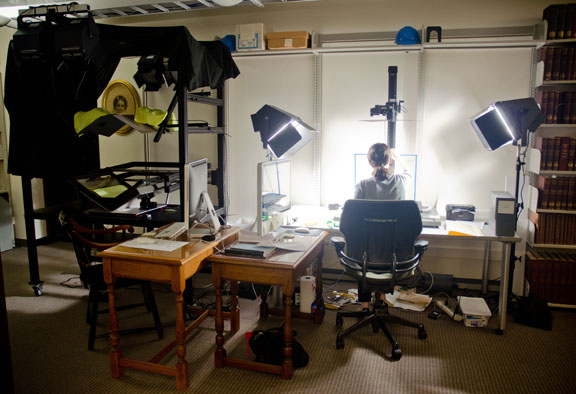 to supply somewhere in the neighborhood of 55,000 manuscript pages to a forthcoming multi-archive digital publication, China, America and the Pacific: Trade and Cultural Exchange. Adam Matthew has contracted, in turn, with Luna Imaging in Los Angeles to do the scanning. In late August, Luna shipped all of the equipment shown here and sent a representative to install and test it and train a scanning technician. The technician, shown here, is now hard at work scanning correspondence, account books, ships’ logs, and letterbooks from multiple collections, including the extensive Forbes Family Papers. Other highlights of the final product, scheduled for release in late 2013, will include the manuscript of Richard Henry Dana’s seminal work, Two Years Before the Mast, and Robert Haswell’s log of the Columbia-Rediviva, the first vessel to circumnavigate the globe
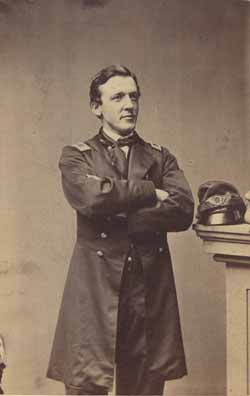 to tell portions of the story. MHS materials feature prominently in two segments of the film. In the segment “Dying” a letter written by Wilder Dwight to his mother Elizabeth Dwight (