The New Riding Club of Boston

By Daniel Hinchen, Reader Services

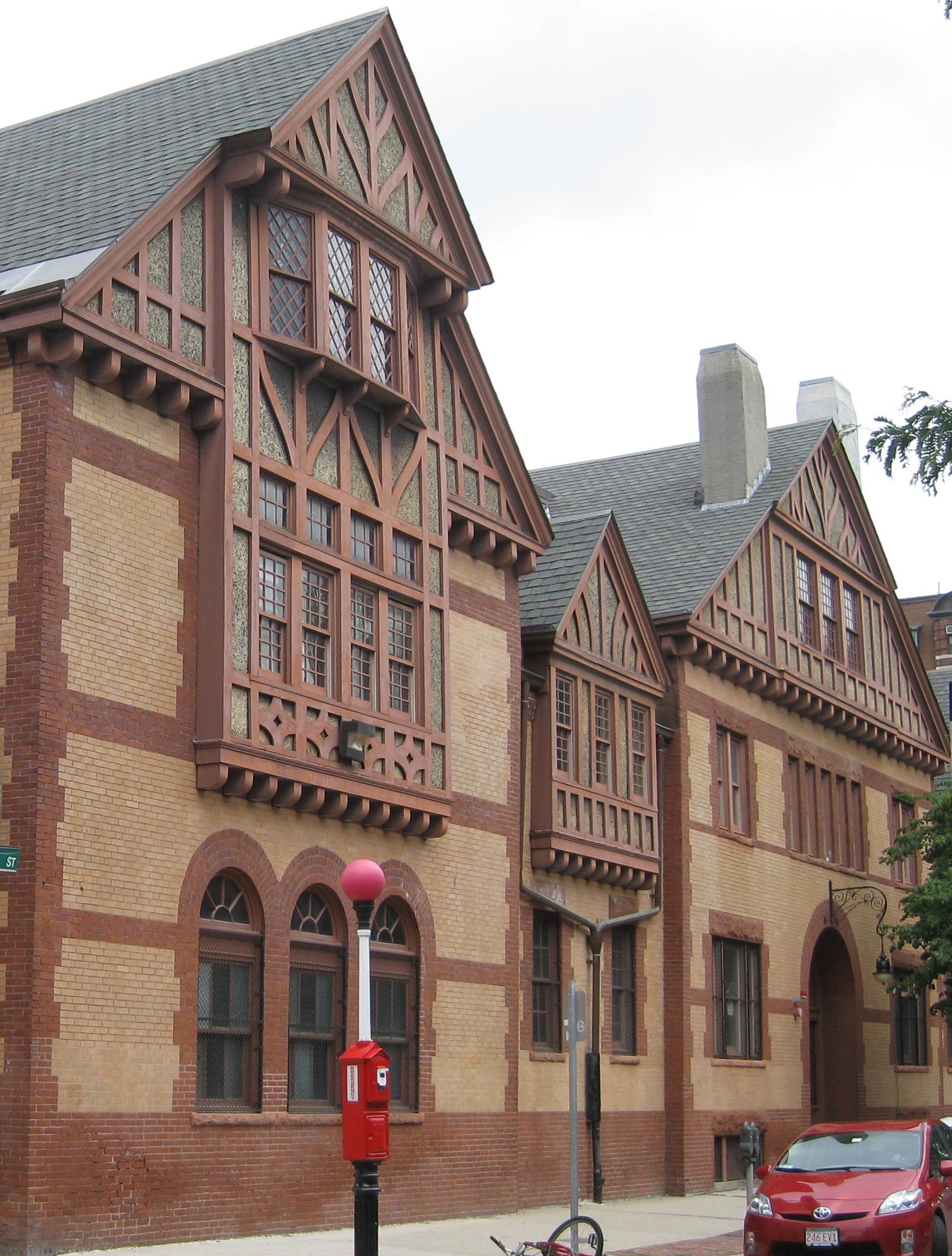
The Boston area is known for some very famous examples of architecture. Photograph of 52 Hemenway Street, front of buildingJust think of the variously colored steeples that dot the campus of Harvard in nearby Cambridge; the golden dome of the State House; and of course, the grand brownstones that line Newbury and Beacon Streets and Commonwealth Avenue. One architectural style that is not well represented in Boston, though, is the Tudor Revival style. And yet, just around the corner from the MHS, among the rows of stone and brick apartment buildings, is a fine example of that style.
At 52 Hemenway Street there stands a three-storied building with a steeply pitched roof, high chimneys, dormer windows, and just a touch of the half-timbered feature that makes the Tudor Revival style so noticeable. While it may be missing the herringbone brickwork and mullioned windows of most structures in this style, it is nonetheless distinguishable as a Tudor Revival building.

The building has served as a home to two very different organizations. And while it may look out of place in its neighborhood, it has been standing for 120 years and has a spot on the National Register of Historic Places.

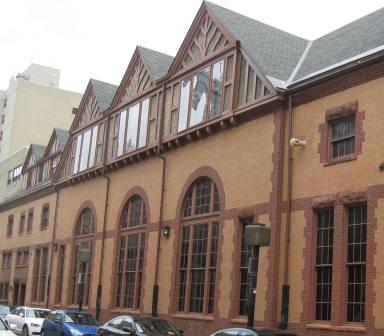
Designed by Willard T. Sears, 52 Hemenway was first home to the New Riding Club of Boston. Photo of side of 52 Hemenway StreetA quick look at the building’s exterior shows one repeated feature that hints to its original use: around the building are several large portals — some arched — resembling modern-day garage doors giving the viewer the impression of stables. 

Built in 1891, it allowed for easy access to the bridle paths in the nearby Back Bay Fens, which had recently been completed by Frederick Law Olmsted. Inside the building there were several stables for horses, as well as a riding ring. It retained this make-up until 1934 when it was acquired by the Badminton and Tennis Club.* After the take-over, the riding ring was converted to tennis courts. Finally, in 1985 the remaining stables were converted into residential apartments.

The MHS does not hold  much original material relating to either of these organizations in our collections. We do hold original copies of the published by-laws and rules of the New Riding Club, from 1920 and 1924. Interested neighbors may view these items in our library.


*The Badminton and Tennis Club is affiliated with the Boston Tennis and Racquet Club whose home is in the Back Bay at 939 Boylston St. which was built in 1902 and contributes to the area’s designation as a National Register Historic District.


This Week @ MHS

By Elaine Grublin

There is much happening at the MHS this week. Be sure to check out our online calendar for more information about these and other upcoming programs. 

Do not miss your chance to learn more about the fenced in gardens on the Fenway and to join in celebrating the 70th anniversary of the Fenway Victory Gardens.  Tuesday, 5 June, join us at 1154 Boylston Street to view items from the Fenway Garden Society’s collections, held by the MHS, and to stretch your legs with a walk through the gardens. This program is co-sponsored by the Fenway Garden Society

Wednesday, 6 June, at noon join us for a Brown-bag lunch program. Researcher Jared Hardesty, Boston College, will present his project The Origins of Black Boston, a project that examines the formation of a slave community in pre-Revolutionary Boston and argues that historians have overstated the significance of freedom as a motivating factor for slaves. Come listen to Jared’s presentation, and then join in the Q & A session.

Saturday, 7 June, stop in for our tour “The History and Collections of the MHS.”  The 90-minute guided tour departs the front lobby promptly at 10:00 AM. 


Stephen Greenleaf Bulfinch, Post 14

By Elaine Grublin

The following excerpt is from the diary of Stephen Greenleaf Bulfinch.

Thursday, June 19th, 1862

Of public events the chief worthy of record is the sudden irruption of the rebel force into central Virginia, occasioning the retreat of Gen. Banks, & an instant rally to arms in this state and elsewhere. The first personal acquaintance I have lost in this war (as far as I yet know) was killed in the encounter, at Port Royal, with Jackson’s Force, – Capt. Wm. P. Ainsworth of Nashua, a fine young man of my former parish.

Come back to read Bulfinch’s July entry where he reflects on the increasing loss of life in battle and Lincoln’s call for 300,000 new volunteers. 

A Boylston Family Mystery

By Susan Martin, Collection Services

Boylston Street, the address of the MHS, is named for Boston philanthropist Ward Nicholas Boylston (1749-1828). No full-length biography of Boylston has been written, but what we know about his life is intriguing. He was born Ward Nicholas Hallowell and changed his surname in 1770 as a condition of his inheritance from his uncle. Although he was a Loyalist during the American Revolution and lived in London between 1775 and 1800, his first wife was the daughter of an American revolutionary, and his second cousin was President John Adams. He was estranged from his oldest son Nicholas (for unknown reasons) and bequeathed him a small annuity in his will…as long as Nicholas never returned to live in Massachusetts.

 Now, staff here at the MHS have come across another Boylston family plot twist.

One of the editors on the Adams Papers Editorial Project recently found what seemed to be an error in a footnote: the birth dates of Ward Nicholas Boylston’s two younger sons. Records indicate that Thomas and John Lane Boylston were born in 1785 and 1789, respectively. However, Boylston’s first wife Ann died in 1779, and he didn’t re-marry until 1807. So who was the mother of Thomas and John?

The most likely explanation was that one of the dates was wrong. But a careful look through the MHS collection of Boylston family papers confirmed that Ann (Molineux) Boylston died in 1779 on a voyage to America, and that Ward married Alicia Darrow, or Darrham, at Boston’s Trinity Church in 1807. Had he been married in London during the intervening years? If so, we have no record of it.

One letter in the collection suggests an answer to the mystery. The letter was written by Robert Bentham, the uncle of Boylston’s grandson Henry, on 23 Mar. 1840. It relates to Henry’s inheritance.

My nephew claims an Interest in this property as the only surviving Son of Nicholas Boylston (now deceased) the eldest Son (indeed the only lawful Son) of Ward Nicholas Boylston…. I pass over the doubt which exists & has for many years existed, as to the marriage of the present Mrs. [Alicia] Boylston (the styled widow of Ward Nicholas Boylston) or the legitimacy of her children. When I first became personally acquainted with the family she went by the name of Davis. All her elder children went by the name of Davis…. The fact was notorious in the neighborhood.

On this statement various & important questions must of course arise, which I shall not be so indelicate to propose, & far less to obtrude an observation on, or answer thereto….

His implication is clear. Assuming that Thomas and John were Alicia’s sons, they were born before she was Boylston’s lawful wife. It’s possible that Alicia had been previously married, to a Mr. Davis, but Bentham had no knowledge of it.

The historical record is often fragmentary and misleading, and we may never know the truth behind Bentham’s claims. Unfortunately, the Boylston collection contains very little personal correspondence between the family members directly involved. A thorough search through the papers of Boylston’s contemporaries might shed some light on the subject. I’m told Louisa Catherine Adams had an appetite for gossip. Maybe one of our intrepid researchers will take up the challenge…?

New Biography Illuminates Life of Clover Adams

By Emilie Haertsch, Publications

For all the importance and notoriety of Henry Adams’s book The Autobiography of Henry Adams, it contains one glaring omission: Henry’s wife Clover Adams is not mentioned once. Natalie Dykstra’s new biography, Clover Adams: A Gilded and Heartbreaking Life, attempts to rectify this by shedding light on the life and work of a remarkable 19th-century woman. This is no dry, esoteric biography, but an engaging, enjoyable read for the scholar or layperson alike.

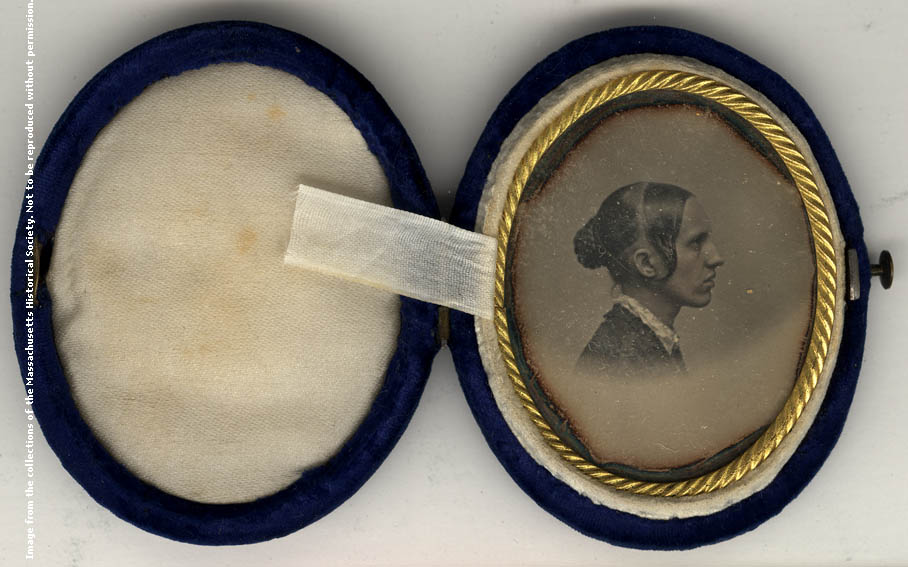
Marian Hooper Adams was nicknamed “Clover” by her mother, who felt that her daughter’s birth was a lucky occurrence. Born into a wealthy, prominent Boston family, Clover was raised in privilege and highly educated. Her mother died when she was five, but Clover remained very close to her father for the rest of her life. In 1872, at the age of 28, she married the historian Henry Adams, who was teaching at Harvard. After five years they moved to Washington, DC, residing near the White House, and began hosting an exclusive salon of politicians, writers, and thinkers. Despite this stimulation, Clover and Henry were bored, and the spark went out of their marriage. Their problems intensified due to the fact that they were unable to have children.

Clover had always been interested in art and she found an outlet for her frustrations in a new camera in 1883. She learned the painstaking development process and began to take photographs of people, landscapes, and animals (she was a great lover of dogs and horses). Although a few of her photographs show traces of humor, including those of her dogs posed at a table set for tea, many of Clover’s photographs convey the melancholy and isolation of her own experience.

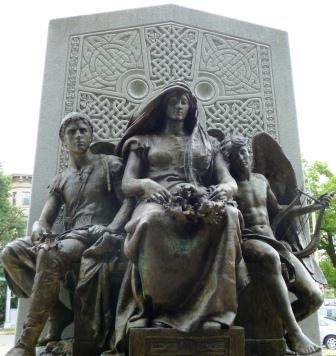
In the spring of 1885, Clover’s father died, and her emotional state worsened. In December of that year she took her own life by drinking a chemical used in processing photographs. She was 42 years old. Although Henry Adams rarely spoke of his wife after her death, he commissioned the sculptor Augustus Saint-Gaudens to produce a memorial at her gravesite in Rock Creek Cemetery. Saint-Gaudens created a sculpture of a mysterious shrouded, seated figure, which still receives many visitors today and helped inspire Natalie Dykstra to begin researching this book.

Dykstra is an associate professor of English at Hope College in Holland, MI, and she received a National Endowment for the Humanities fellowship for her work on Clover Adams. A Fellow of the Massachusetts Historical Society, Dykstra did much of the research for her book at the Society, and she guest-curated the Society’s current exhibit, A Gilded and Heartbreaking Life: The Photographs of Clover Adams. The exhibit is free and open to the public and runs through June 2nd.

Excursion to the Pacific: Rail Travel Then and Now

By Andrea Cronin, Reader Services


On 23 May 1870, the first transcontinental train left Boston for San Francisco. Here are a few of George Gordon Byron DeWolfe’s words celebrating its departure, as captured on a broadside held by the MHS:

The train left St. James Park in the “Hub,” also known as Boston, on a Monday morning at a quarter past nine o’clock. The eight-car train arrived in San Francisco on Saturday, 28 May, but the entire trip lasted approximately 39 days. The group returned to Boston on 2 July 1870.

What a train ride! Consider it against modern rail travel. In the present, you can travel via train from Boston to San Francisco in approximately 86 hours (3.5 days), which excludes wait time at stations. Boston-San Francisco is approximately 3,000 miles or a 50-hour drive via car. A 6-day journey in 1870 – that’s pretty good timing for the first transcontinental train! Some of you readers are, no doubt, thinking, “Why do that now when you can just fly?”

But there is something so captivating about trains. George Pullman, inventor of the Pullman sleeping railcar, designed this eight-car train for the journey. The train cars included the following: a baggage car, a smoking car, two commissary cars (the St. Charles and the St. Cloud), two hotel and drawing room cars (the Revere and the Arlington), and two saloon cars (the Palmyra and the Marquetta). Note to Amtrak: start naming the train cars things like Revere, Arlington, Boylston, Fenway, etc. Those names are much more appealing than train car no. 2106. The café car could be named Batali, Lagasse, or Oliver! Although that may be a little misleading; microwaved hot dogs are not haute cuisine. This train was clearly finely-made and comfortable for travel, as DeWolfe mentions.

So who was aboard this tricked-out train? Members of the Boston Board of Trade and their families made this journey, spending a few weeks in California. They planned to visit Yosemite National Park, and the itinerary for the return journey included  stops in Salt Lake, Omaha, Chicago, and Niagara. Among the families on board were well-known names in the Boston area like Peabody, Forbes, Houghton, Rice, Prentiss, Dana, Farnsworth, Hunnewell, Warren, and many more. The list of passengers on the broadside suggests approximately 125 persons traveled on this train. If that sounds a little crowded to you, just think of the commuter rail in rush hour. Eight cars for 125 people sounds spacious in comparison.

If you’d like to find out more about this particular journey, transcontinental railways, or rail travel in Massachusetts, please visit our online catalog, ABIGAIL. The broadside shown here is the “Excursion to the Pacific” by George G. B. DeWolfe. Plan a visit to the library to view it in person.


A Classroom with an Ocean View

By Kathleen Barker, Education Department

Summer is an exciting season for the MHS education department. Over the next three months, hundreds of teachers from nearly 40 states and the United Kingdom will visit the Society to take part in workshops on topics including the American Revolution, anti-slavery and abolition efforts, 19th-century immigration, and American imperialism. Many of these programs also include excursions to local landmarks like Faneuil Hall in the heart of Boston or the Old North Bridge in Concord. One particular workshop, however, will take participants to a stunning seaside setting: the new Thomas Jefferson Memorial Center at Coolidge Point in Manchester, Massachusetts.

In this workshop, participants will explore the challenges faced by the new nation in the years after the American Revolution. They will examine five sets of documents selected from the Society’s collections that shed light on key issues, including the rights and responsibilities of a new government, the needs of a diverse citizenry, slavery, women’s roles, and America’s relationship with the world. For example, using sources such as Thomas Jefferson’s draft of the Declaration of Independence and the correspondence generated by St. George Tucker’s Queries on Slavery in Massachusetts, teachers can analyze the ways in which America’s founding mothers and fathers attempted to negotiate the complex issue of slavery and its place in the new republic.

A $50 registration fee covers three lunches, one dinner, and all snacks. All materials, instruction, and admissions are included. Participants will receive 30 Professional Development Points, as well as the opportunity to earn graduate credit at Framingham State University. For more information, please contact the education department at education@masshist.org or (617) 646-0557.

A Yankee in King George’s Court

By Amanda A. Mathews, Adams Papers

This year Great Britain celebrates Queen Elizabeth II’s Diamond Jubilee year, and here at the Adams Papers our forthcoming volumes, Adams Family Correspondence, Volume 11 and Papers of John Adams, Volume 17, provide a glimpse at America’s earliest diplomatic meetings with the monarchy.

On June 1, 1785, John Adams entered the Court of St. James for a private audience with King George III. He made three bows and presented himself as the first minister of the newly independent United States. After a moving exchange of formalities, the king mentioned the rumor that Adams was not particularly fond of France. Adams found the perfect reply that neither praised nor insulted France or England. “I must avow to your Majesty, I have no Attachments but to my own Country.” To which the King replied “An honest Man will never have any other.” After the encounter, Adams confidently reported to Congress, that he had been treated precisely as all other foreign ministers were.

Ten years later John Quincy Adams, sent by Congress on a special errand over from The Hague, was led through the same procedures of etiquette for his audience. He recorded his experience in his diary. When asked by King George if it was his father who was currently governor of Massachusetts (that was Samuel Adams), Adams, no doubt with a bit of pride, replied, “No Sir, he is Vice-President of the United States.”

These events, full of pomp and circumstance, are illustrative of the complicated view Americans have of the monarchy, which they find both absurd and fascinating. The difficulty of embracing this unique opportunity without getting caught up in the extravagance is evident in the Adamses’ writings. Abigail Adams, for example, though fatigued by the occasion, nevertheless paid close attention to the details, as she described the ceremony of her own presentation at Court to her sister. Such sentiment seems to have become a staple in American life. The mixture of excitement and cynicism with which Americans met last year’s wedding of the Duke and Duchess of Cambridge (better known as William and Kate) reveals the likelihood that our conflicted sensibilities regarding monarchy are also not going away soon.

2012-2013 Research Fellows Announced!

By Elaine Grublin & Kate Veins

Each year the MHS grants a number of research fellowships to scholars from around the country. For more information about the different fellowship types, click the headings below. 

Our fellowship programs bring a wide variety of researchers working on a full range of topics into the MHS. If any of the research topics are particularly interesting to you, keep an eye on our events calendar. All research fellows present at brown-bag lunch programs as part of their commitment to the MHS.

MHS Short-term Fellowships
African-American Studies Fellowship
Heather Cooper, University of Iowa
“Representing the Race: African American Performances of Slavery and Freedom in the Nineteenth Century”

Alumni Fellowship
Lauri Coleman, William and Mary
“Interpretations of New England Weather in the Revolutionary Era”

Andrew Oliver Fellowship
Katelyn Crawford, University of Virginia
“Mobility and Portrait Painting in the Late Eighteenth-Century British Atlantic World”

Andrew W. Mellon Fellowship
Frances Clarke, University of Sydney                                                                           
“Minors in the Military: A History of Child Soldiers in America from the Revolution to the Civil War”                                                                  

Eberhard Faber, Princeton University
“‘Everybody Talks of Visiting That Country’: New England Reactions to the Louisiana Purchase, Territorial Rule, and Louisiana Statehood, 1803-1812”

Michael Hevel, University of Iowa
“‘Betwixt Brewings’: A History of College Students and Alcohol”

Ann K. Johnson, University of Southern California
“Cabinets of Miscellany and Meaning: Managing Information in Antebellum America”

Greta LaFleur, University of Hawai’I at Manoa
“American Insides: Popular Narrative and the Historiography of Sexuality, 1675-1815”

Jen Manion, Connecticut College
“Crossing Gender; Female Masculinity in the 18th and 19th Centuries”

Brooke Newman, Virginia Commonwealth University
“Island Masters: Gender, Race, and Power in the Eighteenth-Century British Caribbean”

Benjamin Park, University of Cambridge
“Localized Nationalisms in Post-Revolutionary America”

Brad Snyder, University of Wisconsin
“The House of Truth: The Men Who Created Modern Progressivism”

Benjamin F. Stevens Fellowship
Sarah Sutton, Brandeis University
“Industrializing the Family Farm: Dairy Farming, Milk Consumption, and the New England Landscape”

Cushing Academy Fellowship in Environmental History
Jennifer Staver, University of California Irvine
“Energy, Work, and Power along the Pacific Coast of North America, 1768 to 1820” 

Malcolm and Mildred Freiberg Fellowship
Katherine Grandjean, Wellesley College
“‘Terror ubique tremor’: Communicating Terror in Early New England, 1677-1713”

Marc Friedlaender Fellowship
Rick Kennedy, Point Loma Nazarene University                                                          
“Cotton Mather Biblia Americana Volume 8”

 Massachusetts Society of the Cincinnati Fellowship
Holger Hoock, University of Pittsburgh
“Scars of Independence: Practices and Representations of Violence in the American Revolutionary War”

Ruth R. & Alyson R. Miller Fellowship
Bonnie Lucero, University of North Carolina Chapel Hill                                            
“Privates, Prostitutes, and Pardos: Women and Racial Conflict in Cienfuegos, Cuba, circa 1898”

Lindsay Moore, Boston University
“Women, Power, and Litigation in the English Atlantic World, 1630-1700”

W. B. H. Dowse Fellowship
Nichole George, University of Notre Dame
“Riots and Remembrance: America’s Idols and the Origins of American Nationalism”

Reiner Smolinski, Georgia State University
“Cotton Mather: The Life of a Puritan Intellectual”

Suzanne and Caleb Loring Fellowship
Ann K. Holder, Pratt Institute
“‘Making the Body Politic’: Sexual Histories, Racial Uncertainties and Vernacular Citizenship in the Post-Emancipation U.S.”

MHS-NEH Long-term Fellowships
Megan Bowman, University of California Santa Barbara
“Networking for Global Perfection: The International Dimension of Nineteenth-Century Fourierism”

 Kristen Collins, Boston University School of Law
“Entitling Marriage: A History of Marriage, Public Money, and the Law”

Matthew Dennis, University of Oregon
“American Relics and the Material Politics of Public Memory”

Martha Hodes, New York University
“Mourning Lincoln: Personal Grief and the Meaning of the American Civil War”

New England Regional Fellowship Consortium Fellows
*Denotes scholars whose itineraries include the MHS

Kelly Brennan Arehart, College of William and Mary
“Give Up Your Dead: How Business, Technology, and Culture Separated Americans from their Dearly Departed, 1780-1930”

Justin Clark, University of Southern California*
“Training the Eyes: Romantic Vision and Class Formation in Boston, 1830-1870”

Michael Cohen, Tulane University
“Jews in the Cotton Industry: Ethnic Networks in 19th Century America”

John Dixon, Harvard University*
“Found at Sea: Mapping Ships’ Locations on the Eighteenth-Century Atlantic”

Moira Gillis, University of Oxford*
“The Unique Early Modern American Corporation”

Jared Hardesty, Boston College*
“The Origins of Black Boston, 1700-1775”

Benjamin Hicklin, University of Michigan Ann Arbor*
“‘Neither a Borrower nor a Lender Be’?: The Experience of Credit and Debt in the English Atlantic World, 1660-1750”

Allison Lange, Brandeis University*
“Pictures of Change: Transformative Images of Woman Suffrage, 1776-1920”

Jason Newton, Syracuse University
“Forging Titans: Myth and Masculinity in the Working Forests of the American Northeast, 1880-1920”

Ana Stevenson, University of Queensland*
“The Woman-Slave Analogy: Rhetorical Foundations in American Culture, 1830-1900”

Gloria Whiting, Harvard University
“‘Endearing Ties’: Black Family Life in Early New England”


Anatomy of a Pun: 1813 Edition

By Emilie Haertsch


Humor, like beauty, is in the eye of the beholder. This colorful broadside will be featured in the MHS’s upcoming War of 1812 exhibition, Mr. Madison’s War, which opens on June 18. A broadside such as this would have been posted on the side of a building or kept for home consumption by a patriotic family. In its day, it would have been considered as funny – and meaningful – as our contemporary newspaper’s political cartoons or television news spoofs such as The Colbert Report. But without context, a great deal of this broadside’s wit could be lost to today’s reader.

With the title “Huzza for the American Navy,” the picture features a heavyset man in uniform. Two winged insects sting him on either side as he runs, brandishing his sword, to get away. They are on the beach, and two ships are visible at sea in the background. The caption below reads, “John Bull stung to agony by the Wasp and the Hornet.”

The man is “John Bull,” the personification of Great Britain, and his uniform is hand-painted in scarlet. The “Wasp” and the “Hornet” refer to American ships that won victories over Britain early in the War of 1812. USS Wasp defeated HMS Frolic on October 15, 1812, and USS Hornet sunk HMS Peacock on February 24, 1813.

The first insect says, “You’ll bridge the Atlantic, won’t you? Oh then you’ll have a Bane to your Bridge, friend Johnny.” The use of “Bane” and “Bridge” refers to William Bainbridge, who was captain of USS Constitution when it captured HMS Java on December 29, 1812.

John Bull replies, “Are these your Wasps and Hornets! Oh! I’m Hull’d already!!” “Hull” was Isaac Hull, who commanded USS Constitution during an earlier cruise when it defeated HMS Guerrière on August 19, 1812.

The second insect says, “How comes on your Copper-bottom at Bombay? Here is something for you between Wind and Water.” “Copper-bottom at Bombay” appears to be a taunt. When the Constitution defeated and then destroyed the Java off the coast of Brazil, the Royal Navy frigate was transporting the new commander-in-chief of British forces in India, Sir Thomas Hislop, to Bombay, along with copper to sheath the hull of a new 74-gun ship. Copper sheathing prevented a ship from being slowed by marine growth on its hull over the course of a long voyage. The loss of the Java and its cargo of copper delayed the completion of HMS Cornwallis.

“Between Wind and Water” denotes the way sailing ships engaged in battle. They aimed their cannons for the opponent vessel’s waterline, to “hull” it. A hit there was likely to do the most damage because a ship’s waterline rose and fell as wind and waves rocked the ship. But it also works as a double entendre, with the insect stinging John Bull between where he created “wind” and “water – as does the word “Bombay.”

Although this broadside has no inscription, due to the timely nature of its content it likely was printed in March or April of 1813, soon after the Hornet returned from its victory over the Peacock off of the coast of Guyana. The Hornet anchored at Holmes’ Hole in Martha’s Vineyard on March 19, 1813.

Some of the jokes hidden inside this broadside we will likely never know, but a little bit of context provides insight not just into the events of the war but also into what made Americans laugh in 1813, when the pun was the epitome of wit.

To see more documents from the Society’s collections related to the war, as well as more information about our upcoming exhibition and other planned events in the Boston area, please visit our War of 1812 web feature.