
“Appears Frank but Has Not Much Feeling”: Criminality, Sensibility, and the Carceral System in the Jared Curtis Notebooks

By Anne Boylan, Library Assistant

“Parents died when he was 5 ys old. Was bound out. No education of any consequence. Can read but not write. Born in Boston & has lived there and in vicinity most of his life. Work’d at Brickmaking, teaming, &c. &c. Never married. Says he has always work’d hard. First ofence. Been here 2 months. Sentence 9 months.

“Says he has drink’d too freely & that has brot him here. Stole 3 pints of Rum. Wept very freely. Says he can now see his folly and hopes this confinement will be a warning to him. Appears very well.”

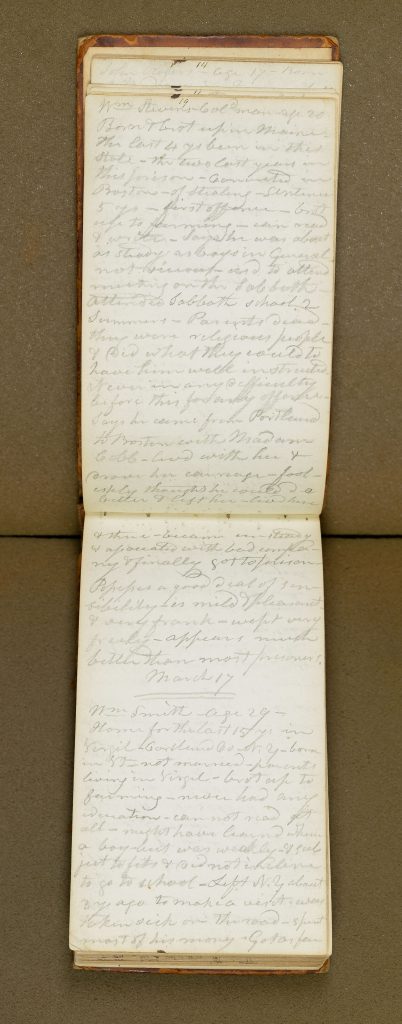
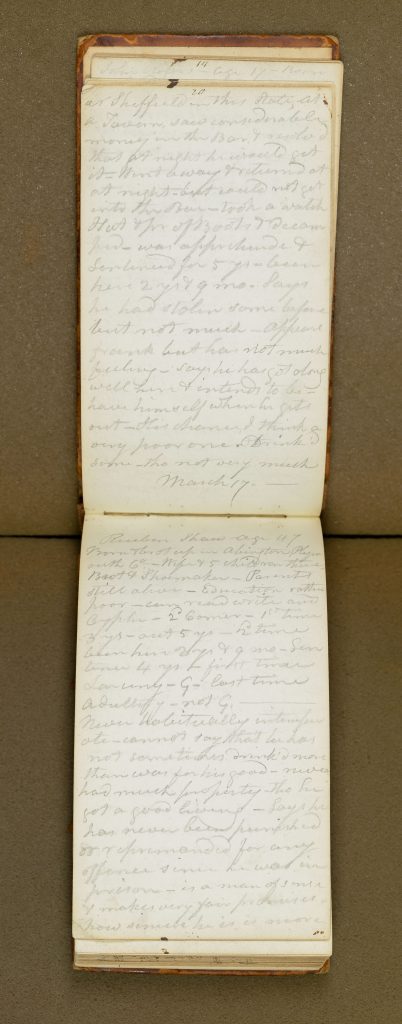
So prison chaplain Jared Curtis described Edward Butler, a 27-year-old inmate at the Massachusetts State Prison in Charlestown, on April 1, 1829. This description and other brief biographical sketches of nineteenth-century incarcerated men fill the Jared Curtis notebooks, 1829-1831, which provide a tantalizingly limited but invaluable view into the lives of populations so frequently excluded from the historical record, such as incarcerated people and, in many cases, the poor, the illiterate, and people of color.

open notebook with handwritten pencil notes

Jared Curtis also recorded these sketches at a particularly pivotal moment in the history of the carceral system. As Philip F. Gura wrote in Buried from the World: Inside the Massachusetts State Prison, 1829–1831, the 1820s saw a shift in the goal of prisons away from punishment and toward reform of the incarcerated. This is not to say that prisons necessarily became kinder or gentler places; this so-called reform was achieved through hard work and extreme isolation, thought to provide the incarcerated person with the proper environment for contemplation and to instill the discipline presumed to have been lacking in their upbringing. While previously, corporal punishment served as both the means and the end of prison, the hard labor and social isolation now became not punishment, but personal improvement. The method, pioneered at Auburn Prison in New York and referred to as “the Auburn system,” prohibited:

“the writing or receiving of letters, even from immediate family. Prisoners could not speak to anyone in prison, even to officers . . . ‘except for purposes of instruction, or to ask for orders and make necessary reports.’” (Gura).

Silent often for the entirety of the day, isolated in their cells at night, prevented even from looking too long at other prisoners, inmates at the Massachusetts State Prison truly were, per Gura’s title, “buried from the world.”

This new emphasis on reform and penance meant that a new marker of success had to be considered to gauge its success: the inmate’s state of mind. Unlike corporal punishment, which exists solely in the physical realm, repentance is internal and can only be intuited and guessed at through outward behavior. Curtis was especially interested in the states of mind of the men whose stories he sketched. He emphasized the sensibility of inmates—not their rationality, as we now use the word to imply—but its contemporaneous meaning, signifying the prisoners’ abilities to understand and be impacted by deep emotion. Curtis felt optimistic about the prospects of Edward Butler, who “[w]ept very freely,” clearly able to access and perform a deep well of emotion under Curtis’s observation. Curtis seemed kindly disposed toward his ability to “see his folly”; his entry hints at an optimism toward Butler’s prospects for rehabilitation.

However, about W[illia]m Smith, 29, Curtis felt very differently: “Says he has stolen some before but not much. Appears frank but has not much feeling. Says he got along well here & intends to behave himself when he gets out. His chance, I think, a very poor one.” Curtis’s poor prognosis for Smith’s moral rehabilitation sits directly adjacent to his observation that he “has not much feeling,” implicitly linking Smith’s ability to feel emotion to his presumed ability to leave criminality behind. These and similar entries raise questions about Curtis’s beliefs in the prospects of his charges that echo forward into the present: can anyone empirically judge another’s moral fiber from their outward demonstrations of emotions? What other factors might cloud or impact that judgement? Who can be trusted to hold the power to determine who exhibits enough emotion, and emotion of the correct type, to demonstrate moral character?

Curtis’s notebooks are a rich vein, giving insight not only into the lives of a population otherwise largely forgotten by the official historical record, but also into the rhetorics of sentiment and penance that laid the nineteenth-century foundations for our present-day ideas around criminality, recidivism, and reform. The notebooks would be a fascinating study for those interested in the history of criminal justice and incarceration, religious instruction, and the lives of various underclasses. If you want to view the Jared Curtis notebooks, plan your visit and make an appointment to do so on the MHS website.

The Hungarian Invasion: The Celebrity of Lajos Kossuth

by Susan Martin, Senior Processing Archivist

In my last post for the Beehive, I wrote about the European revolutions of 1848. I’d like to follow up today by focusing on one particular revolutionary, Lajos Kossuth of Hungary.

Black and white engraving of a white man in an oval frame. He faces slightly to his left and has dark hair parted on the side, a mustache, and a beard. He wears a dark jacket buttoned up to his collar.
Engraving of Lajos Kossuth, Photo. 81.402b

Lajos (often anglicized Louis) Kossuth served as leader of the Hungarian revolutionary government from 1848 to 1849. I wanted to write about Kossuth because his name appears frequently in manuscript collections here at the MHS, and I was intrigued. I’ve run across him in the Channing family papers, Caroline Wells Healey Dall papers, Joseph H. Hayward papers, Theodore Parker papers, Perry-Clarke additions, Catharine Maria Sedgwick papers, and many others. Several of our autograph collections include his signature.

The MHS also holds a number of books and pamphlets about Kossuth, including Authentic Life of His Excellency Louis Kossuth, Governor of Hungary (1851); Daniel Webster’s Sketch of the Life of Louis Kossuth, Governor of Hungary (1851); Kossuth in New England (1852); and White, Red, Black: Sketches of American Society in the United States During the Visit of Their Guests (1853). We have engravings of Kossuth and even three brass gaming tokens stamped with his name and likeness. He was clearly a phenomenon.

I won’t attempt the difficult task of summarizing the Hungarian Revolution of 1848 here, but I would like to discuss Kossuth’s popularity in the US, and Massachusetts in particular. Although the revolution failed, many Americans admired and sympathized with Kossuth.

He visited the US between December 1851 and July 1852 to raise money for Hungarian independence from the Austrian Empire and to advocate for American intervention against Russia, Austria’s ally. He was feted everywhere he went. Newspaper articles filled with breathless exclamation points tracked his every move. Enterprising hatters even started selling “Kossuth hats.”

His itinerary included a meeting with President Millard Fillmore at the White House. He also addressed a joint session of Congress, only the second foreigner to do so after the Marquis de Lafayette 28 years before.

Screenshot of a portion of a newspaper article with the headline “Louis Kossuth in Boston.”
Screenshot from the Boston Daily Evening Transcript, 27 April 1852

Kossuth arrived in Boston on 27 April 1852, coincidentally his 50th birthday. His enthusiastic welcome by Bostonians is described in Kossuth in New England: “On the whole route to Roxbury line, the windows were full of ladies, who waved their welcome with their handkerchiefs, and the streets were literally crammed with people.” (p. 68) Buildings were draped with the Hungarian, American, and other flags, and banners compared Kossuth to George Washington.

By all accounts, Kossuth was a skilled and fascinating orator, and people flocked to hear his speeches. Author Catharine Maria Sedgwick heard one and later wrote to her niece, “I never had so profound an impression from the presence of any human being.” Lawyer Tracy P. Cheever gushed in his diary, “I rejoice in the privilege of having heard one of the greatest Orators and Patriots (as I suppose) of modern days!”

Of course, admiration for the Hungarian revolutionary was not universal. In the pages of The Liberator and elsewhere, abolitionists repeatedly and vociferously criticized Kossuth for his silence and hypocrisy on slavery, even after he witnessed it first-hand in the southeastern states. This issue became a dark cloud over his otherwise celebrated visit and may have contributed to his abrupt and unobtrusive departure from the country.

In the end, Kossuth left the US with donations and well wishes from supporters, but Americans had no appetite at that time for involvement in foreign conflicts.

Lajos Kossuth died in Italy in 1894 at the age of 91. He is buried in Budapest.

Love During the Siege of Boston

by Rakashi Chand, Reading Room Supervisor

The Siege of Boston (April 1775-March 1776) during the American Revolution was marked by chaos. Boston, one of the busiest cities in the colonies, became a loyalist stronghold as British troops took control, while those drawn to the American cause fled to the countryside. American troops, eventually forming into the Continental Army, surrounded the city, cutting off land access that led to food and causing supply shortages.

Amid this turmoil a young patriot named William Tudor was in love with a beautiful loyalist named Delia Jarvis. But duty and the cause called; John Adams had William appointed chief legal officer to General Washington and William left Boston with a heavy heart. But that didn’t stop him from trying to court Delia, who refused to leave her family in the besieged city, as their love turned to missives. They took on romantic pen names, she signing her letters Felicia, and he Crito.  Delia pretended to be unimpressed by William’s pursuits but that did not discourage him, nor did it ease the worries he had for dear Delia trapped in Boston. He urged her to come out and guaranteed her safe passage, but she refused to go, worrying about the health and wellbeing of her family. The pain William must have felt looking at Boston aching for his ‘Felicia’ as the siege intensified.


Excerpt of Delia Jarvis to William Tudor, 3 August 1775

I sincerely wish to see you, I hope you are not yet Metamorphised into a Soldier. I am sure it will be a moral absurdity the Philosopher wou’d sit more natural, therefore I am in hopes that you will not oppose nature in her wise design by quitting a sphere which you illuminate, for one in which you may be eclipsed. It is probable we may come out soon when I flatter myself I shall drink tea Coffee in some fine Arbour of your own entwining, not in a tent, in either case I am my worthy Rebel,

Your Loyal
Friend
Felicia

handwritten letter
Letter by Delia Jarvis excerpted above

Excerpt of William Tudor to Delia Jarvis, 10 August 1775

You appear inclin’d to make an Excursion into the Country, provided you could get back again to Boston. If you will come, I will venture to insure you Permission to return, from Head Quarters here. You are best acquainted with the Difficulty on your Side. There can be none of your Friends who would not be happy to see you, & among them I presume you will think me not the least so, on such an Occasion.

Should the Family remove, I will ask the Favour of Felicia to bring with her 3 or 4 Manuscript Books, which I left in my writing Desk; providing she can do it . . . .

Adieu my amiable Loyalist & be assur’d that though deem’d a Rebel in Politicks, I am a true Subject to Friendship. To that I mean which you have permitted me to cultivate; For as my Esteem for you was founded on Qualities, which Time can no otherwise affect, than to improve. It cannot cease but with the Life of Crito

handwritten letter
First page of the letter by William Tudor excerpted above

The Siege of Boston continued until the spring of 1776, but William and Delia maintained their secret correspondence throughout. According to family lore, when word came that Delia had escaped to Noddle’s Island, Wiliam swam across the bay to see her with his clothes on his head. Perhaps it was that sight that swayed Delia’s heart, as they reunited on the shore after months of uncertainty, longing, and letters.

The Siege ended with the exodus of the British troops and loyalist followers from the city, but Delia stayed. Unfortunately for William, he now had to leave Boston with the Continental Army for New York City, as the Judge Advocate General, further interrupting their complicated courtship.

Were they ultimately united?

Yes.

After marrying in 1778, their union produced several notable descendants including author and diplomat William Tudor Jr., the “Ice King” Frederic Tudor, and their daughter Delia, who may have had an even more interesting romance when she married naval hero Charles Stewart, commander of the USS Constitution.

Most enduringly, William Tudor went on to be one of the ten founding members of the Massachusetts Historical Society. The very first meeting of the Massachusetts Historical Society was hosted by “Felicia” and “Crito” in their Court Street home and their love story became a part of the Society they helped create.

Further Reading

The Tudor Family Papers

The bulk of this collection are the love letter between William Tudor (1750-1819) and Delia Jarvis (later Tudor 1753-1843) during their courtship from 1773 until their marriage in 1778.

Tudor family papers II, 1765-1862

A small collection of mostly legal papers involving recovery of land after the evacuation of Boston,  and some family correspondence

“Overturnings and Uprootings”: Boston and the World in the Mid-Nineteenth Century

by Susan Martin, Senior Processing Archivist 

“Reflections on the past year 1848 – The past year has been a most wonderful one, full of import[an]t & stirring events – big with the fate of Empires and Nations; never has the civilized world been so shaken. There have been overturnings and uprooting[s] of political systems, such as no other Era in the worlds history ever witnessed in so brief a space. – The whole civilized world is in motion, the people claim rights, and the despots of the world tremble, and will have finally to yield.”

Thus begins Robert Waterston’s 1849 diary, one of our collections here at the MHS.

Color photograph of two open pages of a manuscript diary covered with cursive writing in black ink. The spine of the volume is separated, and some of the stitching is visible.
Pages from Robert Waterston’s diary, 11 November 1849

In 1848, a year that has been called the “Spring” or “Springtime” of nations, a wave of revolutions had swept across Europe, including (but not limited to) France, Germany, Austria, Hungary, Italy, Denmark, and Poland. Other significant events of the year included the discovery of gold in California, the publication of The Communist Manifesto, the Treaty of Guadalupe Hidalgo, the Seneca Falls women’s rights convention, and the ongoing famine in Ireland.

Although Waterston’s diary begins with this summary of 1848, most of its entries date from several months later, September to December 1849. However, many of the revolutions that had started the previous year were still going strong.

Waterston, a prosperous merchant in Boston and an immigrant from Scotland, had personal and professional ties to Europe. On the whole, he was optimistic about the future of the continent, writing that “progress must be, as it always has been, slow, but these upheavings of nations give promise that a better day is approaching.”

He got his news from letters and newspapers carried across the Atlantic Ocean on ships. A typical diary entry reads: “The Niagara arrived at Halifax on Wedy morng […] The most import[an]t news she brings is…” He wrote often and at length about developments in Europe and his hope for the end of “despotic power” everywhere. He was a pacifist and apparently acquainted with some participants in the International Peace Congress of 1849, including Elihu Burritt.

But Waterston also wrote about several local events that clearly affected him. The first was the shipwreck on 7 October of the St. John, a brig carrying refugees from the Irish famine that went down off Cohasset, Massachusetts, killing 99 people. “What an awful scene it must have been,” Waterston lamented.

Another tragedy he discussed was the disappearance and death by apparent suicide of a young man named Leonard M. Knight, a clerk in his counting room. Knight was reported missing on 30 October and found nearly three weeks later floating in the Charles River.

And the year ended with a bang; on 1 December, Waterston heard, “to my utter astonishment,” about the arrest of Harvard professor John White Webster for the murder and dismemberment of George Parkman. Bostonians were “struck with horror,” and Waterston described the fallout of the arrest over the next several days.

The diary of Robert Waterston is a fascinating snapshot of a tumultuous time, both in Boston and around the world. It’s my favorite kind of diary, covering topics both big and small, full of details about his daily life and personal reflections, as well as reactions to world affairs. If you’re interested in doing research at the MHS on a particular time period or event, you can search our catalog for the subject “Diaries,” which are cataloged by year.

For the story of how Robert Waterston helped another Scottish immigrant, Walter Cran, see this previous post.

“Old Ironsides”: The United States’ Innovative Ship of State

by Aaron Peterka, MHS Early Career Scholar Committee & Mentorship Program Member

On July 22, 1798, U.S.S. Constitution set sail on its first deployment. Two hundred twenty-seven years later, “Old Ironsides,” the world’s oldest commissioned warship still afloat, serves as a living link to its illustrious past. Yet, the heavy oak hull responsible for its name is but a part of a design that made Constitution so formidable.

When naval architect Joshua Humphreys planned the country’s first frigates, he was fully aware that the navy would be at a numerical disadvantage to its British and French rivals. Thus, the need for a fast, agile ship with enough firepower to outrun, outmaneuver, or outfight a two or three-deck enemy ship-of-the-line. Such a ship would “‘render those of an enemy in a degree useless, or require a greater number before they dare attack our ship.’” From this necessity Constitution was born.

At 175 feet long and a beam of 43.5 feet, U.S.S. Constitution was wider and longer than the average British frigate; its narrower frame and higher “length-to-beam ratio” enhancing its speed and maneuverability. Furthermore, its reinforced spar deck allowed the ship to carry heavier cannons and carronades, and its unique integrated deck design prevented keel distortions caused by uneven weight dispersal at opposite ends of the ship. Humphreys’ system connected the spar, gun, and berth decks through a series of stanchions, knees, and planks, which evenly distributed the weight from the gun deck through the decks below. Six pairs of “diagonal riders” resembling those in a Pennsylvania Dutch barn channeled that weight to the center of the keel. The result was a solid 44-gun frigate that carried 55 and cruised at a top speed of 13.5 knots.

Wooden stanchions, right and far left, on U.S.S. Constitution’s berth deck.
Courtesy of Aaron Peterka
An example of wooden stanchions (left and right) and white knee (middle) supporting Constitution’s integrated deck system.
Courtesy of Aaron Peterka

Constitution’s innovations would serve it well during the War of 1812 with Great Britain and are visible throughout various holdings at the Massachusetts Historical Society. Its firepower is unmistakable in the de-masted wreck of the British H.M.S. Guerrière in D. Kimberly’s engraving of that famous 1812 sea battle, as is Midshipman Frederic Baury’s account of Constitution having “Shott away” H.M.S. Java’s masts, bowsprit, gaff, jib, and spanker booms. The Society’s detailed 1800 broadside engraving of Paul Revere and Son at their Bell and Cannon Foundry reflects how that company produced the frigate’s copper bolts, as well as its 242-lb bell and 10 carronades. Moreover, its speed and agility are also evident in records like Baury’s letter to his mother during the War of 1812 declaring, “‘Our Ship Sails remarkably fast and I think thus but Little Danger of our being Taken.’” His logbook observation of H.M.S. Java’s attempt to “rake” Constitution, which the ship “avoided by wearing” (changing course by turning its stern through the wind) confirms his confidence.  

Looking down the gun deck and its 24-lb long guns on the right.
Courtesy of Aaron Peterka

At its height, U.S.S. Constitution was one of the most feared frigates at sea, and fortunately, this history is not lost. Today, people can see and touch it through the MHS’s physical & online collections and by touring the ship at the Charlestown Navy Yard. By doing so, visitors are stepping aboard one of the most innovative warships of its time; one that was fast, nimble, and undefeated.

Further Reading:

“Paul Revere’s Cannons.” Paul Revere’s Cannons | Paul Revere Museum The Paul Revere Heritage Site | Canton, MA.

Tyrone G. Martin. A Most Fortunate Ship: A Narrative History of Old Ironsides. Annapolis: Naval Institute Press, 1997.

“U.S.S. Constitution Facts.” January 11, 2023. https://ussconstitutionmuseum.org./uss-constitution-facts/.

Adams Family Correspondence, Volume 16: Part Three

by Miriam Liebman, Adams Papers

The newest Adams Papers publication is here! Adams Family Correspondence, volume 16, follows the Adams family from the end of 1804 through the middle of 1809 as John and Abigail Adams spent time at Peacefield and guided their growing family through challenges, big and small. This is the last of three blog posts exploring the volume’s main themes.

Part Three: The Adams Family, Party Politics, and Great Britain

The third major narrative arc in Adams Family Correspondence, volume 16, concerns the increased tensions between the United States and Great Britain, which posed the greatest threat to the new nation. Conflicts on the seas and impressment of sailors threatened war. As Federalists and Democratic-Republicans sought solutions to these issues, John Quincy Adams broke from family and Massachusetts tradition and sided with the Democratic-Republicans in voting for an embargo against Great Britain. Abigail challenged him to explain his vote since it would affect local families, and an anonymous newspapers article asked John Quincy to consider his father’s legacy when deciding his congressional actions. John Quincy defended himself by saying country comes before party. In response, the Massachusetts General Court voted to replace him as senator when his term ended, but he did not wait and resigned immediately.

While the United States sought to eliminate the prospect of war, tensions would further escalate between the two nations over the next several years. The volume ends with John Quincy heading off to St. Petersburg to serve as the first US minister to Russia. For those adventures, you will have to stay tuned for Adams Family Correspondence, volume 17.

The cover of the Adams Family Correspondence. There is text on an off-white background. In the center is the oak leaf seal of the family.
The cover of the latest Adams Family Correspondence volume

The Adams Papers editorial project at the Massachusetts Historical Society gratefully acknowledges support for this volume from the National Endowment for the Humanities, the National Historical Publications and Records Commission, and the Packard Humanities Institute.

Adams Family Correspondence, Volume 16: Part Two

by Miriam Liebman, Adams Papers

The newest Adams Papers publication is here! Adams Family Correspondence, volume 16, follows the Adams family from the end of 1804 through the middle of 1809 as John and Abigail Adams spent time at Peacefield and guided their growing family through challenges, big and small. This is one of three blog posts exploring the volume’s main themes.

Part Two: The Adams Family and the Miranda Expedition: Scandal, Intrigue, and Rumor

Adams Family Correspondence, volume 16, contains many political stories, but the Miranda Expedition might be the most surprising one. From their home in Quincy, Mass., the Adamses were drawn into scandal from the involvement of their son-in-law, William Stephens Smith, and grandson, William Steuben Smith, with Francisco de Miranda’s failed attempt to overthrow Spanish rule in Venezuela. From February through August 1806, Miranda, a Venezuelan revolutionary and friend of William Stephens Smith, staged an expedition to liberate Venezuela. Miranda met with President Thomas Jefferson and James Madison seeking financing from the United States but failed to garner their support. William Steuben joined as a member of the expedition. Prior to her son’s departure, Nabby wrote to Miranda asking him to care for her son and stating that due to his long friendship with her husband and her “own observations, I can say that I do not know any person to whom I could with so much confidence entrust him.” As newspapers reported the mission’s failure and rumors swirled regarding the sailors, the Adams family worried about William Steuben’s fate. The family learned he was safe when he crossed paths in Cambridge with his uncle John Quincy on his way to Peacefield. Many others in the expedition were not as lucky; the Spanish executed and imprisoned many of the participants.

Map of the coast of Venezuela highlighting the area near Caraccas.
Detail from “Caraccas and Guiana,” by John Moffat, 1817. Collection of the Massachusetts Historical Society.

William Stephens Smith lost his job as surveyor of the port of New York and was indicted for helping Miranda but was ultimately acquitted of the charges. John Quincy was “very sorry to see a connection of ours so much implicated.” William Steuben Smith struggled to find a career path upon his return and went with his uncle to serve as his secretary in St. Petersburg. For more on his time in Russia, stay tuned for the (already underway!) next volume of Adams Family Correspondence.

The Adams Papers editorial project at the Massachusetts Historical Society gratefully acknowledges support for this volume from the National Endowment for the Humanities, the National Historical Publications and Records Commission, and the Packard Humanities Institute.

Adams Family Correspondence, Volume 16: Part One

by Miriam Liebman, Adams Papers

The newest Adams Papers publication is here! Adams Family Correspondence, volume 16, follows the Adams family from the end of 1804 through the middle of 1809 as John and Abigail Adams spent time at Peacefield and guided their growing family through challenges, big and small. Several of the volume’s main themes will be explored over the course of three blog posts, including family, the Miranda Expedition and its repercussions, and the deteriorating politics between the United States and Great Britain.

Part One: The Adams Family at Home

At the center of volume 16 of Adams Family Correspondence is the growing Adams family at their home, Peacefield. The 236 letters in this volume highlight the bustle of almost every family member crossing paths with John and Abigail, including some of the first letters to their older grandchildren. Settled into their retirement, Abigail oversaw the household, cared for grandchildren, and even looked at houses to rent in Cambridge for John Quincy and his family, while John took care of his farm and educated the grandchildren. Daughter Nabby and all three of her children briefly lived at Peacefield to escape her husband William Stephens Smith’s financial and political troubles before they moved to a new homestead in upstate New York. John Quincy and Louisa Catherine Adams spent Senate recesses in Boston, and briefly moved to the area during John Quincy’s short tenure as a professor at Harvard. They also welcomed son Charles Francis Adams. Thomas Boylston Adams tried the family business of politics but settled instead into his career as a lawyer. He lived at Peacefield with his new wife Ann Harrod Adams, where two daughters were born to the youngest Adams couple.

Handwritten document that reads: "Abigail Smith Adams born July 29th 1806–was carried to meeting and christened by Mr Whitney when she was five weeks old. The day she was eight months old her first tooth came through–she spoke several words distinctly at eleven months and walked alone when she was a year and a fortnight old. She was inoculated for the Kine Pox when she was sixteen months old by Dr. Waterhouse. the sixth day she began to look pale and heavy–and for the three succeeding days her fever continued to increase her arms were very sore but no eruption appeared on any part of her body.”
Ann Harrod Adams retained a journal recording her children’s growth, illnesses, and milestones.
Family Record, by Ann Harrod Adams, 1806–1825. Collection of the Massachusetts Historical Society.

Even with all their family events, Abigail and John remained apprised of and involved with political happenings. Abigail questioned John Quincy’s Senate votes and his attendance at a Democratic-Republican caucus writing that it was “inconsistant both with Your principles, and your judgment, to have countananced such a meeting by Your presence.” John began to write about his political life for the newspaper Boston Patriot in the endeavor to pursue “Truth and Justice” in shaping his legacy. From their home, they worried as domestic scandals and international tensions challenged the new nation.

The Adams Papers editorial project at the Massachusetts Historical Society gratefully acknowledges support for this volume from the National Endowment for the Humanities, the National Historical Publications and Records Commission, and the Packard Humanities Institute.

Clara E. Currier’s Diary, July 1925

by Hannah Elder, Associate Reference Librarian for Rights & Reproductions

Today we return to the transcription of Clara E. Currier’s 1925 diary. Currier was a working-class woman who lived in or near Haverhill, MA. Her diary records her daily activities—from fiber arts to paid employment to observations of the natural world—providing insight into daily life a century ago. You can find entries for January, February, March, April, May, and June in past blog posts.

July is another hot month, punctuated with occasional rain showers. Haverhill plays host to two national figures: President Calvin Coolidge and the rigid airship USS Shenandoah. The community also suffers a loss in the passing of Berenice (or Bernice) Marsh, a little over a month after she had given birth to a baby boy in June. Clara attends her funeral, noting it was “very sad.” Alongside this sadness, the rhythms of the summer continue, with an abundance of berries, parties to attend, and a trip to the coastal communities of southern Maine.

July 1, Wed. Fair, and hot, cooked.

July 2, Thurs. $19 Fair, Blanche came over.

July 3, Fri. Fair, went up home, saw the [dirigible] Shenandoah.

USS Shenandoah flies over the Boston Customs House tower in a black and white photograph.
MHS Photo. 10.20 USS Shenandoah above Boston Customs House, ca 1925

July 4, Sat. Dull with showers, picked peas, strawberries and washed, started an English Broadcloth dress. Bernice Greeley has a baby boy.

July 5, Sun. Fair and hot, rained early, picked strawberries, came home.

July 6, Mon. Fair with showers, sewed.

July 7, Tues. Fair and showers, went to Salisbury Beach after meeting at Grange.

July 8, Wed. Fair, sewed and cooked, Blanche sick with diptheria. [sic]

July 9, Thurs $17.10 Fair, went up town.

July 10, Fri. Fair, went up to Etta’s, picked cherries and blueberries.

July 11, Sat. Fair, Pres. Coolidge was in town guest of Mr. Bauer at Pond Hills, went to Haverhill to see Mr. + Mrs. P.

July 12, Sun. Fair, went to church + S.S, read.

July 13, Mon. Fair, went up town.

July 14, Tues. Fair, finished my dress.

July 15, Wed. Fair, cleaned my kitchen. Shower a.m early

July 16, Thurs. [$]19 shower a.m early  Fair, cleaned out funnel. Went up town.

July 17, Fri. Fair, swept and dusted.

July 18, Sat. Fair, went to Haverhill and over home went blueberrying and picked 7 or 8 qts. Canned 8 ½ pts.

July 19, Sun. Fair, picked a few raspberries and blueberries, shampooed my hair.

July 20, Mon. Fair, went up town, cooked.

July 21, Tues. Showers and partly clear, William brought me peas and blueberries. Berenice Marsh died at 11 P.M.

July 22, Wed. Fair with shower at night.

July 23, Thurs. [$]18.62 Fair, went up town.

July 24, Fri. Fair, went up to Berenice’s funeral, very sad, had Rebekah service, called on Mrs. Pickering and Mrs. Quimby, came back and went over to see Sizzie, Grace and her husband.

July 25, Sat. Fair, went to Porpoise Beach, Beachwood, Me with Corner Class guests of Mrs. Willis Cummings had a fine time, went by auto by the way of Portsmouth, York Beach, Ogunquit, ^Wells, Kennebunkport and Cape Porpoise. 31 in all in the party. Crosses the new Memorial bridge between Me. + MH.

July 26, Sun Fair, wrote letters, went down to see Cody and they took me up to Uncle Will’s and home again.

July 27, Mon. Rainy, thunder shower A.M, cooked.

July 28, Tues Dull and cleared, went up home blueberrying with Mr. Dennis, Sizzie went, shower.

July 29, Wed. Fair, came down with Mr. Dennis. out of work the rest of the week.

July 30, Thurs. [$]15.58 Fair, washed and ironed, went up town, Sizzie and I went up home with Mr. Dennis. Went to lawn party up to Alice Marden’s.

July 31, Fri. Fair, went blueberrying, picked around a half bushel. July 31, Fri. Fair, went blueberrying, picked around a half bushel.

If you are interested in viewing the diary in person in our library or have other questions about the collection, please visit the library or contact a member of the library staff.

*Please note that this diary transcription is a rough-and-ready version, not an authoritative transcript. Researchers wishing to use the diary in the course of their own work should verify the version found here with the manuscript original.

This line-a-day blog series is inspired by and in honor of MHS reference librarian Anna J. Clutterbuck-Cook (1981–2023), whose entertaining and enlightening line-a-day blog series ran from 2015 to 2019. Her generous, humane, and creative approach to both history and librarianship continues to influence the work of the MHS library.

Lucius Cary’s Summer Reading List

by Betsy Klima, MHS-NEH Long-Term Research Fellow, Spring 2025

I’ve spent the last few months in residence at the MHS as a long-term research fellow. I’m working on a book on author Susanna Rowson and the story of her novel Charlotte Temple. Charlotte Temple tells the story of an English teenager who falls in love with a British soldier. They sail to New York, where he marries another woman and leaves the pregnant, unmarried Charlotte to a tragic death. My book, Guilty Pleasure: The Story of America’s First Romance Novel, explores Charlotte Temple’s unique popularity with American readers—and shows how it paved the way for today’s romance novels.

Charlotte got good reviews when it was first published in London in 1791. After it debuted in Philadelphia in 1794, Charlotte became a sensation. America’s first best seller, Charlotte Temple would remain in the public consciousness for over a century. Charlotte Temple’s name was inscribed onto an actual gravestone, given to children, and bestowed on a race horse. Her wax body captivated curious throngs. Her image circulated in pocket-sized books with tiny type.

Charlotte Temple was so popular for so long that it’s easy to find copies from the eighteenth and nineteenth centuries in libraries, often inscribed with their owners’ names. But I am looking for more than names. I want to understand how the novel found its early readers.

One day over lunch at MHS, a fellow researcher suggested that the Cary family papers might help me paint a picture of Boston in the 1790s and early 1800s when Susanna Rowson lived in town. So one June day, I sat in the Reading Room, a gray box full of manila folders on the table before me.

The Carys were Bostonians whose sugar plantation on the island of Grenada made them a small fortune. In 1791, patriarch Samuel Cary moved his growing family to a farm in Chelsea, Massachusetts, where they hoped to live out their days in comfort funded by the labor of enslaved people on an island far away. But slave rebellions in 1795 and 1796 destroyed their plantation. By 1797, their finances faltering, the Carys pulled their son Lucius out of school and sent him to work with his brother Sam in Philadelphia.

Handwritten letter
One of Lucius Cary’s letters to his mother, Sarah Cary

Lucius was not happy. His beautiful penmanship makes his feelings clear, even centuries later.  On January 23, 1797, Lucius wrote to his mother, Sarah Cary, “Now I call this a very lonesome life. I have not a single acquaintance…. You know I said in my last letter that I was going to the play. I did and was much pleased. I have found no circulating library yet. I have been quite wretched since I left you for want of society but I have exerted all my philosophy and have almost conquered it.”

The letter stops me in my tracks—the unmistakable voice of a 14-year-old boy negotiating an unfamiliar and challenging situation. He has been wretched and homesick, but, he reassures his mother, he has “almost conquered it.” He misses his ten younger siblings and sends his love to each of them by name.

Lucius Cary sends his love to his ten younger siblings

Lucius wrote often to his mother about everyday life in 1797 Philadelphia. On March 10, he wrote, “I have been to Rickett’s once and twice to see the Play. I have also had the pleasure of seeing General Washington, Mrs. W, and family, I could hardly believe my eyes when I saw this long wished for sight.” Ricketts’ was a popular equestrian circus. Lucius saw the Washingtons at the New Theatre, where Susanna Rowson performed from 1794-1796.

I could feel myself getting closer. And then I found Charlotte.

Lucius must have joined a circulating library. On July 1, he informed his mother, “The books that I have read are principally Lives, Voyages, Magazines, Travels, Histories, Letters, and some Novels…Novels Montalbert, Charles Townley or Bastile, Charlotte or tale of Truth, and a few others.”

Lucius Cary’s reading list

Charlotte is there, part of a lonely 14-year-old boy’s reading list. Did the story of teenaged Charlotte, friendless and alone in New York resonate with Lucius? Did it keep him company? Make him laugh? Make him cry? We’ll never know. But the evidence that he read Charlotte keeps me going on my quest to understand why it resonated with so many Americans—and why it’s been forgotten.