In my previous blog posts, I have explored MHS collections related to WWII. It likely isn’t a surprise by now that the Society holds a relatively small but strong number of these collections. But did you know that several of them are personal narratives of Jewish American soldiers? As we near the end of Jewish American Heritage Month, and having just observed Memorial Day, I want to highlight a handful of these Jewish voices in our collections.
One is the Robert E. Siegel papers, which I looked at for two blog posts this past year. Robert was a young soldier killed in France in 1944, and his mother compiled two scrapbooks in her quest to have him posthumously awarded the Bronze Star. As a Jewish American, I found it deeply moving to see this work of love and grief, especially the pages filled with notes of condolence from friends and family alike. In letters to his parents during training, Robert writes of attending events hosted by the Jewish Welfare Board, a non-profit which, alongside other organizations like the YMCA, attended to the spiritual and recreational needs of soldiers during the war.
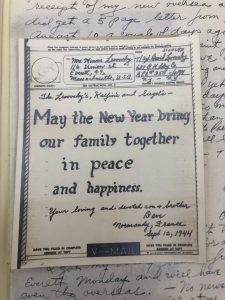
Another collection is the Levovsky family papers, which contains letters by two brothers overseas to family back home. David (“Dave”) Levovsky served with the U.S. Army, 681st Quartermaster Laundry Company, and his brother Simon (“Sy”) with Army counterintelligence. David’s letters are not the narratives of combat that we largely see portrayed in popular films and books – his unit’s work is part of the massive infrastructure needed to move men and machines across a continent, and which we often forget about when thinking about the war. It’s fascinating to read about how David uses his “Jewish” (Yiddish), augmented by some German, to communicate with Polish and Yugoslavian POWs who are on labor detail. The Levovskys exchanges High Holiday greetings, andDavid is sent gifts of dried fruit (except from his sister Bertha, who sends a salami – his response is truly hilarious). He attends services when he can, and in one especially moving letter, recounts meeting a Jewish refugee in Normandy, “a nice little old lady with a blue dotted kerchief over her head” who visibly relaxes when in the company of David and fellow Jewish soldiers.
New Year’s greetings V-mail from David Levovsky to family back home.
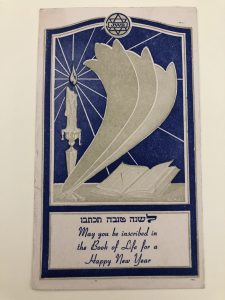
The last collection I want to share is the Samuel L. Barres papers, recently written about by Meg Szydlik in her series on disability in the archives. Samuel was Jewish, the only son of immigrant parents. When he wrote home to his widowed mother, he sugarcoated his experiences so as not to make her worry. He speaks fondly of her home cooking, writing that he really can’t think of anything else for her to send him unless she could send him some herring or gefilte fish (agree to disagree here, Samuel). Like David Levovsky, he refers to his Yiddish as Jewish, and helps his mother with her English through gentle lessons in his letters. I couldn’t help but draw parallels to my grandmother’s family – like Samuel, she and her brothers were born to Jewish immigrant parents. All three of my great uncles served in WWII (as did my grandfather), and at the time of the war were children of a widowed mother. He had passed away when my grandmother, the youngest, was seventeen, the same age as Sam.
New Year’s card from Samuel Barres to his mother Sarah – note the Jewish Welfare Board logo at the top.
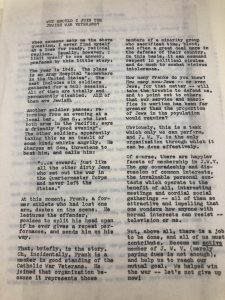
Like each collection here, the Barres papers are a treasure trove, and I can’t do them justice in a blog post. However, Day, I wanted to highlight an appeal written by Samuel’s friend Bill Carmen, who was the national commander of the Jewish War Veterans of the United States of America, as well as instrumental in the construction of the New England Holocaust Memorial in Boston. Titled “Why Should I Join The Jewish War Veterans,” he speaks of solidarity between veterans organizations against antisemitic prejudice – people who call Jewish soldiers cowards who “sat out the war in the Quartermaster Corps and never left the States.” (This is the same unit with which David Levovsky served, as you’ll recall – he did not sit out the war, and even left the states.) “We helped win the war,” Carmen writes. “[l]et’s not give up now!”
Appeal by Bill Carmen on why Jewish soldiers should join the Jewish War Veterans group.
Exploring these collections, I experience a range of emotions – sadness, fierce pride, feelings of familiarity and tenderness reading these soldiers seek out the comfort of their religion and upbringing far from home, what I know too having grown up as an Ashkenazi Jewish person in Massachusetts. All this in a war that always was and proved itself further to be deeply, horrifically personal.
Further reading on these collections can be done by visiting the MHS, and I really recommend that you do. I also want to share the Library of Congress page for the 2023 Jewish American History Month, as well as this blog series by Claire Jones on Judaica in the collections of the American Antiquarian Society.
The 2023 National History Day season has been a whirlwind of epic proportions! Folks from across the Commonwealth came together energized for our first fully in-person contest season since the onset of COVID, and they came back with a bang!
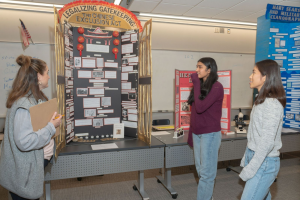
With 4,000 NHD participants across the state this year, over 600 middle and high school students competed in the Regional and State contests hosted by the MHS. It was impressive to witness student work come to life over the course of this program year: Guided by over 90 dedicated educators, students presented almost 350 projects to over 90 judges, all history lovers who enthusiastically volunteered their time to carefully assess the students’ work. While judges reviewed rubrics for each project category and prepared to interview the students on their topics, teachers tirelessly supported student work and helped move students’ projects from concept to reality, making this year’s local contests a collective community achievement!
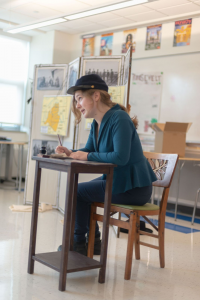
Navigating after-school clubs, extra-curriculars, and even holiday breaks, students showed up this year with their historian hats on to teach us all about a wide range of topics that speak to this year’s NHD theme, “Frontiers in History.” Students developed papers, websites, performances, exhibits and documentaries to share about people, places, things, and ideas that demonstrate a frontier being crossed in history. What a sight! And we, their very impressed pupils, listened in awe! Projects covered a wide range of subjects such as: women’s roles in war, frontiers through race and gender, LGBTQ representation in literature, advancements in technology such as music and video games, frontiers in fashion, American furniture, entertainment, and even space exploration!
Students present their Exhibit to a Judge at the 2023 State Contest. Photography by Laura Wulf.Student enacting an original performance at the 2023 State Contest. Photography by Laura Wulf.
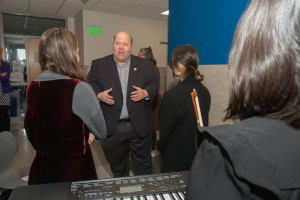
On Saturday, April 1, we hosted an exciting awards ceremony at Winchester High School where NHD Winners from Massachusetts were announced at the closing of a very rich state contest. Among the many special History Day guests was Sen. Paul Feeney, who spent the morning observing project presentations and interviews and meeting NHD constituents! This visit helped all of us shine an even brighter light on the incredible experience that is National History Day.
Senator Feeney chats with NHD Students at the 2023 State Contest. Photograph by Laura Wulf.
This year, 50 projects received gold, silver and honorable mention awards, and local institutions sponsored 30 special prizes, including: Best Project in: Massachusetts History, LGBTQ+ History, andAfrican American History. Our 62 Gold and Silver medalists will be moving on to the National Contest this June at the University of Maryland.
When I first began working here at the MHS, I was told that “National History Day is more than just a day, it is an experience!”, and after my first year of coordinating this program, I can see that nothing is more true. NHD builds strong community ties between folks from all different walks of life, connecting us under one common goal of supporting young people in their exploration of and relationship to history and to themselves. Teacher mentors connect their youth with the program on an individual basis, as a whole class, and even as an after-school program, opening the door for students from all backgrounds to explore history with both a critical and curious lens! Parents & guardians help students glue the pieces of their exhibits together, practice performance lines when no one is watching, equip and encourage students to advocate for themselves when in need, & usher their young people to our local contests on early weekend mornings.
Thank you again to all of the students, teachers, parents, schools, and judges who supported the 2023 contests. Thank you as well to all of our sponsors at the Mass Cultural Council and the Commonwealth of Massachusetts, who help us grow the program and make it accessible to all students.
We invite members of the public to learn more about the NHD program and to contact us at nhd@masshist.org for more information. There are so many ways to engage with this program and support its growth!
This is the second installment in a series. To read Part I, click here.
A few weeks ago, I introduced you to Howard J. Ford and his Civil War journal, held by the Massachusetts Historical Society. The MHS holds many collections related to the Civil War, of course, but this journal is truly remarkable. It’s not often we get such an honest and intimate look at a soldier’s inner life.
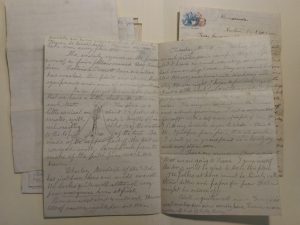
On 4 September 1862, Howard J. Ford of Cambridge, Mass. enlisted for nine months’ service in the 43rd Massachusetts Infantry Regiment. He started his journal one week later, on the day he reported to Camp Meigs at Readville, Mass. I call it a “journal,” but it really consists of loose pages of stationery that Howard initially titled “Memoranda” and sent home at intervals over several months.
Pages from the journal of Howard J. Ford, Nov. 1862
Howard and his younger brother George were mustered in as privates on 24 September. The first few pages of Howard’s journal contain brief, dashed-off entries about life in camp, equipment issued, duty details, and the weather (mostly rain). But the 43rd Regiment was stationed at Readville for just six weeks, leaving from Boston Harbor on 10 November 1862. Their destination was New Bern, North Carolina.
The weather seemed to bode well. As Howard wrote, “This morning the sun shines and he seems almost like a stranger.” The men sang “Home, Sweet Home” as their ship pulled away from shore. And Howard made the following pledge in his journal: “I dont [sic] intend to come home if I have […] to save my life by being a coward or disobeying orders. Howard.”
His ship, the Merrimac, and two other troop ships, the Mississippi and the Saxon, traveled as a convoy under the protection of a gunboat, the Huron. The voyage was relatively uneventful, except for the usual bouts of seasickness and an accidental shooting. (Lt. Henry A. Turner shot himself in the foot “in consequence of carelessly handling his pistol while cocked.”)
When Howard disembarked in North Carolina on 15 November, he was unimpressed, calling it “a mean sort of a place.” Traveling inland, he described the landscape in more detail, including soil that was a combination of “sand & swamp”; architecture (“chimney on the out side of the house”!); and “that peculiar moss hanging [from trees] in pretty festoons.” He also began to see “contrabands,” or enslaved people who had escaped bondage and now worked for or sold goods to Northern troops.
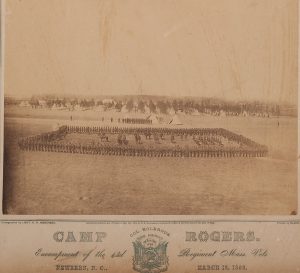
The Union camp, later named Camp Rogers, was located on the southern bank of the Trent River. But even though Northern troops had occupied New Bern for the past eight months, Howard was disappointed to find “no tents, barracks or food ready for us.”
His journal entries at New Bern contain a lot of vivid descriptions, even a few sketches. For example, here’s how he explained a skirmish drill to family members back home:
In this style of fighting the men keep at least 5 paces apart, so that it is more difficult to hit them than in the ordinary way. We also move more rapidly. It is lively work. One minute we are scattered over a long line, and the next rallied by fours, or perhaps sections or platoons. All up in a cluster with our bayonets looking like a porcupine sticking out in every direction to keep off cavalry. Sometimes we load and fire lying down, kneeling, advancing, retreating.
Howard knew Confederate troops were positioned nearby and that the next battle was probably imminent. He told his family that he anticipated having “a chance at the rebels” within the month. When each soldier was issued twenty rounds of ammunition, he wrote ominously, “This looks warlike.”
Stay tuned for more about Howard J. Ford in my next post!
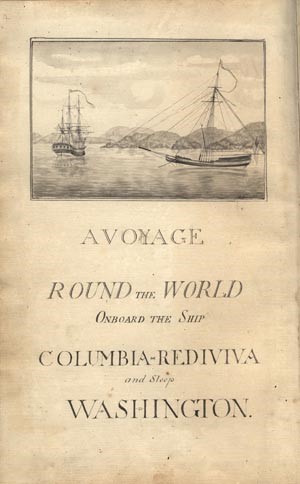
Between November 1789 and January 1790, the two American ships Columbia Rediviva and Lady Washington arrived in the Pearl River Delta, ready to sell their precious cargo. Captained by John Kendrick and Robert Gray, the two ships had set out from Boston in 1787 to sail to the Pacific Northwest, where they were to acquire sea otter furs furnished by Indigenous traders and hunters. These furs promised to generate significant profits, if Kendrick and Gray managed to bring them to Canton (Guangzhou) unspoilt, and if they succeeded in navigating the ins and outs of the complicated Canton market.
The Canton system was closely regulated by the Emperor, and Kendrick and Gray likely relied on reports from Samuel Shaw, a Boston man who had served as supercargo on the first American trading vessel in Canton for insights on how to deal with the Chinese authorities. Shaw had noted how each foreign trader could only sell his cargo if he enlisted the services of a set of government-licensed Chinese agents: The first was a “fiador” or security, who was in charge of collecting port fees once a ship entered Cantonese waters, the second was a “comprador,” who supplied each foreign vessel with provisions and other necessaries, and the third was a “linguist” through whom all foreign trade had to be conducted (Shaw 346-349).
I came to the MHS specifically to learn more about Kendrick and Gray’s endeavor to sell their sea otter skins in Canton, and about the early transoceanic trade between the United States and China more generally. Like Kendrick and Gray, I was initially quite overwhelmed with what I found. The MHS houses one of the largest collections on the early US-China trade in the United States, and even though I had as a guide Katherine H. Griffin and Peter Drummey’s article on the MHS’s China trade holdings, it took me months to fully grasp the wealth of the collections. As I read my way through journals, correspondence, notebooks, accounts, and shipping papers, I became increasingly fascinated with the Canton linguists and their crucial role in all trading activities.
The linguists served as the official mediators of all exchanges between foreign traders and the Chinese authorities. In Kendrick and Gray’s case this meant that they examined the sea otter skins to assess their quality, determined if an offer should be made and at what price, and managed payment (Howay 133-135). They were also in charge of procuring the necessary paperwork and customs seals and they acted as translators. Intriguingly, however, the linguists did not actually speak English or any other foreign language well. Linguists were in fact discouraged from becoming too fluent in any foreign language because fluency indicated that a linguist had become too sympathetic to foreign concerns (Van Dyke 290). How, then, was this trade conducted when Europeans and Americans did not speak Cantonese and Chinese linguists only knew “broken” English? How did linguists and traders navigate language and cultural barriers? And to what extend did misunderstandings, mistranslations, and communication gaps affect the trading activities?
I do not have the answers to these questions yet, but I suspect coming closer to them may involve the notebooks of American trader William P. Elting and the Chinese merchant Houqua, as well as a closer look at the emergence of Cantonese Pidgin English (CPE), an English jargon that linguists and traders alike began to resort to to negotiate their exchanges. Although Kendrick, Gray, and the linguist assigned to them likely already communicated in CPE, they only managed to sell their 700 sea skins with “the greatest trouble and difficulty” (Howay 133). The prices they fetched were underwhelming. Gray returned to the United States in 1790, only bringing back cheap bohea tea, and none of the luxury items and Chinoiserie he and Kendrick had hoped for. He could console himself with being the first American to circumnavigate the globe.
Sources:
Columbia Papers, 1787-1817. Massachusetts Historical Society. Special Colls. Columbia.
William P. Elting Notebook, 1797-1803. Massachusetts Historical Society. Ms. N-49.19
Katherine H. Griffin and Peter Drummey, “Manuscripts on the American China Trade at the Massachusetts Historical Society.” Proceedings of the Massachusetts Historical Society Vol. 100 (1988): 128-139.
Frederic W. Howay, ed. Voyages of the “Columbia” to the Northwest Coast, 1781-1790 and 1790-1793. Boston: Massachusetts Historical Society, 1941.
Samuel Shaw and Josiah Quincy. The Journals of Major Samuel Shaw, the First American Consul at Canton, with A Life of the Author, by Josiah Quincy. Boston: Crosby and Nichols, 1847.
Samuel Shaw Papers, 1775-1887. Massachusetts Historical Society. Ms. N-49.47.
Paul Arthur Van Dyke, “Port Canton and the Pearl River Delta, 1690-1845.” Ph.D. Dissertation, University of Southern California, 2002.
Image:
Robert Haswell. Voyage Round the World on Board the Ship Columbia Rediviva and Sloop Lady Washington, 1787-1789. Massachusetts Historical Society. Special Colls. Haswell.
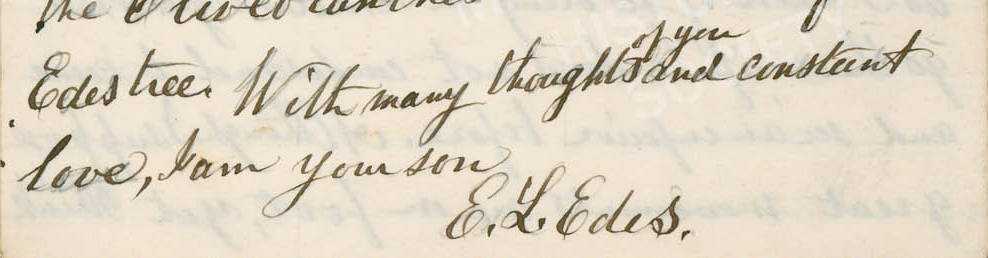
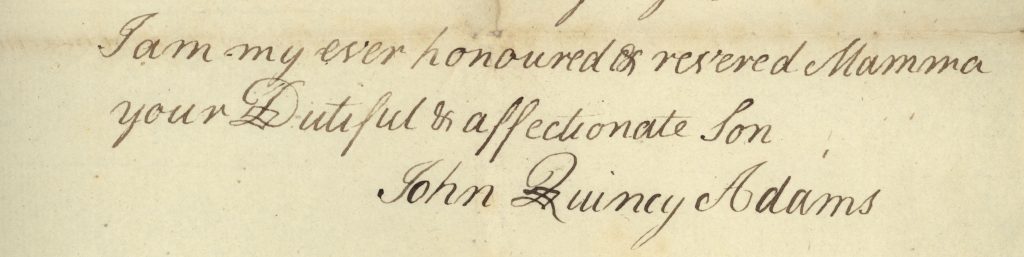
Thinking about Mother’s Day this Sunday, I thought there must be some letters home from sons in the MHS collection, and how nice it would be to read some loving familial words. Many letters I found were much more a declaration of news or the passing along of information, but even in these less personal letters, the closing lines captured my attention. These following are especially affectionate.
With many thoughts of you and constant love, I am your son, E. L. Edes
Letter from John Quincy Adams to Abigail Adams, 27 September 1778.
The next type of letter I really enjoyed reading was the kind from sons in the midst of activity who still took the time to write to their mothers to make sure they knew what was going on. The following one especially captures this sentiment.
Mayoralty of New Orleans,
City Hall 5th day of May 1865
My Dear Mother
Gen Banks having taken it into his head that this city requires a little more military government, has today executed a “coup d’etat” by which the Civil Mayor has been decapitated & I am installed as military vicegerent in his place. Half the city is delighted—the other half furious. [ . . . ] but if it pleases you to have another ‘Mayor Quincy’ in the family—soyez en heureuse. I hope it won’t last long. It was a delightful scene this A.M. when I ousted the civil government, backed up by the military arm. The Governor was enraged & has gone to Washington to protest against military despotism. I don’t care—so long as I obey orders I am safe I write in order that you may learn the important fact in advance of the newspapers
It is a misty moisty morning. We are engaging the enemy and are drawn up in support of Hooker who is now banging away most briskly. I write in the saddle to send you my love and to say that I am very well so far
Dearest mother,
I am wounded so as to be helpless. Good bye if so it must be I think I die in victory. God defend our country. I trust in God & love you all to the last Dearest love to father & all my dear brothers.
Our troops have left the part of the field where I lay—
Although the language in the excerpts of these next two letters may sound less affectionate than the previous letters, they do convey their loving admiration for their mother.
I was in the fort when the enemy came in, Jump’d over the wall and ran half a Mile, where balls flew like hail stones and Cannon roar’d like thunder, but tho I escap’d then it may be my turn next after asking your Prayers must conclude wishing you the best of Blessings, still remain your Dutiful Son
Peter Brown
PS, I wish very much to come and see you, ’tis in vain to think of that now, I desire you to write to me…
Letter from Edward Burgess Peirce to Mary Alden Peirce, 22 October to 24 October 1863.
Dear Mother
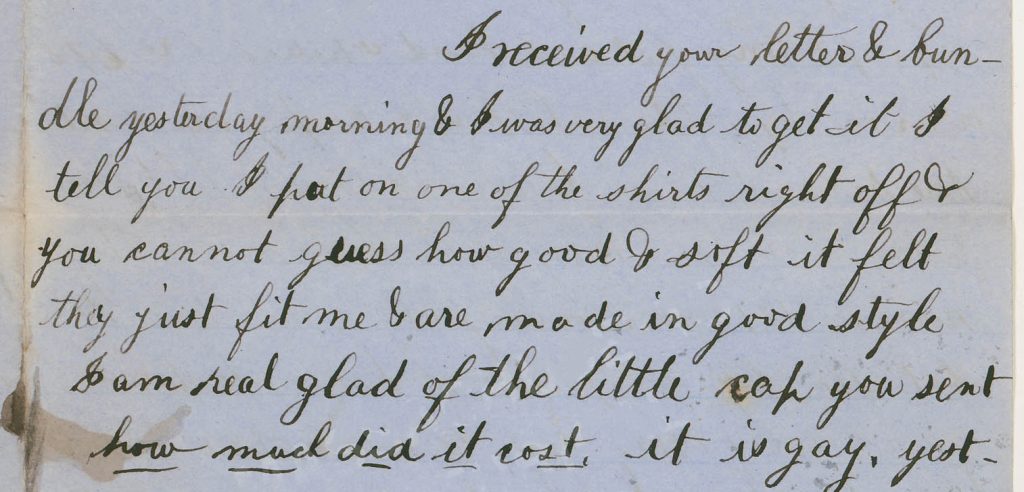
I received your letter & bundle yesterday morning & I was very glad to get it I tell you I put on one of the shirts right off & you cannot guess how good & soft it felt they just fit me & are made in good style I am real glad of the little cap you sent how much did it cost. it is gay.
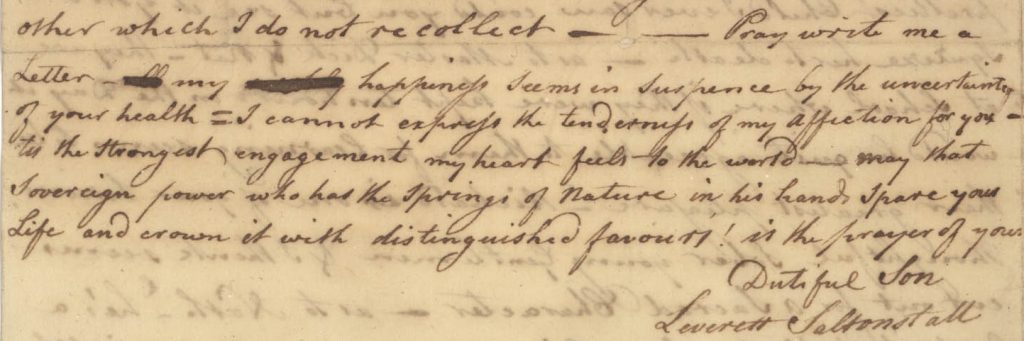
This last letter touched my heart the most, with the son’s loving language, his hope for his mother’s health, and his expression of affection.
Letter from Leverett Saltonstall to Mary Cooke Saltonstall Harron, 12 May 1782.
Pray write me a Letter. all my happiness Seems in Suspence by the uncertainty of your health. I cannot express the tenderness of my Affection for you. ’tis the Strongest engagement my heart feels to the world. May that Sovereign power who has the Springs of Nature in his hands Spare your Life and crown it with distinguished favours! is the prayer of your
By Neal Millikan, Series Editor, Digital Editions, The Adams Papers, MHS
The Adams Papers at the Massachusetts Historical Society has been editing the John Quincy Adams Digital Diary since 2016. Adams kept his diary for 68 years, starting when he was twelve and continuing until his death. In total it comprised 51 diary volumes and over 15,000 pages. As you can imagine, his diary mentioned lots of people: some famous and some obscure. As we have been transcribing the diary for digital publication, we have also been identifying and tagging individuals at their first mention within each date entry. Millard Fillmore and Zachary Taylor both appeared in the diary; we have tagged Fillmore’s name 211 times and Taylor’s name 20 times. In this post I want to highlight some of the mentions of Fillmore, all of which occurred after Adams’s (1825–1829) and before Fillmore’s (1850–1853) presidencies and focus on their years serving together in the U.S. House. This blog pairs nicely with a recent post on Fillmore, Taylor, and Congress.
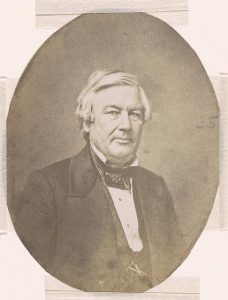
Apart from the fact that both men served as president, Adams and Fillmore had some other things in common: they were both Unitarians, both members of the Whig party (after each had briefly flirted with the Anti-Masonic party), and both represented northern states in Congress (Adams Massachusetts, Fillmore New York). While there was an age gap between the two congressmen—Fillmore was born about the same time as Adams’s eldest son (George Washington Adams, 1801–1829)—they served together in the U.S. House during the 23d, 25th, 26th, and 27th congressional sessions.
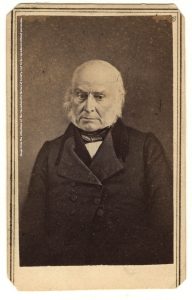
Carte de visite of daguerreotype of John Quincy Adams by Brady’s National Photographic Portrait Galleries. Image from the collection of the Massachusettts Historical Society.
Fillmore first showed up in Adams’s diary on 7 December 1833, where Adams recorded his first name as “Mellerd” in the list of individuals with whom he visited on that date. This was not unusual, as Adams often wrote a name one way (how he believed it was spelled) and then adjusted his spelling in later diary entries. Interestingly, while he started spelling Fillmore’s first name correctly, Adams used the spellings of “Fillmore” and “Filmore” interchangeably. Beginning in January 1834, Fillmore routinely appeared in the diary as Adams reported on congressional activities.
The next significant mention of Fillmore was on 25 December 1837 when Adams noted that he, along with three other representatives from New York (Richard Marvin, Charles Mitchell, and Luther Peck), “came and requested me to draw up a paper to address to their Constituents assigning their reasons for voting against the resolution for laying all abolition petitions on the table.— They said they wished to guard against the amputation of favouring abolitionism, but to adhere inflexibly to the right of Petition,” one of Adams’s pet congressional causes, as he waged his years’ long fight against the gag rule. “I drew up accordingly a sketch of an address to the People of the State of New-York—according to their ideas.” Adams gave the document to Fillmore on 26 December.
Over the next several years Fillmore is consistently mentioned in the diary. Adams noted that he, like other representatives, championed the causes and concerns of his constituency in the U.S. House. On 12 March 1838, Fillmore “presented a Memorial from a meeting of Inhabitants of his District, where the capture of the Steam boat Caroline took place, complaining of that act, and praying for defensive military force.” This memorial was about the Caroline affair, an international incident during which an American vessel was destroyed by Canadian militia in December 1837.
Adams was critical of Fillmore’s attitude toward the Seneca Nation of New York, stating his belief on 23 May 1838 that Fillmore “had by some unnatural influence been induced to assume the defence of Schermerhorn’s swindling practices.” This comment related to John Schermerhorn’s part in the 1832 Treaty with the Seneca and Shawnee Nations. The following day his diary entry compared Fillmore to James Graham, a North Carolina representative who supported Cherokee removal from that state. According to Adams, while Fillmore and Graham’s “judgment and feelings” were “fair, just and humane in all cases which touch not the immediate interests and passions of their Constituents,” they were “unseated when Cherokee or Seneca Indians are parties concerned in the question.”
Not all the references to Fillmore dealt with political issues; he is mentioned in the diary for other reasons as well. For example, on 18 May 1838, Adams recounted that he returned a book to the Library of Congress—an English edition of Father Louis Hennepin’s Description de la Louisiane—because Fillmore had requested to check it out. By the 1840s, the two men were on friendly terms with each other. When Adams visited Niagara Falls in July 1843, now former congressman Fillmore invited him to also tour Buffalo, New York, while he was in that state. When Adams arrived in Buffalo on the 26th, Fillmore introduced him to a gathered crowd, and the two men then rode around the city together. When Adams again visited Buffalo that October, Fillmore “invited us to tea at his house . . . and offered us seats in his pew at the unitarian church,” both of which the former president accepted. Adams’s last mention of the future president was on 20 August 1847, when Fillmore visited Boston and they had dinner together. Adams died on 23 February 1848, so he did not live to see Fillmore’s presidency.
One of the interesting aspects of the work of documentary editing is analyzing primary sources like Adams’s diary and learning that the sixth and thirteenth presidents were well acquainted with each other. From Adams’s diary and from Fillmore’s letters, we get a sense of how the lives of these two presidents intertwined in the nineteenth century.
The Adams Papers editorial project at the Massachusetts Historical Society gratefully acknowledges the generous support of our sponsors. Major funding for the John Quincy Adams Digital Diary was provided by the Amelia Peabody Charitable Fund, with additional contributions by Harvard University Press and a number of private donors. The Mellon Foundation in partnership with the National Historical Publications and Records Commission also supports the project through funding for the Society’s Primary Source Cooperative.
Postscript: Millard Fillmore on John Quincy Adams
By Michael David Cohen, Editor and Project Director, The Correspondence of Zachary Taylor and Millard Fillmore, American University
Millard Fillmore’s relationship with John Quincy Adams continued after their time together in Congress. The Correspondence of Zachary Taylor and Millard Fillmore, at American University’s Center for Congressional and Presidential Studies, has been locating and editing Taylor’s and Fillmore’s letters since 2020. Our forthcoming edition is more temporally constrained than the John Quincy Adams Digital Diary. We are preparing a three-volume, print and digital edition of letters that the two men wrote or received between 1844 and 1853. That decade began with General Taylor’s preparing to lead U.S. troops into the Republic of Texas, continued through the Mexican-American War, and concluded with Taylor’s and Fillmore’s presidencies. Taylor entered the White House in 1849 but died in 1850; Fillmore, his vice president, completed the term.
During those years, until his death in 1848, Adams continued to serve in the U.S. House. Not surprisingly, his fellow Whig and former House colleague Fillmore exchanged occasional letters with or about him. But let’s start with Taylor.
Although Taylor ran for president as the Whig Party’s nominee in 1848, he had never served in civil office before and often foreswore any partisan identity. He may never have voted. Before his candidacy he corresponded with a few national politicians, including Senators John J. Crittenden (a Whig) and Jefferson Davis (a Democrat and his son-in-law), but not with many. Of the more than 1,300 letters our project has found by or to Taylor between 1844 and Adams’s death, none was exchanged with Adams. Only one mentioned him.
Taylor’s single reference to Adams came in a letter of August 10, 1847, to F. S. Bronson. Answering Bronson’s request for “my views on the questions of national policy now at issue,” Taylor denied being a presidential candidate and mostly refused to disclose his opinions. But he did repeat Bronson’s praise for a list of Whig and Democratic politicians. As amended by the Washington Daily National Intelligencer, which published the letter on October 5, Taylor shared “your high and just estimate of the virtues, both of head and heart, of the distinguished citizens [Messrs. Clay, Webster, Adams, McDuffie, and Calhoun] mentioned in your letter.” So, apparently, he respected Adams.
Adams showed up a bit more often in Fillmore’s correspondence. Of nearly 1,000 letters between 1844 and Adams’s death, four involved Adams or his close family. On June 5, 1844, the Washington, D.C., artist Elizabeth Milligan wrote to Fillmore about her recent work. Reflecting on her experience painting Dolley Madison, she remarked that the former White House hostess “and J. Q. Adams seem to be the links that connect ours with a past age” (SUNY-Oswego/Millard Fillmore Papers). A year later Fillmore received a letter from Charles Francis Adams, John Quincy Adams’s son, reporting a Massachusetts convention’s opposition to the annexation of Texas. (We published that letter last year as part of our teaching guide on Texas annexation.)
The remaining letters came near the end of Adams’s life. On February 10, 1848, Fillmore wrote to Adams himself—the letter is now preserved in the Massachusetts Historical Society’s Adams Papers—to introduce a friend “to the ‘Old Man Eloquent.’” Fillmore expressed pleasure that Adams continued to serve in Congress “in this great national crisis.” Thirteen days later, Representative Nathan K. Hall informed his friend Fillmore that “Mr Adams cannot survive many hours” (SUNY-Oswego/Fillmore Papers). Indeed, having suffered a stroke on the House floor, John Quincy Adams died that day.
Fillmore and Adams’s relationship ended with the latter’s death. Fillmore, Taylor, and others were left to carry on the brief political career of the Whig Party. We at the Taylor-Fillmore project are proud to be contributing, along with the Adams Papers, to expanding access to primary sources from both prominent and obscure individuals in that pivotal era of U.S. history.
The Taylor-Fillmore project at American University thanks the National Historical Publications and Records Commission (NHPRC) and The Gladys Krieble Delmas Foundation, our current sponsors. We also thank our past contributors: Delaplaine Foundation Inc., the William G. Pomeroy Foundation, the Summerlee Foundation, and the Watson-Brown Foundation. The Mellon Foundation in partnership with the NHPRC supports our project through funding for the University of Virginia Digital Publishing Cooperative.
I’ve been wanting for some time to write about the fascinating Civil War journal of Howard J. Ford, which the MHS acquired four years ago. Howard served as a private in the 43rd Massachusetts Infantry, otherwise known as the “Tiger Regiment.” His journal consists of loose pages written between 11 September 1862 and 2 May 1863 and sent at intervals to his family back home in Cambridgeport, Mass. The journal contains incredible details and vivid descriptions, not to mention sketches and maps, making it a unique and indispensable account of the war.
Howard was born in Boston on 10 July 1832, the oldest of six children of Nancy (Richardson) Ford and John Ford. I couldn’t find much information about Howard’s life prior to the war. I know he worked as a printer, as recorded in Massachusetts Soldiers, Sailors, and Marines in the Civil War. In fact, this profession ran in the family; his father John and uncle Daniel Sharp Ford also worked in publishing, and his father-in-law Andrew Reid was the founder of the Cambridge Chronicle.
In the summer of 1862, after over a year of heavy fighting, the Union needed fresh troops. President Lincoln issued the Militia Act, which called for the enlistment of 300,000 volunteers as “nine month men” and threatened conscription in any state that didn’t meet its quota. The 43rd was one of many northern regiments organized in response to this act. On 4 September 1862, at the age of 29, Howard joined up, leaving behind a wife and two young children (their son was 2 ½, and their daughter less than four weeks old). Enlisting alongside Howard was his 18-year-old brother George.
Howard’s journal begins on 11 September, just one week later. He and George would both be mustered into Company I and spend less than two months training at Camp Meigs in Readville, Mass., before their regiment shipped out for the south. In the coming weeks, I’ll be telling you more about Howard’s experiences as he described them.
In addition to journal pages, the collection includes one other document, a heartfelt letter written by Howard’s mother Nancy on 23 February 1863. In honor of the upcoming Mother’s Day, I’ll inaugurate this blog series by quoting from her letter.
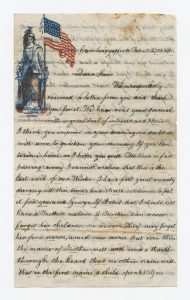
We unexpectedly received a letter from you, and thank you for it. We have read your journal with a great deal of interest and pleasure. […] I have felt great anxiety during all this time, and shall continue to feel it for you and George. If I did not I should not have a Mothers nature. A Mother can never forget her children no never. […] When we have a snow or rain storm, I think of my Soldier Sons. When the Thermometer is 15 below zero, or the wind is blowing a gale, or the mud is ankle deep then again do I think of my Solder Sons. When I go to bed, I think of them on guard, or lying on the cold ground or on the soft side of a pine board. In the morning I think will my Sons be called into action today are they on the march […] You may call this weakness or by what name you please. I call it Mothers love.
Stay tuned for more on Howard J. Ford.
Letter from Nancy (Richardson) Ford to Howard J. Ford, 23 Feb. 1863
Trigger warning: use of outdated but period-typical language to describe disabled individuals.
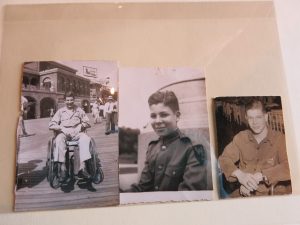
The third and (for now) final installment of my series on Disability in the Archive is a hopeful one. Read Part 1 and Part 2. As I investigated the treatment of disabled veterans, I had my first opportunity to use the actual voices of disabled people in this blog post. I examined the letters and photographs of Samuel “Sammy” Barres, a WWII bilateral amputee who wrote faithfully to his “sweetheart” Bernice and his mother, giving us a window into his thoughts. I am not a veteran and being deaf/hard of hearing is a very different disability, but in his letters, I see echoes of my own experiences.
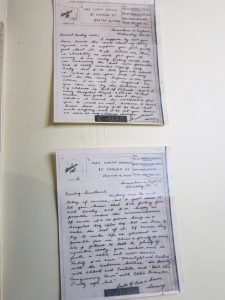
Three photographs of Sammy he sent to Bernice
The first things I noticed were how other people talk about him and his consistently overly positive attitude in response. After Sammy’s legs are amputated, one above the knee and one below, he receives letters from friends, all of whom clearly love him but who talk like his life is over and praise his cheerfulness. His friend Bill says, “reading the letter again, I began to notice your high morale and as I read more I couldn’t figure out how anyone under your circumstances could display such high spirits.” Sammy himself even says “how thankful I am for being spared my sight, and my hands, and my brain. Handicapped? Sure I am. But so very little, comparatively speaking.”
It is reminiscent of modern-day inspiration porn, which is when people create content around disabled people doing things that are only inspiring because they are disabled. For an excellent introduction, read this article and this article. In a more direct example, Sammy’s picture is shared to raise funds for amputees, which is one reason that inspiration porn gets made. Abled people feel grateful that they are not disabled and are more willing to participate. Inspiration porn asks: how can someone who is disabled continue to exist and even succeed? That is certainly a question I have been asked- directly and indirectly.
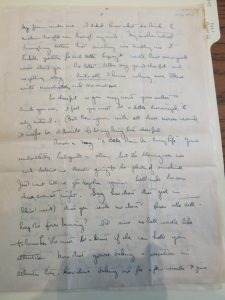
Letter from Bill to Sammy where he tells Sammy that no matter how cheerful his letters to his mother are, Bill believes that he must be somewhat sad about his accident
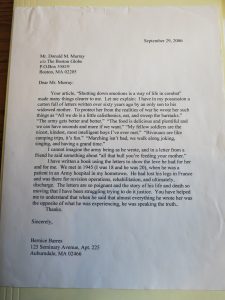
The differences between his letters to his mother and to Bernice are striking, and not just because he is lovesick for Bernice. Letters that were mailed around the same time and talk about the same things are far less cheerful and inspiring when he writes to his nurse “sweetheart” than when he writes to his mother. I have done similar things, kept the full truth from someone, either because they would overreact (as Sammy’s mother does), because I don’t want to be pitied, or even because I don’t want to explain all the background. Sometimes “fine” is the best answer! I’m sure that Sammy felt similarly. In fact, years later Bernice writes that “almost everything he wrote her [his mother] was the opposite of what he was experiencing.”
Letter from Bernice to Donald Murray about his article on how soldiers lied in their letters back homeFirst two letters from Sammy to his mother after he lost his legs
Another thing I noticed while reading is the extraordinary frustration of bureaucracy that was present then and is still present now. Sammy talks about how difficult it is to get help from the limb shop. He tells Bernice that he “went to the limb shop this morning to remind them that [he] was still alive” and then the very next day he “spent a very upsetting afternoon in the limb shop. And [he] still got nowhere.” That frustration is so common for chronically ill or disabled people. While in Boston his leg has a significant issue, and he struggles to find a place that can fix it for him. Similar things have certainly happened to me where getting my assistive device fixed was much more challenging than others think. Like Sammy, I am very good at troubleshooting and finding ways around things that break or around the limits my body has placed on me.
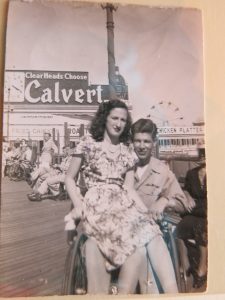
Photograph of Sammy and Bernice on the Boardwalk in Atlantic City
Hearing a disabled person’s own perspective was valuable. While Sammy Barres is only one man and his experience is not universal, it is a story worth telling as part of understanding disability and the presence of disability in the archives. In his case, he and Bernice married— over the objections of her family, who never spoke to Bernice again because she married her “legless love—” and had five children. They generally seem to have lived a happy and loving life, one where they were not separated long enough to write the stacks of letters telling their story, like they did during their engagement. This story has a happy ending! Not an easy one, but a happy one nonetheless.
Psst! Do you like gossip? Well, what about historical gossip?
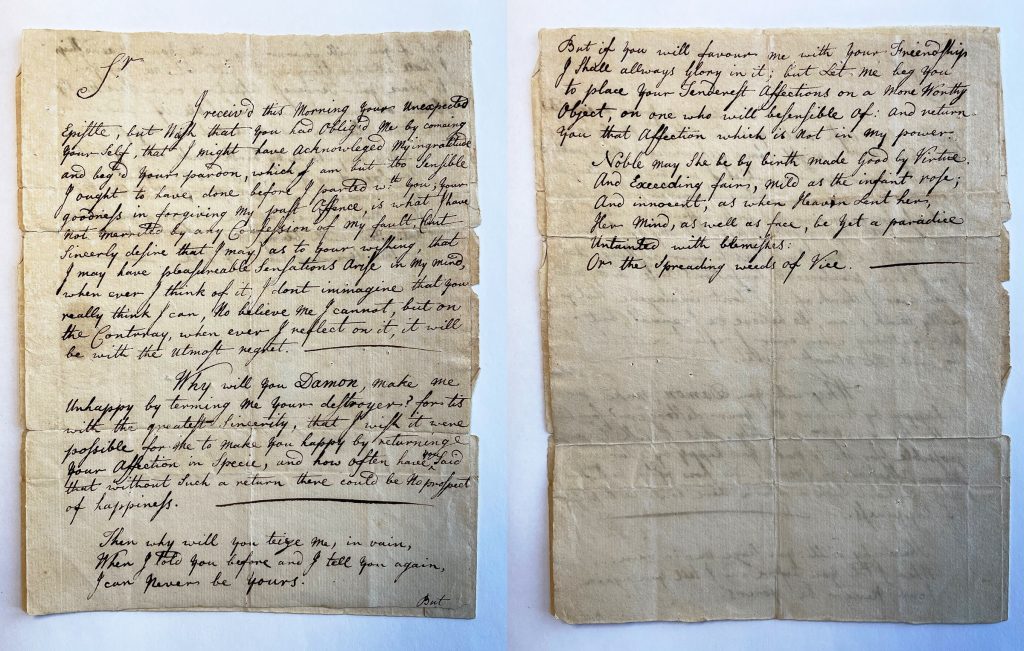
Okay, don’t tell anyone you heard this from me, and I don’t know what exactly, but something very dramatic happened between Hannah Quincy and Richard Cranch in the 1750s. Just read this letter she wrote him!
Hannah Quincy’s letter to Richard Cranch.
Sr.
I receiv’d this morning your unexpected Epistle, but Wish that you had oblig’d me by comeing yourself, that I might have acknowledged my ingratitude and beg’d your pardon, which I am but too sensible I ought to have done before I parted wth you; your goodness in forgiving my past Offence, is what I have not merited by any Confession of my fault, (but sincerely desire that I may.) as to your wishing, that I may have pleasureable sensations arise in my mind, when ever I think of it, I dont immagine [sic.] that you really think I can, No believe me I cannot, but on the Contrray [sic.], when ever I reflect on it, it will be with the utmost regret.—
Why will you Damon, make me unhappy by terming me your destroyer? for tis with the greatest sincerity, that I wish it were possible for me to make you happy by returning your affection in specie, and how often have [inserted: you] said that without such a return there could be no prospect at happiness.—
Then why will you teize me, in vain,
When I told you before and I tell you again,
I can never be yours.
But if you will favour me with your Friendship I shall allways Glory in it; but Let me beg you to place your Tenderest affections on a more worthy object, on one who will be sensible of: and return you that affection which is not in my power.
I know, it seems fairly straightforward at first—he liked her, she didn’t like him—but wait, it gets juicier.
Hannah Quincy was the daughter of Col. Josiah Quincy and the sister of Josiah Quincy II, who would go on to be Mayor of Boston. Richard Cranch was a close friend of John Adams. The letter is not dated, but it is cataloged as originating from 1754. If this attribution is correct, Cranch still hadn’t quite gotten over Quincy two years later. John Adams tried to comfort his cousin in a letter dated October 18, 1756: “I know it must be hard to conquer a Passion for a Lady so greatly accomplished as Miss H—— Q. But consider my friend that the more engaging the charms of her person and the more distinguished the Refinements of her Mind, the more noble your Resolution will appear if you subdue the inclination that such qualities naturally excite.”[2]
Hannah Quincy was quite popular among the bachelors of Braintree. Only a few years later, Adams himself would fall for Quincy, whom he sometimes called “Orlinda” in his diaries. By his description, Quincy was well-read, witty, charming, and beautiful. She was also clever and shrewd, with a good poker face: “She is apparently frank, but really reserved, seemingly pleased, and almost charmed, when she is really laughing with Contempt. Her face and Hart have no Correspondence.”[3] The two of them shared stimulating conversation and the occasional romantic stroll throughout the winter and spring of 1759.
Adams even came close to proposing to Quincy that spring, but they were interrupted in conversation, giving a doctor named Bela Lincoln the opportunity to sweep in and propose to her instead. Quincy and Lincoln were married in 1760. At the time, Adams evidently assumed the proposal was sudden and unexpected on Quincy’s part. He called this twist of fate “a great sacrifice to Reason”—he knew he wasn’t quite ready for marriage and needed to focus on his law career.[4]
Adams later developed a relationship with Quincy’s cousin, Abigail Smith, who of course would go on to be his wife and trusted friend and advisor. But first, in the summer of 1759, Adams drafted a very curious letter to Hannah’s father, Col. Josiah Quincy:
H. was very imprudent, to endeavour to exasperate Mr. Cranch, for she is sensible, that he knows a story to her Disadvantage, and she should remember that Love turned to Hatred, is like the best Wine turned to Vinegar, the most acrid in the World. He will seek Revenge. Arise black Vengeance from the hollow Hell is the language of Othello. I expect to hear very soon that he has divulged that story.
By saying you have corresponded with Dr. Lincoln so long and by saying I can tell you how J. Brackett carries your Letters to Captn. Hews’s, and leaves them there, and takes Lincolns Letters to you, she judged, that J. Brackett had told me she held a correspondence with Lincoln, and went to clearing herself. She declared and protested, she never wrote a Line to him in her Life, excepting one Billet, relating to those Reflections on Courtship and Marriage which she sent with that Book. So I got satisfied.
H. I dont know who has been plagued most, Mr. Cranch or I. I think I have as much Reason to complain of being plagued as he.[5]
By the summer, Adams had discovered that Hannah had played the field a bit, allowing Bela Lincoln to court her at the same time she entertained a relationship with Adams. But what exactly happened between Hannah Quincy and Richard Cranch that “plagued” him so—that Cranch could have chosen to damage her reputation by telling it? Perhaps it was simply the revelation about Quincy and Lincoln, but why would that be Cranch’s secret to tell? Could it be something even more shocking?
I suppose we may never know. But doesn’t that make the gossip even more intriguing?
For more juicy tidbits, see the Boston 1775 series on the Quincy/Cranch/Adams/Lincoln drama:
The late 19th and early 20th centuries saw a plethora of innovations in photographic development. As photographic reproduction technology became more widely distributed, both professional and amateur photographers had the opportunity to experiment with different ways of capturing images. While it may be hard to imagine today, when most photographs are taken with a single tap on a smartphone screen, early photographs widely varied in their methods of documenting the world around them.
One early photographic technique I find particularly interesting is the cyanotype method. By bathing paper in a mixture of iron salts and potassium ferricyanide, and then exposing the treated paper to light, a photographer can capture images in distinctive shades of Prussian blue—a rich near-indigo color that gives cyanotypes an immediately identifiable aesthetic.
This process was invented by English photographer John Frederick William Herschel in the 1840s—but perhaps its most iconic images were created by his acquaintance Anna Atkins, a botanist who used the cyanotype process to create photograms of seaweed, algae, and ferns. Now considered the first female photographer, Atkins had a keen eye for artistic detail and composition that ensured her images are celebrated everywhere from the Getty Museum to the MOMA.
I’ve long been interested in cyanotypes for their vivid monochromes and fascinating history, and have occasionally gone out of my way to find exhibits on them, such as the Provincetown Art Association and Museum’s Out of the Blue show from last fall. So I was happy to recently discover that ABIGAIL, our online catalog, has a subject heading under which our cyanotype holdings are cataloged! This made it easy for me to explore what kinds of cyanotypes we have here at the MHS—and I certainly wasn’t disappointed.
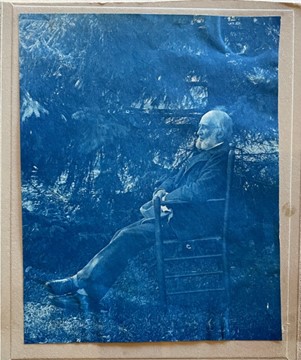
Many of our cyanotypes depict domestic scenes and personal, poignant snapshots. In the below photograph, a grandfatherly man reclines in a garden, the textures of his clothing and the trees surrounding him picked out in stunning pacific blues. The monochrome coloring mimics the cool shade of the trees, making the scene’s careful composition and use of light a snapshot of private peace.
Taken by S.D. Hiller. Wigglesworth family photographs II.
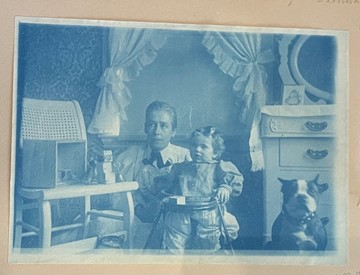
Perhaps because we’re used to seeing old photographs in black and white, the cyanotypes feel particularly alive—details jump out at me more in blue, and make moments that break the serious propriety so often (and wrongly) associated with old photographs feel even more vivid. The presence of a dog (maybe a pitbull?) in the lower right hand of the below photograph is especially delightful in the below image: blurry and wide-eyed, its startled stare into the camera feels like an ancestor of the many pet photographs stored on my phone.
Mrs. Seabury and Leonora. Bemis family photograph album.
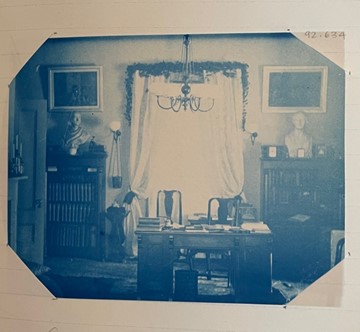
Sometimes, though, the blued lens of a cyanotype can lend a melancholy cast to an otherwise neutral tableau. In the below photograph, the lit window of an empty room appears almost ghostly to me, blotting out the details of the scene with periwinkle sheen.
Wigglesworth family photographs II.
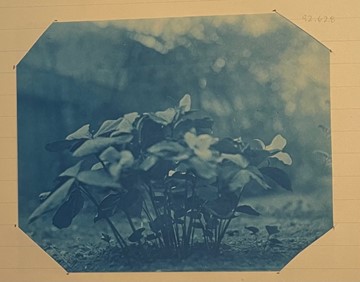
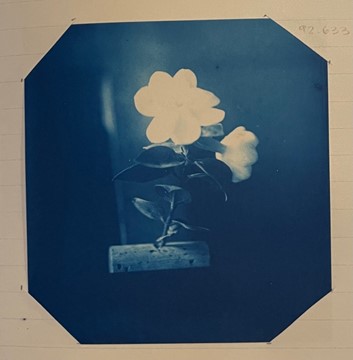
Similarly, the careful, minimalist composition in the following images of flowers feels a little lonely when rendered in blue—what might have merely been pretty in color appears wistful in monochrome.
Trillium. Wigglesworth family photographs II.Jasminum sambac. Wigglesworth family photographs II.
Artistic interpretations aside, cyanotypes were an easy and cheap method of photographic reproduction, commonly used before the advent of other, later methods of film reproduction. Their low barrier to access meant that their use is more generally one of convenience than intentional artistic statement. Still, with the distance of time, it’s hard not to gaze into the blue and see something more than pure color staring back.