By Hannah Elder, Assistant Reference Librarian for Rights and Reproductions
Even though I, like many of my fellow librarians, am an Official Introvert, I love people. I love learning their stories, figuring out the ways we’re different or similar, and building relationships. I love reflecting on their humanity, on what makes them unique and what connects us all. I suppose that’s a part of why I love history. It’s a way to get to know people and their stories. And it’s a reminder that while there are things that separate us, including time, we all have the shared experience of living complicated, messy, beautiful lives.
Today I want to look back, just one hundred years, to a day in some of those beautiful lives. I’ve gathered a few diaries from our collection with entries for March 25, 1922 and have transcribed them below.
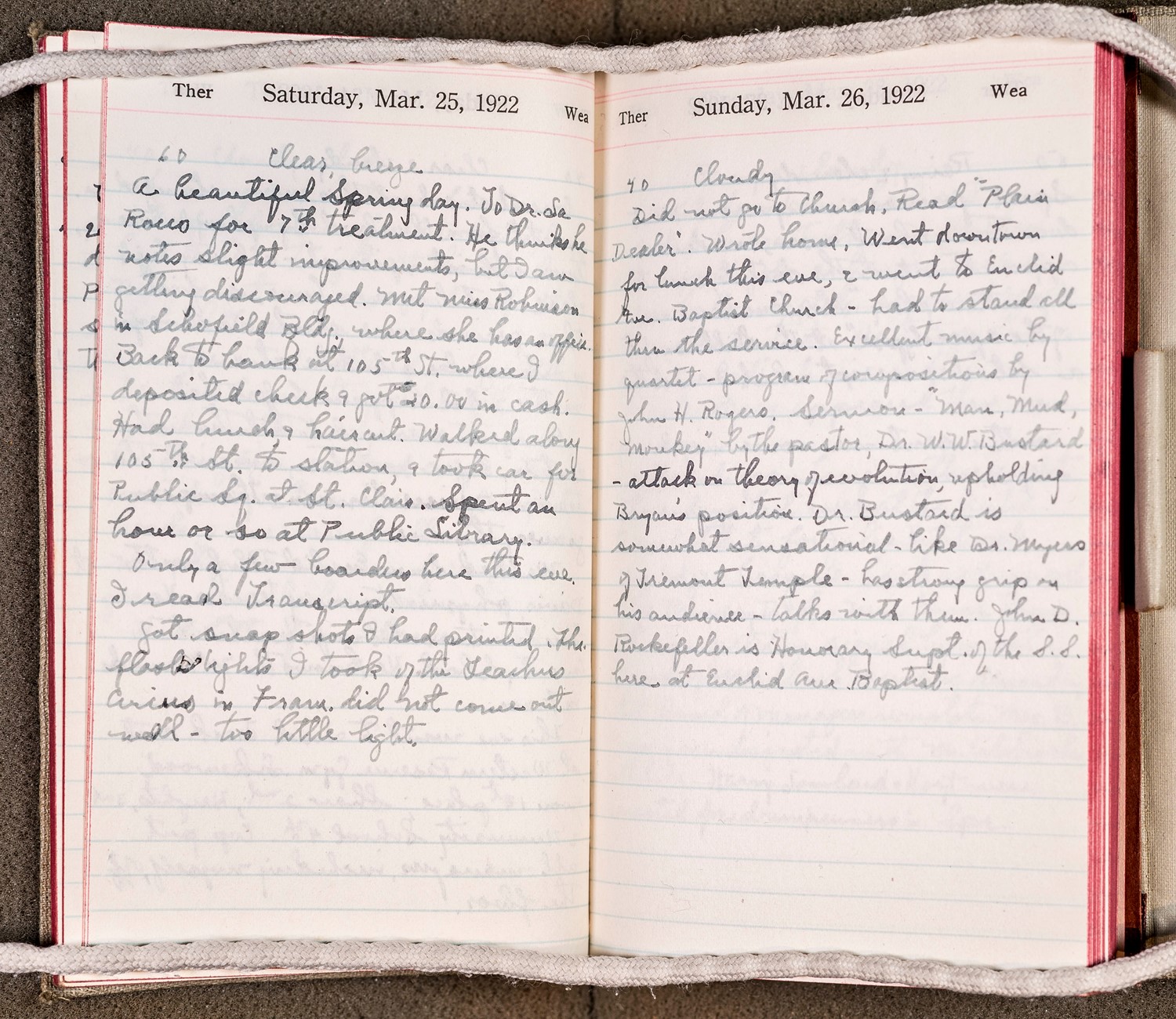
Robert James Streeter diaries, 1849-1951, 25 March 1922 entry
60clear, breeze
A beautiful Spring day. To Dr. La Rous for 7th treatment. He thinks he notes slight improvements, but I am getting discouraged. Met Miss Robinson in Schofield Bldg. where she has an office. Back to bank at 105th St. where I deposited check + got $20.00 in cash. Had lunch + haircut. Walked along 105th St. to station, + took a car for Public Sq. at St. Clair. Spent an hour or so at Public Library.
Only a few boarders here this eve, I read transcript.
Got snap shots I had printed. The flash lights I took of the Teachers Circus in Fram. did not come out well – too little light.
Reading earlier entries in the diary, I was able to learn more about Streeter’s day. The doctor he mentioned was a dermatologist, who he had been seeing for x-ray treatments for a condition on his face. Streeter had moved to Cleveland Heights, Ohio earlier that year, and was living in a boarding house, the fellow occupants of which were largely teachers. His Saturday sounds very familiar; a mix of errands, appointments, visits, and leisure.
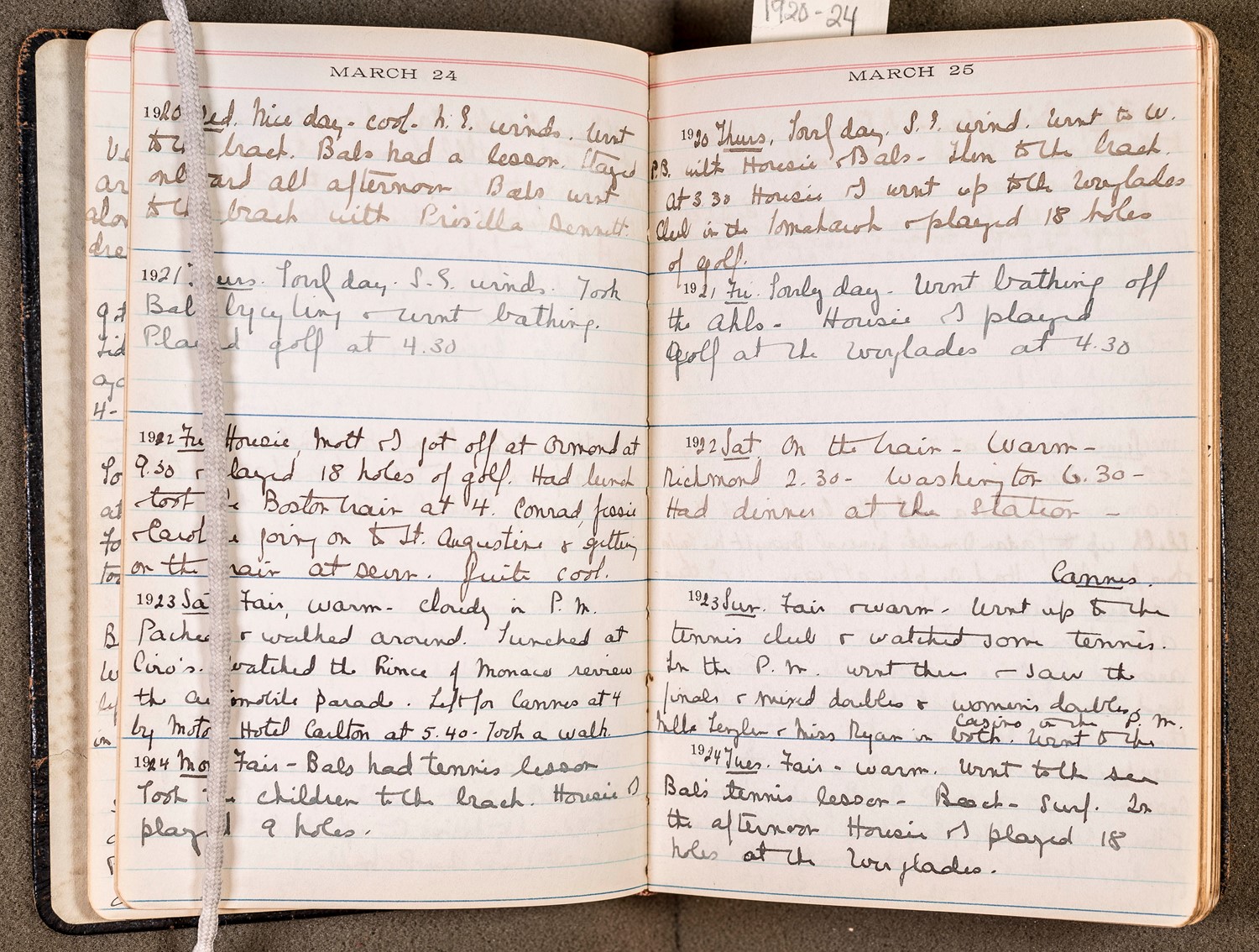
Mildred Cox Howes diaries, 1896-1973, entries for 24 and 25 March 1922
Sat[urday] On the train – Warm – Richmond 2.30 – Washington 6.30 – Had dinner at the station –
Again, I was able to learn more through other entries. Howes was traveling from the Florida Keys, where she had spent some time socializing and enjoying the weather, to her native Boston. When she returned home, she spent many days visiting with her mother.
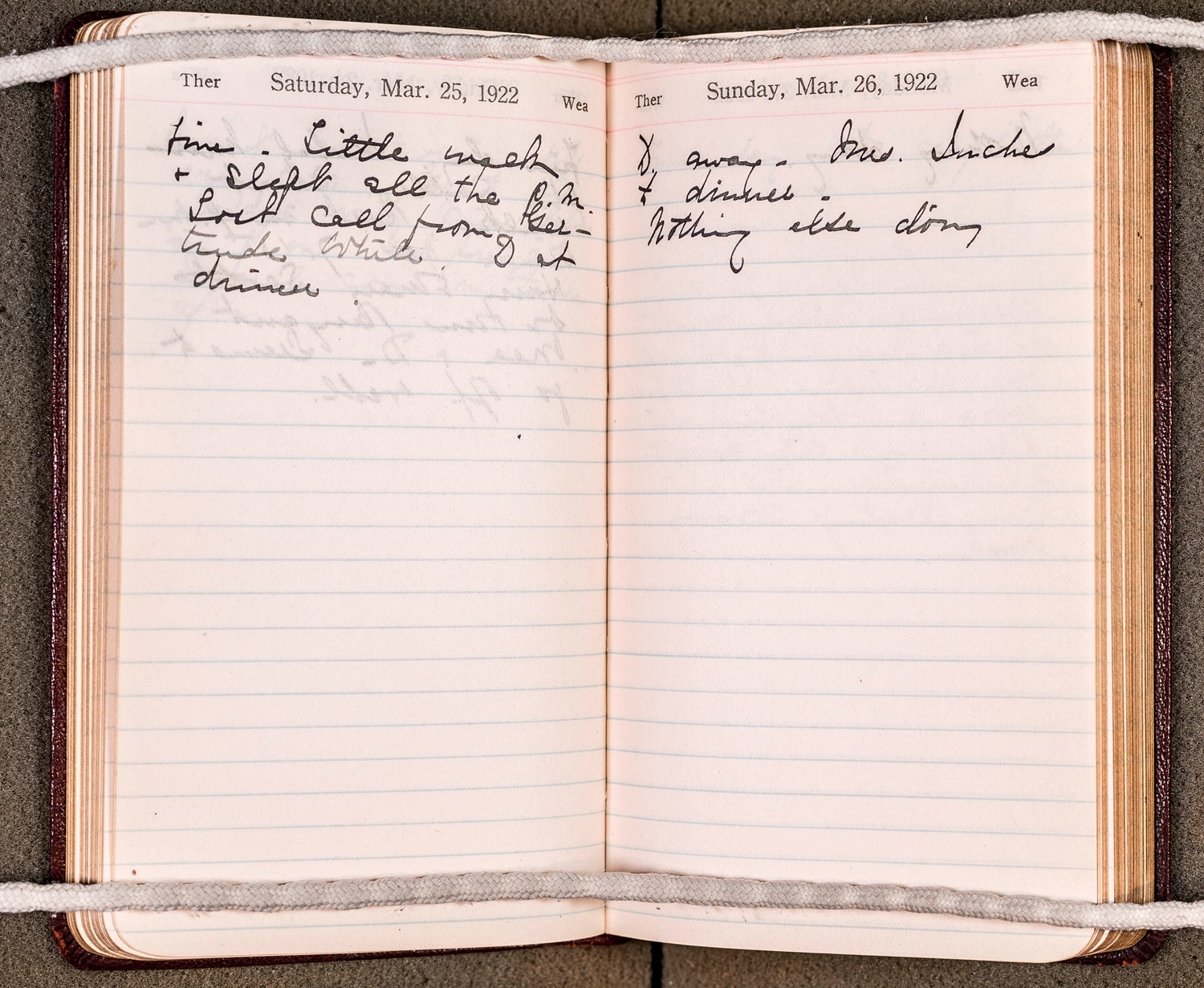
Diary of Henry P. Binney, entries for 25 and 26 March 1922.
Weather Bright and fair
Morning went to my riding lesson
Afternoon took Elisha to see a nesting meet.
Was in bed 830
Binney was eleven years old when he recorded this entry in 1922. As the year progressed, his handwriting improved and the entries got longer. In addition to the diary, the Henry P. Binney Family collection includes a baby book that his mother, Alberta, filled out as young Henry grew up. Leafing through the book was a delight, as I learned about his first outing, saw cuttings of his hair, and even got to see his first photograph. It was precious.
I hope you’ve enjoyed this look at the day in the lives of a few individuals who lived in 1922! If you would like to do some similar exploration of your own, consider making an appointment to visit the MHS library.
“Dear March—Come in—
How glad I am—
I hoped for you before—
Put down your Hat—
You must have walked—
How out of Breath you are—
Dear March, how are you, and the Rest—
Did you leave Nature well—
Oh March, Come right upstairs with me—
I have so much to tell—“
In 1846 — Decades before she became Amherst’s enigmatic recluse – a young Emily Dickinson visited Boston. She told her friend Abiah Root: “I left for Boston a week before last…I have both seen & heard a great many wonderful things…I have been to Mount Auburn, to the Chinese Museum, to Bunker Hill. I have attended 2 concerts, & 1 Horticultural exhibition. I have been upon the top of the State house & almost everywhere that you can imagine” [i]
Today, let’s enjoy some fresh March air and tour 1846 Boston, following in Dickinson’s footsteps.
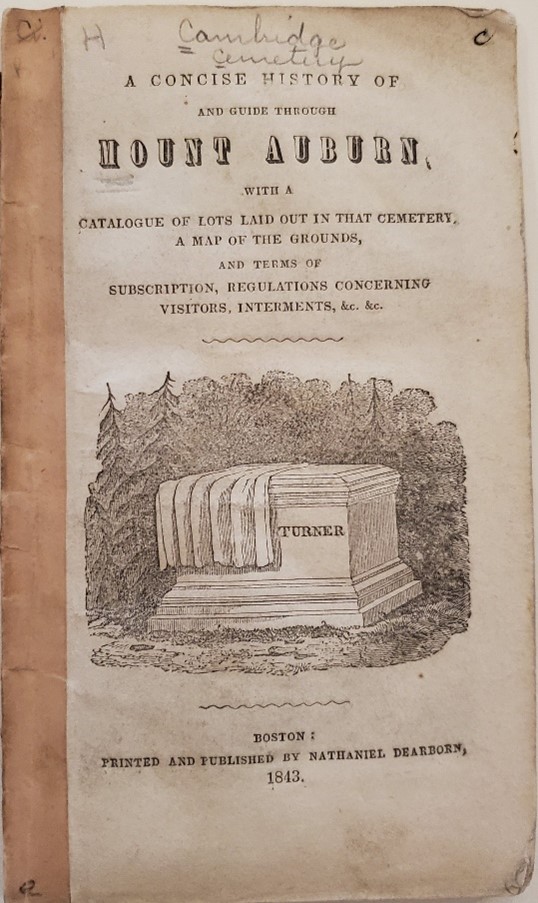
Let’s begin with Mount Auburn. Mount Auburn Cemetery was laid out to serve the Boston area in 1831 and had been open for 15 years when Emily Dickinson visited her Aunt Lavinia Norcross. Mount Auburn was the first of its kind in the country: a permanent resting place and pleasant place to visit, away from the ever-growing cities.[ii] The cemetery park design attracted many visitors like Emily, both mourners and people coming to enjoy the grounds. Visitors could wander around the numerous paths and enjoy the greenery. They could also buy a guidebook like this one by Nathaniel Dearborn, “A concise history of, and guide through Mount Auburn,” which details the history, lots, and occupants of Mount Auburn, along with the rules for visiting.
Nathaniel Dearborn’s 1843 guide to Mount Auburn
One of these rules, which may have slightly irked Dickinson, is that visitors to the cemetery were “prohibited from gathering any flowers, either wild or cultivated, or breaking any tree, shrub, or plant.”[iii] One of Dickinson’s greatest pleasures was gardening, and at time she visited Mount Auburn, she was finishing up her ‘Herbarium,’ a book, completed in 1846, in which she pasted pieces of plants with their everyday and scientific names. She seems to have thought highly of the grounds, telling Abiah “it seems as if Nature had formed the spot with a distinct idea of its being a resting place for her children, where wearied and disappointed they might stretch themselves beneath the spreading cypress & close their eyes ‘calmly as to a nights repose or flowers at set of sun.”[iv]
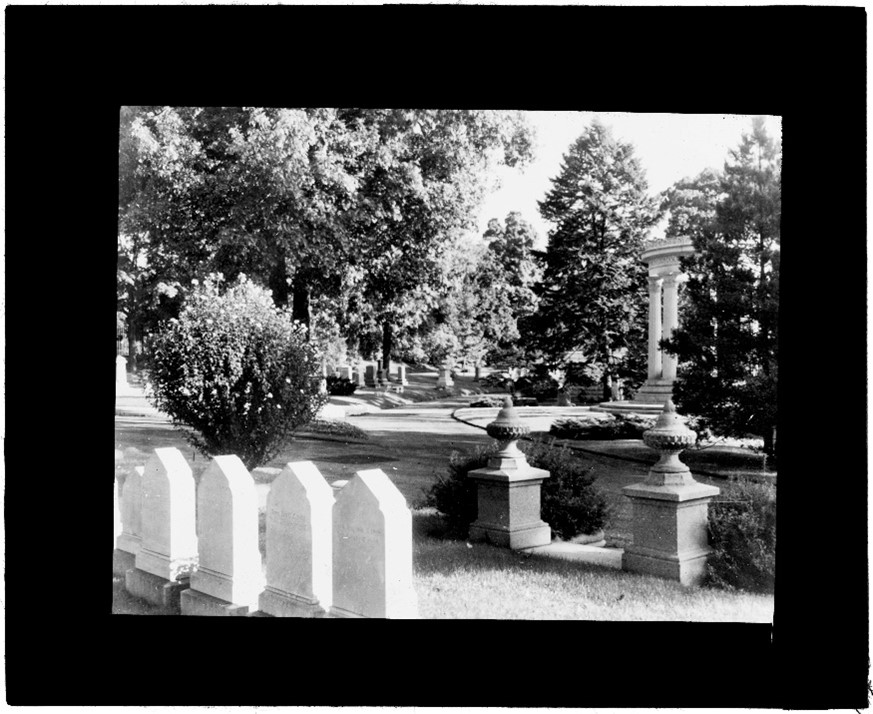
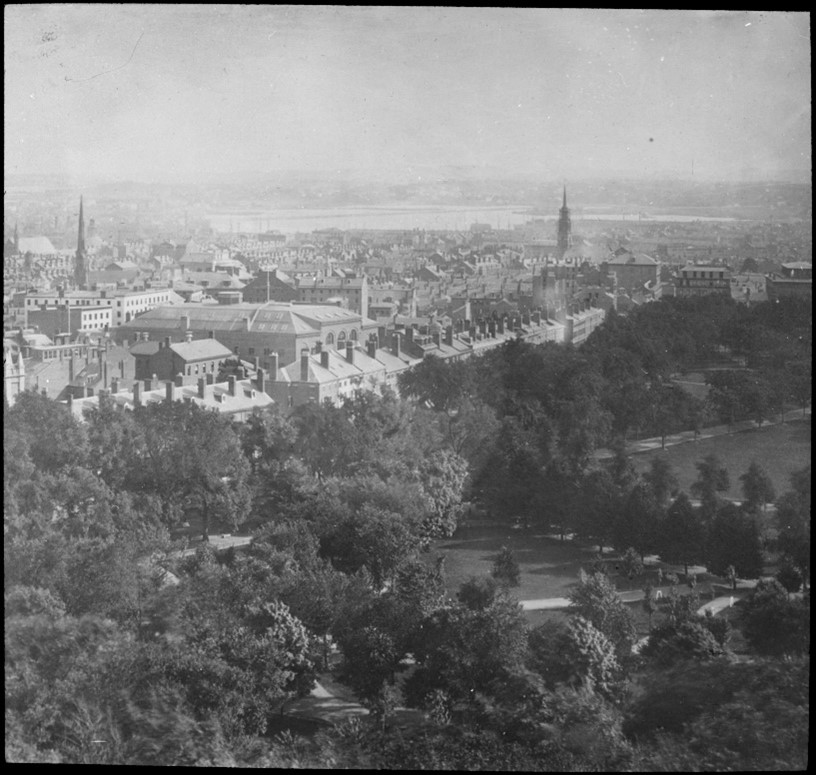
Doesn’t this 1920s picture of Mount Auburn look so peaceful? It’s easy to see why Dickinson liked it. Lantern slide possibly taken by Arthur A. Shurcliff, circa 1920s. From the Arthur Asahel Shurcliff collection of glass lantern slides. Photo. 6.19.477.
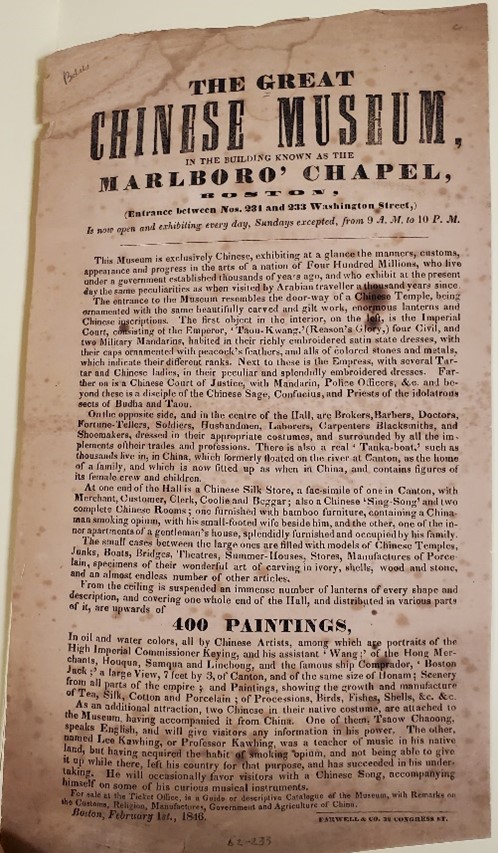
Dickinson also enjoyed a trip to the Chinese Museum. The Chinese Museum was a museum that ran from 1845-1847 in the Marlboro Chapel on Washington St., and was made up of objects, drawings, and featured the work of two Chinese men who entertained and educated visitors, all brought to Boston by a recent diplomatic mission.[v] It was created by John R. Peters, who would later sell the museum to P.T. Barnum. Peters also wrote a guidebook that we hold here at the MHS, which walks the viewer or reader exhibit by exhibit through the museum with an explanation, facts, and historical background of each tableau. Peters claims that “This collection was formed without reference to labor or expense, and with the aid of the Chinese and of the American Missionaries who have resided so long…”[vi] Visitors would have wandered past 25 cases illustrating daily life and culture, and viewed items such as musical instruments and money, and smelled incense burning. Dickinson was particularly impressed by the “endless variety of Wax figures made to resemble the Chinese & dressed in their costume.”[vii]
First page of John R. Peter’s pamphlet detailing the exhibits in the Chinese Museum
After that, Dickinson visited Bunker Hill. In 1846, the Bunker Hill Monument was only a few years old, and a popular tourist attraction. At its heart, a towering granite obelisk and a park dotted with memorials to those who had died at the Battle of Bunker Hill. Another great draw is the view from Bunker Hill, which is a panoramic scene over the city of Boston. Check out this engraved panoramic view of Boston from Bunker Hill in 1848. From here they could have seen the entire city of Boston stretching out below them.
A Panoramic View from Bunker Hill monument/ Engraved by James Smillie from a drawing by R.P. Mallory (1848) shows the amazing view Dickinson could have seen.
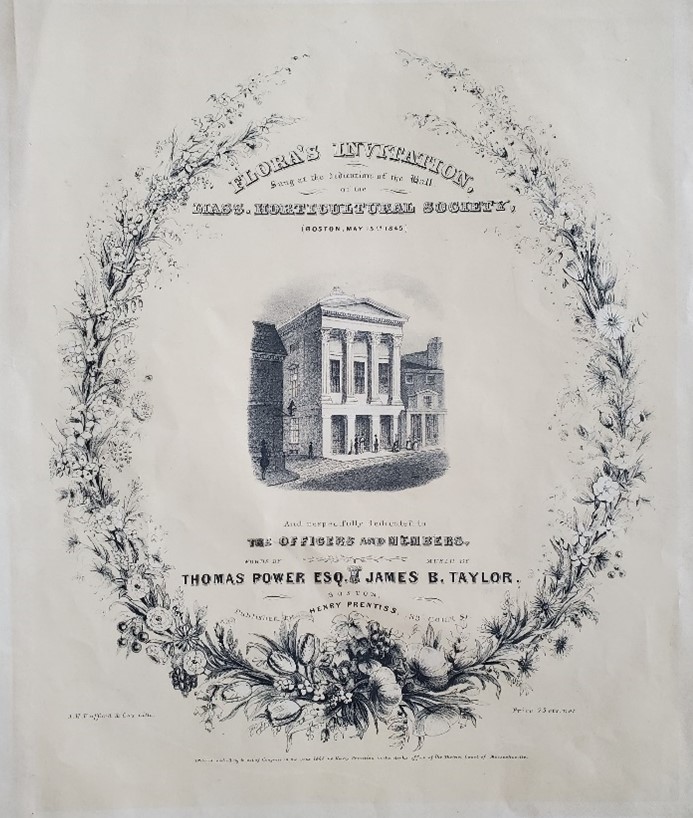
For the next stop, we’re off to stop and smell the roses. On this day, Emily, Aunt Lavinia, and Cousin Louisa went to a Horticulture Exhibition for an “exhibition of fruits and flours.”[viii] The exhibition may have been held in the Horticultural Hall on School Street.
Flora’s Invitation: the sheet music cover to the music played at the dedication of the Horticultural Hall in 1845. The Horticultural Hall is pictured in the center.
Perhaps they viewed the August exhibition of Dahlias that William Bordman Richards describes in his 1846 diary as “the best thus far I have been able to make.”[ix] Richards was especially proud of his ‘Cleopatra’ varietal, which was new to the Massachusetts Horticultural Society that year. Dickinson and her family may have wandered through the Walker & Co flower-seed store on their way out, picking up some of the new varietals of dahlias that were for sale, or some flower seeds to take home. We can wander through this seed shop through the Descriptive catalogue of flower-seeds for sale by Walker & Co.
In our final stop on the trip, we head to the top of the State House. The ‘New’ Massachusetts State House was built on Beacon Hill in 1798, to replace the older State House on State Street. We’re extra lucky in this stop, as someone took photos of the views from the top of the State House in every direction. What a view!
View from top of Massachusetts State House, facing South. Late 1850s.View from State House across Common & Public Garden. Lantern slide circa 1853-1900.
You can check out the MHS’s collection of photos and take in the best views that Boston had to offer here.
Dickinson returned home to Amherst after a month’s sightseeing in Boston, telling Abiah she had been “almost everywhere that you can imagine.”[x] Over the course of her life, Dickinson would write over a thousand poems—including the one featured in this blog post—and slowly become more and more reclusive, choosing not to travel, eventually avoiding leaving the house if possible. Instead, she focused on her poems. Only a handful of her poems were published during her lifetime; it was only after her death and her sister Lavinia Dickinson’s discovery of her work that they were published in 1890. The MHS holds a beautifully illustrated first edition of this poetry, which can be viewed here.
“Who knocks? That April—
Lock the Door—
I will not be pursued—
He stayed away a Year to call
When I am occupied—
But trifles look so trivial
As soon as you have come”[xi]
If you’re in the neighborhood check out the Homestead, the Emily Dickinson Museum in Amherst, MA.
[i] “Letter from Dickinson to Abiah Root,” Dickinson Electronic Archive, last modified February 25, 2008, http://archive.emilydickinson.org/correspondence/aroot/l13.html
[ii] “Rural Cemetery Movement Grows.” Mount Auburn Cemetery, last modified October 25, 2014, https://mountauburn.org/rural-cemetery-movement-grows/
[iii] Dearborn, Nathaniel., A concise history of, and guide through Mount Auburn (Boston, N. Dearborn, 1843)
[iv] Dickinson Electronic Archive, “Letter from Dickinson to Abiah Root.”
[v] Zboray, Ronald J., and Mary Saracino Zboray. “Between ‘Crockery-Dom’ and Barnum: Boston’s Chinese Museum, 1845-47.” American Quarterly 56, no. 2 (2004): 271–307. http://www.jstor.org/stable/40068196.
[vi] Peters, John R., The great Chinese Museum, (Boston, Farwell & Co, 1846)
[vii] Dickinson Electronic Archive, “Letter from Dickinson to Abiah Root.”
[viii] Dickinson Electronic Archive,” Letter from Dickinson to Abiah Root.”
[ix] William Bordman Richards diary, Walcott family papers, Massachusetts Historical Society.
[x] Dickinson Electronic Archive, “Letter from Dickinson to Abiah Root.”
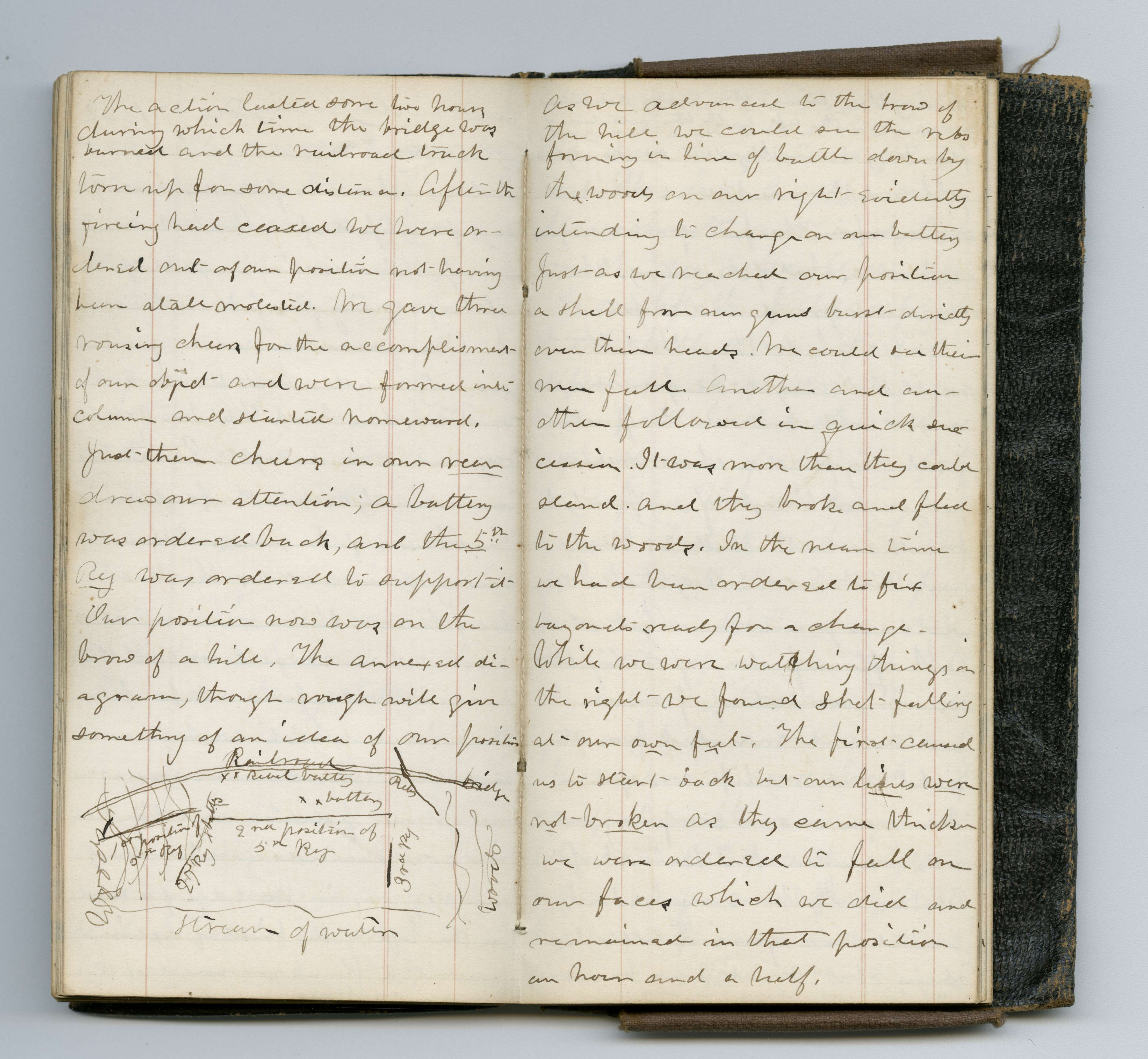
I recently had the opportunity to do some fun detective work when an unidentified diary was donated to the MHS.
The volume in question
The diary was kept in a small leatherbound volume, just 6 by 3.5 inches, very typical of its time. It describes a Northern soldier’s Civil War service between 10 September 1862 and 8 June 1863, primarily at New Bern, North Carolina. The pages are clean, the handwriting neat and legible, and the content very interesting. But who kept it? There’s no inscription or other identification.
I started by skimming the diary for some names and dates. The writer tells us on the first page that he enlisted as a private in the 5th Massachusetts Infantry Regiment, Company I, “having felt it [his] duty to serve [his] country in some way in this its hour of need.” On subsequent pages, he refers to a son Eddie and a wife Martha. He mentions his wedding anniversary on 16 Oct. 1862.
Fortunately, archivists and historians have a terrific resource in the nine-volume reference work Massachusetts Soldiers, Sailors, and Marines in the Civil War, published in the 1930s. This work lists, by regiment, all the soldiers from Massachusetts known to have served in the war.
To identify our mystery man, I started with a guess: maybe his son Eddie was his namesake. Well, according to Massachusetts Soldiers, Company I of the 5th Mass. Infantry included six privates named either Edward or Edmund. Online searches on each of them turned up nothing that corresponded to the diary. None of them, as far as I could tell, had a wife Martha or a son Eddie. At least one never married. The father of another died before the war (and our diarist wrote about his very-much-still-alive father).
The diary, in fact, has nothing in it to indicate our writer was an Eddie, Sr., so I dropped that hypothesis and went back to the text for a closer look. I noticed repeated references to people with the surname Wright. Was he a Wright? There were four Private Wrights in the company. But one thing gave me pause: “Father Wright,” which appears in several diary entries, sounded more like a father-in-law than a father. So I guessed that the Wrights were his wife’s family. Unfortunately, searches for “Martha Wright” also came up dry.
Other tantalizing but ultimately unhelpful clues included the name of a sister (or sister-in-law) Mary and the towns of Marlborough and Shrewsbury, Mass. None of these details were specific enough to narrow my search. I kept feeling like I was getting close, only to hit another dead end.
Eventually I came across a pivotal diary entry dated 27 Oct. 1862: “Our tent mess is composed of Geo. Fogg, E. E. Wright, C. W. Hill, W. W. Wood, J. F. Claflin, A. E. Wright, J. D. Barker, Frank Bean, Charles Adams, Geo. Works, A. L. Nourse, J. W. Barnes, Eph. Howe, E. A. Perry.” These are all names of men in Company I. Assuming our writer included himself in this list (albeit in the third person), I finally had a short list to work from. I eliminated a few fairly quickly—those mentioned in other diary entries, for example—but still couldn’t make a positive identification.
Then I discovered I’d made a critical mistake. As neat as our diarist’s handwriting was, I had misread one name. What I initially thought was Wright…was actually Wight. This was the proverbial break in the case. An online search for “Martha Wight” eventually led me to a family genealogy published in 1890. There she was at the bottom of page 280: Martha Eleanor Wight married Charles Willard Hill, of the 5th Massachusetts Infantry, on 16 October 1856. The couple’s oldest son, Edward Albert Hill, was born in 1857.
It was short work to verify all the details. Hill’s was one of the names listed in the “tent mess” above. Family members and towns in the diary checked out, as did the diary entry for Hill’s birthday, 5 June. I finally had my man.
Entry for Charles W. Hill in Massachusetts Soldiers, Sailors, and Marines in the Civil War, vol. 1, p. 331
Hill had been a teacher before the war and would return to it afterwards, eventually serving as headmaster of the Comins School in Roxbury and the Bowditch School in Jamaica Plain. Based on his diary, he was a very religious person and a loving husband and father. His entry about saying goodbye to his five-year-old son is particularly touching.
My parting with my dear Eddie was in the road near Father Wight’s house. The dear little fellow seemed fully to appreciate that I was going away for a long time. He said afterwards that he went back to the place alone to see if he could not see me again. I am glad I did not know of it at the time, as it would have unmanned me.
On 1 January 1863, Abraham Lincoln’s Emancipation Proclamation freed enslaved people in the Confederate states. That same month, Hill was detailed to work with the “superintendent of the freedmen” at New Bern. Hill spent his days answering questions, distributing donations, and writing passes. He loved the job and often expressed his wish to be of service to African Americans in the South.
Who was this superintendent of the freedmen? Well, in Hill’s diary, and even in the published history of the regiment, he’s just “Rev. Means.” It looked like I had a second mystery on my hands.
Fortunately, this one was much easier to solve. All it took was some creative keyword searching to find hospital chaplain James Means (1813-1863). Means’s many affiliations included Andover Theological Seminary, Middlesex County Temperance Society, Lawrence Academy, Spingler Institute, Tilden Female Seminary, and Lasell Seminary. (The MHS holds some of his correspondence in the Amos Lawrence and Amos Lawrence III papers.) Means was an inspiration to Hill, but he died just a few months after they met. Hill was apparently present at his death.
We’re grateful to our donors for all the terrific manuscripts they have sent us over the years! And we hope many researchers will come and take a look at the Charles Willard Hill diary for themselves.
In Part 1, the story began when Asa Nickerson drove his “iron” into an elusive whale while whaling in the Straits of Belle Isle. However, Lot Gage, captain from another ship, then also drove his iron into the whale. At some point, Nickerson’s line dislodged, and Gage harvested the profitable parts of the whale. Nickerson’s captain, Joseph Doane felt he was owed money and sued Gage for a one-eighth share in the profits from that whale. All of Cape Cod had opinions on who was in the right. At the same time, 2,000 troops of the Royal Army descended on Boston to quell rebellion and James Otis, Jr. had a fateful and lifechanging fight in a coffeehouse. The dramatic stage is set for the trial to take place in the Vice Admiralty Court.
The Vice Admiralty Courts were established in Massachusetts Bay Colony by the crown in 1697 to enforce the Acts of Trade and Navigation, with which England sought to control colonial commerce. The courts were open for the trial of ordinary civil maritime cases, but in Massachusetts it took the royal Admiralty judges nearly 20 years to overcome hostility aroused by the establishment and unfamiliarity with the new process. By 1720, the Admiralty had developed a solidly established tradition of common-law competence in maritime matters. This means most matters were settled outside of the Vice Admiralty Court except for seamen’s wages. Parliament expanded the jurisdiction of these courts in 1764. When the Townshend Acts were passed in 1767, the civil cases heard at this court were dramatically reduced while revenue cases increased sharply. The case of the whale was one of the six to eight civil cases heard that year.
There were at least 74 witnesses who had given depositions: 34 for Joseph Doane, the captain who was seeking his one-eighth share in the whale represented by John Adams, and 40 for Lot Gage, represented by James Otis, Jr., James Otis, Sr., and Robert Treat Paine. There were no live witnesses giving testimony. Instead, since the case was heard four years after the event, the counselors read out loud the depositions, paraphrasing or embellishing with explanation, comments, and arguments when needed. The case took six days to hear all arguments and testimonies.
John Adams, representing Doane, started by relaying the witnesses testification that in normal whaling practices, a boat was in possession of a whale when it was “fast” to it, or when the iron is still seated in the whale and the line was still in the boats control. A second boat then securing a line to the whale while the first is still fast was entitled to a one-eighth share if the first boat asked for assistance. If the first boat had not asked for assistance, the second boat had no rights to the whale. If, however, the first striker had lost control of their line, then the second striker had full possession of the whale.
Adams’ evidence showed that Nickerson had been fast to the whale when Gage struck, thus giving Doane possession of the whale. He also presented testimony that suggested physical impossibilities, inconsistencies, and dubious motives regarding Gage’s evidence.
Here is testimony from Robert Newcomb that seems to confirm that Gage struck the whale while Nickerson was fast to it:
“Robert Newcomb. Hove his Iron at her, did not fasten, hawled in his Iron. Nickerson shot in, and struck her, his Boat not more than 8 or 10 fathoms from mine. Nickersons Iron Pole the whole length above the Water. Nick. hove over his Coils of Warp and shipped his oars. Whale went down, in about a minute shot up again so near to Gage that I thought she would have stove his Boat. I, 40 yds. distance from Gage. Gage hove his Iron into her. Nothing parting us and Gage from the Whale but Nickersons Boat. Nick and Gage towed away together. About 4 Boat length 104 foot. Both fast to said Whale at the same Time, cant say how long. When Nick. struck her he saw the Whale and Iron Pole go down together.”
Paine followed Adams, attacking Doane’s case then used the testimonies to present evidence that Gage only struck after Nickerson’s line had disengaged. When he finished, Otis summed up the testimony presented.
Here is testimony from John Tarrow that confirms that no line was attached to the whale when Gage struck.
“John Tarrow. No. 3. With (John) Wheelden. The Whale went under Water, 8 or 10 Minutes. Saw no Boat fast when Gage struck.”
No record of the court decision has been discovered, however, the MHS holds a letter from Joseph Otis, James Otis, Jr.’s brother who was also a lawyer, to Robert Treat Paine on 12 February 1770 paying Paine £30 for his expenses in the whale case. Some people have assumed this means that the court judged in Gage’s favor. Although the only thing that was written about the end of the case was by Robert Treat Paine who noted “Whale case finished.” in his diary on 27 October 1769.
This court case drew my attention in the archives because of the drama that is present throughout. From the dramatic whale chase through the Straits of Belle Isle, to the strong opinions raised in Cape Cod, to John Adams and James Otis, Jr., friends, and colleagues on different sides of the case, and finally that the case has no verdict recorded. It is like watching an episode of Judge Judy but having to dig through archival records to find all the details. I have my opinions on the verdict, but unless more records are found, we may never know what the Vice Admiralty Court ruled.
by Kate Melchior, MHS, and Patrick McGravey, North Andover MS
Every year, the MHS awards the Kass Teacher Fellowship to one or more K-12 educators. The is designed to offer K-12 teachers the opportunity to focus on historical research that will support their classroom efforts, discovering new primary sources to use in their classroom and deepening their understanding of history and humanities.
In 2021, Patrick McGravey of North Andover Middle School in North Andover, MA was awarded a Kass Fellowship to pursue research into North Andover resident William Symmes Jr and his role casting what was possibly the key vote that led to the ratification of the US Constitution. Patrick spent several months pouring through the MHS archives discovering primary sources for educators to use when teaching the history of civic action in Massachusetts. Read about Patrick’s research experience and his findings at the MHS:
Civics in Action from the William Symmes Jr. Experience
Patrick McGravey, Grade Eight Civics, North Andover Middle School
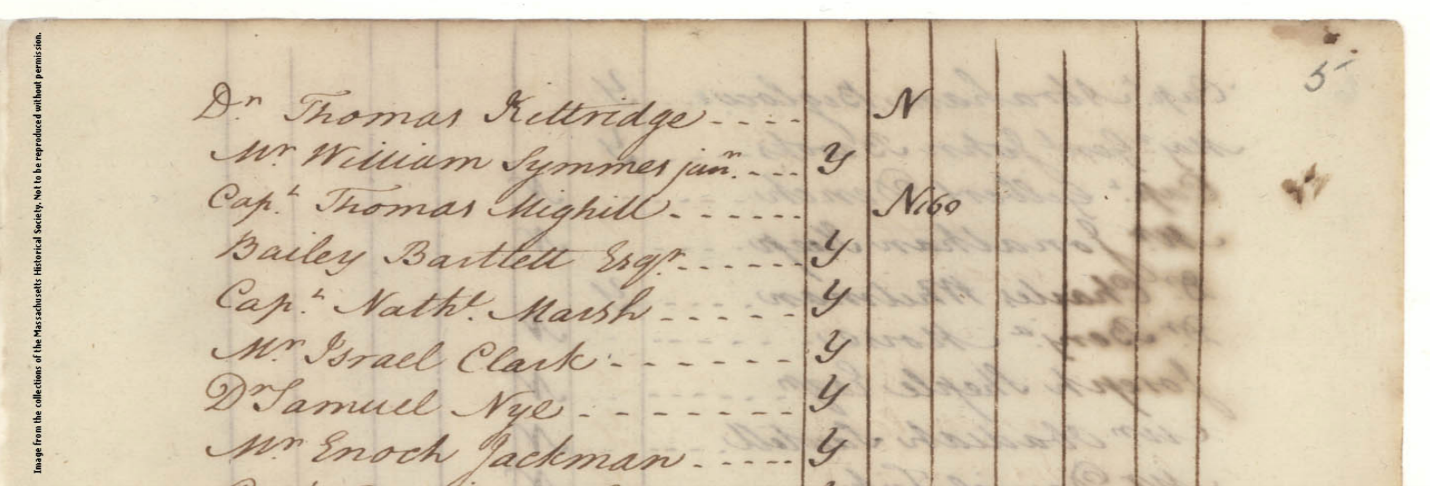
Mr. William Symmes “Yes” vote at the Massachusetts 1788 Ratification Convention for the US Constitution
In the fall of 1996, I began my teaching career at the North Andover Middle School which is in a New England community chock full of history from the colonial, revolutionary, and constitutional time periods. As I walked into the building that had just been newly renovated, I noticed a large banner that said, “Symmes House” which was obviously the name of the wing where my first classroom would be located named after someone of great importance. Growing up in this town, I had never heard of this name and as I asked around no one could tell me its overall significance including the building principal. It was twenty years later when I was reading an article about the annual Town Meeting where I saw that name again as the Manager of Town Meeting was dedicating part of the program to this man that had eluded me decades ago. It turns out that William Symmes Jr. was a representative at the Massachusetts 1788 Nomination Convention for the US Constitution who went against his constituents and voted yes for its approval. This became part of something that historians call the “Massachusetts Compromise” which was made up of an addition of a Bill of Rights combined with the US Constitution that eventually led to its unanimous adoption by all thirteen states.
This ratification process would eventually become part of my new curriculum in 2018 when my grade eight course went from U.S. History I to an intensive year of Civics based on a change in the Massachusetts History and Social Science Frameworks. It was a very exciting time for my students and I as we were creating something new together that would eventually have great meaning to them as civically engaged adults. Part of my instruction was to have various civic actors come into my classroom including the Town Manager who told the story of William Symmes Jr. to all of my students who were riveted with the overarching question of was this man a hero that helped bring about the ratification of the US Constitution by leading a group of voting members to change their positions impacting history forever or was he a villain who went against the wishes of his fellow townspeople who had instructed him to vote no on this crucial issue?
It was just a few years later that I received an email from the Massachusetts Historical Society (MHS) about offering the 2021- 2022 Kass Teacher Fellowship which would “offer an opportunity to focus on historical research that would fill a knowledge gap and address a need in the curriculum.” After my application and eventual acceptance, I was so thrilled to have the opportunity to explore this topic further and have a wide variety of resources available directly connected to the 1788 Massachusetts Ratification Convention for the US Constitution and possibly the story of William Symmes Jr. What follows is a story that truly impacted me as a civic educator and strongly presents evidence that the MHS is one of the best places for all educators to learn from materials and resources that are easily accessible which can be used in multiple ways to interact with students learning both Civics and U.S. History.
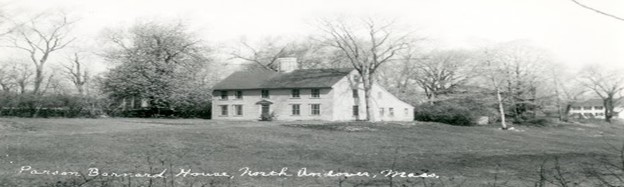
Childhood Home of William Symmes Jr, Andover (Now North Andover, MA)
After having my preliminary meeting with staff from the MHS, I immediately found two online resources created by them which were websites dedicated to the 1788 Massachusetts Ratification Conference. This was an amazing place to start with a detailed examination of this process which is not always covered in such an impressive manner. The website was so user friendly with a multitude of artifacts digitized and only a click away for the researcher. I was able to find a map of communities across Massachusetts that detailed their votes on ratification, newspapers from the week on the Ratification Convention, and a voting register with all of the members that were present including Symmes. I was so excited to not only be researching Symmes but also gaining knowledge about the ratification of the US Constitution process which will now become an integral part of my Civics course.
After just a few hours of research, I was able to find North Andover which was called Andover on the map detailing the overall votes (unrecorded due to a clerical error), a newspaper article from this time period that actually quoted Symmes, and the voting register with his “Yes” vote written in black ink. This was such an exciting and quickly developing process and personalized all that I was doing within my research of this topic as well as this man. At this point, I realized that William Symmes Jr. was not just an isolated learning topic and experience for my students but rather an integral part of my curriculum unit on the ratification of the US Constitution. I could now literally bring Symmes into my classroom showing my students that he played a huge role in this process as he was quoted on the front page of the newspaper and went on record as voting for ratification going against his constituents at the Massachusetts convention.
In addition, I was able to find his speech against ratification at the beginning of the convention and a second speech a few days later advocating for approval with the stipulation that a Bill of Rights would be added to the US Constitution which eventually became a development in other states’ ratification deliberations. This could not be more clear evidence that this organization not only knows its history but is on a mission to make it accessible to educators and students in interactive and meaningful ways which I was experiencing throughout this fellowship.
In the fall of 2021, I was actually able to visit the MHS library and do authentic research with the artifacts themselves which was a huge highlight for me especially with the COVID 19 restrictions over the past year and a half. The staff was so diligent both before and during my visit. The ABIGAIL request system was such an efficient experience and I was able to find even more resources including books about this topic, newspapers from this time period which actually quoted Mr. Symmes and the official voting ledger from the Convention with his signature and “Yes” vote right in front of my eyes. I was able to take a video of this that I will share with all of my students to deeply personalize this moment. I strongly encourage all of my fellow educators to not only use the resources of the MHS but to also apply for all of these multiple fellowships where you will have rewarding experiences and opportunities like the one I went through and be treated like a historian with access to so many resources along with the impressive knowledge and expertise of the staff.
I was also able to find more information about William Symmes in follow up research within college textbooks about this time period where actual chapters were dedicated to this man that I had no knowledge of years ago. I also found a periodical that documented a series of lectures in Andover and North Andover entitled a “Memorial Discourse on William Symmes, Esq” that took place in the winter months of 1859- 1860 asking history to take another look at this historical figure. The central theme of these highly attended talks was that Symmes was someone that was courageous who did the right thing for his community and should be revered in the history of the Andovers not vilified as someone that went against the wishes of his constituents.
In addition, I made a new connection with the North Andover Historical Society to learn even more about this topic and controversial local historical figures. One important part of this story was the reaction of Symmes’ constituents to his voting change which was described in one publication as “for his perfidy, Symmes’ constituents retired him from public life.” In my research, I learned that he left Andover with his successful law practice to move up north to Portland, Maine which was then part of Massachusetts. This then led me back to the MHS where I was able to find two speeches that Symmes had made to his new community with one being on the twenty third anniversary of the signing of the Declaration of Independence in 1797 which was a few years before his death in 1807. Once again, an opportunity presented itself for my students to learn the “What Happens Next ” as part of this remarkable story of history where Symmes was able to move on, form another successful law practice and proudly serve as a member of the Massachusetts House of Representatives as well as a School Committee member for his new community in Portland.
As I wrap up my research for this fellowship, I am now working on a curriculum unit about the ratification of the US Constitution making Symmes the centerpiece of this historical event. I am also inviting the Manager of Town Meeting back into my classroom to facilitate a debate on the legacy of William Symmes Jr for my students. In addition, my students and I are going to work together on a mini Civic Action Project to rededicate the Symmes wing in a more meaningful way to guarantee that all members of our school community now know who this man was and the impact that he had not only on the community of North Andover but on the legacy of the United States. These meaningful and engaging experiences for my students and I could not have taken place without this fellowship as well as the impressive work of the Massachusetts Historical Society as an organization. They clearly want to not only keep history alive in all of our minds but also make it accessible for all, proving that we are all “historians” and deserve to be treated in this manner with access to incredible resources in a way that is both welcoming and meaningful at the same time.
In 1765, nearly 100 Massachusetts vessels fished and whaled the Gulf of St. Lawrence and the Straits of Belle Isle, which lie between Newfoundland and Labrador. There were several Cape Cod whalers, including the two ships that concern us today, captained by Capt. Joseph Doane of Chatham and Capt. Lot Gage of Harwich. On 21 June the hunting was good in the Straits; a sizable number of boats from several vessels were in the water, and numerous whales had been sighted. One whale had succeeded in eluding capture, until Asa Nickerson, commanding one of Doane’s boats, drove his “iron” into it. The whale sounded with the line. At some point thereafter, Gage himself struck the same whale and Nickerson’s line came free. Gage was able to maintain control over the whale, supervise the kill, and bring its marketable parts aboard ship.
It seems that Gage then owned the whale and the rights to all proceeds made from it, right? Not according to Doane who then demanded one-eighth share in the profits of the whale since his sailor caught the whale first. Gage stood his ground and Doane had no choice but to take him to court.
This is where the story gets very interesting and dramatic! The two captains brought the case to the Inferior Court in Barnstable on Cape Cod, where people were swayed to a side, depending on long-standing rivalries, which ship’s sailors told them the story, or because they held a financial interest in one of the ships. Sides were chosen all along the Cape and public opinion was running rampant.
In June 1766, John Adams was asked to serve as counsel to Doane in his suit for that one-eighth share. James Otis, Jr., John Adams’ mentor as a lawyer, as well as James Otis, Sr., represented the Gage interests.
Depositions were taken in Barnstable, but public opinion was so strong on each side that both lawyers felt that holding the trial in Barnstable would be detrimental since a partial jury would not be found there. It was agreed between them that depositions are fine, but the Vice Admiralty Court would be the place for the eventual trial.
On 6 January 1768 John Adams entered “Joseph Doane v. Lot Gage, rela. a Whale” on the docket for the Vice Admiralty Court. At this time Robert Treat Paine, a whaler himself for a brief time, joined the father and son Otis on the counsel for Gage.
I’d like to pause here because there are things happening in Boston that would have made emotions run even higher. In October 1768, 2,000 troops arrived from his Royal Highness’s Army to quell suspected rebellion in Boston. This came after taxes were levied in the previous years and Bostonians refused to pay them which resulted in tax collectors’ property and bodies being attacked. The soldiers were there to dampen the fervor in the town, but it stoked the fire of rebellion instead and eventually led to the Boston Massacre on 5 March 1770, after which the soldiers were sent out of Boston.
I’ve written before about James Otis, Jr. and his volatile, if brilliant, nature, but an incident occurred during this time that shines a little light on his character and capacity. Otis was known for having exemplary oratory capabilities and could wax poetic for literally hours. However, he could also have bouts of mania where he would malign his enemies in Boston papers, have abrupt changes in mood, and be despondent for days. In September 1768, one of his enemies finally had enough. Otis responded in one of his newspaper writings to something tax collector John Robinson had said about him. Robinson and Otis happened upon each other in a Boston coffeehouse and a fight ensued. Robinson struck Otis on the head with his cane, after which Otis was never quite the same. He had mental struggles before this, but after the incident it was difficult for Otis to carry on conversations, handle his law cases, or do his duty to the Massachusetts General Assembly. His family eventually secluded him in a friend’s house. Although he would periodically dine with friends or other Assembly members, it was obvious he was very different.
With all this going on in Boston, and personally with Otis, on 22 April 1769 the parties agreed to submit the matter to arbitrators.
Watch for Part 2 coming soon, where we will discuss the particulars of the case and the outcome.
By Neal Millikan, Series Editor for Digital Editions, The Adams Papers
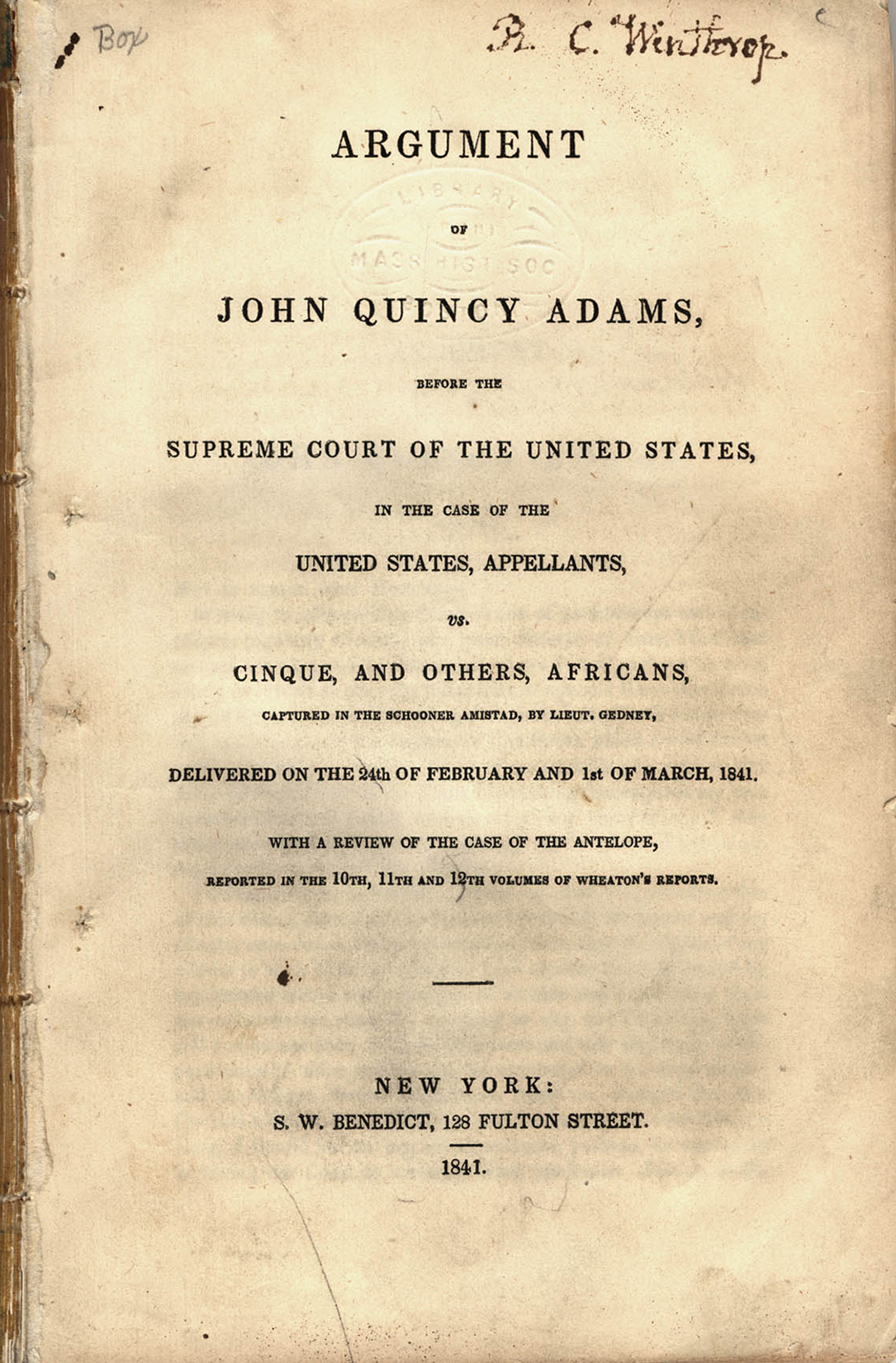
Transcriptions of more than 1,400 pages of John Quincy Adams’s diary have just been added to the John Quincy Adams Digital Diary, a born-digital edition of the Adams Papers editorial project at the Massachusetts Historical Society. The new material spans the period January 1839 through December 1842 and chronicle Adams’s involvement with the Amistad court case as he also continued serving in the United States House of Representatives.
In July 1839, fifty-three Africans revolted aboard the Spanish slave ship Amistad as they were being transported by their enslavers from Havana to another Cuban port. During the revolt, the Africans killed the ship’s captain and another crew member, demanding to be returned to Mendiland (now Sierra Leone). However, the remaining Amistad crew were able to divert the vessel from its course. On 24 August a U.S. revenue cutter seized the Amistad off Long Island and brought it into the port of New London, Connecticut. The Africans were imprisoned at New Haven, Connecticut, while their case moved through the U.S. District and Circuit Courts.
While he offered opinions and advice on the Amistad case as early as September 1839, John Quincy Adams did not take a formal role until a year later. Abolitionists visited the former president at his home in Quincy on 27 October 1840 and convinced him to join the Amistad defense team when the case went before the U.S. Supreme Court. In his diary, Adams noted his reluctance to provide further legal counsel. “I endeavoured to excuse myself upon the plea of my age and inefficiency—of the oppressive burden of my duties as a member of the House of Representatives, and my inexperience after a lapse of more than thirty years . . . before judicial tribunals.” However, the abolitionists “urged me so much and represented the case of those unfortunate men as so critical, it being a case of life and death, that I yielded.”
The trial opened in February 1841. John Quincy Adams began his oral arguments for the defense on the 24th, speaking for “four hours and a half, with sufficient method and order to witness little flagging of attention, by the judges or the auditory.” Pleased with his performance, he modestly assessed: “I did not I could not answer public expectation—but I have not yet utterly failed.” Adams returned to the court on 1 March to conclude his argument on behalf of the Amistad Africans and spoke for another four hours. The court’s opinion, delivered on 9 March, ruled that the Africans were free and could return home.
As he revised for publication his oral arguments in the Amistad case, John Quincy Adams mused in his diary on the current state of the emancipation cause in the United States. “The world, the flesh, and all the devils in hell are arrayed against any man, who now, in this North-American Union, shall dare to join the standard of Almighty God, to put down” the issue of slavery. He lamented that his own physical infirmities prevented him from doing more to further the cause. “What can I, upon the verge of my seventy-fourth birth-day, with a shaking hand, a darkening eye, a drowsy brain, and with all my faculties, dropping from me, one by one, as the teeth are dropping from my head . . . what can I do for the cause of God and Man? for the progress of human emancipation? . . . Yet my conscience presses me on.” The following year, Adams recorded that his continued opposition to slavery produced considerably different reactions in the North and South. While northerners routinely wrote to him asking for an autograph, the letters he received from southerners often contained “insult, profane obscenity and filth.”
For more on John Quincy Adams’s life, navigate to the entries to begin reading his diary. The addition of material for the 1839–1842 period joins existing transcriptions of Adams’s diary for his legal, political, and diplomatic careers (1789–1817), his time as secretary of state (1817–1825), his presidency (1825–1829), and his early years in the House of Representatives (1830–1838) and brings the total number of transcriptions freely available on the MHS website to more than 9,800 pages.
The Adams Papers editorial project at the Massachusetts Historical Society gratefully acknowledges the generous support of our sponsors. Major funding for the John Quincy Adams Digital Diary was provided by the Amelia Peabody Charitable Fund, with additional contributions by Harvard University Press and a number of private donors. The Andrew W. Mellon Foundation in partnership with the National Historical Publications and Records Commission also support the project through funding for the Society’s Primary Source Cooperative.
For today’s blog, I’d like to give you a behind-the-scenes peek at the work of archivists, specifically some of the small challenges we face in processing and preserving manuscripts for researchers. Collections come to us in all shapes, sizes, and physical conditions. While the work is interesting and rewarding, you may be surprised how long it takes to get a collection ready for use. Here are a few of the issues that make our jobs a little harder.
First, let’s talk about processing. Processing involves physically arranging a collection and describing its contents in a catalog record or collection guide. Imagine taking the carton shown above, removing all the letters from their envelopes, arranging them chronologically, identifying correspondents and subjects, etc. So, what are the most common hurdles?
An undated letter
Undated manuscripts. I give this issue pride of place in my list because of how common and how frustrating it is. Archivists may be able to date a letter based on a postmark (if we still have the envelope), a partial date, or internal clues, such as the passing mention of a recent event. The black border on the letter pictured here tells us a relative of the writer has recently died. However, archivists don’t read all the letters in a collection and seldom have time to do the digging necessary to date undated letters.
Unattributed manuscripts. I’ve seen this primarily with diaries, which is understandable. After all, most people probably don’t think their diaries will ever be read by anyone else. (God forbid!) But so much information is lost without this context. Who was this person? What experiences did they live through? Like letters, diaries can often be identified with some investigation, but it’s time-consuming.
Unidentified photographs. I wrote a few years ago about processing a large collection of family photographs and having to identify the baby pictures of three sisters who looked almost identical. We see so many terrific photographs come through our doors, it’s a shame when we can’t tell you who’s in them.
This word is “some,” believe it or not
Difficult/illegible handwriting. Archivists get better at this with practice, but it never really stops being tricky. If you’re responsible for processing a large collection of someone’s papers, you’ll become intimately familiar with their handwriting and the way they form certain letters, but then you’ll move on to the next collection and start all over again. Centuries-old writing sometimes barely even looks like English.
An example of cross-writing
Cross-writing. It was very common for correspondents, when they were running out of space but had a little more to say, to return to the first page and write across it at a 90-degree angle, as shown in this letter by Margaret Fuller. In this example, the end of the letter is right on top of the beginning. I’ve seen many variations of this, including writers who scribble along the margins or even turn a letter upside down and write in the gaps between the lines.
Duplicate copies. For modern collections, one of the biggest problems is excessive duplication. A collection, particularly the records of an organization, will usually contain multiple photocopies of documents that take up unnecessary space and need to be weeded.
Next up is preservation, the key to the long-term survival of our collections. Preservation encompasses everything from conservation—the physical repair of individual documents—to temperature and humidity control, light management, and the selection of acid-free enclosures. It also includes all the little steps we processing archivists take to ensure that a given document lasts as long as possible.
Newspaper stains the papers it touches
Acidic paper. Newspaper clippings, as they deteriorate, will not only become more brittle themselves, but they’ll also emit acid that does the same thing to the papers that touch it. You’ll see the pattern of staining on documents that have lived next to clippings for a period of time. It’s not just newspapers, either; the same kind of poor-quality wood-pulp paper was used for telegrams and some 20th-century copy paper. MHS archivists generally, time-permitting, photocopy newspaper clippings and remove the originals, or at least isolate any acidic paper.
Onion-skin paper. This unmistakable thin paper was common in airmail because of its light weight. It was also used for carbon copies of typed business correspondence. The ink on these copies is frequently faint to the point of illegibility, and the paper tears very easily.
Rust from metal fasteners
Metal fasteners. Ah, staples and paper clips. I often think archivists should be sure to keep up with their tetanus shots. Some past recordkeepers even used straight pins to attach pages together. And if a collection has been kept in a damp and/or warm environment before coming to the MHS, the rust (and rust stains) resulting from these metal fasteners can be epic. Rubber bands get an honorable mention here, too, because as they dry and harden, they will also stain paper. When fasteners are necessary, we use plastic paper clips.
Post-it® notes, tape, and other forms of adhesive are dangerous for paper even after they’ve been removed. Some residue of the adhesive remains on the paper and will damage it over time. Best to avoid them altogether.
Deteriorated leather bindings
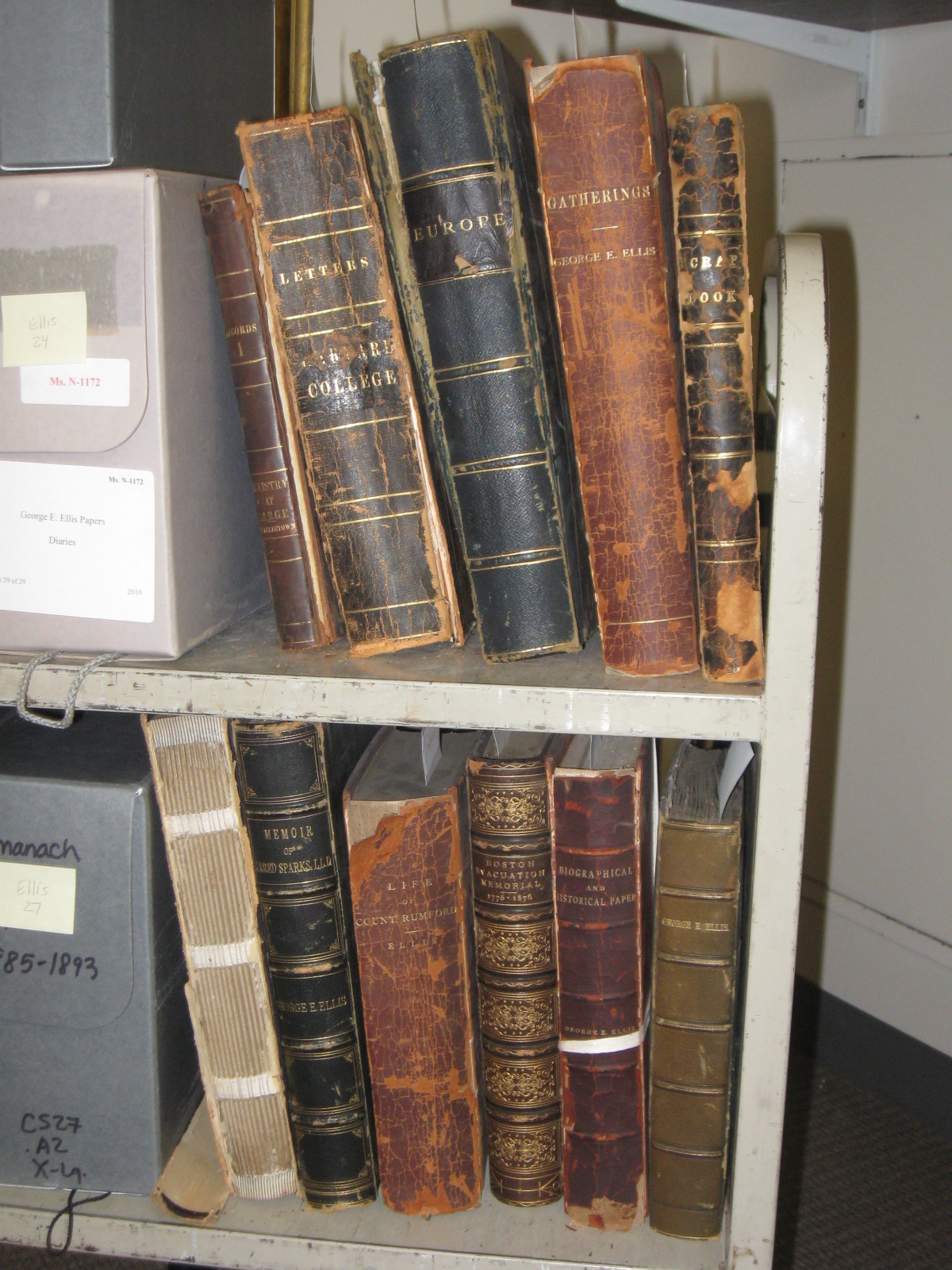
Red rot. Red rot is what happens to leather that has been exposed to humidity and/or high temperatures. This image shows how poor the condition of leather-bound volumes can become. Red rot is also, as any archivist or special collections librarian can tell you, a huge mess; it will crumble onto shelves, desks, your clothes, everything. Volumes that are literally falling to pieces can’t be handled by researchers, so the MHS measures each volume and orders custom-fitted cases.
Organic material. More than a few collections contain other forms of organic material, such as leaves and flowers pressed into volumes, as well as locks of human hair. These items are removed.
This is only a partial list; I haven’t mentioned digital records or issues related to the reference side of things. If my fellow archivists or librarians out there want to add anything in the comments, you’re more than welcome!
Abigail Adams’s death on 28 Oct. 1818 represented a cosmic shift in the Adamses’ universe. As her daughter-in-law Louisa Catherine Adams explained, Abigail was “the guiding Planet around which all revolved, performing their separate duties only by the impulse of her magnetic power.”
Though her death touched every member of the family, John Quincy Adams, then in Washington, D.C., knew his 83-year-old father would be the most affected. On 1 November, having received notice that his mother was gravely ill, he wrote in his diary, “Oh! what must it be to my father, and how will he support life without her who has been to him its charm?”
The next day, John Quincy received confirmation of his mother’s death. He retired to his chamber to weep and then reflected on what this loss would mean to his father.
“She had been fifty four years the delight of my father’s heart; the sweetener of all his toils—the comforter of all his sorrows; the sharer and heightener of all his joys— It was but the last time when I saw my father that he told me . . . that in all the vicissitudes of his fortunes, through all the good Report, and evil Report of the World; in all his struggles, and in all his sorrows the affectionate participation, and cheering encouragement of his wife, had been his never failing support; without which he was sure he should never have lived through them.”
John Quincy wrote to his father, lamenting their mutual loss and assuring his father it was “the dearest of his wishes to alleviate” John’s pain. “Let me hear from you, my dearest father; let me hear from you soon.” On 3 November, John Quincy repeated to his diary, “It is for him, and to hear from him that my anxiety now bears upon my mind.”
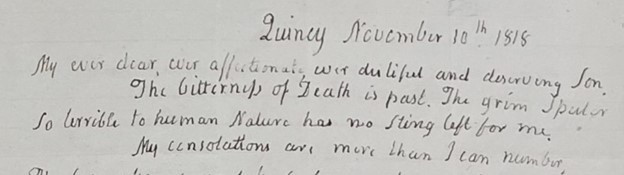
John Adams to John Quincy Adams, 10 Nov. 1818
On 10 November, John Adams responded to his “ever dear, ever affectionate, ever dutiful and deserving Son.” He wrote that “The bitterness of Death is past. The grim Spector So terrible to human Nature has no Sting left for me.” Knowing John Quincy was agonized to be separated from his father at such a painful juncture, John reassured him that “the Sympathy and Benevolence of all the World, has been Such as I Shall not live long enough to describe” and that his “consolations are more than I can number.”
John Quincy wrote to his last-surviving sibling, Thomas Boylston Adams, on 22 November. “I have received a short Letter from our dear and honoured father, and have heard from various quarters of the fortitude with which he has met the most distressing of calamities. Knowing his character as I do this was what I expected.” John Quincy confided to his brother that he still fretted for their father. “The struggle which is not apparent to the world, is not the less but the more trying within— Watch over his health, my dear brother with unremitting, though if possible to him imperceptible attention. Assist him with unwearied assiduity in the management of his affairs; and always according to his own deliberate opinions and wishes.” He stressed this last point. “Let the study of every one around him be to gratify his wishes, according to his ideas, and not according to their own.”
Indeed, John Adams had lost the person who most carefully watched over his health and affairs, but it was the loss of Abigail’s constant company and conversation John felt most severely. Though Adams put on a brave face for his family—his letters from this period are filled with levity and self-deprecating jokes—his boredom and loneliness saturate the page.
John Quincy couldn’t leave Washington, so he dispatched his eldest son, George Washington Adams, to Peacefield during Harvard’s winter break. “He is fond of your company,” John Quincy wrote to his son. “You can render yourself very serviceable to him; and . . . you can be in no possible situation better adapted to the improvement of your heart and the cultivation of your Understanding than with him.”
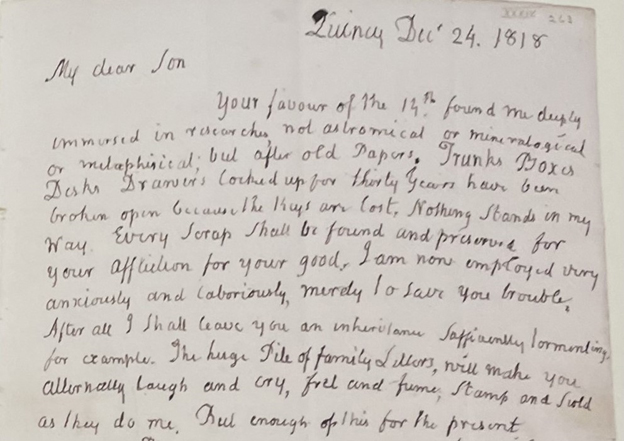
In December 1818, the bereaved patriarch and his grandson embarked on a project that thrills the heart of this editor. The two Adamses tore Peacefield apart in search of family papers. “Trunks Boxes Desks Drawers locked up for thirty Years have been broken open because the Keys are lost. Nothing Stands in my Way. Every Scrap Shall be found and preserved.”
John Adams to John Quincy Adams, 24 Dec. 1818
Though John Adams had been kicking around Peacefield since 1801, it was the loss of Abigail that stimulated this frenzied search. Perhaps her death made him reflect on his own mortality and legacy. Perhaps he just needed a project to keep him busy. But I wonder if the quest to find old family letters wasn’t a grieving widower seeking the company and conversation of his dearest friend.
The Adams Papers editorial project at the Massachusetts Historical Society gratefully acknowledges the generous support of our sponsors. Major funding is provided by the National Endowment for the Humanities, the National Historical Publications and Records Commission, and the Packard Humanities Institute. The Florence Gould Foundation and a number of private donors also contribute critical support. All Adams Papers volumes are published by Harvard University Press. Major funding for the John Quincy Adams Digital Diary was provided by the Amelia Peabody Charitable Fund. Harvard University Press and a number of private donors also contributed crucial support.
When I look through the archives of the MHS, I find myself laughing a lot. Not everything is funny, of course, but enough to remind you that these towering figures from history were, in fact, human beings that made mistakes and experienced awkward situations, just like anyone else. I’ve gathered a few stories revolving around plants that I hope you enjoy as much as I do.
In his diary on 6 June 1771, John Adams recounts what I took to be an exaggerated and funny tale about eating fruit, told by his friend Mr. William Barrell. In the end, Adams moralizes that it’s a wholesome way to eat:
“Barrell this Morning at Breakfast entertained Us with an Account of his extravagant Fondness for Fruit. When he lived at New market he could get no fruit but Strawberries, and he used frequently to eat 6 Quarts in a Day. At Boston, in the very hottest of the Weather he breakfasts upon Water Melons—neither Eats nor drinks any Thing else for Breakfast. In the Season of Peaches he buys a Peck, every Morning, and eats more than half of them himself. In short he eats so much fruit in the Season of it that he has very little Inclination to any other Food. He never found any Inconvenience or ill Effect from fruit— enjoys as much Health as any Body. Father Dana is immoderately fond of fruit, and from several other Instances one would conclude it very wholsome.”
More from John Adams, this time when he was in Paris on 7 December 1779 on a diplomatic mission, when he had an unfortunate experience with caustic nut oil:
“Yesterday the Chevr. de la Molion gave me some Nuts which he call’d Noix d’Acajou. They are the same which I have often seen, and which were called Cooshoo Nuts. The true name is Acajou Nuts. They are shaped like our large white Beans. The outside Shell has an Oil in it that is corrosive, caustic, or burning. In handling one of these Shells enough to pick out the meat I got a little of this oyl on my fingers, and afterwards inadvertently rubbing my Eyes, especially my Left, I soon found the Lids swelled and inflamed up to my Eyebrow.”
If you have ever handled spicy food then rubbed your eye, I know you are cringing as much as I did when I read that!
Abigail Adams is famous for inoculating her children for smallpox while her husband was away at the Continental Congress in 1776. This was cutting edge medicinal science at the time. So, when her mother-in-law took to carrots as a way to heal an arm sore, she did not believe it would work. However, in this letter to John on 21 February 1796, she remarks on the potential of carrots to heal this type of malady, perhaps as a joke.
“Tho I have not seen her since, I saw her Arm last week. There is not the appearance of a Soar upon it. It is matter of surprize and proves the powerfull efficacy of carrots in such cases as the rose kind.”
On 18 October 1820, John Quincy Adams was enjoying an evening with friends, including a beautiful young woman, when he was teased and challenged to come up with a poem about myrtle and geranium leaves for an album they were creating together. However, he disappointed the group, as he was unable to come up with anything imaginative on the spot. Afterwards, Adams notes that what was especially mortifying for him was the young woman’s impression of him as a man with an “inability” to produce a poem. Although he admits “I produce no impromptus,” later that night, he did write a poem for his friends to place in the album:
“Leaves of unfading verdure! here remain!
Myrtle of beauty! still thy place retain!
Still o’er the page, your hope-ting’d foliage spread;
Imprison’d still, your genial fragrance shed.
But Oh! could language, worthy of the theme,
Give instant utterance to fond fancy’s dream;
When your frail forms, her gentle hand shall raise,
The page should blossom with perennial praise:
A sweeter fragrance than your own should rise”
The Adams family may have been prominent, learned, worldly, and presidential, but these stories revolving around plants found in the MHS archives, are examples of the ways they could also be simply human. Perhaps what we can learn from the above is to always eat your carrots and fruit, and be careful which nut shells you handle—or, at least, don’t rub your eye afterwards!