This Week @MHS

This week at the MHS we have an author talk, our annual graduate student reception, and a discussion among hisotrians about the musical Hamilton. Details below:

– Tuesday, 18 September, 6:00 PM: If I Survive: Frederick Douglass and Family in the Walter O. Evans Collection with Celeste-Marie Bernier of the University of Edinburgh. Bringing to light previously unpublished manuscript letters, essays, speeches, and photographs from Frederick Douglass and his sons, Charles Remond, Frederick Jr., and Lewis Henry Douglass, If I Survive casts Douglass in the role of dedicated family man and inspirational figure to his five children. This family biography as accompanied by these personal documents comprises the first extensive study of Frederick Douglass and his family’s fight for the cause of liberty during the Civil War and in the post-emancipation era.

A pre-talk reception begins at 5:30 PM; the speaking program begins at 6:00 PM. There is a $10 per person fee (no charge for MHS Fellows and Members or EBT cardholders). 

– Thursday, 20 September, 6:00 PM: Graduate Student Reception. Calling all graduate students and faculty in history, American Studies, or any related field! Enjoy drinks and hors d’oeuvres as you meet students and professors from other universities working in your fields. Take a behind-the-scenes tour to learn more about the Society’s collections as well as the resources available to support your scholarship, from research fellowships to our six different seminar series.

The reception is free, but we ask that you RSVP by 19 September by e-mailing seminars@masshist.org or calling (617) 646-0579.

– Saturday, 22 September, 4:00 PM: Historians on Hamilton with Catherine Allgor, MHS; Lyra D. Monteiro, Rutgers University-Newark; Joseph M. Adelman, Framingham State University. The musical Hamilton has catapulted a founding father to the heights of popular culture. Three historians will explore this creative approach to discussing the stories of America’s founding, the conversations that have been created by this phenomenon, and how the excitement can be used to inspire the public to look at American history in greater depth.

A pre-talk reception bins at 3:30 PM; the speaking program begins at 4:00 PM. There is a $10 per person fee (no charge for MHS Fellows and Members or EBT cardholders). 

Visit www.masshist.org/events for upcoming programs including Under the Starry Flag: How a Band of Irish Americans Joined the Fenian Revolt & Sparked a Crisis over Citizenship, an author talk on Monday, 24 September, and Radical Nonviolence & Interracial Utopias in the Early Civil Rights Movement, a seminar on Tuesday, 25 September.

Triumph and Tragedy in History

By Kate Melchior, Education

School has started, which means that it is time to start brainstorming for this year’s National History Day  projects!  Each year National History Day selects a theme that is intentionally broad enough so that students can select topics from anywhere and any time in history.  The theme gives students a lens through which they will gain a deeper understanding of history beyond facts and dates, and pushes them to think about perspective, context, and broader impact of historical events.


The 2019 theme has been announced as “Triumph and Tragedy in History.”  While this theme sounds straightforward at first, it challenges students and teachers alike to think about the true meaning of both words in a historical context.  National History Day advises students to begin with the definition of both words: according to Merriam Webster, the definition of triumph is “a victory or conquest by or as if by military force, or a notable success,” while tragedy is defined a “disastrous event.”  While students do not need to necessarily include both triumph and tragedy in their work, many topics will end up including both:  a military triumph, for example, might be defined as a tragedy by the losing side.  NHD then poses the following questions for students starting to select their topics:

“Can one person’s triumph be another’s tragedy? Can the same person or group suffer from tragedy and triumph at the same time? How does one ultimately triumph after tragedy? Can triumph lead to tragedy?”


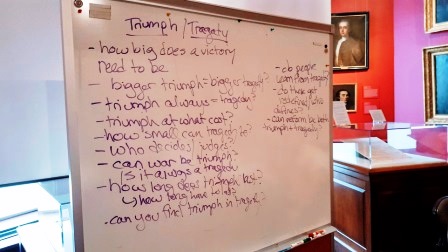
The Massachusetts History Day affiliate recently held an Intro to Mass History Day teacher workshop for educators from BPS, Lynn, and other schools in the Boston area.  To put themselves in their students’ shoes, teachers built upon NHD’s questions about the meaning of “Triumph and Tragedy” and brainstormed their own questions (see image).  Some of their questions included:

  • Can war ever be a triumph?  Is it always a tragedy?
  • How long does triumph last in history?
  • Does triumph always equal tragedy for someone else?
  • Do people learn from tragedy?  Can that lesson be a triumph?
  • Can reform be both triumph and tragedy?
  • Can whether something is thought of as a triumph or tragedy change through history?  Does it depend on who remembers it?

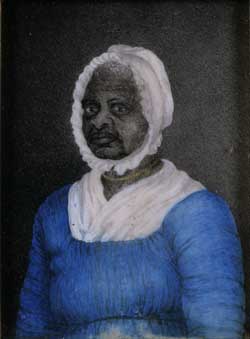
Portrait of Elizabeth Freeman, 1811.


Along with many heritage organizations around the country, the MHS Center for the Teaching of History thought about how the NHD theme connects to our own collections at MHS.  We set up a CTH Theme Page with ideas about topics, links to collections, and intriguing objects from our archives that might serve as a launching point for student research into triumph and tragedy.  Suggested topics include early Boston smallpox inoculations, Massachusetts women in WWI, Boston marriages and LGBTQ+ history, Wampanoag and English settler interactions, and Elizabeth Freeman’s suit for freedom from slavery.

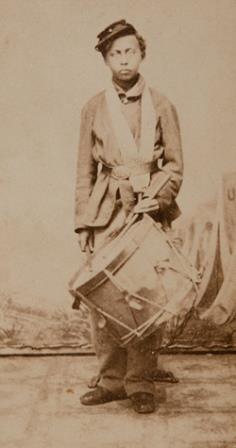
Henry A. Monroe, a young musician with the 54th Regiment.


Another example is the history of the Fifty-fourth Massachusetts Volunteer Infantry Regiment, the first military unit consisting of black soldiers to be raised  in the North during the Civil War.  The 54th’s tragic losses at the Battle of Fort Wagner in 1863 are also remembered for triumphant bravery shown and for how the soldiers paved the way for numerous other black units in the Union Army for the remainder of the war.  The 54th also fought a lesser-known but just as critical battle against its own government: the fight for equal pay.  African American soldiers in the 54th and other Black units refused pay for 18 months until the government granted them the same pay to their white counterparts.  While the achievement of equal pay is regarded another triumph for civil rights, numerous tragedies shape this story: the hardship of the pay battle on Black soldiers and their families, the immense tragedy of the US Government’s racism and oppression, and the harsh punishments and even deaths of several soldiers for “mutiny” over the conflict.

How do you think that Triumph and Tragedy can act as perspectives for examining history?  What items in our collection do you think connect to the theme?


Barbara Hillard Smith’s Diary, September 1918

By Lindsay Bina, Intern and Anna Clutterbuck-Cook, Reader Services

Today we return to the 1918 diary of Newton teenager Barbara Hillard Smith. You may read our introduction to the diary, and Barbara’s previous entries, here:


January | February | March | April

May | June | July | August

September | October | November | December


As regular readers of the Beehive know, we are following Barbara throughout 1918 with monthly blog posts that present Barbara’s daily life — going to school, seeing friends, playing basketball, and caring for family members — in the words she wrote a century ago. Here is Barbara’s September, day by day.


* * *

SUN. 1                                    SEPTEMBER

Boys came to church. Park in afternoon. Boys to supper

MON. 2                       LABOR DAY

Went up river with boys. Down to Spuds. K’s in evening.

TUES. 3

In town. Went to Keith’s with the gang. Up to farm with [Spud].

WED. 4

Hung around K’s for lunch. Wendell took us to Revere. Park in evening

THUR. 5

Peg’s for tennis. In town. Babe went home. Hospital with Dr. G-

FRI. 6

Peg came over. Pete is going to Lasell. Hurrah! Sick?

SAT. 7

Hung around. Felt rotten. Saw [Eli].

SUN. 8

Cousin Mildred to dinner. Over to Peg’s for supper. Ben is home.

MON. 9

School. Mrs. Reed’s

TUES. 10

School. Mrs. Reeds

WED. 11

School. In town

THUR. 12

School. Mrs. Reed’s. Played tennis.

FRI. 13

No school. It rained. Movies [+ overnight with] Lane’s. Babe + Mother went

SAT. 14

Took flowers up to Bil Sybil + saw Bob. That boy was awfully sick

SUN. 15

Church and Sunday School. Went up to see Bob with K. Spud to supper

MON. 16

School. Staid at home and studied.

TUES. 17

School. Peg and I went to see Bob.

WED. 18

School. Went over to Pegs. Rained hard

THUR. 19

School. Went to Surgical Dressings.

FRI. 20

School. Went down to Connies. Night at Pegs

SAT. 21

Down at station at 5:45. In town. Pegs for a dance

SUN. 22

Sunday School. Came down with influenza.

MON. 23

In bed. Dr. G- came. Mother came home.

TUES. 24

In bed. Feel rotten. School closed till Monday.

WED. 25

Got up and went out. Felt rotten.

THUR. 26

Went over to Pegs. Hung around. Sick?

FRI. 27

Tenn Went over to Pegs

SAT. 28

Tennis at Pegs

SUN. 29

Church. No Sunday School. Over to Pegs in afternoon

MON. 30

In town. Surgical Dressings. Spud very sick

* * *

If you are interested in viewing the diary in person in our library or have other questions about the collection, please visit the library or contact a member of the library staff for further assistance.


 *Please note that the diary transcription is a rough-and-ready version, not an authoritative transcript. Researchers wishing to use the diary in the course of their own work should verify the version found here with the manuscript original. The catalog record for the Barbara Hillard Smith collection may be found here.


This Week @ MHS

By

This week we have a pair of Brown Bag talks, an author talk, and the end of an exhibition. Details below:

– Wednesday, 12 September, 12:00PM : The first lunch talk this week is with C. Ian Stevenson of Boston University, and is titled “‘This Summer-Home of the Survivors’: The Civil War Vacation in Architecture & Landscape, 1878-1910.” In the decades after the Civil War, its veterans built communal summer cottages in waterfront locations to merge memory and leisure among their comrades and families. Through interdisciplinary lenses, this talk considers the ways veterans used architecture and landscape to heal their wartime trauma and preserve their scripted legacy.

This talk is free and open to the public.

– Wedensday, 12 September, 6:00PM : On the night of March 5, 1770, British soldiers fired into a crowd gathered in front of Boston’s Custom House, killing five people. Denounced as an act of unprovoked violence and villainy, the Boston Massacre became one of the most familiar incidents in American history, yet one of the least understood. In “Boston’s Massacre,” Eric Hinderaker of the University of Utah revisits this dramatic episode, examining in forensic detail the facts of that fateful night, the competing narratives that molded public perceptions at the time, and the long campaign to transform the tragedy into a touchstone of American identity.

This talk is open to the public and registration is required with a fee of $10 (no charge for MHS Fellows and Members or EBT cardholders). Pre-talk reception begins at 5:30PM, followed by the speaking program at 6:00PM.

– Friday, 14 September, 12:00PM : “A Possible Connection between a Scandal and Susanna Rowson’s Last Novel” is the second Brown Bag of the week, this time presented by Steven Epley of Samford University. The talk will describe evidence in letters and public records suggesting that best-selling author Susanna Rowson may have based her last novel, Lucy Temple, at least in part on a scandal in which she was innocently but indirectly involved in Medford, Mass., in 1799.

As ever, this lunchtime talk is open to the public free of charge.


This is your last chance to view the current exhibition, Entrepreneurship & Classical Design in Boston’s South End: The Furniture of Isaac Vose & Thomas Seymour, 1815 to 1825, which ends on 14 September.

John Quincy Adams and the Allens

By Lindsey Woolcock, Adams Papers Intern

In October 1837, John Quincy Adams was reading the newspaper, when he came across an advertisement for a slave sale.

There was in the National Intelligencer this morning an advertisement, signed James H. Birch … headed Sale of Slaves—A sale at public auction at 4 O’Clock this afternoon, of Dorcas Allen, and her two surviving children aged about 7. and 9. years (the other two having been killed by said Dorcas in a fit of insanity as found by the jury who lately acquitted her)… (23 October 1837)

Dorcas Allen was promised her freedom multiple times by her owners, the Davises. Though informally released from slavery, after multiple deaths and remarriages in the Davis family, Allen was left without the papers she needed to legally secure her freedom. Allen and her four children were taken from the District of Columbia to a slave prison in Alexandria, Virginia; there Allen killed her two youngest children and attempted unsuccessfully to commit suicide. She was put on trial for murder but acquitted on grounds of insanity.

This story deeply affected John Quincy. In his later years, he began taking more of an active stance against slavery. He presented dozens of antislavery petitions to an unresponsive House of Representatives, leading to the establishment of the House’s “gag” rule, where all petitions relating to slavery were laid aside without discussion.

His succeeding diary entries talk about visiting the auction house where Dorcas was to be sold in order to discover more information. He met with Nathan Allen, Dorcas’s husband, who was trying to raise enough money to purchase his wife and the two children from Birch. He also met with Dorcas, who came with her husband to ask for the $50 that John Quincy promised to contribute toward her purchase.

After that meeting, Dorcas and Nathan Allen and their children disappear. John Quincy seems to have never met with them again. We don’t know what happened to Dorcas and her children, yet these brief moments in Adams’s voluminous diary offer small glimpses into the parallel worlds of the black and white communities of Washington, D.C.

Over the summer that I’ve transcribed John Quincy’s diary, I’ve watched many seemingly random people show up in his parlor: a Quaker woman who gave a sermon and advised him to maintain a steady course in the House of Representatives; men visiting “out of curiosity”; a Scottish silkworm breeder who spoke so long about his worms that John Quincy didn’t have time to write letters of introduction for an earlier visitor. You never know who’s going to show up, and these meetings always struck me as odd. How do you just show up at the home of the former President of the United States? Do you just knock on the front door?

But a story like the Allens’s in particular struck me: what was that meeting like? How did Dorcas and Nathan feel? And what happened to their family afterward?

This Week @ MHS

By

As we enter September and a new academic year, we see a bit of an increase in programming here at the Society. This is what is in store in the week ahead:

The Society is CLOSED on Monday, 3 September, for Labor Day. New normal hours pick up on Tuesday, 4 September.

– Wednesday, 5 September, 12:00PM : Stop in at midday for a Brown Bag lunch talk titled “Garrisonian Rhode Island: Reassessing Abolitionism’s Radicals.” In this talk, Kevin Vrevich of Ohio State University explores the place of Rhode Island, a center of William Lloyd Garrison’s “radical” abolitionism, in the larger antislavery network. As historians of abolitionism increasingly focus on continuities within the movement, Rhode Island offers an opportunity to reassess the place of the Garrisonians and to reconsider their contributions.

This talk is free and open to the public.

– Thursday, 6 September, 6:00PM : “100 Years of Education Henry Adams” is a public conversation with Natalie Dykstra of Hope College, William Decker of Oklahoma State University, and Natalie Tayor of Skidmore College. Henry Adams offers an account of his life and commentary on political and cultural events during the mid and late 19th century in the Pulitzer Prize–winning autobiography The Education of Henry Adams. Join us to mark the centenary of both Adams’s death and the Education’s publication with a critical conversation on Adams and his best known work.

This talk is open to the public, registration required with a fee of $10 (no charge for MHS Members and Fellows or EBT cardholders). There is a reception that begins at 5:30PM, followed by the program at 6:00PM.

– Friday, 7 September, 12:00PM : “American Silver, Chinese Silverwares, and the Global Circulation of Value” is the title of the second Brown Bag this week which is presented by Susan Eberhard of University of California, Berkeley. Silver coin was the primary commodity shipped to China from the United States in the late eighteenth and nineteenth centuries, some of which was reworked into silverwares by Chinese craftsmen for British and American buyers. This talk explores the different silver conduits of the American trade relationship with China. Far from a neutral medium, how were understandings of its materiality mobilized in cross-cultural transactions?

As ever, this lunchtime talk is free and open to the public.

– Saturday, 8 September, 10:00AM : The History and Collections of the MHS is a 90-minute docent-led walk through our public rooms. The tour is free, open to the public, with no need for reservations. If you would like to bring a larger party (8 or more), please contact Curator of Art Anne Bentley at 617-646-0508 or abentley@masshist.org.

While you’re here you will also have the opportunity to view our current exhibition: Entrepreneurship & Classical Design in Boston’s South End: The Furniture of Isaac Vose & Thomas Seymour, 1815 to 1825. There is only one more week for this exhibition which closes on 14 September. Be sure to see it before it’s gone!


Sibley’s Harvard Graduates: Determination and Persistence

By Conrad Edick Wright, Research

One of the happy consequences of the Massachusetts Historical Society’s centuries-long institutional stability has been its ability to carry out extended projects. It is not that we actively try to transform small, modest undertakings into ones that never end, but that we see our commitments through to their conclusion. Determination and persistence are our watchwords. The time horizon of most businesses is usually a matter of a few weeks, months, or years. Even well-endowed educational and cultural institutions rarely project their plans decades into the future. One of the Massachusetts Historical Society’s signature projects, however, Sibley’s Harvard Graduates, a multi-volume collected biography of the college’s alumni, has a history more than a century and three-quarters long, including more than 130 years as a formal MHS activity.

In the middle of the nineteenth century, no one expected that work on Sibley’s Harvard Graduates would still be underway today. To say that Sibley has proceeded by fits and starts would be a triumph of tact. Whether one dates the series from 1842 (the year that Harvard assistant librarian John Langdon Sibley [1804-1885] began to collect source materials for the series), 1859 (when he wrote the first entries), or 1873 (when he published the first volume), the undisputable fact is that the project has been underway for a very long time.

It goes without saying that everyone involved would prefer a more rapid rate of publication. The series was an ancillary responsibility when Sibley began to work on it some 176 years ago, however, and an ancillary responsibility it has remained. One of his many duties as assistant librarian was to maintain an up-to-date record of Harvard’s alumni. The college began no later than 1674 to publish an annotated broadside list of its graduates, Catalogus eorum qui in Collegio Harvardino . . . alicujus gradus laurea donate sunt, so in 1841, when President Josiah Quincy asked (or really instructed) Sibley to add the preparation of the list to his library responsibilities its form and nature were well established. The broadside appeared once every three years. To the extent possible, it included the Latinized names of the known graduates of the college—thus William Ames, A.B. 1645, became Gulielmus Amesius. Graduates who had achieved such honors as elevation to a major public office or admission to a significant cultural institution qualified for appropriate abbreviated notes recognizing these distinctions. When a graduate died, he did not disappear from the list; instead, a star next to his name marked his passing.

As Sibley accumulated reams of biographical information on Harvard men, friends began to urge him to make more of this data than the restricted space of the triennial broadside allowed. There were already models of collected biography to draw on, notably Athenae Oxonienses: An Exact History of All the Writers and Bishops Who Have Had their Education in the University of Oxford from 1500 to 1690 by Anthony Wood (1632-1695), but, model or not, preparing volumes of Biographical Sketches of Graduates of Harvard University, later known simply as Sibley’s Harvard Graduates, still proved to be a time consuming task. Shortly before Sibley’s death in 1885, he completed his third and final volume; he had taken his story from Harvard’s first graduating class in 1642 through the class of 1689. All told, he had written entries on 301 graduates. Some sketches, on subjects about whom little was known, were only a few paragraphs long. In contrast, the entry on the Puritan minister Cotton Mather, A.B. 1678, no doubt colonial America’s most prolific author, ran 153 pages, including a list 117 pages long of his 456 works.

John Langdon Sibley and his wife, Charlotte, lived with unusual frugality; at his death, after providing for Charlotte, he pledged to the Society about $150,000, to that point its largest bequest. Although the legacy could be used for a number of different purposes, the continuation of Sibley’s Harvard Graduates was the closest to his heart. Nearly half a century passed before another scholar, Clifford K. Shipton (1902-1973), resumed the series. Between 1930, when Shipton began the work, and the posthumous publication of volume 17 in 1975, he prepared fourteen volumes of sketches, a massive achievement that carried the project from the class of 1690 through the class of 1771. After a sixteen-year pause, work on the series resumed in 1989. Volume 18 appeared in 1999. Publication of volumes 19 and 20 is in progress, and research and writing for volume 21, which will take the series through the class of 1784, is far along.

From time to time, scholars and administrators at other American colleges have toyed with the possibility of undertaking their own counterpart to Sibley and two institutions have produced valuable reference tools. Between 1885 and 1912, Franklin Bowditch Dexter (1842-1920) brought out six volumes of entries on Yale alumni from the school’s founding in 1701 through the class of 1815. At Princeton, between 1976 and 1991, a team of scholars issued five volumes of sketches of that college’s graduates and non-graduates through the class of 1794. In 2005, the MHS and the New England Historic Genealogical Society brought out a CD-ROM, Colonial Collegians: Biographies of Those Who Attended American Colleges before the War for Independence, that collected all the Harvard, Yale, and Princeton entries through the class of 1774, together with parallel material on the graduates of William and Mary, Columbia, the University of Pennsylvania, Brown, Dartmouth, Rutgers, the medical schools at Penn and Columbia, and William Tennant’s Log College, a Presbyterian seminary.

Recent Sibley volumes, both published and in the works, as well as Colonial Collegians testify to the Society’s belief that even after well over a century it has not quite satisfied its commitment to John Langdon Sibley and his Harvard graduates. In the coming years, look for more Sibley volumes in print, including those now in press. And look for Colonial Collegians, currently available in our reading room as a CD-ROM, to be accessible one day as a free reference source on the MHS’s website.

Brief Trip to Revere Beach

By Brendan Kieran, Reader Services

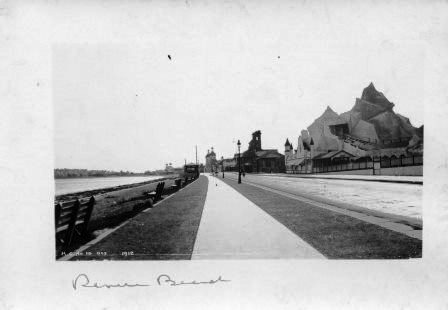
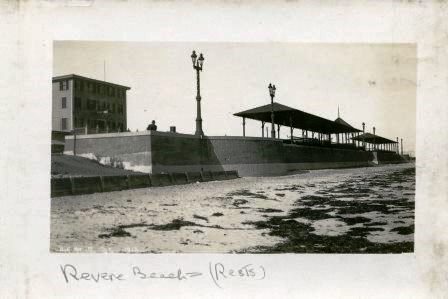
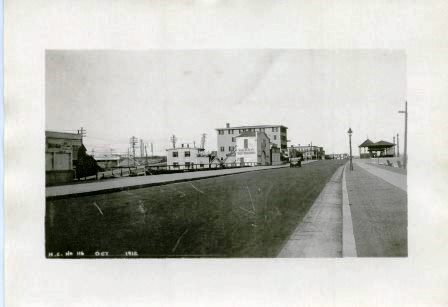
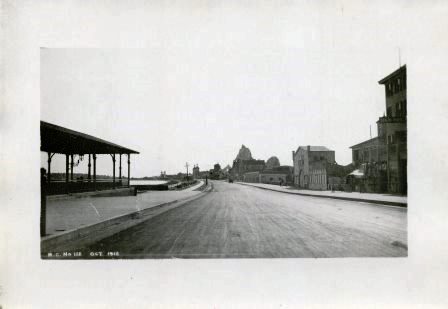
Last summer, I wrote a post for the Beehive based on my exploration of MHS materials relating to Lynn Woods, an outdoor public space I’ve enjoyed in my lifetime that I wanted to look at through a different lens. I decided to continue with that theme this summer by looking at another North Shore recreational area, Revere Beach. The MHS holds a handful of materials relating to the beach, including some of the Arthur Goss photographs. These photos, taken in 1912, provide brief but interesting snapshots of the Revere Beach landscape of the time.

“Revere Beach,” from the Arthur Goss photographs, 1912.


When I looked through these photos, I was struck by the number of rides and attractions that lined the road along the beach. One photo includes the sign for a merry-go-round, and multiple photos include a ride of some sort that looks like a miniature mountain. In Boulevard Landmarks: America’s First Public Beach, a book of postcards edited by Peter McCauley and the Revere Society for Cultural and Historical Preservation ([Revere, Mass.?: s.n., 1996]), this ride is referred to as the Thompson Scenic Mountain Railway.

“Revere Beach   Bath House,” from the Arthur Goss photographs, 1912


The Toronto Harbour Commissioners sent these photographs to the MHS in 1987. Their earlier provenance is not clear, but the Chief Engineer for the Harbour Commissioners, Edward L. Cousins, visited Massachusetts in 1912, the year in which the photos were taken. The waterfront development in Toronto was influenced by beach setups in Massachusetts, including Lynn Beach and Revere Beach.

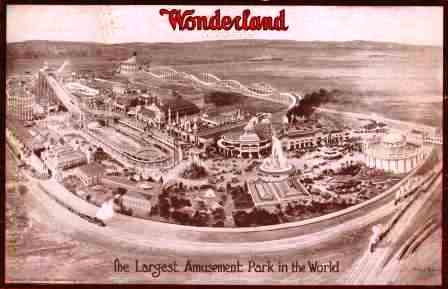
From the cover of the “Wonderland” score, words and music by Thos. S. Allen (Boston, Mass.: Walter Jacobs, 1906)


Additionally, the Revere Beach area was once home to the Wonderland amusement park. The experience of a night at the park with a date was the subject of a 1906 waltz song by Thos. S. Allen. The cover of the published score includes an illustration of Wonderland, which is billed as “The Largest Amusement Park in the World.” 

“Revere Beach = (Rests),” from the Arthur Goss photographs, 1912


A 2003 MHS publication, Faces of Community: Immigrant Massachusetts, 1860-2000, edited by Reed Ueda and Conrad Edick Wright, includes a chapter about Revere Beach. In “Lines in the Sand: Ethnicity, Race, and Culture at Revere Beach,” Mark Herlihy chronicles the development of the Revere Beach Reservation as a public park in the 1890s by the Metropolitan Park Commission (MPC) and the rise of recreational amusements along the beach shortly thereafter. He then explores the dynamics of ethnicity and race over the years at the beach, including the strong roles played by immigrants (mainly Jewish and Italian) in the development and use of the beach environment in the early decades after its conversion into a public space, tensions between immigrants and longer-established residents as well as among different immigrant groups, racism at the beach (including racist attractions along the boardwalk and at Wonderland), and difficulties as well as successes Black beachgoers experienced as they began to use the beach in greater numbers after World War II.

From the Arthur Goss photographs, 1912


The MHS holds some other items relating to Revere Beach. Revere Beach Chips: Historical Background from the Revere Journal, compiled by McCauley (Revere, Mass.: Revere Society for Cultural and Historic Preservation, 1996), includes transcriptions of Revere Journal newspaper articles relating to Revere Beach, with the earliest article in the book being from 1881 and the latest being from 1974. “Revere Beach Reservation : bath-house, shelters and beach” ([Boston: Metropolitan Park Commission, 1898]), removed  from the Metropolitan Park Commission Report, January 1898, depicts a crowded beach scene (this item was recently featured in a Beehive post by Lindsay Bina and Anna Clutterbuck-Cook).

From the Arthur Goss photographs, 1912


If you would like to catch a glimpse of Revere Beach in earlier periods, these materials are available for research here in the MHS library

100 Years after the Influenza Pandemic

By Rakashi Chand

On this date a century ago, two sailors stationed in Boston went to the sickbay with flu-like symptoms; the next day eight more, the following day 58 more, and this was just the beginning. As we make plans for flu season this autumn, we should remember that this year marks the centennial of the deadliest epidemic of Influenza in modern history. The 1918-1919 influenza, or “Spanish flu,” pandemic killed upwards of fifty million people worldwide and five thousand people in Boston alone, numbers only surpassed by Philadelphia and Pittsburgh. The shocking morbidity pattern killed young, healthy people between 20-40 years of age at an alarming rate, with a rapid disease progression that could lead to multi-organ failure and death within twenty-four hours. The influenza strain was highly contagious and unfortunately spread at exponential rates. Although the origin of the outbreak is still debated, the Spanish media were the first to openly cover the outbreak because they were neutral in WWI. In part because of the war, the U.S. and non-Spanish European press were slow to report accurate information about the epidemic, and the high rate of casualties among military and civilian populations. Some lawmakers also suppressed coverage in an effort to reduce panic. 

At Camp Devens, an army training base for 45,000 soldiers just outside of Boston, the first soldier to come down with the flu was misdiagnosed with meningitis and influenza began spreading rapidly throughout the entire camp.  At the height of the crisis, 1,543 soldiers were reported ill on a single day. A poignant letter by Physician N. Roy Grist stationed at Camp Devens describes the scene in detail and can be read online: www.pbs.org/wgbh/americanexperience/features/influenza-letter/.

The epidemic soon spread to the civilian population of Boston.

The MHS has a public notice issued by the city for the care and prevention of Influenza. This broadside is an example of the advice given to the people of Boston during the Influenza outbreak by William C. Woodward, the Health Commissioner of Boston from 1918 -1922.  
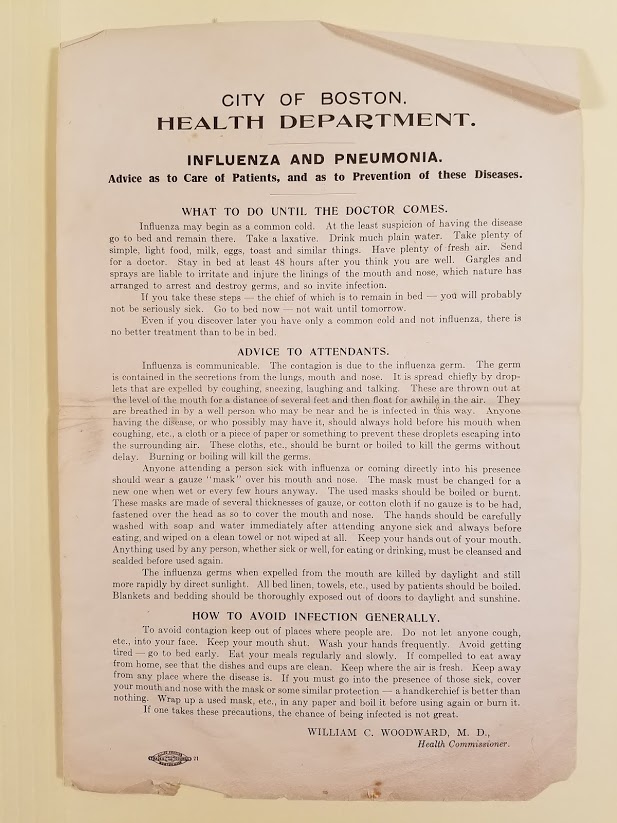
Influenza broadside

The epidemic took over the lives of all Bostonians. In mid-September, the Boston Globe reported on that the city planned to keep schools open, saying:

Neither Dr. William H. Devine, medical director of the schools, nor Dr. W. C. Woodward, City Health Commissioner, is in favor of closing Boston schools. They say that by remaining at their studies pupils are less likely to become affected, especially since teachers, school physicians and nurses are doing everything in their power to head off the epidemic.

But things turned for the worse very quickly, and people started to panic. No one understood why the disease was spreading so quickly or how to prevent it. Officials in Boston began forbidding public gatherings as they were desperate to try to control the spread of the disease. Finally, the schools were closed, as well as theatres, bars, and even churches were asked to hold not services. City hospitals were flooded with patients, there was an urgent need for doctors and nurses especially since so many were oversees helping the War effort, and, sadly, even coffins could not be supplied at the rate they were needed. 

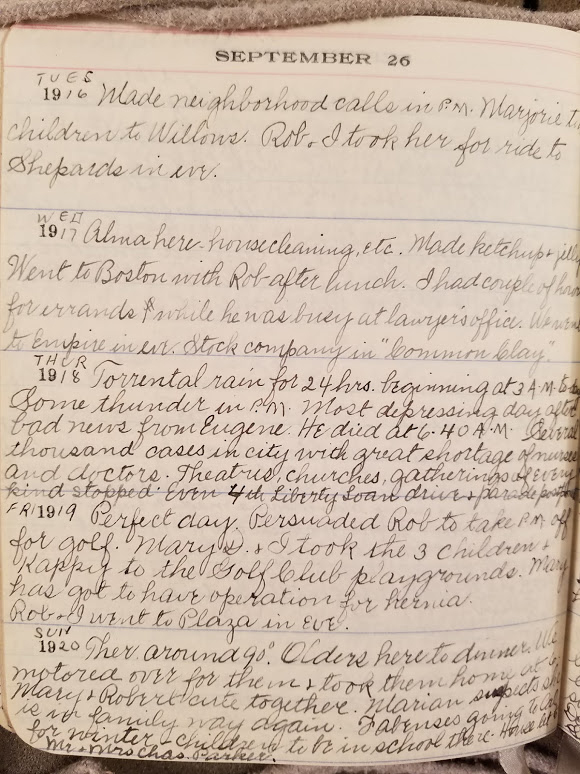
The diaries of Edith Coffin (Colby) Mahoney, from the Colby-Mahoney Family Papers, provide a glimpse of life in Massachusetts during the Influenza Outbreak. The diary Edith keeps is full of descriptions of lovely Golf outings at the Club, picnics, shopping, and friends’ visits during the final days of August, and into September of 1918. But then her daily entries suddenly mention Influenza, and with it, death.
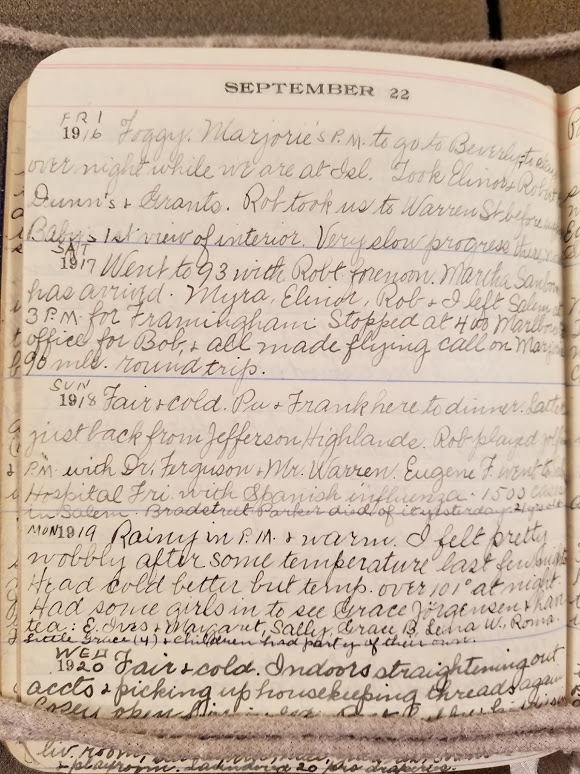
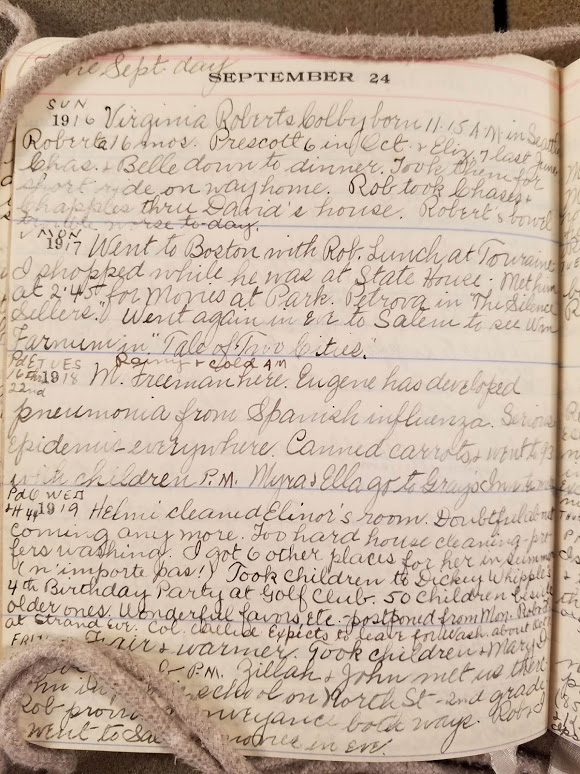
Edith diary 9-22 Edith diary 9-24 Edith diary 0-26

September 22 1918

“Fair & cold. Pa and Frank here to dinner just back from Jefferson Highlands. Rob played golf with Dr. Ferguson and Mr. Warren. Eugene F. went to the hospital Fri. with Spanish influenza. 1500 cases in Salem. Bradstreet Parker died of it yesterday. 21 yrs old.”

September 24 1918

“Mr. Freeman here. Eugene has developed pneumonia from Spanish Influenza. Serious epidemic everywhere. Caned carrots. Went to 93 with children P.M. Myra and Ella go to Gray’s Inn tomorrow.”

September 26 1918 

“Torrential rain for 24 hours beginning at 3am today, some thunder in the P.M.. Most depressing day after bad news from Eugene. He died at 6:40am. Several thousand cases in the city with a great shortage of nurses and doctors. Theatres, churches, gatherings of everykind stopped. Even 4th Liberty Loan drivers parade postponed.”

September 27 1918

“Fair part of day but cold. Had Elwood Noyes get boiler ready and start furnace fire. Out with kiddies in P.M. Called at Ma’s. Belle there with a hoarse cold. Pa here right from office the past three days. Harry at Nasson School to see Agnes who has influenza. Rob home from N. Y. at midnight. Came instead of tomorrow accnt of Eugene’s funeral.”

September 28, 1918

“Beautiful, mild day. Rob in bed all day with high fever, bound up head and aching eye balls, so could not be pall bearer at Eugene’s funeral at grace Church. Prompt measures with hot lemonade, castor oil, aspirin etc.induced god sweat by afternoon so he felt much better in evening. Phoned but did not call Dr. Sargent”

September 29, 1918

“Beautiful, mild day. Rob very much better. Husky throat the only symptom left. Up at noon. Dr. Sargent said to keep him in tomorrow. Met him as I was going to 93 with children in the P.M.. James Tierney died Fri of pneumonia (37yrs). Dr says there is no sign of epidemic abating.”

The MHS houses another diary kept by young Barbara Hillard Smith of Newton, MA, describing her experience during the Influenza epidemic.
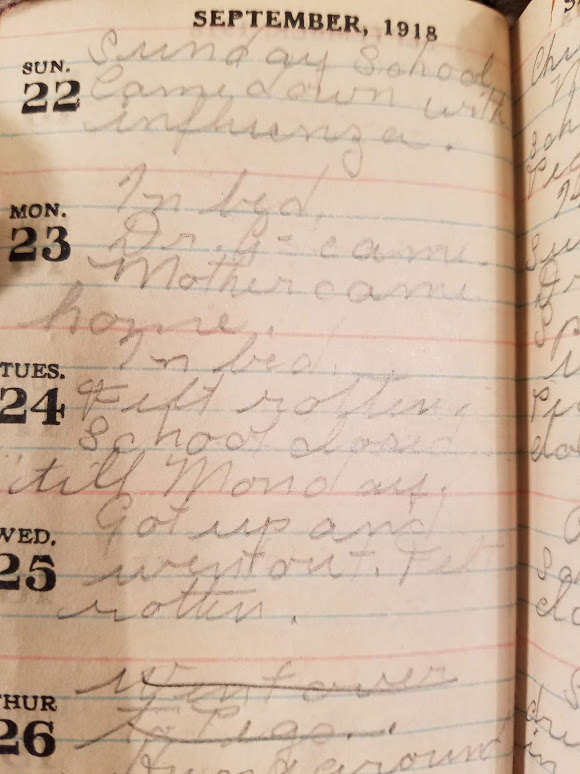
Barbara diary

September 21, 1918

“Down at Station at 5:45. In town. Pegs for a dance.”

September 22, 1918

“Sunday School. Came down with Influenza.”

September 23, 1918

“In bed. Dr. G- came. Mother came home.”

September 24, 1918

“In bed. Felt rotten. School closed till Monday.”

September 25, 1918

“Got up and went out. Felt rotten.”

September 26, 1918

“Hung around. Sick.”

September 27, 1918

“Went over to Pegs”

September 29, 1918

“Church. No Sunday school. Over to Pegs in afternoon.”

October 2, 1918

“Over to Pegs. School still closed.”

Luckily, Barbara survived the influenza epidemic, and it seems the greater impact on her family was that of the school closure.

To learn more about the Influenza Epidemic of 1918, or more about diaries and letters from 1918 please visit the Library at the Massachusetts Historical Society. We welcome your questions and research queries at library@masshist.org


Bibliography:

https://www.massmoments.org/moment-details/flu-epidemic-begins-in-boston.html

https://academic.oup.com/cid/article/47/5/668/296225

https://www.influenzaarchive.org/cities/city-boston.html#

https://www.smithsonianmag.com/history/journal-plague-year-180965222/ 

https://www.wgbh.org/news/post/1918-influenza-outbreak-when-boston-was-patient-zero 

https://www.pbs.org/wgbh/americanexperience/features/influenza-letter/

This Week @ MHS

By

Welcome back to our weekly round-up of programs taking place in the coming days. Once again, this week is characterized by Brown Bag lunch talks, of which we have two for you. Here are the details:

– Monday, 27 August, 12:00PM : Thomas Whittaker of Harvard University starts the week with “The Missionary Republic: American Evangelicals and the Birth of Modern Missions.” The turn of the nineteenth century was a time of missionary mobilization for evangelicals in Britain, the United States, and continental Europe. This talk explains why Americans bought into the missions movement and how they domesticated it within a republican vision of civilization building on the frontier.

This talk is free and open to the public.

– Friday, 31 August, 12:00PM : Hannah Tucker of University of Virginia closes the week with “Masters of the Market: Ship Captaincy in the Colonial British Atlantic.” During the colonial period, captains acted as powerful auxiliaries for their vessel owners in markets far from the owners’ direct oversight. This talk explores why the economic services ship captains provided transformed as the Atlantic trading economy became more complex, capital intensive, and informed in the eighteenth century.

Once again, this talk is free and open to the public.

Don’t forget to come in and see our current exhibition, The Furniture of Isaac Vose & Thomas Seymour, 1815-1825, on view until 14 September.

The Society is CLOSED on Saturday, 1September, and Monday, 3 September, for Labor Day. Normal hours resume on Tuesday, 4 September

Also, a reminder that beginning in September we are resuming evening library hours on Tuesdays. Every week on Tuesday, the library is open 9:00AM-7:45PM.