Travel Without Moving : Adam Matthew Digital and the History of Tourism

By Katie Loughrey, Reader Services

As summer draws to its inevitable end, I am somewhat grateful (In case you haven’t noticed, it has been a hot one!) and somewhat wistful. Although I’ve been privileged to take several trips this season, I am someone always thinking of the next place left to explore, even if that place is as close as downtown Boston or a small piece of New England I haven’t yet seen in my lifetime of living here. Luckily, as a library assistant here at MHS and an aspiring archivist, I do always have an option to turn to when needing to be transported to a new place: the archives.

Quite the useful tool in my vicarious travels has been the Adam Matthew Digital online database Leisure, Travel and Mass Culture: The History of Tourism. This digital collection – available by subscription – highlights materials from several contributing institutions around the world, including the Massachusetts Historical Society, revolving around the birth and growth of travel and mass tourism between 1850 and 1980. The collection is made up of all sorts of ephemera from photographs, travel brochures, and ads to promotional tourism films. One can explore the collection by curated themes, country or region, contributing institution, or even within a set chronological timeline. It can be accessed online here at the MHS, or within any contributing or subscribing library.

Below I’ve highlighted a few items from our collections available on this database, and how they contribute to our understanding of how Americans traveled and toured New England in the past two centuries.

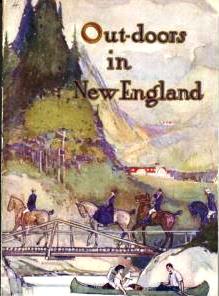
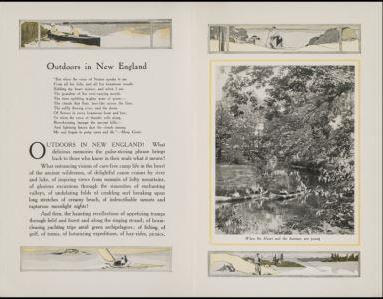
Many of the more eye-catching items are those tourism guides and brochures by transportation and tourism companies trying to entice consumers to be whisked away on a seasonal adventure of a lifetime. A prime example is this guide, Outdoors in New England, published in 1909 by the Boston & Maine Railroad General Passenger Department.


Inside this colorful volume, are nearly 50 pages of enthusiastic prose on the many leisure activities in the different states of New England, “the ideal, the perfect resting-up section of America.” Accompanied by both photographs and tri-colored illustrations of serene activities like boating and fishing, it captures the ever increasing narrative of the commodity of vacation as a respite from the tedium and stress of work and everyday life that was becoming available to the average American as railroads commercialized.


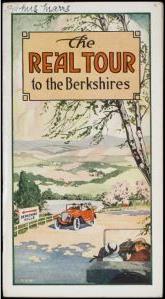
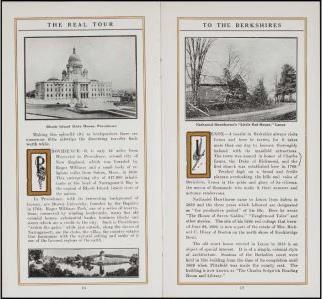
As the next decade approaches, more of these brochures became geared toward automobile travel, such as Real Tour to the Berkshires, published by the Real Tour Association of Lenox, MA. Including a fold-out map of the routes, the guide provides a detailed description of a scenic drive from New York through Connecticut and into the Berkshire area of western Massachusetts, with suggestions of accommodations and activities along the ride.


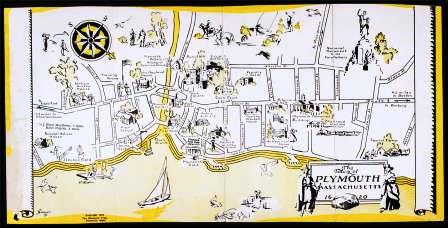
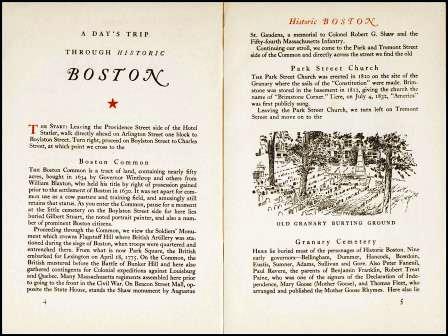
Aside from brochures and advertisements, a large part of our travel related collections on this database, and in general, are travel diaries. The diaries of Eva E. Blackwelder record her travels through Boston and surrounding towns, from winter 1938 to spring 1939. Eva’s entries are quite thorough, noting the weather, the sights seen, town histories learned on her tours and the quality, or lack thereof, of food at each of their accommodations. Not unlike myself, Eva seems to have kept most of the brochures, maps, photos and newspaper clippings collected along her journey to remember these places by. A notable realization as one leafs through these pages is how most of the sites she visited nearly a hundred years ago – the many stops of the Freedom Trail, Plymouth village, the House of Seven Gables in Salem – remain the draw for many tourists to this area today due to eastern Massachusetts’ historic past.

Eva E. Blackwelder Scrapbook [8], c.1938-1957.


Eva E. Blackwelder Scrapbook [Brochures], 1935.


Eva E. Blackwelder Scrapbook [Brochures], c.1938-1957.


Here’s a final nostalgic image from Eva’s journal – soon to be just a faint memory for Massachusetts travelers – physical turnpike tolls. On her way back into Boston at one point she writes:  

The toll houses were constructed with large gates which swing across the way as reminders to the traveler that he must help pay for the road.

The toll rates for passing over the turnpike were 25 cents for one person with a carriage of 4 wheels drawn by four horses. Carts and wagons with 2 horses paid half this amount… horse chaise, 10 cents. A man on horseback 5 cents. Cattle one cent and sheep and swine 3 cents a dozen. According to the general turnpike laws no toll could be collected from a passenger on foot; nor could toll be collected from those going to or from public worship within the limits of any town.

It’s hard to decide which is more surreal – a 25 cent toll or dozens of sheep on I-90! Either way, I hope this post inspires you to venture out on one last day trip before it’s too late.

This Week @ MHS

By

After a very quiet week with naught on the schedule but a Saturday tour, we are back this week with a couple more programs happening in the days ahead. Specifically, we have pair of Brown Bag lunch talks as well as our Saturday building tour. Here are the details:

– Wednesday, 22 August, 12:00PM : Sunmin Kim of Dartmourth College leads the first Brown Bag this week. The talk, titled “Re-categorizing Americans: Difference, Distinction, and Belonging in the Dillingham Commission (1907-1911),” traces how the federal government surveyed immigrants in the early-20th century and how such attempts helped solidify the racial boundary-making for the nation. By dissecting the tenuous connections between racist ideology, state power, and social science knowledge, this talk provides an empirical account of how categories such as race and ethnicity emerge from confusion and contradiction in knowledge production.

This talk is free and open to the public. Pack a lunch and come on in!

– Friday, 25 August, 12:00PM : The second Brown Bag talk this week is “‘A Brazen Wall to Keep the Scriptures Certainty’: European Biblical Scholarship in Early America,” with Kirsten Macfarlane of University of Cambridge. During the sixteenth and seventeenth centuries, European scholars made significant advances in the historical and critical study of the Bible, often with highly controversial and factious results. This talk will examine how such exciting but potentially subversive European scholarship was received and transformed by its early American readers, through a close study of the books owned and annotated by seventeenth-century readers in New England and elsewhere.

This talk is free and open to the public.

– Saturday, 26 August, 10:00AM : The History and Collections of the MHS is a 90-minute docent-led walk through our public rooms. The tour is free, open to the public, with no need for reservations. If you would like to bring a larger party (8 or more), please contact Curator of Art Anne Bentley at 617-646-0508 or abentley@masshist.org.

While you’re here you will also have the opportunity to view our current exhibition: Entrepreneurship & Classical Design in Boston’s South End: The Furniture of Isaac Vose & Thomas Seymour, 1815 to 1825.


N. B. – The teacher workshop scheduled for this 23-24 August, “Education: Equality and Access” is POSTPONED. Further information will be posted here when it is rescheduled.

Adding Evening Hours in the Library

By Elaine Heavey, Director of the Library

On Tuesday, 4 September, after a four-year hiatus, evening hours are returning to the MHS library!

The library will operate until 7.45 PM every Tuesday, allowing researchers with 9-5 work schedules and full-time students more opportunities to work with the MHS collections in the library. 

Starting September 1, our library hours will be:

Monday: 9:00 AM to 4:45 PM
Tuesday: 9:00 AM to 7:45 PM
Wednesday: 9:00 AM to 4:45 PM
Thursday: 9:00 AM to 4:45 PM
Friday: 9:00 AM to 4:45 PM
Saturday: 9:00 AM to 4:00 PM

Please help us spread the word – and of course also plan to visit the library on a Tuesday evening in the not too distant future. 


John Quincy Adams’ 1794 London Interlude

By Neal Millikan, Adams Papers

When John Quincy Adams arrived in London on October 15, 1794, on his way to The Hague to become minister resident to the Netherlands, he was a 27-year-old beginning his new life as an American statesman. We know much about his two week stay in London because he recounted his visit in his diary, transcriptions of which will eventually be available through The John Quincy Adams Diary Digital Project website.

John Quincy purposefully stopped in London to deliver important government documents; however, he almost lost these papers. “Just before we got to the London Bridge we heard a rattling before us and immediately after a sound as of a trunk falling from the Carriage. I instantly looked forward and saw that both our trunks were gone. One of them contained all the public dispatches which I brought for the American Ministers here … For a moment I felt sensations of the severest distress.” Luckily his brother, Thomas Boylston Adams, who accompanied him as his secretary, jumped out of the carriage and located the trunks. John Quincy noted how detrimental their loss would have been to American diplomacy and his career: “Entrusted with dispatches of the highest importance … particularly committed to my care, because they were highly confidential,” he questioned how he could have ever “presented myself” to the men for whom they were intended, only to inform them “that I had lost” their documents. He believed the trunks had been purposefully cut loose and considered their quick recovery “as one of the most fortunate circumstances that ever occurred to me in the course of my life.”

It was during this visit that John Quincy participated in one of his first diplomatic activities. He, Chief Justice John Jay, and U.S. minister to Great Britain Thomas Pinckney discussed the document that would become known as the Jay Treaty, which sought to settle outstanding issues between America and Great Britain left unresolved after the Revolutionary War. That Jay and Pinckney included Adams in these deliberations demonstrated the young man’s status among the American diplomatic corps. The three men held lengthy conversations during which the draft treaty was “considered Article by Article.” Adams commented on the treaty in his diary: “it is much below the standard which I think would be advantageous to the Country, but … it is in the opinion of the two plenipotentiaries, preferable to a War: and when Mr Jay asked me my opinion I answered that I could only acquiesce in that idea.” John Quincy’s inclusion in these discussions proved prescient, for in 1795 he received instructions to return to London to exchange ratifications of the Jay Treaty.

Revisiting the Nathaniel T. Allen Photograph Collection

By Susan Martin, Collections Services

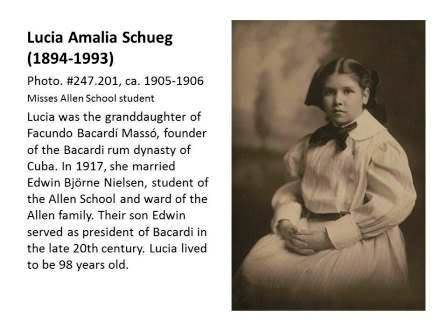
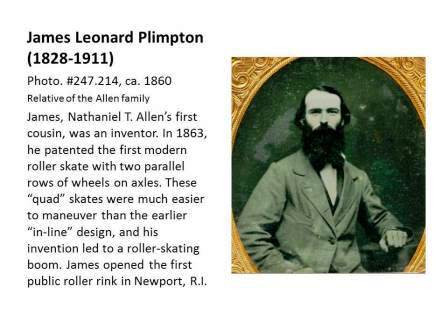
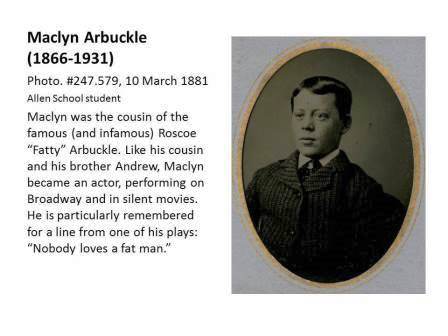
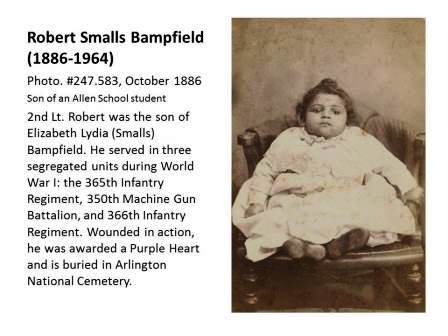
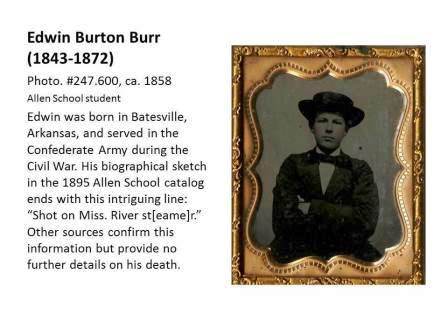
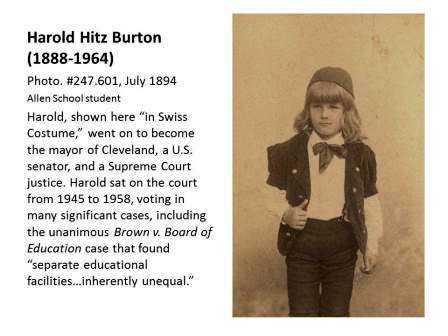
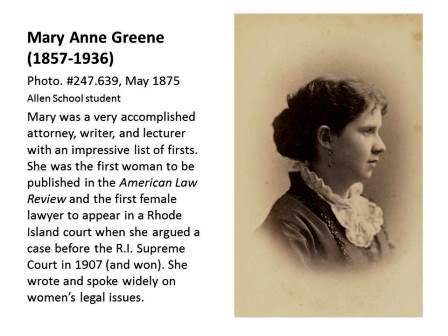
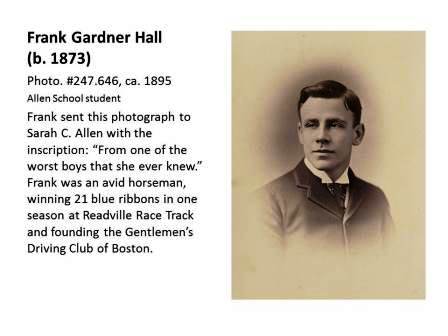
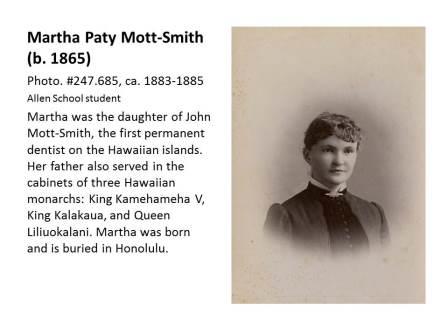
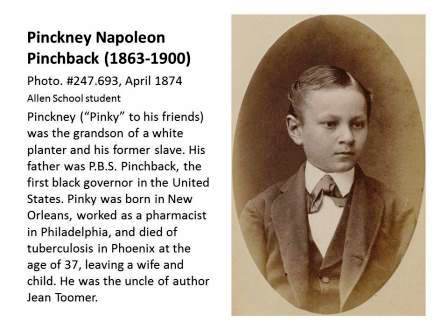
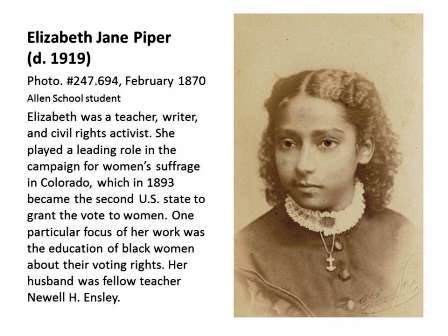
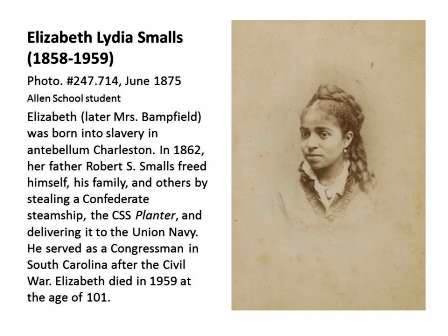
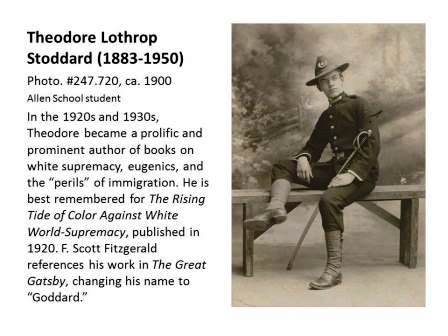
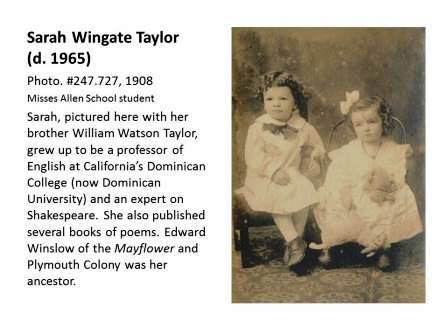
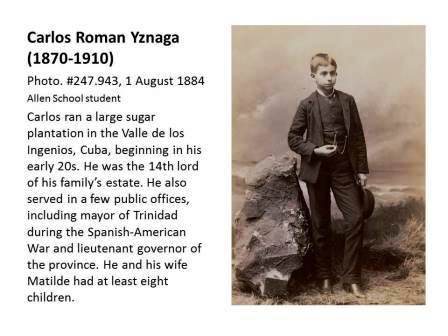
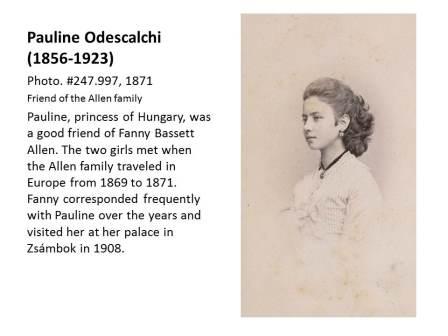
Three weeks ago, I told you about the Nathaniel T. Allen papers and photographs, two collections available for research here at the MHS library. Allen founded the West Newton English and Classical School (or “Allen School”) in West Newton, Mass. As I processed the photograph collection, I stumbled across a lot of interesting stories and trivia about students of the Allen School and the Misses Allen School, as well as friends and relatives. I’d like to share a few of them in this post.


Summer Education Programs at the MHS

By Kate Melchior, Center for the Teaching of History

Friday, June 20th marked the end of our three-day teacher workshop, “Loyalism in the Era of the American Revolution”. The program played host to 40 K-12 teachers and heritage educators from the Boston area to as far as Seattle, providing them with an in-depth perspective on both the motivations and struggles of American loyalists in the late 18th century.

Participants arrived early Wednesday morning to begin the workshop. MHS Adams Papers’ Christopher Minty kicked off the program by introducing participants to the roots of Loyalist ideology and motivations.  Teachers then explored Loyalist primary source materials from the MHS collections, including the broadside denouncing Loyalist shop owner William Jackson and his later letter to the Continental Congress protesting his imprisonment and the seizure of his property. Teachers also explored political cartoons and propaganda from the period.  After lunch, Christina Carrick from the MHS Robert Treat Paine papers discussed violence and “civil war” during the Revolution, and we ended the day with MHS intern Lindsay Woolcock presenting on primary sources from the Revolutionary period in South Carolina and comparing the occupations of Boston and Charlestown.

On Thursday, participants received a guided tour at the Royall House and Slave Quarters in Medford from Education Coordinator Amy Peters Clark, where they learned about how the Revolution impacted two familes: the Royall family, who owned the home, and the Sutton family, who were enslaved there.  Afterwards, we headed to the Medford Public Library to hear a talk on Black Loyalists and Loyalist slavery in the Canadian Maritimes from Professor Harvey Amani Whitfield of the University of Vermont.

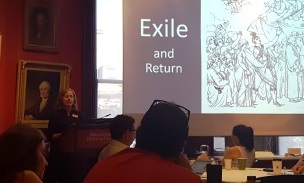
Upon returning to the MHS on Friday, participants were treated to several other sessions on loyalism by scholars Patrick O’Brien (USC) and Christina Carrick on Loyalist exile and return, ultimately finishing their workshop with a session on technological tips and tricks from local educator Edward Davies. Throughout the course of the workshop, participants received guidance on accessing primary source materials through the MHS website and other digital resources.
Thank you to all of our speakers and staff for helping to make this seminar so successful, and to our wonderful community of educators!

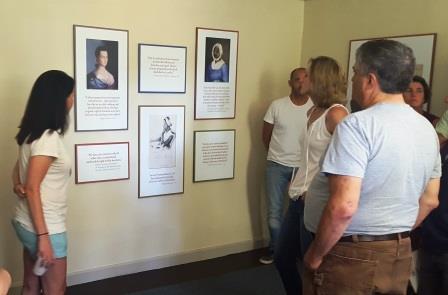
Looking forward, the MHS will be hosting an October workshop titled “Fashioning History” to partner with our upcoming MHS exhibit on “Fashioning the New England Family.”  In December, we will host the “Remembering Abigail” workshop celebrating the life and legacy of Abigail Adams.  To learn more, visit our Teacher Workshops page at the Center for the Teaching of History website.


Join Us for Lunch!

By Alexis Buckley, Research Department

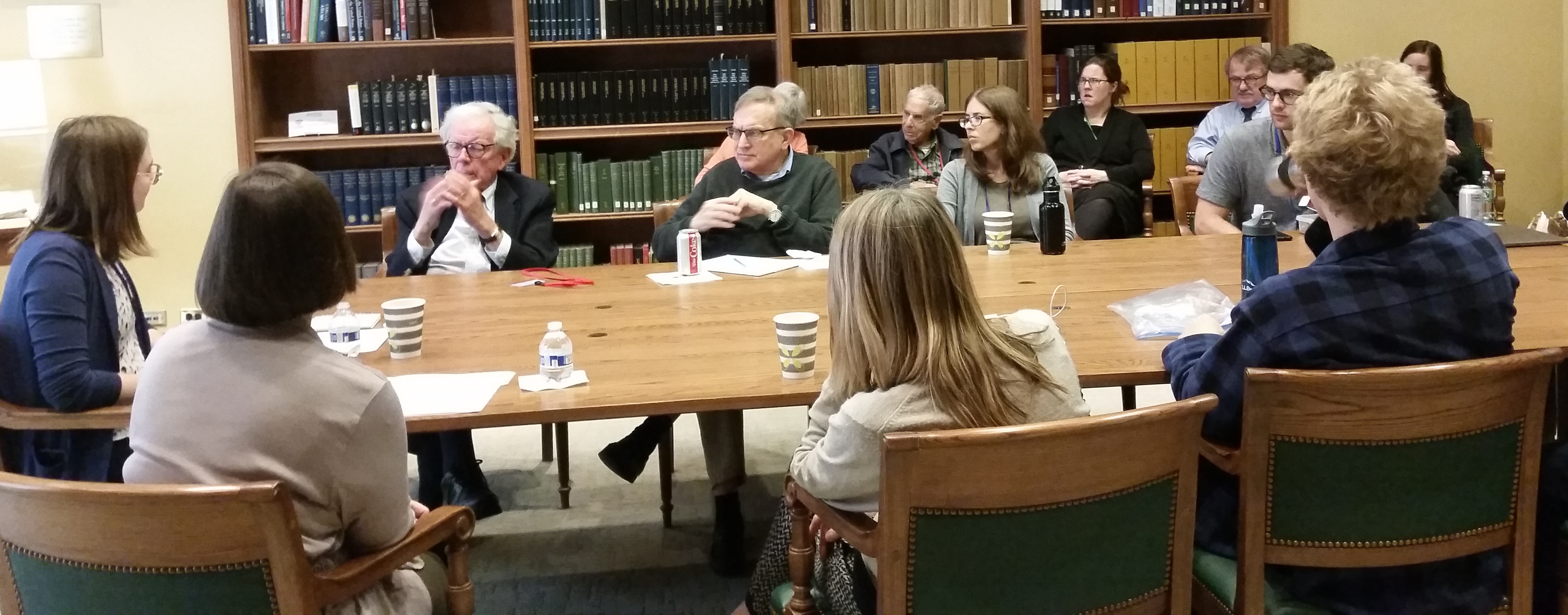
If you’ve been by the Massachusetts Historical Society on a Wednesday, or if you follow us on Twitter, you’ve probably come across an invitation to attend a brown bag lunch talk. “Join us for Kate McIntyre’s brown bag lunch, and learn about the intersections of #race and #ecology!” the tweet might read. Or you’ve passed the sign in the lobby that says: “Madeline Kearin’s Brown Bag lunch talk at 12 pm—all are welcome.” But what exactly is a brown bag lunch talk?

Good question! A brown bag lunch talk offers our MHS researchers and research fellows a chance to present on the work they’re doing here at the Society. The presenter speaks for about twenty minutes on their research. They talk about the dissertation or book project that they’re working on, and about why they’ve come to the MHS. Then they focus in on a specific chapter or section of their project. They discuss the sources they’ve found—or haven’t found yet!—and perhaps some of the challenges this chapter has offered. Then the floor is opened to questions and suggestions, and for the next forty minutes we have a discussion about the presenter’s project.

Our most recent brown bag lunch talk was with Ian Saxine, whose second book project has brought him back to the Massachusetts Historical Society on a short-term W.B.H. Dowse Fellowship. (For a list of this year’s research fellows, go here.) He discussed the fourth Anglo-Wabanaki War, 1722-1725, the many names for the war, and how the war’s unexpected outcomes influenced colonial policy in Maine for next several decades. The discussion was lively, involving such questions as: “How do you define a war?”; “How are you looking at the memory of the war?”; and “What was the role of religion in the war?”

Upcoming brown bag talks will focus on a wide array of topics, from tomorrow’s talk on partisanship and the origins of the American Revolution to New England hospitals for the insane to the United Fruit Company and 20th-century revolutions.

Interested in attending? Brown bag talks are free and open to all. Bring a lunch or show up and enjoy a coffee or soda while you listen to the talk. The talks are always at noon. For our upcoming talks, keep an eye on the calendar, pack a lunch, and join us for the chance to learn about what our researchers are doing at MHS, and for a lively discussion about their work. We look forward to seeing you there!


[Photo from Alexandra Montgomery’s (University of Pennsylvania) brown bag lunch, June 6, 2018.]


This Week @ MHS

By

– Monday, 30 July, 12:00PM : Diego Pirillo of University of California, Berkeley, closes out the month with a Brown Bag talk. “The Heterdox Atlantic: Italian Heretics in Early America” presents the initial findings of a new project on religious radicalism in early America, which aims at recovering the transatlantic legacy of Italian Protestantism. Focusing on 17th- and 18th-century New England, the talk examines discussions on religious migration and liberty of conscience.

This talk is free and open to the public.

– Wednesday, 1 August, 12:00PM : The second Brown Bag talk of the week features Christopher Minty of the Adams Papers Editorial Project here at the MHS. Minty’s talk is titled “‘The Sons of Britain’: Partisanship & the Origins of the American Revolution in New York City.” In 1775, New York City merchant Frederick Rhinelander told a friend, “if this province ever fights, it will be for the King.” Yet Rhinelander’s reasons were not based on New Yorkers’ blind loyalty to George III or Great Britain. Instead, for him and many of his friends, loyalism was a tool to challenge political opponents.

This talk is free and open to the public.

– Saturday, 4 August, 10:00AM : The History and Collections of the MHS is a 90-minute docent-led walk through our public rooms. The tour is free, open to the public, with no need for reservations. If you would like to bring a larger party (8 or more), please contact Curator of Art Anne Bentley at 617-646-0508 or abentley@masshist.org.

While you’re here you will also have the opportunity to view our current exhibition: Entrepreneurship & Classical Design in Boston’s South End: The Furniture of Isaac Vose & Thomas Seymour, 1815 to 1825.

This Week @ MHS

By

– Wednesday, 25 July, 12:00PM : “The End of War: The Wabanaki Struggle with New England, 1722-1727” is a Brown Bag talk with Ian Saxine of Alfred University. This talk examines the Anglo-Wabanaki War of 1722-1727 in the American Northeast. It situates the conflict as the final resolution of a half-century of imperial crisis in the region. The talk argues the limits of indigenous, colonial, and imperial power influenced the war’s outbreak, the fighting, and its resolution.

This talk is free and open to the public.

– Wednesday, 25 July, 6:00PM : On November 23, 1849, in the heart of Boston, one of the city’s richest men, Dr. George Parkman, vanished. What resulted was a baffling case of red herrings, grave robbery, and dismemberment on the grounds of Harvard Medical School. The Commonwealth of Massachusetts v. John White Webster pioneered the use of medical forensics and the meaning of reasonable doubt. In “Bloody & Ivy: The 1849 Murder That Scandalized Harvard,” Paul Collins of Portland State University brings 19th-century Boston back to life in vivid detail, weaving together accounts of one of America’s greatest murder mysteries.

This talk is open to the public, registration required with a fee of $10 (no charge for MHS Fellows and Members or EBT cardholders). Pre-talk reception begins at 5:30PM, followed by the speaking program at 6:00PM.

– Thursday, 26 July : The teacher workshop “Immigration Policy in American History” has been POSTPONED. Please check back for further information about rescheduling.

– Friday, 27 July, 12:00PM : The second Brown Bag talk this week is with Katherine McIntyre of Columbia University. “Maroon Ecologies: Albery Allson Whitman and the Place of Poetry” follows the intertwining of race and ecology in Albery Allson Whitman’s 1884 The Rape of Florida through an analysis of colonial cartographic practices. Using maps to examine the cartographic representation of swamps and other wetlands that permeate the boundary between land and water, this talk opens questions about the porous ecologies of maroon communities and the poetics that follow from such ecologies.

This talk is free and open to the public.

– Saturday, 28 July, 10:00AM : The History and Collections of the MHS tour is a 90-minute docent-led walk through our public rooms. The tour is free, open to the public, with no need for reservations. If you would like to bring a larger party (8 or more), please contact Curator of Art Anne Bentley at 617-646-0508 or abentley@masshist.org.

While you’re here you will also have the opportunity to view our current exhibition: Entrepreneurship & Classical Design in Boston’s South End: The Furniture of Isaac Vose & Thomas Seymour, 1815 to 1825.

The Battle of the Barges

By Peter Drummey, Librarian

Joseph Pennell originally titled his dramatic depiction of war-ravaged New York City, a poster he created during World War I for a patriotic loan drive, “Buy Liberty Bonds or You Will See This.” In 1918, the idea of New York under aerial bombardment and in flames would have seemed to be a fantasy, but Pennell’s lithograph contained one element that reflected actual events a century ago. In the poster, just to the right of the decapitated head of the Statue of Liberty, the sinister shape of a German submarine glides through New York Harbor. In the summer of 1918, “U-Kreuzers,” German long-range submarines, patrolled off the coast of Long Island where, at night, crewmembers could see light cast by the “Great White Way” of Manhattan on the horizon. The threat of enemy attack had come to North American waters and would soon arrive off the shores of Cape Cod.

July 21, 2018, marks the 100th anniversary of the only attack on American soil—although probably inadvertent—during the First World War. On that summer Sunday morning, 21 July 1918, while shooting at the tugboat Perth Amboy and its towline of four large barges off Nauset Beach in Orleans, on Cape Cod, Massachusetts, the German submarine U-156 fired shells that passed over their intended targets and landed on the beach. Town residents and vacationers, attracted by the rumble of artillery fire, gathered to watch the “Battle of the Barges,” also known as the “Battle of Nauset Beach.”

Dr. Joshua Danforth Taylor of East Boston, a loyal subscriber to the Boston Globe, telephoned the Globe newsroom from his vacation cottage overlooking the scene to give the editors and reporters, in real time, a blow-by-blow (shell-by-shell?) account of the one-sided “battle.” Almost miraculously, although some of the barge captains were accompanied on their ships by wives and children, there were only two serious injuries, both to members of the Perth Amboy’s crew. The casualties, John Bogovich and John Zitz, turned out to be immigrants from the Austro-Hungarian Empire, then at war with the United States, so Bogovich and Zitz—although badly wounded—fell under suspicion of playing some sort of nefarious role in the attack.


As shown in the accompanying photographs (deck of tug / side of tug) , the Perth Amboy was badly damaged by shell fire and abandoned by its crew, but it survived the attack. The four barges were all sunk. Prompt action by the Coast Guard and local fishermen saved the barges’ crews, families, and even a ship’s dog named Rex. Jack Ainsleigh, a young son of the master of the sail barge Lansford, became an instant celebrity when he waved the American flag as his family abandoned ship and threatened to return the 150 mm cannon fire from the U-156 with his .22 caliber rifle.

The U-156 disappeared with all hands in September 1918 during its voyage home to Germany, probably sunk by a British or American mine in the North Sea, so some of its operations are conjectural or based on intercepted radio messages, but its presence off Nauset Beach probably had more to do with an attempt to cut the transatlantic telegraph cable to France that came ashore in Orleans than to sink empty coal barges and scare/thrill the local population. If cable cutting was the U-156’s mission that day, it failed, but the U-Kreuzer already had delivered a heavy blow: the mines it laid off the coast of Long Island sank the armored cruiser San Diego on 19 July, the largest U.S. warship lost during the war.

With no loss of life to darken the story and many human interest elements to enliven the very heavy press coverage of the event, the “Battle of the Barges” seems a long-ago and somewhat bizarre summer adventure at the beach for the people who witnessed it. The U-156 was a technological marvel, but it devoted most of its voyage to destroying sail-powered American and Canadian fishing vessels. Nevertheless, the German long-range submarine campaign in 1918 was, in some respects, a rehearsal for the much more dangerous and successful German U-boat operations in North American waters during the Second World War.

The photographs of the Perth Amboy after it was salvaged and towed into Vineyard Haven on Martha’s Vineyard are from the diary of Charles Henry Wheelwright Foster, an avid yachtsman, who inserted them between his entries for August 1918, but otherwise made no note of the attack on Orleans or the presence of German submarines along the coast. Joseph Pennell’s Liberty Loan poster is from the Massachusetts Historical Society’s large collection of World War I posters, many the gift of Senator Henry Cabot Lodge, the president of the Historical Society during the war.